

Pollinator Post 9/23/26
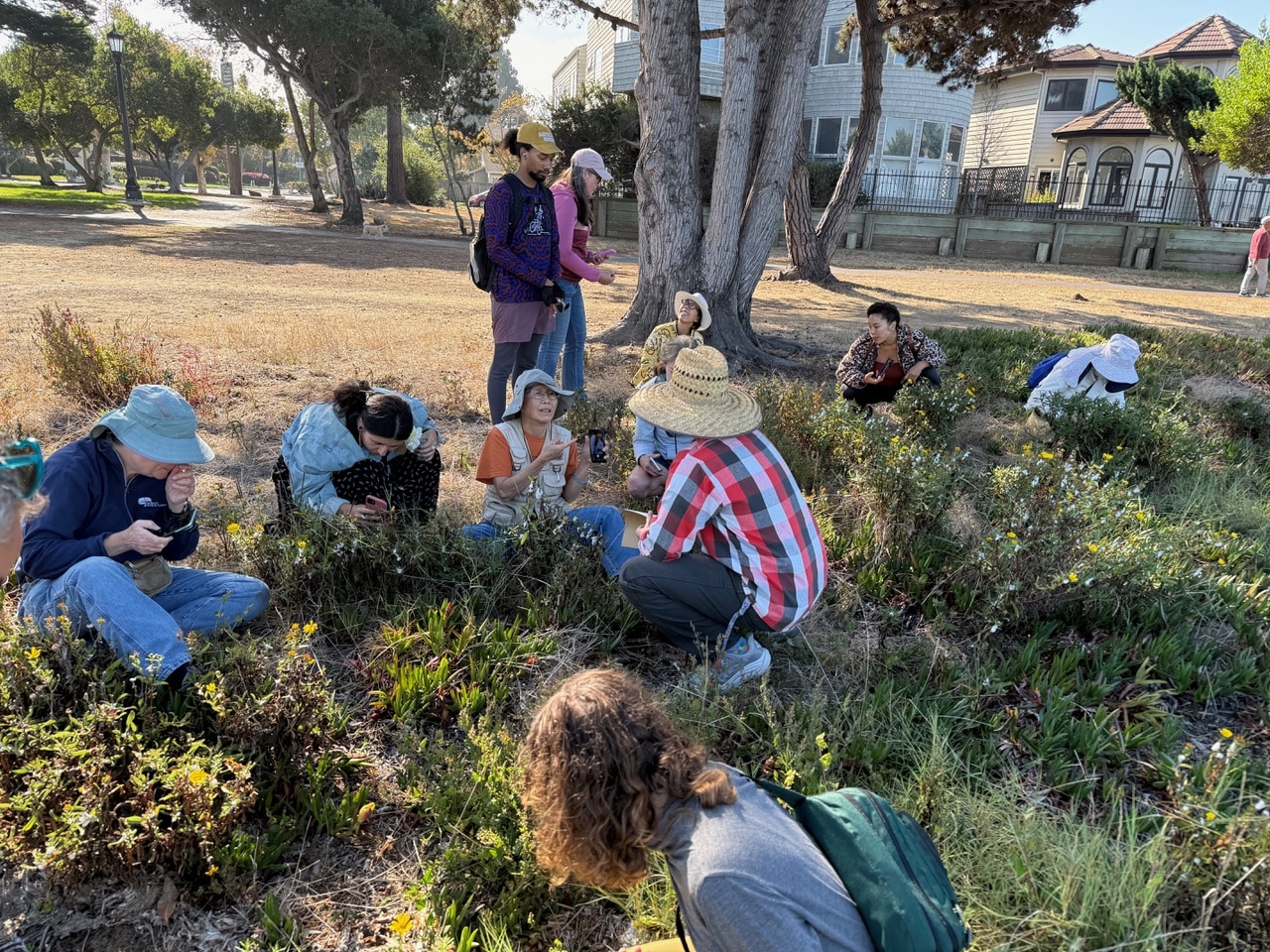
It’s a big day. I have been asked by a professor who is currently teaching an entomology class at Merritt College to share my experiences photographing insects with her students. We meet at Shore Line Park at the end of Aughinbaugh Way on Bay Farm Island, some equipped with attachable macro lenses for their cell phone cameras. These are lucky students indeed – instead of having to collect and pin their specimens, they are only required to photograph or sketch the insects for their reports. I have long advocated for this kinder approach to the study of insects, as we now have the technology for that. Aside from the barbarism of pinning, there’s valuable behavioral information to be gleaned from photos and videos that is simply not available from pinned specimens. While waiting for the late comers, we gather at the patch of Oregon Gumweed, Grindelia stricta that is heavily infested with Spittlebugs. These tiny, sedentary bugs are perfect subjects on which to hone our macrophotography skills .

My first photography subject of the day is the Spittlebug, taken on the highest magnification (about 1.9X) on my iPhone 11Pro with an attachable 10X macro lens. I have been observing this population of Spittlebugs on the Grindelia for three years now. The nymphs mysteriously appear on the plants every summer, covering the plants with white foamy masses as they feed. The adults have started to emerge about two weeks ago this year.
The Spittlebug, Clastoptera lineatocollis (family Clastopteridae) is found in western United States. The bugs feed mostly on Asteraceae, although other hosts have been reported. Females are brownish (3.3-3.8 mm), while the smaller males (3.0-3.2 mm) are mostly black.
Unlike their young, adult spittlebugs (also known as Froghoppers) are efficient flyers and hoppers, feeding on diverse plant species. Using their piercing-sucking mouthparts, they pierce plant stems to feed on xylem. To get enough nutrients, they consume massive quantities of sap, drinking up to 280 times their body weight daily, resulting in high waste excretion. Froghoppers can cause damage by distorting plant leaves and causing shoot tips to die back. Froghoppers are champion jumpers among insects, out-performing even the fleas. The bug can leap the human equivalent of a skyscraper without a running start. It is the highest jumping insect proportional to body size. The muscles in its hind legs act like a “catapult” to release energy explosively.

We make our way slowly along the shoreline in search of insects to photograph.

18 students are a large crowd for observing small subjects, but somehow we manage. The group eventually spreads out along the shoreline, each happily going on his/her own bug quest.
The class project on iNaturalist is named ‘Lanht 10 – Insects’, a repository of insect photos taken by the students. I am offering some comments below on a few highlights of our excursion. Kudos and thanks to all who contributed your photos here – you know who you are!
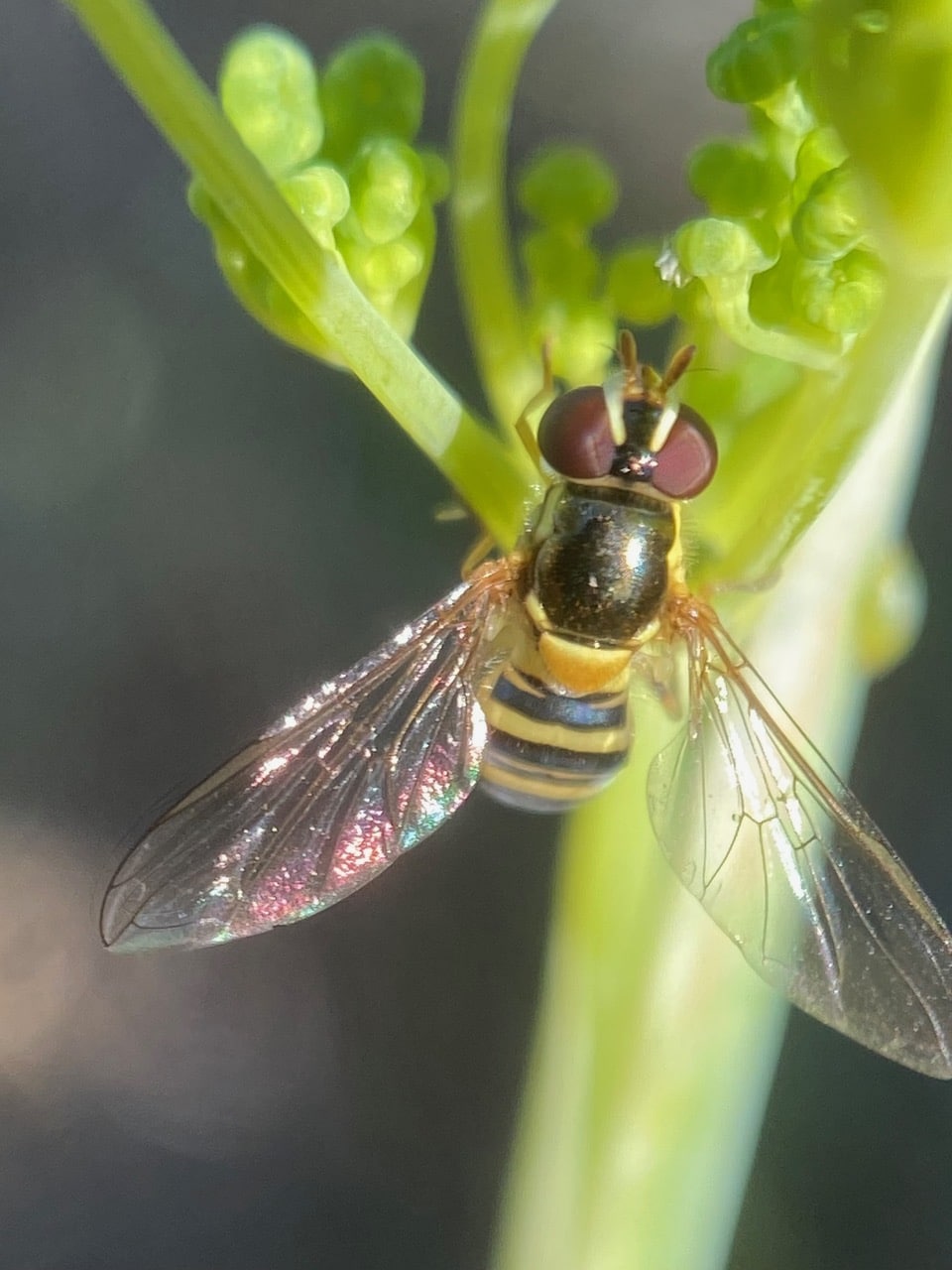
Ooh, a nice close-up of a female Oblique Streaktail, Allograpta obliqua (family Syrphidae). As we usually depend on natural light for insect photography using iPhone cameras, the excessive brightness might not be avoidable; however, the light exposure can sometimes be improved with digital editing. Backing up just a hair might allow a clearer view of the cluster of ocelli (simple eyes) on top of the hover fly’s head. To be fair, the photo does clearly show that the fly is female – her compound eyes are not touching on top of the head. (In contrast, a male would exhibit holoptic eyes.) Regardless, it’s always a good idea to keep the insect’s eyes in focus. In general, a photo with out-of-focus eyes simply does not look right, whether the subject is human or insect. The most easily distinguishable characteristic of this hover fly species is the unique pattern near the tip of its abdomen. It would be nice to aim for those details in your photos if possible. Don’t be afraid to take multiple images of the same subject, each focusing on different anatomical features from various angles. This is especially important if you don’t know the insect and need it identified by iNaturalist.
Although small in size (6-7 mm long), the Oblique Streaktail is easily recognizable for the unique pattern on its black-and-yellow abdomen. It is a common North American species of hover fly. Adults visit flowers for nectar and pollen, and are pollinators. Females lay eggs on plant surfaces near aphids. Larvae feed on the aphids.

A female Sugarcane Soldier Fly is posing on someone’s finger.
The Sugarcane Soldier Fly, Inopus rubriceps (family Stratiomyidae) is native to eastern Australia where it infests such crops as corn, pastures, and sugarcane. The fly was accidentally introduced into California over 50 years ago. It is now infesting lawns in San Francisco and other Bay Area counties. Damage to turf and other members of the grass family results from withdrawal of sap from roots of host plants by the larvae and possibly, injection of a toxin into the plant.
In California adults occur in large numbers from late September to early November each year. Eggs are deposited in crevices in the soil. The adults are sexually dimorphic. Females have tiny red heads with eyes set far apart. The smaller males have large eyes that occupy the whole surface of the head. Adults are non-feeding or drink only liquids such as flower nectar and honeydew. They are strictly focused on mating and laying eggs during their short, few-day lifespan.

Ooh, love those iridescent blue fingernails! Posing on the middle finger is a Southern Green Stink Bug nymph, Nezara viridula (family Pentatomidae). Besides the visual interest, photos like this can provide useful scale and size information.
Pentatomidae is a family of insects belonging to the order Hemiptera or “true bugs”. As hemipterans, the pentatomids have piercing-sucking mouthparts, and most are phytophagous, including several species that are severe pests on agricultural crops. Stink Bugs feed on plant fluids by inserting their needlelike mouthparts into stems, leaves or seed pods. While feeding, they inject materials into the plant to aid in digestion and sap removal. Penetration by the mouthparts can cause physical damage, much like stabbing the plant with a fine needle.
All Pentatomids have 5-segmented antennae (hence their family name, Penta – five and tomos – section.) They generally have a large triangular scutellum in the center of the back. The adult is generally shield-shaped when viewed from above. The common name of Stink Bug refers to their ability to release a pungent defensive spray when threatened, disturbed, or crushed.
The Southern Green Stink Bug, Nezara viridula (family Pentatomidae) is a plant-feeding stink bug. Believed to have originated in Ethiopia, it can now be found across the world. Because of its preference for certain species of legumes, such as beans and soybeans, it is an economically important pest on such crops.
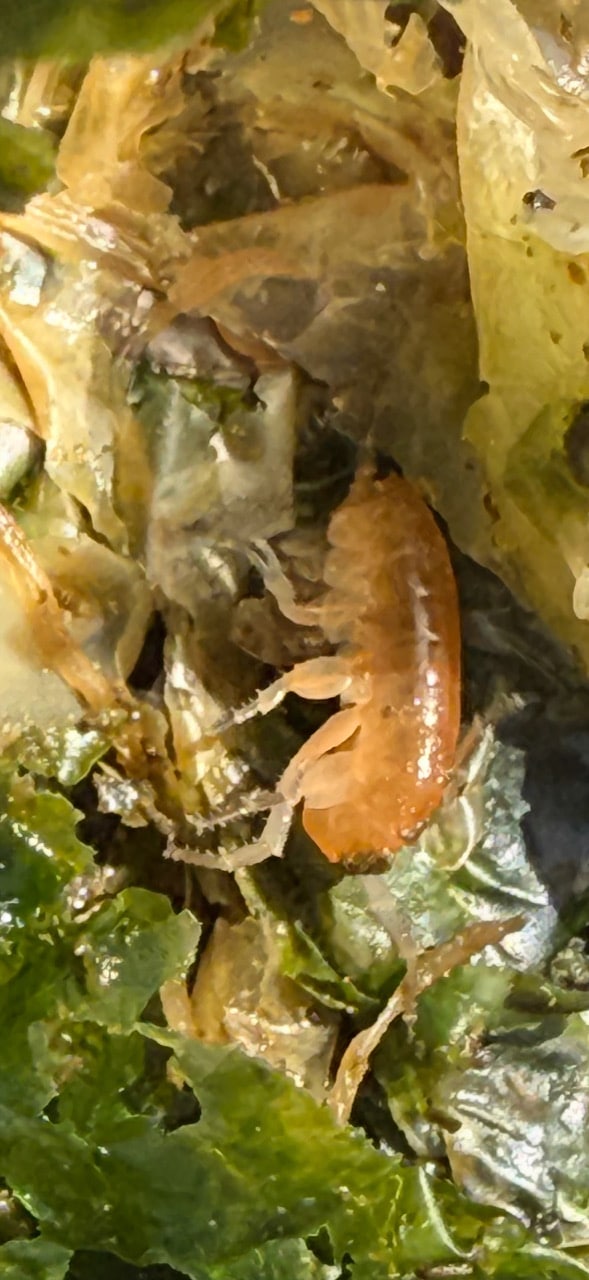
Elizabeth found this little creature crawling around when she lifted up a mat of seaweed next to the water’s edge. iNaturalist has helped identify it as a member of the Sandhopper family Talitridae, a kind of Amphipod. It is fun to explore new habitats – you never know what novel creatures you will find. That said, I do encourage people to keep a close eye on a small patch of habitat accessible to them; it can be quite rewarding. I have been coming to Bay Farm for three years now, at least twice a week to accompany my husband who likes to walk the easy paths here for his post-surgical rehabilitation. Because of that I have become very familiar with most of the plants, native or invasive that grow along the shoreline, and thus attuned to the ebb and flow of the local seasons. In a sense, I have come to appreciate the life cycles of the insects that depend on these plants. Although I might see the same creatures over and over again, the circumstances are never the same – there has never been a dull moment. I congratulate those who aspire to study and observe insects – you are immune to boredom! Insects are everywhere, and their life is full of wonder and drama everywhere you care to look. They offer you the thrills of the Serengeti and the Amazon as soon as you step into your own backyard.
Amphipods are small aquatic and terrestrial crustaceans rather than insects, making them more closely related to crabs and shrimp than to bugs.
Talitridae is a family of amphipods. Terrestrial species are often referred to as land hoppers and beach dwellers are called sand hoppers or sand fleas. Making amphipods are often washed up in the strand line, but die rapidly on drying out. Tralitrids differ in being able to survive for a long time out of water. Most function as scavengers or detritivores, feeding on decaying organic matter, algae, or detritus, though some act as predators or parasites.
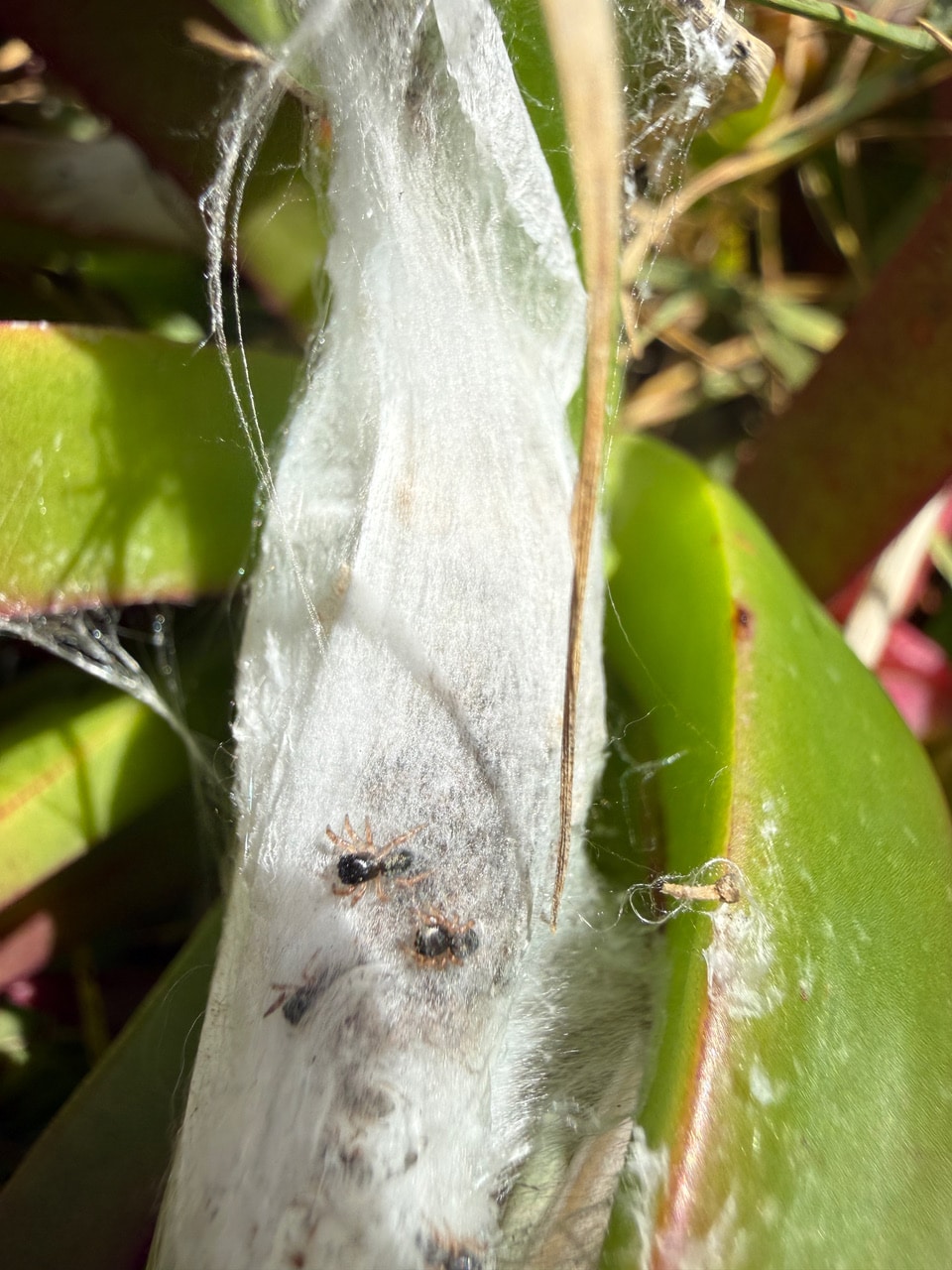
Nice picture of spiderlings leaving their nursery, a sturdy, cottony egg sac woven by their mother between succulent leaves of Ice Plant. Auspicious timing is something we cannot count on, but they are oh so gratifying!
Spiderlings typically leave their egg sacs after hatching and completing their first molt, which usually takes about two to three weeks depending on the species. Eggs hatch into a preliminary stage inside the protective silk sac, where the spiderlings rely on leftover yolk for nourishment. The young spiders undergo their first molt while still inside the sac, leaving their tiny shed skins behind. Once hardened after the molt, they use their fangs or digestive fluids to cut a hole in the sac and emerge. After coming out, they often stay clustered together for a few days before dispersing by walking or ballooning (floating away on silk threads carried by the wind).
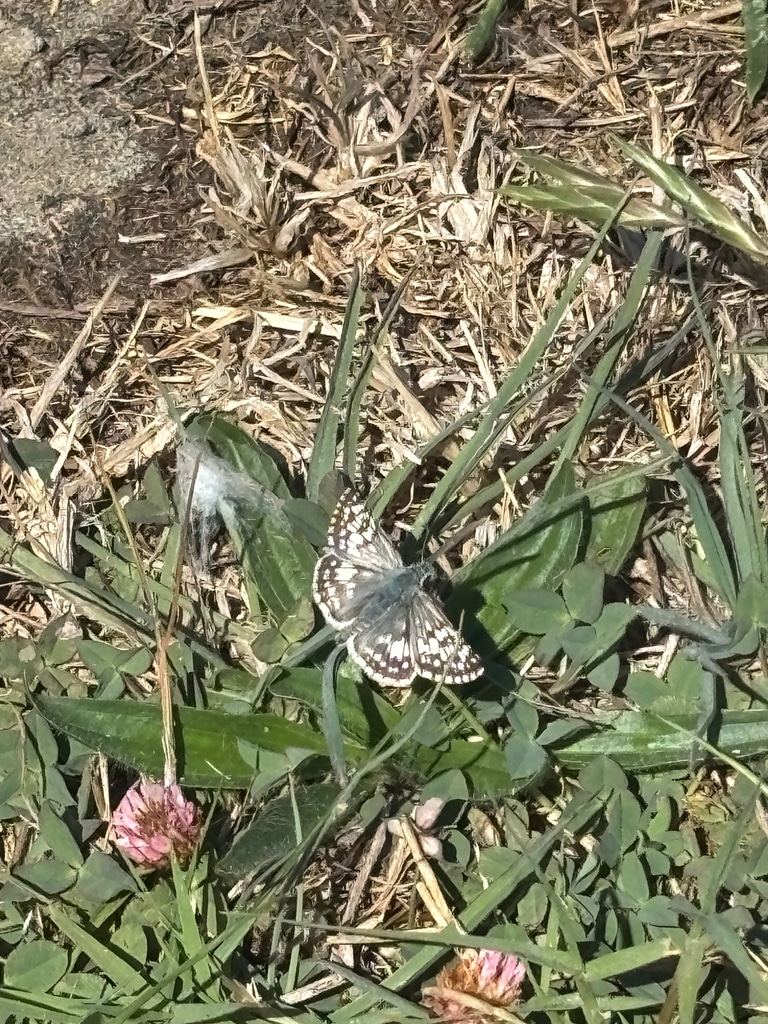
A Common Checkered Skipper is resting on low vegetation. For insects this size, we don’t even need a macro lens to photograph them. Many newer iPhones now come with built-in zoom. My iPhone 11 Pro has a built-in 2X zoom; I find that this is sufficient for photographing most insects about the size of a honey bee or larger. Given a sharp enough image, we can always crop the photo for a closer view. Leaving room for cropping also allows us to modify/ improve the composition of the photo. If possible, I avoid placing the subject in the dead center of the photo, usually leaving more space in front of the insect. This arrangement tends to give a perception of movement and flow, more pleasing to the eye. Of course this is just aesthetics. Everybody has his/her own sense of beauty – experiment to find your own style.
Because of its small size, bluish color, and spread-wing posture, the Common Checkered Skipper, Burnsius communis is often mistaken for one of the “Blues” in the family Lycaenidae. Skippers have the antennae clubs hooked backward like a crochet hook, while the typical butterflies have club-like tips to their antennae. Skippers also have generally stockier bodies and larger compound eyes.
Checkered Skippers belong to the subfamily Pyrginae, commonly known as spread-wing skippers, in the family Hesperiidae. Spread-wing skippers bask with their wings held wide open. The wings are held closed when they are at rest. Caterpillars make folded-leaf nests in which they live and feed on several plants in the mallow family, Malvaceae. Mature caterpillars often pupate in their leaf shelters, typically close to the ground, among low vegetation, or in leaf litter.
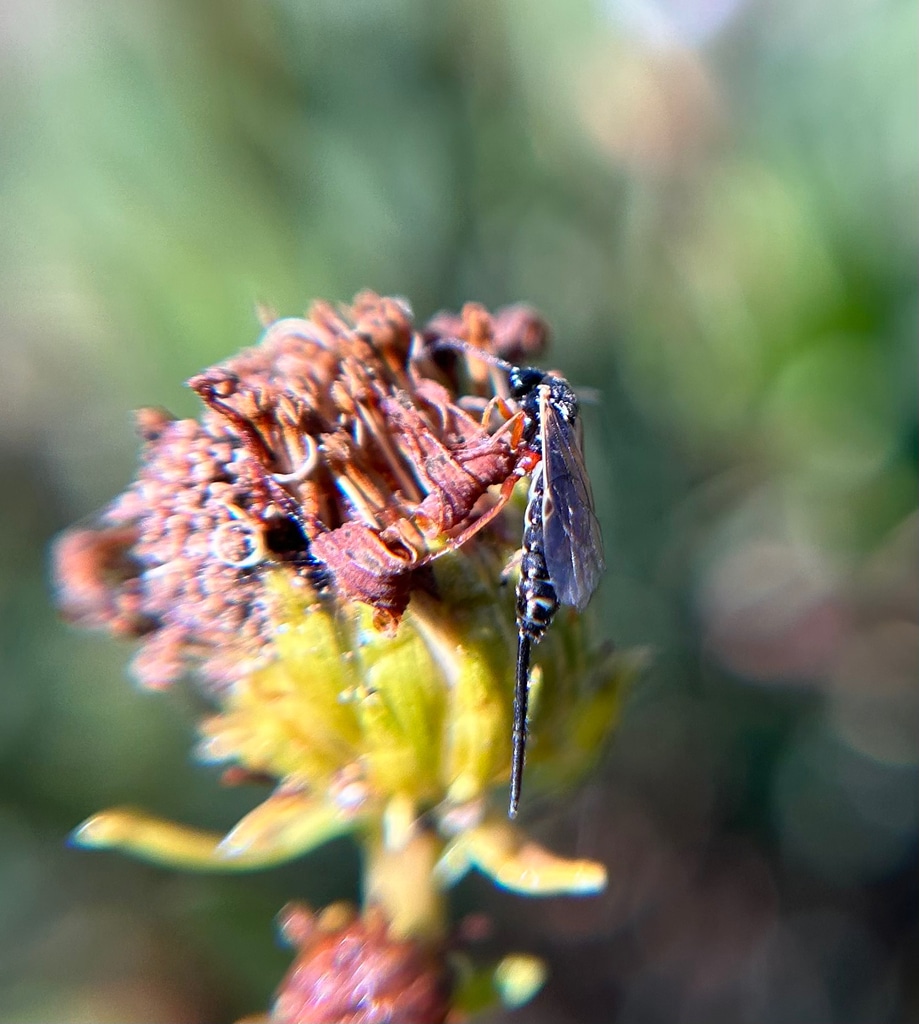
This is quite a special photo of a small, slender parasitoid wasp on a faded Grindelia flowerhead. Elongated insects can present challenges in macro photography. Since the depth of field is so narrow in high magnification, any part that is not parallel to the camera lens will be out of focus. It is not easy to get the whole elongated insect in good focus, especially when it is moving. This small wasp’s long ovipositor identifies it instantly as a parasitoid, probably scouting for a host in which to lay her eggs.
The Ichneumonidae, also known as the Ichneumon Wasps, or Ichneumonids, are a family of parasitoid wasps. They are one of the most diverse groups within the Hymenoptera (the order that includes the ants, wasps and bees) with about 25,000 species and counting. Ichneumon Wasps attack the immature stages of insects and spiders, eventually killing their hosts. They play an important role in the ecosystem as regulators of insect populations.
The Ichneumon Wasps have longer antennae than typical wasps, with 16 segments or more as opposed to 13 or fewer. Ichneumonid females have an unmodified ovipositor for laying eggs. They generally inject eggs either directly into their host’s body or onto its surface, and the process may require penetration of wood. After hatching, the Ichneumonid larva consumes its still living host. The most common hosts are larvae or pupae of Lepidoptera (butterflies and moths), Coleoptera (beetles) and Hymenoptera. Adult Ichneumonids feed on plant sap and nectar. Females spend much of their active time searching for hosts while the males are constantly on the look out for females. Many Ichneumonids are associated with specific prey, and Ichneumonids are considered effective biological controls of some pest species.
Glypta is a very large, worldwide genus of parasitoid Ichneumon wasps. The wasps have slender bodies with long antennae. Females possess a long, flexible, needle-like ovipositor used for precise egg placement. They are specialized parasitoids that target the larval or pupal stages of specific insects, frequently moth and butterfly (Lepidoptera) larvae hidden inside plant tissues, seed heads, or stems. Females use their antennae to tap and locate hidden hosts. She inserts her ovipositor directly into the host or its micro-habitat to lay an egg. The wasp larva feeds internally while keeping the host alive during early growth, eventually consuming it fully before spinning a cocoon and pupating. Adults do not hung prey for food; they feed on flower nectar, pollen, and water.

Ooh, a Robber Fly on the path! These wary predators are very difficult to photograph at close range.
Robber Flies (family Asilidae) have three simple eyes (ocelli) in a characteristic depression on the tops of their head between their two large compound eyes. This feature is clearly visible in the front view and is a morphological peculiarity of Asilidae. The face also has a characteristic dense bundle of mustache-like bristles, called a “mystax”. Apparently the mystax helps protect the head and face of the fly from its struggling prey bent on defense.
The name “robber flies” reflects their notoriously aggressive predatory habits; they feed mainly or exclusively on other insects and, as a rule, they wait in ambush and catch their prey in flight. Asilids have long, stout, spiny legs for capturing prey. The fly attacks its prey by stabbing it with its short, strong proboscis, injecting the victim with saliva containing neurotoxic and proteolytic enzymes which very rapidly paralyze the victim and digest the insides; the fly then sucks the liquefied material through the proboscis. In general, Asilids attack a very wide range of prey, including other flies, beetles, butterflies and moths, various bees, ants, wasps, dragonflies, damselflies, grasshoppers, and some spiders. Larvae of robberflies live in soil, rotting wood, leaf mold, and similar materials, some being predatory and others detritivorous.

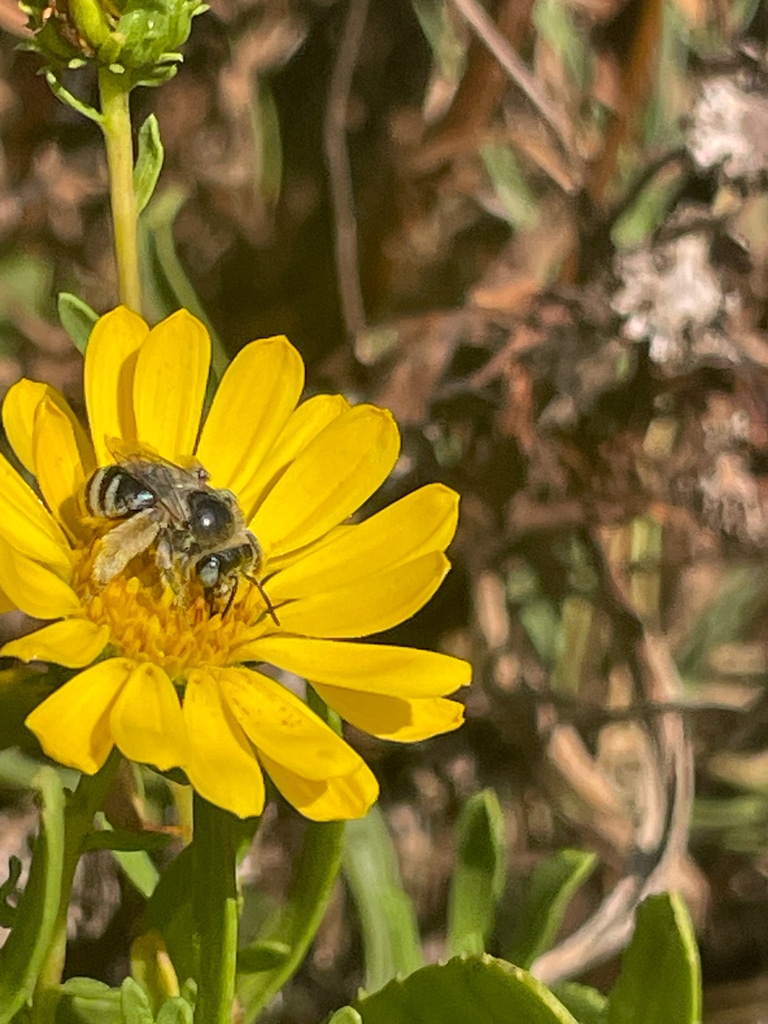
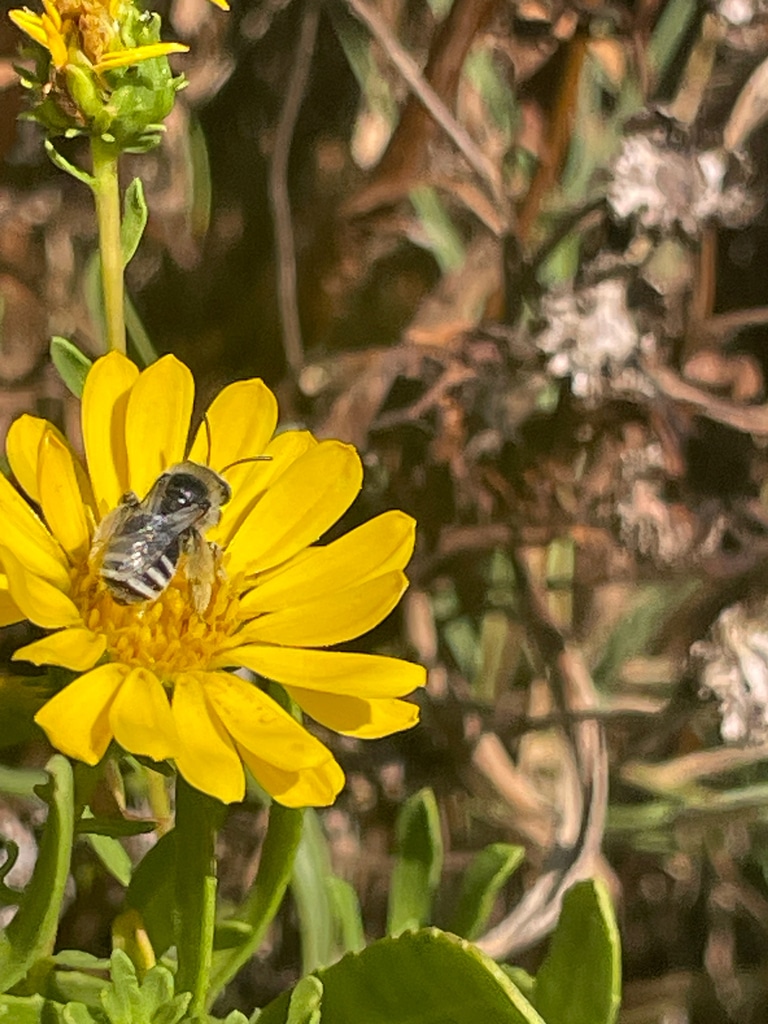
Oftentimes, it is difficult to take a single photo that shows all the pertinent characteristics necessary for identifying an insect. The second photo in this series manages to do that beautifully by itself. Although the photographer has posted three photos of the same insect to iNaturalist, this single one by itself is sufficient for me to tell that it as a female Longhorn Bee, Melissodes sp. (family Apidae). Her size (relative to the Grindelia flowerhead), the prolific scopa (special pollen collecting hairs) on her hind legs, moderately long antennae, her mottled gray-blue eyes, and her presence on a flowerhead of Asteraceae clinch the case. In case of doubt, it never hurts to take as many photos of the unknown insect from as many angles as possible, as long as the insect is cooperative.
The Summer Longhorn Bees, Melissodes sp. (family Apidae) are medium to large bees, stout-bodied, usually with gray hair on the thorax and pale hair bands on the abdomen. Males usually have yellow markings on their faces and have very long antennae from which their common name is derived. They are active May to September, with peak flight in late June to early August. The females prefer flat, bare ground for digging their solitary nests, though they sometimes nest in aggregations. Pollen is transported in scopae on the hind legs. Pollen loads are often copious and brightly colored and thus very distinguishable. Melissodes are specialists on Asteraceae – females gather pollen from flowers of Aster, Bidens, Coreopsis, Cosmos, Encelia, Gaillardia, Helianthus, and Rudbeckia ssp.
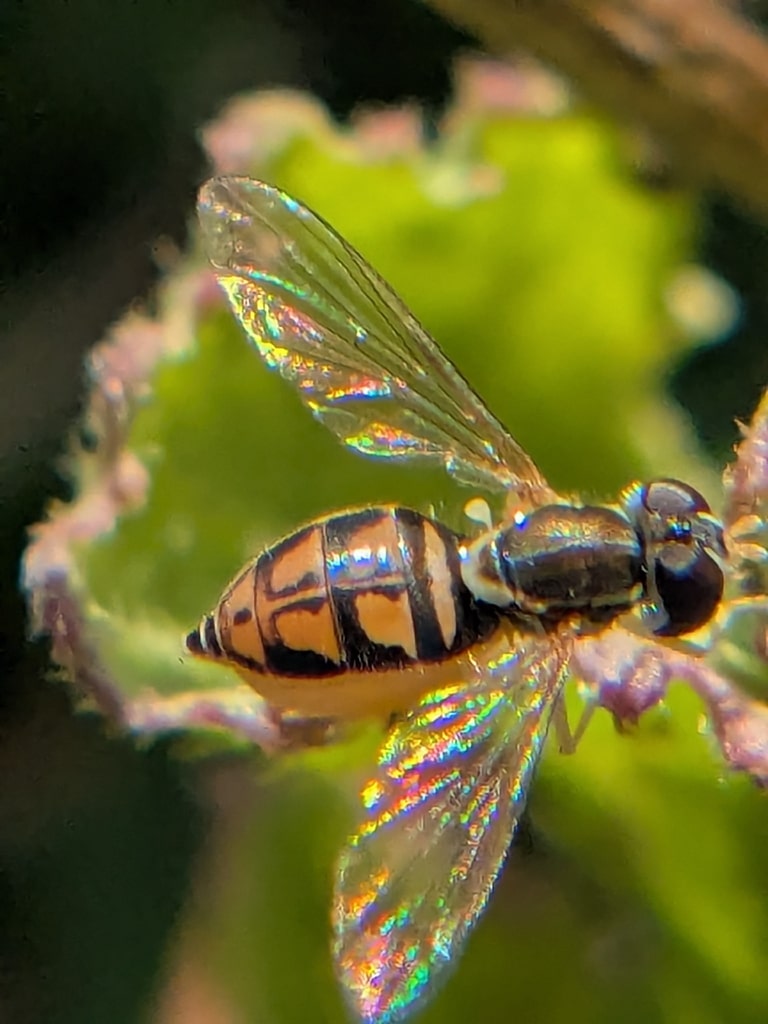
Whoa, a very gravid hover fly, Margined Calligrapher ready to lay her eggs! It tickles me to recall how students were forbidden to use the term “pregnant” in the days I took an aquatic entomology class. The term “pregnant” is apparently reserved for humans and other live-bearing mammals, while “gravid” is used for females carrying eggs that are eventually laid as eggs. By that definition, most insects carrying eggs are gravid. The obvious exception that comes to mind is the aphids, which give live birth.
Toxomerus marginatus, also known as the Margined Calligrapher is a common species of hoverfly found in North America. These are small hoverflies, measuring 5-6 mm in length. The abdomen is black and yellow, and is narrowly margined with yellow. Adults are found in diverse habitats such as forests, fields, meadows, marshes, deserts, and alpine areas. They are highly adaptable and can occur is very disturbed habitats. Larvae prey on aphids, thrips, mites, and small caterpillars. Adults visit flowers for nectar and pollen.
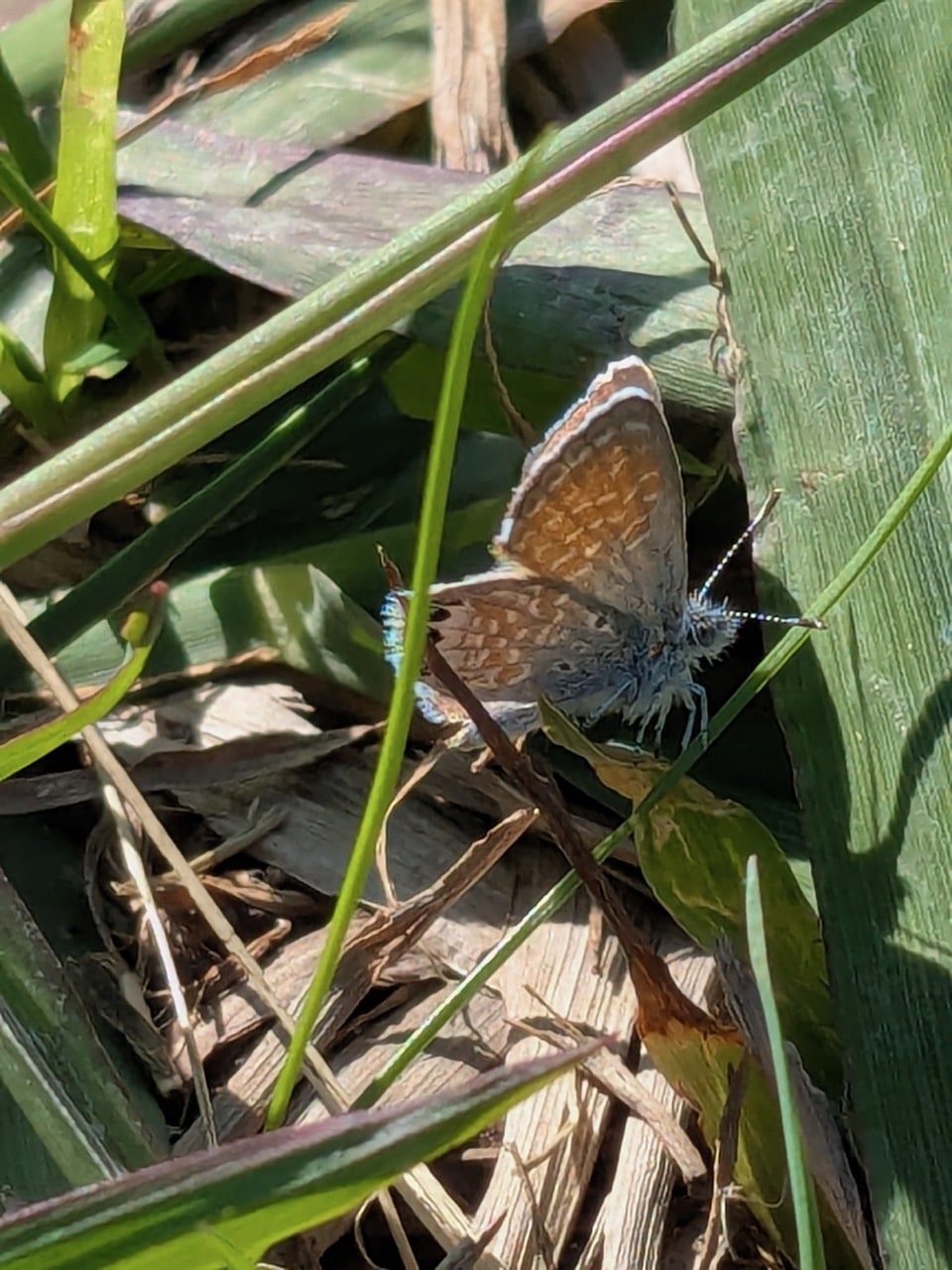
I’m so glad that someone did spot this Western Pygmy Blue butterfly! The salt marsh around Bay Farm Island is an excellent place to find these dainty butterflies fluttering around the pickleweeds and saltbushes this time of year.
The Western Pygmy Blue, Brephidium exilis (family Lycaenidae) is one of the smallest butterflies in the world and the smallest in North America. The butterfly is found in alkaline areas such as deserts and salt marshes. The caterpillars feed on plants in the Goosefoot family Amaranthacea which includes pickleweeds and saltbushes, commonly found in salty habitats. Although the species has no set breeding season, mating activity is at its peak during late summer and early fall.

Wow, an exquisite close-up shot of a male Fine Striped Sweat Bee, Agapostemon subtilior (family Halictidae) with perfect light accentuating its iridescent green head and thorax. I have found that the hyperactive males of the species are difficult to approach with the camera, while the all-green females are more cooperative once they have settled down to collect pollen. I usually photograph the males without using the macro lens, and crop the pictures afterwards. In contrast, I would occasionally attempt a 10X shot of a female collecting pollen. Knowing the behavior/personality of the insect can often help you decide how you would take its picture.
The Fine Striped Sweat Bee, Agapostemon subtilior is a small, widespread species found across North America. They are active from late spring to fall, with all-green females measuring roughly 11 mm, and males (slightly smaller) displaying a black-and-yellow striped abdomen. Like other Agapostemon bees, they are solitary ground-nesters, and are polylectic, foraging from a wide variety of flowers.

Ooh, a beautiful shot of a Grass Fly! It’s not easy to photograph these tiny flies!
Grass Flies (family Chloropidae) are minute to small flies (1-4 mm), yellow or black and appearing shiny due to the virtual absence of any hairs. The thorax often has a pattern of 3-5 dark longitudinal stripes against a light-colored background. The majority of the larvae are phytophagous, mainly on grasses, and can be major pests of cereals. However, parasitic and predatory species are known. These flies are commonly found thriving in open grassland ecosystems, meadows, and agricultural fields worldwide.

Many of us get to photograph these large, colorful Harlequin Stink Bugs on the Wild Radish. A low-hanging fruit, photographically speaking, but oh so gratifying! Kudos for getting the eyes of the bug in focus; the photo wouldn’t work otherwise. Extra credit for showing the needle-like rostrum (mouthpart) of the bug that is folded under the body when not in use.
The Harlequin Stink Bug, Murgantia histrionica is a brightly colored shield-shaped insect native to the Americas that feed heavily on crops in the mustard family, Brassicaceae. Adults are about 3/8 inch long with a flat, shield-shaped body. They are glossy black with striking red, orange or yellow markings. They use piercing-sucking mouthparts to drink sap and juices from plant tissues. Preferred plants are cruciferous crops like cabbage, kale, collards, broccoli, cauliflower, radishes, and turnips. The feeding causes leaves to develop white, yellow, or cloudy spots (stippling). Heavy infestations cause wilting, brown dead patches, stunted growth, or plant death. Eggs are distinctive white barrel shapes with black bands, laid in neat clusters of about 12 on the undersides of leaves. Like other stink bugs, they release a foul smell when disturbed or threatened.
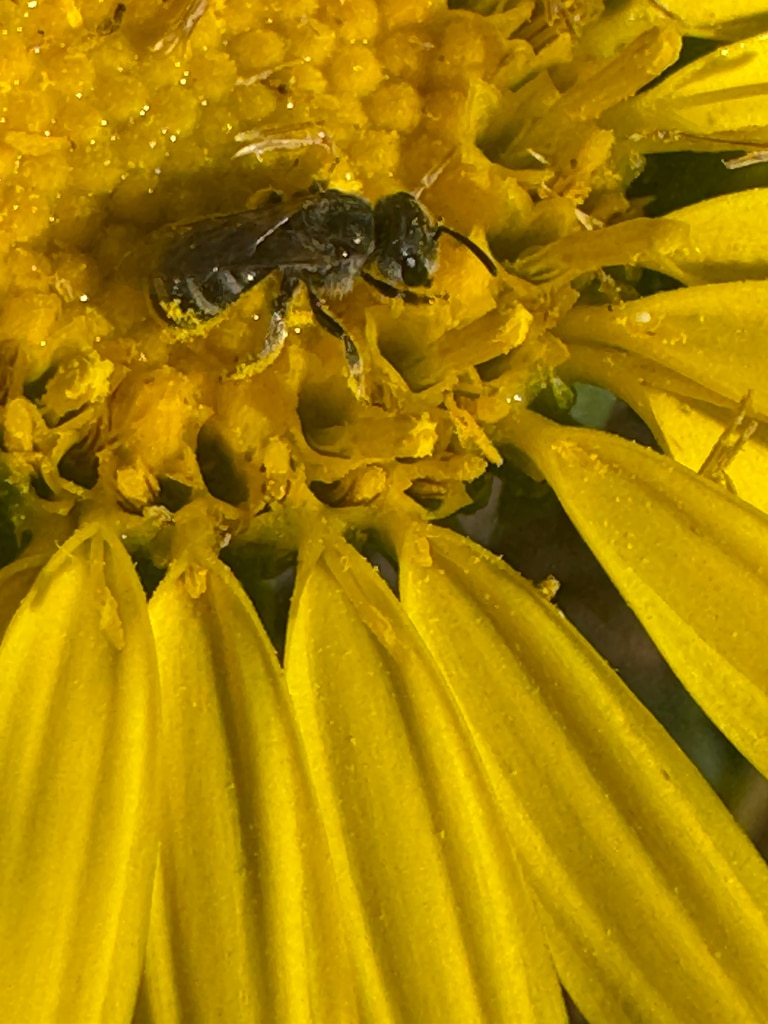
I am glad someone has spotted the Tripartite Sweat Bee, Halictus tripartitus (family Halictidae). It is one of the most common bees around here, but often overlooked because of its small size.
Halictus is found worldwide; they are most common in the Northern Hemisphere. All are generalists, foraging from a wide variety of flowering plants. Many species are social and produce several generations per year. This is not surprising as most blooming plants are season-specific; a bee that requires pollen and nectar across multiple seasons would not thrive as a specialist. All Halictus in North America nest in the ground, often in aggregations; and they may nest in the same area for decades.
Tripartite Sweat Bees, Halictus tripartitus are social, forming annual colonies in the soil where a queen lays eggs and daughter bees act as workers. They are considered a “primitively social” species, meaning they have a social organization with a queen and workers, but with simpler colonies compared to more complex eusocial insects such as honey bees.

I discover a small hitchhiker on me after brushing past a Bristly Oxtongue. Panicked, the beetle runs all over my hand and arm while I try my best to follow it with my camera. Whoa, see the knobby structures near the base of its antennae? It is a male Collops beetle!
The Four-spotted Collops, Collops quadrimaculatus, is a species of the Soft-winged Flower Beetle in the family Melyridae. The beetles are found in Central and North America. Members of the family Melyridae differ from most other beetles in that their bodies are not hard and shell-like. Collops are small beetles, 4-7 mm. They are important predators with a penchant for soft-bodied insects like whiteflies, small Lygus nymphs, aphids, mites, and lepidopteran eggs and caterpillars. Occasionally they graze on pollen and nectar resources too. Larvae are predaceous in the soil litter, but are rarely seen.

Checking my records at home, I find an account of the Collops beetles in Pollinator Post 9/24/24 (2), which includes courtship behavior – almost exactly 2 years ago!
Pollinator Post 9-24-24 (2) – Bringing Back the Natives Garden Tour and Green Home Features Showcase
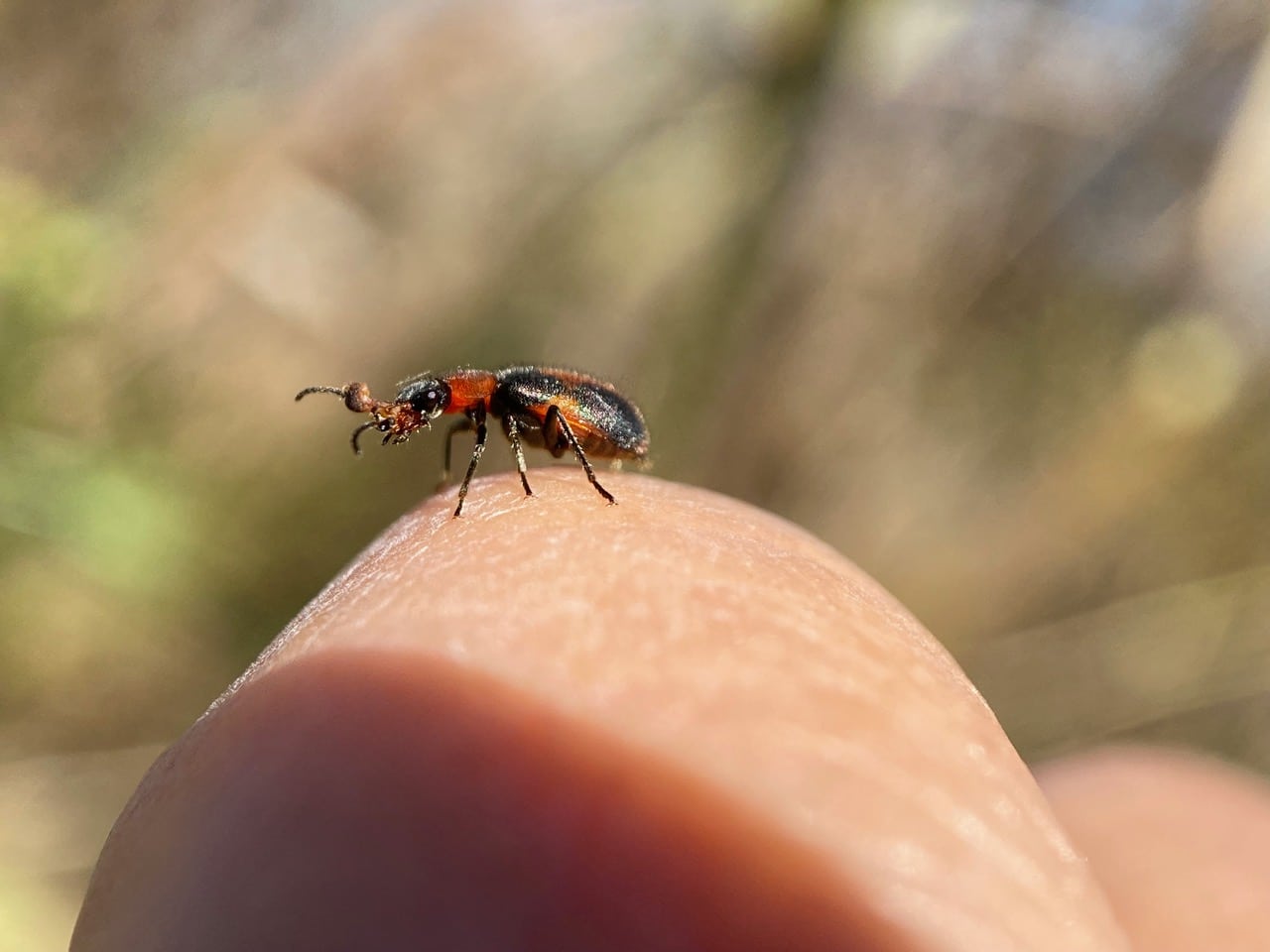
The male Collops settles down for a minute on my knuckle. I’m not sure what is happening here. Can the antenna knob be taken apart??
This is what I found on Google search about the function of those knobby structures:
Male Collops beetles (soft-winged flower beetles) use their modified, knobby antennae primarily to woo females during courtship by releasing and presenting chemical pheromones. During mating rituals, these unique structures serve a very specific, hands-on purpose. The large knobs are packed with chemical receptors and glandular structures. Scientists believe they produce or hold courtship pheromones (aphrodisiac-like substances) that increase a female’s receptivity.
When a male finds a female, he approaches her and aggressively vibrates his antennae. He will physically touch her antennae and sweep his large knobs across her head and pronotum. By doing this, he ensures she gets a direct “sniff” or taste of his pheromones, signaling that he is a suitable mate. If the female is impressed, she will accept his advances. If not, she simply walks away, leaving him to wave his knobby feelers at someone else!
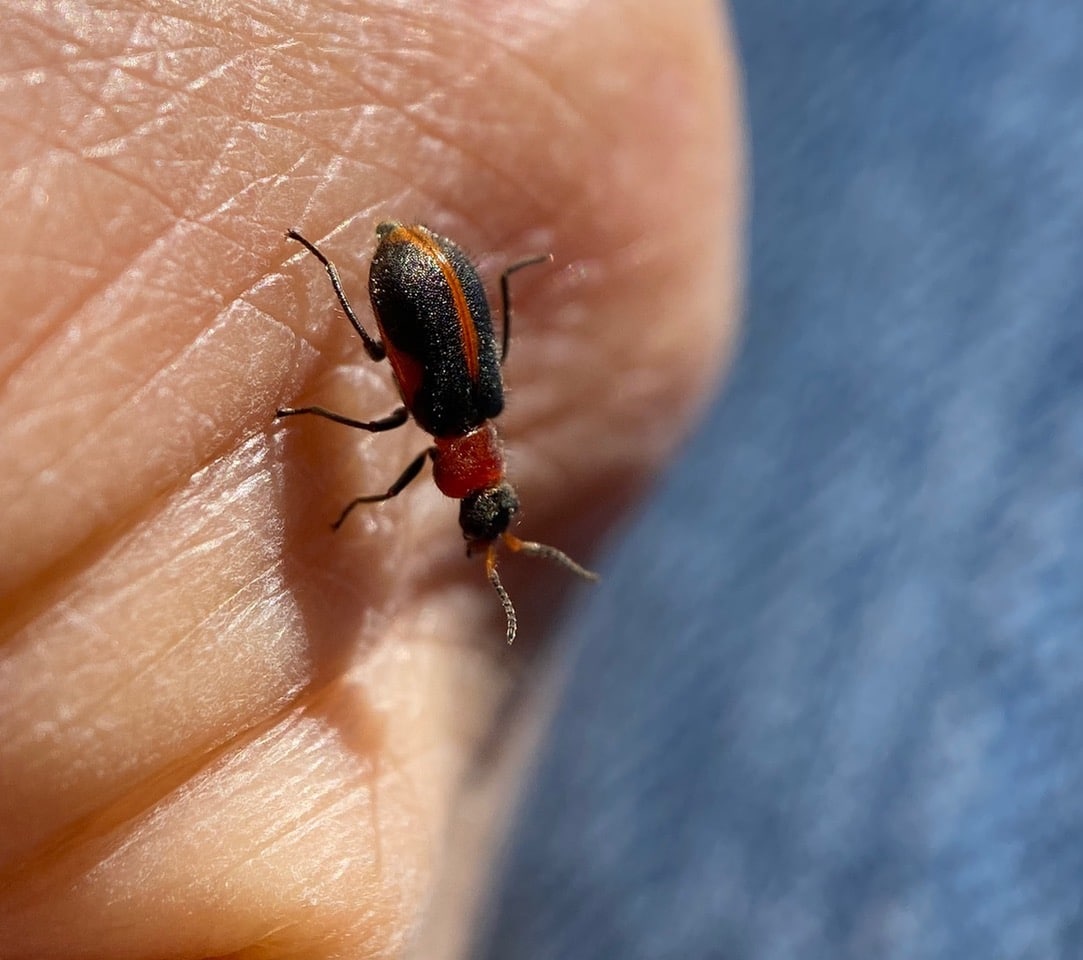
A little later, I find another Collops on me – this one’s a female without the knobs on her antennae.

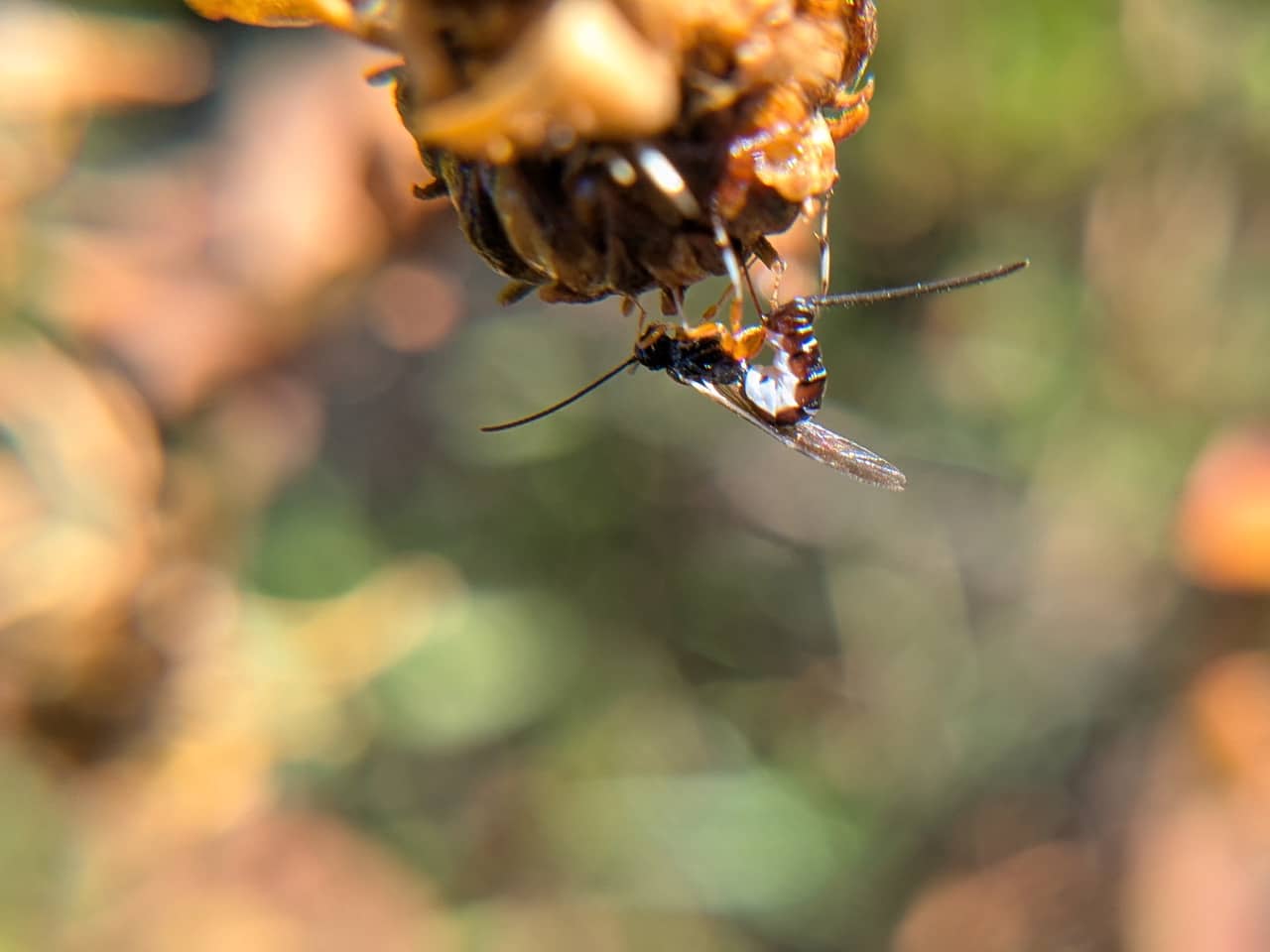
Wow, I’m blown away!! OK, these last two jaw-dropping photos above are late submissions, but definitely worth waiting for! Congratulations, Zerena, you have very successfully captured the special moment when a female Ichneumonid Wasp oviposits into a spent Grindelia flowerhead. Macro photography can hardly get more demanding than this. The first photo shows the wasp upside-down on the flowerhead with her abdomen curled forward in a typical egg laying posture. The second picture is taken from a better angle, showing the white underside of the wasp’ abdomen, and the actual hair-like, orange-brown ovipositor that has been removed from the thick, black protective sheath we normally take as the ovipositor. The sheath is now held at right angle, out of the way, so the wasp can push and drill the actual ovipositor straight down into the flowerhead. She has apparently detected the presence of a potential host (caterpillar?) in there. The ovipositor is in perfect focus!
The Ichneumonidae, also known as the Ichneumon Wasps, or Ichneumonids, are a family of parasitoid wasps. They are one of the most diverse groups within the Hymenoptera (the order that includes the ants, wasps and bees) with about 25,000 species and counting. Ichneumon Wasps attack the immature stages of insects and spiders, eventually killing their hosts. They play an important role in the ecosystem as regulators of insect populations.
The Ichneumon Wasps have longer antennae than typical wasps, with 16 segments or more as opposed to 13 or fewer. Ichneumonid females have an unmodified ovipositor for laying eggs. They generally inject eggs either directly into their host’s body or onto its surface, and the process may require penetration of wood. After hatching, the Ichneumonid larva consumes its still living host. The most common hosts are larvae or pupae of Lepidoptera (butterflies and moths), Coleoptera (beetles) and Hymenoptera. Adult Ichneumonids feed on plant sap and nectar. Females spend much of their active time searching for hosts while the males are constantly on the look out for females. Many Ichneumonids are associated with specific prey, and Ichneumonids are considered effective biological controls of some pest species.
An outer pair of sheaths covers and supports the delicate ovipositor when it is not in use. The unsheathing of the ovipositor in a parasitic wasp involves the separation of the flexible protective external sheaths from the needle-like egg-laying organ (terebra) so the wasp can maneuver and insert it into a substrate. To unsheath the ovipositor, the wasp bends or flexes its abdomen and swings the protective sheaths away or loops them backward, exposing the bare needle-like stylet to touch and penetrate the host’s habitat. The actual drilling organ consists of three interconnected, sliding parts called valvulae. Once unsheathed, the individual valves slide back and forth against each other in an alternating push-pull pattern, which lets the wasp drill deep into wood or plant tissue without bending the slender organ.