

Pollinator Post 9/14/25 (1)

The clouds have cleared early this morning and there should be insects flying. I decide to revisit Jenny and Craig’s predominantly native garden in Alameda. Although it is a young garden installed in 2024, I have been impressed by the diversity of insects on their well chosen plants the last time I visited.
A female Western Leafcutter Bee, Megachile perihirta (family Megachilidae) is foraging on the flowerheads of Pacific Aster by the curb.
Leaf-cutter Bees, Megachile sp. (family Megachilidae) are stout-bodied, usually with pale hair on the thorax and stripes of white hairs on the abdomen. Females usually have a triangular abdomen with a pointed tip, and males’ faces are covered with dense, pale hair. Flight season is from May into September, with peak activity from June to August.
Solitary females construct nests in tubular cavities, including hollow stems, tree holes, and abandoned beetle burrows in wood. Many use holes drilled into wood, straws, or other manufactured tunnels. Females cut pieces from leaves or flower petals for use in the construction of brood cells. Most Megachile females are generalists when foraging for pollen. Pollen is transported in dense scopae on the underside of the abdomen.
Photos of Western Leafcutter Bee (Megachile perihirta) · iNaturalist
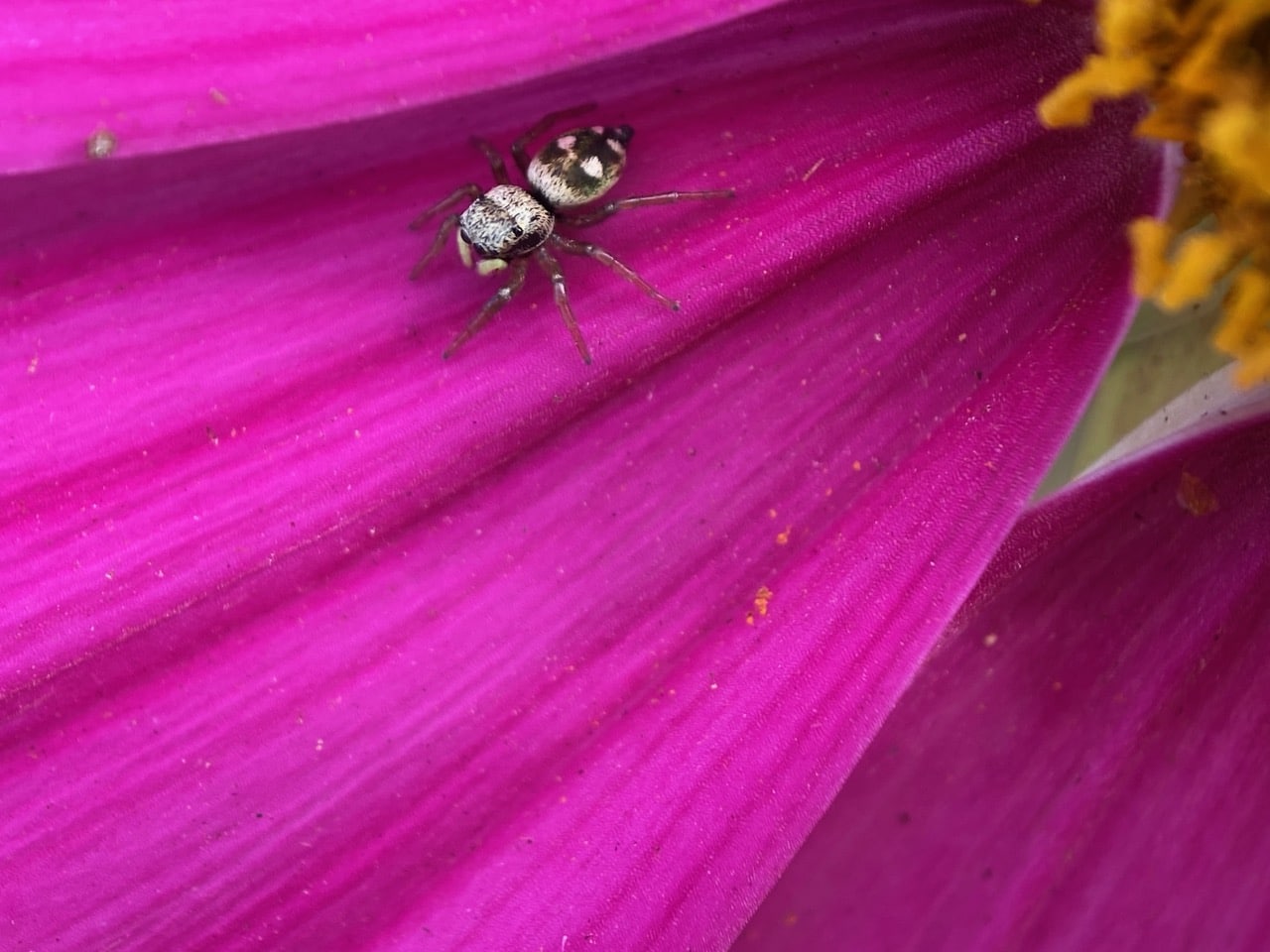
A Sun Jumping Spider, Heliophanus apiatus (family Salticidae) is hunting on a Cosmos flowerhead in front of the house.
Jumping spiders (family Salticidae) are free-roaming hunting spiders. They do not weave a web to catch prey. They stalk, then pounce on their prey. Just before jumping, the spider fastens a safety line to the substrate. It can leap 10-20 times their body length to capture prey. Their movement is achieved by rapid changes in hydraulic pressure of the blood. Muscular contractions force fluids into the hind legs, which cause them to extend extremely quickly. Jumping spiders are visual hunters. Their excellent vision has among the highest acuities in invertebrates. Since all their 8 eyes are fixed in place and cannot pivot independently from the body like human eyes can, jumping spiders must turn to face whatever they want to see well. This includes moving their cephalothorax up and down, an endearing behavior.
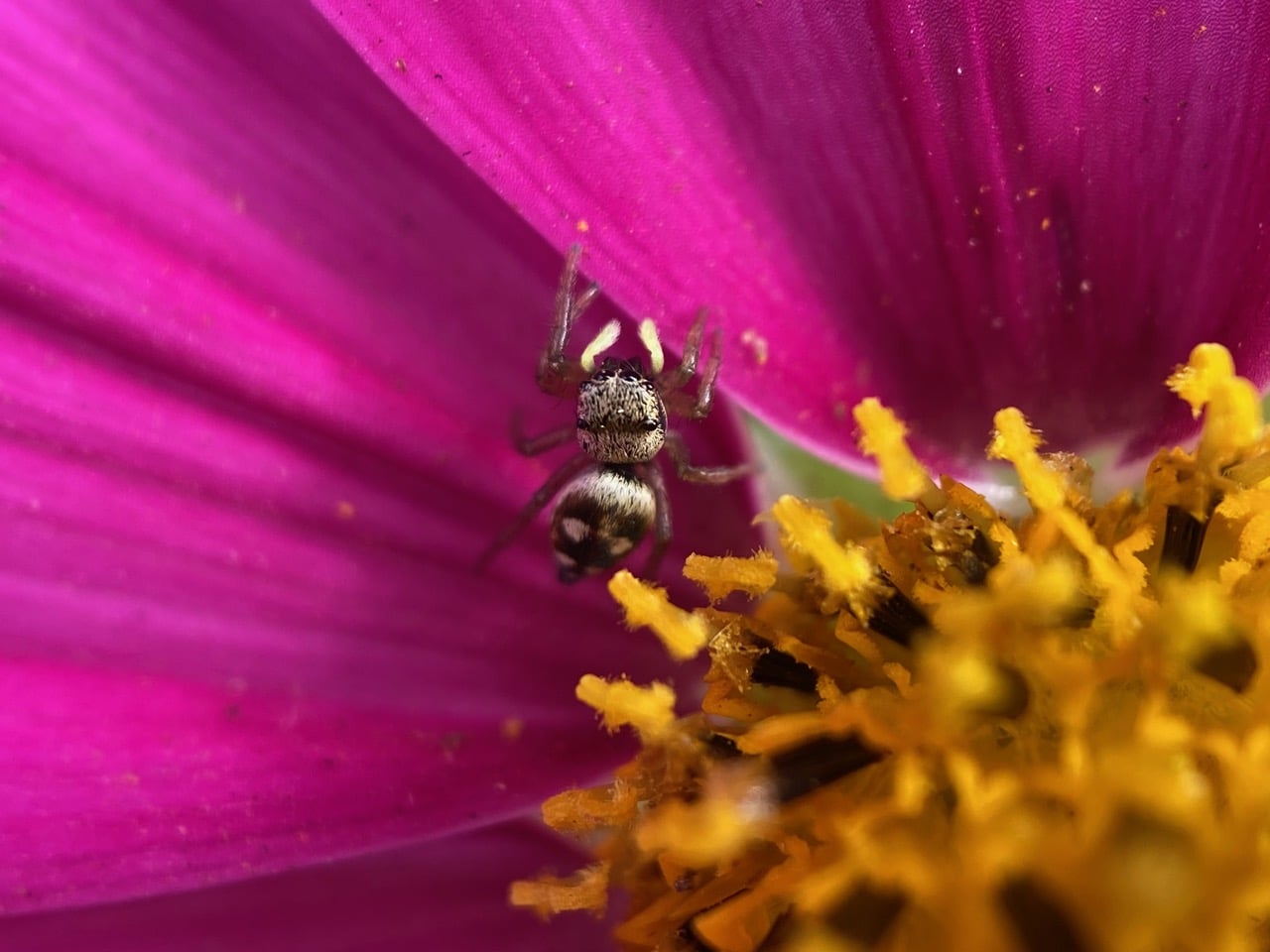
Look, it has yellowish white pedipalps. It is a female!
Spiders’ pedipalps are short, leg-like appendages near the mouth that function as sensory organs for touch, smell, and taste, as well as for handling food and manipulating prey. In male spiders, the pedipalps are modified for transferring sperm to the female during mating.
The genus Heliophanus is one of the largest genera of jumping spiders with over 150 species, widespread in the Palearctic and Africa, with one center of diversity in the Mediterranean region. Heliophanus apiatus was first reported in the San Francisco Bay Area in 2015. Since then the species has established in three counties – Alameda, Santa Clara and San Mateo – surrounding the southern arm of San Francisco Bay. H. apiatus is a small salticid, male measuring 3.5-4.0 mm, and females 4.0-4.5 mm in body length. Mature males and females are similar in appearance, but only the females have yellow pedipalps. These spiders are found on low vegetation and on hard structures on or near the ground. They are capable of taking prey their own size.
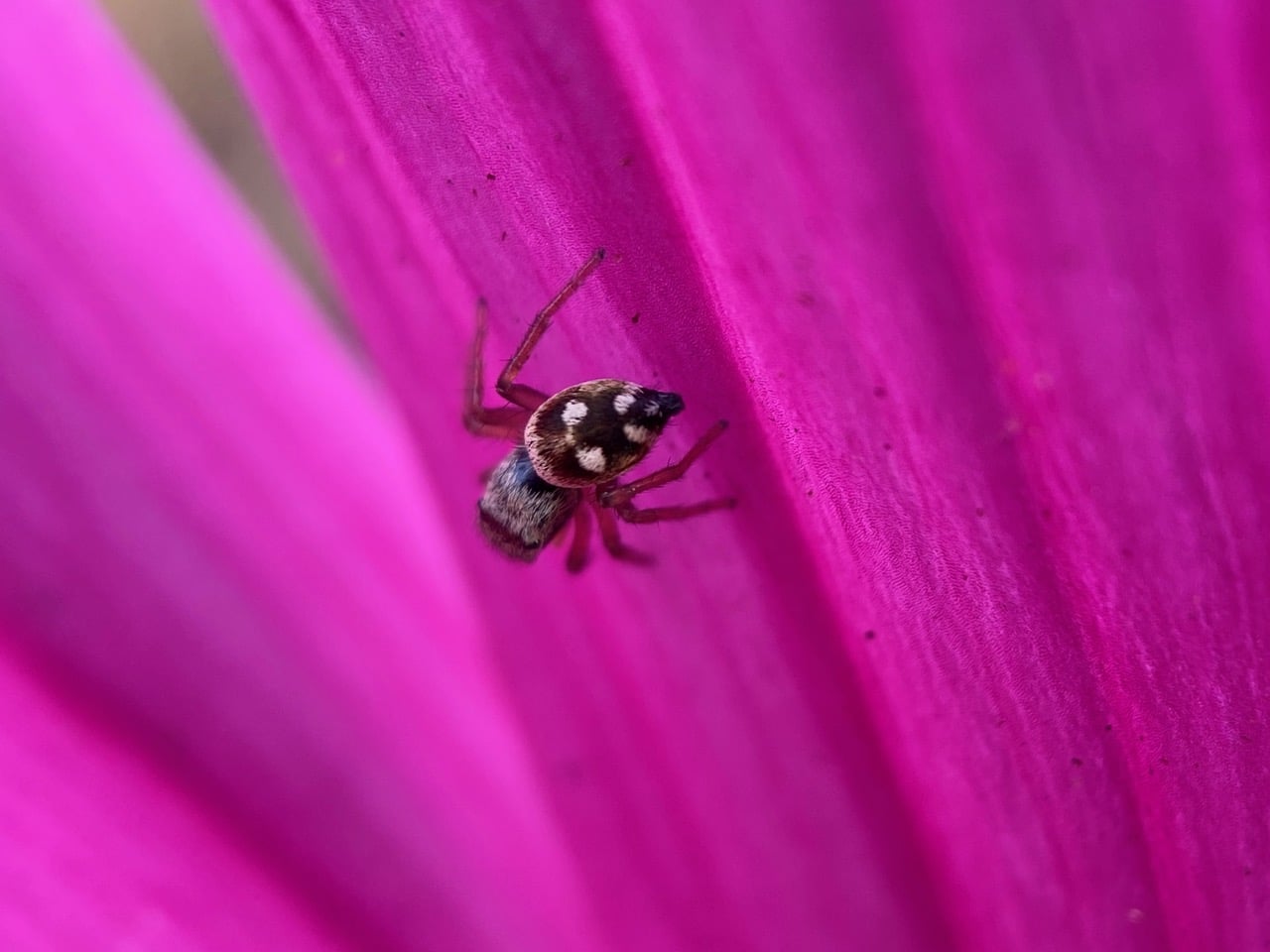

Flushed up by my footfall, a small brown moth lands upside down on the stem of Buckwheat. It lifts off again when I approach for a better photo…
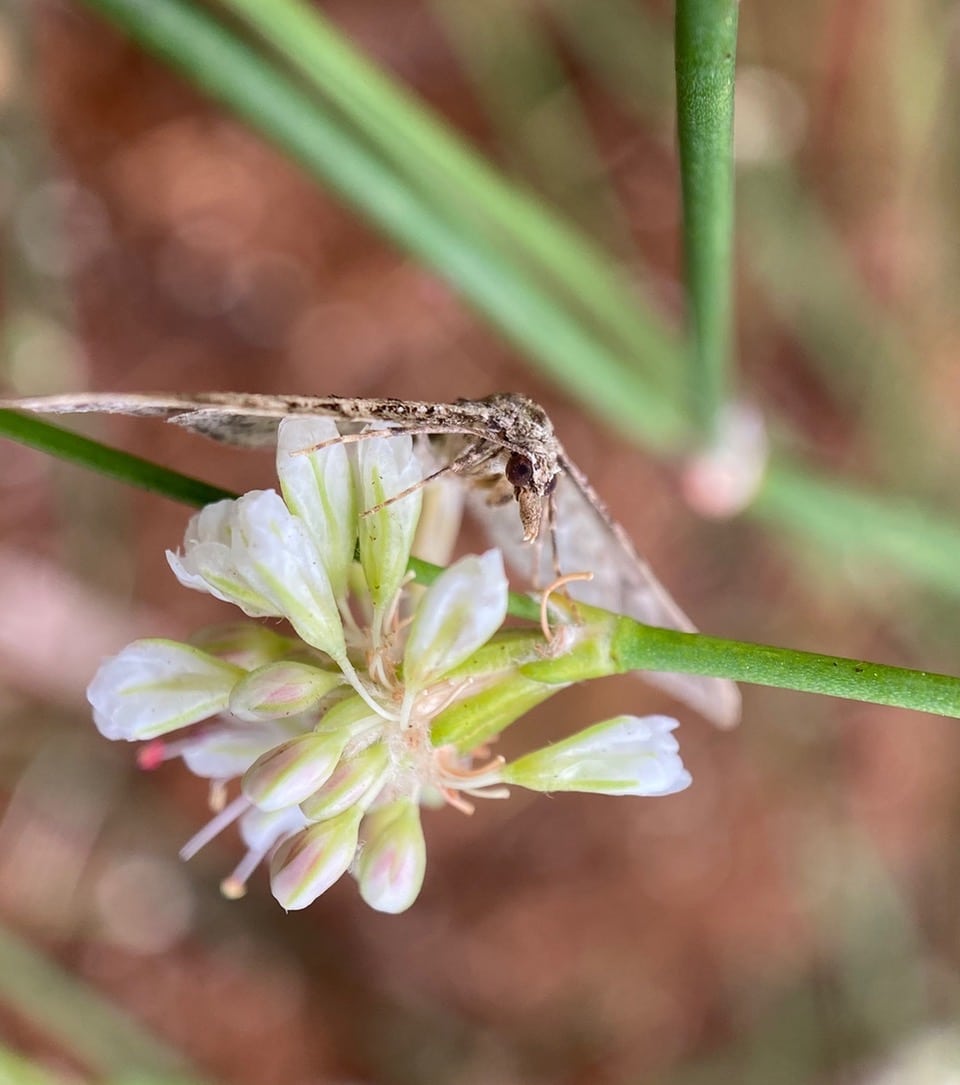
… and lands on a cluster of Buckwheat flowers, Eriogonum sp. iNaturalist has helped identify it as the a Pug Moth, Eupithecia sp. (family Geometridae).
Eupithelia is the largest genus of moths of the family Geometridae. Occurring worldwide except for Australasia, species in the genus are commonly known as pugs. The caterpillars move in a looping manner and are commonly called inchworms. Adults are typically small, 12 – 35 mm, with muted colors. Most species rest with forewings held flat at right angles to the body, while the hindwing are largely covered by the forewings. They are generally nocturnal. Larvae mostly feed from the flowers and seeds of their food plants rather than the foliage. Many species have a very specific food plant.
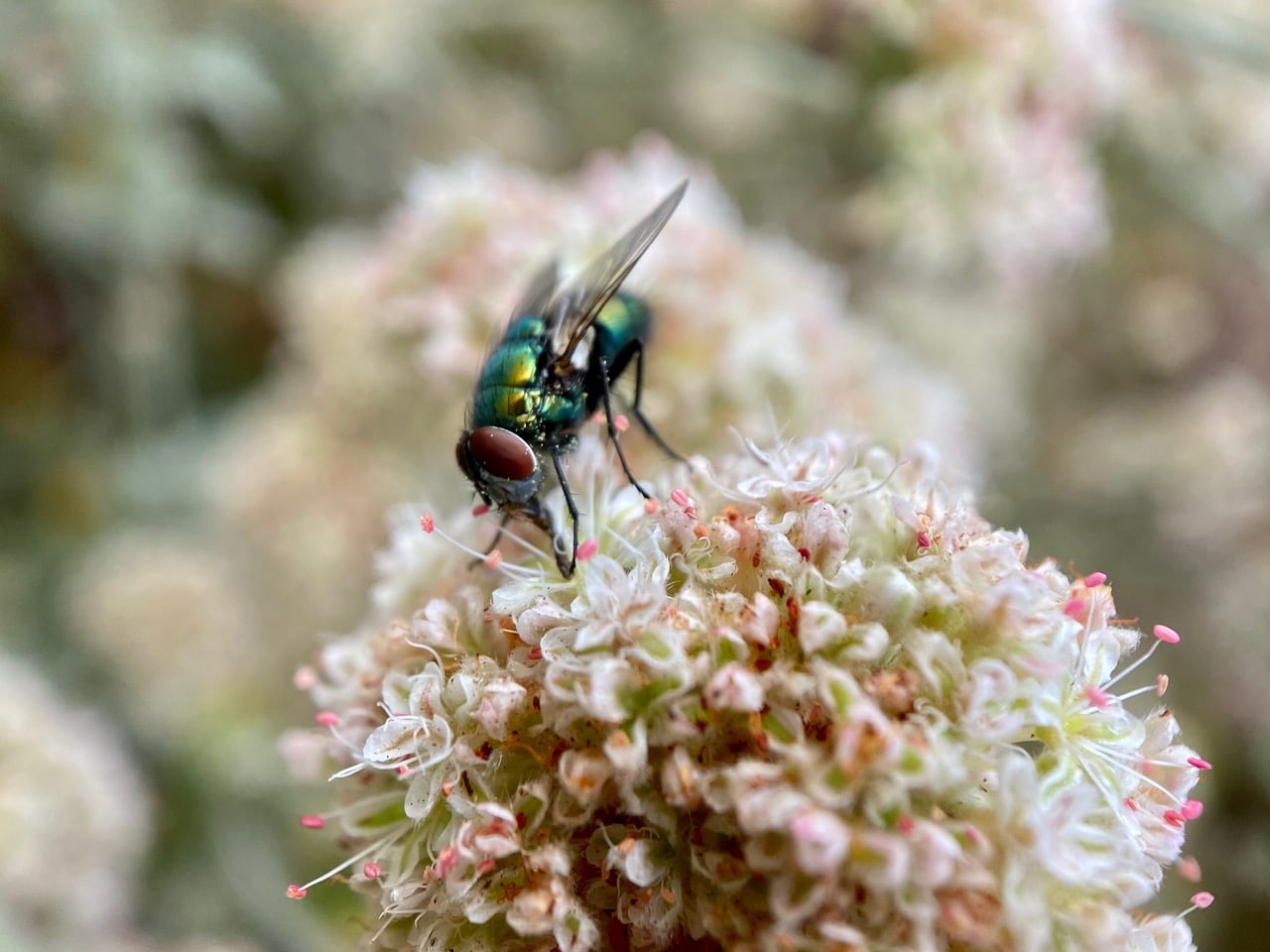
A Common European Greenbottle Fly, Lucilia sericata (family Calliphoridae) is foraging on the flowers of a white-flowered Buckwheat in the front yard.
The Common European Greenbottle Fly is a Blowfly found in most areas of the world and is the most well-known of the numerous green bottle fly species. The lifecycle of Lucilia sericata is typical of blowflies. Females lay masses of eggs in fresh carrion. The flies are extremely prolific – a single female may produce 2,000 to 3,000 eggs in her lifetime. The larvae feed on dead or necrotic tissue, passing through 3 larval instars. Third-instar larvae drop off the host to pupate in the soil. The adults feed opportunistically on nectar, pollen, feces, or carrion; they are important pollinators as well as important agents of decomposition. Pollen is used as an alternative protein source, especially for gravid females who need large amounts of protein and cannot reliably find carrion.
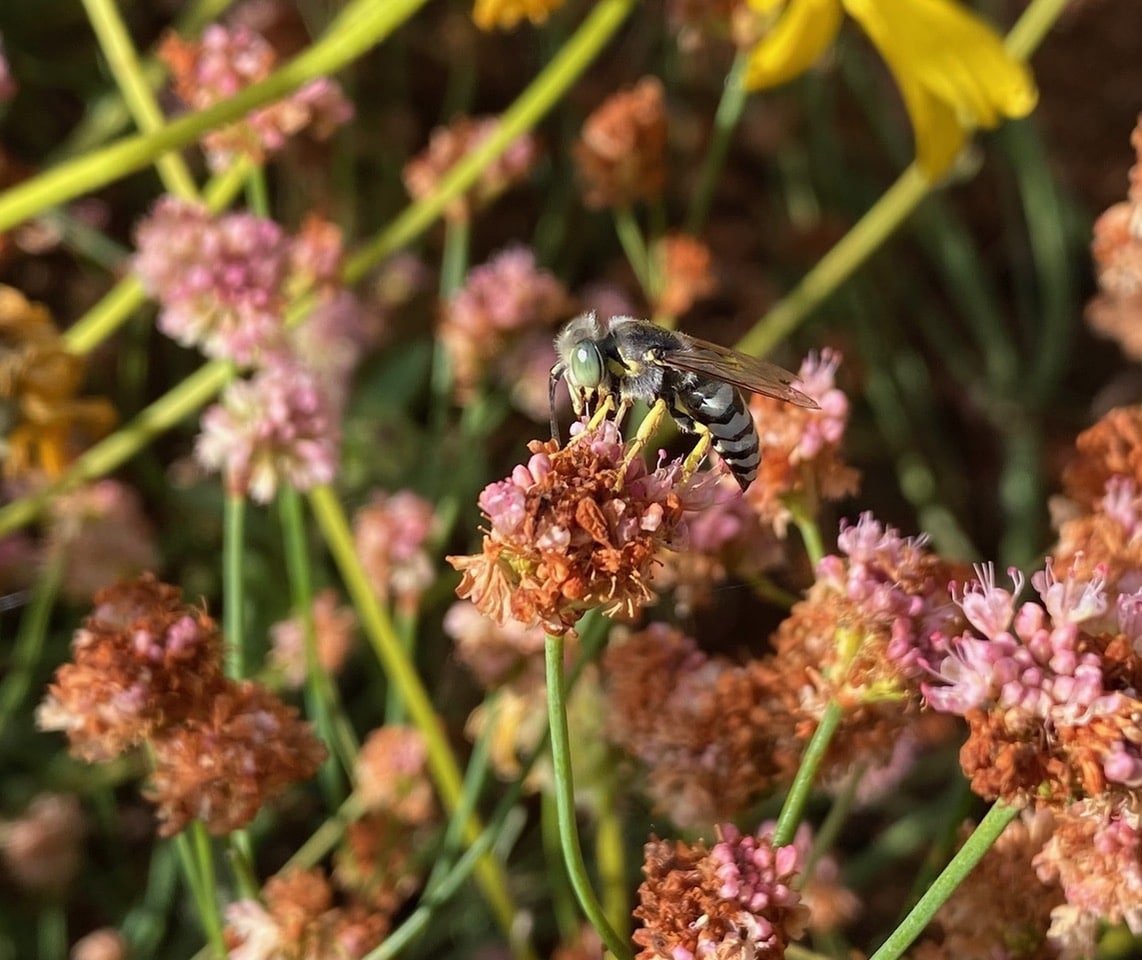
An American Sand Wasp, Bembix americana (family Crabronidae) is taking nectar from a fading inflorescence of Red-flowered Buckwheat, Eriogonum grande ssp. rubescens.
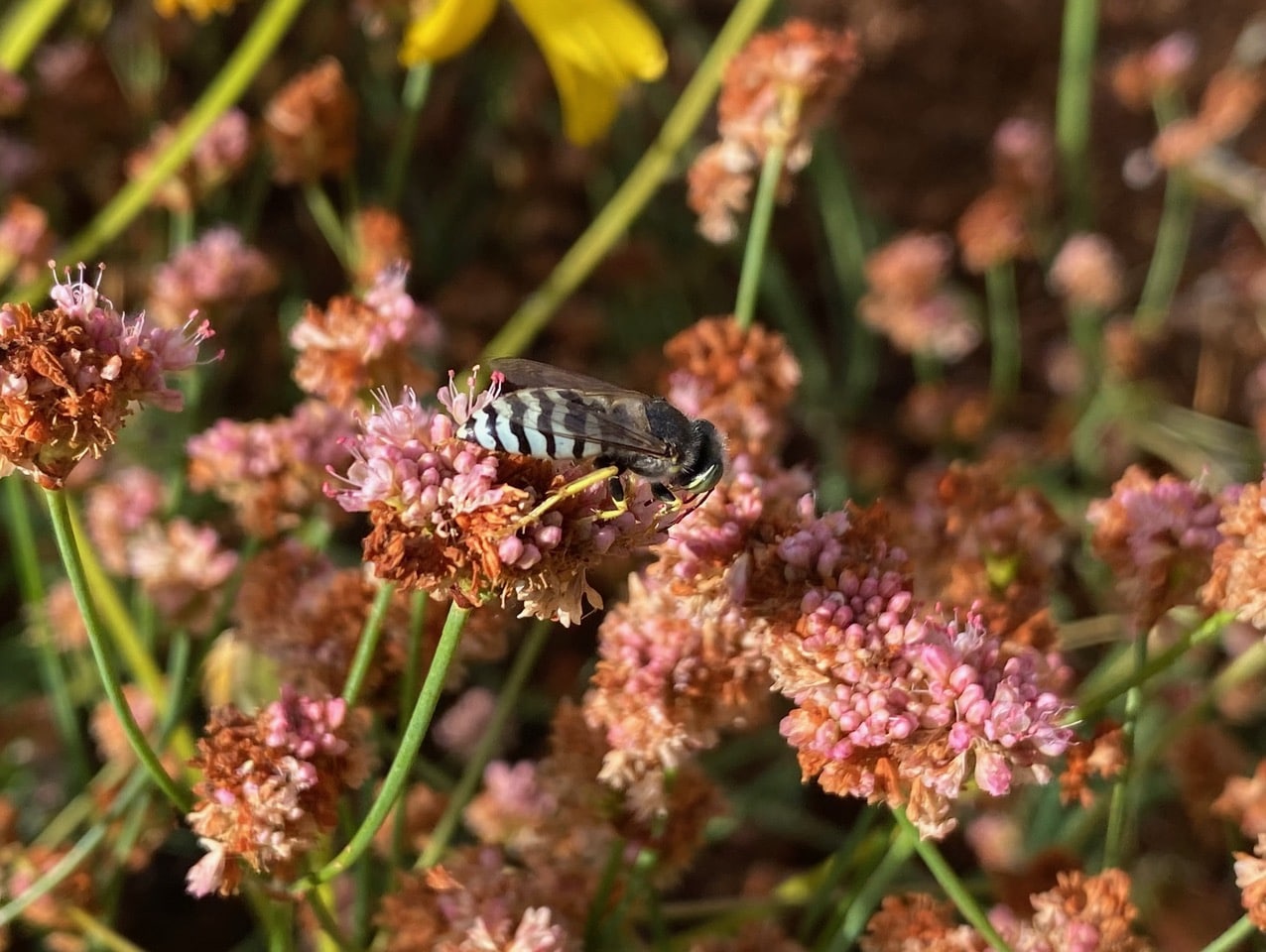
Sand wasps in the genus Bembix are familiar and common throughout North America, digging their burrows in dunes, on beaches, and other habitats with loose, deep sand. The female rapidly kicks out large quantities of sand using a “tarsal rake” of spines on each front leg. The burrow is excavated before the wasp goes hunting. Bembix are generalist, opportunistic hunters. True flies in the order Diptera are the usual prey. A victim is paralyzed or killed by the wasp’s sting, and is then flown back to the nest. Most species will lay an egg on the first victim, while some species lay an egg in the empty cell before starting to hunt. Once the egg hatches, mama wasp brings flies to her larva as needed. This “progressive provisioning” is rare in the insect world. When the larva reaches maturity, mama wasp closes the cell. Inside, the larva spins an oblong cocoon, weaving sand grains into the structure and resulting in a hardened capsule. Overwintering takes place as a prepupa inside this cocoon, but there are usually two generations a year.
Male sand wasps often engage in an elaborate flight ritual called “sun dances”. Males emerge before females, and fly erratically at dizzying speed one or two inches above the ground attempting to detect virgin females about to emerge from their underground nests. Both sexes are often seen taking nectar at flowers, especially from Asteraceae family. Bembix wasps are often victims of other insects such as cuckoo wasps (Chrysididae), velvet ants (Mutillidae), satellite flies (Sarcophagidae), bee flies (Bombyliidae), and thick-headed flies (Conopidae).

A female Western Leafcutter Bee, Megachile perihirta (family Megachilidae) is foraging on a flowerhead of Bush Sunflower, Encelia californica. Note the pollen on the underside of her abdomen.
Megachilids are unusual among bees in the way the females carry pollen. While most bees have scopae (Latin for “broom”, dense, textured hairs that pollen collects on) on their legs, Megachilids have scopae on the underside of their abdomen. The pollen is held loosely by electrostatic attraction to the hairs. When the Leafcutter Bee scrambles over the flowers it lands on, the pollen on its abdominal scopa dusts each flower the bee visits. This is probably why the Megachilids are considered pollinators extraordinaire. They are important pollinators for commercial crops from alfalfa, blueberries to sunflowers.
The Leafcutter Bees are best known, of course, for their leaf-cutting behavior. Solitary females construct nests in tubular cavities, including hollow stems, tree holes, and abandoned beetle burrows in wood. Many use holes drilled into wood, straws, or other manufactured tunnels. Females cut pieces from leaves or flower petals for use in the construction of brood cells. While most leafcutter bees nest above ground in tubes and tunnels, the Western Leafcutter nests underground. Often a small group of females live in a community and burrow into soil, gravel, or sand.
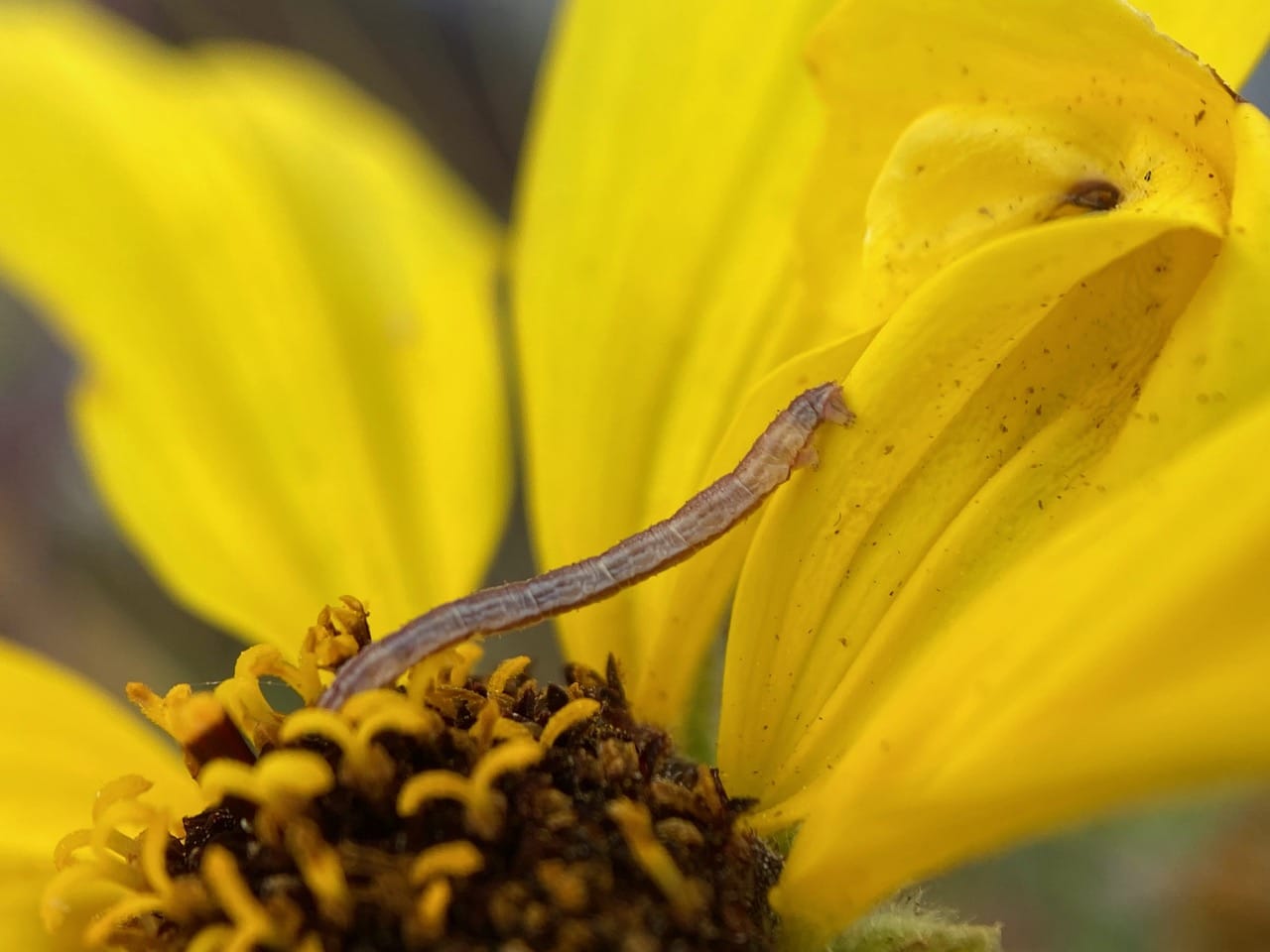
Its anal prolegs firmly anchored on a ray petal of a Bush Sunflower flowerhead, an inchworm has buried its head to feed on the florets in the center. It is the caterpillar of the Pug Moth, Eupithecia sp. (family Geometridae).
Inchworms are also called loopers and measuring worms. The majority of the inchworms are the larvae of moths in the family Geometridae. The name comes from the Greek “geo” for earth and “metro” from measure, because the caterpillars seem to be measuring the surface on which they are walking.
All caterpillars have three pairs of jointed legs behind their heads. These legs are called true legs because they will become the six legs of the adult butterfly or moth. There are additional appendages, called prolegs, along their bodies. Prolegs are not true legs, they are just outgrowths of the body wall and will be lost at metamorphosis. They have little hooks on their soles to help the caterpillar walk and grip onto things.
Most caterpillars have five sets of prolegs, four in the middle of the body and one pair at the hind end. Inchworms have the normal six true legs but only two or three pairs of prolegs, all located at the tail end of the body, with none in the middle. When an inchworm walks, it moves its tail-end prolegs up behind its true legs, causing the center of its body to loop upward. Then it stretches its front end forward to take another step.

A Fiery Skipper, Hylephila phyleus (family Hesperiidae) has landed on an inflorescence of De La Mina Verbena, Verbena lilacina.
Skippers are a family, the Hesperiidae, of the order Lepidoptera (butterflies and moths). They are named for their quick, darting flight habits. Most have the antenna clubs hooked backwards like a crochet hook. They also have generally stockier bodies and larger compound eyes than the other butterflies. Their wings are usually small in proportion to their bodies. When at rest, skippers keep their wings usually angled upwards or spread out, and only rarely fold them up completely. Californian species are mostly brown or tan, with black, orange, or yellow markings.
Skipper caterpillars are usually green or brown, sometimes yellowish, never brightly colored. They have a distinctive “collar”, a narrow ring around the body right behind the head. Caterpillars are camouflaged and often hide during the day. Many species make nests of leaves and silk for additional protection. Most North American species feed on grasses, but some common species eat shrubs and trees, especially in the bean family. Most species are limited to a single group of food plants. Adult skippers are only active during the day, but Skipper caterpillars feed mainly when it is dark or partly light.
Fiery Skippers, Hylephila phyleus (family Hesperiidae) is a small butterfly, with a wingspan of 1.25 to 1.5 in. It can be seen from March to November. Host plants include various species of grasses.
Fiery Skipper is the most abundant grass skipper in California, mostly due to its dominance in urban areas, thanks to the ubiquity of the Great American Lawn.
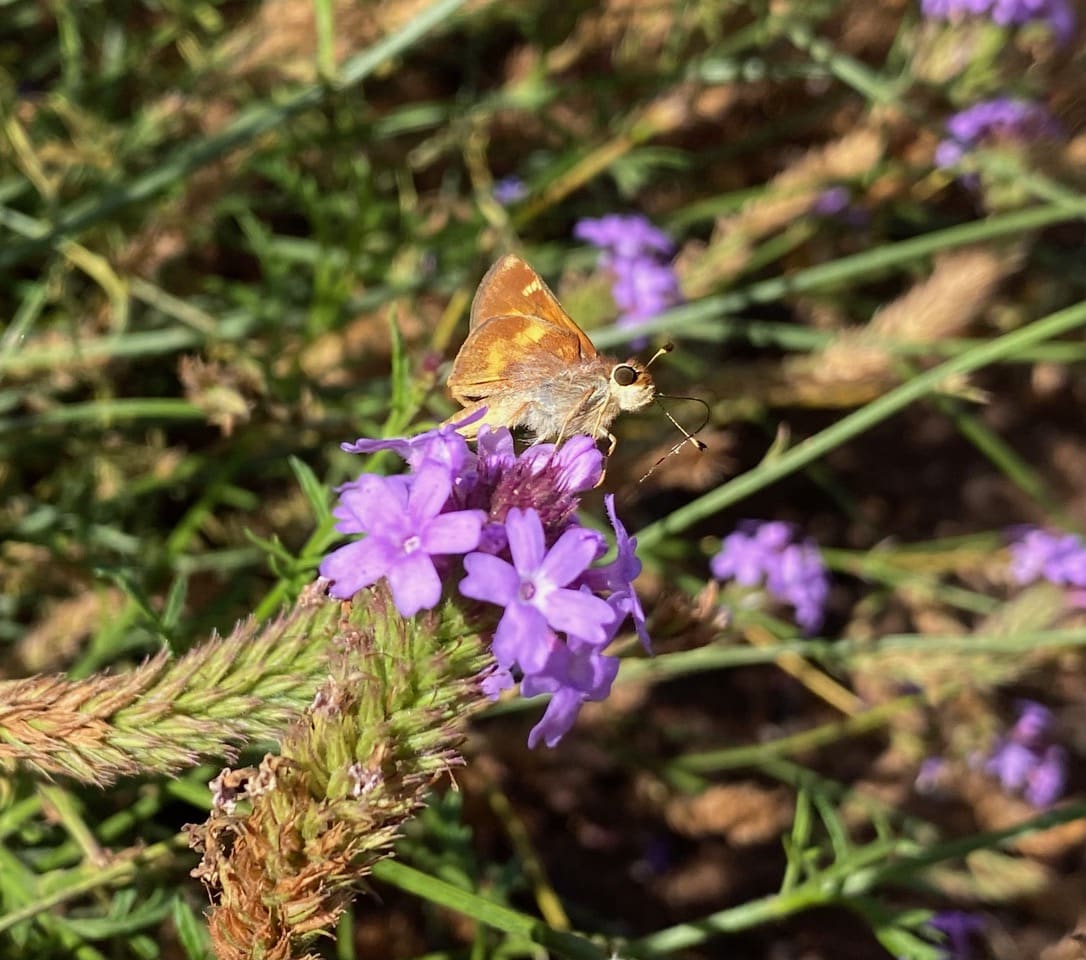
Verbenas are generally considered butterfly flowers as they are a rich source of nectar The narrow throat of the tubular flowers requires long tongues to access the nectar at the base of the corolla. All the reproductive structures are located within the throat of the flower.
As the Fiery Skipper lifts its proboscis from the flower it has been taking nectar from, you can see the pollen that has adhered to its proboscis in the process. Yes, butterflies do pollinate with their proboscis. Butterflies use their long, flexible, hollow proboscis to reach deep into flowers and suck up nectar. As the proboscis extends and retracts, pollen grains from the flower’s anthers stick to its surface. The butterfly may subsequently visit another flower, where the pollen may be deposited on the flower’s receptive parts, aiding in pollination. While feeding, the butterfly’s body and legs may also pick up pollen, but the proboscis is a critical tool for nectar collection, and consequently, for pollen transport. Butterflies are not specialized pollen collectors like bees; they primarily seek nectar. The pollen pickup is an unintentional side effect of their foraging.

A small wasp is hunting on a seed head of a Palmer’s Indian Mallow, Abutilon palmeri in the corner of the front yard. It is a Mason Wasp, Ancistrocerus bustamente (family Vespidae, subfamily Eumeninae).
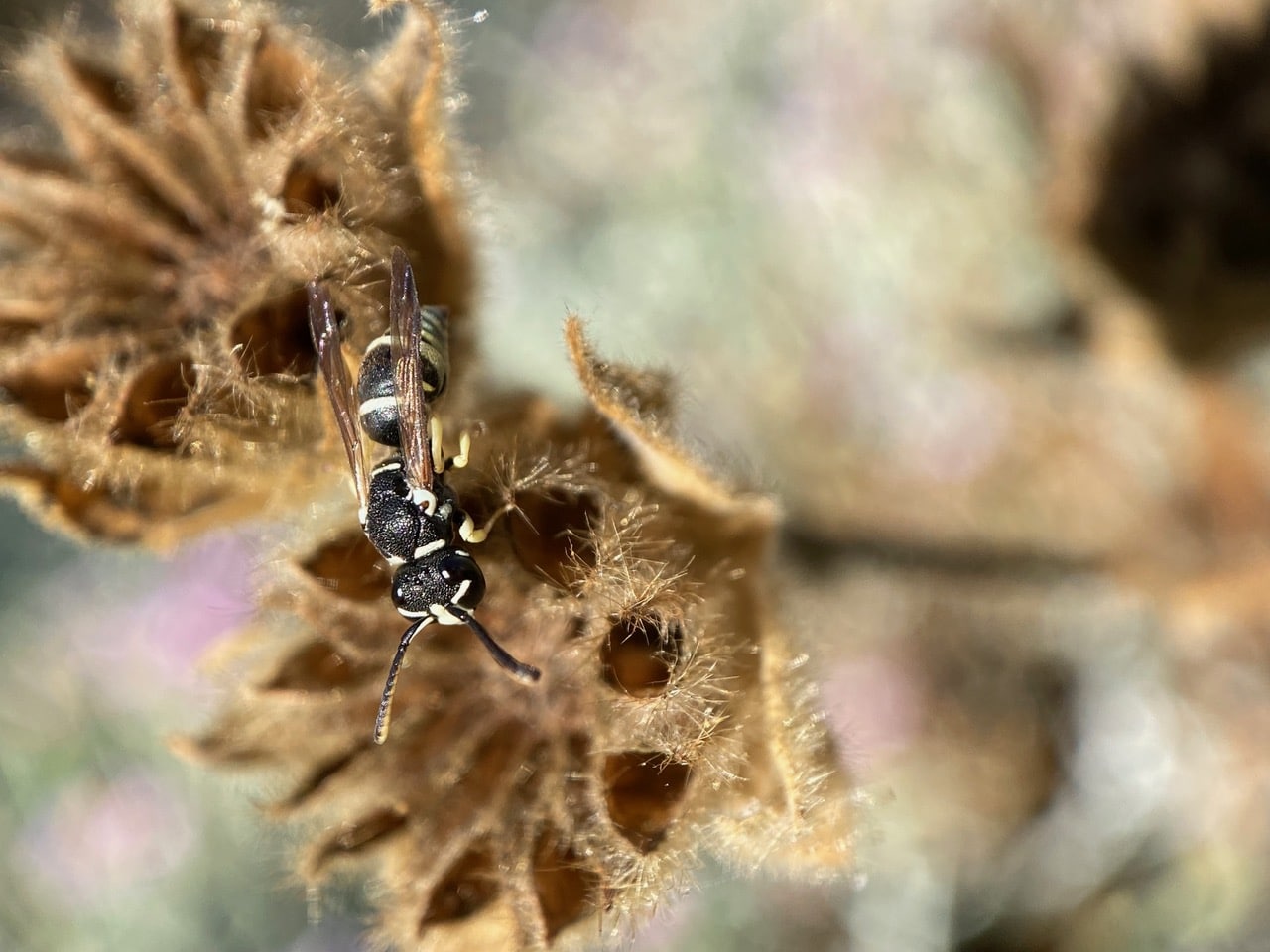
Potter wasps (or mason wasps), the Eumeninae, are a cosmopolitan wasp group presently treated as a subfamily of Vespidae. Most eumenine species are black or brown, and commonly marked with strikingly contrasting patterns of yellow, white, orange, or red. Their wings are folded longitudinally at rest. Eumenine wasps are diverse in nest building. The Mason Wasps are species that generally nest in pre-existing cavities in wood, rock, or other substrate. Potter Wasps are the species that build free-standing nests out of mud, often with a spherical mud envelope. The most widely used building material is mud made of a mixture of soil and regurgitated water.
All known Eumenine species are predators, most of them solitary mass provisioners. When a cell is completed, the adult wasp typically collects beetle larvae, spiders, or caterpillars and, paralyzing them, places them in the cell to serve as food for a single wasp larva. As a normal rule, the adult wasp lays a single egg in the empty cell before provisioning it. The complete life cycle may last from a few weeks to more than a year from the egg until the adult emerges. Adult mason wasps feed on floral nectar.
The Mason Wasp, Ancistrocerus bustamente is found in western North America and Mexico. The species frequents arid areas, and nests in pre-existing cavities (e.g. old borings in wood, hollow stems, rock crevices) and use mud for partitions between brood cells. The wasps have been known to nest in Sambucus (Elderberry) stems. The name of the genus means “hooked horn” for the back-curved last segments of the antennae characteristic of the males.
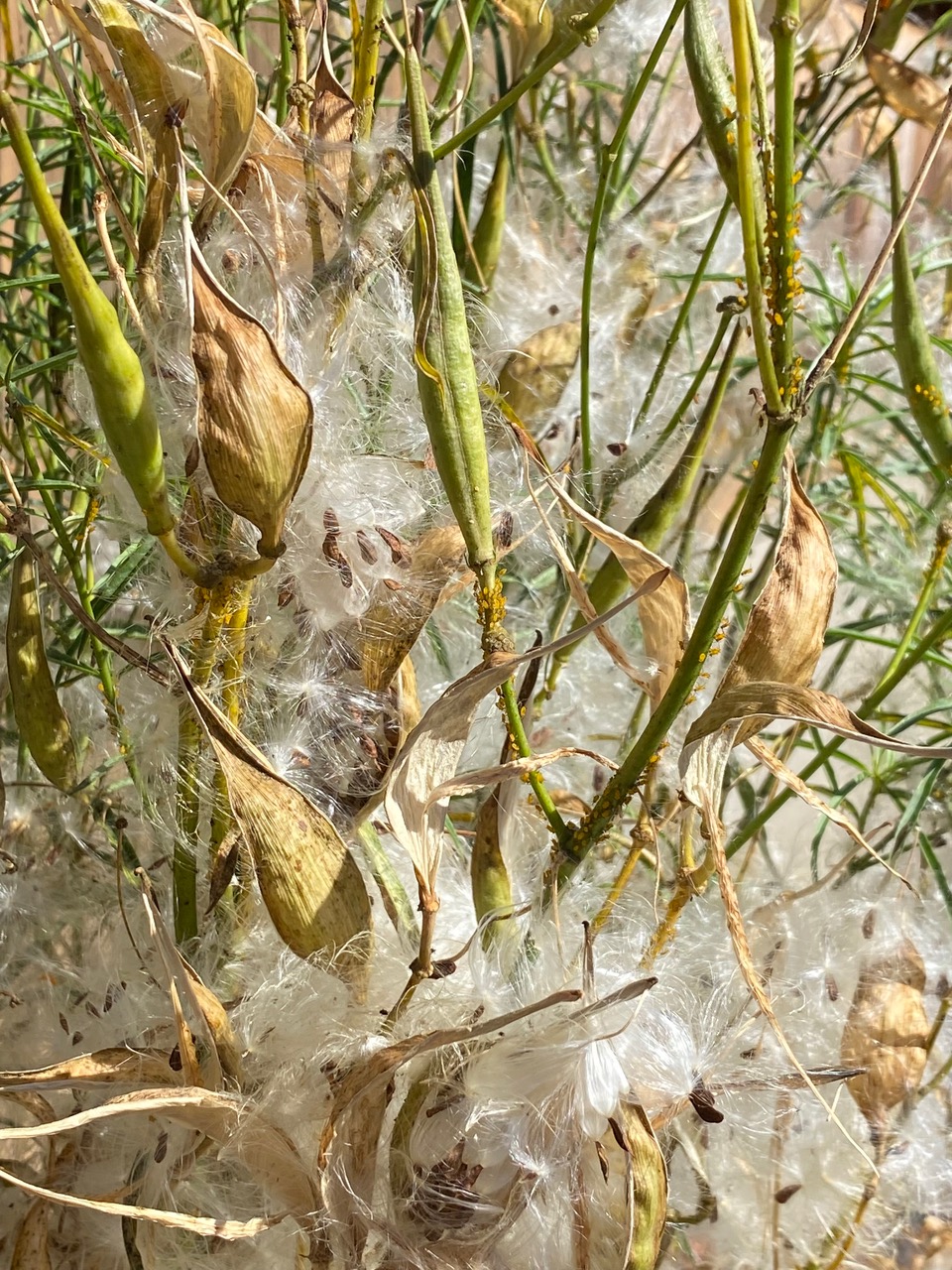
The Narrowleaf Milkweed, Asclepias fascicularis in the backyard has exploded into a riot of silky plumed seeds.

Several conspicuous red-and-black nymphs of the Large Milkweed Bug, Oncopeltus fasciatus (family Lygaeidae) can be seen on an open milkweed seed pod.
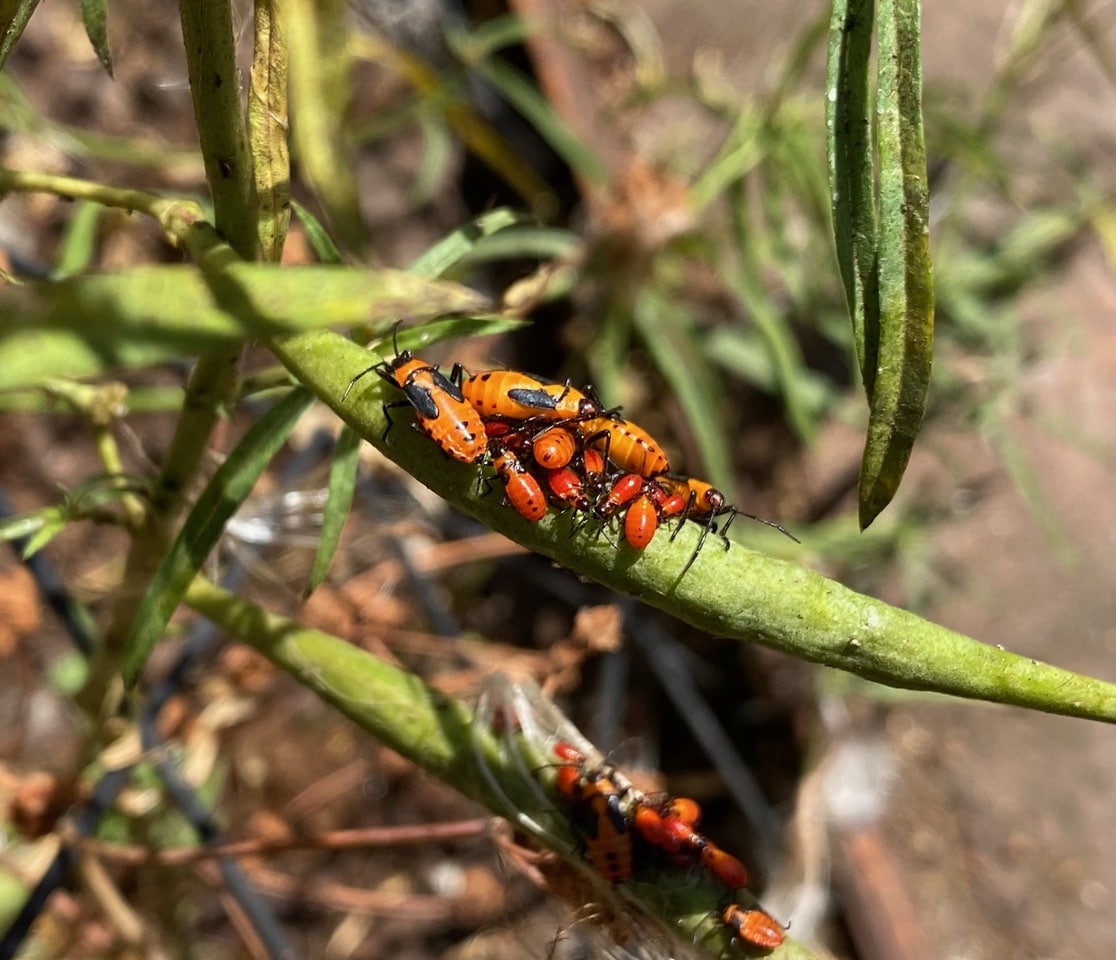
An aggregation of Large Milkweed Bugs of various ages have gathered on an immature milkweed seed pod. Black wing pads grow larger as the nymphs molt through their developmental stages. Only the adults have functional wings.
Milkweed Bugs are Seed Bugs (family Lygaeidae) in the insect order of “true bugs”, Hemiptera. The bold red-and-black coloration of the bug serves as aposematic warning to potential predators of its distastefulness and toxicity. Like the Monarch butterflies, Oncopeltus sequesters the toxic compounds of milkweeds, giving the insect its toxicity. The bugs undergo incomplete metamorphosis, with five instars before reaching adulthood. The nymphs and adults all feed on milkweed using their piercing-sucking mouthparts. Adults are capable of penetrating the seed pod with their proboscis and injecting digestive juices. All stages of development can be found on the plants in mid to late summer. Adults live for about one month. The insect overwinters as an adult.

An adult Large Milkweed Bug appears to be sheltering a young nymph under it. Note the rostrum (mouthpart) that is folded under the body of the adult.
The defining feature of Hemipterans or “true bugs” is their “beak” or rostrum in which the modified mandibles and maxillae form a “stylet” which is sheathed within a modified labium. The stylet is capable of piercing tissues and sucking liquids, while the labium supports it. The stylet contains a channel for outward movement of saliva and digestive enzymes, and another channel for the inward movement of pre-digested liquid food. The rostrum is usually folded under the body when not in use. Seed bugs are able to feed on seeds by injecting digestive juices into the seeds and sucking up the digested contents as a liquid.

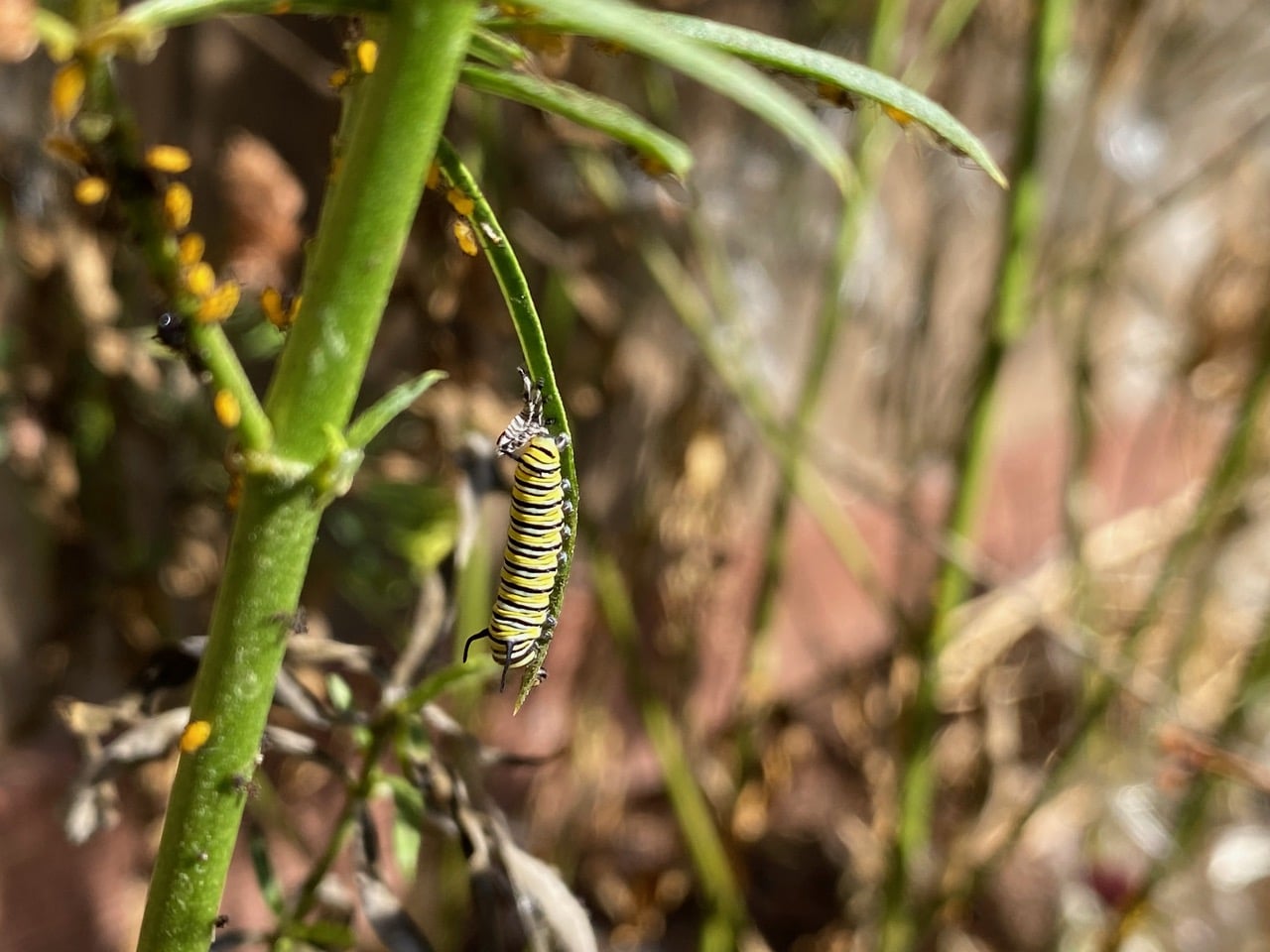
Hey, there’s a small Monarch caterpillar at the end of that drooping milkweed leaf!
Monarch caterpillars sequester toxic compounds called cardiac glycosides from the milkweed they eat, storing them in their bodies as a defense mechanism against predators. These toxins remain in the caterpillar even after metamorphosis, making both the caterpillar and the adult monarch poisonous.
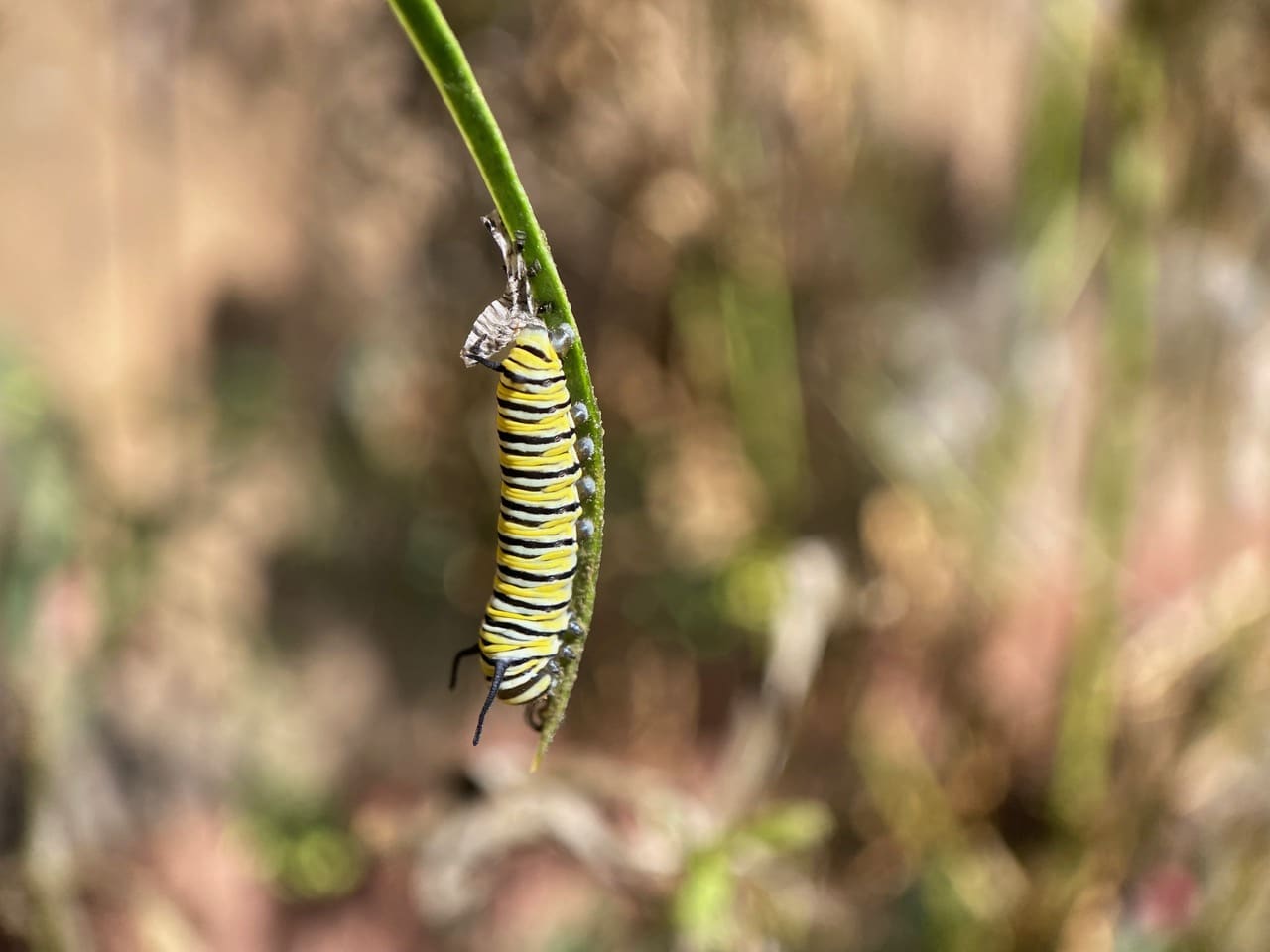
The caterpillar must have just molted – the exuvia (molted skin) is still attached to its rear.
A monarch caterpillar molts five times before it transforms into a chrysalis, shedding its skin to accommodate its rapid growth. Each time it molts, the caterpillar enters a new developmental stage, known as an instar.
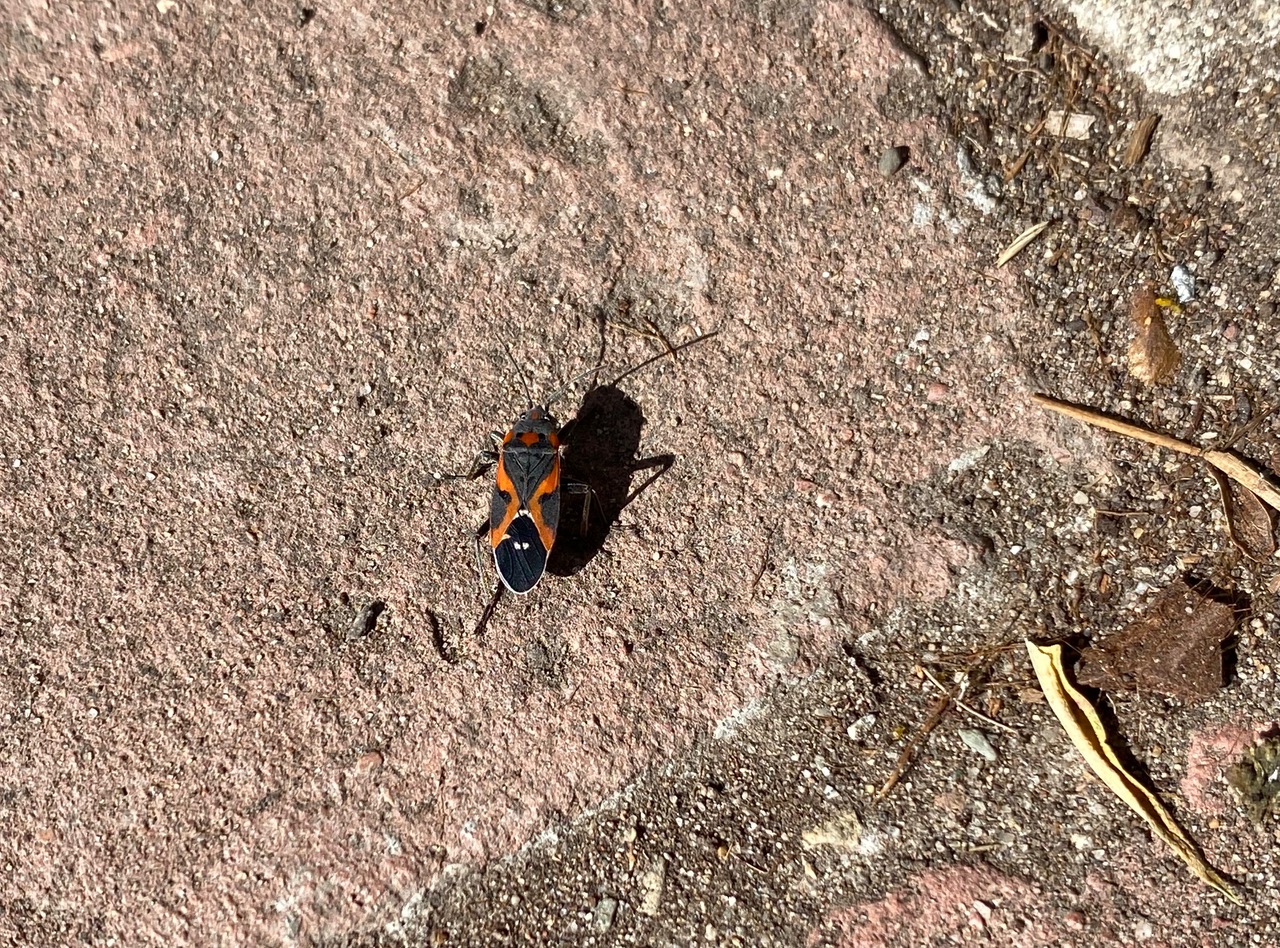
A Small Milkweed Bug, Lygaeus kalmii (family Lygaeidae) is running on the path.
The Small Milkweed Bug, Lygaeus kalmii belongs to the family Lygaeidae, collectively known as “seed bugs”. Through their piercing-sucking mouthparts, they secrete saliva and digestive enzymes to predigest their food before sucking up the slurry. Milkweed seeds make up the diet of the nymphs, but adults are generalists, feeding on the seeds of various plants and the nectar of flowers. The adults are not even strictly herbivorous; they are opportunistic scavengers on dead insects, and are known to feed on the eggs, larvae or pupae of other insects. The adult bugs overwinter and often emerge from cracks and crevices on warm spring days. They are found at virtually any time of the year in our gardens.
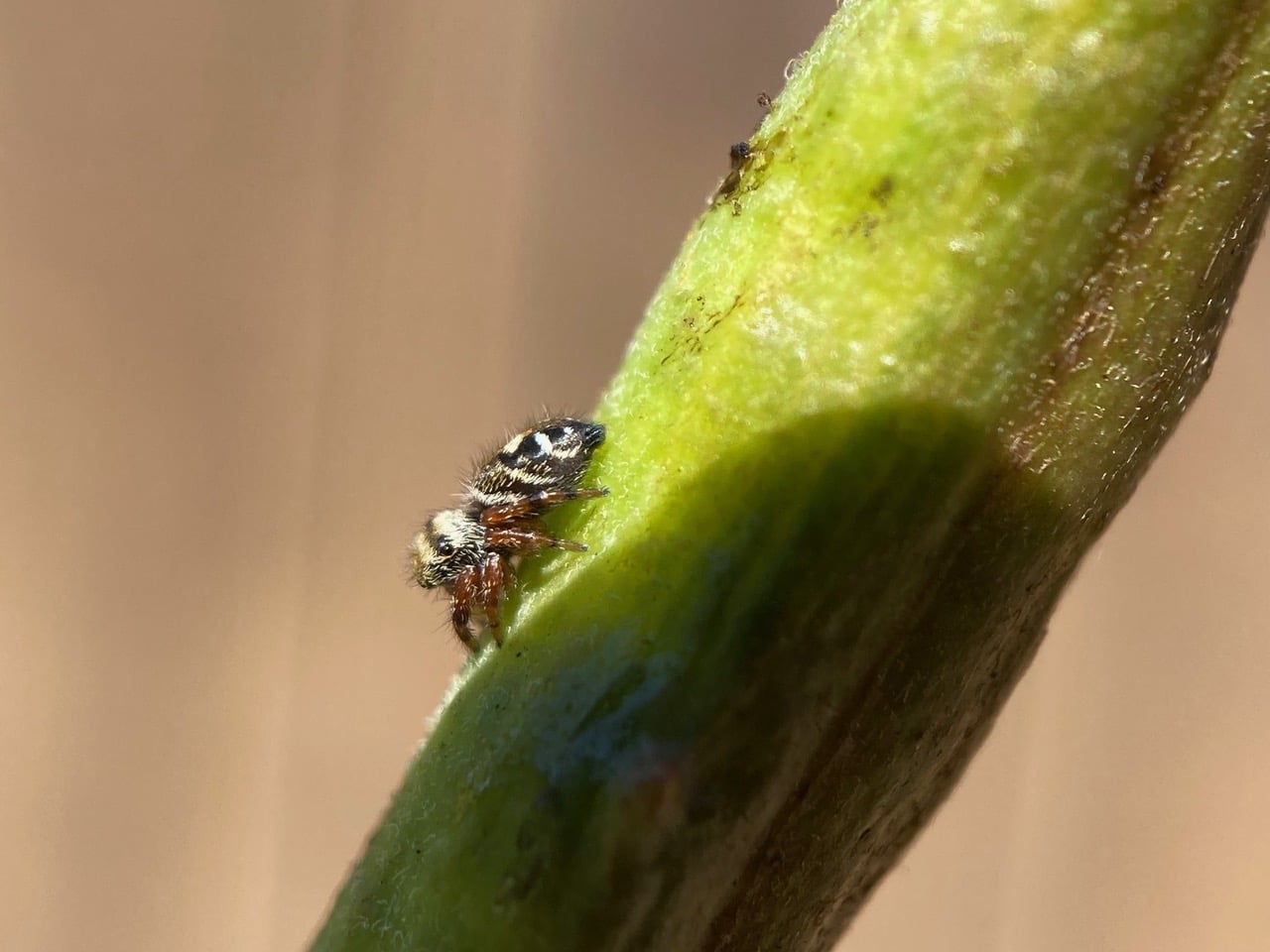
A small Jumping Spider is running on an immature milkweed seed pod. iNaturalist has helped identify it as a Bold Jumping Spider, Phidippus audax (family Salticidae).
Jumping spiders (family Salticidae) are free-roaming hunting spiders. They do not weave a web to catch prey. They stalk, then pounce on their prey. Just before jumping, the spider fastens a safety line to the substrate. It can leap 10-20 times their body length to capture prey. Their movement is achieved by rapid changes in hydraulic pressure of the blood. Muscular contractions force fluids into the hind legs, which cause them to extend extremely quickly. Jumping spiders are visual hunters. Their excellent vision has among the highest acuities in invertebrates. Since all their 8 eyes are fixed in place and cannot pivot independently from the body like human eyes can, jumping spiders must turn
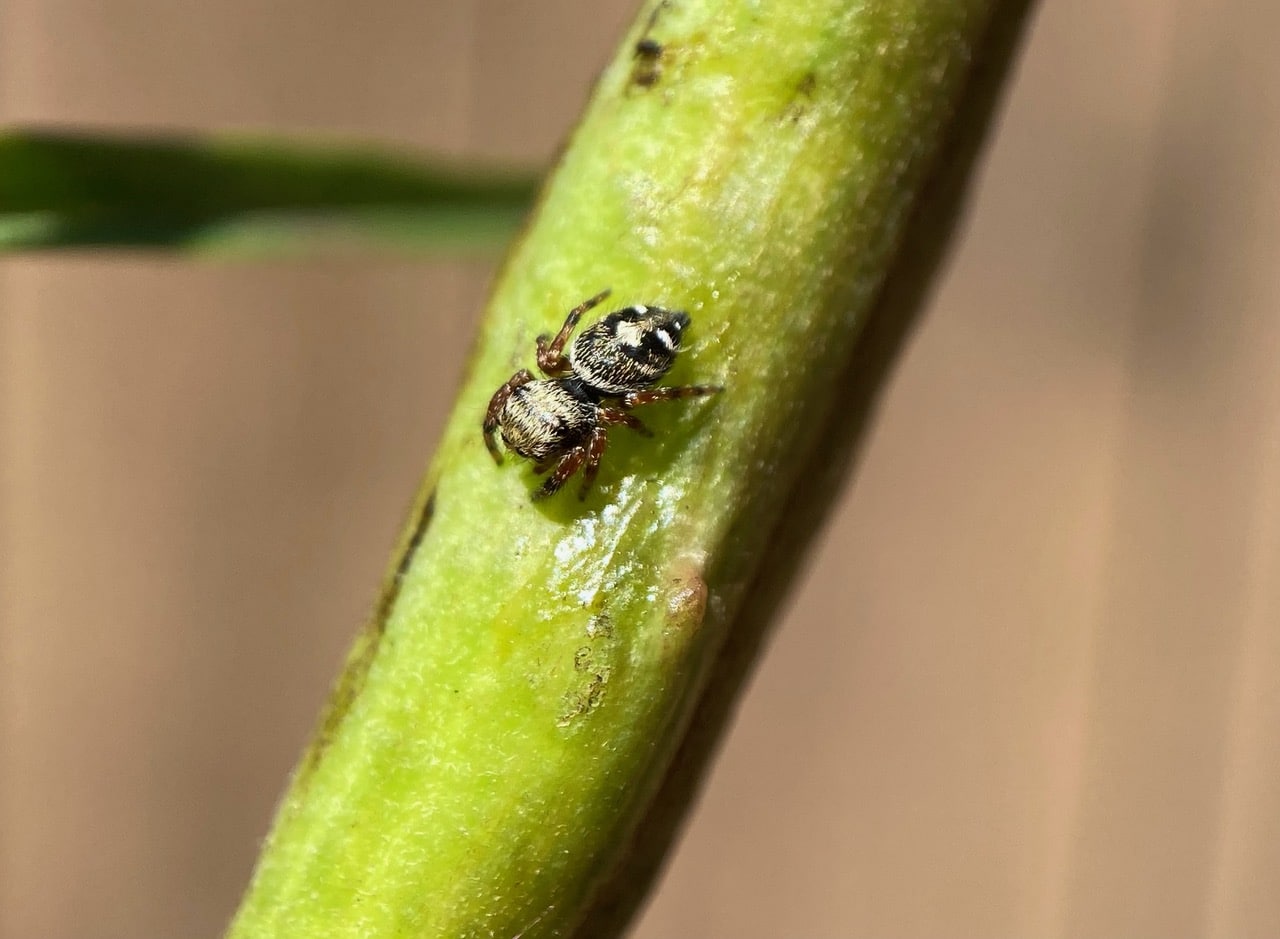
Phidippus audax (family Salticidae) is commonly referred to as Bold Jumping Spider. The species name, audax, is a Latin adjective meaning “audacious” or “bold”. These spiders are commonly found in grasslands, chaparrals, open woodlands, and agricultural fields. It is one of the most commonly occurring spider species within its range and is often found living in close proximity to humans. The adult female ranges from 8-15 mm in body length; the smaller males range from 6-13 mm. They are typically black with an ovoid abdomen and round cephalothorax. The presence of a large triangular white spot in the center of the abdomen with two smaller spots below it is often used to distinguish this species. These spiders are diurnal hunters, using their excellent eyesight for hunting, courtship and observational learning. They are often found hunting on fence posts and plant leaves, stems, and branches. At night, they hide in a crevice or small cavity and make a silk retreat to avoid predators. Bold jumpers prey on a variety of insects including caterpillars, dragonflies and grasshoppers, and other spiders. The species overwinters as immatures in sac-like silk shelters hidden underneath rocks and bark. Spiders emerge in the spring to complete their final molts, mating in late spring and early summer.