

Pollinator Post Dec. 2024 (1)

Happy New Year!




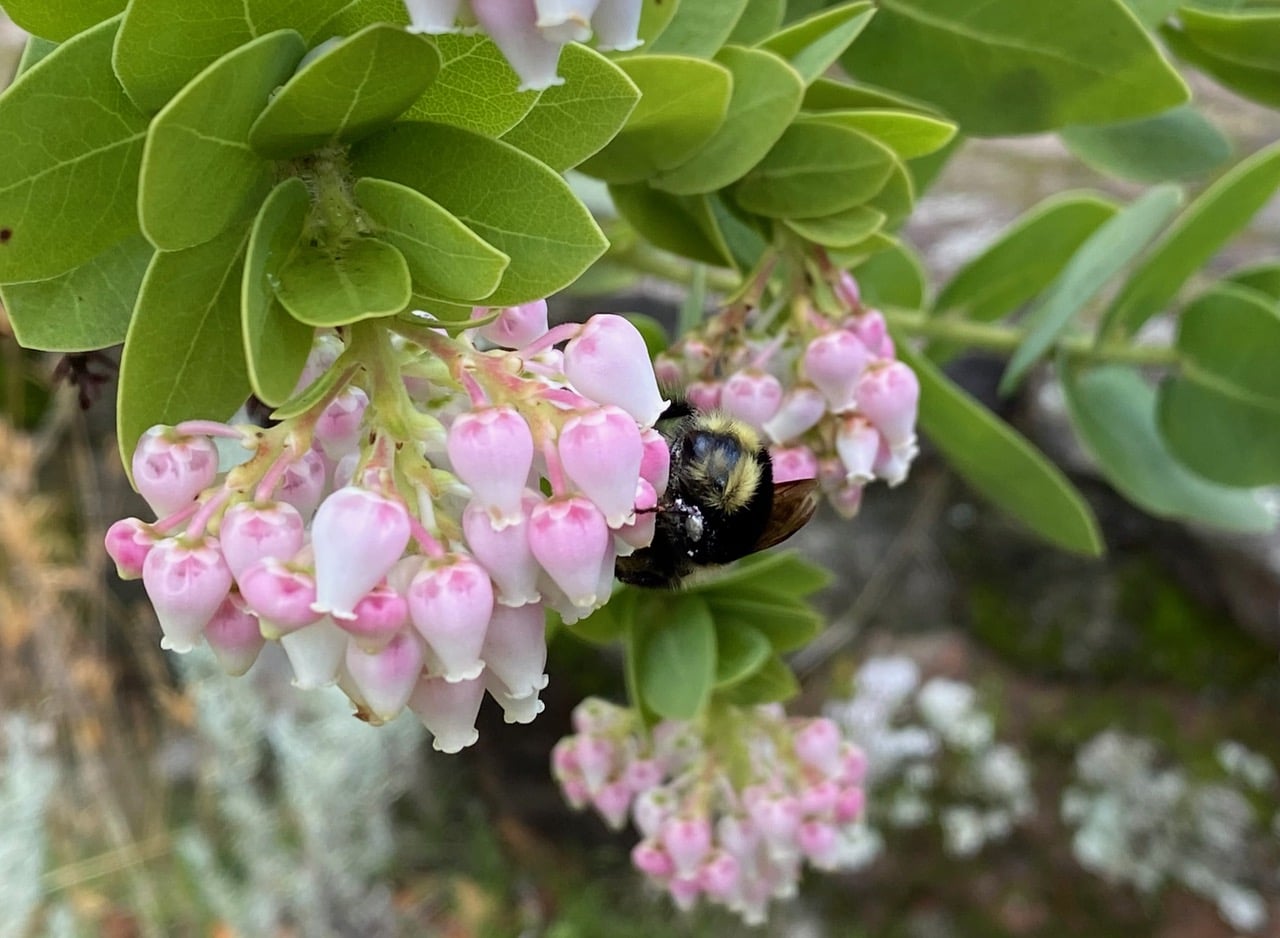


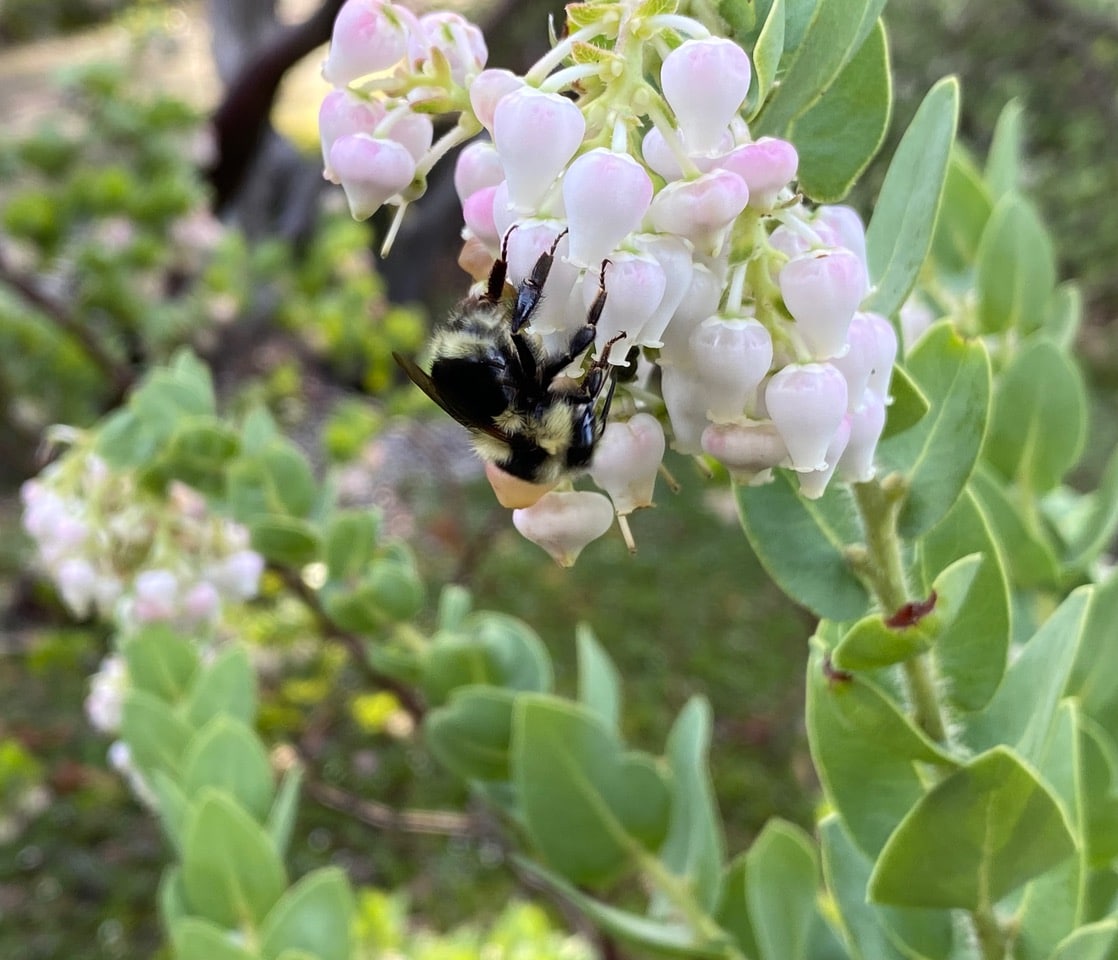
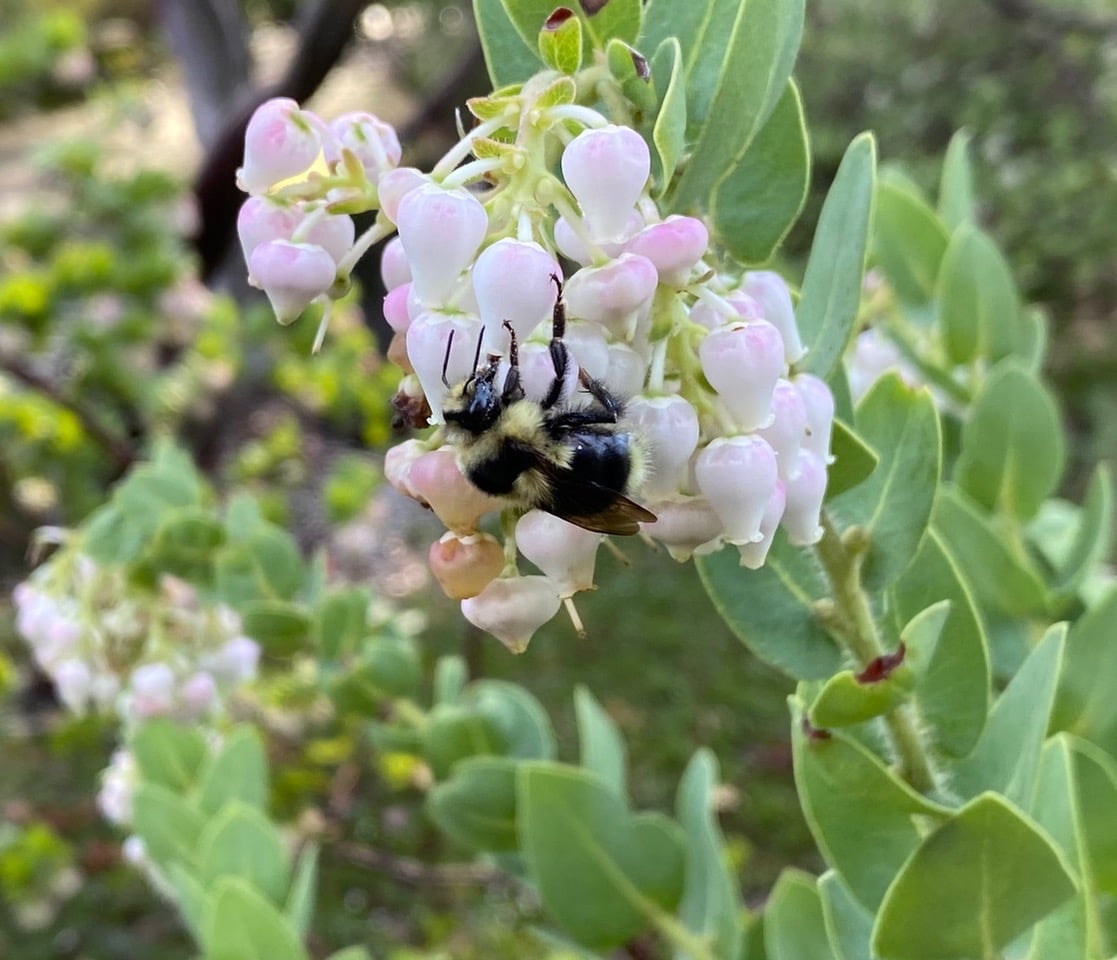
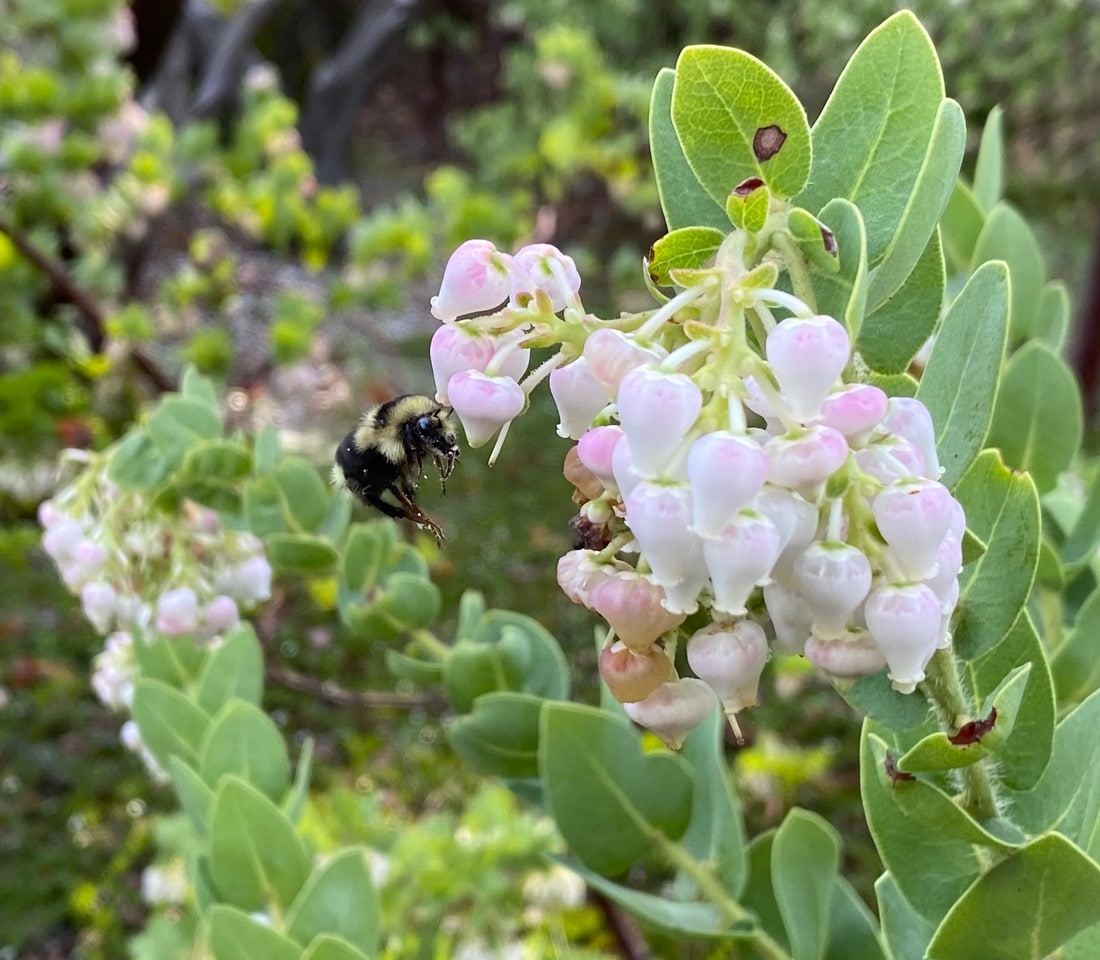
 Hey, Hey, I’m not the only one out here! A damp queen Black-tailed Bumble Bee, Bombus melanopygus (family Apidae) is foraging on a cluster of rain-soaked manzanita flowers.





Those of us with manzanitas in our garden would have noticed that the plant has been in bloom for a while, even before Christmas. Whenever the weather and air quality permitted, I have visited the Regional Parks Botanic Gardens through the later half of December to check for insect activity on the garden’s amazing diversity of manzanita. I thought I would start the year by reporting on my observations of these early bloomers, covering several visits. To keep the record straight, I am including the dates of the observations.
12/18/24
The East Bay Regional Parks Botanic Gardens in the hills of Berkeley is home to a wide variety of Manzanita, Arctostaphylos sp. (family Ericaceae). I am delighted that many of the hardy evergreen shrubs are already in full bloom on this cold but sunny morning.
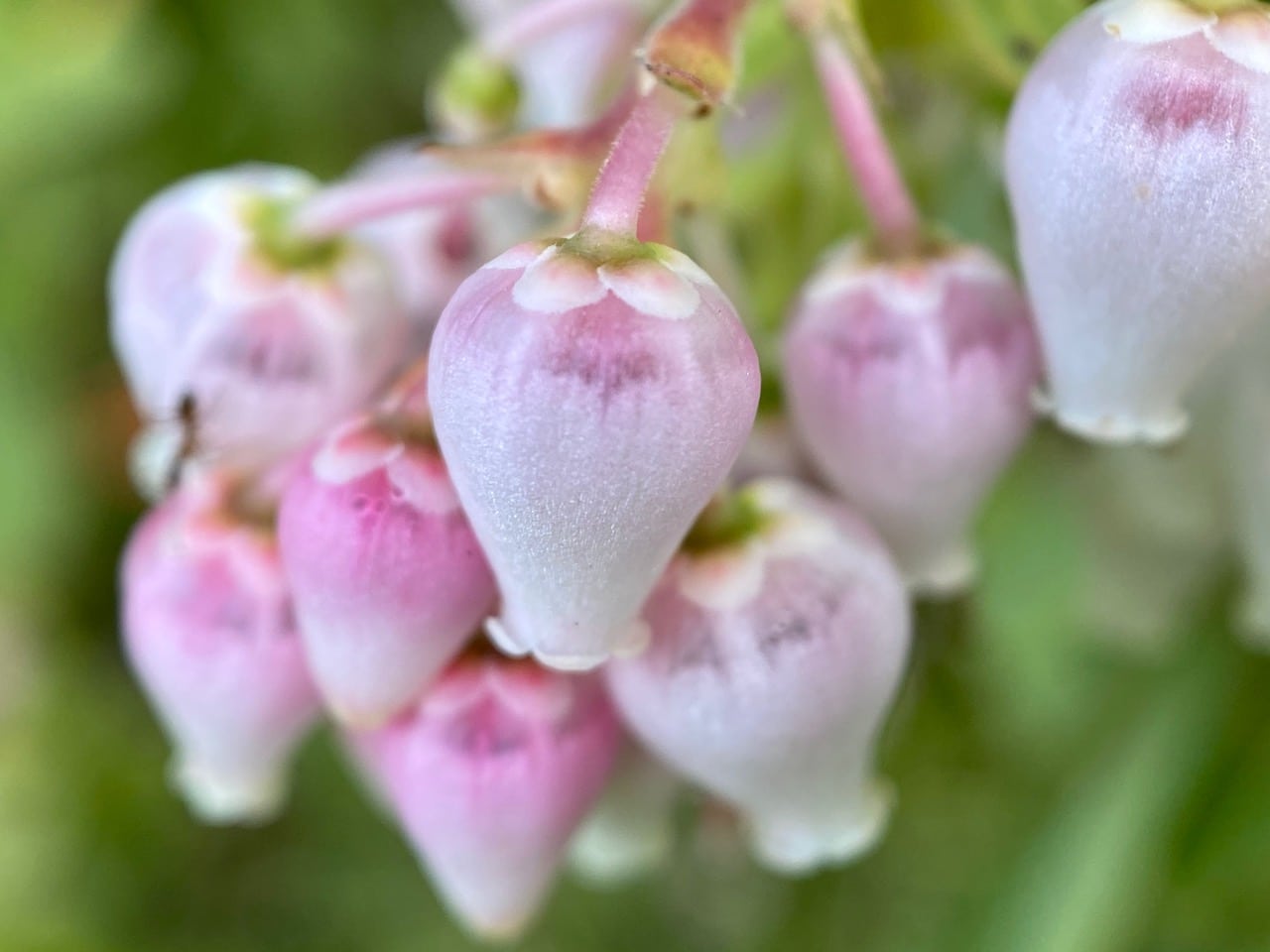
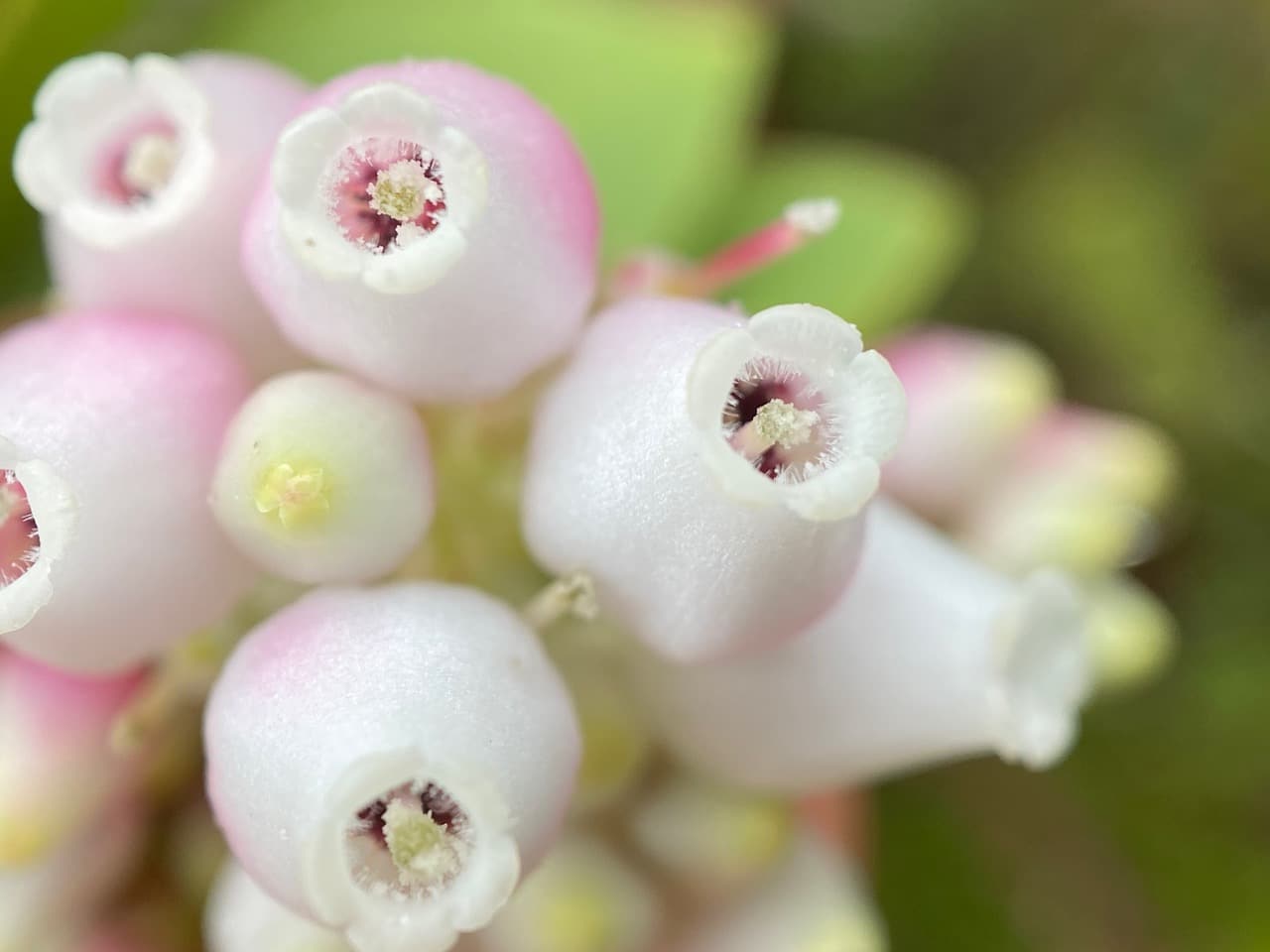
The manzanita flower is made up of fused petals that form an urn-shaped corolla, with a slightly flared opening. The flowers are usually small, white or tinged with pink, held upside-down and clustered together on the tips of branches, giving a showy display when blooming. The inverted urn-shaped corolla serves to protect the reproductive structures within through the rainy winter when the plant starts to bloom. The flowers are usually pollinated by bees shaking the pollen out through the tiny openings by sonication.
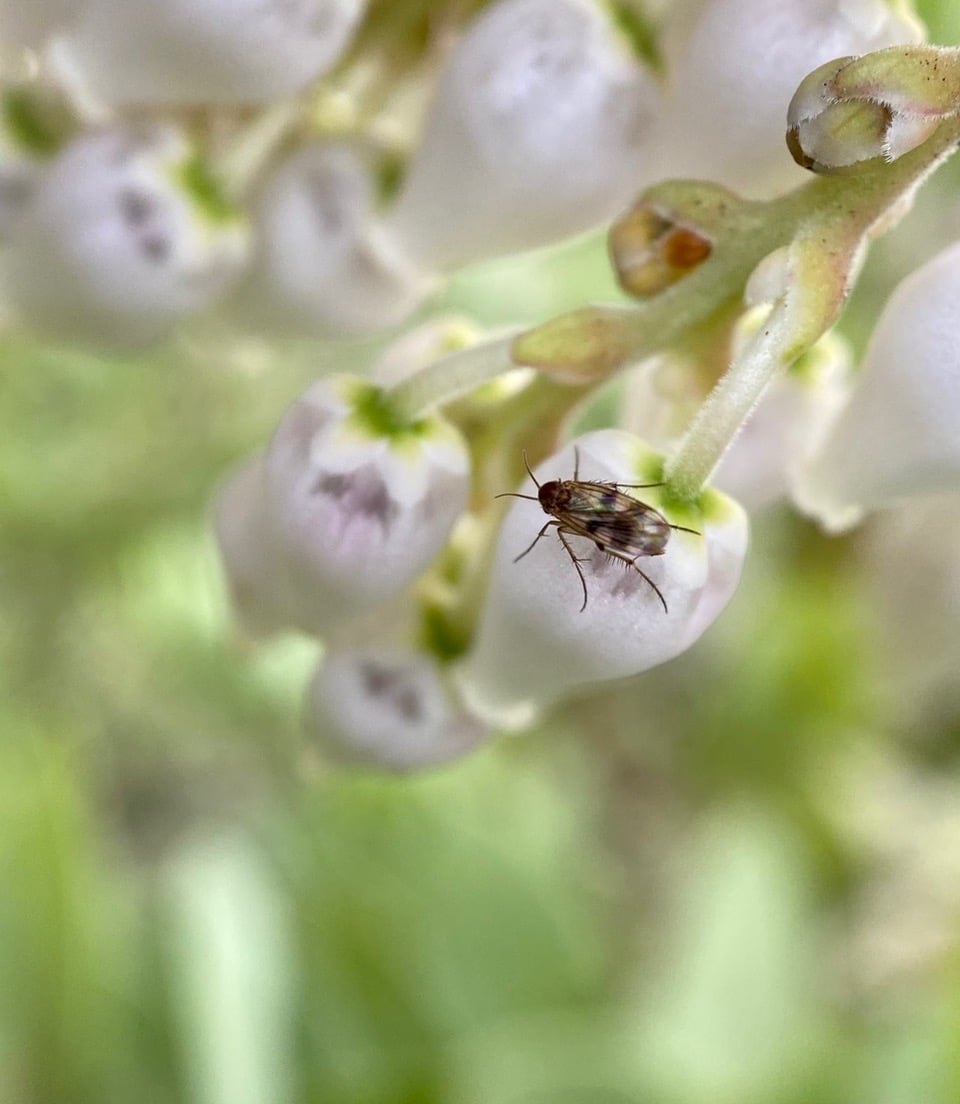
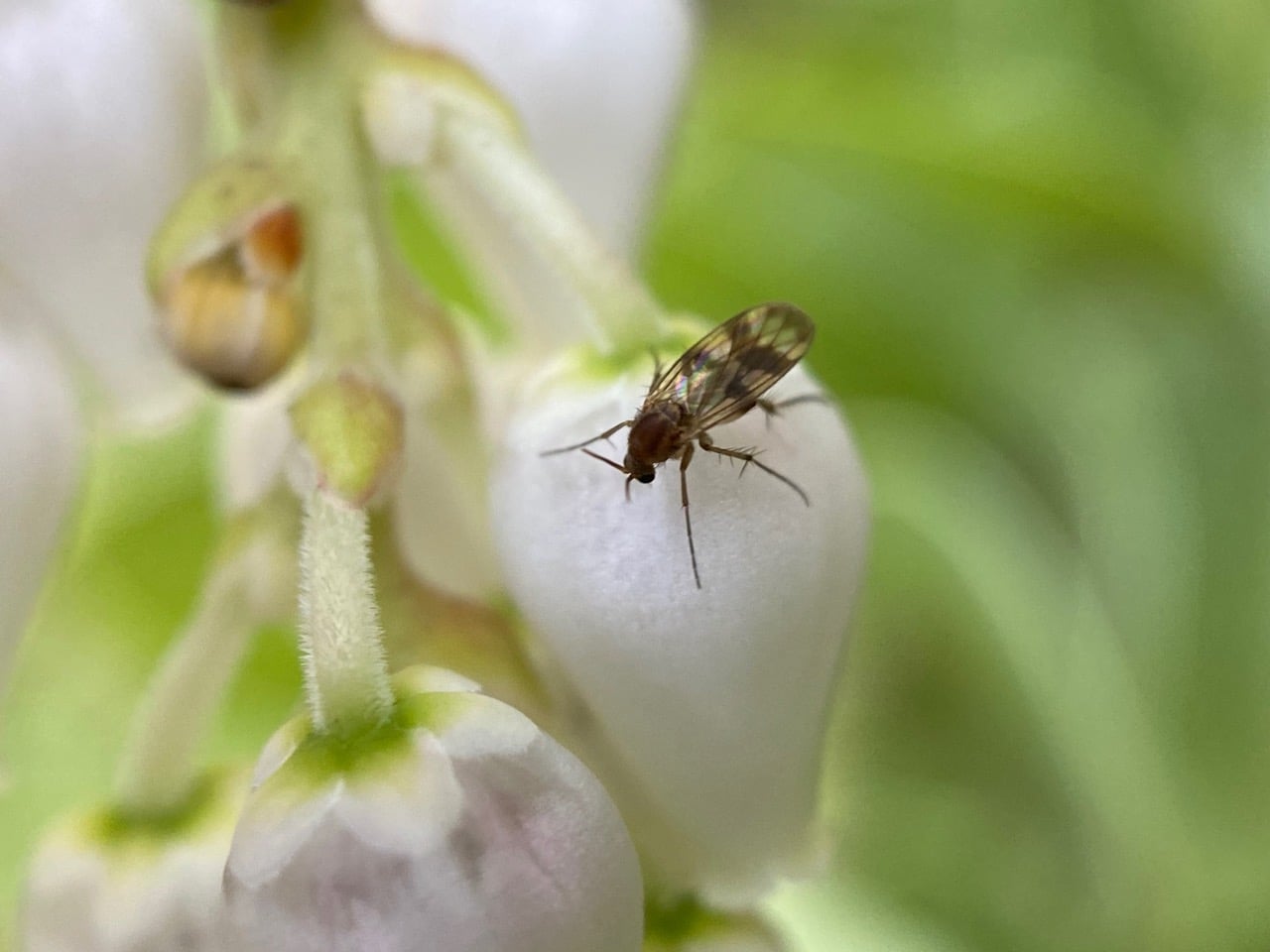
A small insect is perched motionless on a manzanita flower. It is a Fungus Gnat, genus Mycetophila (family Mycetophilidae).
The Mycetophilidae are a family of small flies, often known by their common name of Fungus Gnats. They are generally found in the damp habitats favored by their host fungi and sometimes form dense swarms. The delicate-looking flies are similar in appearance to mosquitoes. Adults have slender legs with segmented antennae that are longer than their head. Adult fungus gnats do not damage plants or bite people. Larvae, however, when present in larger numbers, can damage roots and stunt plant growth. Females lay tiny eggs in soil or moist organic debris. Most of the fungus gnat’s life is spent as a larva and pupa in organic matter or soil. There may be many overlapping generations each year. They are most common during winter and spring in California when water is more available and cooler temperatures prevail.
An Argentine Ant is exploring the exterior surface of a manzanita flower.
The Argentine Ant, Linepithema humile (family Formicidae) is native to Northern Argentina, but it has been inadvertently introduced by humans to many countries, and is now an established invasive species in many Mediterranean climate areas worldwide. The success of the species can be attributed to their lack of aggression between the colonies. There is no apparent antagonism between separate colonies of its own kind, resulting in “super-colonies” that extend across hundreds or thousands of kilometers in different parts of the their range. Genetic, behavioral, and chemical analyses show that introduced Argentine Ants on separate continents actually represent a single global supercolony.
The Argentine Ants are ranked among the world’s worst invasive animal species. In its introduced range, the Argentine ant often displaces most or all native ants and can threaten native invertebrates and even small vertebrates that are not accustomed to defending against the aggressive ants. This can, in turn, imperil other species in the ecosystem, such as native plants that depend on native ants for seed dispersal, or lizards that depend on native ants for food.
Many species of manzanita have flowers with translucent patches near the bases of their fused petals, forming window-like areas where sunlight may penetrate.
I wonder if the “windows” serve to let in sunlight to lure small insects that enter the flower to the base of the corolla where the reproductive structures are located. Some species of manzanita are known to be pollinated by tiny thrips. Additionally, do the windows create a sort of green-house effect within the flowers to help ripen the reproductive structures?
A queen Black-tailed Bumble Bee, Bombus melanopygus (family Apidae) is foraging on a cluster of Manzanita flowers. There’s pollen adhering to her legs, both front and back. If she is collecting pollen it would be neatly packed in the corbiculae of her hind legs only. The pollen on her is probably acquired unintentionally while probing for nectar. This early in the season, the queen bee is probably fresh out of hibernation, and has probably not produced a brood for which she has to collect pollen.
Bumble bees are social and live in colonial hives. Many of the large individuals seen early in the season are queens. They are the only members of their colony to survive the winter, hibernating until the days begin to warm and their host plants are in bloom. These queens have mated before they went into hibernation. Now their first order of business is to each find a nesting site (usually an abandoned rodent burrow), lay eggs, brood and nurture the first batch of workers. Hence forth, the queens stay behind in the hive to concentrate on laying eggs while the workers take on hive duties and foraging. Bumble bees are among the most cold tolerant bees, and are usually the first bees we see out foraging. This is why it’s important for us to plant early blooming natives to support the queen bumble bees.
The black tip of her abdomen gives the bee its common name of Black-tailed Bumble Bee.
Bombus melanopygus is a species of bumble bee native to western North America, widely distributed from the Pacific to the Rocky Mountains, and from Alaska to Baja California. The species is found in various habitats, including agricultural and urban areas. The bees feed on many types of plants, including manzanitas, Ceanothus, golden bushes, wild buckwheats, lupines, penstemons, rhododendrons, willows, sages, and clovers. They nest underground or aboveground in structures.
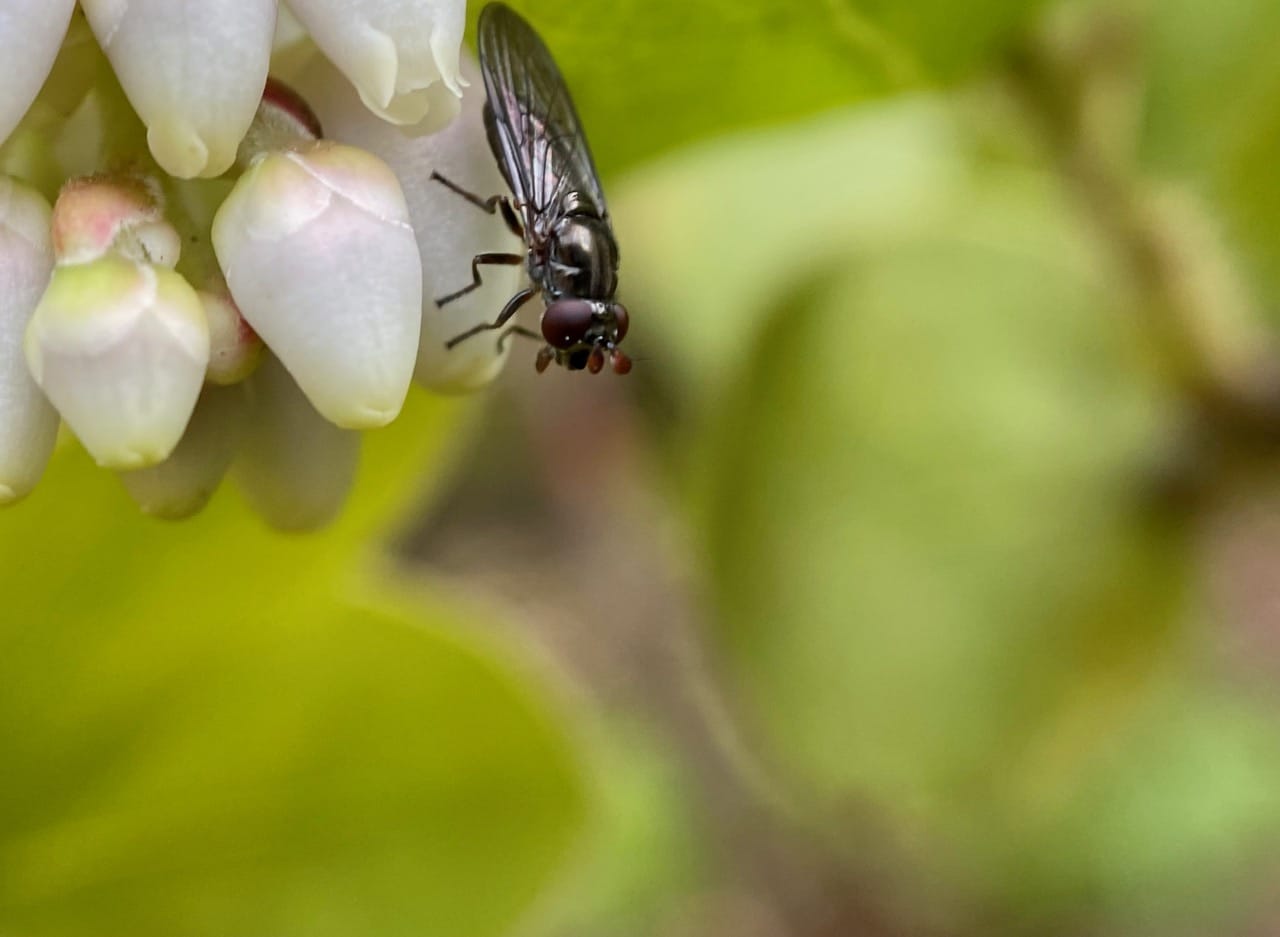
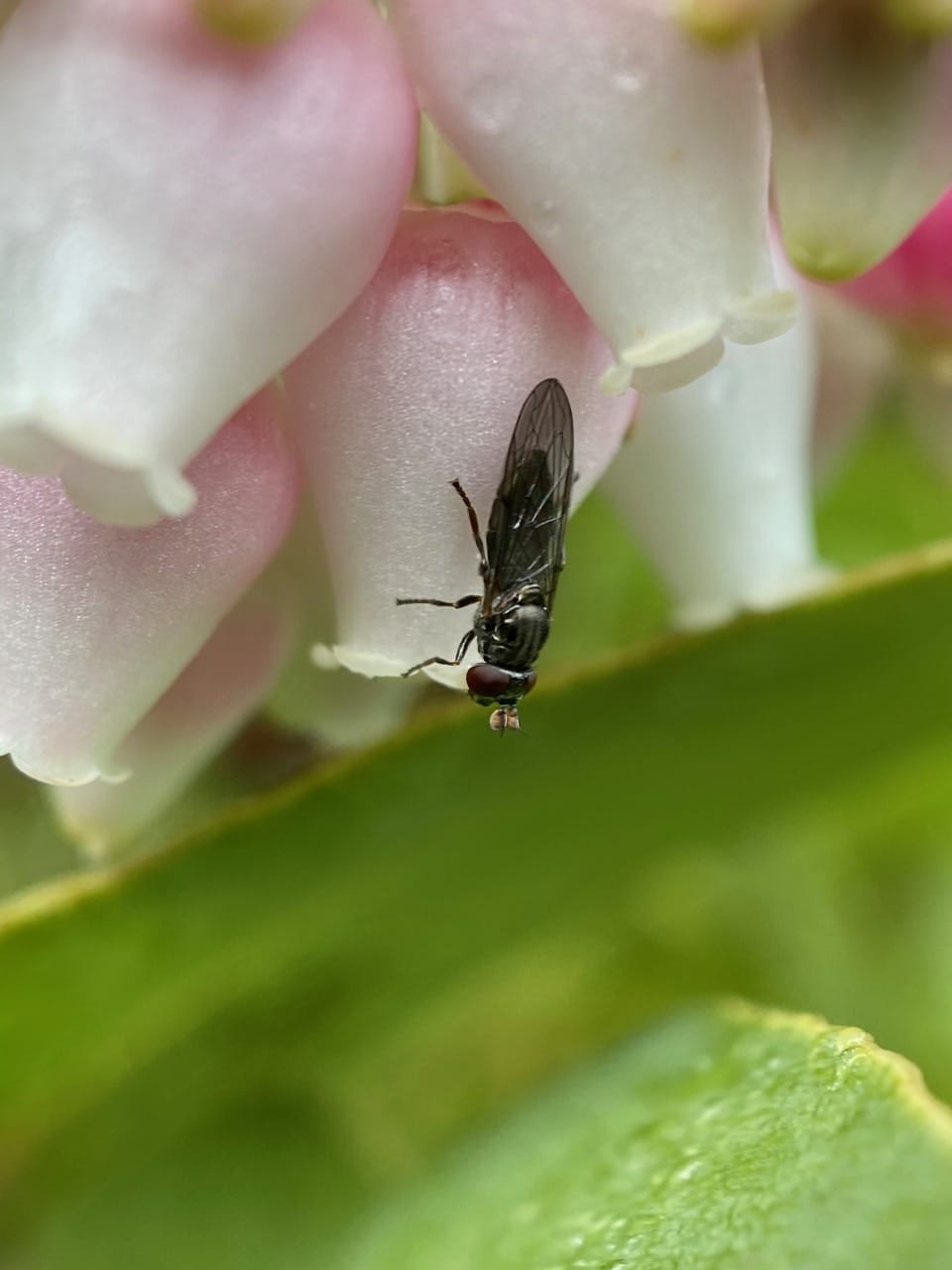
A dusky hover fly with a metallic sheen has landed on a cluster of Manzanita flowers. iNaturalist has identified it as a Bighorn Fly, Pelecocera sp. (family Syrphidae). The common name obviously refers to the large, greatly expanded paddle-shaped aristate antennae. The genus Pelecocera consists of small, narrowly-built hoverflies superficially resembling Platycheirus or Melanotstoma species in the field but of unclear affinity. Larva is undescribed, but apparently phytophagous. Yay, a new species of hover fly for me!
A closer look at the same fly.
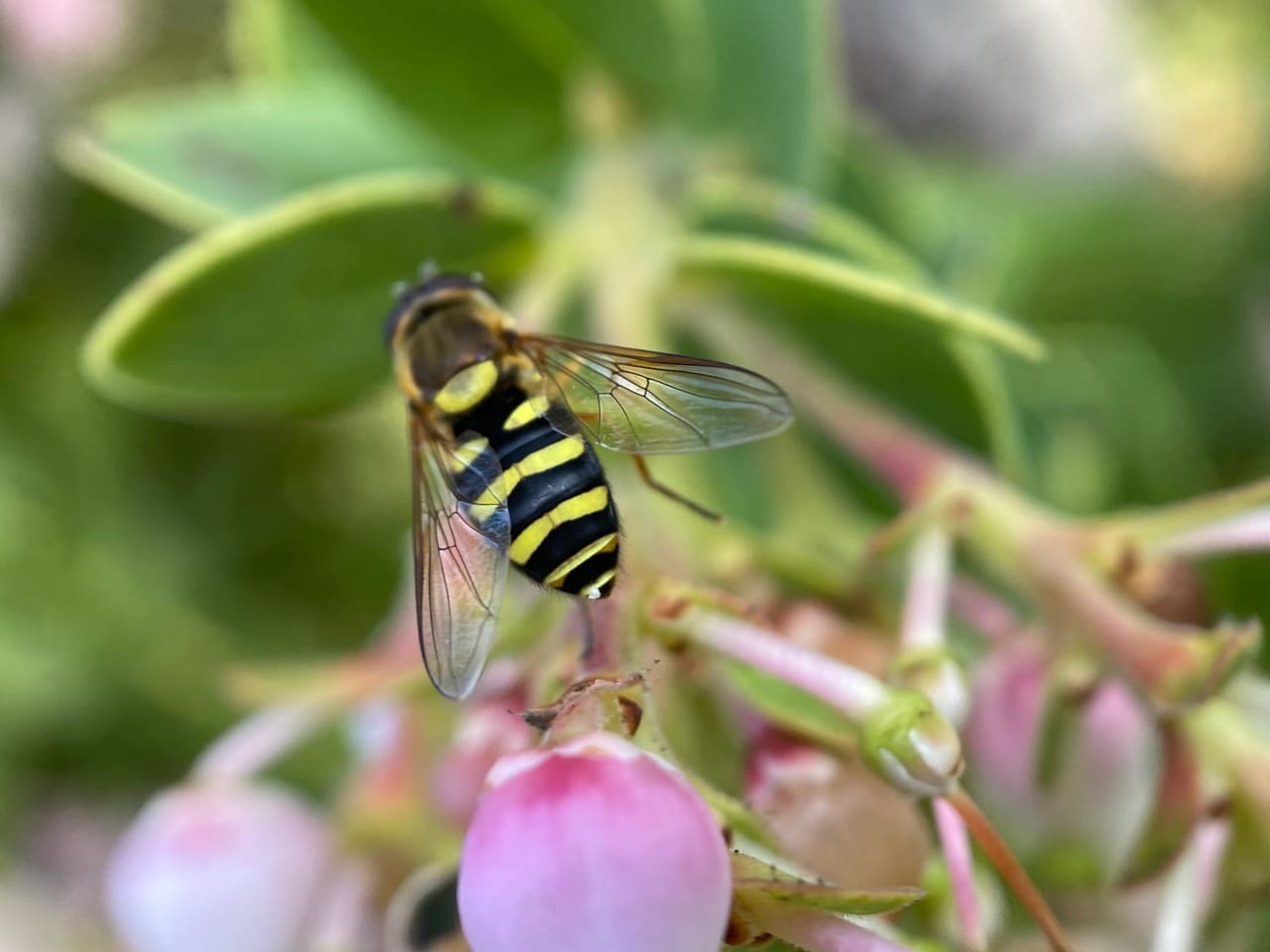
A black-and-yellow hoverfly suddenly comes into my view. It is a Black-margined Flower Fly, Syrphus opinator (family Syrphidae). Ooh, you can actually see the spurious vein on the wings!
Hoverflies are distinguished from other flies by having a spurious vein in the wing between the third (radius) and the fourth (media) longitudinal veins. The spurious vein is open on either end. It is not a true vein, but a thickening in the wing.
Hoverflies or syrphids, make up the insect family Syrphidae. As their common name suggests, they are often seen hovering or nectaring at flowers. The adults of many species feed mainly on nectar and pollen, while the larvae eat a wide range of foods. In some species, the larvae are saprotrophs, eating decaying plant and animal matter in the soil or in ponds and streams. In other species, the larvae are insectivores, preying on aphids, thrips, and other plant-sucking insects. Many species of hoverflies are mimics of stinging wasps and bees, a mimicry which may serve to ward off predators.
Syrphus opinator is the common species of hoverfly in central California, and has the abdominal fasciae restricted to the sides and isolated from the margins. Adults are 7-12 mm long and feed on nectar and pollen. The larvae feed on aphids and other small insects.
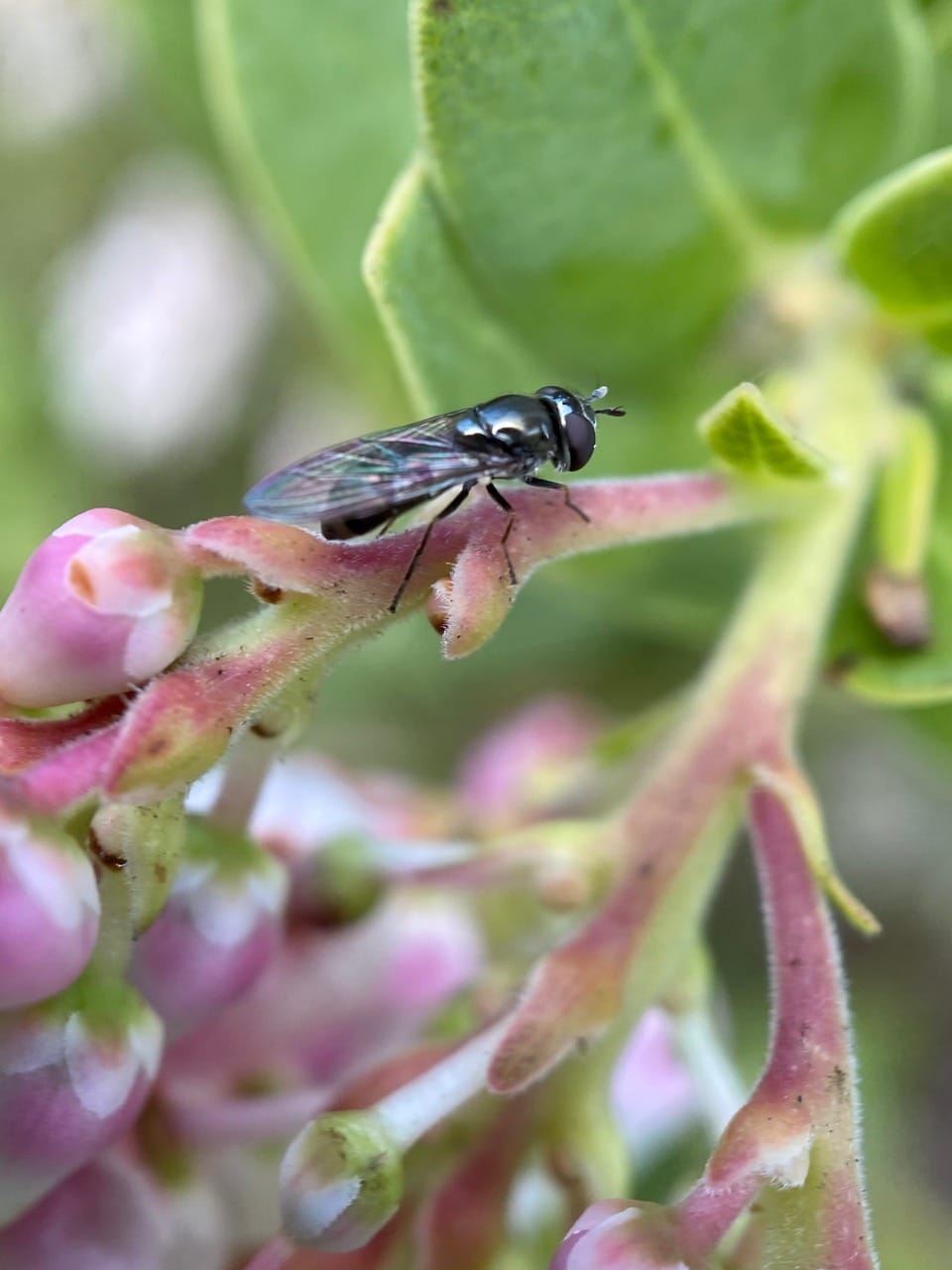
A Sedgesitter, Platycheirus sp. (family Syrphidae) is foraging on a cluster of Manzanita flowers.
Platycheirus is found in grass and herb vegetation. Adults of many species feed on pollen of wind-pollinated plants, such as Salix, Plantago, Poaceae, Cyperaceae, but they visit other flowers also. Many stay active during cold and rainy weather. Larvae feed on aphids.
It is a female, as its eyes do not meet on top of the head like the eyes of the males. This is an easy way to tell the genders apart in hoverflies.
Hanging upside-down, a Black-tailed Bumble Bee, Bombus melanopygus (family Apidae) is foraging on a cluster of Manzanita flowers. The pollen baskets (corbiculae) on her hind legs are empty, so the bee is not collecting pollen. She is quietly taking nectar. I am not hearing the high-pitched buzzing sounds that bumble bees emit while buzz pollinating.
To collect pollen, bumble bees perform sonication or “buzz pollination”. Hanging upside-down on the manzanita flower, they disengage their wings from the flight muscles; then the muscles are vibrated at a specific high frequency to cause the pollen to shake loose and to fall down onto the bee’s belly. The bee gathers the pollen into the pollen baskets on her hind legs before returning to her hive.
On to the next flower! Note that there’s pollen adhering to the bee’s tongue and legs. Even without sonicating the flowers, the bee is apparently capable of transferring pollen between flowers.
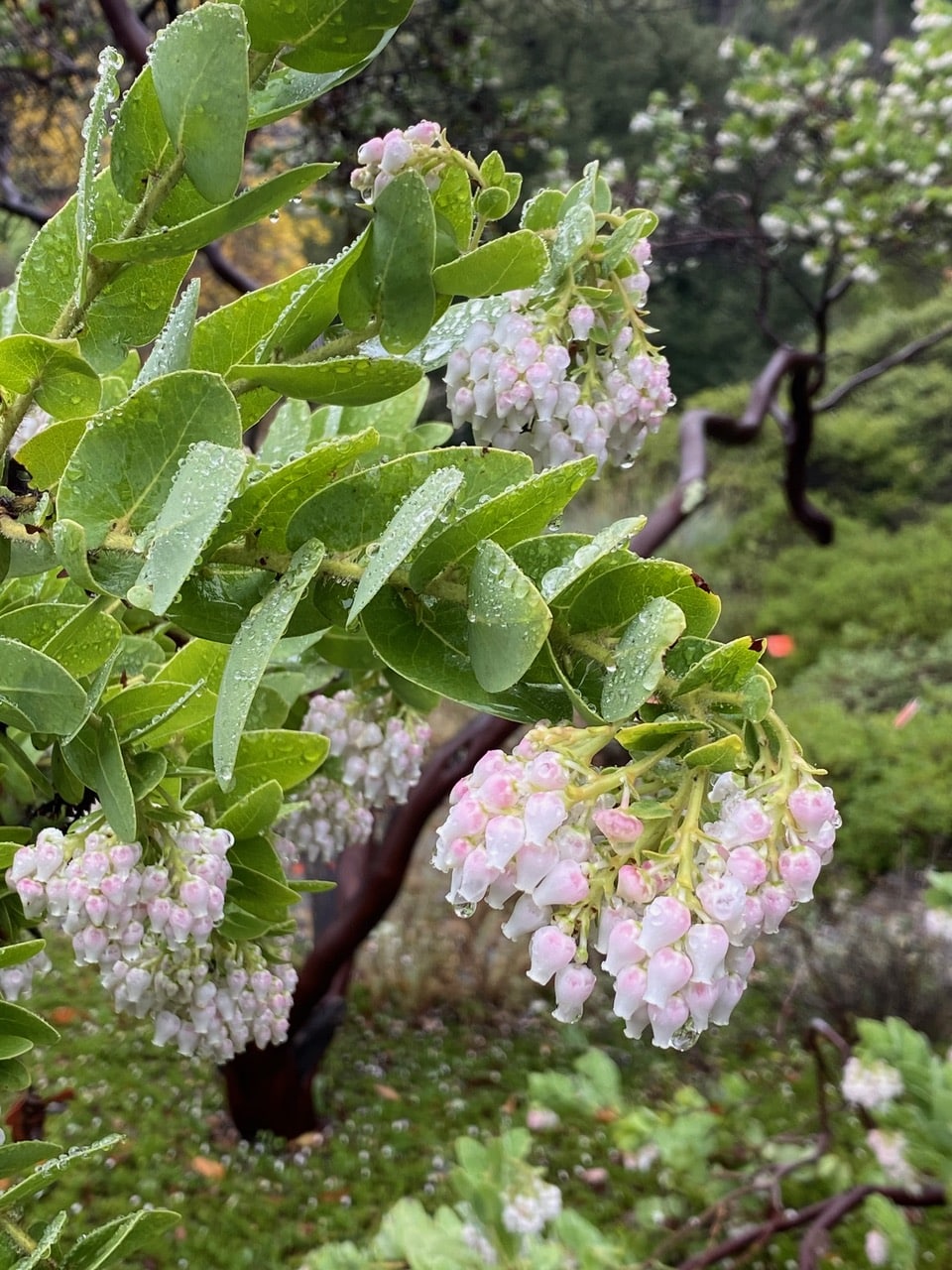
12/22/24 I am back at the Regional Parks Botanic Gardens first thing after a series of rain storms. What am I thinking? What self-respecting insects would be out in these wet conditions?
Hey, Hey, I’m not the only one out here! A damp queen Black-tailed Bumble Bee, Bombus melanopygus (family Apidae) is foraging on a cluster of rain-soaked manzanita flowers. Argentine Ants are moving in and out of the manzanita flowers. These down-ward pointing urn-shaped flowers are probably the best shelter that small insects can find during California’s wet winter. There’s also nectar and pollen inside – B & B!
Has the rain stopped yet?
Wait, isn’t that a Bighorn Fly, Pelecocera sp. (family Syrphidae)? These hover flies are apparently tolerant of cold and wet weather.
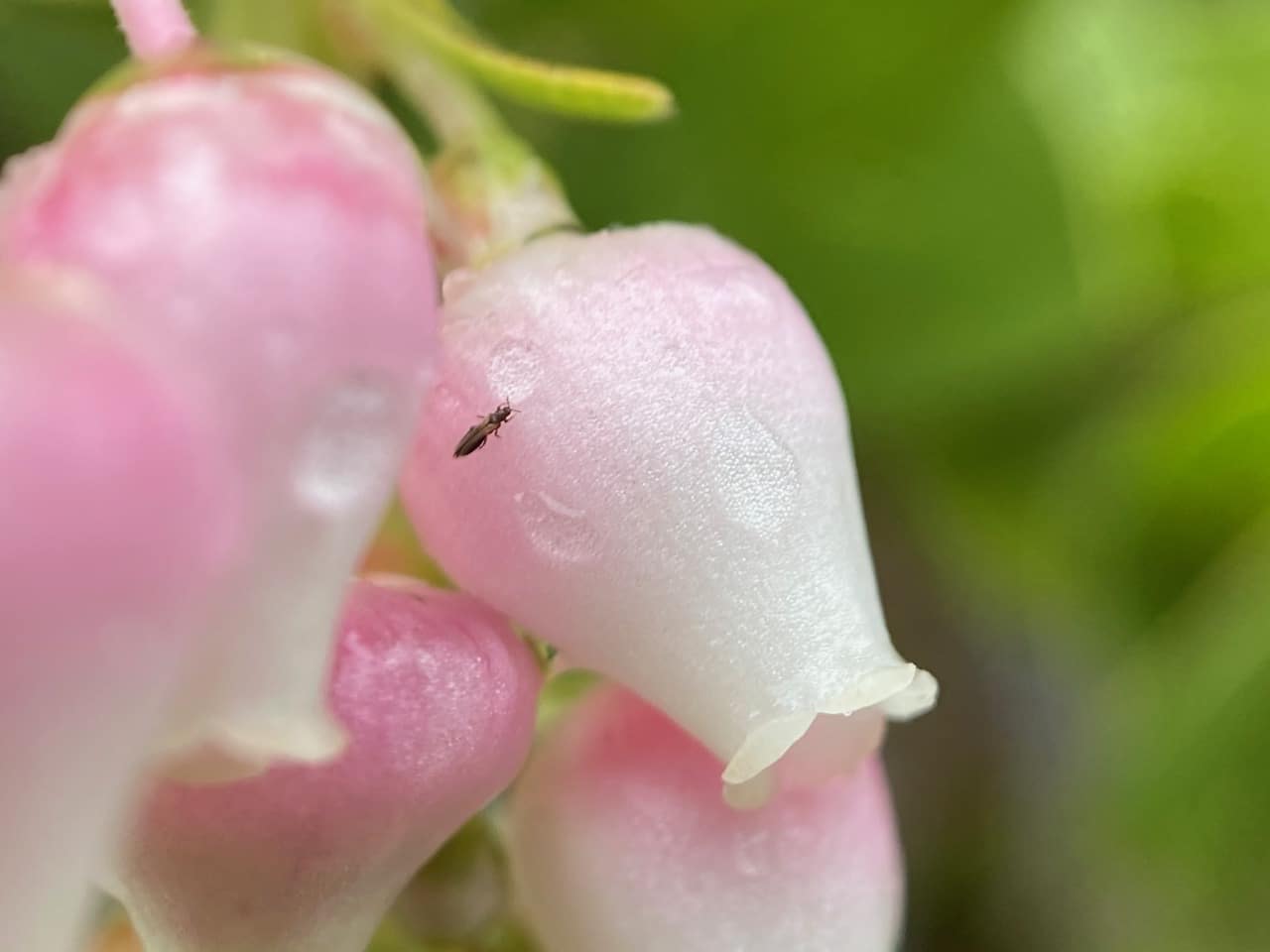
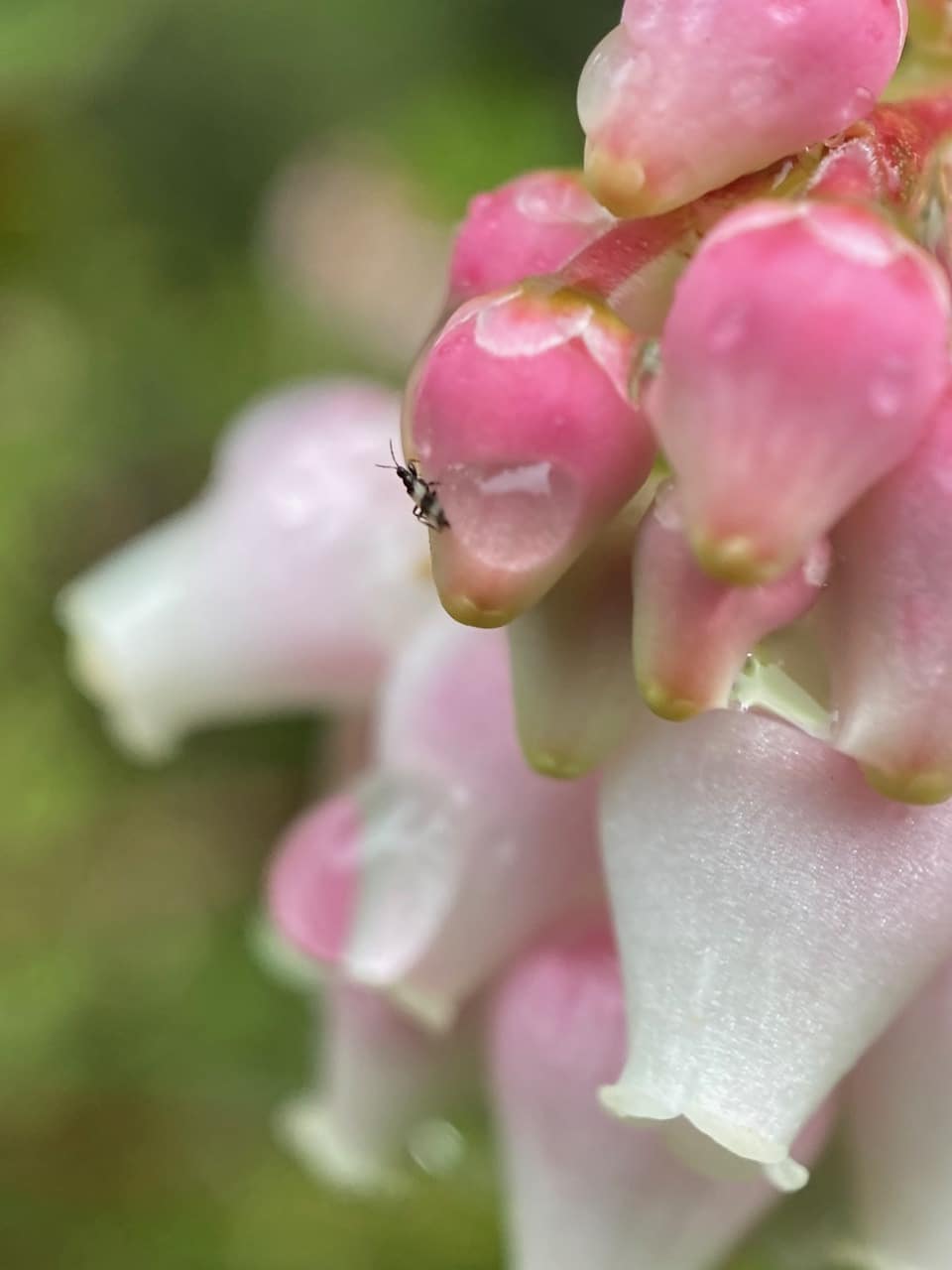
Barely visible to the naked eye a Thrips is perched next to a rain drop on a manzanita flower. An entomologist on iNaturalist has helped identify the thrips to the suborder Terebrantia, consisting of herbivorous thrips.
Thrips (order Thysanoptera) are minute (mostly 1 mm long or less), slender insects with fringed wings and unique asymmetrical mouthparts. They feed mostly on plants by puncturing and sucking up the contents, although a few are predators. Some flower-feeding thrips pollinate the flowers they are feeding on, and some scientists believe that they may have been among the first insects to evolve a pollinating relationship with their host plants. A genus is notable for being the specialist pollinator of cycads. Thrips are likewise the primary pollinators of heathers in the family Ericaceae, and play a significant role in the pollination of pointleaf manzanita. Electron microscopy has shown thrips carrying pollen grains adhering to their backs, and their fringed wings are perfectly capable of allowing them to fly from plant to plant.
BTW, there’s no such thing as a “thrip”. It’s always “thrips”, singular or plural!
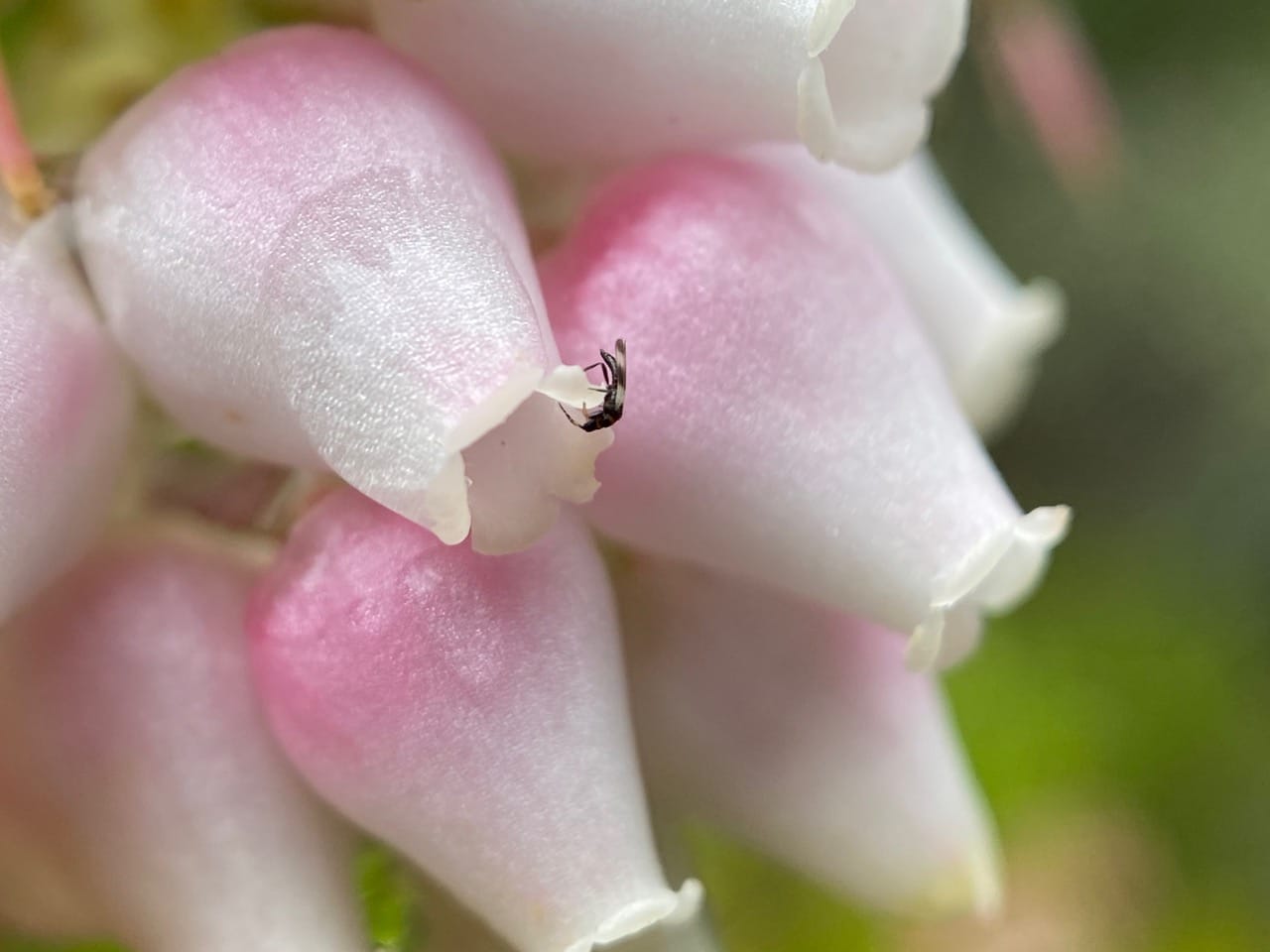
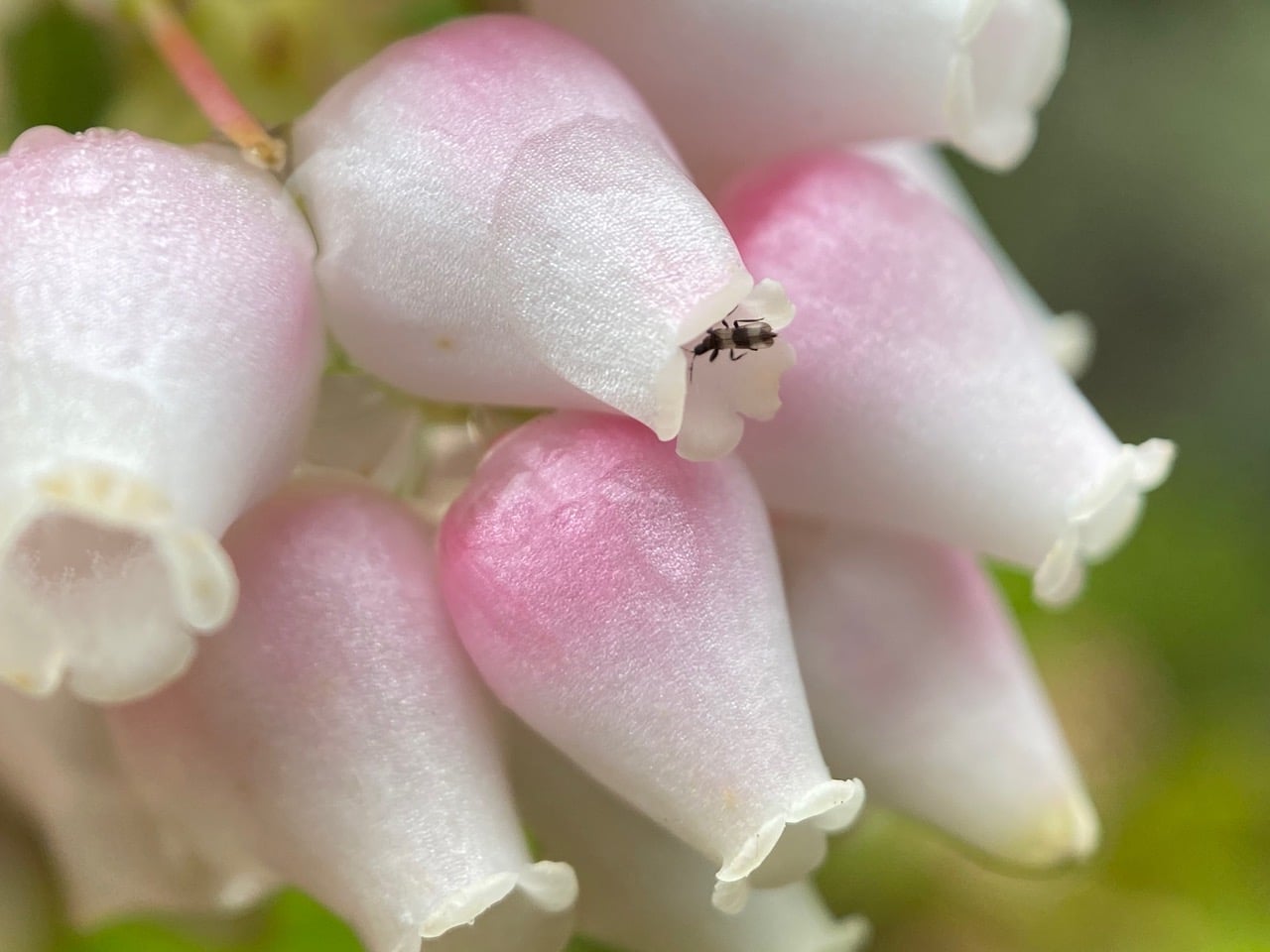
Hey, there’s another thrips on another manzanita flower! It is slightly larger, and has black-and-white banded wings. It is an Aeolothrips Predatory Thrips.
Predatory thrips are generally larger than the herbivorous thrips, about 1.5-2.5 mm long. Aeolothrips can be found whenever their prey occur. They are thought to be predaceous on small arthropods, such as plant-feeding thrips and spider mites. At least some species also feed on pollen and other arthropods, such as aphids and whiteflies.
The predatory thrips approaches the opening of the manzanita flower….
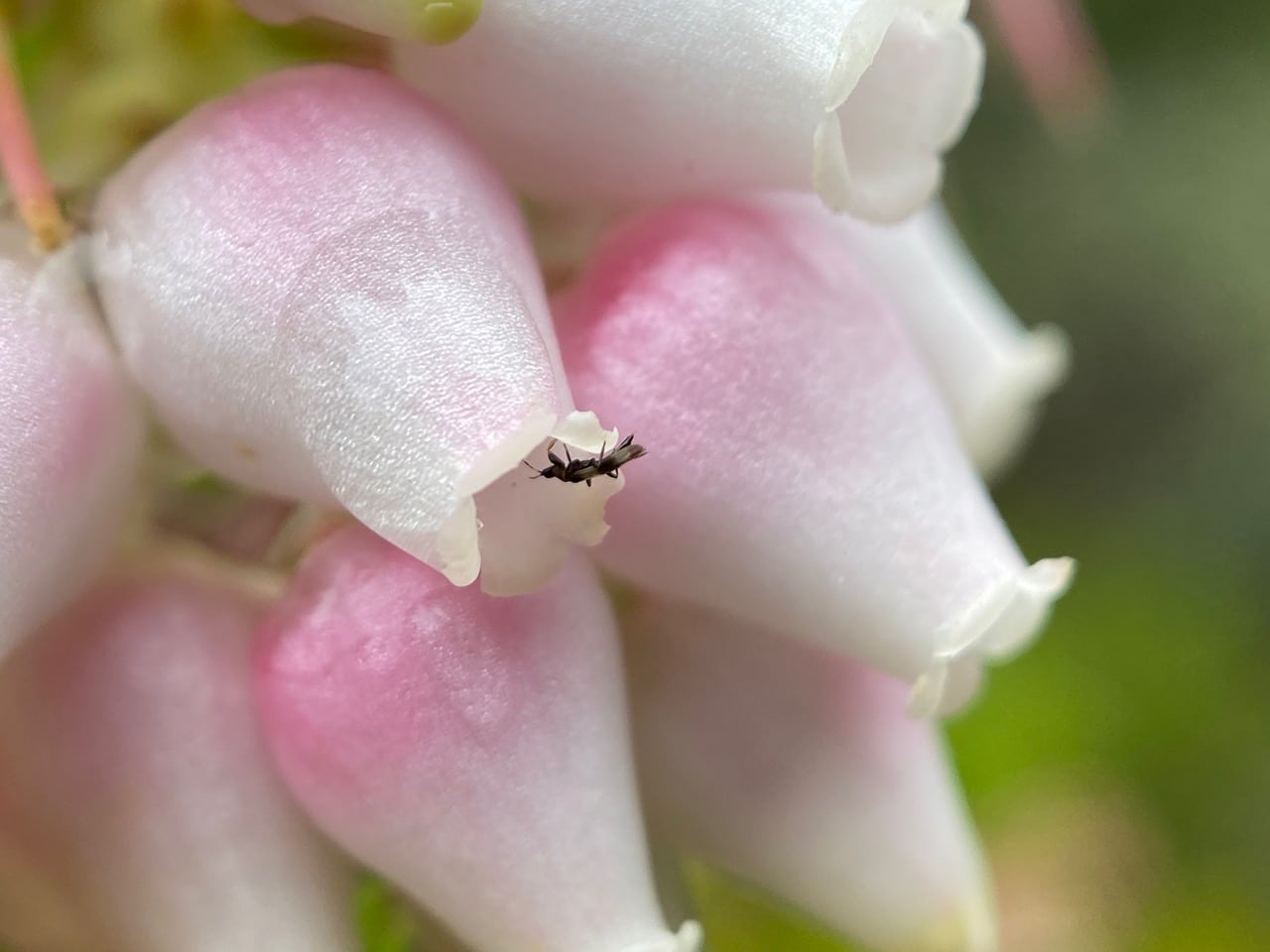
The predatory thrips disappears into the corolla of the manzanita flower. Maybe it has detected the presence of its prey inside?
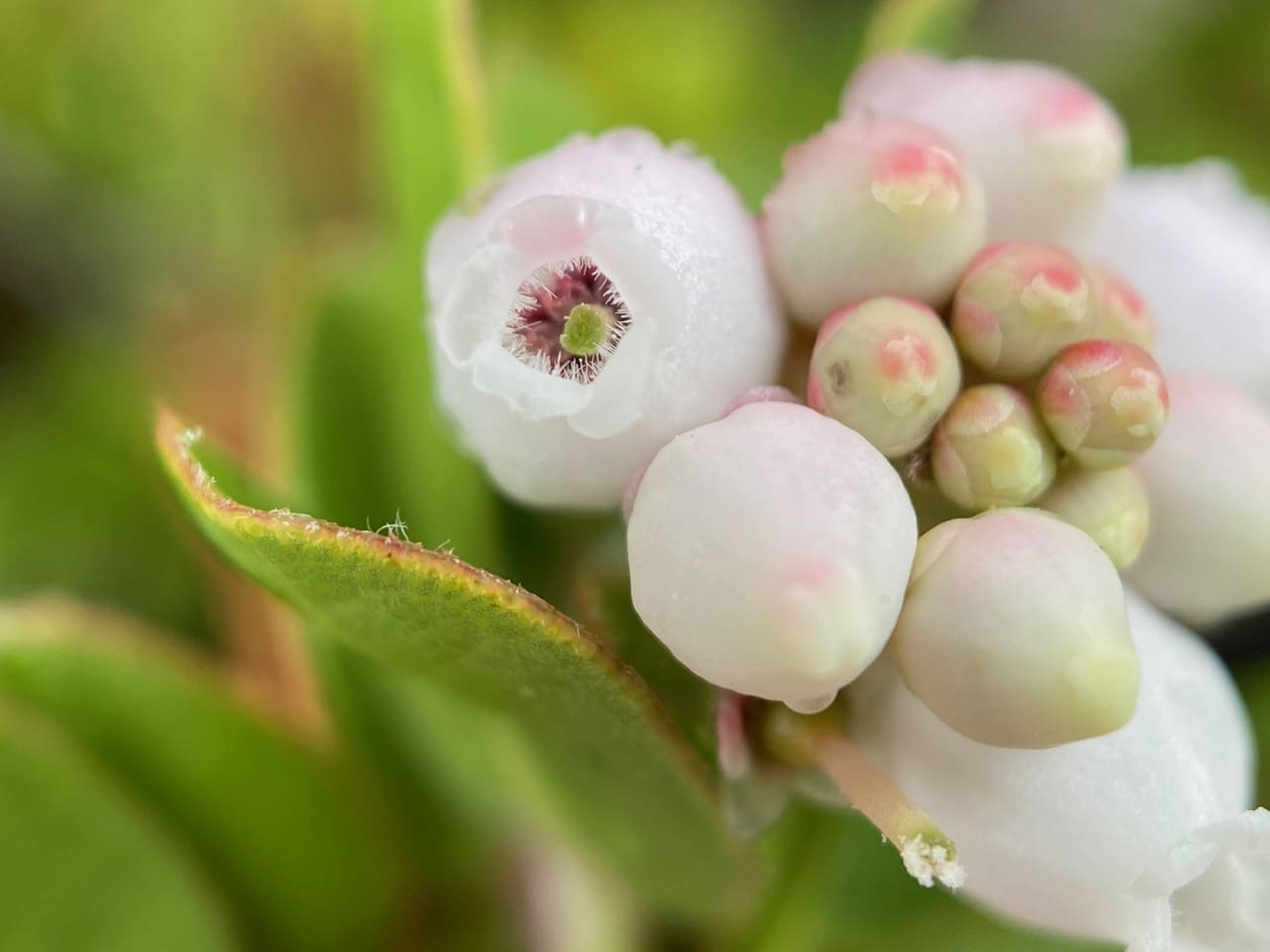
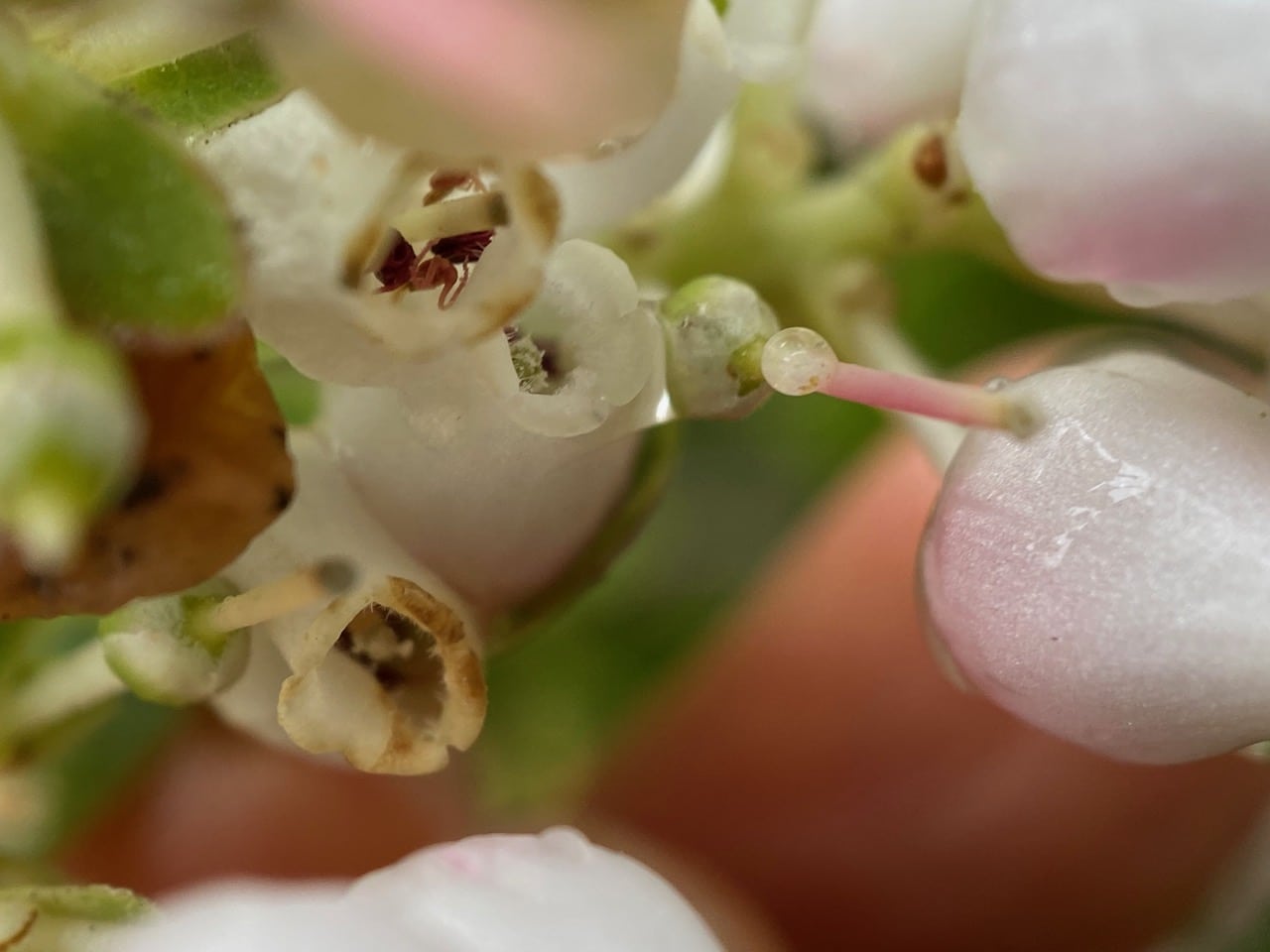
I turn over a cluster of manzanita flowers to peer inside. Behind the opening of the urn-shaped flower is a wall of short stiff hairs. The sturdy style in the center is topped by a green stigma, just short of the opening of the corolla.
There is an image of a sagittal section of the manzanita flower, as well as close-ups of the unusual stamens in this excellent article: Manzanitas and Buzz Pollination — San Bruno Mountain Watch
Pollen grains seem to be sticking to the stigma and hairs of these manzanita flowers. Did this result from a bee buzz-pollinating the flowers? How, then, does a manzanita flower prevent self-pollination? Perhaps the male and female reproductive structures mature at different times – dichogamy?
Focusing past the hairs, I can see the maroon-colored anthers near the base of the corolla.
In the older, fading flowers in which most of the hairs have disappeared, I can see the manzanita flower’s unusual stamens – anthers with appendages that maintain contact with the corolla. This arrangement apparently enhances the transmission of vibrations emitted by the bees during sonication or buzz pollination to extract pollen.
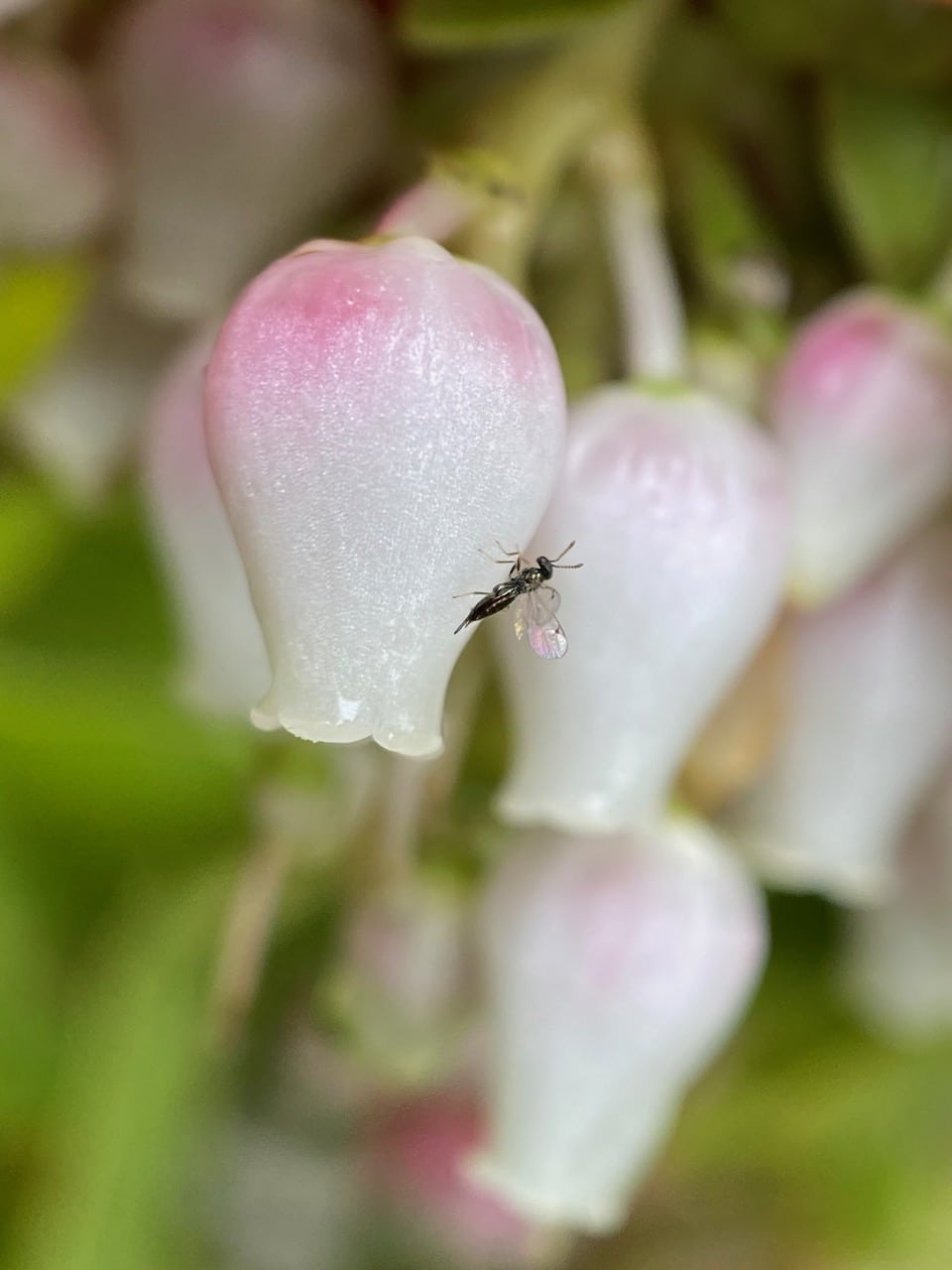
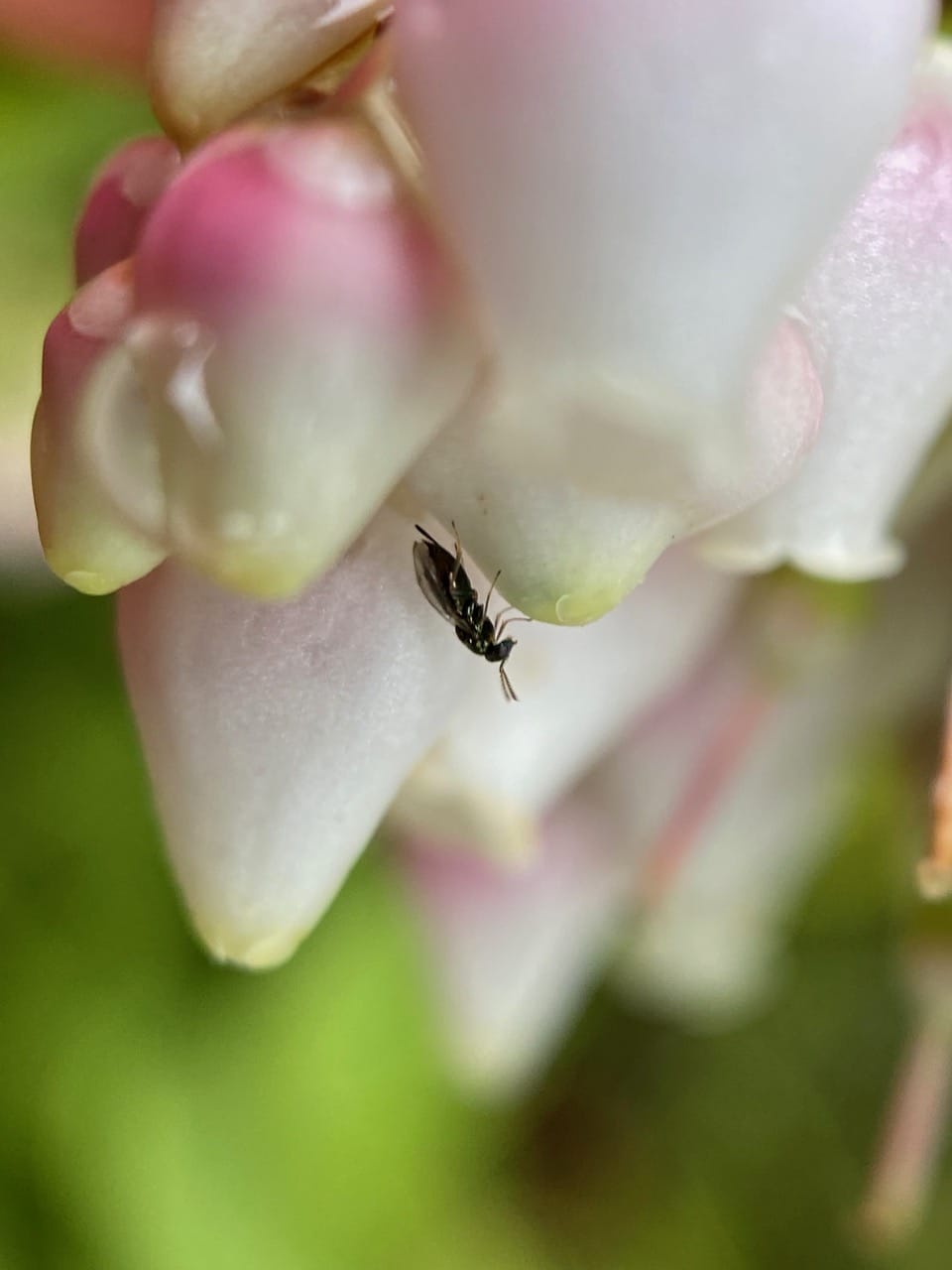
A tiny parasitoid wasp is perched on a manzanita flower. iNaturalist has identified it as a member of the family Pirenidae (superfamily Chalcidoidea).
Most Chalcid species are parasitoids of other insects, attacking the eggs or larval stage of their host, though many other life cycles are known. These hosts are to be found in at least 12 different insect orders including Lepidoptera (butterflies and moths), Diptera (true flies), Coleoptera (beetles), Hemiptera (true bugs), and other Hymenoptera, as well as two orders of Arachnida. When the host is itself a parasitoid, the wasps are referred to as hyperparasitoids. Generally beneficial to humans as a group, chalcidoids help keep various crop pests under control, and many species have been used as biocontrol agents.
Members of the family Pirenidae are parasitoids or hyperparasitoids of insect eggs and larvae.
The wasp suddenly lifts its wings, giving me a better look at their venation or lack there of. Members of the superfamily Chalcidoidea are characterized by reduced or absent wing venation; forewings with two or fewer cells enclosed by tubular veins; sometimes fore wings with no venation at all.
The wasp appears to be female, with a prominent ovipositor that she uses to deposit eggs in host eggs or larvae.