

Pollinator Post 9/9/23
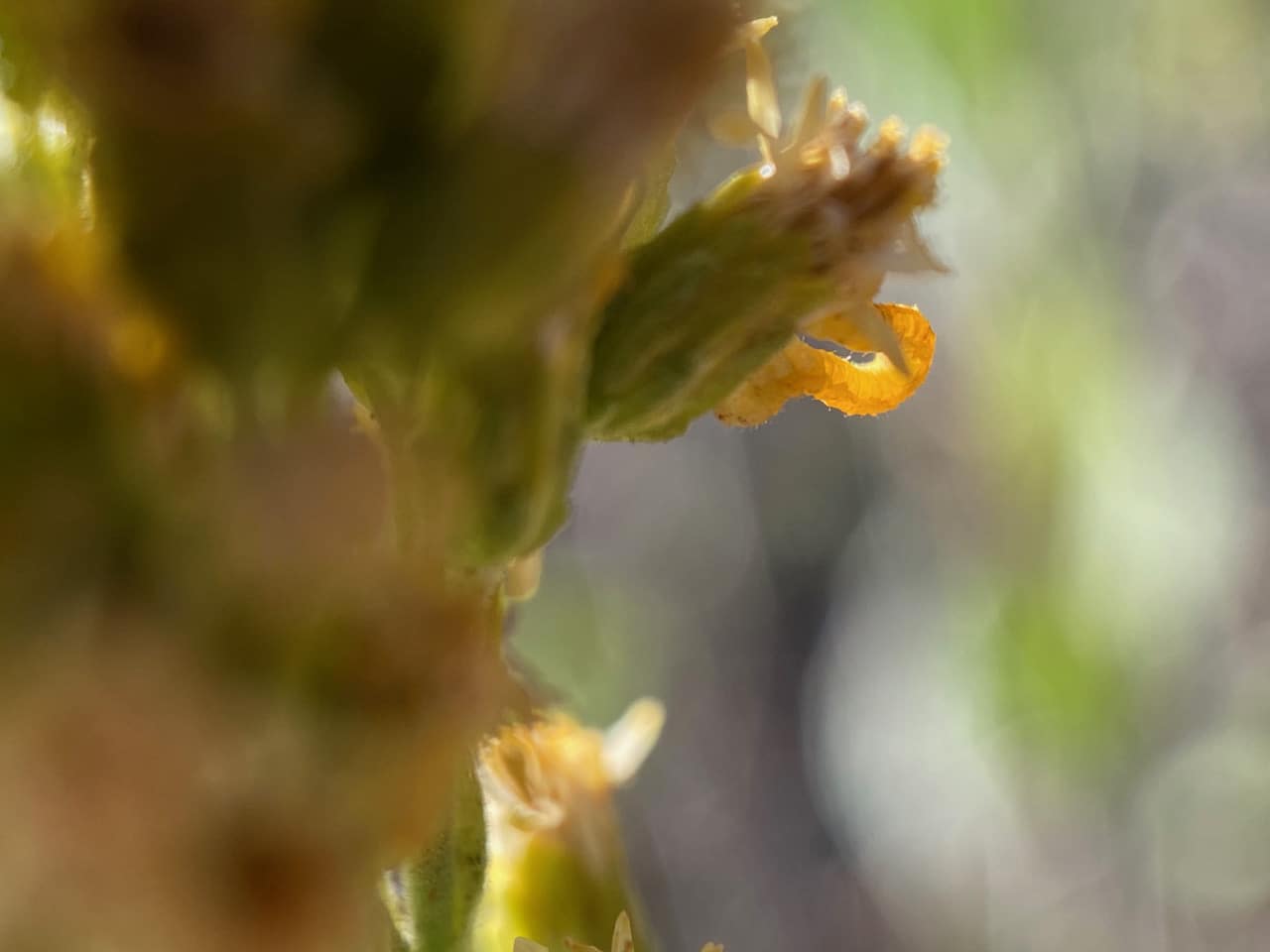 A tiny yellow Inchworm is resting on a senescing flowerhead of California Goldenrod, Solidago velutina ssp. californica.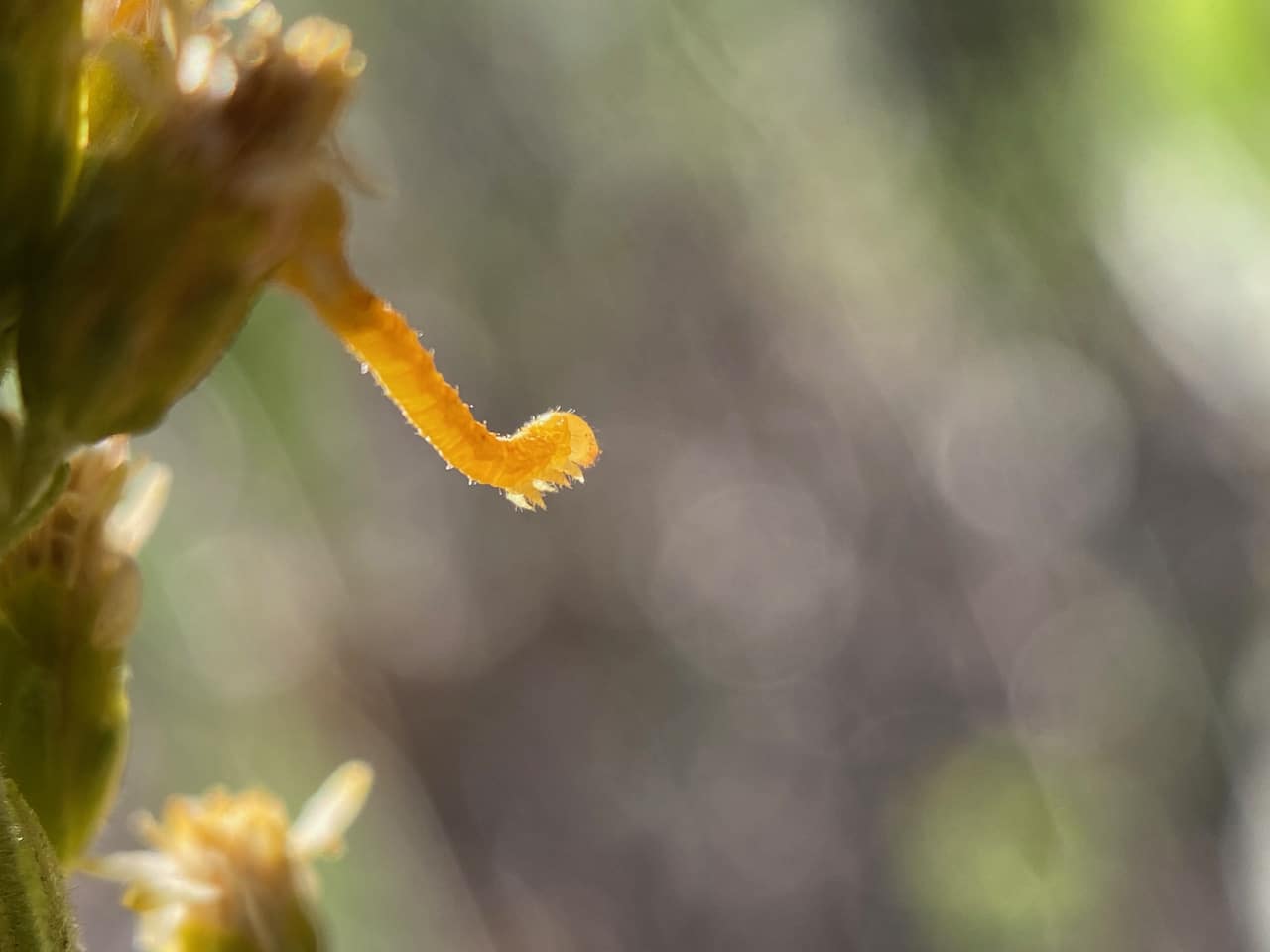
Inchworms are also called loopers and measuring worms. They majority of the inchworms are the larvae of moths in the family Geometridae. The name comes from the Greek “geo” for earth and “metro” from measure, because the caterpillars seem to be measuring the surface on which they are walking.
All caterpillars have three pairs of jointed legs behind their heads. These legs are called true legs because they will become the six legs of the adult butterfly or moth. There are additional appendages, called prolegs, along their bodies. Prolegs are not true legs, they are just outgrowths of the body wall and will be lost at metamorphosis. They have little hooks on their soles to help the caterpillar walk and grip onto things.
Most caterpillars have five sets of prolegs, four in the middle of the body and one pair at the hind end. Inchworms have the normal six true legs but only two or three pairs of prolegs, all located at the tail end of the body, with none in the middle. When an inchworm walks, it moves its tail-end prolegs up behind its true legs, causing the center of its body to loop upward. Then it stretches its front end forward to take another step.
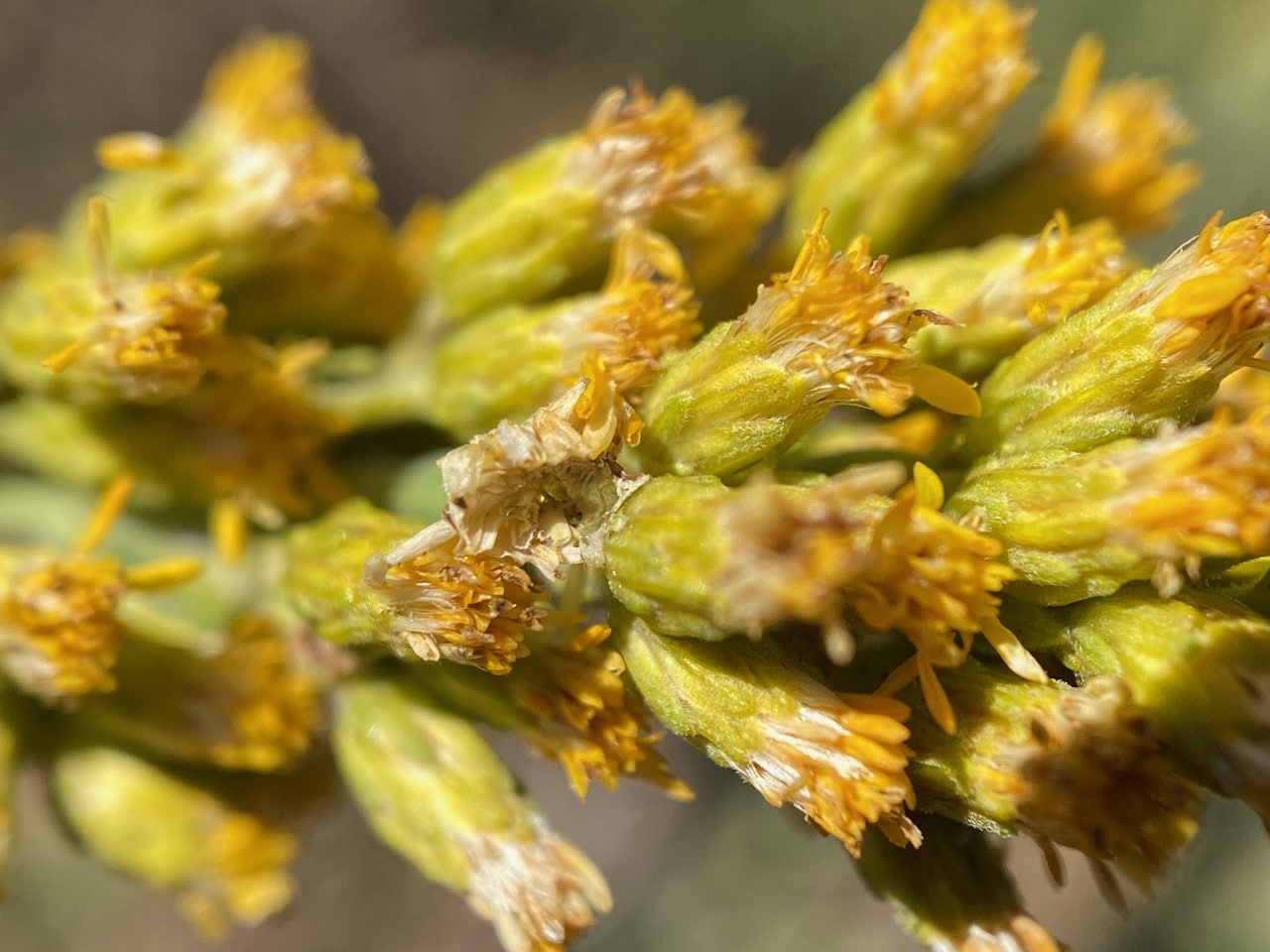
I look for the Camouflaged Loopers on the goldenrod inflorescences on which I have found them a few days ago. Looper #1 is no longer on its inflorescence. Looper #2 , its disguise rather faded, is motionless in its inverted U-shaped position on the involucre of a flowerhead. Is it still alive?
The Camouflaged Looper is the larva of the Wavy-lined Emerald Moth, Synchlora aerata (family Geometridae), a species found throughout much of North America. The larvae feed on many plants in the family Asteraceae, as well as a variety of other flowering plants. The Camouflaged Loopers are well known for covering themselves with the plant they feed on. The caterpillar chews off small pieces of flower petals, seed heads, leaves, whatever plant material is available, and attaches the pieces to its back with a little silk from the spinnerets beneath the caterpillar’s mouth. The disguise helps protect them from hungry predators such as birds and wasps.
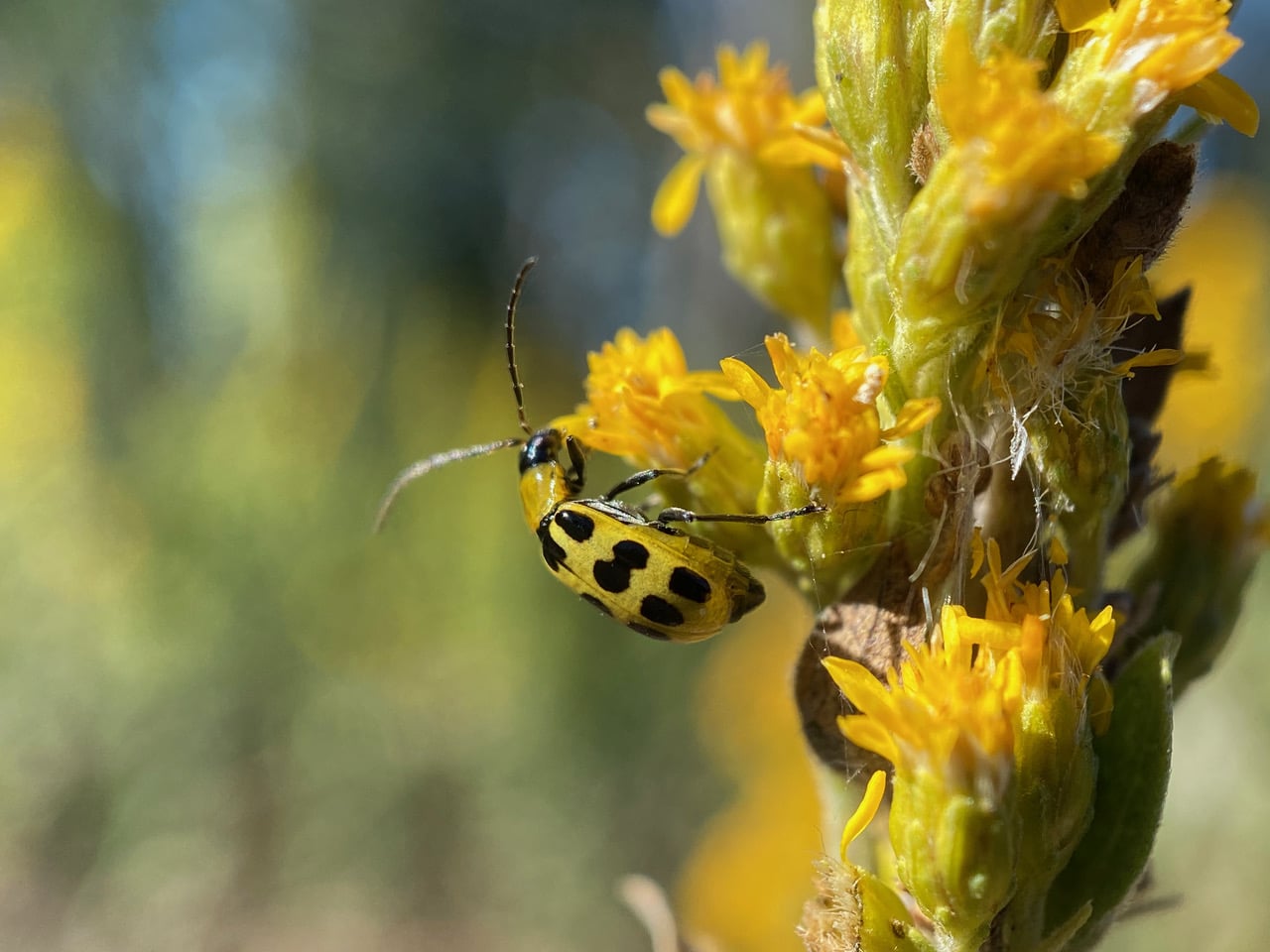
A Spotted Cucumber Beetle, Diabrotica undecimpunctata (family Chrysomelidae) is feeding on the flowers of California Goldenrod.
Members of the family Chrysomelidae are commonly known as Leaf Beetles. Adults and larvae feed on all sorts of plant tissues, and all species are fully herbivorous. Many are serious pests of cultivated plants, including food crops. Others are beneficial due to their use in biocontrol of invasive weeds. Chrysomelids are popular among insect collectors, as many are conspicuously colored, typically in glossy yellow to red or metallic blue-green hues, and some have spectacularly bizarre shapes. Photos of Leaf Beetles (Family Chrysomelidae) · iNaturalist
Native to North America, the Spotted Cucumber Beetle can be a major agricultural pest, causing damage to crops in the larval as well as adult stages of their life cycle. Larvae, sometimes known as rootworms feed on the roots of emerging plants. In the adult stage the beetles cause damage by eating the flowers, leaves, stems and fruits of the plant.
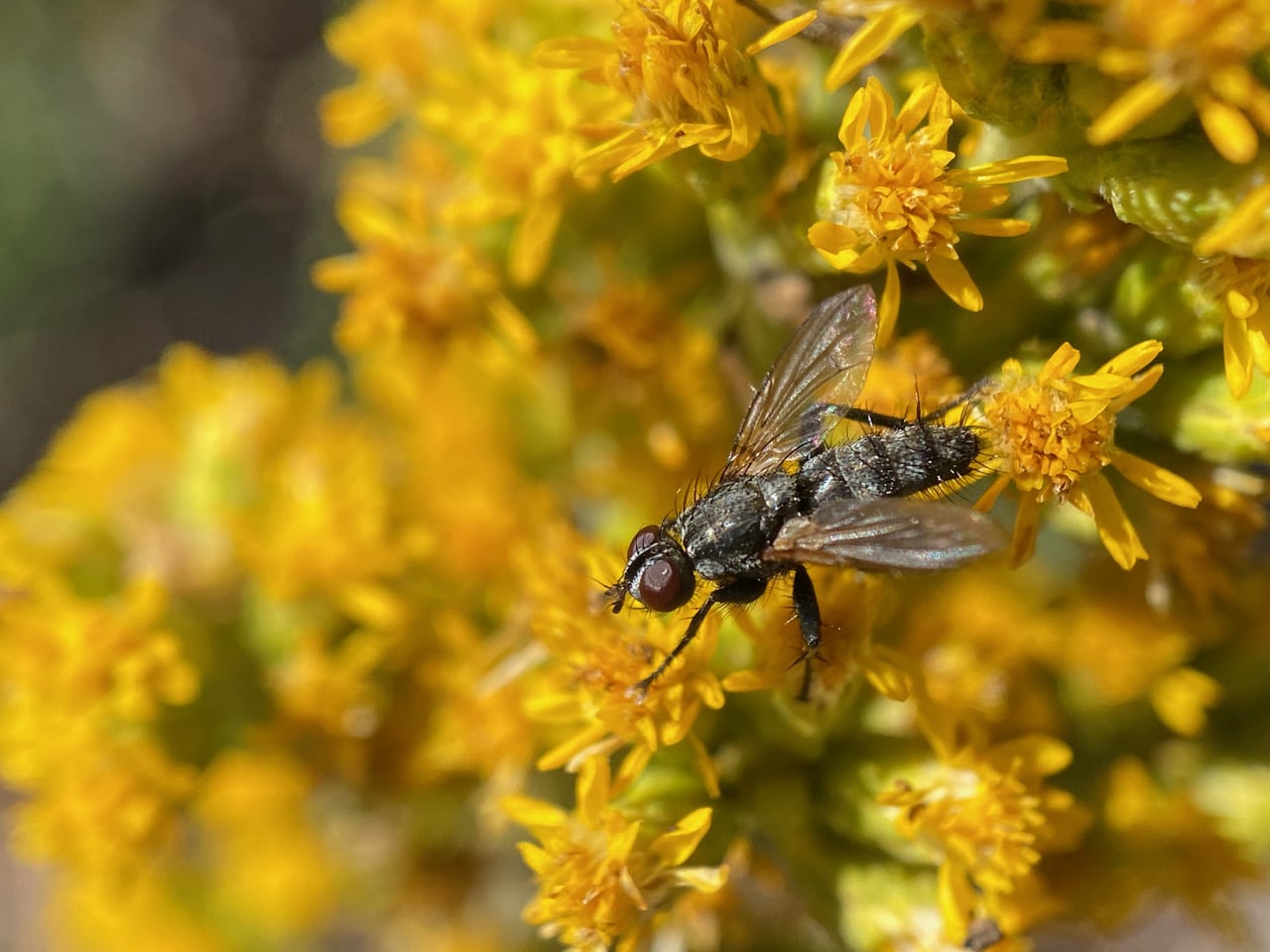
The Woodlouse Fly, Stevenia deceptoria (family Rhinophoridae) is the most common insect visiting flowers in the garden these days. It is hard to imagine that we could have enough woodlice (or pillbugs) to support such a large population of these parasitoid flies. These flies probably fulfill the role of pollinators too.
A Woodlouse Fly, Stevenia deceptoria (family Rhinophoridae) is perched on an inflorescence of California Everlasting. These small, slender, black, bristly flies are somewhat related to the Tachinidae. The larvae are mostly parasitoids of woodlice (pill bugs), beetles, spiders and other arthropods, and occasionally snails.
Native to Europe, Stevenia deceptoria is now widespread in the US. The flies are parasitoids of terrestrial woodlice (roly polies) of the order Isopoda (Oniscoidea).

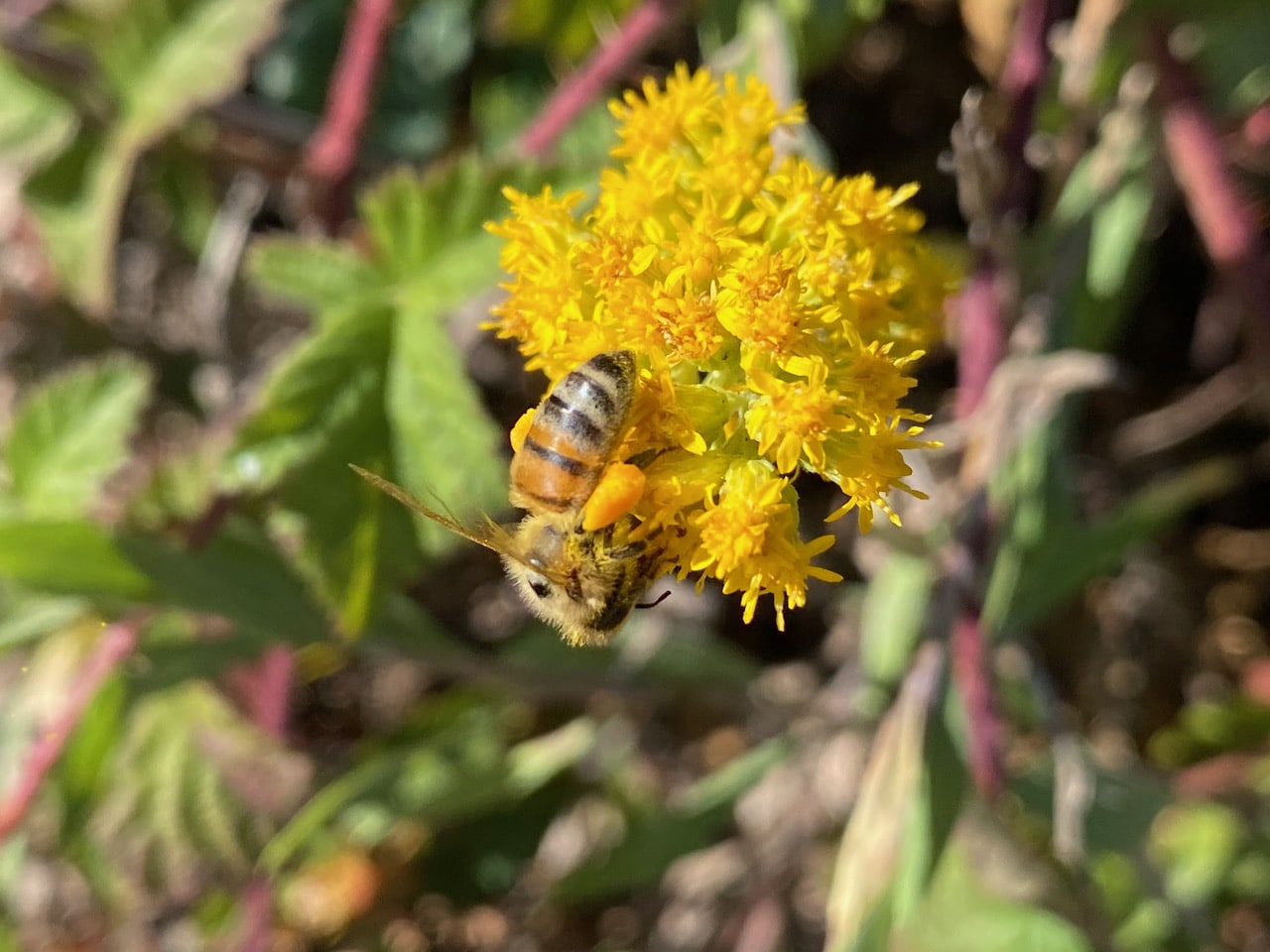
A Honey Bee, Apis mellifera (family Apidae) is collecting prodigous amounts of pollen from the goldenrod flowers.
The pollen collecting apparatus in Apidae bees, which include honey bees and bumble bees, is commonly called a “pollen basket” or corbicula. This region is located on the tibia of the hind legs and consists of hairs surrounding a concave region. After the bee visits a flower, she begins to groom herself and brushes the pollen down toward her hind legs and packs the pollen into her pollen basket. A little nectar mixed with the pollen keeps it all together like putty, and the stiff hairs surrounding the pollen basket hold it in place. A honey bee can fly with a full pollen load that weighs as much as a third of her body weight.
.jpg)

On average, 15-30% of a colony’s foragers are collecting pollen. A single bee can bring back a pollen load that weighs as much as 1/3 of the bee’s body weight.
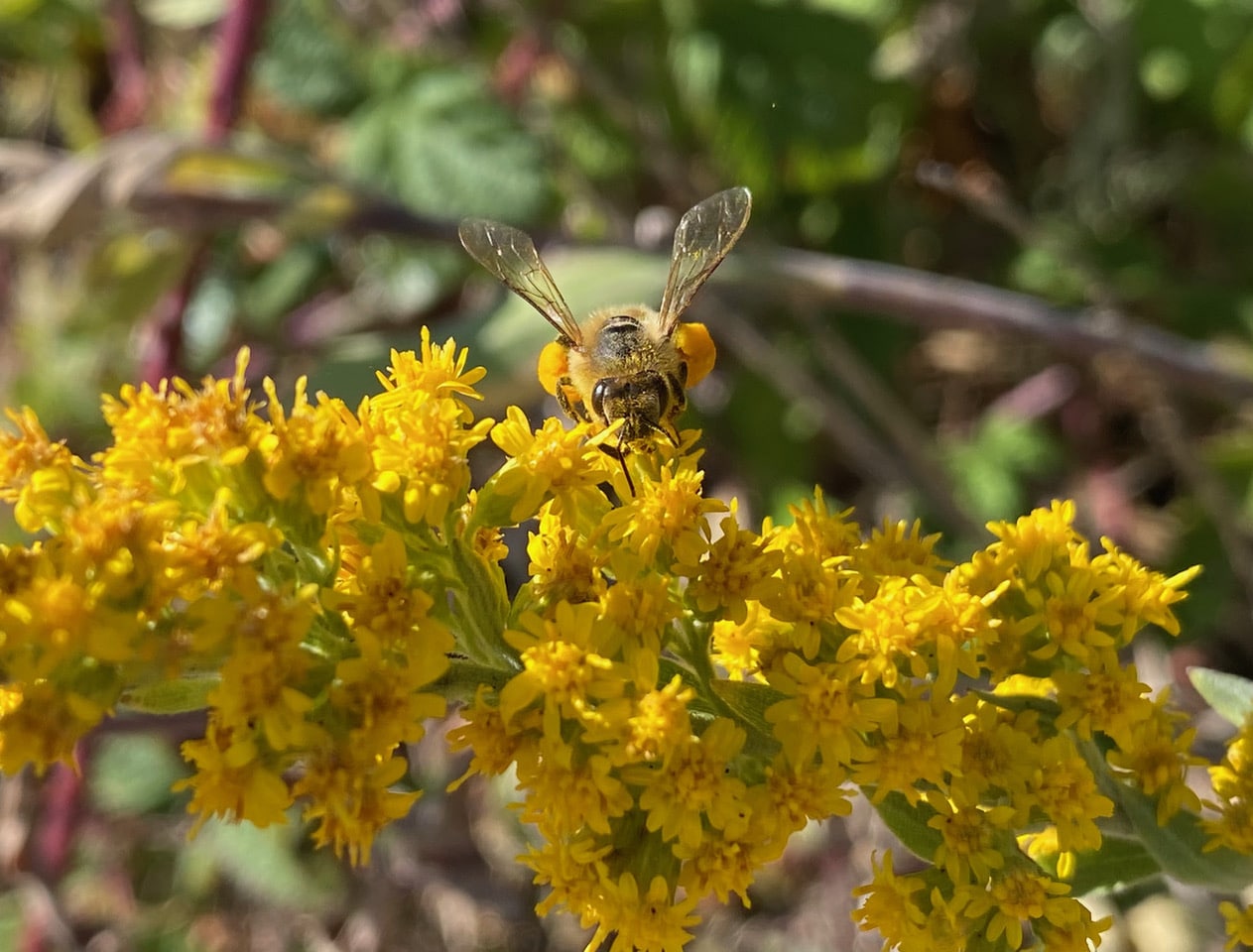
Sometimes the full pollen baskets can look like saddlebags on the bee’s flanks.
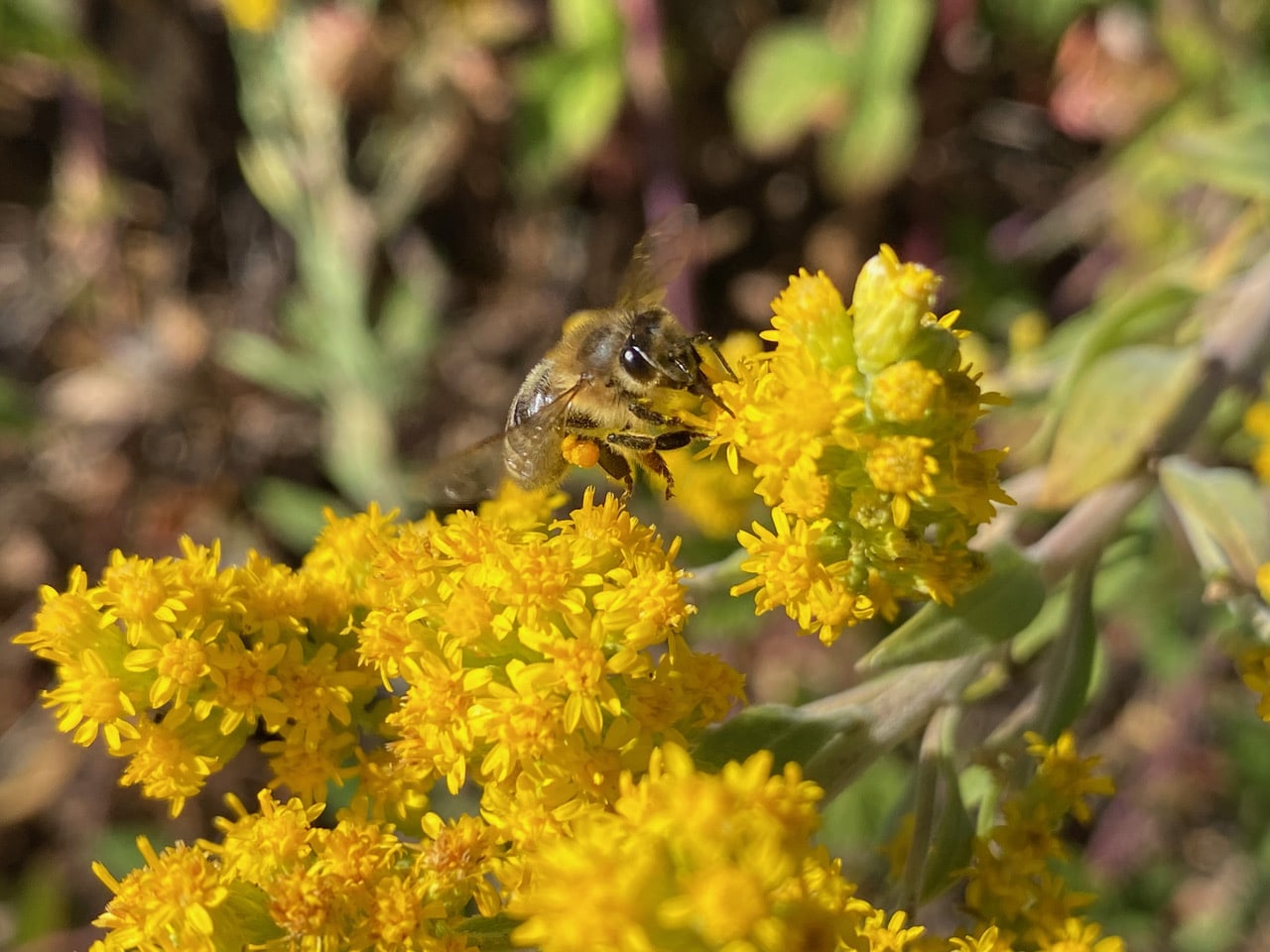
A bee appears on the goldenrod flowers. It looks every bit like a Honey Bee, but it is a lot darker in the abdomen.

At the Tarweed patch below the Water Tank, I find many more of these dark Honey Bees visiting the flowers of Elegant Tarweed, Madia elegans. I have been observing this phenomenon in late summer for a few years now. I even get inquiries and photos from folks asking about these bees.
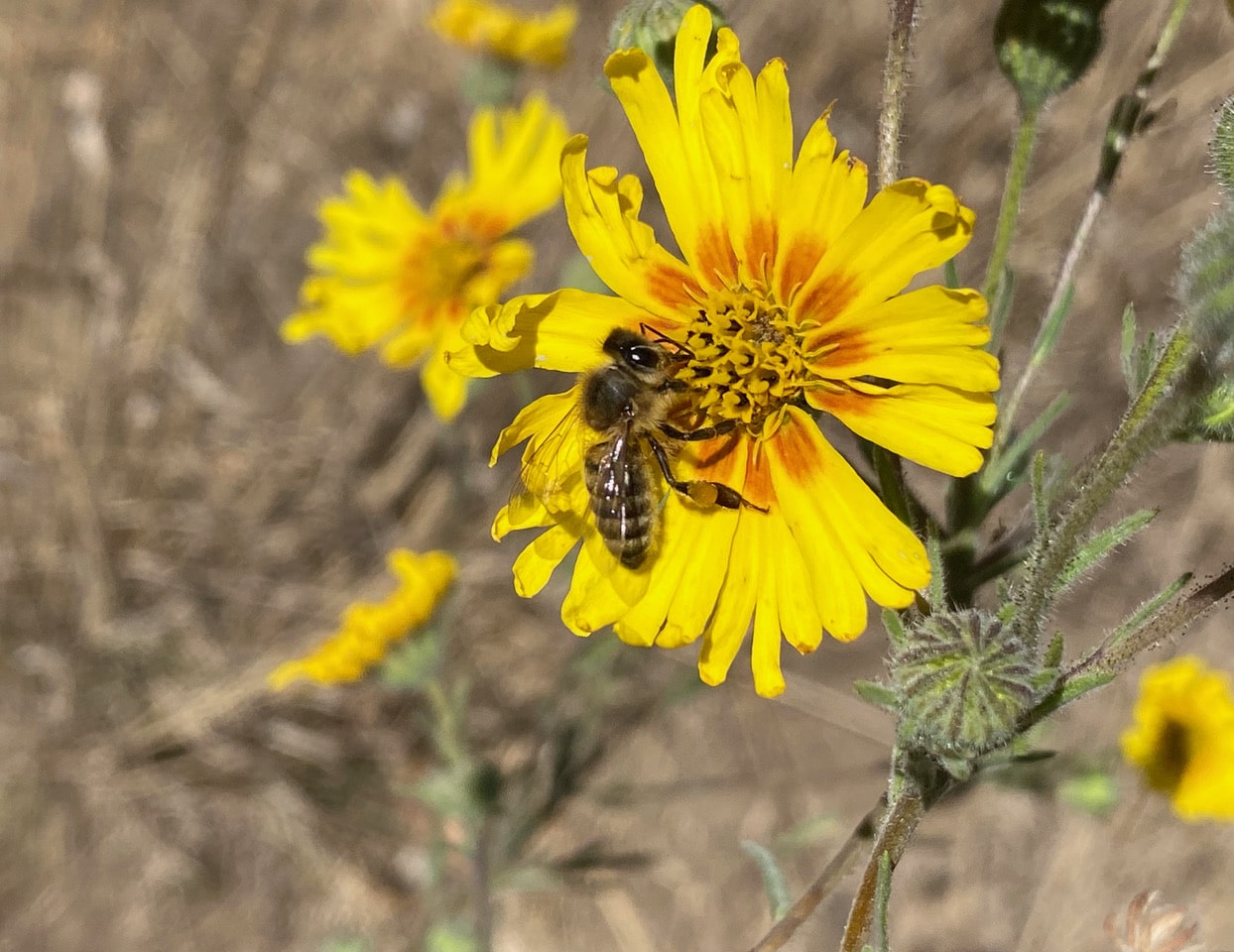
I find only confusing information about these dark honey bees online. One theory posits that the black coloration results from older bees having their hairs rubbed off from their abdomen by their hive mates. I can’t subscribe to that since the yellow color is part of the integument, and is not conferred by the abdominal hairs. The dark bee in this photo shows that she is quite well covered with fur.
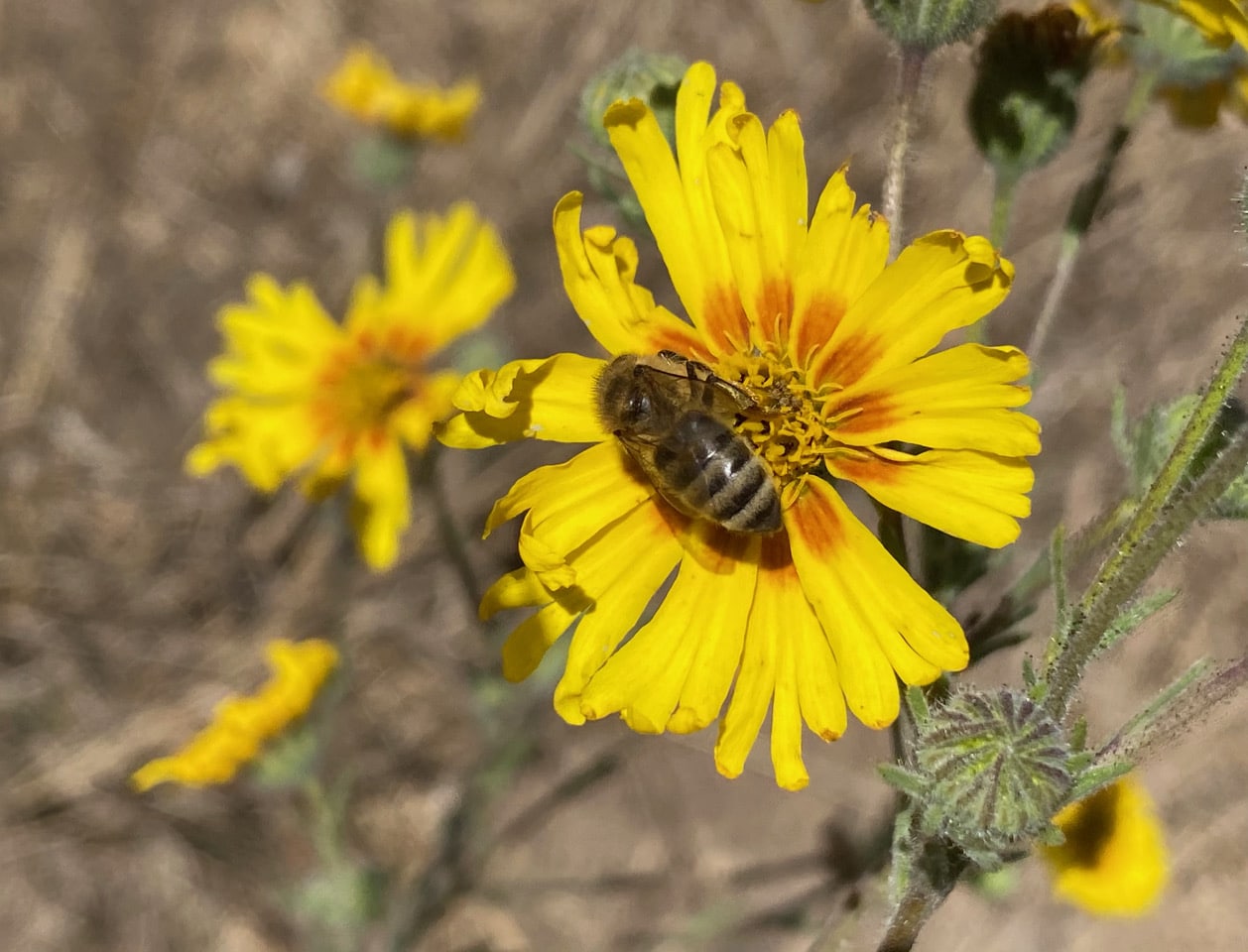
Another theory posits that these black bees are a subspecies, Apis mellifera mellifera, the so-called European Dark Bee, or the German Dark Bee. However, the subspecies is only found in one small region of the world, and not known to have been introduced to America. It’s also proposed that genetic mutation may cause a rare handful of bees to turn black, but this is very uncommon. Others think that the bee might have been infected with a virus that turns the bees black. This is typically why black bees are found dead in abandoned hives.
None of the above theories explain why the black bees are more often found in late summer. One would think that the black coloration is not a good adaptation for the hot summer, as black would absorb more heat. The phenomenon remains a mystery. It surprises me that the bee keepers have not figured this out.
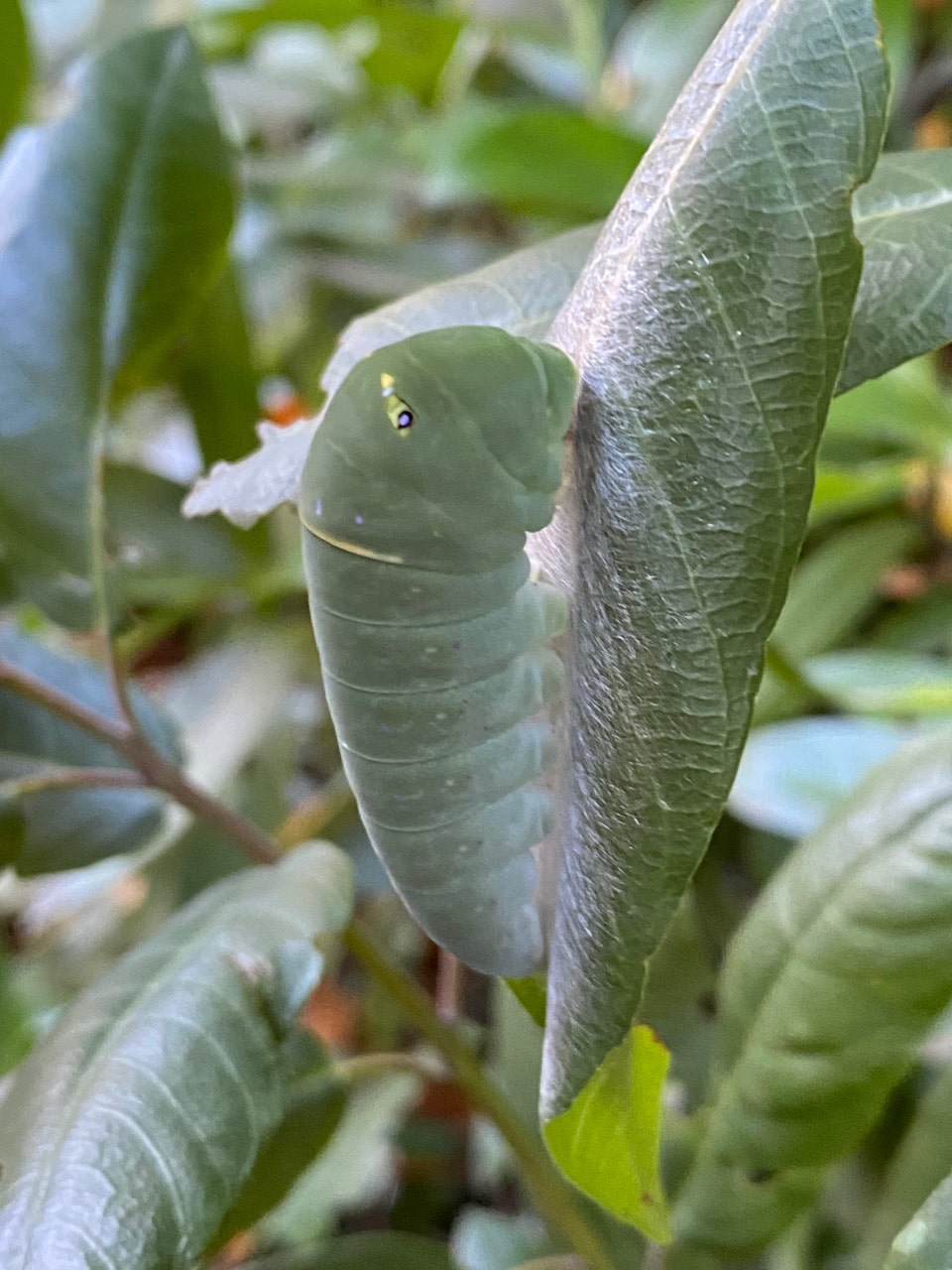
Blue, our Pale Swallowtail caterpillar is doing well. I am tickled that I can show it off to a friend today, confident that it would be there on its home leaf on a Coffeeberry bush. Of all the caterpillars I have observed over the years, Blue is exceptionally sedentary and predictable.
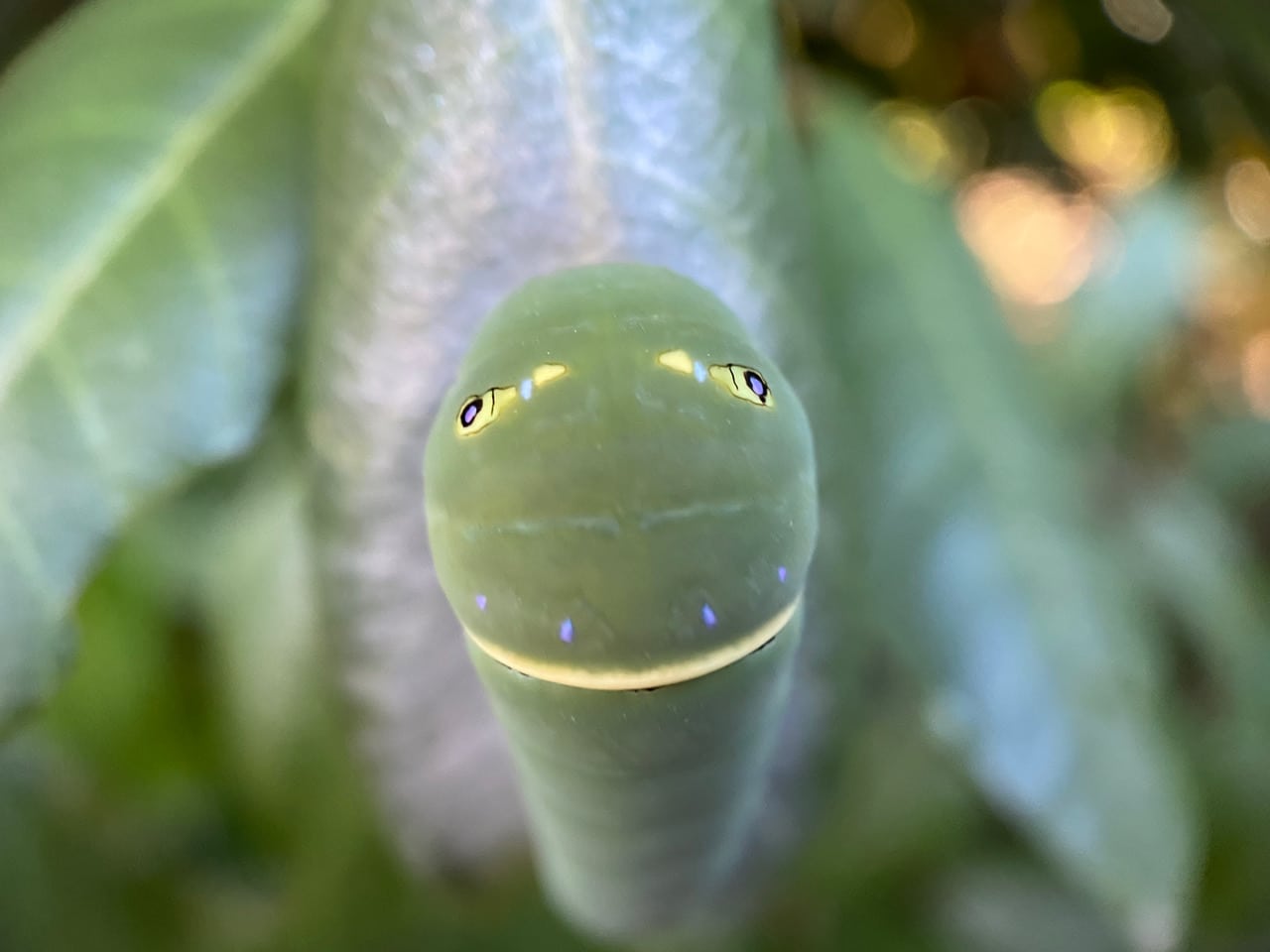
What is Blue thinking, sitting on its silk pad? Dreaming of becoming a butterfly?
 Just as I stop at another Coffeeberry bush to ponder the feeding scars on the leaves, a Scudder’s Bush Katydid nymph comes into focus. Note the short wing buds. It is a late instar – a stage of development close to adulthood. Earlier in the season, I have encountered countless early instars of this species, mostly on flowers of the Sticky Monkeyflower. This one has graduated to eating leaves?
Scudderia is a genus of katydids in the family Tettigoniidae. They are sometimes called bush katydids and are 30-38 mm in length. They are mostly found in North America. They are herbivores, with nymphs feeding primarily on flowers and adults preferring woody deciduous plants.
Like other members of the order Orthoptera, katydids undergo incomplete metamorphosis without a pupal stage. The nymphs, which look like adults, develop through a series of molts, each time getting bigger after shedding their old exoskeleton. At the last molt, they transform into adults with functional wings and reproductive parts.
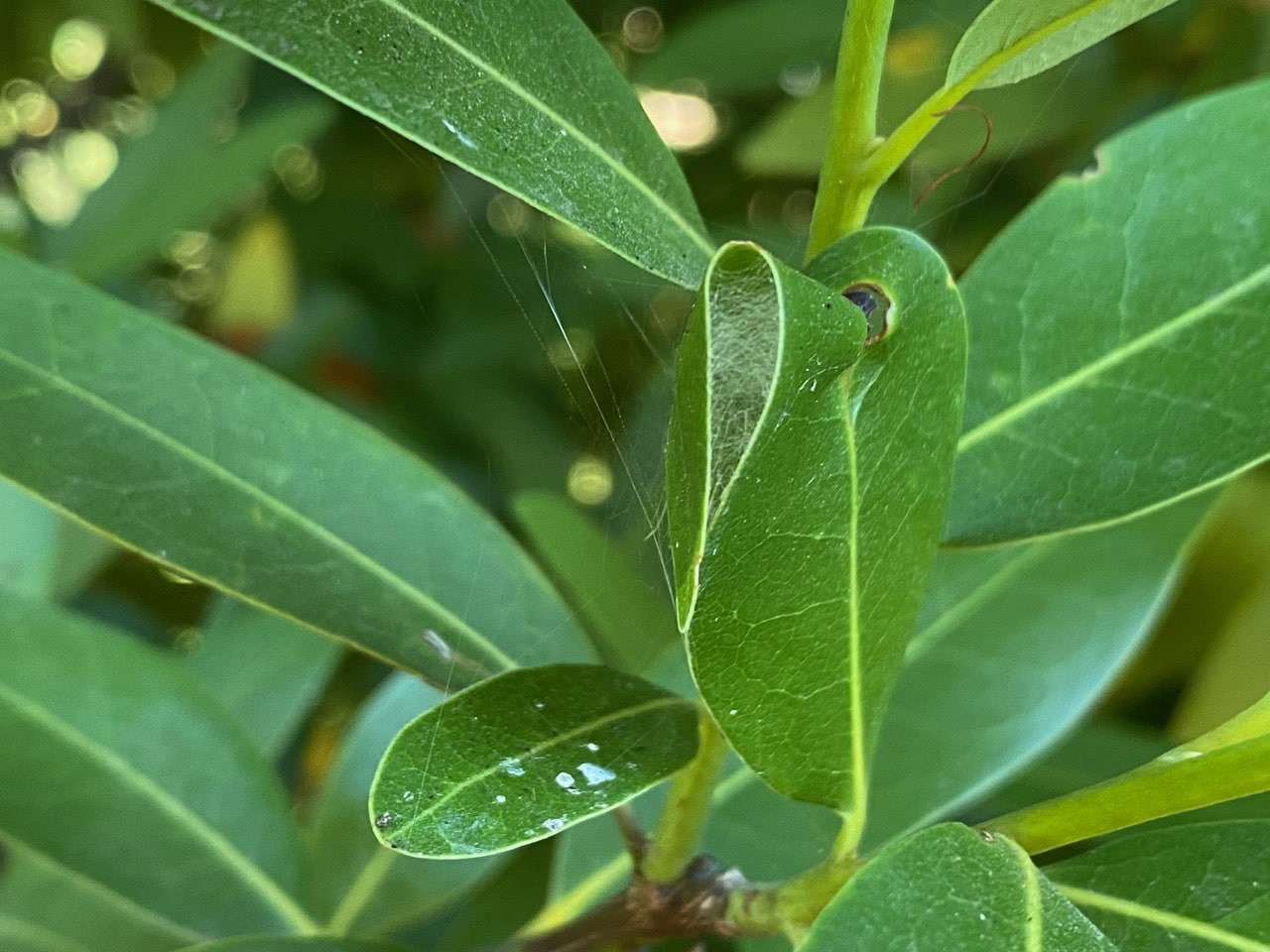
One of the terminal leaves of a California Bay tree has been folded down. Closer inspection shows that the job has been accomplished with silk. A caterpillar or a spider?
I am inclined to think it’s a spider. Note the white stains on the leaf below. These are probably the spider’s excretion of guanine, a nitrogenous waste product, usually appearing as yellow or white droplets under their webs. (Spiders excrete guanine instead of urea.) The fluffy silk between the leaf fold is probably the coverings of an egg sac.

Another view of the same folded Bay leaf. The whole thing looks pretty fresh. I will not disturb the eggs. There might even be a female spider in there guarding her egg sac.

A rather drab looking fly, but it is a new Dipteran species for Skyline’s insect list!
The fly has been identified as Suillia barberi (family Heleomyzidae). Heleomyzidae is a small family of true flies in the order Diptera, distributed throughout the world, especially the northern hemisphere. They are small to medium-sized flies with prominent hairs. They vary in color from yellow to reddish yellow or reddish brown to black. Adults of many species are attracted to carcasses and feces. Larvae feed on decaying plant and animal matter, and mushrooms. The larvae of the subfamily Suillinae occur primarily in fungi.
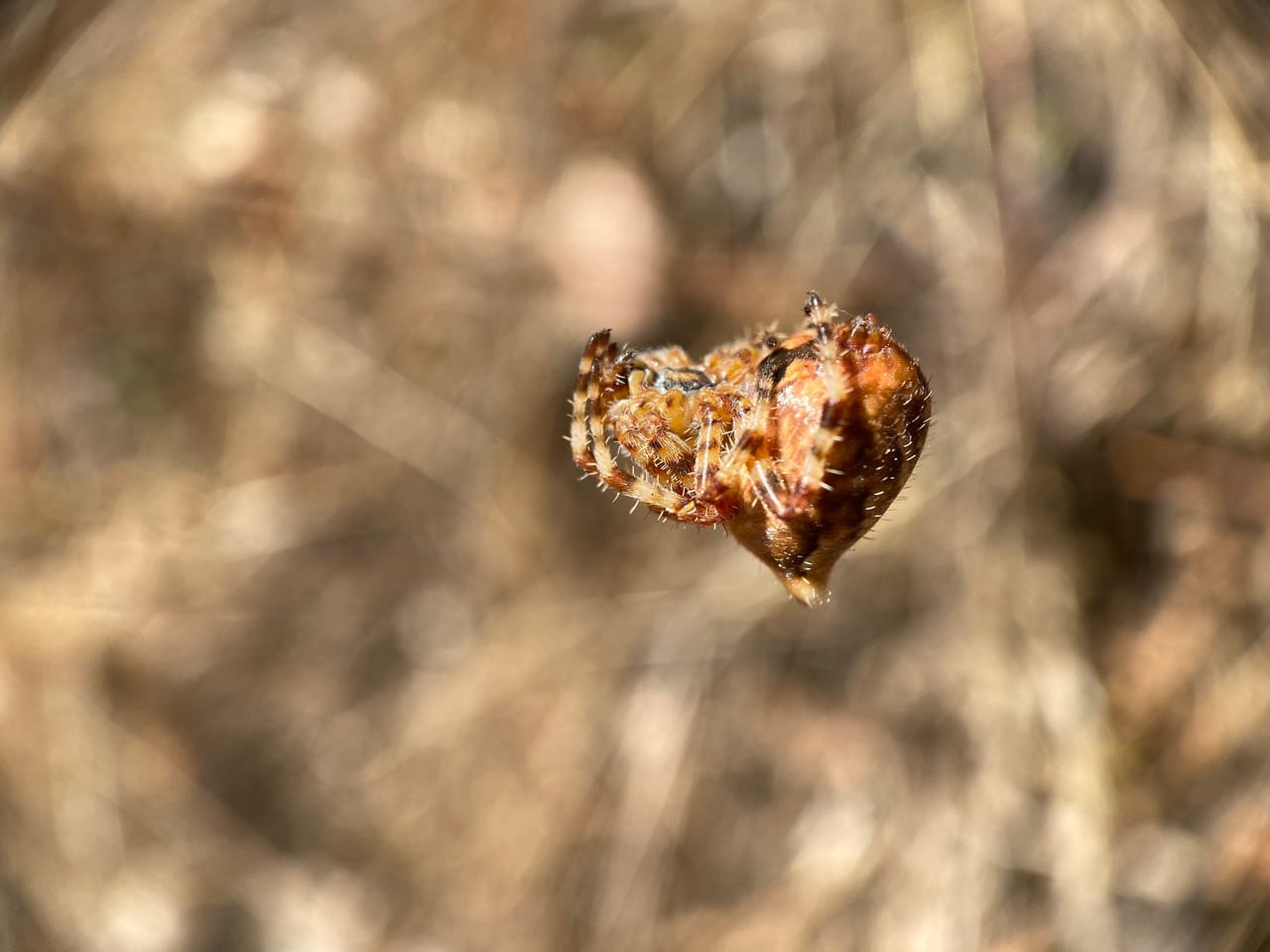
Our Two-tubercled Orbweaver is resting on a dry leaf attached to a seed capsule of a Soap Plant this morning. While trying to photograph her in an awkward angle, I accidentally bump into a branch, shaking the whole plant. The spider immediately drops from her retreat, going into free fall. While she’s hanging upside down, I get a good view of the spinnerets at the tip of her abdomen.
The Two-tubercled Orbweaver, Gibbaranea bituberculata is a species of ‘orbweavers’ belonging to the family Araneidae. They are found in sunny habitats on shrubs, edges and low plants, where they can make their webs near the ground. Their basic color is very variable, but usually it is brownish, with whitish shades. The cephalothorax is covered with adpressed hairs.
Orb-weaver spiders are members of the spider family Araneidae. They are the most common group of builders of spiral wheel-shaped webs often found in gardens, fields, and forests. Generally, orb-weavers are three-clawed builders of flat webs with sticky spiral capture silk. The third claw is used to walk on the non-sticky part of the web. Typically, the prey insect that blunders into the sticky lines is stunned by a quick bite, and then wrapped in silk.
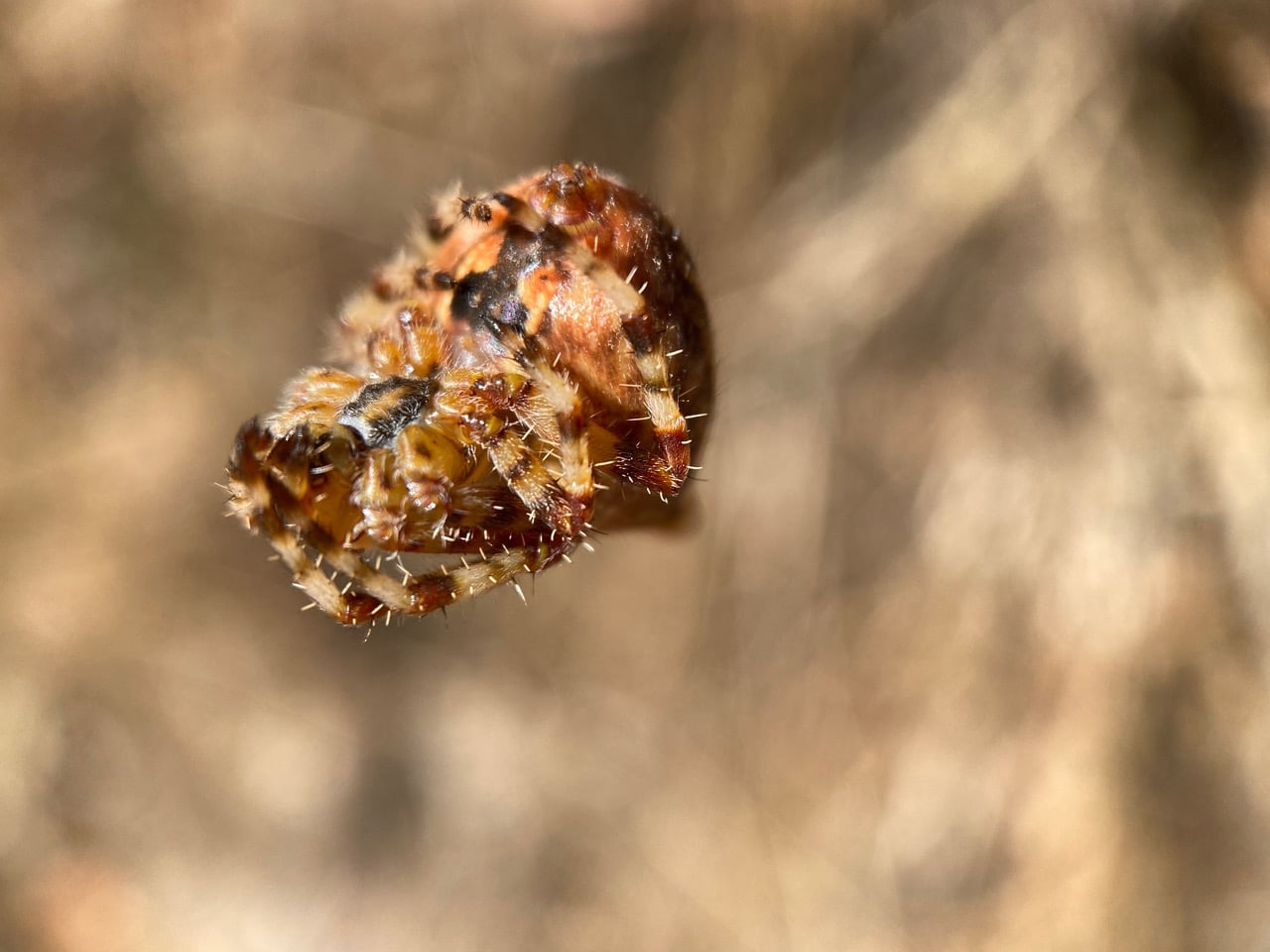
A closer view of the spider hanging upside down on a dragline (not visible at this angle).
All spiders make so-called dragline silk that functions in part as a lifeline, enabling the creatures to hang from structural supports. And it serves as a constant connection to the web, facilitating quick escapes from danger. Even though jumping spiders are stalkers, and do not spin a web to capture prey, they do attach a dragline on the substrate before they make a leap for the prey. This way the spider can return to its perch quickly.
A spinneret is a silk-spinning organ of a spider. Spiders have special glands that secrete silk proteins (made up of chains of amino acids). The spider pushes the liquid solution through long ducts, leading to microscopic spigots on the spider’s spinnerets. Spiders typically have two or three spinneret pairs, located at the rear of the abdomen. Most spinnerets are not simple structures with a single orifice producing a single thread, but complex structures of many microscopic spigots, each producing one filament. The spigots allow the spider to combine multiple filaments in different ways to produce many kinds of silk for various purposes.
Various species of spiders use silk extruded from spinnerets to build webs, to transfer sperm, to entrap insects, to make egg-cases, to manipulate static electricity in the air, and to fly (ballooning), etc.

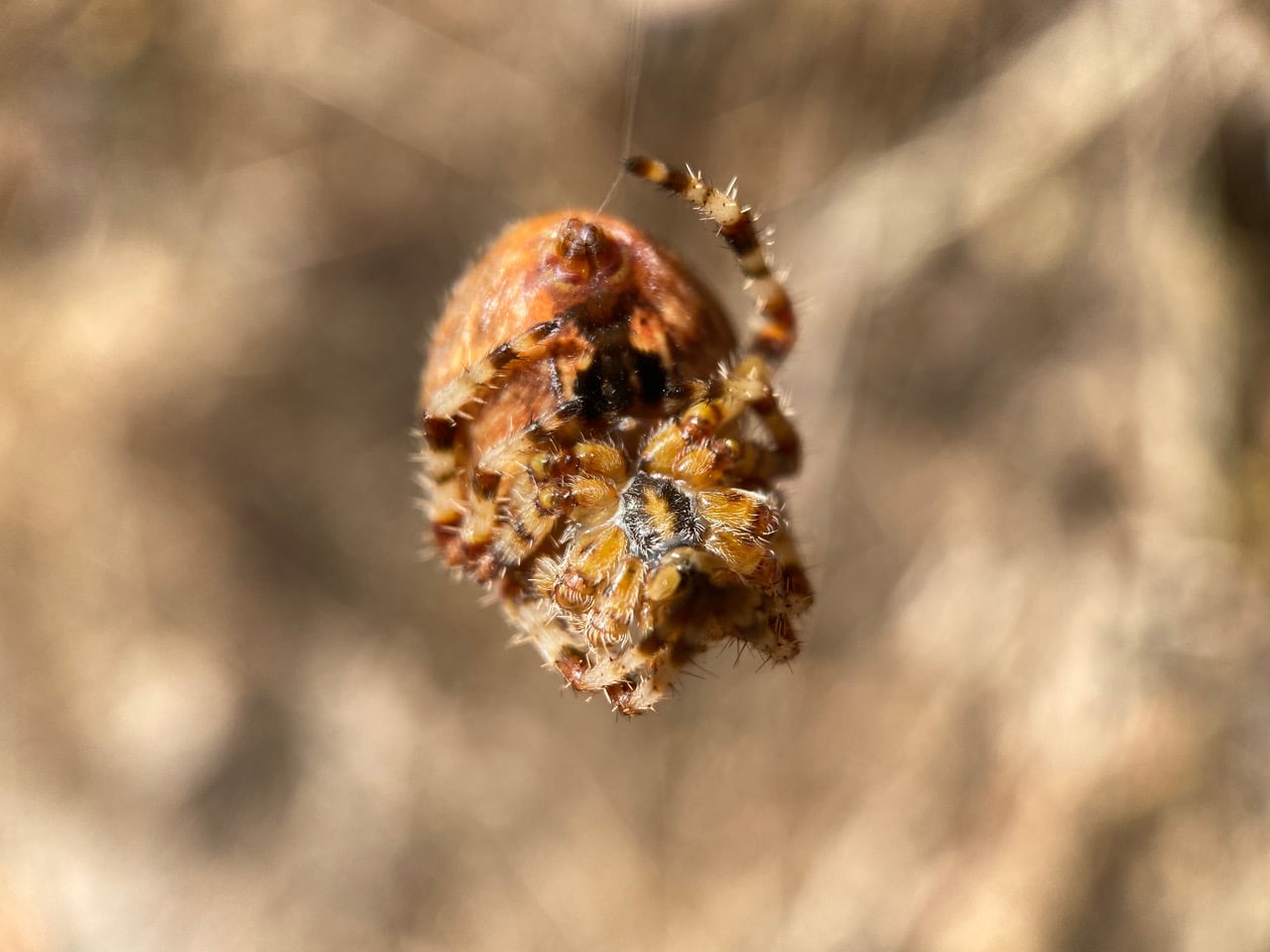
The spider is actually in control. As she is swinging beneath her retreat, she has her hind leg on the dragline, constantly adjusting its length and tension. I am surprised that the thin silk thread could support the weight of the spider.
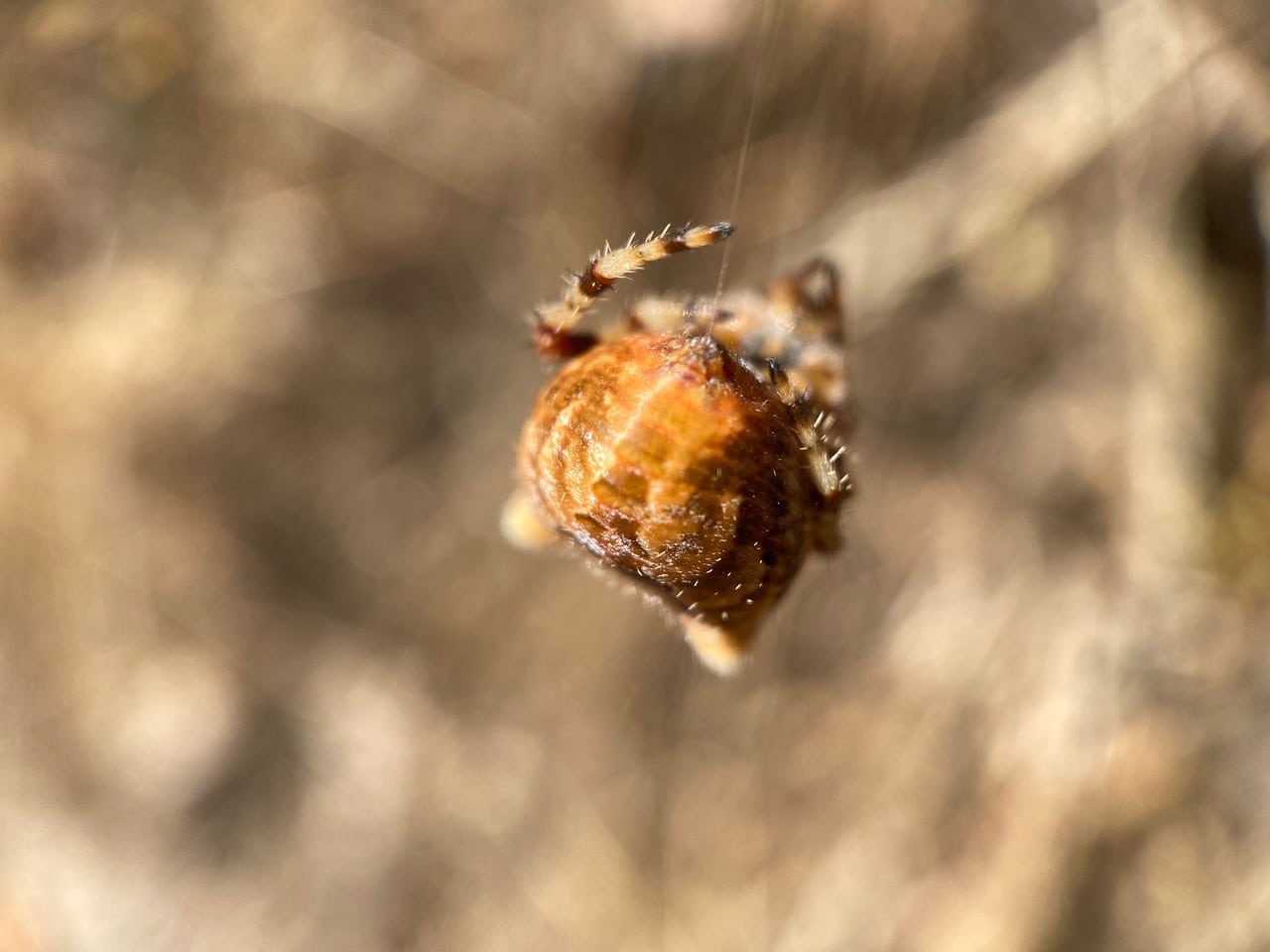
Rear view of the rappelling spider. Note the spider’s hind leg controlling the dragline extruded from her spinnerets. Awesome!

Lower down on an adjacent Soap Plant, a much smaller Two-tubercled Orbweaver is resting on a seed capsule. Its legs are very long in proportion to its body. A male? Our female’s paramour? Or just a younger female?