

Pollinator Post 9/7/25

Fred and I arrive at Bay Farm for our walk at 10 am just when the clouds are clearing.
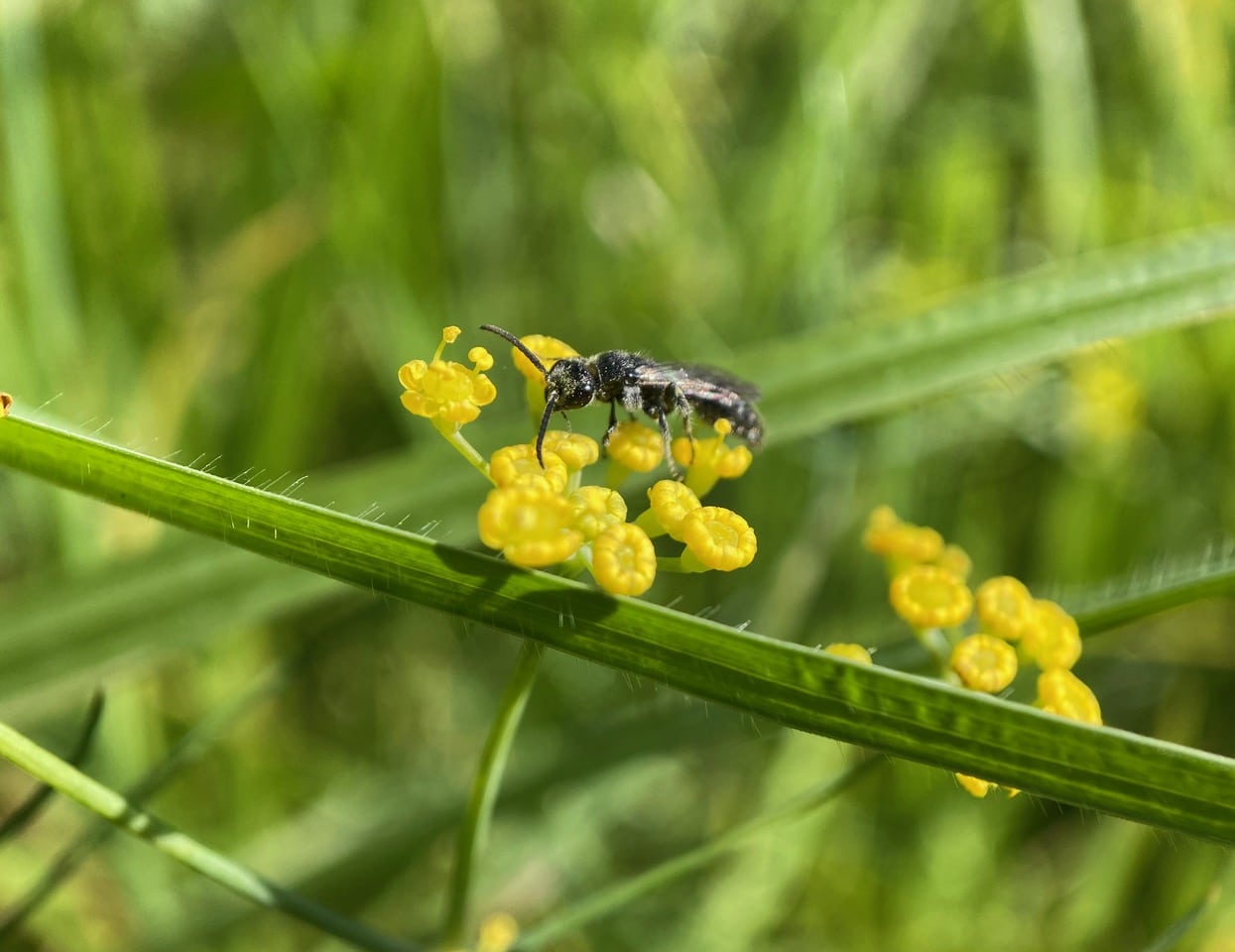

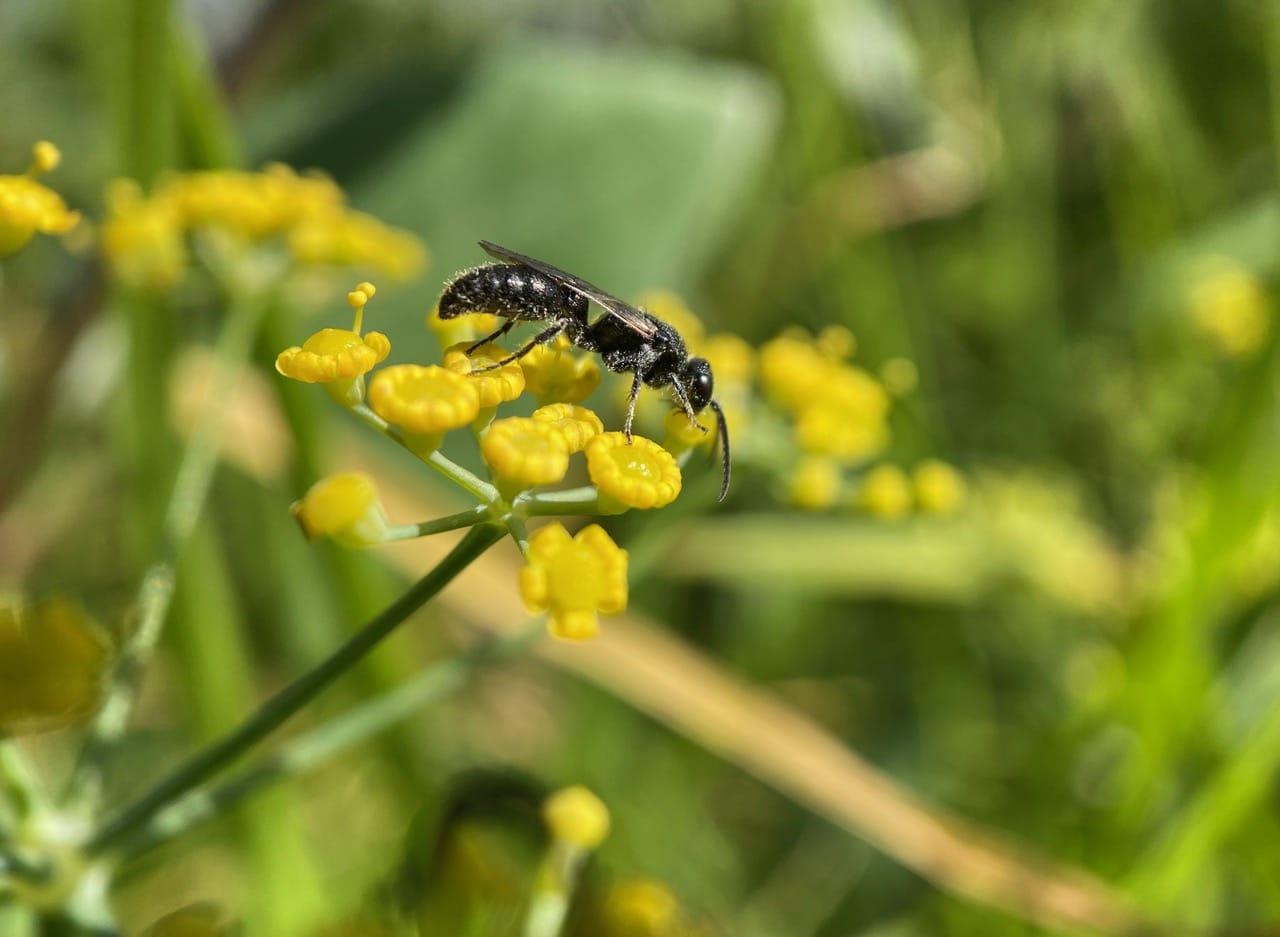
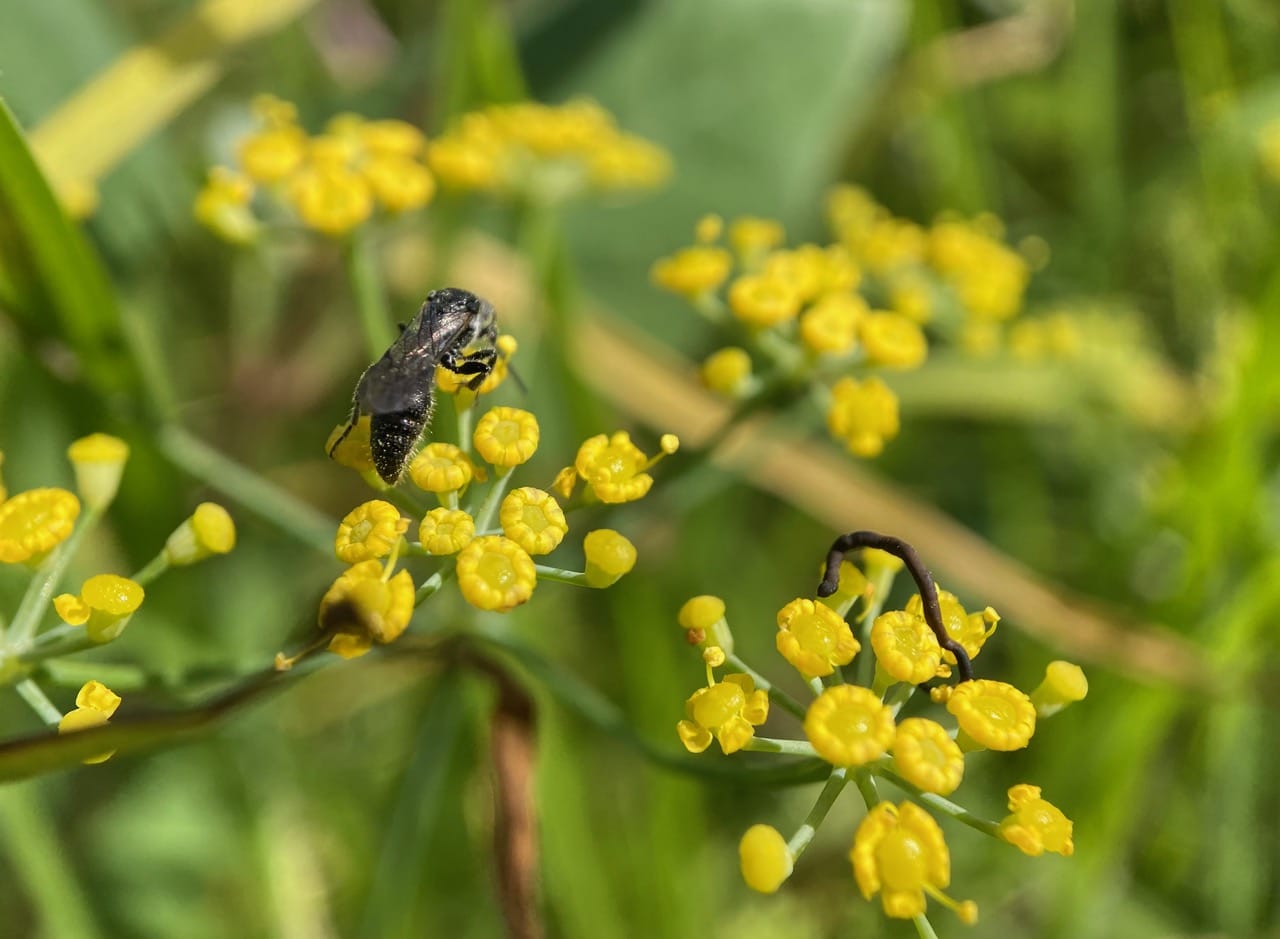
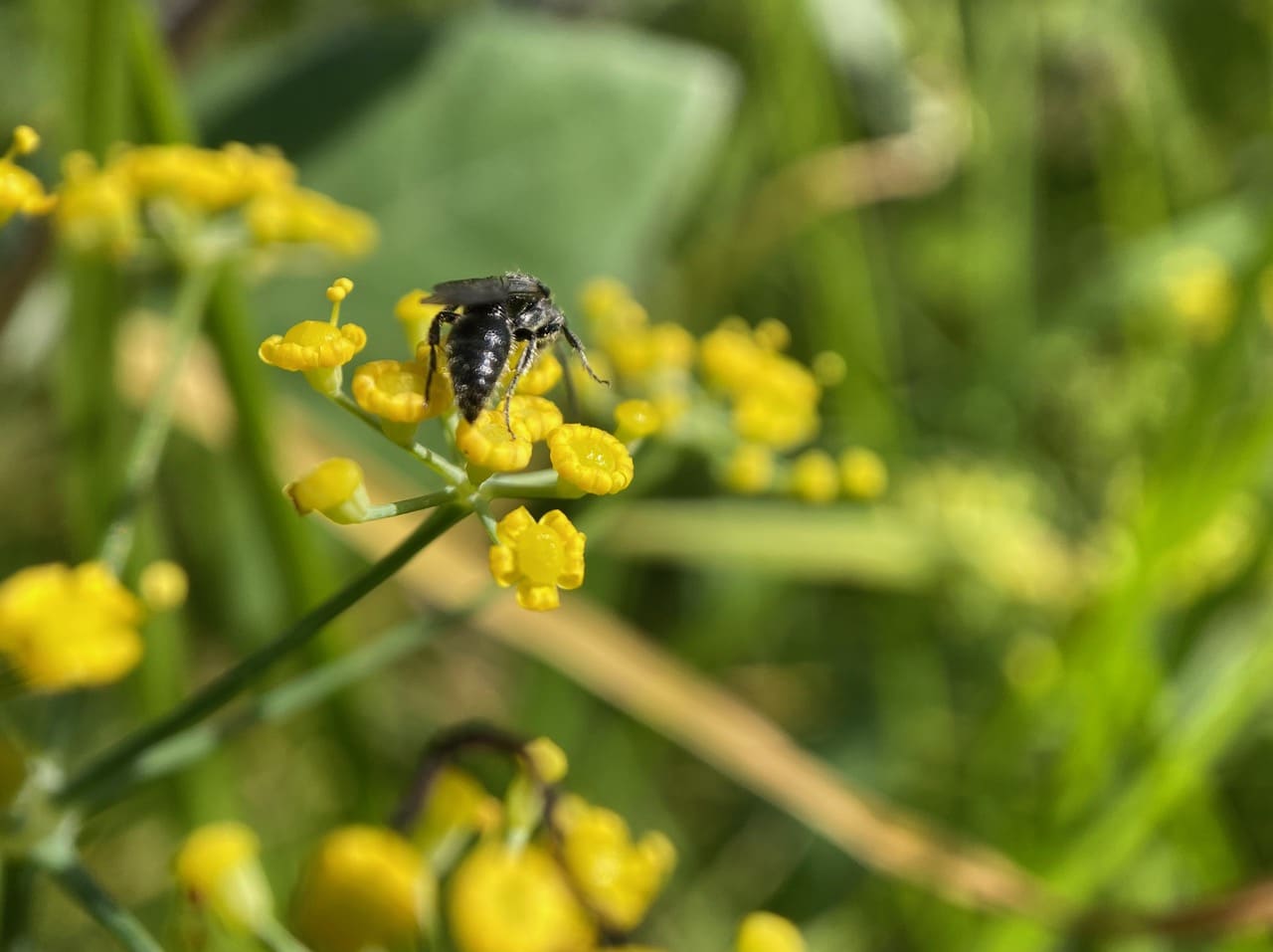


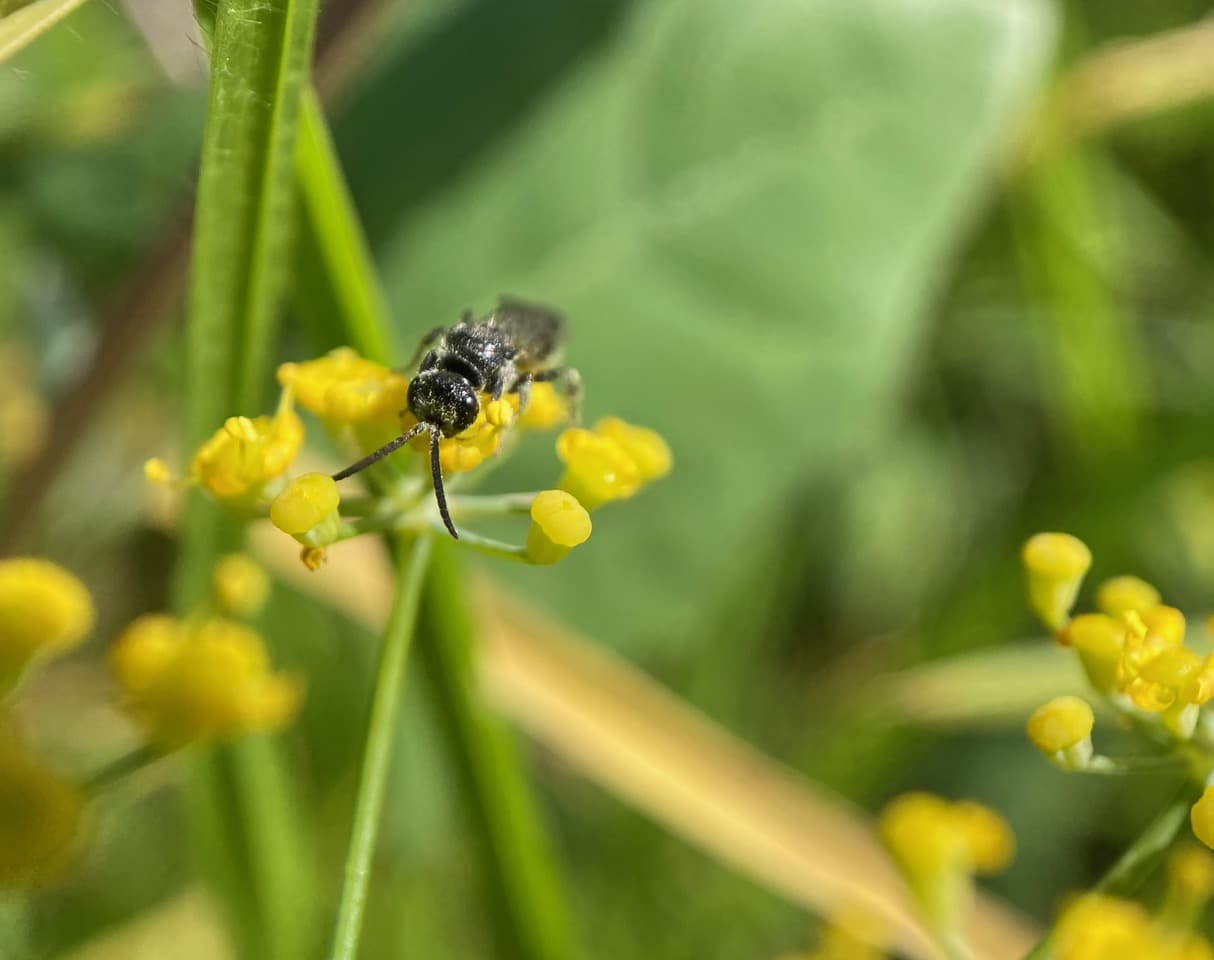
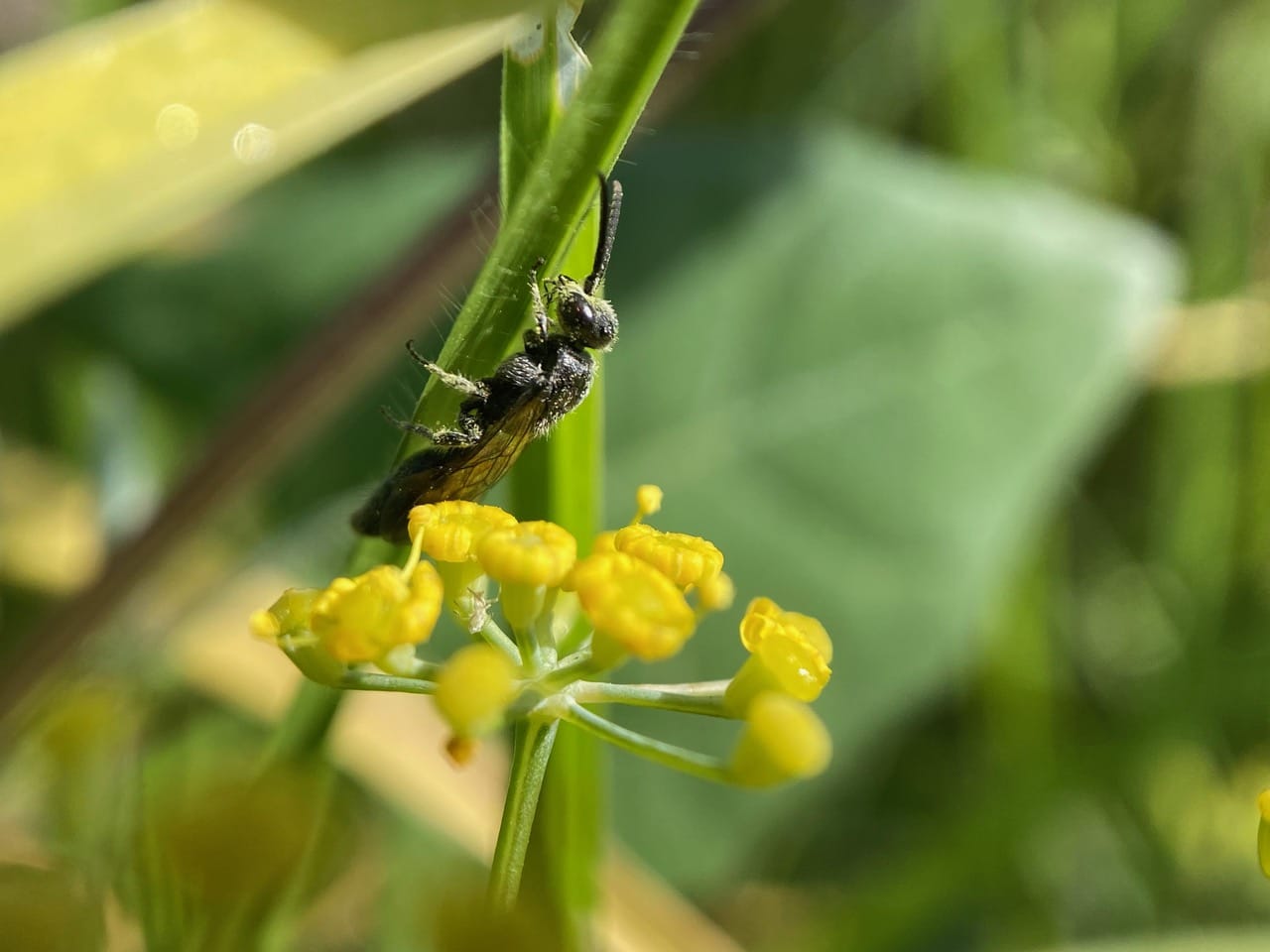


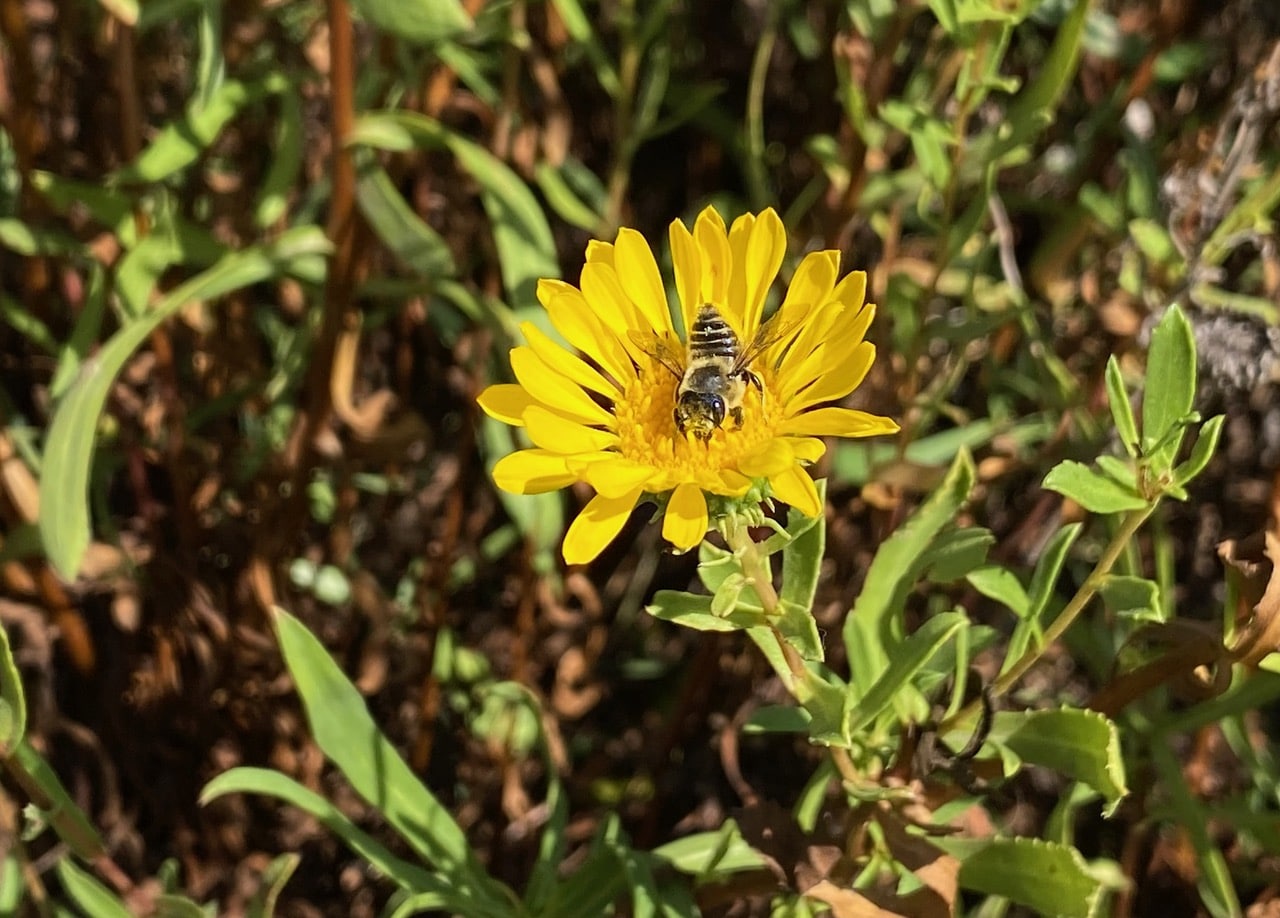
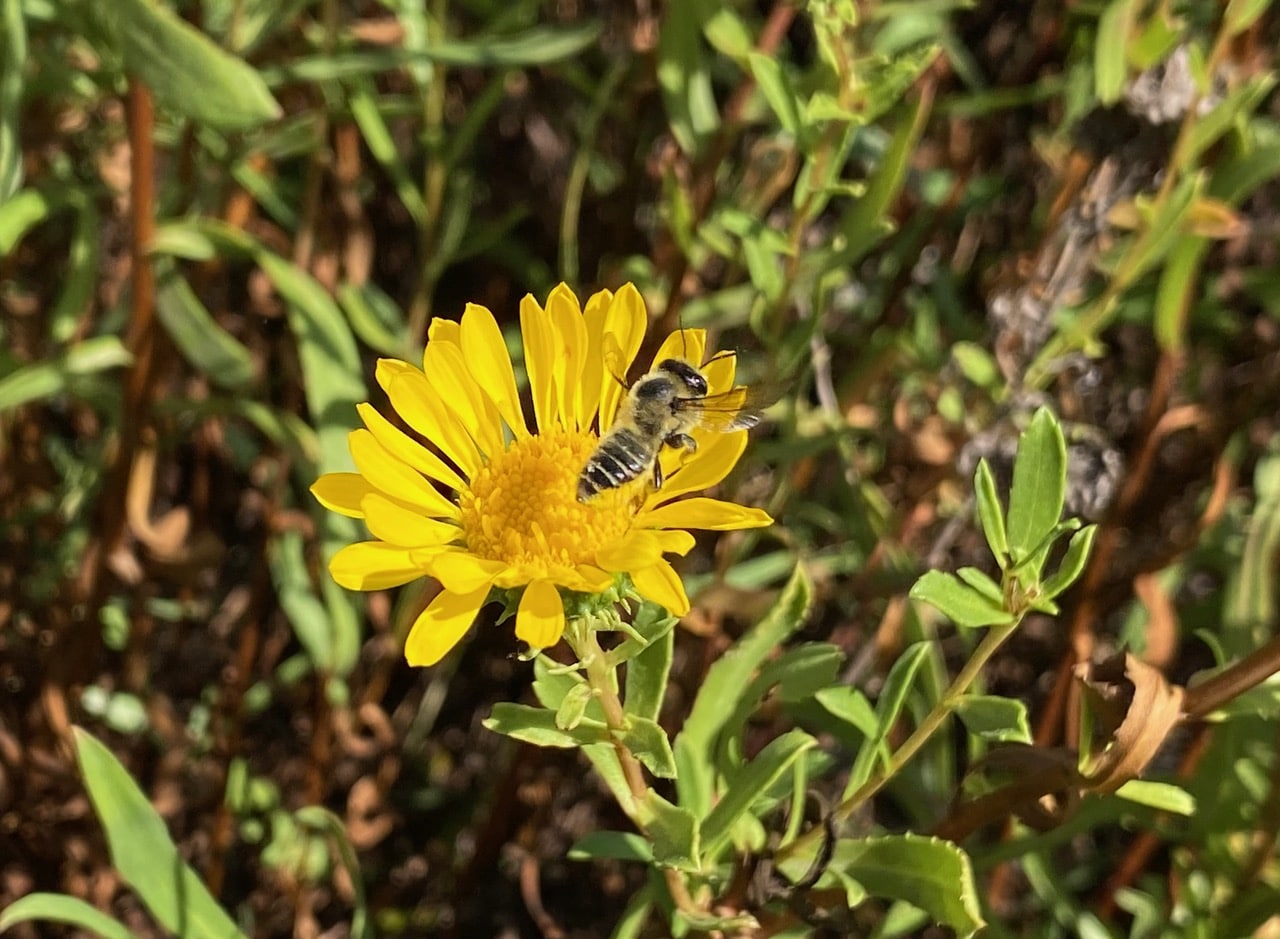
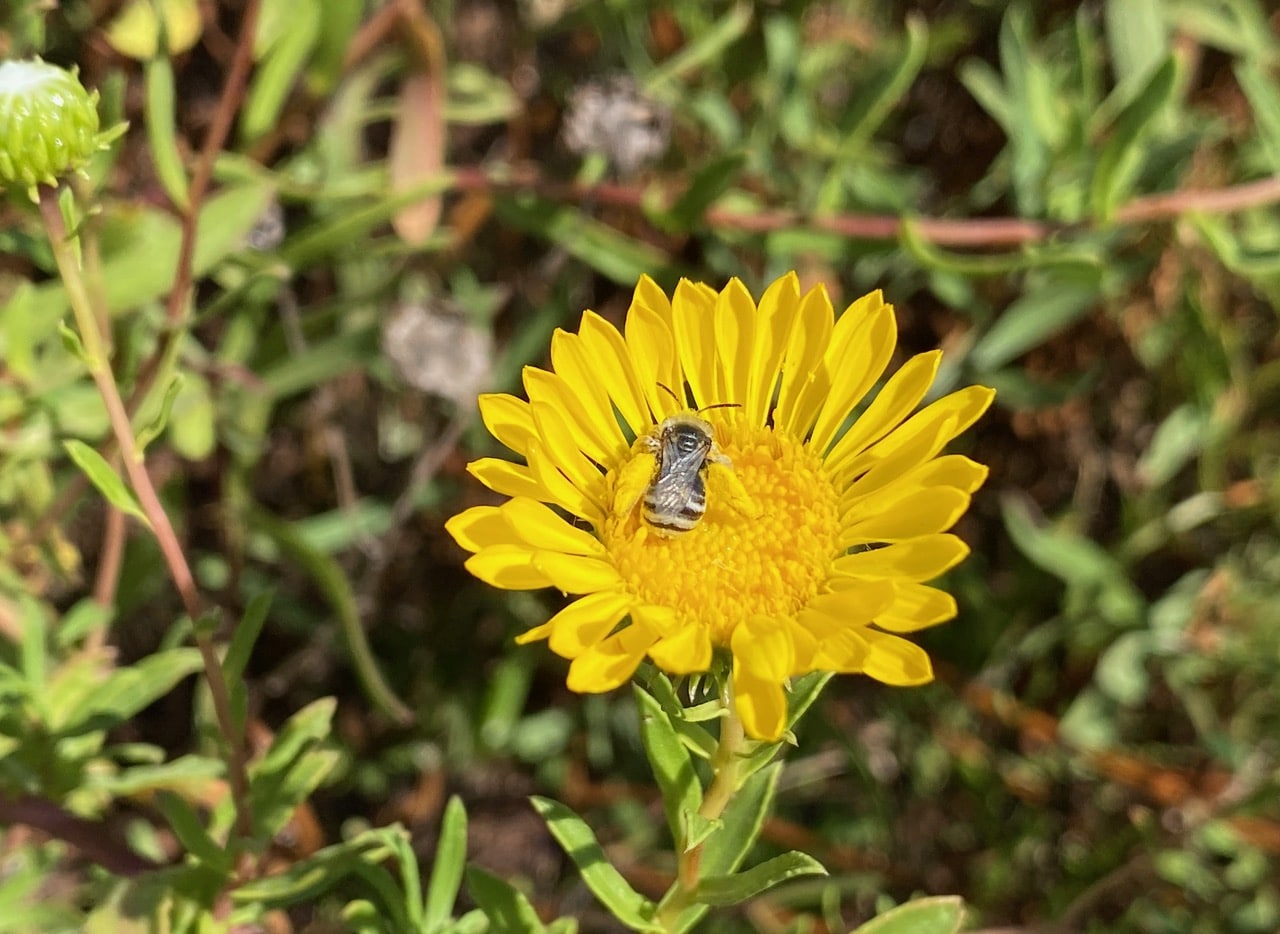
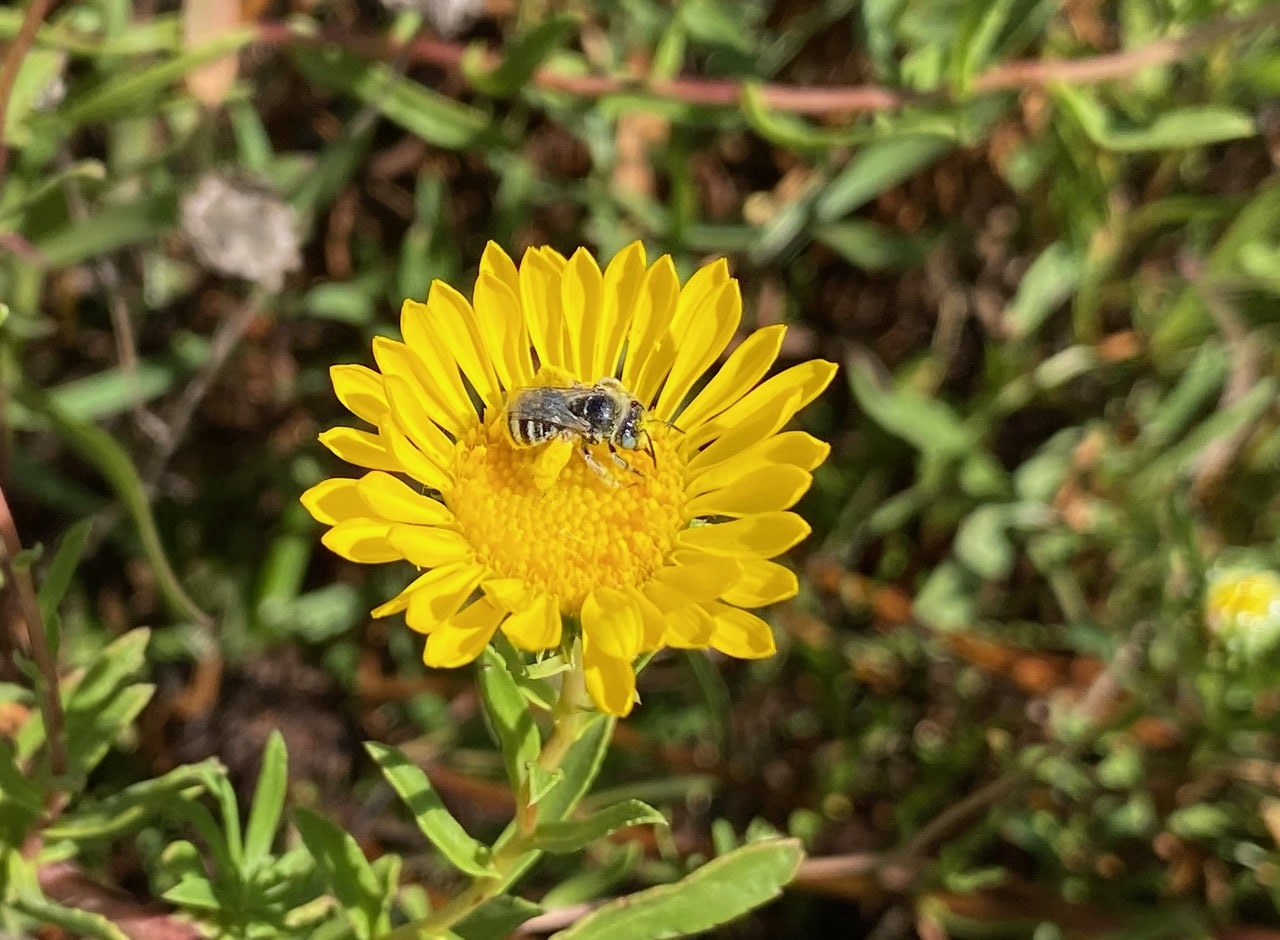
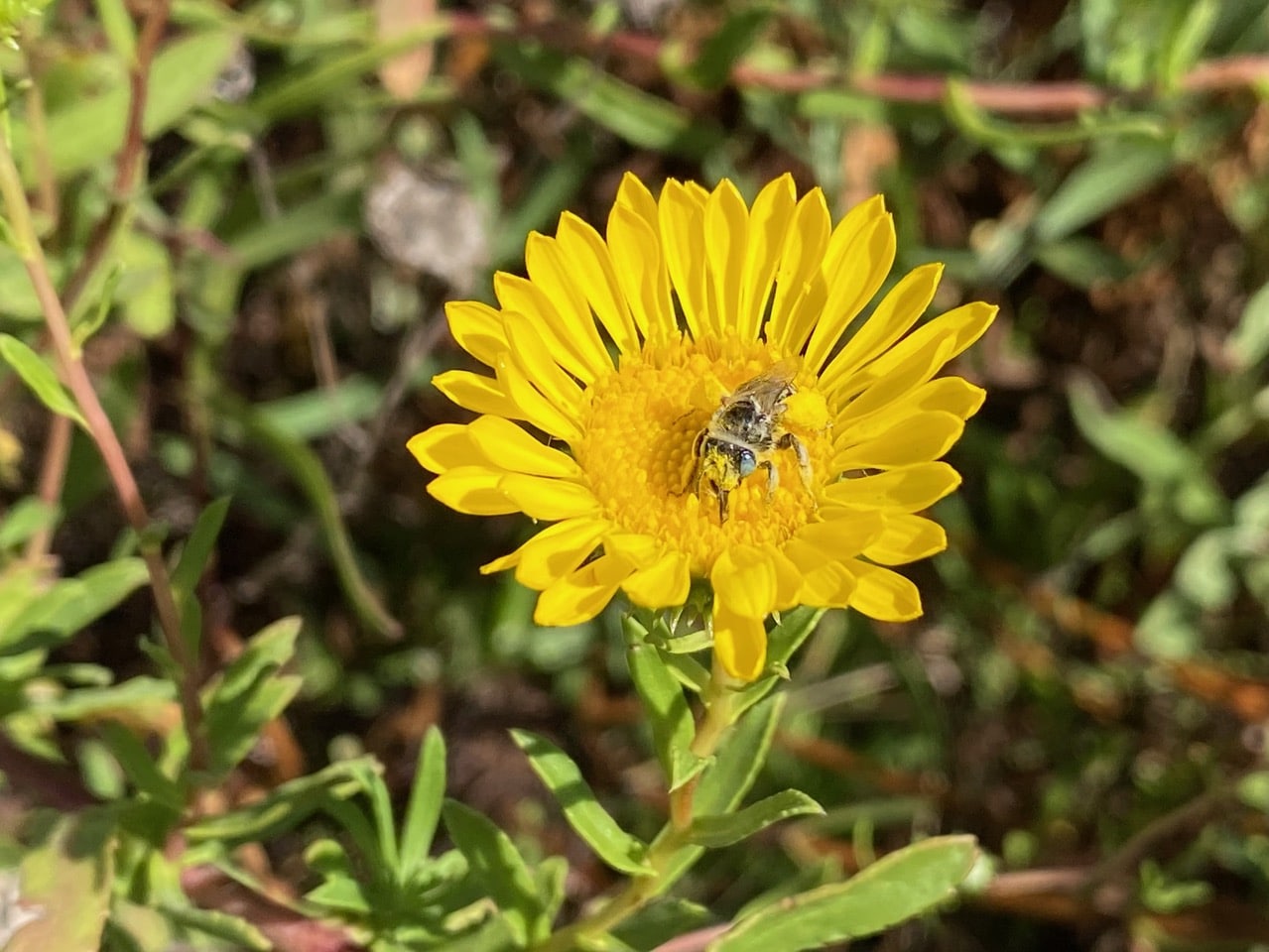
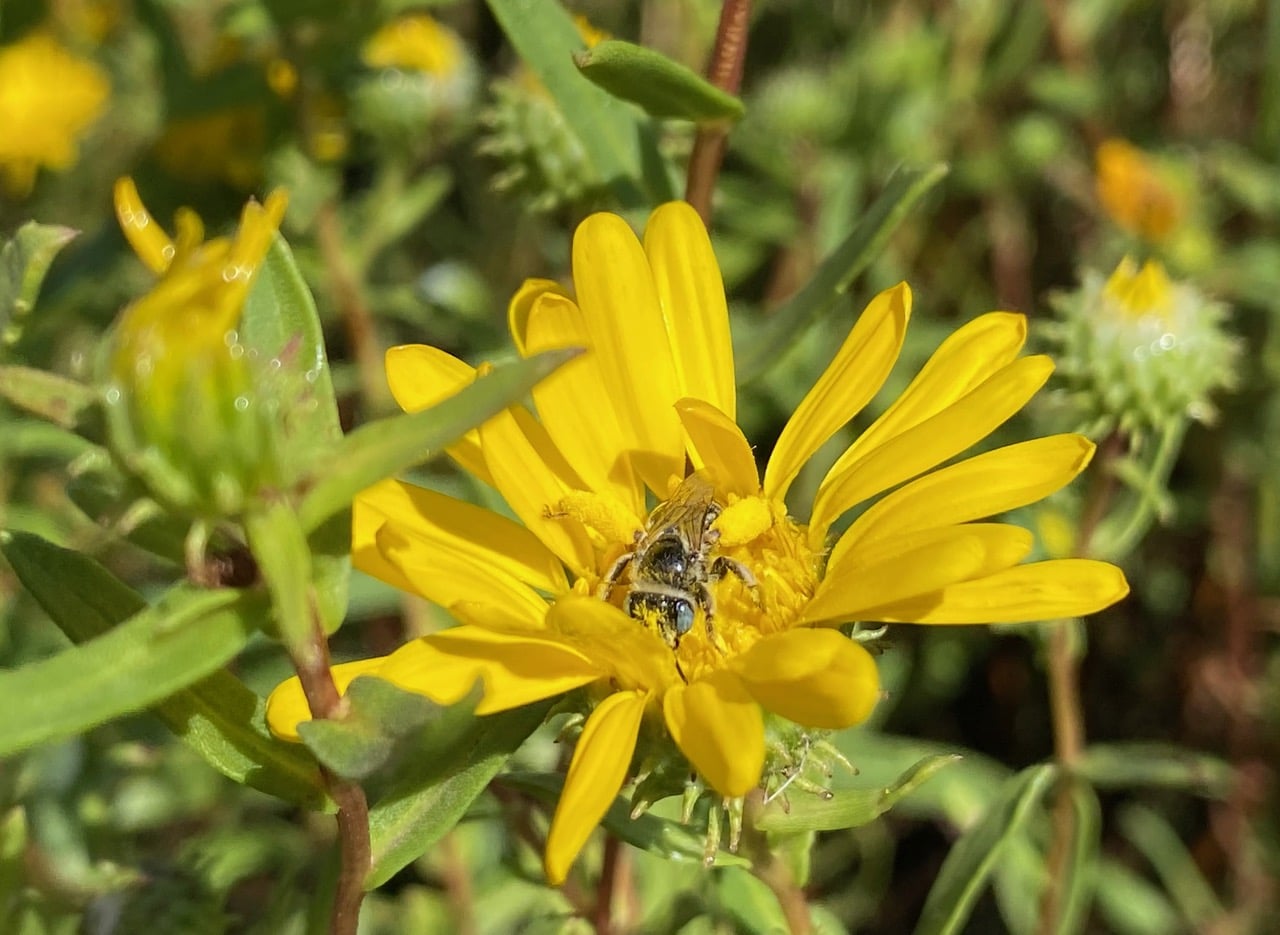
Who’s that black wasp-like insect on the flowers of a low-growing Fennel? I zoom in thinking it might be a large Masked Bee, Hylaeus sp.
No yellow markings on the face or the body. Not Hylaeus.
What’s with all the bristles, and the unfamiliarly-shaped abdomen? No pollen-collecting hairs on the hind legs, but it could be a male. Is this a bee or a wasp?
As with all insects that I don’t recognize, I take dozens of pictures of them for later identification if they are cooperative.
The insect goes on a grass stem to clean its mouthparts. iNaturalist has helped identify the insect as a Tiphiid Flower Wasp, Paratiphia sp. (family Tiphiidae). Yay, a new wasp family for me!
The Tiphiidae, also known as Tiphiid Flower Wasps are a family of large, solitary wasps whose larvae are parasitoids of various beetle larvae (especially Scarabaeoidea, Tenebrionidae, and Cicindelinae) and bees/wasps occurring in soil or rotten wood. The adults feed on nectar. Males have an up-curved hook at the tip of the abdomen. The females of some species are wingless and hunt ground-dwelling beetle larvae. The prey is paralyzed with the female’s sting, and an egg is laid on it so the wasp larva has a ready supply of food. As some of the ground-dwelling scarab beetles attacked by Tiphiids are pests, some the these wasps are considered beneficial as biological control agents.
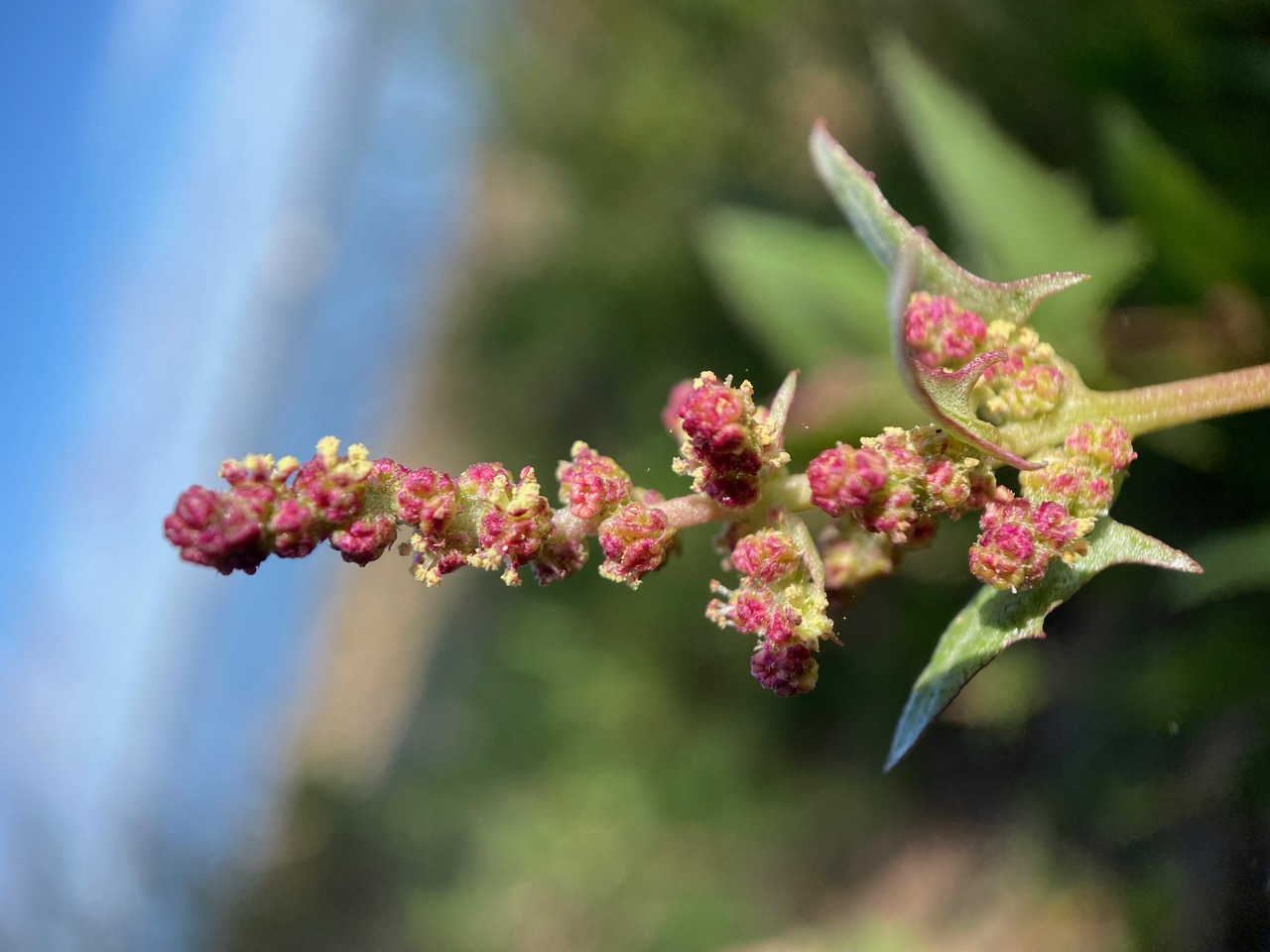
The Creeping Saltbush, Atriplex prostrata growing long the shore is starting to bloom. The flowers on this plant start out as clusters of pinkish-red “buds”.
Saltbush flowers are unisexual, with male flowers having five stamens and a calyx, while female flowers lack stamens and are enclosed by two distinct, often thickened bracteole that form the fruit. Flowers are often wind-pollinated and clustered into small bead-like formations called glomes or spikes. Plants are typically dioecious, with male and female flowers on separate individuals, but can also be monoecious (on the same plant) or even triocious, with plants able to change sex in response to environmental conditions.
Some male flowers are opening up on this spike. Each flower has five stamens and a five-lobed reddish calyx, and no petals. Each stamen has a two-lobed anther that releases yellow pollen.
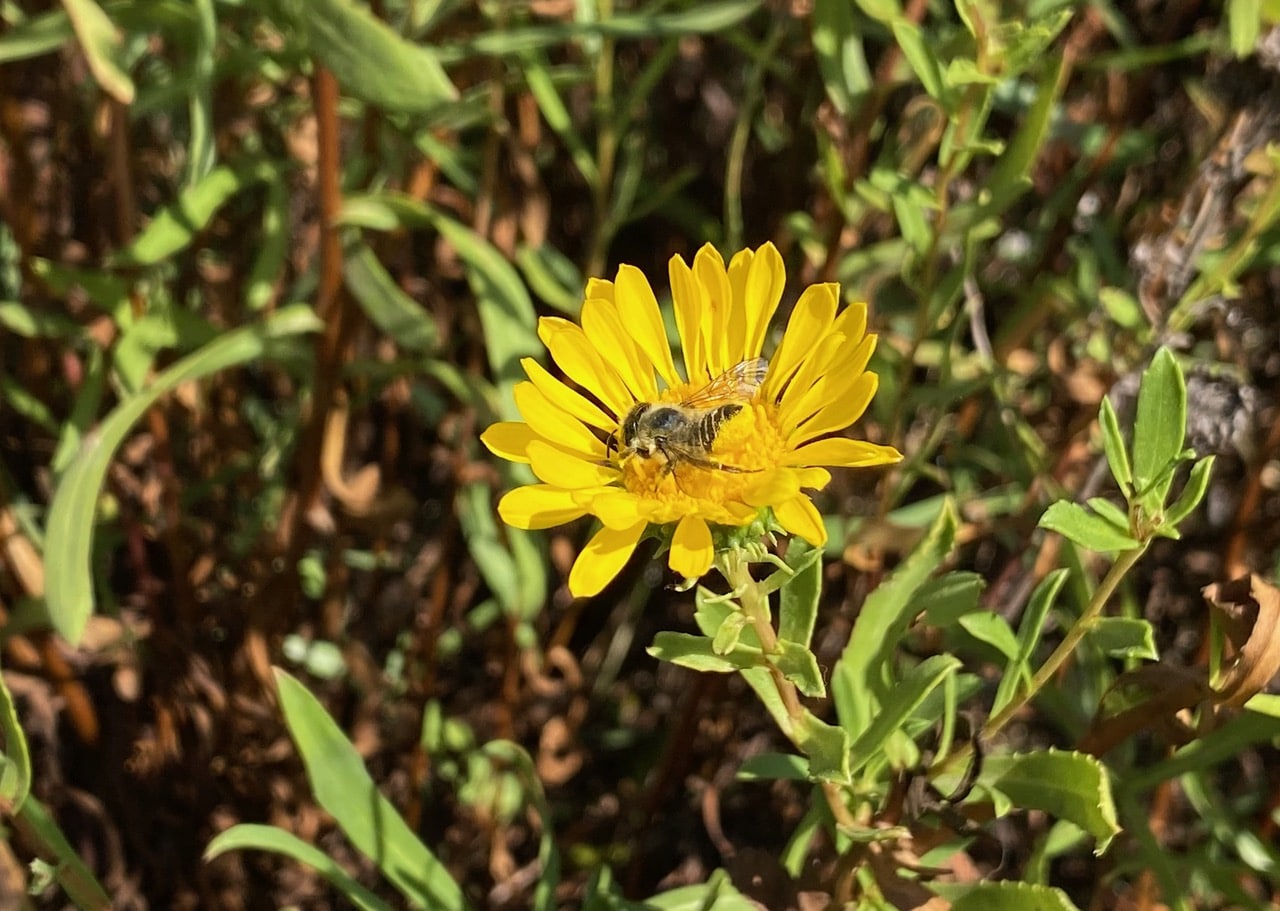
Ah, a glorious stretch of blooming Oregon Gumweed, Grindelia stricta is laid out in front of me along this level path, promising fascinating insect encounters.
White foamy masses have appeared on the stem of this young Grindelia, created by the nymphs of the Spittle Bugs, Complex Clastoptera lineatocollis (family Clastopteridae). The Grindelia at Shoreline Park had a huge infestation of these spittlebugs last summer. So far, the bugs seem to be few and far between this year.
Why the common name of “spittlebug”? The nymphs (immatures) of these bugs create foam masses on plants in which they live and feed. Like the adults, the nymphs use their piercing, sucking mouthparts to feed on plant juices. The nymph produces a cover of foamed-up plant sap reminiscent of saliva, hence the common name of spittlebug. Whereas most insects that feed on sap feed on the nutrient-rich fluid from the phloem, Spittlebugs tap into the much more dilute sap flowing upward via the xylem. The large amount of excess water that must be excreted and the evolution of special breathing tubes allow the young spittlebug nymphs to grow in the relatively protective environment of the spittle. Symbiotic bacteria in the insects’ digestive system provides them with the essential amino acids that their diet lacks. The foam serves a number of purposes. It hides the nymph from the view of predators and parasites, and it insulates against heat and cold, and protects the delicate nymphs from desiccation. Moreover, the foam has an acrid taste that deters predators.
I scoop up one of the foam masses with a finger, and gently part the foam to reveal a relatively mature bicolored nymph. Its hind end is a cream color while the front end is brownish black. After photographing the nymph I return it to its foam on the plant, none the worse for wear. It will stick its rostrum (mouthparts) into the stem and whip up another foam mass in no time. Maybe I’ll see it as an adult soon!
A female Western Leafcutter Bee, Megachile perihirta (family Megachilidae) lands on a Grindelia flowerhead, her abdomen held high. Yellow pollen is visible on the scopa (special pollen collecting hairs) on the underside of her abdomen.
Leaf-cutter Bees, Megachile sp. (family Megachilidae) are stout-bodied, usually with pale hair on the thorax and stripes of white hairs on the abdomen. Females usually have a triangular abdomen with a pointed tip, and males’ faces are covered with dense, pale hair. Flight season is from May into September, with peak activity from June to August.
Solitary females construct nests in tubular cavities, including hollow stems, tree holes, and abandoned beetle burrows in wood. Many use holes drilled into wood, straws, or other manufactured tunnels. Females cut pieces from leaves or flower petals for use in the construction of brood cells. Most Megachile females are generalists when foraging for pollen. Pollen is transported in dense scopae on the underside of the abdomen.
Photos of Western Leafcutter Bee (Megachile perihirta) · iNaturalist
North America is home to many leafcutter bees, but the Western Leafcutter, Megachile perihirta is one of the largest. The species ranges on the west coast from British Columbia south to northern Mexico. From a distance, the female can be mistaken for a honey bee. She is about the same size as a worker honey bee and enjoys many of the same flowers, but her head is disproportionately large because it houses the bulky muscles that operate her large mandibles. While most leafcutter bees nest above ground in tubes and tunnels, the Western Leafcutter nests underground. Often a small group of females live in a community and burrow into soil, gravel, or sand.
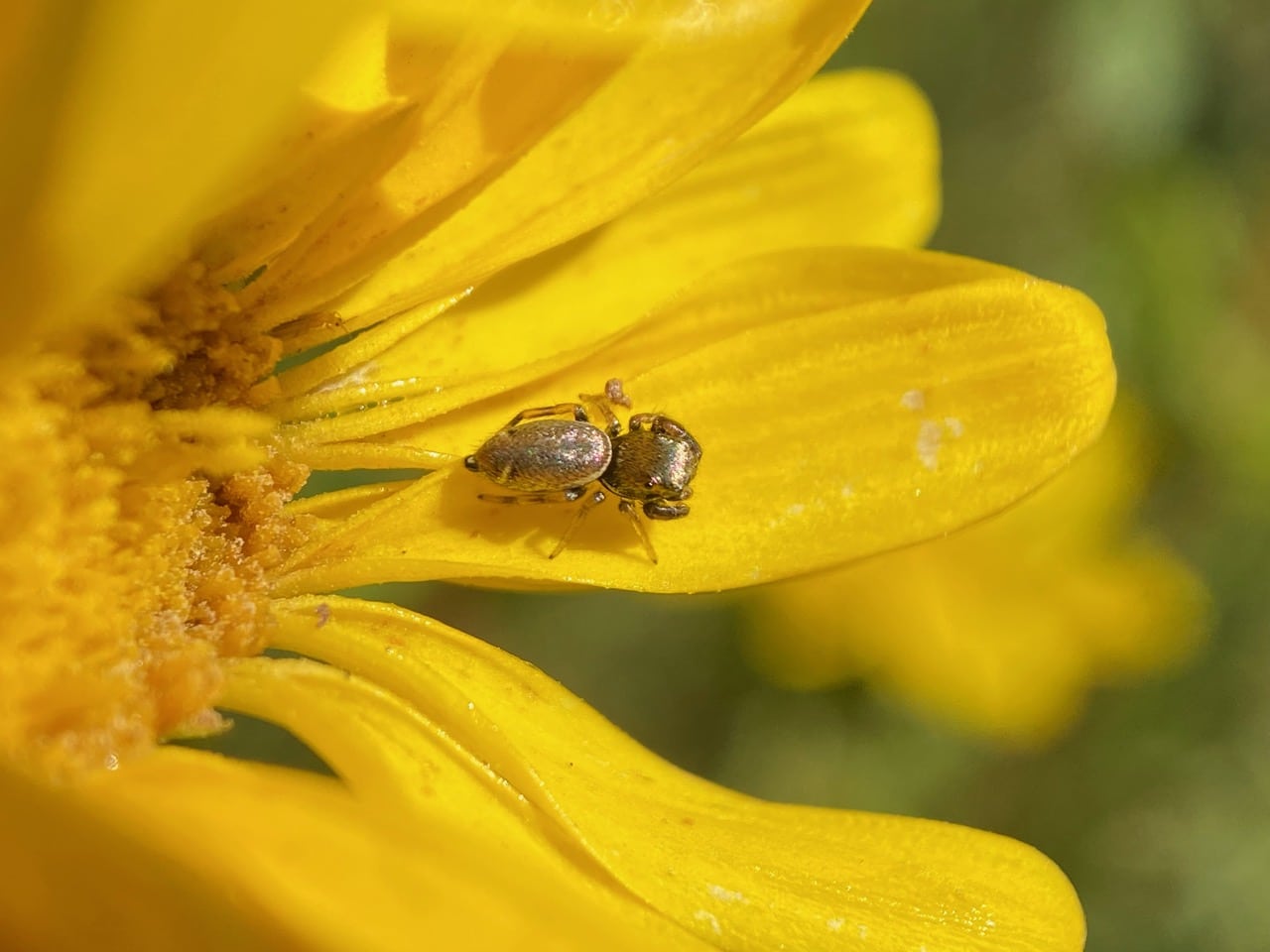
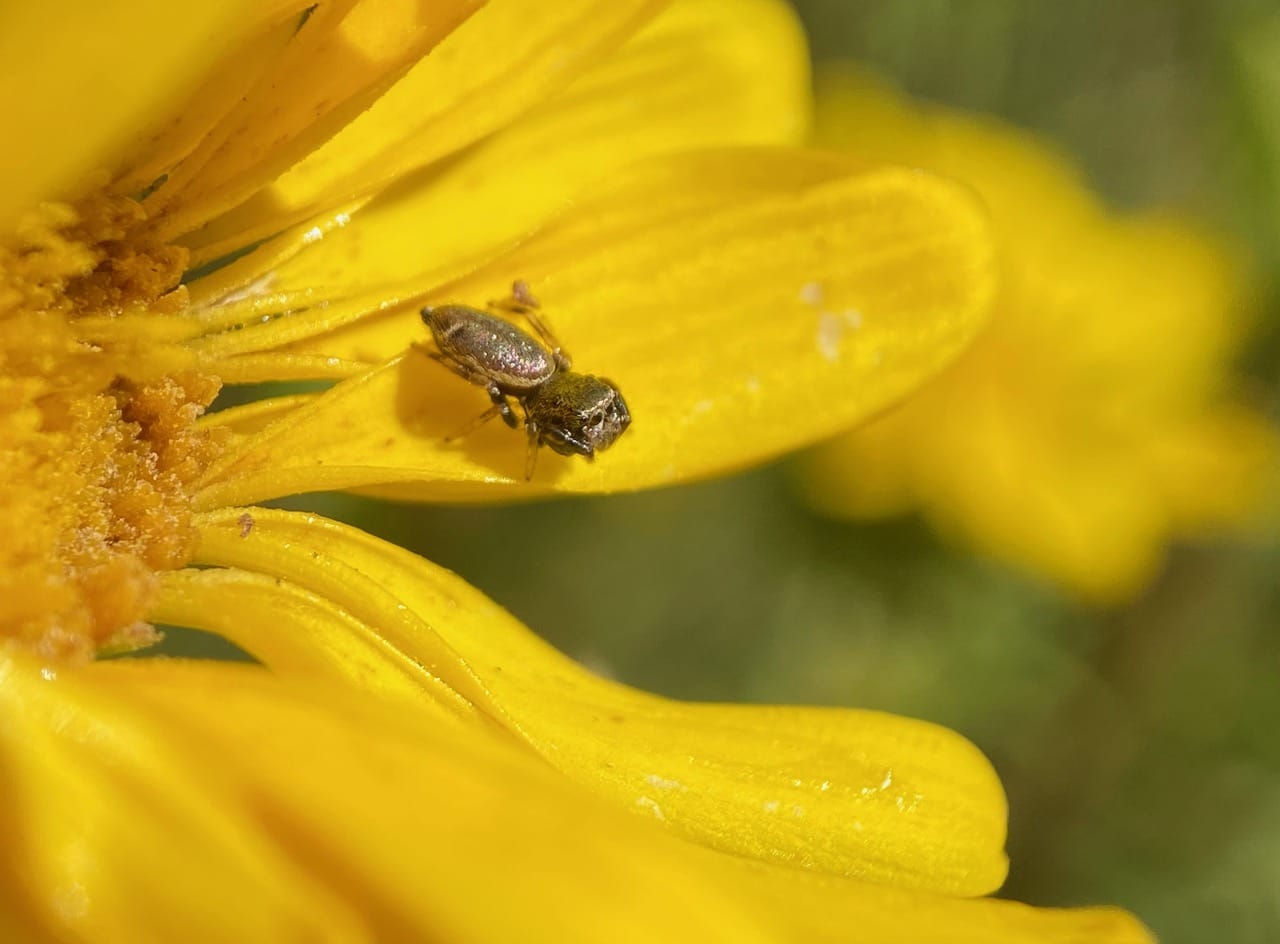
Although it is a very common spider on the Grindelia here, I am always thrilled to see the tiny Buttonhook Leafbeetle Jumping Spider, Sassacus vitis (family Salticidae) through the macro lens.
Jumping spiders (family Salticidae) are free-roaming hunting spiders. They do not weave a web to catch prey. They stalk, then pounce on their prey. Just before jumping, the spider fastens a safety line to the substrate. It can leap 10-20 times their body length to capture prey. Their movement is achieved by rapid changes in hydraulic pressure of the blood. Muscular contractions force fluids into the hind legs, which cause them to extend extremely quickly. Jumping spiders are visual hunters. Their excellent vision has among the highest acuities in invertebrates. Since all their 8 eyes are fixed in place and cannot pivot independently from the body like human eyes can, jumping spiders must turn to face whatever they want to see well. This includes moving their cephalothorax up and down, an endearing behavior.
It is often difficult to tell whether a particular spider is an adult or an immature, judging by size alone. In the jumping spiders in the genus Sassacus, the adults are only about 3-5 mm. The genus name Sassacus was the last chief of the Pequot Indians, a Native American tribe of the Connecticut Valley that was vanquished in a war with English settlers in 1637. The iridescent color and very compact appearance of these spiders leads scientists to suspect that they are mimics of certain leaf beetles in the family Chrysomelidae. Many Chrysomelids don’t taste good, as they feed on poisonous plants and sequester those plant toxins for their own defense. They advertise their distastefulness to predators with bold black and white, yellow, orange, or red color patterns, or with brilliant metallic colors. One of the defining characteristics of the genus is the very short legs. The fourth pair of legs is still the thickest, with one or two pairs of spines, used in tackling prey. Like most jumping spiders, Sassacus engages in visual courtship displays. The twitching abdomen also produces an auditory stimulus as the male waves his front legs to garner the female’s attention.
Sassacus vitis is native to North America, with a range spanning from Canada to Panama. It is a small jumping spider with iridescent gold abdomen and white ring around the anterior surface of abdomen. Body is covered with golden scales. Males are 3.5 mm long, females 4.5 mm. The name vitis is Latin for “grapevine”. The spider is commonly found on shrubs and vines and in fields. Best known as a common resident of vineyards.
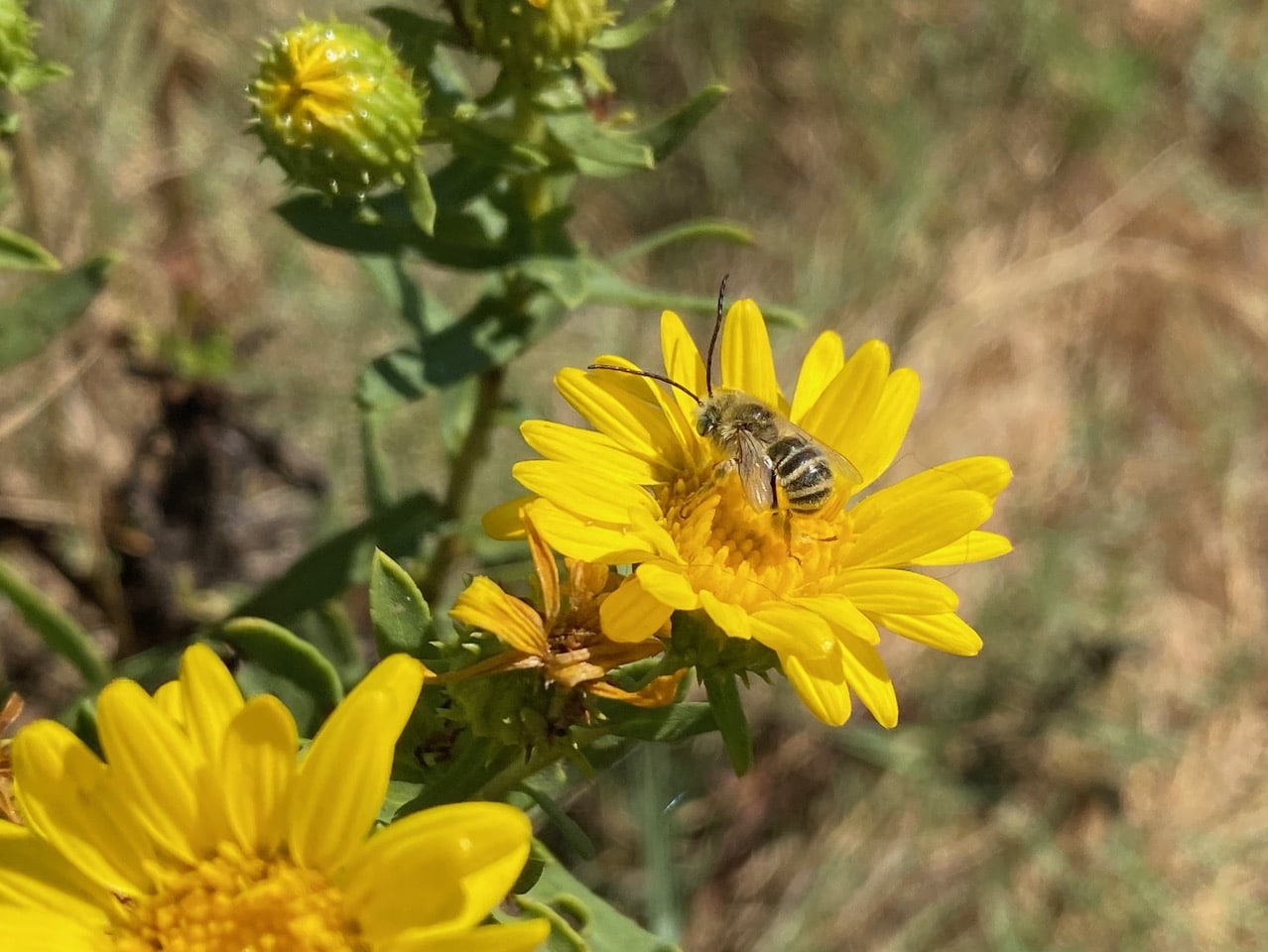
Carrying prodigious loads of pollen on her scopae, this female Longhorn Bee, Melissodes sp. (family Apidae) appears to be wearing yellow pantaloons. Much slower than their male counterparts in showing up here this year, I am glad to see them in good numbers now.
The Summer Longhorn Bees, Melissodes sp. (family Apidae) are medium to large bees, stout-bodied, usually with gray hair on the thorax and pale hair bands on the abdomen. Males usually have yellow markings on their faces and have very long antennae from which their common name is derived. They are active May to September, with peak flight in late June to early August. The females prefer flat, bare ground for digging their solitary nests, though they sometimes nest in aggregations. Pollen is transported in scopae on the hind legs. Pollen loads are often copious and brightly colored and thus very distinguishable. Melissodes are specialists on Asteraceae – females gather pollen from flowers of Aster, Bidens, Coreopsis, Cosmos, Encelia, Gaillardia, Helianthus, and Rudbeckia ssp.
The hard-working female Longhorn Bee gets pollen all over her face as she forages. Melissodes females are easily recognizable in the field from the sheer size of the pollen loads on their hind legs.
Different groups of bees have distinct ways of collecting and transporting pollen. Here are some of the ways:
– Pollen Baskets (corbiculae): Bees in four tribes of the family Apidae, including honey bees and bumble bees, have corbiculae. These are smooth, concave areas on their hind legs surrounded by a fringe of hairs, where they pack pollen that has been moistened with nectar.
– Scopa: Many bees have scopae, which are dense masses of branched hairs where pollen is loosely held by electrostatic attraction. These can be located in different areas:
– Hind legs: Most solitary female bees have pollen brushes or scopae on their hind legs. Mining bees (family Andrenidae), for example, have scopa covering most of the hind legs and sides of the
female.
– Abdomen: Bees in the Megachilidae family, such as Leafcutter and Mason Bees, carry pollen on scopal hairs on the underside of their abdomen. This is a unique trait that helps in their identification.
– Internal Transport: Some bees, such as the Masked Bees lack external pollen-carrying features. They transport pollen internally in a specialized organ called a crop.
– Incidental Transport: Male bees lack specialized pollen-collecting hairs but can still inadvertently transport pollen. While seeking nectar, pollen may cling to their electrostatically charged body hairs. This can lead to successful pollination as the males go from flower to flower.
– No Pollen Collection: Some bees, known as Cuckoo Bees, do not collect pollen at all. They are parasitic and lay their eggs in the nests of other bees where their young consume the host bee’s pollen stores.
Another over-achieving female Longhorn Bee, Melissodes sp. (family Apidae)!
A male Longhorn Bee, Melissodes sp. (family Apidae) is furiously grooming himself on a Grindelia flowerhead. Since he is oblivious to my presence, I am able to video record his behavior at close range. Note that he brushes his abdomen and wings with his hind legs, and cleans his face and antennae with his front legs, sometimes simultaneously. Awesome dude!
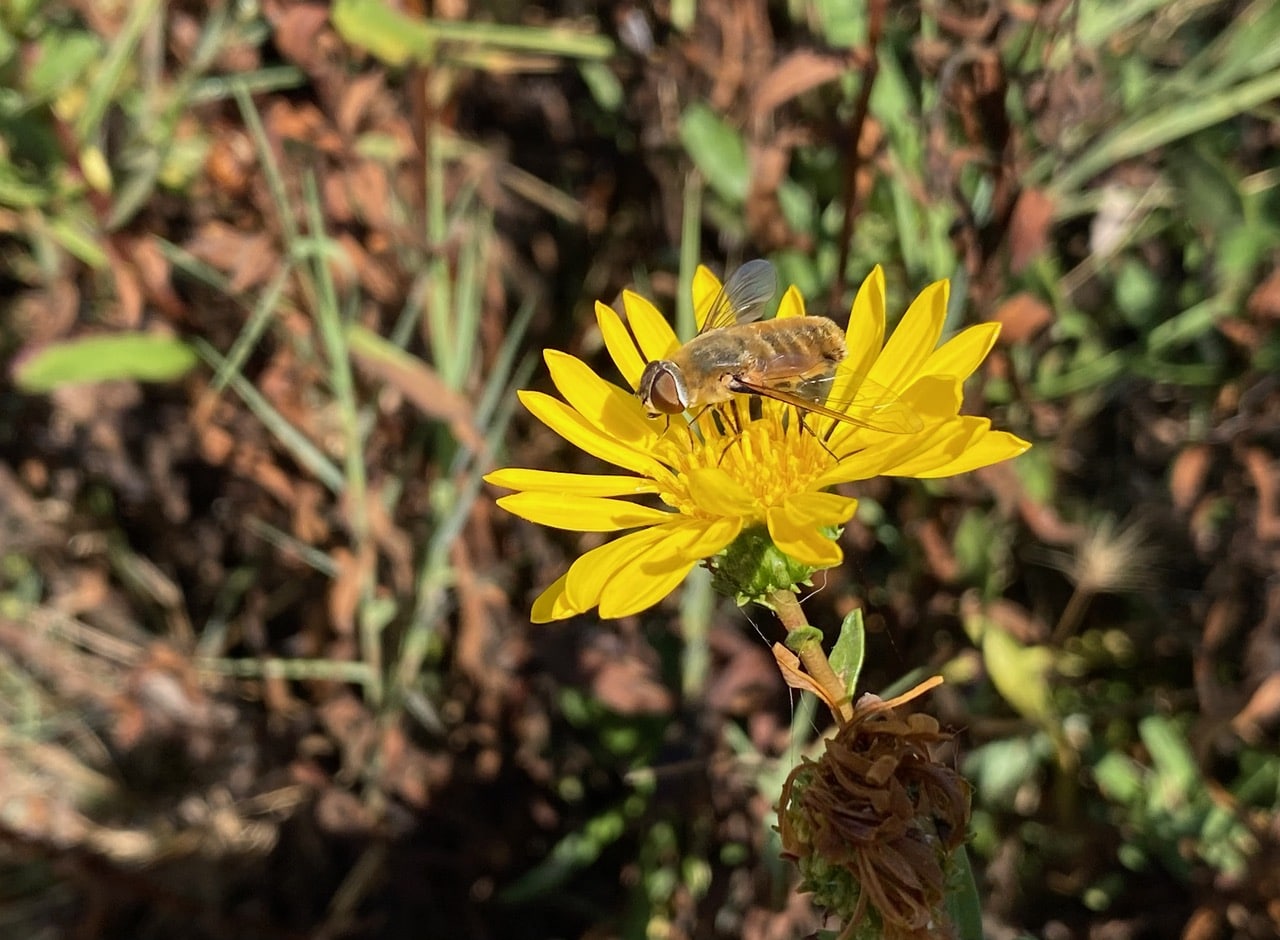
A stout, brown Bee Fly, Villa sp. (family Bombyliidae) is foraging on a Grindelia flowerhead.
The Bee Flies belong to the family Bombyliidae. Adults generally visit flowers for nectar and pollen, some being important pollinators. Larvae generally are parasitoids of other insects. When at rest, many species of bee flies hold their wings at a characteristic “swept back” angle. The adult females usually deposit eggs in the vicinity of possible hosts, quite often in the burrows of beetles or ground-nesting bees/wasps. Bombyliidae parasitism is not host-specific, but rather opportunistic, using a variety of hosts. Adult females of the genus Villa lay eggs in mid-air and flick them towards the nest entrances of their hosts. They typically have an eversible pouch near the tip of their abdomen known as a sand chamber, which is filled with sand grains gathered before egg laying. These sand grains are used to coat each egg just before their aerial release, presumably to improve the female’s aim by adding weight.