

Pollinator Post 9/7/24

Elizabeth, Emil and I are excited to be out exploring the northern shoreline of Bay Farm Island this sunny afternoon. Emil leads us on a narrow path through the low vegetation strewn with stranded algae.
 We are thrilled to find several Wetsalts Tiger Beetles, Cicindela haemorrhagica (family Cicindelidae) on the path as well as on the sandy patches just above the lapping waves. Emil is pleased to get a good picture of a mating pair of the beetles. I am lucky to get a shot of an individual stopping momentarily while running across the drying algae.





We are thrilled to find several Wetsalts Tiger Beetles, Cicindela haemorrhagica (family Cicindelidae) on the path as well as on the sandy patches just above the lapping waves. Emil is pleased to get a good picture of a mating pair of the beetles. I am lucky to get a shot of an individual stopping momentarily while running across the drying algae. Tiger Beetles are a family of beetles, Cicindelidae, known for their aggressive predatory habits and running speed. The fastest known species can run at about 125 body lengths per second! Tiger Beetles often have large bulging eyes, long, slender legs and large curved mandibles. All are predatory, both as adults and as larvae. The genus Cicindela has a cosmopolitan distribution, is usually diurnal and may be out on the hottest days. The fast-moving adults run down their prey and are extremely fast on the wing. Apparently their running speed exceeds their brain’s ability to process visual images – occasionally the beetles have to abruptly stop in mid-chase to visually reorient. What a riot to watch!
The larvae of tiger beetles live in cylindrical burrows as much as a meter deep. The grubs have a large head, armored on top with up to six small eyes and formidable mandibles beneath. A flat plate right behind their head fills the burrow flush with the surface while they wait at the entrance in ambush for passing prey. There is a prominent hump on their fifth abdominal segment with two pairs of backward pointing hooks to anchor them in their burrow against struggling prey. Danger lurks at every turn, both on and below ground for the other little creatures that make their home in this sandy habitat.
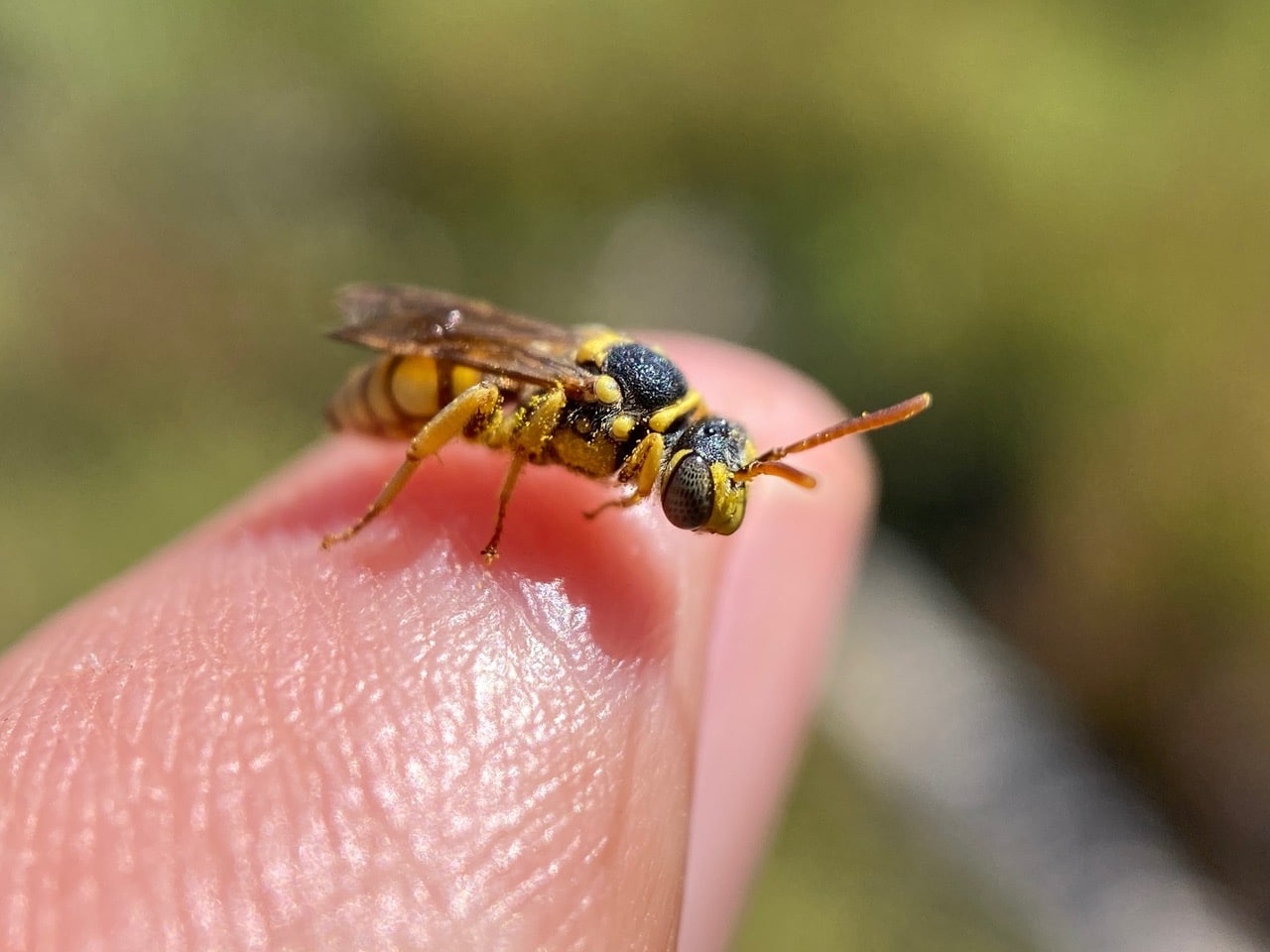
The inveterate bee whisperer, Emil manages to coax a Nomad Bee from a flower onto his finger for a close-up photo.
Nomad Bees in the genus Nomada is one of the largest genera in the family Apidae, and the largest genus of Cuckoo Bees. Nomada are kleptoparasites of many different types of ground-nesting bees as hosts, primarily the genus Andrena. They lack a pollen-carrying scopa, and are mostly hairless, as they do not collect pollen to feed their offspring. Adults visit flowers for nectar. The bees are extraordinarily wasp-like in appearance, often with yellow or white integumental markings on their abdomen.
Nomad Bees occur worldwide. All known species parasitize ground-nesting bees, and their habitats and seasonality correlate closely with their hosts. In early spring, females scout out their hosts, searching for nests to parasitize. The female Nomada sneaks into the host’s nest while the resident female is out foraging, then lays eggs in the nest. The parasite larva that hatches out kills the host offspring and feeds on the host’s provisions. This type of parasitism is termed brood parasitism. The parasites pupate in the host cell and finally emerge as adults the following season along with the hosts.
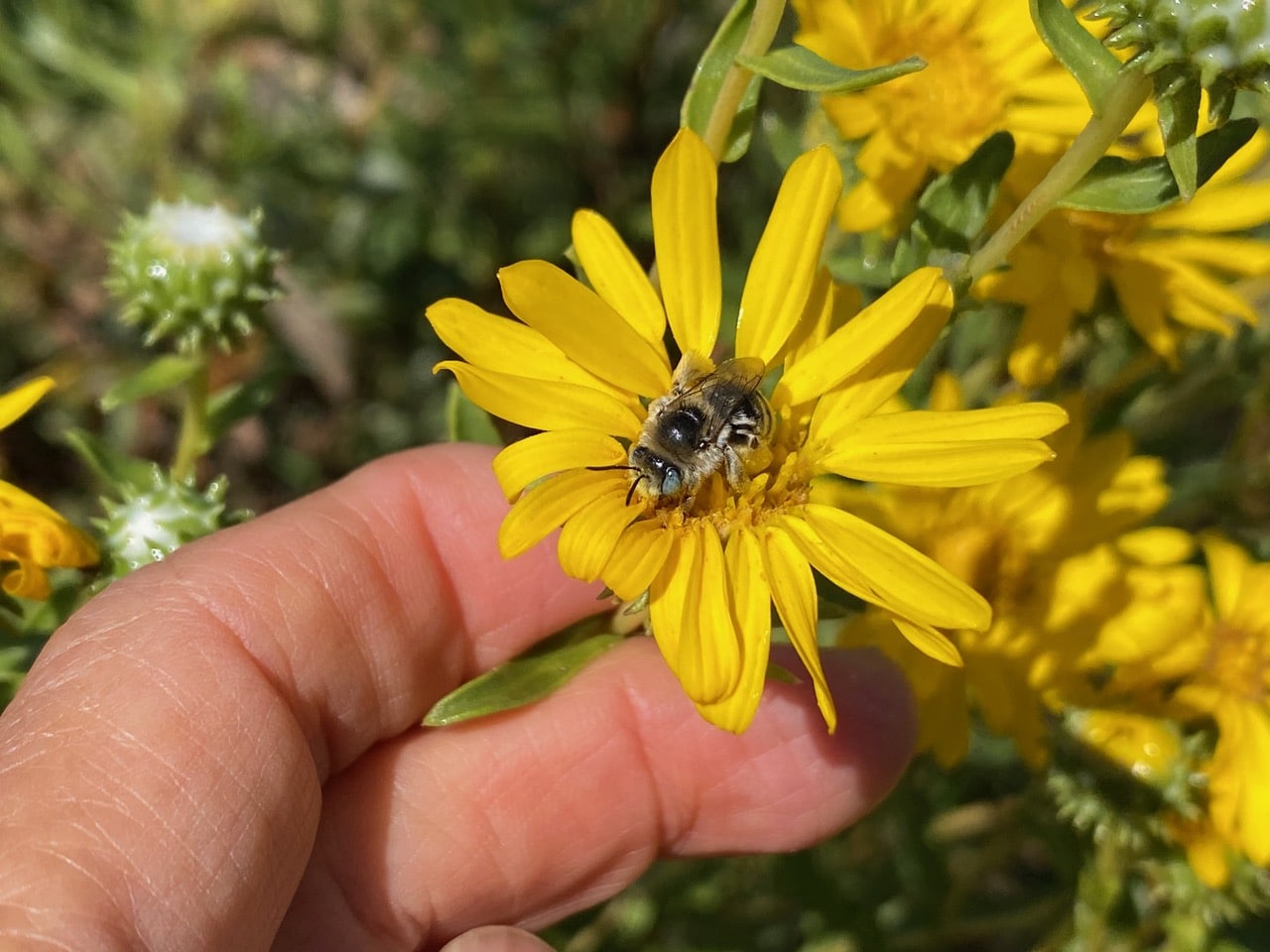
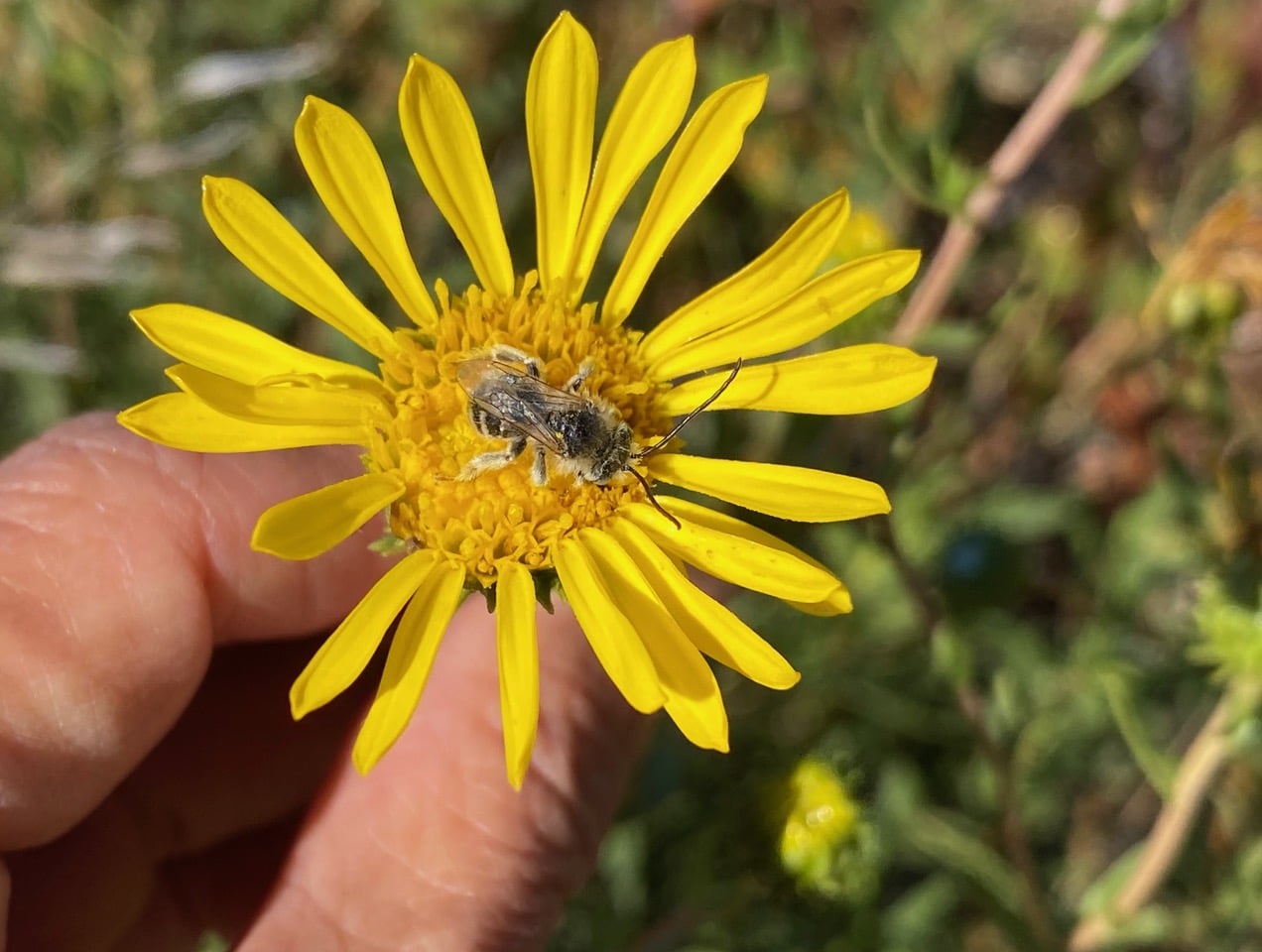
A female Summer Longhorn Bee, Melissodes sp. (family Apidae) is foraging on a flowerhead of Oregon Gumweed, Grindelia stricta.
The Summer Longhorn Bees, Melissodes sp. (family Apidae) are medium to large bees, stout-bodied, usually with gray hair on the thorax and pale hair bands on the abdomen. Males usually have yellow markings on their faces and have very long antennae from which their common name is derived. They are active May to September, with peak flight in late June to early August. The females prefer flat, bare ground for digging their solitary nests, though they sometimes nest in aggregations. Pollen is transported in scopae on the hind legs. Pollen loads are often copious and brightly colored and thus very distinguishable. Melissodes are specialists on Asteraceae – females gather pollen from flowers of Aster, Bidens, Coreopsis, Cosmos, Encelia, Gaillardia, Helianthus, and Rudbeckia ssp.
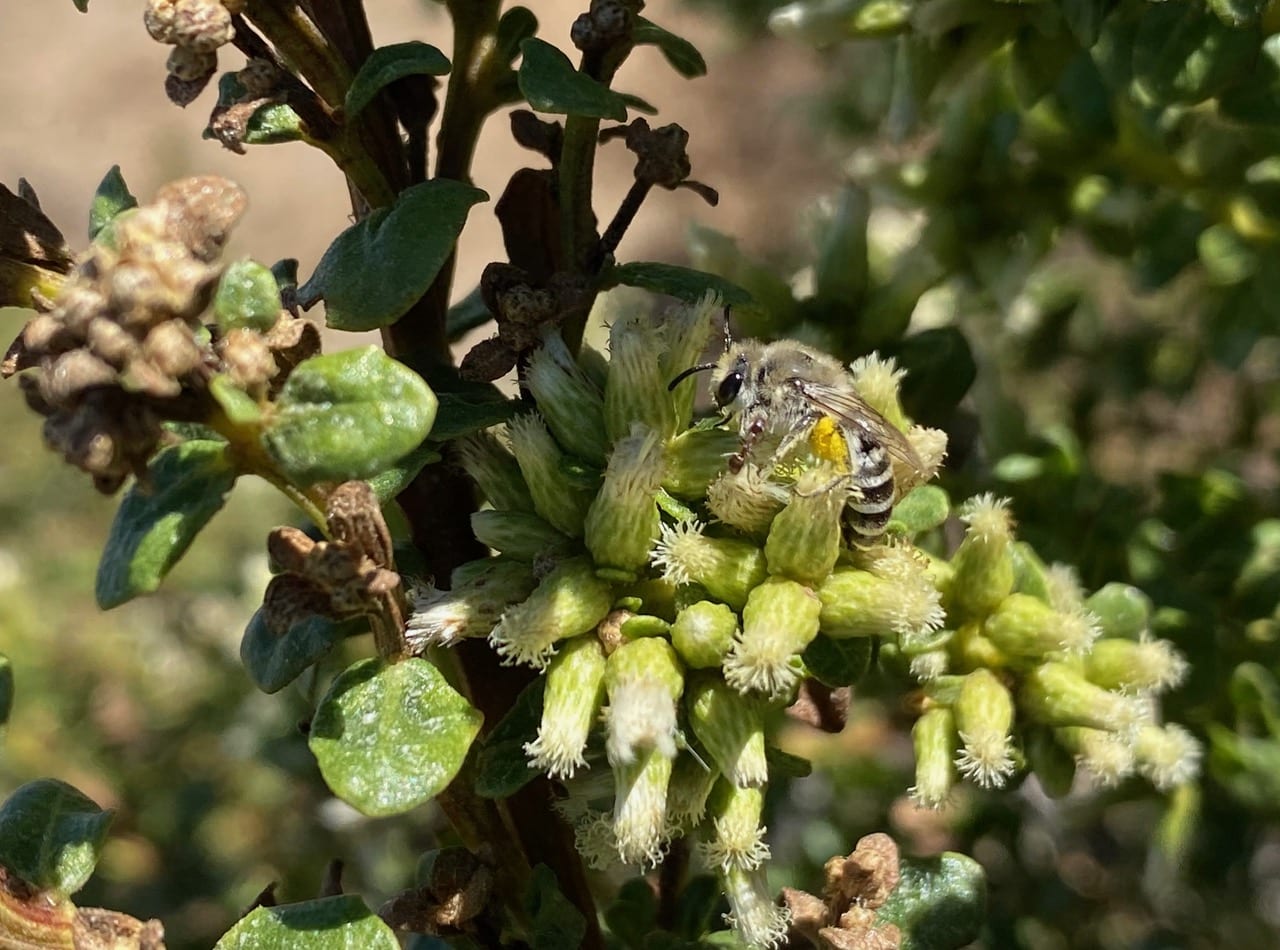
Small insects are swarming over a blooming female Coyote Brush, Baccharis pilularis. They are mostly a species of pale Cellophane Bees, Colletes sp. (family Colletidae). Here a female has landed to take nectar from the compact flowerheads.
The bee family Colletidae includes generalists and specialists, and they are likely important pollinators of many wildflowers. All Colletidae in North America are solitary ground nesters, but some species nest in large aggregations. There are two major genera of Colletidae in North America: the Masked Bees (genus Hylaeus) and Cellophane Bees (genus Colletes). The most obvious shared characteristics of Colletidae is also the hardest to see: their short tongue. The eyes of Colletes are angled (rather than being parallel), making the face slightly heart-shaped.
The genus name Colletes means “one who glues”, referring to their habit of applying a glue- or cellophane-like lining to the walls of nest cells, using their specialized tongues. This lining gives rise to their common names: cellophane bees, polyester bees, and plasterer bees. Colletes tongue is unique: short, flat, and forked at the tip. Colletes line their nests with a distinctive cellophane-like substance made from saliva and secretions from the Dufour’s gland on the abdomen. Using their specialized tongue, they paint the walls with saliva, then with secretions from the Dufour’s gland, they add a coat of varnish. This creates a clear covering that is strong, durable, and resistant to mold and water.
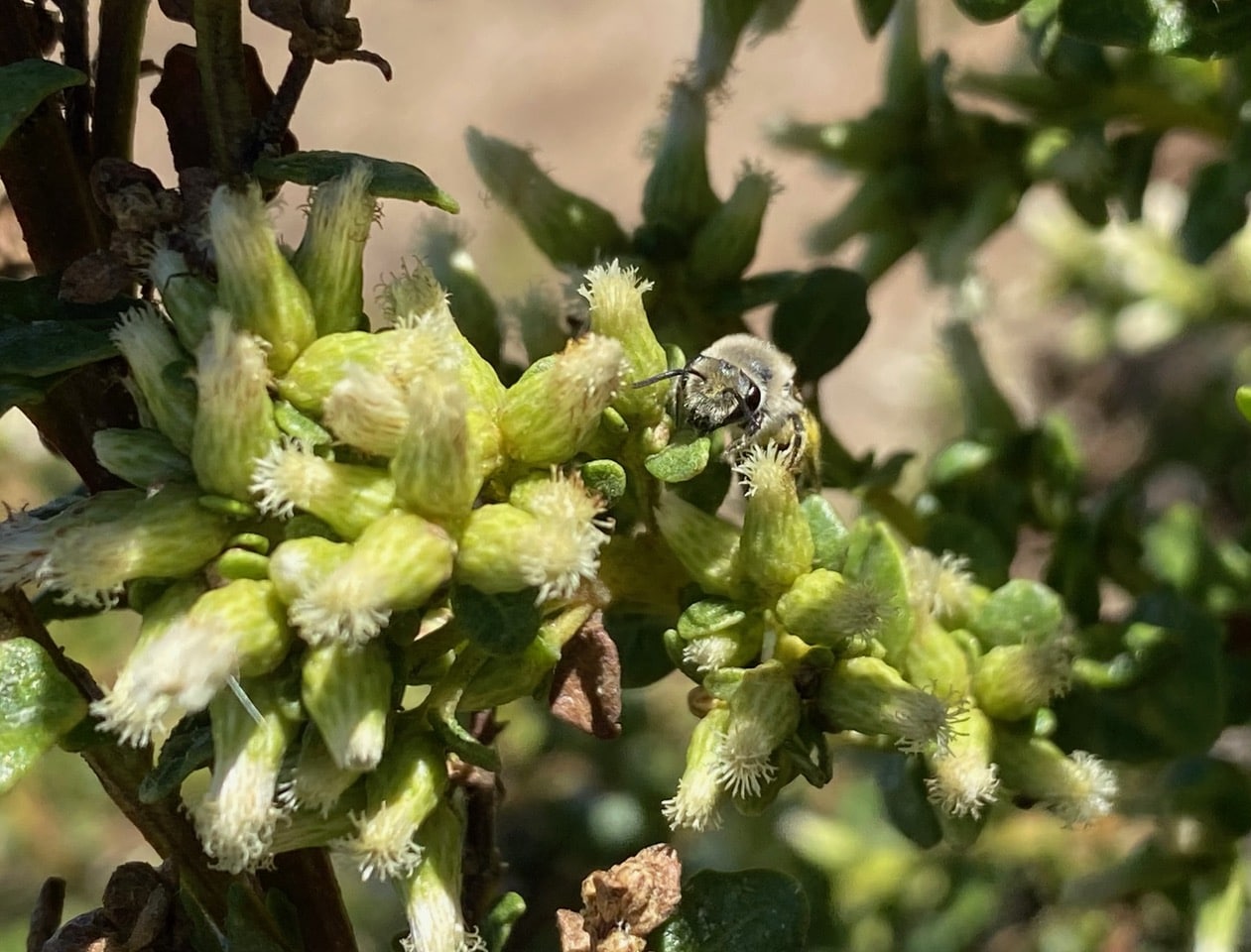
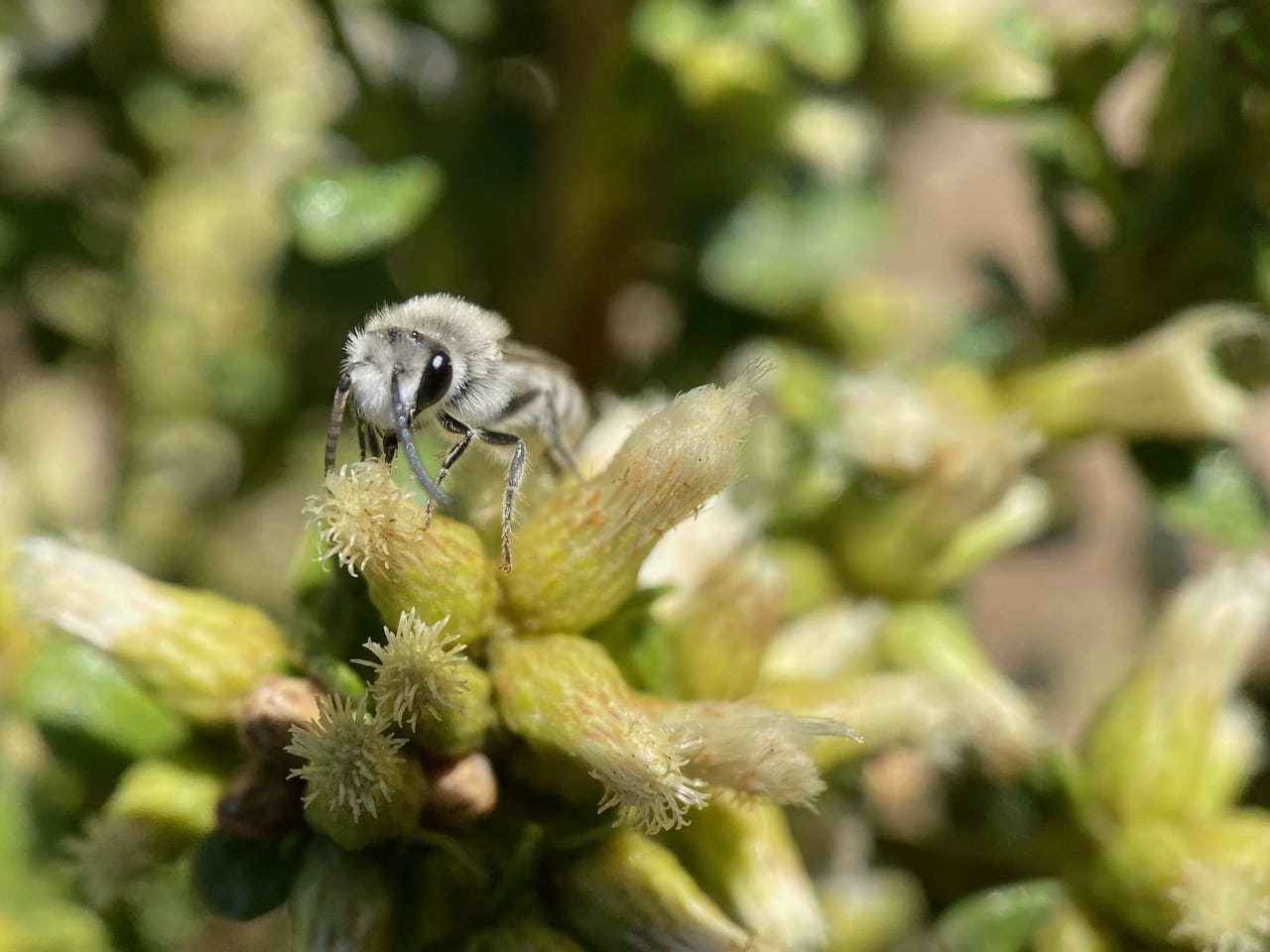
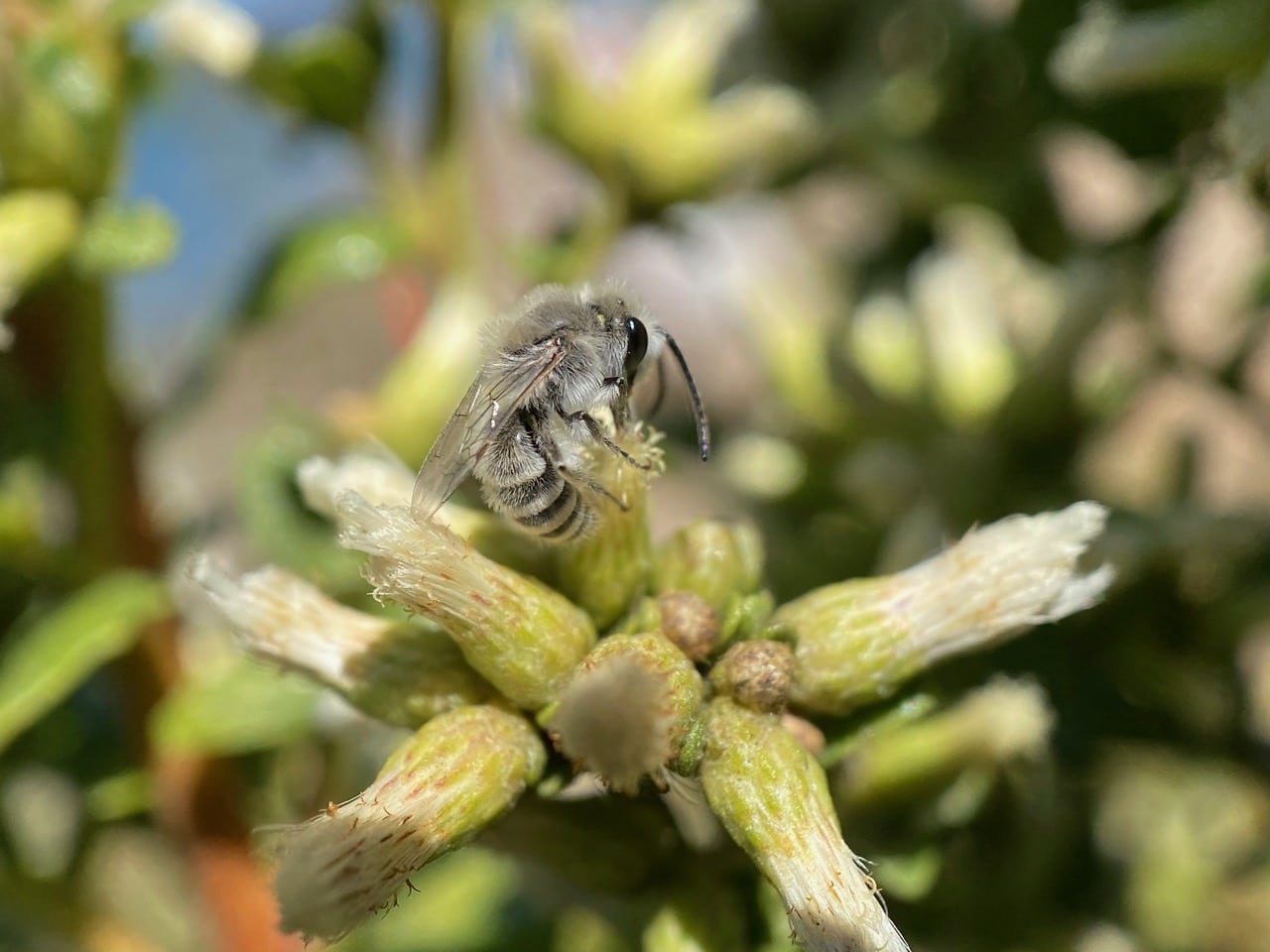
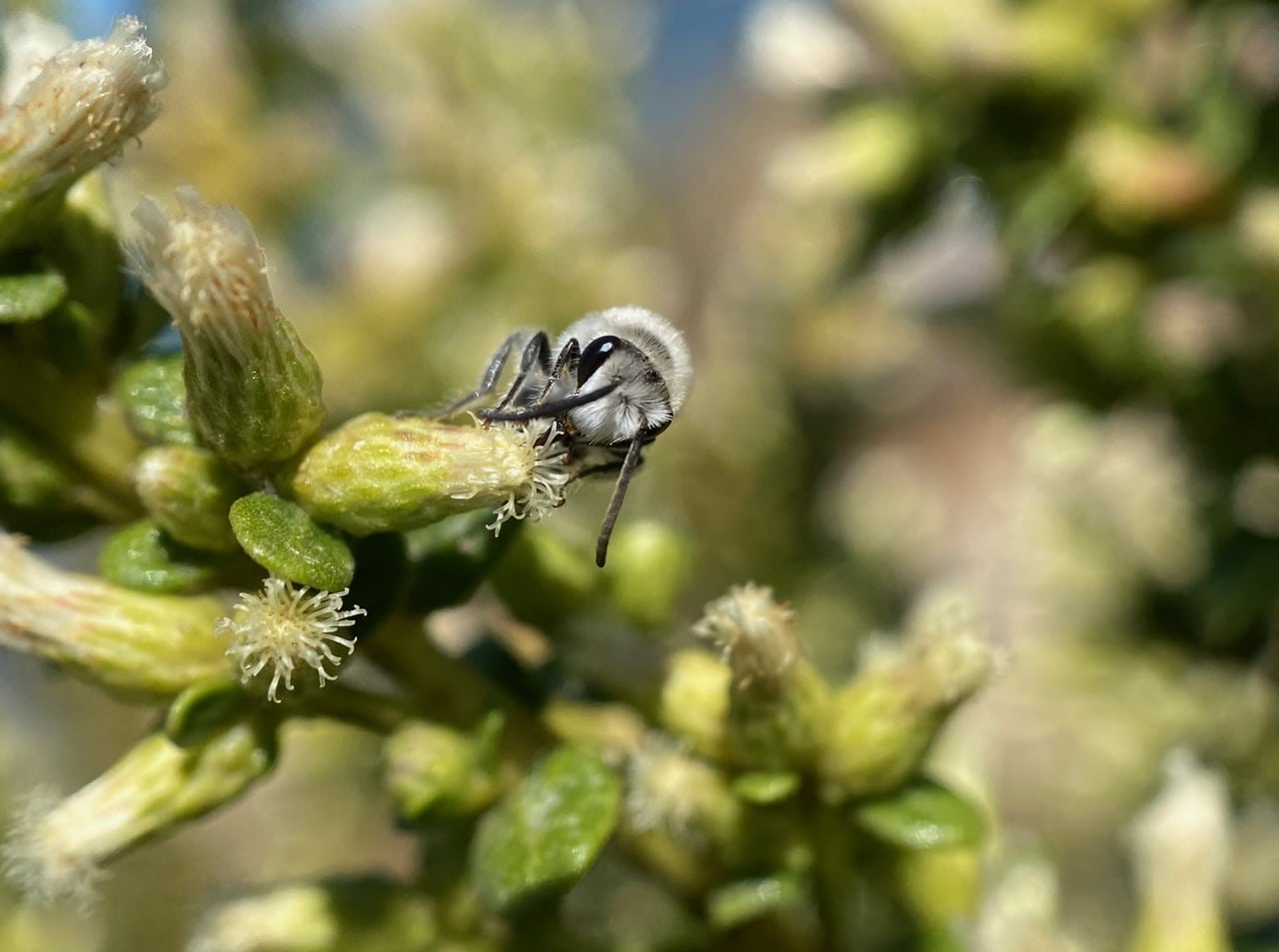
A male Cellophane Bee, Colletes sp. (family Colletidae) with long antennae is grooming itself on a cluster of Coyote Brush flowerheads.
Aww, who could resist falling in love with that fuzzy, heart-shaped face?
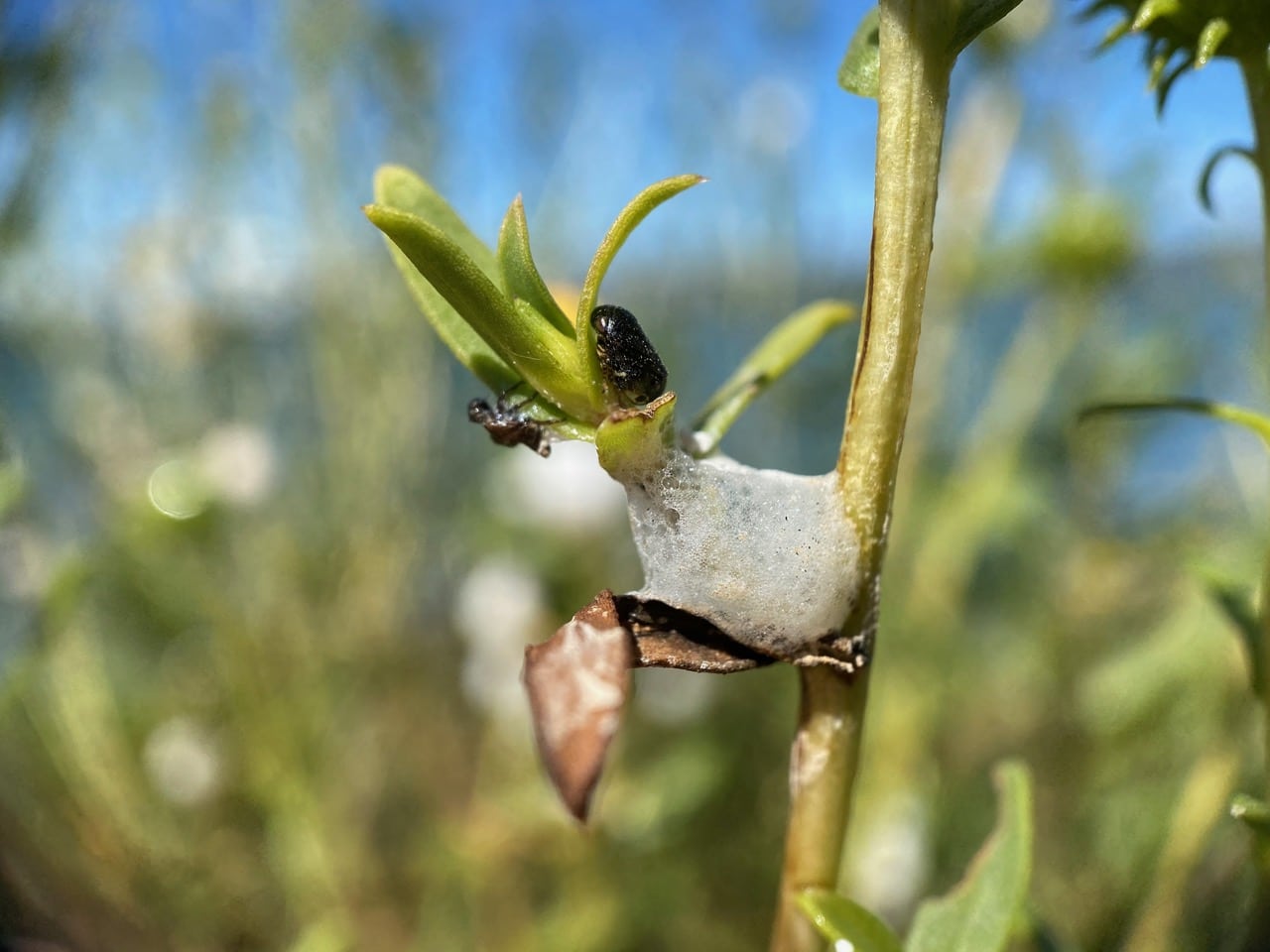
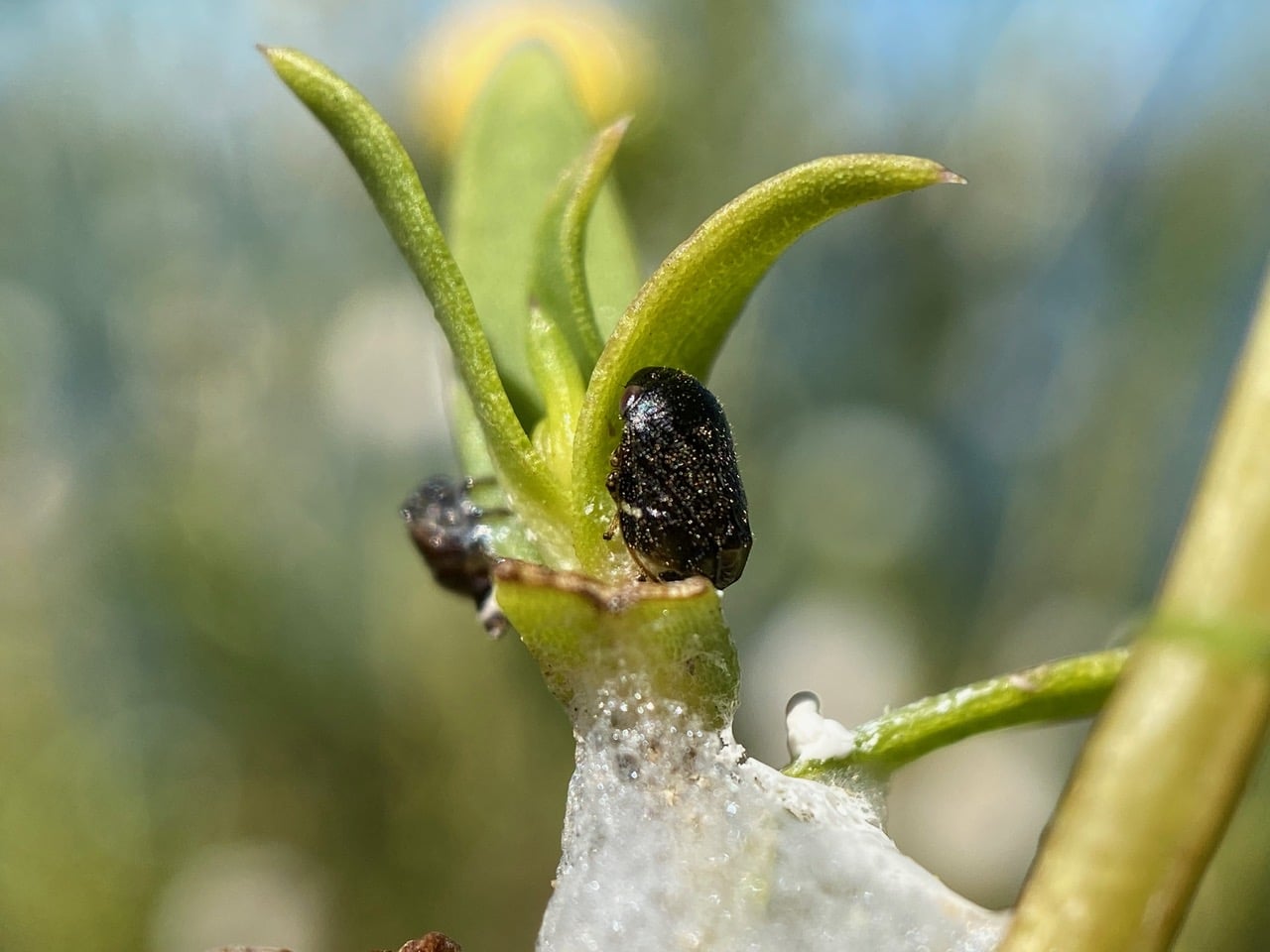
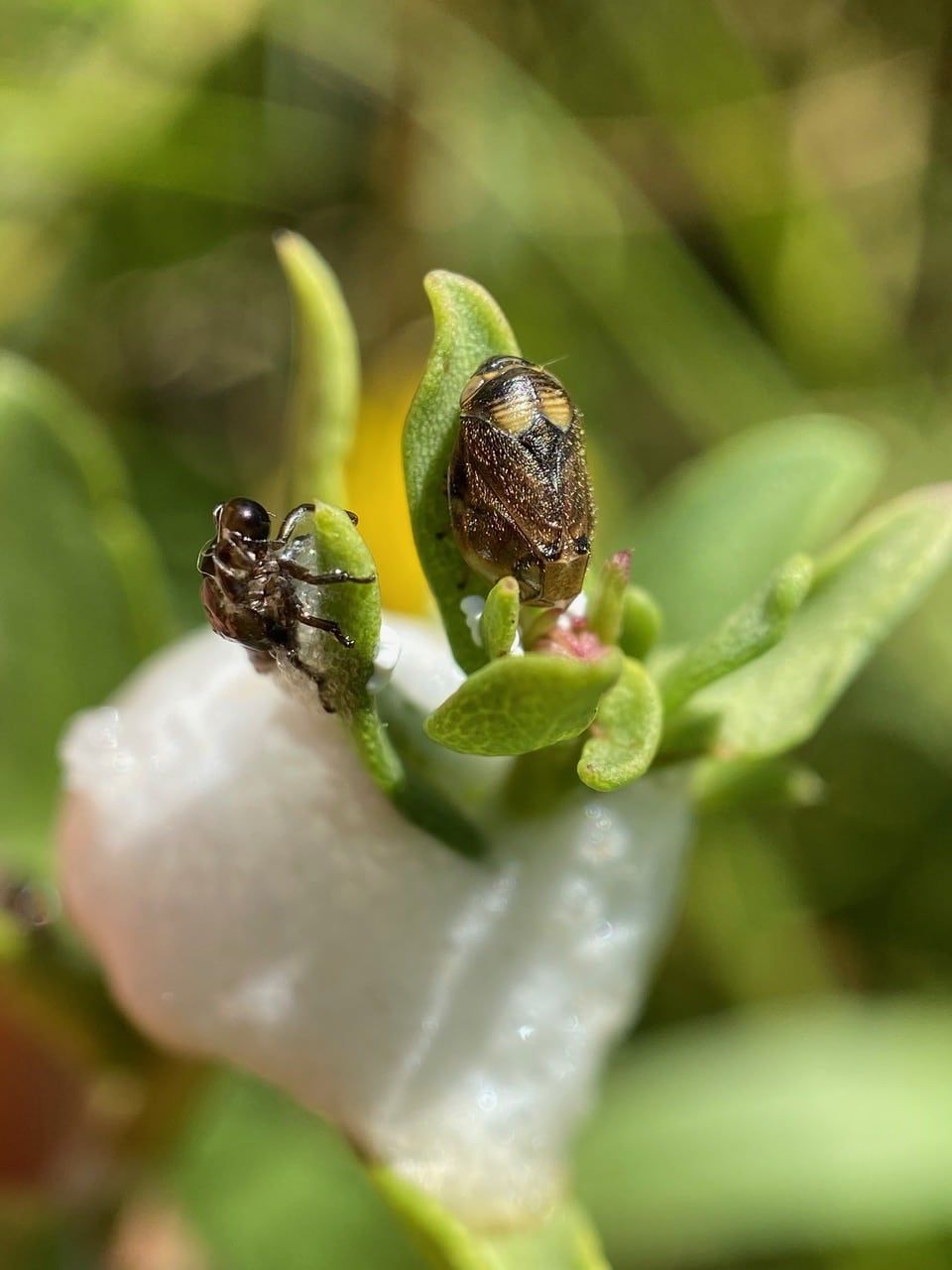
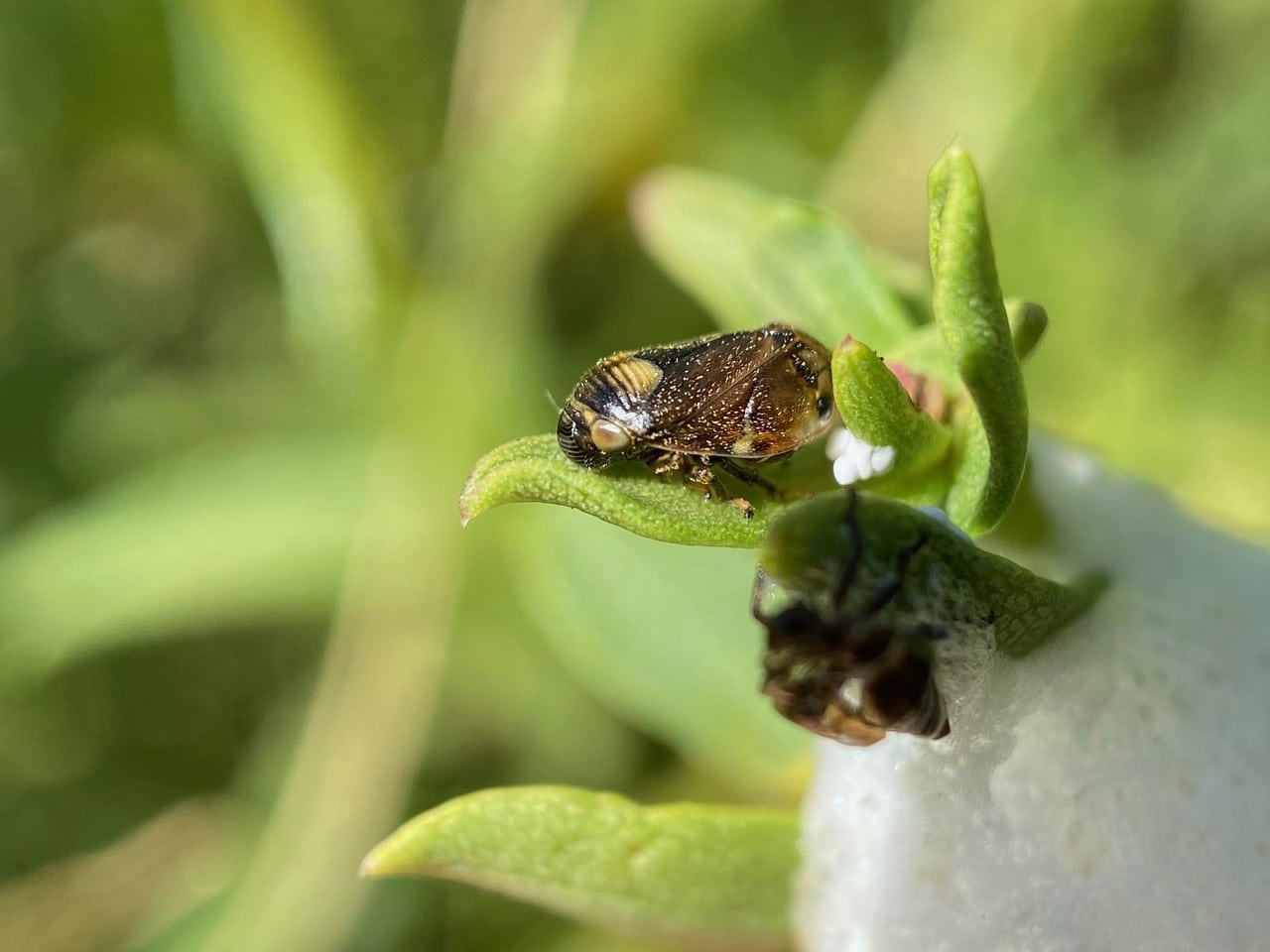
A black male Spittlebug, Complex Clastoptera lineatocollis (family Clastopteridae) is perched on the terminal leaf of Grindelia above a foam mass. Its exuvia is still clinging on an adjacent leaf.
Close-up of the male (?) Spittlebug.
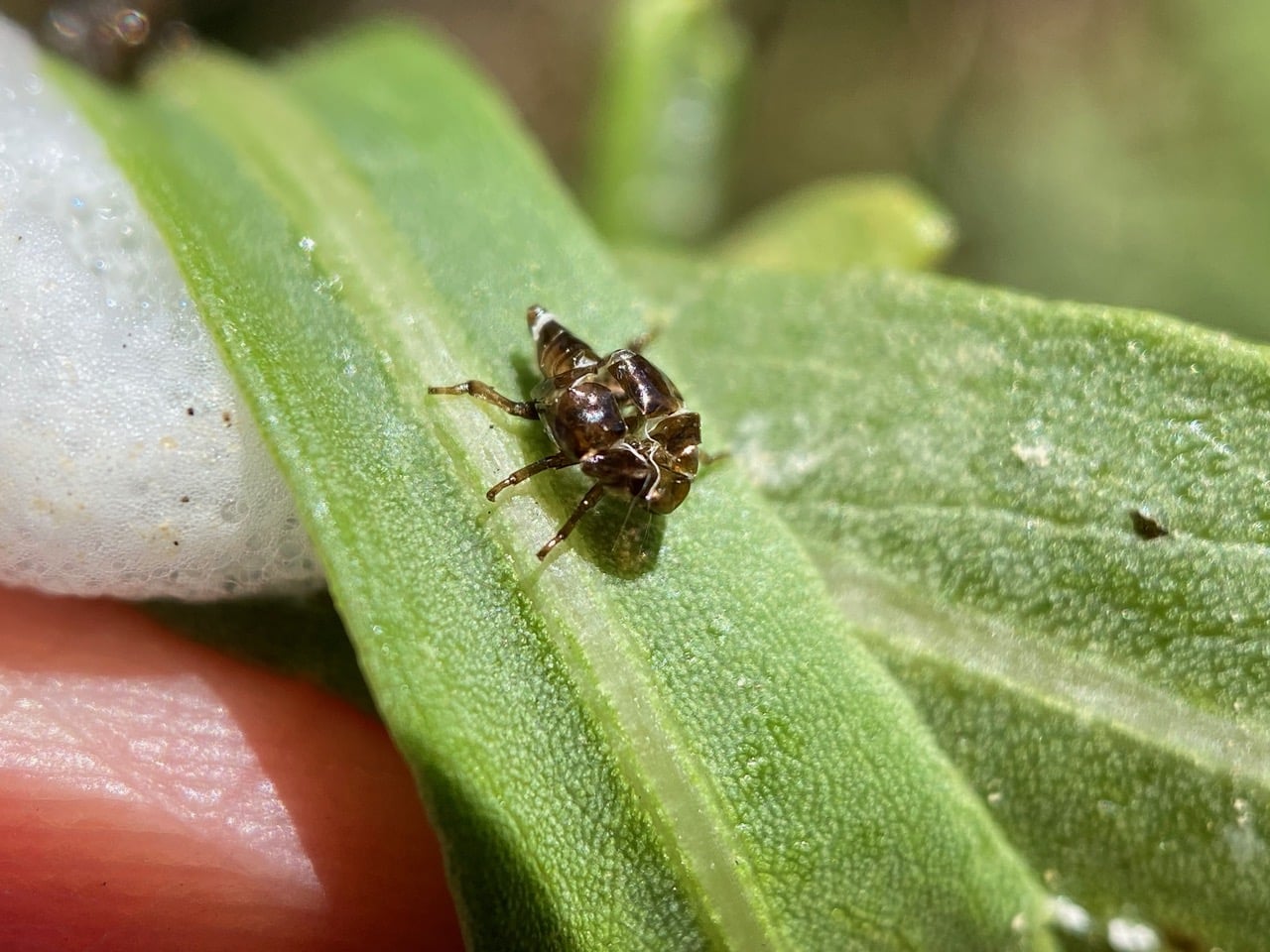
Exuvia can be found everywhere, always close to the white foam masses from which the nymph has emerged to molt.
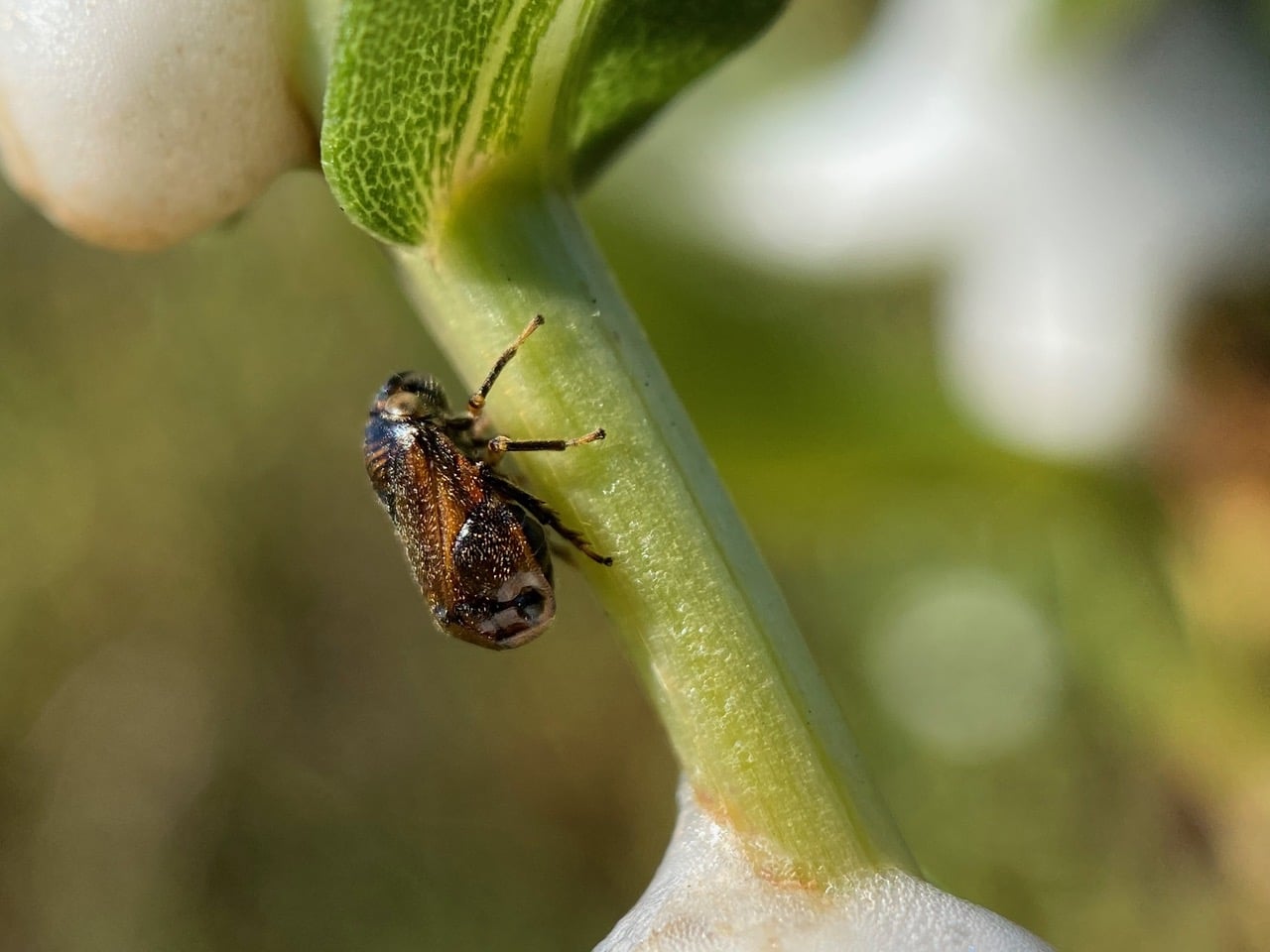
A dark brown adult spittlebug is clinging to the edge of a leaf next to a foam mass. Is it a male or a female?
The bugs is quite fiesty and runs away from the camera.
Here’s another individual whose gender is not obvious. Are those eggs under the Spittlebug?
I tilt the branch for a better look at the bug. Is this a female that has laid the eggs?
Here’s a more ornamented adult Spilttlebug, Complex Clasteroptera lineatocollis (family Clastopteridae).
This is what I gather to be the typical female – larger, brown with striped snout, pronotum and legs. Note the false eyespot on its rear end. Members of the family Clastopteridae have their wings modified to from false heads at the tail end, an anti-predator adaptation.
The adult Spittle Bug is sometimes called a Froghopper. The Froghopper is a “true bug” in the order Hemiptera. Froghoppers are champion jumpers among insects, out-performing even the fleas. The bug can leap the human equivalent of a skyscraper without a running start. It is the highest jumping insect proportional to body size. The muscles in its hind legs act like a “catapult” to release energy explosively.
Athletic prowess aside, the Froghopper is better known for its young, the “spittle bug”. The nymphs produce foamy white masses on plants within which they feed on plant sap. Froghoppers have piercing-sucking mouthparts, and feed on plant sap as both nymphs and adults. A recent report claims, “Froghoppers are the super-suckers of the animal world. The tiny insects produce negative pressures equivalent to people sucking a 100-meter-long straw.” The sucking power is strong enough to suck the water out of a cup at the base of the Statue of Liberty while perched on its crown. To complement that, the Froghopper is also exceptional at urination, excreting the human equivalent of 2,500 gallons of urine a day.
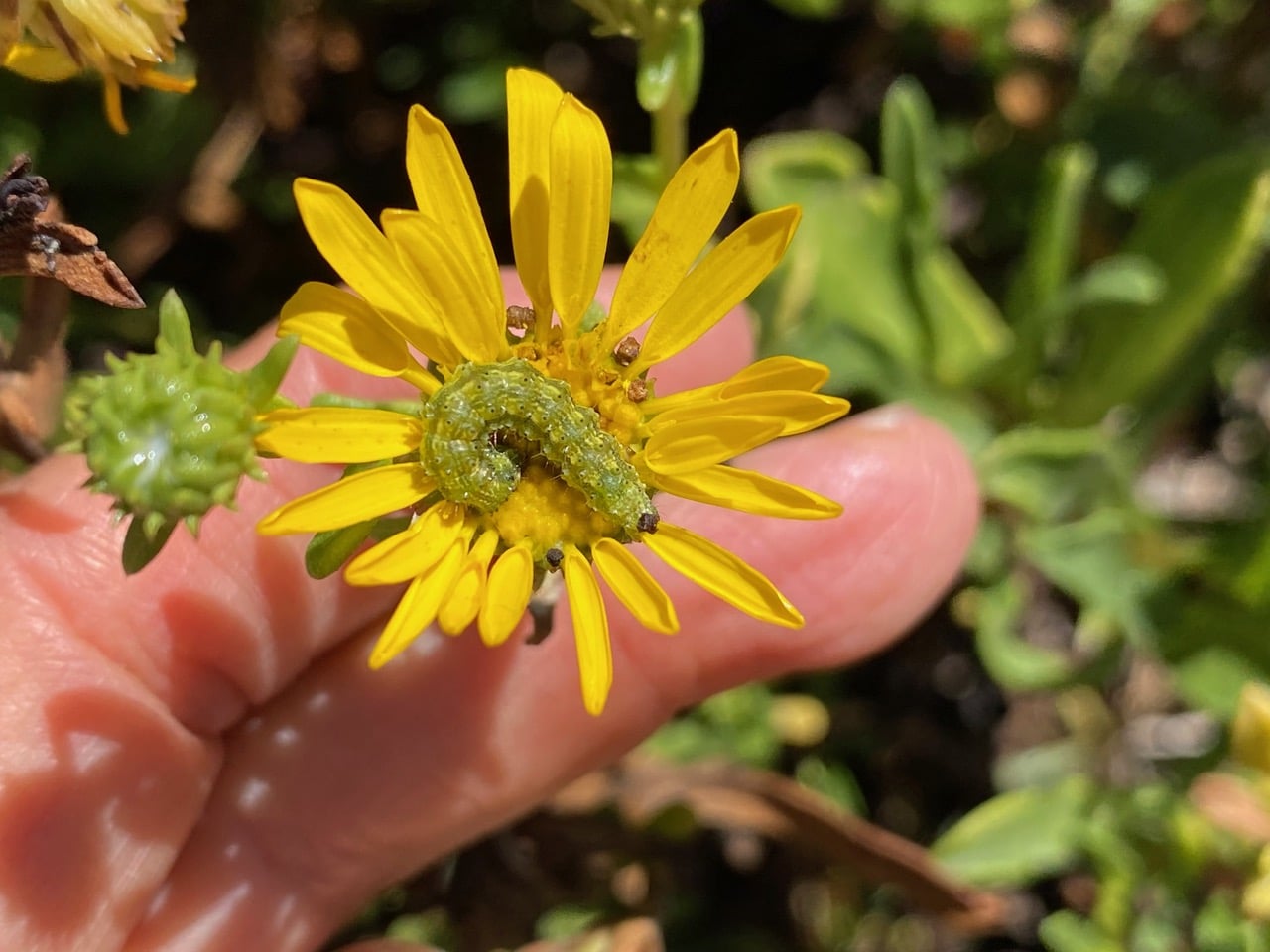
Elizabeth has discovered a green caterpillar on a Grindelia flowerhead. As it is getting breezy, and I have to steady the flowerhead for a clear shot.
It is likely the caterpillar of the Darker-spotted Straw Moth, Heliothis phloxiphaga (family Noctuidae).
Found across the US and S. Canada, Heliothis phloxiphaga is a medium-sized (wing span 3.3-3.7cm) light yellow-brown or tan moth with darker markings. Adults are both nocturnal and diurnal in activity, and may be found feeding and ovipositing during the day. Like other species of the genus, the larvae feed on the flowering parts and seeds of the host plants. Some Heliothis species are agricultural pests on crop species such as tobacco, cotton, soybean and pigeon pea. H. phloxiphaga seems to be fond of members of the sunflower family Asteraceae.
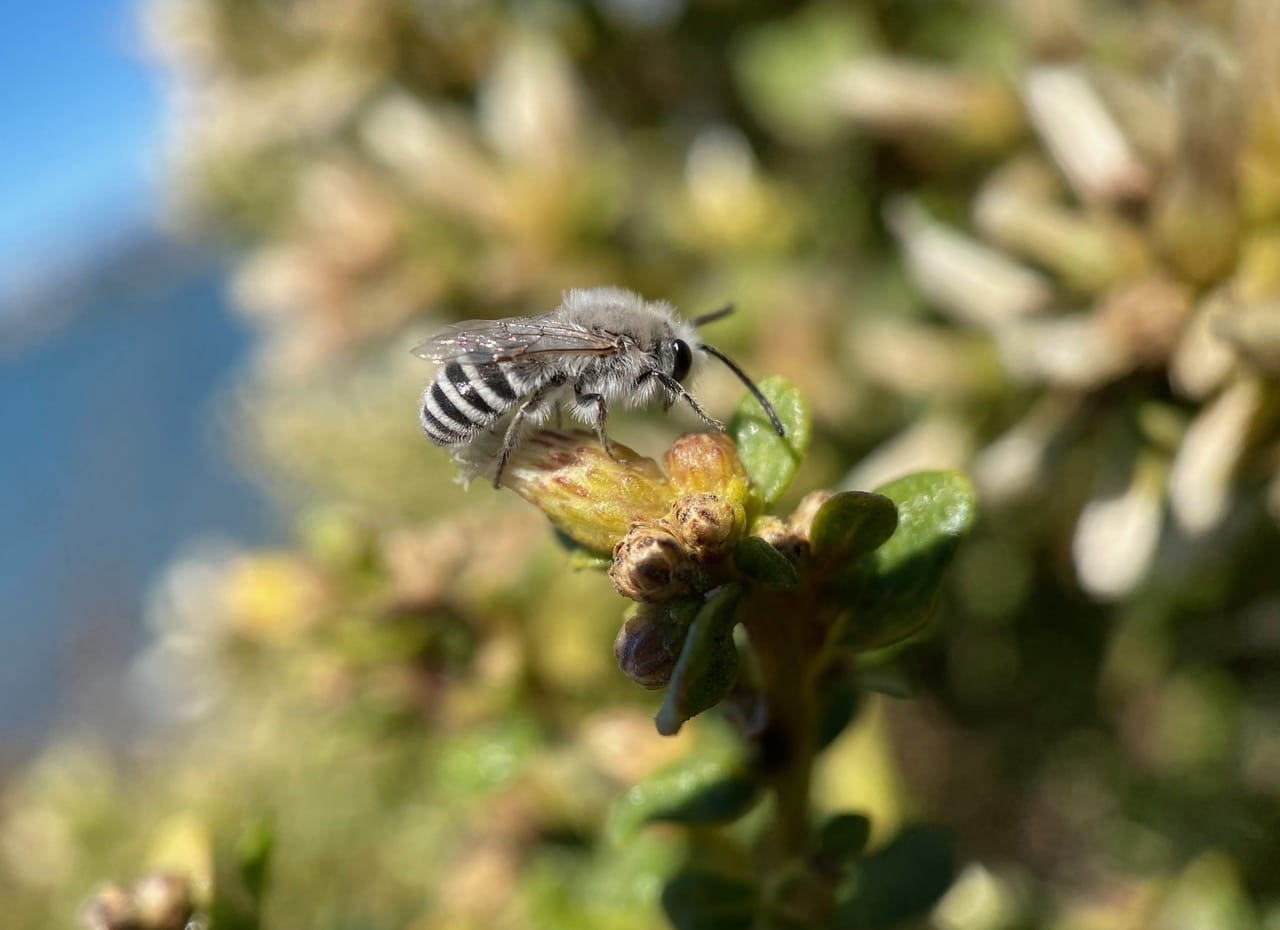
A male Summer Longhorn Bee, Melissodes sp. (family Apidae) is seeking nectar from a Grindelia flowerhead.
The ground where the Grindelia is heavily infested with the spittlebugs is often wet, especially during high tide. Emil always has his eyes out for Mud Daubers here. This is apparently a hotspot for the female wasps to gather mud for nest construction. Sure enough, here comes a female Yellow-legged Mud-dauber rapidly searching the wet ground for mud of the right consistency. I start the video camera when she begins to dig, but she quickly abandons the spot and looks elsewhere.
The Yellow-legged Mud-dauber, Sceliphron caementarium (family Sphecidae) is widespread in the Americas. The species is found in a wide variety of habitats, such as rock ledges, man-made structures, puddles and other water edges. The wasp can reach a length of 24-28 mm. They are generally black with yellow markings. They are solitary parasitoid wasps that build nests out of mud. Females collect mud balls at puddles and pool edges for constructing nests. The nests comprise up to 25 vertically arranged, individual cylindrical cells. Eventually the cells are covered over as a cluster by more mud, forming a smooth structure the size of a human fist. Nest constructed, the female wasp goes hunting for spiders. The prey are stung and paralyzed and placed in the cell, usually 6-15 per cell. A single egg is laid on the prey within each cell. The wasp then seals the cell with a thick mud plug. The larva that hatches out feeds on the spiders, pupates in the cell and emerges as an adult, breaking out of its mud nursery. Adult wasps can be seen in mid-summer feeding on nectar at flowers.
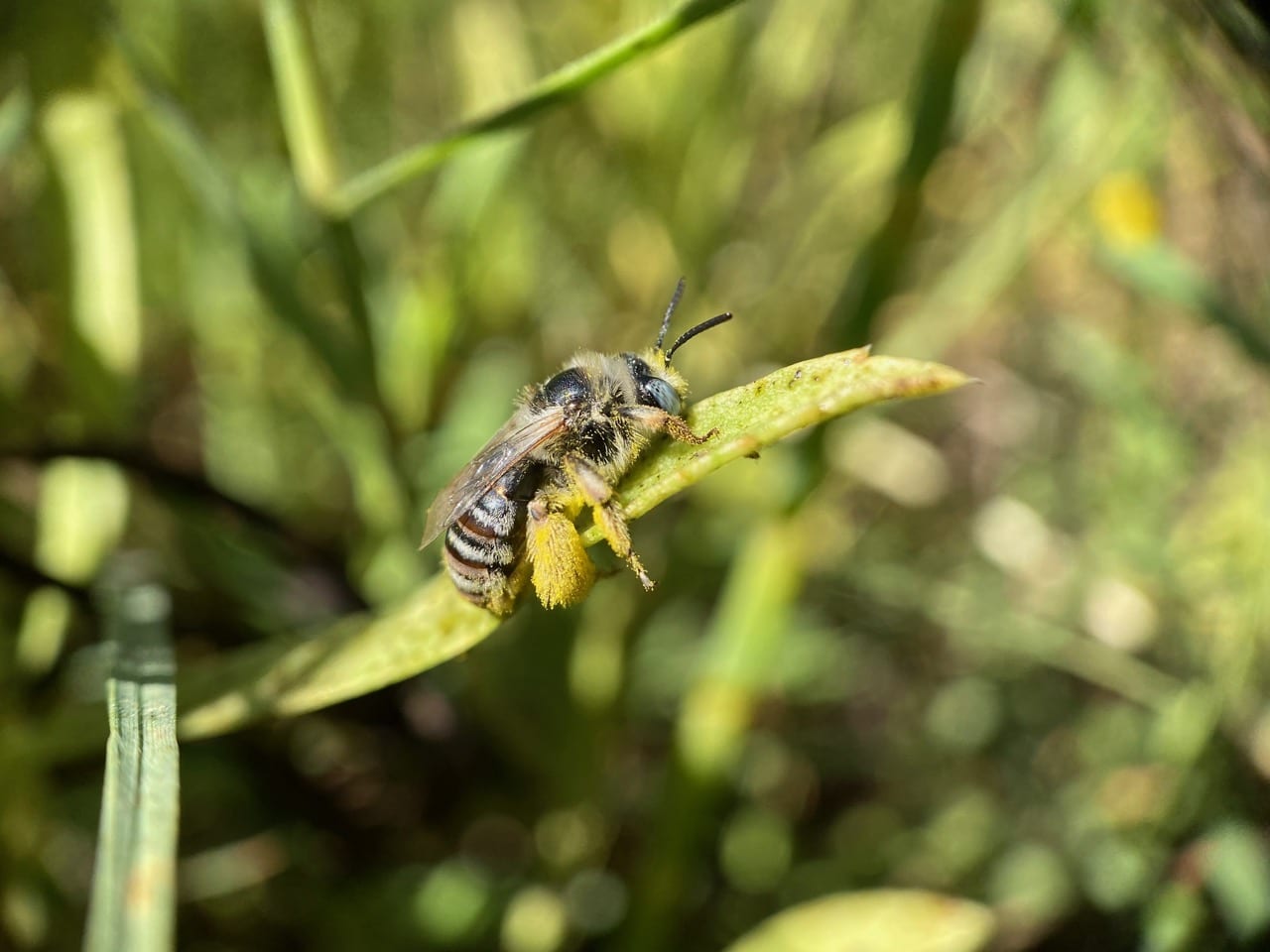
An exhausted female Longhorn Bee, Melissodes sp. (family Apidae) with a half-filled scopa is resting on a leaf in the undergrowth. She appears to be an older bee, with hairs missing from her body.
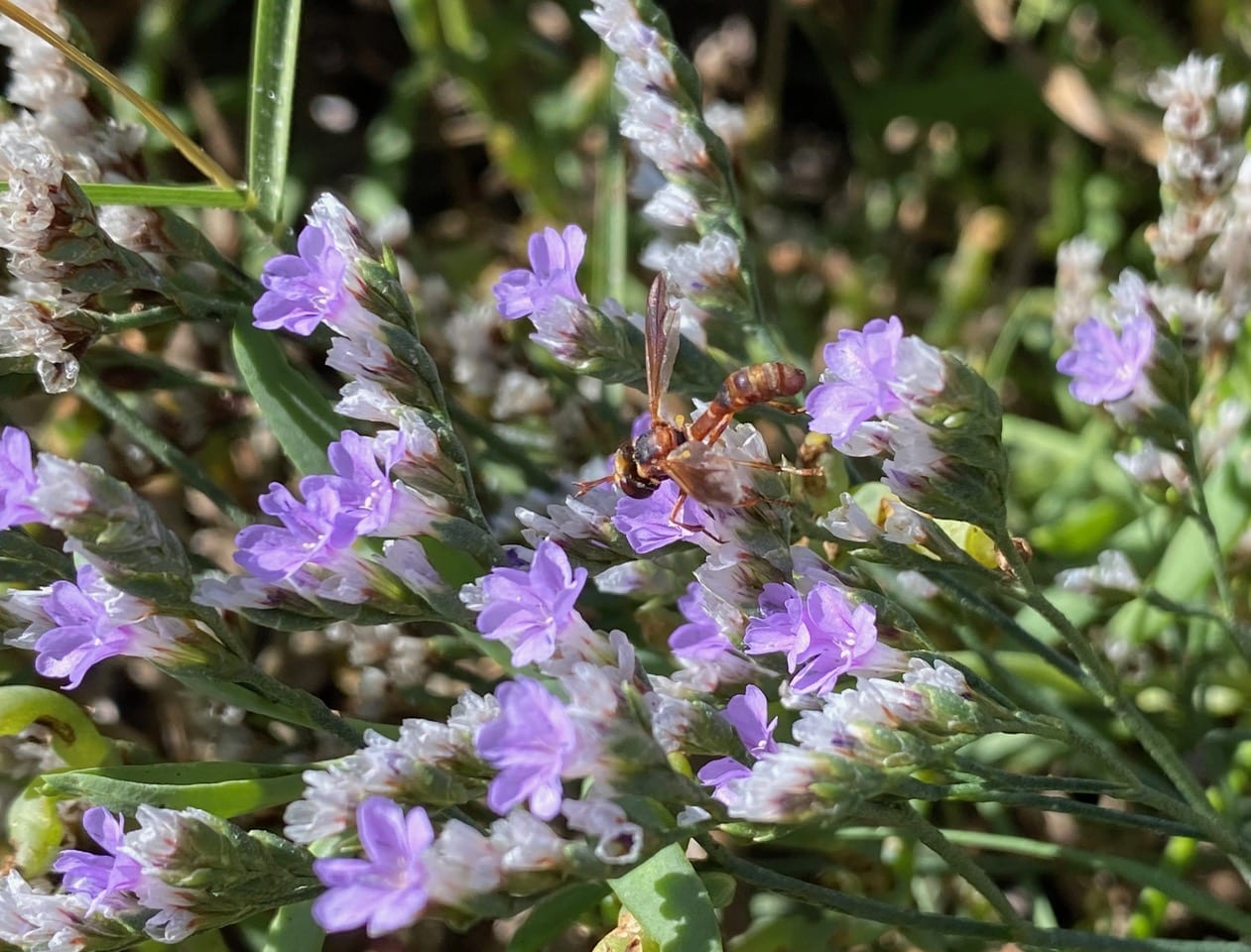
My heart misses a beat when I spot this reddish insect on the small flowers of the Sea Lavender, Limonium sp. The wasp-like insect is a Conopid Fly, Physocephala texana (family Conopidae). It is a parasite of the Yellow-faced Bumble Bee, Bombus vosnesenskii.
The small and little-known family of Conopidae, commonly called the Thick-headed Flies, are distributed worldwide. Remarkable mimics of wasps and bees, the flies are frequently found at flowers, feeding on nectar with their long probosces. The head is broad; the oral opening is large and the proboscis is long, slender and often geniculate (elbowed). The larvae of all Conopids are internal parasitoids, mostly of aculeate (stinging) Hymenoptera (wasps, bees). Adult females aggressively intercept their hosts in flight to deposit eggs. Vulnerable foraging bees are likely the most susceptible to parasitism by Conopids. The female’s abdomen is modified to form what amounts to a “can opener” to pry open the segments of the host abdomen as the egg is inserted. The fly larva feeds on the host from the inside out. The vast majority of parasitized bumble bees bury themselves by burrowing into the ground right before they die. This behavior does not matter to the bees – they are doomed. But it is critical for the flies – if the host dies underground, the fly is sheltered from the elements, predators and parasites.
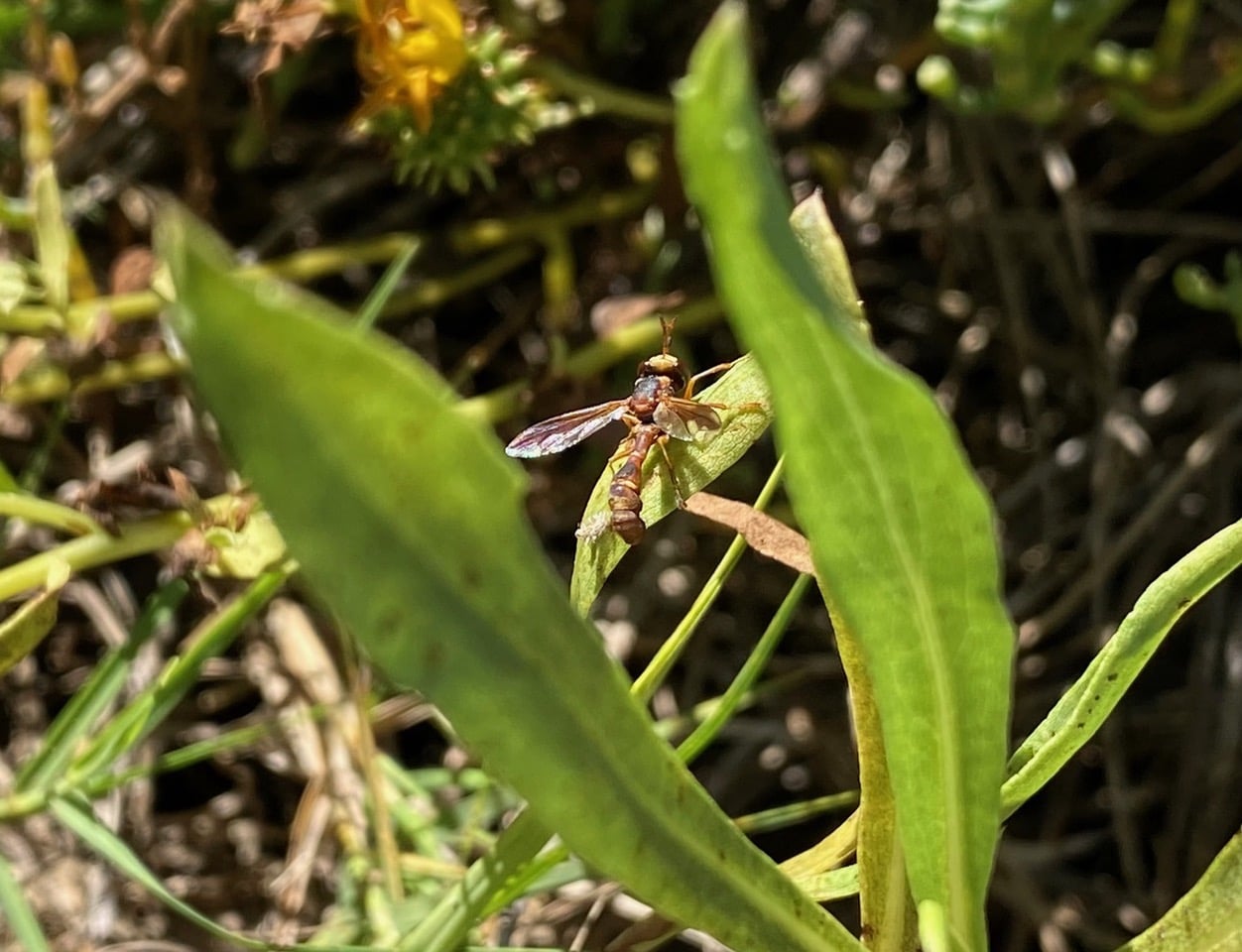
Emil and I visually follow a Conopid Fly in flight, hoping for a photo. It finally lands on a leaf in the undergrowth, and stays a while as if posing for us.
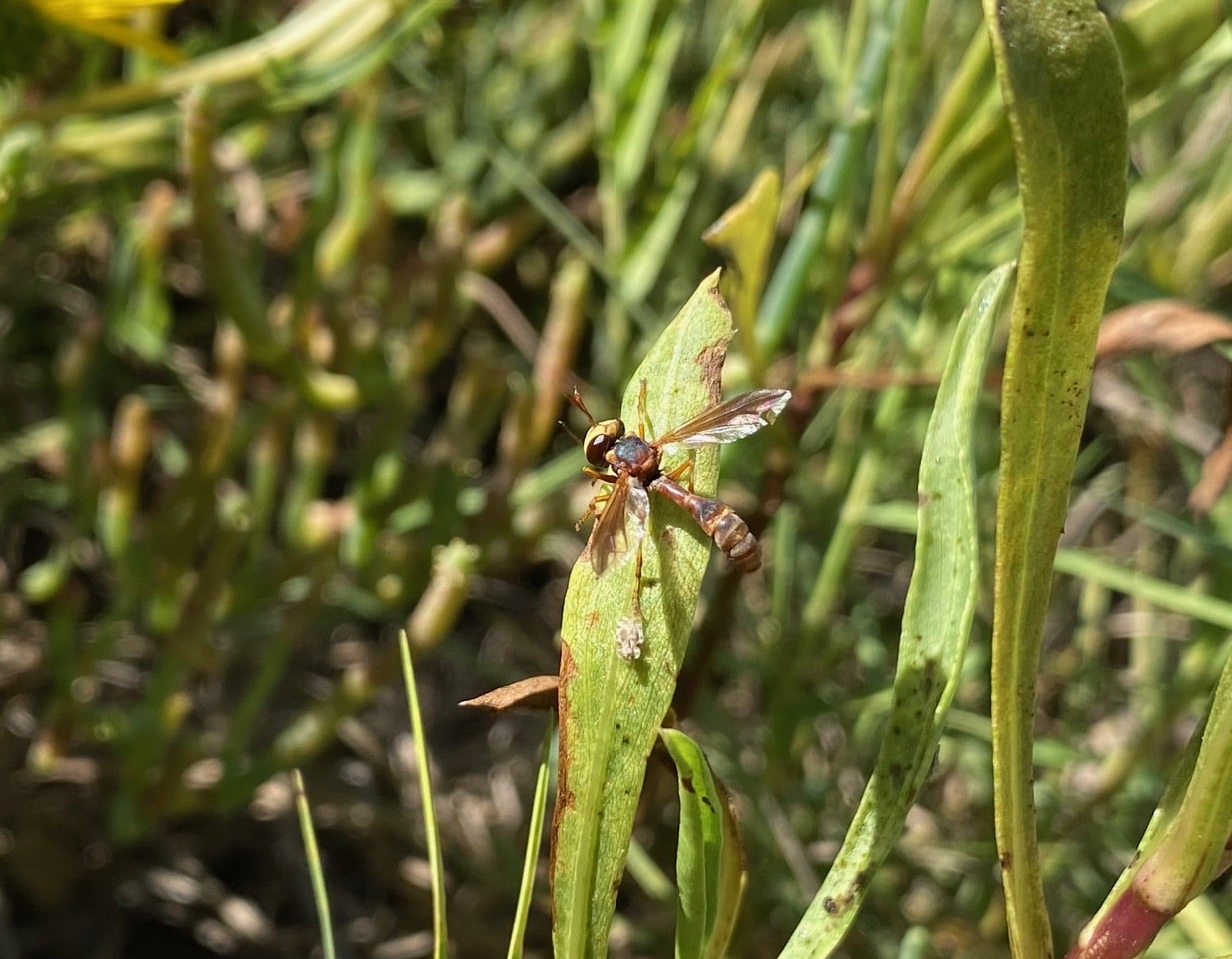
Viewed from this angle, it is evident why the Conopid Fly is called the “thick-headed” fly. The antennae are long, straight and positioned close together. The proboscis is hinged near the base, beyond which it is long, straight and needle-like, projecting forward well beyond the face. Bumble Bees, beware!