

Pollinator Post 9/7/23 (2)
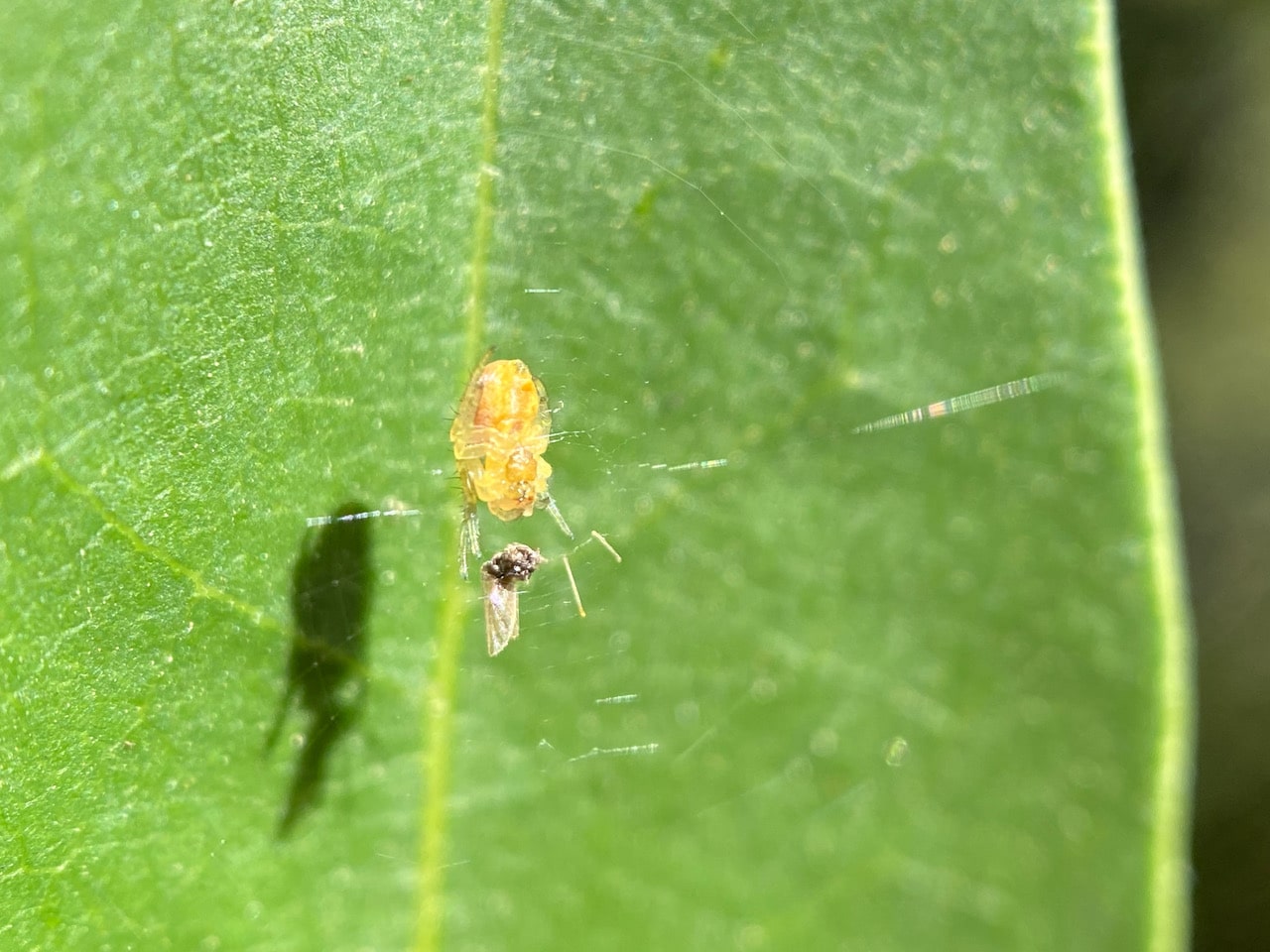
Against the backdrop of a California Bay leaf, a pale yellow spider, barely 3 mm long, has wrapped up a insect prey in silk in the middle of its orb web. We are looking at the spider’s underside, head pointing downward. A mere baby, it already knows its trade.
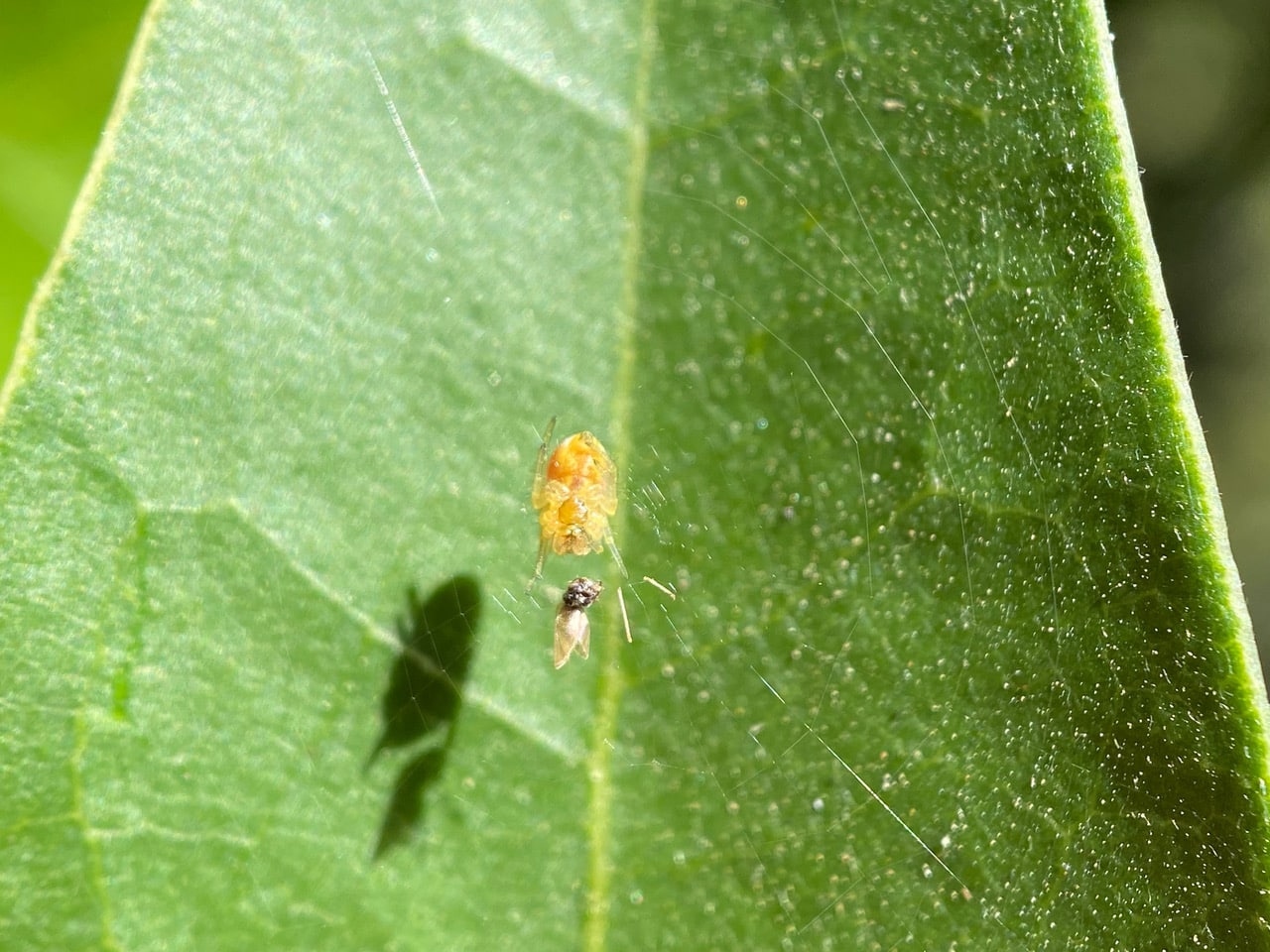
The spiral threads of the spider’s orb web is more visible in a slightly different angle.
Orb-weaver spiders are members of the spider family Araneidae. They are the most common group of builders of spiral wheel-shaped webs often found in gardens, fields, and forests. Generally, orb-weavers are three-clawed builders of flat webs with sticky spiral capture silk. The third claw is used to walk on the non-sticky part of the web. Typically, the prey insect that blunders into the sticky lines is stunned by a quick bite, and then wrapped in silk.

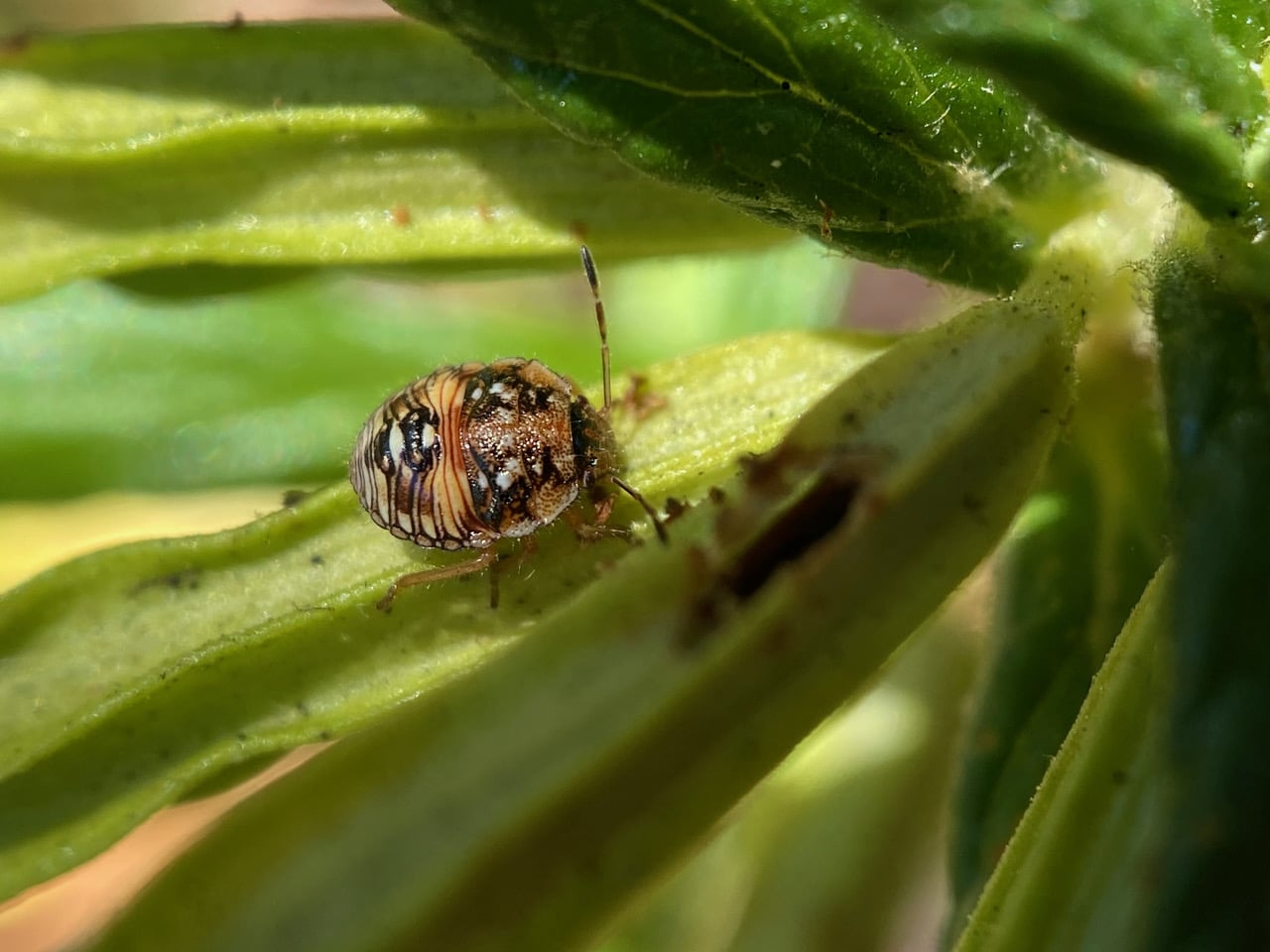
Who’s that on the calyx of a Sticky Monkeyflower, Diplacus aurantiacus ? The insect looks like a beetle, but it is actually the nymph of a Stink Bug. You can see that it has sunk its rostrum (piercing-sucking mouth part) into the plant tissue. Beetles, on the other hand, have chewing mouthparts.


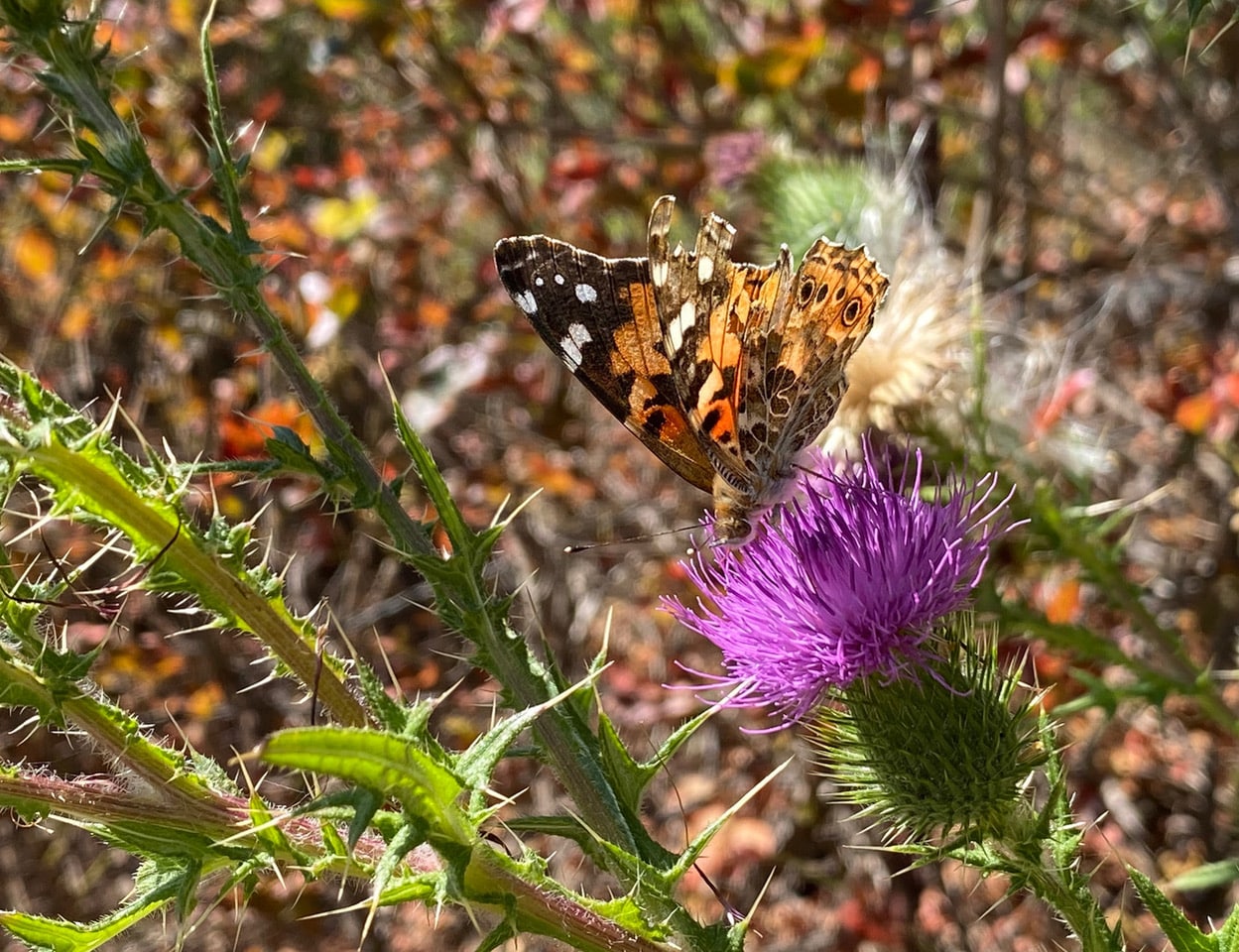
 This side view of the butterfly’s underwings should be useful for ID purposes. Note that the butterfly is probing for nectar with its long and flexible proboscis. The thistle’s tight clusters of small flowers are especially attractive to butterflies. In a single stop, a butterfly can access nectar from numerous flowers with minimal expenditure of energy.
The intricate and colorful patterns on the nymph’s back remind me of a piece of cloisonné jewelry. The creature is a late instar of the Red-shouldered Stink Bug, Thyanta custator (family Pentatomidae).
Pentatomidae is a family of insects belonging to the order Hemiptera or “true bugs”. As hemipterans, the pentatomids have piercing-sucking mouthparts, and most are phytophagous, including several species that are severe pests on agricultural crops.
All Pentatomids have 5-segmented antennae, and they generally have a large triangular scutellum in the center of the back. The body shape of adults is generally shield-shaped when viewed from above. The common name of Stink Bug refers to their ability to release a pungent defensive spray when threatened, disturbed, or crushed.
The Red-shouldered Stink Bug is a generalist feeder and is reported to be a minor pest on a variety of crops including beans, corn, peaches, and wheat. The nymphs undergo a series of dramatic changes in their appearance after each molt.
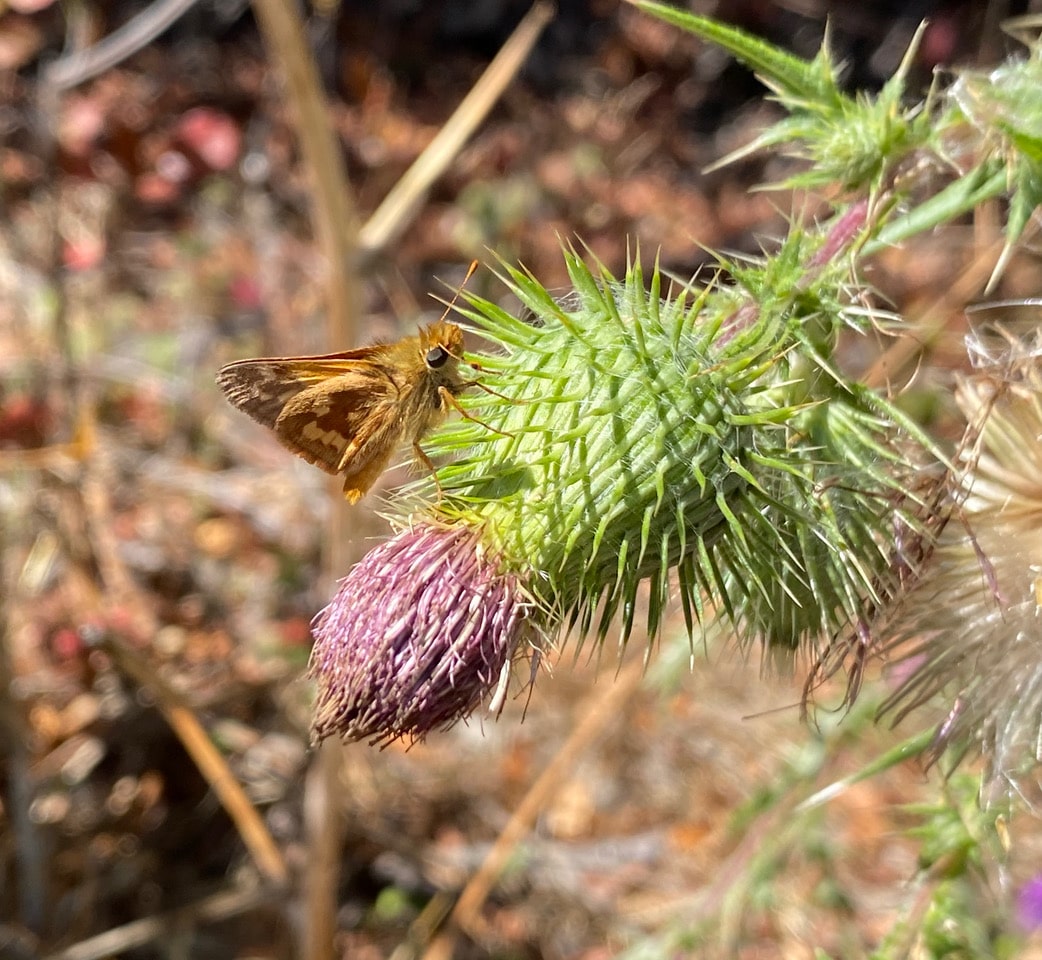
As I pass the same Bull Thistles near the Steam Train entrance a couple of hours later, insect activity seems to have intensified with the rising temperatures. A Skipper butterfly takes a break on an involucre of a spent Bull Thistle flowerhead.
Skippers are butterflies in the family Hesperiidae. They are distinct from the typical butterflies in having antennae with clubs that hook backward like a crochet hook; they have generally stockier bodies and larger compound eyes; their wings are usually small in proportion to their bodies. When at rest, skippers keep their wings usually angled upwards or spread out, and only rarely fold them up completely.
Skipper caterpillars are usually green or brown, sometimes yellowish, never brightly colored. They have a distinctive “collar”, a narrow ring around the body right behind the head. Caterpillars are camouflaged and often hide during the day. Many species make nests of leaves and silk for additional protection. Most North American species feed on grasses, but some common species eat shrubs and trees, especially in the bean family. Most species are limited to a single group of food plants. Adult skippers are only active during the day, but Skipper caterpillars feed mainly when it is dark or partly light.
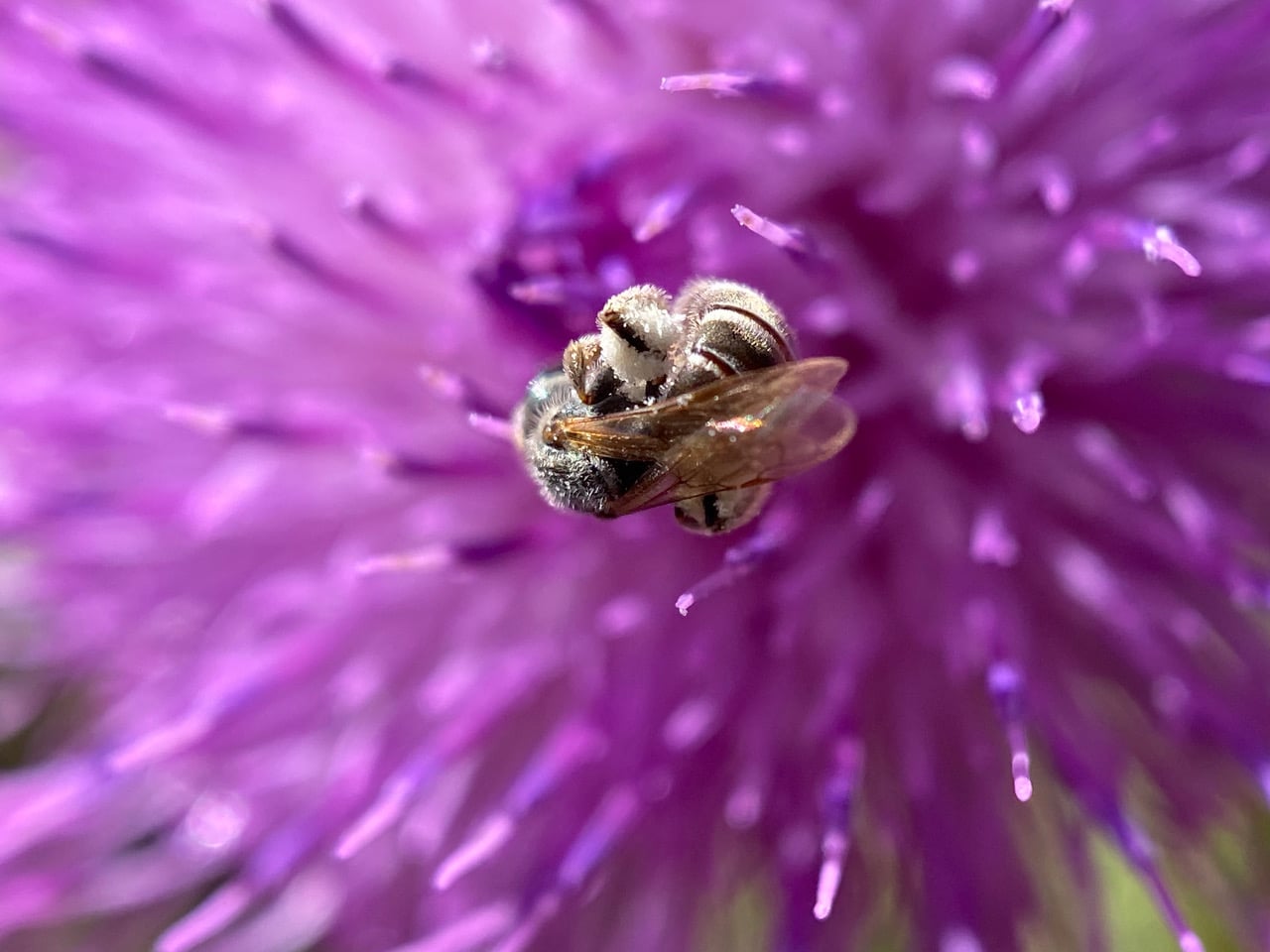
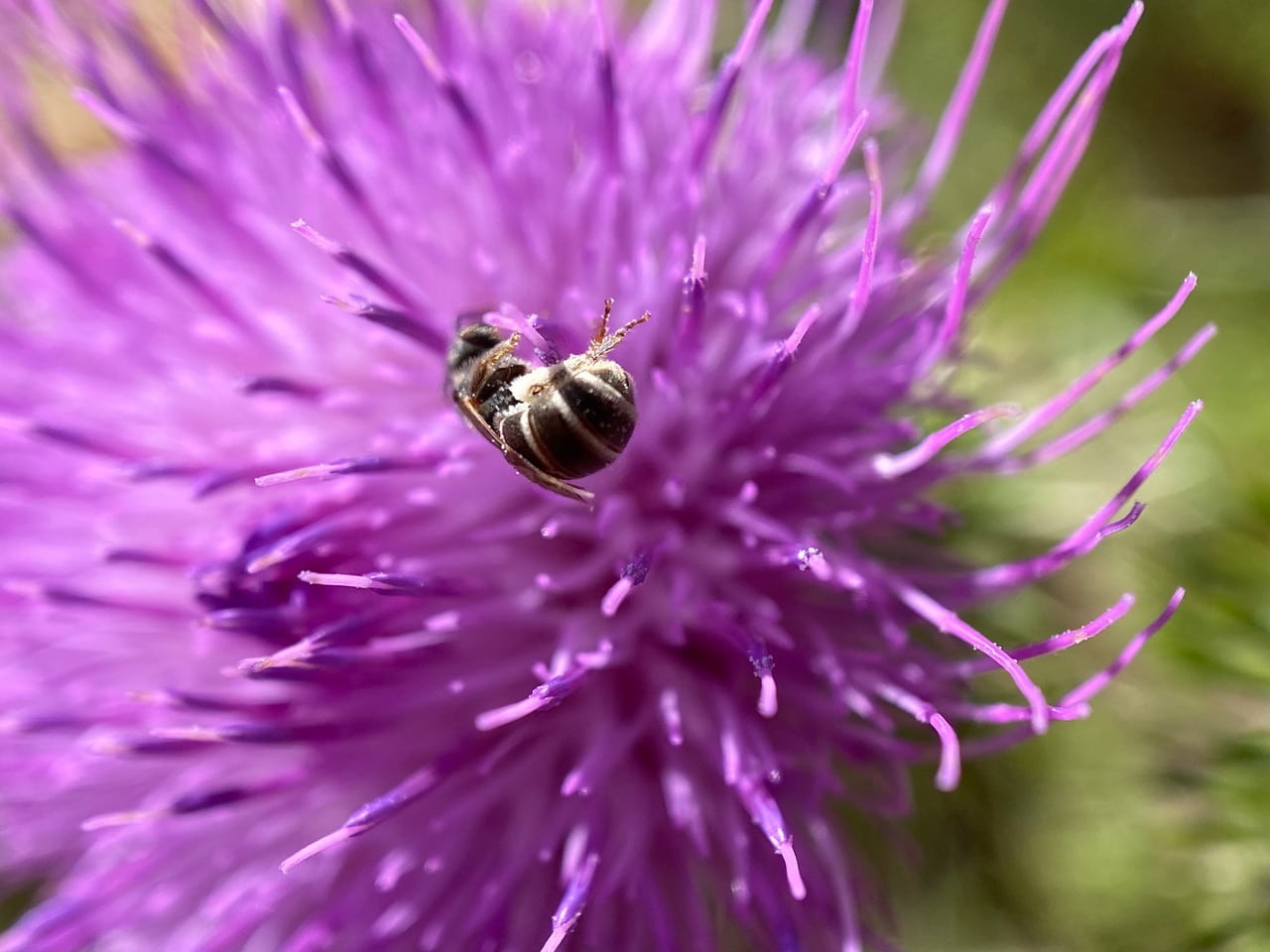
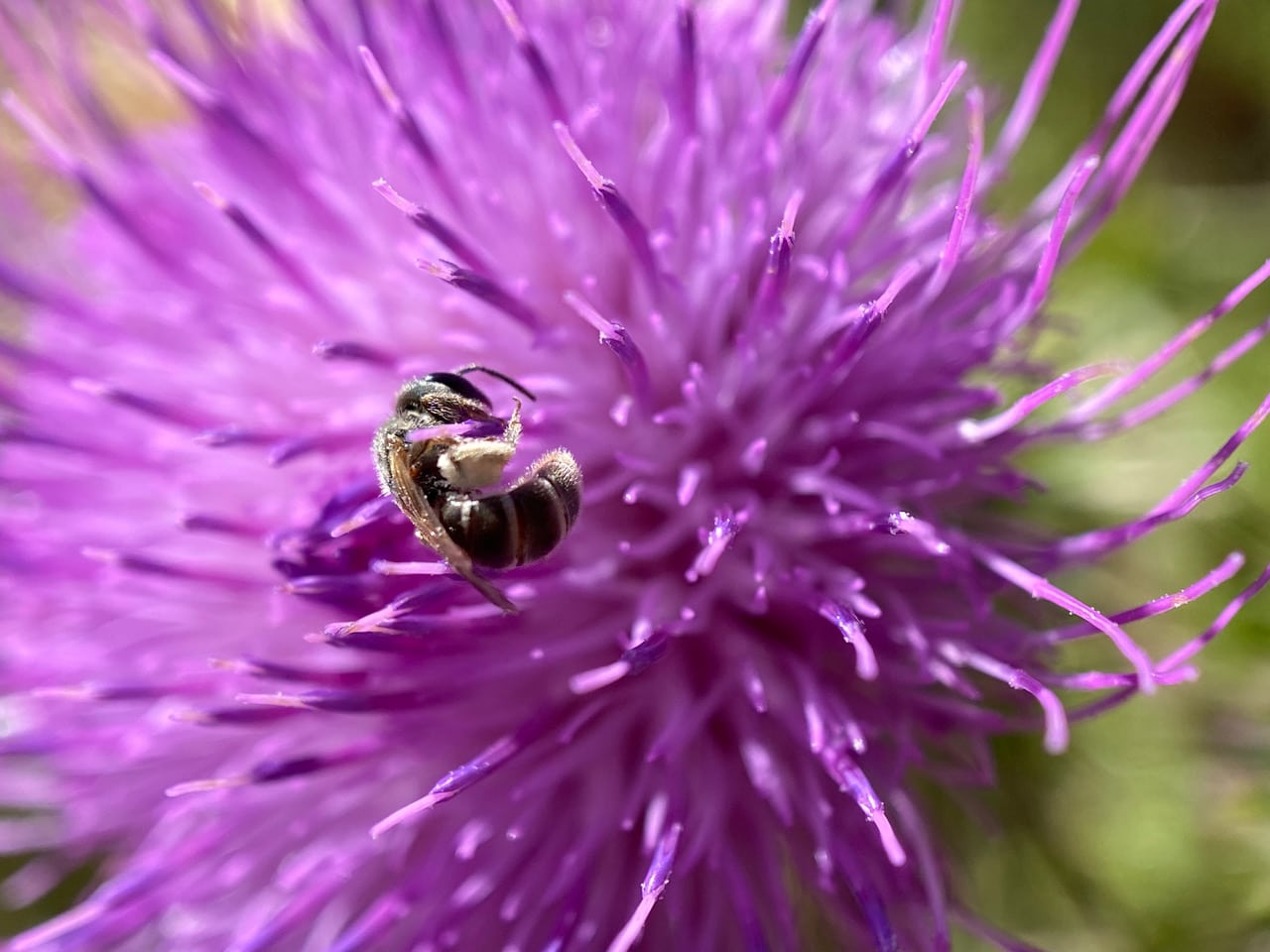
The Bumble Bees and Honey Bees are still dominating the scene, but I spend more time observing the little bees on the thistle flowerheads. This one is in a typical pollen gathering mode. She is embracing the tip of the anther tubes and scraping the pollen onto the scopae on her belly as well as her hind legs.
Here’s a brief glimpse of the furrow at the tip of the bee’s abdomen. She is a Sweat Bee in the genus Halictus (family Halictidae). The feature, only present in females, distinguishes the genus Halictus from the related and similar genus Lasioglossum. This is the reason why Halictus are sometimes called Furrow Bees. The furrow on the last tergite (top segment of the abdomen) is referred to as a ‘rima’. The purpose of this anatomical feature is unknown.
The little bee works one anther tube at a time, wriggling and writhing vigorously on each to gather the pollen.
Occasionally the bee would coax the pollen out of the anther tubes by using her jaws. It’s all in a day’s work for these little bees.
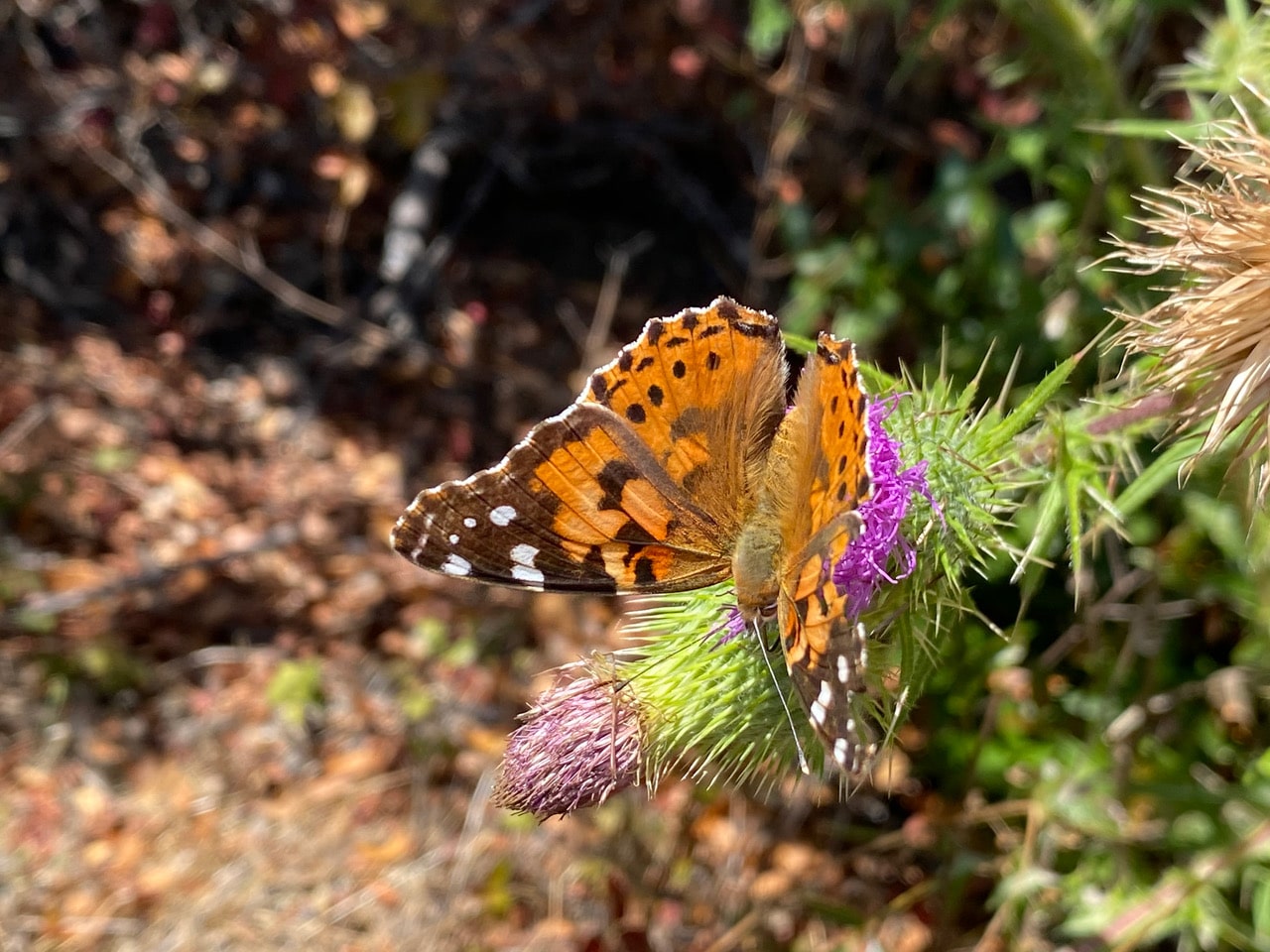
A beautiful butterfly lands to sip nectar from a Bull Thistle flowerhead. There are small tears on its left front wing, but they don’t seem to affect the butterfly’s ability to fly. At first glance, I know the butterfly is one of the “Lady” butterflies in the genus Vanessa. But I am not skilled enough to tell which species while it is moving around. Better to take some good pictures for identification later.
This side view of the butterfly’s underwings should be useful for ID purposes. Note that the butterfly is probing for nectar with its long and flexible proboscis. The thistle’s tight clusters of small flowers are especially attractive to butterflies. In a single stop, a butterfly can access nectar from numerous flowers with minimal expenditure of energy. The butterfly is most cooperative in spreading its wings to show the upper surface. With those two pictures, I am able to identify the butterfly as the Painted Lady. Here’s how:
The Painted Lady, Vanessa cardui (family Nymphalidae) is the most widespread of all butterflies. They are found on every continent except Antarctica and Australia. The butterfly also goes by the name thistle butterfly; its scientific name Vanessa cardui means “butterfly of thistle”. Although more than 100 host plants have been recorded for the species, the caterpillars’ favorites include thistles (Asteraceae), hollyhock and mallow (Malvaceae), and various legumes (Fabaceae).
Female Painted Lady butterflies lay eggs singly on the upper side of host plant leaves, sometimes on the thistle flowerheads. When small the caterpillars live for most of the time within a tent of leaves loosely spun together with silk. Only when larger are the larvae more likely to be found feeding outside a leaf tent on the food plant.
Painted Lady butterflies are known for their distinct migratory behavior. They are an irruptive migrant, meaning that they migrate independently of any seasonal or geographical pattern. The populations that migrate from North Africa to Europe may include millions of butterflies. The distance covered rivals that of the better known Monarch butterflies. The butterflies can cover up to 100 miles per day during their migration; the round trip may take up to 6 successive generations.
In California, the butterflies are usually seen flying from north to north-west. These migrations appear to be partially initiated by heavy winter rains in the desert where rainfall controls the growth of larval food plants. In the spring of 2019, the butterflies migrated by the millions across the state.
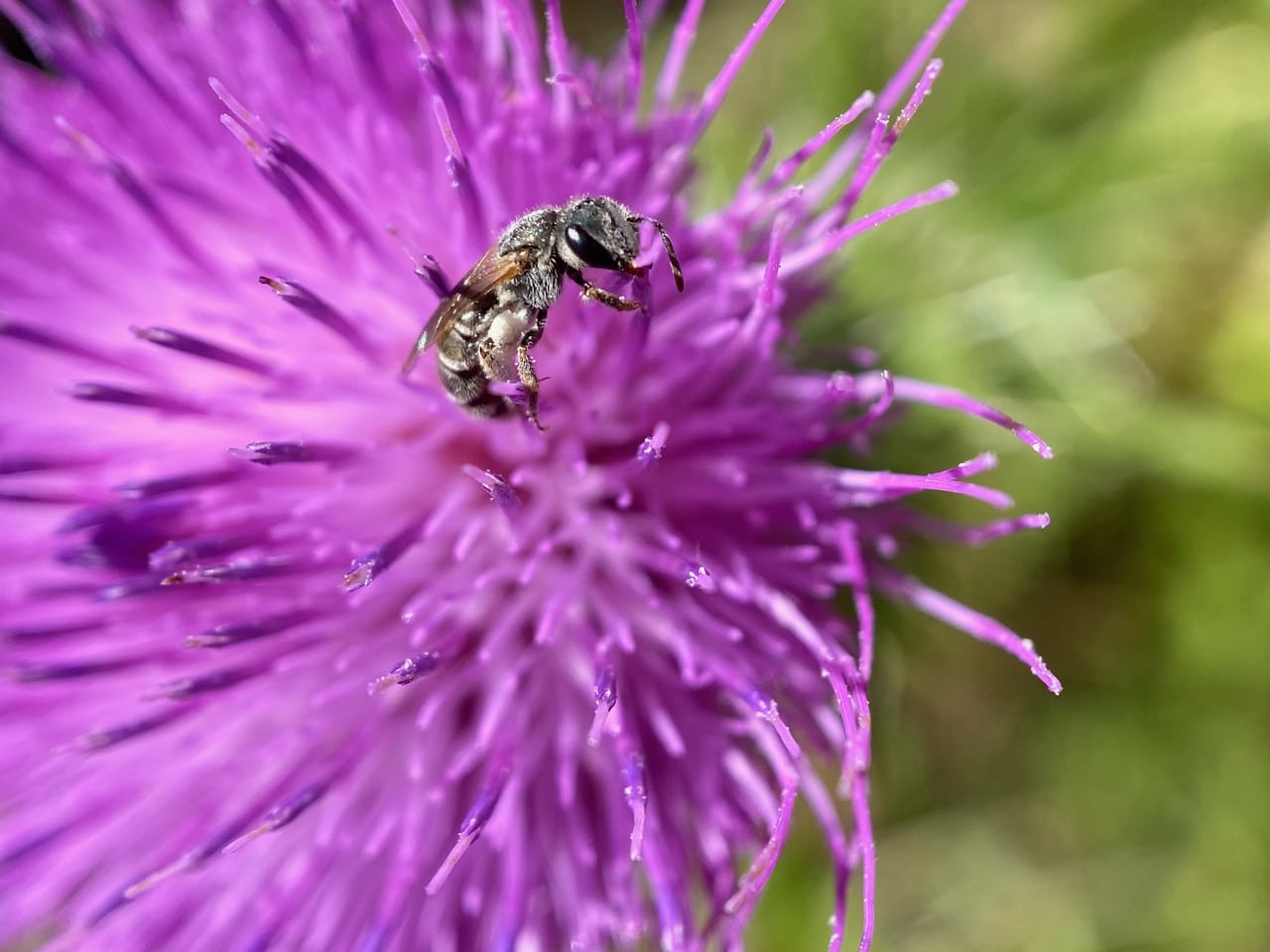
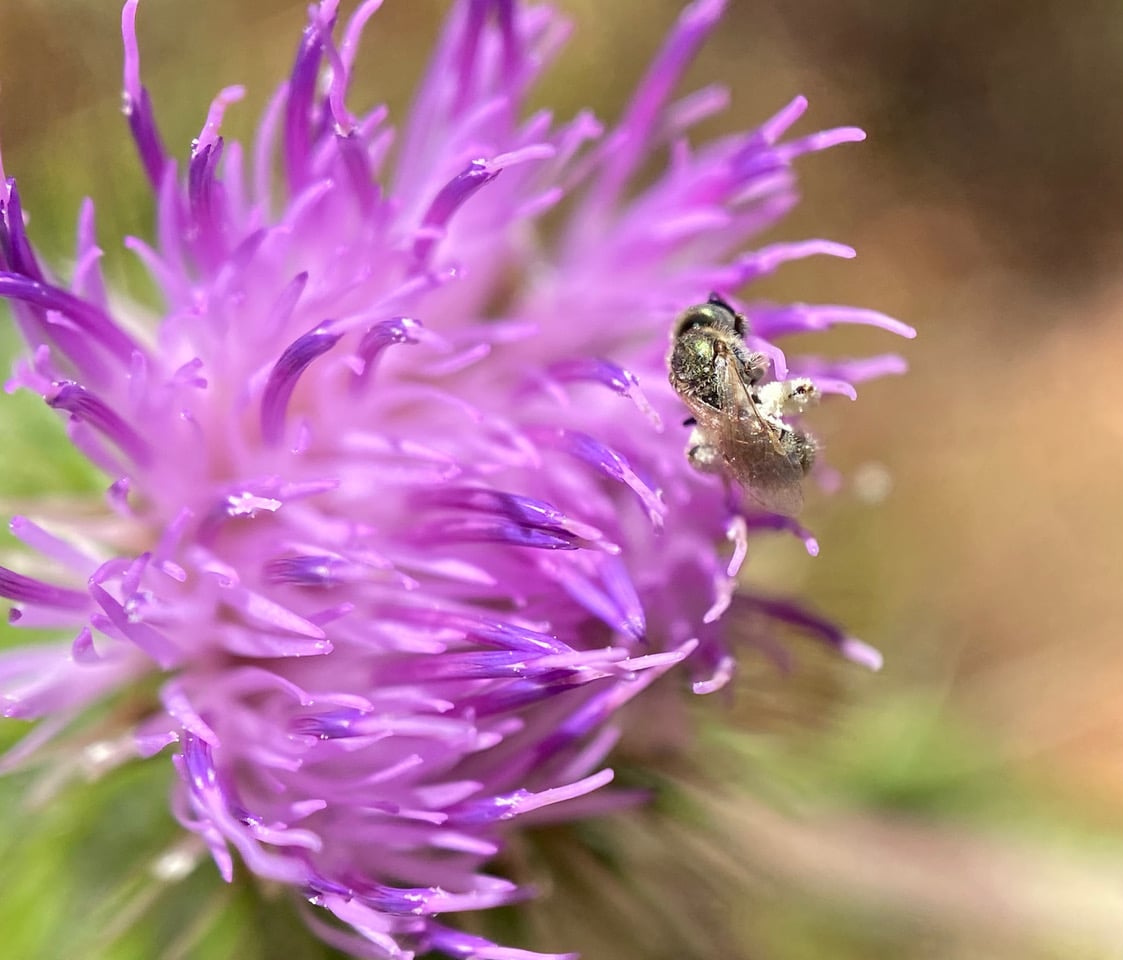
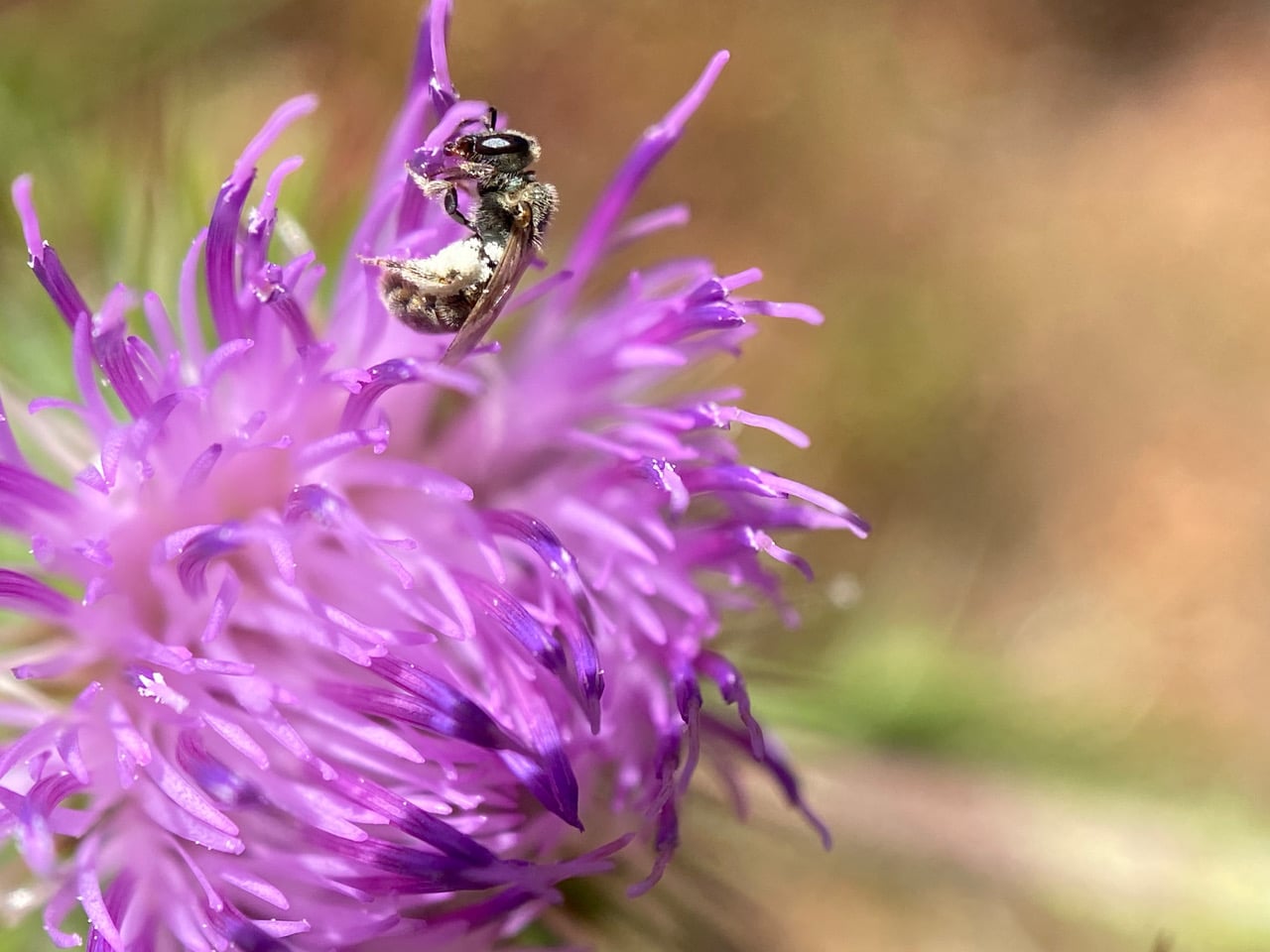
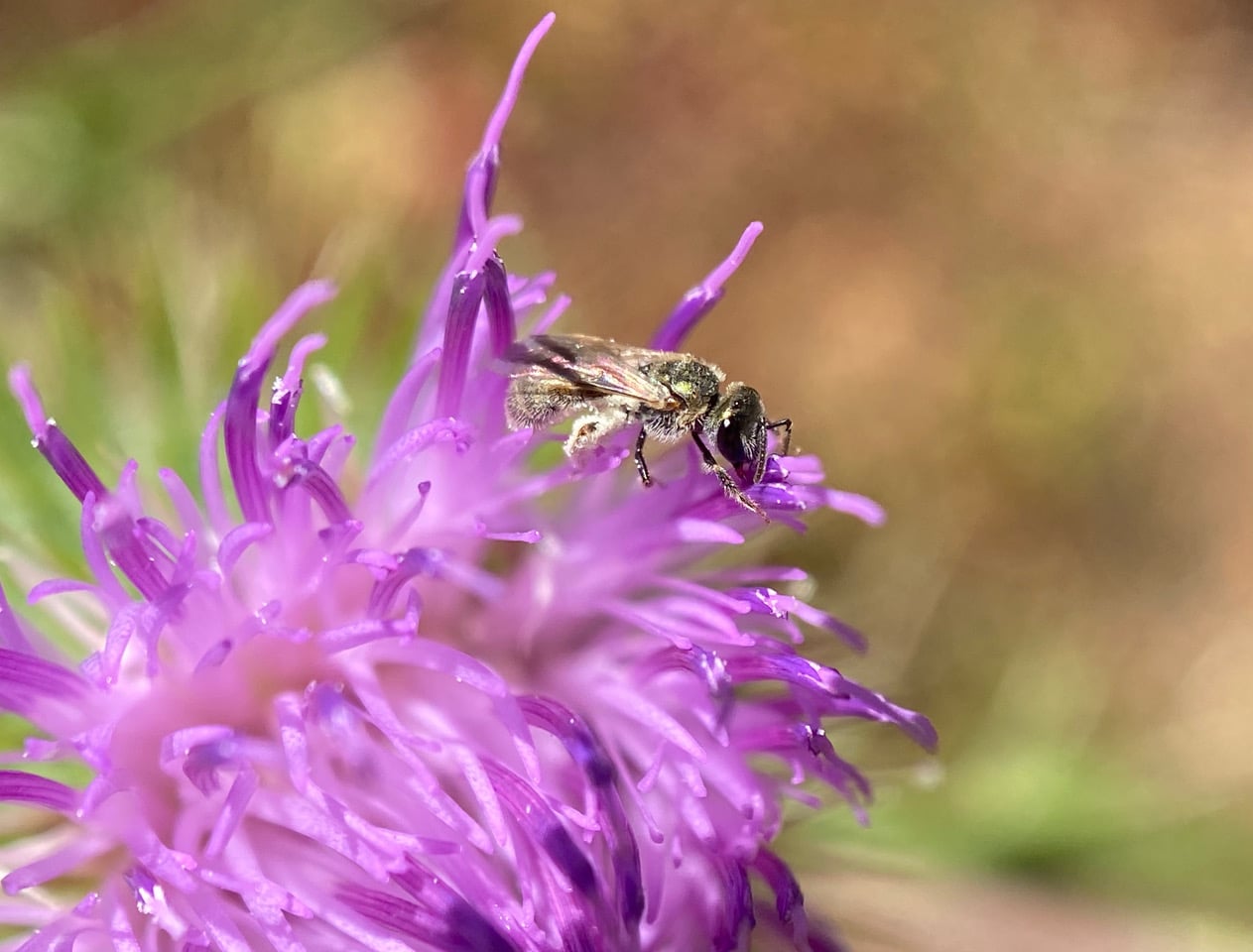
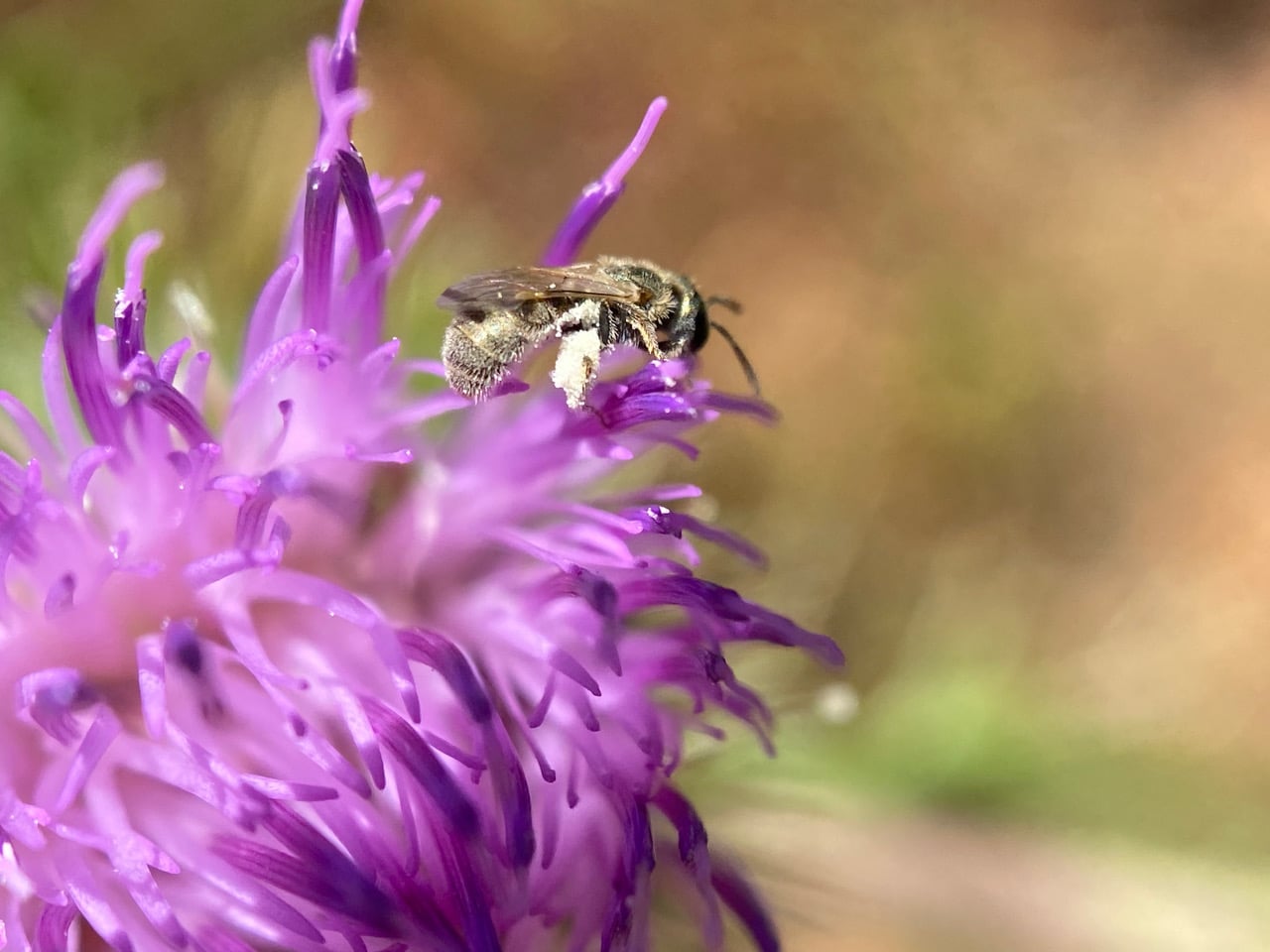
A Metallic Sweat Bee, Lasioglossum (Dialictus) sp. (family Halictidae) is collecting pollen from the Bull Thistle flowers.
As is typical of Sweat Bees, the little bee carries pollen on her entire hind legs as well as on her belly.
Lasioglossum are closely related to the genera Halictus and Agapostemon. These genera are commonly called “sweat bees” because of their attraction to human sweat, which they drink for its salt content. Lasioglossum are dusky black to brown slender bees with bands of hair on their abdomen.
Dialictus is a subgenus of Sweat Bees belonging to the genus Lasioglossum. Most of the members of this subgenus have a subtly metallic appearance, and are small, about 3.4-8.1 mm in size. They are commonly found in Northern Hemisphere and are found in abundance in North America. As in the other members of the family Halictidae, the bees have very diverse forms of social structure, making them model organisms for studying the social behavior of bees.
Lasioglossum species are found worldwide, and they constitute the largest bee genus. The subgenus Dialictus are the most likely to be seen in the U.S., with over 300 species of these tiny metallic bees. The majority of Lasioglossum are generalists. Because they are so abundant throughout the flowering season, the bees are often important pollinators. Their sheer numbers are enough to achieve excellent pollination of many wild flowers.
Lasioglossum exhibit a range of social behaviors; the genus includes solitary, communal, semi social, primitively eusocial, and even parasitic species. Almost all Lasioglossum in the U.S. nest in the ground. Generally these nests are built in the spring by fertilized females (called foundresses) that spent the winter in hibernation. In social species, the foundresses behave much like the queen Bumble Bees – they lay the first batch of eggs that develop into the first generation of female workers. The nest grows with each additional generation of bees. Later broods may consist of both males and females. They mate, and at the end of the season the fertilized females hibernate til the following spring, repeating the life cycle of the colony.