

Pollinator Post 9/6/24 (1)

As soon as I arrive at the Sea View Park this morning, I decide to first visit the spot where I found a concentration of the Summer Longhorn Bees, Melissodes sp. (family Apidae) yesterday. Sure enough, there they are, a few males still asleep on the flowerheads of the same Grindelia plant.
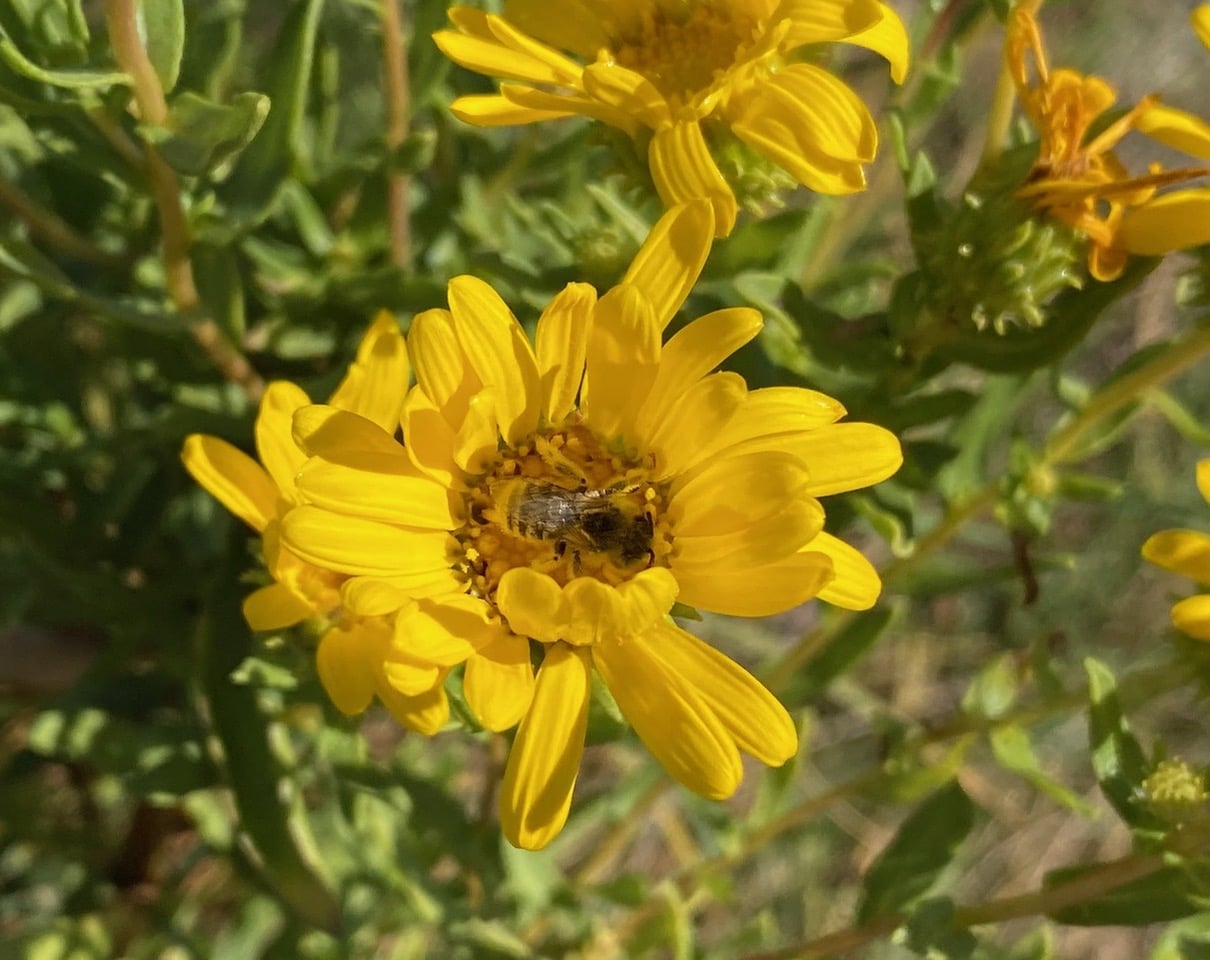
The males are not aggregated as I have expected, but each occupies his own flowerhead.

Their eyes are wide open, but they do not respond to any disturbance. That’s how I know the bees are asleep. In a few minutes, they are all up and flying around and visiting flowers.

As I walk past a female Coyote Brush in bloom, I spot a tiny insect on a flowerhead. It is a Fruit Fly (family Tephritidae) waving its picture wings semaphore-style, twisting and turning the wings alternately in figure-8 movements. It is signaling to someone of its own species. The wing display is usually used in courtship or territorial claims.
Commonly called Fruit Flies, Tephritids are small to medium-sized flies that are often colorful, and usually with picture wings. The larvae of almost all Tephritidae are phytophagous. Females deposit eggs in living, healthy plant tissues using their telescopic ovipositors. Here the larvae find their food upon emerging. The larvae develop in leaves, stems, flowers, seeds, fruits, and roots of the host plant, depending on the species. Adults are often found on the host plant and feeding on pollen, nectar, rotting plant debris, or honeydew. Tephritid flies are of major economic importance as they can cause damage to fruit and other plant crops. On the other hand, some Tephritids are used as agents of biological control of noxious weeds.

About half a dozen Common Grass Skimmers, Paragus haemorrhous (family Syrphidae) are hovering over the shrub, occasionally landing to take nectar. Some of them have red on their abdomen, others are all black. This one’s a male – his large compound eyes meet on top of the head. The species has oversized heads in proportion to the rest of their body. I witness a couple of attempts at mating. Ah, it must be their mating season?
The Common Grass Skimmer, Paragus haemorrhous (family Syrphidae) is easily the smallest hover fly I know, measuring only about 4 mm in length. The species has a world-wide distribution, found in unimproved grassland, dune grass, open areas and pathsides in forest, and meadows. Adults visit flowers for nectar and pollen. Larvae feed on aphids on low herbaceous plants.

Some small bees are visiting the flowers of the Bristly Oxtongue, Picris echioides. I think they are the small Digger Bees, Anthophora (Micranthophora) sp. (family Apidae). They are some of the most difficult bees to photograph – small, wary, and fast-flying. While foraging, they appear to be bouncing from one flowerhead to the next. Note that this female has pollen on her scopae.
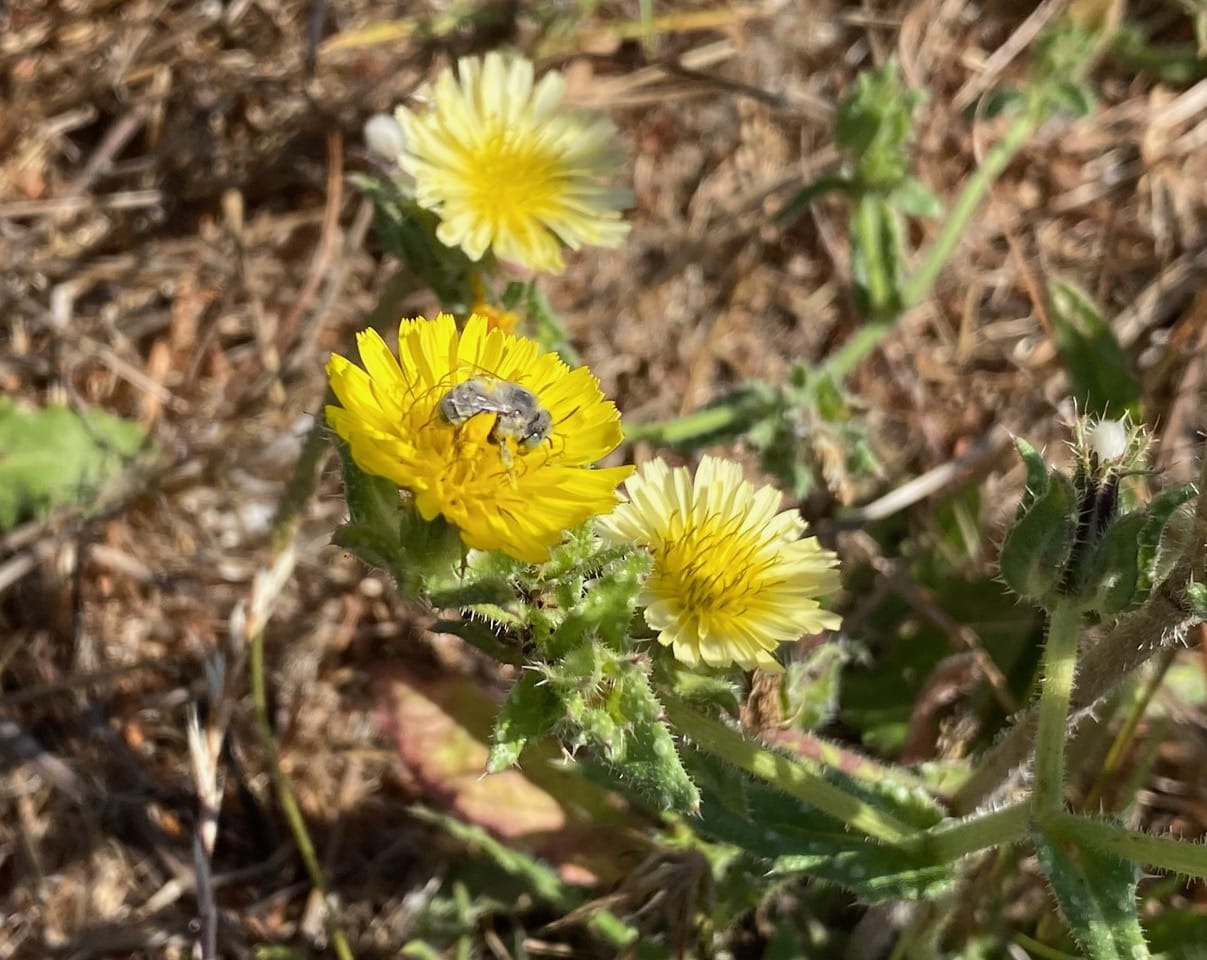
Here’s another female.
The bee genus Anthophora is one of the largest in the family Apidae, with over 450 species worldwide in 14 different subgenera. They are most abundant and diverse in the Holarctic and African biogeographic regions. All species are solitary, though many nest in large aggregations. Nearly all species make nests in the soil, either in banks or in flat ground; the larvae develop in cells with waterproof linings and do not spin cocoons. Males commonly have white or yellow facial markings, and/or peculiarly modified leg armature and hairs.
Members of the subgenus Micranthophora are smaller than other New World Anthophora. Many but not all species are associated with xeric habitats.

Yet another…. The bees seem to love the flowers of the Bristly Oxtongue.


Occasionally the bees would perch on the dried plant matter on the ground. Do they have their nest burrows under the thatch of plant debris?

Uh oh, is that a dead bumble bee?
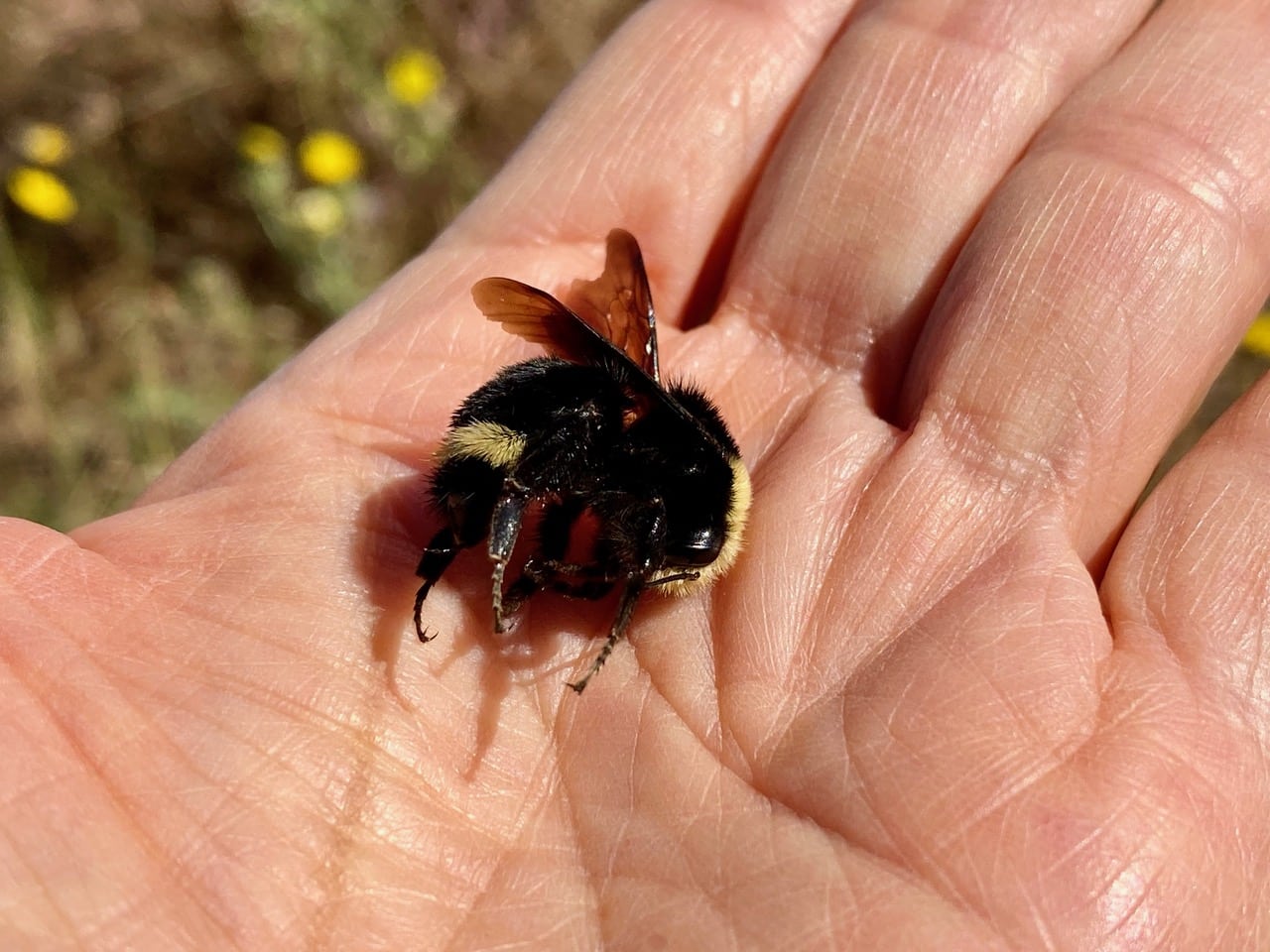
I pick up the bee to examine it. It is light as feather. The large Yellow-faced Bumble Bee, Bombus vosnesenskii (family Apidae) is probably a queen. It’s too bad that she didn’t make it to hibernation, and didn’t have a chance to start her own colony next spring. I wonder how and why she died. We are just coming out of a hot spell, and I just read a rather disturbing study on the effect of global warming on bumble bees. Apparently bumble bees lose most of their sense of smell after heat waves, impairing their ability to find food. Did the queen bee die of starvation?

That sure looks like a Small Carpenter Bee, Ceratina sp. (family Apidae) on a Bristly Oxtongue flowerhead. I haven’t seen these bees for a while.
The Small Carpenter Bee genus Ceratina is closely related to the more familiar, and much larger Carpenter Bees (genus Xylocopa). Ceratina are typically dark, shiny, even metallic bees, with fairly sparse body hairs and a weak scopa on the hind leg. The shield-shaped abdomen comes to a point at the tip. Some species have yellow markings, often on the face.
Females excavate nests with their mandibles in the pith of broken or burned plant twigs and stems. While many species are solitary, a number are subsocial. Both male and female carpenter bees overwinter as adults within their old nest tunnels, emerging in the spring to mate. In the spring, this resting place (hibernaculum) is modified into a brood nest by further excavation. The female collects pollen and nectar, places this mixture (called bee bread) inside the cavity, lays an egg on the provision, and then caps off the cell with chewed plant material. Several cells are constructed end to end in each plant stem.


A California Digger-cuckoo Bee, Brachymelecta californica (family Apidae) is taking nectar from a flowerhead of Bristly Oxtongue.
The term cuckoo bee refers to a variety of different bee lineages which have evolved the kleptoparasitic behavior of laying their eggs in the nests of other bees, similar to the behavior of cuckoo birds. Female cuckoo bees lack pollen-collecting structures and do not construct their own nests. Cuckoo bees typically enter the nests of pollen-collecting species, and lay their eggs in cells provisioned by the host bee. When the cuckoo bee larva hatches, it consumes the provision in the nest, and kills the host larva. Many cuckoo bees are closely related to their hosts, and may bear similarities in appearance reflecting this relationship. Others parasitize bees in families different from their own.
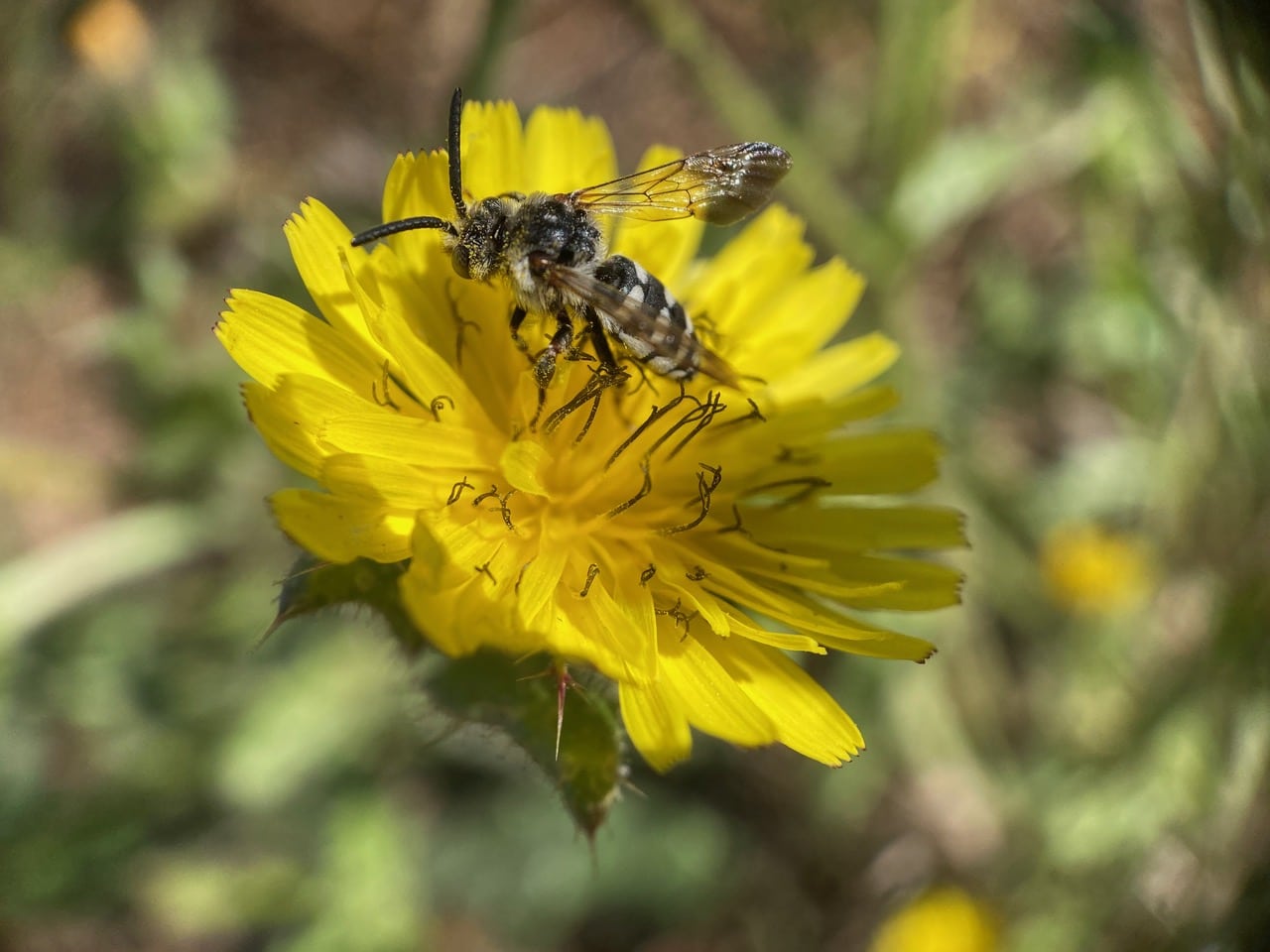
The California Digger-cuckoo Bee, Brachymelecta californica (family Apidae) is an odd-looking creature. The terga (upper body segments) have medially broken bands of appressed white (rarely pale brown) pubescence. They are parasites of the Digger Bees, Anthophora sp. (family Apidae).
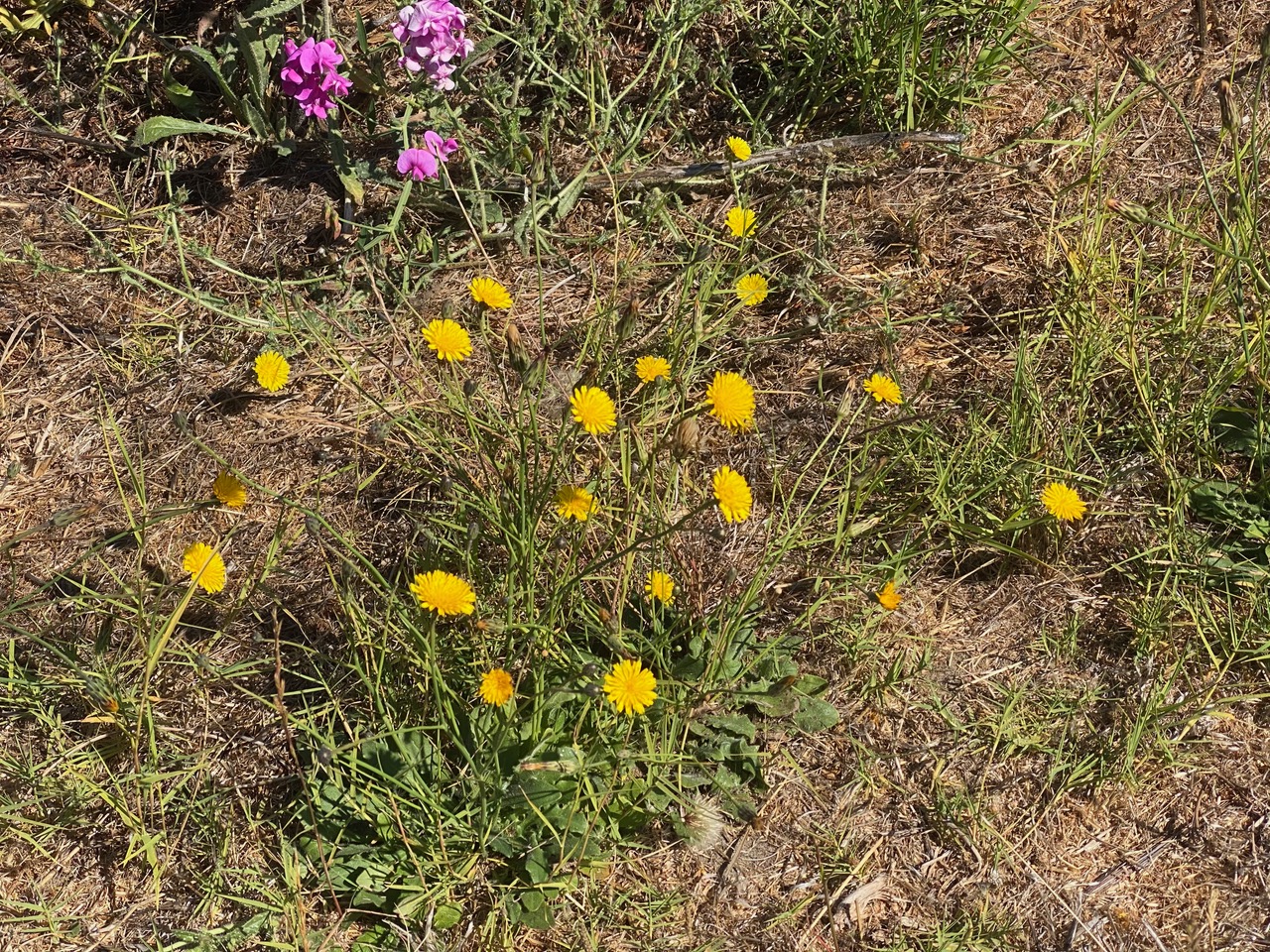
In the same vicinity, another composite “weed”, the Cat’s Ear, Hypochaeris radicata is also in bloom, attracting some insects.

The feisty Digger Bees are foraging on these flowerheads too.

Hey, isn’t that a European Woolcarder Bee, Anthidium manicatum (family Megachilidae)?

Here’s one that’s perched on the ground. Do these bees have their nests here too?
Anthidium manicatum, commonly called the European Woolcarder Bee, is a species in the family Megachilidae, which includes the leaf-cutter bees and mason bees. They get the name “carder” from the behavior of the females scraping hair from leaves and stems of wooly plants. The substantially larger males engage in territorial behavior, aggressively chasing other males and pollinators from their territory. They mate with the females that forage in their territory. The females construct their nests in pre-existing cavities, using the hairs of wooly plants that they collect with their sharply toothed mandibles. They then roll up the fibers into a ball and transport them to the nest to line the nest cell, where they lay an egg and a provisioning mass consisting of nectar and pollen. Females largely use the hairs of plants in the mint family, Lamiaceae, especially those of genus Stachys and Betonica. The European Woolcarder Bees visit a wide range of flowers, with a preference for blue flowers that have long throats. They are considered generalists. Females carry pollen in the scopa on the underside of their abdomen. Both males and females can hover in midair near flowers similar to the hover flies (family Syrphidae).
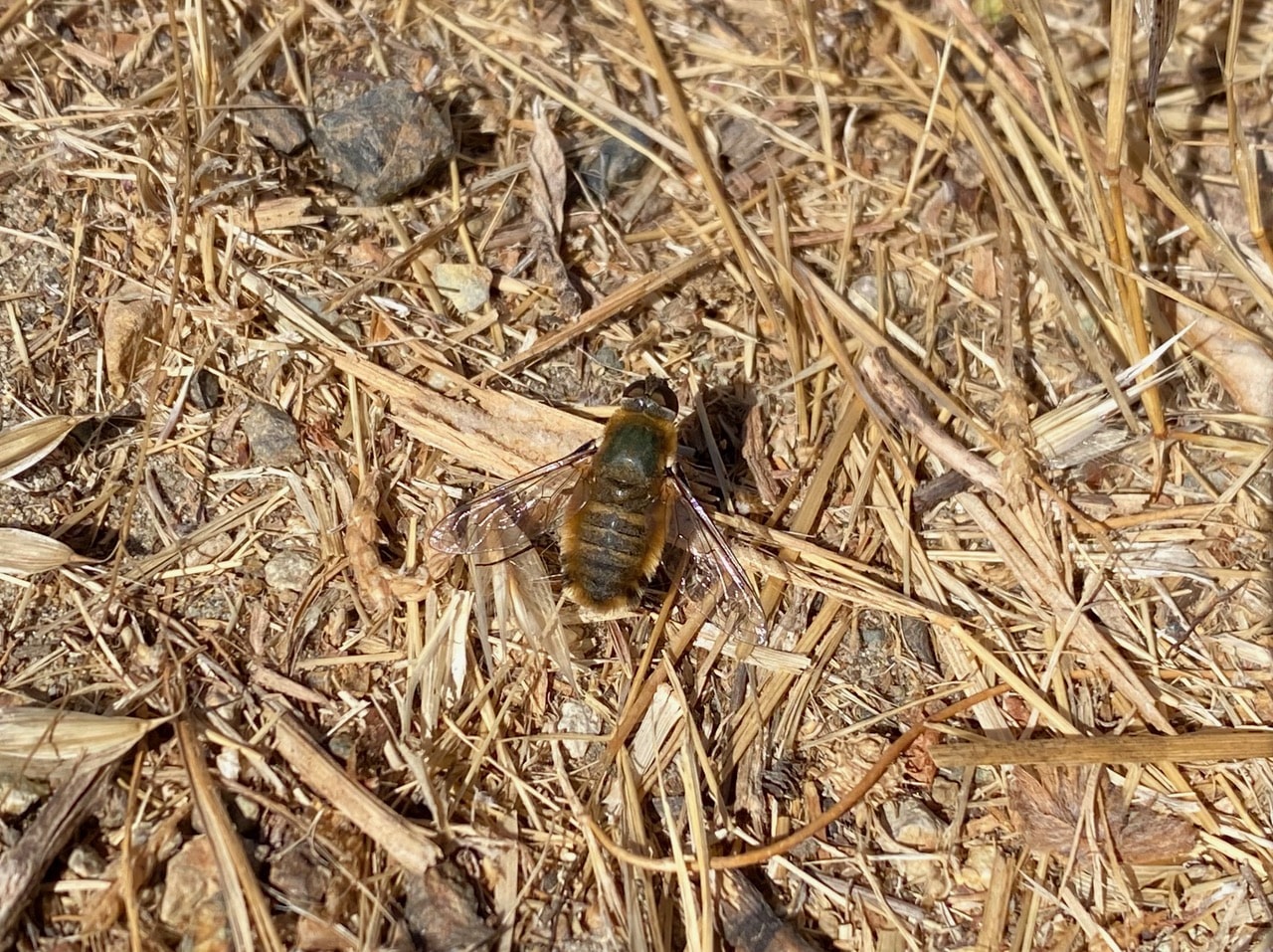
One of the most exasperating insects to photograph is the Bee Fly. Flying low over the ground, the fly taunts by landing just out of reach in front of you, then lifts off just when you’ve focused your camera. At least this one finally lets me take a picture of it after a few false starts. It is a Bee Fly in the genus Villa (family Bombyliidae).
The Bee Flies belong to the family Bombyliidae. Adults generally visit flowers for nectar and pollen, some being important pollinators. Larvae generally are parasitoids of other insects. When at rest, many species of bee flies hold their wings at a characteristic “swept back” angle. The adult females usually deposit eggs in the vicinity of possible hosts, quite often in the burrows of beetles or ground-nesting bees/wasps. Bombyliidae parasitism is not host-specific, but rather opportunistic, using a variety of hosts. Adult females of the genus Villa lay eggs in mid-air and flick them towards the nest entrances of their hosts. They typically have an eversible pouch near the tip of their abdomen known as a sand chamber, which is filled with sand grains gathered before egg laying. These sand grains are used to coat each egg just before their aerial release, presumably to improve the female’s aim by adding weight.