

Pollinator Post 9/6/23
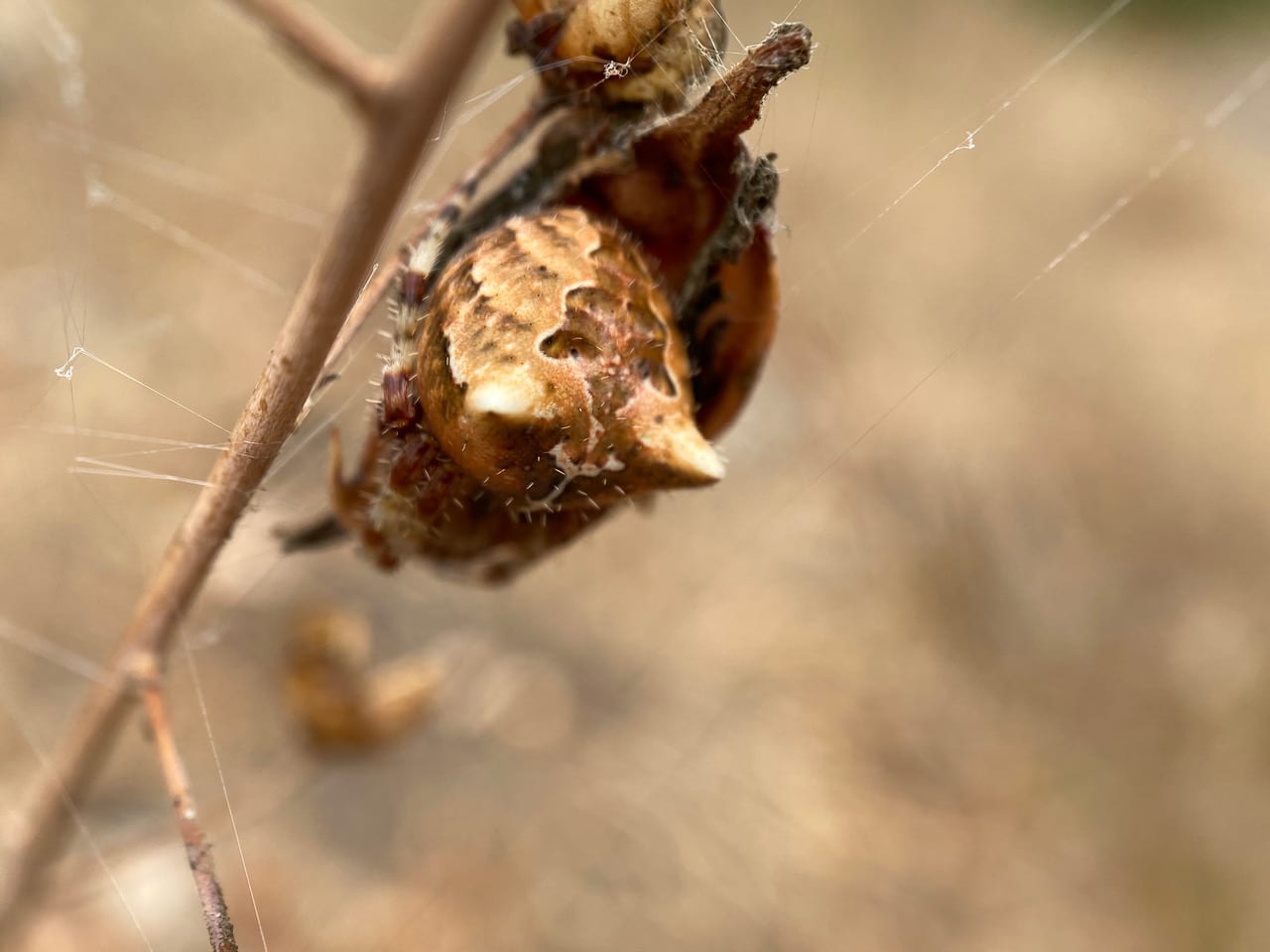
Our Two-tubercled Orbweaver Spider has outgrown her seed capsule on the Soap Plant, Chlorogalum pomeridianum. Today she is resting on a 1-inch dried leaf she has attached to the seed capsule. Did she have to haul that up from the ground? Or maybe the leaf was blown fortuitously into her web?
The Two-tubercled Orb-weaver Spiders, Gibbaranea bituberculata (family Araneidae) are found in sunny habitats on shrubs, edges and low plants, where they can make their webs near the ground. Their basic color is very variable, but usually it is brownish, with whitish shades. The cephalothorax is covered with adpressed hairs.
Orb-weaver spiders are members of the spider family Araneidae. They are the most common group of builders of spiral wheel-shaped webs often found in gardens, fields, and forests. Generally, orb-weavers are three-clawed builders of flat webs with sticky spiral capture silk. The third claw is used to walk on the non-sticky part of the web. Typically, the prey insect that blunders into the sticky lines is stunned by a quick bite, and then wrapped in silk.
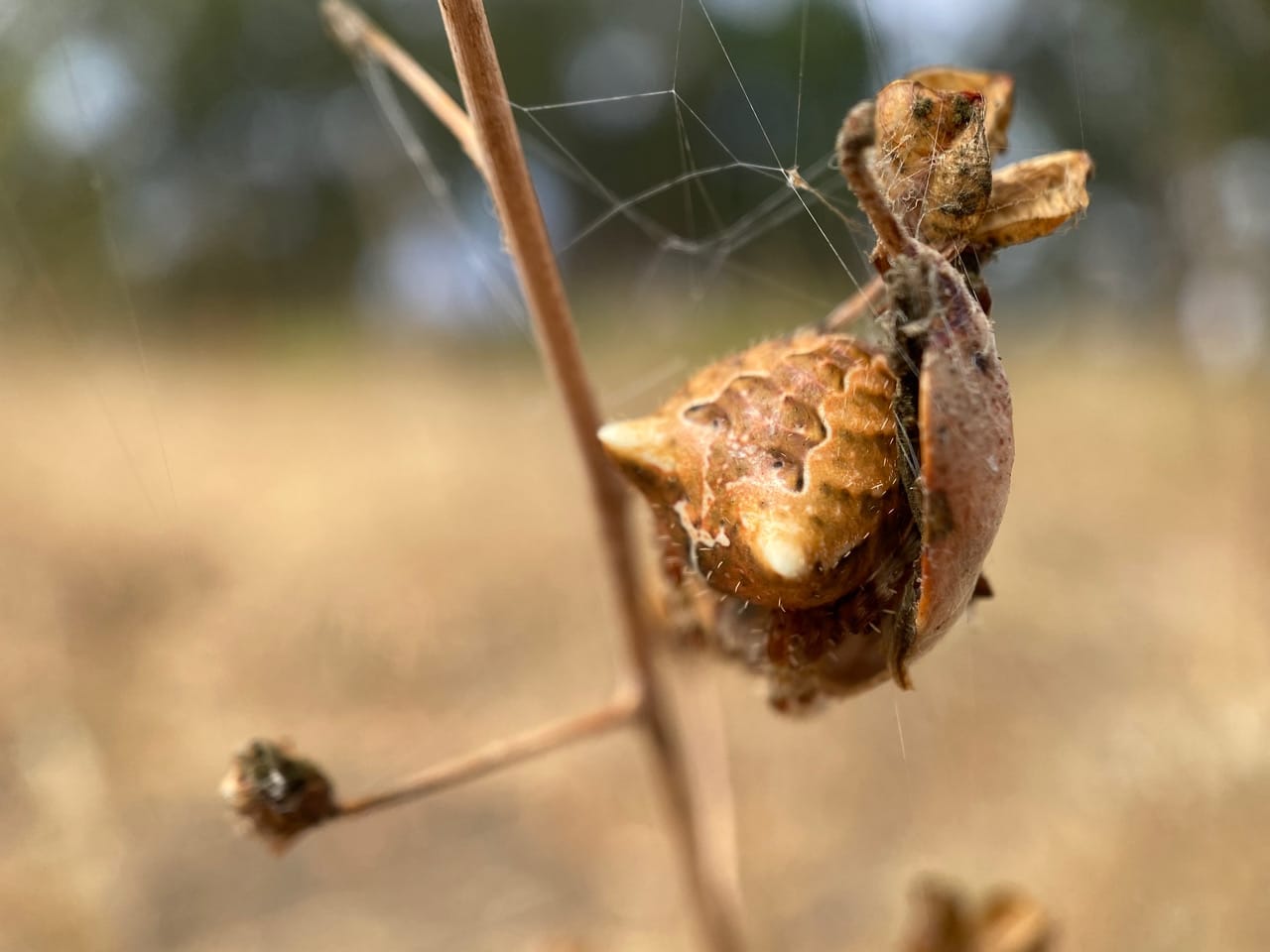
Aah, life on a hammock!
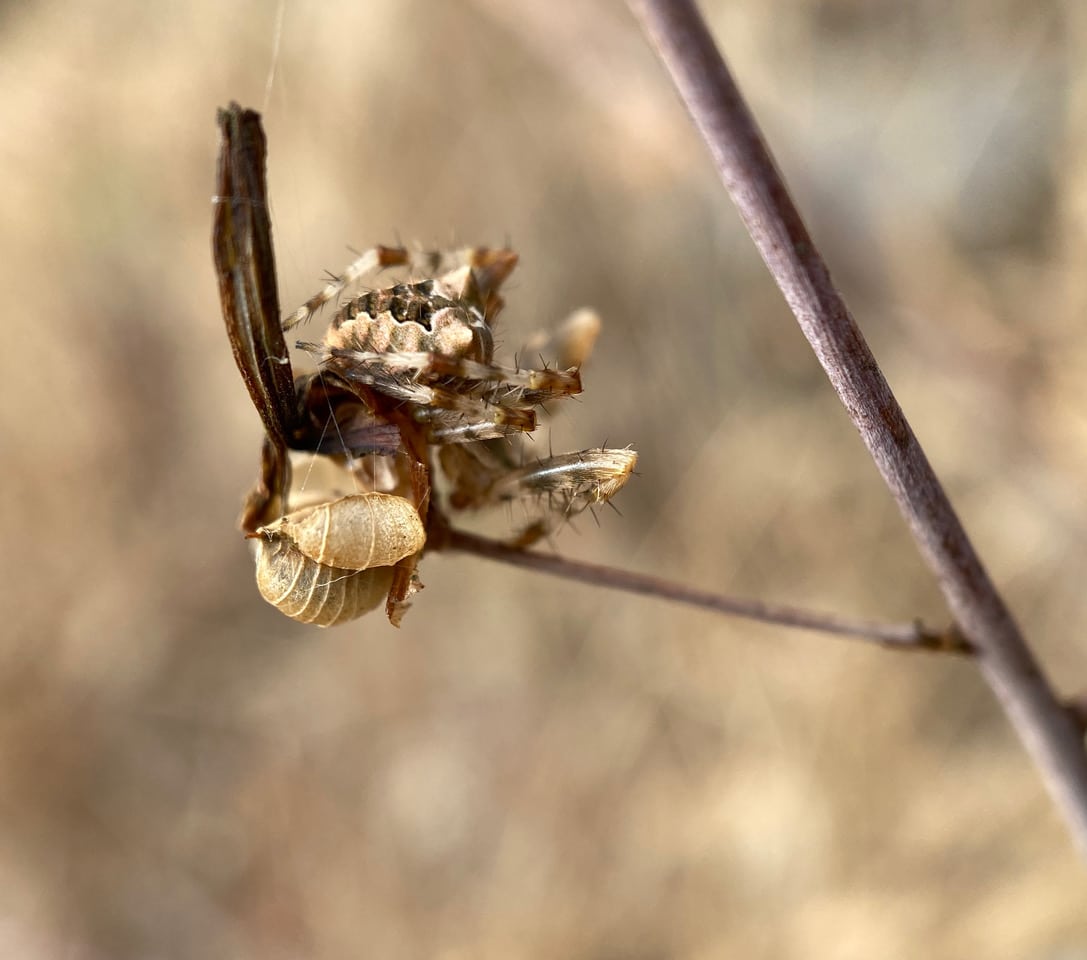
The smaller spider on a neighboring plant has moved over to another seed capsule. What beautiful camouflage!

A Crab Spider, Mecaphesa sp. (family Thomisidae) is waiting in ambush among the flowerheads of a California Goldenrod, Solidago velutina ssp. californica.
Members of the family Thomisidae do not spin webs, and are ambush predators. The two front legs are usually long and more robust than the rest of the legs. Their common name derives from their ability to move sideways or backwards like crabs. Most Crab Spiders sit on or beside flowers, where they grab visiting insects. Some species are able to change color over a period of some days, to match the flower on which they are sitting.
Mecaphesa is distinguished from the other genera of Crab Spider by the size and arrangement of the eight eyes (in two curved rows of four). Mecaphesa is also often hairy, with tiny hairs protruding from the head, legs, and body.

The Crab Spider spins around in excitement at the approach of an insect behind her.
 She freezes in predatory mode as the Odorous House Ant comes closer.
 The Odorous House Ant, Tapinoma sessile (subfamily Dolichoderinae) is native to North America, ranging from southern Canada to northern Mexico. The species is found in a vast diversity of habitats, including within houses. The ants mainly feed on floral nectar and other sugary food. They also forage for honeydew produced by aphids and scale insects that they guard and tend.
Odorous House Ants are small ants, the workers measuring 2-3 mm. As in all members of the subfamily Dolichoderinae (odorous ants), this species does not possess a sting, instead relying on the chemical defense compounds produced from the anal gland. Such compounds are responsible for the smell given off by the ants when crushed or disturbed.
T. sessile colonies are polydomous (consist of multiple nests) and polygynous (contain multiple reproductive queens). The species practices seasonal polydomy – the colony overwinters in a single nest, and forms multiple nests during spring and summer when resources are more abundant and spread out.
The Odorous House Ants are rather docile, with little propensity for attack, preferring to use chemical secretions instead of biting. For this reason they are vulnerable to the invasion of the aggressive Argentine Ants, Linepithema humile.
 Mecaphesa gives up the hunt, retracting her long front legs. I don’t think ants are on her menu.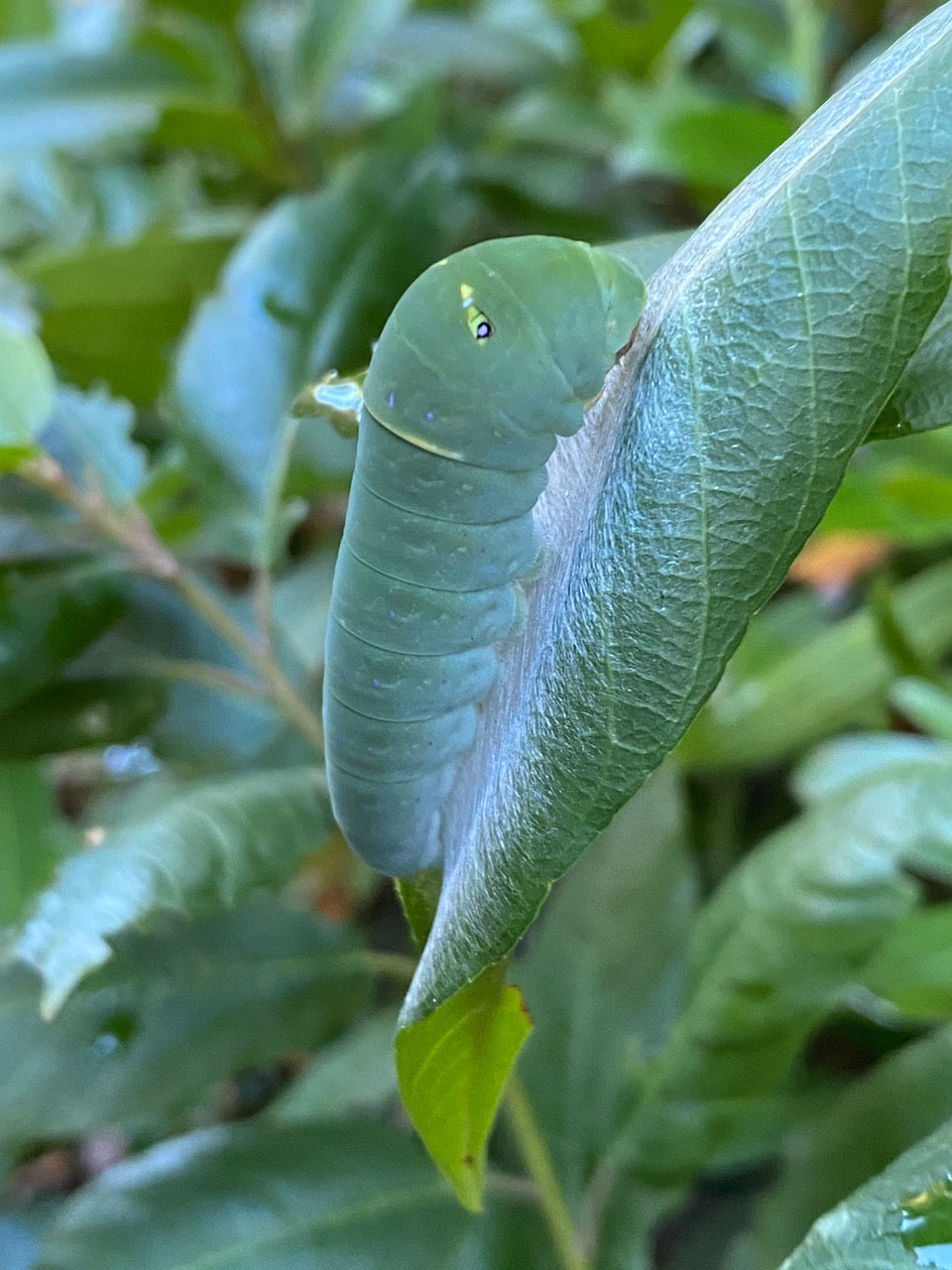
It’s reassuring to find Blue, the Pale Swallowtail caterpillar safe and sound on its home leaf in the Coffeeberry bush, Frangula californica. Blue has grown so heavy the leaf now droops from its weight. Blue holds on tight with its crochets securely anchored in the silk pad that it has spun on the leaf. Crochets are tiny hooks on the tips of the prolegs of caterpillars; they are used to grasp the food plant and to prevent falling away from smooth surfaces of the plant.
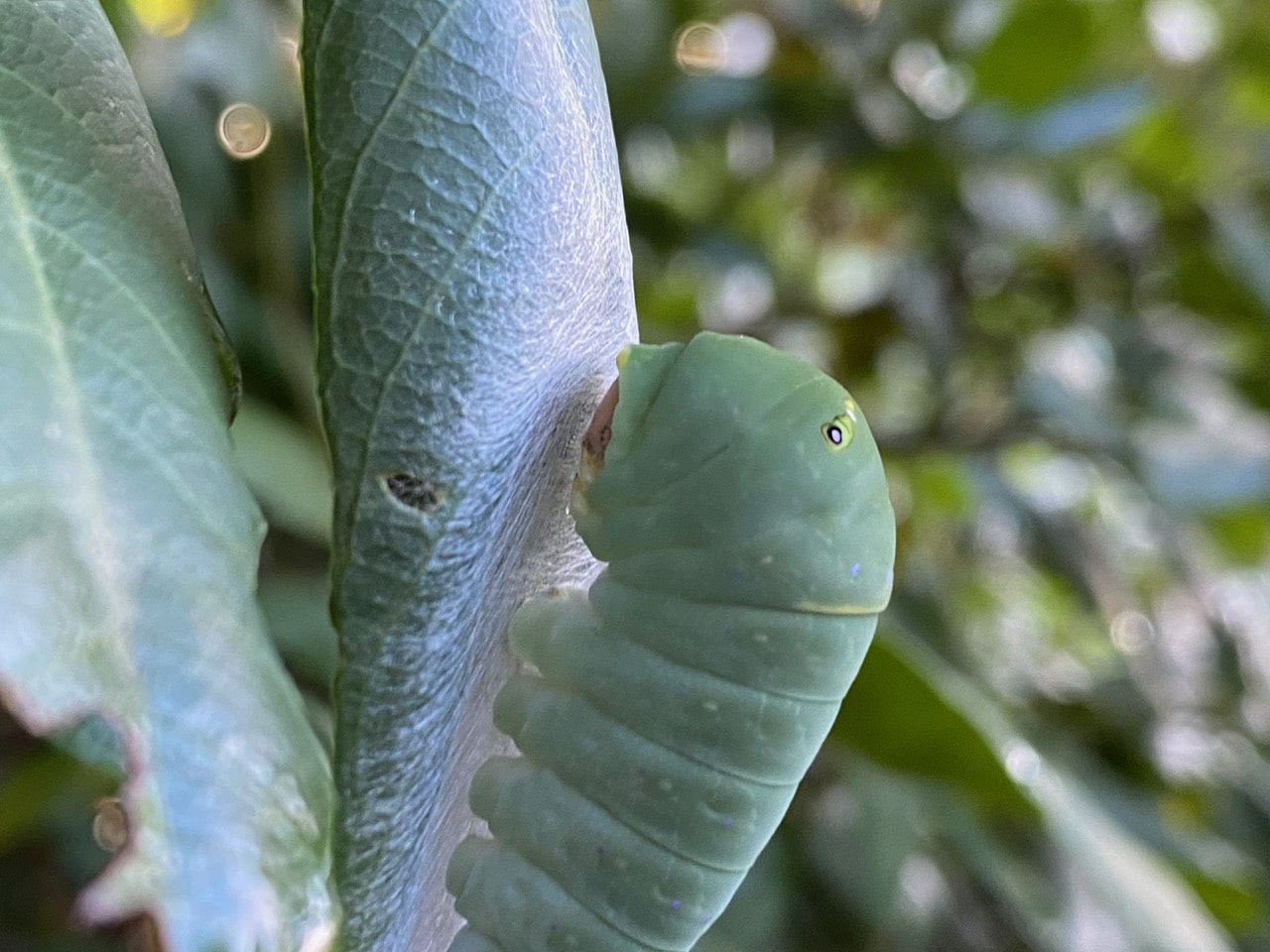
I am always interested in checking on Blue’s head capsule, but it is tightly retracted under the thorax today. When a caterpillar is getting ready to molt, its head capsule will turn pale and translucent.
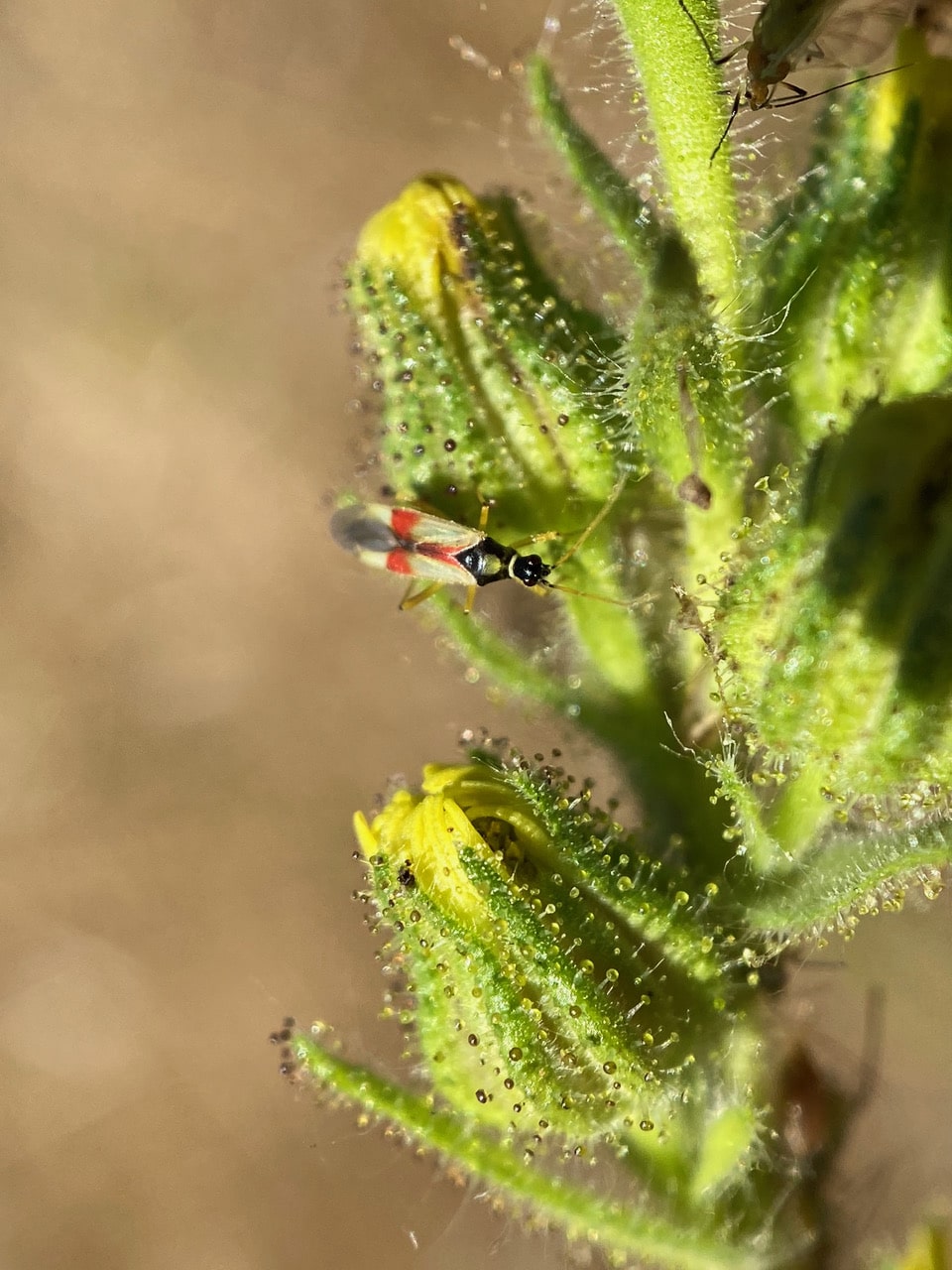
A Phacelia Plant Bug, Tupiocoris californicus (family Miridae) is roaming among the immature flowerheads of Coast Tarweed, Madia sativa.
Sometimes I wonder if the common name isn’t a misnomer. I have never seen this bug on Phacelia, but have only found it on the tarweeds. In fact, it is one of the guild of bugs that are specialized for living on sticky plants. It can navigate the glandular hairs with the greatest of ease.
Mirid bugs are also referred to as plant bugs or leaf bugs. Miridae is one of the largest family of true bugs in the order Hemiptera. Like other Hemipterans, Mirids have piercing, sucking mouthparts to extract plant sap. Some species are predatory.
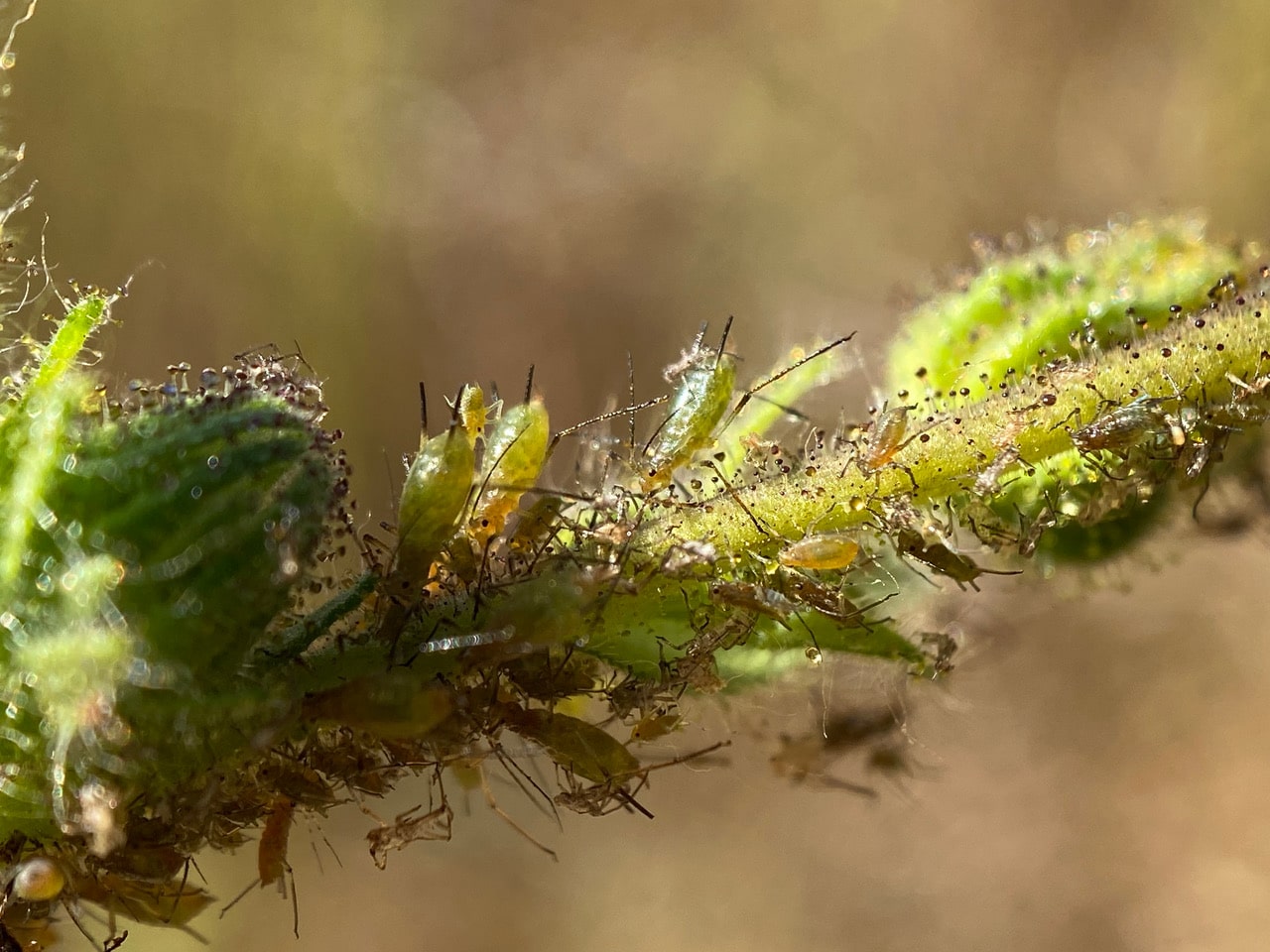
Below the Water Tank, the population of aphids, Uroleucon sp. (family Aphididae) has exploded on the Coast Tarweed. The stems are crowded with aphids of all ages and sizes, all clones of the original mother.
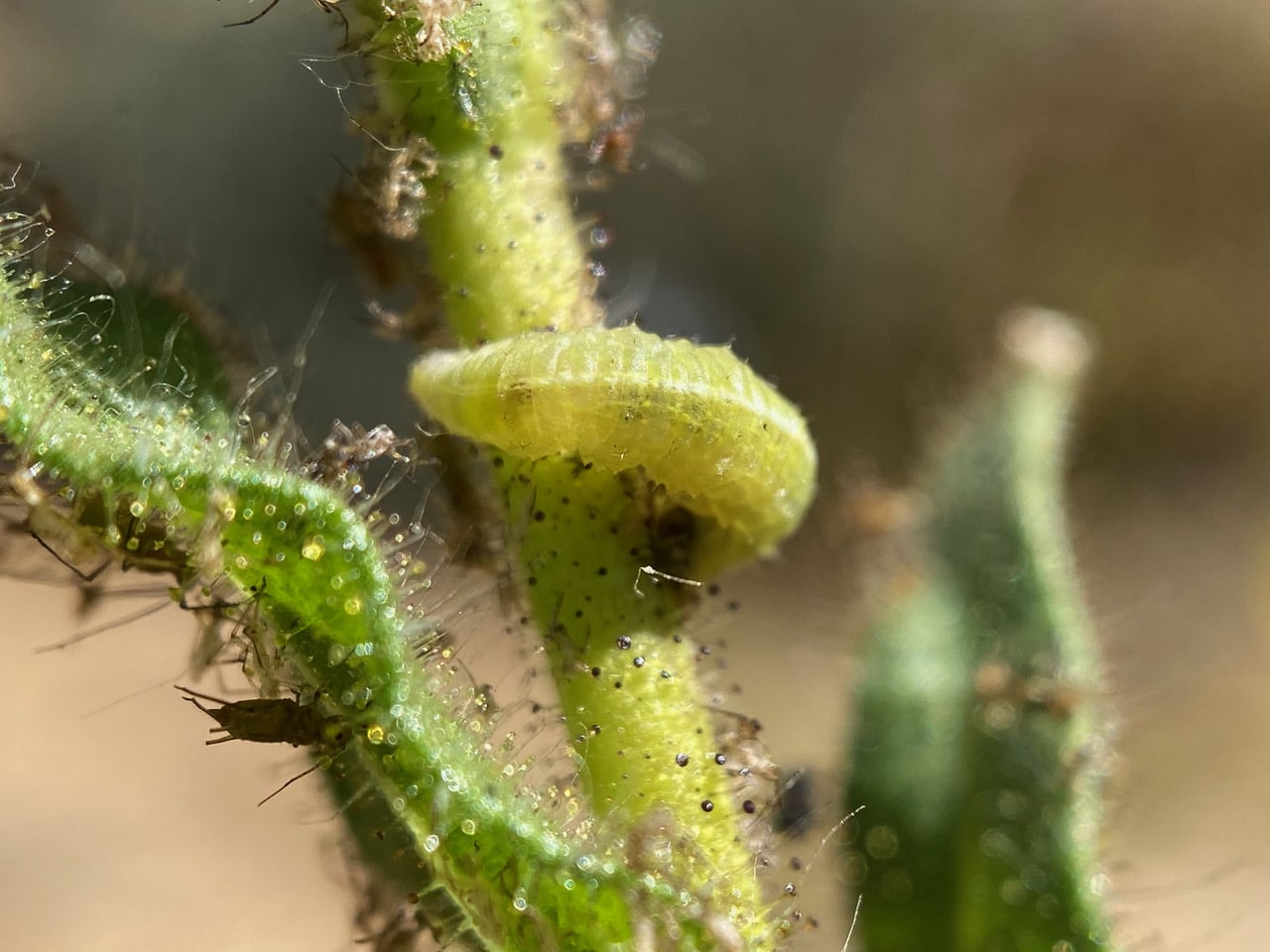
The aphids have attracted predators. This Syrphid larva is hunting aphids on a stem.
Hover Flies, also called Syrphid Flies make up the insect family Syrphidae. They are often seen hovering or nectaring at flowers; the adults of many species feed mainly on nectar and pollen, while the larvae eat a wide range of foods. In many species, the larvae feed on aphids, thrips, and other plant-sucking insects. The feeding habits of many species of Syrphidae endear them to the gardeners, serving as pest control agents as larvae, and pollinators as adults.
The larvae of most Syrphid Fly species are slug like and taper towards the head. Coloration is commonly brown, greenish, pink, or whitish. The Syrphid larvae lack true legs, but the creviced, segmented body can give the appearance of having appendages. They are blind, relying on their sense of touch to navigate and to catch prey. They feed on aphids and other insects and move around on the plants in search of prey. The larvae complete their development in two to three weeks while consuming up to 400 aphids each.
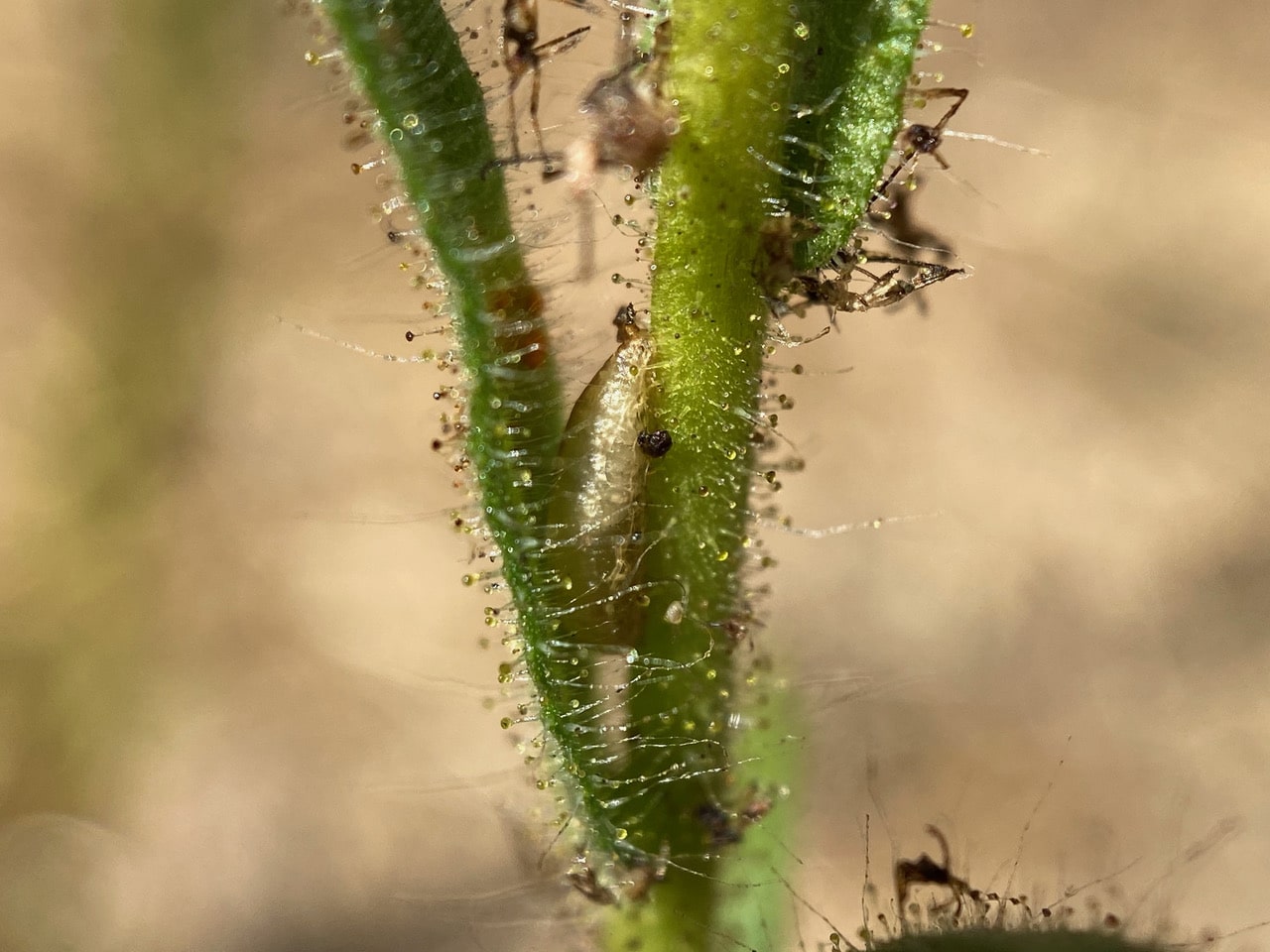
Look, there’s a Syrphid pupa wedged in the leaf axil of Coast Tarweed.
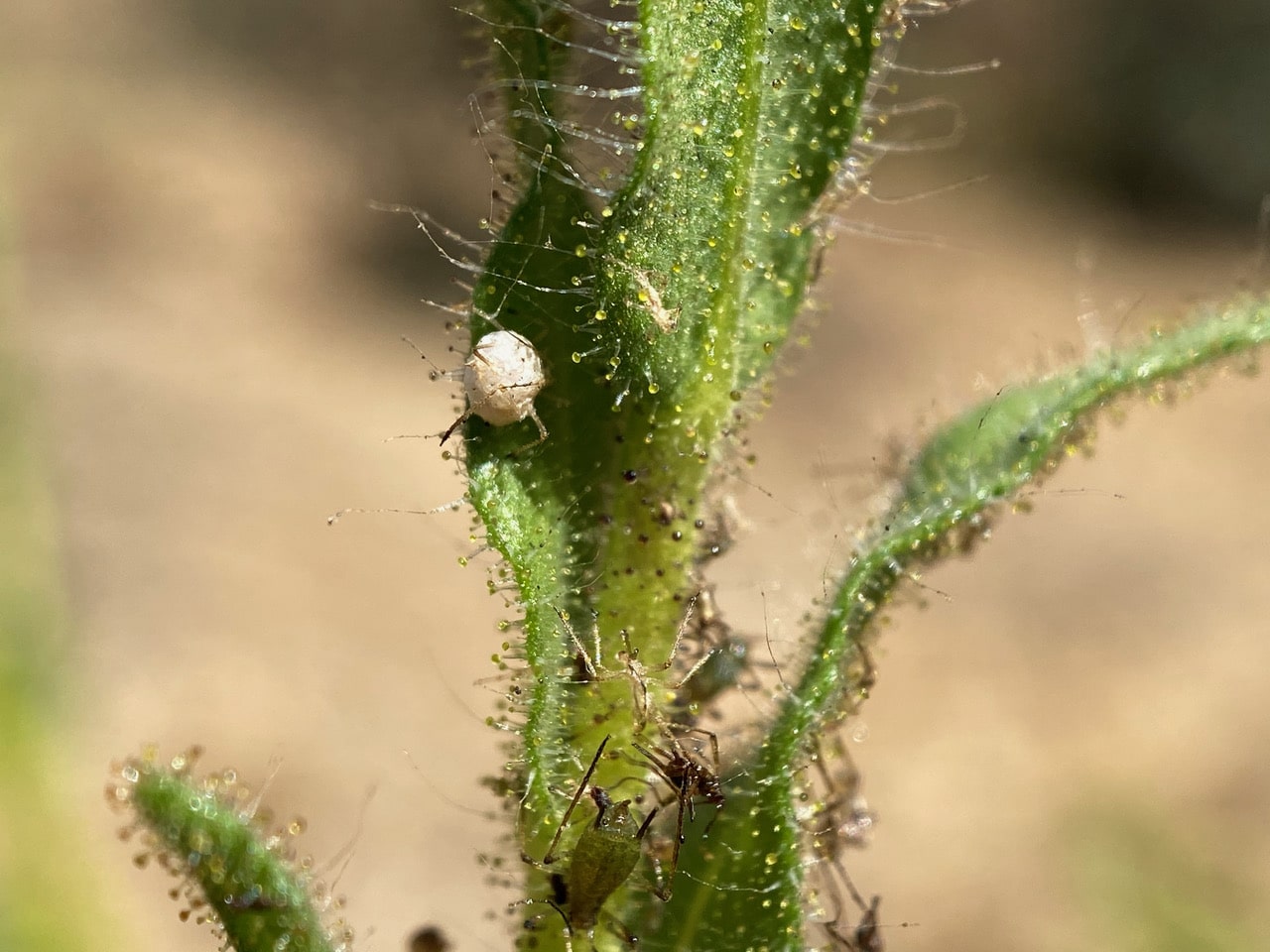
Ooh, an aphid mummy! See that bloated, straw-colored aphid?
Aphids are often attacked by a tiny parasitoid wasp, Aphidius sp. (family Broconidae). The female wasp lays an egg in the aphid. When the egg hatches, the wasp larva feeds on the inside of the aphid. As the larva matures, the host dies and becomes slightly enlarged or mummified, often turning browner yellow. Complete metamorphosis occurs within the host. The adult parasite chews its way out of the mummy, leaving a round hole. The Aphidius wasps are often used for biological pest control of aphids on agricultural crops and home gardens.
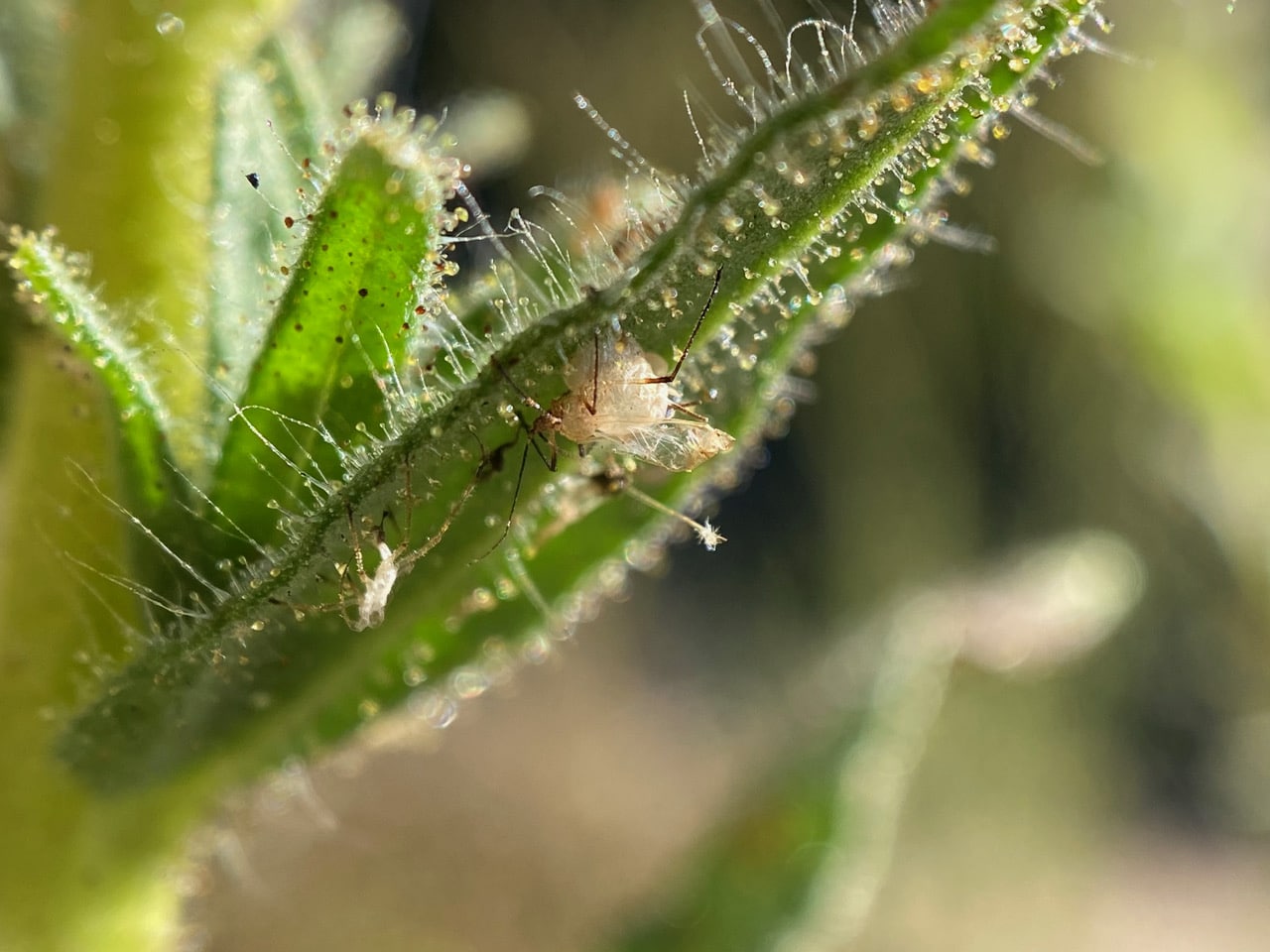
A “mummified” alate! Apparently winged aphids get parasitized by the wasp too. You’d think that the alates would fly away when approached by the wasp.
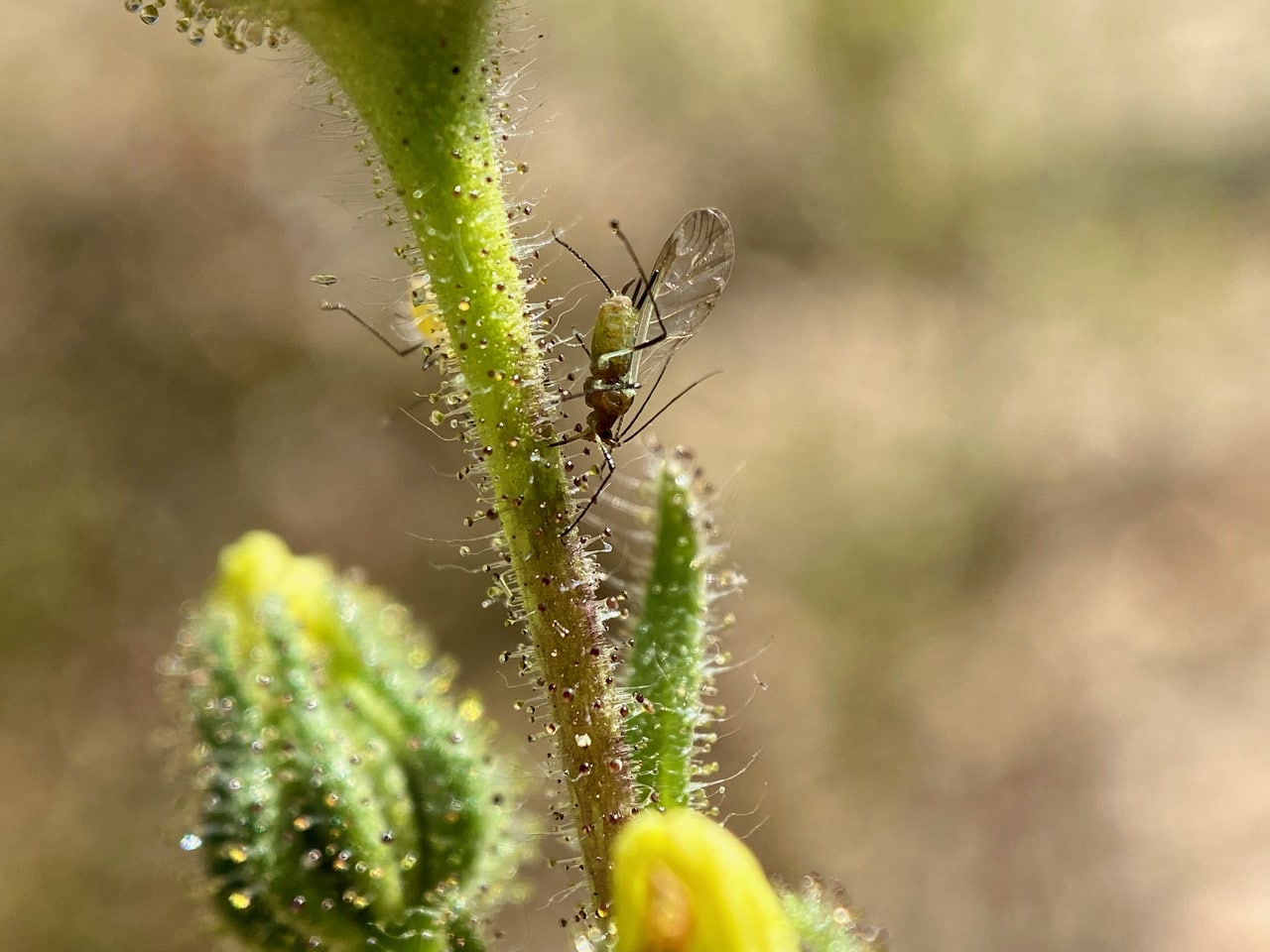
Here’s a healthy aphid alate.
Generally adult aphids are wingless, but most species also occur in winged forms, especially when populations are high or during spring and fall. The ability to produce winged individuals provides the aphids with a way to disperse to other plants when the quality of the food source deteriorates, or when predation pressure is high.
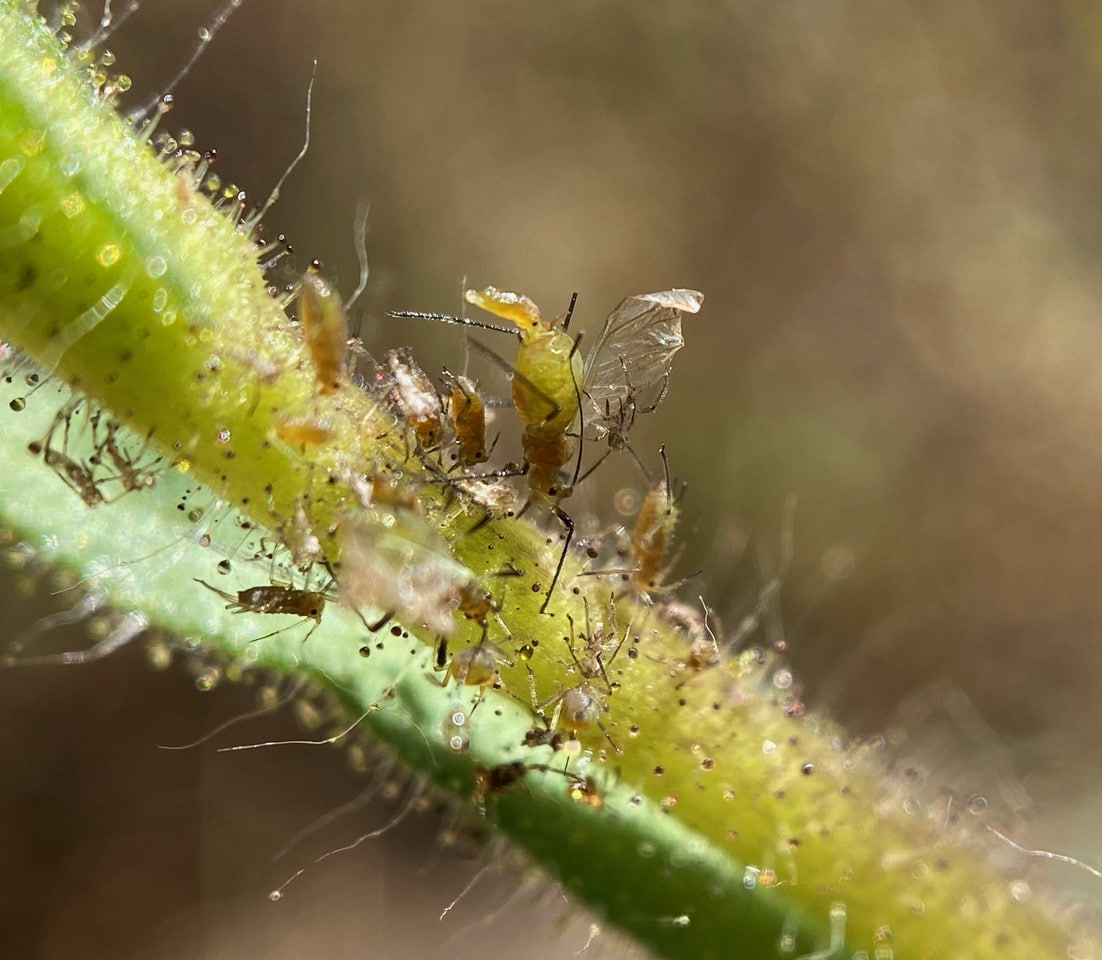
This winged aphid is multitasking – giving birth while feeding! The Coast Tarweed she’s on is young and pristine – this small group of aphids are the only ones on the plant. Mama aphid’s wings are crumpled, but she won’t need them any more. She’s a pioneer establishing a new colony on virgin territory. The young aphids around her are probably all her babies.
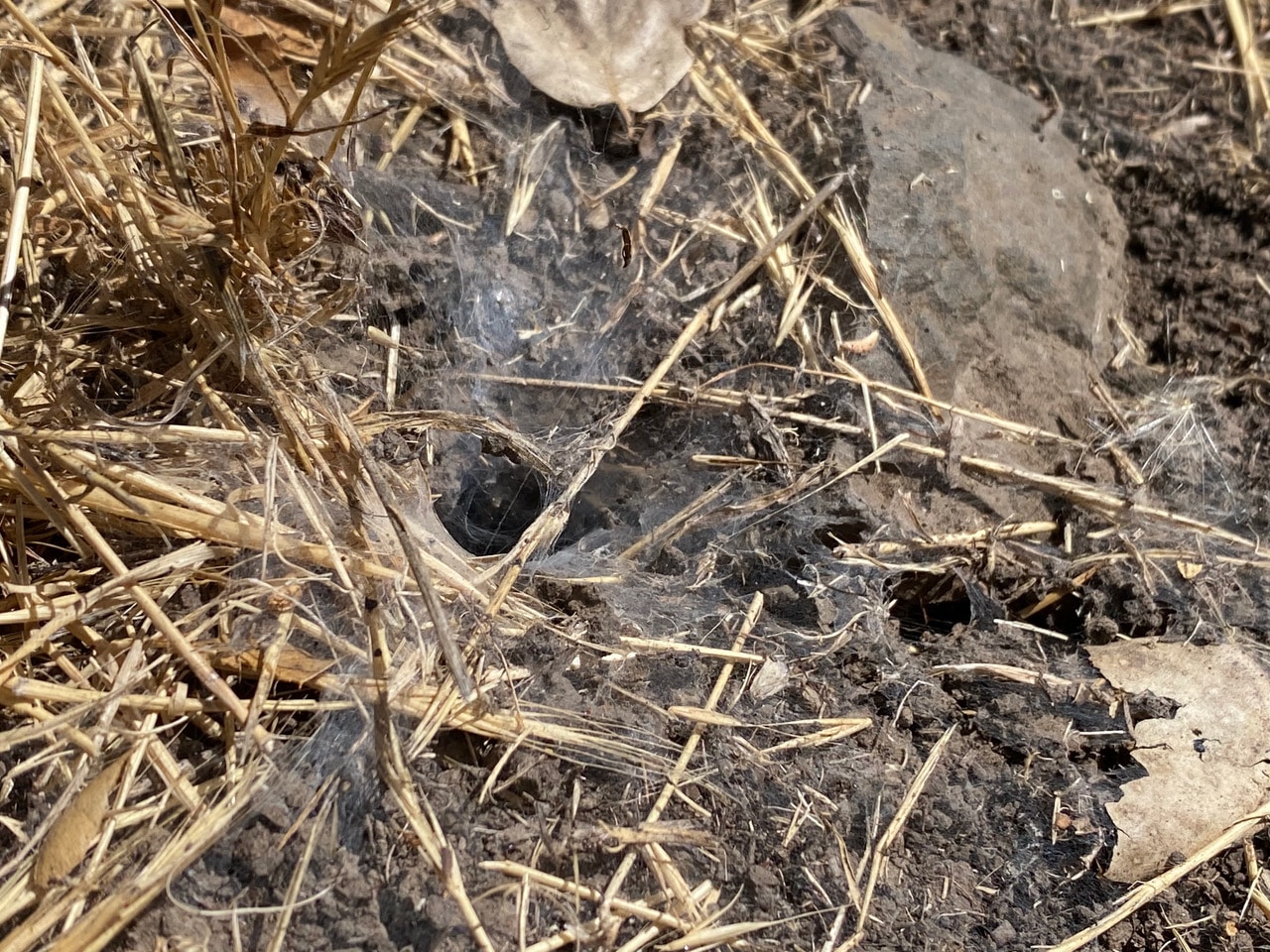
I find a couple of these horizontal, fine-mesh spider webs leading to a central hole in the ground the diameter of a pencil. They are probably made by Grass Spiders, genus Agelenopsis in the funnel weaver family Agelenidae. The web serves as both a platform on which the spider captures prey, and a retreat in which the spider can remain hidden. The web is not sticky, but these spiders make up for that with their running speed. The larger species can grow to almost 2 cm in length. They may be recognized by the arrangement of their eight eyes into three rows. They have two prominent hind spinnerets.

At the patch of blooming California Goldenrod along the paved road, I am happy to find Camouflaged Looper #1 and #2 still on their respective flower spikes. #3 has disappeared, probably gone in search of greener pasture as its flower spike has withered.
Camouflaged Loopers belong to a group of moth species commonly referred to as inch worms because of the way they move, inching along, front legs reaching out, body stretched to its limit, grabbing ahead, pulling and looping the rest of the body forward. The caterpillar appears to be measuring the earth as it moves along, hence the name Geometridae for the family (Geo = earth, metron = measure).
The Camouflaged Looper is the larva of the Wavy-lined Emerald Moth, Synchlora aerata (family Geometridae), a species found throughout much of North America. The larvae feed on many plants in the family Asteraceae, as well as a variety of other flowering plants.
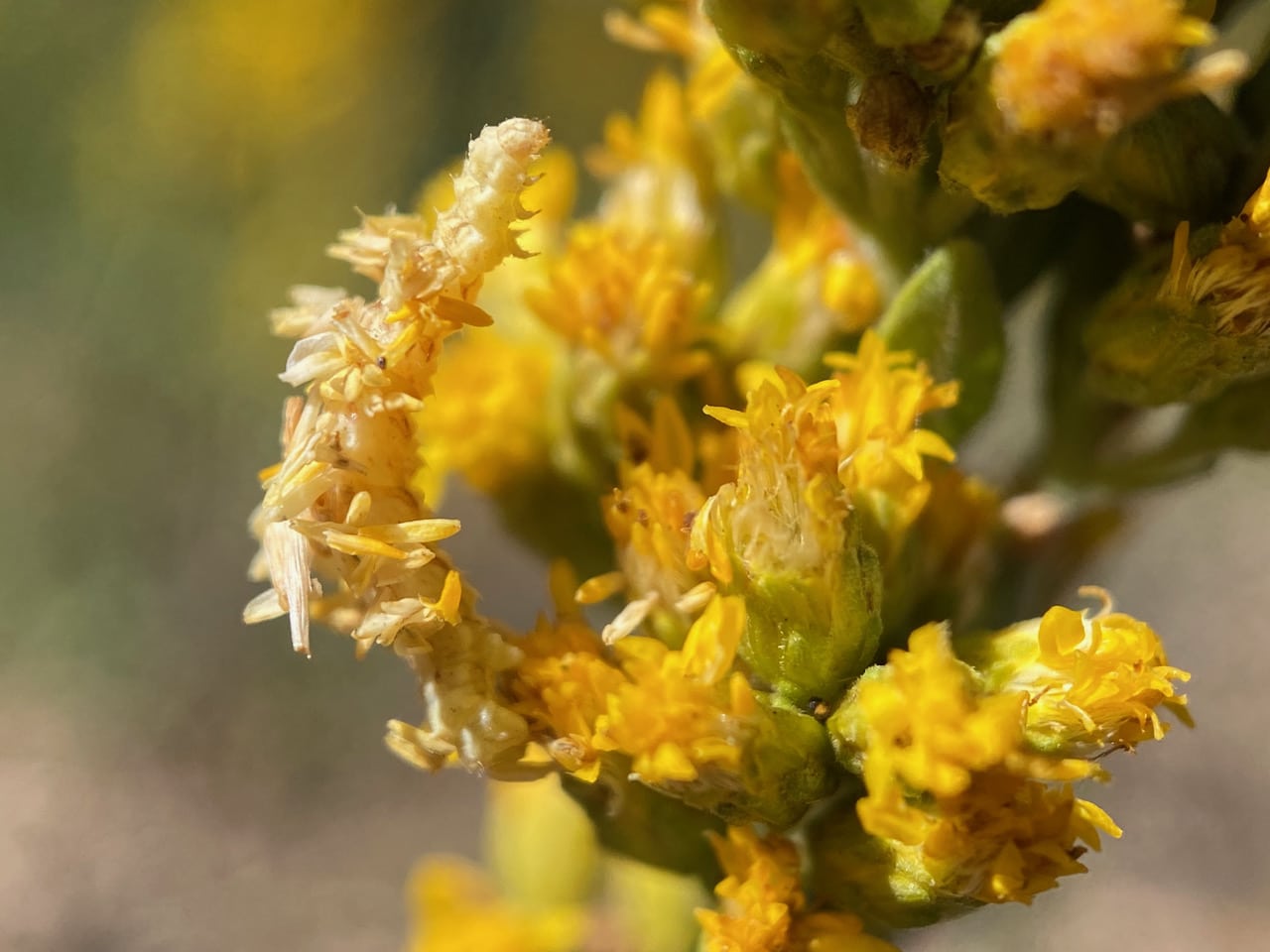
Active and agile, Looper #1 is the inveterate performer.
The Camouflaged Loopers are well known for covering themselves with the plant they feed on. The caterpillar chews off small pieces of flower petals, seed heads, leaves, whatever plant material is available, and attaches the pieces to its back with a little silk from the spinnerets beneath the caterpillar’s mouth. The caterpillar must do this several times during its life as a larva. Each time it molts the camo falls off with the old skin.
When the Camo Looper begins feeding on a different kind of flower, it discards the previous disguise and replaces it with pieces of the new flower. The disguise is probably most useful for hiding from hungry birds. Scientists posit that the Camouflaged Looper’s ability to change disguise allows it to have more varied diet than other caterpillars because it isn’t restricted to eating only those flowers or plant parts that it resembles in appearance.

What in the world is THAT?! A seed? A pupa?

There are several of these on the same Coast Tarweed.
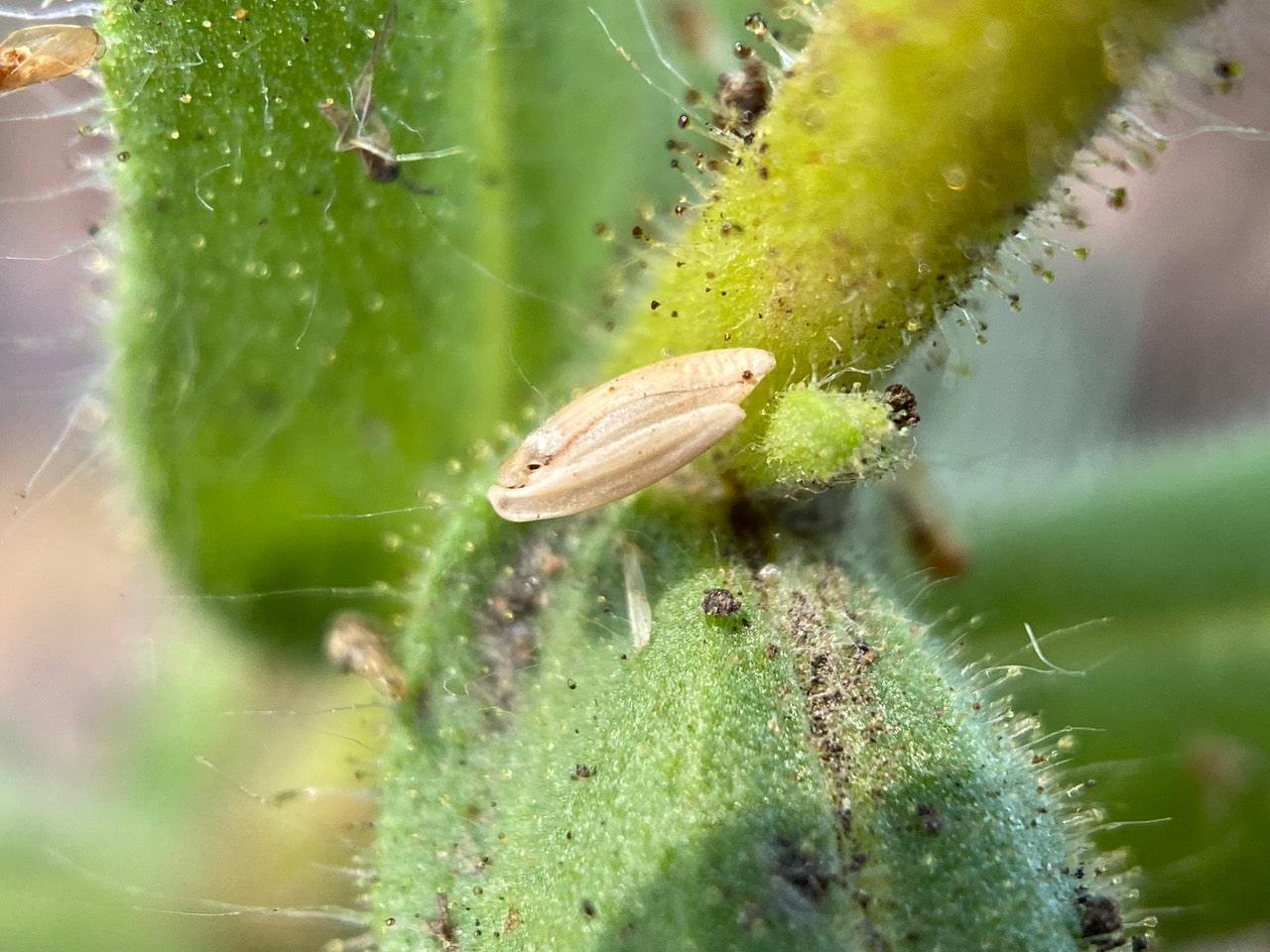
Even iNaturalist’s Computer Vision is at a loss trying to figure these out. If any of you know what they are, I would love to hear from you!