

Pollinator Post 9/4/25
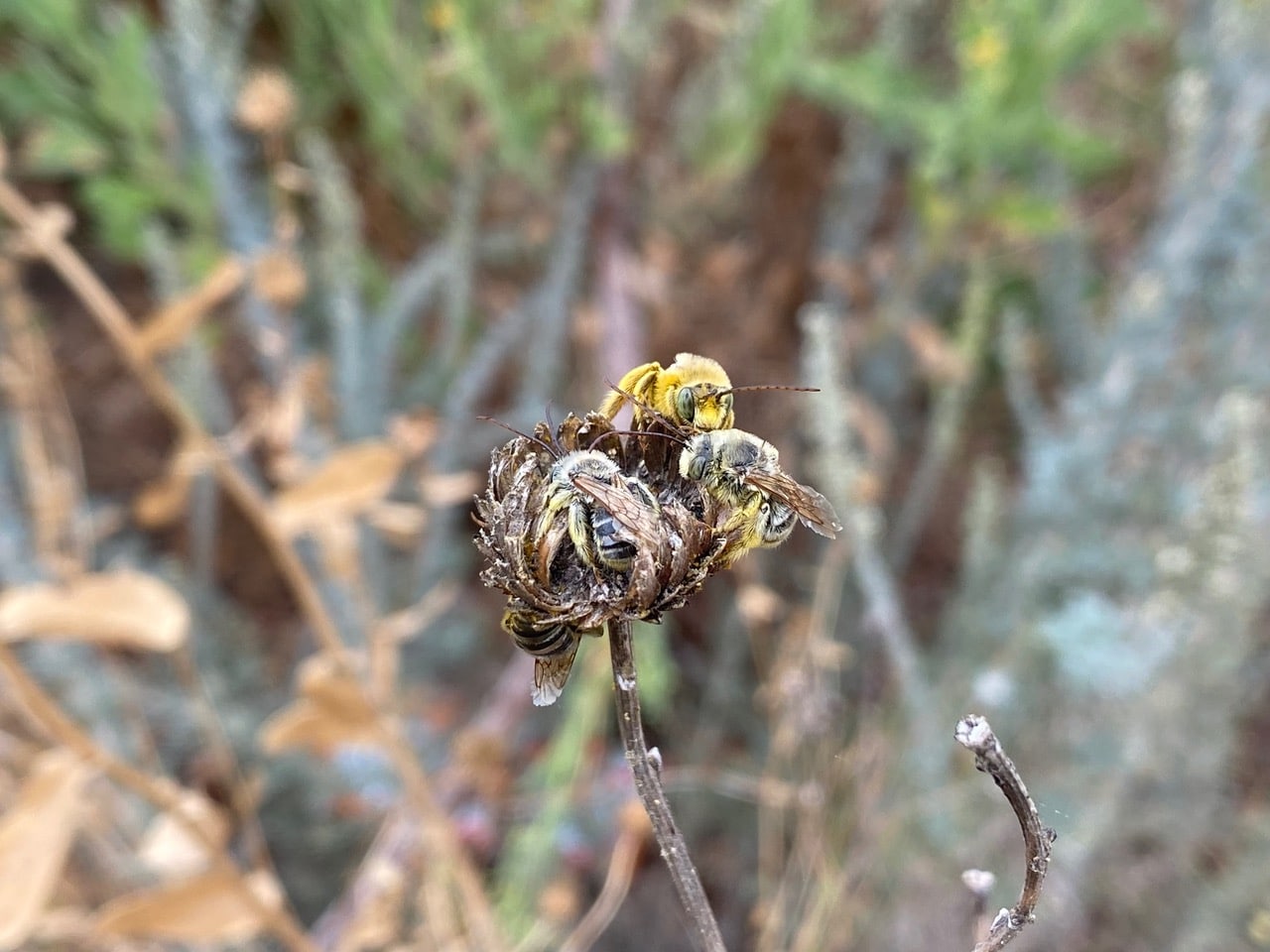
This is the first cool, cloudy day after a spell of heat, and the air is clean. I am elated to be able to go outdoors again. On the way to Bay Farm, I decide to stop by Naomi’s sidewalk garden. Maybe the male Longhorn Bees are still sleeping?
Sure enough, four male Longhorn Bees, Melissodes sp. (family Apidae) are still sleeping together on a spent Grindelia seed head. Yes, their eyes are wide open – insects do not have eyelids.
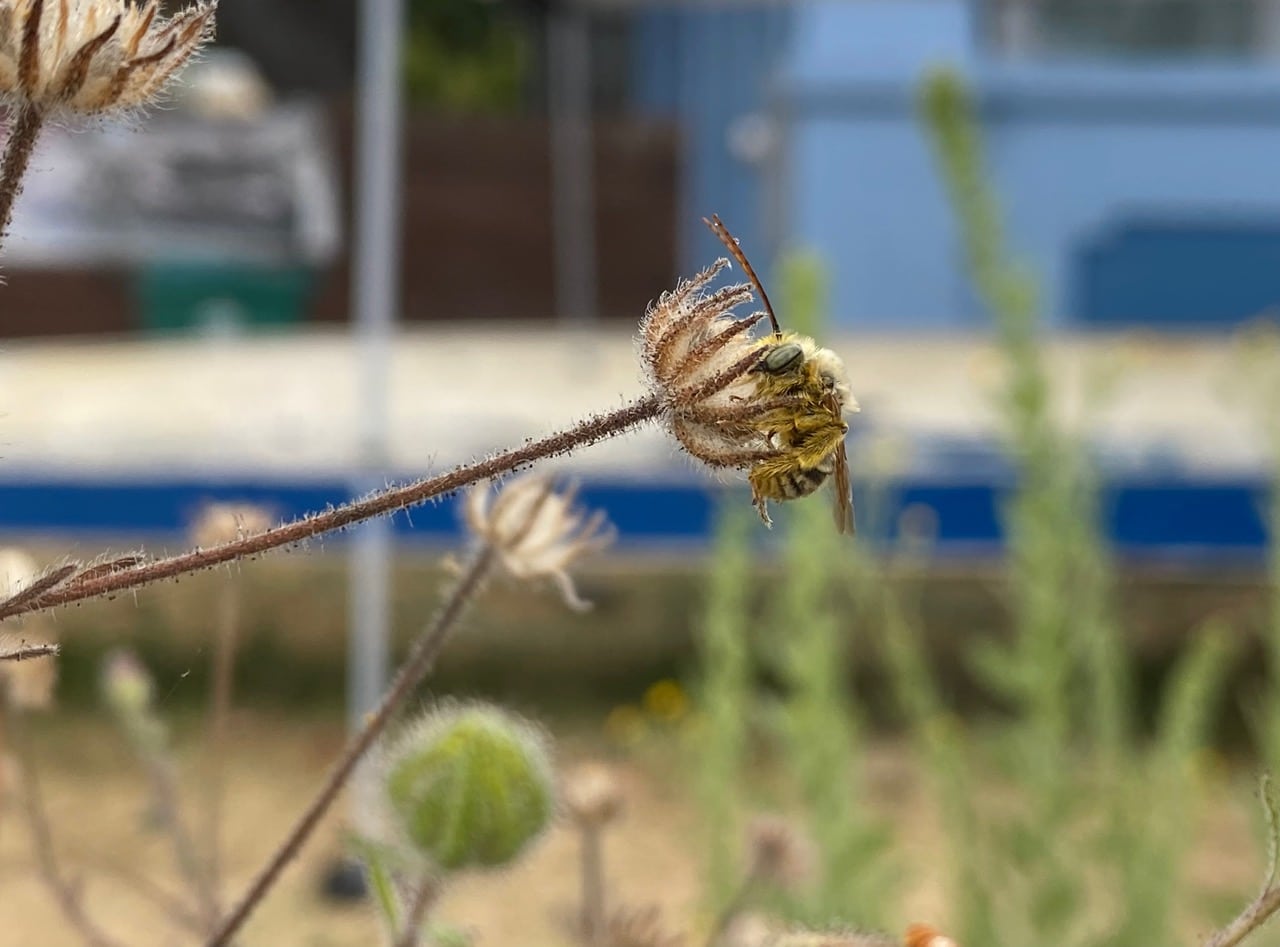







I next check on their old night roost on the tall Elegant Tarweed, Madia elegans. There is no longer an aggregation of sleeping males here. A single male is sleeping on a spent seed head…
… while another is asleep on a different seed head. I wonder what has caused the boys to scatter and relocate their slumber party to the Grindelia seed head? I find six males in total. Not surprising that their number has dwindled – their season is coming to an end. They are, after all, a summer species.
Hey, what happened to that Elegant Tarweed flowerhead? Someone has chewed off all the ray petals except for the red bases. Some disc florets are also missing. I wonder what’s in the red portion of the ray petals that deters herbivory?
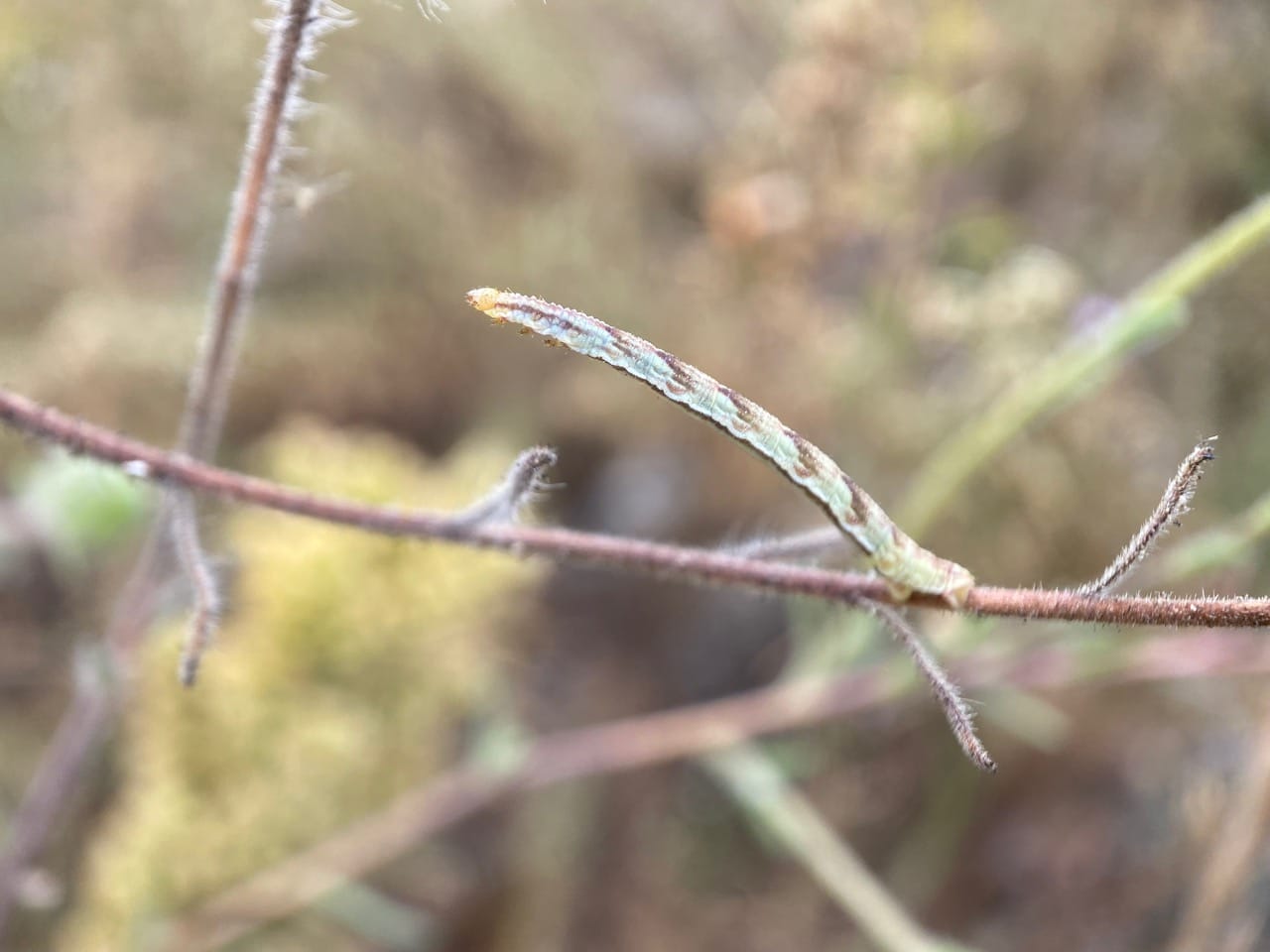
Just inches lower down on an adjacent stem, an inchworm caterpillar is trying to look innocuous, blending in with the sparse gray-green foliage. It is a larva of the Common Eupithecia Moth, Eupithecia miserulata (family Geometridae).
Inchworms are also called loopers and measuring worms. They majority of the inchworms are the larvae of moths in the family Geometridae. The name comes from the Greek “geo” for earth and “metro” from measure, because the caterpillars seem to be measuring the surface on which they are walking. Most caterpillars have five sets of prolegs, four in the middle of the body and one pair at the hind end. Inchworms have the normal six true legs but only two or three pairs of prolegs, all located at the tail end of the body, with none in the middle. When an inchworm walks, it moves its tail-end prolegs up behind its true legs, causing the center of its body to loop upward. Then it stretches its front end forward to take another step.
Eupithelia is the largest genus of moths of the family Geometridae. Occurring worldwide except for Australasia, species in the genus are commonly known as pugs. Adults are typically small, 12 – 35 mm, with muted colors. Most species rest with forewings held flat at right angles to the body, while the hindwing are largely covered by the forewings. They are generally nocturnal. Larvae mostly feed from the flowers and seeds of their food plants rather than the foliage. Many species have a very specific food plant.
Eupithecia miserulata, the Common Eupithecia Moth is found in North America. The adult wingspan is 12-20 mm. The larvae feed on a wide range of plants, including coneflower, asters, willow, cherry, juniper and clover.
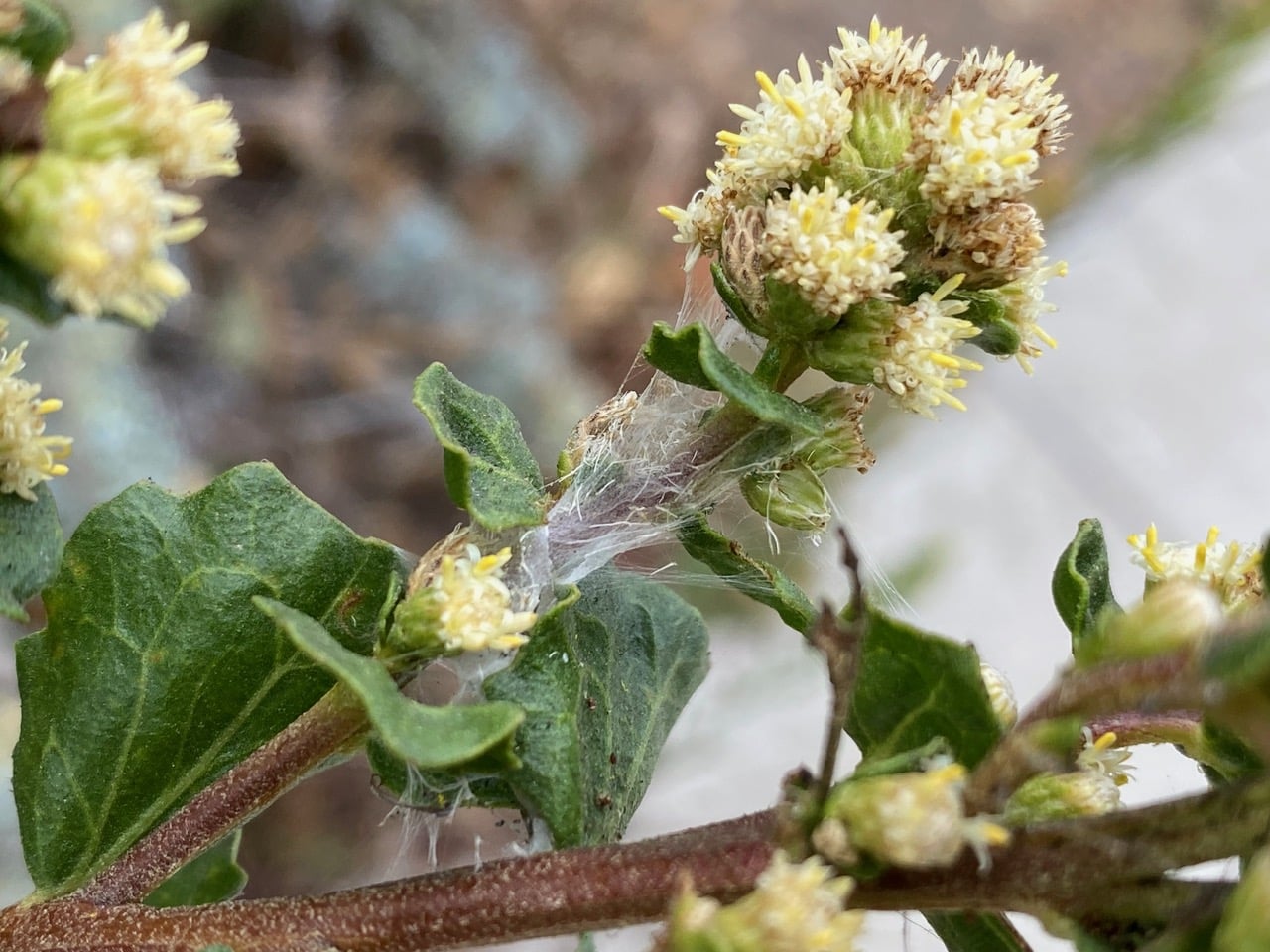
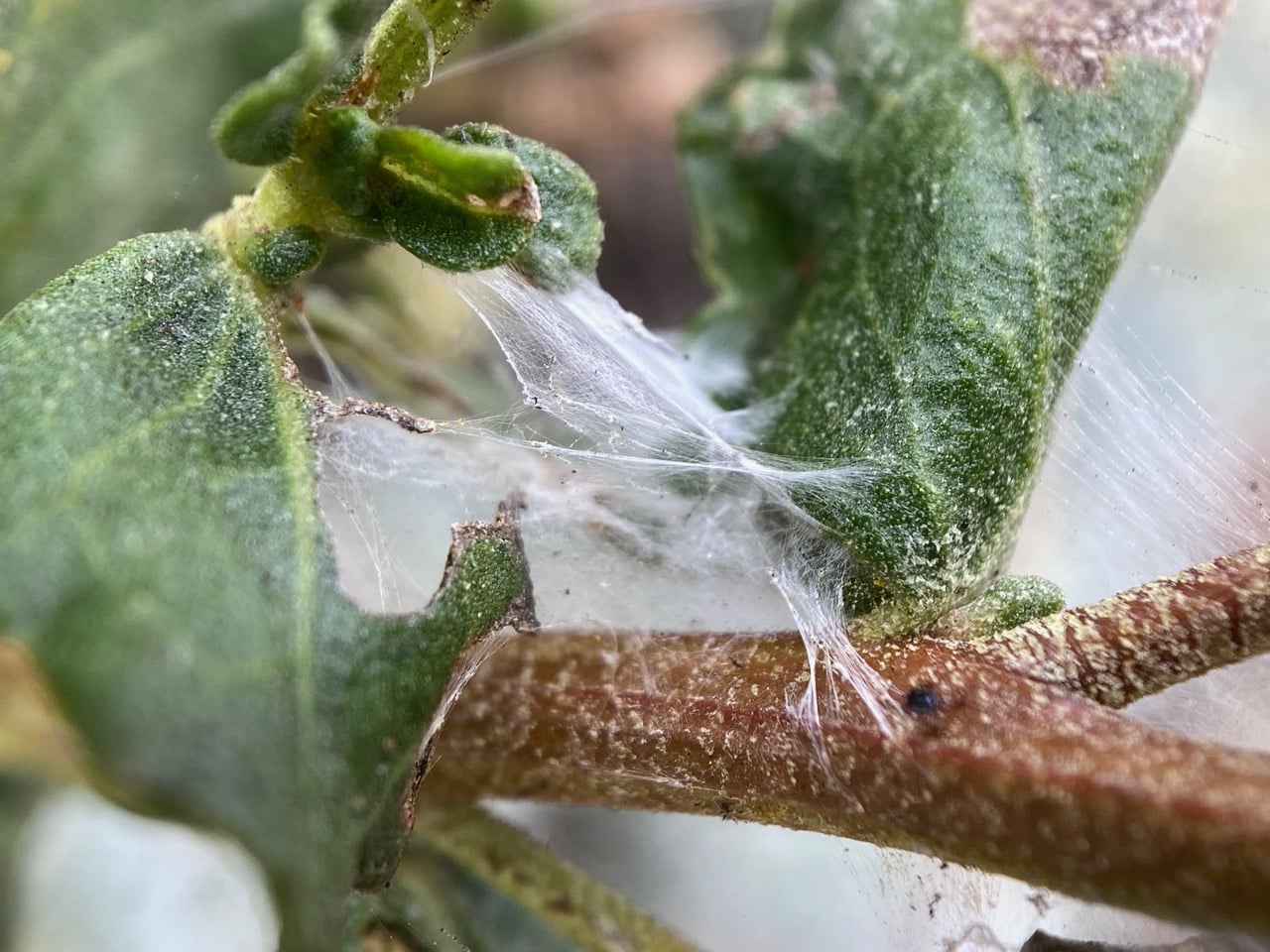
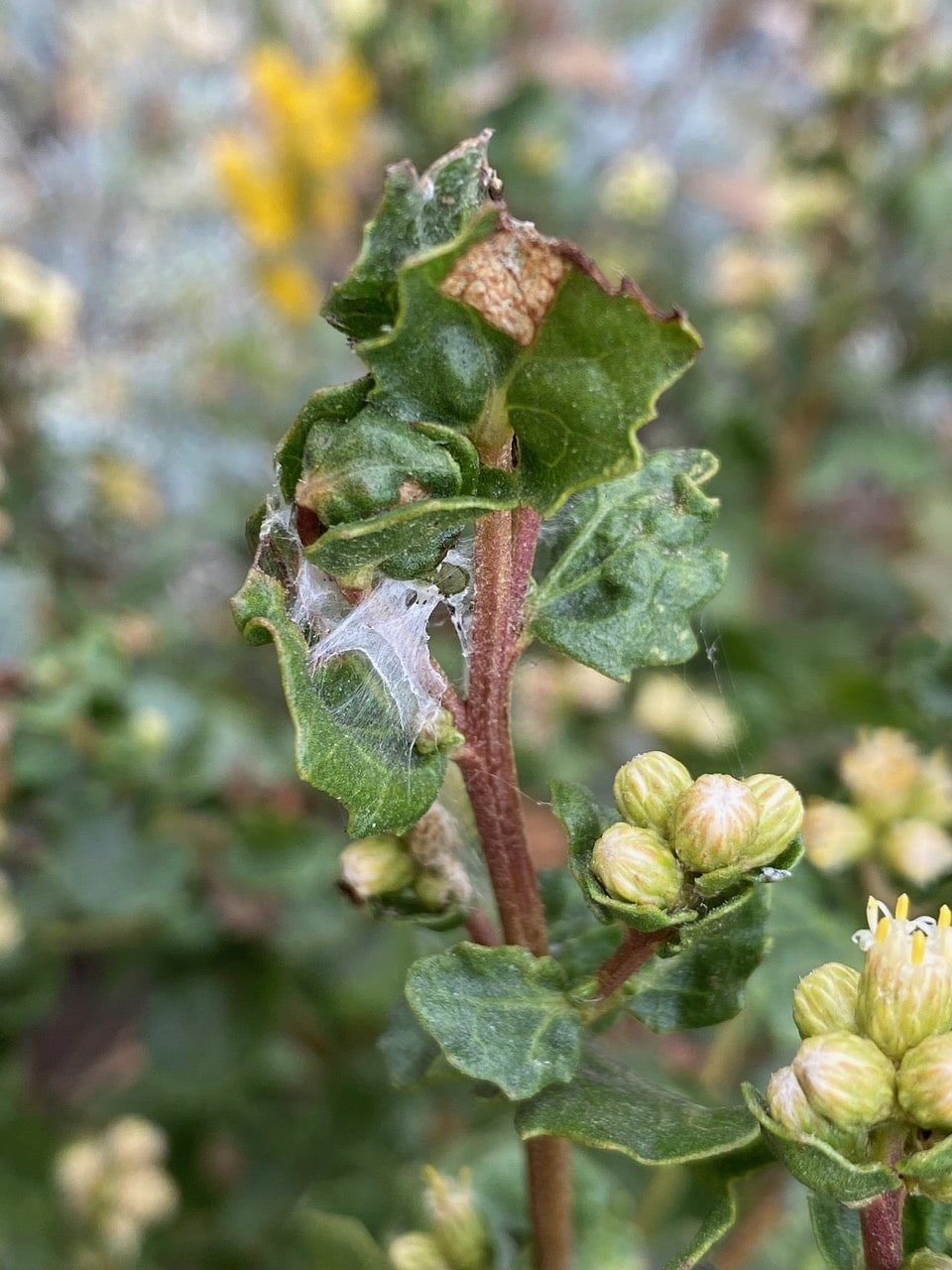
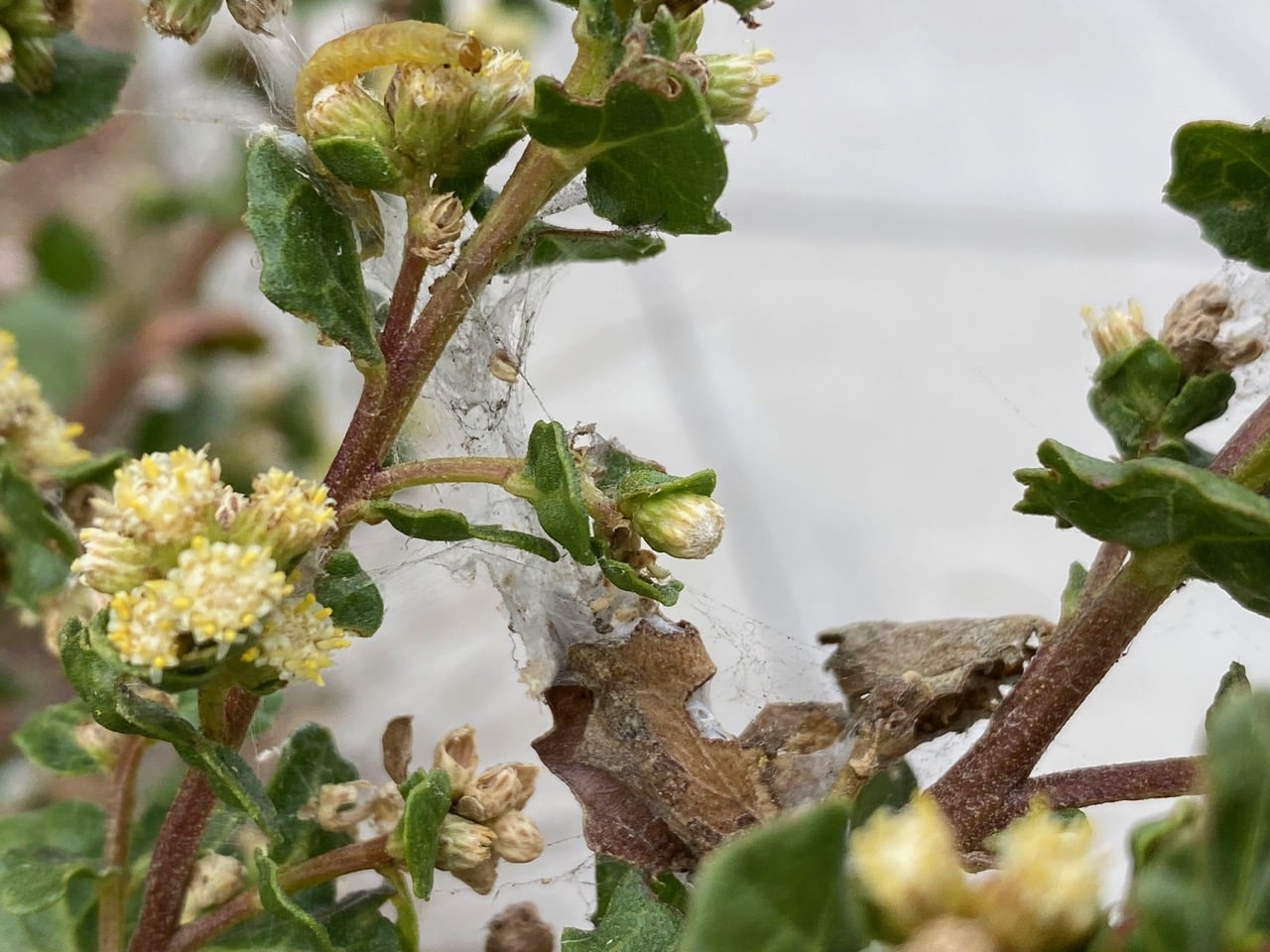
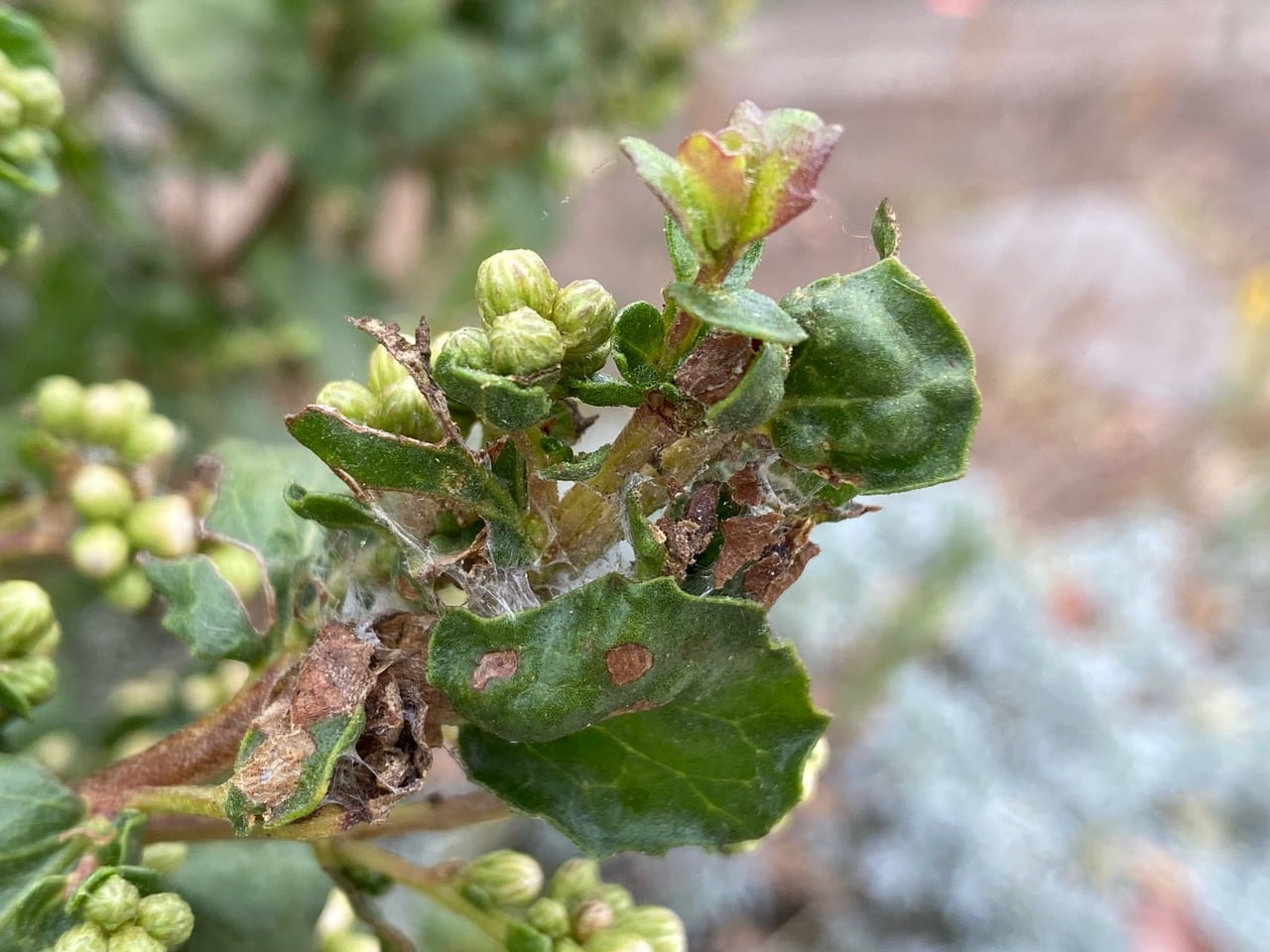
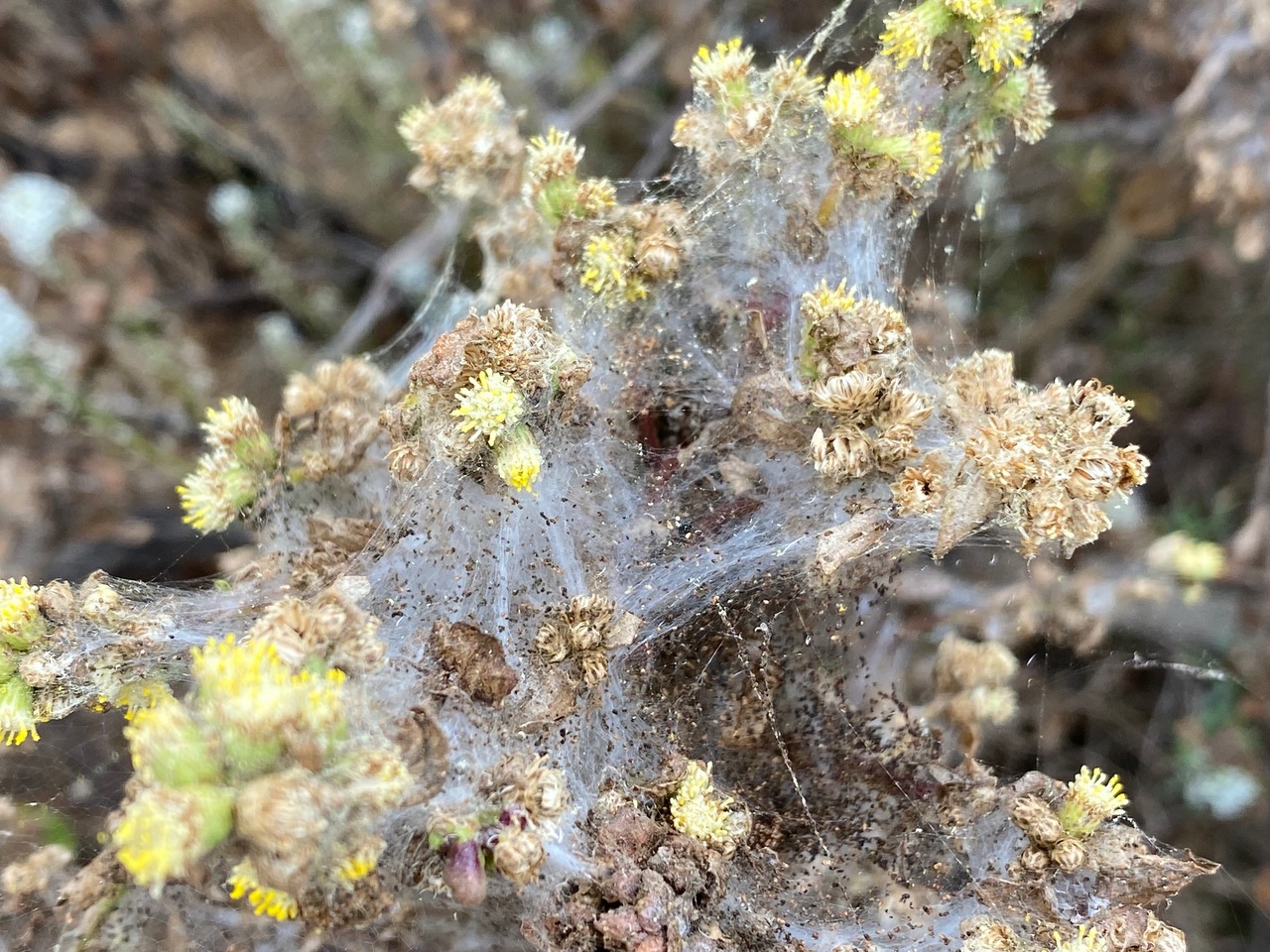
The male Coyote Brush, Baccharis pilularis that Naomi has planted in the sidewalk strip is in bloom. Many of the branch tips have silk covering them.
Whatever caterpillars (or spiders) on the shrub have made extensive use of fine silk to bind the leaves and stems together.
When I took this picture, I have failed to see the caterpillar. Do you see it? It is on the upper left flowerhead.
I think there’s a greenish caterpillar under that silken shelter on the lower left. Again, I didn’t see it when I took the picture.
The terminal leaves of this branch have been bound together with silk.
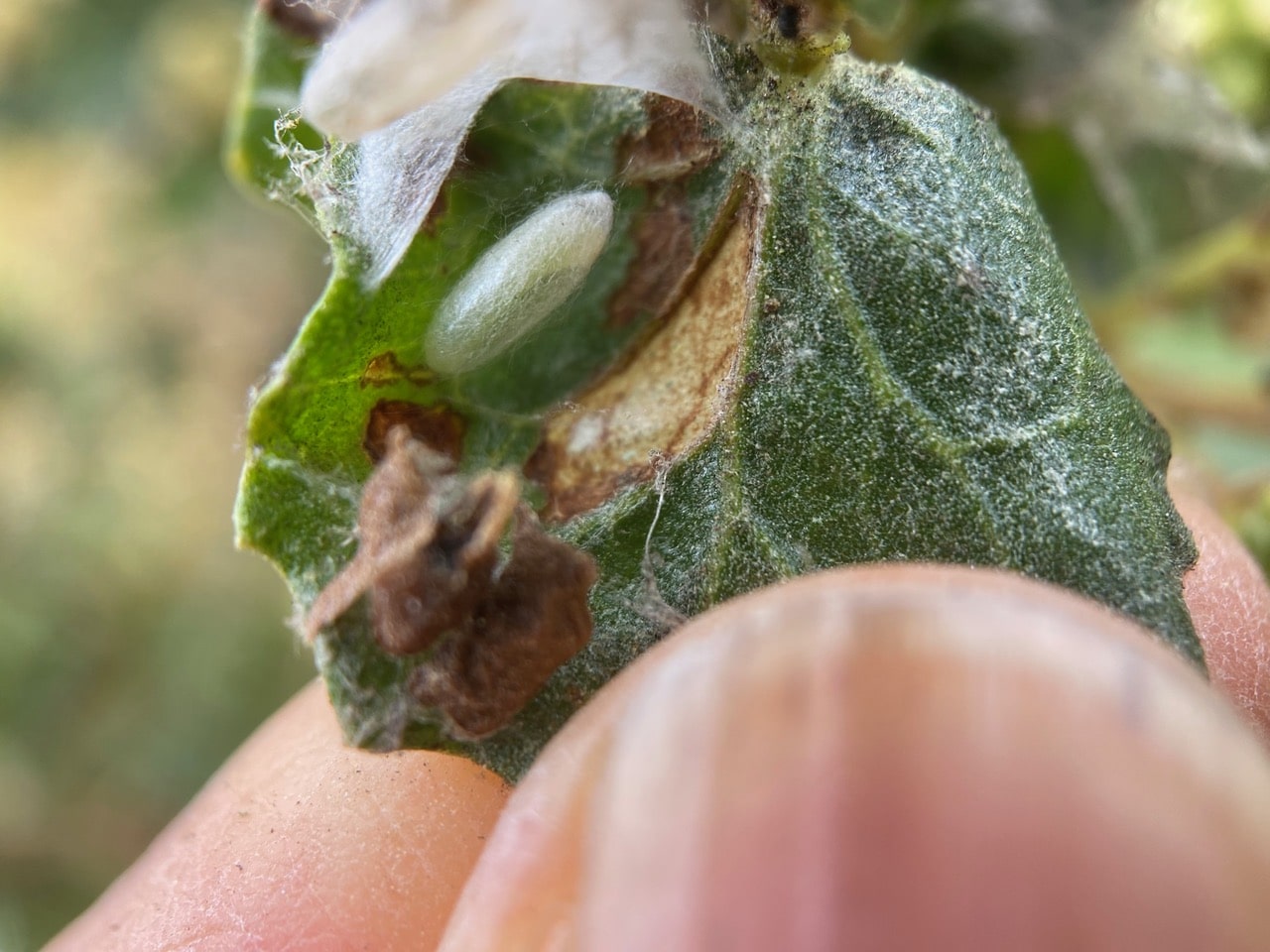
Overcome by curiosity, I gently pull down one of the leaves. The silken seal gives way, revealing a cocoon inside! It should be easy to rear the insect to adulthood – it is no longer feeding. I collect the branch as well as two other similarly silked branches to rear out at home. I hope Naomi doesn’t mind. It is the only way to definitively identify the insect that is feeding on her Coyote Brush.
I drive the short distance to Bay Farm to walk the familiar Shoreline Trail by the water. At 10:30 am, the sky is still heavily overcast. The tall and gangly Telegraphweed, Heterotheca grandiflora are in bloom; some already gone to seed.
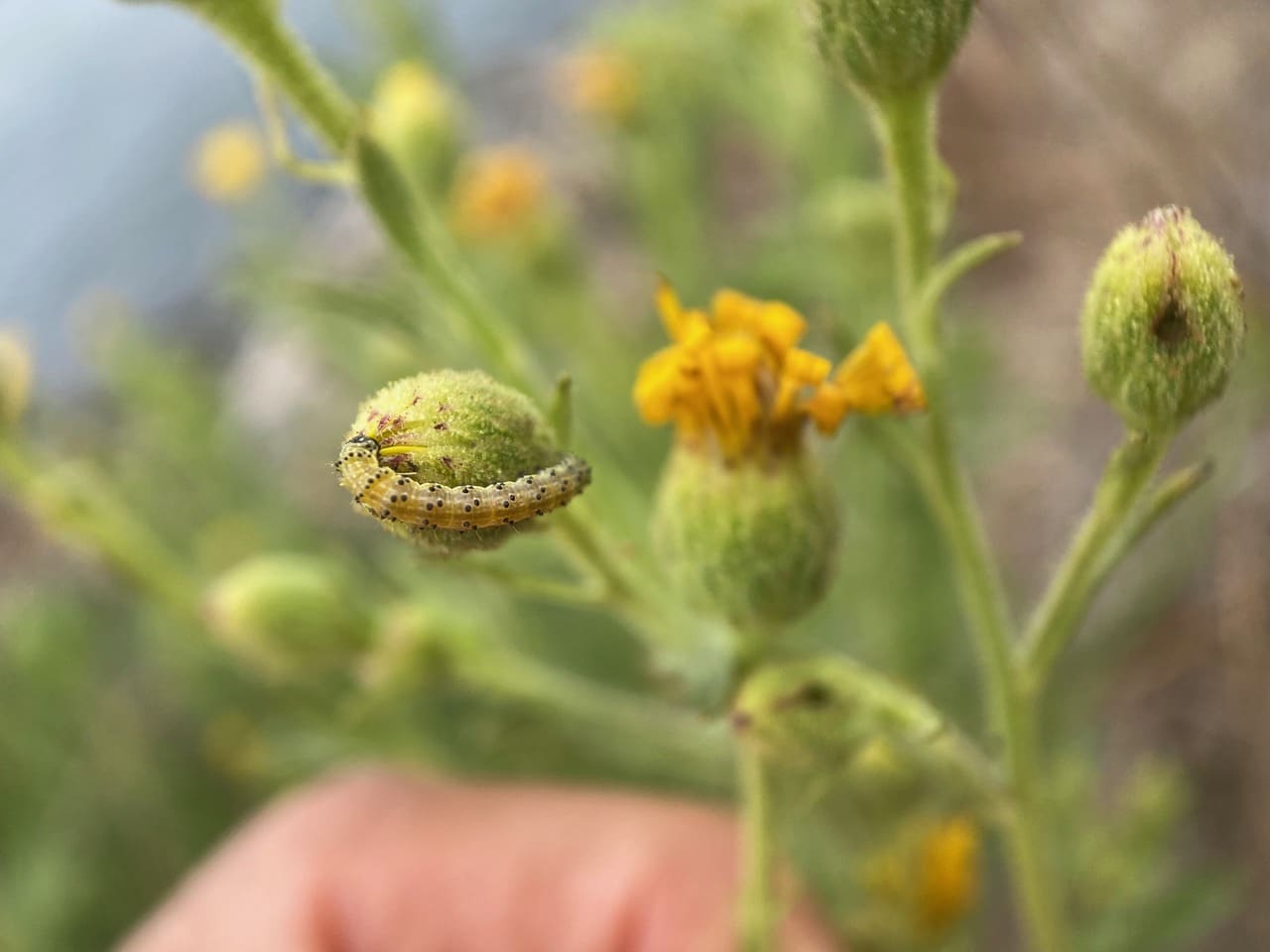
A small greenish caterpillar with raised black spots is feeding on an immature flowerhead of Telegraphweed. iNaturalist has helped identify it as a Darker-spotted Straw Moth, Heliothis phloxiphaga (family Noctuidae).
The species is widely distributed in North America from southern Canada to central Mexico. It is a medium-sized light yellow-brown or tan moth with darker markings. Wingspan is 3.3-3.7 cm. The flight season of H. phloxiphaga is long, commonly seen in the summer and early fall. Adults are reported to be both nocturnal and diurnal in activity, and may be found feeding and ovipositing during the day. Like other species of the genus, the larvae feed on the flowering parts and seeds of herbaceous plants. It is sometimes a pest on agricultural crops.
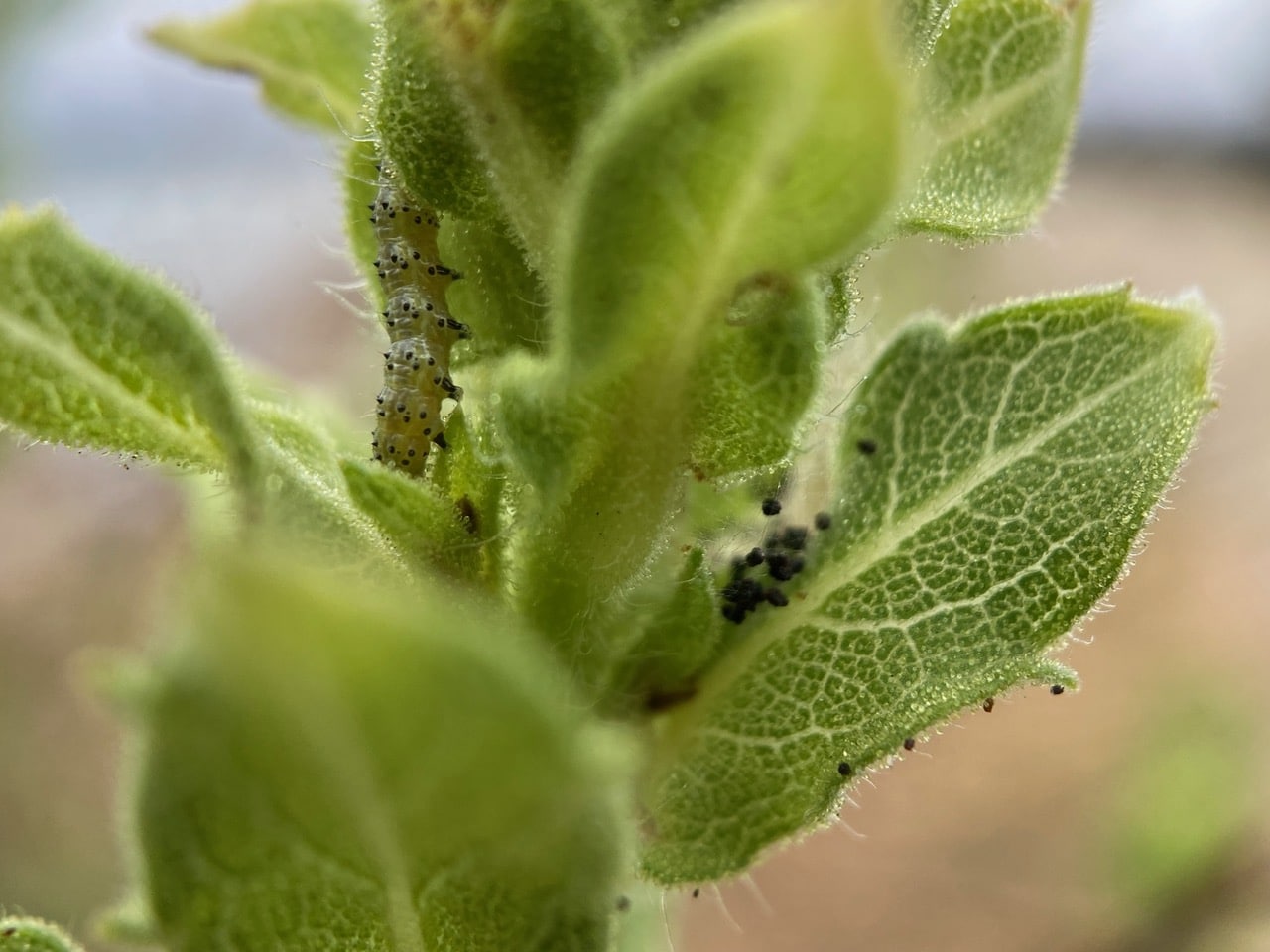
There are signs of caterpillar feeding on some of the Telegraphweed – tiny speckles of frass caught on silken webs among the foliage. Do you see the caterpillar?
Close-up of the caterpillar. It is another Darker-spotted Straw Moth, Heliothis phloxiphaga (family Noctuidae).
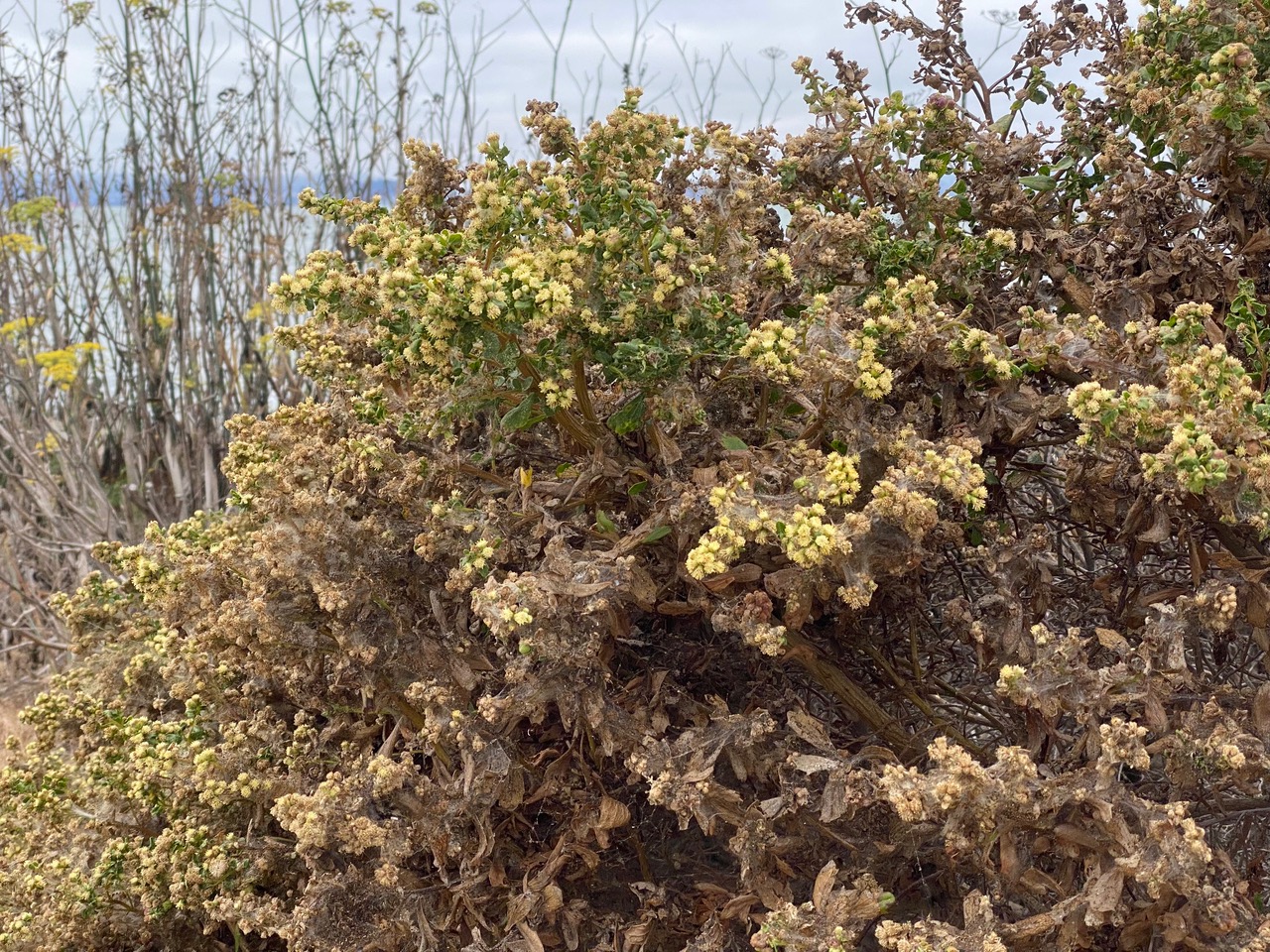
I pause at the half-dead Coyote Brush, still puzzled by what has ailed the large shrub. Infestation by caterpillars? I have first discovered the devastation on 8/12/25.
The affected parts, dead or alive are shrouded in silk. Everything points to caterpillar activity; yet, for the life of me, I can’t find a single caterpillar.
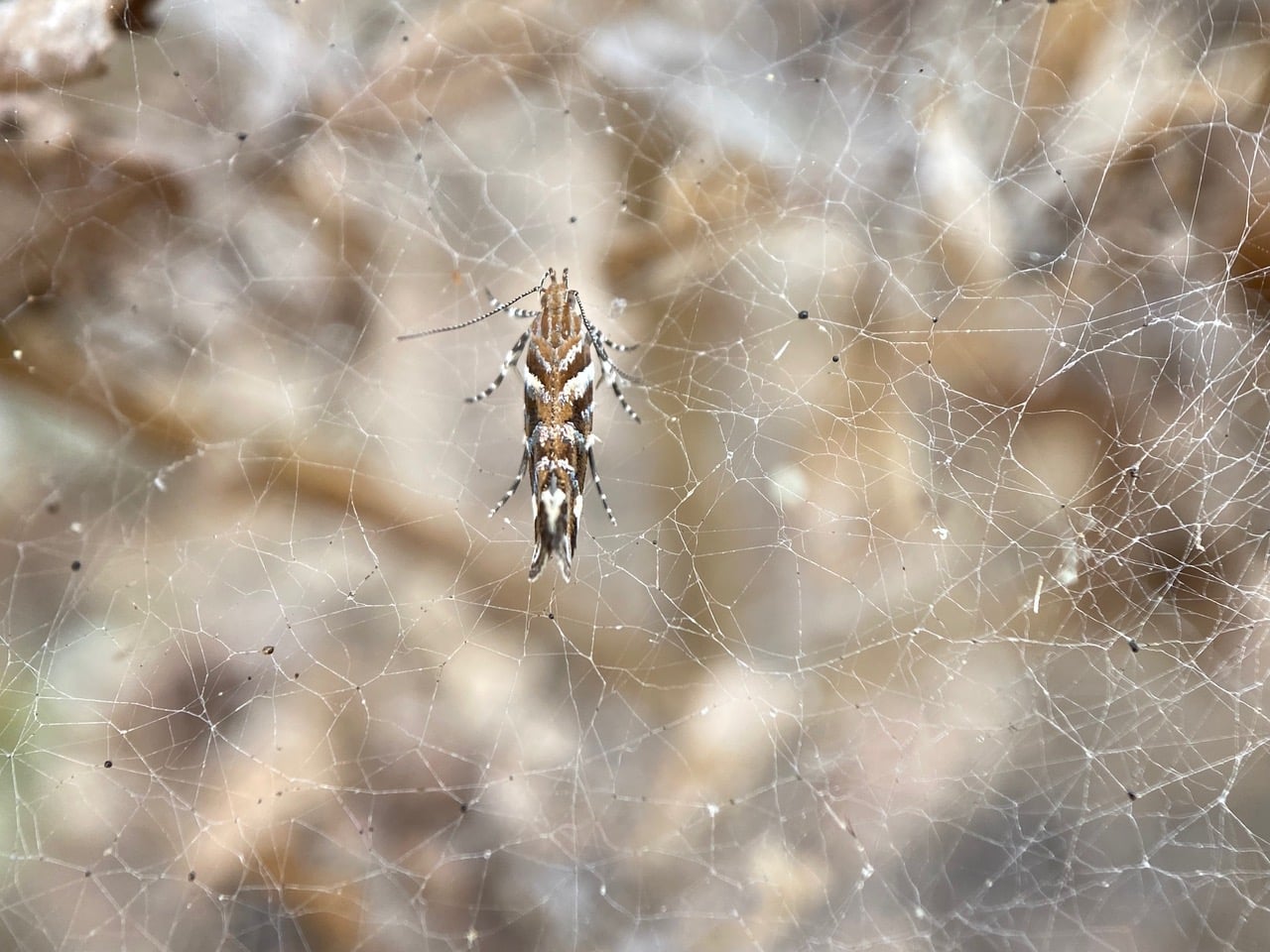
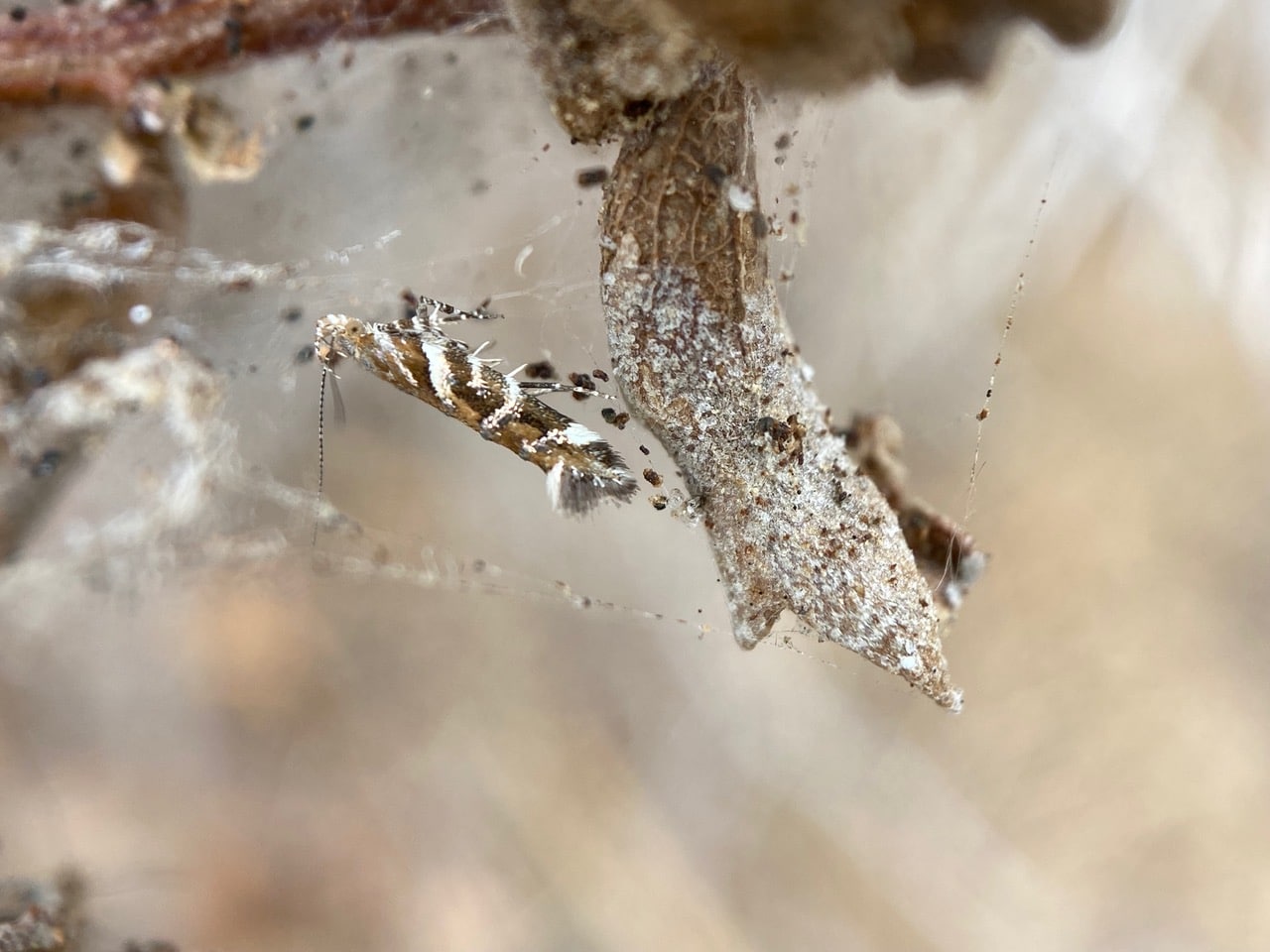
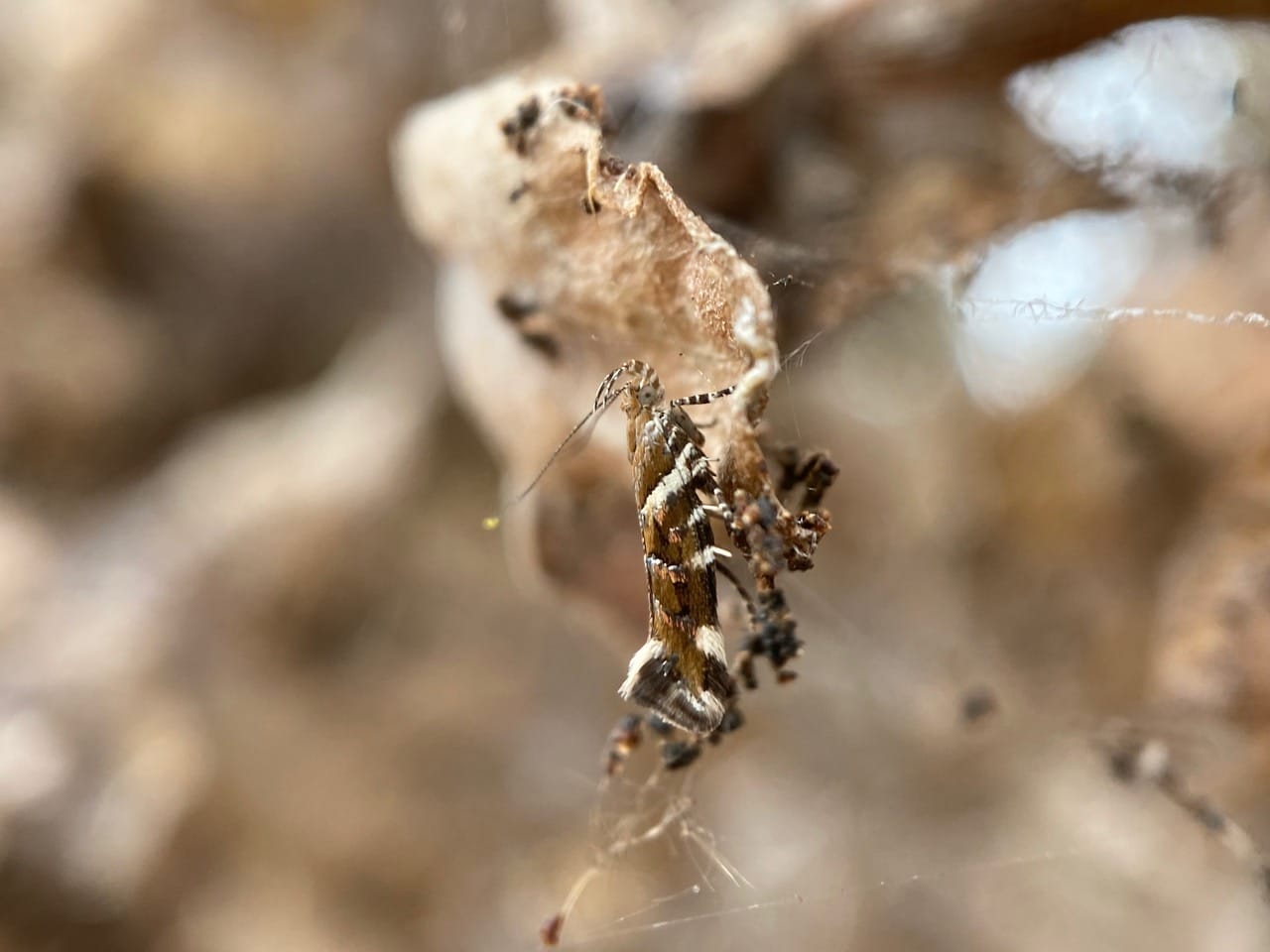
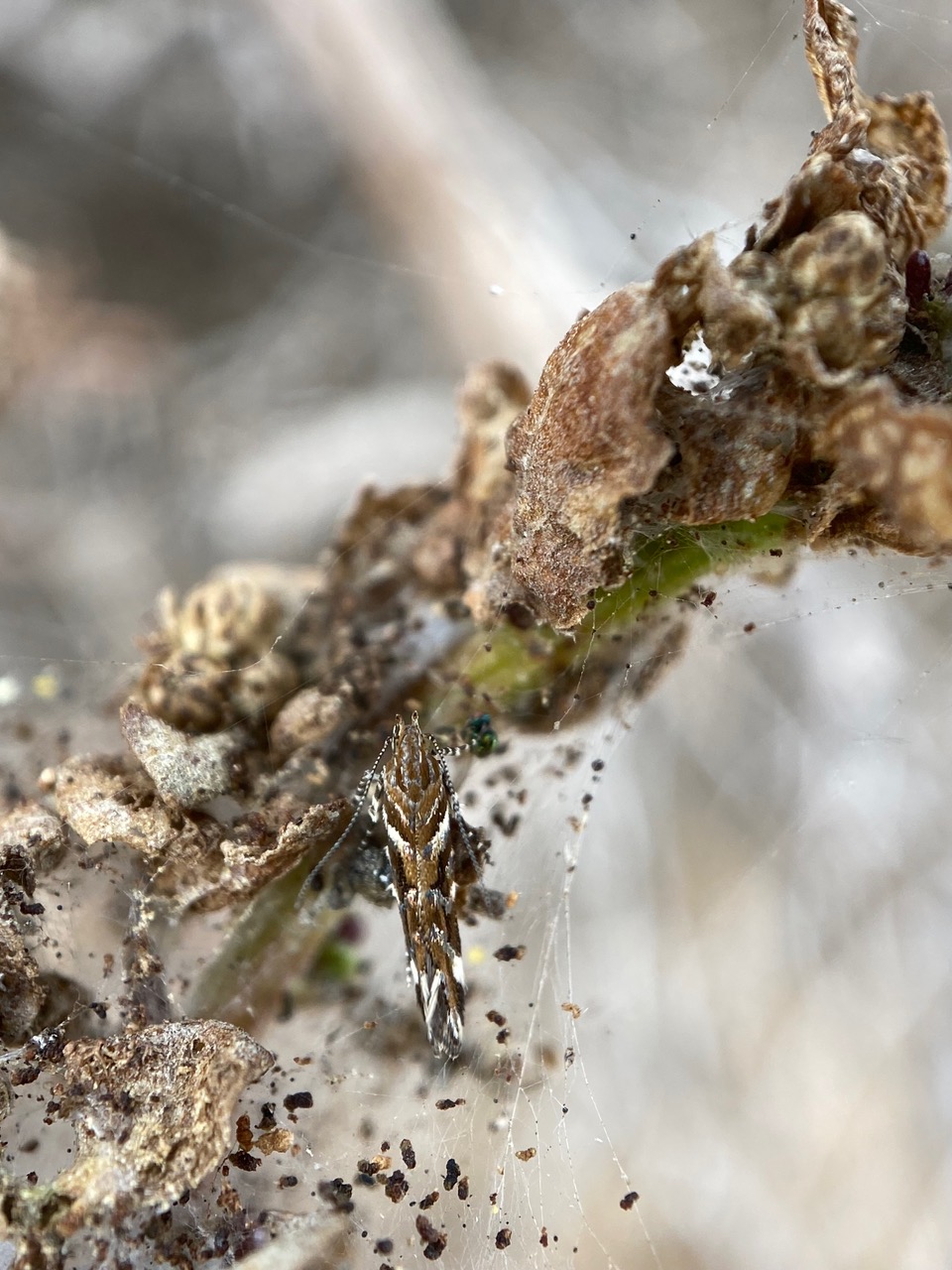
Dozens of small moths are flying around the Coyote Brush. One just flew into a spider web. Ah, it’s the Twirler Moth, Aristotelia sp. (family Gelechiidae) that I first saw on 8/24 on this very plant.
Here’s another one caught on a spider web, already dead.
Once I have the search image, I begin to see the moth everywhere. They are remarkably well-camouflaged against the dead foliage and debris! Note the unusual up-curved mouthparts of the moth. On a cloudy day like this, I am not likely to see the iridescent scales on the wings. Here are some clearer pictures I took on 8/24: Genus Aristotelia from Alameda, CA, USA on August 24, 2025 at 04-07 PM by boo-bee. The insect is on …
Do you see the moth? By their sheer number on the plant, I am almost sure that these are the moths that have been feeding on the Coyote Brush as caterpillars. The adults are emerging in large numbers now. I am very lucky to have caught them in time! I wonder if this moth isn’t the species that is infesting Naomi’s Coyote Brush.
Consulting Calscape’s information on the insects that use Coyote Brush as a host plant, I am able to identify the moth to species very quickly – Aristotelia argentifera (family Gelechiidae). Mystery solved!
The Gelechiidae are a family of moths commonly referred to as Twirler Moths. The common name comes from their habit of spinning in circles on leaf surfaces. There are more than 40 named species of Aristotelia in America north of Mexico. These are generally very small moths with narrow, fringed wings. The moths have long labial palps (3 segments), up-curved, with third segment long and tapering. Hind tibia are covered with long hair-scales above, prominent tibial spurs. The larvae of most species feed internally on various parts of their host plants, sometimes causing galls. Many are leaf-miners, twig borers, etc. Being fecund plant-eaters, many species are agricultural pests. On the other hand, the voracious appetites of their larvae make Twirler Moths suitable for biological control of invasive plants.
Aristotelia argentifera is found in California and western Nevada. They are small moths, with forewing length of 5-7.5 mm. The specific epithet is Latin for “silver”, referring to the strongly metallic silvery and bluish iridescent scales on the wings. Known larval food plants include Coyote Brush, Baccharis pilularis, and California Goldenbush, Ericameria ericoides.