

Pollinator Post 9/4/23 (1)

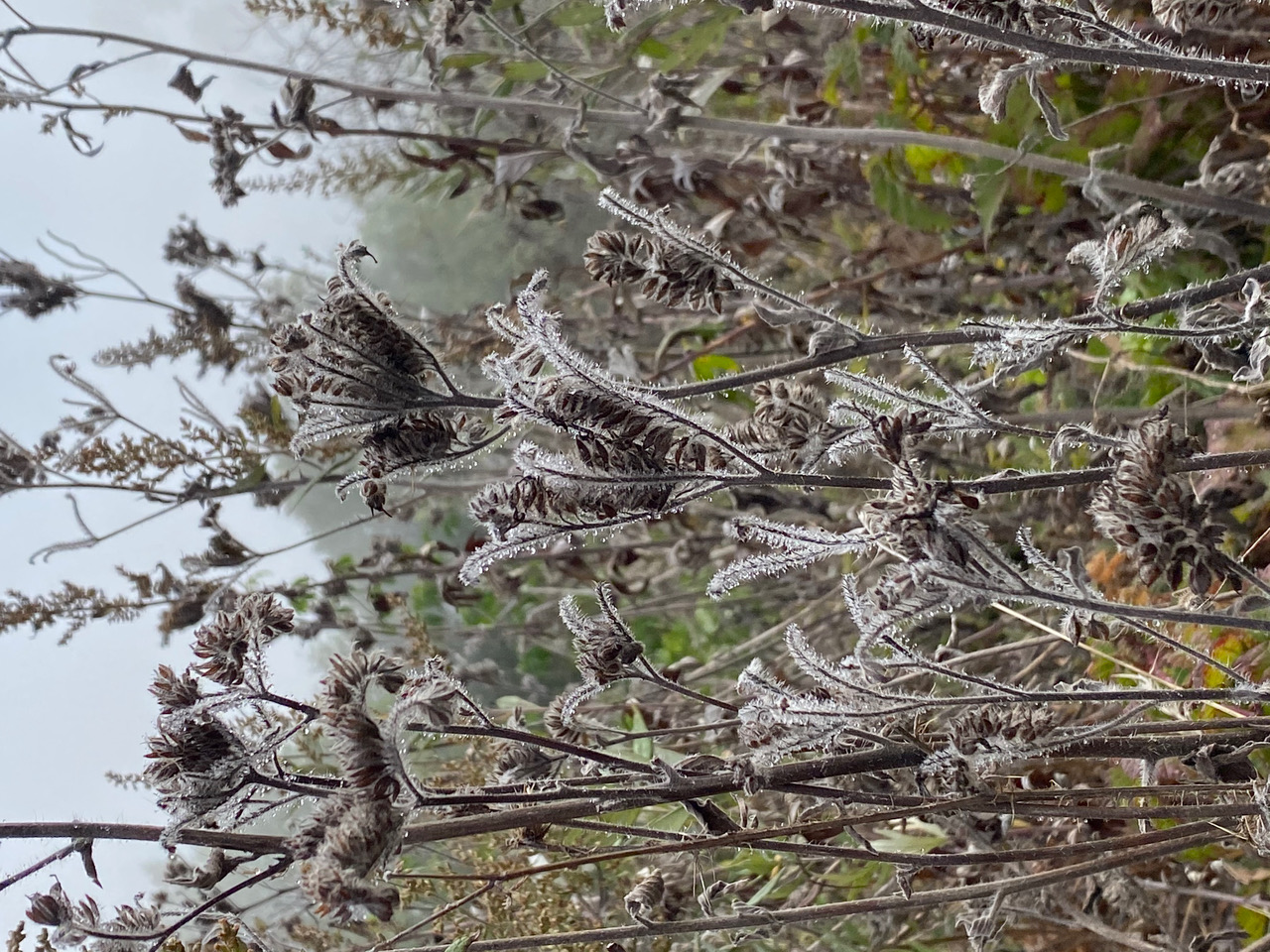
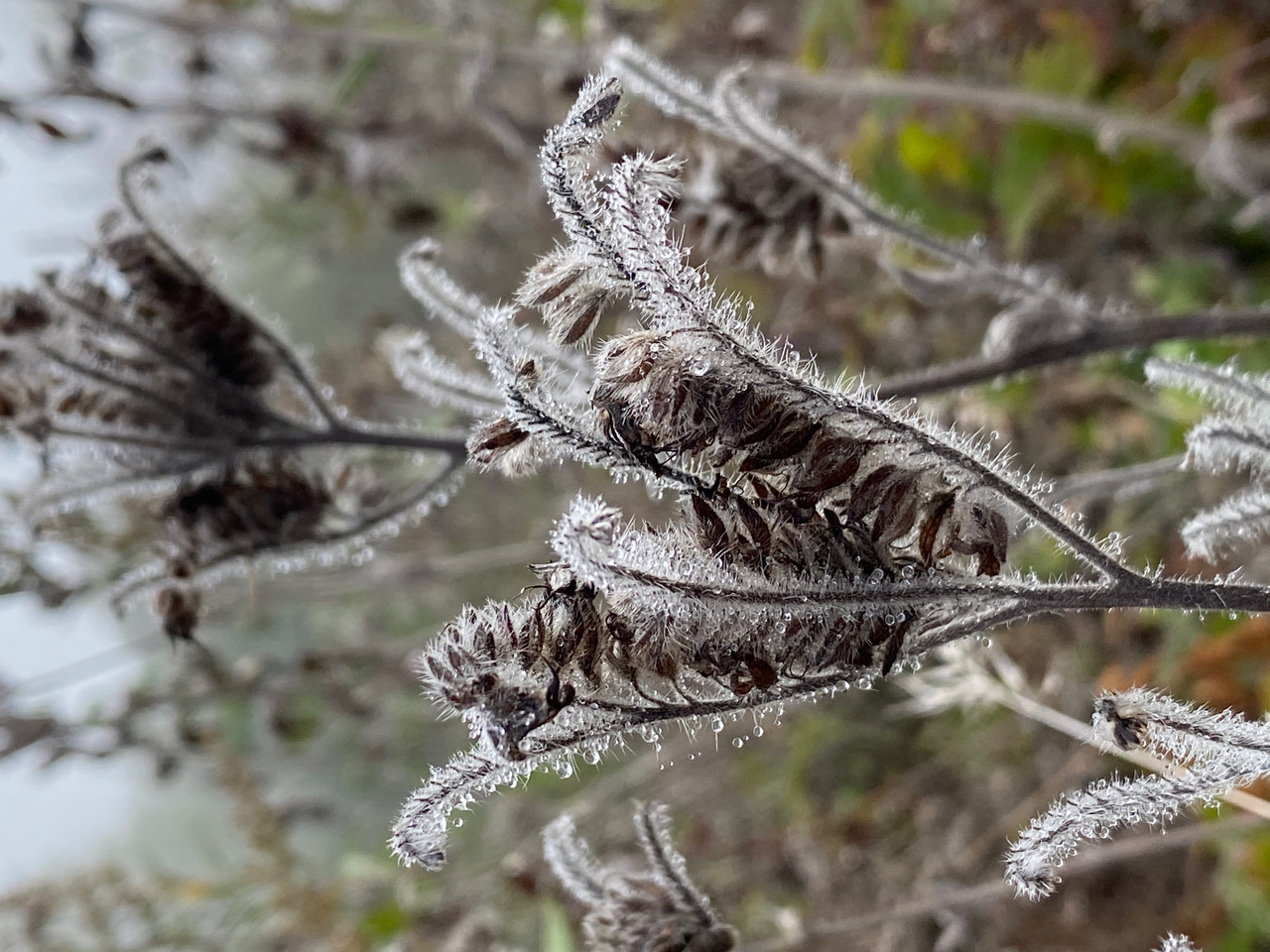
Along the paved road to the Radio Tower, dew drops have transformed the patch of dried California Phacelia into a magic kingdom.




 Yes, our Looper is actively feeding now. Yay!
This is but a slumber for the plant. California Phacelia, Phacelia californica is a perennial herb. Next spring it will sprout new leaves and bloom again, to the delight of countless bumble bees and other insects of Skyline Gardens.
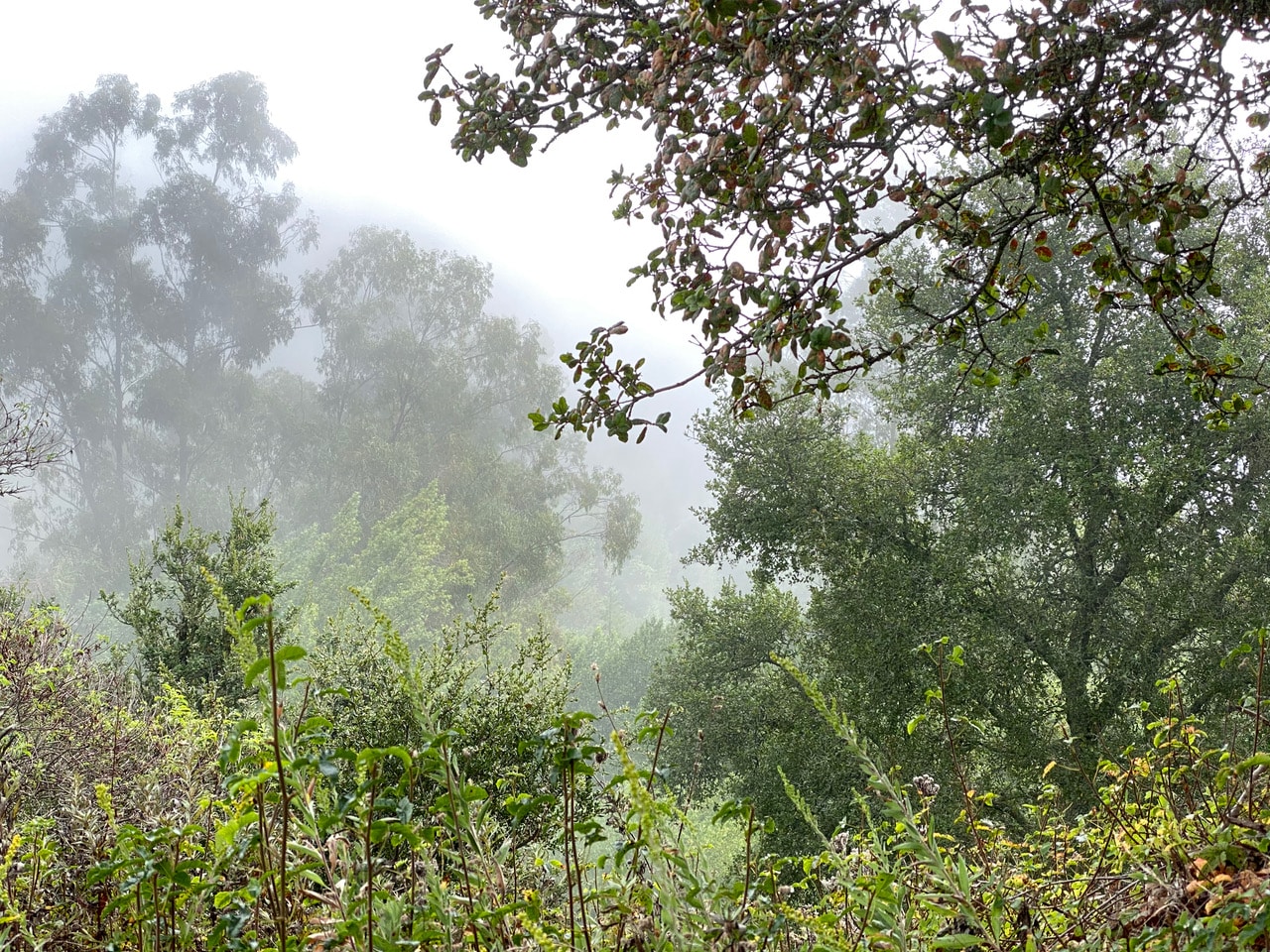
The lingering fog tempers the late summer heat in the Berkeley hills, and provides much needed moisture to the vegetation.
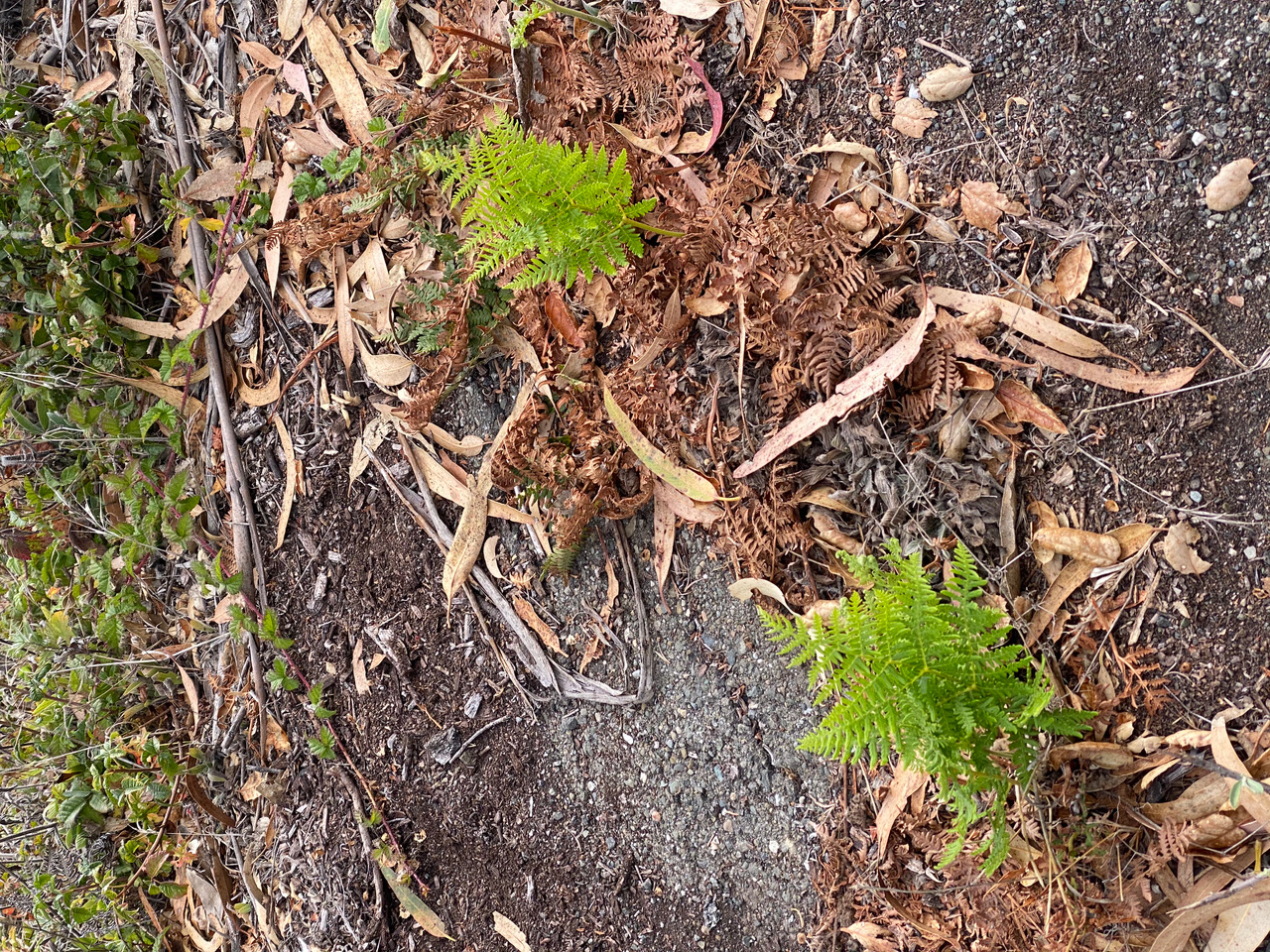
The vegetation on the edges of the paved road has been cleared, exposing the pavement underneath. But look, these resilient Bracken Ferns have managed to emerge through the asphalt! Nature’s renewal is an on-going process, regardless of man’s actions.
It is hard to imagine what Skyline would be like without fog.
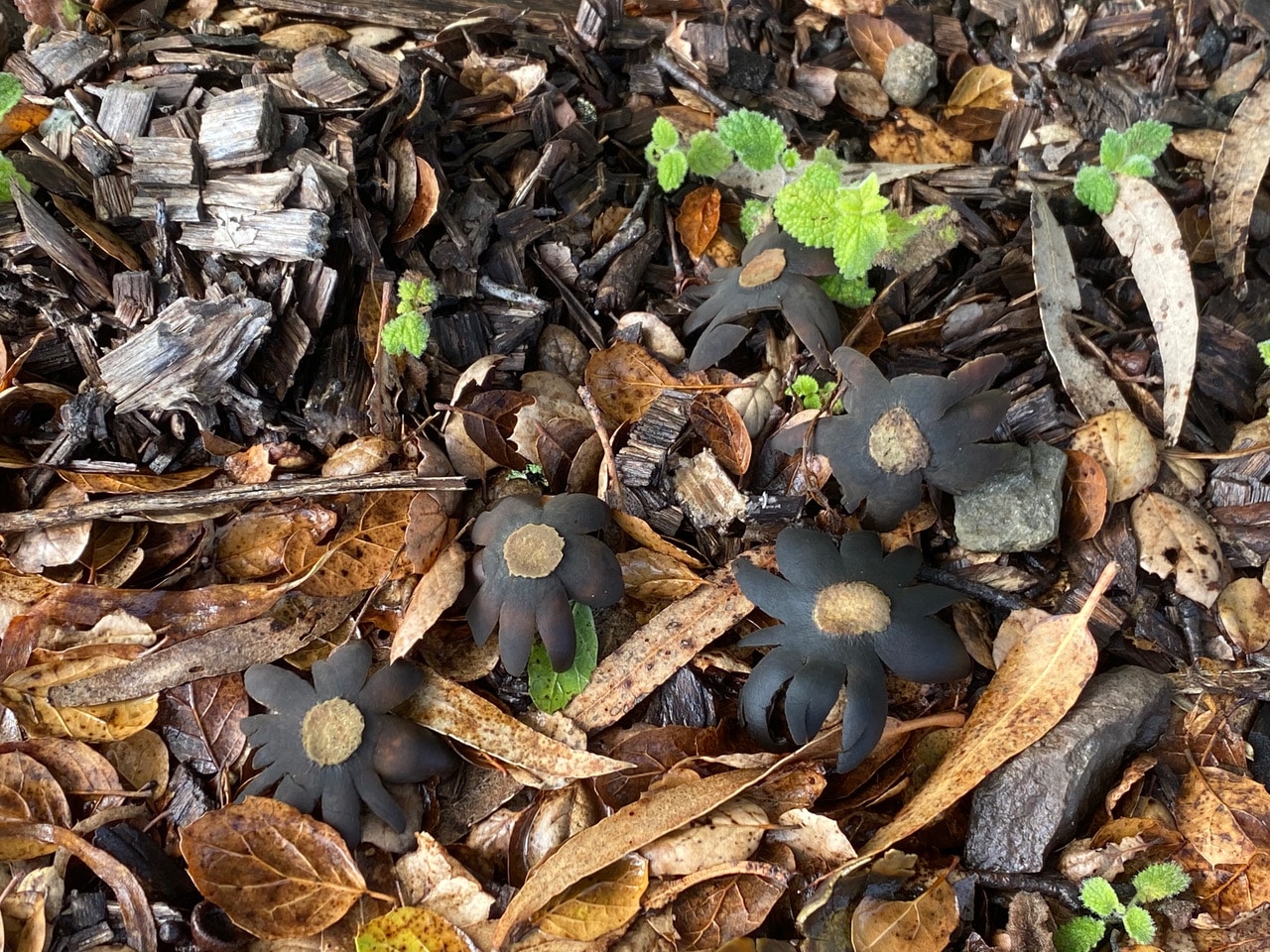
I check under the big oak tree for fresh Earthstar fungus. No, there are no fresh ones, despite the heavy fog drip. I guess the fungi must be seasonal, and it’s not their time now. Their distinctive star-shaped pedestals litter the ground, sans the bulbous spore sacs of earlier days.
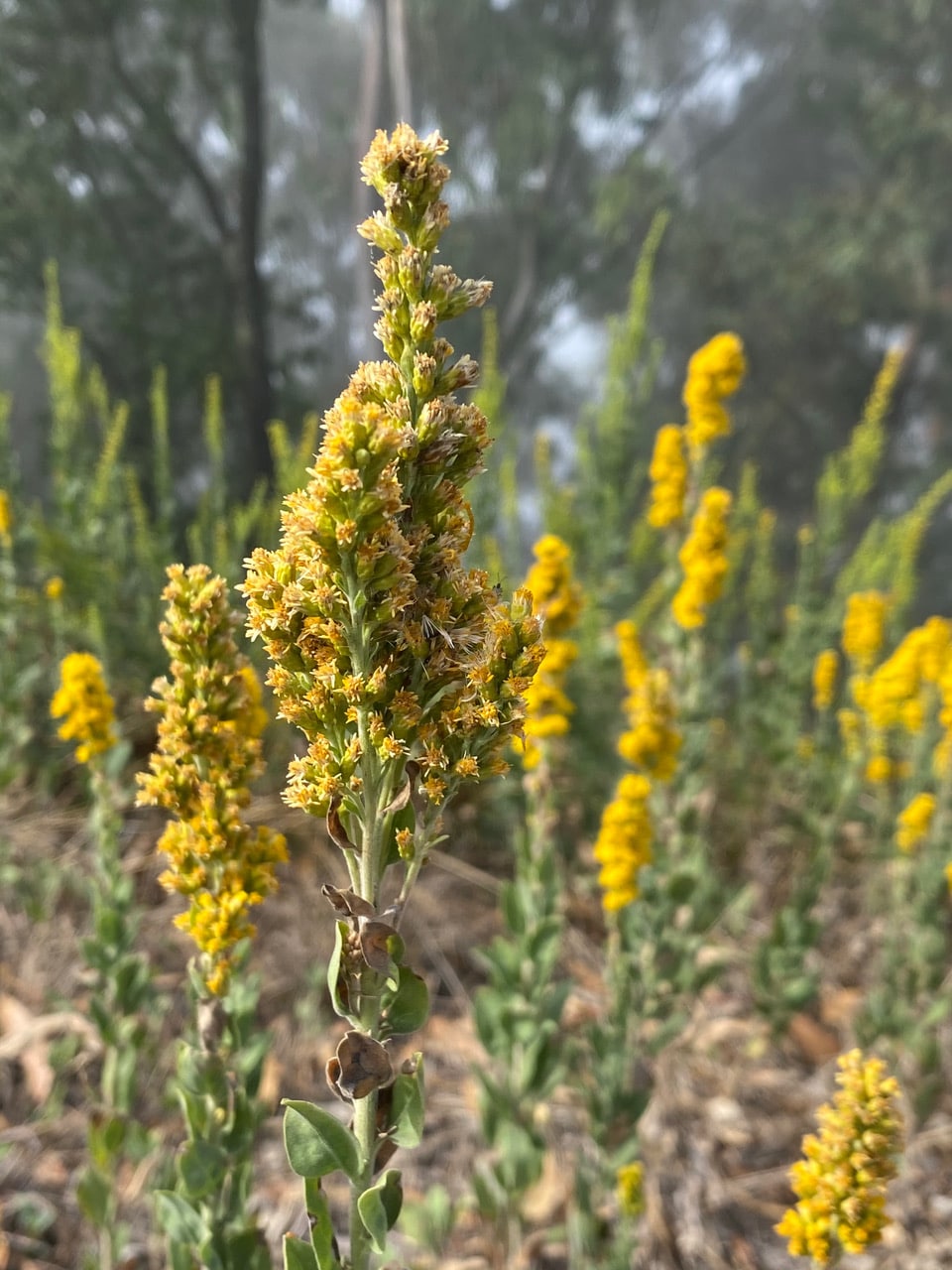
Stopping at the patch of blooming California Goldenrod, Solidago velutina ssp. californica, I look for the Camouflaged Looper that I found two days ago. Almost instantly I spot the caterpillar at almost the same spot on its plant, quivering and reaching downwards from a leaf. It’s a deja vu moment! Something about the caterpillar has changed – the pieces of flower parts on its body have faded.
Camouflaged Loopers belong to a group of moth species commonly referred to as inch worms because of the way they move, inching along, front legs reaching out, body stretched to its limit, grabbing ahead, pulling and looping the rest of the body forward. The caterpillar appears to be measuring the earth as it moves along, hence the name Geometridae for the family (Geo = earth, metron = measure).
The Camouflaged Looper is the larva of the Wavy-lined Emerald Moth, Synchlora aerata (family Geometridae), a species found throughout much of North America. The larvae feed on many plants in the family Asteraceae, as well as a variety of other flowering plants.
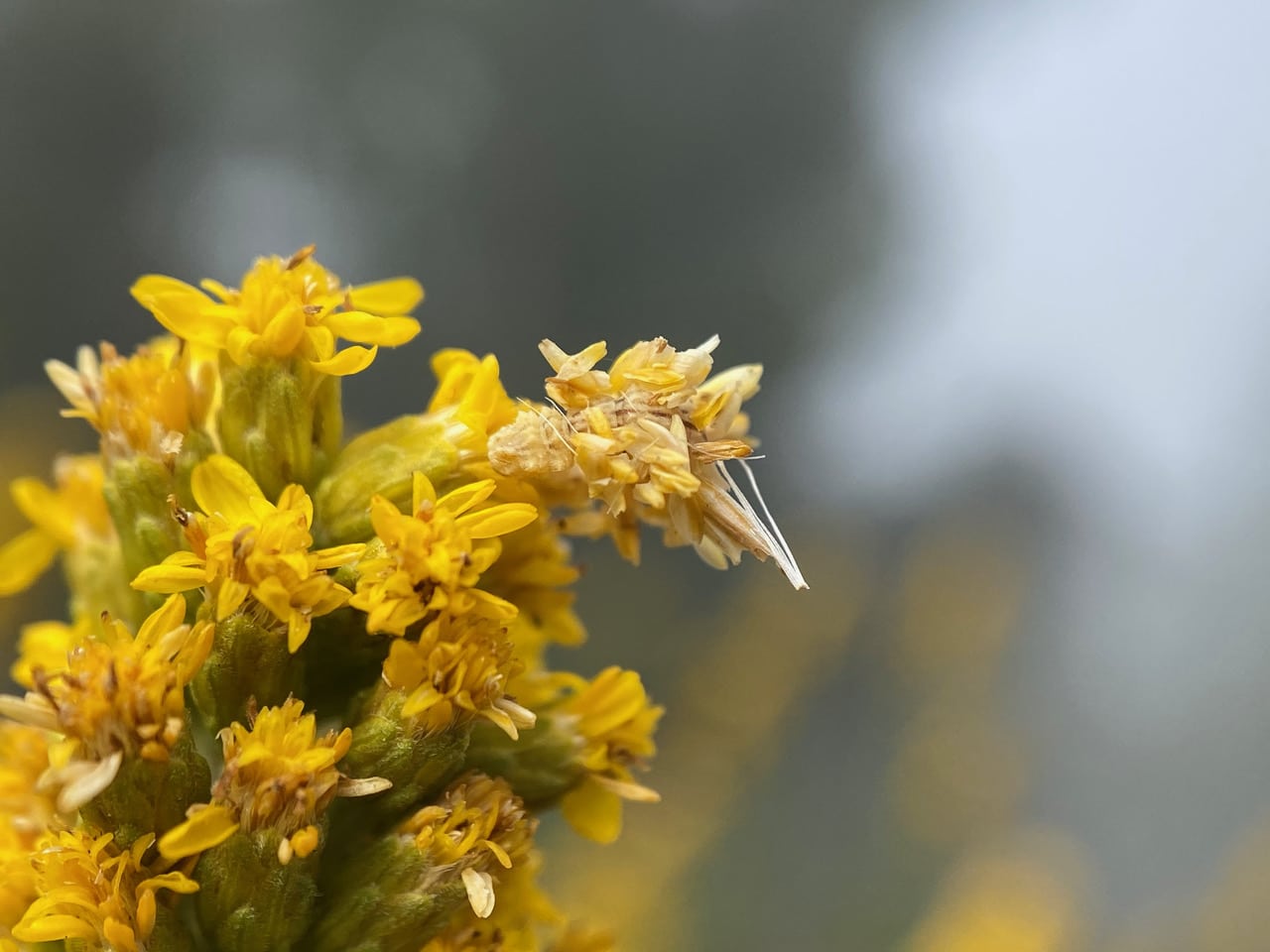
The caterpillar has also added a new element to its costume – some white pappus from the Goldenrod flowers. Note the prominent spiky pappus about mid way down its back. (It is useful for tracking the caterpillar later on.)
The Camouflaged Loopers are well known for covering themselves with the plant they feed on. The caterpillar chews off small pieces of flower petals, seed heads, leaves, whatever plant material is available, and attaches the pieces to its back with a little silk from the spinnerets beneath the caterpillar’s mouth. The caterpillar must do this several times during its life as a larva. Each time it molts the camo falls off with the old skin.
When the Camo Looper begins feeding on a different kind of flower, it discards the previous disguise and replaces it with pieces of the new flower. The disguise is probably most useful for hiding from hungry birds. Scientists posit that the Camouflaged Looper’s ability to change disguise allows it to have more varied diet than other caterpillars because it isn’t restricted to eating only those flowers or plant parts that it resembles in appearance.
I look up at the spike of flowers above the caterpillar. It has faded considerably, and some flowers are already releasing plumed seeds. This explains the change in the caterpillar’s camouflage. It has apparently been feeding up here and attaching the changing flower parts to its costume. But why is the caterpillar heading down the plant again? Is it looking for fresher flowers? It is a herculean task for a caterpillar this size to descend the plant, and climb up another one! So many things I need to learn about these creatures!
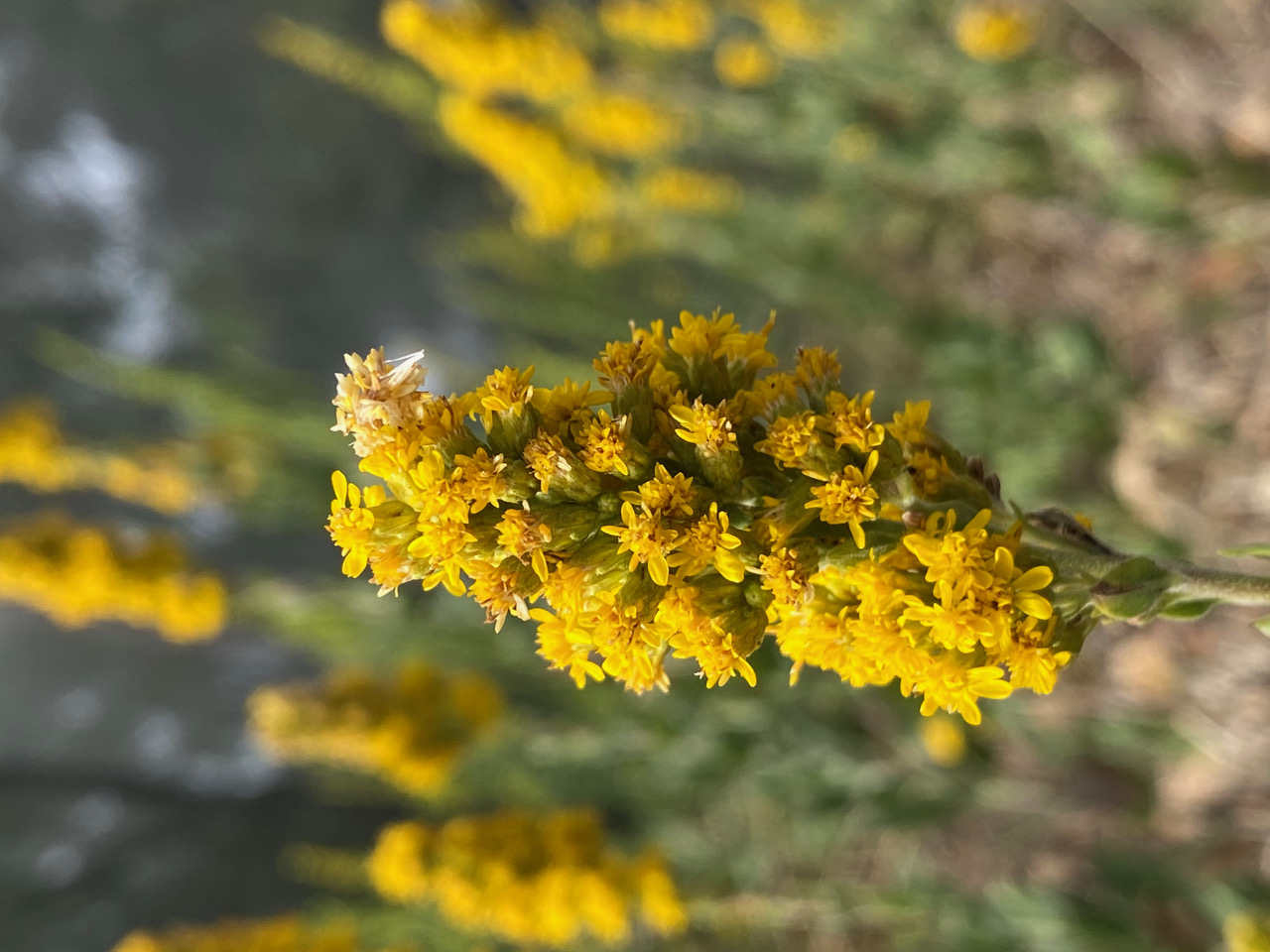
Without much thought, I instinctively remove the leaf with the caterpillar on it, and touch its edge to the top of a fresh spike of flowers just 4 in. away. In a second, the caterpillar moves over to the flowers. Just like that, without any struggle or drama – I have not anticipated such a smooth transition. Do you see the caterpillar on the tip of the inflorescence? Look for the protruding white pappus on its back.
Right away, I realize how incredibly lucky that I have found the caterpillar on the leaf in the first place. I would never have spotted it on the goldenrod inflorescence. Even with a paler costume now, the caterpillar blends invisibly into the busy floral background.
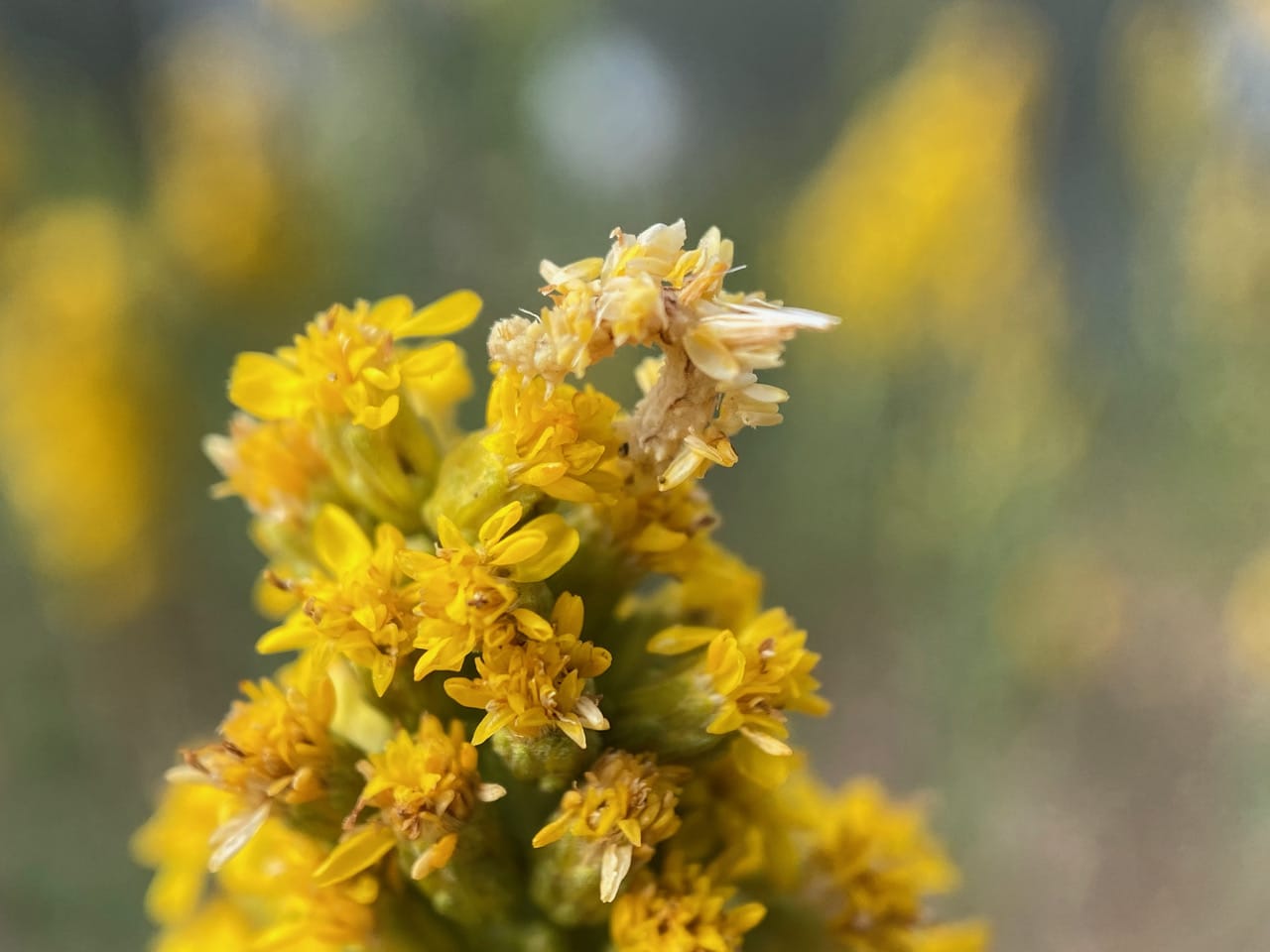
Close-up of the Camouflaged Looper on its new home. The caterpillar remains frozen in this position for a few minutes, probably assessing its new environment.
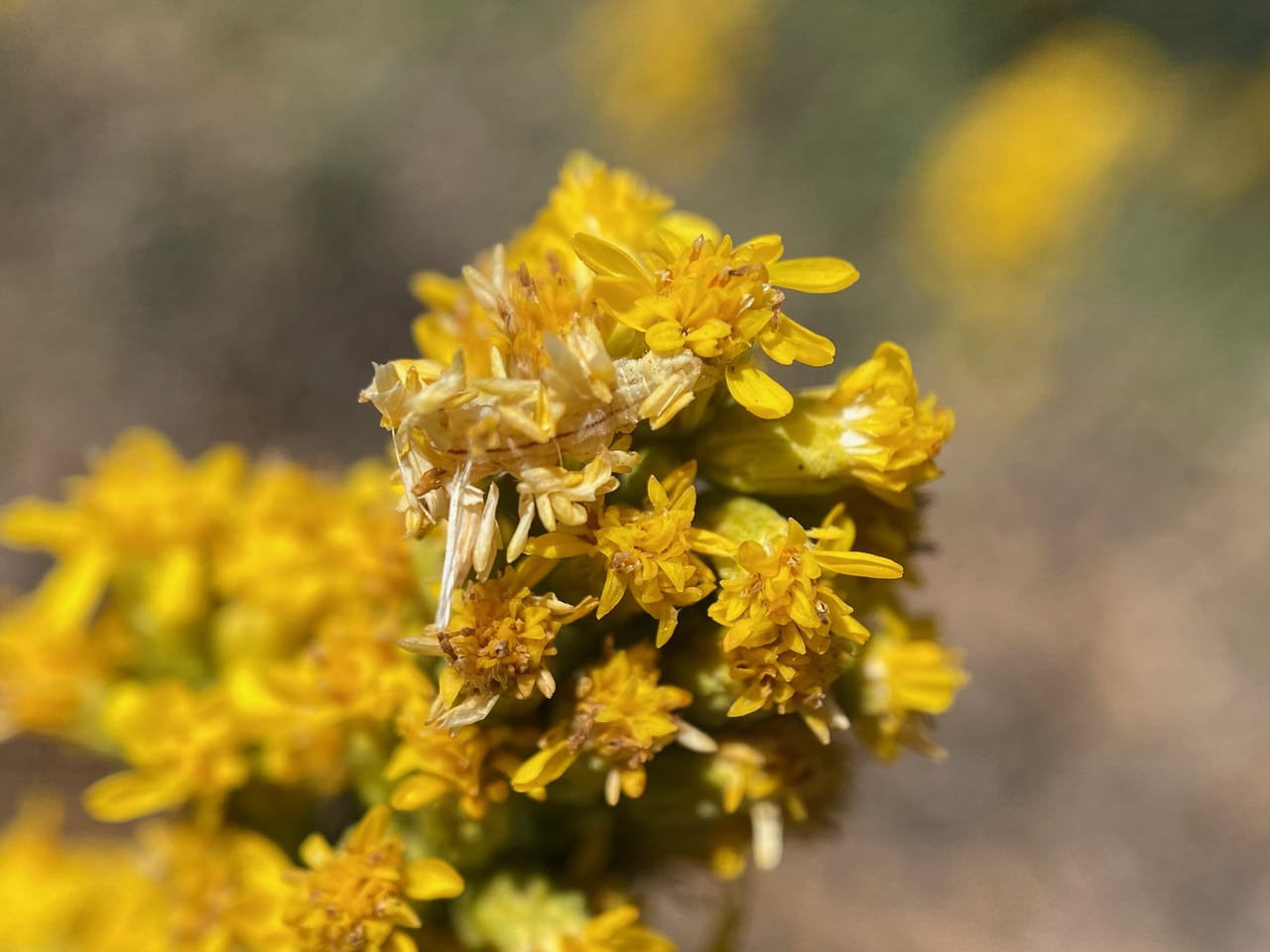
I quickly learn that a convenient way to keep track of the caterpillar is to look for the pappus on its back, and also the dark red line that runs down the middle of its exposed back.
Here’s our little caterpillar, “looping” its way through the flowerheads. I wonder if I have done it a disservice transferring it to a spike of fresh yellow flowers. It’s current camouflage is not working as well in this new environment. A few Yellowjacket wasps are busy patrolling the goldenrod inflorescences, sometimes buzzing past my ears as I take photos. Would they find our little Looper?
I sure hope the Looper would start feeding on the fresh flowers and change its costume quickly. (See the dark red mid-line down the caterpillar’s back, and the long white pappus? They are our best bet for tracking the caterpillar.)
Yes, our Looper is actively feeding now. Yay!