

Pollinator Post 9/30/25
The morning shower has cleaned up the air beautifully. Fred and I are happy to resume our walks at the Shoreline Park on Bay Farm Island in the afternoon. Since it is quite windy, I don’t expect to see many insects, and choose to take the relatively barren section of the trail along the shore.


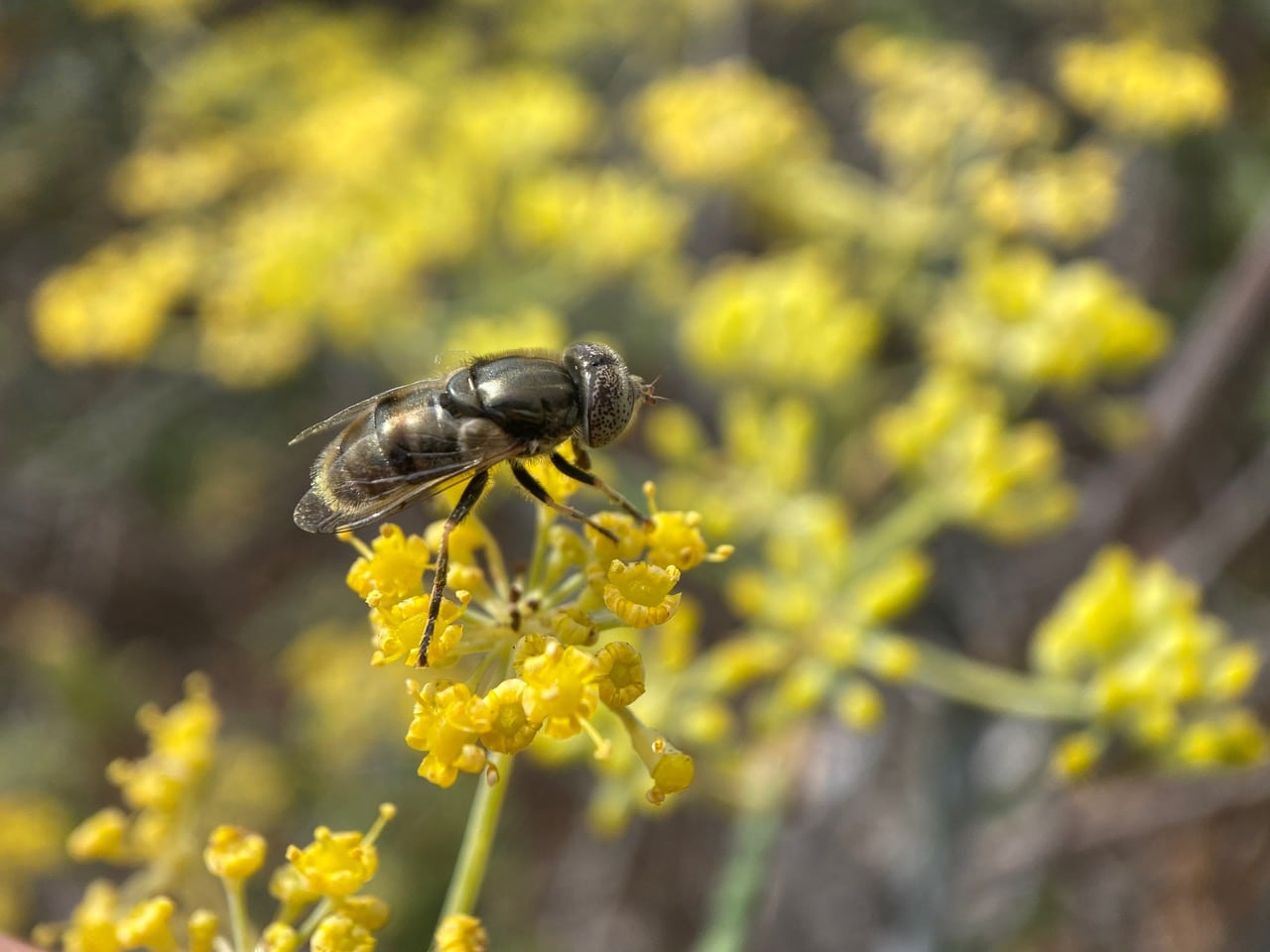








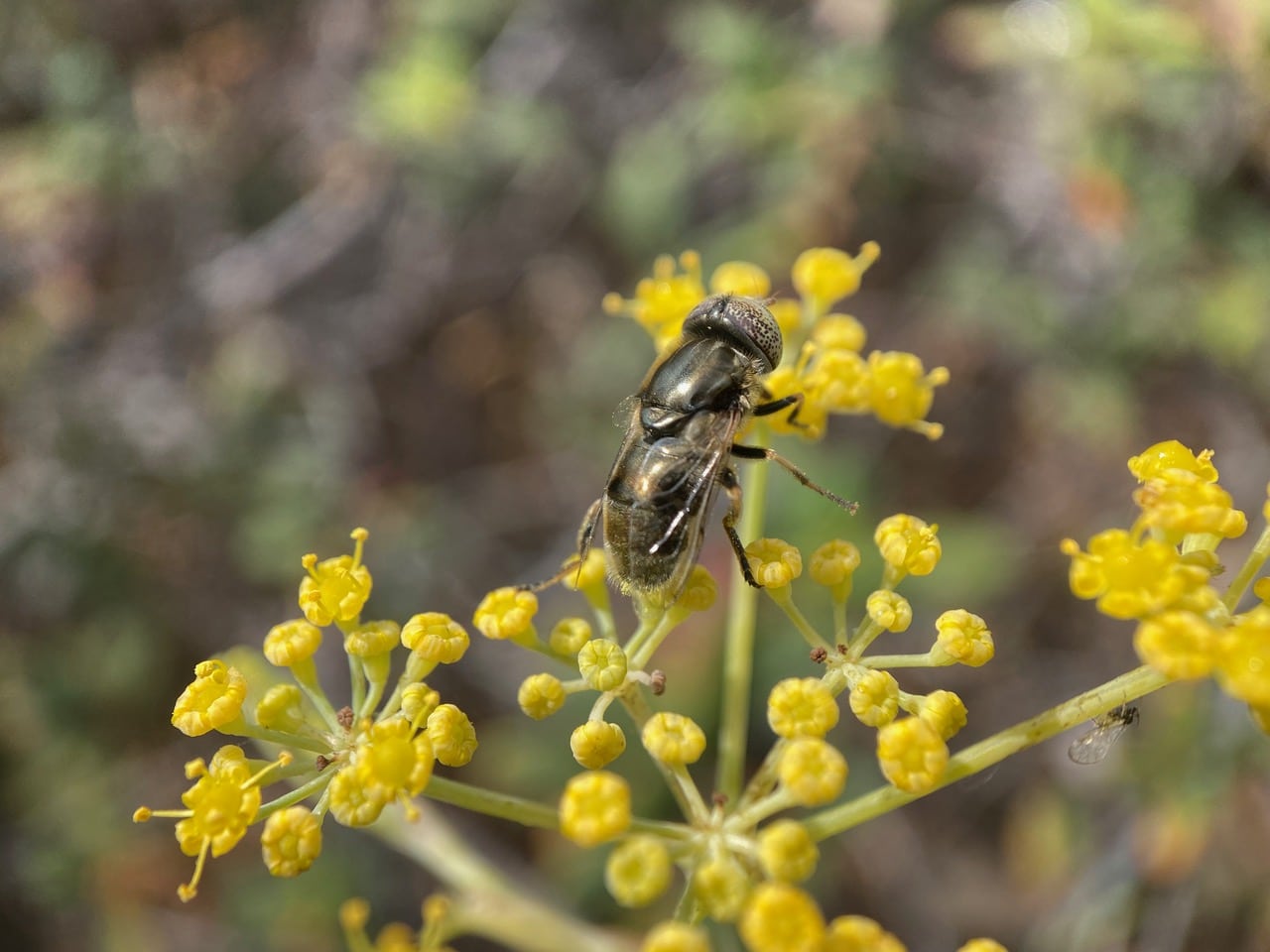
Hey, isn’t that a Common Lagoon Fly on the flowers of Fennel, Foeniculum vulgare?
The Common Lagoon Fly, Eristalinus aeneus (family Syrphidae) is a widespread species, native to Europe and found throughout the United States. Its common name derives from its habitat, which includes lagoons, ponds, and slow-moving streams. Key features are the small, dark spots on its eyes, which tend to merge at the top. The adult flies are pollinators, feeding on nectar and pollen from flowers. The larvae are found in damp environments, often with decaying seaweed. They are also known as “rat-tailed maggots”, for the long siphon on their rear end that acts like a snorkel, helping them breathe under water. The larvae are saprophagous, feeding on bacteria in water rich in decomposing organic matter.
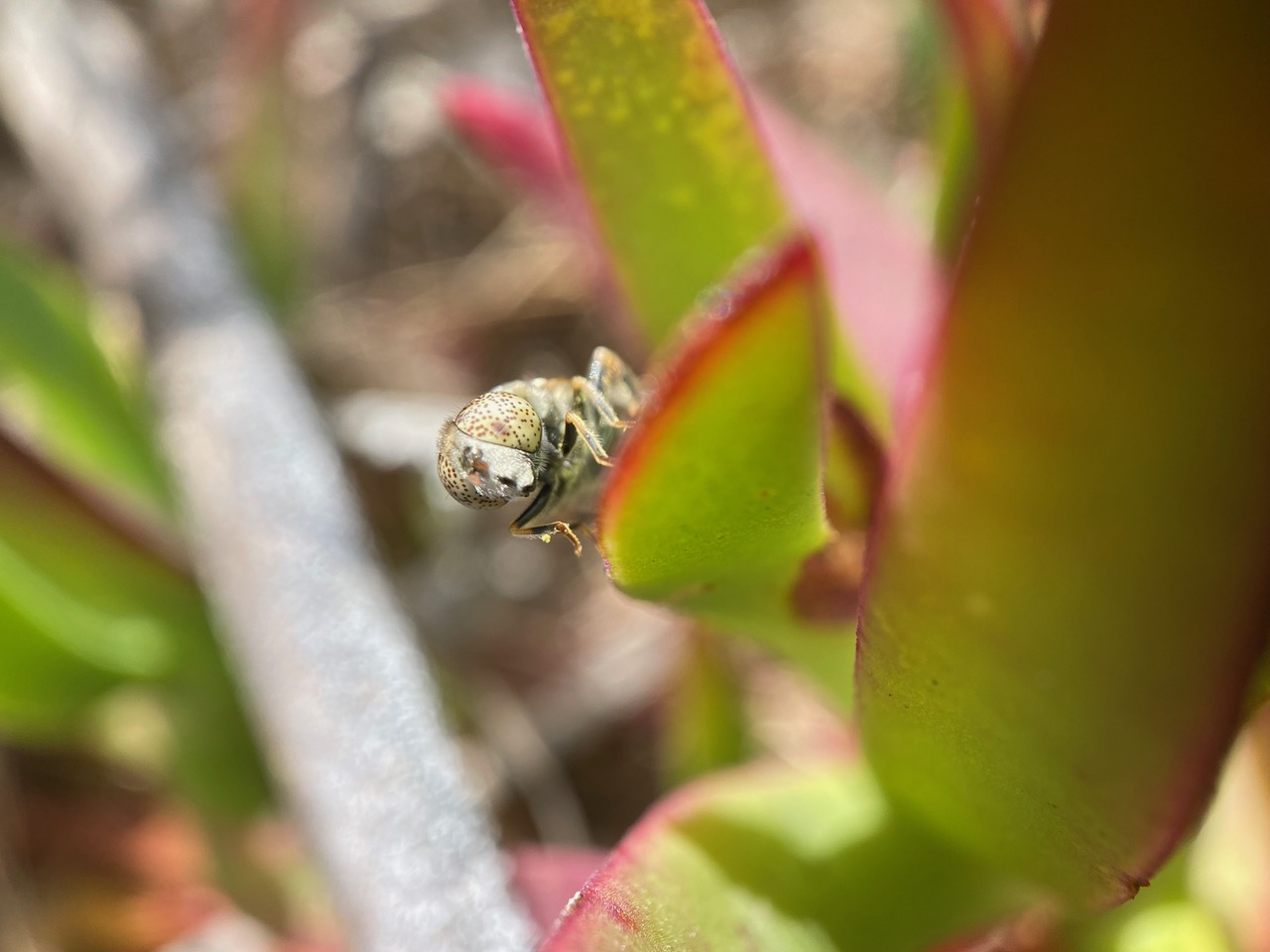
Whoa, what’s with those spotted eyes?
The pattern of spots on a Lagoon Fly’s eyes is caused by the distribution of different pigment types that affect how each individual lens, or ommatidium, perceives light. As wetland dwellers, lagoon flies benefit from filtering out excess glare and reflections from the water’s surface. Pigment spots can function like built-in sunglasses, allowing for clearer vision in sunny, reflective conditions. In some hover flies and robber flies, different eye regions have different visual acuity. The spots may indicate a specialized area of the eye that contains larger ommatidia for a more detailed “acute zone”, enabling them to spot mates or prey from a greater distance. For some insects, eye color patterns play a role in mate recognition and sexual selection. The specific marking on a lagoon fly’s eyes could be a signal to potential mates.
A Common Lagoon Fly, Eristalinus aeneus (family Syrphidae) has landed on an Ice Plant, Carpobrotus edulis. It appears to be a female. Males and female hover flies can be distinguished easily by their eyes. Males typically have large eyes that meet at the top of their head (holoptic), while females have smaller, separated eyes (dichoptic).
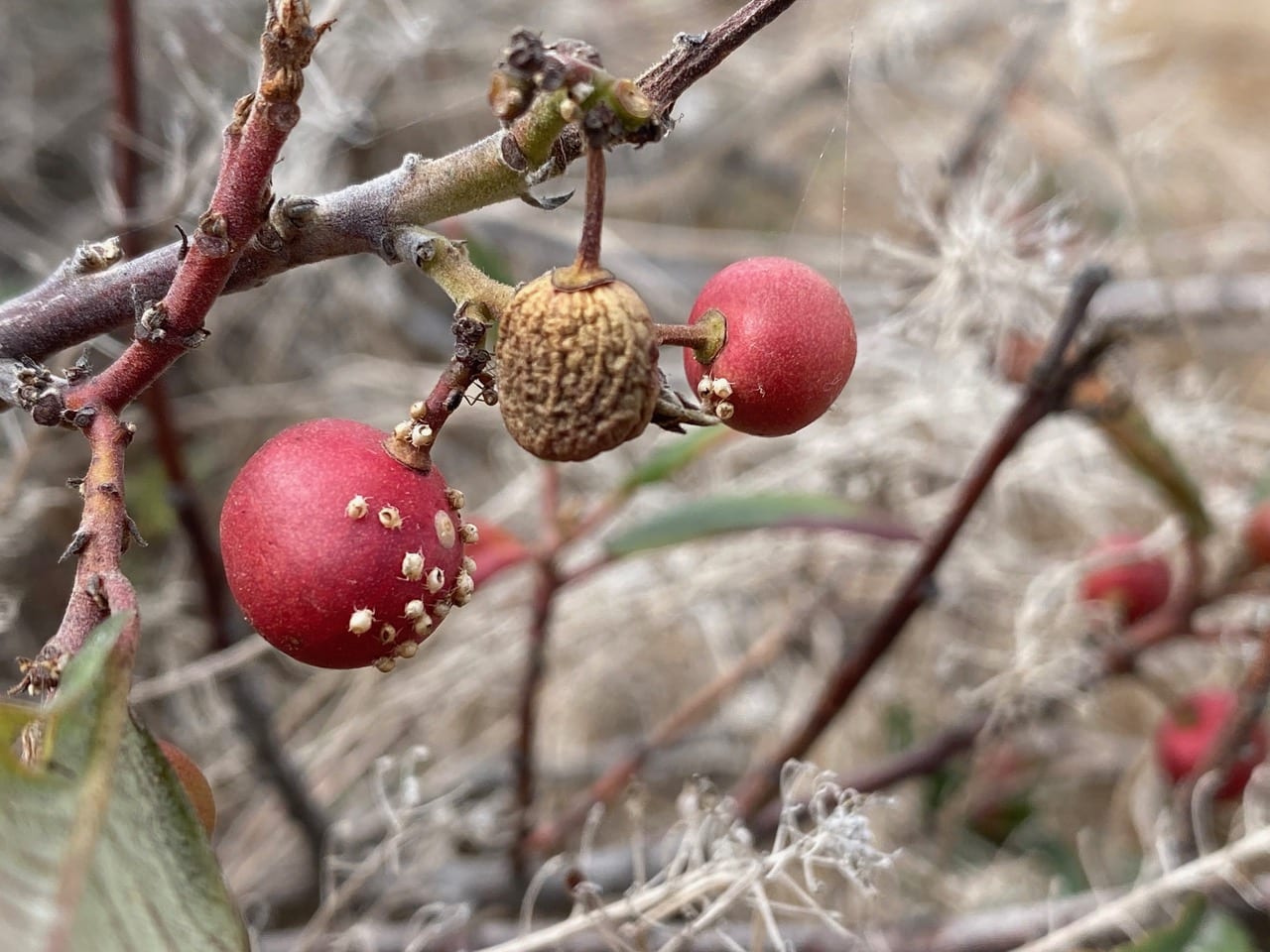
I pause by the large, wind-pruned Coffeeberry, Frangula californica along the shore to admire its crop of large fruits. They are approaching their final ripeness, having transitioned from green to red and then black. What are those tiny pale things on the fruits?
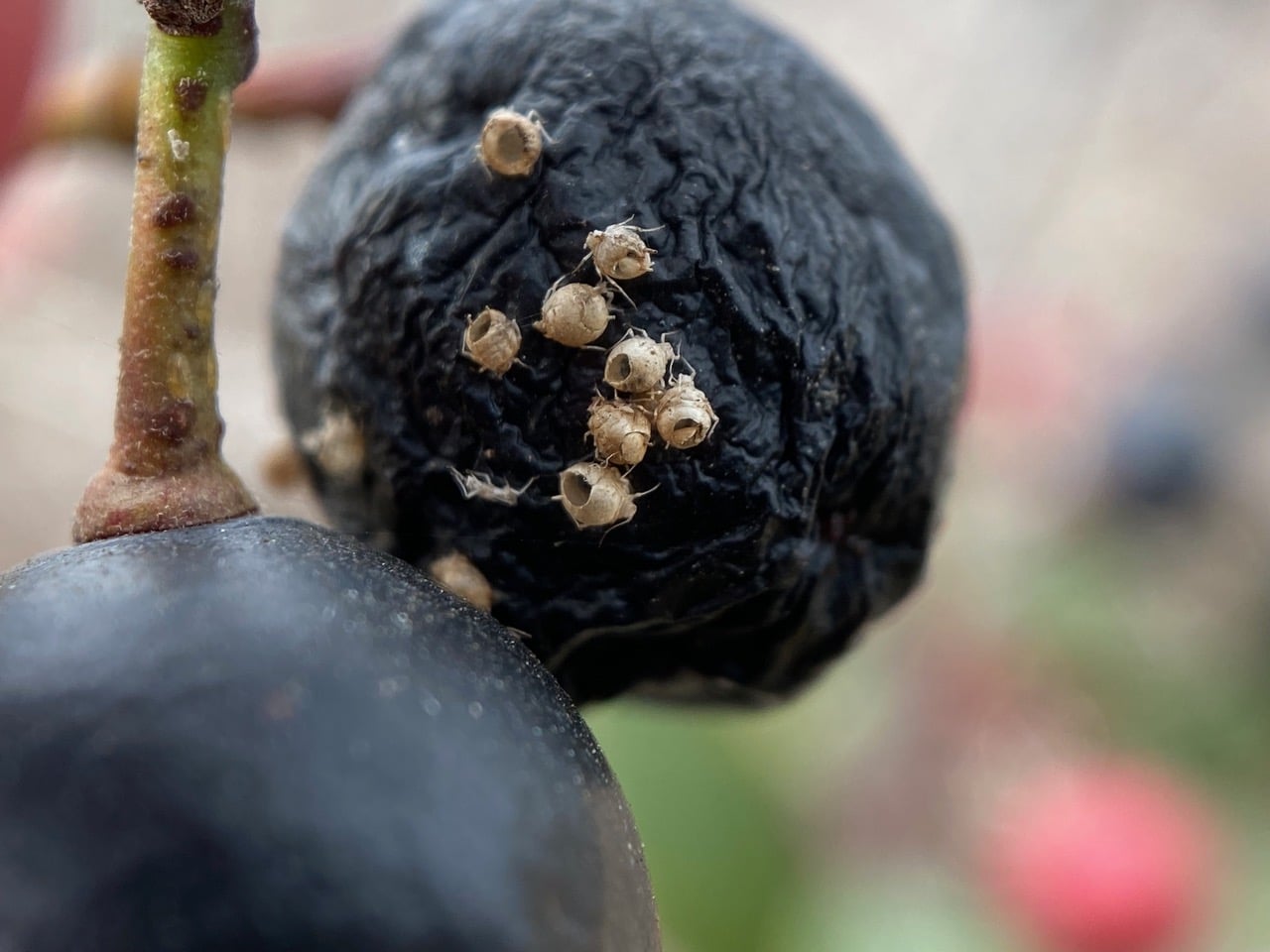
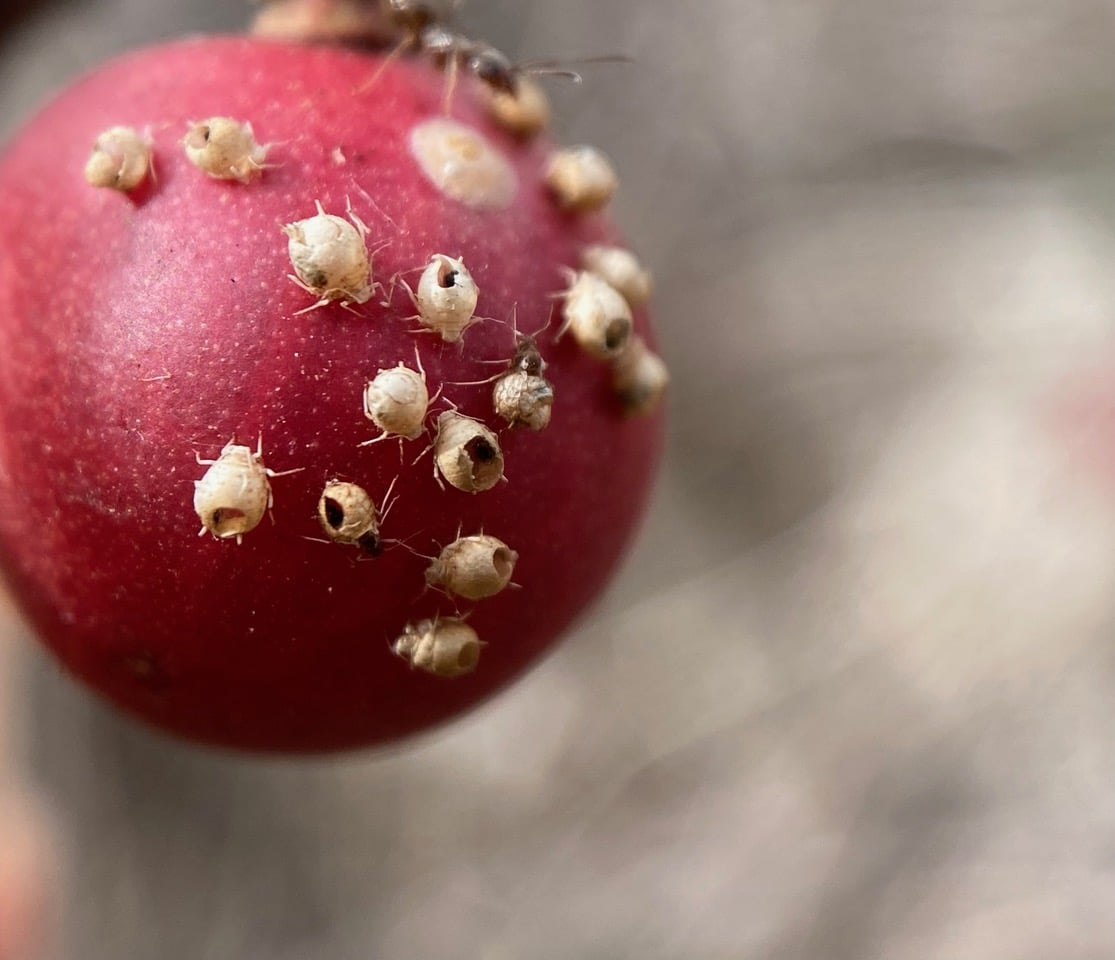
Closer examination reveals skeletons of aphid mummies on the surface of the fruits, each with a gaping hole in its abdomen.
Aphid Mummy Wasps, Aphidius sp. (family Braconidae) are small wasps, typically less than 1/8 in. long. The female wasp lays a single egg in an aphid. When the egg hatches, the wasp larva feeds inside the aphid. As the larva matures the aphid is killed and becomes bloated and mummified, usually turning tan or golden in color. The adult parasitoid chews its way out of the mummy leaving a hole.
Same thing on this shriveled fruit. Note how neatly the parasitoid wasps have carved out the holes to let themselves out of their host aphids.
More aphid mummies on these ripening Coffeeberry fruits.
It takes me quite a while to find these live aphids on a fruit. They are tiny and green, and only visible because they are on a red fruit. They are probably impossible to find on the leaves.
Aphids (family Aphididae) are small sap-sucking insects in the order Hemiptera. Aphids usually feed passively on phloem of plants. Once the phloem vessel is punctured, the sap, which is under pressure, is forced into the aphid’s food canal. Aphids produce large amounts of a sugary liquid waste called “honeydew”. A fungus called sooty mold can grow on honeydew deposits that accumulate on leaves and branches, turning them black.
A typical life cycle involves flightless females giving live birth to female nymphs, – who may also be already pregnant, an adaptation called telescoping generations – without the involvement of males. Maturing rapidly, females breed profusely so that the population multiplies quickly. Winged females may develop later in the season, allowing the insects to colonize new plants. In temperate regions, a phase of sexual reproduction occurs in the autumn, with the insects often overwintering as eggs. The life cycle of some species involves an alternation between two species of host plants. Some species feed on only one type of plant, while others are generalists, colonizing many plant groups. Some ants have a mutualistic relationship with aphids, tending them for their honeydew and protecting them from predators.
It is amazing that while its fruits are ripening, the plant has produced a new flush of flowers. Argentine Ants, Linepithema humile (family Formicidae) are swarming over the freshly opened Coffeeberry flowers, apparently seeking nectar. Wait a minute, do you see the white object that resembles a grain of rice on the flower on the lower right? It looks like a typical egg of a hover fly (family Syrphidae). Females of aphidophagous hover flies deposit their eggs singly near aphid colonies to ensure that their offspring will have plenty to eat when they hatch out.
The Argentine Ant, Linepithema humile (family Formicidae) is native to Northern Argentina, but it has been inadvertently introduced by humans to many countries, and is now an established invasive species in many Mediterranean climate areas worldwide. The success of the species can be attributed to their lack of aggression between the colonies. There is no apparent antagonism between separate colonies of its own kind, resulting in “super-colonies” that extend across hundreds or thousands of kilometers in different parts of the their range. Genetic, behavioral, and chemical analyses show that introduced Argentine Ants on separate continents actually represent a single global supercolony.
The Argentine Ants are ranked among the world’s worst invasive animal species. In its introduced range, the Argentine ant often displaces most or all native ants and can threaten native invertebrates and even small vertebrates that are not accustomed to defending against the aggressive ants. This can, in turn, imperil other species in the ecosystem, such as native plants that depend on native ants for seed dispersal, or lizards that depend on native ants for food.
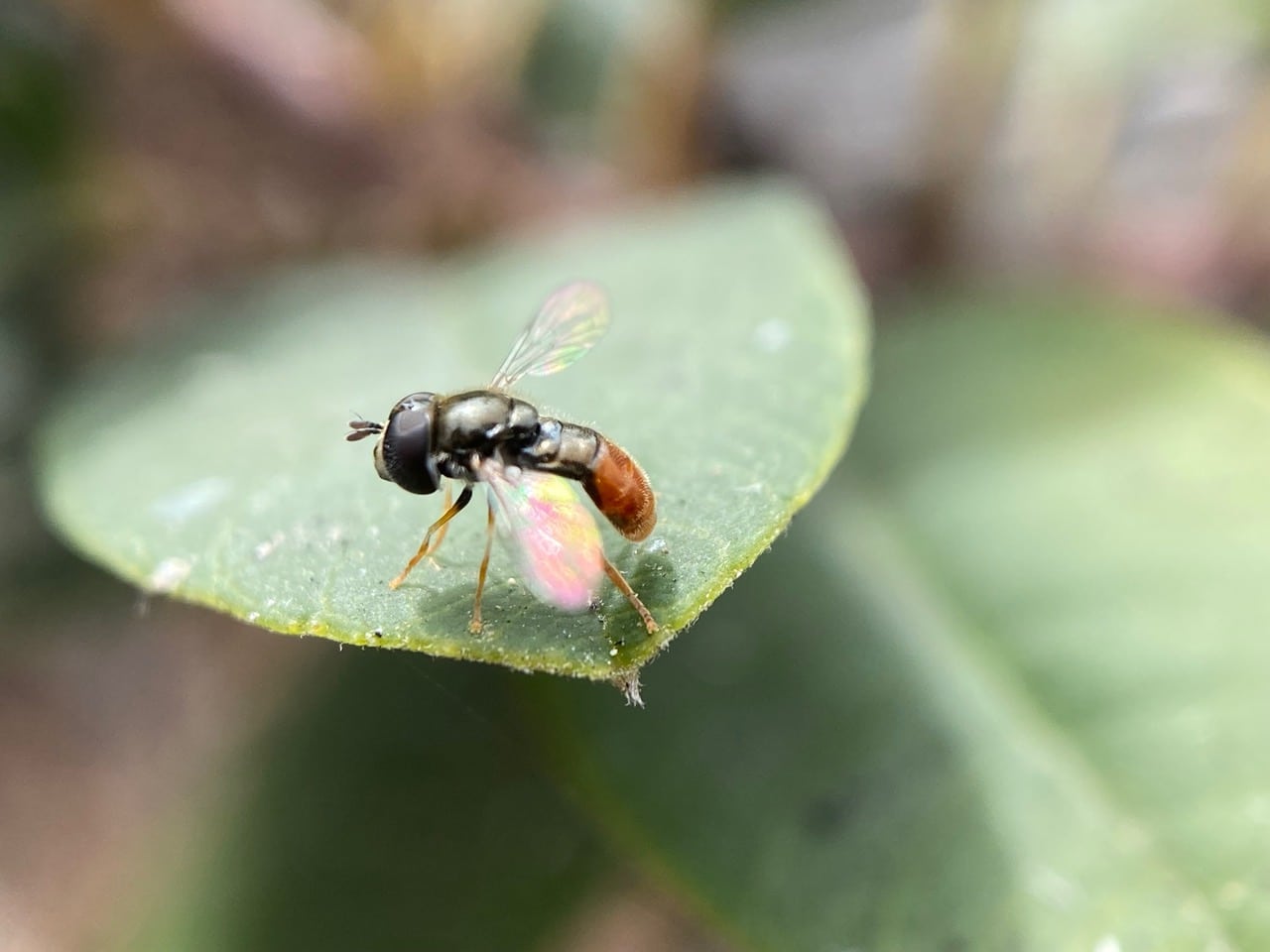
Several Common Grass Skimmers, Paragus haemorrhous (family Syrphidae) are hovering over the Coffeeberry shrub. I marvel at their ability to hover so steadily on such a windy day. One finally lands on a leaf. Note the oversized head and the hunched posture typical of the species. While most have red hind segments on their abdomen, not all individuals of the species do.
The Common Grass Skimmer, Paragus haemorrhous (family Syrphidae) is easily the smallest hover fly I know, measuring only about 4 mm in length. The species has a world-wide distribution, found in unimproved grassland, dune grass, open areas and pathsides in forest, and meadows. Adults visit flowers for nectar and pollen. Larvae feed on aphids on low herbaceous plants.
Photos of Common Grass Skimmer (Paragus haemorrhous) · iNaturalist
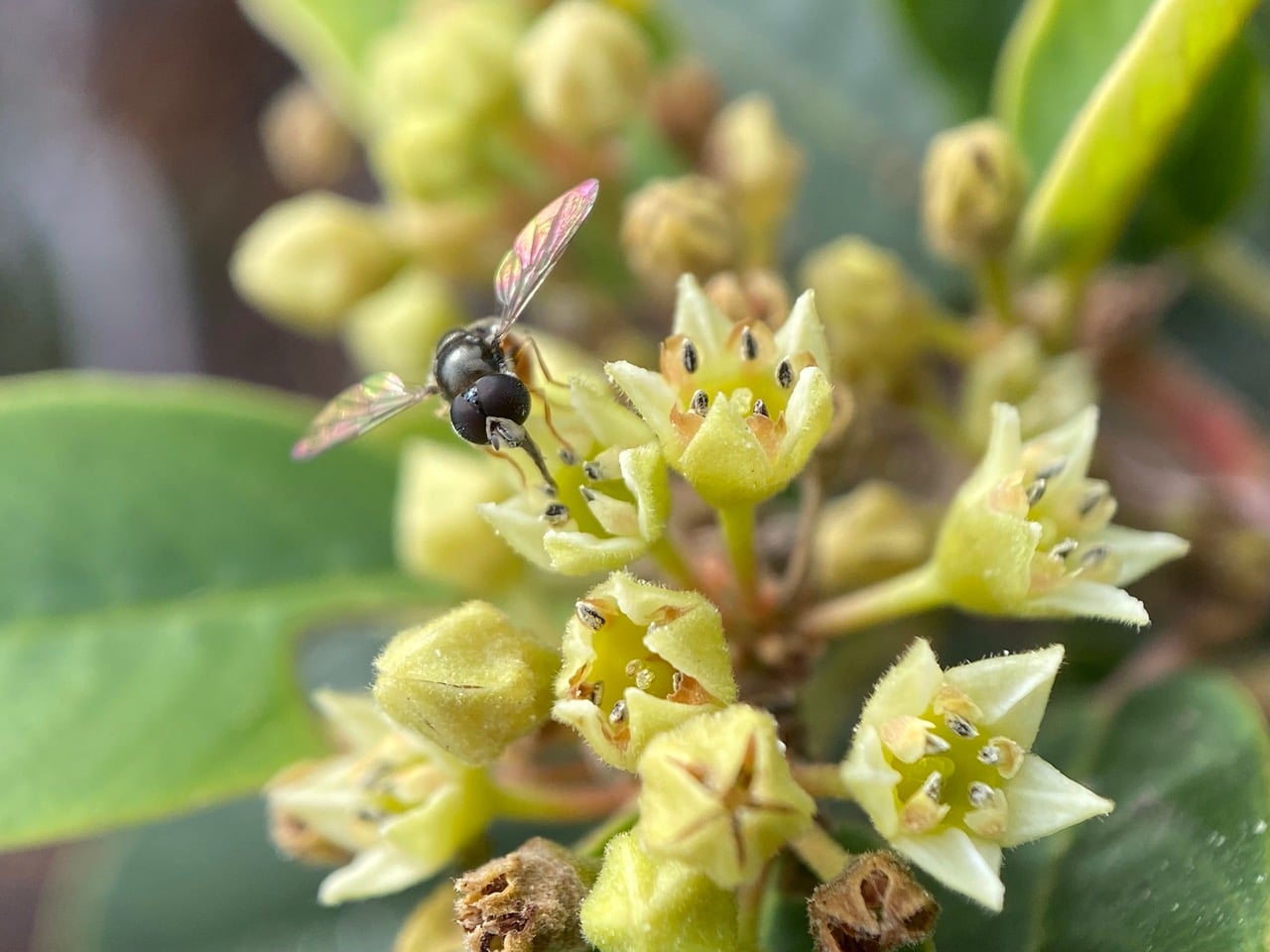
A Common Grass Skimmer is foraging on a freshly opened Coffeeberry flower.
The small flowers of Coffeeberry seem the perfect size for the diminutive hover fly.
California Coffeeberry, Frangula californica is an evergreen shrub native to California. The plant blooms usually from May to July. Flowers are tiny, greenish and symmetrical, and grow in clusters of 5 to 20 or more. The flowers are bisexual, with five or six anthers (depending on the number of petals) circling the branched pistil. These flowers are popular with bees, flies, butterflies and hummingbirds. Pollinated flowers become fruits (drupes) that start out green, transition to red and when ripe are nearly black in color. Birds and deer are known to consume the fruits and disperse the seed in the process.
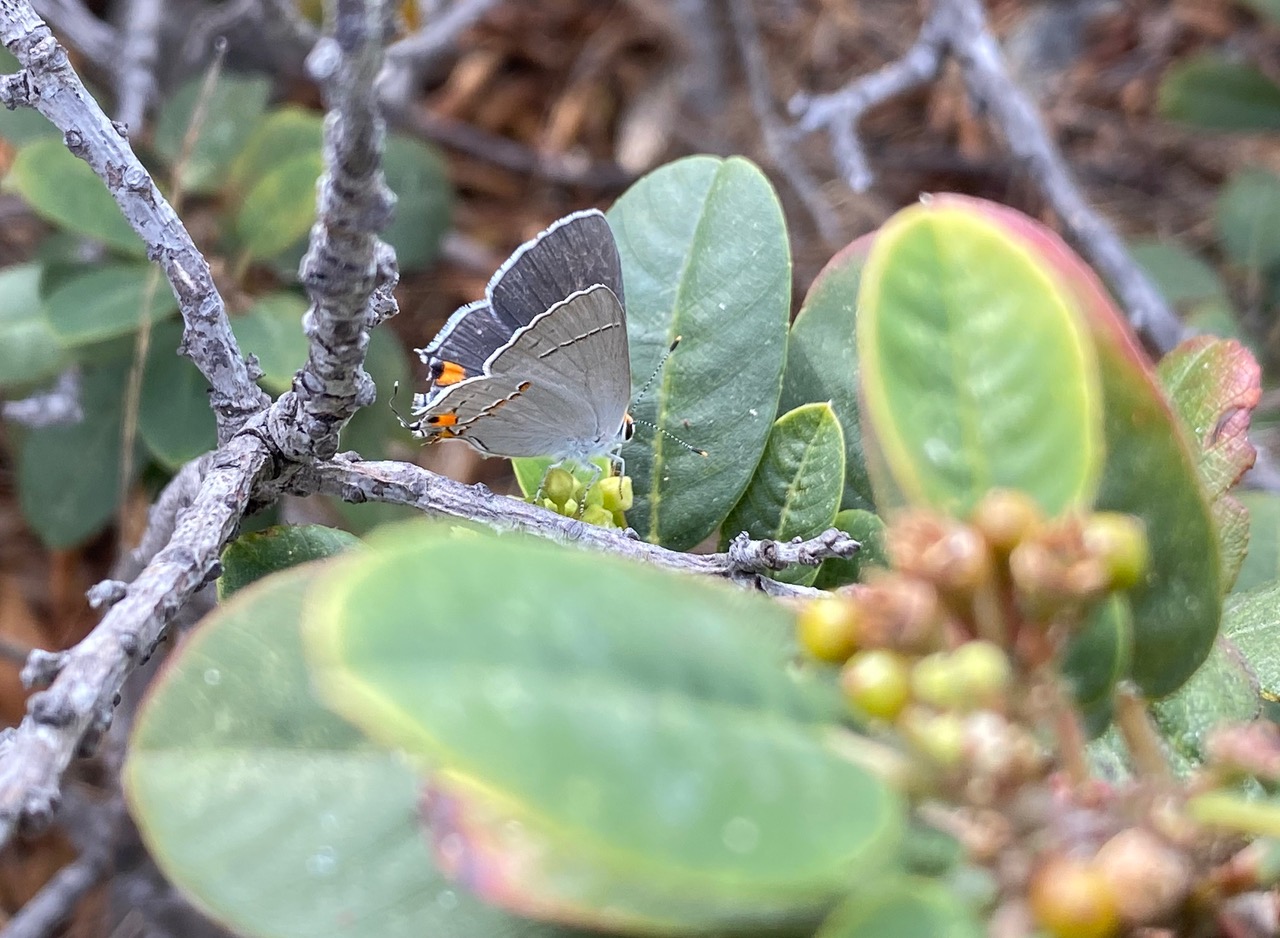
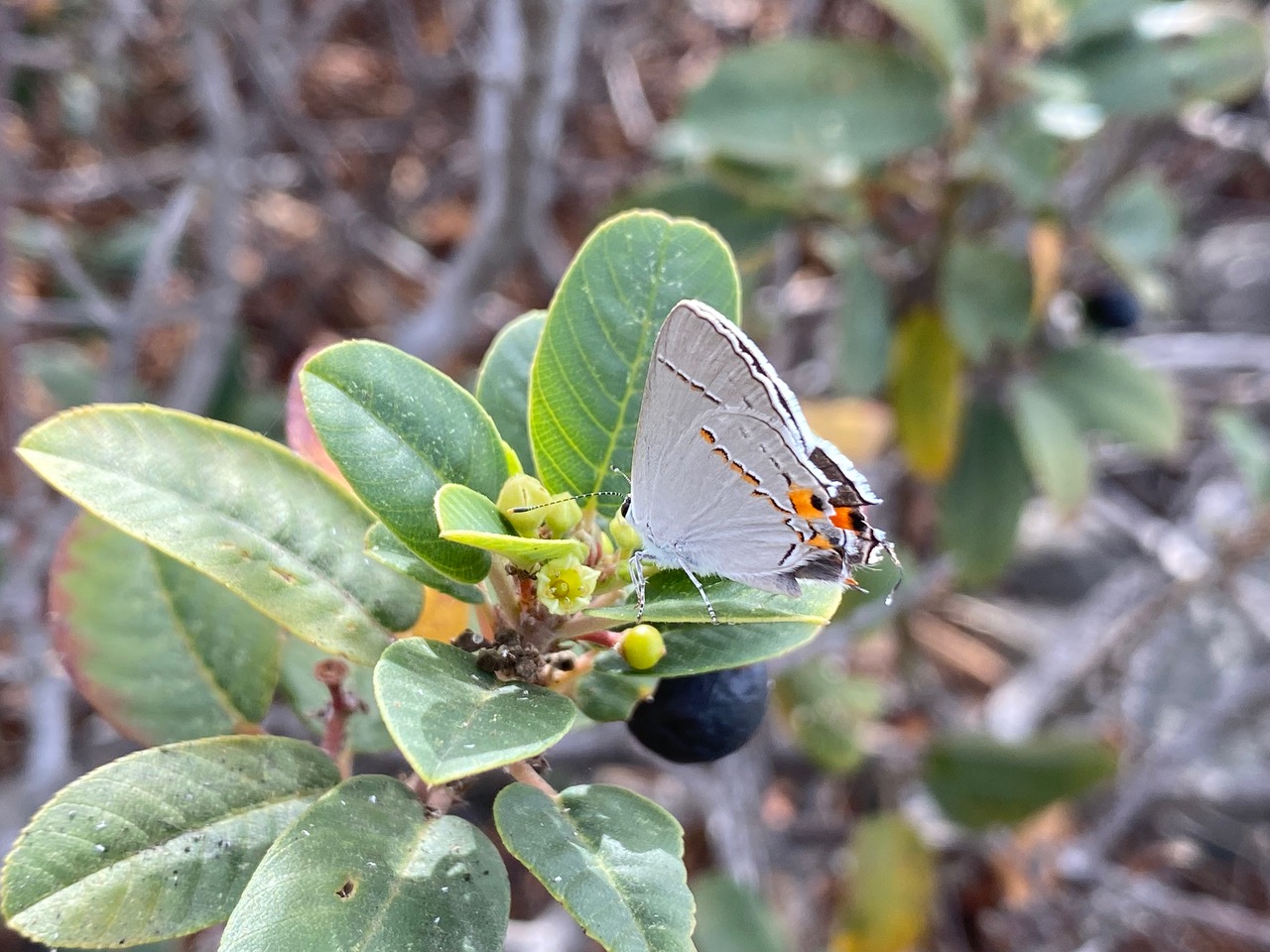
A Gray Hairstreak, Strymon melinus (family Lycaenidae) has landed on a cluster of Coffeeberry flowers. It appears to be missing bits in the tips of its hind wings.
Female Gray Hairstreaks lay eggs singly on the flowers, flower buds, young fruits and nearby leaves of a host plant. Host plants include a wide variety of plants, notably from the pea (Fabaceae) and mallow (Malvaceae) families. The caterpillars are greenish at the start, but older individuals range in color from gray to pink. As in many species of Lycaenidae, Gray Hairstreak larvae are myrmecophiles (ant-lovers) – often tended by ants. Ants harvest a sweet liquid from the caterpillar’s dorsal nectary organ (“honey gland”) and in exchange may protect them from predators. Larvae of many Lycaenidae species also communicate with ants via ant-like sounds (clicks and hums) or by sending vibrations through the substrate.
Despite the injuries to the tips of its hind wings, the Gray Hairstreak is still rubbing them together continuously while seeking nectar. It is possible that the behavior has saved its life from a predator’s attack.
Why the name “hairstreak”? These small butterflies have a slim, hair-like tail on the lower corner of each hindwing. Gray Hairstreak also has colorful false eyespots near the base of each tail. The eyespots and antenna-like tails are believed to fool predators into mistaking its tail for its head. Hairstreaks even add a behavioral component – a nectaring hairstreak often rubs its wings up and down, simulating the movement of twitchy antennae. This may fool birds, lizards, and spiders into attacking the wrong end, sparing the life of the butterfly.