

Pollinator Post 9/3/26

It’s a cloudy and calm morning. After dropping Fred off for his walk at Bay Farm, I make a bee line to the patch of Oregon Gumweed, Grindelia stricta at the end of Aughinbaugh Way. The plants here are heavily infested with Spittlebugs, and I know the insects are ready to transform into adults en masse any time now. I don’t want to miss the show.

I pay special attention to the larger foam masses, as these are likely to hold the more mature nymphs. Wow, the large number of exuviae here tells me that many adult spittlebugs have emerged. An exuvia (plural: exuviae) is the empty exoskeleton or cast-off outer skin that an arthropod leaves behind after molting.

It doesn’t take long for me to find the first adult male Spittlebug, Clastoptera lineatocollis (family Clastopteridae).
Spittlebugs, also known as Froghoppers belong to the superfamily Cercopoidea within the order Hemiptera (true bugs). While sometimes generally referred to as the family Cercopidae, they are scientifically divided into several families, primarily Aphrophoridae (common spittlebugs), Cercopidae (froghopper), and Clastopteridae.
Why the common name of “spittlebug”? The nymphs (immatures) of these bugs create foam masses on plants in which they live and feed. Like the adults, the nymphs use their piercing, sucking mouthparts to feed on plant juices. The nymph produces a cover of foamed-up plant sap reminiscent of saliva, hence the common name of spittlebug. Whereas most insects that feed on sap feed on the nutrient-rich fluid from the phloem, Spittlebugs tap into the much more dilute sap flowing upward via the xylem. The large amount of excess water that must be excreted and the evolution of special breathing tubes allow the young spittlebug nymphs to grow in the relatively protective environment of the spittle. Symbiotic bacteria in the insects’ digestive system provides them with the essential amino acids that their diet lacks. The foam serves a number of purposes. It hides the nymph from the view of predators and parasites, and it insulates against heat and cold, and protects the delicate nymphs from desiccation. Moreover, the foam has an acrid taste that deters predators.
Unlike their young, adult spittlebugs (also known as Froghoppers) are efficient flyers and hoppers, feeding on diverse plant species. Using their piercing-sucking mouthparts, they pierce plant stems to feed on xylem. To get enough nutrients, they consume massive quantities of sap, drinking up to 280 times their body weight daily, resulting in high waste excretion. Froghoppers can cause damage by distorting plant leaves and causing shoot tips to die back. Froghoppers are champion jumpers among insects, out-performing even the fleas. The bug can leap the human equivalent of a skyscraper without a running start. It is the highest jumping insect proportional to body size. The muscles in its hind legs act like a “catapult” to release energy explosively.

I think that’s another male Spittlebug, Clastoptera lineatocollis (family Clastopteridae) at the base of the Grindelia flowerhead.
The Spittlebug, Complex Clastoptera lineatocollis (family Clastopteridae) is found in western United States. The bugs feed mostly on Asteraceae, although other hosts have been reported. Females are brownish (3.3-3.8 mm), while the smaller males (3.0-3.2 mm) are mostly black.

There are adults among the exuviae on that fading branch. In this low light it’s hard to see color – that might be a brown female.

Ooh, that’s an adult female without a doubt. It is large and brown.

There are plenty of females today!


An adult female Spittlebug is resting beside a foam mass on a branch littered with exuviae. Note the black false eye-spot near the tip of her wing. Her real eyes are brownish and blend in with the body. The eye-spot serves to confuse predators that might attack the wrong end of the insect, giving the bug time to escape in the other direction.
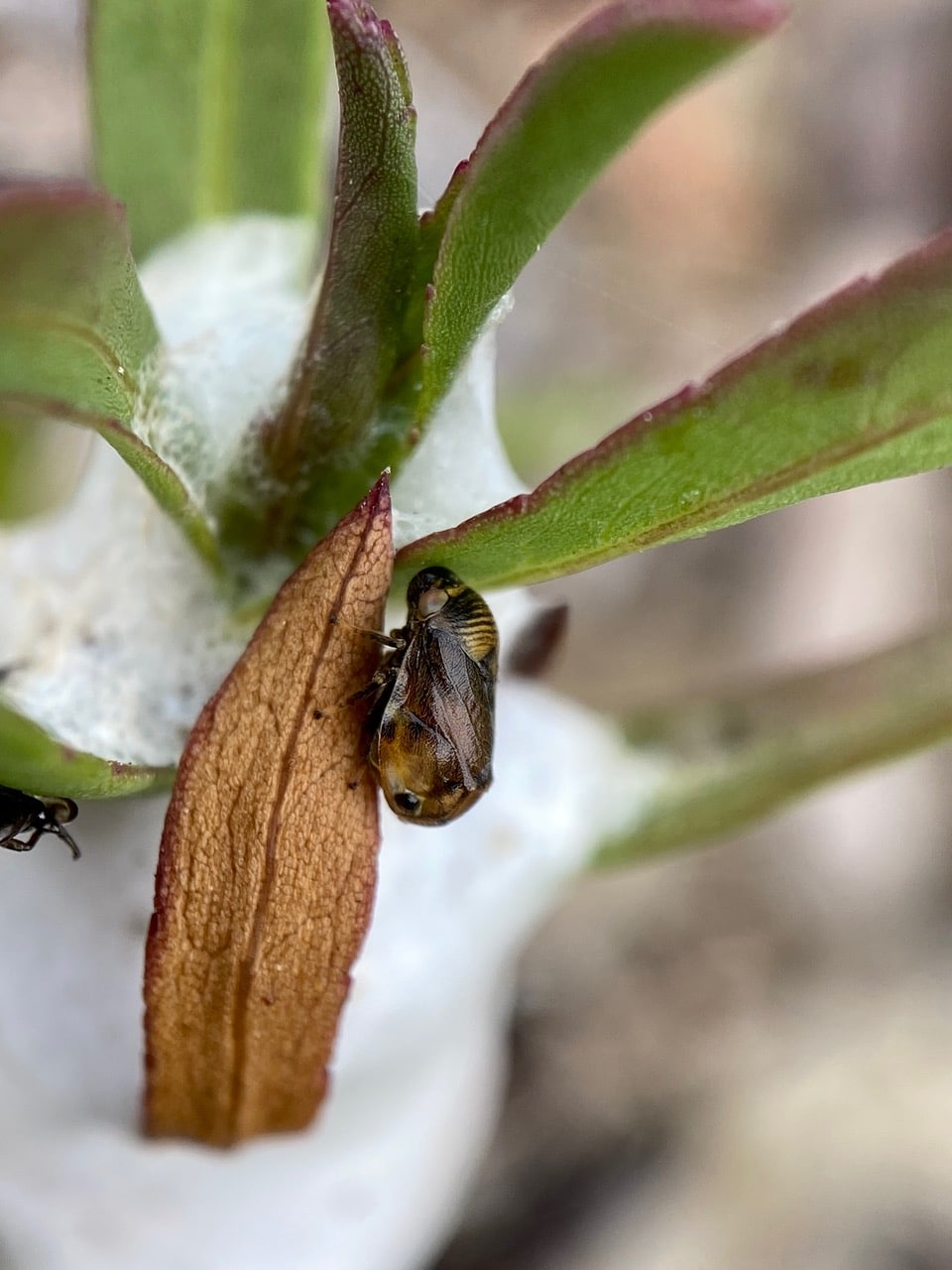
Despite appearances, this female is facing upward.

Dorsal view of a female Spittlebug, Clastoptera lineatocollis (family Clastopteridae).

This female Spittlebug is trying to hide from my camera. Note her bulbous abdomen, and the black false eye-spot near the tip of her wing.
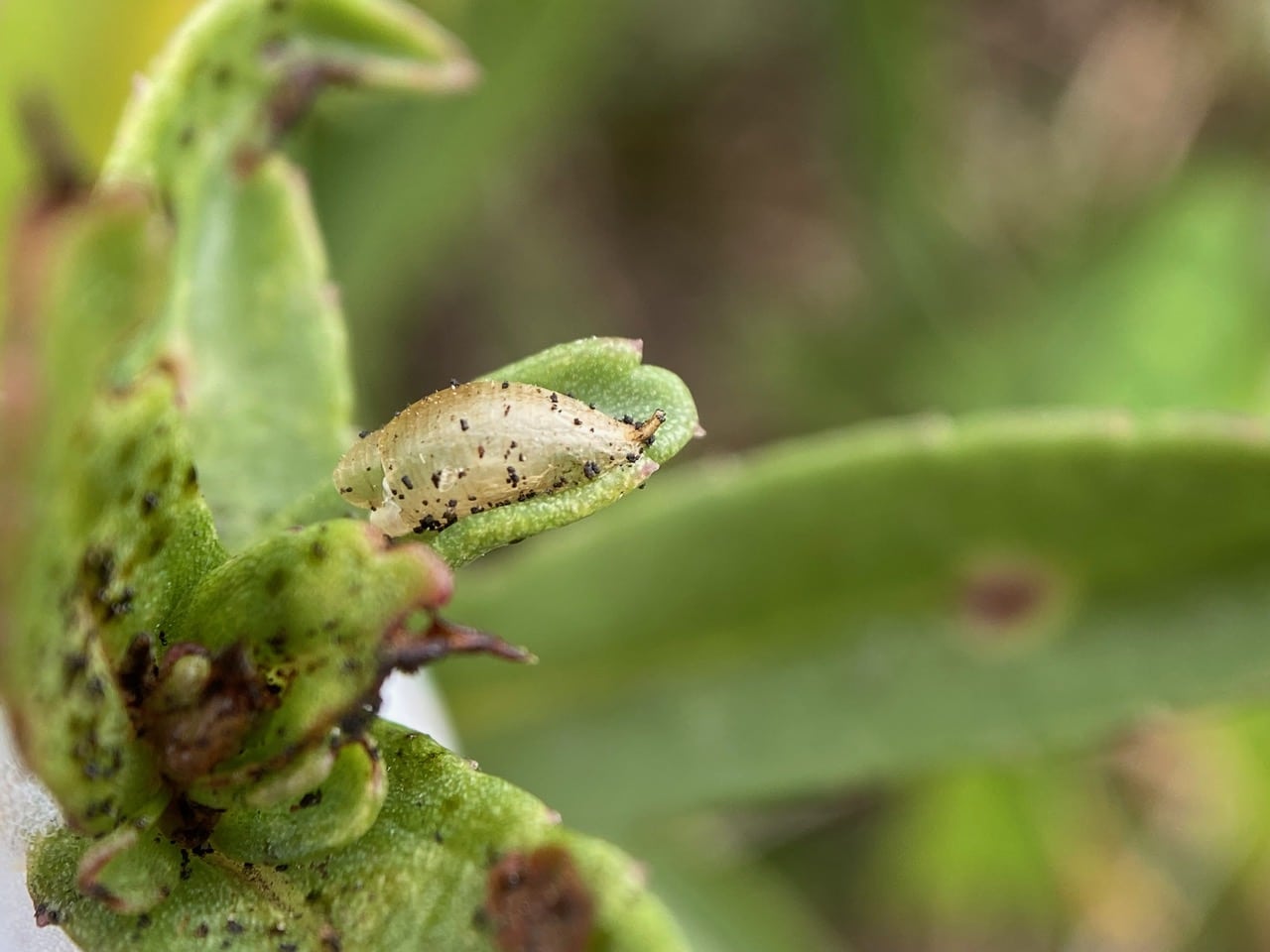
An empty hover fly pupa case lies on a terminal leaf of Grindelia, speckled with debris. The adult fly has emerged from the broad end of the teardrop-shaped puparium.
Hover fly pupae (family Syrphidae) are the teardrop-shaped, transitional life stage where mature larvae metamorphose into adults. They often start out greenish and translucent before shifting to tan-brown or taking on the colors of the developing adult inside. Depending on the species, pupation happens directly on the host plant’s foliage near where the larvae fed on aphids, or down below in the loose soil, mulch, and leaf litter. Pupae need damp conditions or high humidity to successfully mature. If it is too dry, mature larvae crawl down into the soil to find moisture. The pupal stage typically lasts about one to two weeks before the adult hover fly emerges. Many species survive the cold winter months by remaining as pupae hidden in protected leaf litter or topsoil.

There’s a lot of Spittlebug activity on that branch of Grindelia. Several exuviae can be seen. Hey, do you see the fresh, orange-colored adult emerging from its exuvia ?

Here it is close-up. It’s interesting that there’s a double-decker of exuviae here. The nymph has climbed onto an exuvia left on the leaf, and decided to undergo ecdysis then and there. The tender adult is almost fully out now, just waiting to pull its hind legs out of the old exoskeleton. Note its bulbous snout and the dark, thread-like stylet (piercing-sucking mouthpart) held within a rostrum and folded away under the body of the bug.

To keep track of bugs undergoing ecdysis, I tie a piece of red yarn on the plant they’re on for easy identification. I wish I had brought something waterproof to sit on, but fortunately there’s plenty of ice plant to keep my rear dry while I observe the tiny bugs.

9:48 am. Look, a fresh adult is breaking out of its exoskeleton. The mature nymph has crawled out of its foamy home for its final molt into adulthood at the tip of the Grindelia leaf. The new adult emerges through a rupture on the thorax of the nymph.

9:54 am. The fresh adult strains backwards to pull itself out of its old skin. See the white thread-like strands pulling out of the exuvia?
The white filaments are the cast-off linings of the insect’s tracheae – the hollow tubes that make up their respiratory system.
Insects do not have lungs. Instead, they breathe through tiny external openings along their bodies called spiracles, which lead to an internal branching network of tubes called tracheae that deliver oxygen directly to their cells. Even though these breathing tubes are inside the insect’s body, their inner linings are made of the same chitinous material as the outer shell. When an insect or nymph undergoes ecdysis (molting), it must pull its entire body – including the delicate linings of its breathing tubes – out through the old skin, leaving behind the ghostly white filaments.

9:57 am. The emerging adult strains backwards to pull its legs free.

10:00 am. Note the bulbous snout on the head of the emerging adult.
Adult spittlebugs, also known as froghoppers, have a prominent, bulbous snout that houses a highly powerful, internal muscular pump used to suck plant sap. Because xylem sap is mostly water and contains very few nutrients, spittlebugs must drink vast quantities of it just to survive. Pulling xylem sap out of a plant requires immense negative pressure. The bulbous snout provides the physical space needed to pack in massive dilator muscles that serve as a high-speed hydraulic pump, allowing the insect to constantly pull in fluid.
Both the adult froghoppers and their juvenile nymphs share this facial structure, though the nymphs put the massive volume of processed fluid to a unique use – whipping the excess fluid out of their rear ends to build their famous, protective “spittle” bubble nests.
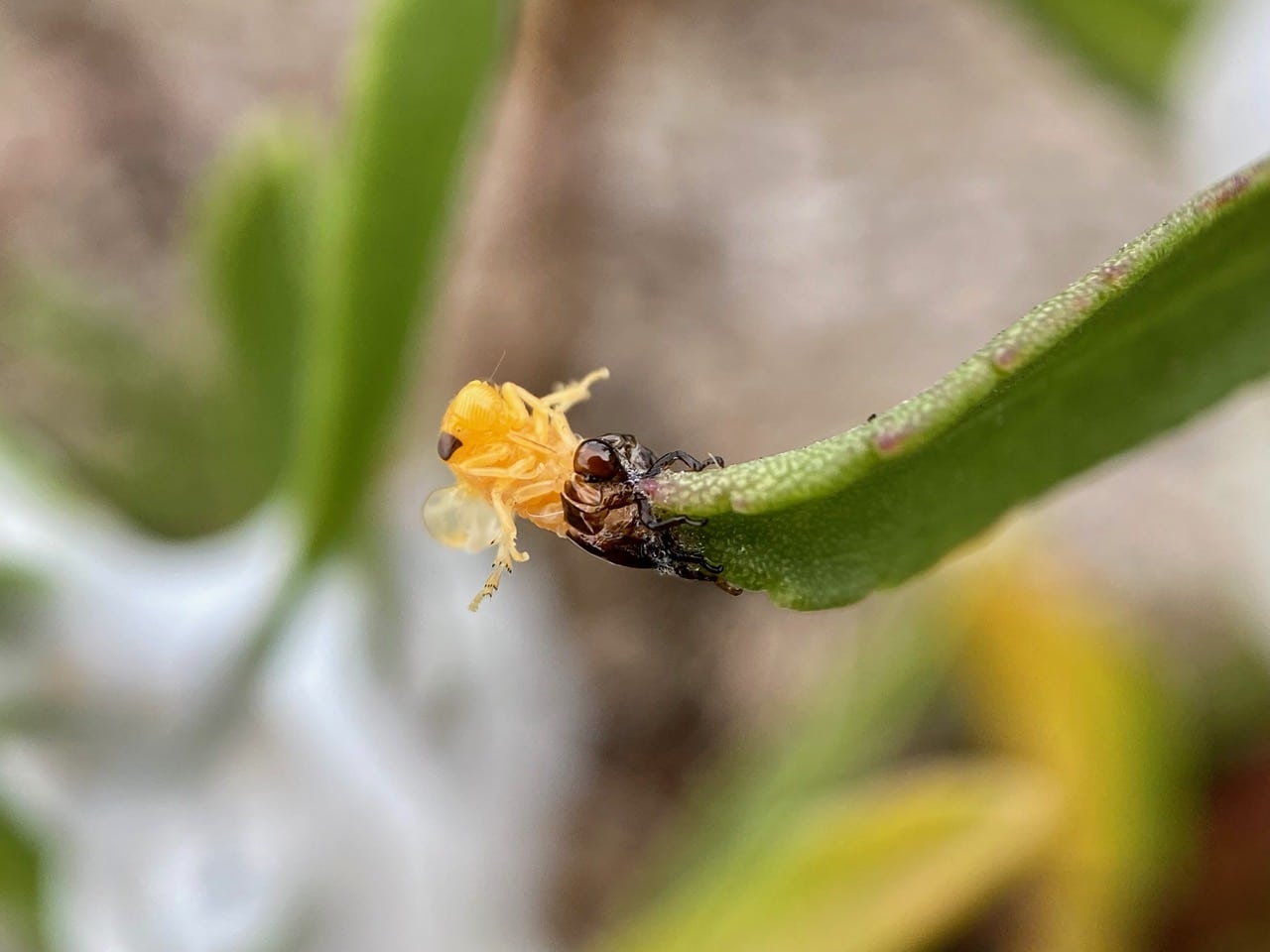
10:05 am. The newly emerged adult pulls its hind leg out of the exuvia. Note the whorl of radiating dark spines on the tip of its hind tibia (shin). This is a key anatomical feature used for identification and high-powered locomotion. In adult Spittlebugs, the ring of spines acts like a cleat or high-grip running shoes, digging firmly into the plant’s surface to prevent slipping so 100% of the energy is converted into a successful forward launch when they jump.

10:08 am. Phew! The teneral manages to lean forward to grasp its exuvia with its front legs to hold on securely. Now it’s a matter of waiting for its wings to fully expand and dry.
A teneral insect is a young insect that has just molted (emerged from its final nymphal skin) but has not yet hardened its exoskeleton or achieved its final coloration. Teneral insects typically have paler or different colors than their mature counterparts. Over a short period (often hours), the insect’s exoskeleton hardens and darkens, a process similar to the tanning of leather. This period allows the insect to expand its body and limbs. Being soft, and unable to move much, tenerals are more susceptible to injury and predation.

10:25 am The teneral has folded its wings over its back. Its abdominal segments appear to be drying up nicely.

10:32 am. Hey, that Spittlebug nymph is emerging from its exoskeleton through a clean tear down the middle of the thorax.

10:34 am. The rupture expands as the new, orange-colored adult pushes through.

10:35 am. We can now see the young adult’s head and dark eyes.

10:37 am. More of the adult’s body has emerged.

10:37 am. Ah, little angel wings are unfurling!

10:39 am. The emerging adult continues to arch backwards, pulling the rest of its body out of the exuvia.

10:40 am. The front and middle legs are free now. Note the dark, straight stylet that is part of the spittlebug’s rostrum or mouthparts. When hardened, it is used to pierce plant tissues to extract sap from plants. It is connected to the hydraulic pump in the massive snout. Note that the cuticular lining of the old rostrum is being pulled out, together with the linings of any other internal structures derived from the ectoderm. When the insect pulls itself out of its old exoskeleton (the exuvia), it carefully slides its delicate internal tissues out of the old rigid tubes, leaving a complete hollow duplicate of its former self behind. Because it must shed its breathing tubes and mouth linings, a bug is briefly unable to breathe or eat until the new, larger lining settles into place.
While butterflies and other insects that undergo complete metamorphosis to reach adulthood get all the awe and press, the incomplete metamorphosis (without the pupal stage) of the Spittlebugs is no less dramatic. Besides it happens in the open where it is visible, given sufficient magnification. Unfortunately I can’t observe the transformation of this spittlebug to its completion as I have to leave. We can, however, use observations from several individuals on different timelines to piece together the general sequence of the event. What a privilege it has been to witness, again and again, this miracle of nature – and all within one and a half hour!