

Pollinator Post 9/29/24 (2)
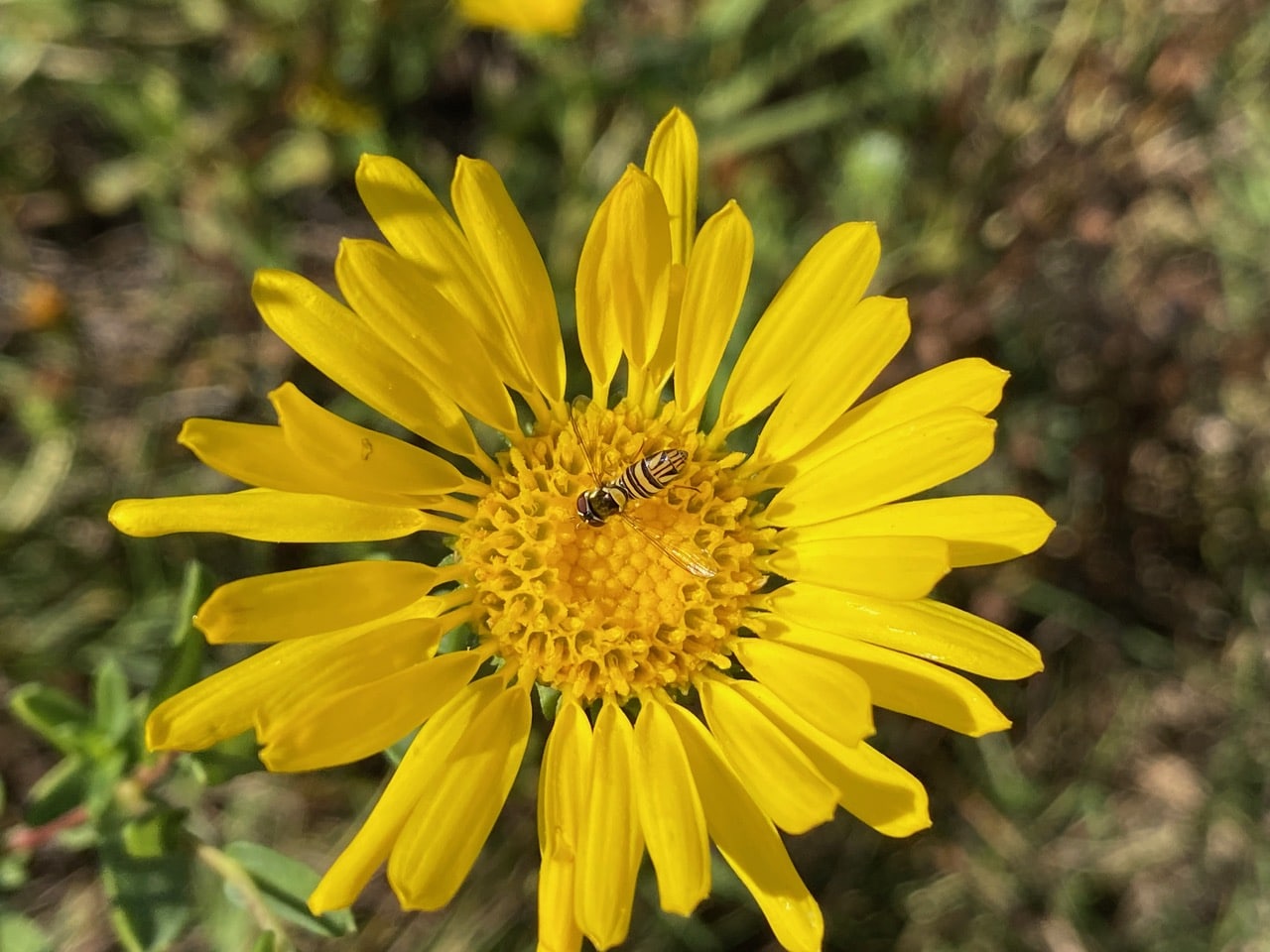
The black-and-yellow pattern on the abdomen of that hover fly is so distinctive one can identify it immediately. It is the Oblique Streaktail, Allograpta obliqua (family Syrphidae).

Close-up of the same fly.
The Oblique Streaktail, Allograpta obliqua (family Syrphidae) is a common North American species of hoverfly. Adults are 6-7 mm long. Males have holoptic eyes (that meet on top of the head), while females have dichoptic eyes. Eggs are laid on surfaces of leaves or stems near aphids. The larvae are important predators of aphids. Adults visit flowers for nectar and pollen, and are pollinators.
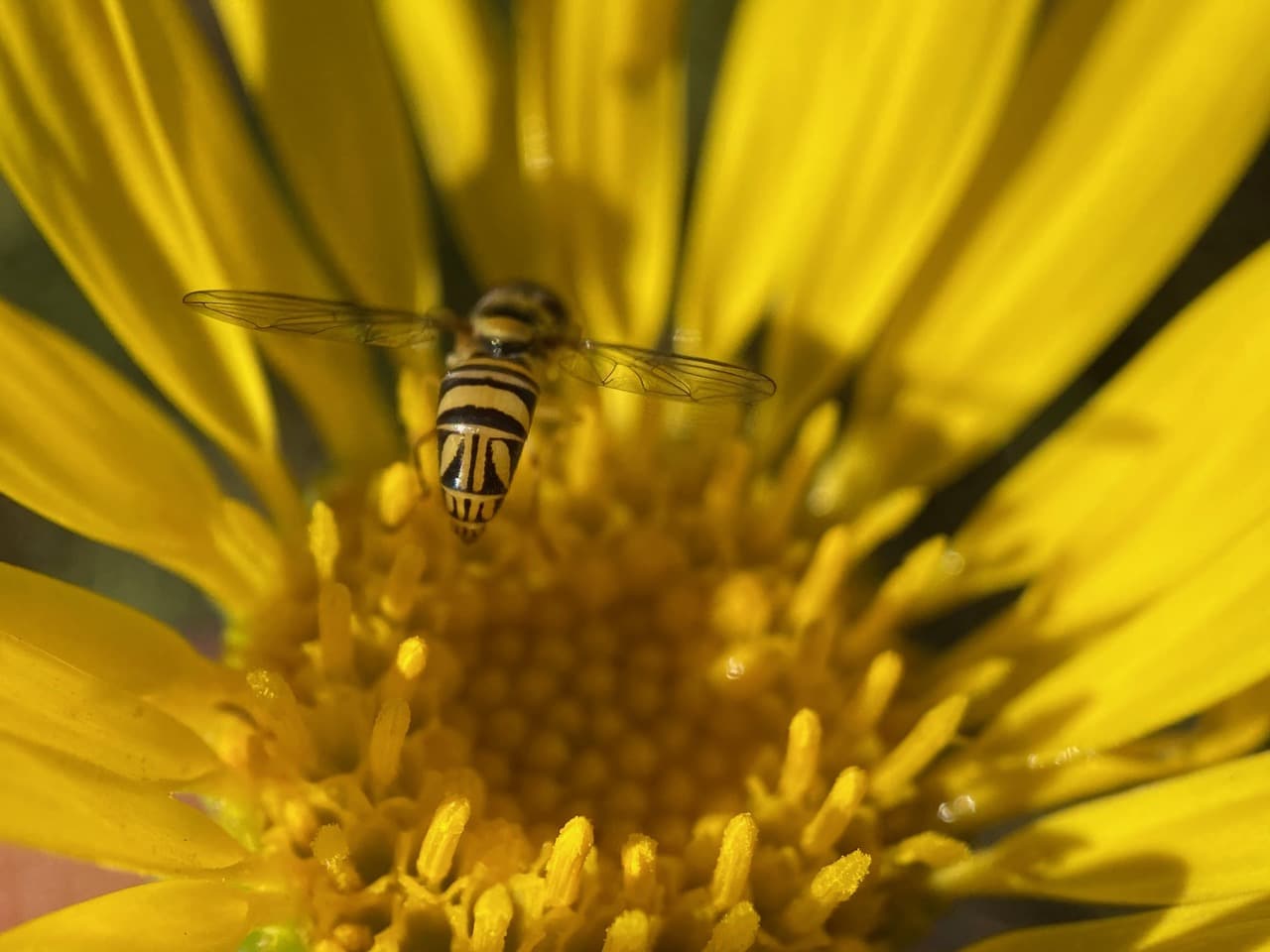
The distinctive abdominal pattern of the Oblique Streaktail, Allograpta obliqua (family Syrphidae). This individual is female, as her abdomen tapers to a pointed tip. The gender of hover flies are also easily distinguishable from their eyes – males have holoptic eyes that meet along a central line on top of the head, while there is a gap between the eyes of the females.
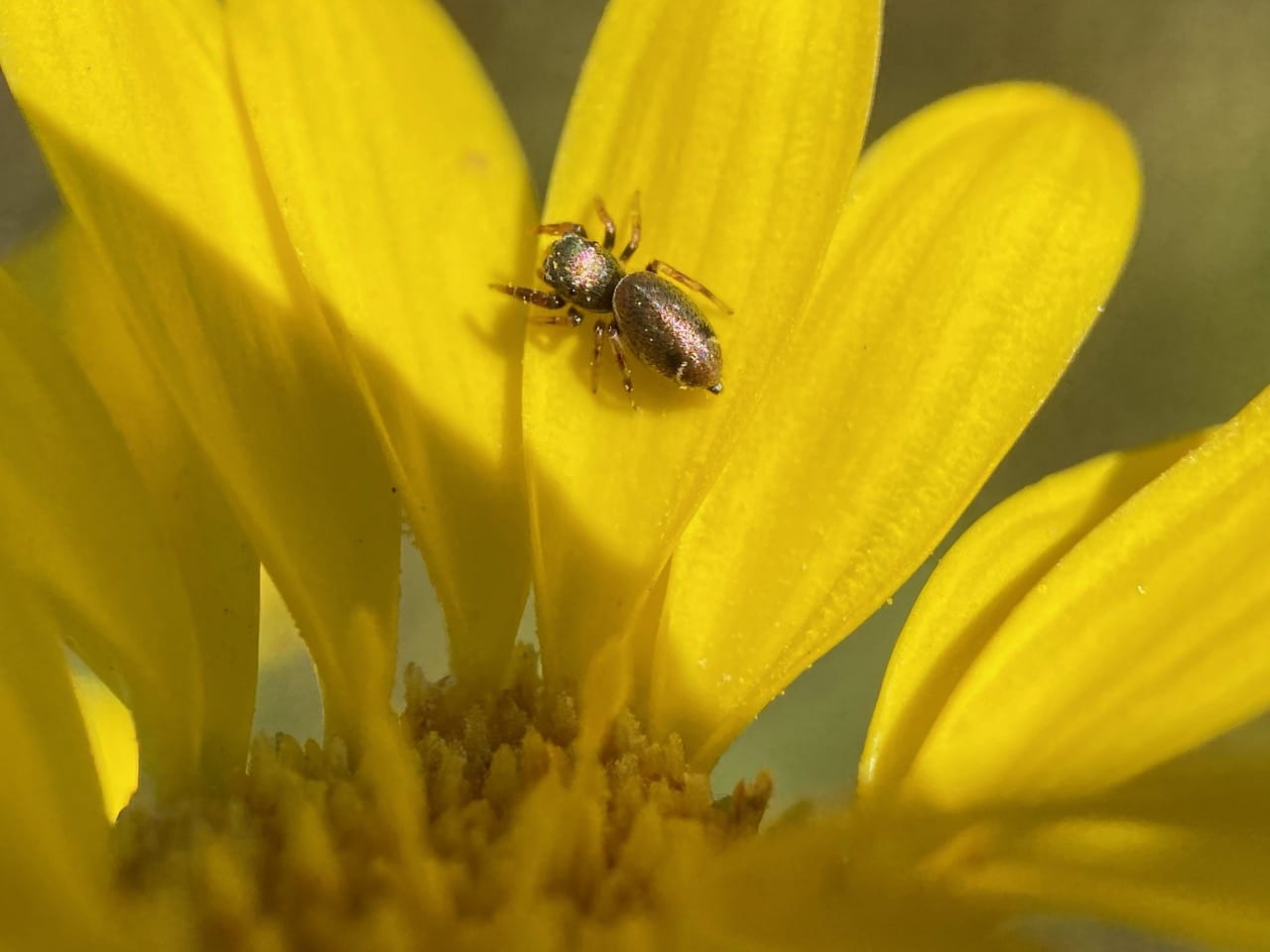
A female Buttonhook Leafbeetle Jumping Spider or Grapevine Jumping Spider, Sassacus vitis (family Salticidae) on a Grindelia ray petal is reflecting gold in the bright sunlight.
The spider is native to North America, with a range spanning from Canada to Panama. It is a small jumping spider with iridescent gold abdomen and white ring around the anterior surface of abdomen. Body is covered with golden scales. Males are 3.5 mm long, females 4.5 mm. The name vitis is Latin for “grapevine”. The spider is commonly found on shrubs and vines and in fields. Best known as a common resident of vineyards.
Salticids are free-roaming hunting spiders. They do not weave a web to catch prey. They stalk, then pounce on their prey. Just before jumping, the spider fastens a safety line to the substrate. It can leap 10-20 times their body length to capture prey. Their movement is achieved by rapid changes in hydraulic pressure of the blood. Muscular contractions force fluids into the hind legs, which cause them to extend extremely quickly. Jumping spiders are visual hunters. Their excellent vision has among the highest acuities in invertebrates. Since all their 8 eyes are fixed in place and cannot pivot independently from the body like human eyes can, jumping spiders must turn to face whatever they want to see well. This includes moving their cephalothorax up and down, an endearing behavior.
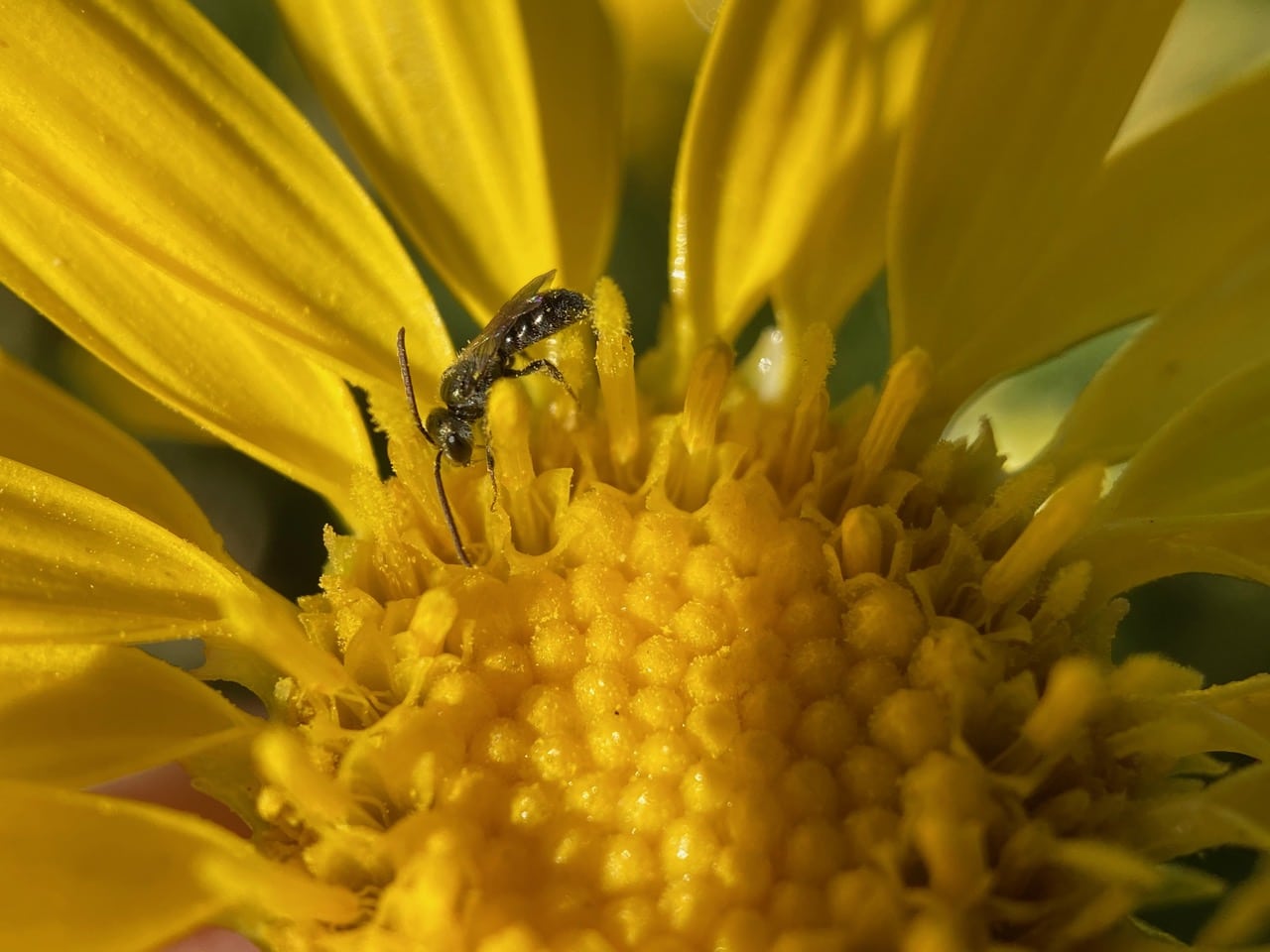
A male Metallic Sweat Bee, Lasioglossum (Dialictus) sp. (family Halictidae) is foraging on a Grindelia flowerhead, its body no longer than the stamen tubes of the florets.
Lasioglossum species are found worldwide, and they constitute the largest bee genus. The subgenus Dialictus are the most likely to be seen in the U.S., with over 300 species of these tiny metallic bees. The majority of Lasioglossum are generalists. Because they are so abundant throughout the flowering season, the bees are often important pollinators. Their sheer numbers are enough to achieve excellent pollination of many wild flowers, especially of plants in the Asteraceae, which have shallow floral tubes that are easily accessed by these minute bees.
Lasioglossum are closely related to the genera Halictus and Agapostemon. These genera are commonly called “sweat bees” because of their attraction to human sweat, which they drink for its salt content. Lasioglossum are dusky black to brown slender bees with bands of hair on their abdomen. Female Sweat Bees (family Halictidae) carry pollen in the scopae on their entire hind legs and underside of their abdomen.
Lasioglossum exhibit a range of social behaviors; the genus includes solitary, communal, semi social, primitively eusocial, and even parasitic species. Almost all Lasioglossum in the U.S. nest in the ground. Generally these nests are built in the spring by fertilized females (called foundresses) that spent the winter in hibernation. In social species, the foundresses behave much like the queen Bumble Bees – they lay the first batch of eggs that develop into the first generation of female workers. The nest grows with each additional generation of bees. Later broods may consist of both males and females. They mate, and at the end of the season the fertilized females hibernate til the following spring, repeating the life cycle of the colony.

Perched atop the stamens of a Wild Radish flower, a Common Grass Skimmer, Paragus haemorrhous (family Syrphidae) is feeding on pollen.
The Common Grass Skimmer, Paragus haemorrhous (family Syrphidae) is easily the smallest hover fly I know, measuring only about 4 mm in length. The species has a world-wide distribution, found in unimproved grassland, dune grass, open areas and pathsides in forest, and meadows. Adults visit flowers for nectar and pollen. Larvae feed on aphids on low herbaceous plants.

The fly descends to probe for nectar at the base of the flower.

The droopy, hunched posture is characteristic of the Grass Skimmers.

Back to the nectar!
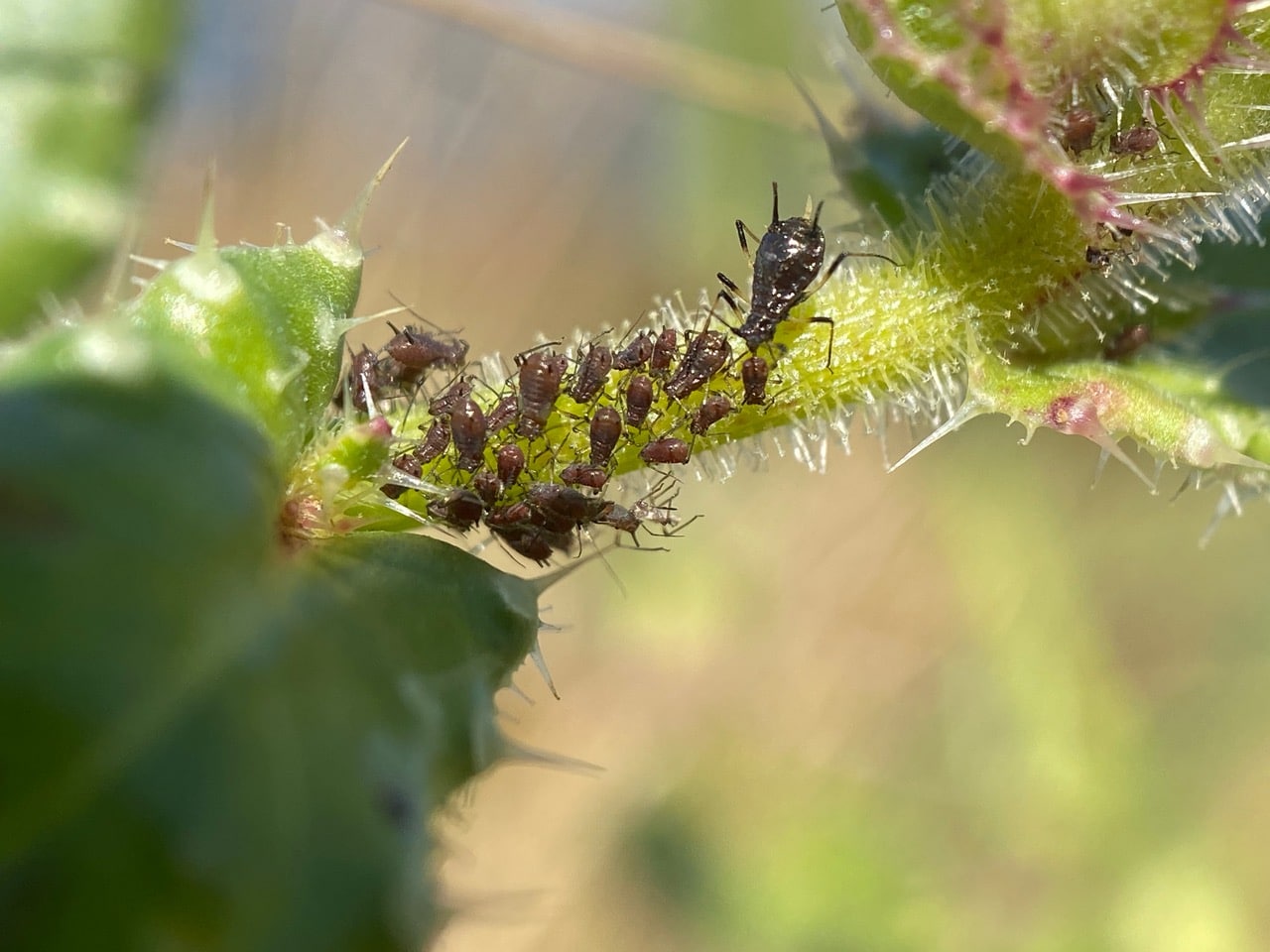
A large aphid is standing next to a group of young aphids of various sizes on a stem of Bristly Oxtongue, Helminthotheca echioides. She might be the mother of them all, with some of them born the same day.
Aphids are small sap-sucking insects in the order Hemiptera. A typical life cycle involves flightless females giving live birth to female nymphs, – who may also be already pregnant, an adaptation called telescoping generations – without the involvement of males. Maturing rapidly, females breed profusely so that the population multiplies quickly. Winged females may develop later in the season, allowing the insects to colonize new plants. In temperate regions, a phase of sexual reproduction occurs in the autumn, with the insects often overwintering as eggs.
The life cycle of some species involves an alternation between two species of host plants. Some species feed on only one type of plant, while others are generalists, colonizing many plant groups. Some ants have a mutualistic relationship with aphids, tending them for their honeydew and protecting them from predators.
Aphids usually feed passively on phloem of plants. Once the phloem vessel is punctured, the sap, which is under pressure, is forced into the aphid’s food canal. Aphids produce large amounts of a sugary liquid waste called “honeydew”. A fungus called sooty mold can grow on honeydew deposits that accumulate on leaves and branches, turning them black.
Born Pregnant- Aphids Invade With an Onslaught of Clones | Deep Look – YouTube
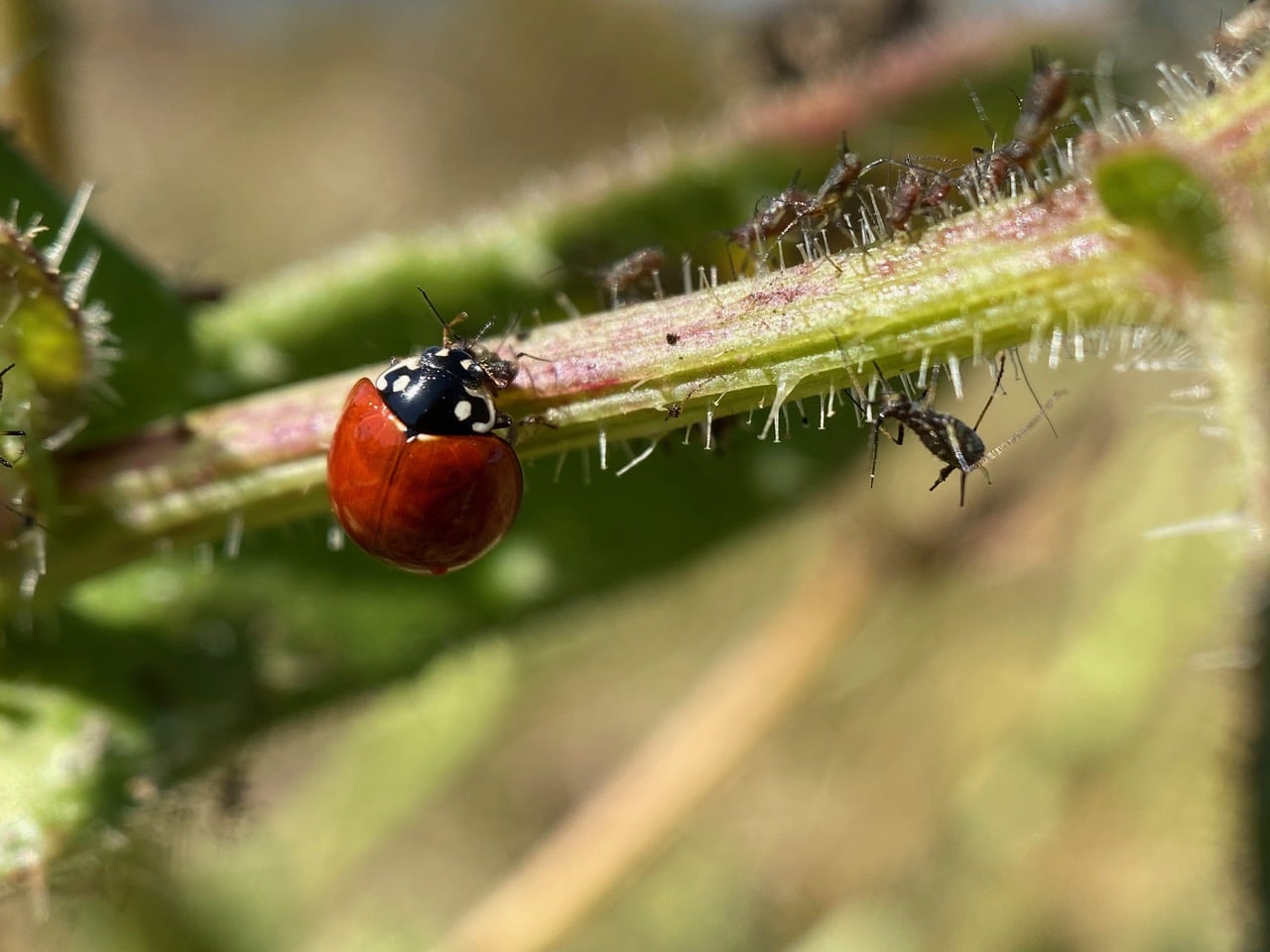
On another branch of the Bristly Oxtongue, a Spotless Lady Beetle, Cycloneda sanguinea (family Coccinellidae) is feeding on an aphid.
The Spotless Lady Beetle, Cycloneda sanguinea (family Coccinellidae) is a widespread species of lady beetle in the Americas. It is is large lady beetle with red, unspotted elytra (wing covers) ranging from 4-6.5 mm long. The black and white marks on the head and pronotum are very distinctive, and they are also gender-specific. These lady beetles are very often found feeding on aphids on milkweeds, but also occur on a number of other plants. Both adults and larvae are voracious predators of aphids and other soft-bodied insects.

Another view of the lady beetle chomping on the aphid with its chewing mouthparts. Not a pretty sight!
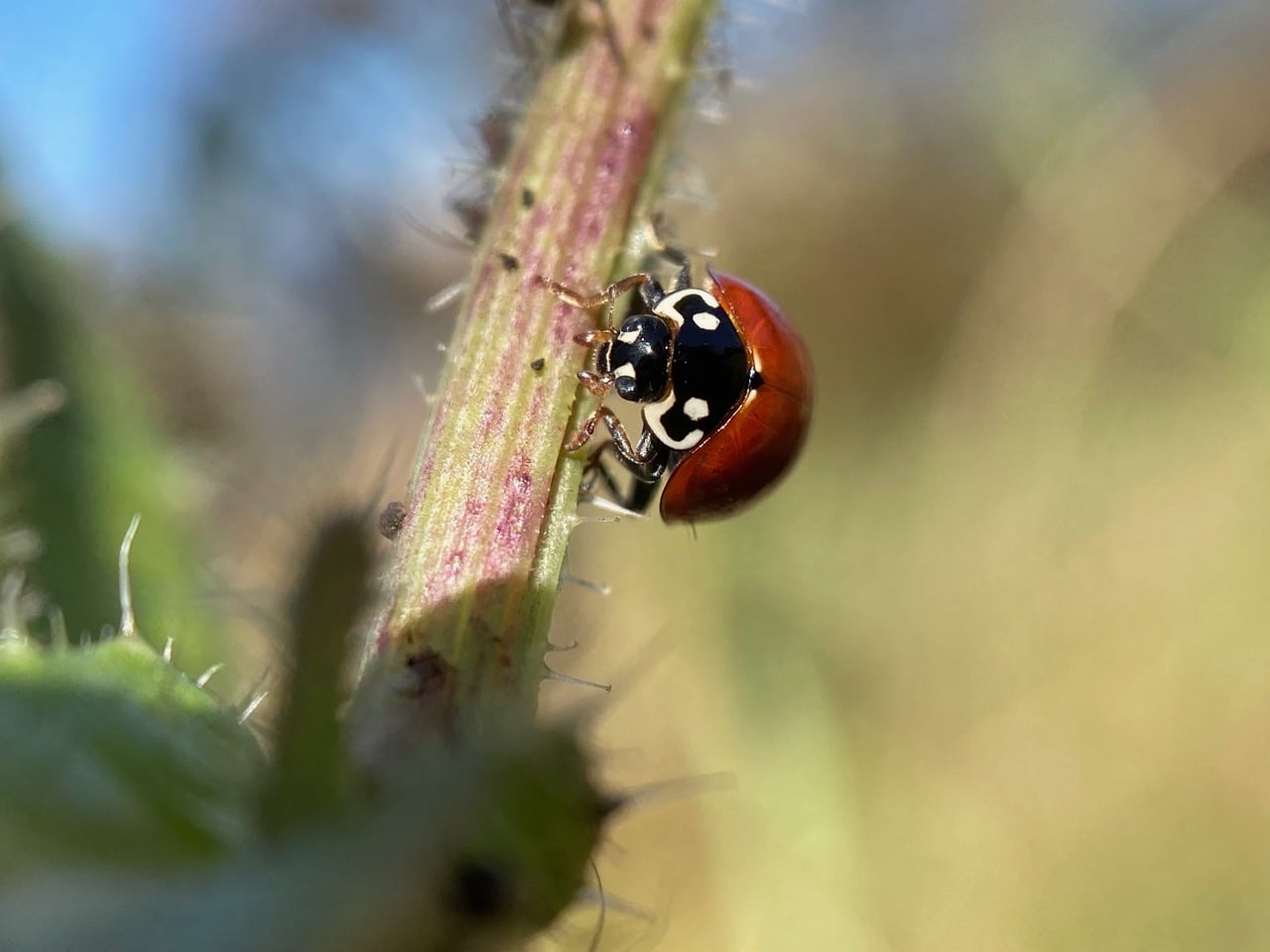
The Lady Beetle spends some time cleaning its mouthparts after eating the aphid.
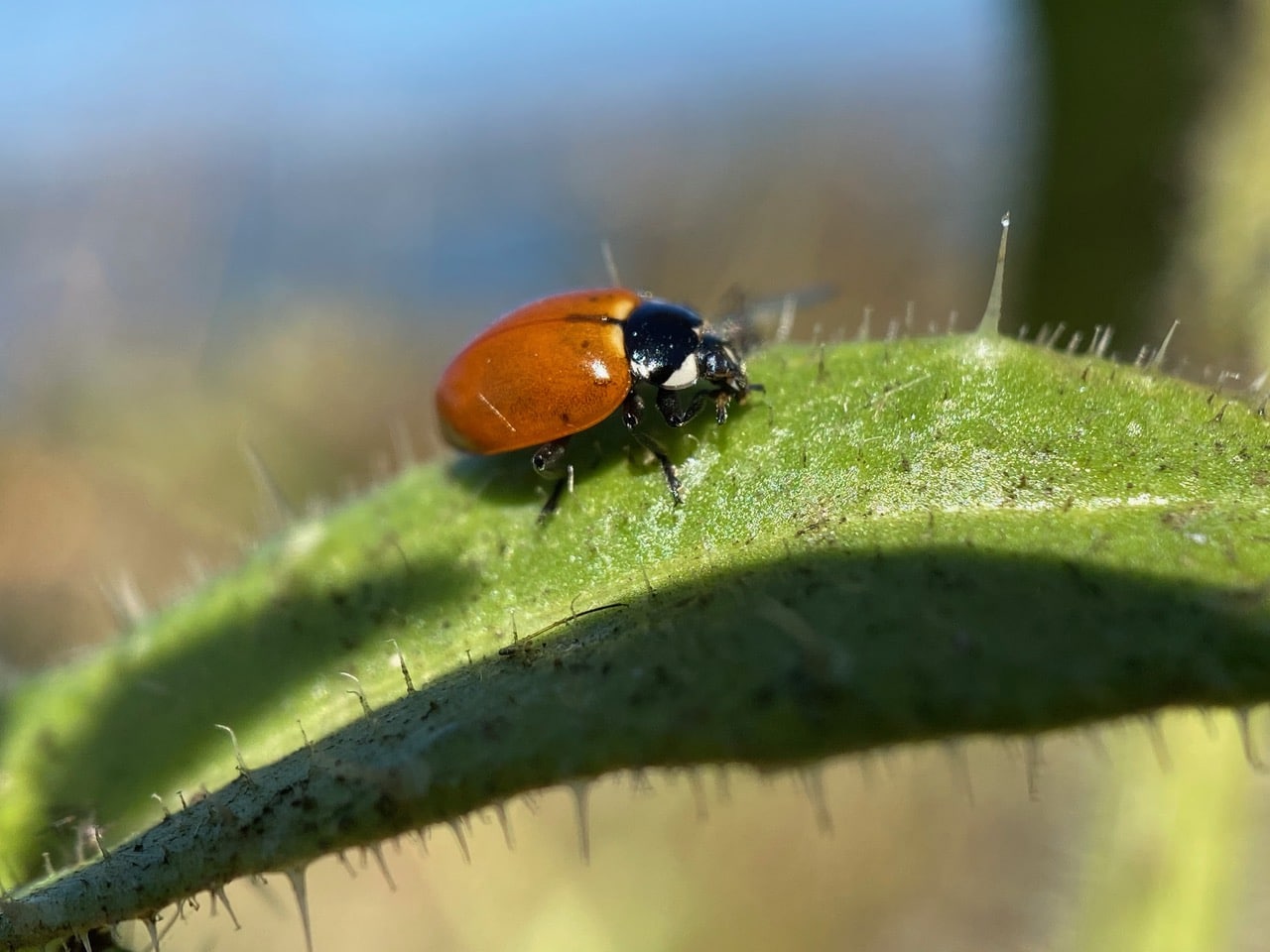
Wait, there’s a different species of Lady Beetle on the same plant! The white markings on the pronotum is quite distinct.


It is the Pacific Five-spotted Lady Beetle, Hippodomia quinquesignata ssp. ambigua (family Coccinellidae). The species is found in western North America. Elytral color pattern is extremely variable, with some being completely spotless. Pronotum with or without convergent pale spots.
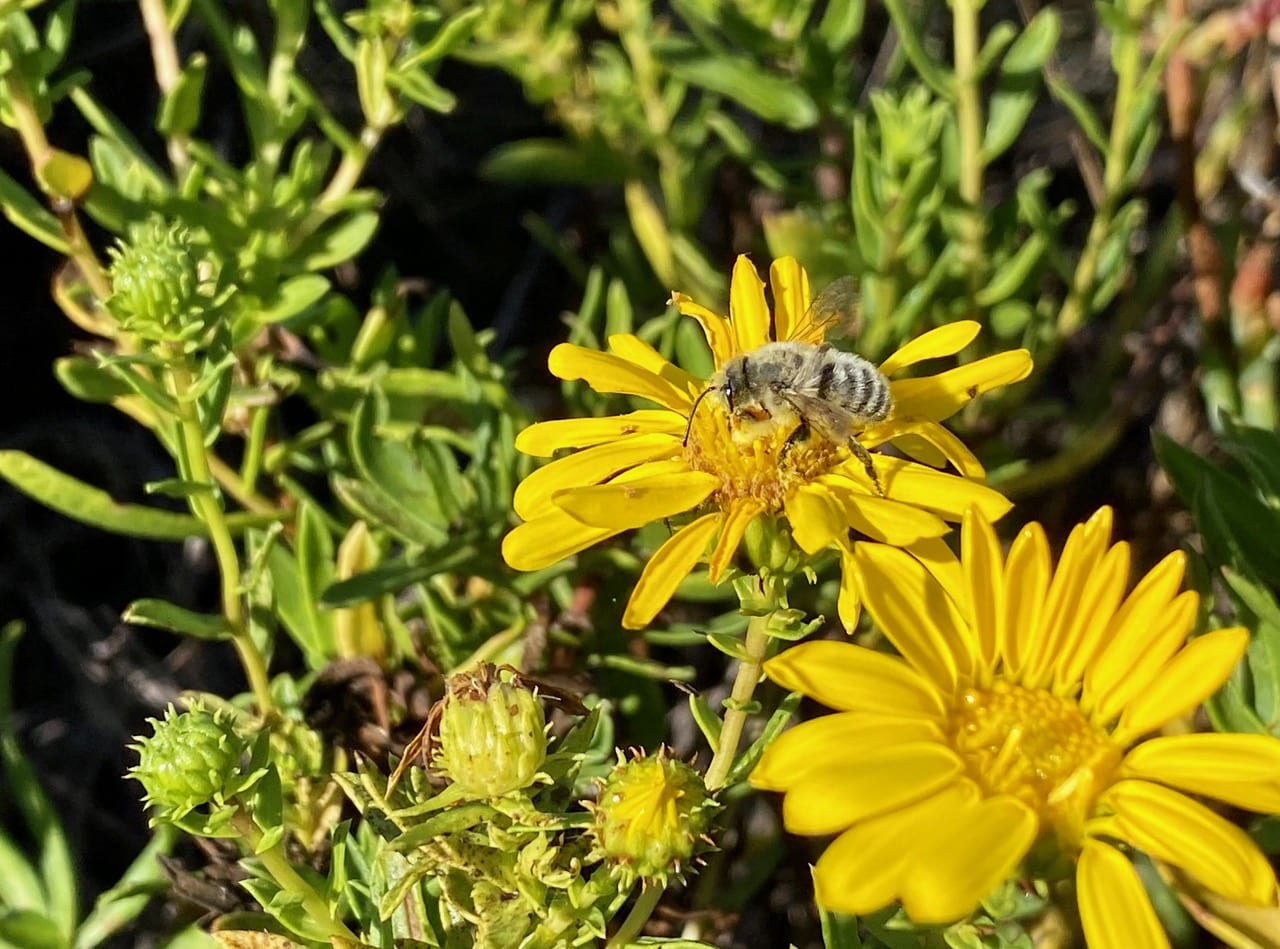
A male Western Leafcutter Bee, Megachile perihirta (family Megachilidae) is foraging on a Grindelia flowerhead.
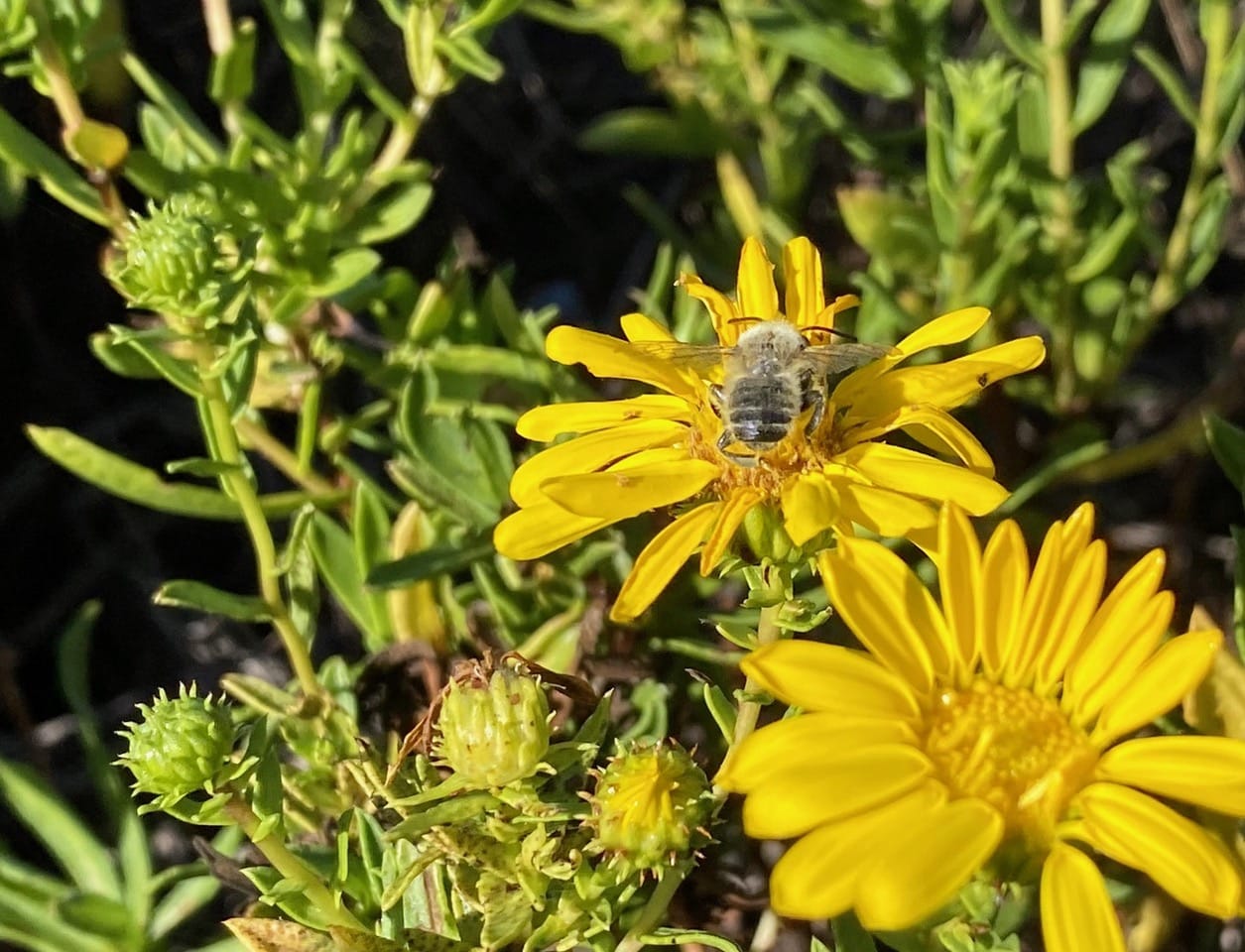
Leaf-cutter Bees, Megachile sp. (family Megachilidae) are stout-bodied, usually with pale hair on the thorax and stripes of white hairs on the abdomen. Females usually have a triangular abdomen with a pointed tip, and males’ faces are covered with dense, pale hair. Flight season is from May into September, with peak activity from June to August.
Solitary females construct nests in tubular cavities, including hollow stems, tree holes, and abandoned beetle burrows in wood. Many use holes drilled into wood, straws, or other manufactured tunnels. Females cut pieces from leaves or flower petals for use in the construction of brood cells. Most Megachile females are generalists when foraging for pollen. Pollen is transported in dense scopae on the underside of the abdomen.
Photos of Western Leafcutter Bee (Megachile perihirta) · iNaturalist


A large fly has landed on a Grindelia flowerhead. It behaves every bit like a hover fly, holding its wings out at an angle from the body.
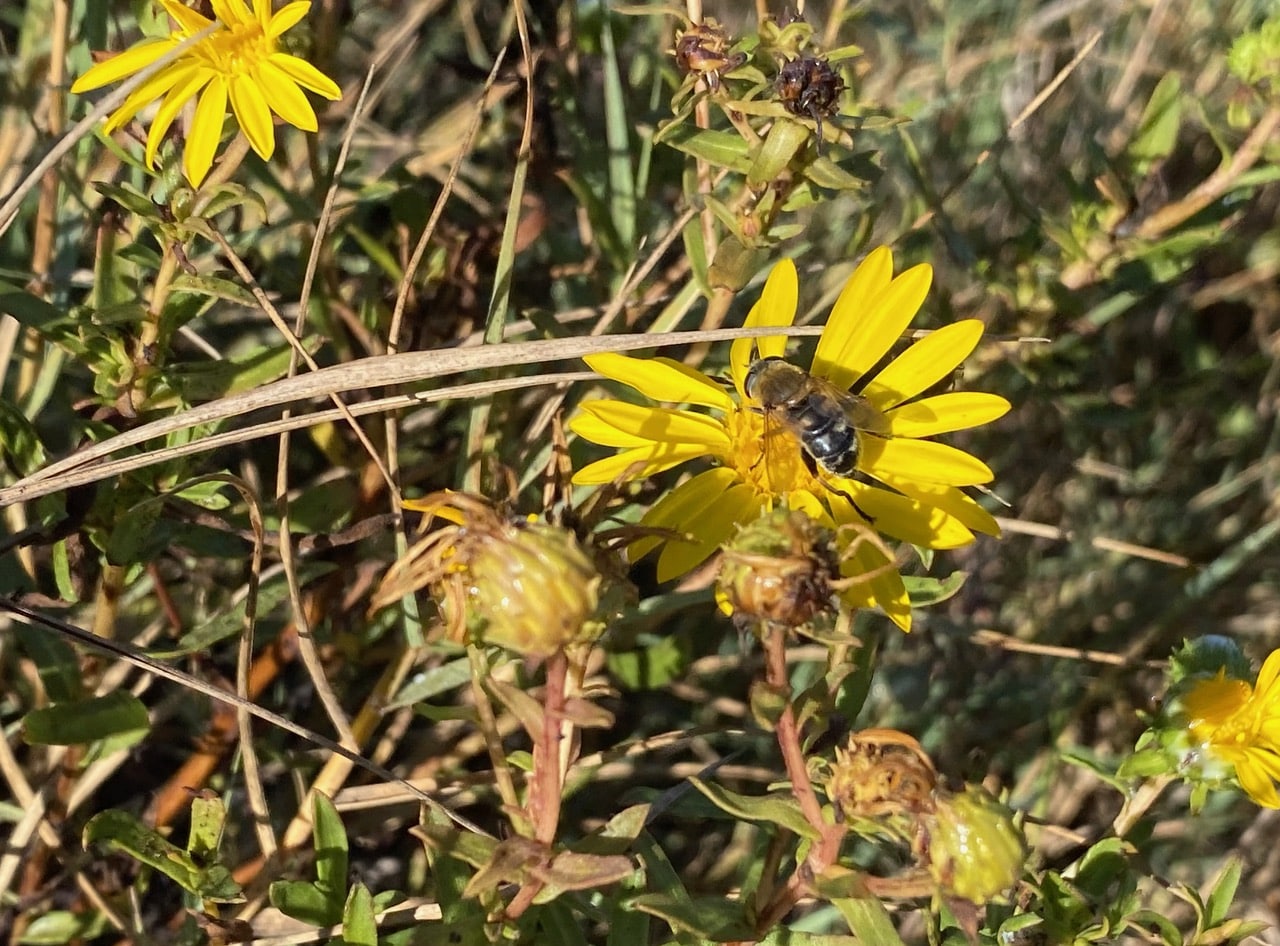
iNaturalist has helped identify it as the Dimorphic Sickleleg, Polydontomyia curvipes (family Syrpidae). The males of the species have a red abdomen, so our friend here is probably a female. Many hoverflies are Batesian mimics of bee/wasp, but the Sickleleg seems to have done away with the black-and-yellow theme, preferring a drab appearance, at least for the females.

There is little available information about the biology of this hover fly. Since the species is in the tribe Eristalini, its larvae are probably rat-tailed maggots that develop in aquatic or semi-aquatic habitats. A characteristic feature of rat-tailed maggots is a tube-like, telescoping breathing siphon located at its rear end. This acts like a snorkel, allowing the larva to breathe while submerged. When fully extended, the siphon can be several times the larva’s body length, giving rise to the common name of “rat-tailed maggot”. These larvae are often found in stagnant, oxygen-deprived water, with a high organic content.
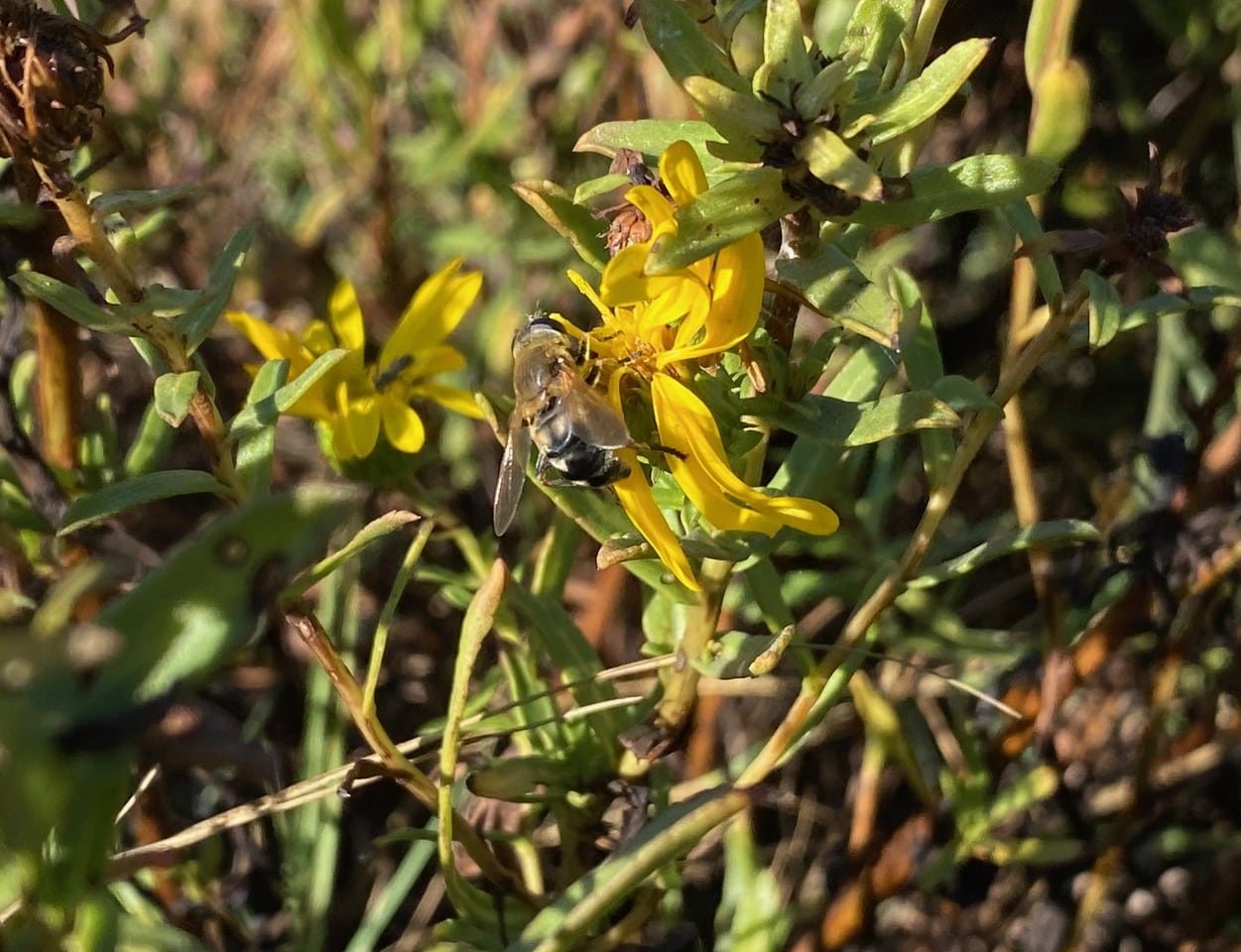
The female Dimorphic Sickleleg, Polydontomyia curvipes (family Syrphidae) is foraging on a Grindelia flowerhead. Males of the species have bright reddish-orange abdomen and much larger and curved femur. I have yet to see one.