Pollinator Post 9/29/24 (1)
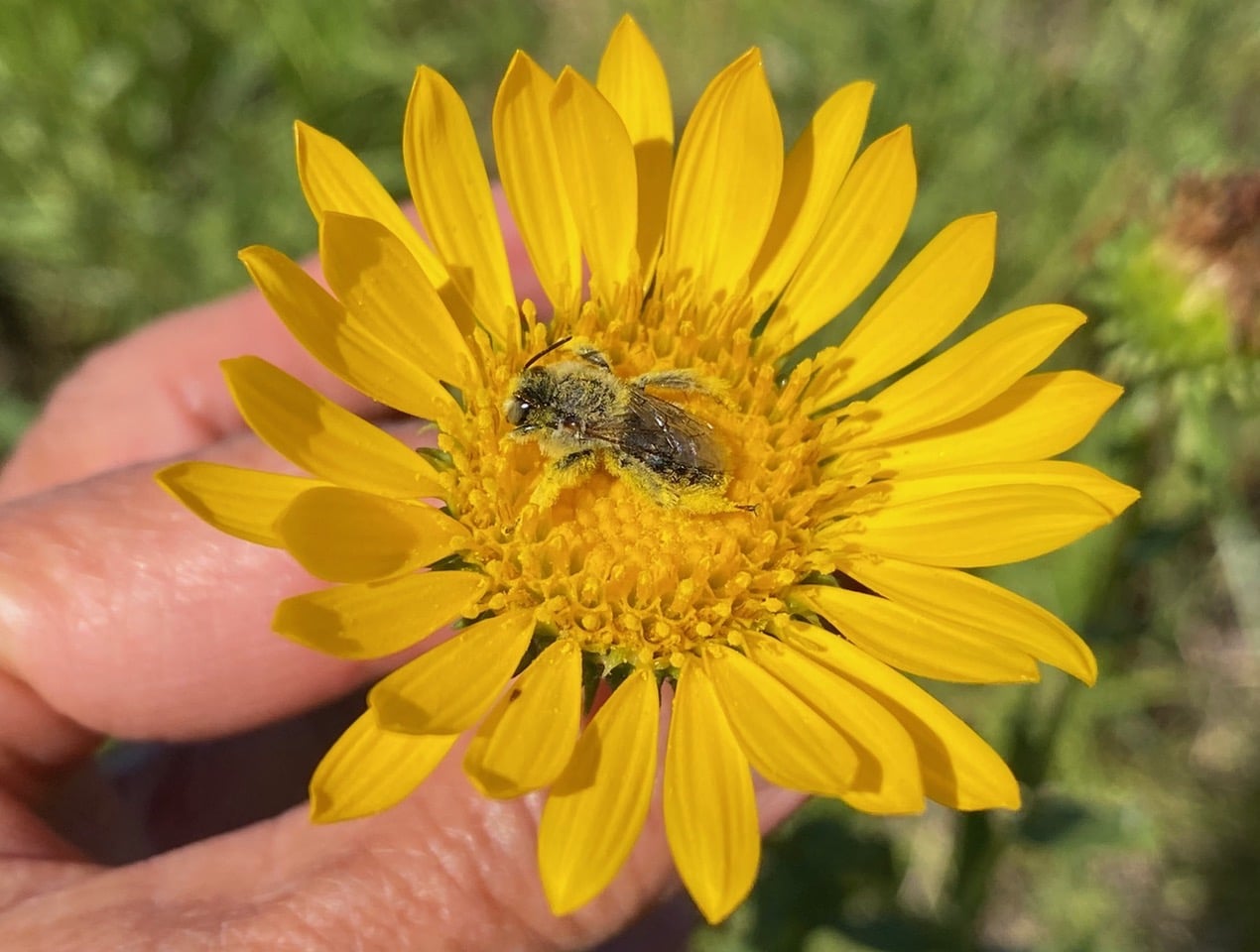
Fred and I are taking our regular walk at Shoreline Park on Bay Farm Island this afternoon.
The first insect I spot is this pollen covered Summer Longhorn Bee, Melissodes sp. (family Apidae) resting prone on a flowerhead of Oregon Gumweed, Grindelia stricta. I steady the flowerhead with my fingers for a better look. The bee shows no reaction and remains motionless. From the short antennae, I gather that it is a female, but the scopae on her hind legs have been so worn down that it is hard to tell her from a male. Female bees do not usually sleep in the open. Is she dead? I don’t have the heart to prod her to find out. Melissodes is, after all, a summer species, and we are almost into October now. I have come across a couple of dead males lately, but this is the first female. The bee has been gathering pollen until her last breath. So typical for these hard working bees, faithful to their beloved Grindelia to the end. Melissodes is the major pollinator for the plant at Bay Farm – from my observations, these Asteraceae specialists forage from Grindelia exclusively at this location.
The Summer Longhorn Bees, Melissodes sp. (family Apidae) are medium to large bees, stout-bodied, usually with gray hair on the thorax and pale hair bands on the abdomen. Males usually have yellow markings on their faces and have very long antennae from which their common name is derived. They are active May to September, with peak flight in late June to early August. The females prefer flat, bare ground for digging their solitary nests, though they sometimes nest in aggregations. Pollen is transported in scopae on the hind legs. Pollen loads are often copious and brightly colored and thus very distinguishable. Melissodes are specialists on Asteraceae – females gather pollen from flowers of Aster, Bidens, Coreopsis, Cosmos, Encelia, Gaillardia, Helianthus, and Rudbeckia ssp.
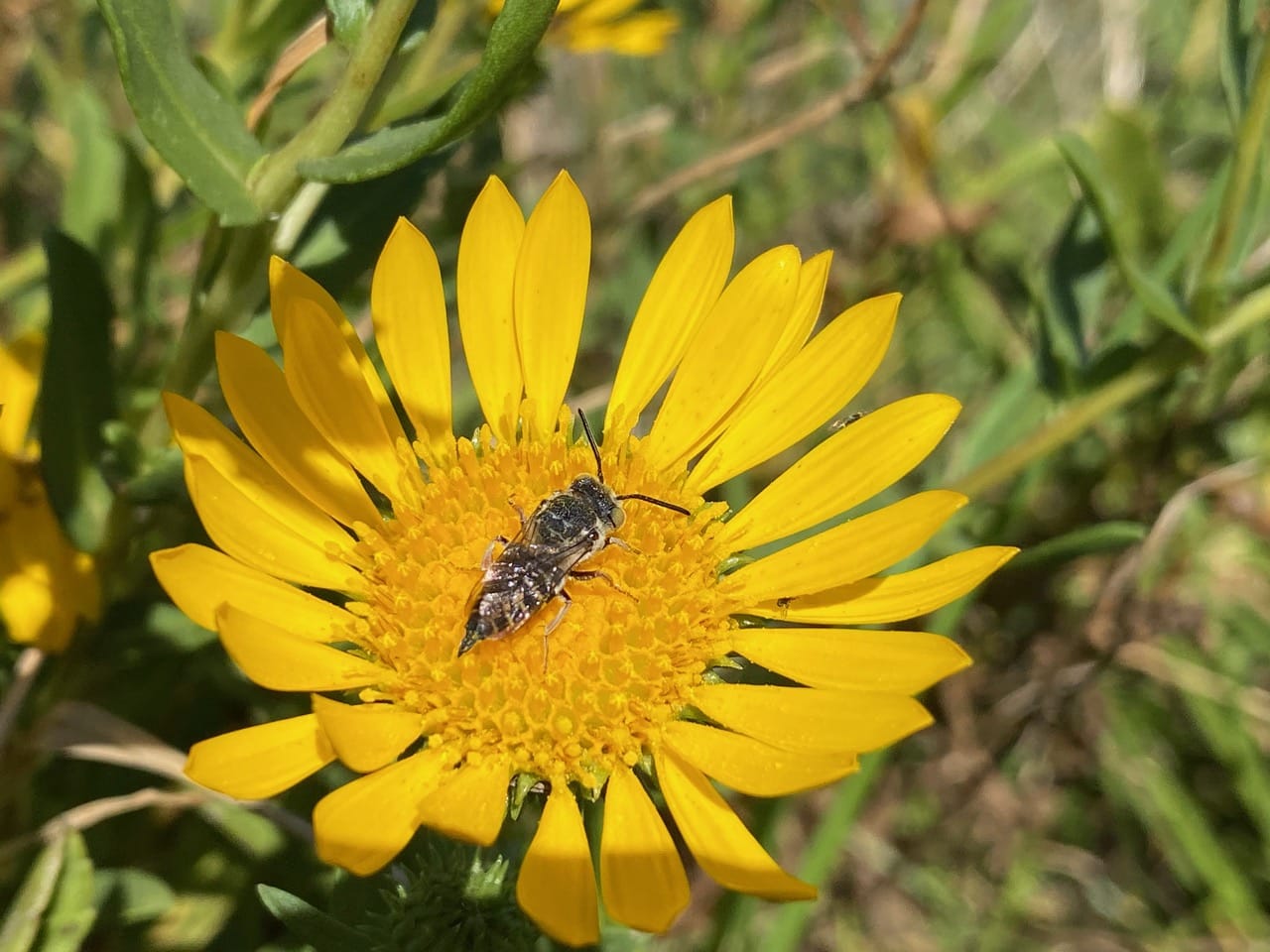
Hey, that’s a female Coelioxys on the Grindelia flowerhead! Coelioxys, commonly known as the Sharptail Bee or the Cuckoo Leafcutter Bee, is a genus of solitary kleptoparasitic cuckoo bee belonging to the family Megachilidae. It is native to North America.
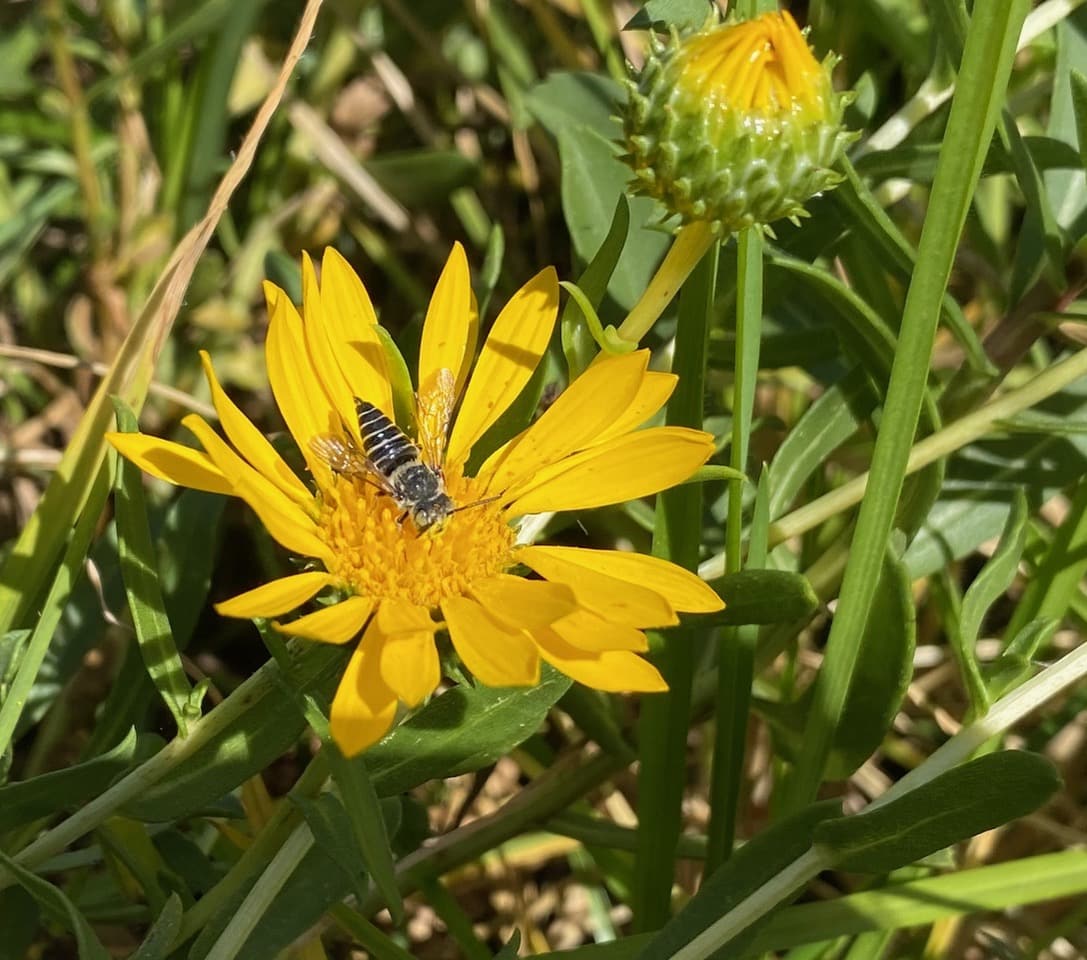
The bee flies to another flowerhead and opens her wings. Ah, now we can really see the banding on her sharply pointed abdomen!
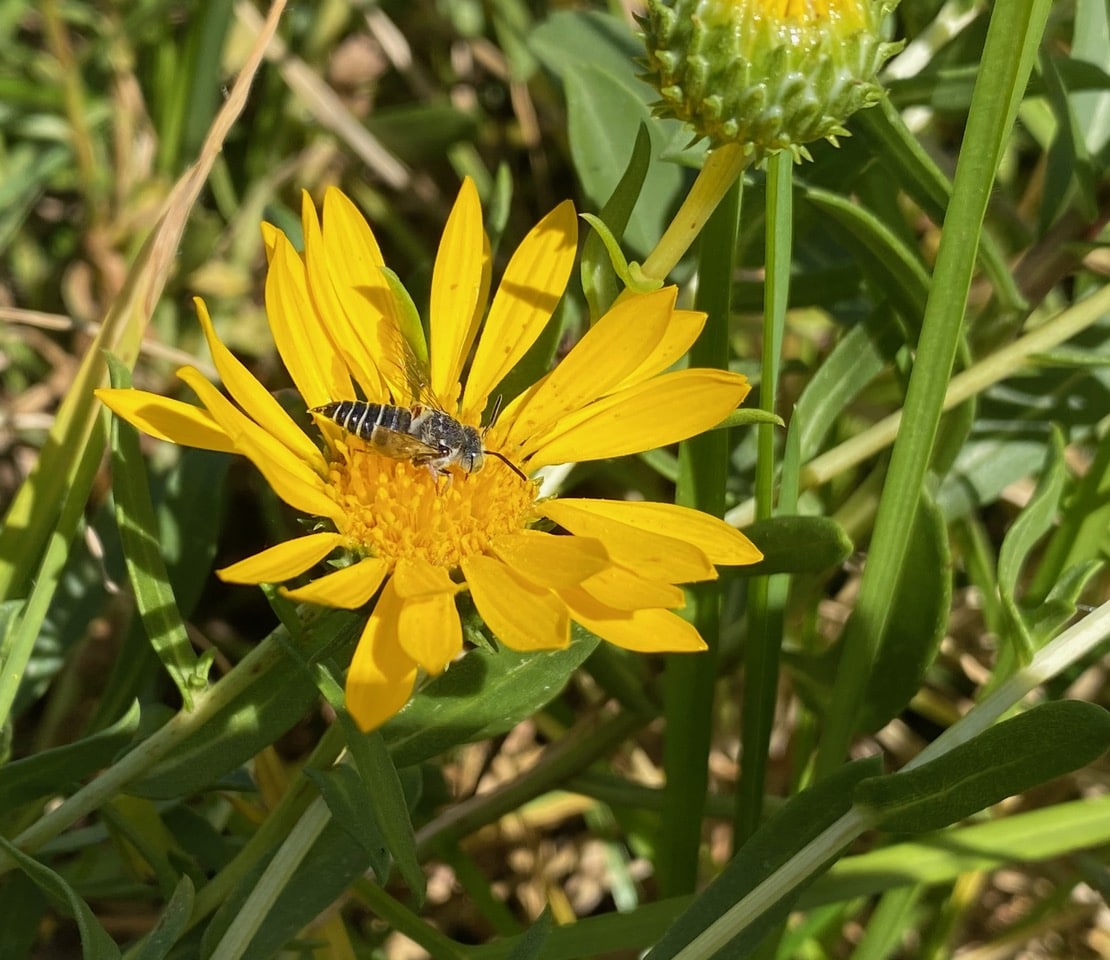
The term cuckoo bee refers to a variety of different bee lineages which have evolved the kleptoparasitic behavior of laying their eggs in the nests of other bees, similar to the behavior of cuckoo birds. Female cuckoo bees lack pollen-collecting structures and do not construct their own nests. Cuckoo bees typically enter the nests of pollen-collecting species, and lay their eggs in cells provisioned by the host bee. When the cuckoo bee larva hatches, it consumes the provision in the nest, and kills the host larva. Many cuckoo bees are closely related to their hosts, and may bear similarities in appearance reflecting this relationship. Others parasitize bees in families different from their own.
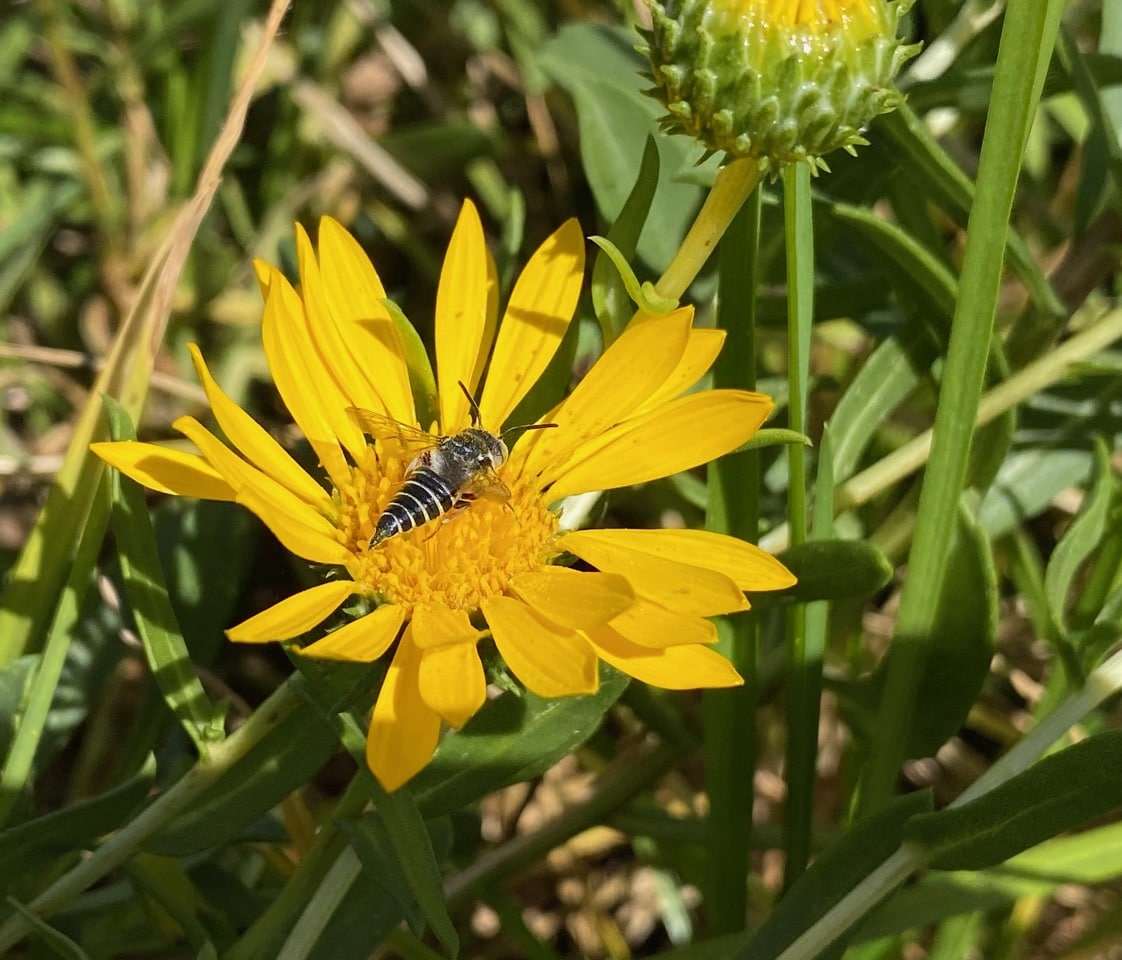
The Cuckoo Leafcutter Bees belong to the genus Coelioxys, in the same family as their hosts, Megachilidae. Members of the genus Coelioxys share the distinctive trait of having hairs on their eyes. In addition, the back rim of the bee’s scutellum (the second segment of the thorax) has prominent toothlike protrusions called axillae. In Greek, Coelioxys means “sharp belly”, referring to the tapered, pointed abdomens of cuckoo leaf cutters. The bees have dark abdomens banded by short pale hairs; thorax with prominent axillae; red, black or red-and-black legs; and green eyes. Female Coelioxys have pointed, conical abdomens with spearlike tips. The spade-shaped abdominal tips allow the female cuckoos to break through the brood-cell walls that leafcullters construct with leaves, petals and other materials. Males have abdomens armed with multiple pronged tips.
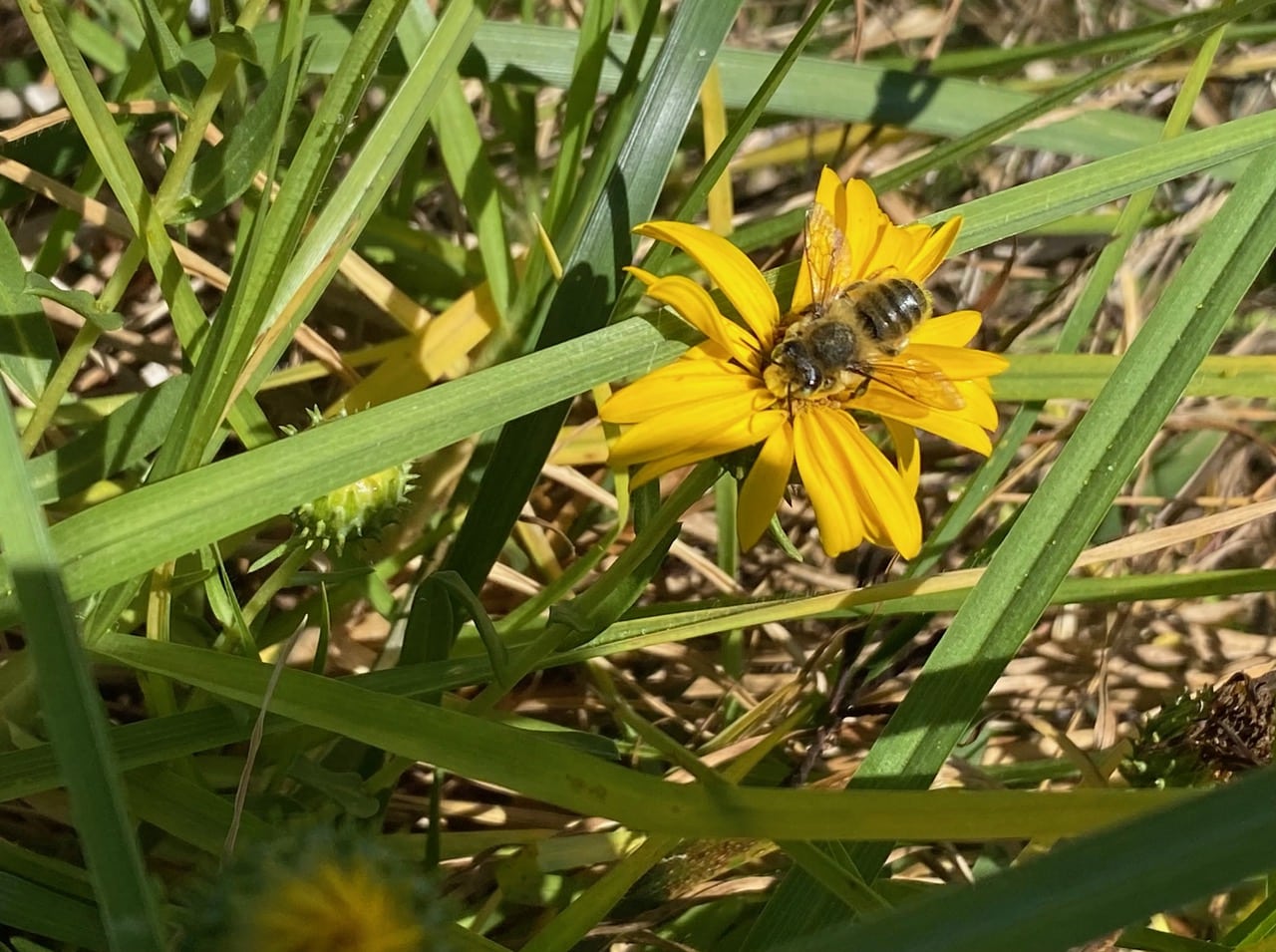
A male Western Leafcutter Bee, Megachile perihirta (family Megachilidae) is foraging on a Grindelia flowerhead. There is a healthy population of these bees along the shoreline here. It’s no wonder that the cuckoo bees that parasitize them are found here as well.
Leaf-cutter Bees, Megachile sp. (family Megachilidae) are stout-bodied, usually with pale hair on the thorax and stripes of white hairs on the abdomen. Females usually have a triangular abdomen with a pointed tip, and males’ faces are covered with dense, pale hair. Flight season is from May into September, with peak activity from June to August.
Solitary females construct nests in tubular cavities, including hollow stems, tree holes, and abandoned beetle burrows in wood. Many use holes drilled into wood, straws, or other manufactured tunnels. Females cut pieces from leaves or flower petals for use in the construction of brood cells. Most Megachile females are generalists when foraging for pollen. Pollen is transported in dense scopae on the underside of the abdomen.
Photos of Western Leafcutter Bee (Megachile perihirta) · iNaturalist
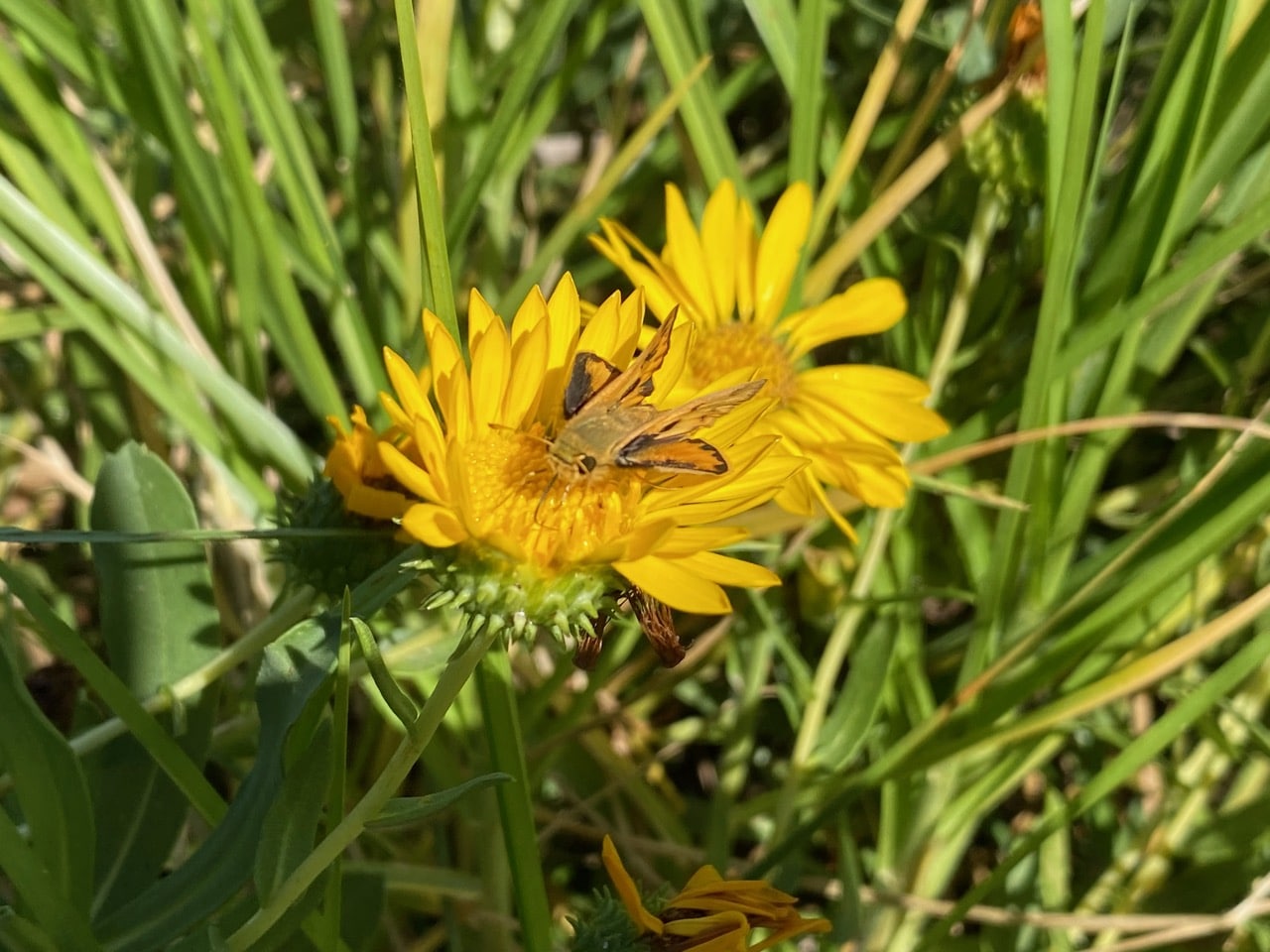
A Skipper lands on a Grindelia flowerhead to take nectar.
Skippers are a family, the Hesperiidae, of the order Lepidoptera (butterflies and moths). They are named for their quick, darting flight habits. Most have the antenna clubs hooked backwards like a crochet hook. They also have generally stockier bodies and larger compound eyes than the other butterflies. Their wings are usually small in proportion to their bodies. When at rest, skippers keep their wings usually angled upwards or spread out, and only rarely fold them up completely. Californian species are mostly brown or tan, with black, orange, or yellow markings.
Skipper caterpillars are usually green or brown, sometimes yellowish, never brightly colored. They have a distinctive “collar”, a narrow ring around the body right behind the head. Caterpillars are camouflaged and often hide during the day. Many species make nests of leaves and silk for additional protection. Most North American species feed on grasses, but some common species eat shrubs and trees, especially in the bean family. Most species are limited to a single group of food plants. Adult skippers are only active during the day, but Skipper caterpillars feed mainly when it is dark or partly light.

A female Texas Striped Sweat Bee, Agapostemon texanus (family Halictidae) is foraging on a Grindelia flowerhead. In a split second, she is dive-bombed by a male who attempts to mate with her.
The genus Agapostemon is widespread and abundant throughout North America. These ground nesters are most diverse and abundant in temperate regions and southwestern U.S. deserts. Agapostemon are commonly called “sweat bees” because they are closely related to, and resemble bees in the Halictus and Lasioglossum genera. Unlike those bees however, Agapostemon are not attracted to human sweat.
Agapostemon are brightly colored metallic green or blue bees measuring 7 to 14.5 mm long. Most species have a metallic green head and thorax, and black-and-yellow striped abdomen; some females are entirely bright green or blue. Females carry pollen on scopal hairs located on their hind legs. Agapostemon are generalists. Like other members of the family Halictidae, they are short-tongued and thus have difficulty extracting nectar from deep flowers. Males are often seen flying slowly around flowers looking for females. The bees favor flowers with high densities. They are active summer to fall.
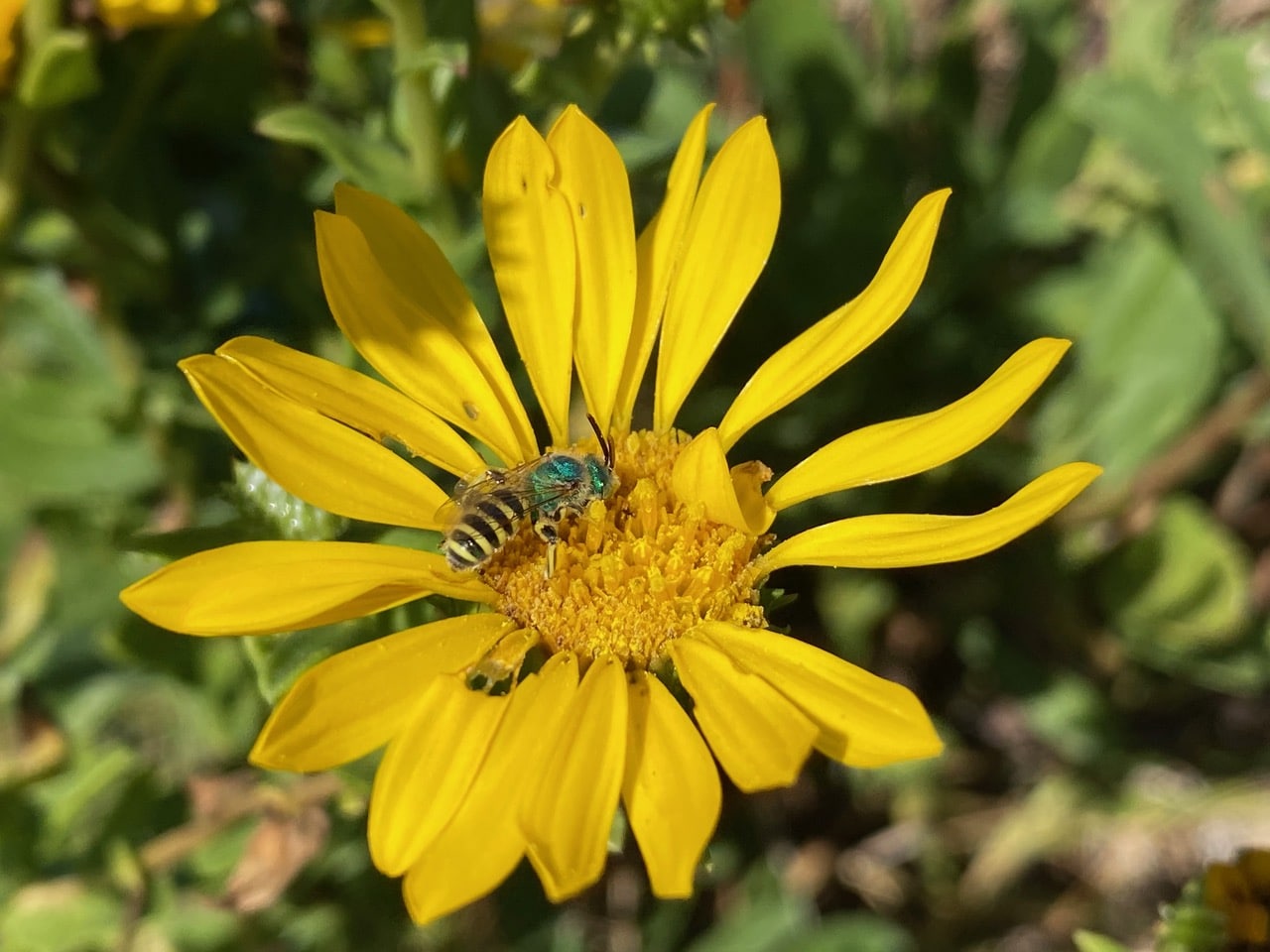
Rejected by the female, the male Texas Striped Sweat Bee, Agapostemon texanus (family Halictidae) settles down on another flowerhead to take nectar. Note his distinct black-and-yellow striped abdomen.

it is difficult to photograph the Sedgesitters, the dusky, metallic hover flies in the genus Platycheirus unless you have good light.
While most hover flies are known for their Batesian mimicry of bees and wasps, sporting variations of black/yellow patterns on their body, the Sedgesitters have a dusky, metallic appearance. Platycheirus is found in grass and herb vegetation. Adults of many species feed on pollen of wind-pollinated plants, such as Salix, Plantago, Poaceae, Cyperaceae, but they visit other flowers also. Many stay active during cold and rainy weather. Larvae feed on aphids.
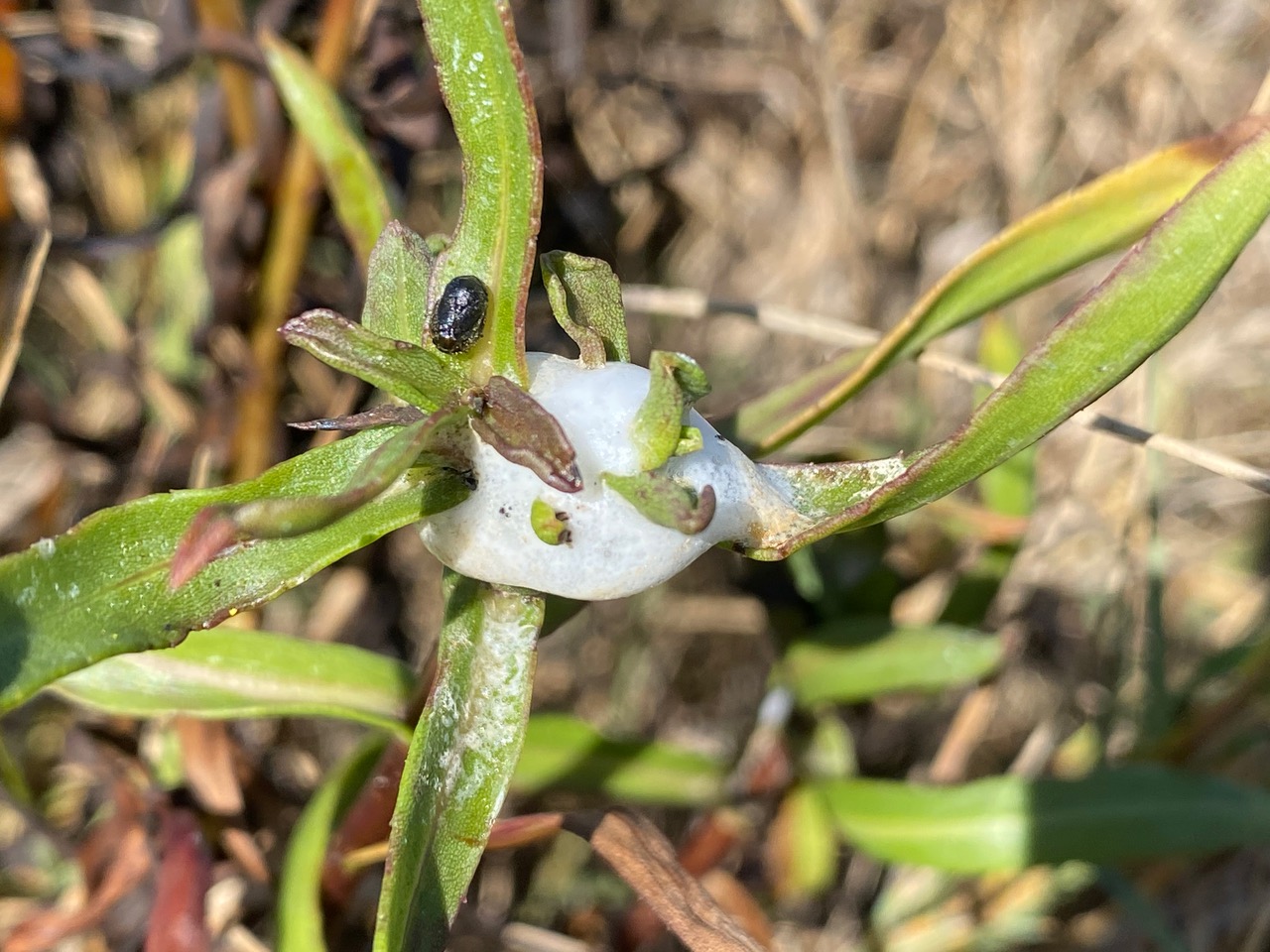
Look, there’s a black Froghopper or adult Spittlebug on that Grindelia leaf next to a foam mass.
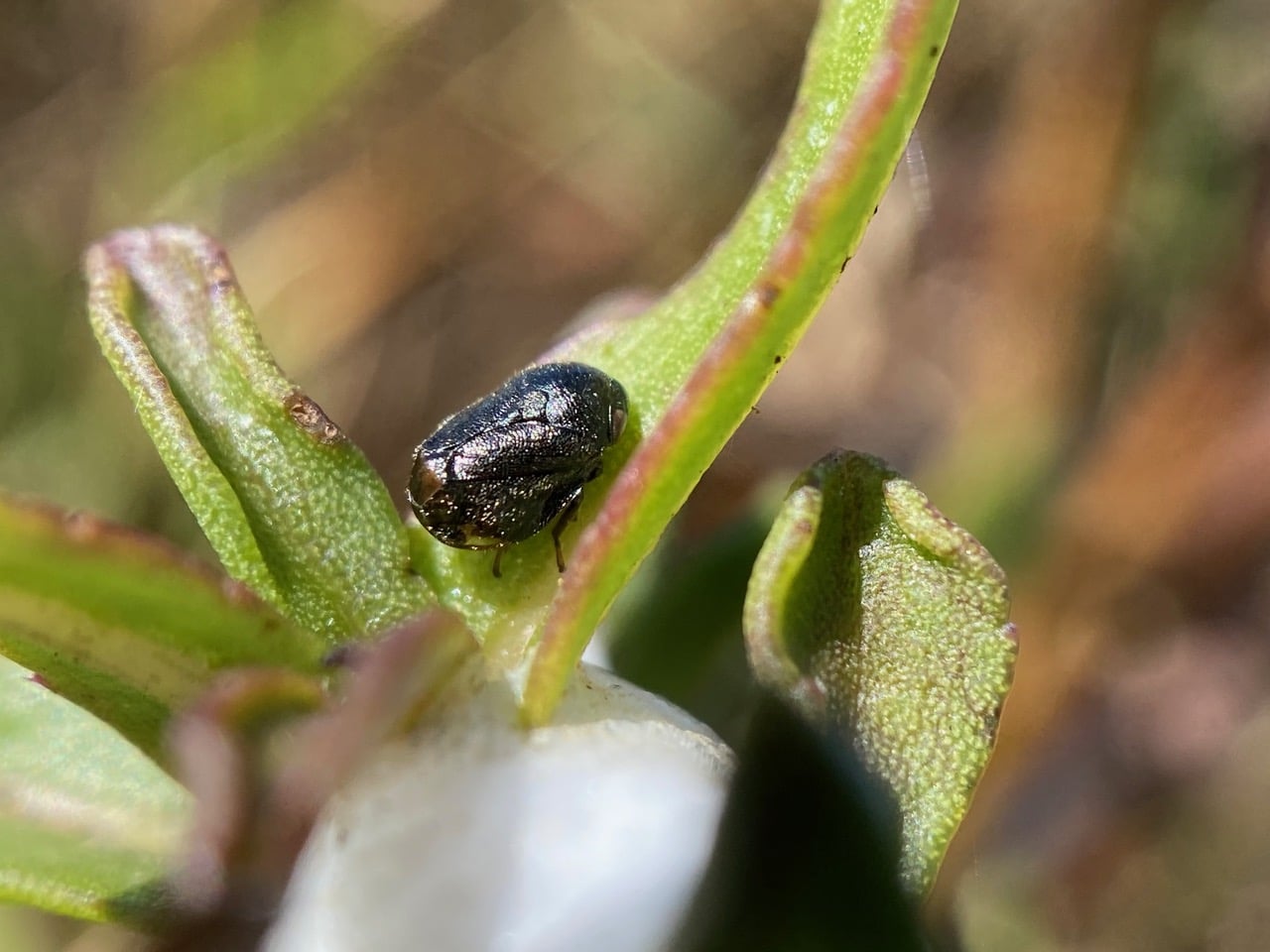
Close up of the Spittlebug, Complex Clastoptera lineatocollis (family Clastopteridae).
The Froghoppers (superfamily Cercopoidea) are a group of “true bugs” in the order Hemiptera. Adults are capable of jumping many times their height and length, giving them their common name, but many species are best known for their plant-sucking nymphs which produce foam shelters, and are referred to as “spittlebugs”. The superfamily currently consists of three families: the Aphrophoridae, Cercopidae, and Clastopteridae. The nymphs produce a cover of foamed-up plant sap visually resembling saliva, hence the common name. Whereas most insects that feed on plant sap tap into the nutrient-rich fluid from the phloem, the spittlebugs utilize the much more dilute sap flowing upward from the roots via the xylem. The insects’ digestive system contains symbiotic bacteria that provide them with the essential amino acids. The large amount of excess water that must be excreted and the evolution of special breathing tubes allow the young spittlebug nymphs to grow in the relatively protective environment of their foam shelters. The foam serves a number of purposes. It hides the nymph from the view of predators and parasites, and it insulates against heat and cold, providing thermal as well as moisture control. It also has an acrid taste that deters predators.
Froghoppers are champion jumpers among insects, out-performing even the fleas. The bug can leap the human equivalent of a skyscraper without a running start. It is the highest jumping insect proportional to body size. The muscles in its hind legs act like a “catapult” to release energy explosively.
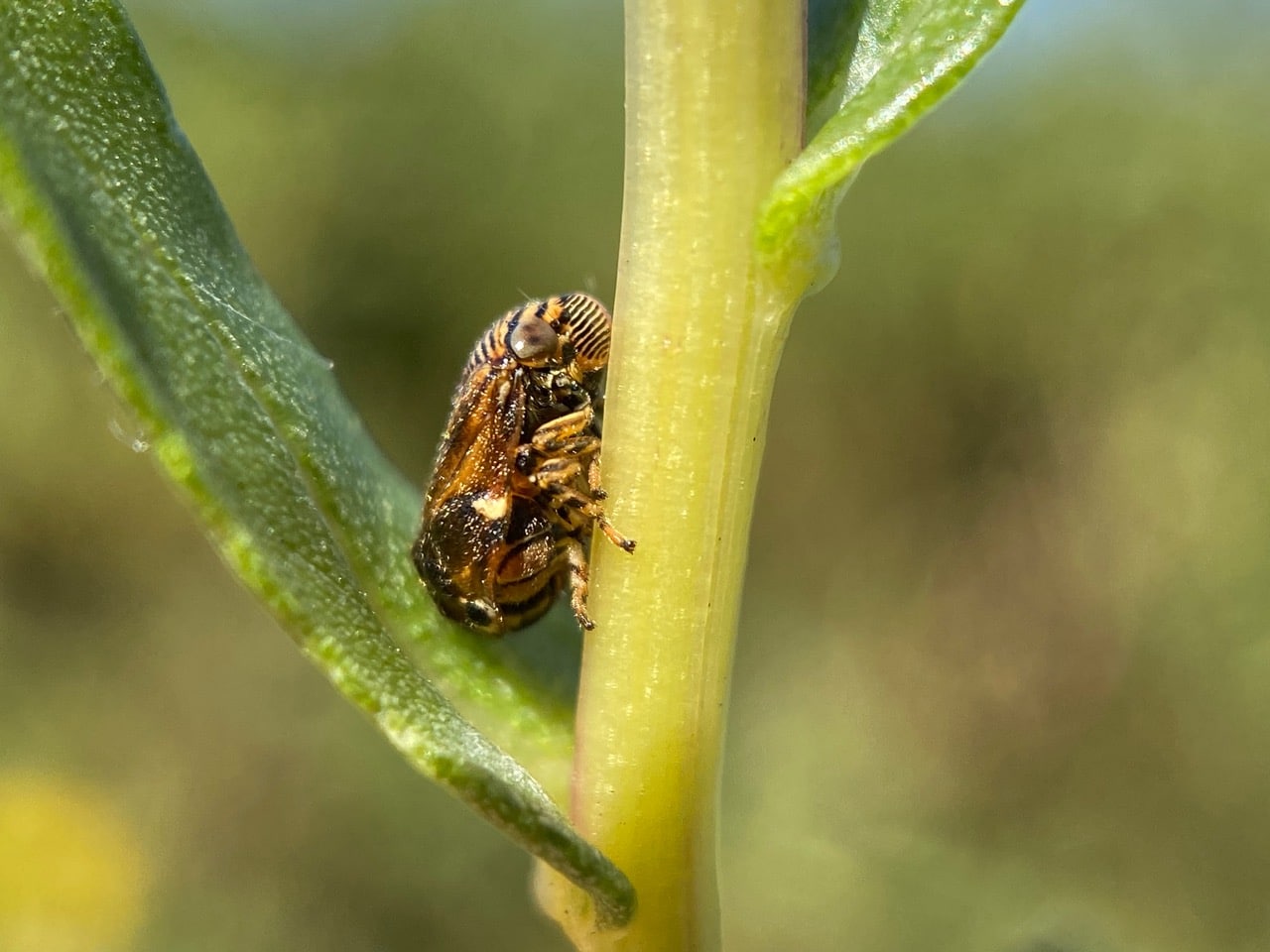
Hey, here’s a larger brown Spittlebug! Both the black and the brown individuals have been identified by iNaturalist as the same species, Complex Clastoptera lineatocollis (family Clastopteridae). I suspect that the species might display sexual dimorphism. Are the smaller black individuals the males and the larger, brown ones females?

The damage caused by the Spittlebugs is becoming evident in the patch of Grindelia hugging this stretch of the shoreline. Many of the leaves and whole branches infested with the bugs are turning brown. The flowerheads fade earlier than usual, or simply fail to open. Although there’s an overwhelming abundance of the foam masses to start with, they are slowly disappearing as the adults have emerged and the frothy masses have dried up and disintegrated. I am seeing very few adult Spittlebugs, compared to the initial number of foam masses. Perhaps most of the damage to the host plant is caused by the nymphs feeding. In fact, I am not even sure if the adults feed at all.
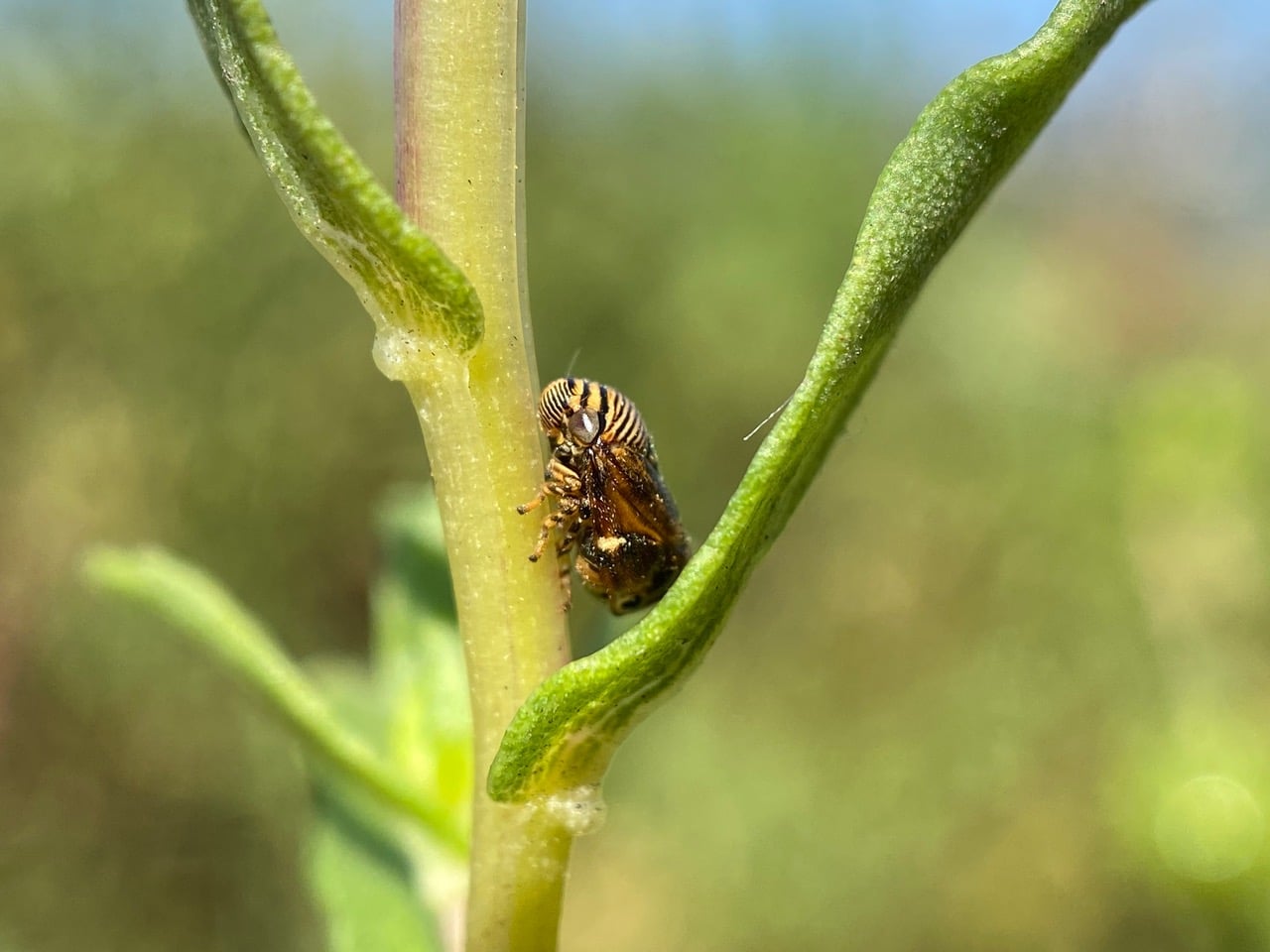
When threatened, the adult Spittlebugs hardly ever jump. They simply sidle to the other side of the stem. Their mouthparts don’t seem to be attached to the plant.

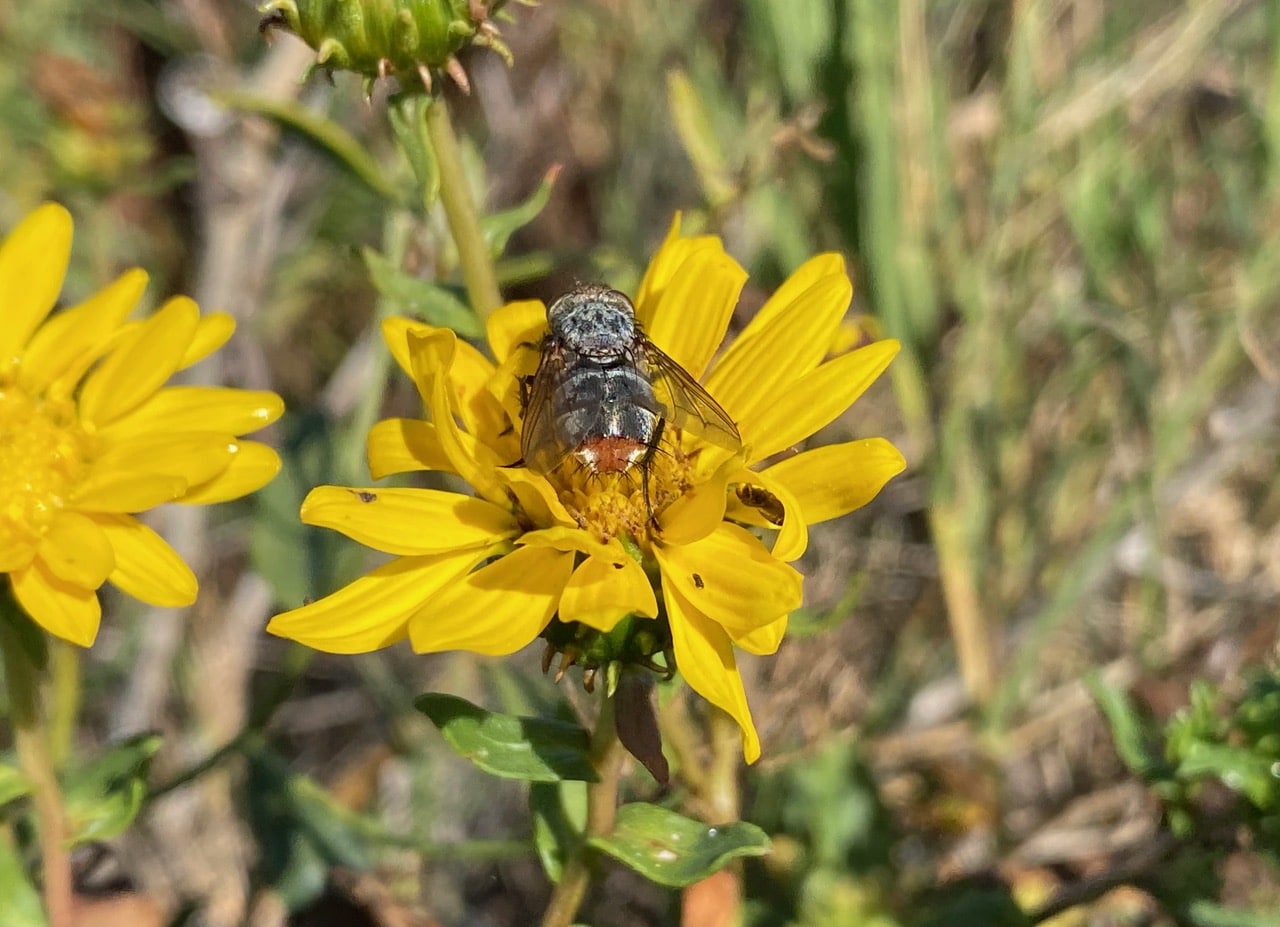
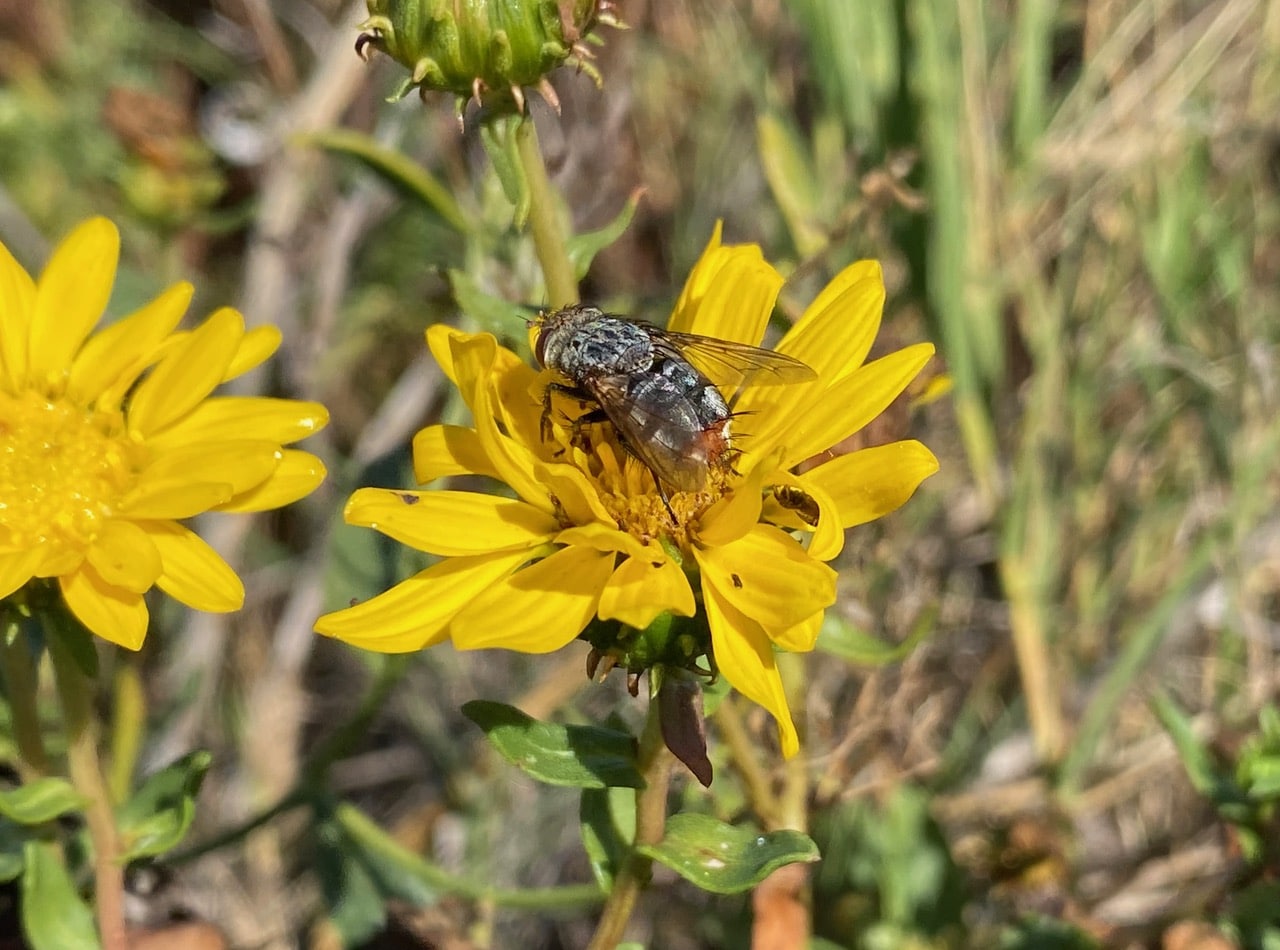
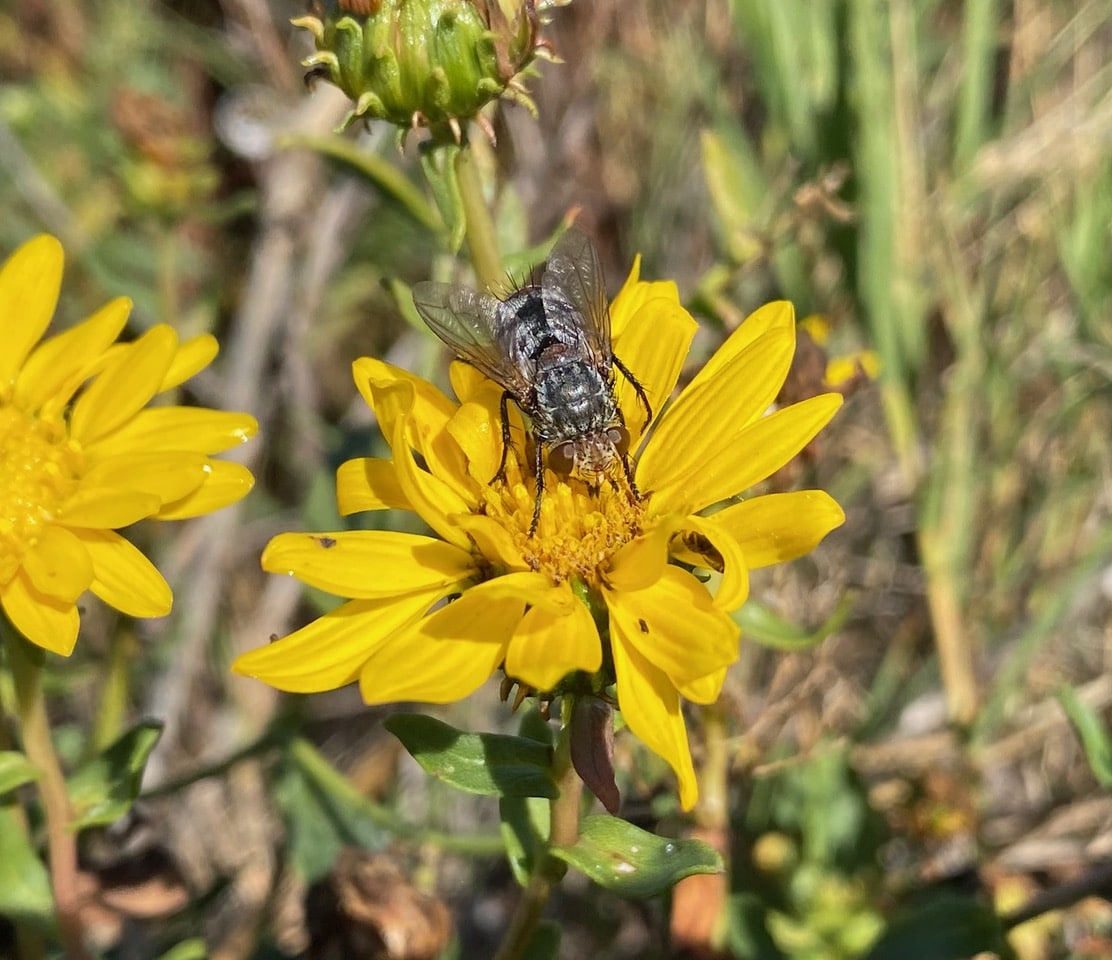
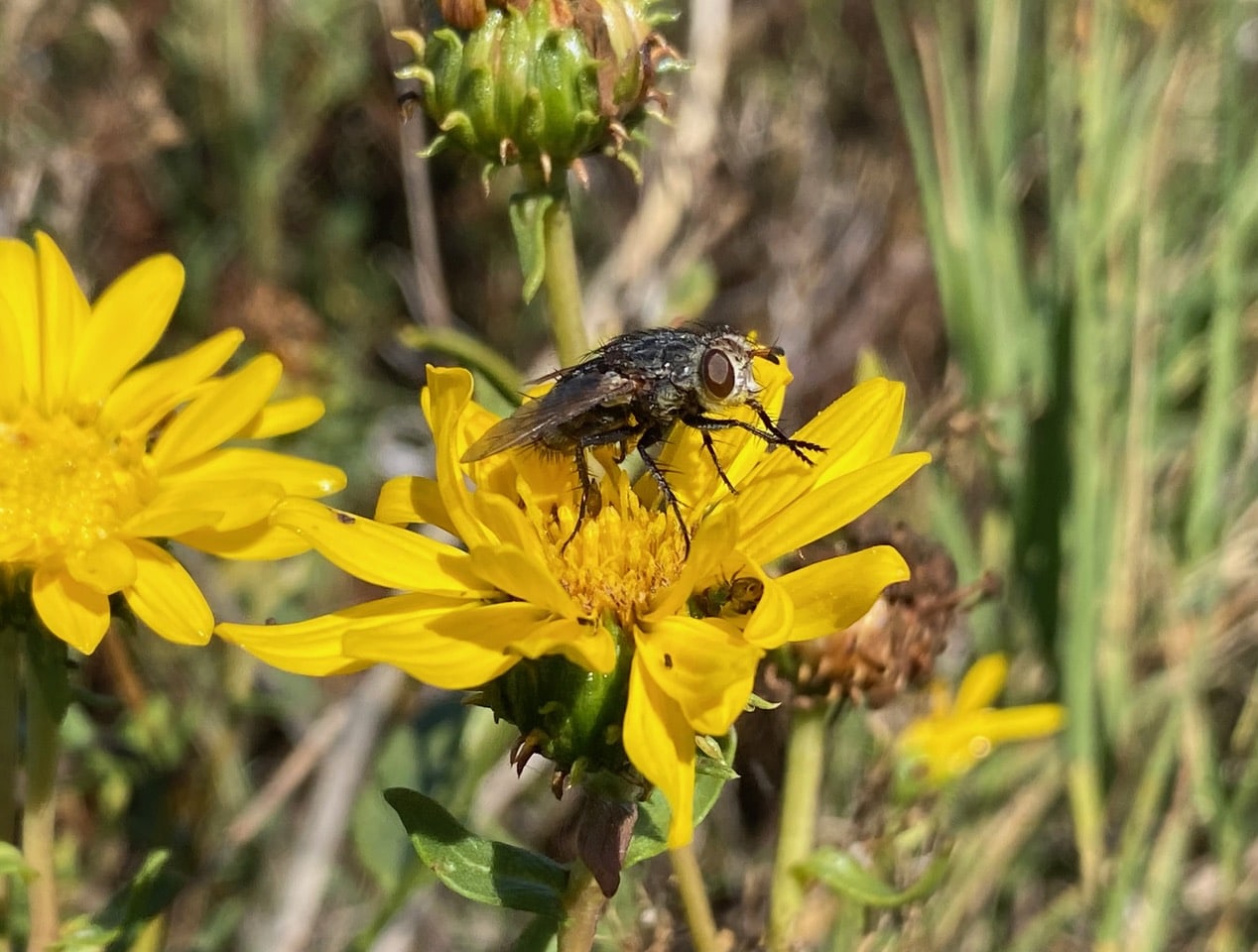
A large, formidable looking fly has landed on a Grindelia flowerhead. Its bristly appearance tells me that it is most likely a Bristle Fly (family Tachinidae), possibly in the genus Peleteria.
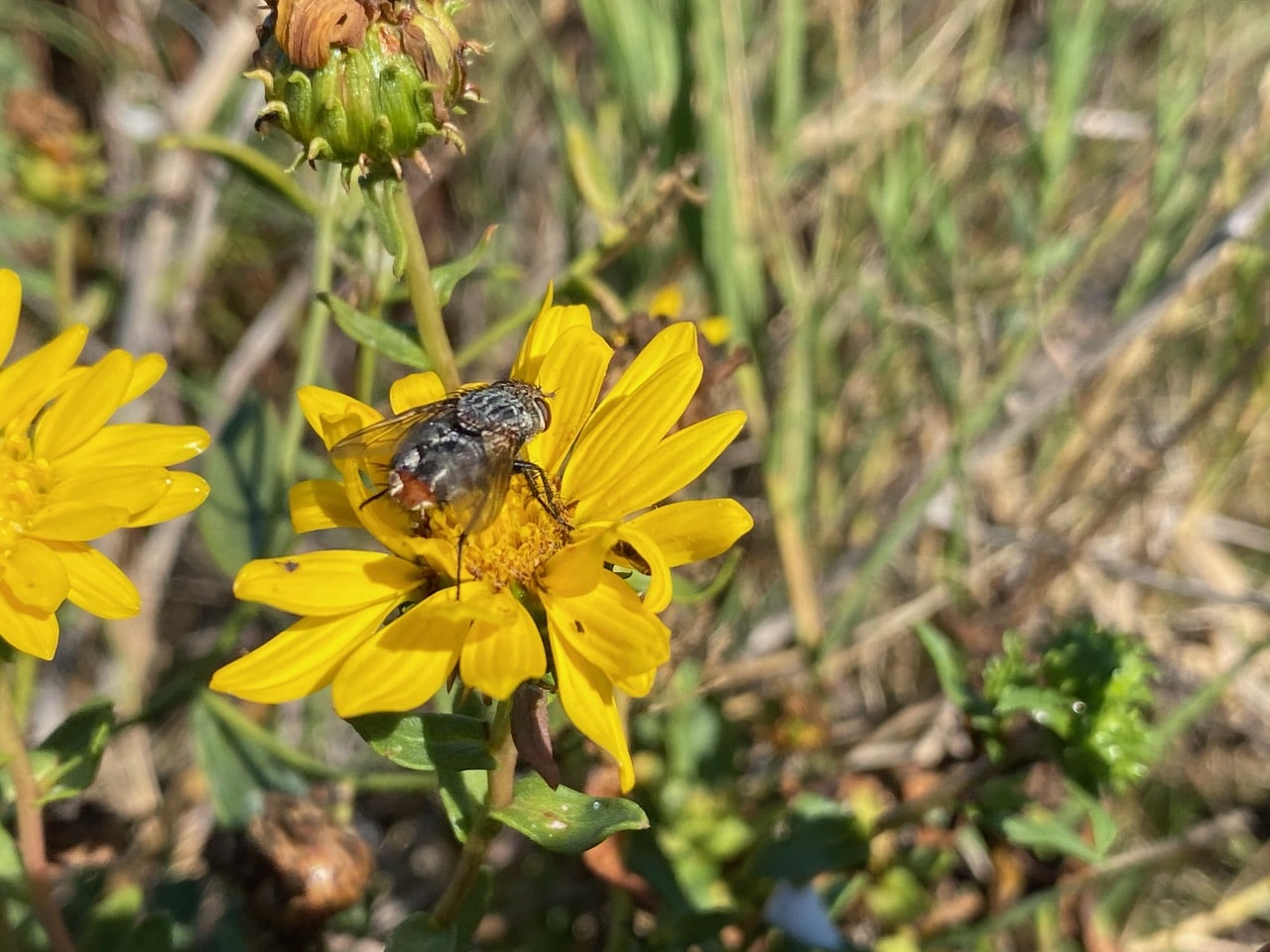
The family Tachinidae is by far the largest and most important group of parasitoid flies. All species are parasitic in the larval stage. Most adults have distinct abdominal bristles, hence the common name. Adults feed on liquids such as nectar and honeydew. They can be found resting on foliage, feeding at flowers or searching for hosts.
Most tachinids attack caterpillars, adult and larval beetles, true bugs, grasshoppers, and other insects. Females lay eggs in or on the host. Tachinid larvae live as internal parasites, consuming their hosts’ less essential tissues first and not finishing off the vital organs until they are ready to pupate. The larvae leave the host and pupate on the ground. Tachinids are very important in natural control of many pests, and many have been used in biological control programs.
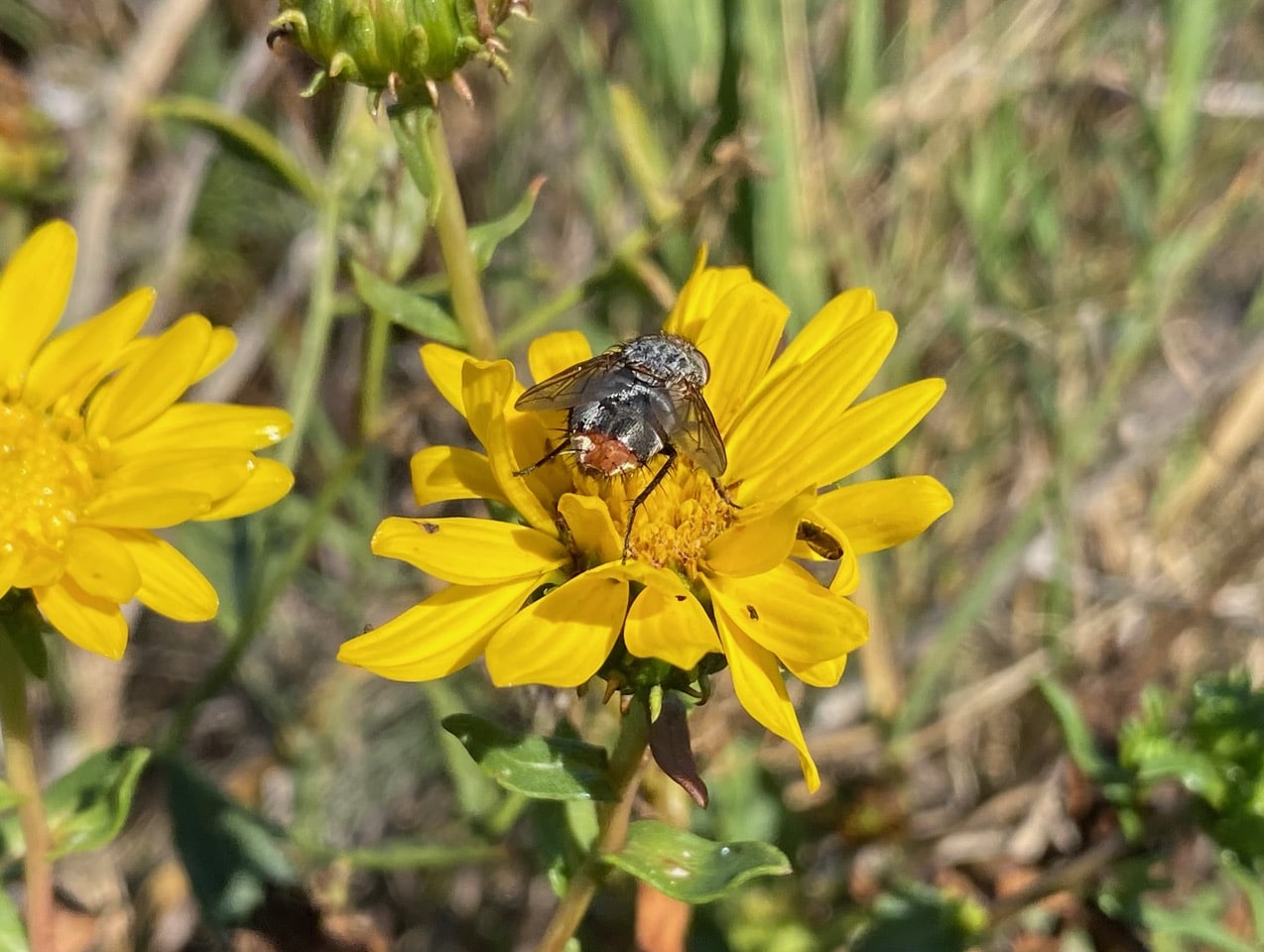
The genus Peleteria (family Tachinidae) has a worldwide distribution (except Australasia), including most of North America (mostly western and boreal). Tachinid flies in the genus Peleteria can lay their eggs on a variety of insects, including: butterflies and moths (order Lepidoptera), bee, wasps, and ants (order Hymenoptera), beetles (order Coleoptera), grasshoppers and crickets (order Orthoptera), true bugs (order Hemiptera).