

Pollinator Post 9/29/23
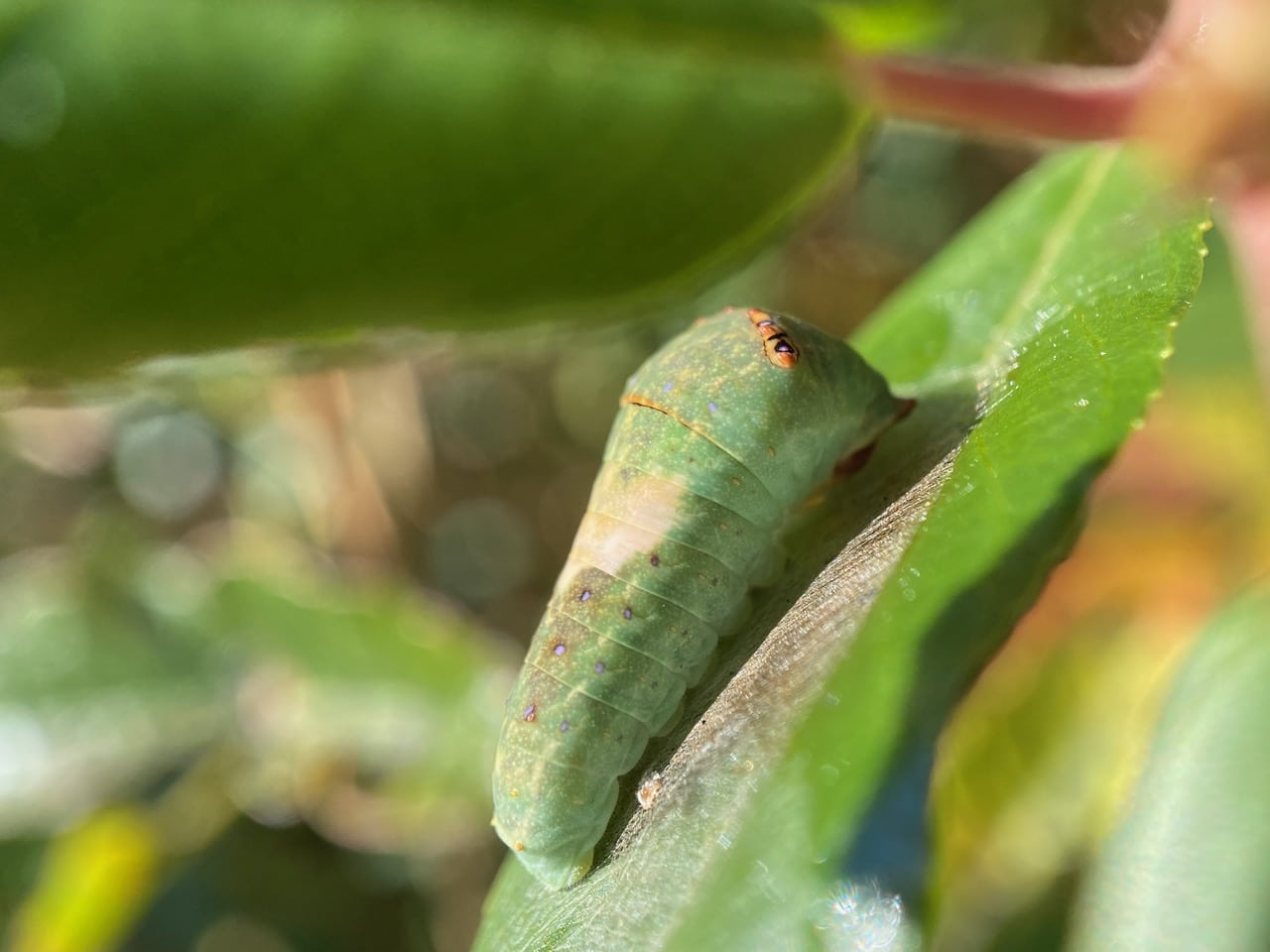
Our little Pale Swallowtail caterpillar B2 is almost completely green today, just as Alan has predicted!
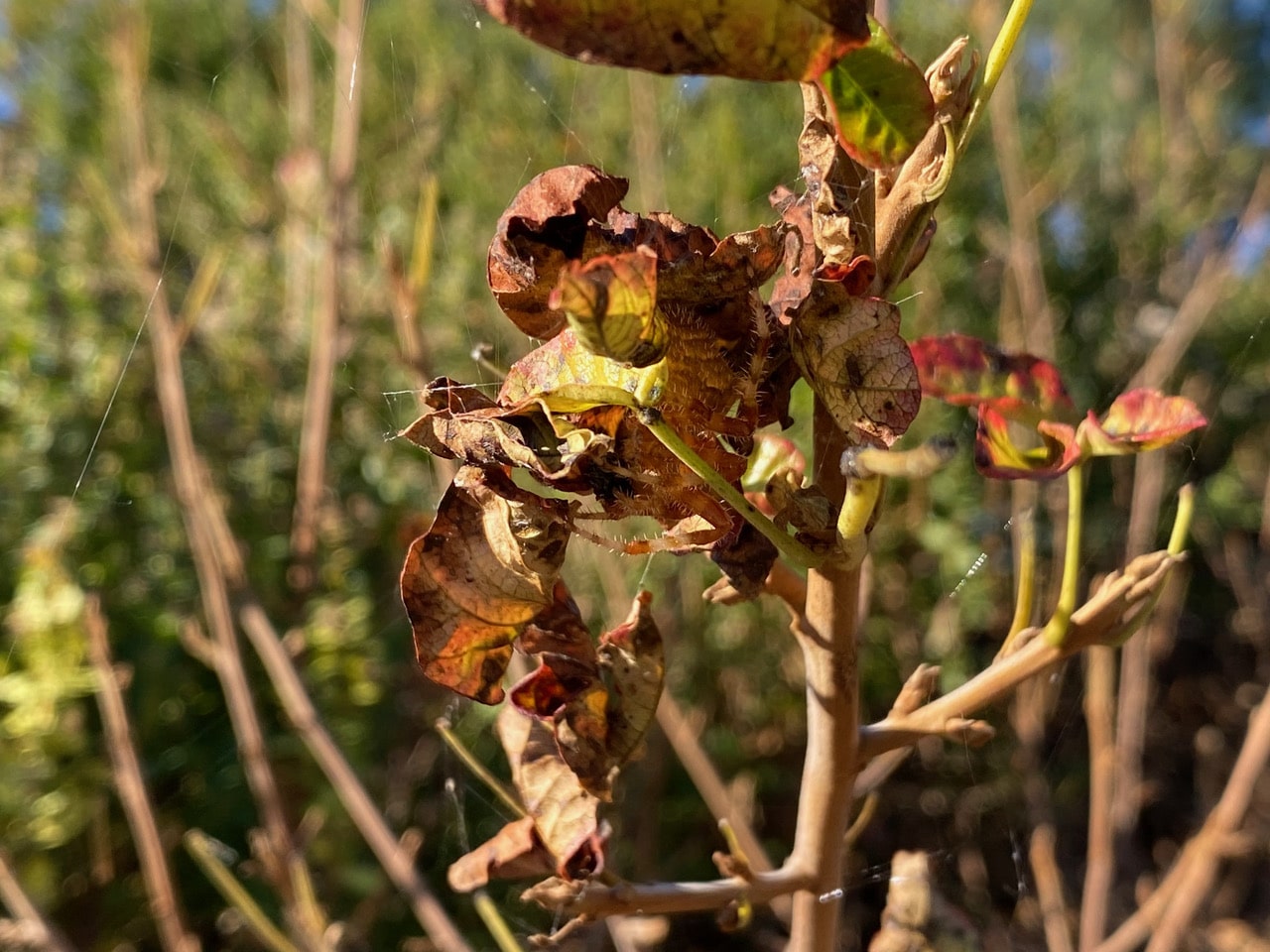
A large orb web is strung across the branches of a fading Poison Oak. The spider is not on the web, but can be located behind some senescing leaves. It is a Cross Orbweaver, Araneus diadematus (family Araneidae). Do you see it? The spider’s reddish-orange color blends in well with autumn foliage.
Araneus diadematus is commonly called the Cross Orbweaver or the European Garden Spider. It is found in Europe where it is native, and North America, where it was introduced. Individual spiders can vary markedly in coloration, from light yellow to dark grey, but all have mottled white markings across the dorsal abdomen, with four or more segments forming a cross. The markings are formed in cells filled with guanine, which is a byproduct of protein metabolism. Adult females range in length from 1/4 to 3/4 in, while the males range from 1/4 to 1/2 in.
The legs of orb-weaver spiders are specialized for spinning orb webs. The webs are built by larger females, which hang head down in the center of the web or remain hidden in nearby foliage, with one claw hooked to a signal line connected to the main orb, waiting for a disturbance to signal the arrival of prey. Prey is then quickly wrapped in silk and bitten, and the prey may hang on the web to be stored for later consumption. The initial bite serves to paralyzed the prey and to prevent injury to the spider from struggling prey. The injected enzymes serve to begin liquefaction of the prey’s internal structures.
Orbweaver spiders are well known for sexual cannibalism. Females often kill and consume the males just before, during, or just after mating.

As I have anticipated, our more mature Pale Swallowtail caterpillar Blue-2 has disappeared from its home leaf. It is probably on its walk-about in search of a place to pupate. I stare at Blue-2’s thin silk pad and recall the mixed emotions of being in my daughter’s bedroom right after she left home for college. I look forward to seeing Blue-2 as a full-fledge butterfly in the spring!
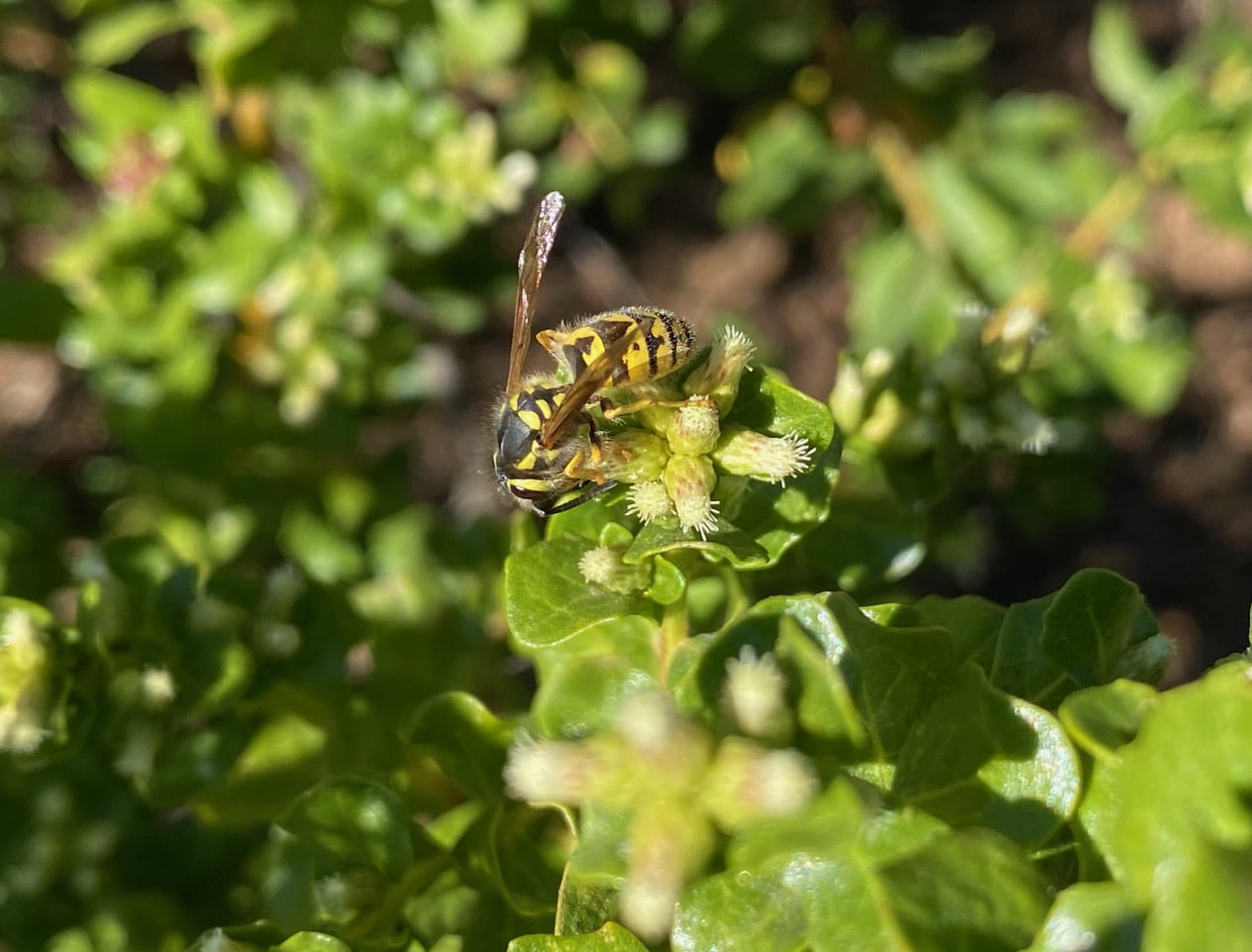
Insects are swarming over a female Coyote Brush, Baccharis pilularis in peak bloom. As I get closer, I discover that they are mostly Yellowjacket wasps…
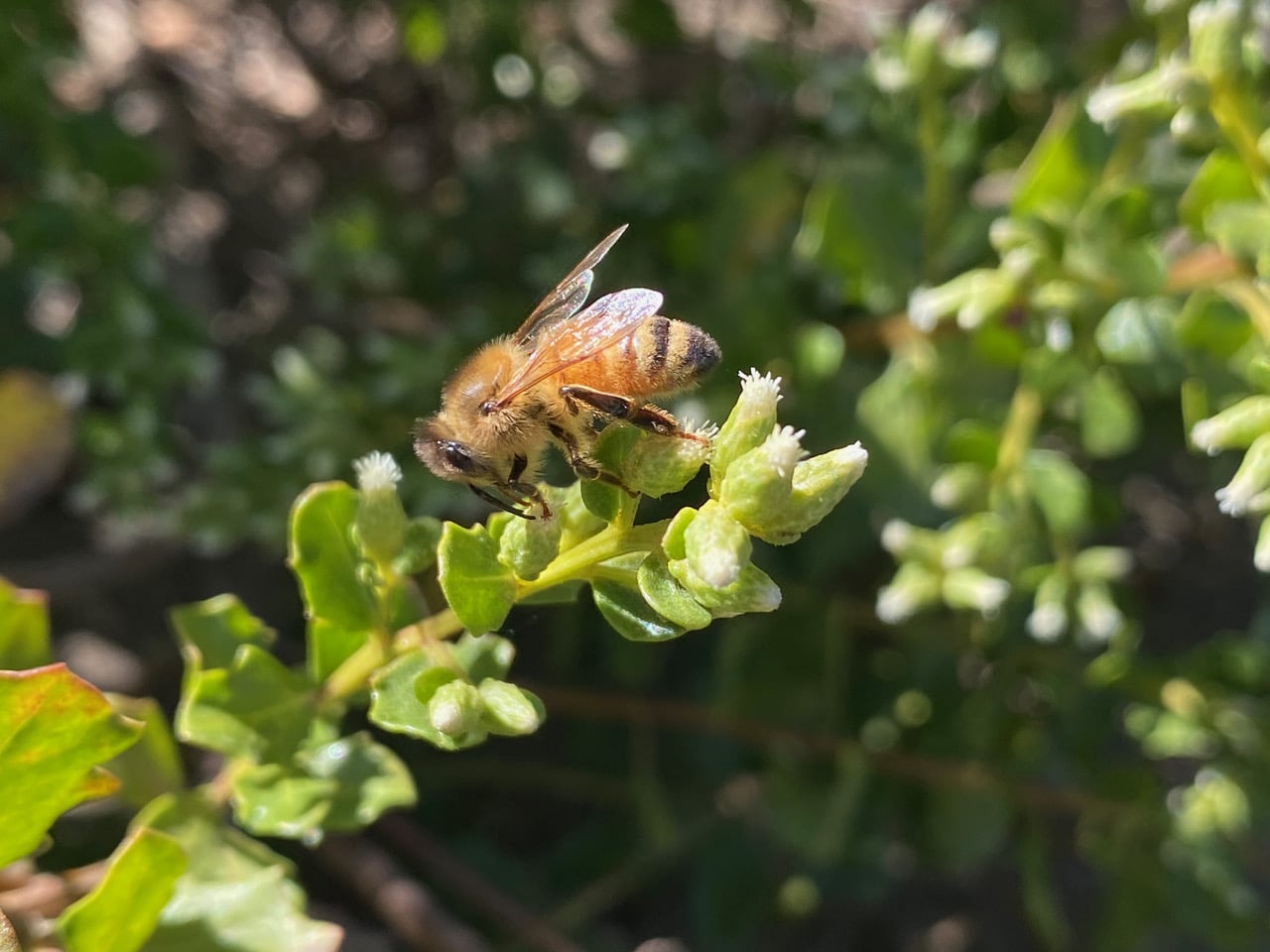
… and Honey Bees. In our area, Coyote Brush offers the last floral resources in the fall to pollinators and other insects. Often ignored by gardeners because of its small, inconspicuous flowers, the evergreen shrub is actually a hardy keystone species of the California landscape. It feeds and harbors countless insects, many tiny and not easily visible, but serve important roles within the ecosystem.

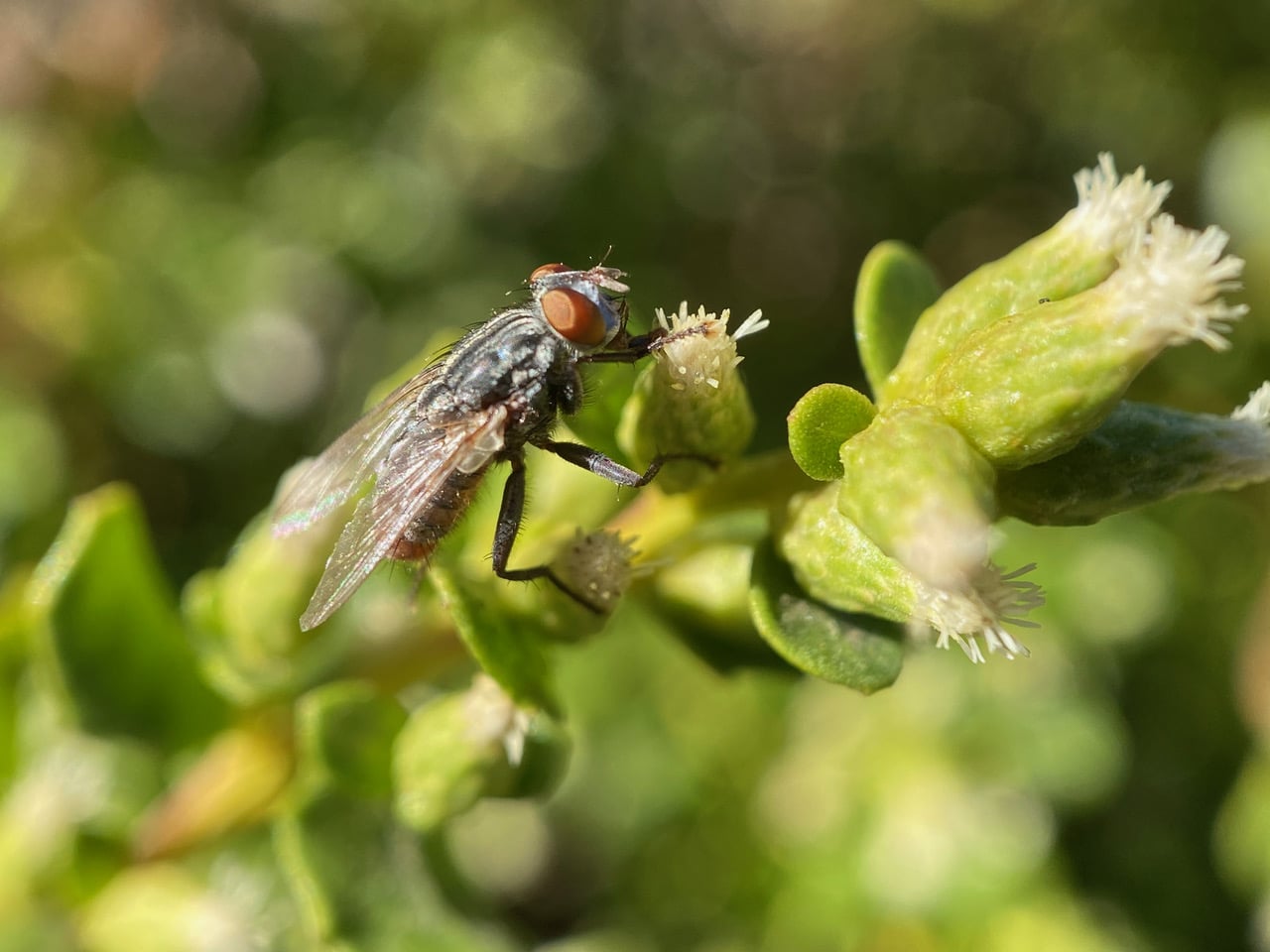
A Flesh Fly (family Sarcophagidae) is foraging on the flowers of a female Coyote Brush.
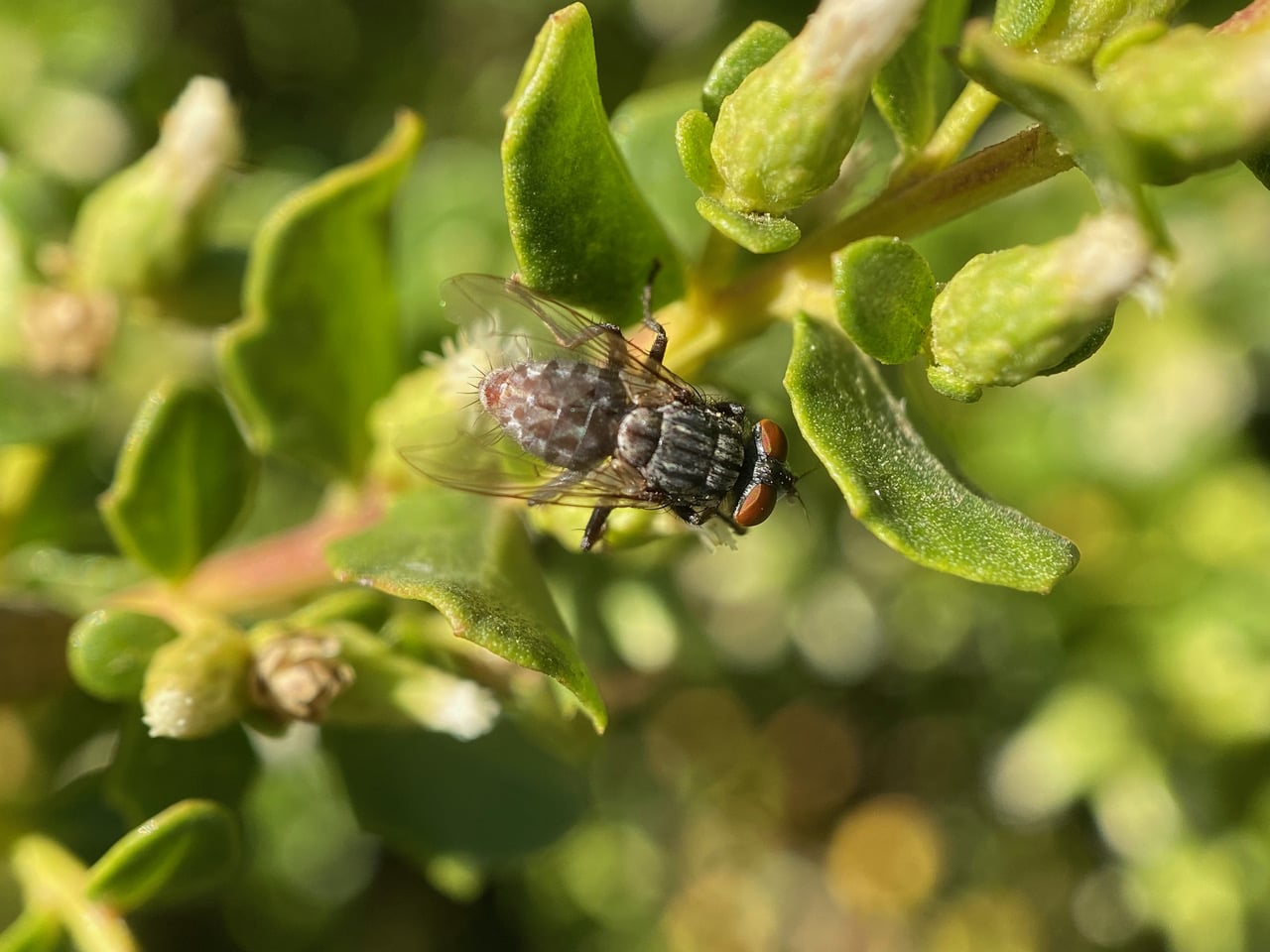
Many Flesh Flies have black and gray longitudinal stripes on the thorax and checkering on the abdomen, red eyes, and a bristled abdomen sometimes with a red tip. They differ from most flies in that they are ovoviviparous, opportunistically depositing hatched or hatching maggots instead of eggs on carrion, dung, decaying material, open wounds of mammals, hence their common name. The adults mostly feed on fluids from animal bodies, nectar, sweet foods, fluids from animal waste and other organic substances. While we may find their habits revolting, Flesh Flies perform important roles in the ecosystem – the larvae as decomposers/recyclers, and the adults as pollinators.

A Blow Fly (family Calliphoridae) is foraging on the same Coyote Brush.
The Calliphoridae are variously known as blow flies, carrion flies, greenbottles, and bluebottles. Adults are usually brilliant with metallic sheen, often with blue, green, or black thoraces and abdomens. There are three cross-grooves on the thorax; calypters are well developed. Females visit carrion both for proteins and egg laying. The larvae that hatch feed on dead or necrotic tissue, passing through three instars before pupation. After the third instar, the larva leaves the corpse and burrows into the ground to pupate. Adult blow flies are occasional pollinators, being attracted to flowers with strong odors resembling rotting meat. The flies use nectar as a source of carbohydrates to fuel flight.
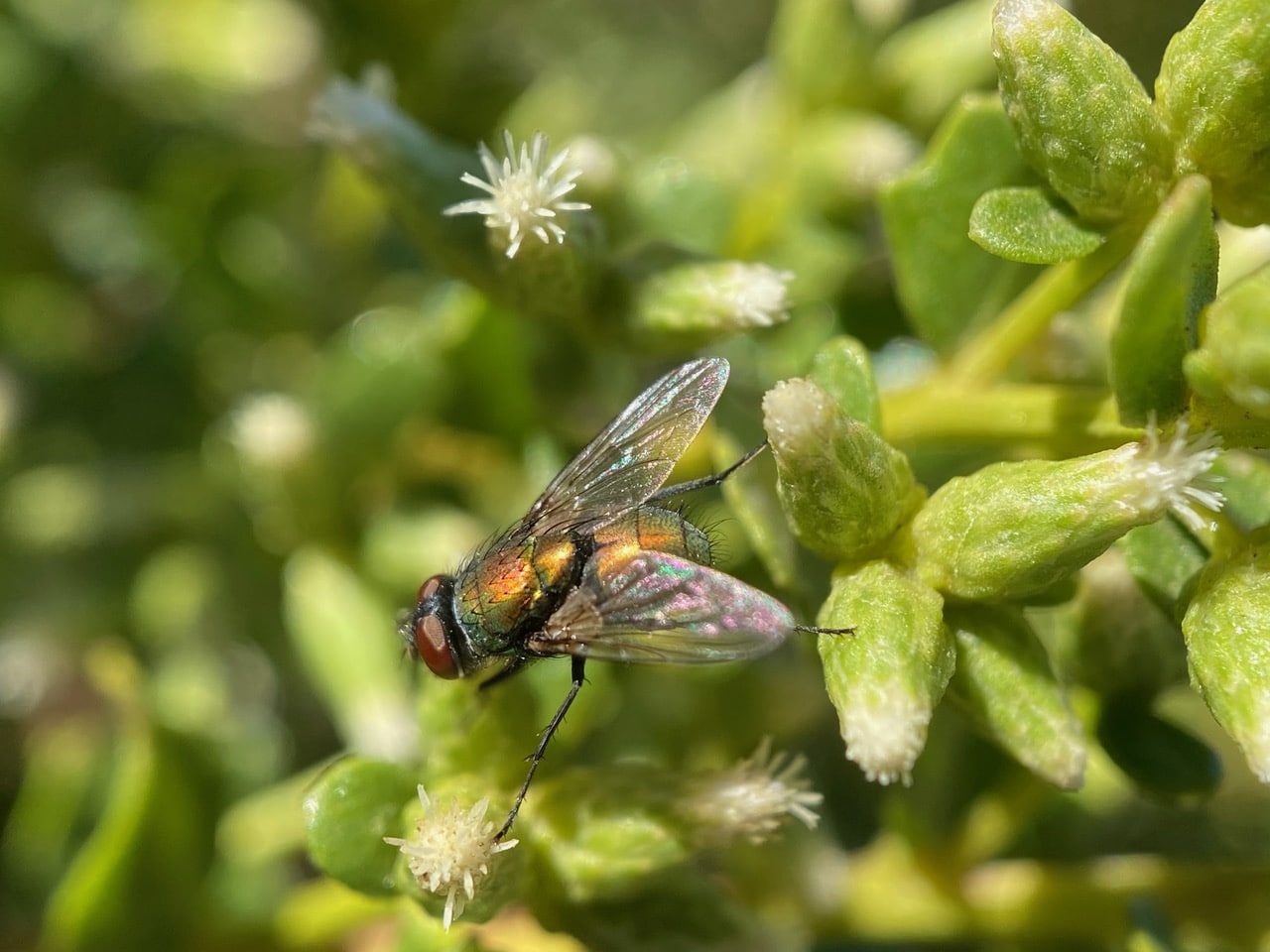
Here’s a smaller species of Blow Fly, the Common Green Bottle Fly, Lucilia sericata (family Calliphoridae).
The Common Green Bottle Fly is a Blowfly found in most areas of the world and is the most well-known of the numerous green bottle fly species. The lifecycle of Lucilia sericata is typical of blowflies. Females lay masses of eggs in fresh carrion. The flies are extremely prolific – a single female may produce 2,000 to 3,000 eggs in her lifetime. The larvae feed on dead or necrotic tissue, passing through 3 larval instars. Third-instar larvae drop off the host to pupate in the soil. The adults feed opportunistically on nectar, pollen, feces, or carrion; they are important pollinators as well as important agents of decomposition. Pollinator is used as an alternative protein source, especially for gravid females who need large amounts of protein and cannot reliably find carrion.
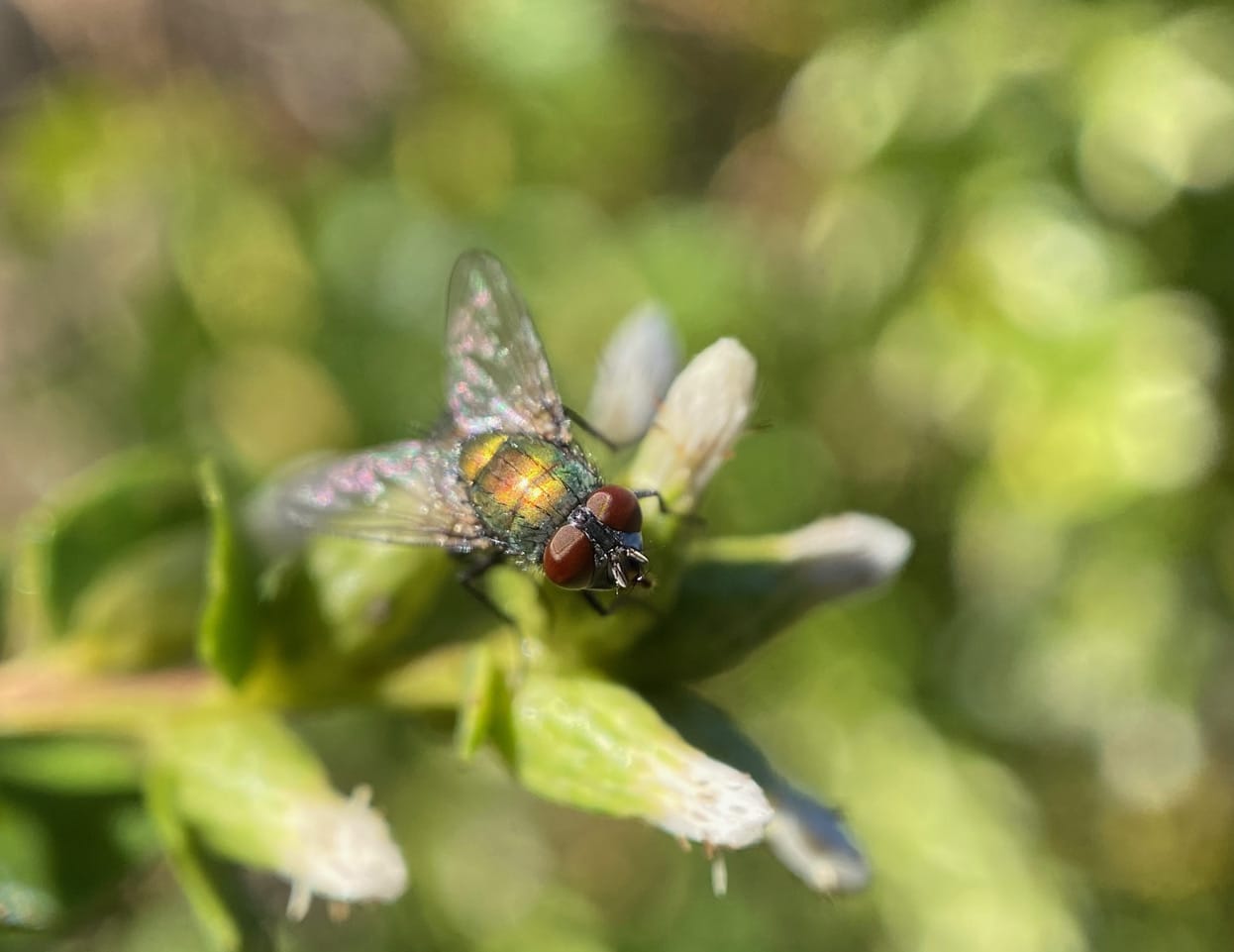
Lucilia sericata is an important species in forensic entomology, commonly used to determine the time of death of crime victims. The larvae serve an important function in medicine, used to debride wounds without causing infection. Larval secretions have been shown to help in tissue regeneration.
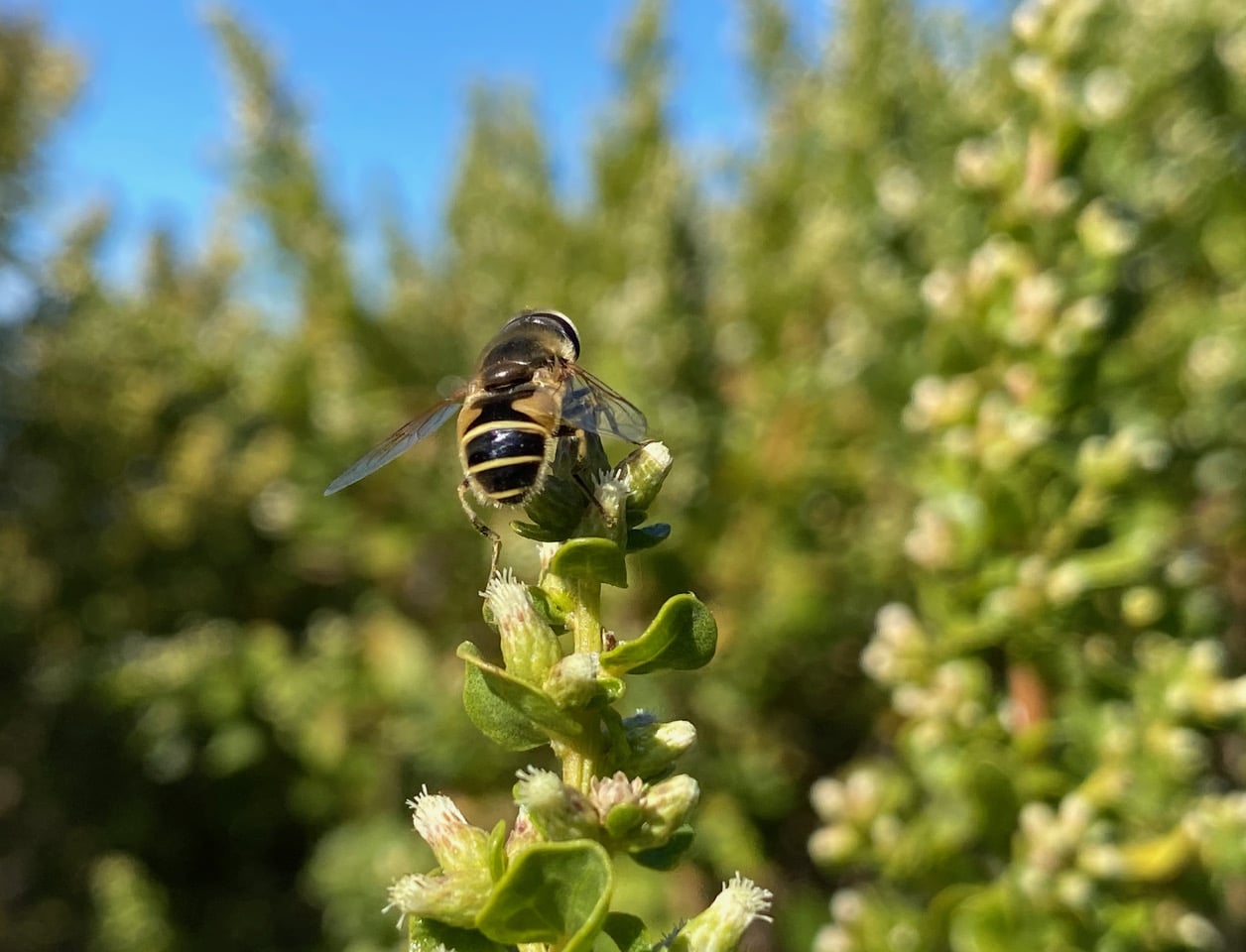
The Black-footed Drone Fly, Eristalis hirta (family Syrphidae) is a common Western North American species of hoverfly. The adults visit flowers for nectar and pollen. Larvae are aquatic filter-feeders of the rat-tailed type.
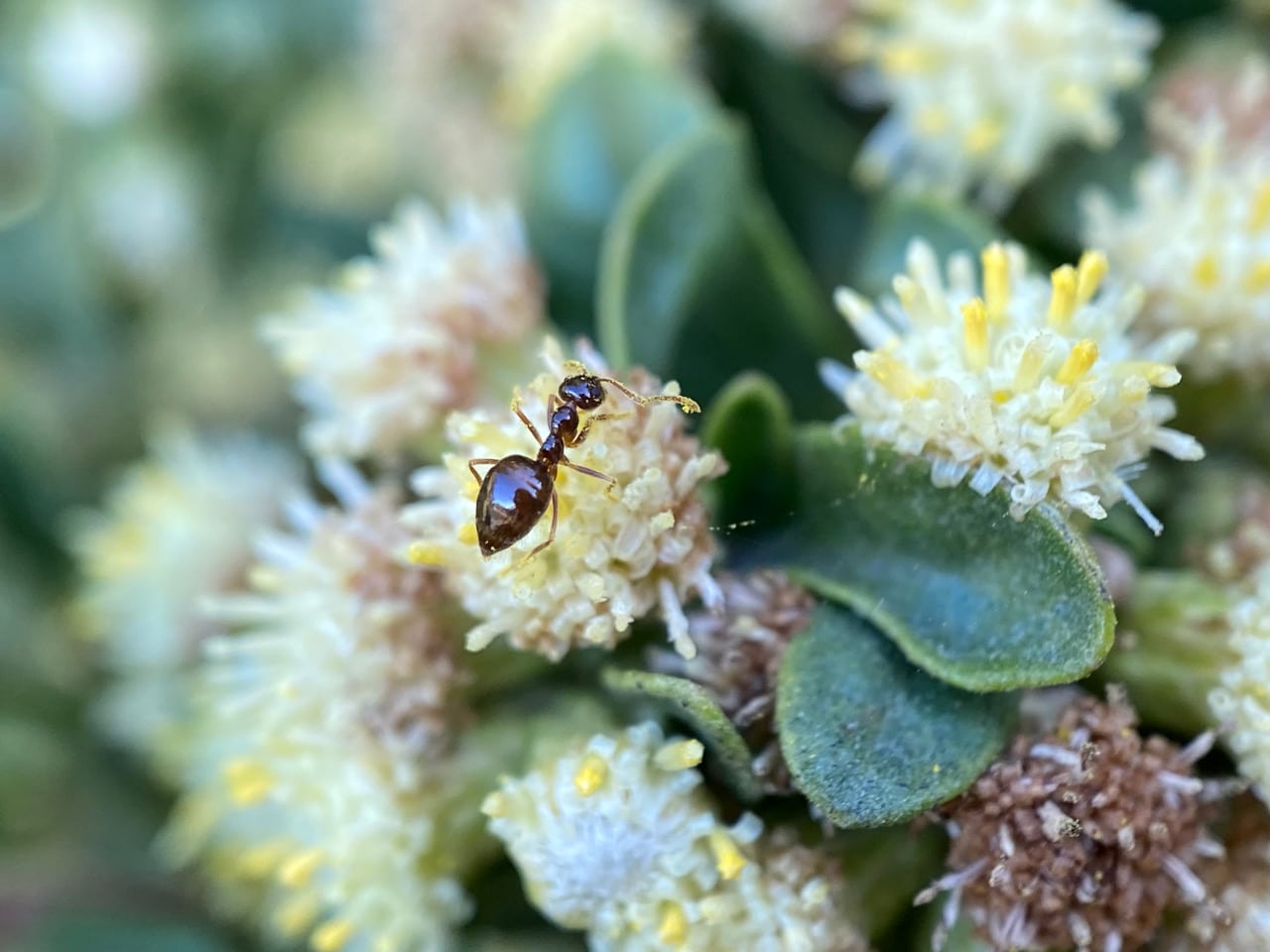
Ooh, I haven’t seen this species in a while – an American Winter Ant! I guess they have become active above ground now that our weather has cooled down. The ant appears to be feeding on pollen on the male flowers of Coyote Brush.
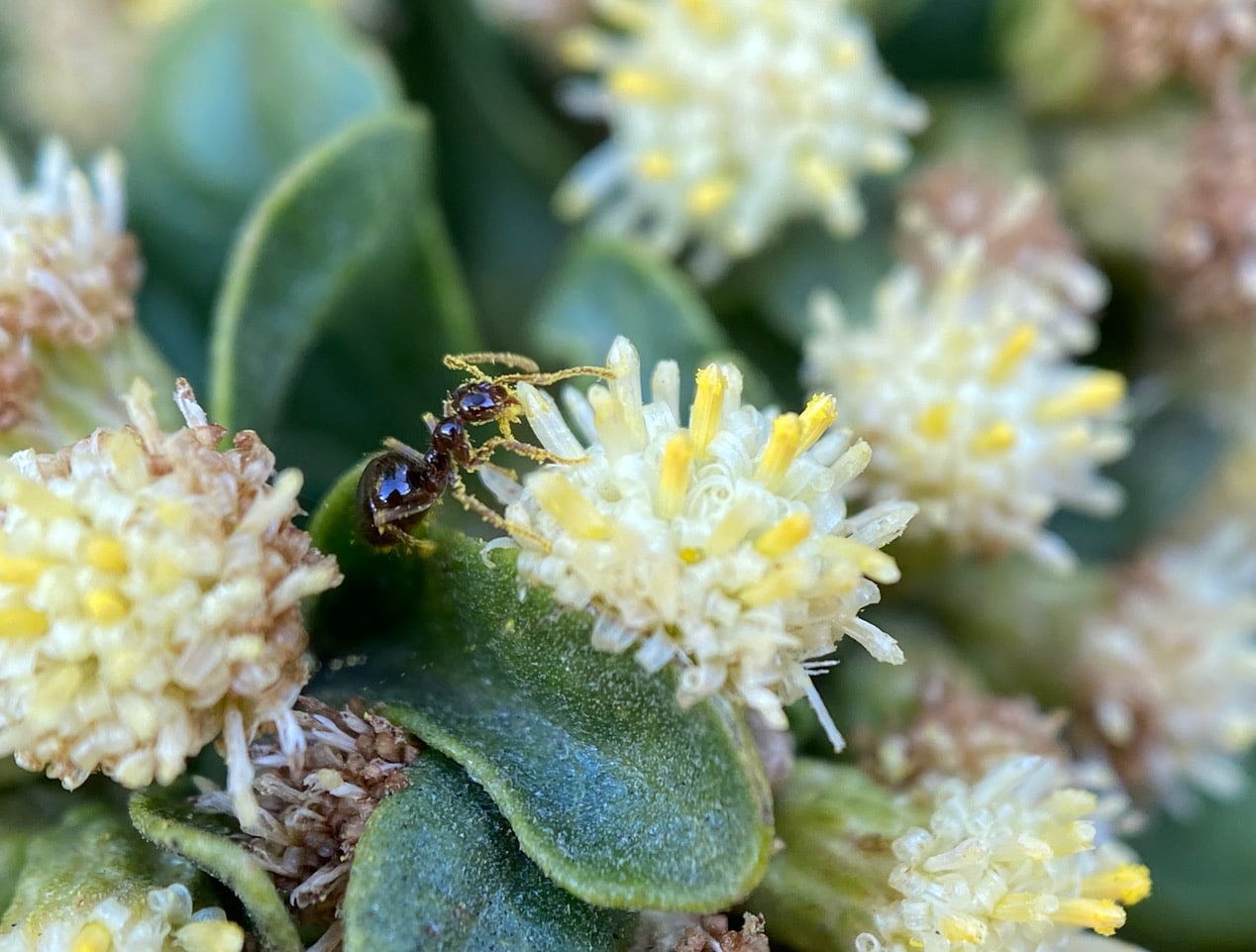
The American Ant, Prenolepis imparis is a widespread North American ant. A dominant woodland species, it is most active during cool weather, when most other ant species are less likely to forage. This species is one of a few native ants capable of tolerating competition with the invasive Argentine Ant, Linepithema humile. They are also aggressive toward other ants and produce abdominal secretions that are lethal to Argentine Ants. Prenolepis imparis is a generalist omnivore. Foragers are known for tending to aphids or scale insects from which they consume excreted honeydew, aggregating on rotting fruit, and exploiting protein-rich sources such as dead worms. The colony enters estivation (a hibernation-like state) and becomes inactive above ground for the warmer months, during which time eggs are laid and brood are reared. Reproductives overwinter and emerge on the first warm day of spring for their nuptial flight.

As the Coyote Brush is dioecious, with male and female flowers borne on separate plants, the ant is unlikely to be a effective pollinator. Only the alates (winged reproductives) fly!
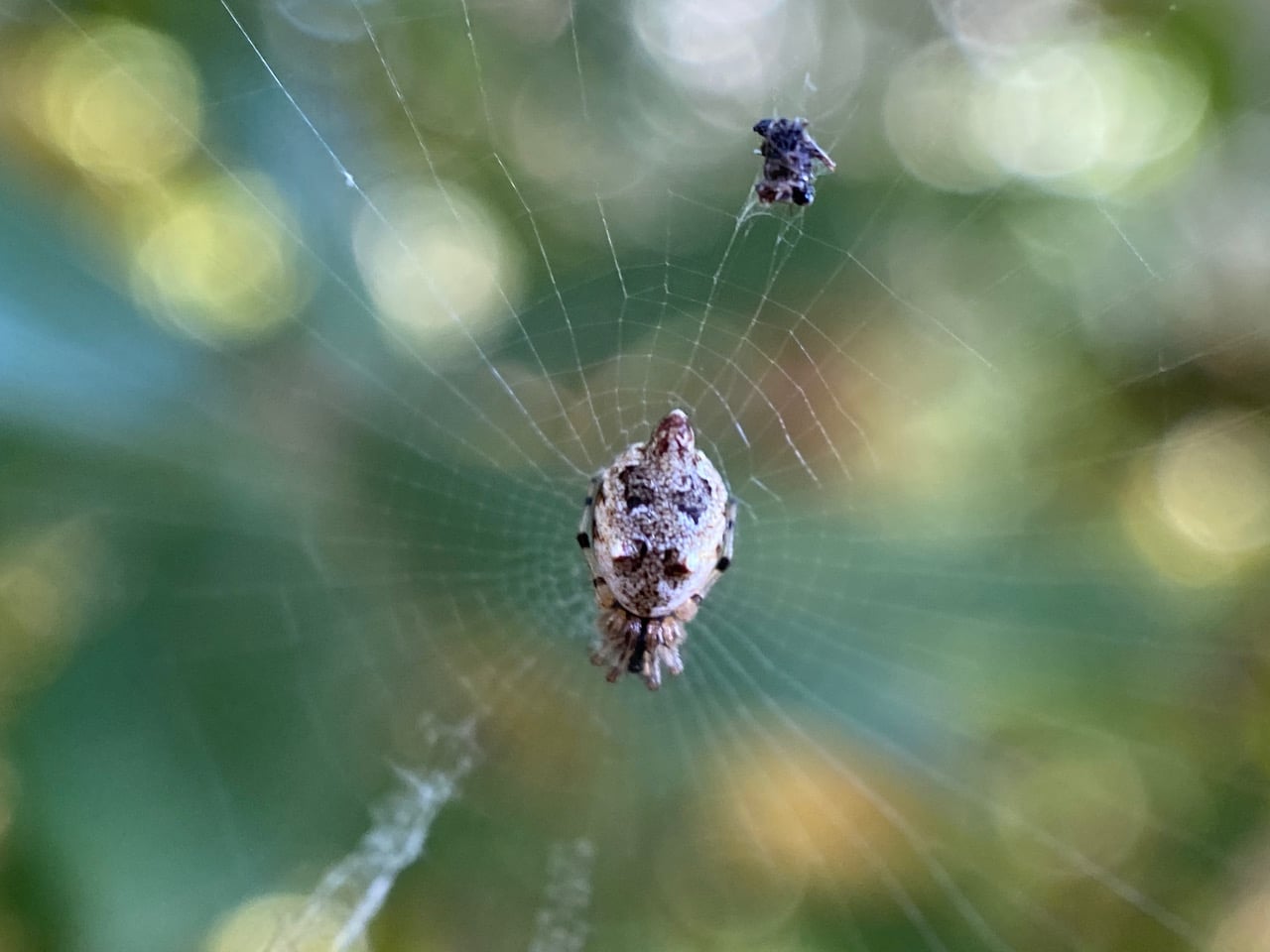
A tiny Humped Trashline Orbweaver is resting head-down in the hub of its web that it has yet to decorate with debris. So far it has only hung up what looks like parts of a dead prey above it.
The Humped Trashline Orbweaver, Cyclosa turbinata (family Araneidae) is native to the continental United States. It is a small species, about 4-7 mm in length. Their color is a mix of browns, blacks, and whites, and their abdomen tapers to a rounded point. C. turbinate is distinguished from the others in the genus by the presence of two anterior dorsal humps.
Trashline spiders are so-called for their web decoration. Cyclosa create orb-shaped webs using both the sticky and non-sticky threads, mostly during times of complete darkness. Across its spiral wheel-shaped web, Cyclosa fashions a vertical “trashline” made of various components such as prey’s carcasses, detritus, and at times, egg cases. The trashline helps the spider to camouflage exceptionally well from predators. The spider sits in the web hub to conduct its sit-and-wait hunting, ensnaring prey at nearly any time of day; it only leaves its spot to replace the web prior to sunrise.

A Black-margined Flower Fly, Syrphus opinator (family Syrphidae) has landed on a California Bay leaf.
Syrphus opinator is a common hoverfly species in central California. It is fairly large, measuring 7-12 mm. The black-and-yellow adults are the quintessential hoverfly that mimics the appearance of stinging bees or wasps. Stingless, they are harmless and visit flowers for nectar and pollen. The larvae feed on aphids and other soft-bodied insects.