

Pollinator Post 9/28/24 (2)
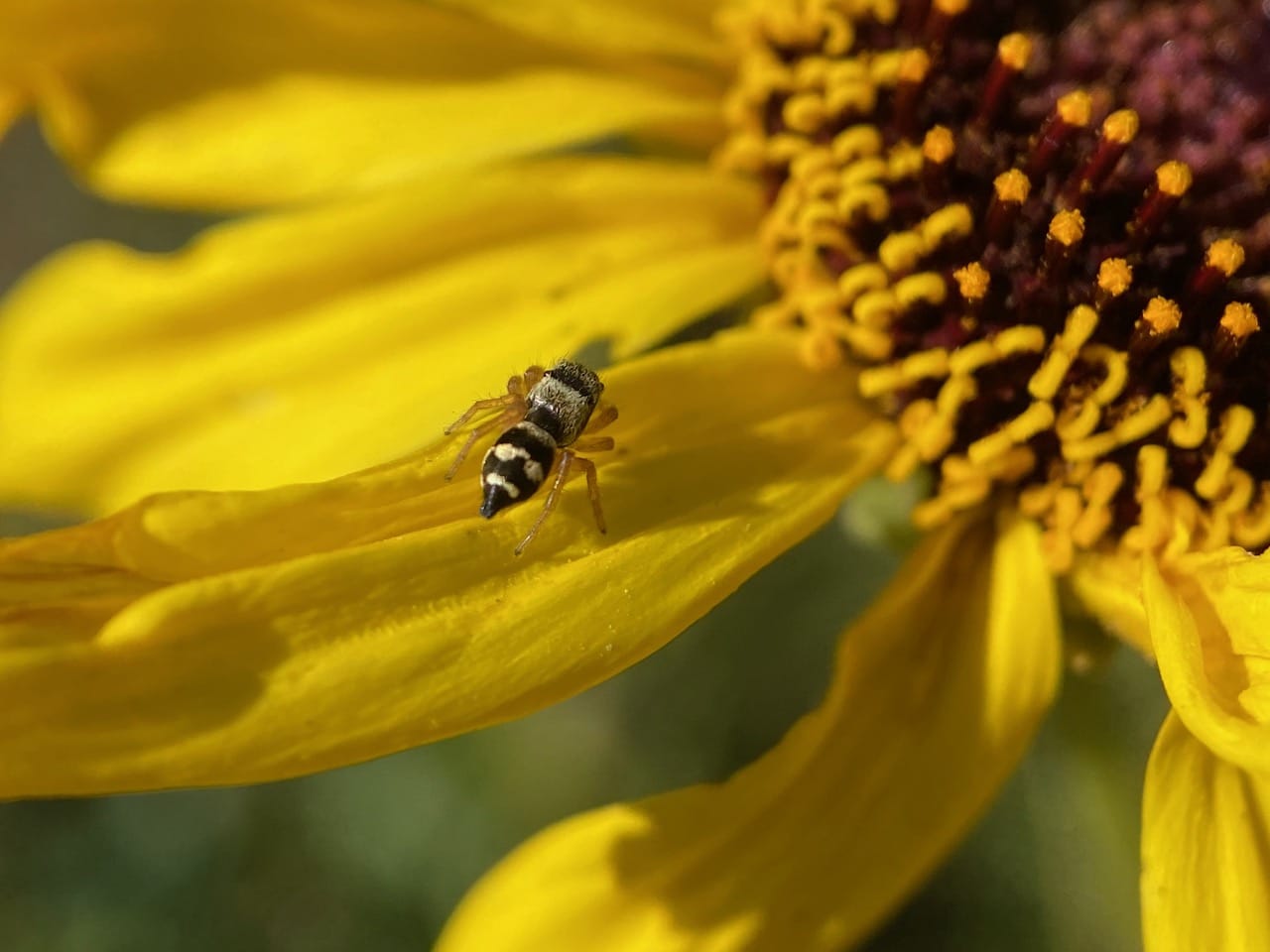
In Stefanie’s backyard, a tiny spider is running on the ray petals of a Bush Sunflower, Encelia californica. I am ready to call it a Zebra Jumper, until I notice that it has pale translucent legs, and yellow pedipalps.
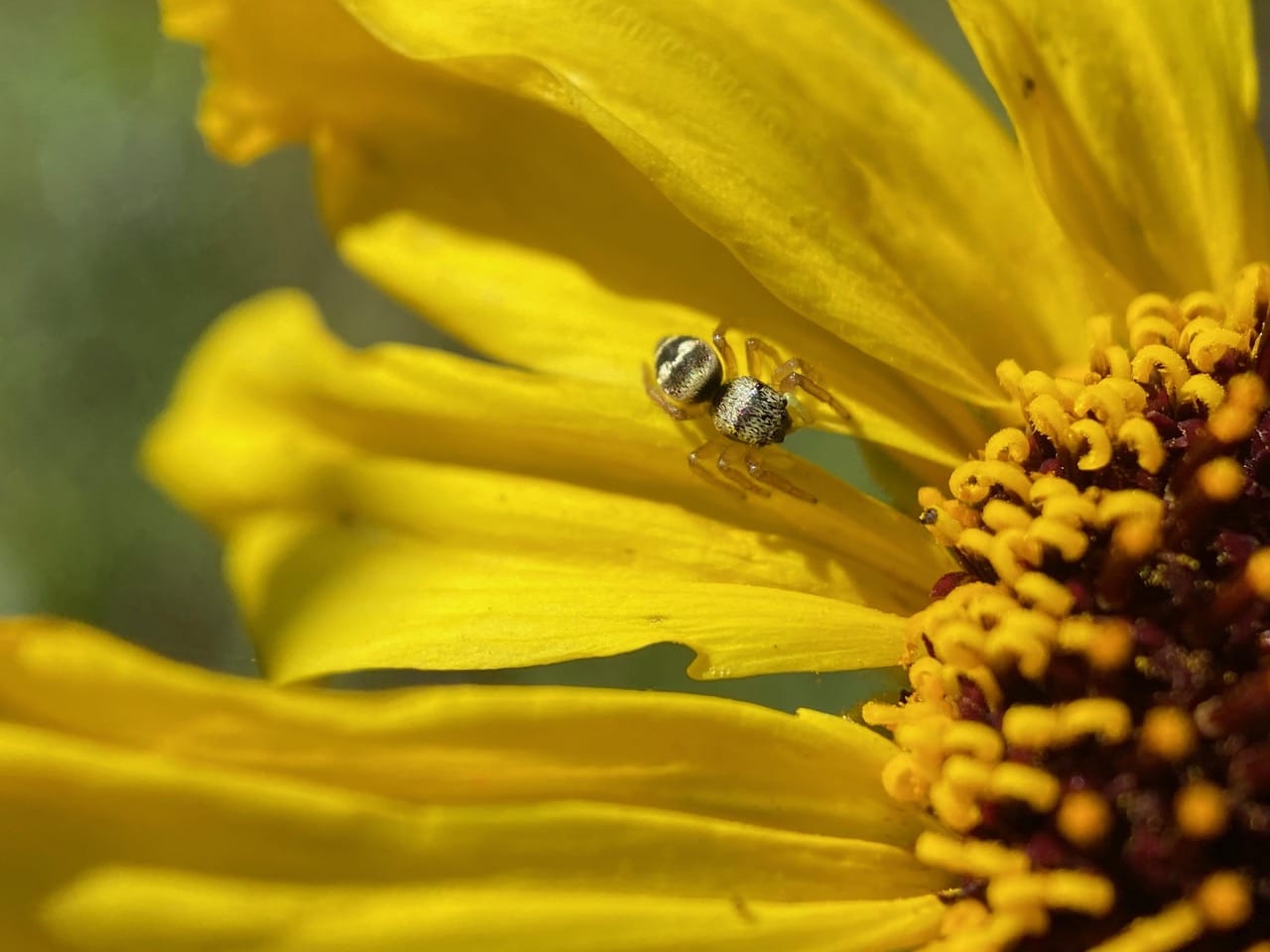




It is a Sun Jumping Spider, Heliophanus apiatus (family Salticidae).
The genus Heliophanus is one of the largest genera of jumping spiders with over 150 species, widespread in the Palearctic and Africa, with one center of diversity in the Mediterranean region. Heliophanus apiatus was first reported in the San Francisco Bay Area in 2015. Since then the species has established in three counties – Alameda, Santa Clara and San Mateo – surrounding the southern arm of San Francisco Bay. H. apiatus is a small salticid, male measuring 3.5-4.0 mm, and females 4.0-4.5 mm in body length. Mature males and females are similar in appearance, but only the females have yellow pedipalps. These spiders are found on low vegetation and on hard structures on or near the ground. They are capable of taking prey their own size.
A Buttonhook Leafbeetle Jumping Spider, Sassacus vitis (family Salticidae) is lurking on a fresh Encelia flowerhead. The spider is sometimes referred to as the Grapevine Jumping Spider because of their prevalence on grape vines.
The spider is native to North America, with a range spanning from Canada to Panama. It is a small jumping spider with iridescent gold abdomen and white ring around the anterior surface of abdomen. Body is covered with golden scales. Males are 3.5 mm long, females 4.5 mm. The name vitis is Latin for “grapevine”. The spider is commonly found on shrubs and vines and in fields. Best known as a common resident of vineyards.
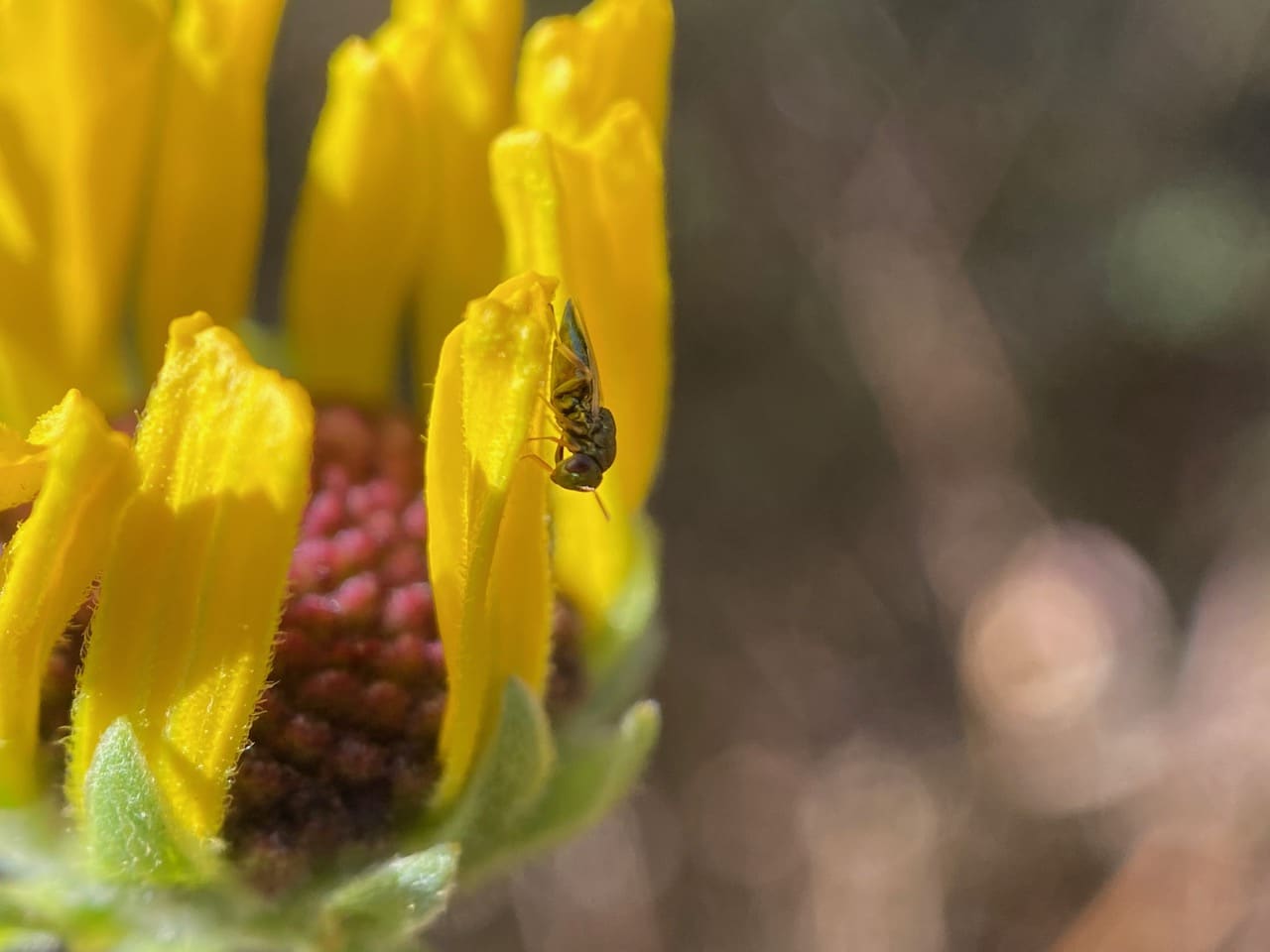
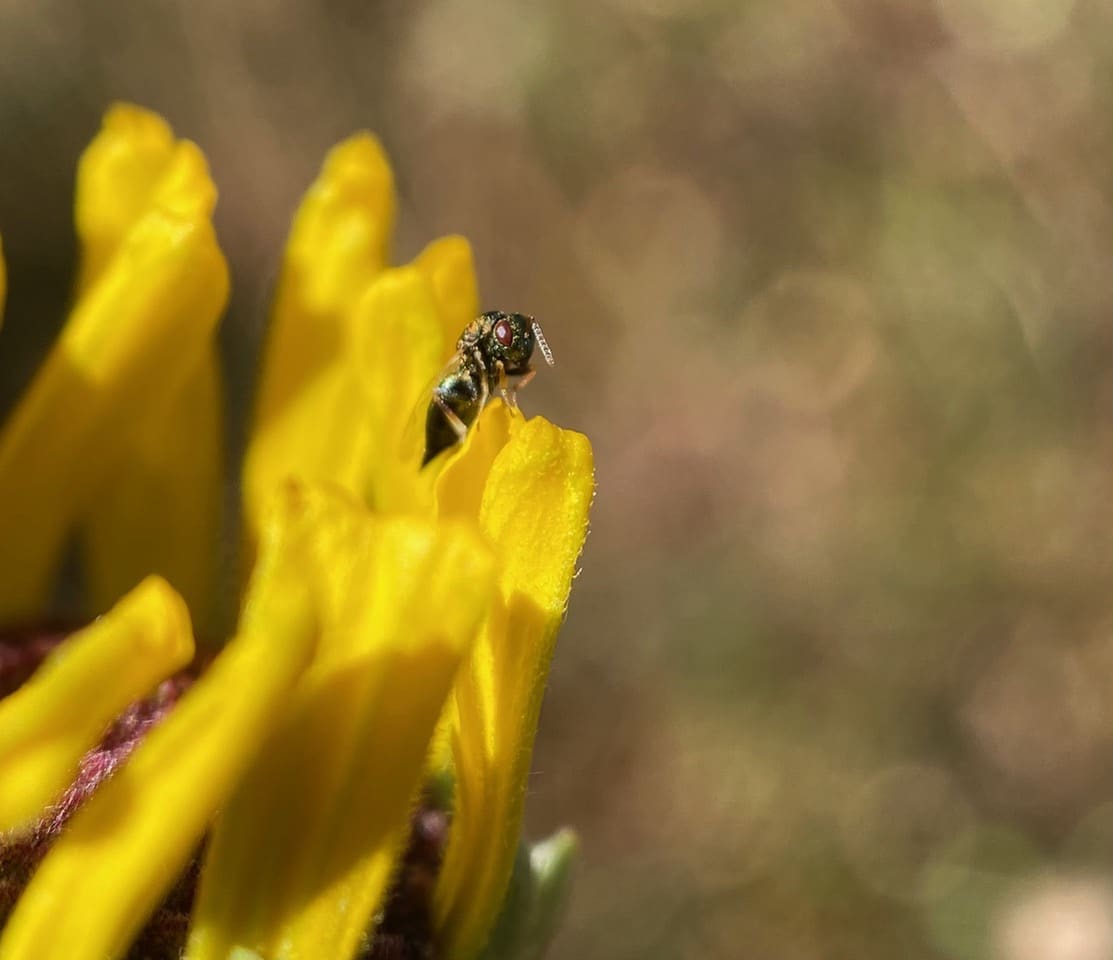
A tiny, iridescent green insect is perched upside-down on a ray petal of Bush Sunflower, Encelia californica.
The wasp seems to be missing its right antenna. iNaturalist has helped identify it as a chalcid wasp, Ormyrus sp. (family Ormyridae).
The Ormyridae are a small family of parasitic wasps in the superfamily Chalcidoidea. They are either parasitoids or hyperparasitoids on gall-forming insects, primarily cynipid wasps and tephritid flies. The 120 or so species (mostly in the genus Ormyrus) occur worldwide, except for South America. Some species have distinctive scalloped sculpturing of their thorax. Adults of many species are iridescent.
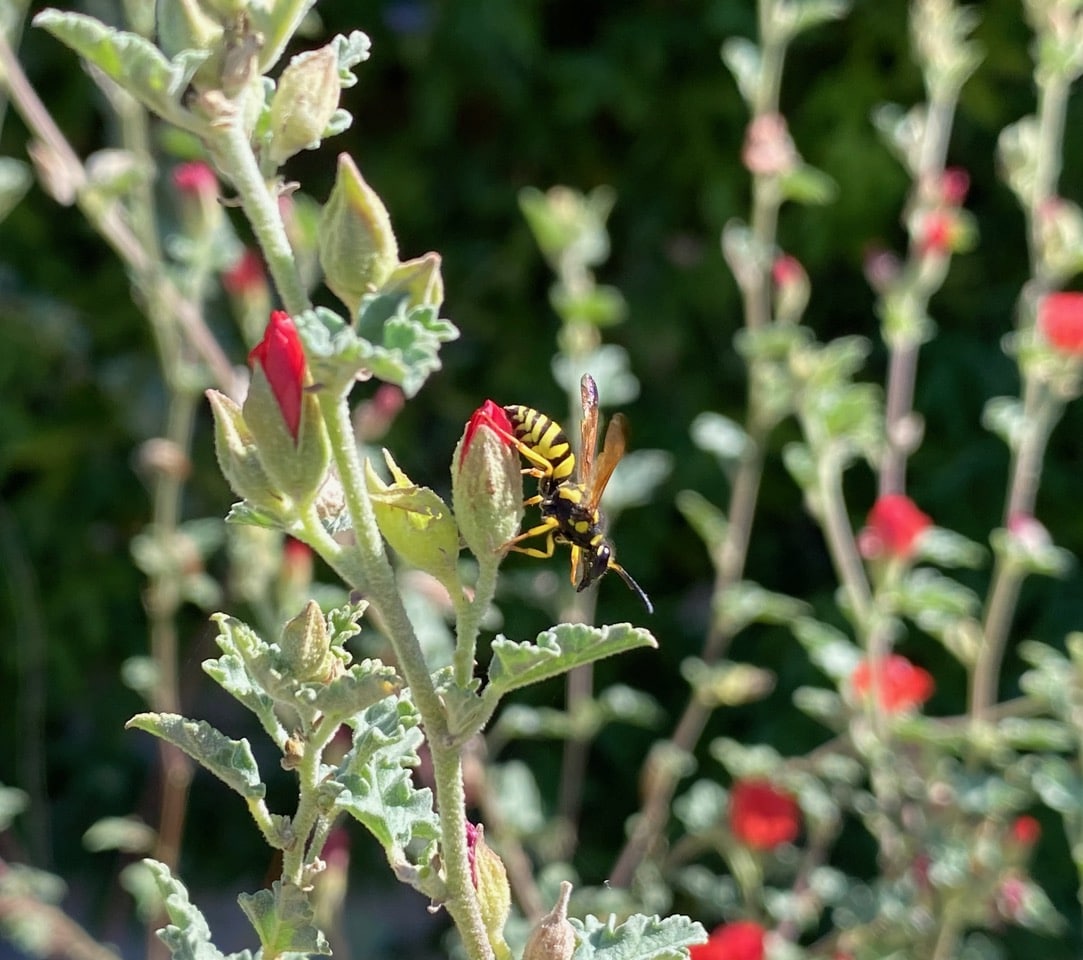
A Mason Wasp (family Vespidae, subfamily Eumeninae) is hunting on a still blooming Desert Globemallow, Sphaeralcea ambigua “Louis Hamilton”.
Potter wasps (or mason wasps), the Eumeninae, are a cosmopolitan wasp group presently treated as a subfamily of Vespidae. Most eumenine species are black or brown, and commonly marked with strikingly contrasting patterns of yellow, white, orange, or red. Their wings are folded longitudinally at rest. Eumenine wasps are diverse in nest building. The different species may either use existing cavities or even man-made holes like old nail holes that they modify to some degree, or they construct their own either underground or exposed nests. The most widely used building material is mud made of a mixture of soil and regurgitated water.
All known Eumenine species are predators, most of them solitary mass provisioners. When a cell is completed, the adult wasp typically collects beetle larvae, spiders, or caterpillars and, paralyzing them, places them in the cell to serve as food for a single wasp larva. As a normal rule, the adult wasp lays a single egg in the empty cell before provisioning it. The complete life cycle may last from a few weeks to more than a year from the egg until the adult emerges. Adult mason wasps feed on floral nectar.
Wow, I am impressed by the fruit set on Stefanie’s California Buckeye, Aesculus californica. The buckeyes in the local parks I visit have not been very productive this year.
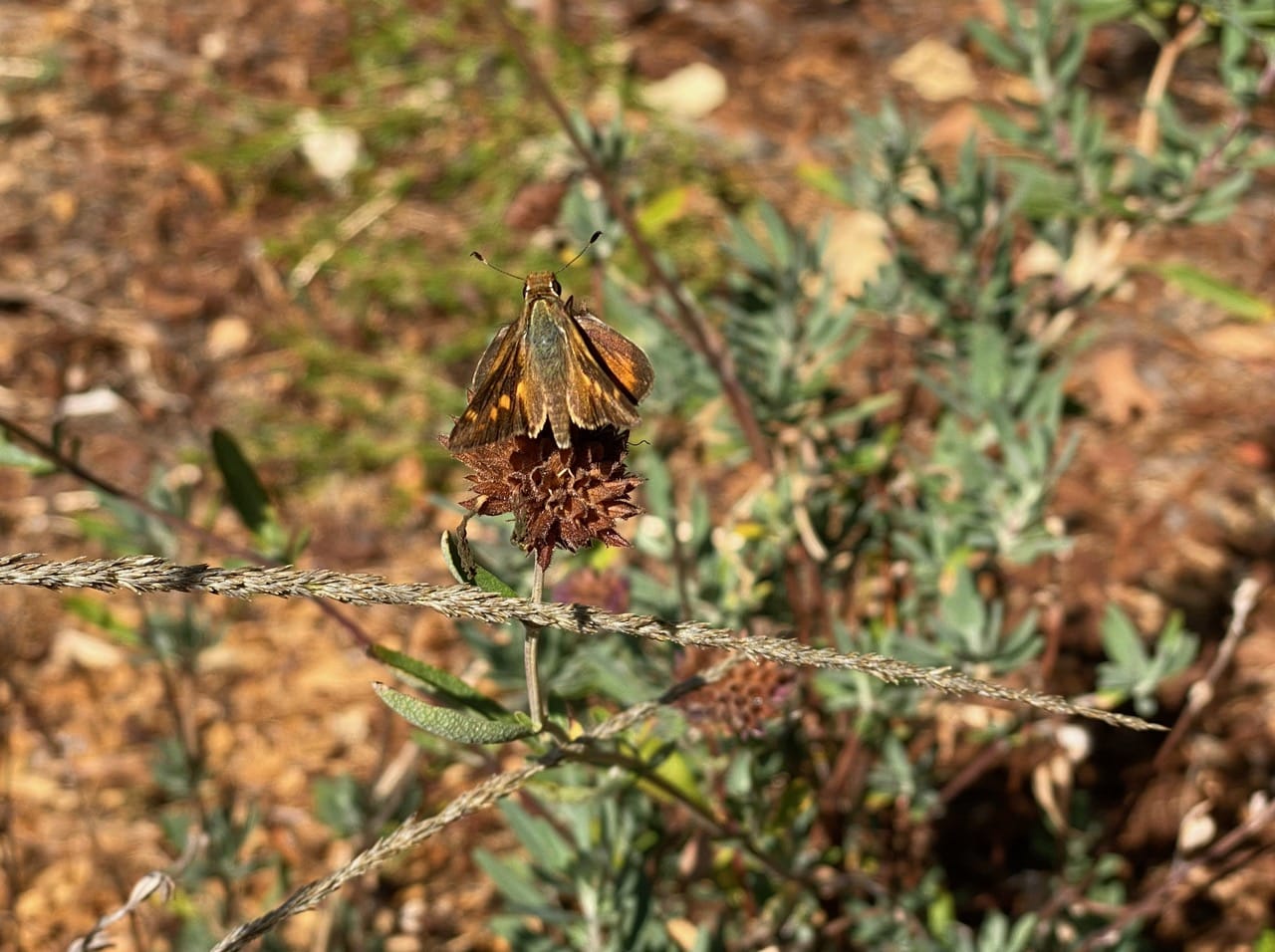
An Umber Skipper performs a disappearing act as it lands on a brown seed head of a Sage, Salvia sp.
The Umber Skipper, Lon melane (family Hesperiidae) is found in California west of the Sierra Nevada, southern Arizona, Baja California and the highlands of Mexico and Central America. Males perch in grassy areas to wait for receptive females. Caterpillars feed on leaves of various grasses and sedges, and live in shelters of rolled or tied leaves. Adults feed on flower nectar. There are two broods a year March-May and September-October.
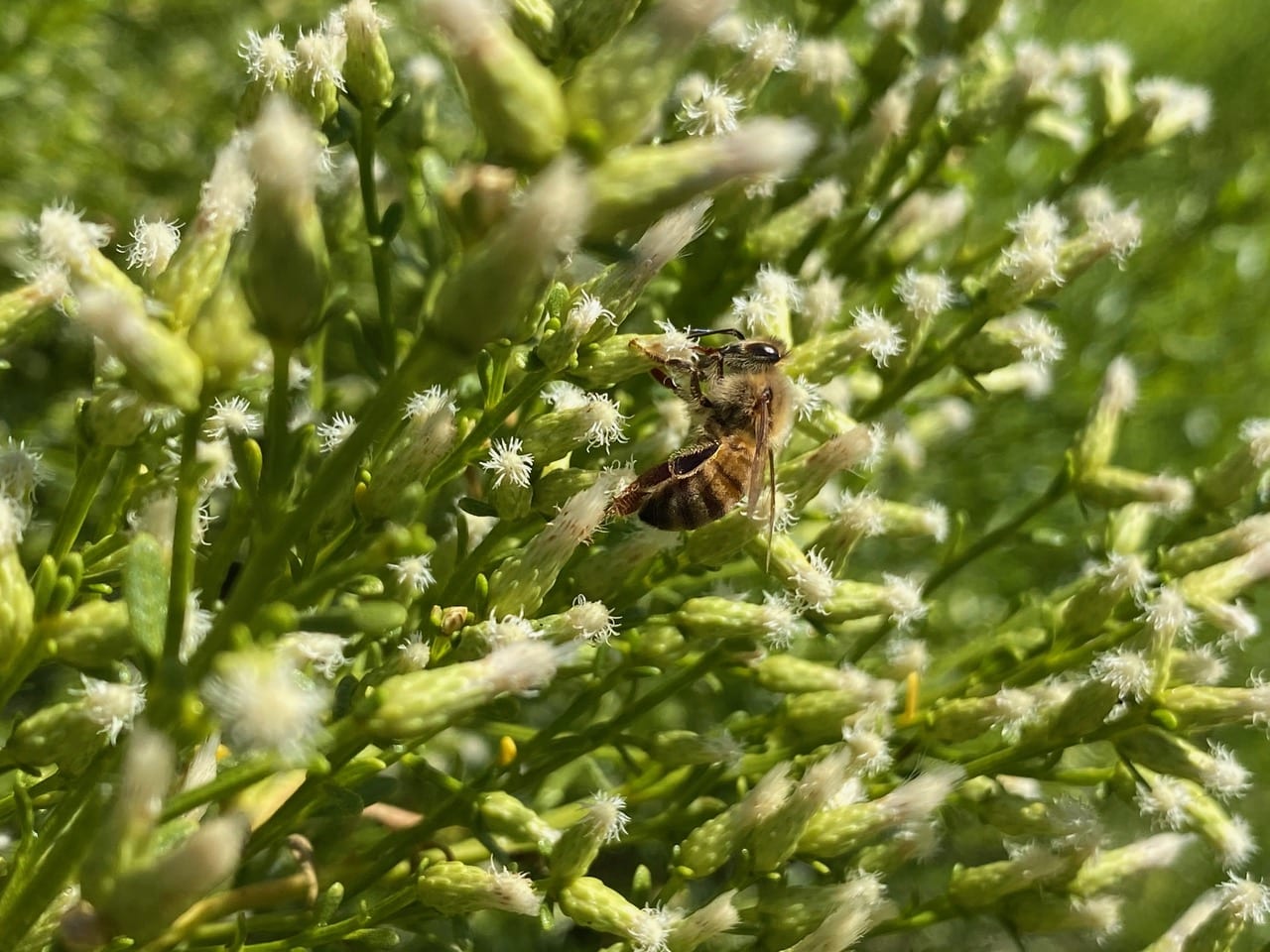
The female Coyote Brush, Baccharis pilularis in the backyard is in peak bloom, attracting a hoard of Honey Bees, Apis mellifera (family Apidae) seeking nectar.
I spot an unusual lady beetle, the Twenty-spotted Lady Beetle, Psyllobora vigintimaculata (family Coccinellidae) on an immature Baccharis flowerhead, but only manage to get a picture of its rear end before it disappears.
The Twenty-spotted Lady Beetle is found in North America. It is tiny, 1.75-3.0 mm in length. Its diminutive size and the brown/gold patches on its white elytra help distinguish it from other lady beetle species found in North America. The species has been proposed for use in place of fungicides as biological control. This is because of its ability to utilize cues to seek and feed on plants infected with powdery mildew, an agriculturally significant plant parasite.
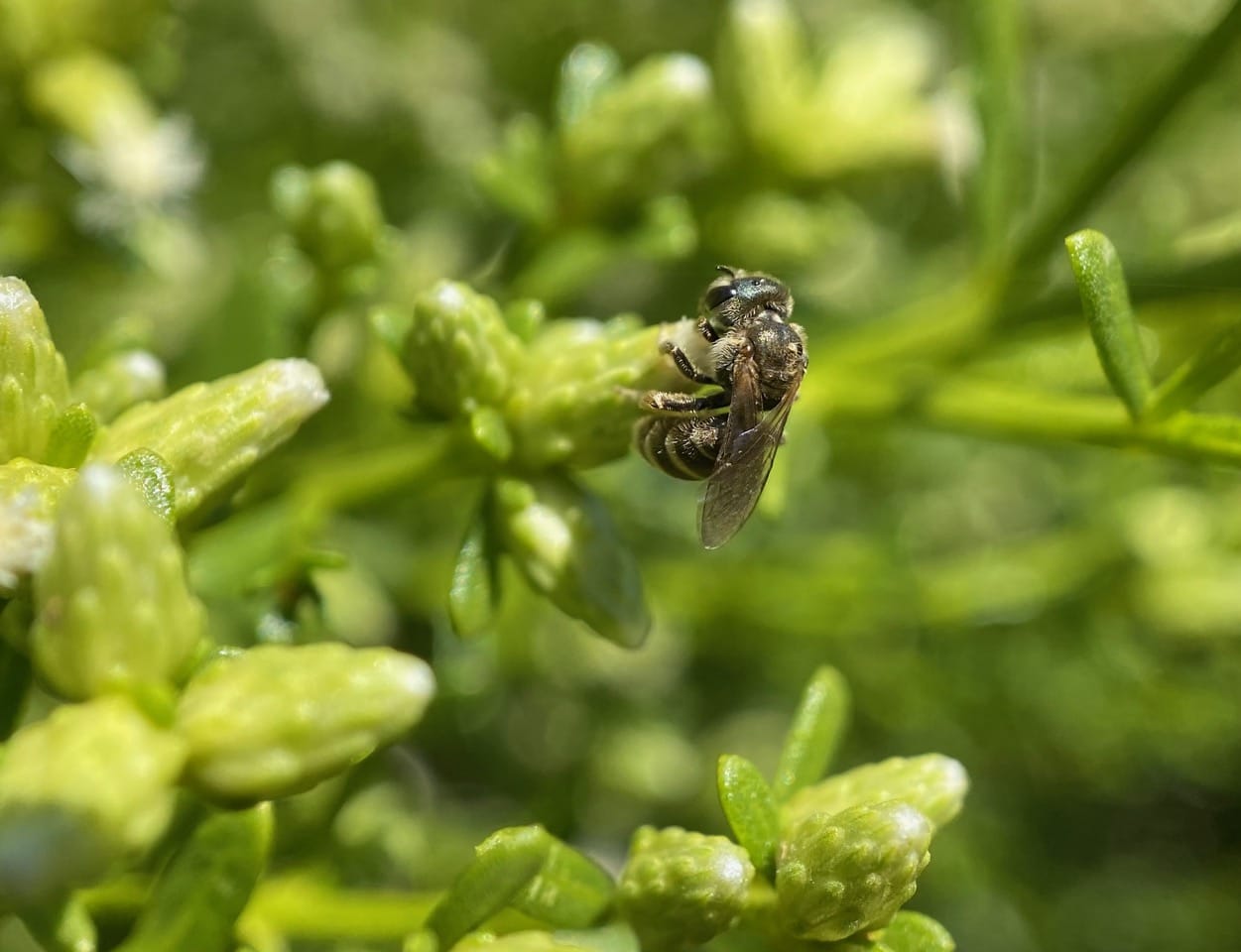
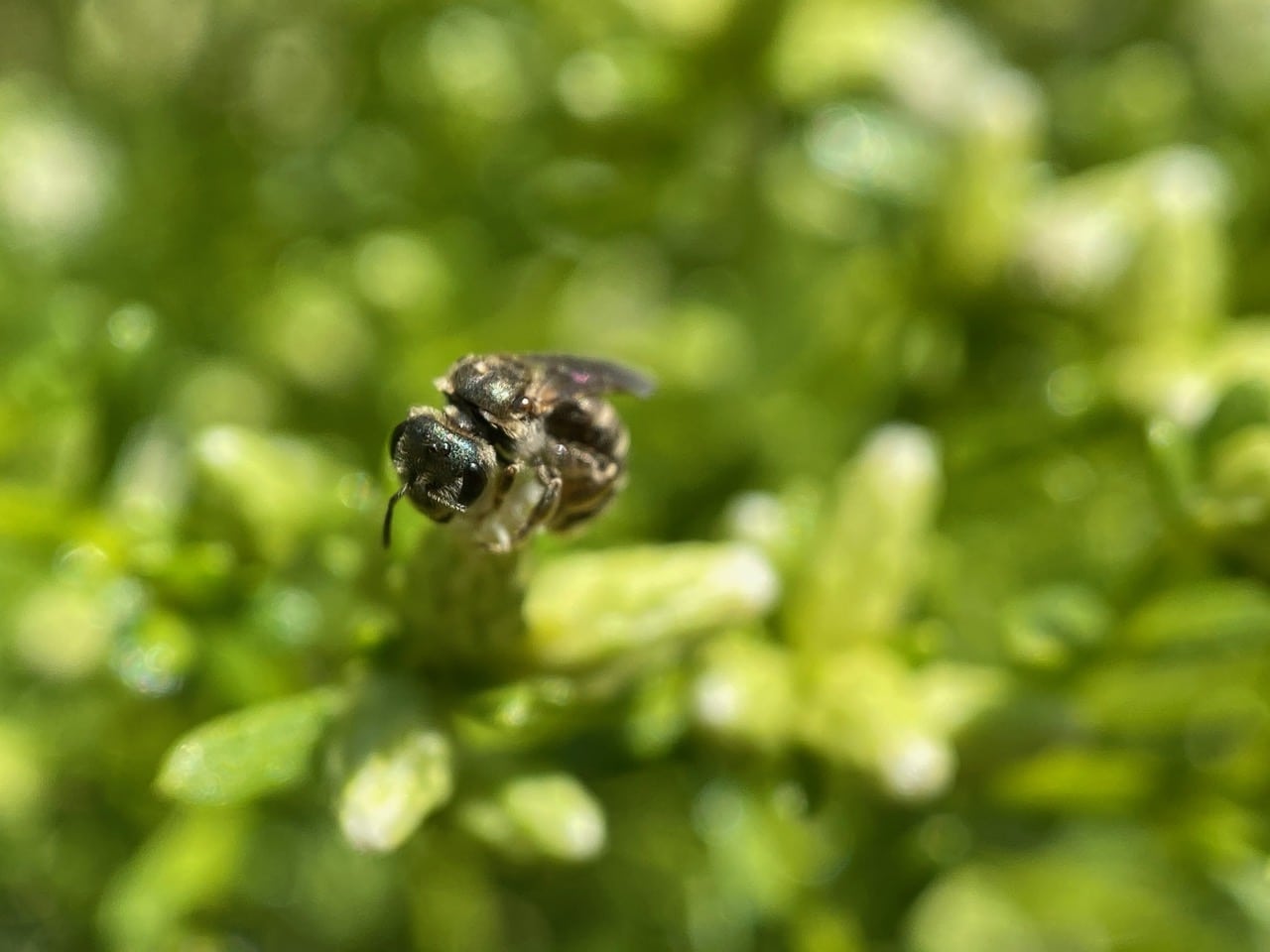
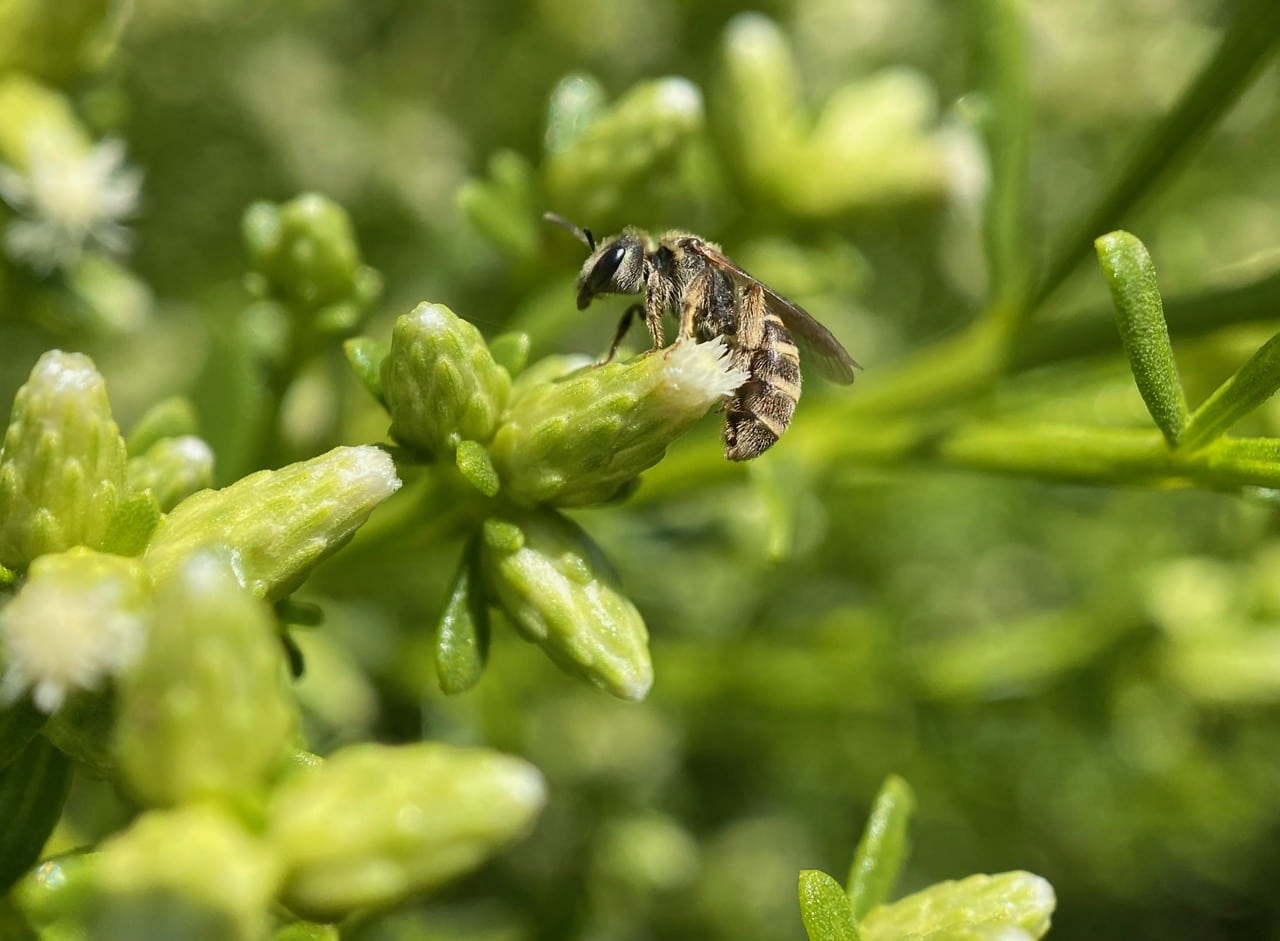
A small bee is taking nectar from a Baccharis flowerhead.
The head and scutum appear to have a slight greenish metallic coloration.
The small size, the apical hair bands on the abdominal terga, and the metallic green scutum are all suggestive of the Tripartite Sweat Bee, Halictus tripartitus (family Halictidae).
Halictus is found worldwide; they are most common in the Northern Hemisphere. All are generalists, foraging from a wide variety of flowering plants. Many species are social and produce several generations per year. This is not surprising as most blooming plants are season-specific; a bee that requires pollen and nectar across multiple seasons would not thrive as a specialist. All Halictus in North America nest in the ground, often in aggregations; and they may nest in the same area for decades.
Halictus tripartitus is active February to October. The bees visit flowers from several families. The species is partially eusocial, with nests connected underground and some workers capable of reproducing.
In the front garden, a Red-flowered Buckwheat, Eriogonum grande var. rubescens in a container is heavily infested with aphids.
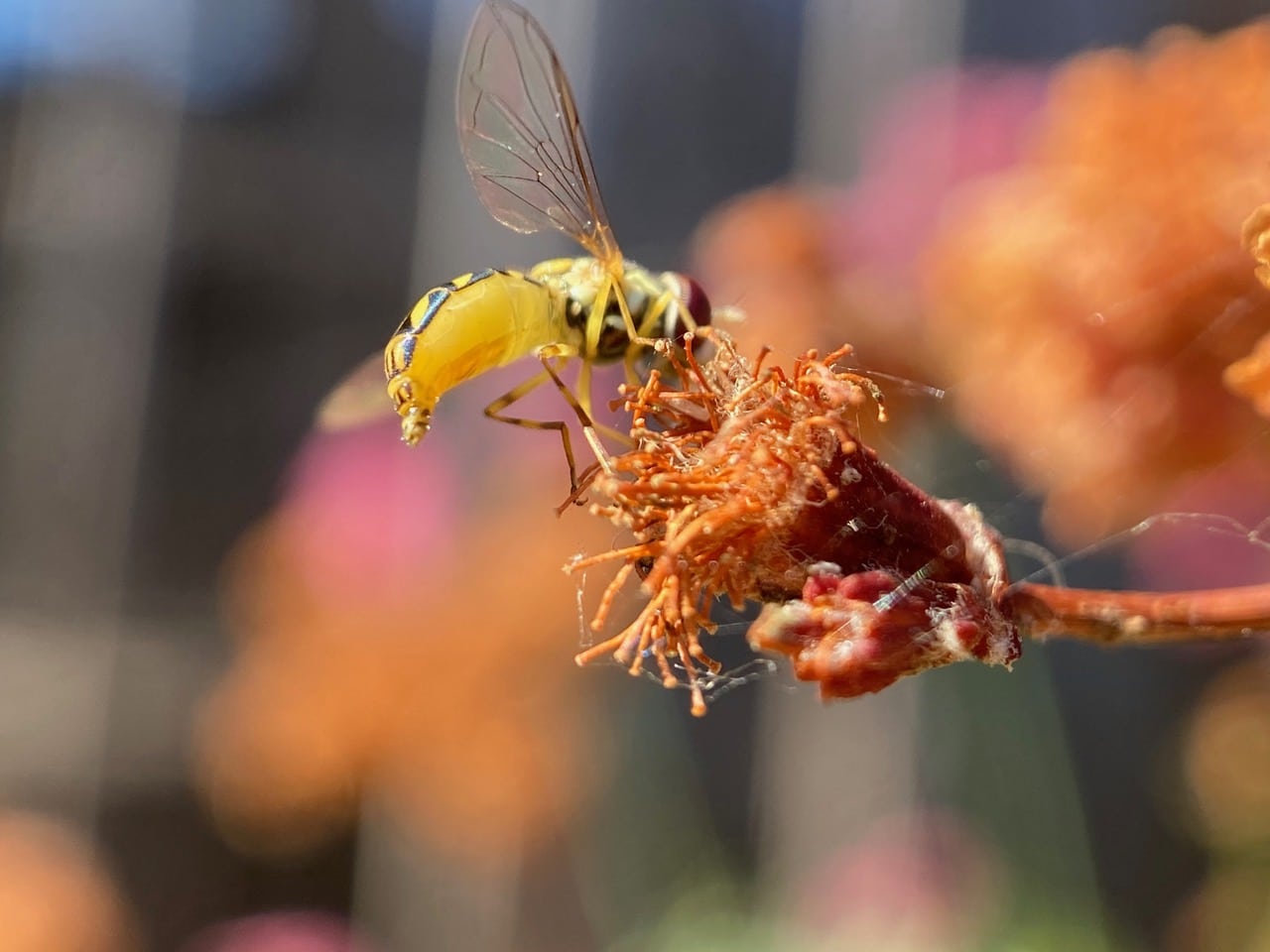
A gravid female Oblique Streaktail, Allograpta obliqua (family Syrphidae) lands on a withered flowerhead of the aphid-infested buckwheat. Her abdomen is curled as if ready to lay eggs.
The Oblique Streaktail is a common North American species of hoverfly. Adults are 6-7 mm long. Males have holoptic eyes (that meet on top of the head), while females have dichoptic eyes. Eggs are laid on surfaces of leaves or stems near aphids. The larvae are important predators of aphids. Adults visit flowers for nectar and pollen, and are pollinators.
Photos of Oblique Streaktail (Allograpta obliqua) · iNaturalist
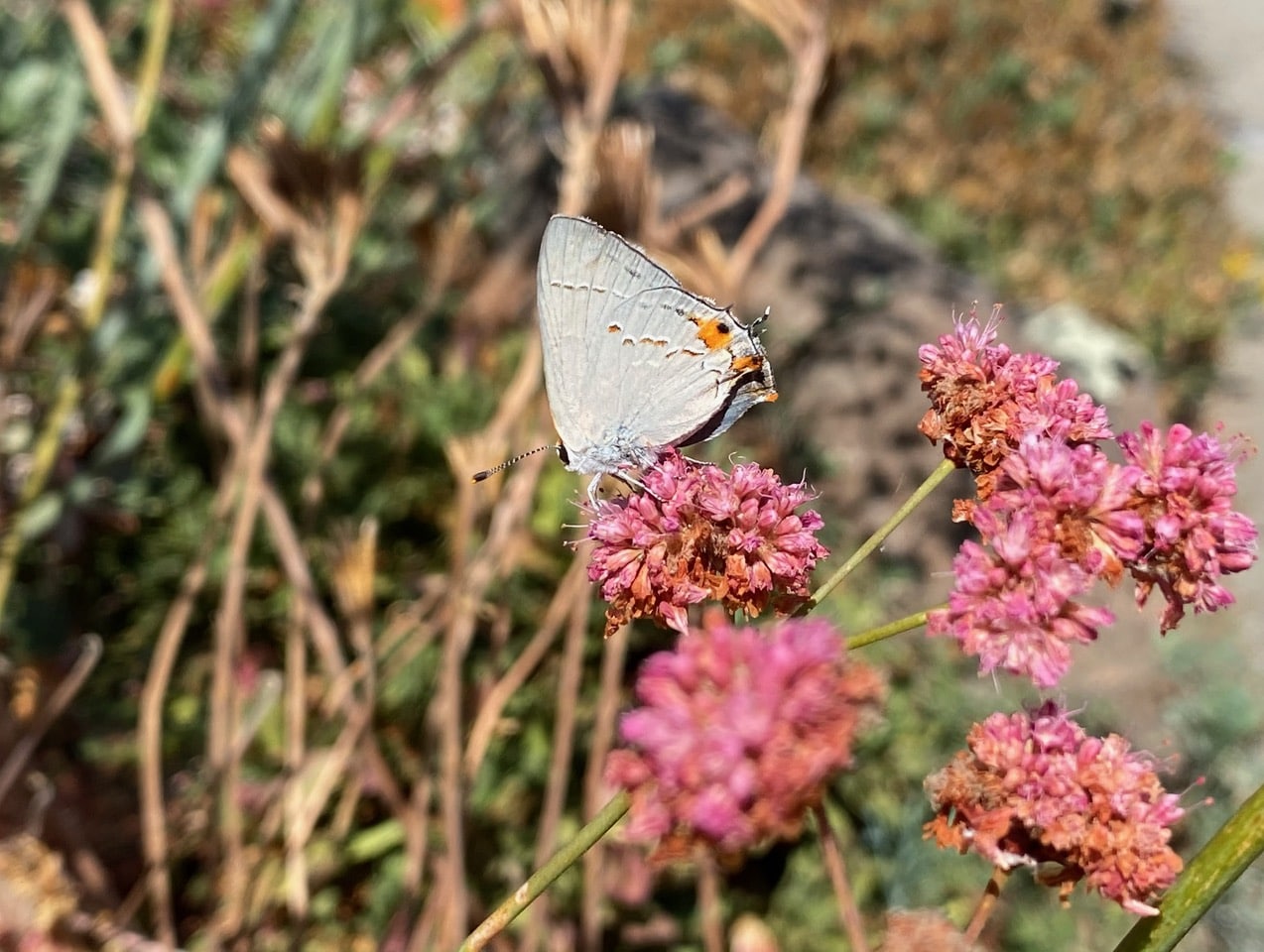
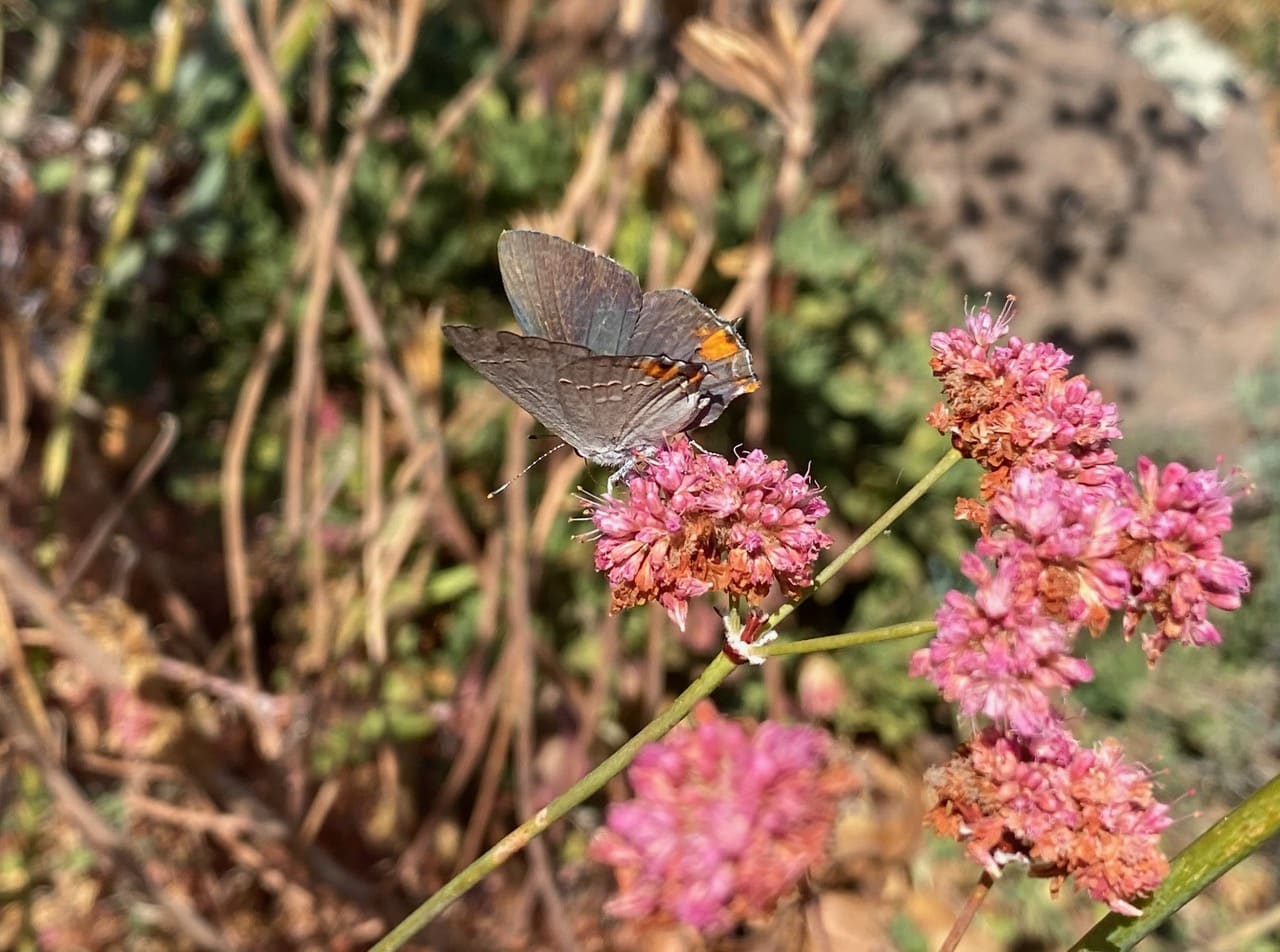
A Gray Hairstreak, Strymon melinus (family Lycaenidae) is perched on a fading inflorescence of Red-flowered Buckwheat, rubbing its hind wings together continuously.
Why the name “hairstreak”? These small butterflies have a slim, hair-like tail on the lower corner of each hindwing. Gray Hairstreak also has colorful false eyespots near the base of each tail. The eyespots and antenna-like tails are believed to fool predators into mistaking its tail for its head. Hairstreaks even add a behavioral component – a nectaring hairstreak often rubs its wings up and down, simulating the movement of twitchy antennae. This may fool birds, lizards, and spiders into attacking the wrong end, sparing the life of the butterfly.
Female Gray Hairstreaks lay eggs singly on the flowers, flower buds, young fruits and nearby leaves of a host plant. Host plants include a wide variety of plants, notably from the pea (Fabaceae) and mallow (Malvaceae) families. The caterpillars are greenish at the start, but older individuals range in color from gray to pink. As in many species of Lycaenidae, Gray Hairstreak larvae are myrmecophiles (ant-lovers) – often tended by ants. Ants harvest a sweet liquid from the caterpillar’s dorsal nectary organ (“honey gland”) and in exchange may protect them from predators. Larvae of many Lycaenidae species also communicate with ants via ant-like sounds (clicks and hums) or by sending vibrations through the substrate.
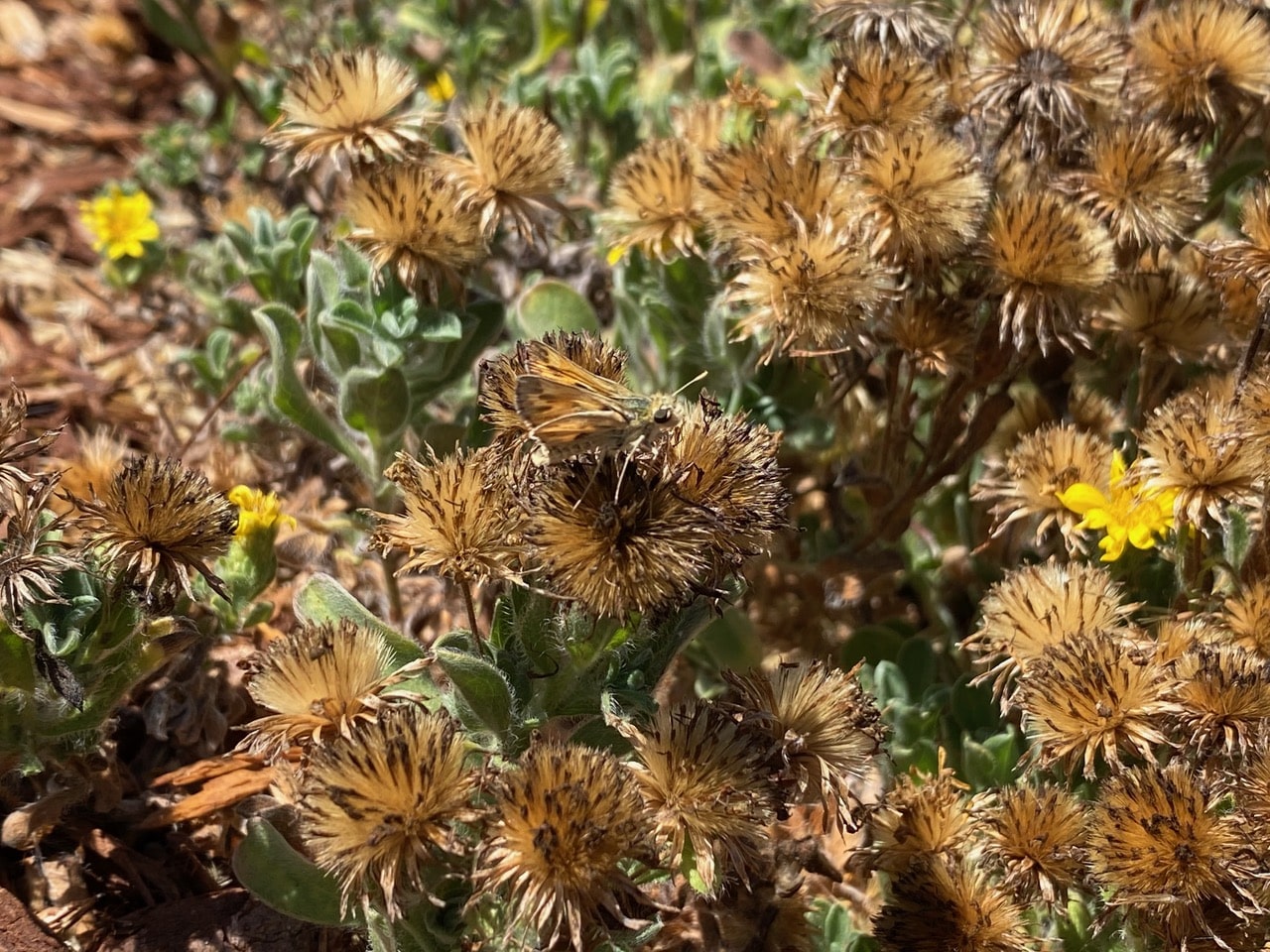
A Skipper butterfly lands on a seed head of San Bruno Mountain Aster, Heterotheca sessiliflora, and instantly disappears from view. The camouflage is uncanny. Are insects aware of their own appearance, and do they perch preferentially on surfaces with which they blend well?
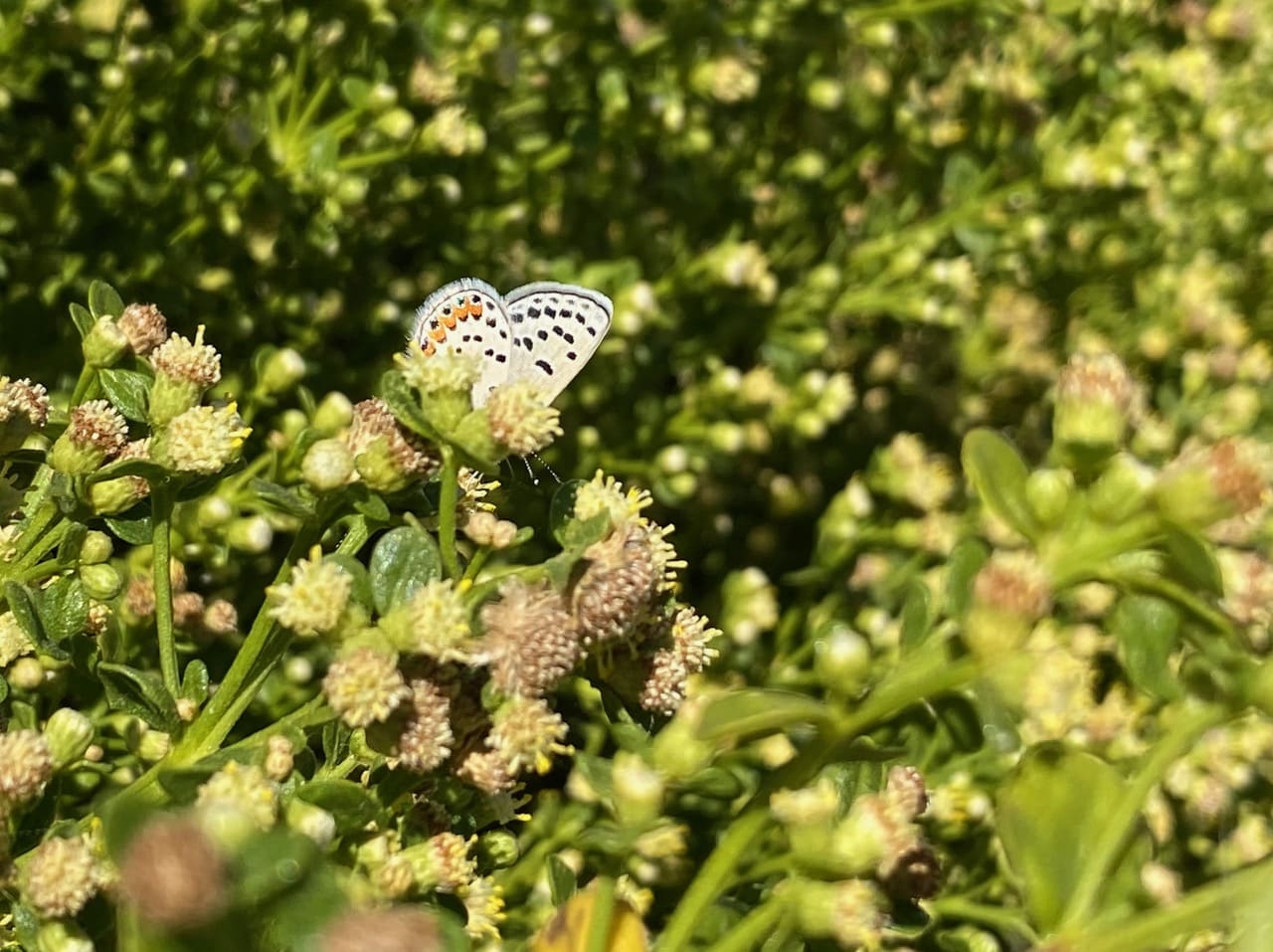
Partially hidden, an Acmon Blue butterfly, Icaricia acmon (family Lycaenidae) is taking nectar from a cluster of flowerheads of a male Coyote Brush. Acmon Blue is easily distinguished from the other “blues” by the band of red-orange markings along the trailing edge of the hind wings.
Acmon Blue is a North American butterfly, found mostly in California. Adults feed on nectar while caterpillars feed on a variety of plant species, including buckwheats, deer weed, lupines, trefoils, and milkvetches. Like many Lycaenid butterflies, Acmon Blue shares a mutualistic relationship with ants. The larvae are often protected and kept in the ant nest when not feeding. In return, they provide honeydew to the ants.
A female Forked Globetail, Sphaerophoria sulphuripes (family Syrphidae) lands on an immature flowerhead of a male Coyote Brush and proceeds to groom herself.
The species is native to western North America. There is marked sexual dimorphism in the Forked Globetail – the males have a narrow abdomen with a reddish, swollen tip. Adults visit flowers for nectar and pollen. The larvae of Sphaerophoria feed on aphids and other soft-bodied insects.
Forked Globetail (Sphaerophoria sulphuripes) · iNaturalist
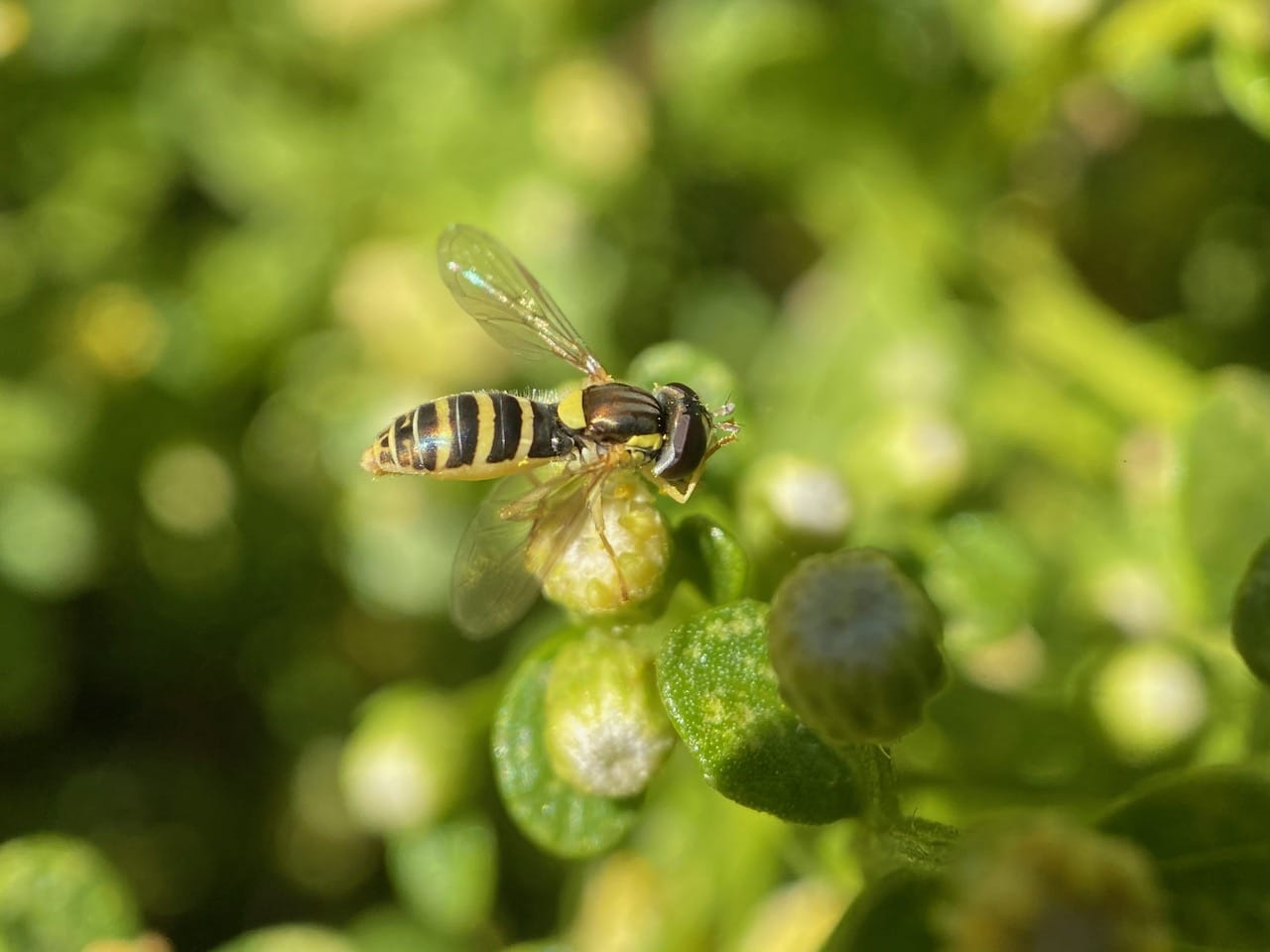
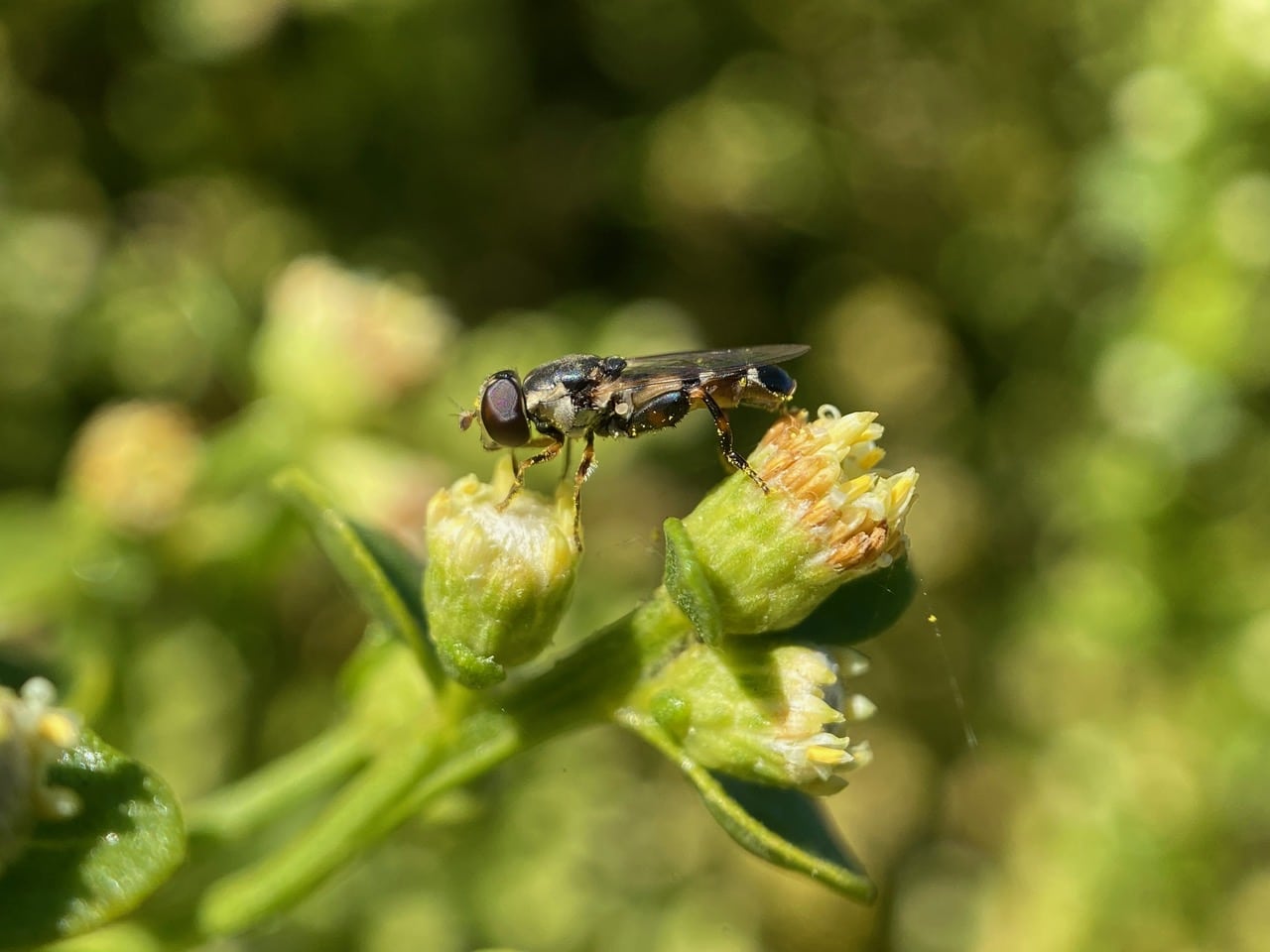
Straddling two flowerheads, A Thick-legged Hover Fly, Syritta pipiens (family Syrphidae) is foraging on a male Coyote Brush.
Syritta pipiens originates from Europe and is currently distributed across Eurasia and North America. They are fast and nimble flyers, and their larvae are found in wet, rotting organic matter such as garden compost, manure, and silage. The flies are important pollinators for a variety of flowering plants.
The Thick-legged Hover Flies are often found on flowers, where the adult males primarily feed on nectar and adult females eat protein-rich pollen to produce eggs. The common name comes from the fly’s distinctively broad femora. The fly is about 6.5 -9 mm long. The species flies at a very low height, rarely more than 1 m above the ground. Males accurately track females, aiming to attempt forced copulation.
In just two hours this morning I have recorded 7 species of Hover Flies (family Syrphidae) in Stefanie’s garden! In fact, there are two more species that I fail to get photos of – the Common Grass Skimmer, Paragus haemorrhous, and the Interrupted Hornet Fly, Spilomyia interrupta. Wow, nine species in total!
While the number and diversity of bees have declined considerably, the hover flies are still going strong in the garden. They seem to outlast all the other pollinators through the seasons.