

Pollinator Post 9/28/24 (1)
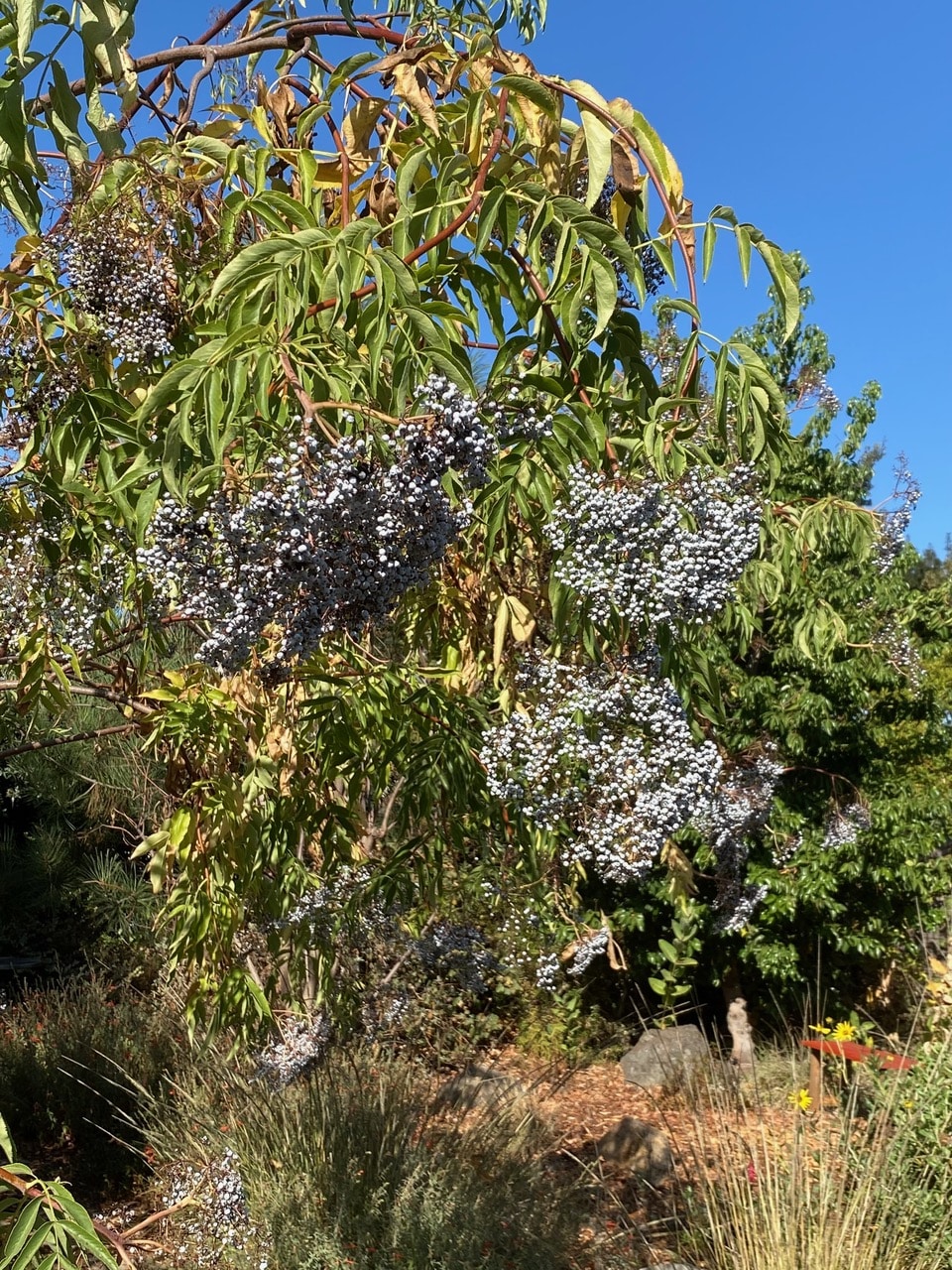
It’s been a while since I last visited Stefanie’s home garden in San Leandro. I wonder how it is faring in the fall?
Huge bunches of ripe berries droop on the large Blue Elderberry in the backyard. I wonder which pollinators are responsible for this bumper crop?
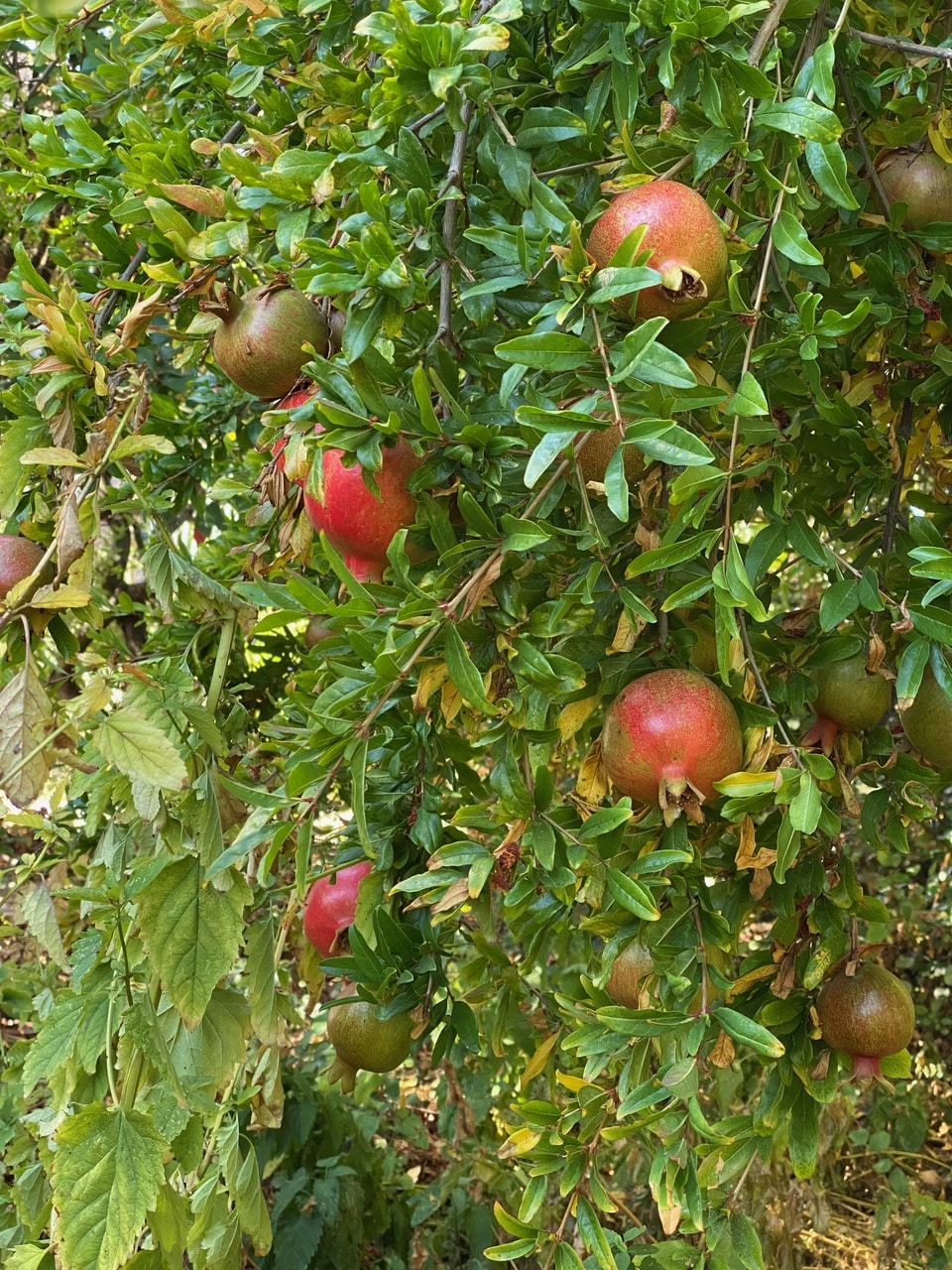
Further back, large pomegranates are ripening on their droopy branches.

It might not be immediately obvious, but the Deer Grass, Muhlenbergia rigens are in full bloom.
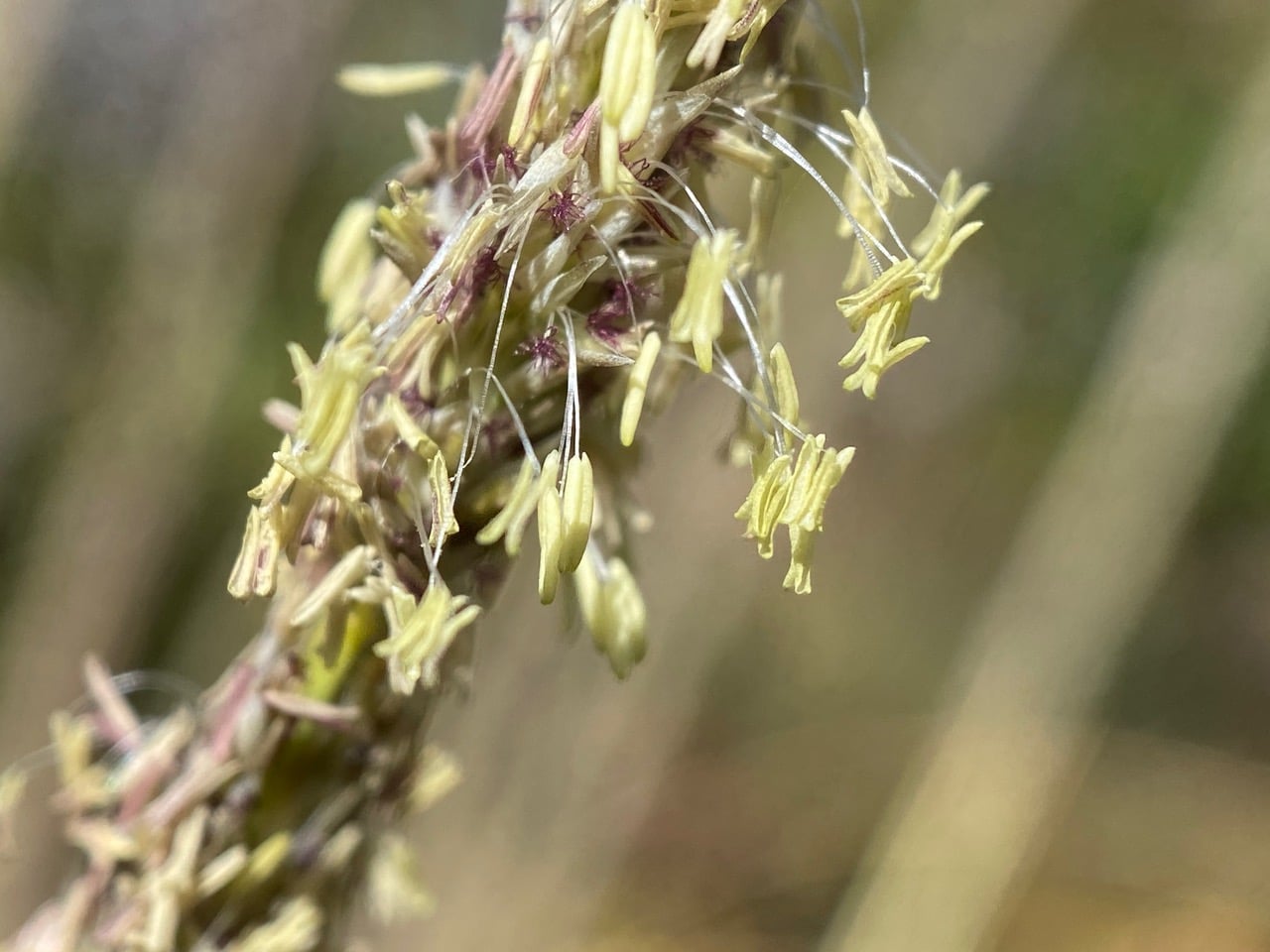
Close up of Deer Grass flowers.
Without a need to attract insects to transfer their pollen, grasses do not expend energy on lavish pageantry. Their flowers are small and muted, lacking petals. They exist as rows of envelopes, smaller florets, braiding themselves into a diversity of branching inflorescence.
The straight and narrow inflorescence of Deer Grass appears as a spike, crowded with inconspicuous florets. The pollen carrying anthers dangle on long, hairlike filaments. Closer to the florets are the feathery dark purple stigmas for receiving incoming pollen. Grasses are anemophilous, “wind loving”. When the anthers are mature, the slightest breeze will send their prolific pollen aloft, perchance to land on a receptive stigma on another plant.
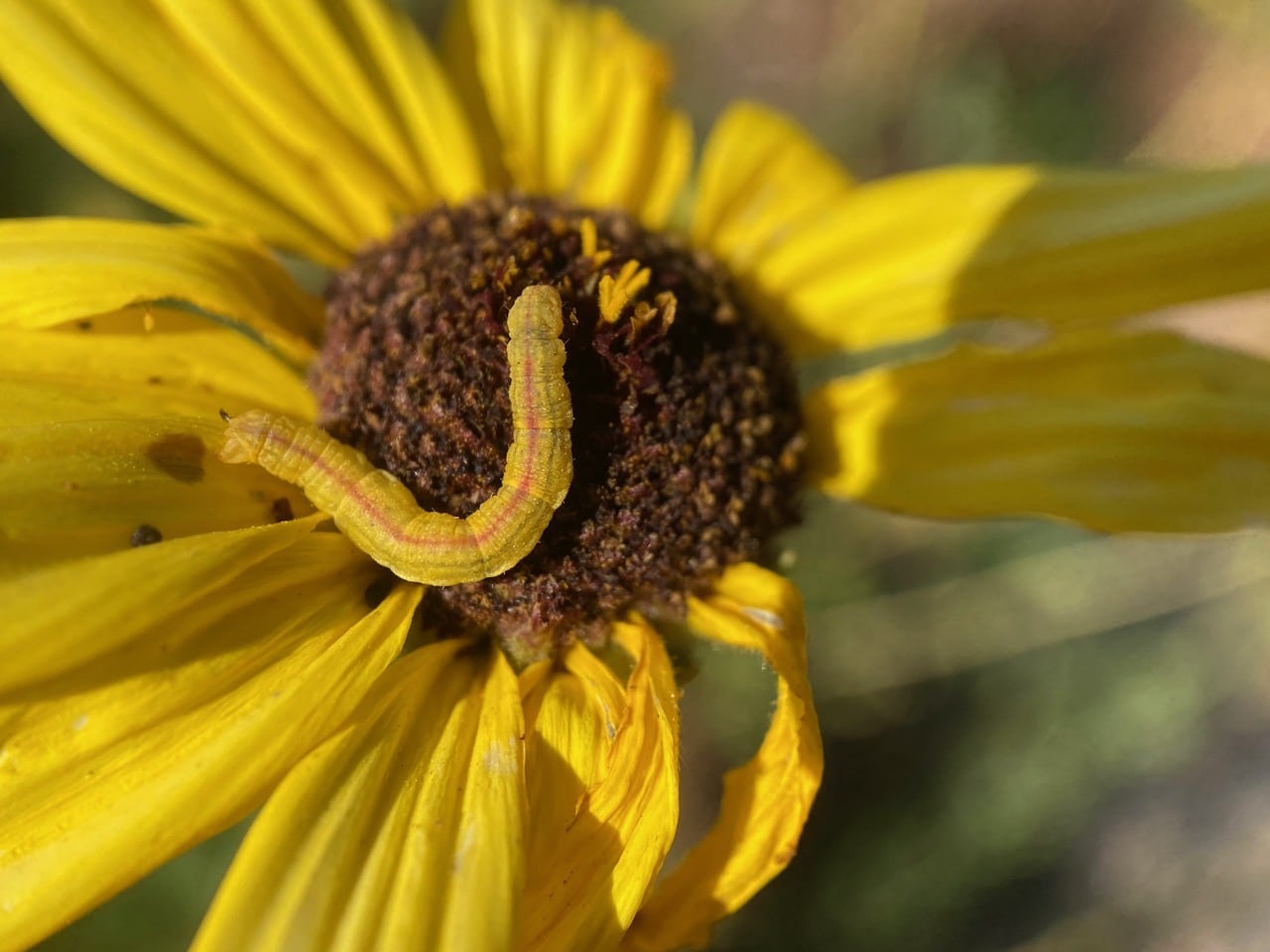
An Inchworm caterpillar of Pug Moth, Epithecia sp. (family Geometridae) is resting on a fading flowerhead of Bush Sunflower, Encelia californica.
Inchworms are also called loopers and measuring worms. They majority of the inchworms are the larvae of moths in the family Geometridae. The name comes from the Greek “geo” for earth and “metro” from measure, because the caterpillars seem to be measuring the surface on which they are walking.
All caterpillars have three pairs of jointed legs behind their heads. These legs are called true legs because they will become the six legs of the adult butterfly or moth. There are additional appendages, called prolegs, along their bodies. Prolegs are not true legs, they are just outgrowths of the body wall and will be lost at metamorphosis. They have little hooks on their soles to help the caterpillar walk and grip onto things. Most caterpillars have five sets of prolegs, four in the middle of the body and one pair at the hind end. Inchworms have the normal six true legs but only two or three pairs of prolegs, all located at the tail end of the body, with none in the middle. When an inchworm walks, it moves its tail-end prolegs up behind its true legs, causing the center of its body to loop upward. Then it stretches its front end forward to take another step.
Epithelia is the largest genus of moths of the family Geometridae. Occurring worldwide except for Australasia, species in the genus are commonly known as pugs. Adults are typically small, 12 – 35 mm, with muted colors. Most species rest with forewings held flat at right angles to the body, while the hindwing are largely covered by the forewings. They are generally nocturnal. Larvae mostly feed from the flowers and seeds of their food plants rather than the foliage. Many species have a very specific food plant.
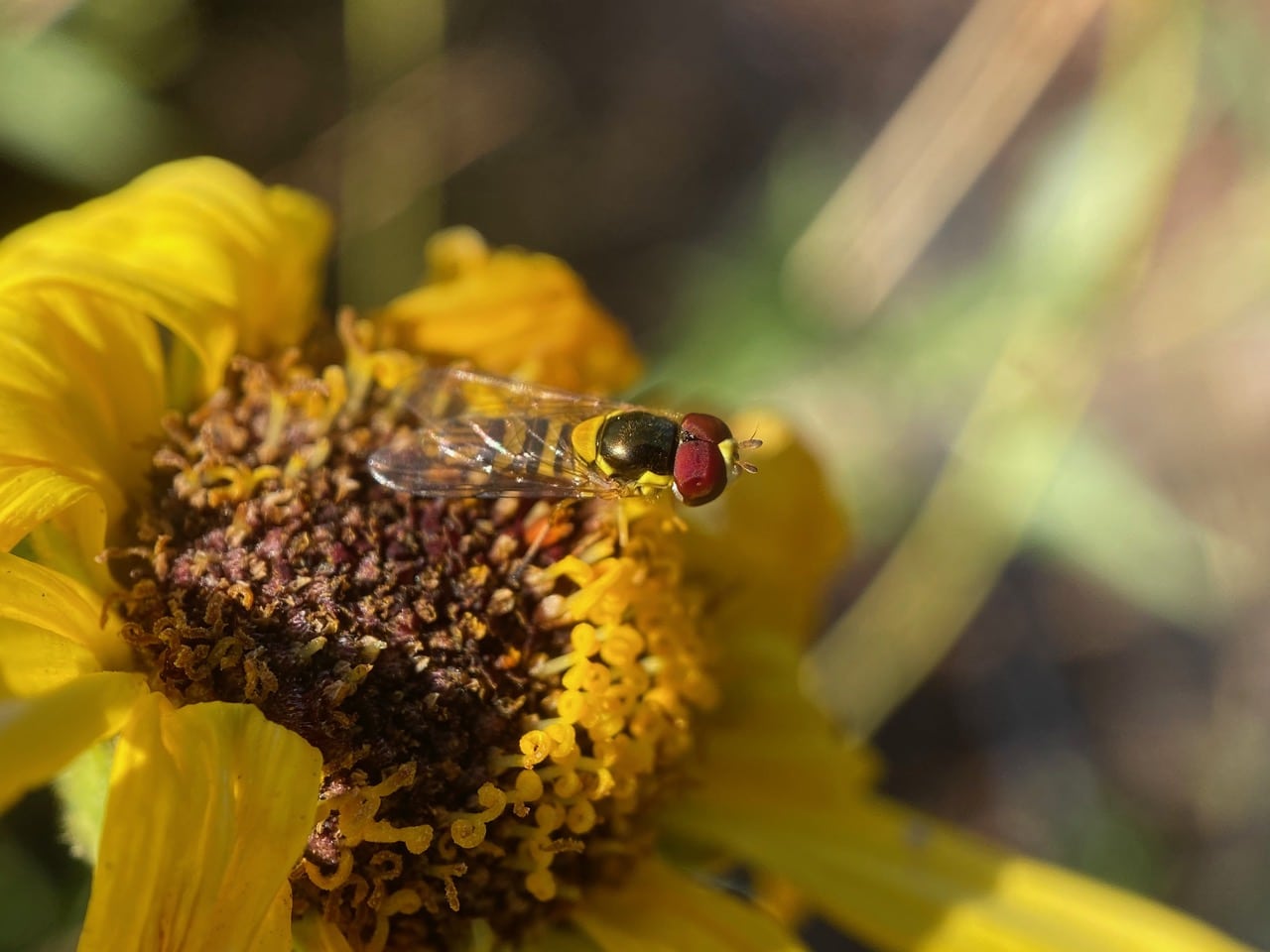
A male Oblique Streaktail, Allograpta obliqua (family Syrphidae) visits an Encelia flowerhead.
The Oblique Streaktail is a common North American species of hoverfly. Adults are 6-7 mm long. Males have holoptic eyes (that meet on top of the head), while females have dichoptic eyes. Eggs are laid on surfaces of leaves or stems near aphids. The larvae are important predators of aphids. Adults visit flowers for nectar and pollen, and are pollinators.
Photos of Oblique Streaktail (Allograpta obliqua) · iNaturalist

A tiny, shiny spider on an Encelia flowerhead catches my eye. It is a Buttonhook Leafbeetle Jumping Spider, also known as the Grapevine Spider, Sassacus vitis (family Salticidae).
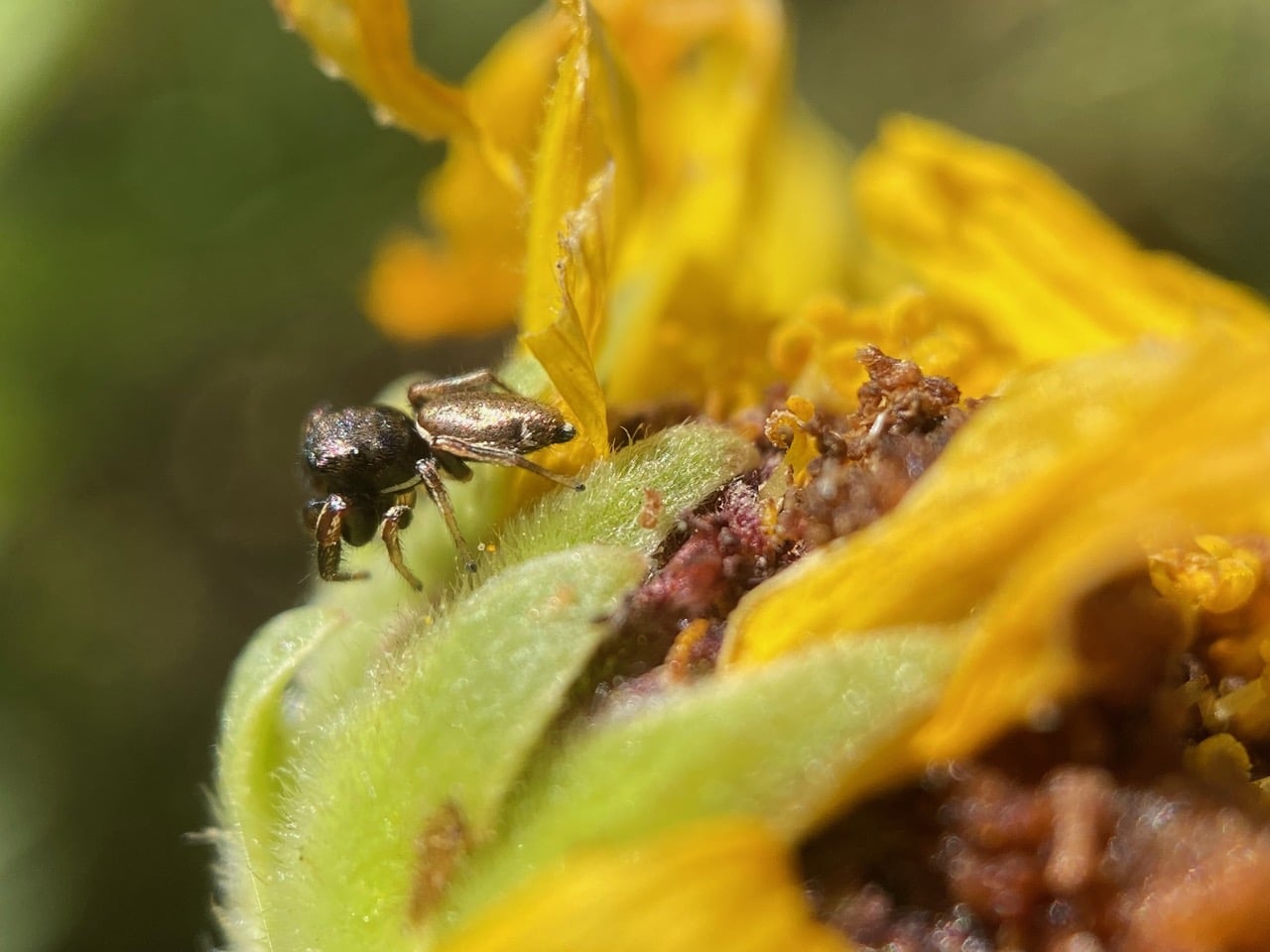
Salticids are free-roaming hunting spiders. They do not weave a web to catch prey. They stalk, then pounce on their prey. Just before jumping, the spider fastens a safety line to the substrate. It can leap 10-20 times their body length to capture prey. Their movement is achieved by rapid changes in hydraulic pressure of the blood. Muscular contractions force fluids into the hind legs, which cause them to extend extremely quickly. Jumping spiders are visual hunters. Their excellent vision has among the highest acuities in invertebrates. Since all their 8 eyes are fixed in place and cannot pivot independently from the body like human eyes can, jumping spiders must turn to face whatever they want to see well. This includes moving their cephalothorax up and down, an endearing behavior.

The Buttonhook Leafbeetle Jumping Spider, Sassascus vitis is native to North America, with a range spanning from Canada to Panama. It is a small jumping spider with iridescent gold abdomen and white ring around the anterior surface of abdomen. Body is covered with golden scales. Males are 3.5 mm long, females 4.5 mm. The name vitis is Latin for “grapevine”. The spider is commonly found on shrubs and vines and in fields. Best known as a common resident of vineyards.

Sensing my camera, the spider spins around to face it.
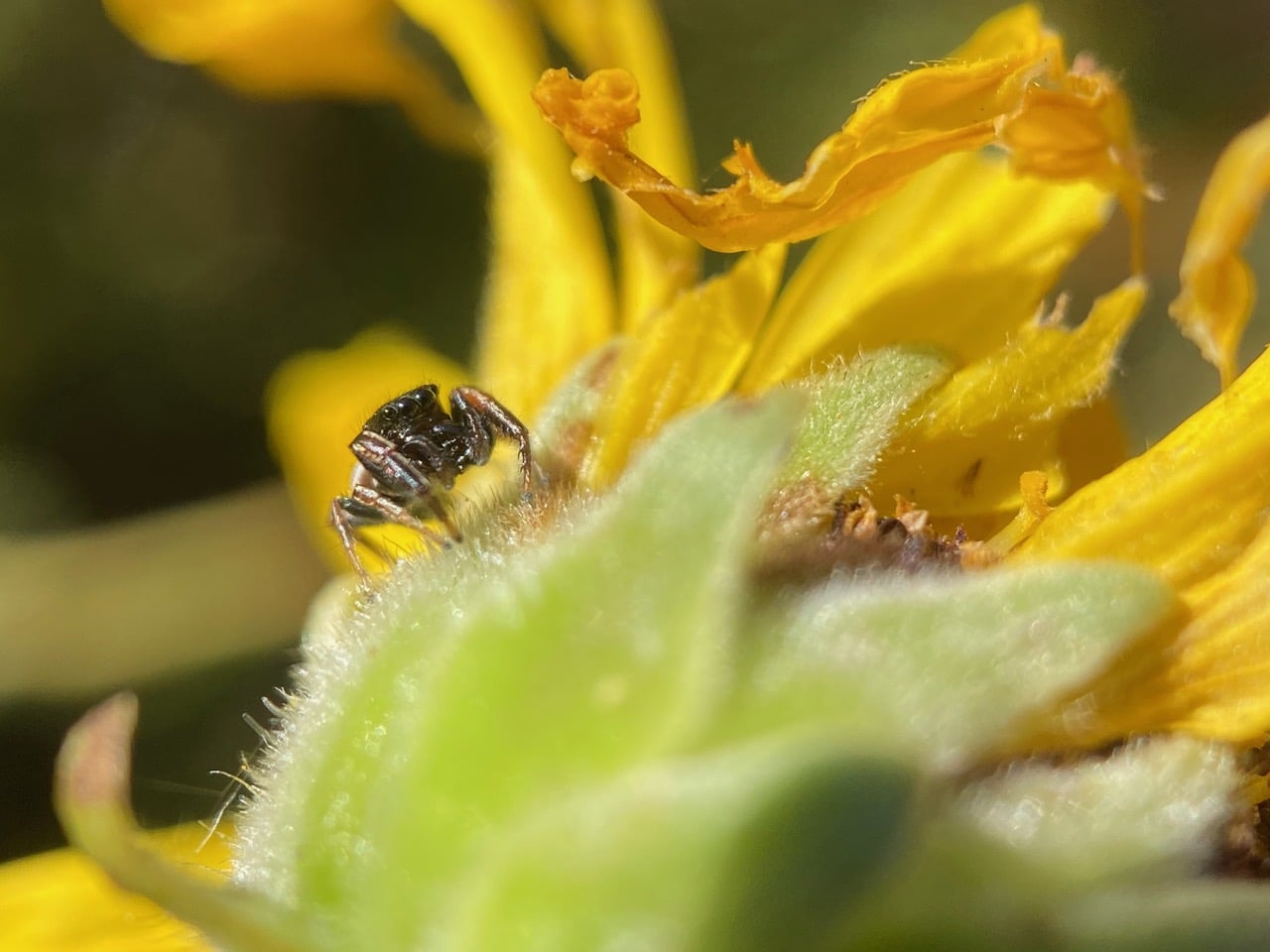

Hey, here’s a different Jumping Spider on a spent Encelia flowerhead. It is a Sun Jumping Spider, Heliophanus apiatus (family Salticidae).
The genus Heliophanus is one of the largest genera of jumping spiders with over 150 species, widespread in the Palearctic and Africa, with one center of diversity in the Mediterranean region. Heliophanus apiatus was first reported in the San Francisco Bay Area in 2015. Since then the species has established in three counties – Alameda, Santa Clara and San Mateo – surrounding the southern arm of San Francisco Bay. H. apiatus is a small salticid, male measuring 3.5-4.0 mm, and females 4.0-4.5 mm in body length. Mature males and females are similar in appearance, but only the females have yellow pedipalps. These spiders are found on low vegetation and on hard structures on or near the ground. They are capable of taking prey their own size.

A female Margined Calligrapher, Toxomerus marginatus (family Syrphidae) has landed on a broken branch of California Fuchsia.
Toxomerus marginatus, also known as the Margined Calligrapher is a common species of hoverfly found in North America. These are small hoverflies, measuring 5-6 mm in length. The abdomen is black and yellow, and is narrowly margined with yellow. Adults are found in diverse habitats such as forests, fields, meadows, marshes, deserts, and alpine areas. They are highly adaptable and can occur is very disturbed habitats. Larvae prey on aphids, thrips, mites, and small caterpillars. Adults visit flowers for nectar and pollen.
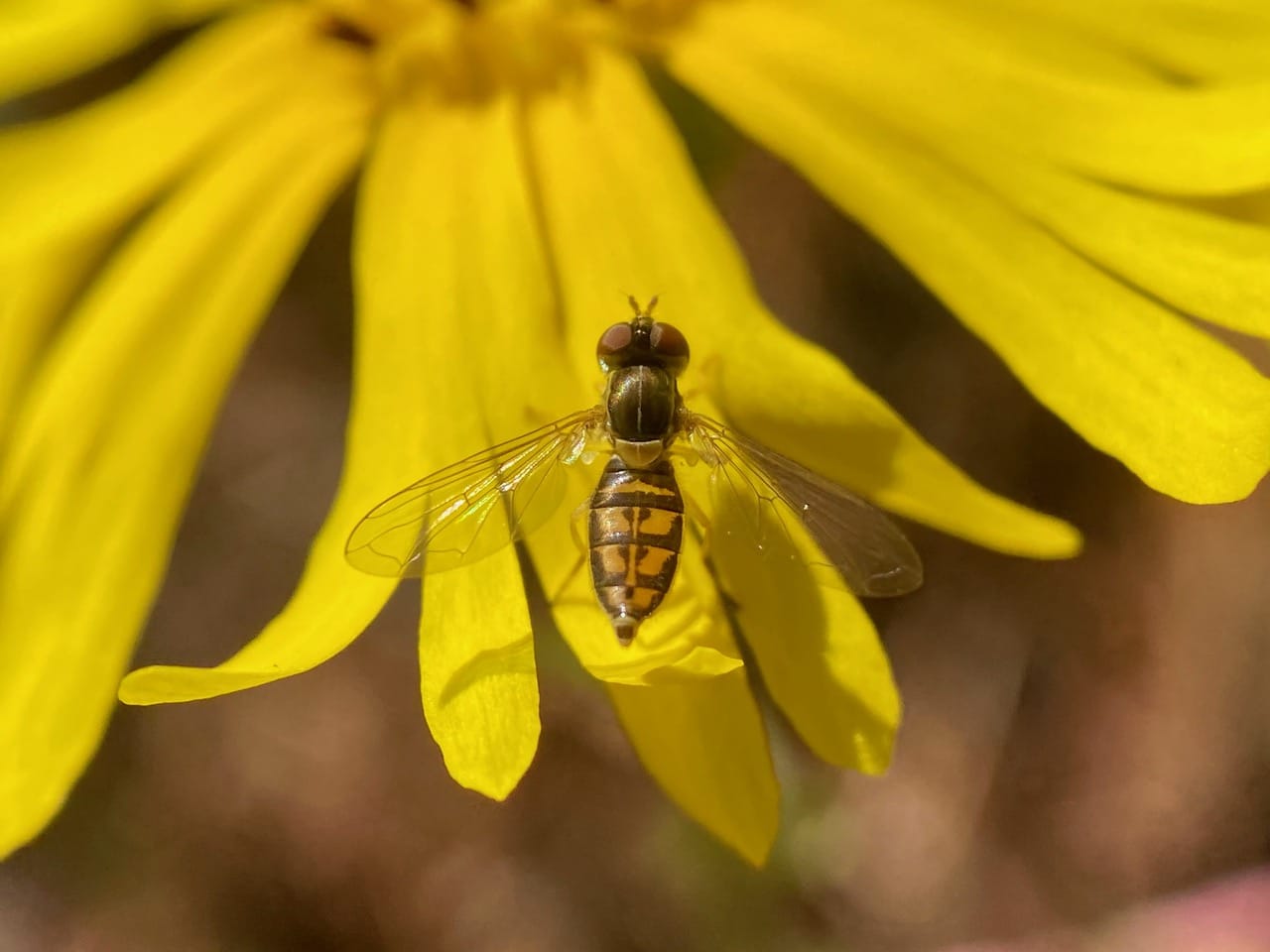
Another Margined Calligrapher, Toxomerus marginatus (family Syrphidae) has landed on the ray petals of an Elegant Tarweed flowerhead.
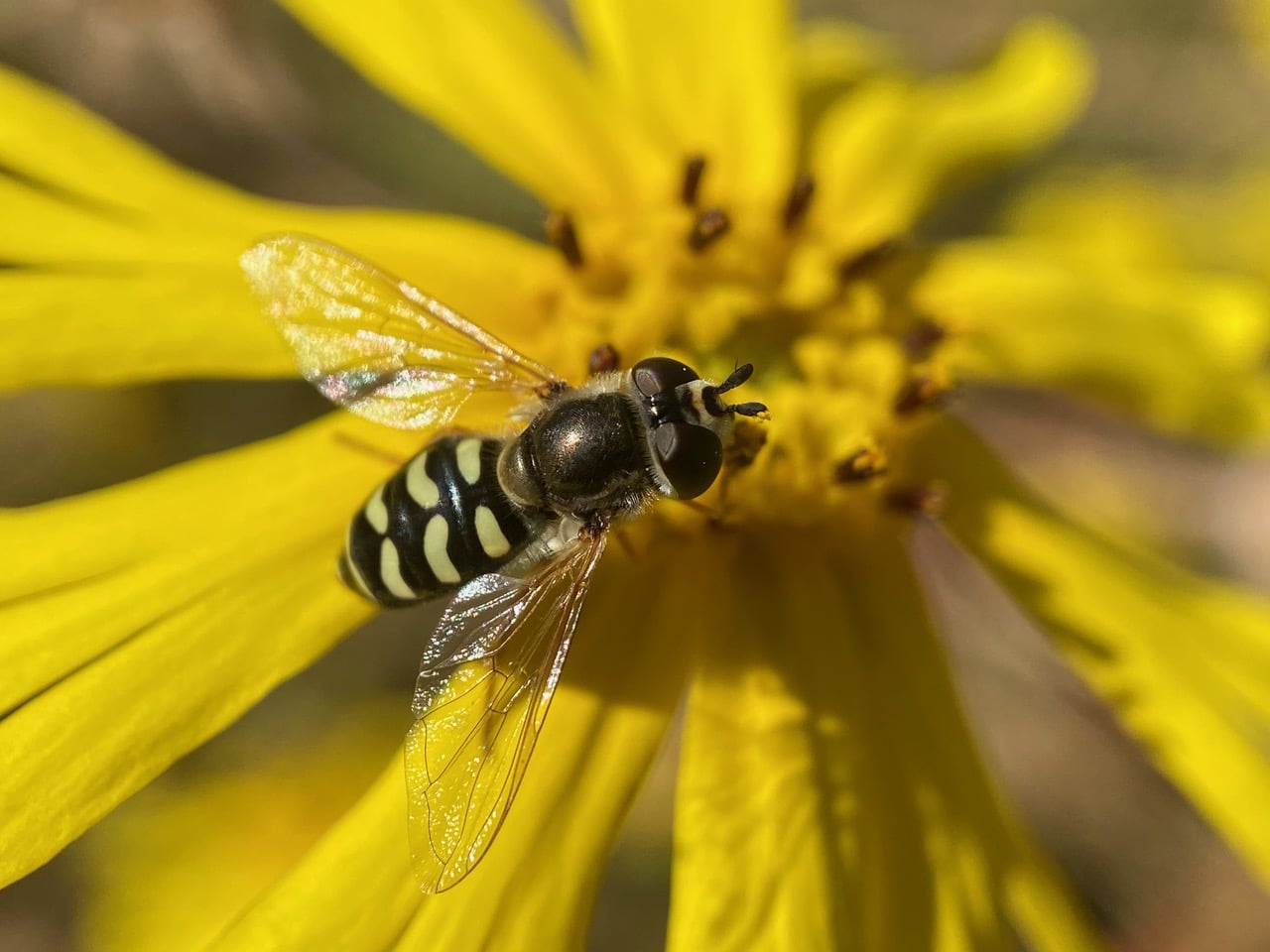
A female Large-tailed Aphideater, Eupeodes volucris (family Syrphidae) is foraging on a flowerhead of Elegant Tarweed, Madia elegans.
The hover fly is found in western North America, and is active March through November. The common name of the species refers to the distinctive “large tail” or projecting cylindrical abdomen of the males. As the rest of the common name implies, the larvae of the species are voracious predators of small plant-sucking insects such as aphids. Females seek out dense aphid colonies on plants to lay eggs among them. Adults visit flowers for nectar and pollen.
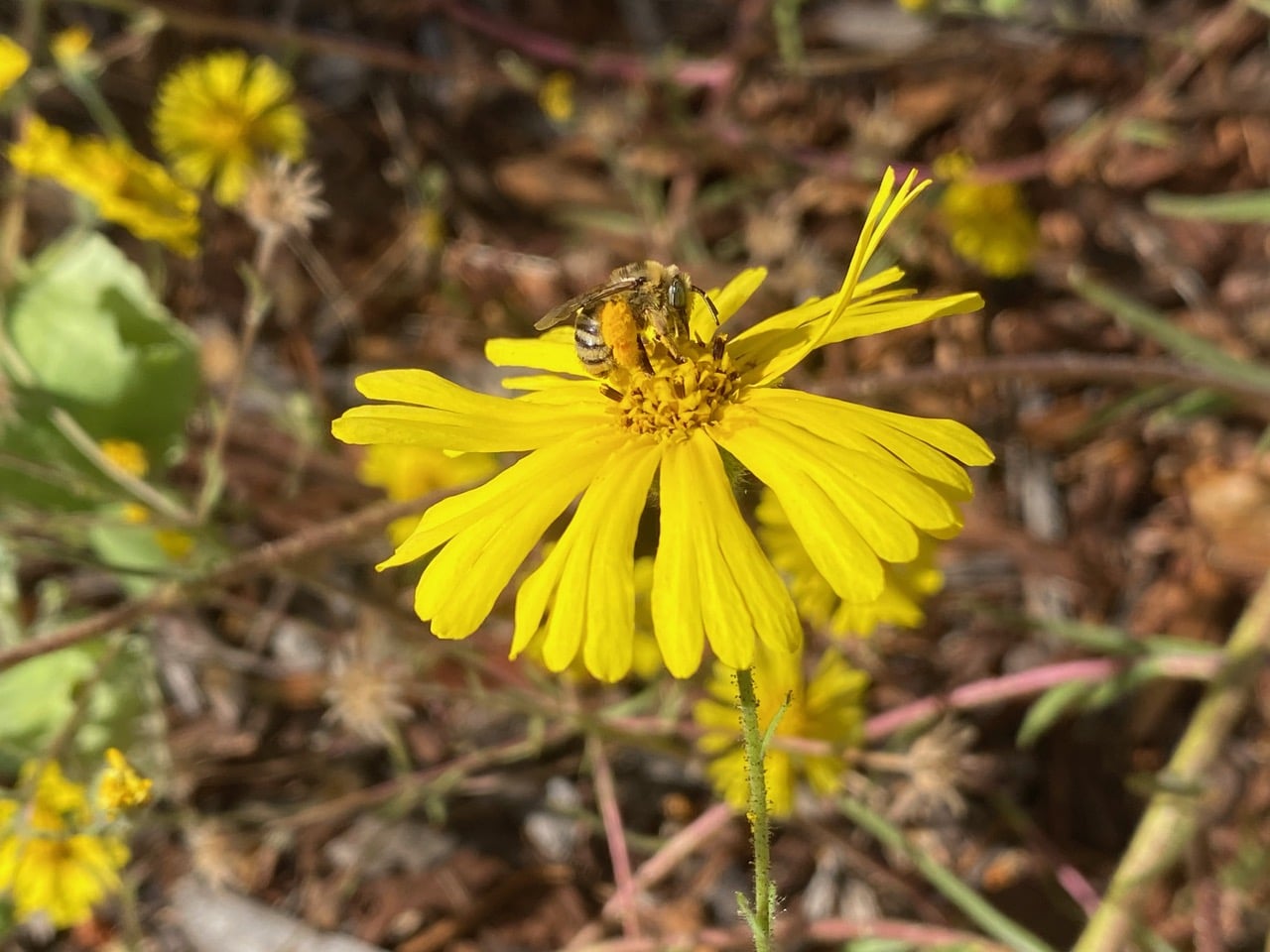
As the morning heats up, female Summer Longhorn Bees, Melissodes sp. (family Apidae) begin to appear on the Elegant Tarweed flowers. While the males of the species are easily recognized from their long antennae, the females are recognized for the huge pollen loads on their hind legs.

The Summer Longhorn Bees, Melissodes sp. (family Apidae) are medium to large bees, stout-bodied, usually with gray hair on the thorax and pale hair bands on the abdomen. Males usually have yellow markings on their faces and have very long antennae from which their common name is derived. They are active May to September, with peak flight in late June to early August. The females prefer flat, bare ground for digging their solitary nests, though they sometimes nest in aggregations. Pollen is transported in scopae on the hind legs. Pollen loads are often copious and brightly colored and thus very distinguishable. Melissodes are specialists on Asteraceae – females gather pollen from flowers of Aster, Bidens, Coreopsis, Cosmos, Encelia, Gaillardia, Helianthus, and Rudbeckia ssp.

Specialists on the sunflower family, Asteraceae, the Melissodes females are extremely efficient at gathering pollen from the Elegant Tarweed. With rapid and fancy footwork she typically pivots on the flowerhead a couple of times, packing pollen loosely into the long hairs of her scopae. An observer can actually see the pollen load burgeon in real time as the female Melissodes works.
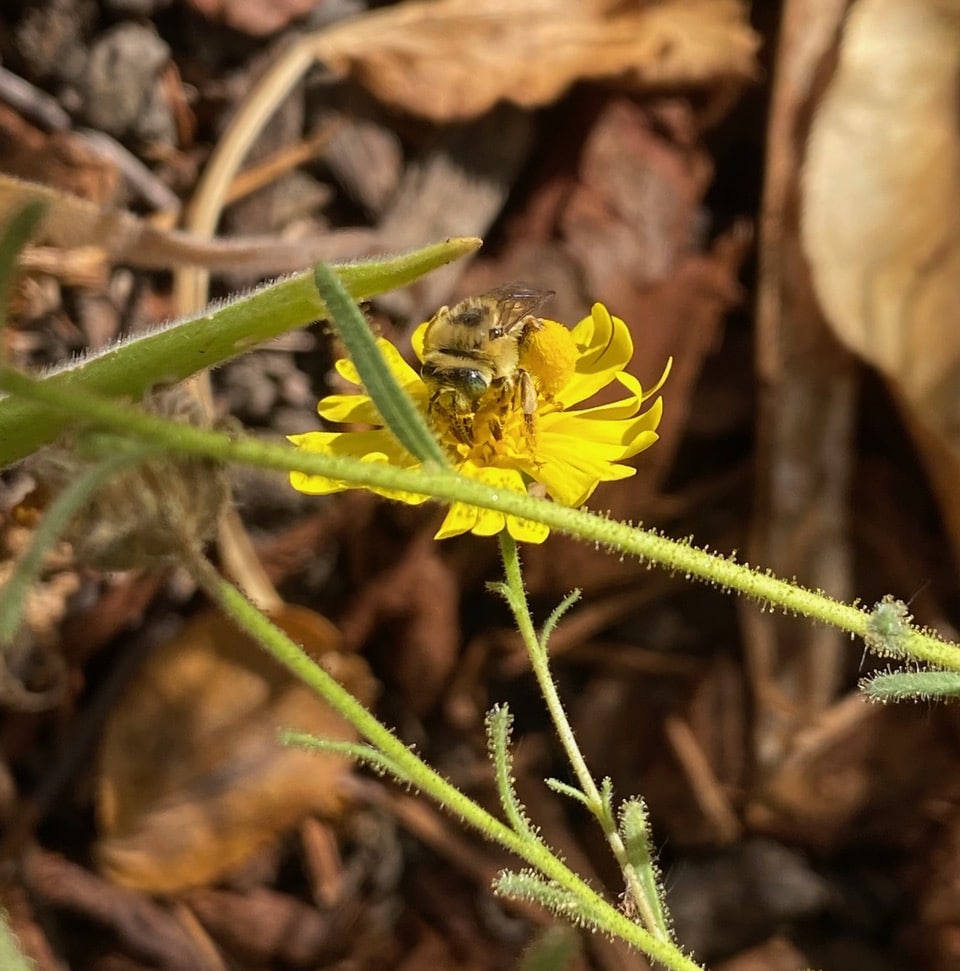
Pollen is loosely held on the scopal hairs by electrostatic attraction. This way of transporting pollen is believed to better facilitate pollination as the grains come off easily as the bee goes from flower to flower, as compared to the wetted pollen that is neatly packed into the pollen baskets (or corbiculae) of bumble bees and honey bees.
Scientists are beginning to unravel the roles that electrostatic forces play in the interactions between plants and insects.
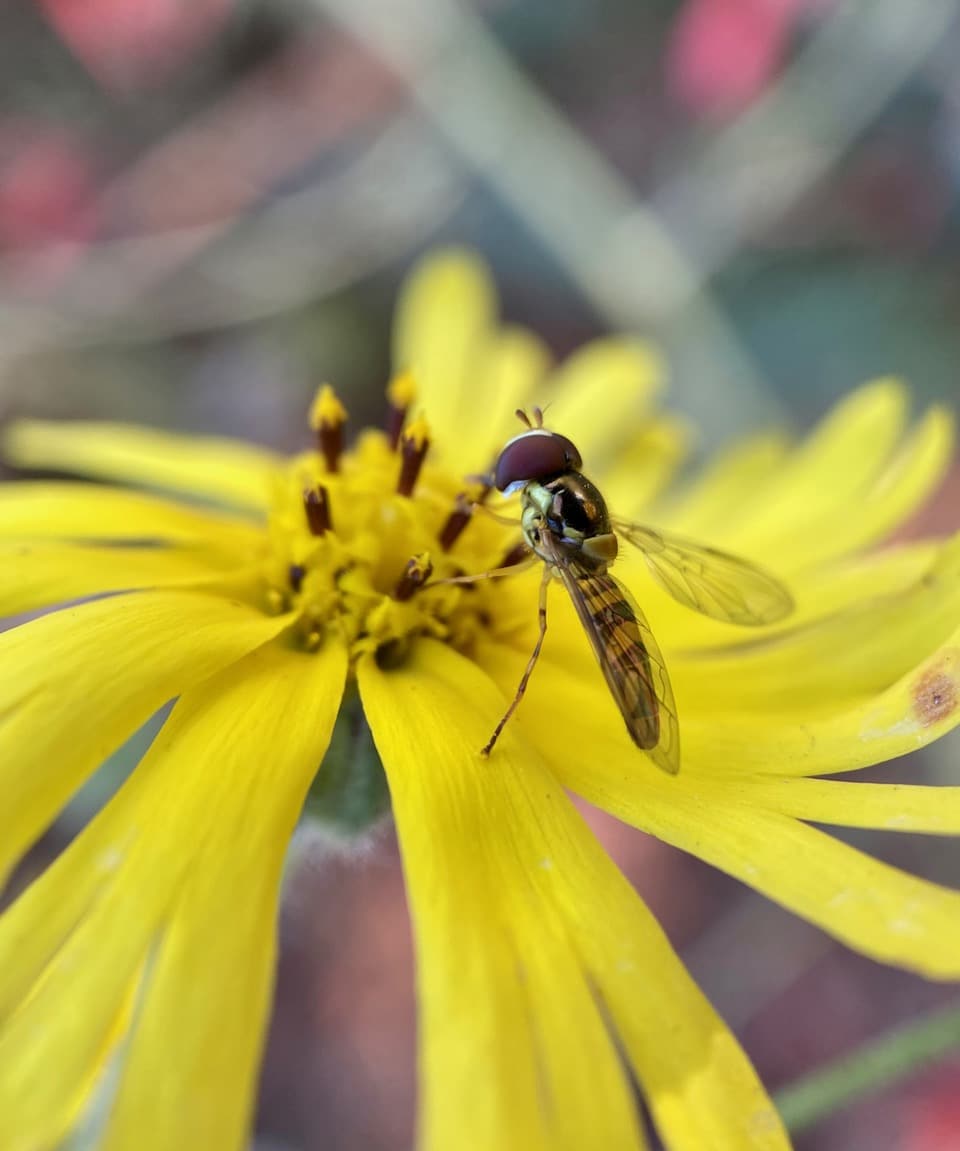
A male Oblique Streaktail, Allograpta obliqua (family Syrphidae) is foraging on a flowerhead of Elegant Tarweed.
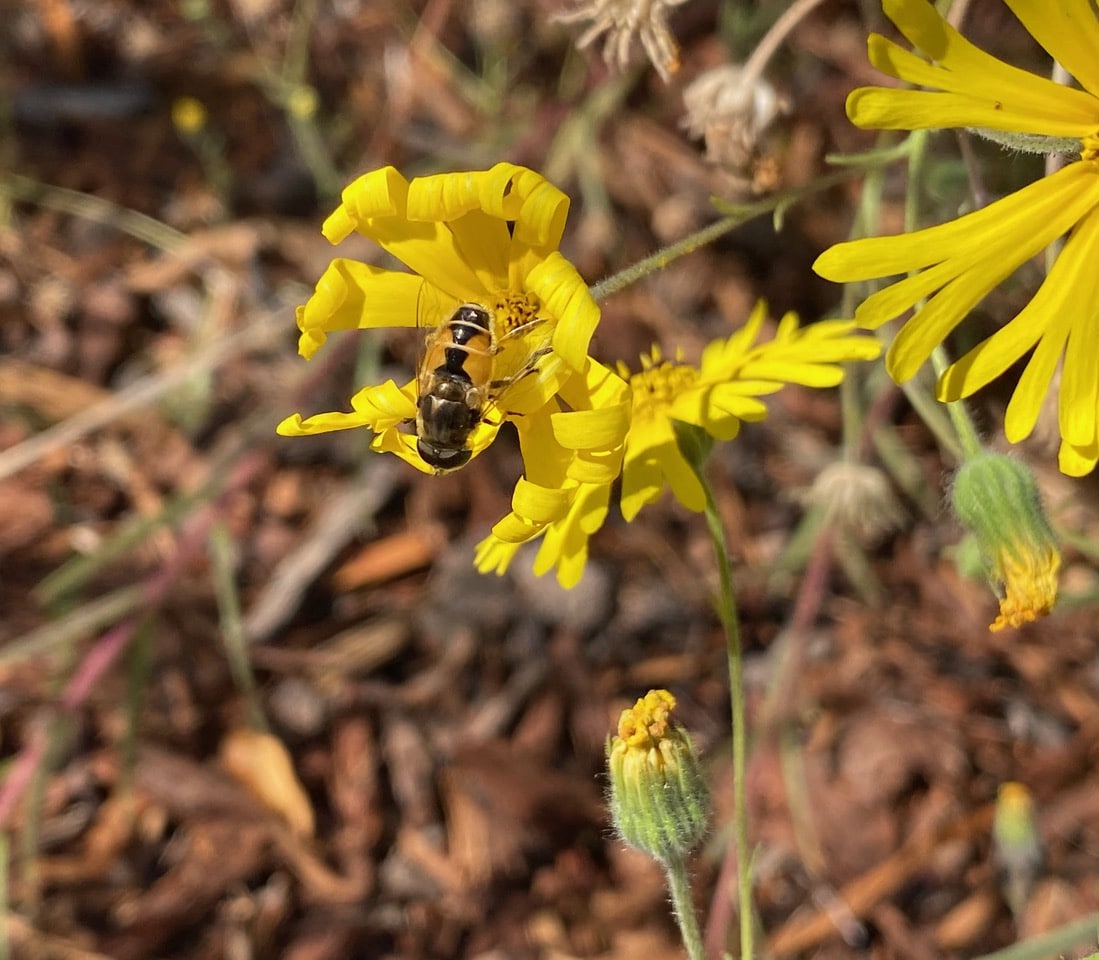
A Eurasian Drone Fly, Eristalis arbustorum (family Syrphidae) forages on an Elegant Tarweed flowerhead.
The Eurasian Drone Fly, Eristalis arbustorum is an abundant species of hover fly that occurs throughout the northern hemisphere, including Europe, North Africa and North India. It was introduced to North America in the mid 1800’s and is now ubiquitous throughout much of the United States and Canada. The common name “drone fly” refers to its resemblance to the drone of the honeybee. Hoverflies get their names from the ability to remain nearly motionless while in flight. The adults are also known as flower flies as they are commonly found on and around flowers feeding on nectar and pollen. The Eurasian Drone Fly is found in a diversity of habitats, including wetland, forests, montane tundra, as well as farmland, urban parks and gardens. It visits the flowers of a wide range of low-growing plants and shrubs. The larvae are aquatic, occurring in shallow, nutrient rich standing water and in cow manure and compost heaps. Also known as “rat-tailed maggots”, the larvae have a siphon on their rear end that acts like a snorkel, helping them breathe under water. The siphon can be several times the length of the larva’s body. The larvae are saprophagous, feeding on bacteria in stagnant water rich in decomposing organic matter.
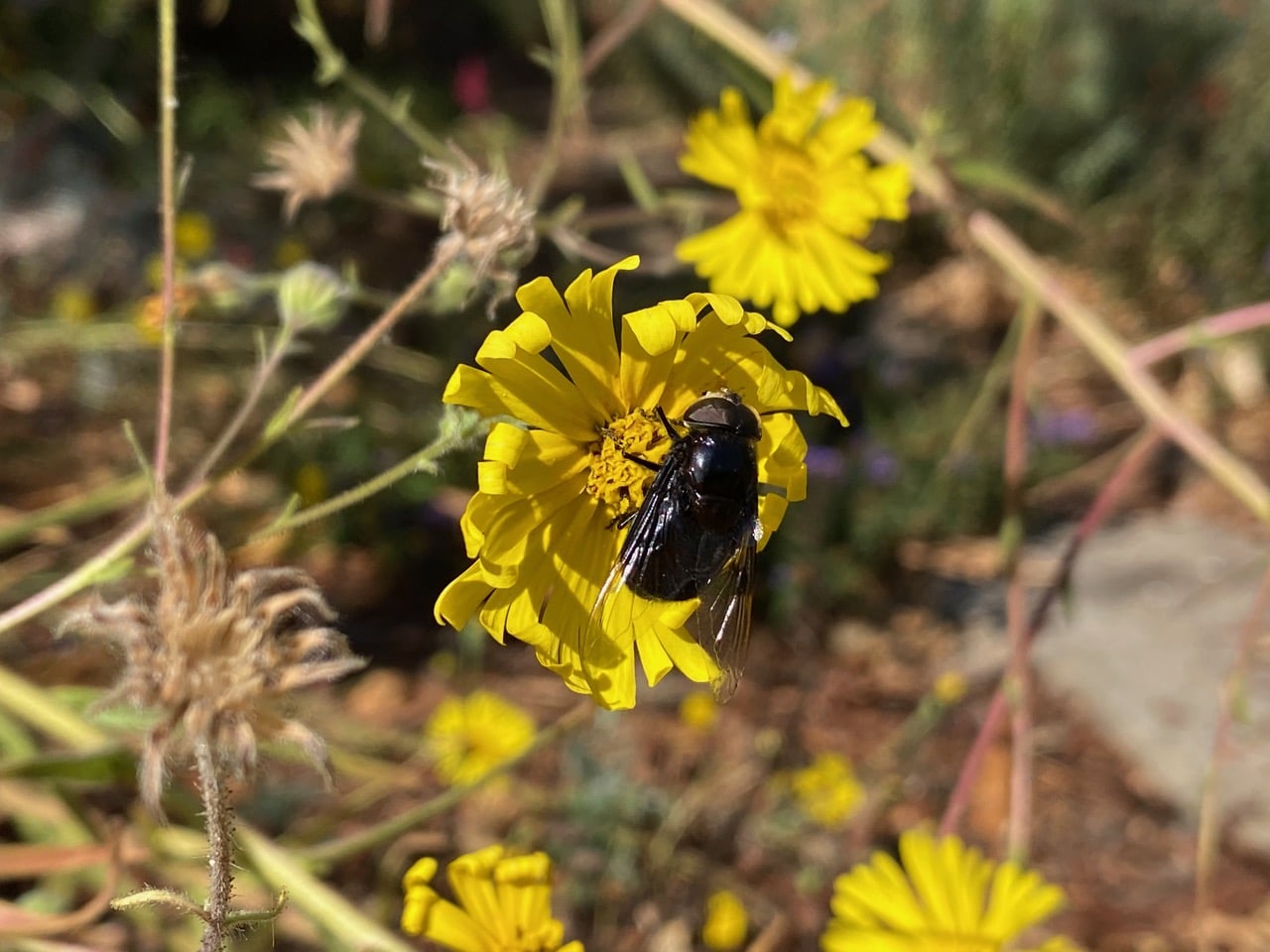
A huge, glossy black fly lands on an Elegant Tarweed flowerhead, making it droop. In flight the fly could easily be mistaken for a Carpenter Bee. It is in fact one of our biggest hover flies, the Purple Bromeliad Fly, Copestylum violaceum (family Syrphidae). The hover fly is much less frenetic than the real bee – once it has found a good food source, it would feed for a long time without being distracted.
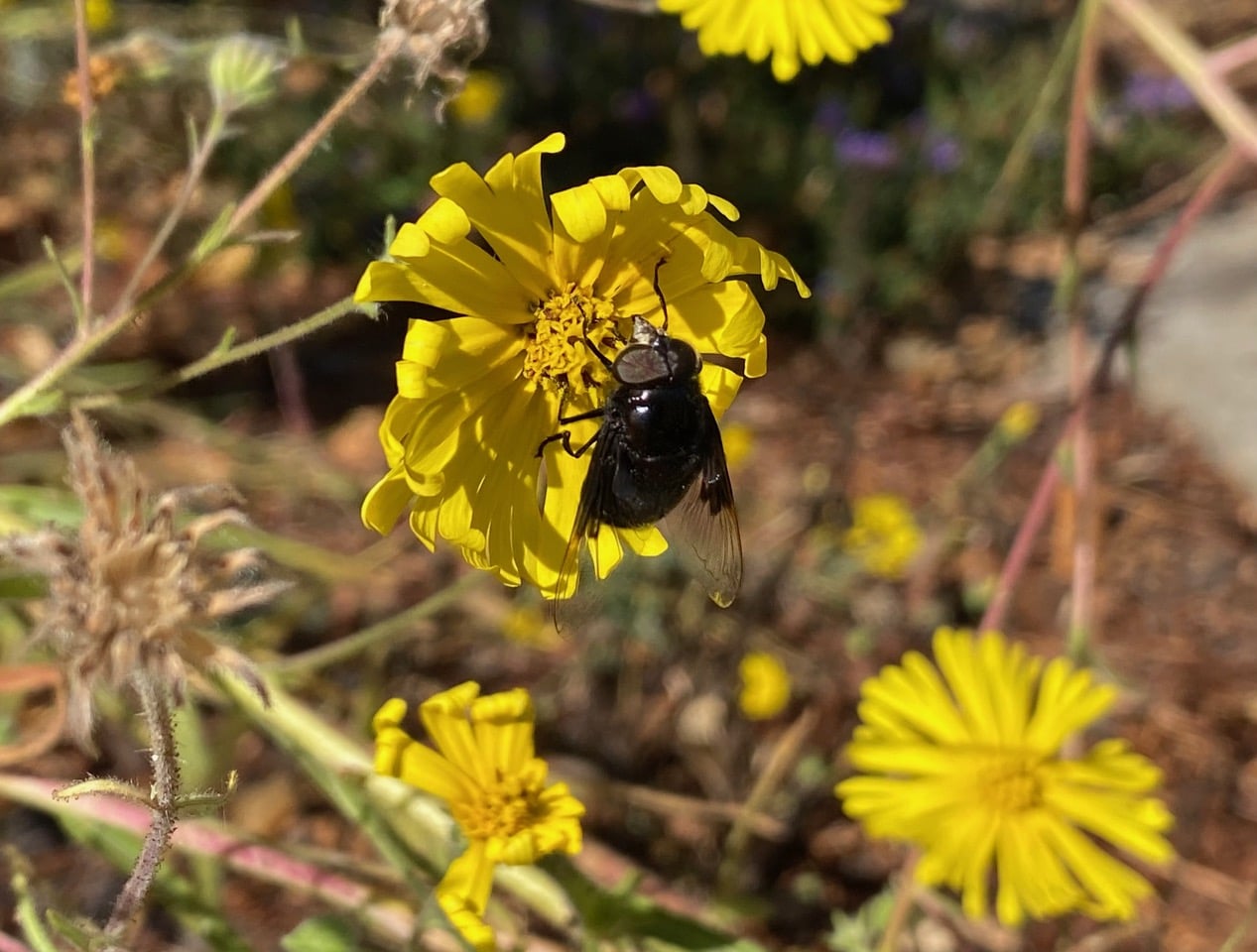
Note the rather unusual pointed “snout” of the fly. The basal part of the wings are black. In certain light, the Purple Bromeliad Fly often reflects a shiny violet-black. I’m not sure where the “bromeliad” part of the common name comes from.
The adults visit a wide range of flowers for nectar and pollen. The larvae develop in semi-aquatic habitats, e.g. tree holes, where they feed on bacteria on decomposing plant matter. The larvae have a long, snorkel-like appendage on their rear end that helps them breathe underwater; hence they are called rat-tailed maggots.