

Pollinator Post 9/27/24

The only places in the East Bay with good air quality this morning are in the hills. I decide to take a walk at Inspiration Point up in the Berkeley hills. The vegetation along the paved trail has been neatly mowed down, leaving everything a sea of brown. Even the brushes and shrubs between the trees have been cleared. I don’t expect to see much insect activity.
The only native plant in bloom is the Coyote Brush, Baccharis pilularis. The shrub is dioecious, with male and female flowers borne on separate plants. Flowers of both sexes are tiny (called florets) with several crowded together into small flowerheads, which in turn are arranged into larger clusters toward the ends of branches. Male florets consist of a tubular, cream-colored, five-lobed corolla, with five stamens forming a cylinder around the style of a sterile pistil. The calyx is reduced to a cluster of stiff hairs (the pappus) around the base of the corolla. Only male florets produce pollen. Insects visit the male flowers for both pollen and nectar.
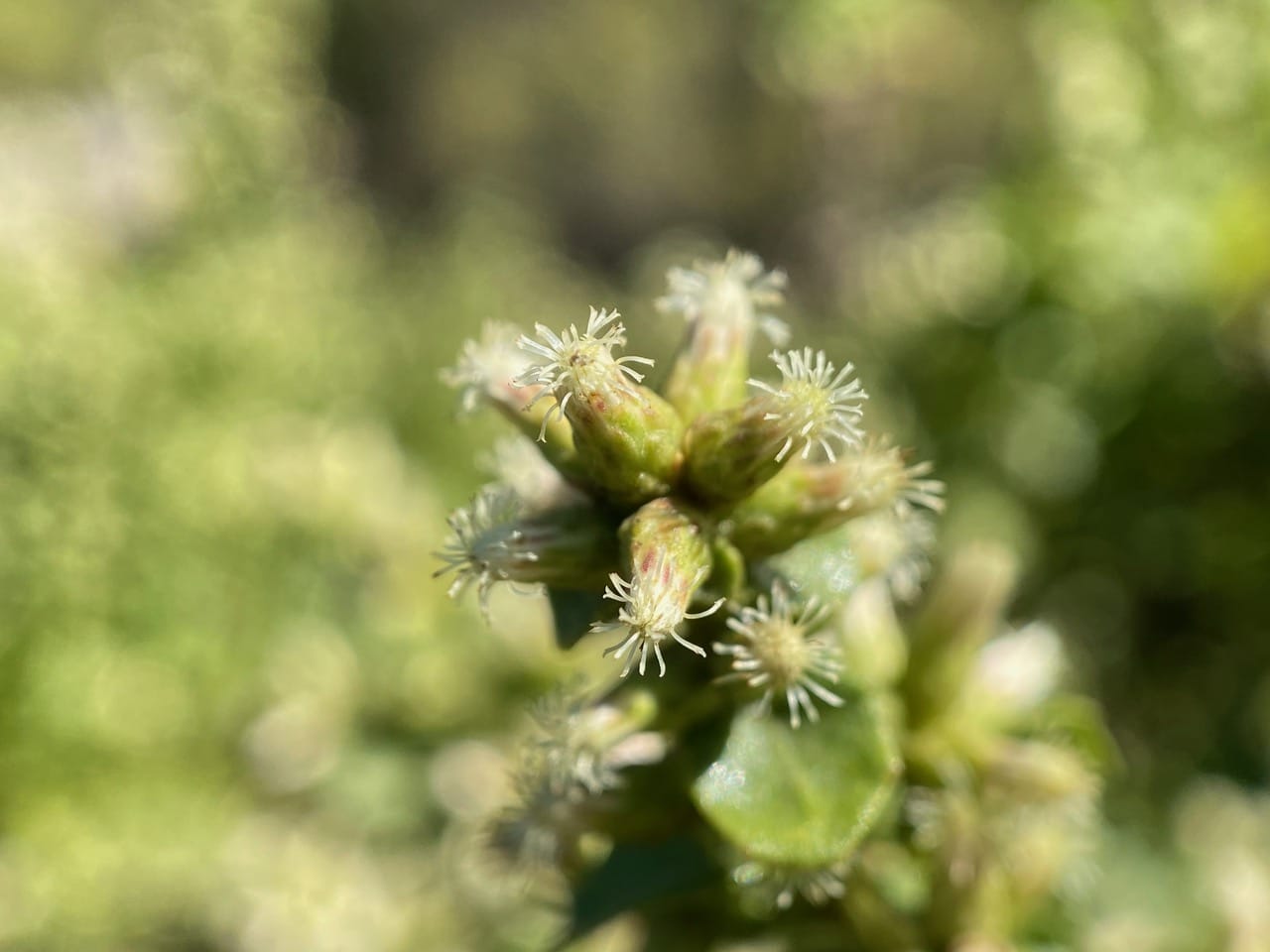
Female florets of Coyote Brush have a slender, pale, tubular corolla that is concealed within the pappus. There are no stamens and the single pistil has a slim, forked style. Although individual flowerheads of Baccharis pilularis are small, the large masses of them color the shrubs white (females) or creamy (males).
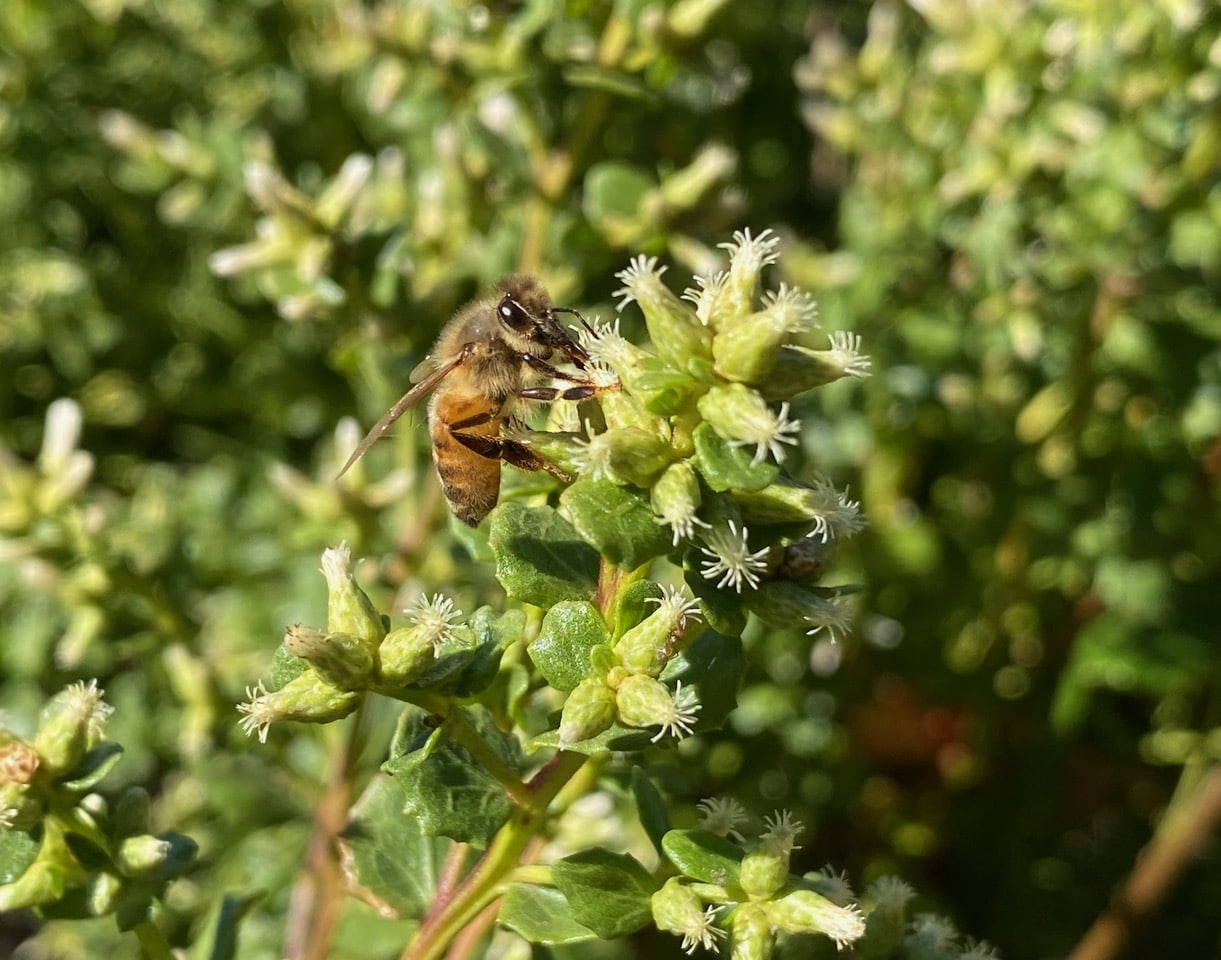
A Honey Bee, Apis mellifera (family Apidae) is taking nectar from a flowerhead of a female Baccharis. Although the male plants produce both nectar and pollen, I find to my surprise that there is distinctly more insect activity on the female plants that offer only nectar. Perhaps it has something to do with the stage of maturation of the flowers and/or the quality and quantity of the nectar? This late in the season, most bees are no longer collecting pollen anyway.

A woodlouse Fly, Stevenia deceptoria (family Rhinophoridae) is taking nectar from a flowerhead of a female Baccharis.
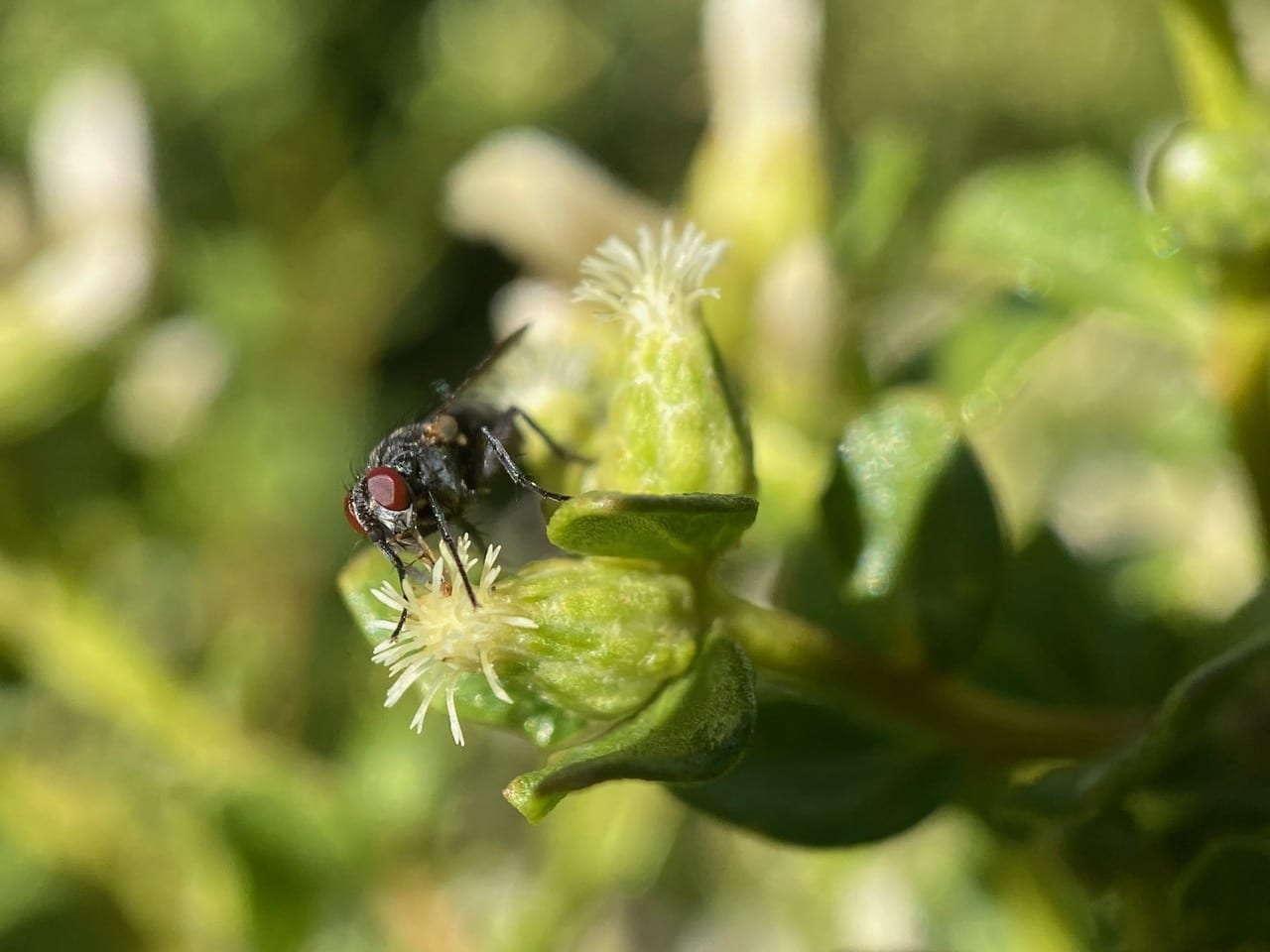
These small, slender, black, bristly flies are somewhat related to the Tachinidae. The larvae are mostly parasitoids of woodlice (pill bugs), beetles, spiders and other arthropods, and occasionally snails. Native to Europe, Stevenia deceptoria is now widespread in the US. The flies are parasitoids of terrestrial woodlice (roly polies) of the order Isopoda (Oniscoidea).

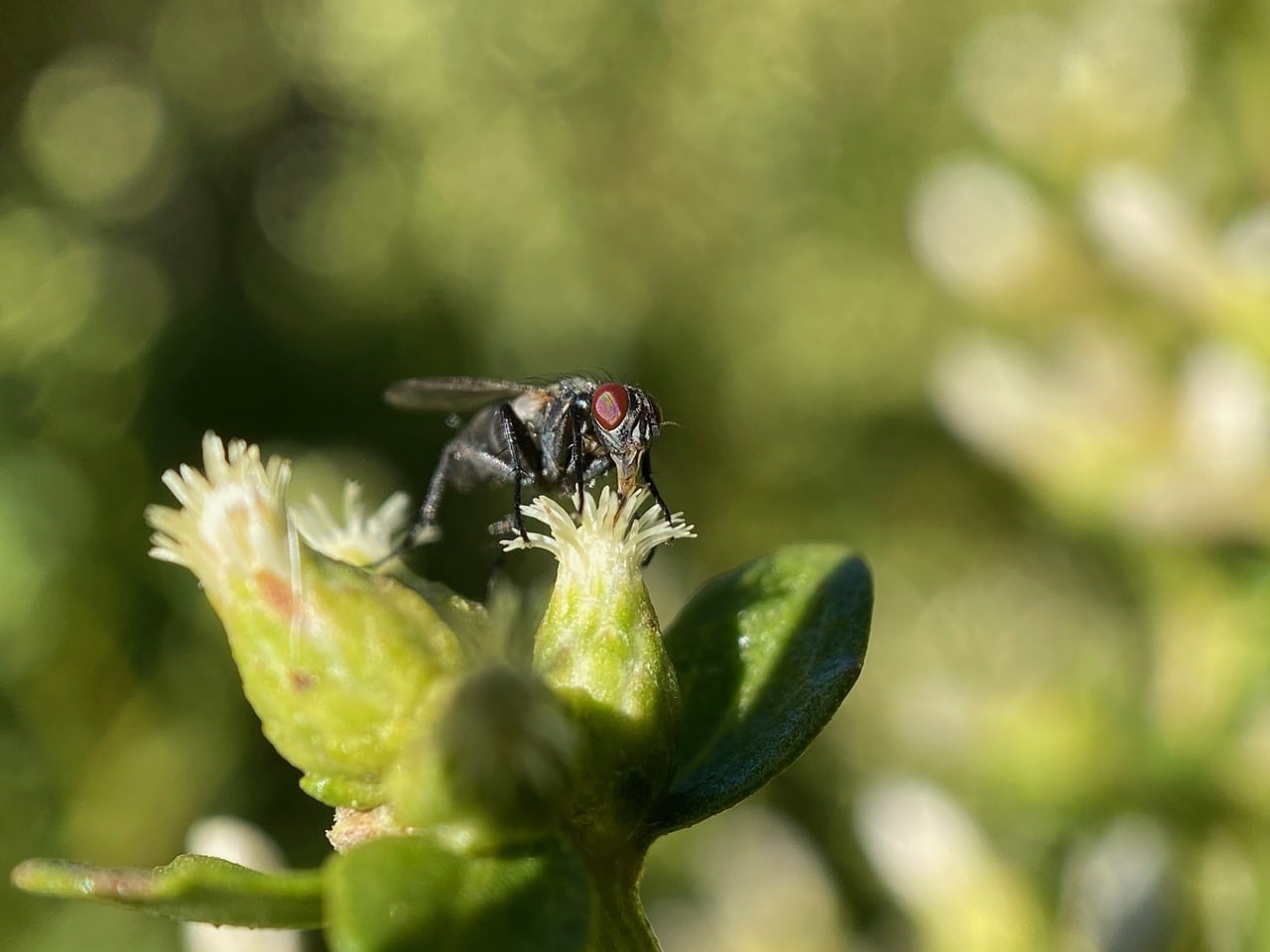
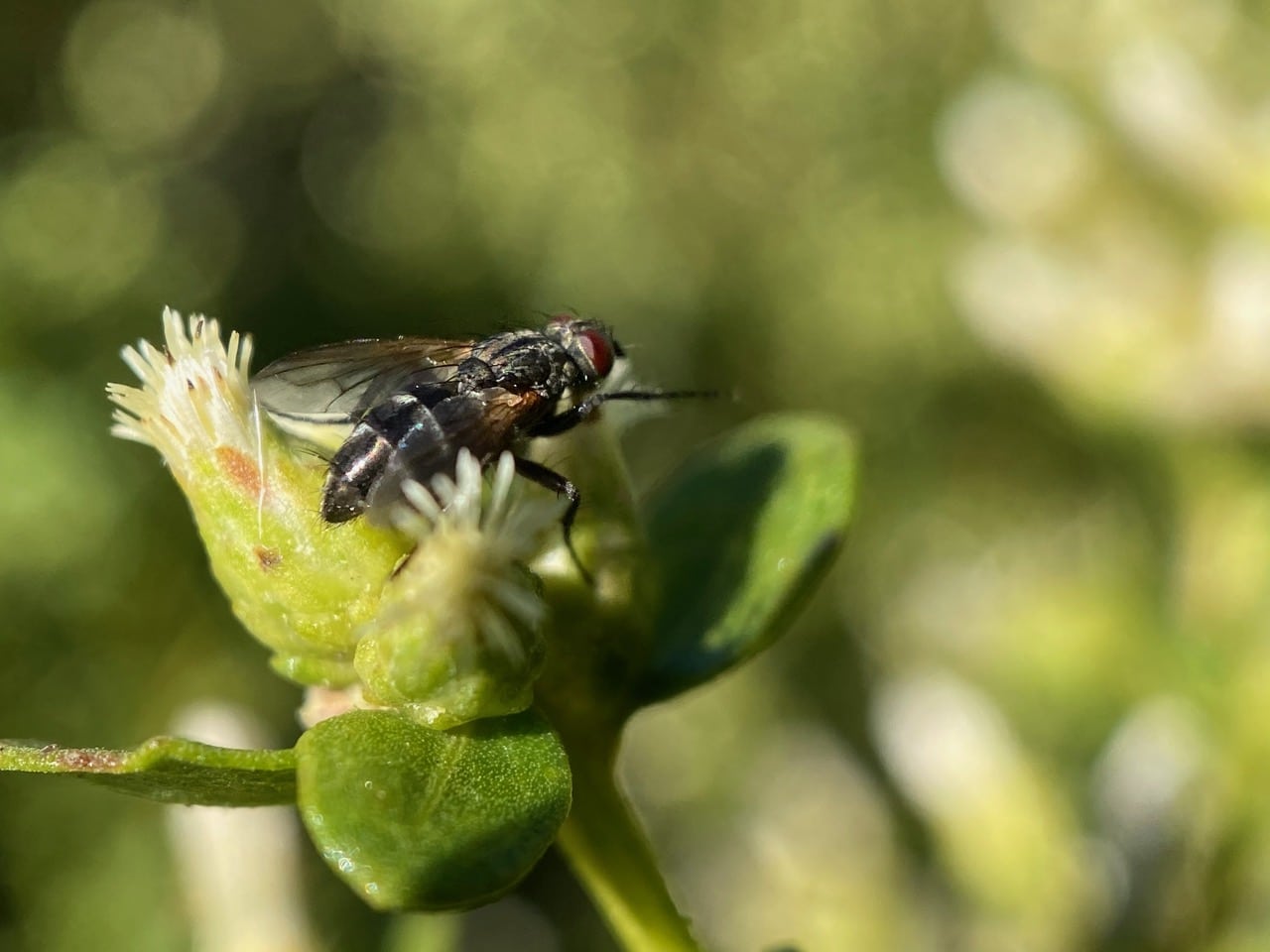


The sponging mouthparts of the Woodlouse Fly is visible from this angle. Sponging mouthparts facilitate absorption of food in liquid form. Not all Dipterans have sponging mouthparts. Many predatory flies have stabbing-sucking mouthparts.
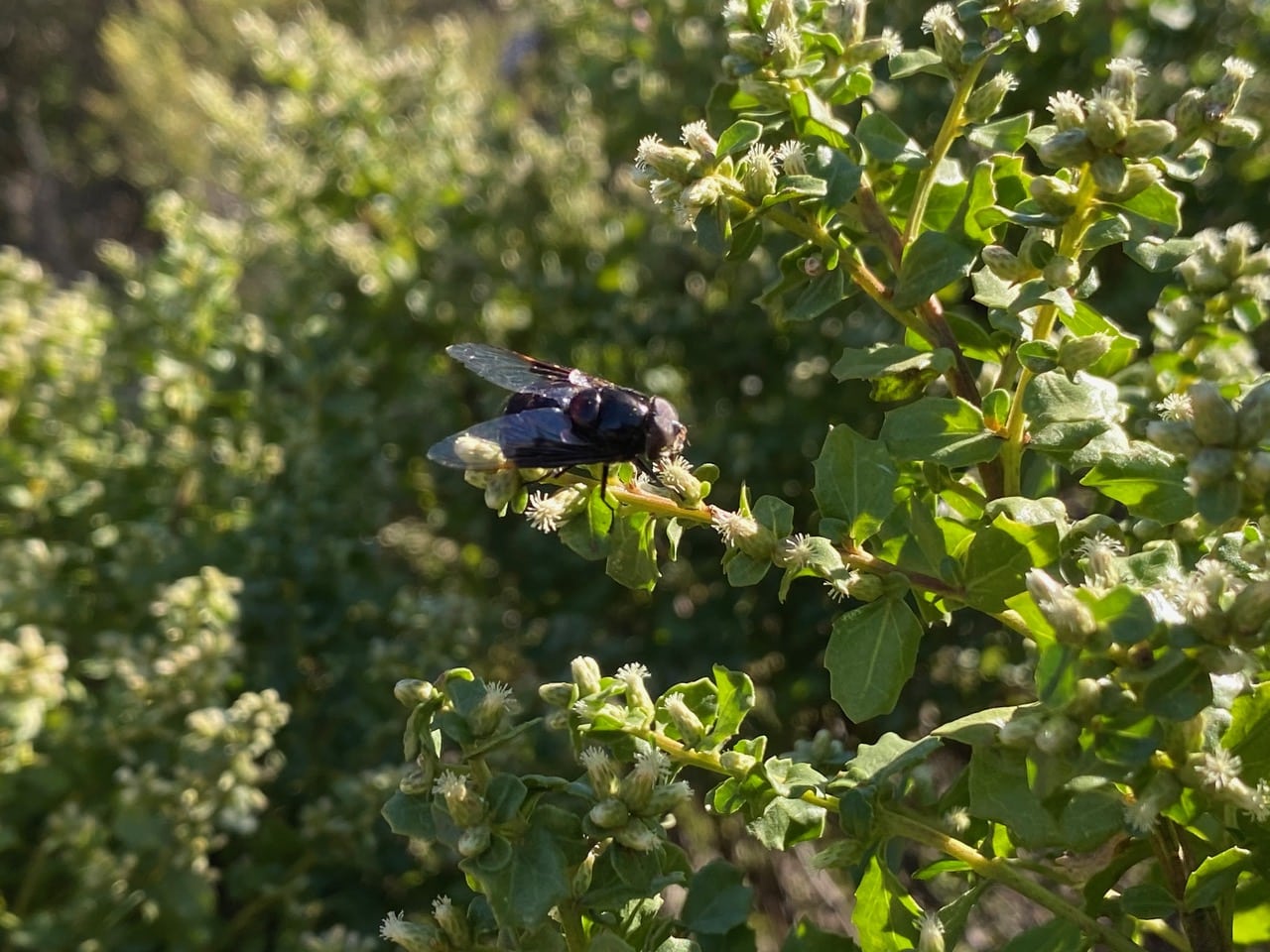
A large, glossy black fly has landed on a branch further away. In flight, the Purple Bromeliad Fly, Copestylum violaceum (family Syrphidae) can easily be mistaken for a Carpenter Bee. Copestylum females lay eggs in wet rotting plant materials and rot holes in trees. The larvae are rat-tail maggots.
Rat-tail maggots are the larval stage of many species of hover fly (family Syrphidae) in the tribes Eristalini. The maggots are most commonly found in dank and decaying environments such as compost, pond margins, and tree rot holes. The larvae feed on the decomposing material which is poor in oxygen but rich in organic matter. The “tails” are the siphons or breathing tubes that extend from their rear end to enable the larvae to breathe while submerged in the wet substrate. When mature, the larvae climb out to pupate on dry land. The larvae are important decomposers/recyclers and the adult flies are important pollinators.

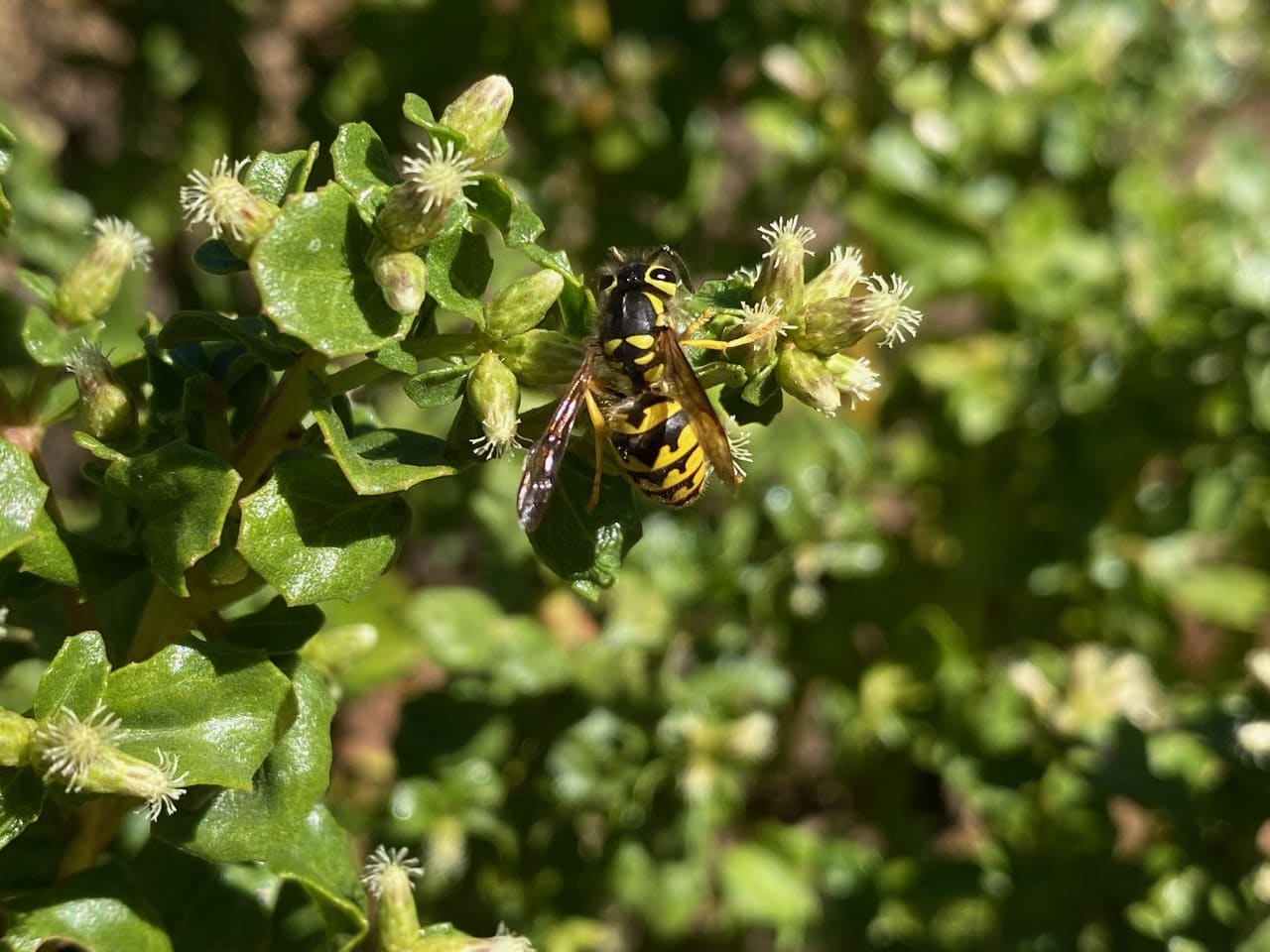
A Yellowjacket wasp is seeking nectar from the flowers of a female Coyote Brush.

Yellowjacket is the common name for predatory social wasps of the genera Vespula and Dolicovespula (family Vespidae). Yellowjackets are social hunters living in colonies containing workers, queens, and males (drones). Colonies are annual with only inseminated queens overwintering. Queens emerge during the warm days of late spring or early summer, select a nest site, and build a small paper nest in which they lay eggs. They raise the first brood of workers single-handedly. Henceforth the workers take over caring for the larvae and queen, nest expansion, foraging for food, and colony defense. The queen remains in the nest, laying eggs. Later in the summer, males and queens are produced. They leave the parent colony to mate, after which the males quickly die, while fertilized queens seek protected places to overwinter. Parent colony workers dwindle, usually leaving the nest to die, as does the founding queen. In the spring, the cycle is repeated.
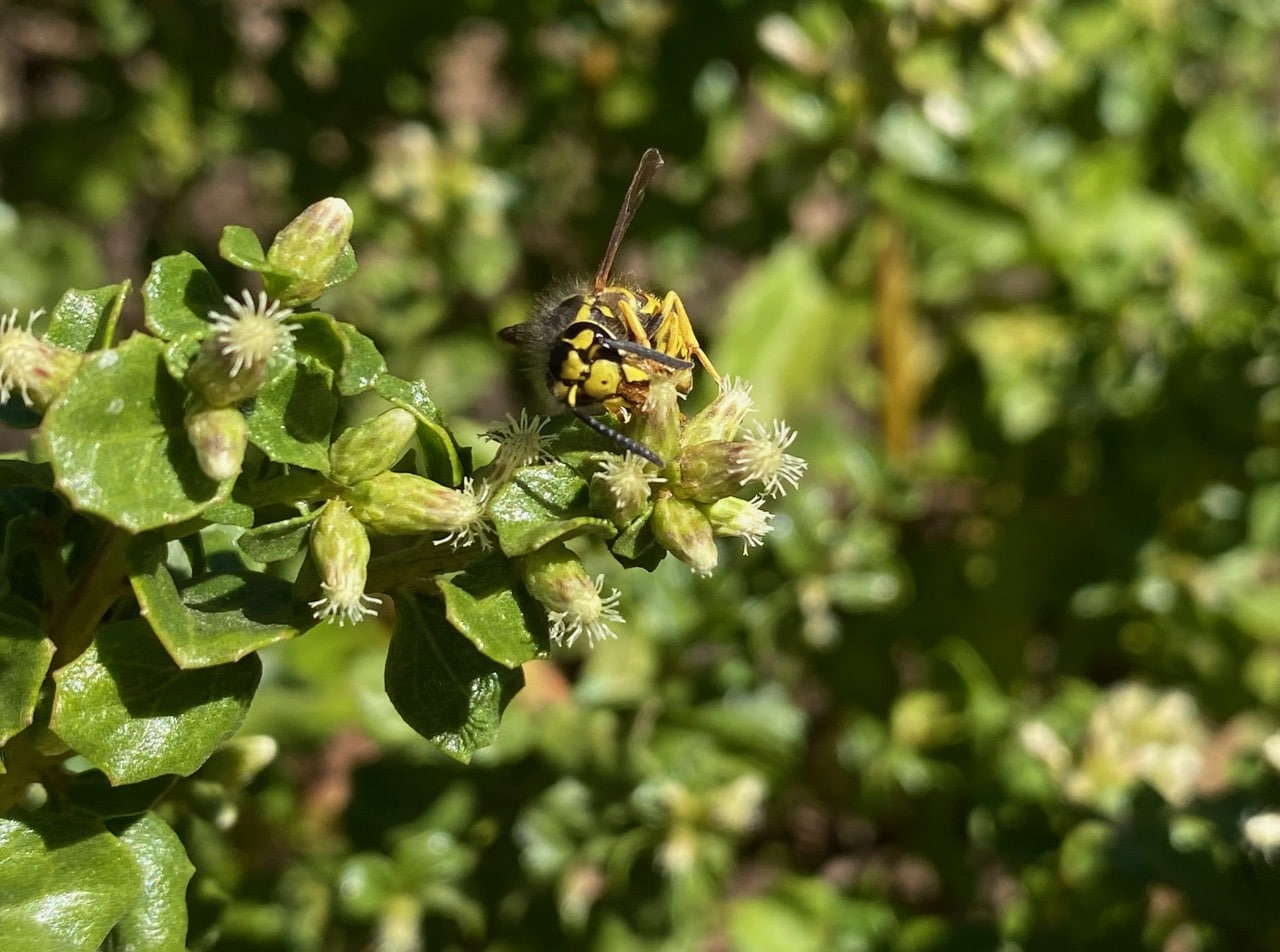
Yellowjackets have lance-like stingers with small barbs, and typically sting repeatedly. Their mouthparts are well-developed with strong mandibles for capturing and chewing insects, with probosces for sucking nectar, fruit, and other juices. Yellowjacket adults feed on foods rich in sugars and carbohydrates such as plant nectar and fruit. They also search for foods high in protein such as insects and fish. These are chewed and conditioned in preparation for larval consumption. The larvae secrete a sugary substance that is eaten by the adults.
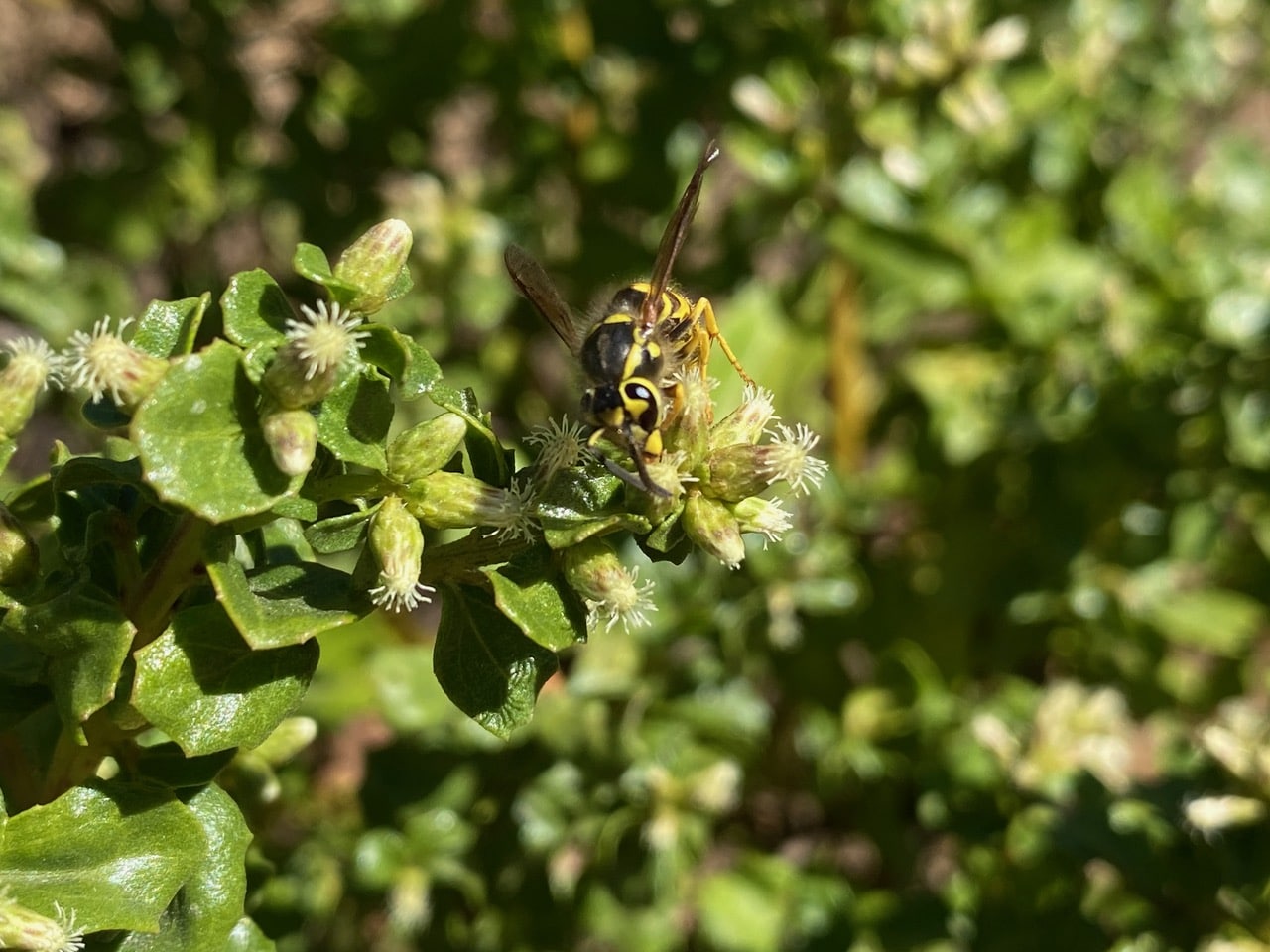
The Western Yellowjackets typically build nests underground, often using abandoned rodent burrows. The nests are made from wood fiber that the wasps chew into a paper-like pulp. The nests are completely enclosed except for a small entrance at the bottom. The nests contain multiple, horizontal tiers of combs within. Larvae hang within the combs.


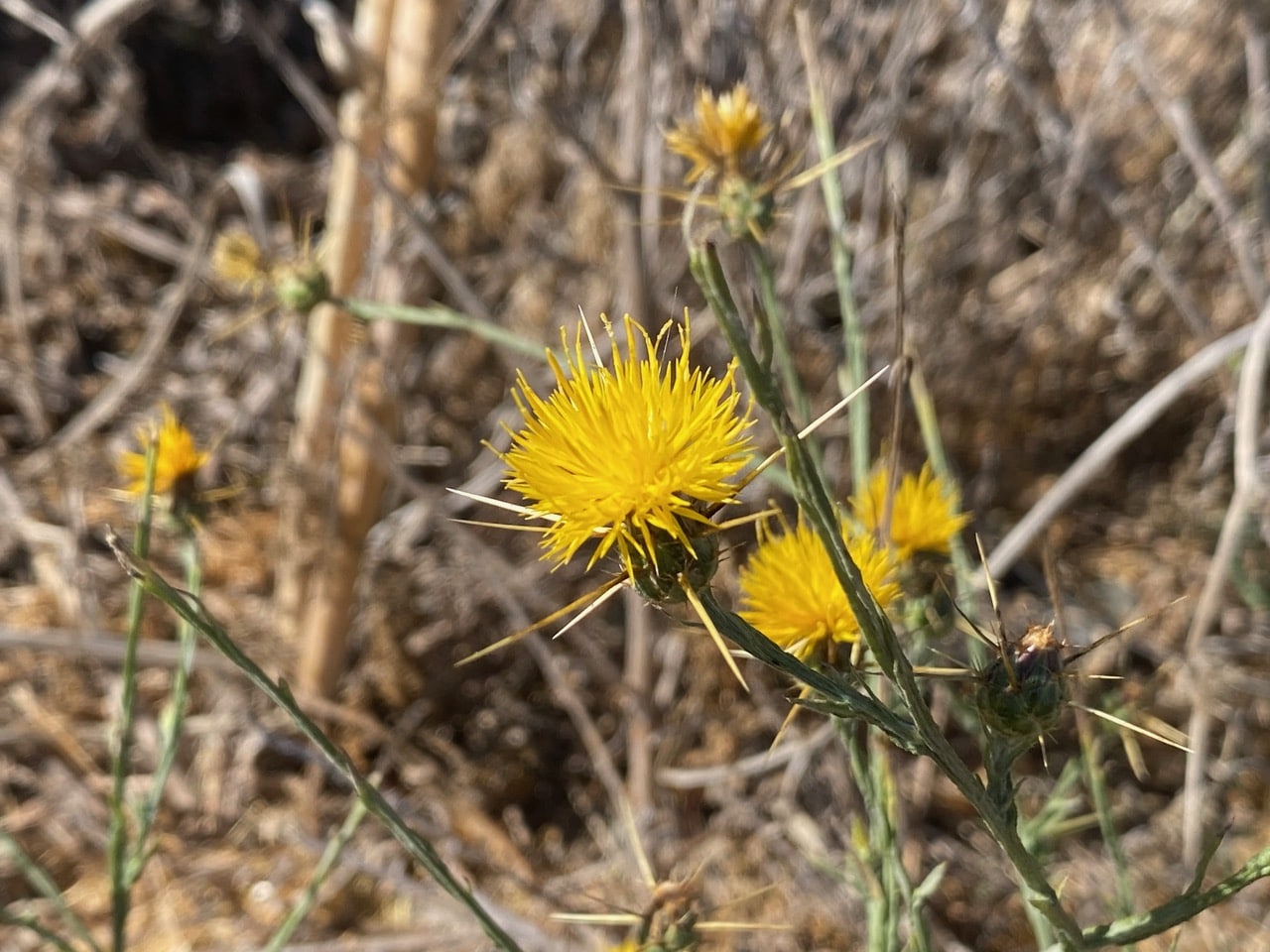
Despite being mowed back, many of the Yellow Starthistles, Centaurea solstitialis have sprouted on the side of the trail, blooming cheerily. It is a low-growing bushy winter annual from the Mediterranean region in Europe that has invaded over 12 million acres in California. It is now common in open areas on roadsides, rangelands, hay fields, pastures, waste areas. Disturbances created by cultivation, poorly timed mowing, road building and maintenance, or overgrazing favor this rapid colonizer. Yellow Starthistle proliferates at high light intensity. The plant produces bright, thistle-like yellow flowerheads with sharp spines surrounding the base.

Its proboscis probing the crowded florets, a Woodland Skipper, Ochlodes sylvanoides (family Hesperiidae) is seeking nectar from a Yellow Starthistle flowerhead.
Skippers are a family, the Hesperiidae, of the order Lepidoptera (butterflies and moths). They are named for their quick, darting flight habits. Most have the antenna clubs hooked backwards like a crochet hook. They also have generally stockier bodies and larger compound eyes than the other butterflies. Their wings are usually small in proportion to their bodies. When at rest, skippers keep their wings usually angled upwards or spread out, and only rarely fold them up completely. Californian species are mostly brown or tan, with black, orange, or yellow markings.
Skipper caterpillars are usually green or brown, sometimes yellowish, never brightly colored. They have a distinctive “collar”, a narrow ring around the body right behind the head. Caterpillars are camouflaged and often hide during the day. Many species make nests of leaves and silk for additional protection. Most North American species feed on grasses, but some common species eat shrubs and trees, especially in the bean family. Most species are limited to a single group of food plants. Adult skippers are only active during the day, but Skipper caterpillars feed mainly when it is dark or partly light.
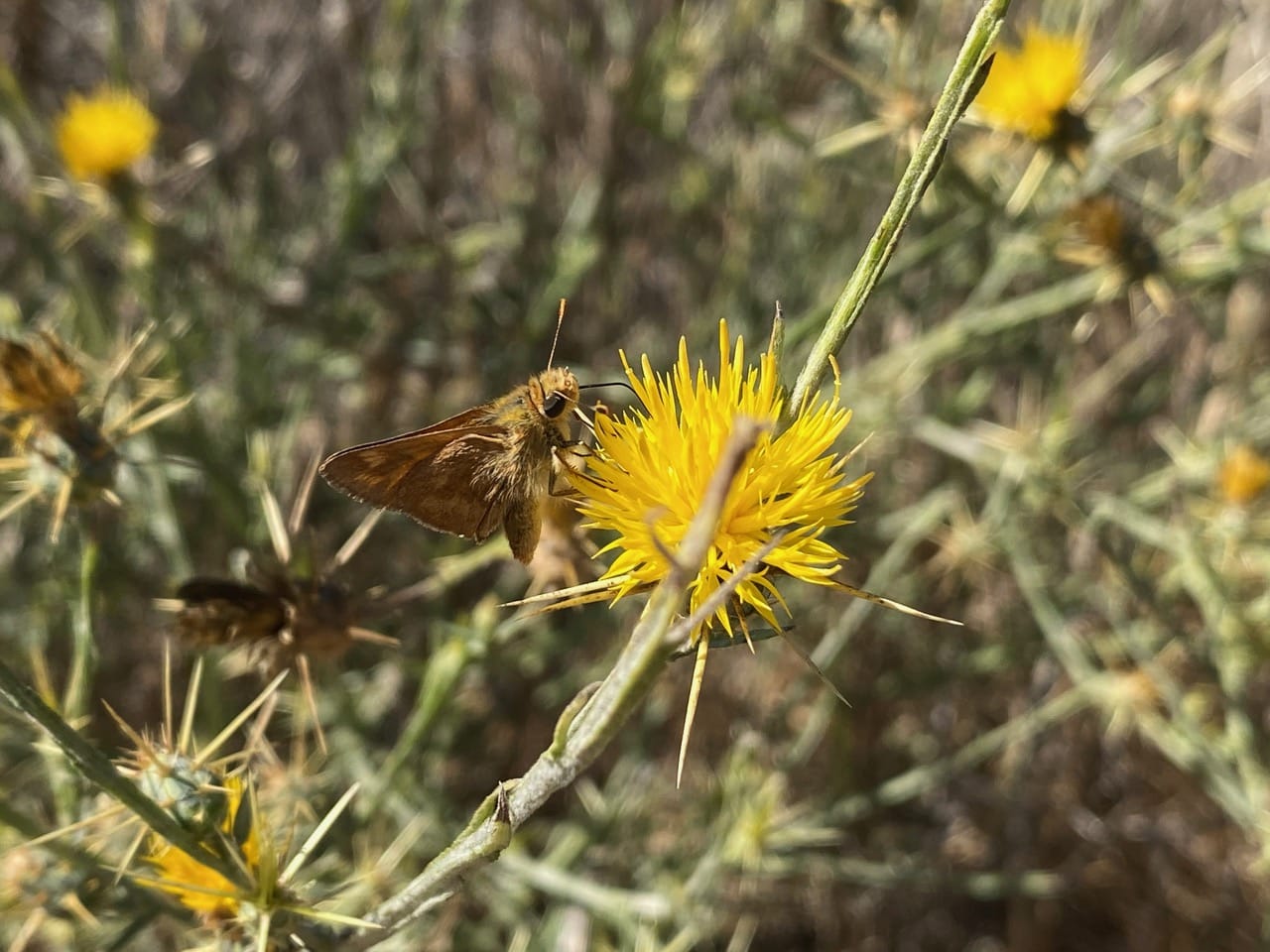
The Woodland Skipper is small butterfly (wingspan 1 – 11/4 in) found in western United States, frequenting grassy areas in chaparral, sagebrush, woodland, and gardens. Larvae feed on various grasses. There is one brood per year from late July-October.

Thanks to its long flexible proboscis, a butterfly can sip nectar from dozens of flowers on a single thistle flowerhead in one sitting.
A tubular sucking organ, the proboscis enables a butterfly to extract sweet nectar from flowers, regardless of the shape of the blossom. When not in use, the proboscis is rolled up out of the way. Unlike caterpillars, adult butterflies do not have any chewing mouthparts, and therefore must obtain their nutrition from sipping liquids. Hydrostatic pressure extends the curled proboscis which is inserted deep into the tubes of flowers. At emergence from the chrysalis, the proboscis initially consists of two parts that appear like a forked tongue. Almost immediately the two tubes are “zipped” together to form the single tube. In addition to flower nectar, butterflies also use the proboscis to suck up moisture from puddles, liquids from fermenting fruits, rotting animal flesh or animal excrements.

A Seven-spotted Lady Beetle, Coccinella septempunctata (family Coccinelidae) adds instant color and cheer to a Coyote Brush. Check out that heart-shaped black spot behind the pronotum!

Native to Europe, the species has been repeatedly introduced to North America as a biological control agent to reduce aphid numbers. It has since spread to many states, where it has outcompeted some native species, including the Coccinella. The Seven-spotted Ladybeetles are large; adults may reach a body length of 0.5 in. Their distinctive spots and conspicuous colors warn of their toxicity, making them unappealing to predators. When threatened, the beetles can secrete a fluid from joints in their legs which gives them a foul taste.