

Pollinator Post 9/27/23

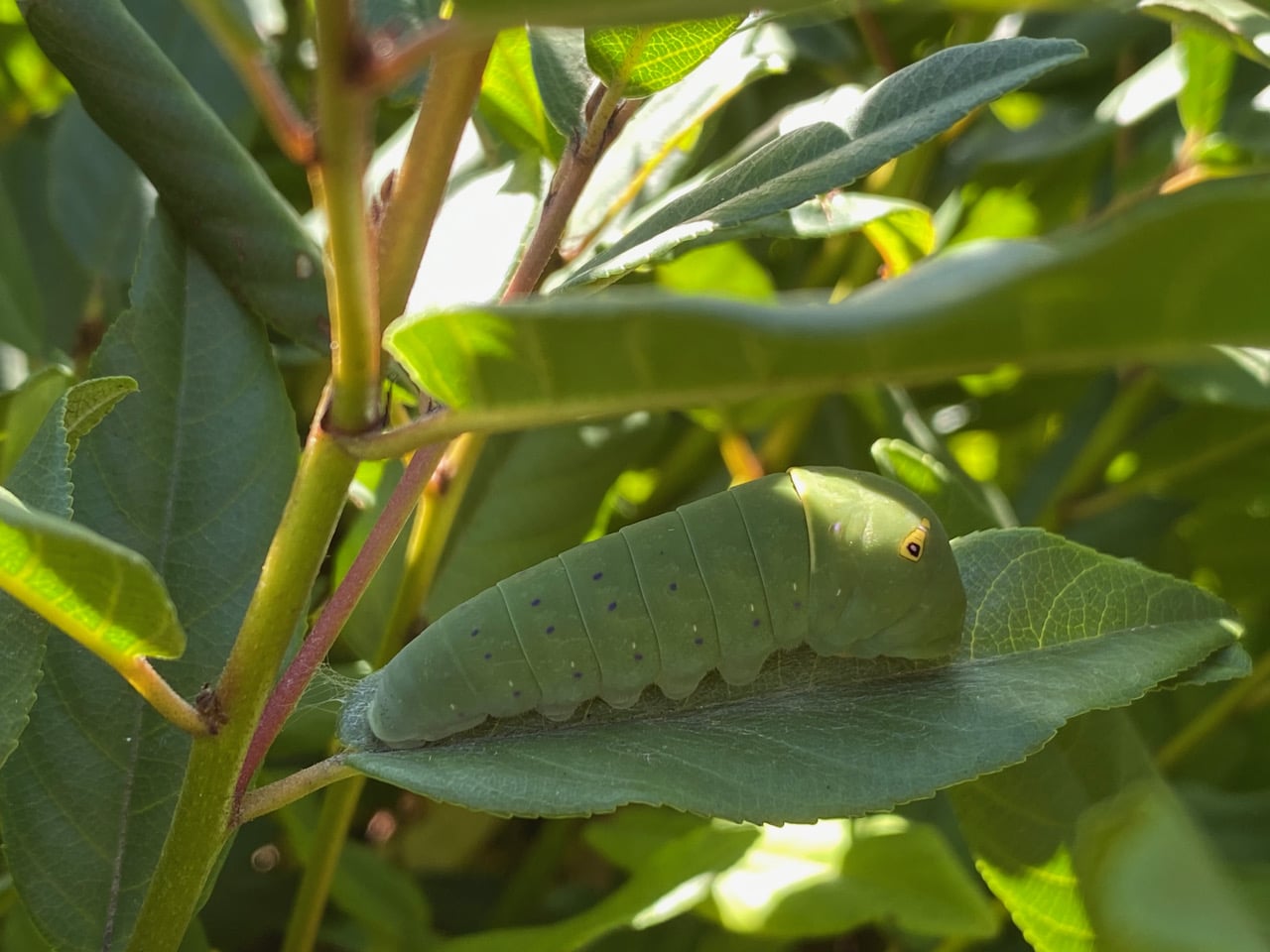
Ooh, our Pale Swallowtail caterpillar B2 is still on its home leaf, basking in the sun! Its silk pad on the Coffeeberry leaf has dried out nicely. It amazes me that the little thing can tolerate so much environmental changes on its fully exposed home – from pelting rain, to baking sun, and punishing winds.





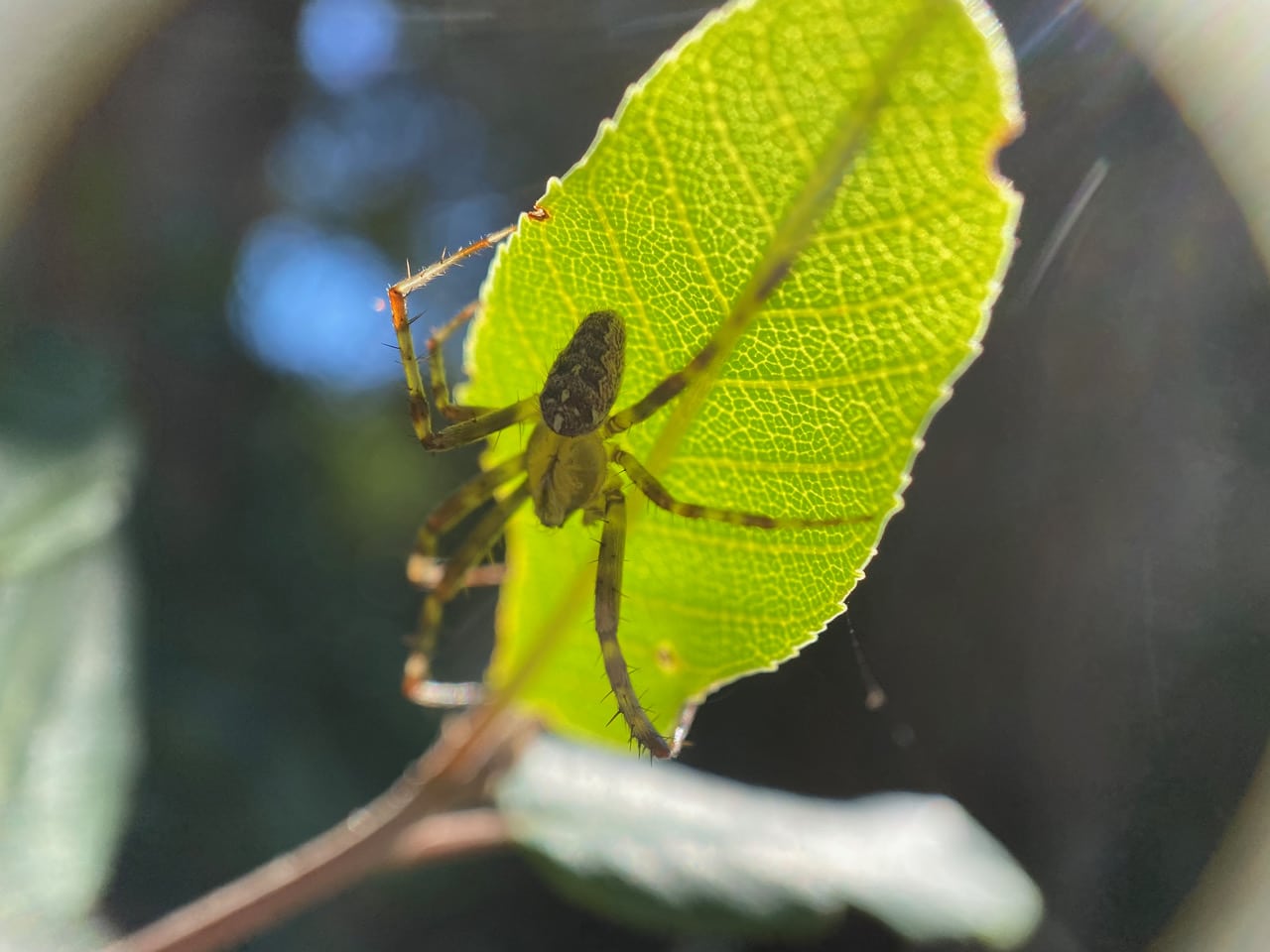 Along the shaded section of Skyline Trail, I find this male Cross Orbweaver, Araneus diadematus (family Araneidae) hiding behind a Coffeeberry leaf. How timely – we just saw a female of the species! The male is much smaller, with a narrow abdomen, and longer legs in proportion to his body.



I arrive at Blue-2’s home shrub full of excitement. For 10 minutes I search the Coffeeberry for the caterpillar, but can’t find it! Desperate, I turn to the iPhone photos I took yesterday to make sure that I am looking at the right place. I scan the spot from different angles, and finally Blue-2 comes into focus among the foliage. Its thorax highlighted by the sun, it is glancing sideways at me with its false eye-spot. Do you see it? Wow, what great camouflage!
Zooming out, do you see Blue-2 now? I wonder how many more of the Pale Swallowtail caterpillars are on the shrub, hidden in plain sight!?
Closing in, I am surprised that Blue-2 doesn’t have as much of a silk pad as Blue did. It is resting on a thin film of silk spread over the leaf. Maybe it’s because its home leaf is oriented horizontally, and falling off is not a problem. If you recall, Blue was literally hanging vertically from its home leaf, hence it had to hook its crochets into a thick silk pad to secure itself.
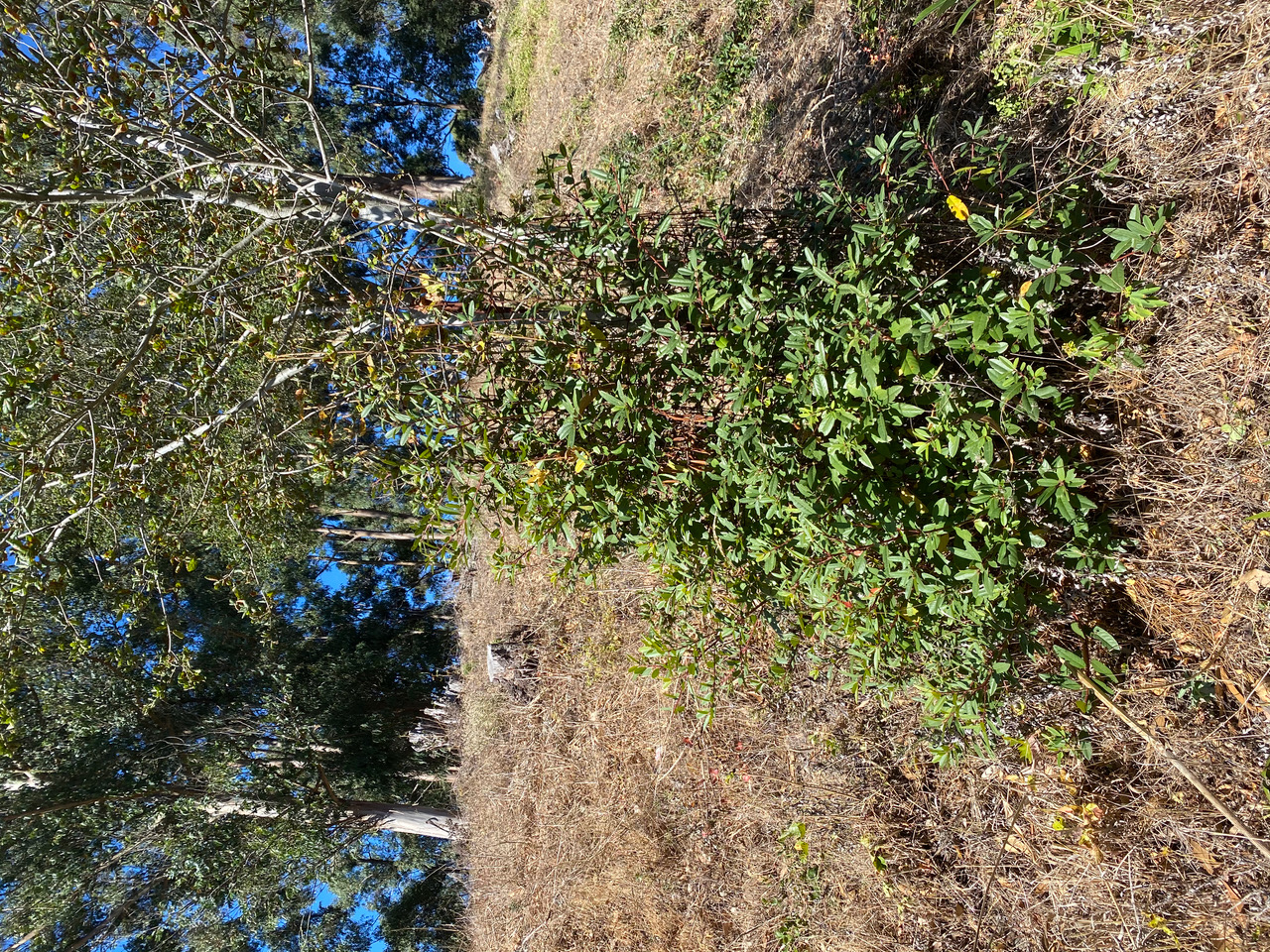
Elated at finding both our surviving Pale Swallowtail caterpillars on their respective host plants, I descend the hill toward the Water Tank. An EBMUD truck and a fire engine were here yesterday to clear brush for fire safety. I have been forewarned about this, and told that they were mainly targeting Coyote Brush. But what I am seeing in front of me on the slope is not Coyote Brush. It is a chopped down Coffeeberry!
I scramble up the hill in disbelief and grief. There are four piles of cut up Coffeeberry on the ground, each close to a fenced oak tree.
Higher on the hill, I find this single Coffeeberry shrub that has been spared, probably because it is enmeshed with the fencing of the oak tree.
These protected oak trees are spaced far apart on the hill, and there’s no reason to fear that a wildfire would spread from one tree to the next via its neighboring Coffeeberry. I am appalled at the total disrespect for our native plants and their role in the ecosystem. What senseless destruction! Perhaps the brush-clearing should have been supervised by someone who knows plants and understands the ways of nature.
A dark female Cross Orbweaver, Araneus diadematus (family Araneidae) is resting head-down in the hub of her large orb web strung beneath a young oak tree.
Araneus diadematus is commonly called the Cross Orbweaver or the European Garden Spider. It is found in Europe where it is native, and North America, where it was introduced. Individual spiders can vary markedly in coloration, from light yellow to dark grey, but all have mottled white markings across the dorsal abdomen, with four or more segments forming a cross. The markings are formed in cells filled with guanine, which is a byproduct of protein metabolism. Adult females range in length from 1/4 to 3/4 in, while the males range from 1/4 to 1/2 in.
The legs of orb-weaver spiders are specialized for spinning orb webs. The webs are built by larger females, which hang head down in the center of the web or remain hidden in nearby foliage, with one claw hooked to a signal line connected to the main orb, waiting for a disturbance to signal the arrival of prey. Prey is then quickly wrapped in silk and bitten, and the prey may hang on the web to be stored for later consumption. The initial bite serves to paralyzed the prey and to prevent injury to the spider from struggling prey. The injected enzymes serve to begin liquefaction of the prey’s internal structures.
Orbweaver spiders are well known for sexual cannibalism. Females often kill and consume the males just before, during, or just after mating.
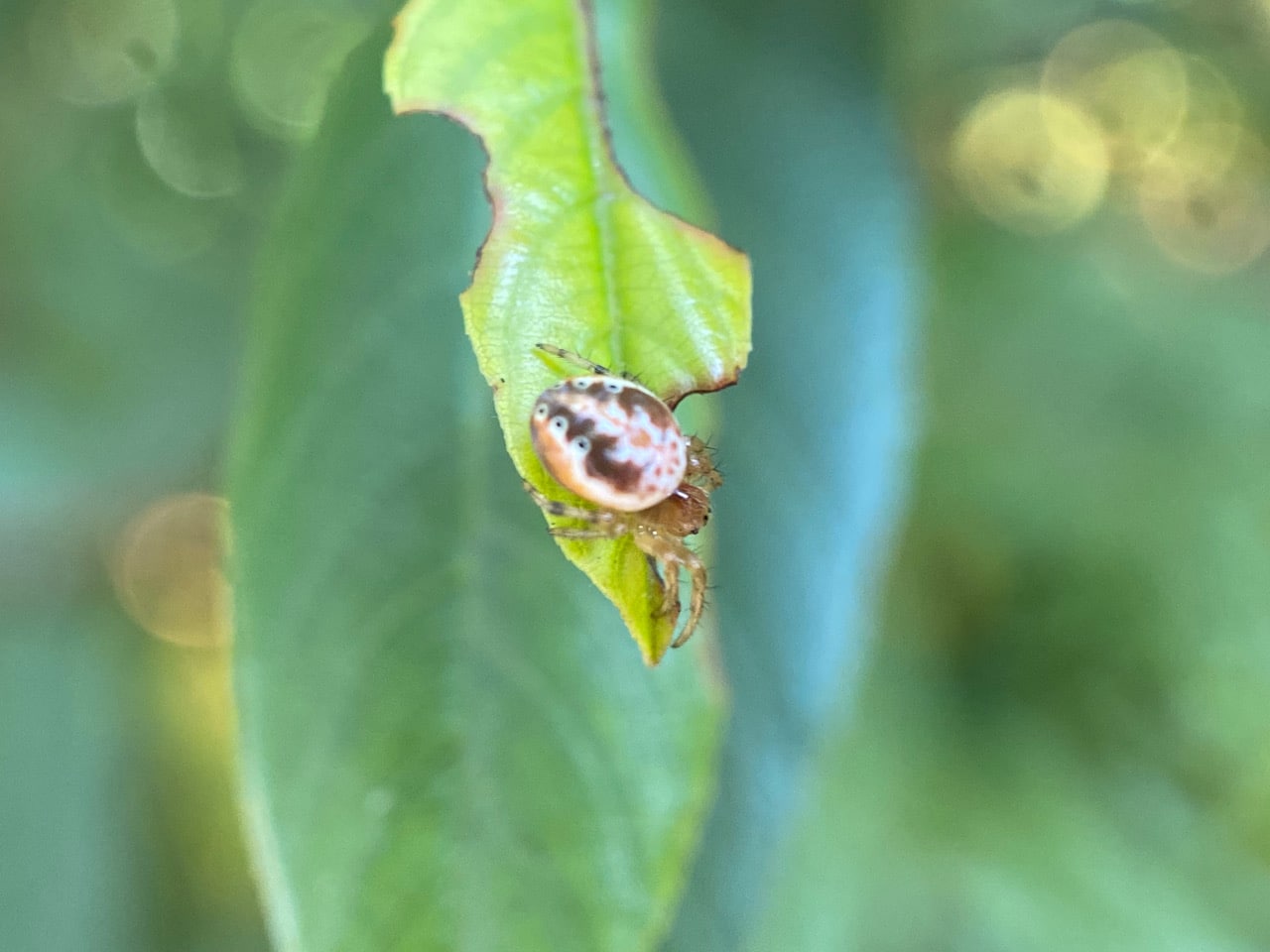
Along the shaded section of Skyline Trail, I find this male Cross Orbweaver, Araneus diadematus (family Araneidae) hiding behind a Coffeeberry leaf. How timely – we just saw a female of the species! The male is much smaller, with a narrow abdomen, and longer legs in proportion to his body. Ooh, here’s a tiny spider on the same plant. iNaturalist has helped identify it as the Six-spotted Orbweaver, Araniella displicata (family Araneidae).
The Six-spotted Orbweaver is a small cucumber spider. It occurs throughout Europe and North America and in parts of Asia. It is found on trees and shrubs in woodland habitats. It is one of the most widely distributed arachnids in North America, but often overlooked due to its small size. Adult females measure only 4-8 mm in length, males 4-6 mm. The species is distinguished by three (sometimes four) pairs of black spots along the edges of the rear half of the abdomen. There’s quite a bit of color variation within the species.
Most orb weavers spin fairly large webs in proportion to their own body size, but not so with Araniella displicata. The web of an adult spider may be only three or four inches in diameter. The spiral snare is usually built well off the ground, and often oriented in the horizontal plane, frequently spanning the edges of a single large leaf. The spider sits in the center, hanging beneath a horizontal web. Adult Araniella displicata are often mistaken for “baby” orb weavers. In late May or early June mating takes place, and females produce egg sacs that contain 80 eggs and are covered in loose, fluffy, yellowish silk. The package may be deposited in a curled leaf that also serves as the mother’s retreat on the perimeter of the web.
(In retrospect, the tiny spiders that build horizontal orb webs across the width of our Bay leaves are probably Six-spotted Orbweavers. It’s impossible to tell for sure – because of the way they hang upside-down in their web, we never get to see the markings on top of their abdomen!)
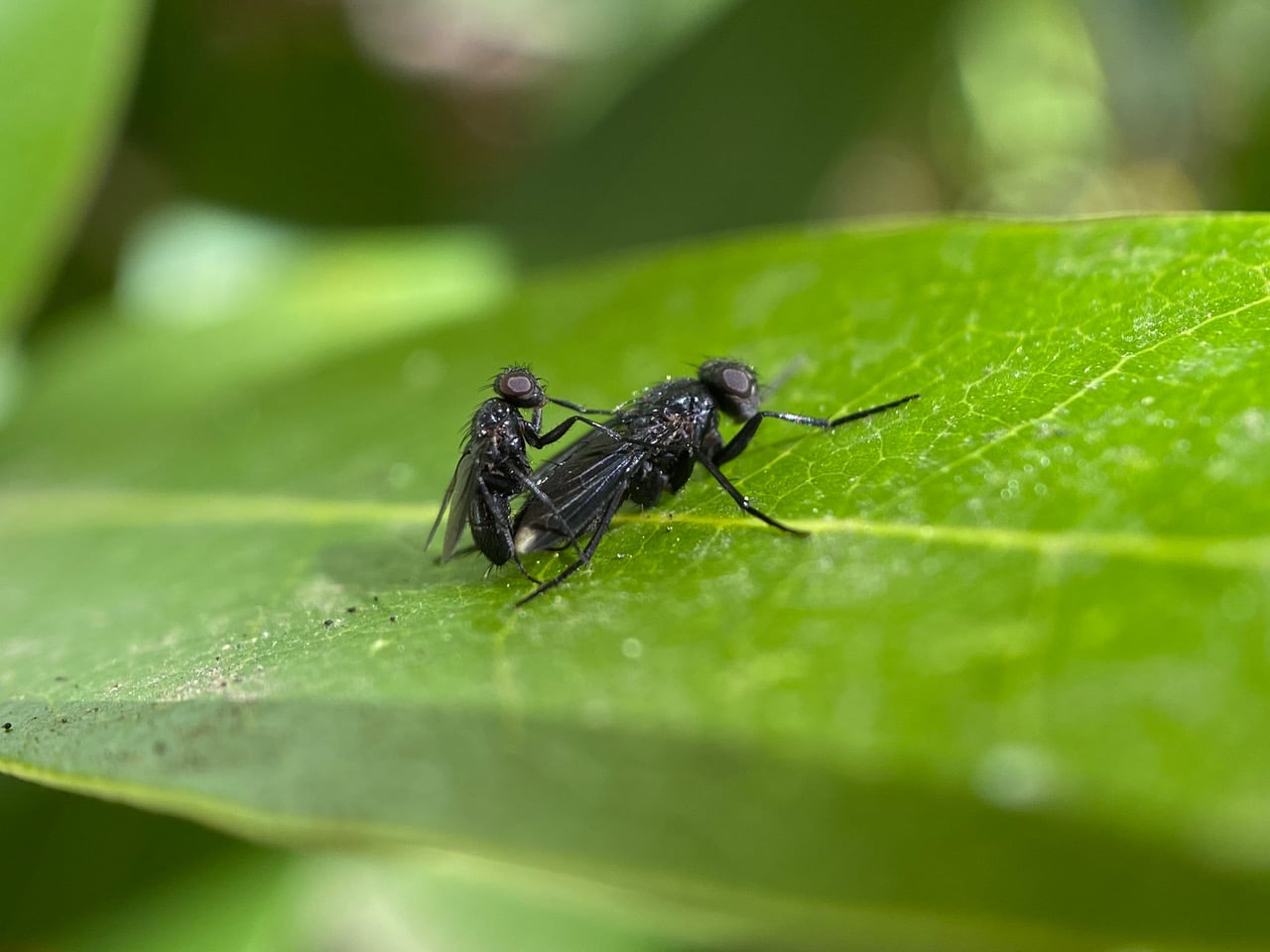
A pair of shiny black flies are mating on a California Bay leaf.
When the smaller male finally departs, I get a good look at the female with white-tipped wings. It is a Smoky-winged Woodlouse Fly, Melanophora roralis (family Rhinophoridae).
Melanophora roralis is a species of woodlouse fly in the family Rhinophoridae. The fly is 3-5.5 mm long, black in color with hairy antennae and a shiny thorax. The species was introduced to North America from Europe. The flies inhabit old forests and damp areas near the shore. Females have a distinctive white spot at the tips of their wings. It is a parasite of the Woodlouse, Porcellio scaber.
Rhinophoridae are small, slender, black, bristly flies that are somewhat related to the Tachinidae. The larvae are mostly parasitoids of woodlice (pill bugs), beetles, spiders and other arthropods, and occasionally snails.

I am pleased to get this picture of an F-winged Barklouse on a California Bay leaf. All the characteristic markings on the wings are clearly visible – five dark marks on the first half of the wing, and a light “F” mark on the second half. The side view also shows the wispy strands of silk above the insect.
The F-winged Barklouse, Graphopsocus cruciatus (family Stenopsocidae) belongs to an ancient lineage of insects in the order Psocodea (formerly Psocoptera). The scientific name comes from the Greek psocus (to grind) referring to the psocodean jaws, which are shaped to grind food, rather like a pestle and mortar. These insects are conveniently discussed in two groups – barklice that live outdoors, and booklice that are found in human habitations.
Barklice are usually found in moist places, such as leaf litter, under stones, on vegetation or under tree bark. They have long antennae, broad heads and bulging eyes. They feed on algae, lichens, fungi and various plant matter, such as pollen. Barklice are usually less than 6 mm, and the adults are often winged. The wings are held roof-like over their bodies. Some species are gregarious, living in small colonies beneath a gossamer blanket spun with silk from labial glands in their mouth. Sometimes the colonies seem to move in coordinated fashion, rather like sheep.
Booklice are wingless and are much smaller (less than 2 mm). They are commonly found in human dwellings, feeding on stored grain, book bindings, wallpaper paste and other starchy products, and on the minute traces of mold found in old books.
Psocodea undergo incomplete metamorphosis. They are regarded as the most primitive amongst the hemipteroids (true bugs, the thrips and lice) because their mouthpart show the least modification from those of the earliest known fossils.