

Pollinator Post 9/26/24
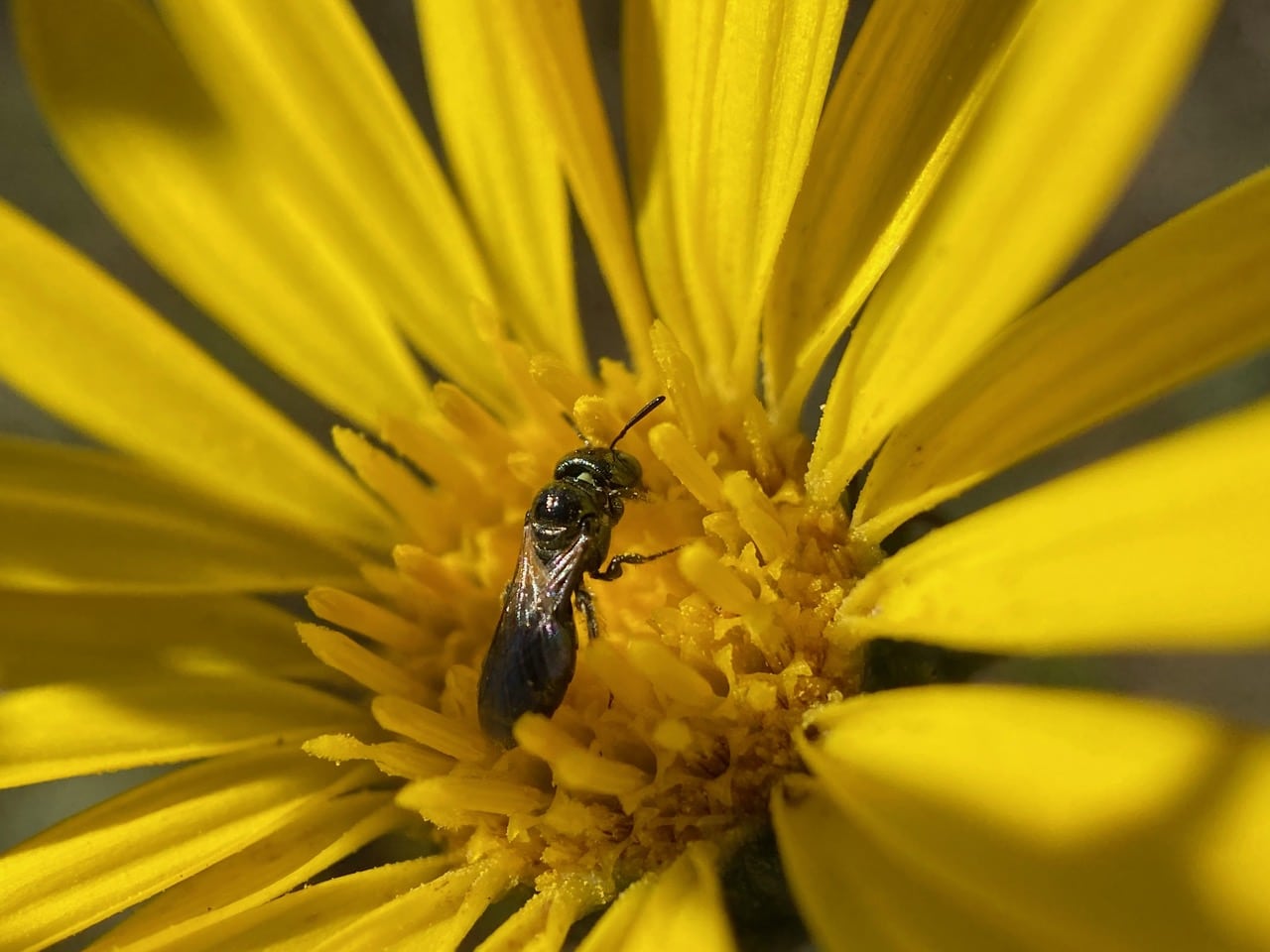
On an afternoon walk at Shoreline Park, Bay Farm Island, I come across a Small Carpenter Bee, Ceratina sp. (family Apidae) foraging on a Grindelia flowerhead.
The Small Carpenter Bee genus Ceratina is closely related to the more familiar, and much larger Carpenter Bees (genus Xylocopa). Ceratina are typically dark, shiny, even metallic bees, with fairly sparse body hairs and a weak scopa on the hind leg. The shield-shaped abdomen comes to a point at the tip. Some species have yellow markings, often on the face.
Females excavate nests with their mandibles in the pith of broken or burned plant twigs and stems. While many species are solitary, a number are subsocial. Both male and female carpenter bees overwinter as adults within their old nest tunnels, emerging in the spring to mate. In the spring, this resting place (hibernaculum) is modified into a brood nest by further excavation. The female collects pollen and nectar, places this mixture (called bee bread) inside the cavity, lays an egg on the provision, and then caps off the cell with chewed plant material. Several cells are constructed end to end in each plant stem.

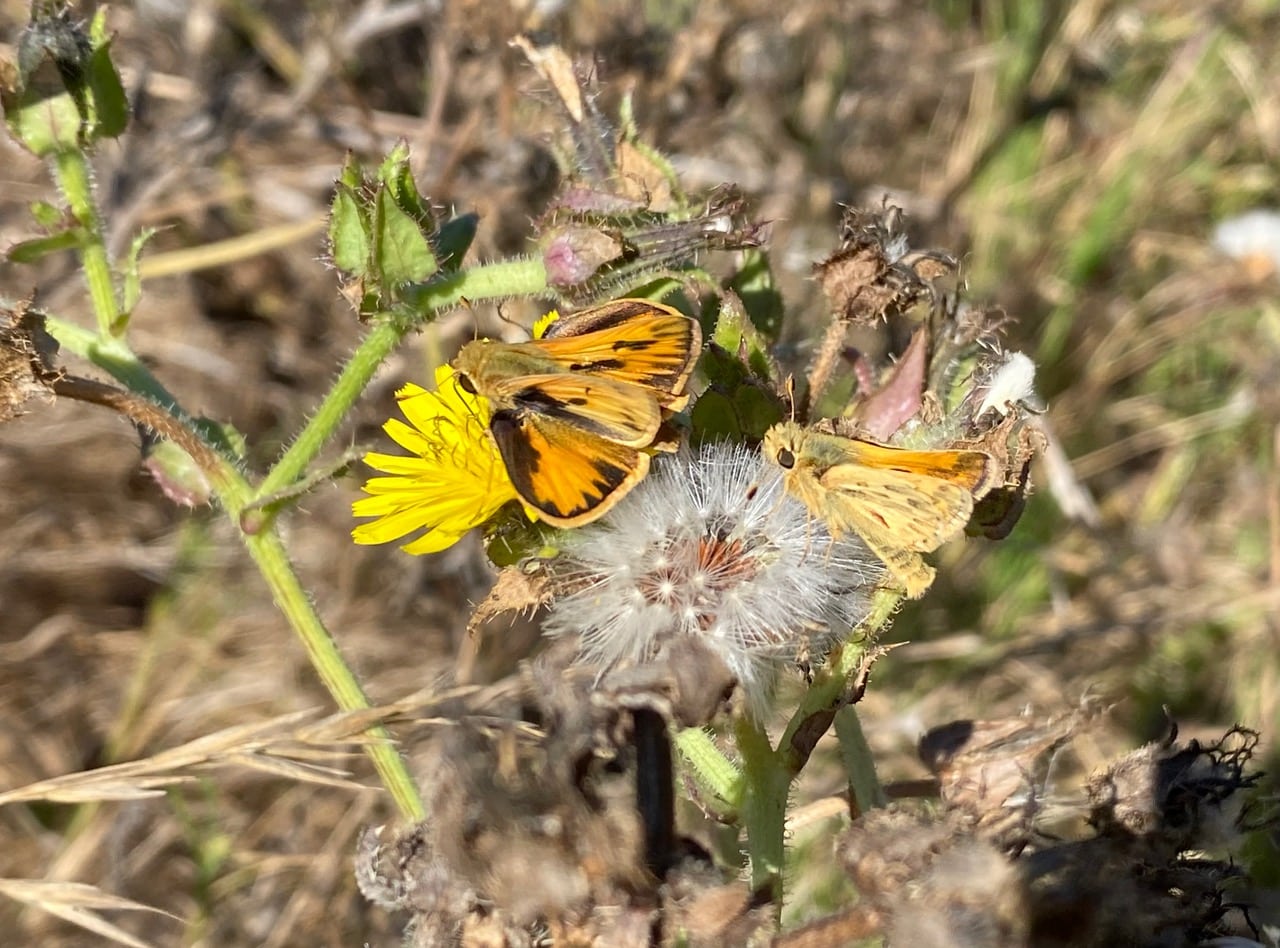
Two Skippers appear to be flirting in the air, one following the other from flower to flower. They land in quick succession on a Bristly Oxtongue, Helminthotheca echioides next to me. The smaller one in the back waits politely while the larger one takes nectar from a flowerhead! To my mind, it is a simple case of butterfly courtship…. until I consulted the skipper experts.
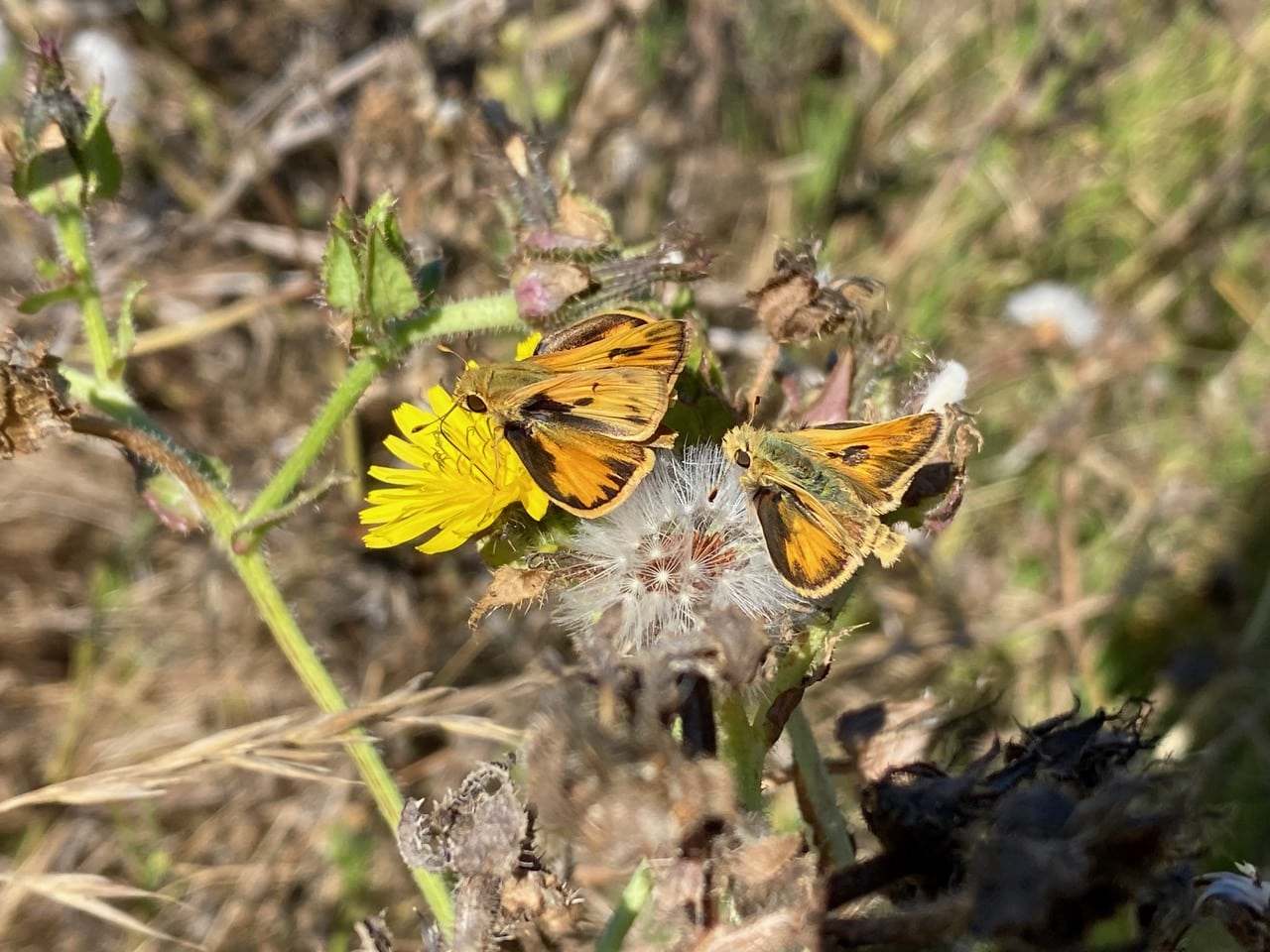
First, there is uncertainty about the identity of the butterflies. Some think they are both Fiery Skippers. Some think the one in front is Fiery Skipper, and the one in the back a Sandhill Skipper. Then there is debate about the gender of the butterflies. Some think they might both be males! Is my perceived “courtship” scenario a case of mistaken species and/or gender identity on the part of the insects, or just poor quality of the photos? Apparently there is much we don’t know about butterfly courtship, and mistaken identities are rife in the Lepidopteran world. Alas, maybe I should just simply call them Skippers!
Skippers are a family, the Hesperiidae, of the order Lepidoptera (butterflies and moths). They are named for their quick, darting flight habits. Most have the antenna clubs hooked backwards like a crochet hook. They also have generally stockier bodies and larger compound eyes than the other butterflies. Their wings are usually small in proportion to their bodies. When at rest, skippers keep their wings usually angled upwards or spread out, and only rarely fold them up completely. Californian species are mostly brown or tan, with black, orange, or yellow markings.
Skipper caterpillars are usually green or brown, sometimes yellowish, never brightly colored. They have a distinctive “collar”, a narrow ring around the body right behind the head. Caterpillars are camouflaged and often hide during the day. Many species make nests of leaves and silk for additional protection. Most North American species feed on grasses, but some common species eat shrubs and trees, especially in the bean family. Most species are limited to a single group of food plants. Adult skippers are only active during the day, but Skipper caterpillars feed mainly when it is dark or partly light.
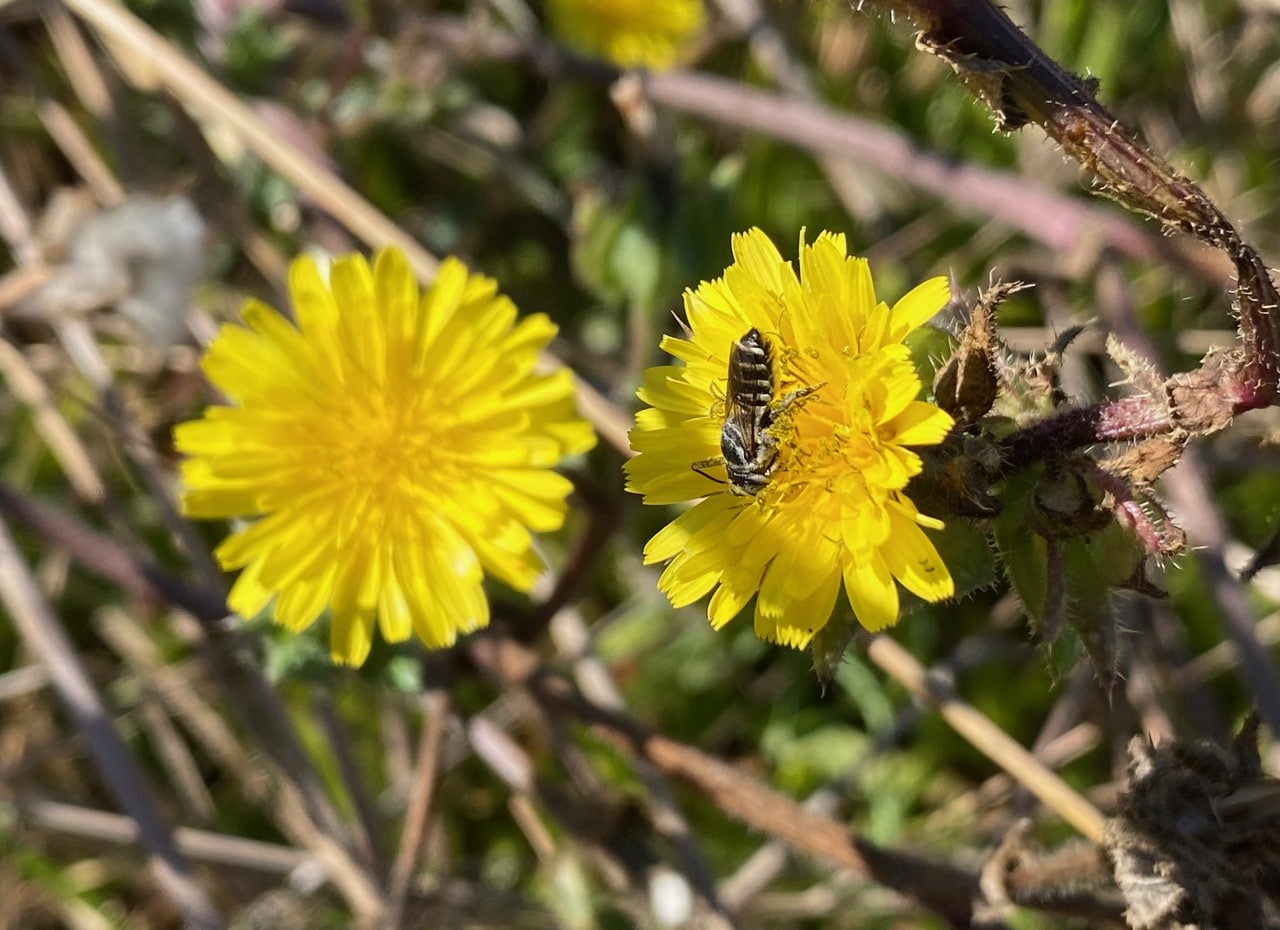
A small bee is foraging on a flowerhead of Bristly Oxtongue. From the shaggy hairs on the underside of its abdomen, I gather that it is a Leafcutter Bee, Megachile sp. (family Megachilidae). It is rather small, much smaller than the common Western Leafcutter Bee, M. perihirta.
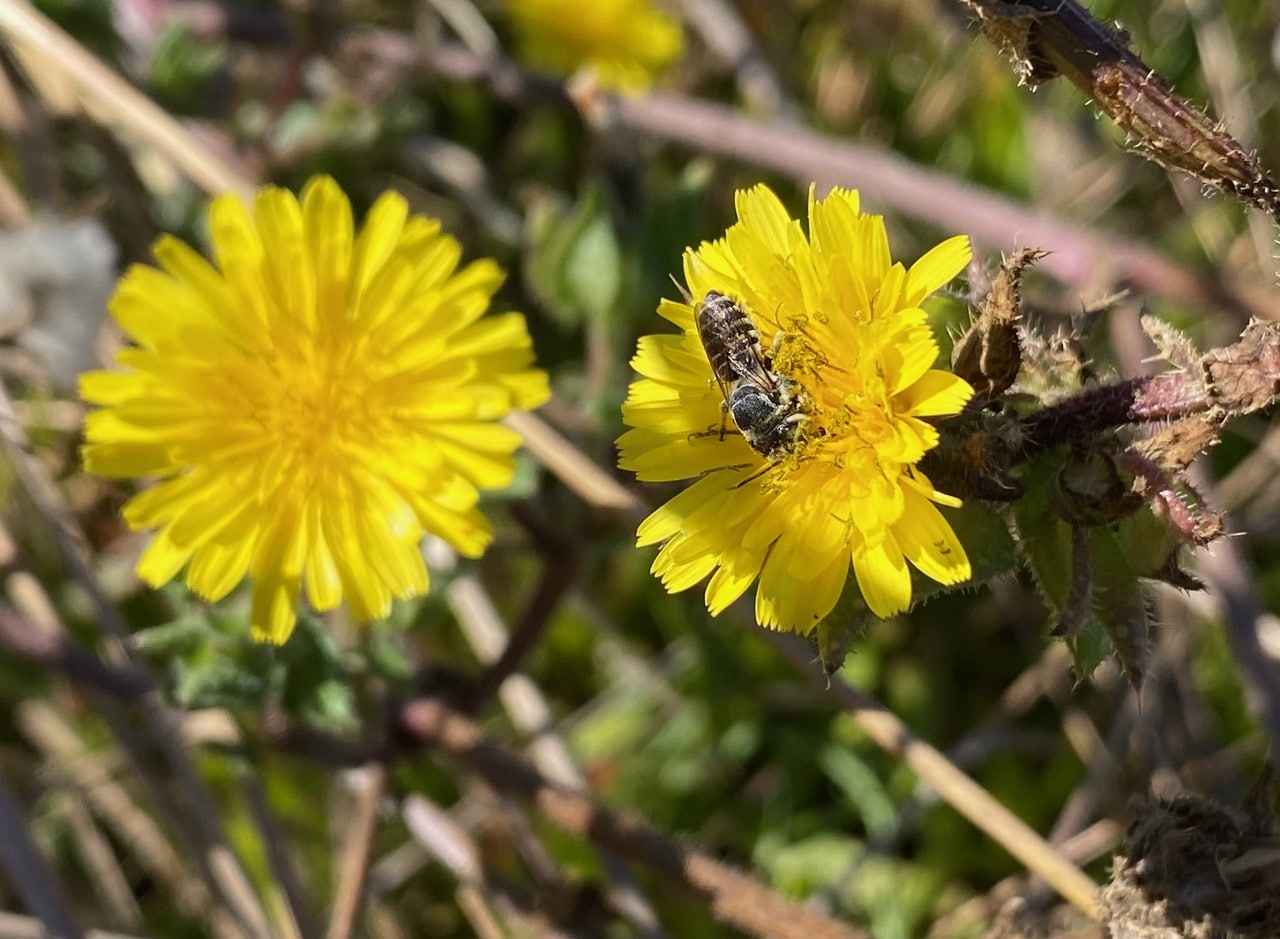
Leaf-cutter Bees, Megachile sp. (family Megachilidae) are stout-bodied, usually with pale hair on the thorax and stripes of white hairs on the abdomen. Females usually have a triangular abdomen with a pointed tip, and males’ faces are covered with dense, pale hair. Flight season is from May into September, with peak activity from June to August.
Solitary females construct nests in tubular cavities, including hollow stems, tree holes, and abandoned beetle burrows in wood. Many use holes drilled into wood, straws, or other manufactured tunnels. Females cut pieces from leaves or flower petals for use in the construction of brood cells. Most Megachile females are generalists when foraging for pollen. Pollen is transported in dense scopae on the underside of the abdomen.

Since the bee is not familiar to me, I take a series of pictures for identification.
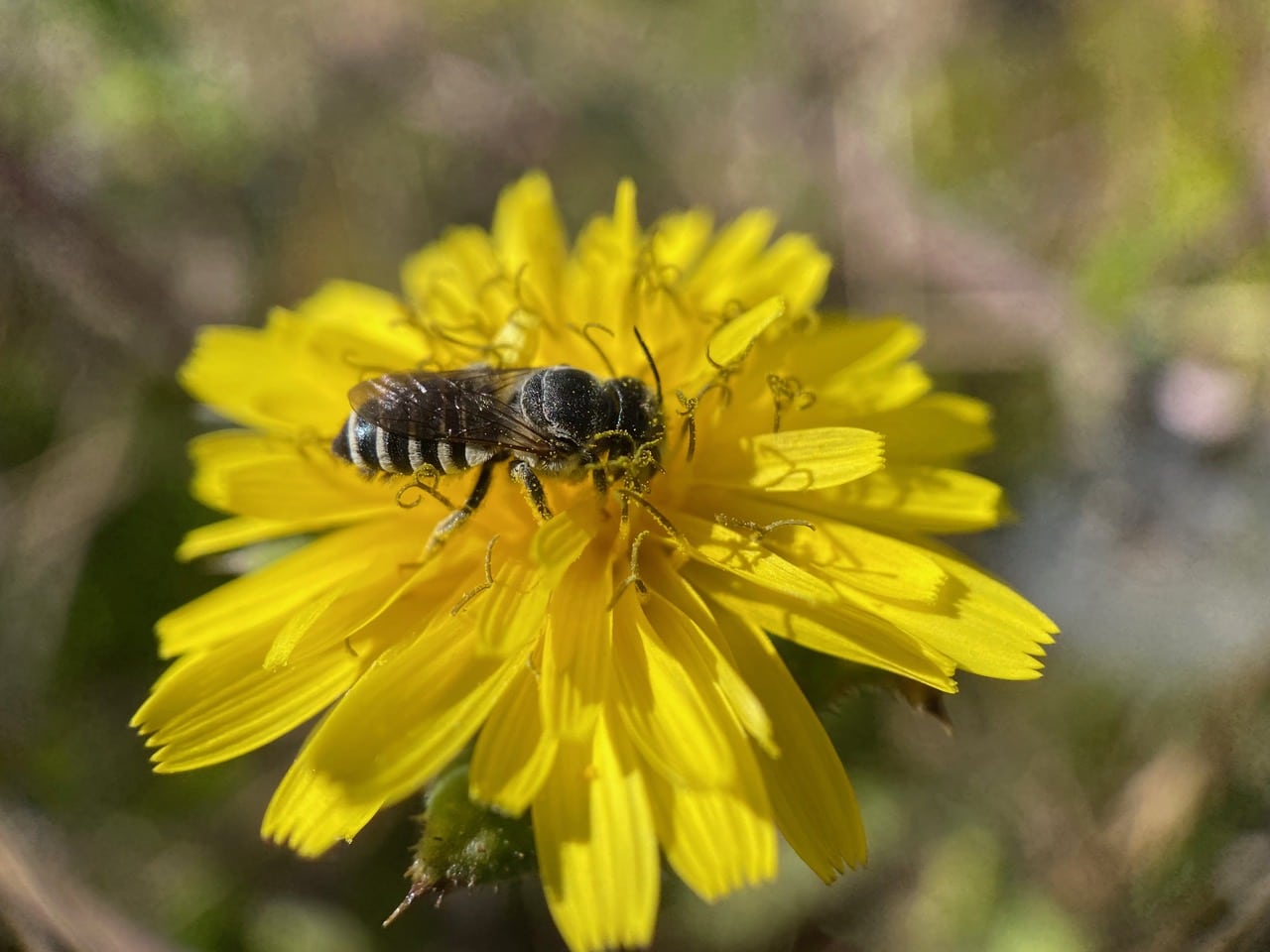
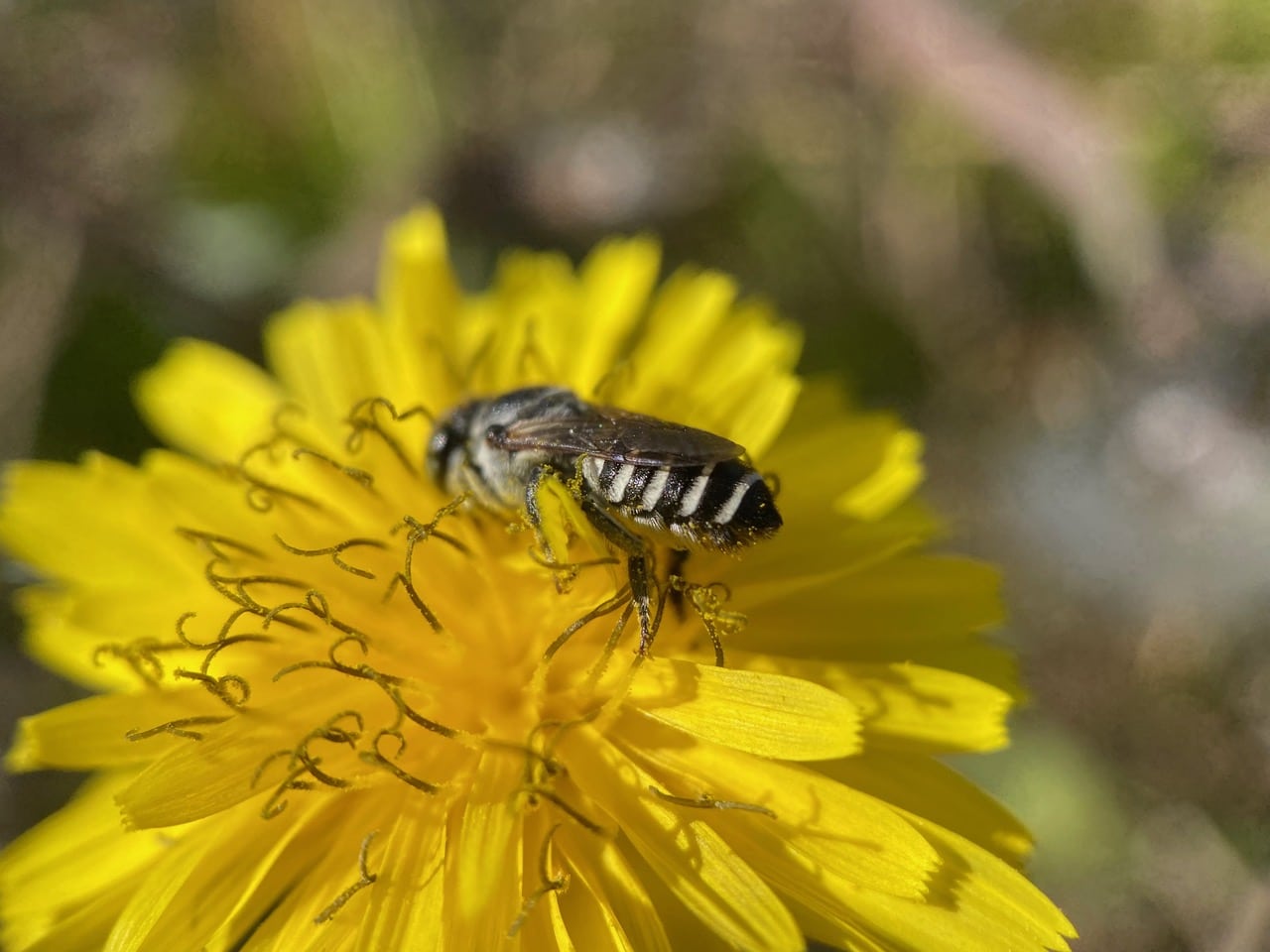
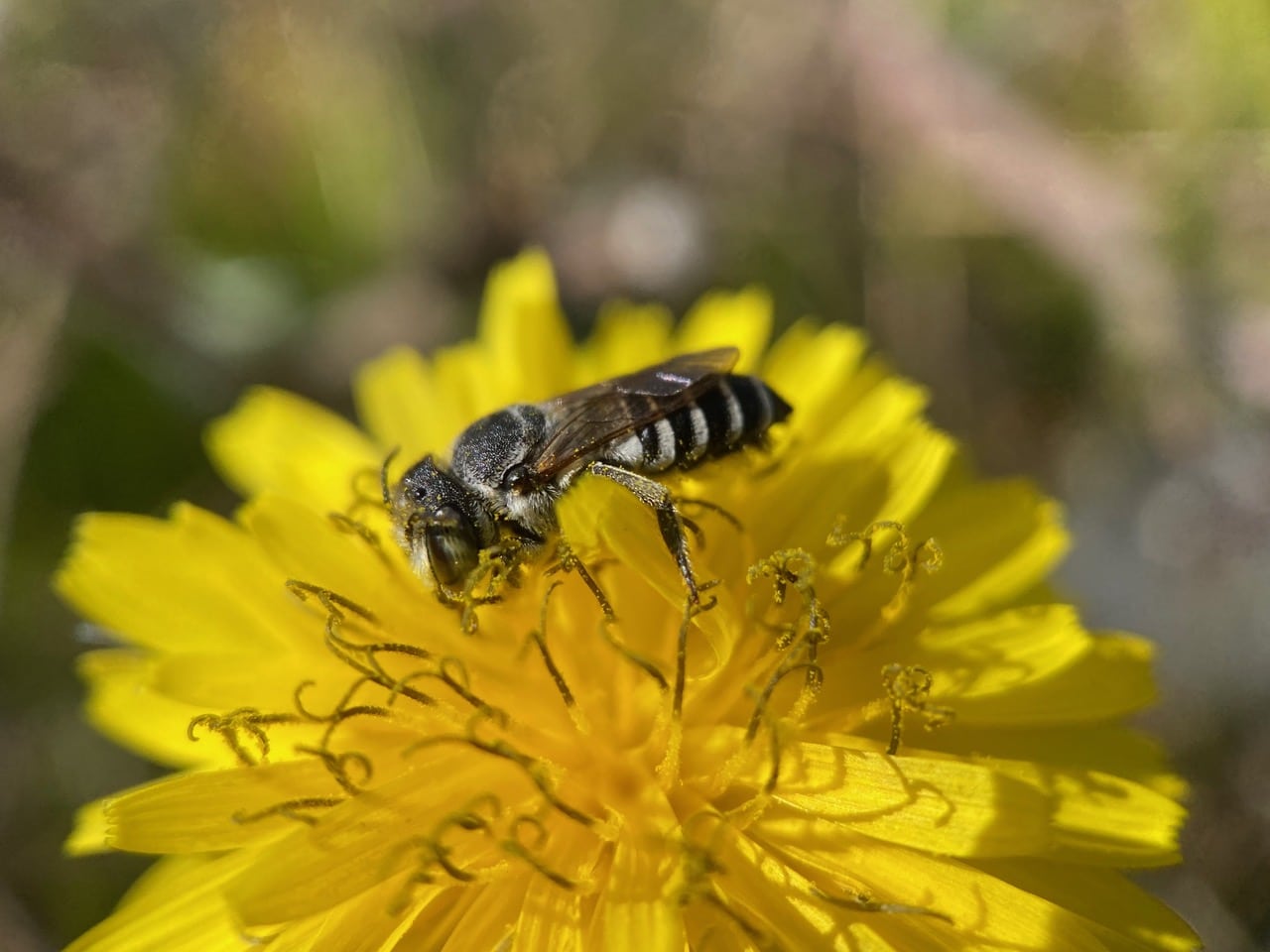
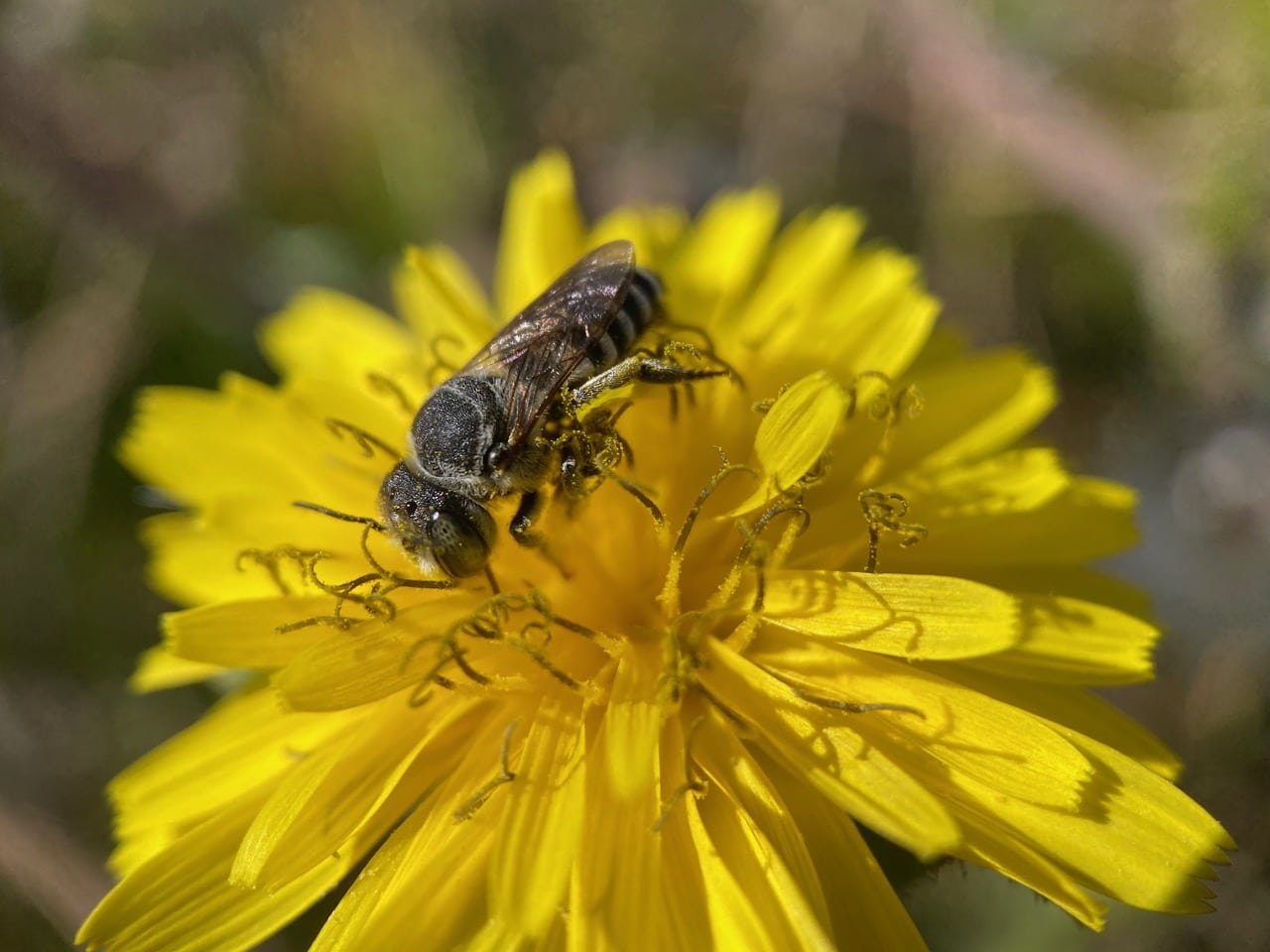
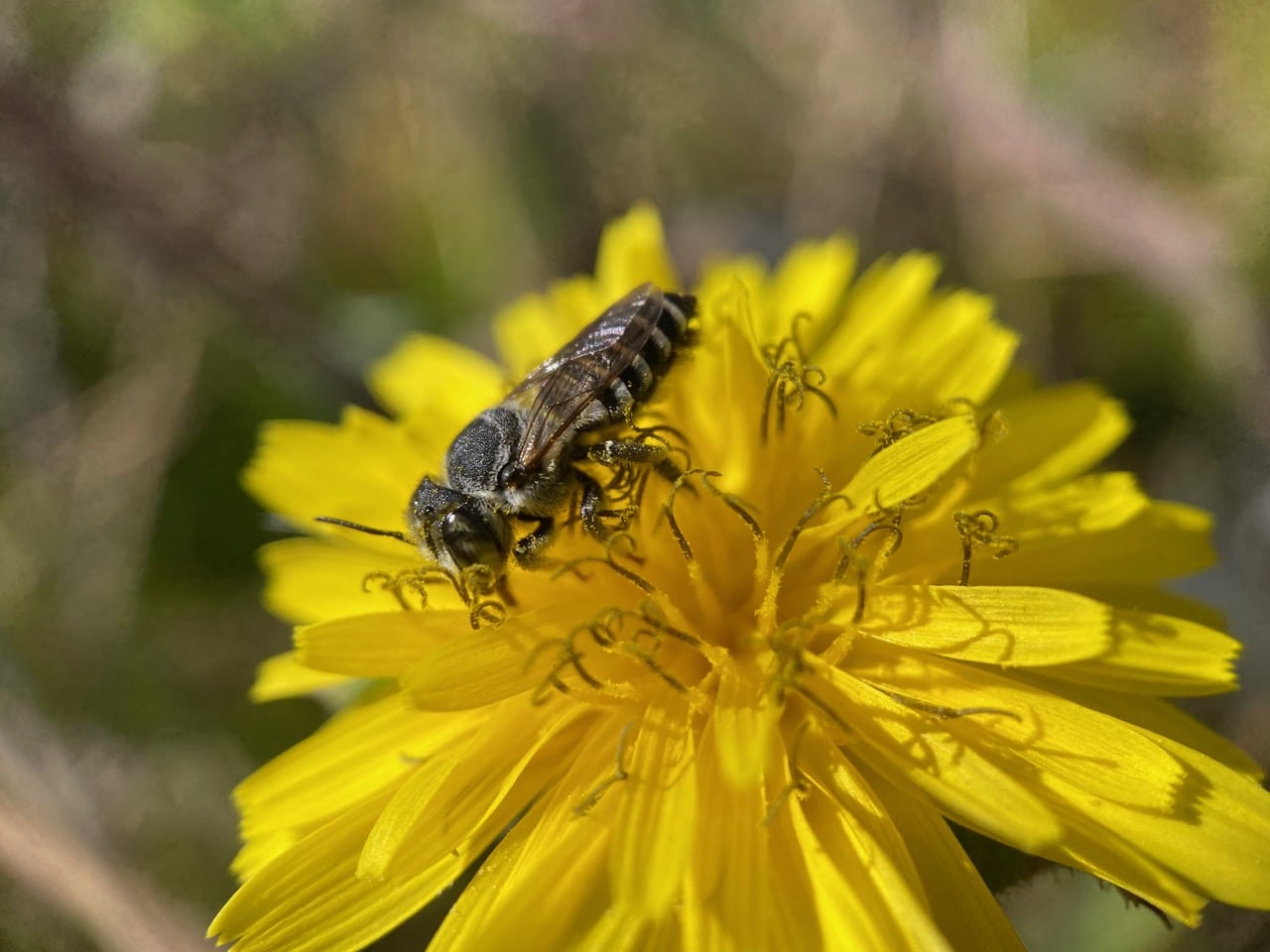
iNaturalist’s AI has identified the bee as Megachile apicalis (family Megachilidae). The species is common in Europe and the Mediterranean region, but instances have been reported in North America. These are small Leafcutters, females measuring 8-9 mm, male 6-8 mm. According to a USGS website, “Specialist on knapweeds. Not common unless you haunt industrial and other wastelands where it can be common. Always carry a net in these areas so that you are clearly seen as a harmless nature nut.”
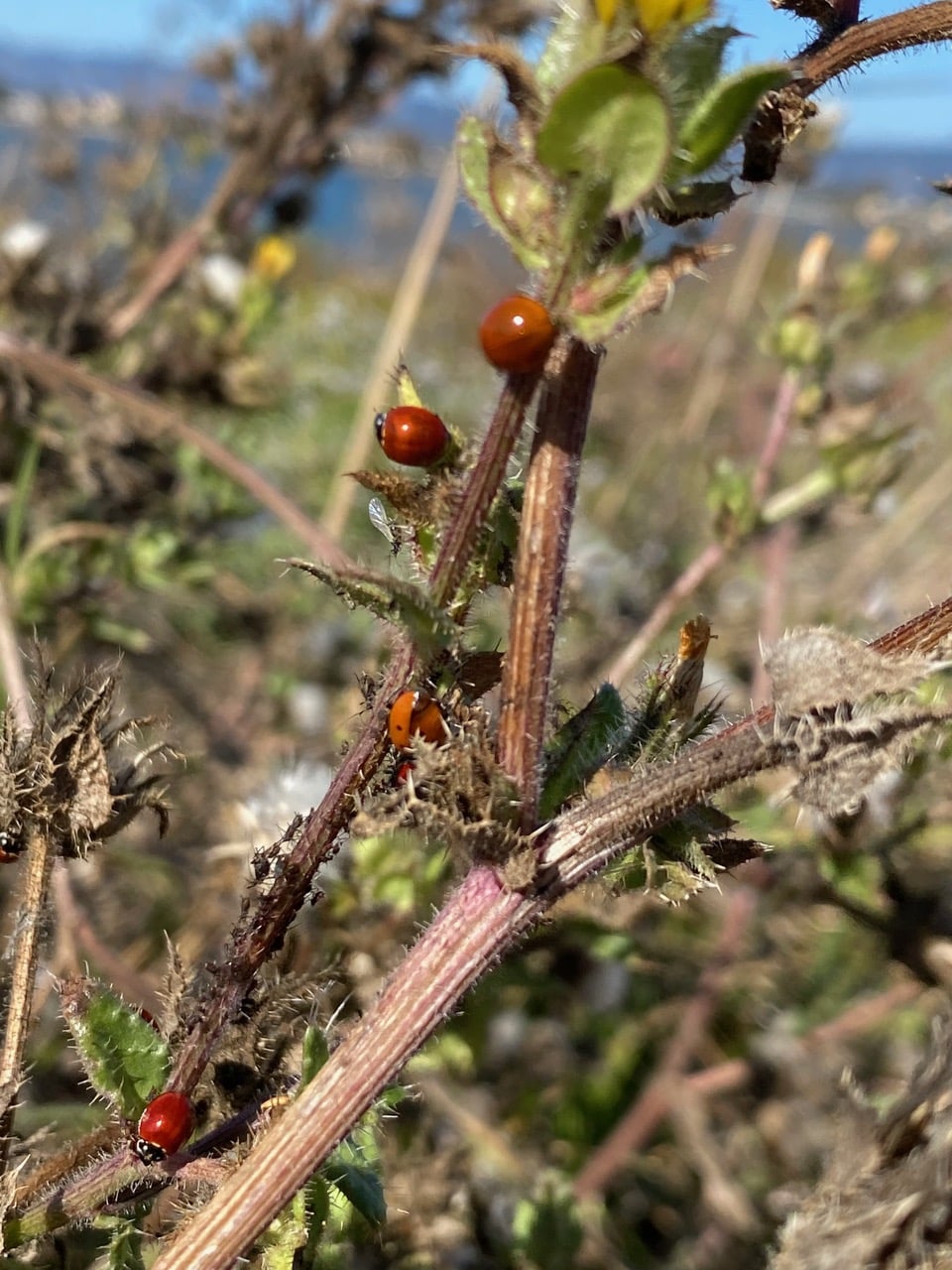
Lady Beetles (family Coccinellidae) appear to be all over this senescing Bristly Oxtongue. It’s no wonder – the plant is heavily infested with dark aphids. Both adult and larval Lady Beetles are voracious predators of aphids.
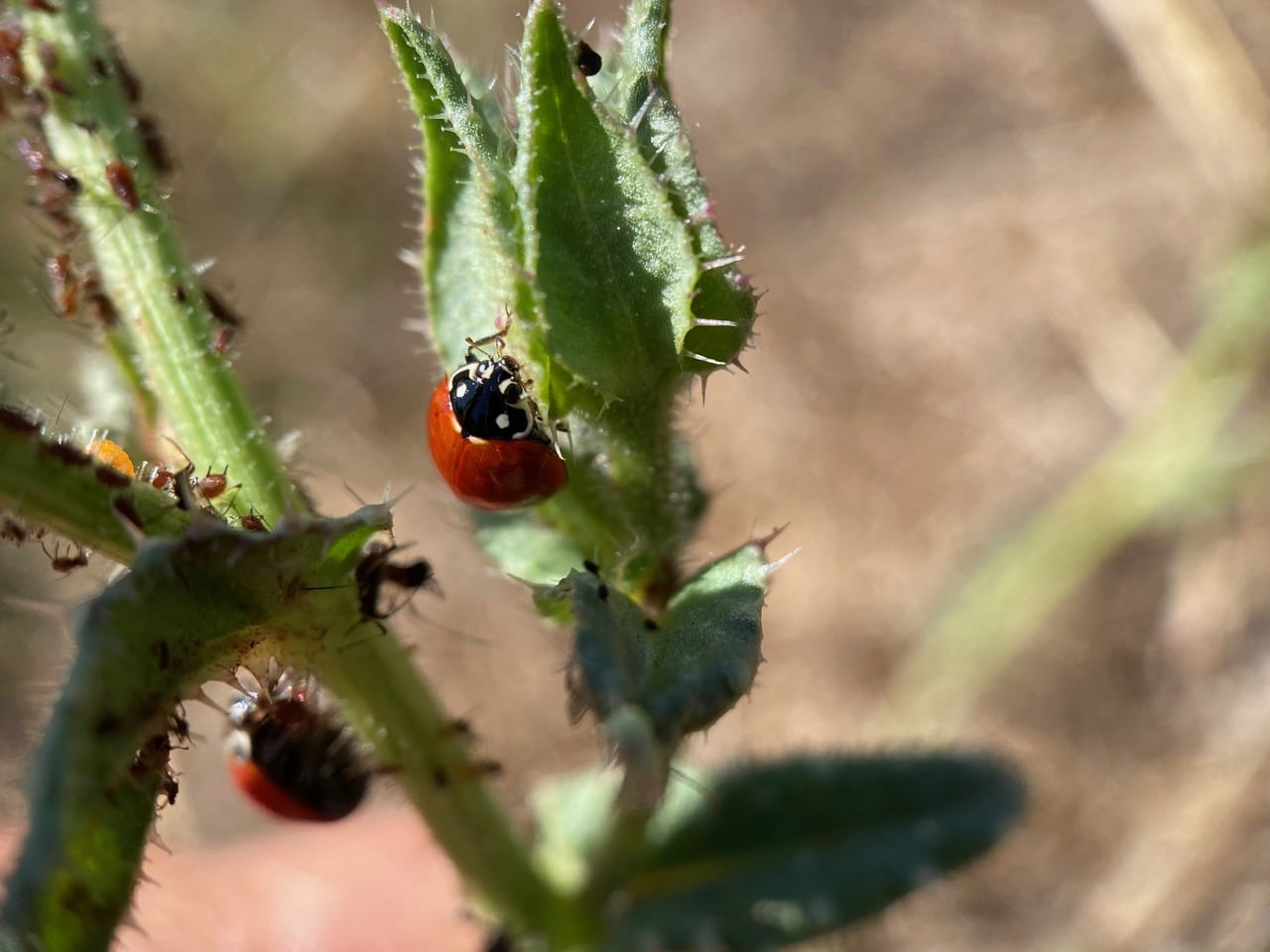
Closer inspection shows that most of the beetles are the Spotless Lady Beetles, Cycloneda sanguinea (family Coccinellidae).

A Spotless Lady Beetle is hunched over, feeding on an aphid on a stem of Bristly Oxtongue.

The Spotless Lady Beetle, Cycloneda sanguinea (family Coccinellidae) is a widespread species of lady beetle in the Americas. It is is large lady beetle with red, unspotted elytra (wing covers) ranging from 4-6.5 mm long. The black and white marks on the head and pronotum are very distinctive, and they are also gender-specific. These lady beetles are very often found feeding on aphids on milkweeds, but also occur on a number of other plants.
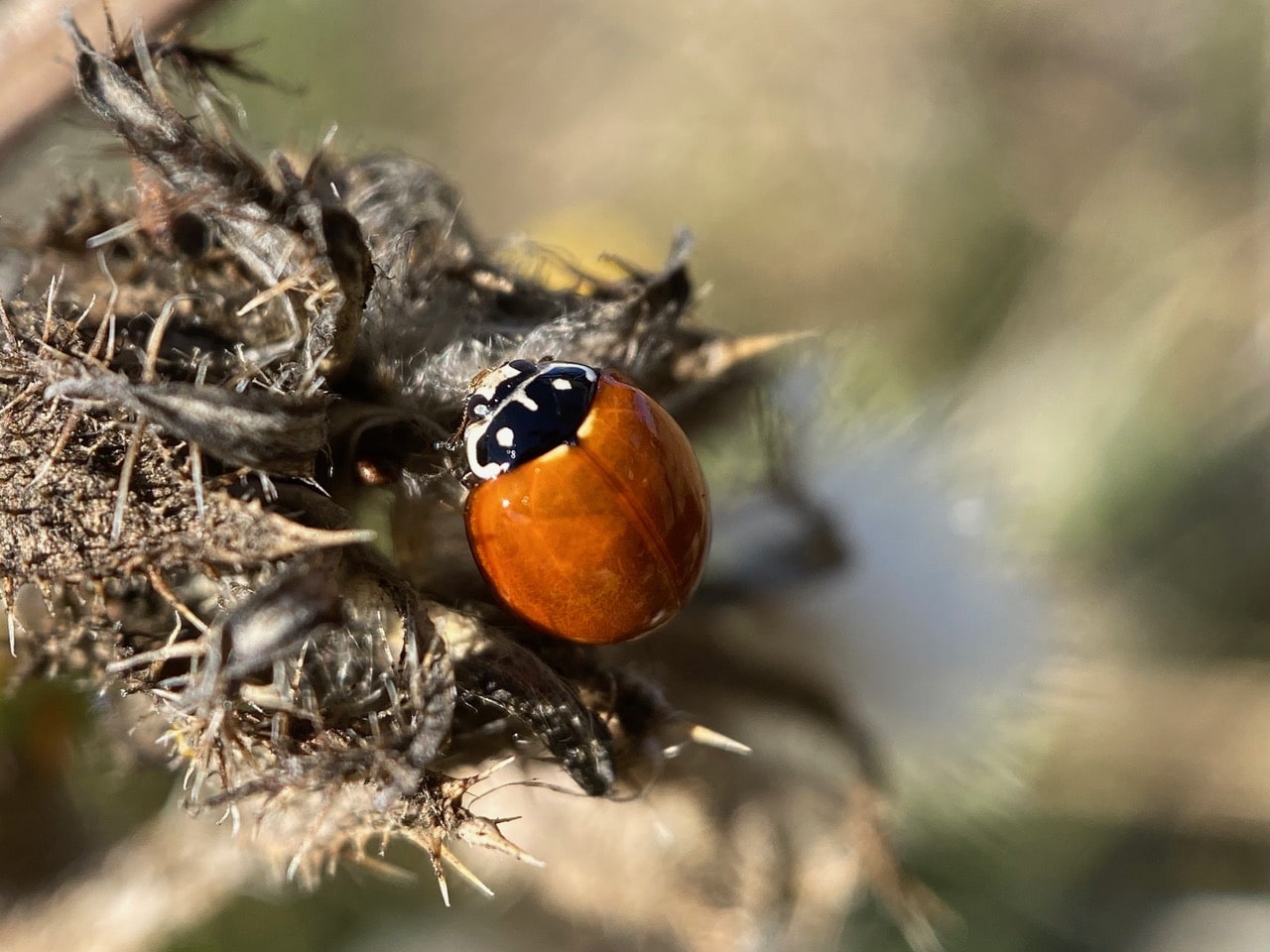
See the short white line between the two white spots on the male beetle’s pronotum? This characteristic helps to distinguish the genders in this species. Females’ pronotum lacks the line.

Ooh, there’s a Lady Beetle larva crawling down from the spent seed head of Bristly Oxtongue.

Lady beetles go through complete metamorphosis, which comprises four stages: eggs, larva, pupa and adult. The larva goes through four molts during their development. Often described as miniature alligators with six legs, the larvae are voracious predators of aphids. Each larva can eat about 400 aphids in the three weeks before it pupates. Besides aphids, they also feed on soft scales, whitefly pupae, thrips, and spider mites.
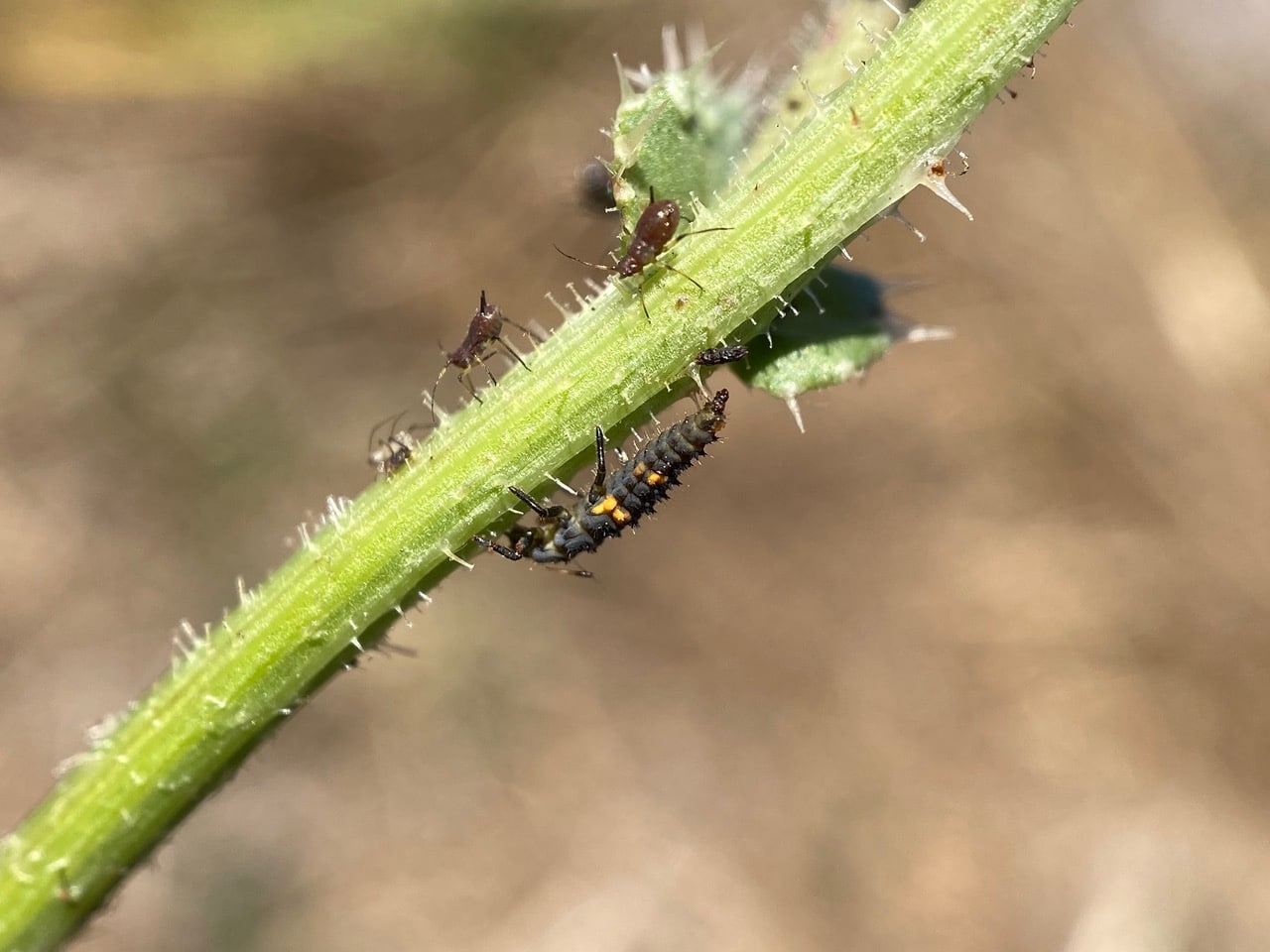
This young larva is hardly bigger than the aphids it hunts.

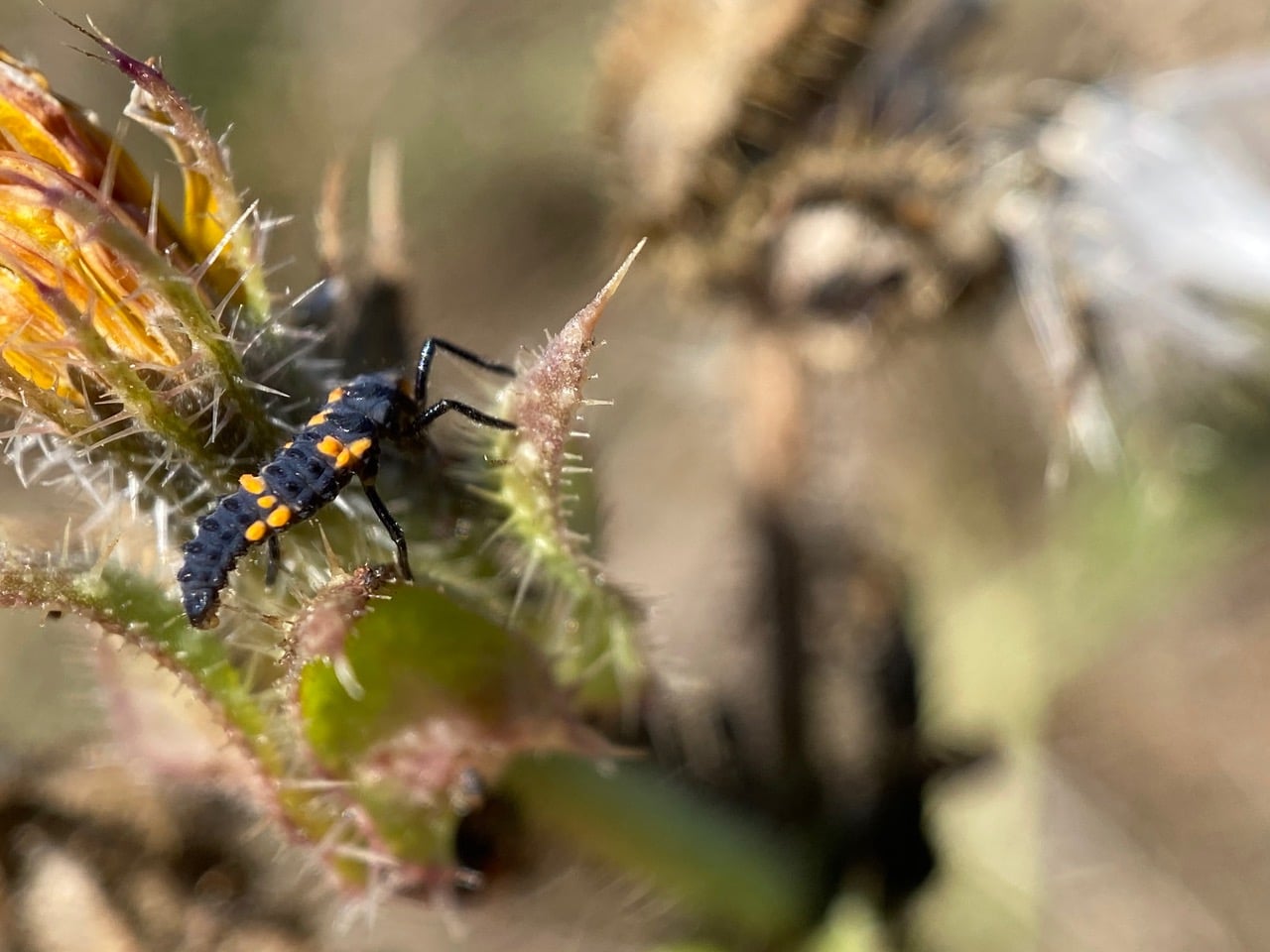
This Lady Beetle larva is moving remarkably fast on its six black legs among the phyllaries of a spent flowerhead, hunting aphids.
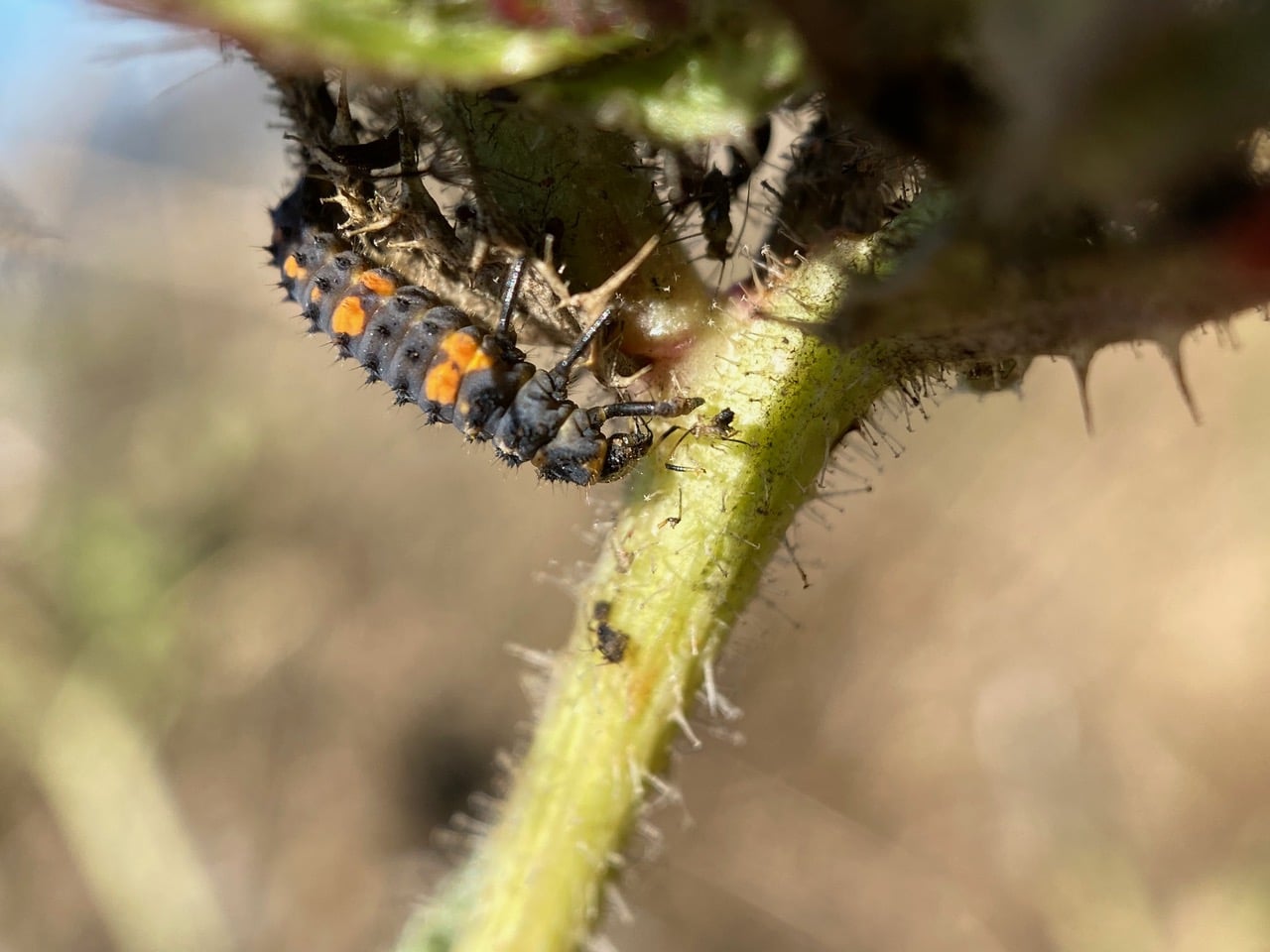
This large larva might be ready to pupate soon.

Hey, that’s a different species of Lady Beetles on the same plant, also spotless! It is the California Ladybeetle, Coccinella californica (family Coccinellidae)
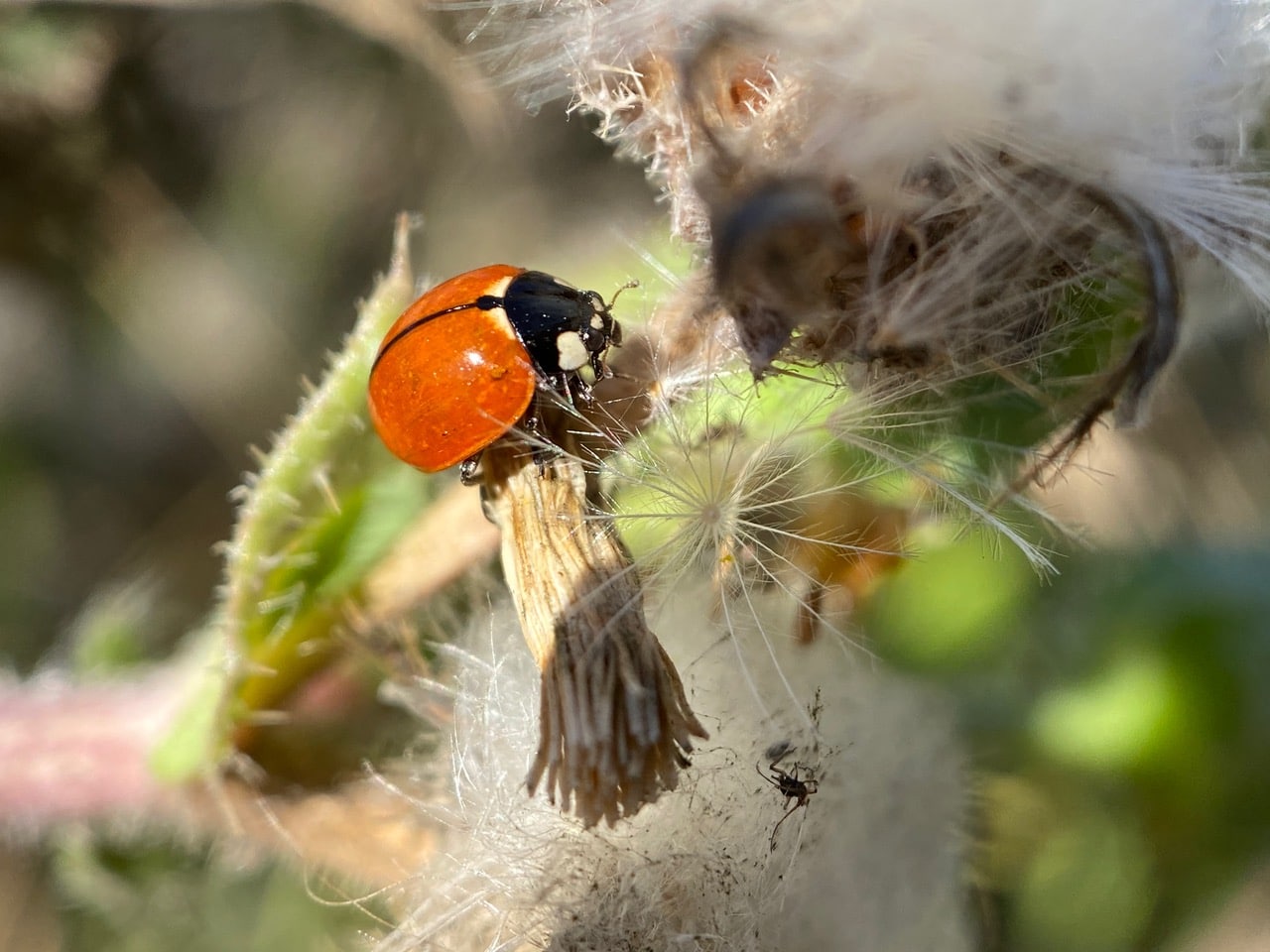
The California Lady Beetle, Coccinella californica has a red elytra that is usually spotless. Pronotum is black with a white patch on each side. Head is black with two small white spots between the eyes. There is a black suture (where the wings meet, down the middle of the back). The species’ range is the coastal counties north of the Transverse Ranges.
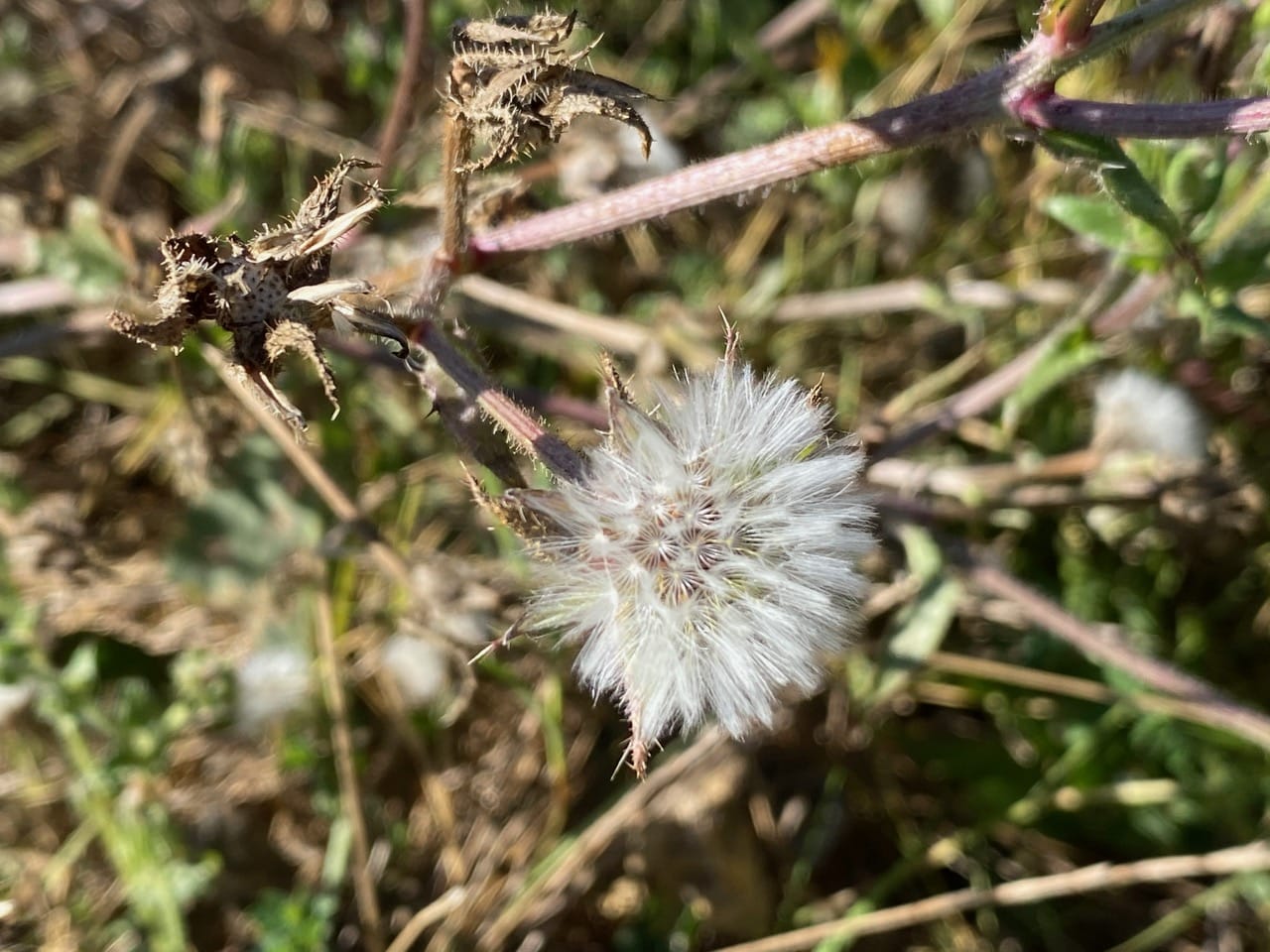
Most of the Bristly Oxtongue, Helminthotheca echioides (formerly genus Picris) along the trail have gone to seed, producing little dandelion-like puff balls.
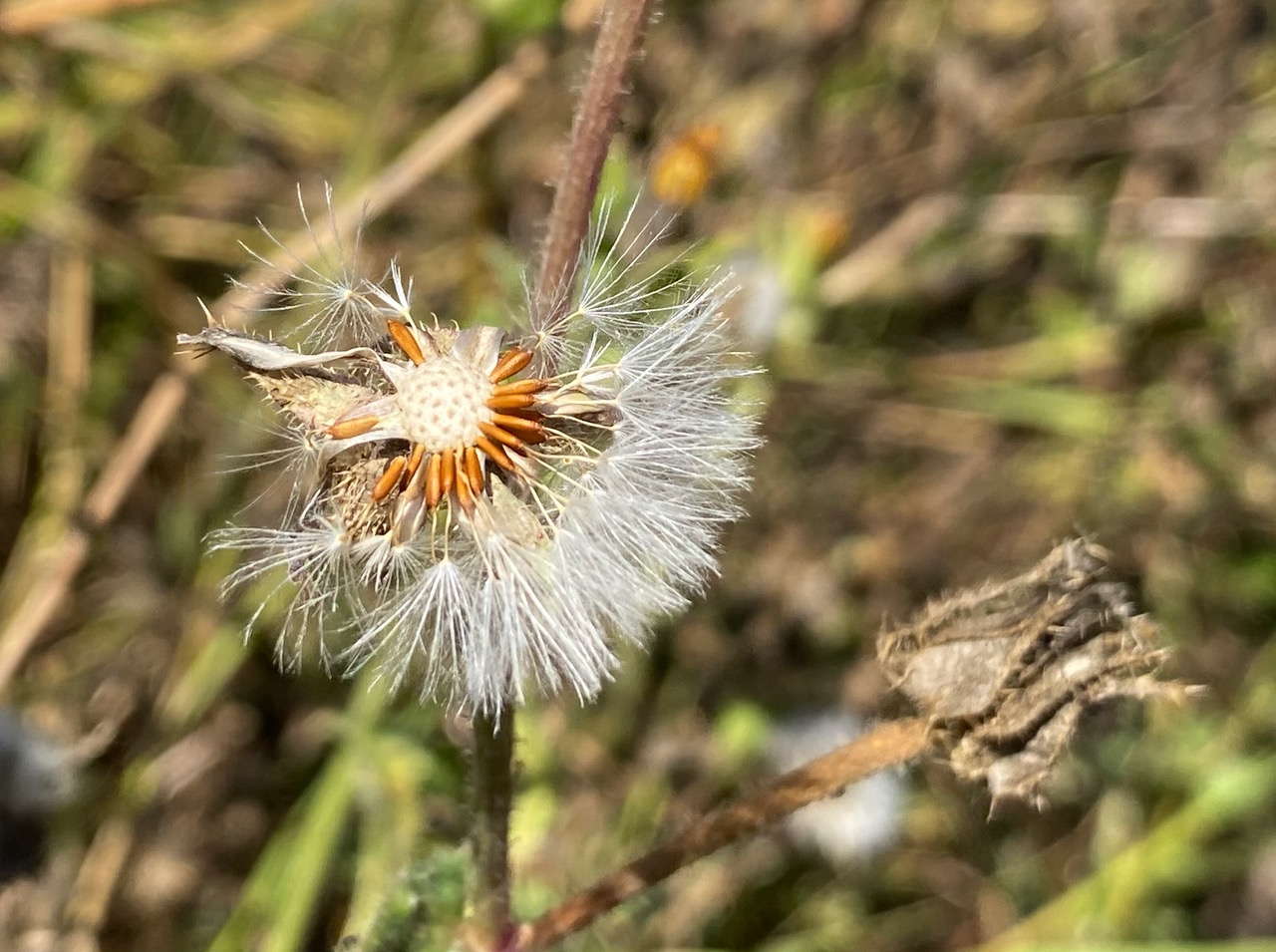
Most of the plumed seeds on this puff ball have been dislodged by the wind. Essentially puff balls of the Bristly Oxtongue and the Dandelion are structurally and aerodynamically similar. The two plants are both in the sunflower family Asteraceae. Their seeds use a bundle of filaments known as pappus. Pappuses are characteristic of plants in the sunflower family, Asteraceae. The pappus is the modified calyx, the part of an individual floret that surrounds the base of the corolla tube in a flower. It functions as a wind-dispersal mechanism for the seeds. The pappus enhances the drag on a seed as it falls and thereby slows its descent. This allows the seed to travel a longer distance before landing.
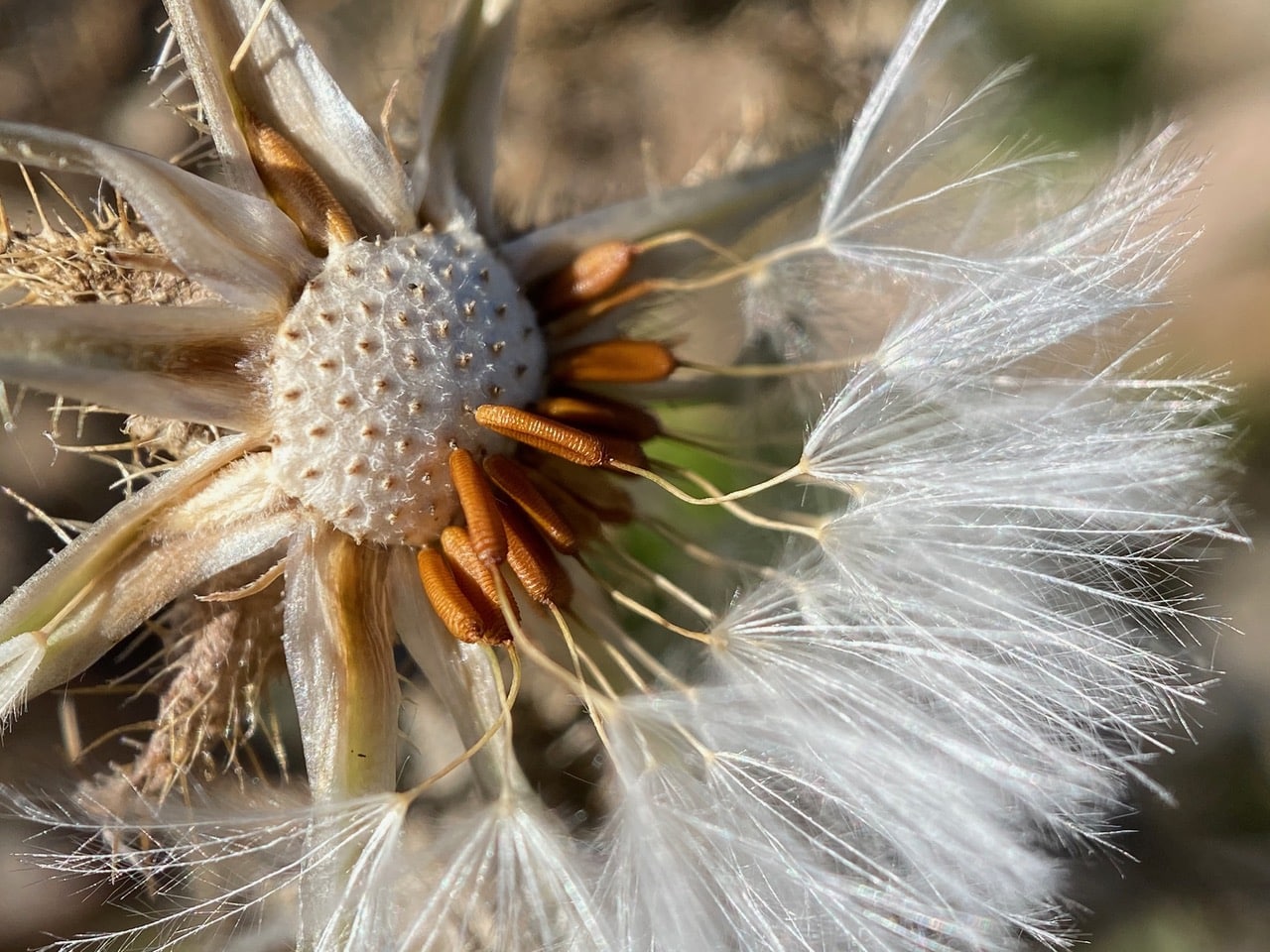
Close-up of the remaining plumed seeds still attached to the seed head of the Bristly Oxtongue.
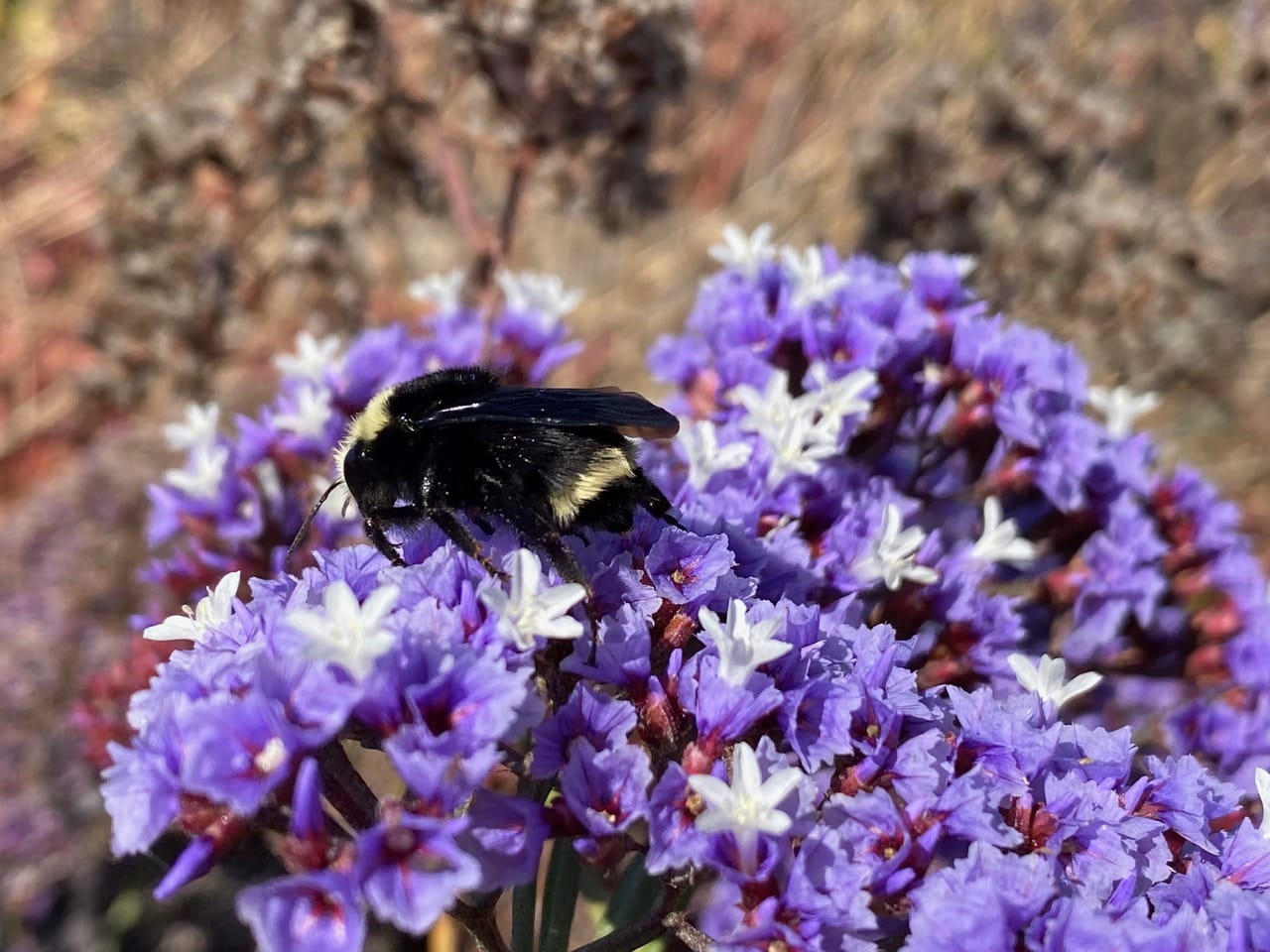
A tired queen Yellow-face Bumble Bee, Bombus vosnesenskii (family Apidae) is moving laboriously on an inflorescence of Perez’s Sea Lavender, Limonium perezii taking nectar from the small flowers. Will she be able to build up enough reserves to last through her winter hibernation? Lately I have been seeing huge bumble bee queens flying low over the ground in search of hibernation sites. After mating, the fresh queens produced this year are the only bees that will overwinter, while the rest of the colony, including the old queen dies. Emerging when the ground warms up next spring, each queen will establish her own colony.