

Pollinator Post 9/25/26 (1)

The smoky air from the controlled burn at Angel Island has kept me house-bound all day yesterday. It’s exhilarating to walk the shoreline of Bay Farm again now that the air has cleared!
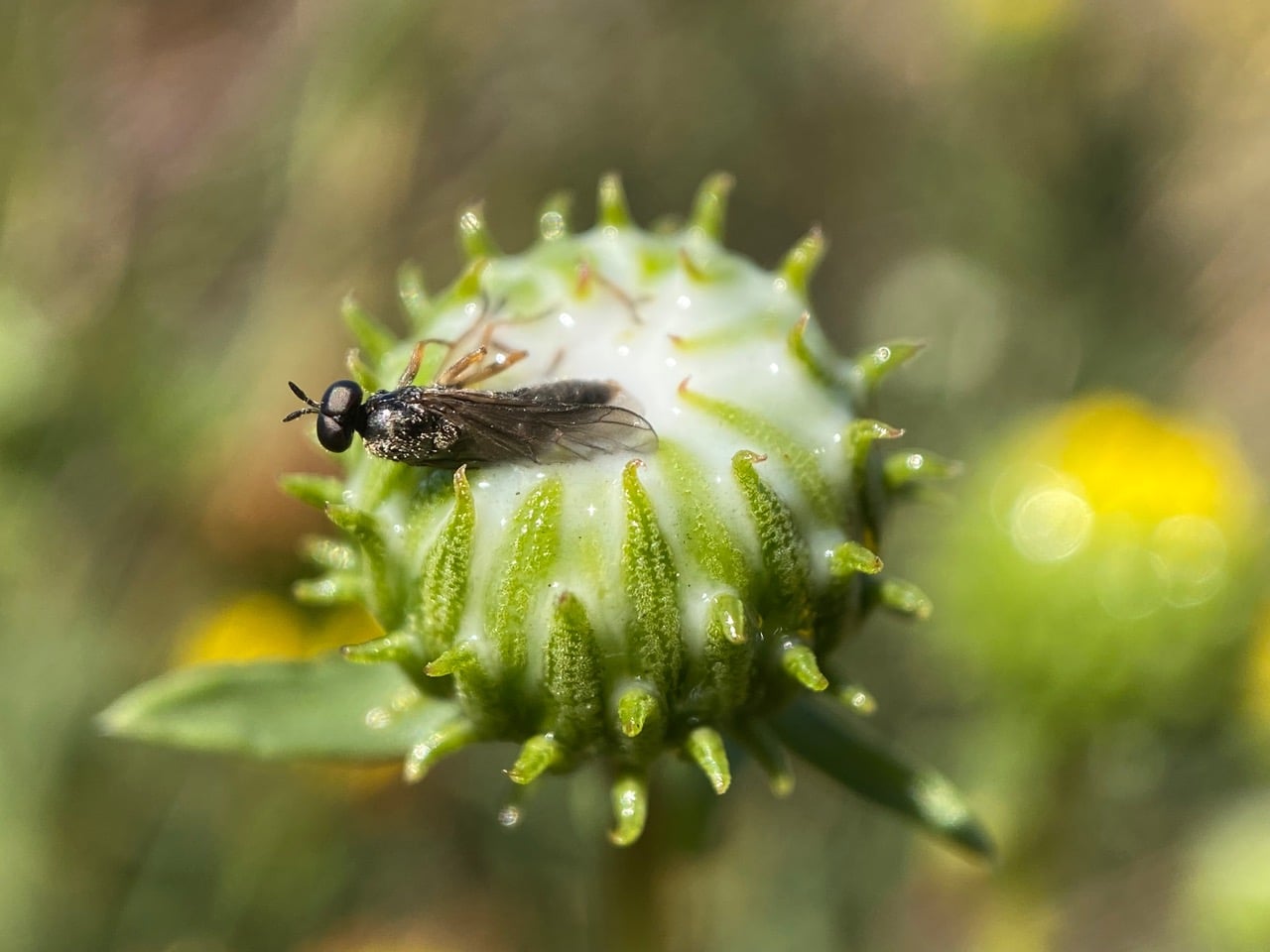
An insect lies lifeless atop an immature flowerhead of Oregon Gumweed, Grindelia stricta, its legs and wings trapped in the white gummy exudate. From the large eyes that occupy most of its head, I recognize it as a male Sugarcane Soldier Fly, very commonly seen around the lawn areas along the shoreline. The poor fly was probably being blown by the wind when it met its demise on the sticky pool.
The sticky, white exudate on immature Grindelia flowerheads is a protective, antimicrobial resin that helps the plant defend itself from insects, herbivores, and pathogens. It is the source of the plant’s common name, “gumweed”. The resin is produced by special glands, called trichomes, that are most abundant on the flowerheads and leaves. Production is highest on the buds right before they open, appearing first as a clear, viscous liquid. As it dries and dehydrates, it becomes the stickier, white substance for which the plant is known. In addition to repelling larger herbivores, the viscous resin can trap smaller insects that come in contact with the buds. The resin in rich in antimicrobial compounds, such as grindelic acid and other diterpenes, that inhibit the growth of bacteria and fungi.
The Sugarcane Soldier Fly, Inopus rubriceps (family Stratiomyidae) is native to eastern Australia where it infests such crops as corn, pastures, and sugarcane. The fly was accidentally introduced into California over 50 years ago. It is now infesting lawns in San Francisco and other Bay Area counties. Damage to turf and other members of the grass family results from withdrawal of sap from roots of host plants by the larvae and possibly, injection of a toxin into the plant.
In California adults occur in large numbers from late September to early November each year. Eggs are deposited in crevices in the soil. The adults are sexually dimorphic. Females have tiny red heads with eyes set far apart. The smaller males have large eyes that occupy the whole surface of the head. Adults are non-feeding or drink only liquids such as flower nectar and honeydew. They are strictly focused on mating and laying eggs during their short, few-day lifespan.

A male Western Leafcutter Bee, Megachile perihirta (family Megachilidae) has landed on a flowerhead of Oregon Gumweed, Grindelia stricta. Note his mustache, and the rounded tip of his abdomen.
Leafcutter Bees, Megachile sp. (family Megachilidae) are stout-bodied, usually with pale hair on the thorax and stripes of white hairs on the abdomen. Females usually have a triangular abdomen with a pointed tip, and males’ faces are covered with dense, pale hair. Flight season is from May into September, with peak activity from June to August. Solitary females construct nests in tubular cavities, including hollow stems, tree holes, and abandoned beetle burrows in wood. Many use holes drilled into wood, straws, or other manufactured tunnels. Females cut pieces from leaves or flower petals for use in the construction of brood cells. Most Megachile females are generalist foragers, but prefer flowers in the family Asteraceae.
North America is home to many leafcutter bees, but the Western Leafcutter, Megachile perihirta is one of the largest. The species ranges on the west coast from British Columbia south to northern Mexico. From a distance, the female can be mistaken for a honey bee. She is about the same size as a worker honey bee and enjoys many of the same flowers, but her head is disproportionately large because it houses the bulky muscles that operate her large mandibles. While most leafcutter bees nest above ground in tubes and tunnels, the Western Leafcutter nests underground. Often a small group of females live in a community and burrow into soil, gravel, or sand.

From this angle, the bee appears to be wearing a white fur coat. His orange front legs are fringed with long white hairs.
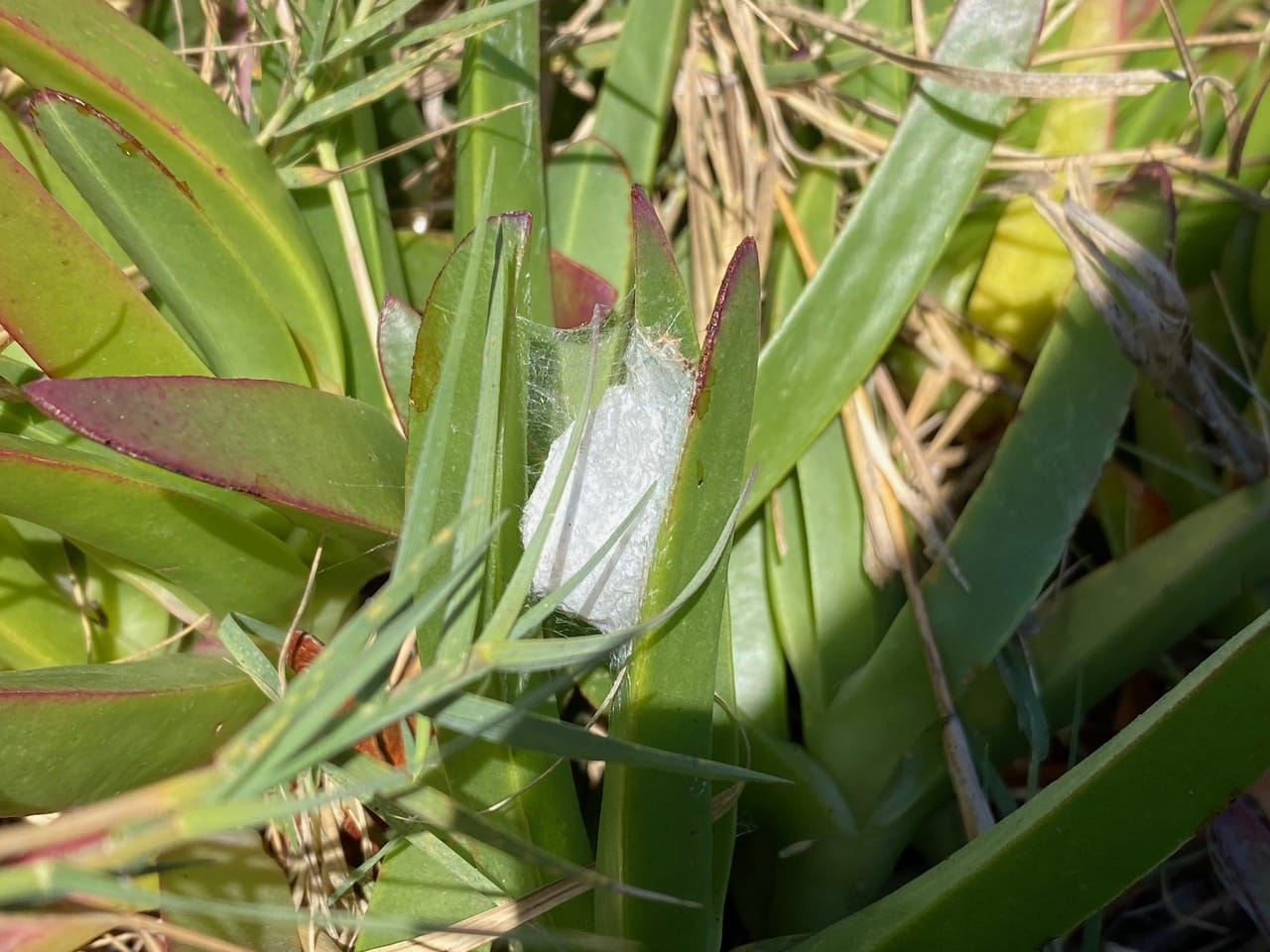
I try to remove the salt grass blocking the view to the spider egg case between the Ice Plant’s succulent leaves. Much to my surprise I can’t because the spider has incorporated the grass into the silken structure. Many spiders build similar shelters like this to protect their egg sacs, but the shape and placement of this one is very suggestive of the Yellow Sac Spiders. Inside there might be a female guarding her eggs.
Cheiracanthium spiders, commonly known as Yellow Sac Spiders, are wandering nighttime hunters that do not build traditional prey-catching webs. Instead, they construct distinct, silk “sac” retreats during the day to rest, molt, mate, and guard their eggs. In gardens and on foliage, these spiders frequently draw terminal leaves together, silking the edges to form a protective tube, “tent”, or folded retreat. These retreats are built almost daily, often completed in a single night. The silken sacs provide camouflage and protection from predators, and they also serve as a crucial, protected nursery where the female will lay and guard her eggs.
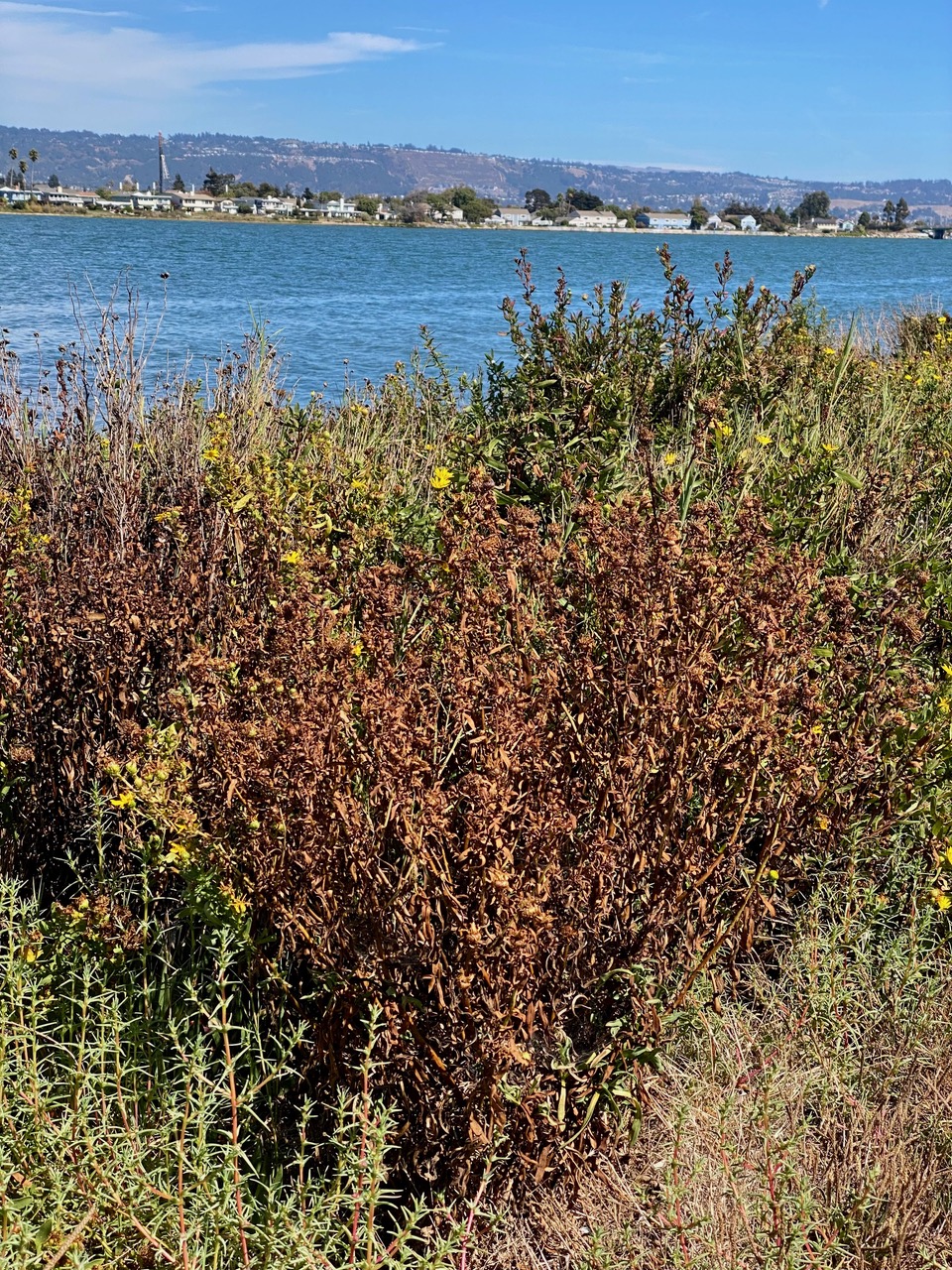
The vegetation along the shoreline are losing their vibrant green. This is not entirely due to seasonal die-back/dormancy, but much of the brown is dead Grindelia. Battered by Spittlebugs and Lace Bugs for years in a row, many of the plants have simply succumbed.
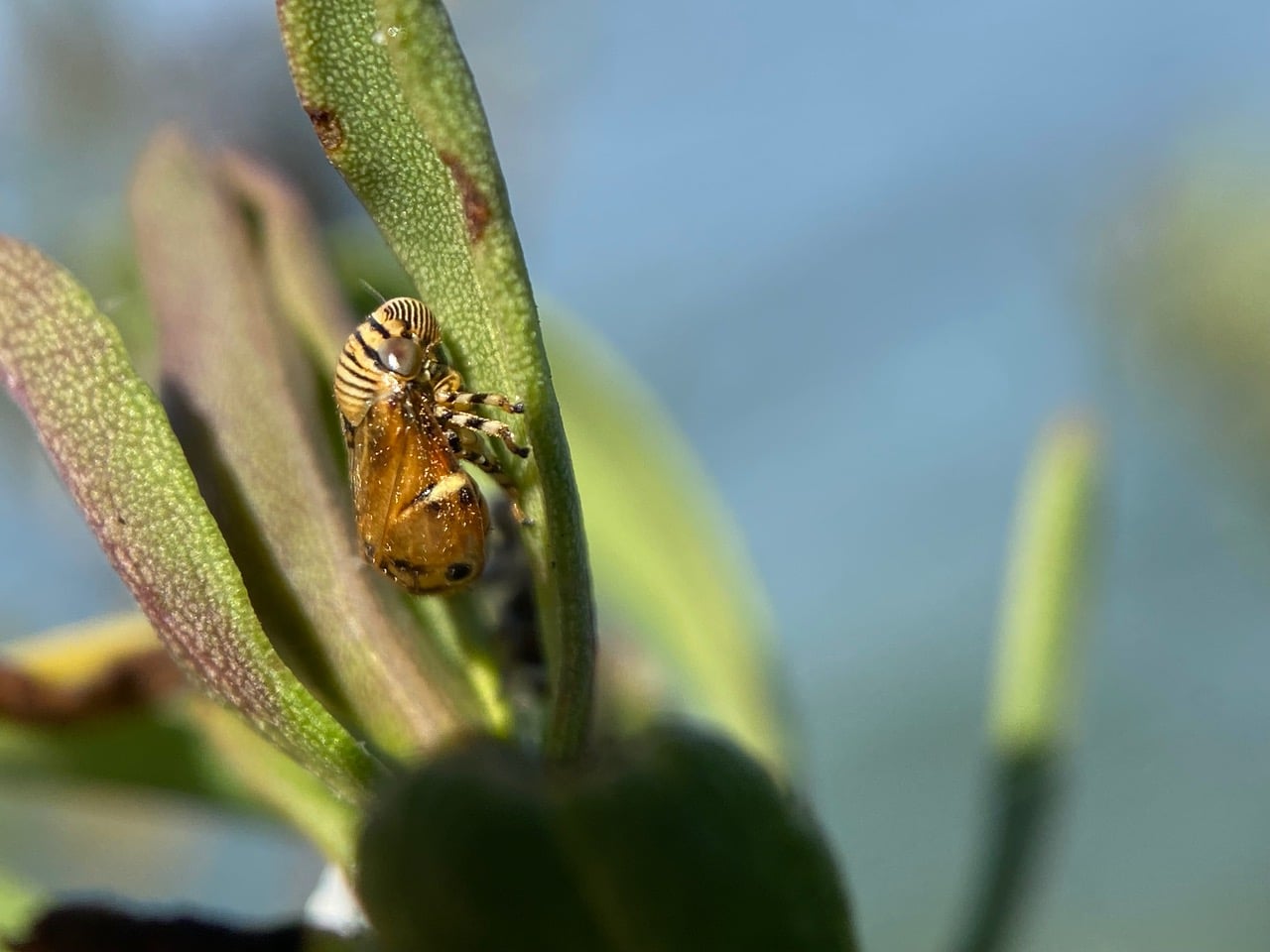
A female Spittlebug, Clastoptera lineatocollis (family Clastopteridae) is perched on a terminal Grindelia leaf. Many of the white foamy masses on the Grindelia made by Spittlebug nymphs have dried up and disintegrated, replaced by numerous adults. Although like the nymphs, they have piercing-sucking mouthparts for sucking plant sap, the adults do not seem to be feeding much. Despite their reputation as champion jumpers, they appear to be rather sedentary bugs.
The Spittlebug, Clastoptera lineatocollis (family Clastopteridae) is found in western United States. The bugs feed mostly on Asteraceae, although other hosts have been reported. Females are brownish (3.3-3.8 mm), while the smaller males (3.0-3.2 mm) are mostly black.
Unlike their young, adult spittlebugs (also known as Froghoppers) are efficient flyers and hoppers, feeding on diverse plant species. Using their piercing-sucking mouthparts, they pierce plant stems to feed on xylem. To get enough nutrients, they consume massive quantities of sap, drinking up to 280 times their body weight daily, resulting in high waste excretion. Froghoppers can cause damage by distorting plant leaves and causing shoot tips to die back. Froghoppers are champion jumpers among insects, out-performing even the fleas. The bug can leap the human equivalent of a skyscraper without a running start. It is the highest jumping insect proportional to body size. The muscles in its hind legs act like a “catapult” to release energy explosively.
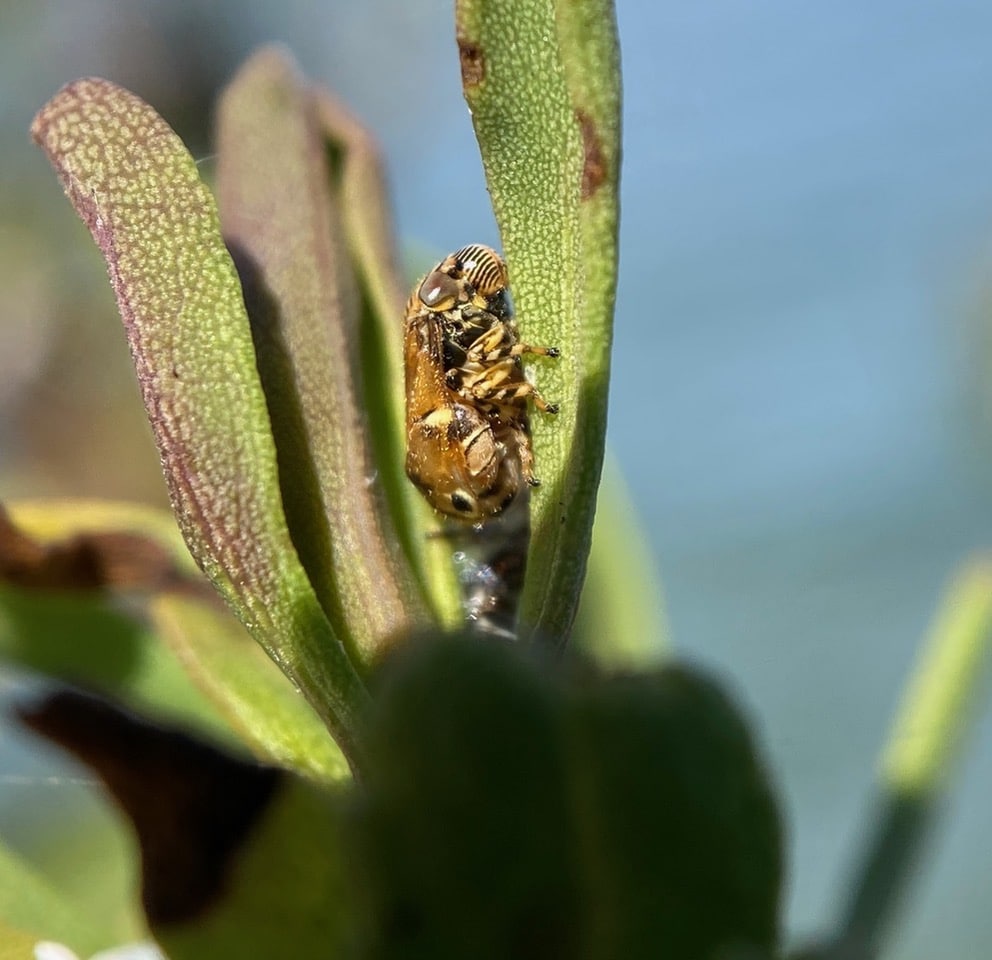
This view of the Froghopper reveals an enormous snout connected to its rostrum used for sucking fluids from plants.
Adult spittlebugs, also known as froghoppers, have a prominent, bulbous snout that houses a highly powerful, internal muscular pump used to suck plant sap. Because xylem sap is mostly water and contains very few nutrients, spittlebugs must drink vast quantities of it just to survive. Pulling xylem sap out of a plant requires immense negative pressure. The bulbous snout provides the physical space needed to pack in massive dilator muscles that serve as a high-speed hydraulic pump, allowing the insect to constantly pull in fluid.
Both the adult froghoppers and their juvenile nymphs share this facial structure, though the nymphs put the massive volume of processed fluid to a unique use – whipping the excess fluid out of their rear ends to build their famous, protective “spittle” bubble nests.

An attached male in tow, a female Froghopper is slowly making her way up a Grindelia stem past an exuvia (shed skin). The pair is mating rear-to-rear while on the move, with the larger female in the lead.
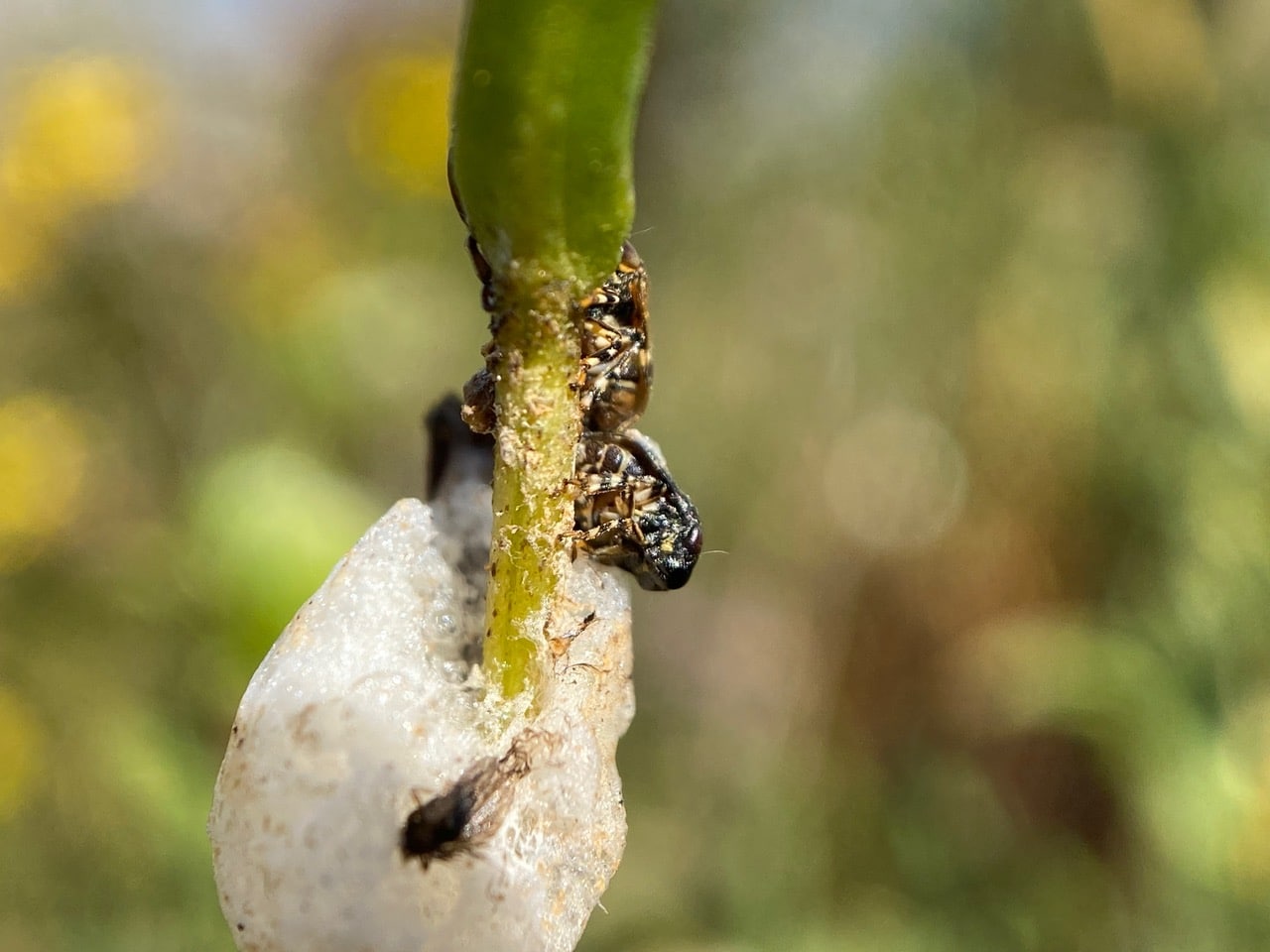
Sensing the approach of my camera, the female sidles to the other side of the stem. The attached male goes along passively.
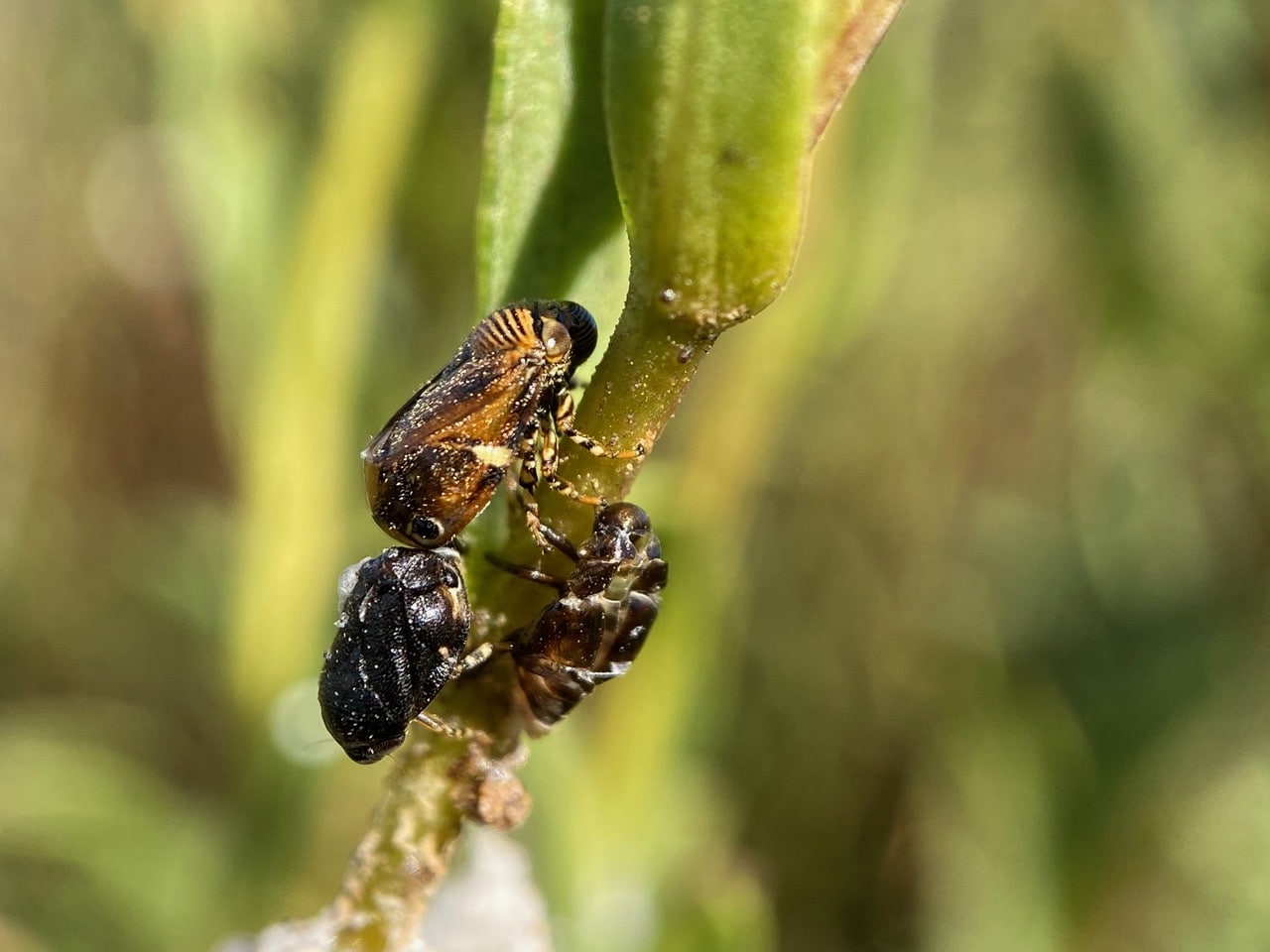
The mating pair passes another exuvia. An exuvia (plural: exuviae) is the empty exoskeleton or cast-off outer skin that an arthropod leaves behind after molting.
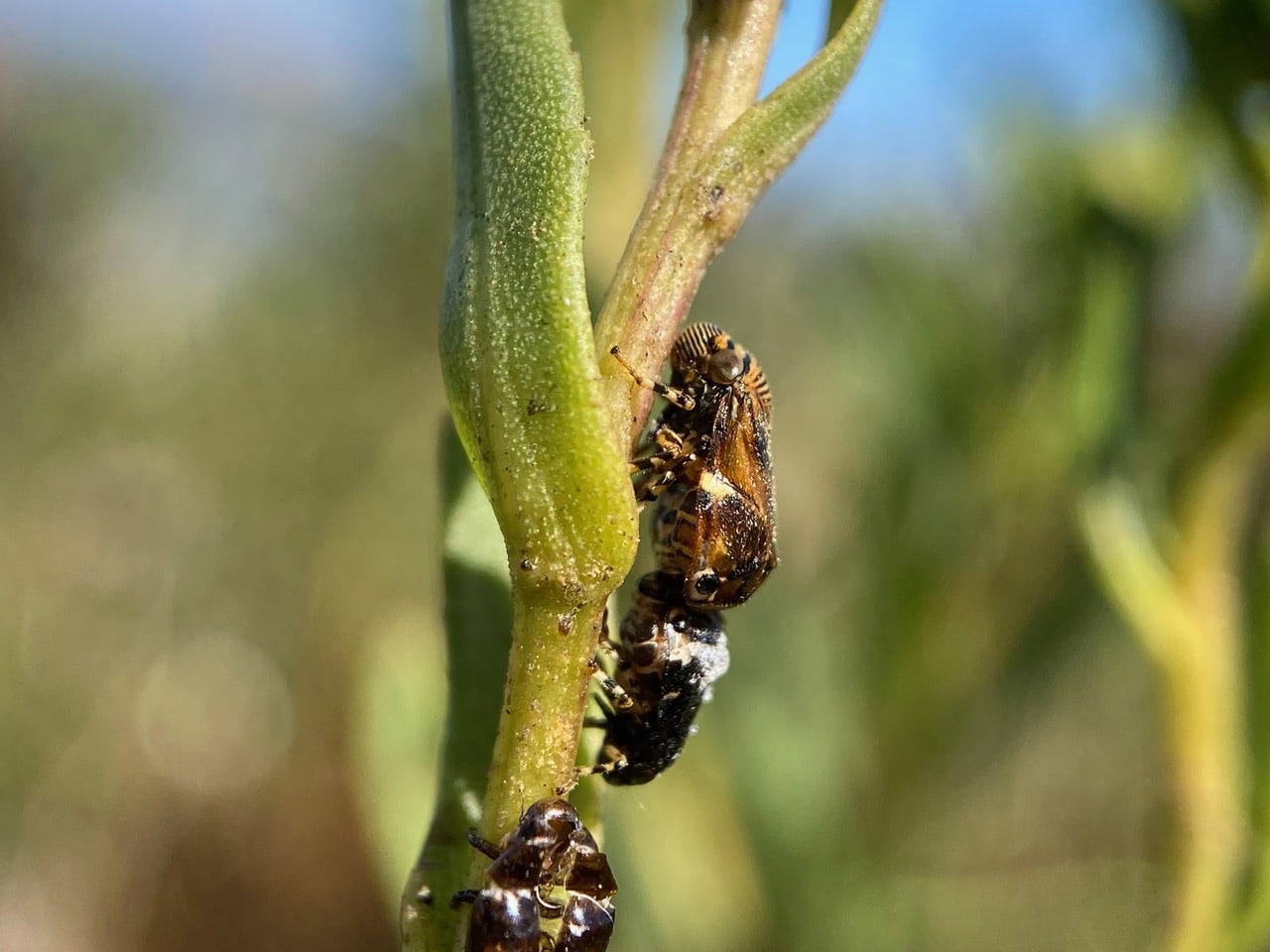
There seems to be dried white foam stuck on the back of the black male.

As the mating pair makes its way up, I have to keep twisting the stem to keep the bugs in sight. The pair remains united throughout their slow journey to the top of the plant.
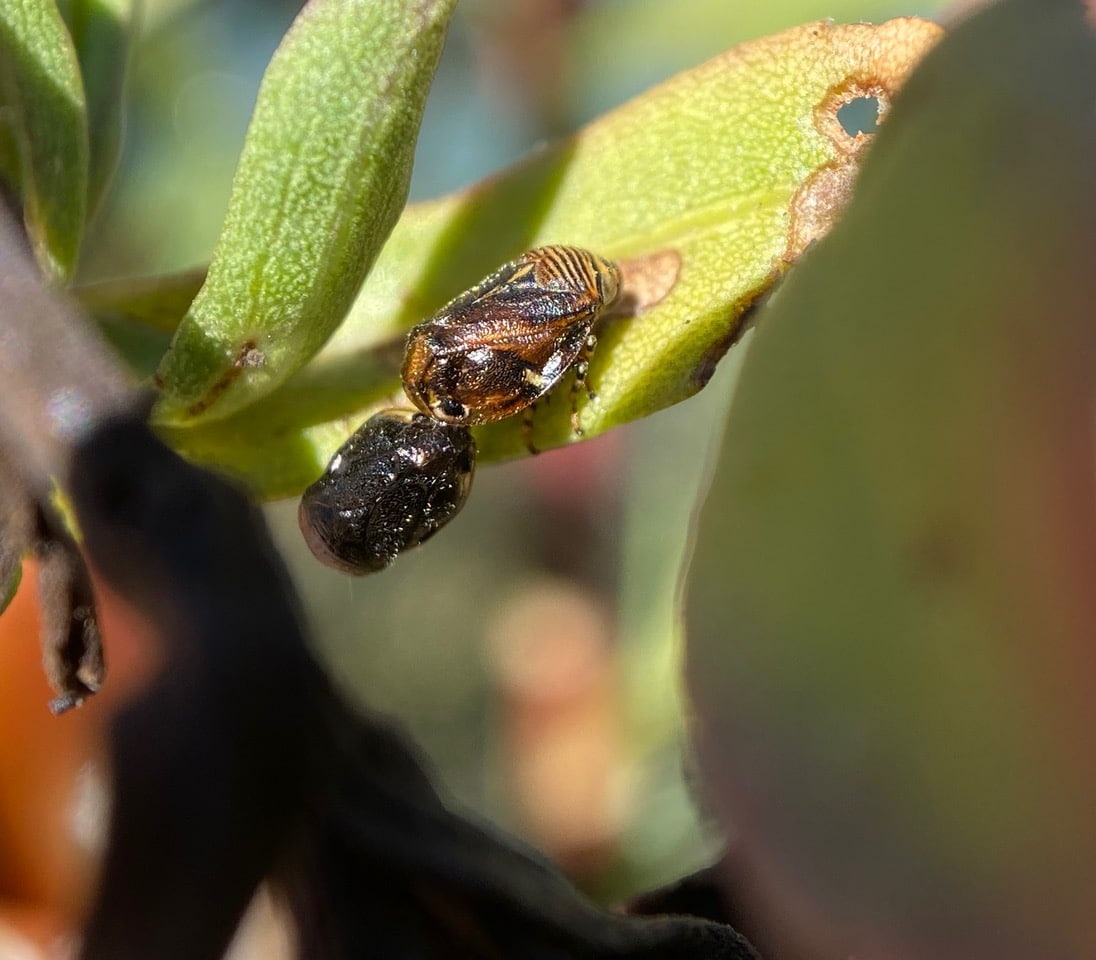
Here’s a mating pair on another Grindelia plant. The male dangles behind passively while the female trundles on.
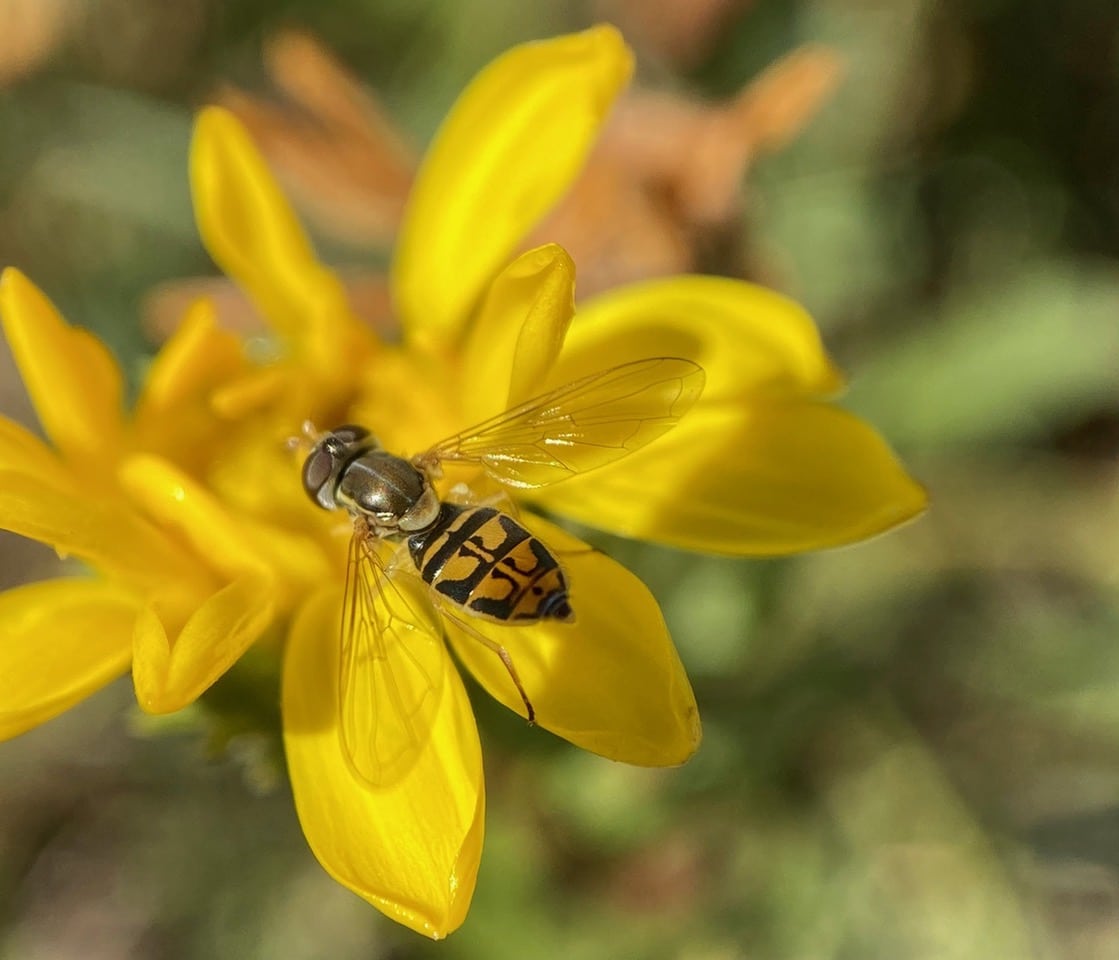
A Margined Calligrapher, Toxomerus marginatus has landed on a Grindelia flowerhead.
Toxomerus marginatus, also known as the Margined Calligrapher is a common species of hoverfly found in North America. These are small hoverflies, measuring 5-6 mm in length. The abdomen is black and yellow, and is narrowly margined with yellow. Adults are found in diverse habitats such as forests, fields, meadows, marshes, deserts, and alpine areas. They are highly adaptable and can occur is very disturbed habitats. Larvae prey on aphids, thrips, mites, and small caterpillars. Adults visit flowers for nectar and pollen.
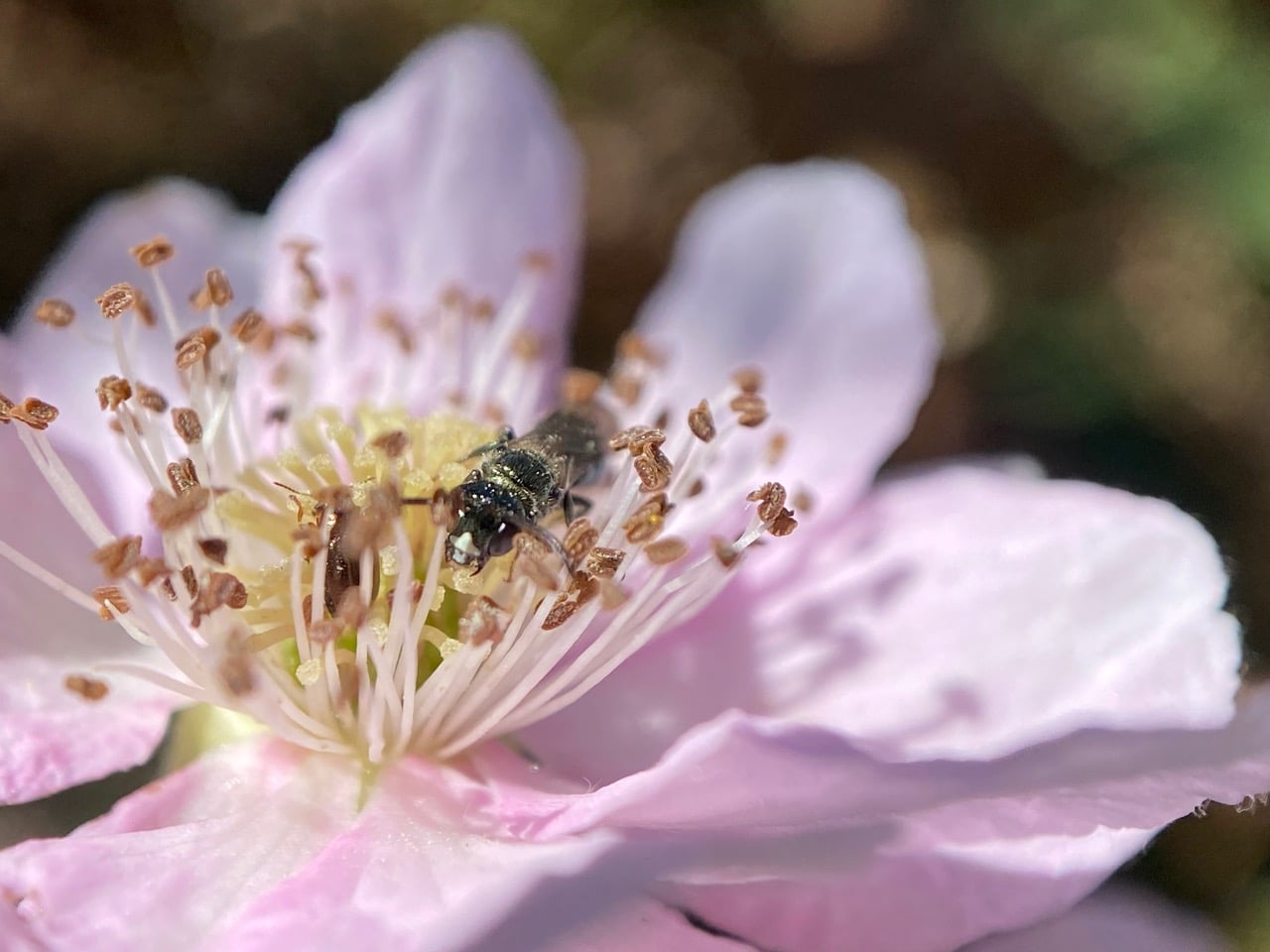
A shiny silvery black bee is foraging among the stamens and styles of an Armenian Blackberry flower, Rubus armeniacus. I have never seen that white facial feature on a bee before. iNaturalist’s AI suggested a Punctate Masked Bee, but a bee expert interceded with a ID of Small Carpenter Bee in the subgenus Zadontomerus (genus Ceratina, family Apidae). I am grateful for such enthusiastic support!
Zadontomerus is a subgenus of Small Carpenter Bees in the genus Ceratina, found across North and Central America. The bees are small, measuring about 5-7 mm. They are slender, dark, shiny black or weakly metallic blue-green, and sparsely haired. These solitary bees build nests inside the pithy stems of woody plants, such as raspberry, sumac, blackberry, and sunflowers. They scrape fibers from the tunnel walls to make partitions for individual egg chambers. Adult bees gather nectar and pollen from a wide variety of flowering plants across dozens of families, serving as important wild pollinators for garden flowers, wildflowers, and fruit crops.
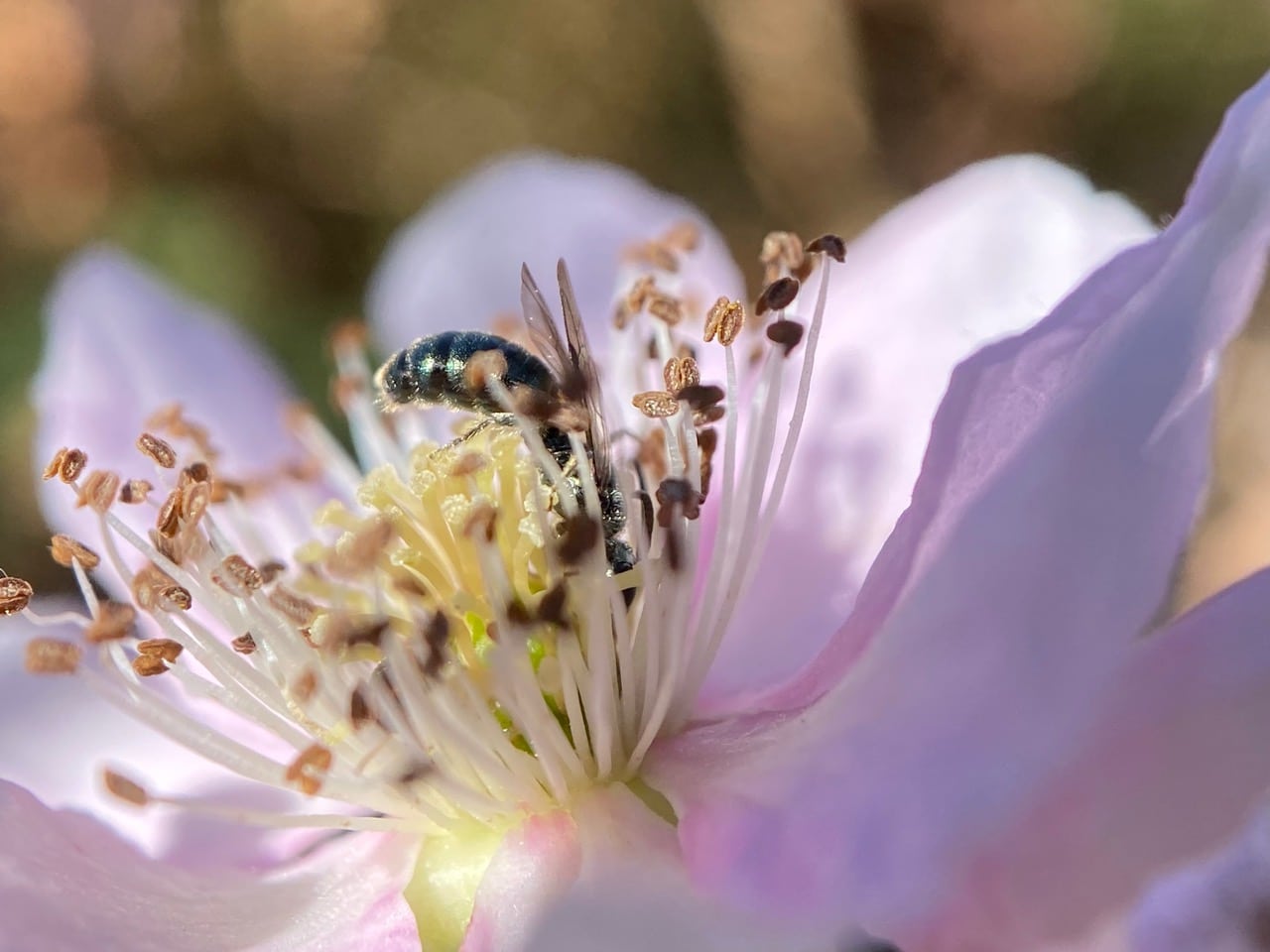
Zadontomerus bees have abdomens that bell outward in the middle and taper abruptly at the end, giving them a club-shaped appearance. Note the long antennae and absence of scopa on the hind leg of this male. He is reaching for nectar at the base of the flower.
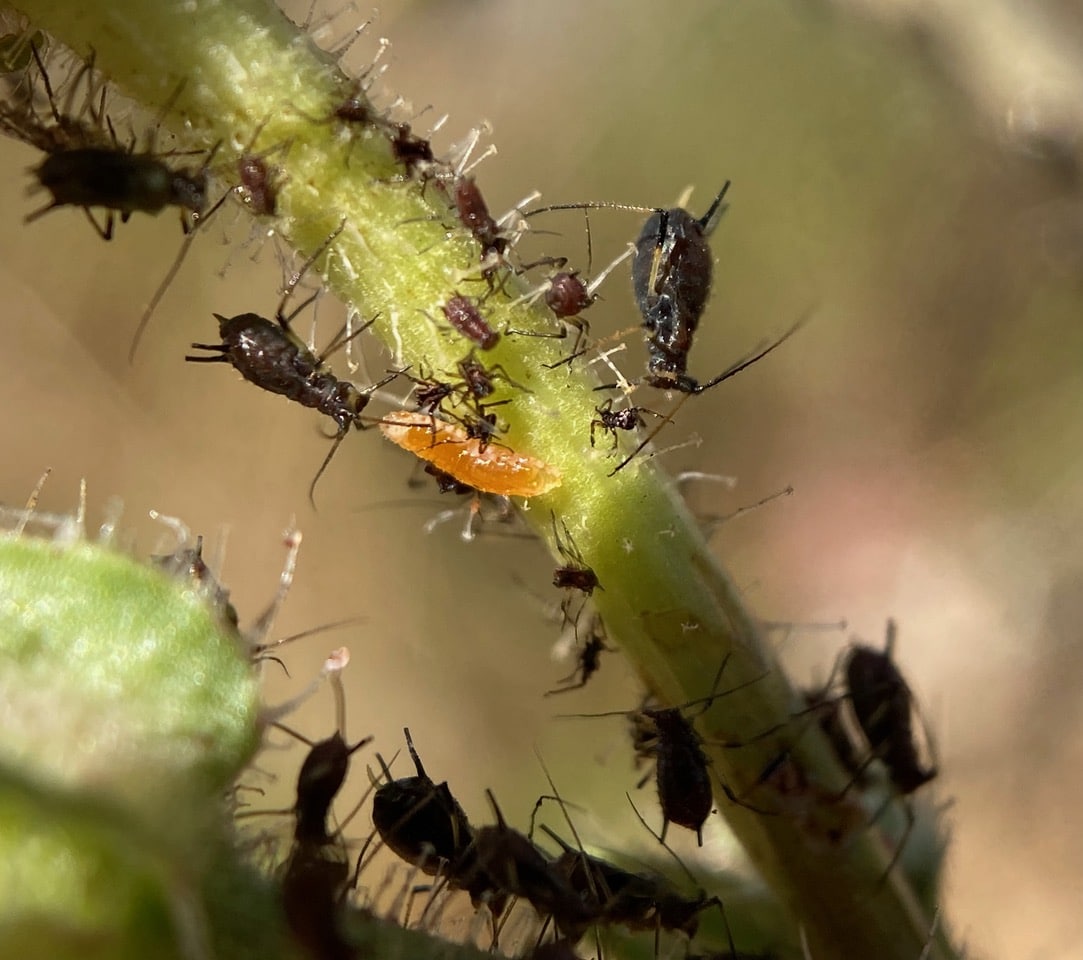
A tiny orange predator is moving slowly among a thriving colony of Sow-thistle Aphids, Uroleucon sonchi (family Aphididae) on a Bristly Oxtongue.
The orange creature is the larva of the Aphid Midge, Aphidoletes aphidimyza (family Cecidomyiidae). Cecidomyiidae are usually known as gall midges, with larvae that live and feed within plant galls. The Aphid Midge is sort of an oddball within the family. Instead of growing up in a gall, it is a free-roaming aphid hunter.
The Aphid Midge, Aphidoletes aphidimyza is a midge whose larvae feed on over 80 aphid species. The adults are small, less than 3.2 mm long, black, delicate, short-lived flies that feed on aphid honeydew. They hide beneath the leaves during the day, and are active at night. Females deposit 100-250 tiny shiny orange eggs among aphid colonies that hatch in 2-3 days. After 3-7 days the larvae drop to the ground to pupate in the soil. The small, bright orange, slug-like larvae inject a toxin into aphids’ leg joints to paralyze them and then suck out the aphid body contents through a hole bitten in the thorax. Larvae can consume aphids much larger than themselves and may kill more aphids than they eat when aphid populations are high. A single larva grows up to 3.2 mm long and kills 4-65 aphids a day. The life cycle from egg to adult can be completed in about 3 weeks, with multiple generations per year. The Aphid Midge is commercially available, widely used in biological control programs for greenhouse crops and orchards.

While the female Coyote Brush, Baccharis pilularis has gone to seed, and no longer attracting pollinators, I thought to check on the small Fennel, Foeniculum vulgare next to it. On 9/18 I have found on the spindly plant a fifth-instar Anise Swallowtail caterpillar and 3 fourth-instar caterpillars.
Instar is the term given to the developmental stage of an insect between molts. For example, after hatching from the egg an insect is said to be in its first instar. When the insect molts it is then a second instar and so on.
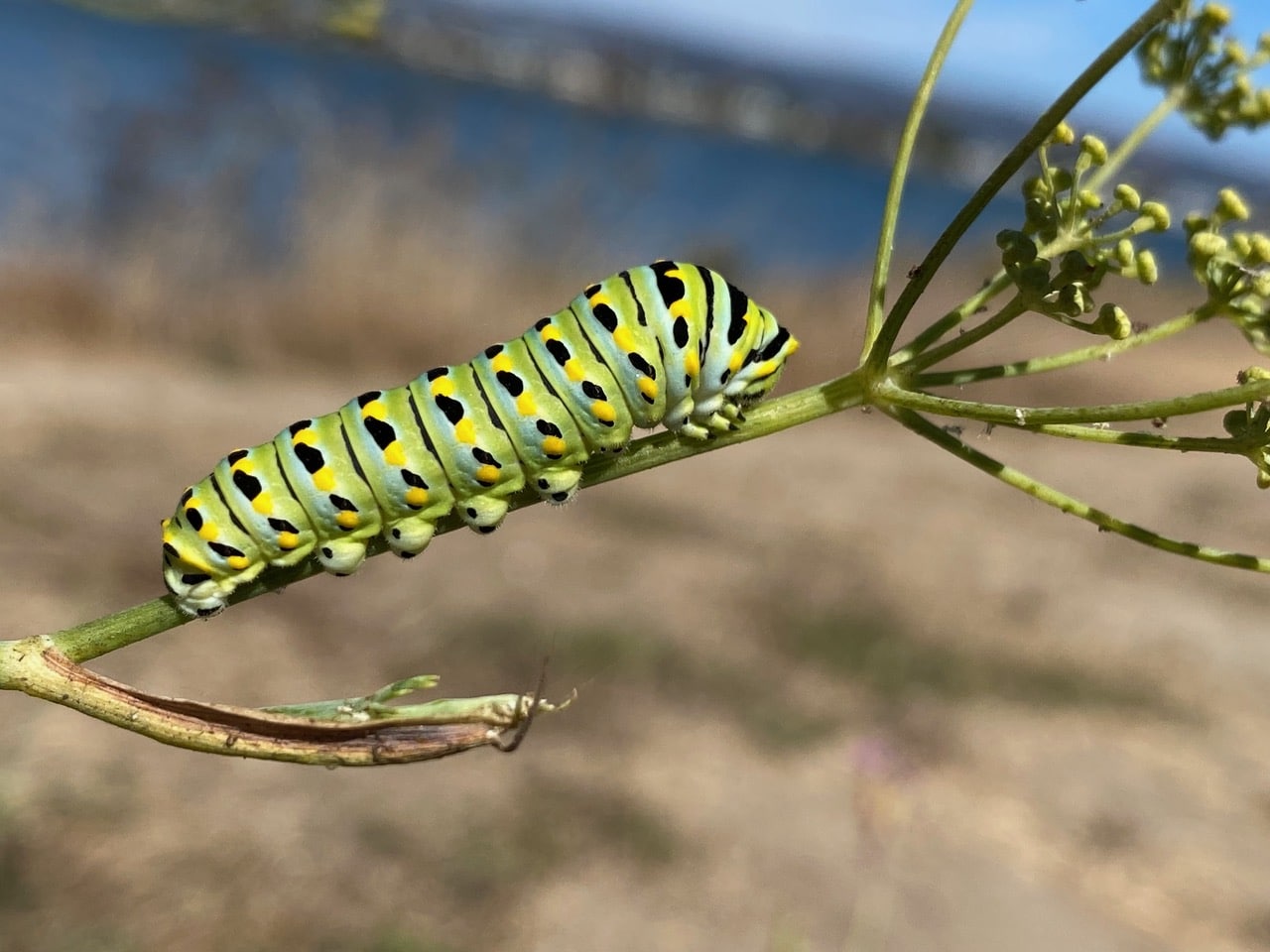
Today there are two fifth-instar caterpillars and no fourth-instar caterpillars. Logic tells me that the fifth-instar from 9/18 has probably crawled off to pupate somewhere safe, while the two current fifth-instars are the former fourth-instars that have molted to the fifth and final stage of the caterpillar’s development. The same characters moving through time, changing costumes as they go… It’s such fun to be able to track wild caterpillars like this.
The Anise Swallowtail, Papilio zelicaon (family Papilionidae), is a common swallowtail butterfly of western North America. It is found in fairly open country, most likely seen on bare hills or mountains, in fields or at the roadside. Adult females lay eggs singly on the underside of host plant leaves. In the first two instars, the caterpillar is a bird poop mimic – dark brown, almost black, with an irregular white band at its middle. After that it becomes more green at each successive molt until, in the fifth (last) instar, it is predominantly green, with markings in black, orange, and light blue. Its major food plants are members of the carrot family, Apiaceae (including Fennel), and also some members of the citrus family, Rutaceae.

I am amazed that the late instar caterpillars of the Anise Swallowtail are so well camouflaged amidst the foliage and flowers of Fennel, a plant that is not even the butterfly’s native food plant.
Native to the Mediterranean, Fennel, Foeniculum vulgare belongs to the carrot family, Apiaceae which includes Anise Swallowtail’s original native host plants, such as Lomatium and Cow Parsnip. Since its introduction to North America, the plant has created a fascinating ecological shift. The butterfly has successfully adapted to using Fennel as a primary larval host plant. Because the invasive Fennel grows aggressively across disturbed areas, it provides a consistent, abundant food source that allows the butterflies to thrive in urban and suburban landscapes. While the plant supports multiple generations of butterflies from early spring through fall, land stewards and native plant conservationists still view Fennel as a threat to local biodiversity. In areas like the San Francisco Bay Area, native plants like Lomatium are crowded out by dense thickets of Fennel, which do not provide the proper habitat for other local insects.
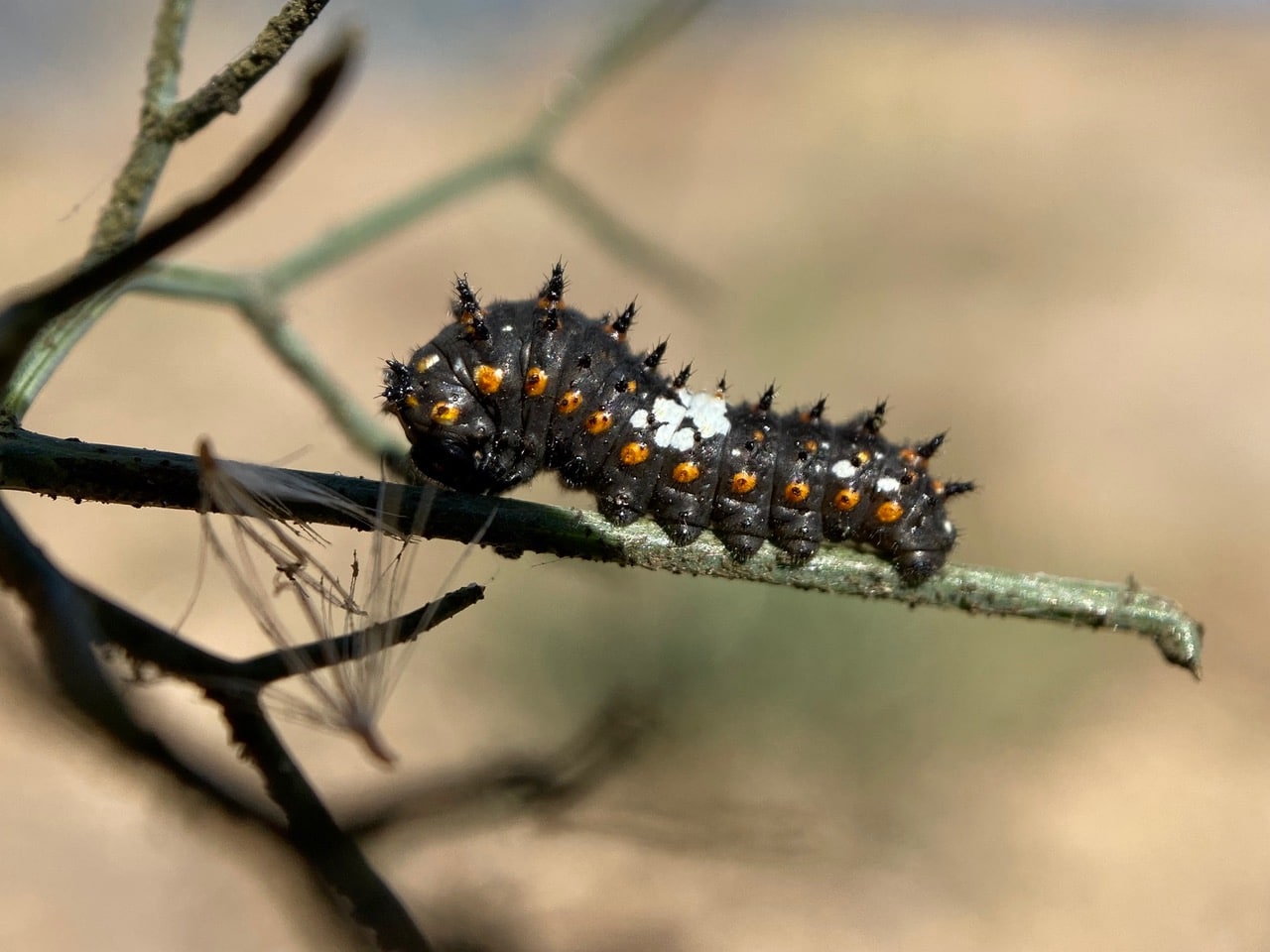
Ooh, there are two younger caterpillars! These are bird-poop mimics, predominantly black with irregular patches of white in the middle. The body is somewhat spiky.
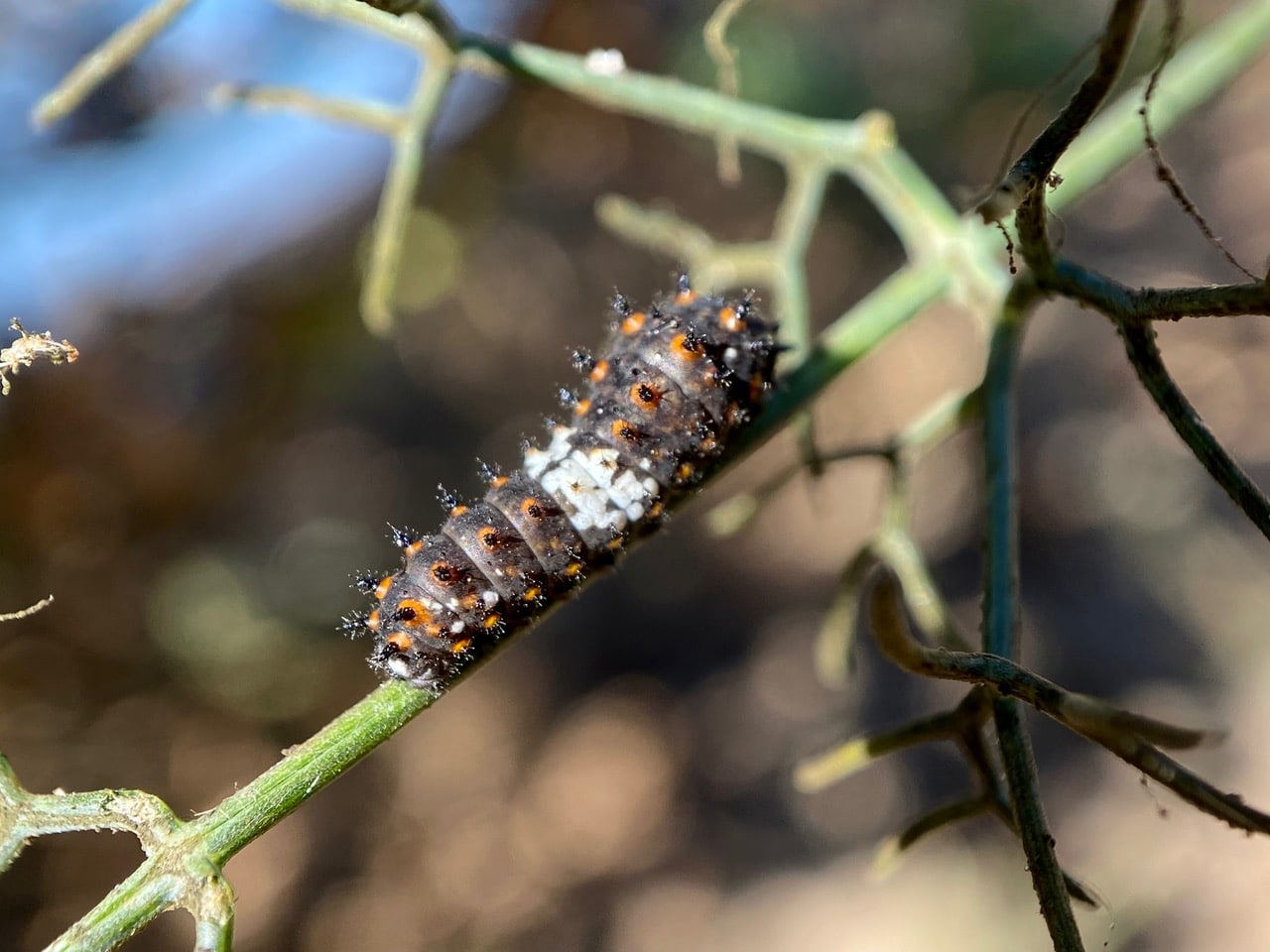
This one in bright sunshine appears a little less black. Will the small Fennel be able to support so many mouths?
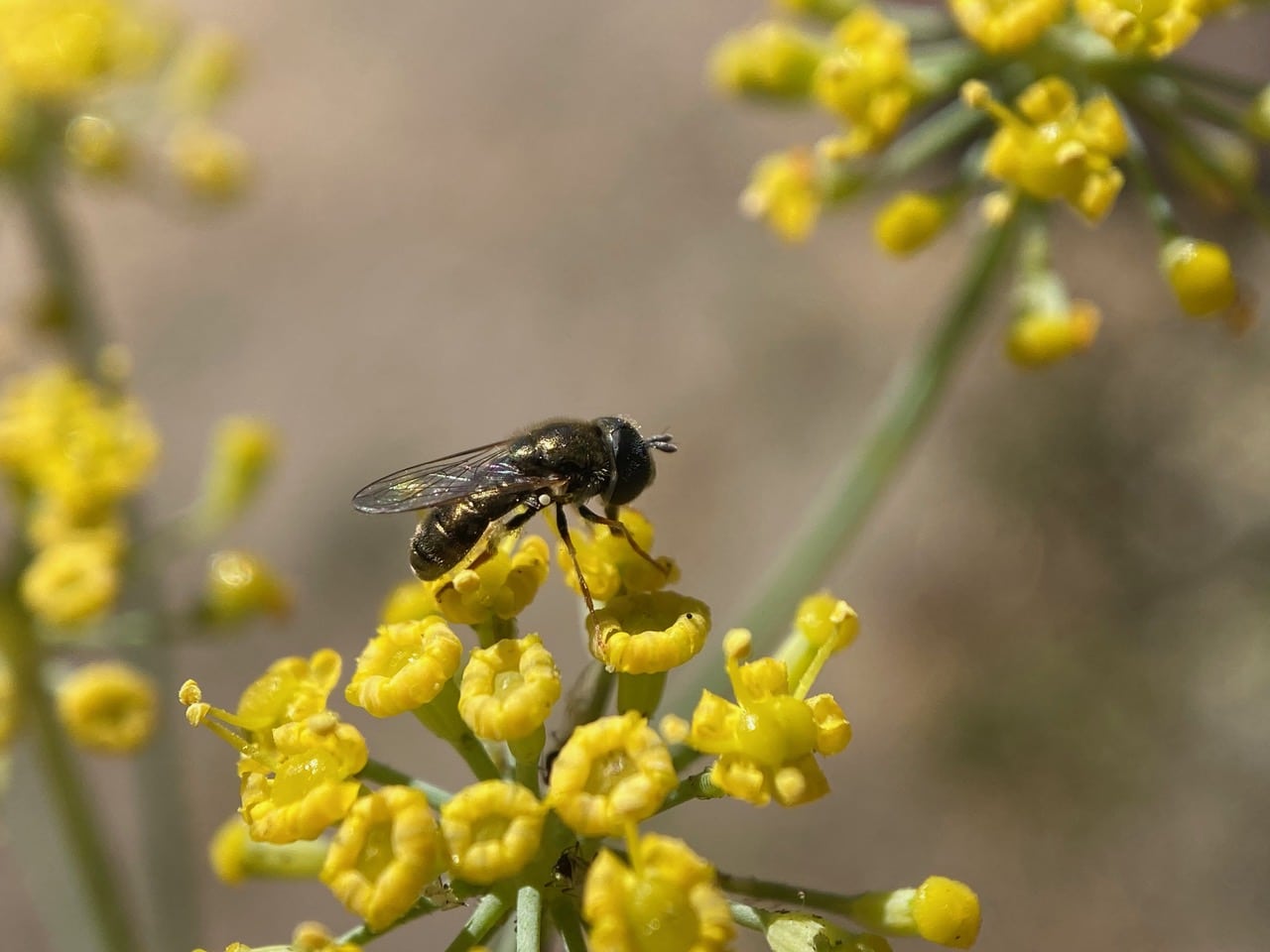
A Common Grass Skimmer, Paragus haemorrhous (family Syrphidae) has landed to take nectar from a fresh umbel of Fennel flowers.
The Common Grass Skimmer, Paragus haemorrhous (family Syrphidae) is the smallest hover fly I know, measuring only about 4 mm in length. The species has a world-wide distribution, found in unimproved grasslands, dune grass, open areas and pathsides in forest, and meadows. Adults visit flowers for nectar and pollen. Larvae feed on aphids on low herbaceous plants.
Photos of Common Grass Skimmer (Paragus haemorrhous) · iNaturalist