

Pollinator Post 9/25/25
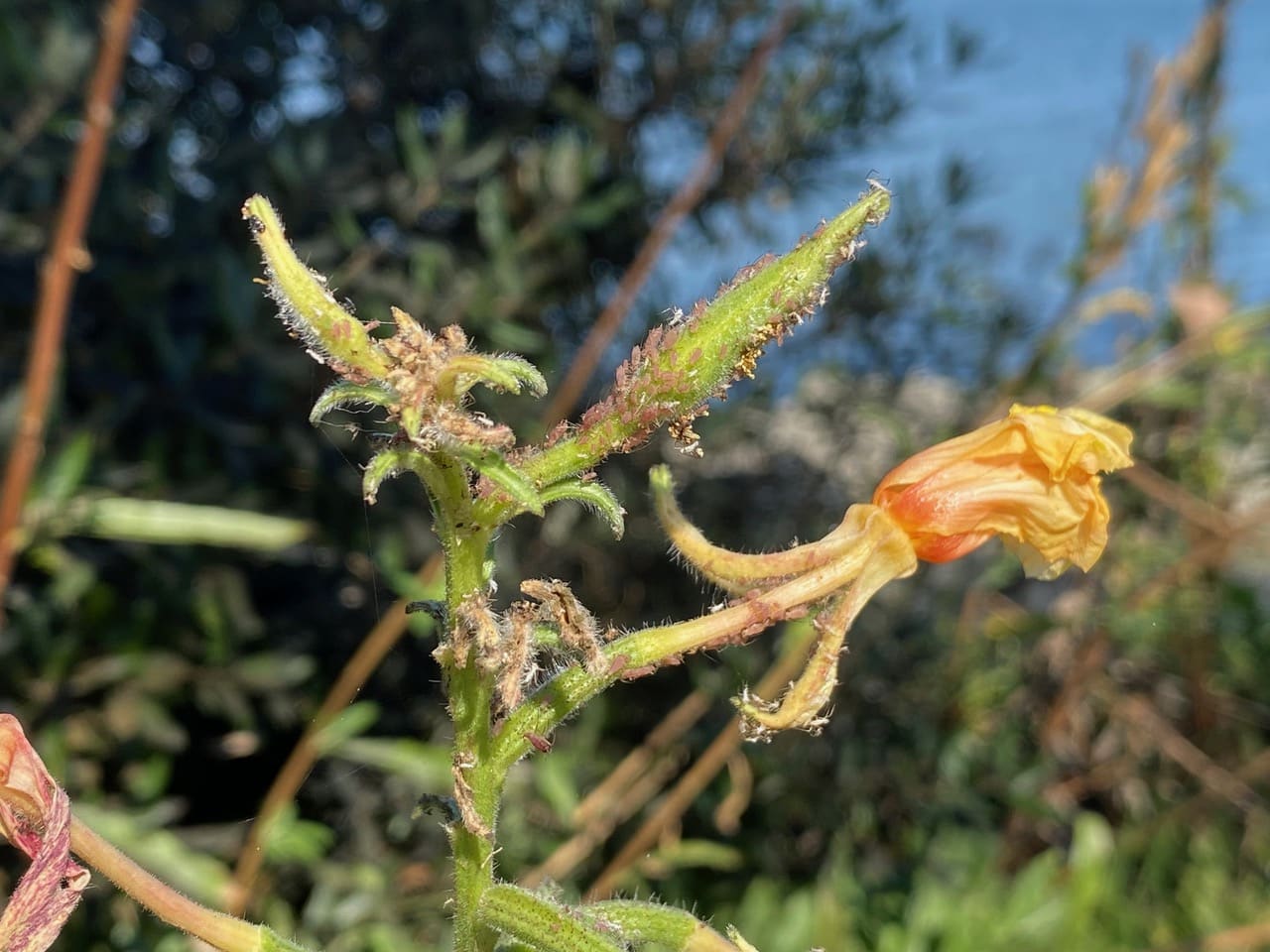
After being housebound for a few days by a combination of heat and poor air quality, I am happy to be visiting Shoreline Park at Bay Farm Island again.
The Hooker’s Evening Primrose, Oenothera elata is infested with mauve-colored aphids.








A close-up view shows that the aphids have rather long legs, antennae and cornicles (“tail pipes” that dispense defense chemicals and alarm pheromones). It is a mature colony, with aphids of various developing stages or instars. Note the white exuvia, the shed exoskeletons left behind after an insect molts. An expert on iNaturalist has helped identify the aphids as the Beeblossom Aphids, Macrosiphum gaurae (family Aphididae).
Aphids (family Aphididae) are small sap-sucking insects in the order Hemiptera. Aphids usually feed passively on phloem of plants. Once the phloem vessel is punctured, the sap, which is under pressure, is forced into the aphid’s food canal. Aphids produce large amounts of a sugary liquid waste called “honeydew”. A fungus called sooty mold can grow on honeydew deposits that accumulate on leaves and branches, turning them black.
A typical life cycle involves flightless females giving live birth to female nymphs, – who may also be already pregnant, an adaptation called telescoping generations – without the involvement of males. Maturing rapidly, females breed profusely so that the population multiplies quickly. Winged females may develop later in the season, allowing the insects to colonize new plants. In temperate regions, a phase of sexual reproduction occurs in the autumn, with the insects often overwintering as eggs. The life cycle of some species involves an alternation between two species of host plants. Some species feed on only one type of plant, while others are generalists, colonizing many plant groups. Some ants have a mutualistic relationship with aphids, tending them for their honeydew and protecting them from predators.
The Beeblossom Aphid, Macrosiphum gaurae feeds on plants in the genus Gaura and Oenathera (both in the Evening Primrose family, Onagraceae). These large, pink or green aphids are spindle-shaped, have long legs and antennae, and are widely distributed across the United States and Canada. They do not host alternate to other plants, remaining on their specific hosts year-round. Most aphids in the genus Macrosiphum are not tended by ants.
A gravid female Oblique streaktail, Allograpta obliqua (family Syrphidae) has landed on an Evening Primrose leaf close to the aphid colony.
Although small in size (6-7 mm long), the Oblique Streaktail is easily recognizable for the unique pattern on its black-and-yellow abdomen. It is a common North American species of hover fly. Adults visit flowers for nectar and pollen, and are pollinators. Females lay eggs on plant surfaces near aphids. Larvae feed on the aphids.
The hover fly proceeds to curl her abdomen forward to lay an egg on the leaf. Eggs are deposited singly, so that the larvae that hatch out will not have to compete for food.
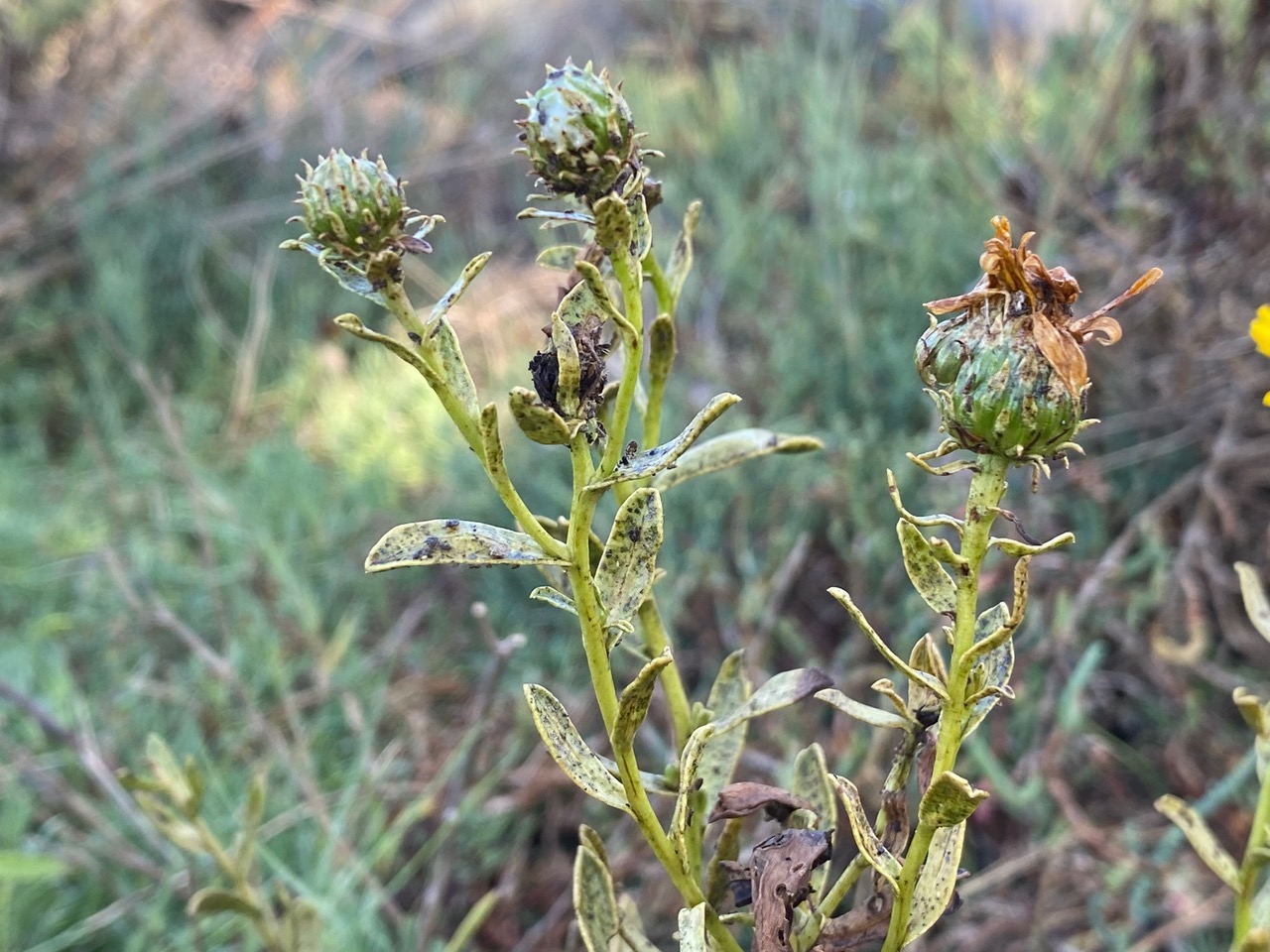
Wow, what happened to this stand of Oregon Gumweed, Grindelia stricta? The foliage looks yellow and sickly, and most leaves are speckled with unsightly black material.
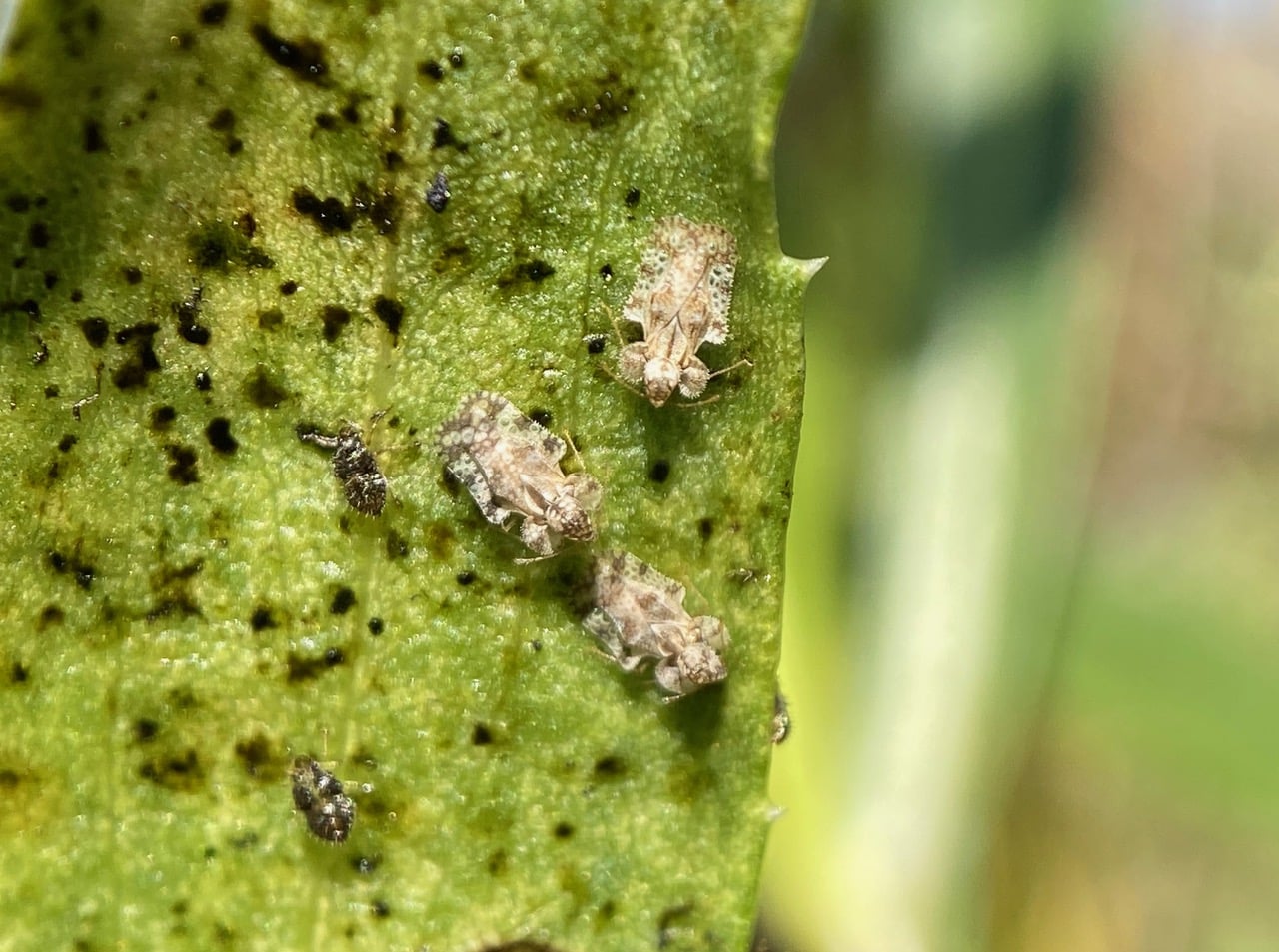
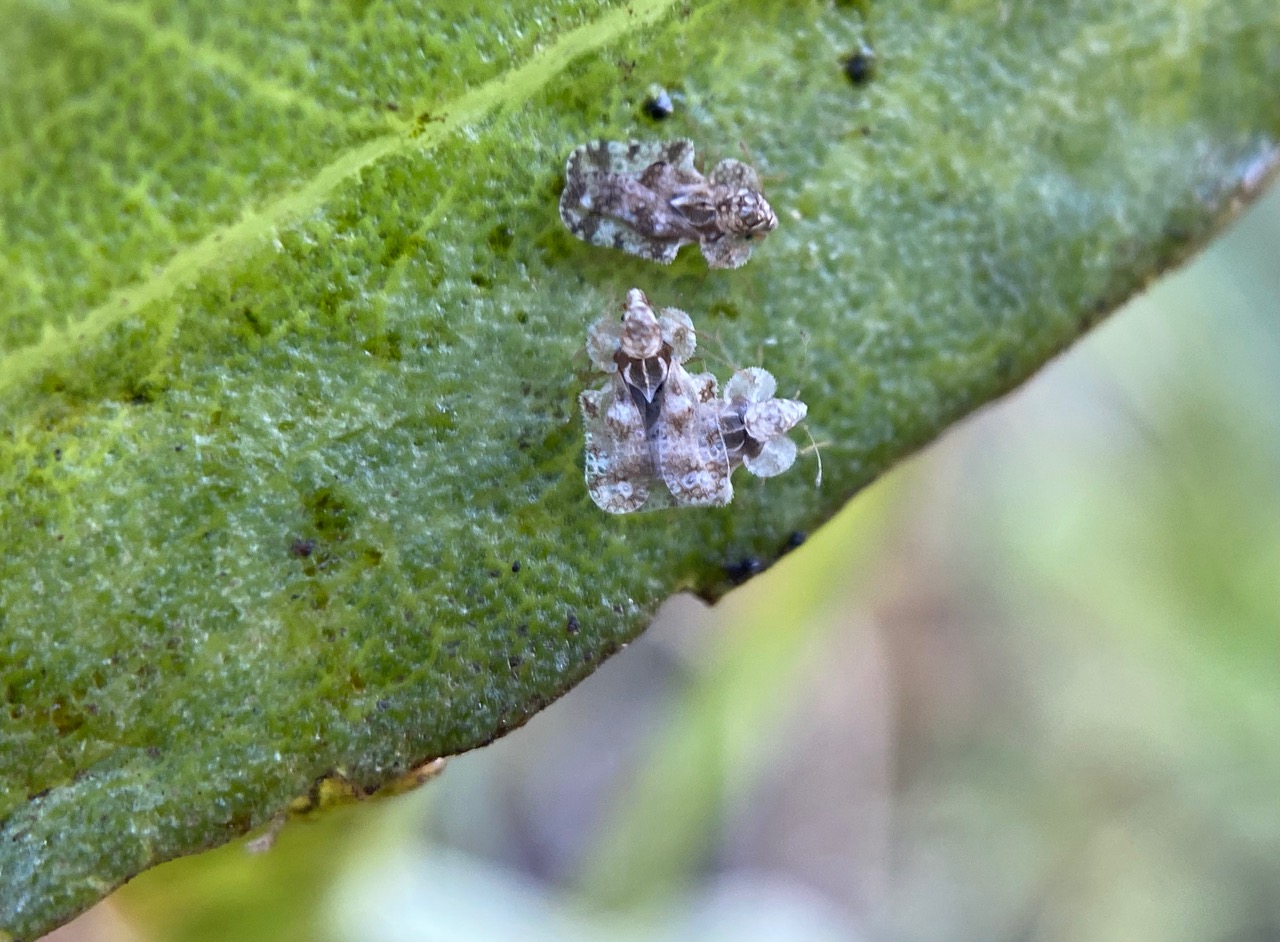
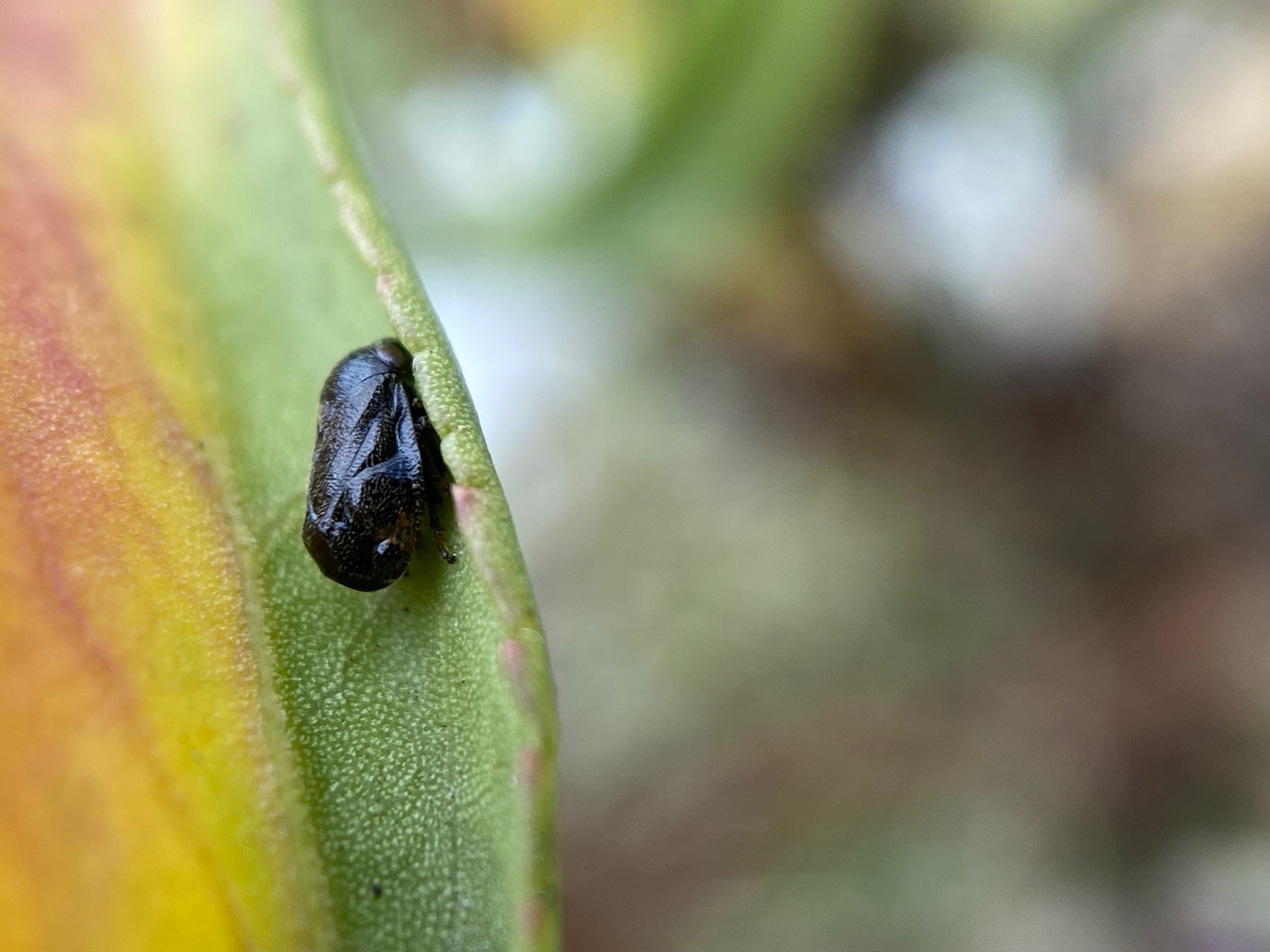
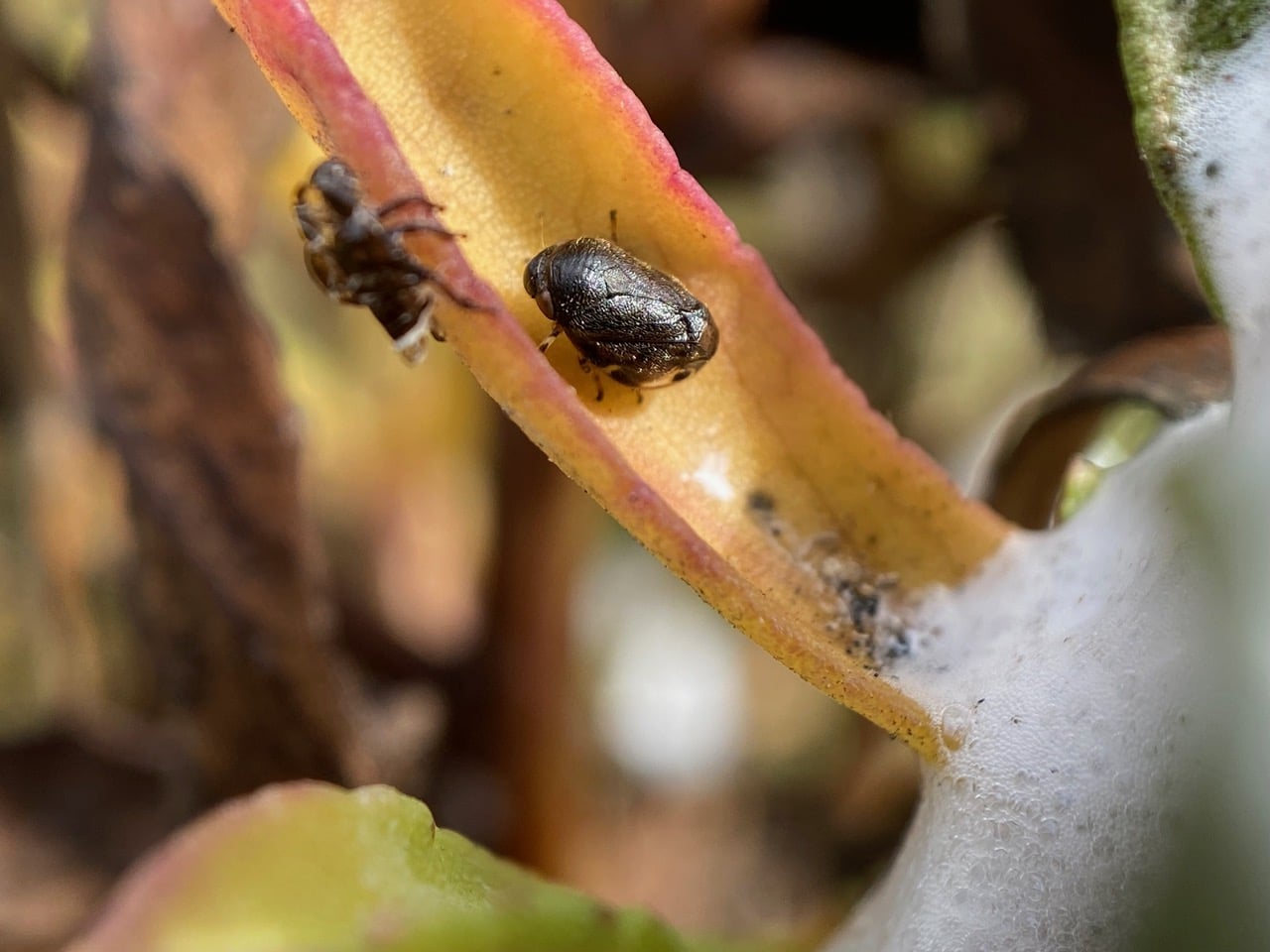
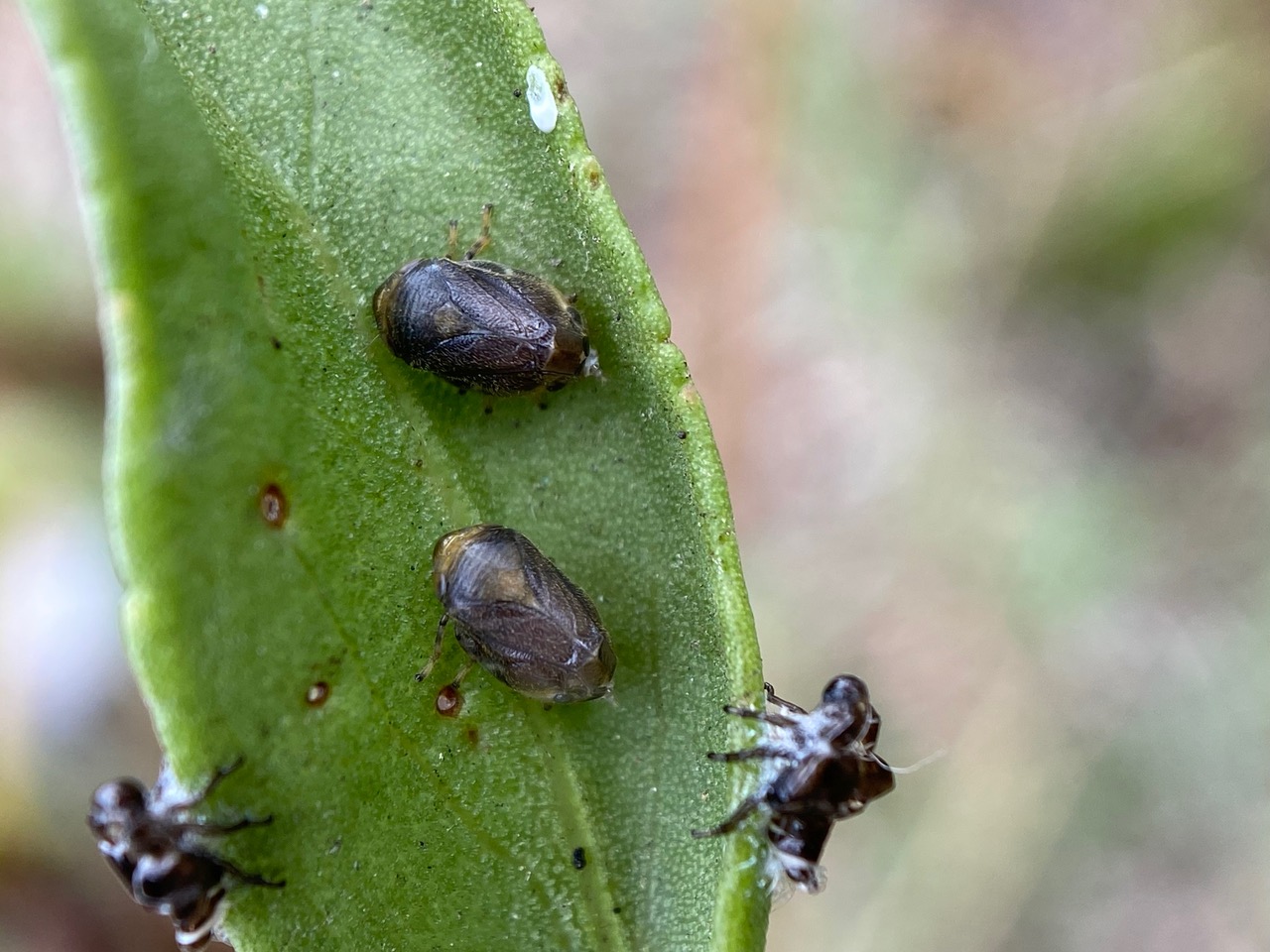
Closer inspection with the macro lens reveals the culprit – Lace Bugs (family Tingidae). iNaturalist has helped identify the species as the Chrysanthemum Lace Bug, Corythucha marmorata (family Tingidae).
The Tingidae are a family of very small (2-10 mm) insects in the order Hemiptera that are commonly referred to as lace bugs. They are called lace bugs because the pronotum and fore wings of the adult have a delicate and intricate network of divided areas that resemble lace. Their body is flattened dorsoventrally, and the head is often concealed under the hood-like pronotum. Lace Bugs feed by sucking sap from plants, extracting the protein they need and excreting liquid waste as honeydew. The most common symptom of feeding is the stippled and mottled yellowish foliage. In heavy infestations, black sooty mold may develop on the honeydew, impairing photosynthesis by the plant. This may result in some dieback of twigs and branches and a reduction in flowering the following year. Tingids are usually host-specific and can be very destructive to plants. Each individual usually completes its entire lifecycle on the same plant, if not the same part of the plant.
The genus Corythucha is primarily distributed in the northern hemisphere, including Europe, North America and eastern Asia. The Chrysanthemum Lace Bug, C. marmorata primarily feeds on plants in the Asteraceae (sunflower family), including chrysanthemums, goldenrods, and sunflowers. The species may also infests other plant families such as Convolvulaceae and Solanaceae.
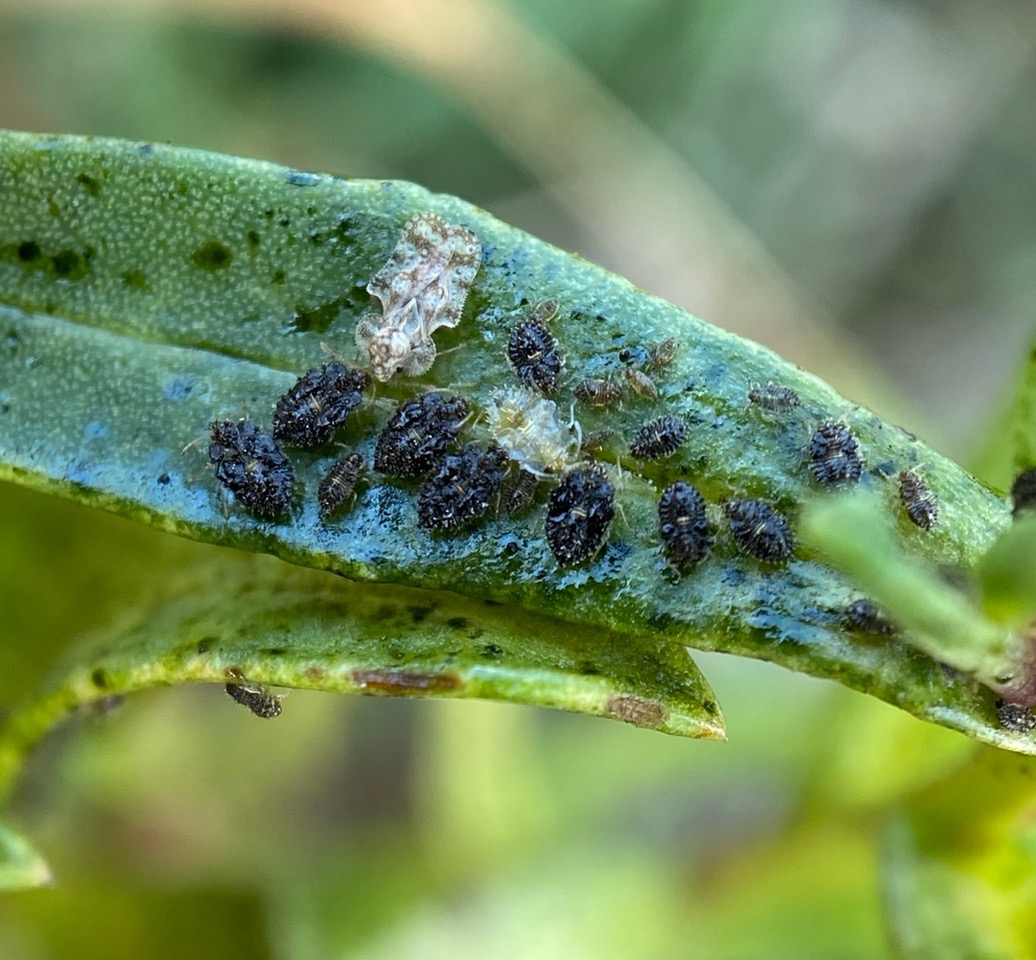
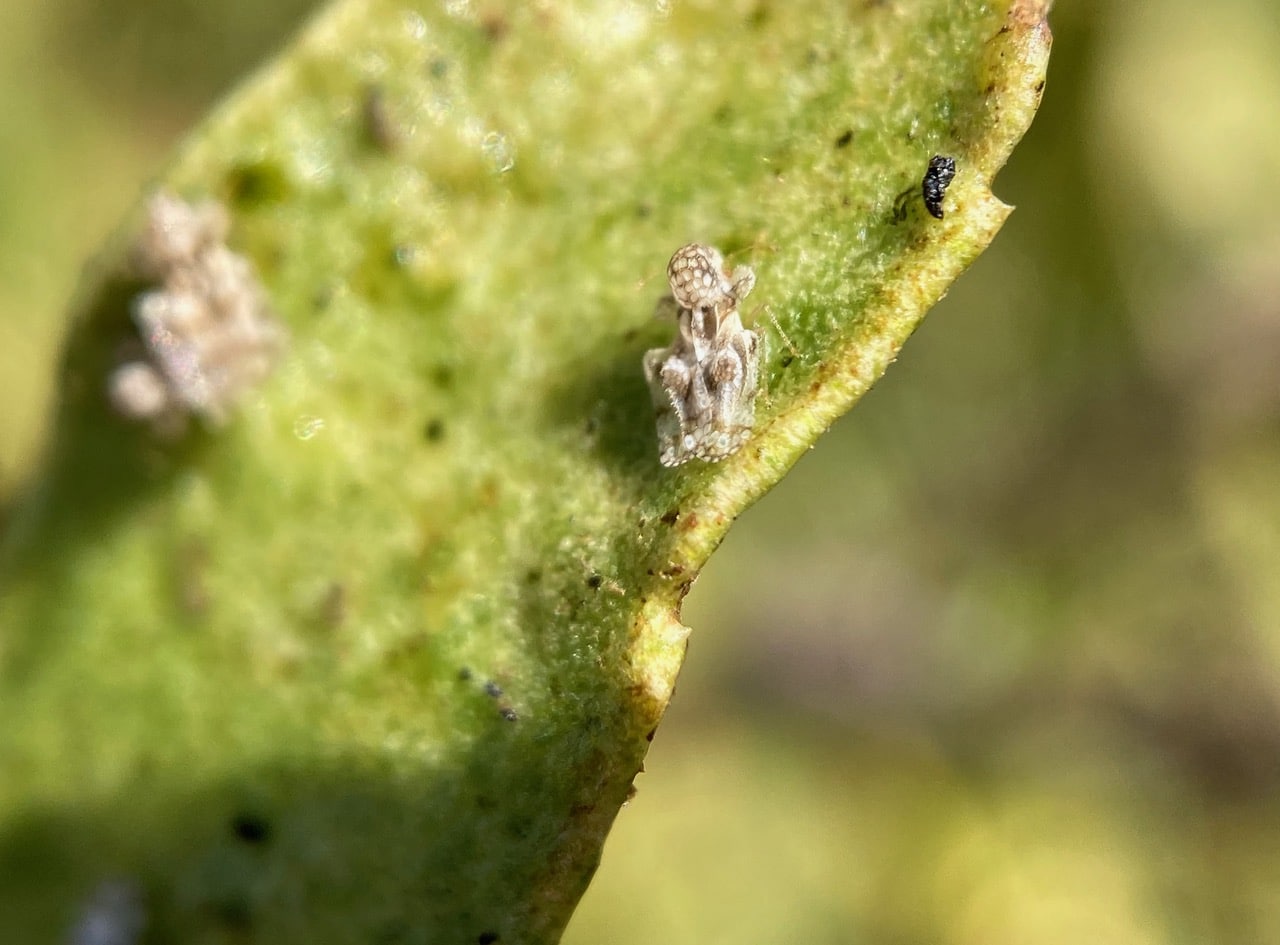
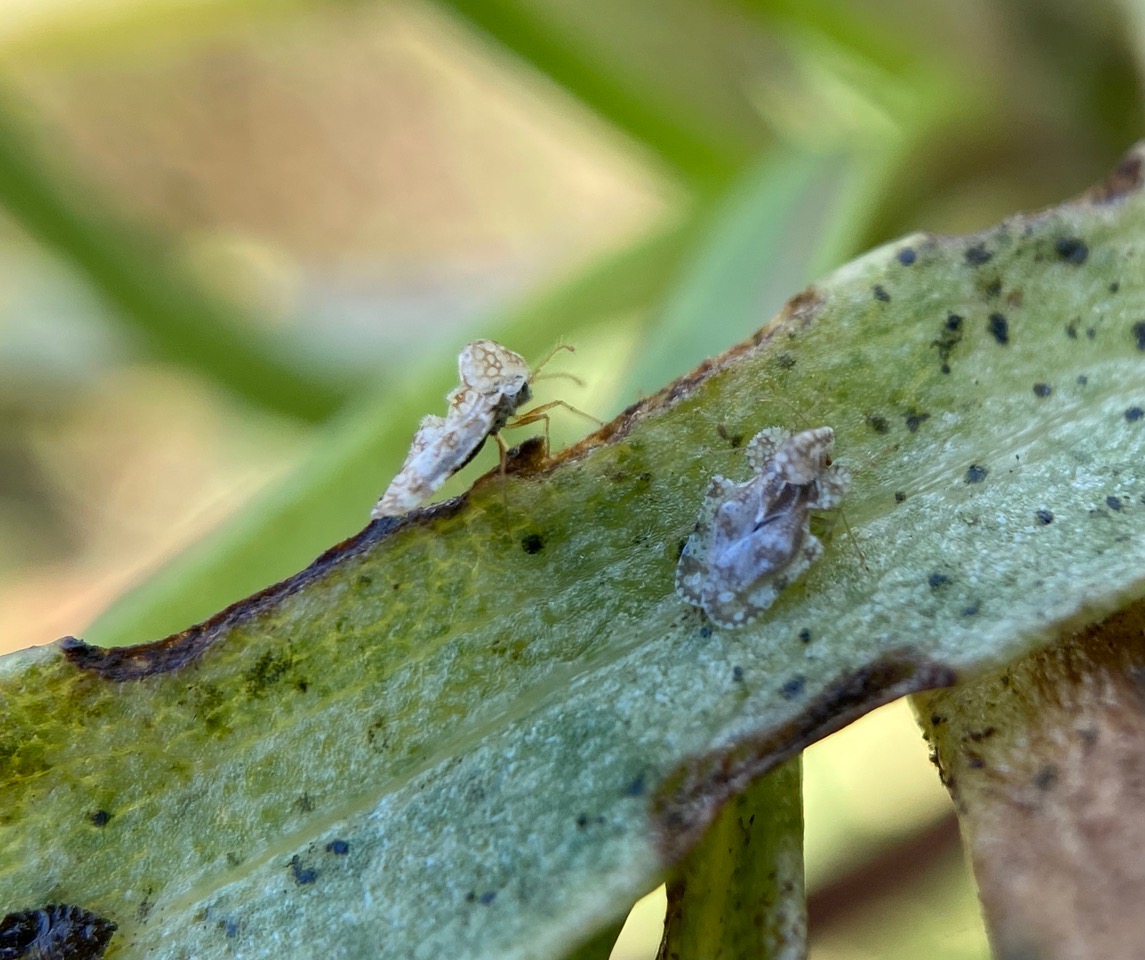
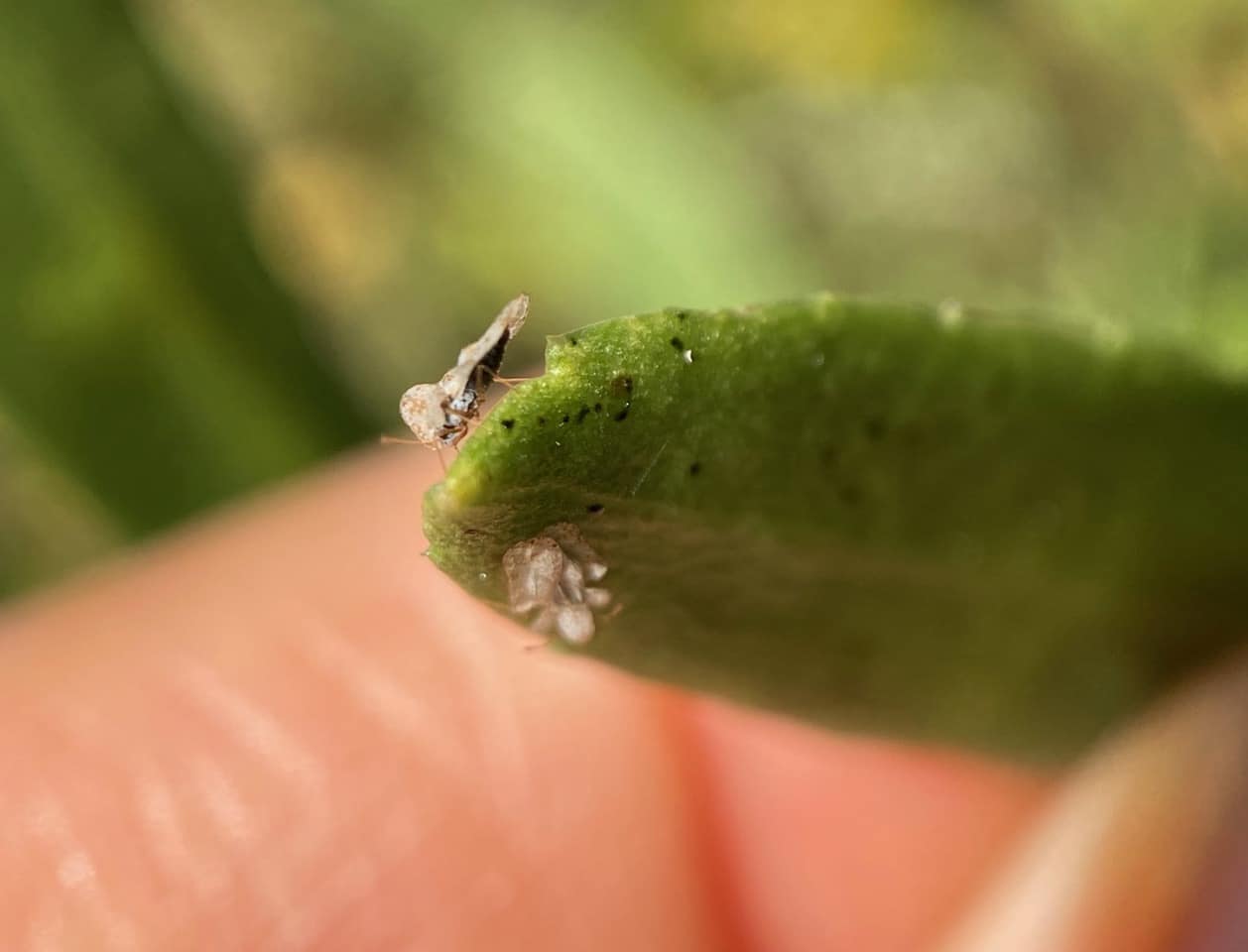
An adult Lace Bug is in the company of nymphs of various stages of development on this Grindelia leaf. The adult is pale, and has a lace-like pattern on the dorsum, while the nymphs are black and spiny.
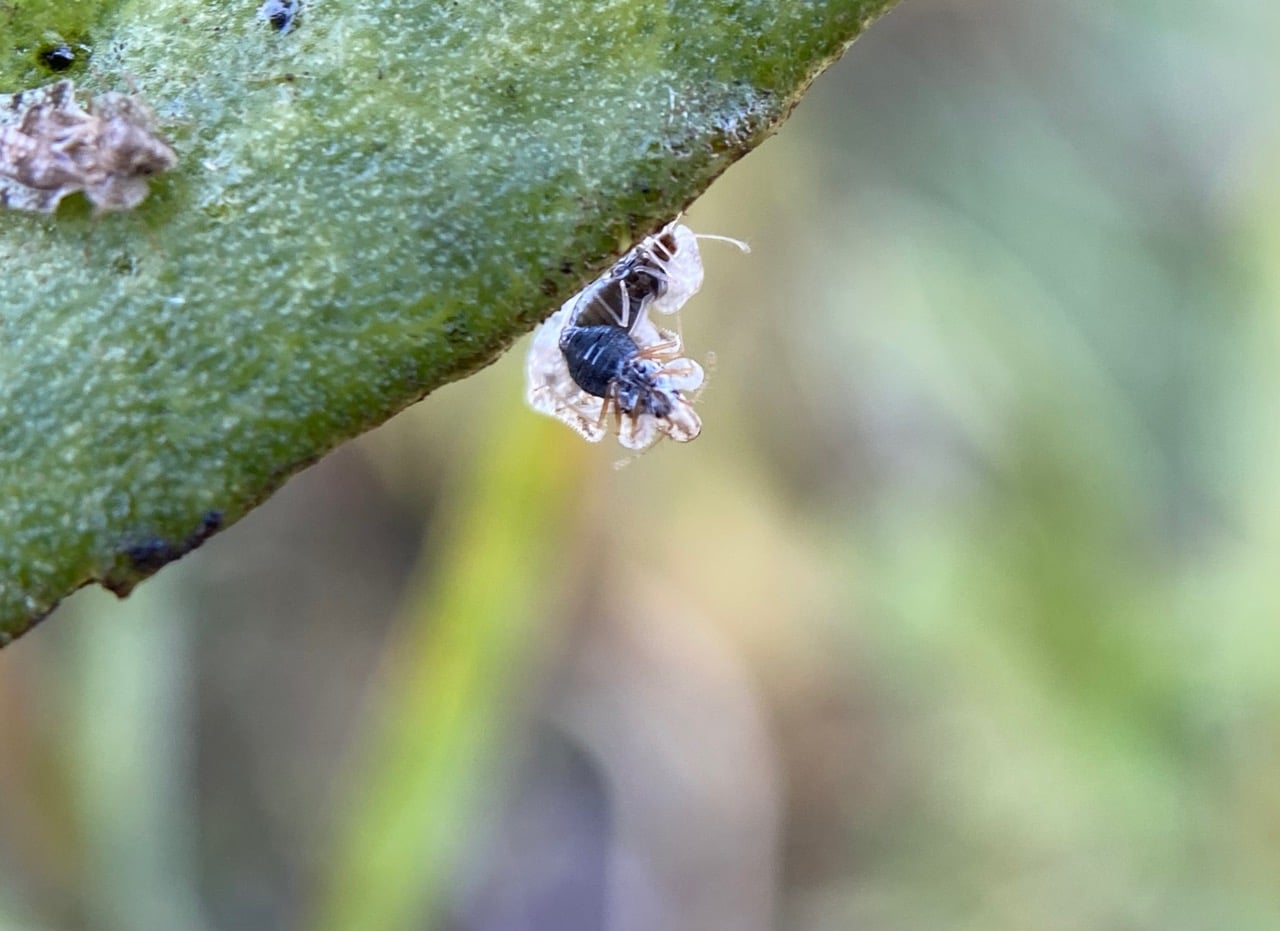
Two adult Lace Bugs are moving in tandem, with their bodies at right angles to each other. Are they mating?
As the pair slips over the edge of the leaf, I can see their undersides. Their genitals appear to be engaged, and their bodies are dark and broad under the lacy wings.
After mating, the female Lace Bug lays eggs on the underside of host plant leaves, often along the midrib. She may then cover the eggs with a protective, varnish-like coating of excrement. Depending on the species and climate, the eggs may hatch in a few weeks or overwinter until the next spring.
An adult Lace Bug is lying on its back (I’m not sure if it’s alive), giving us a view of the insect under the gorgeous costume.
A back view of a Lace Bug as it moves up a leaf. Note the prominent hood, a modified pronotum.
Viewed from the side, the Lace Bug is simply a regular bug that puts on fancy lacy wings and hood as a protective shield over itself.
Here’s another side view of a Lace Bug.
Unlike insects with more streamlined wings for speed, Lace Bugs are not strong or fast flyers. This means they must rely on passive defense, such as camouflage, to survive. The semitransparent, lacy texture of their wings and hoods allows light to pass through, creating a dappled appearance that helps the tiny insects blend in with the leaf’s surface. The complex patterns on the wings and hoods may also confuse or disrupt the visual perception of predators, making it harder to identify the insects as prey.
Who made those brown feeding scars on the Grindelia leaves? Those neat gouges are not made by bugs with piercing-sucking mouthparts, but by an insect with chewing mouthparts.
A Jewel Beetle (family Buprestidae) is resting on a Grindelia leaf. Might it be responsible for chew marks on the Grindelia leaves?
Buprestidae is a family of beetles known as Jewel Beetles or Metallic Wood-boring Beetles because of their glossy iridescent colors. The larger and more spectacularly colored ones are highly prized by insect collectors. Their elytra have been traditionally used in beetlewing jewelry in some Asian countries. The iridescence common to these beetles is not due to pigments in the exoskeleton, but instead is caused by structural coloration, in which microscopic texture in their cuticle selectively reflects specific frequencies of light in particular directions. Buprestid larvae are known as flathead borers. They bore through roots, logs, stems, and leaves of various types of plants, ranging from trees to grasses. Adult jewel beetles mainly feed on plant foliage or nectar, although some species feed on pollen and can be observed visiting flowers.
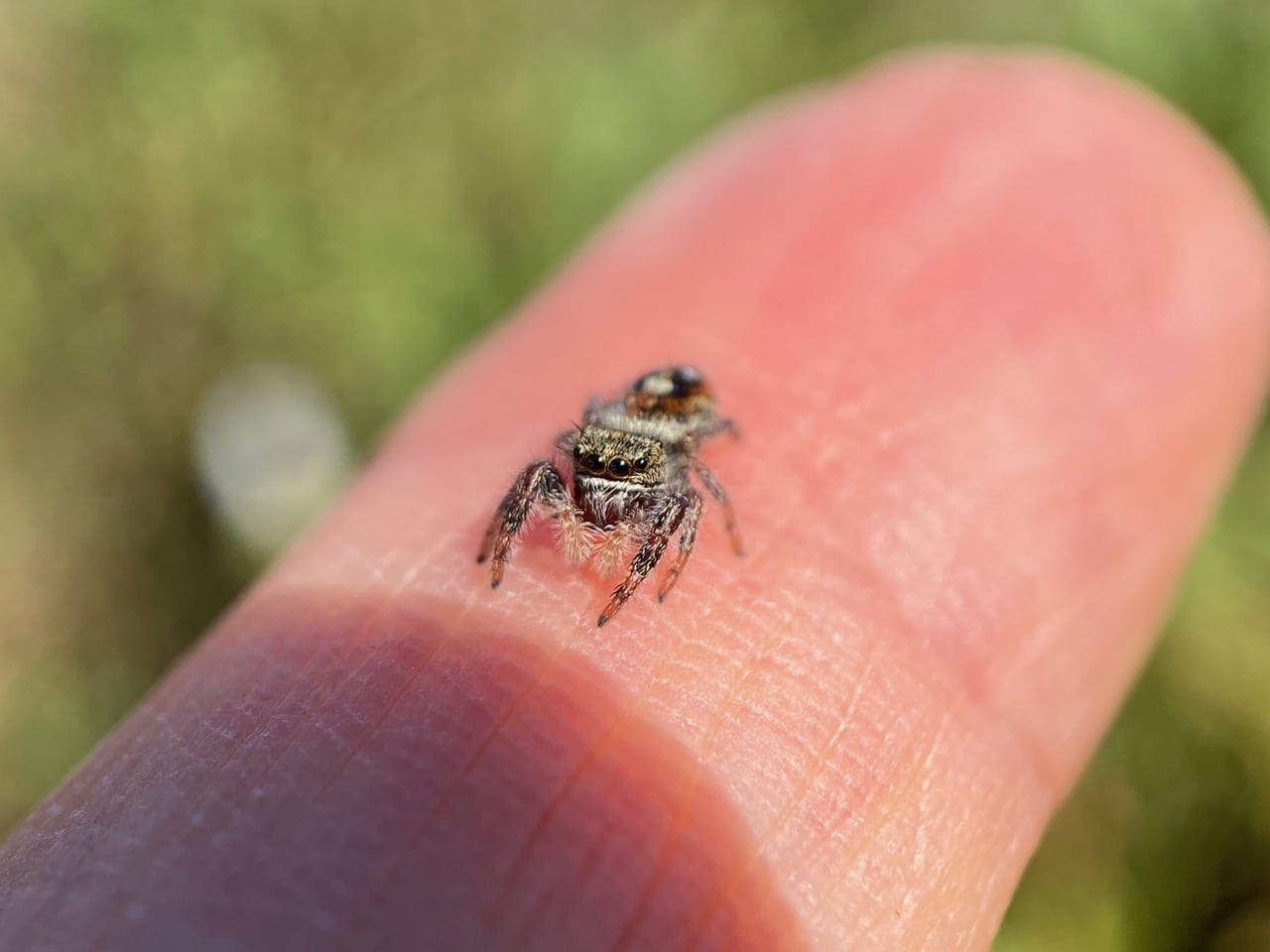
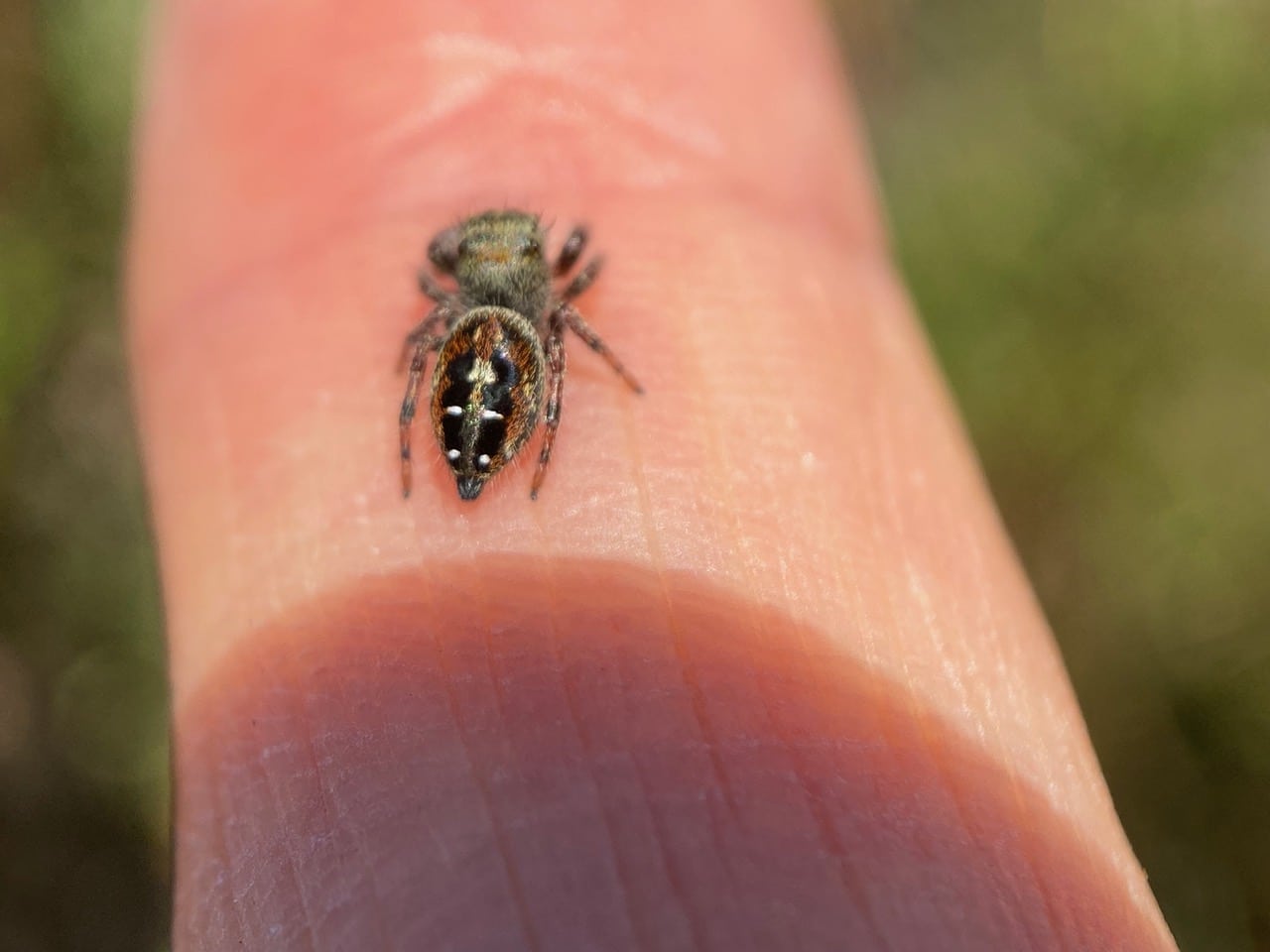
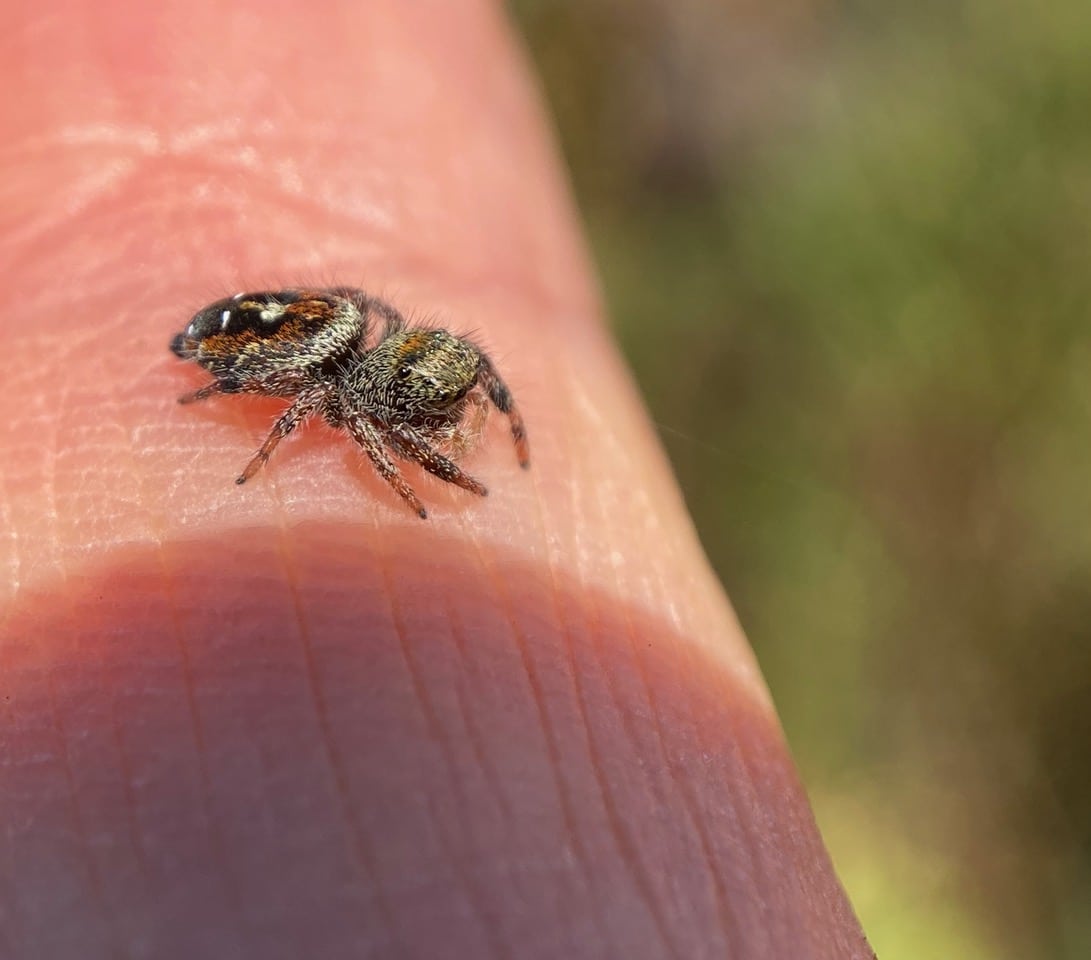
I suddenly find a female Johnson’s Jumping Spider, Phidippus johnsoni (family Salticidae) on my shirt. When offered a finger, she readily jumps on, making it easy for me to photograph her.
Jumping spiders have excellent vision, with among the highest acuities in invertebrates. The 8 eyes are grouped four on the face (the two big Anterior Median Eyes in the middle, and two smaller Anterior Lateral eyes to the side), and four on top of the carapace. The anterior median eyes provide high acuity but small field of view, while the other six eyes act like our peripheral vision, with lower resolution but broad field of view. Since all eight eyes are fixed in place and can’t pivot independently from the body like human eyes can, jumping spiders must turn to face whatever they want to see well. This includes moving their cephalothorax up and down, an endearing behavior.

Also known as the Red-backed Jumping Spider, Phidippus johnsoni is one of the largest and most commonly encountered jumping spiders in western North America. This individual is a female. Males have an all-red abdomen. Salticids are free-roaming hunters. They do not weave a web to catch prey. They stalk, then pounce on their prey. Just before jumping, the spider fastens a safety line to the substrate. It can leap 10-20 times their body length to capture prey. Their movement is achieved by rapid changes in hydraulic pressure of the blood. Muscular contractions force fluids into the hind legs, which cause them to extend extremely quickly.
What a beautiful creature! See those shiny spots on top of the spider’s cephalothorax? Those are the minor eyes that give her peripheral vision.
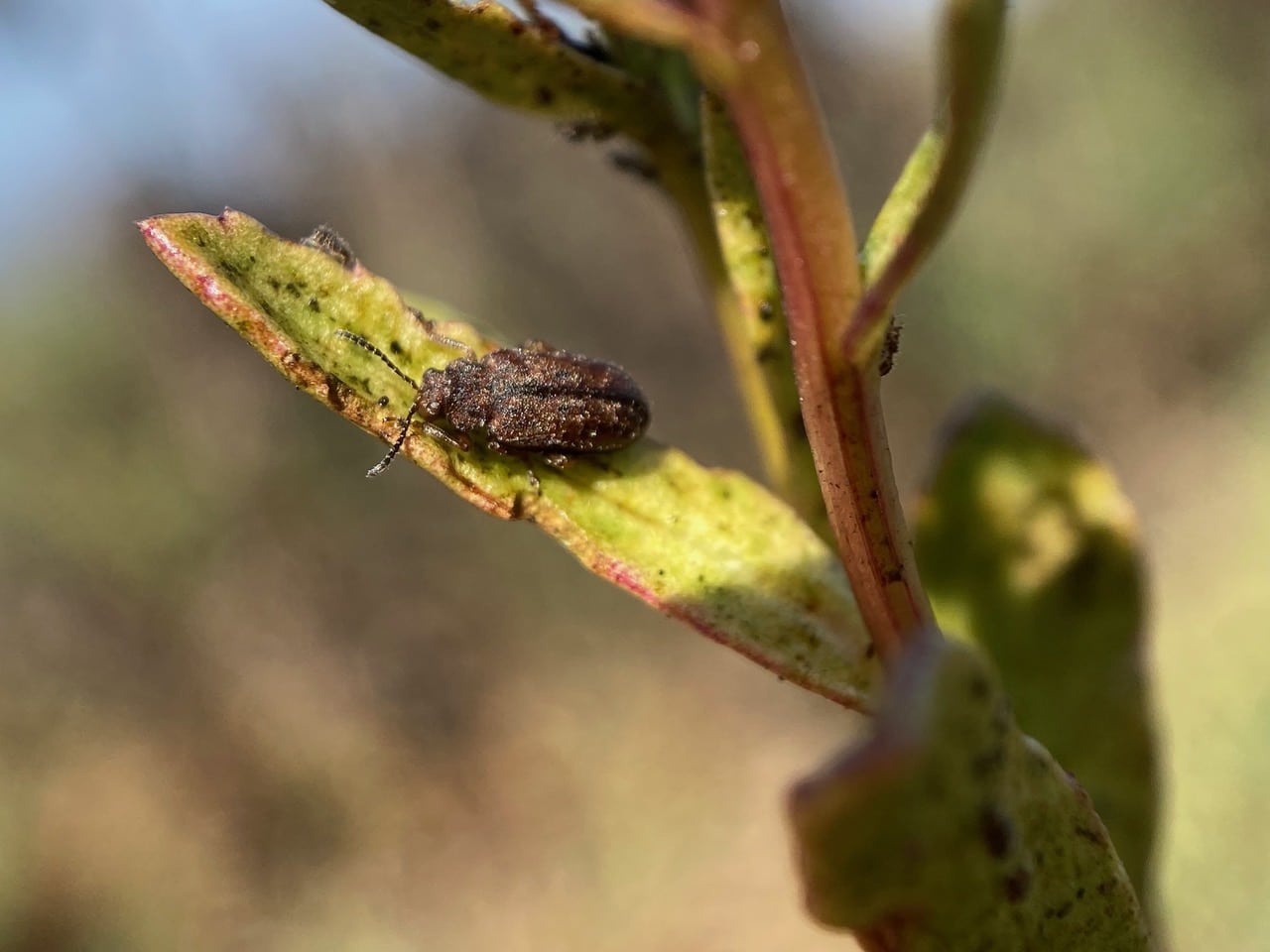
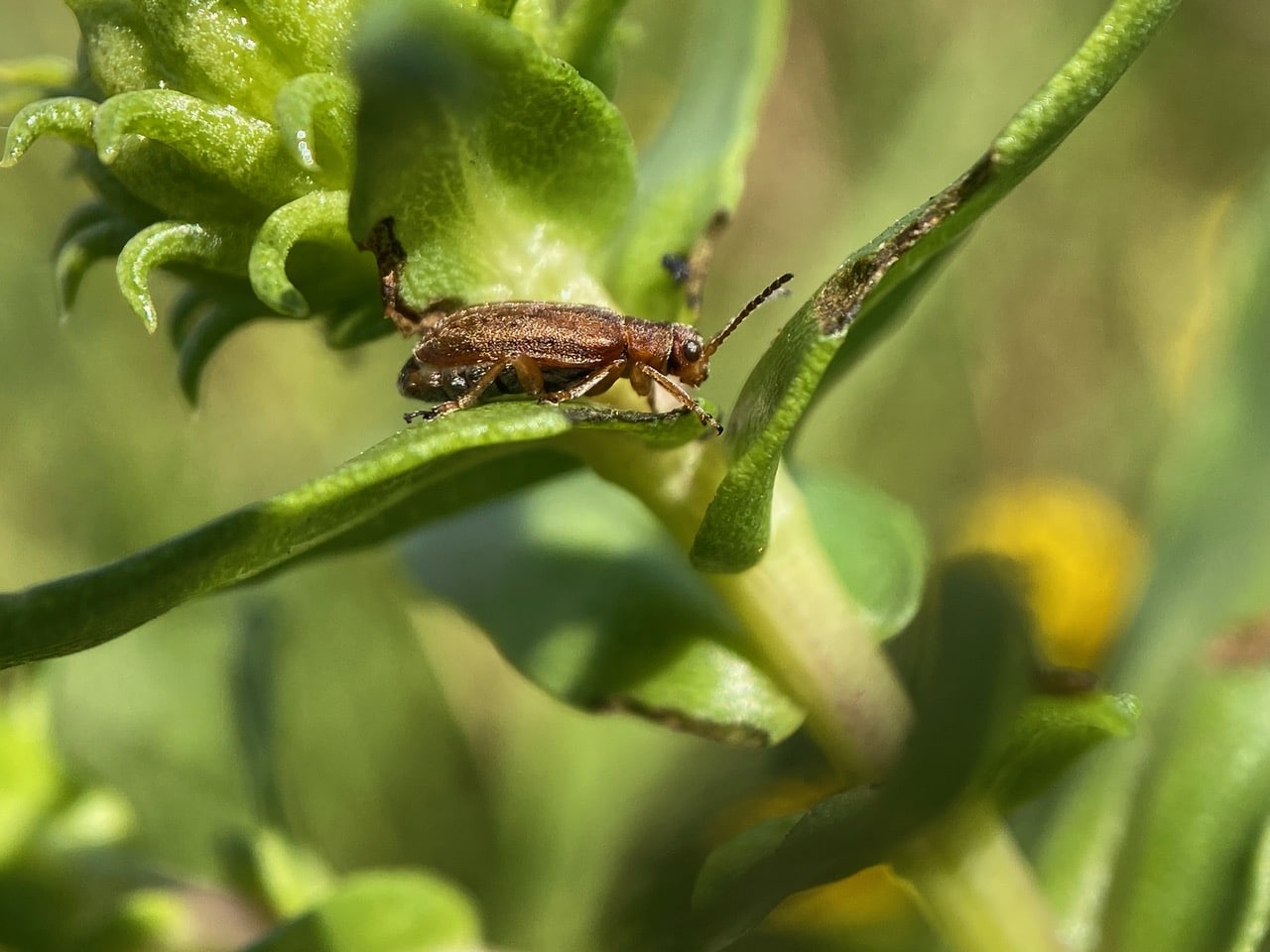
Ooh, another brown beetle on the Grindelia foliage! iNaturalist has helped identify it as a Leaf Beetle, Syneta sp.(family Chrysomelidae).
Leaf Beetles in the family Chrysomelidae make up one of the largest and most commonly encountered beetles. Adult and larval leaf beetles feed on a variety of plant tissue, with some being specialists of particular species or families of plant. Many are serious pests of cultivated plants. Others are beneficial due to their use in biocontrol of invasive weeds. Some Chrysomelidae are conspicuously colored, typically in glossy yellow to red or metallic blue-green hues, and some have spectacularly bizarre shapes, Thus, they are highly popular among insect collectors.
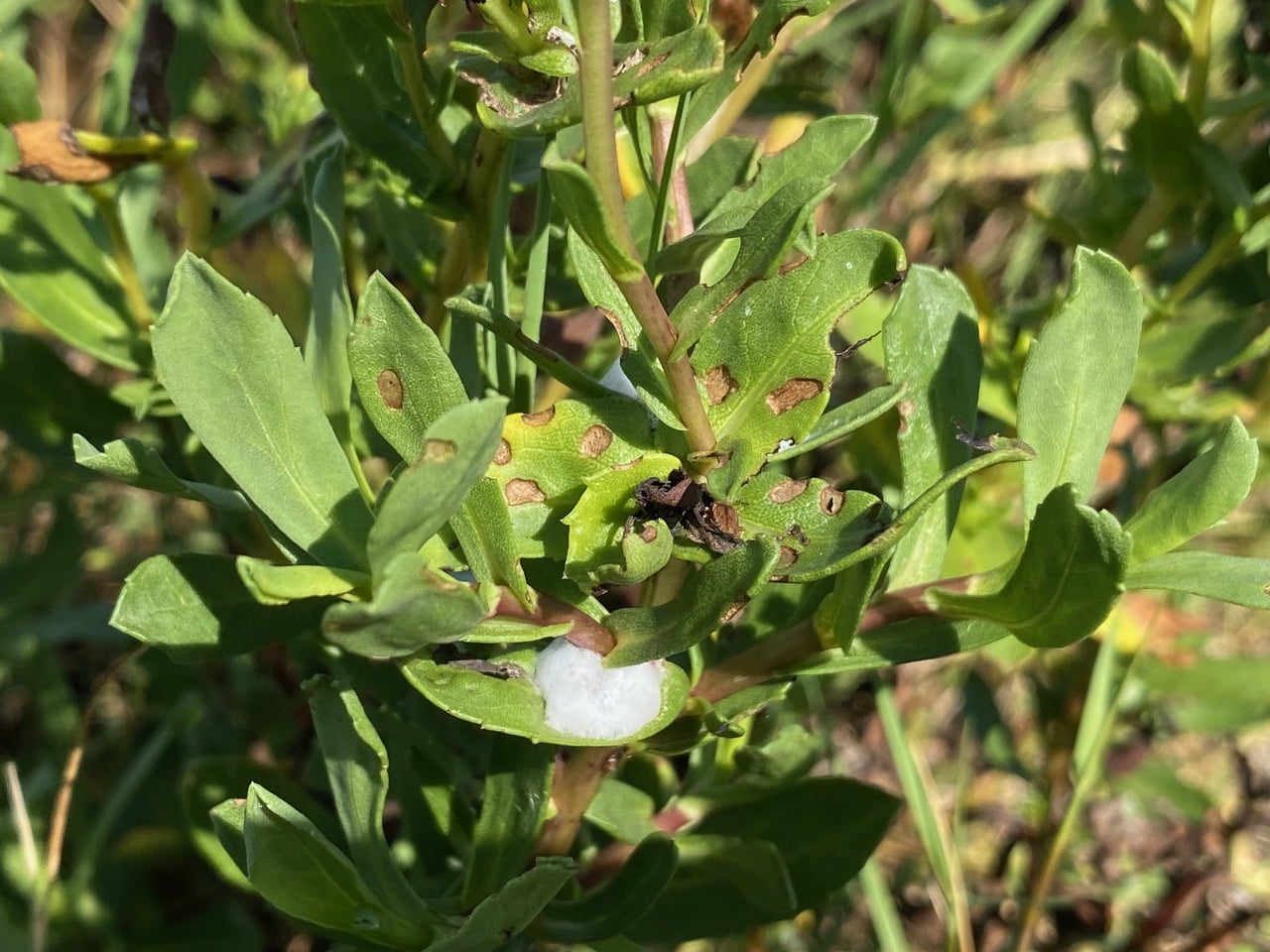
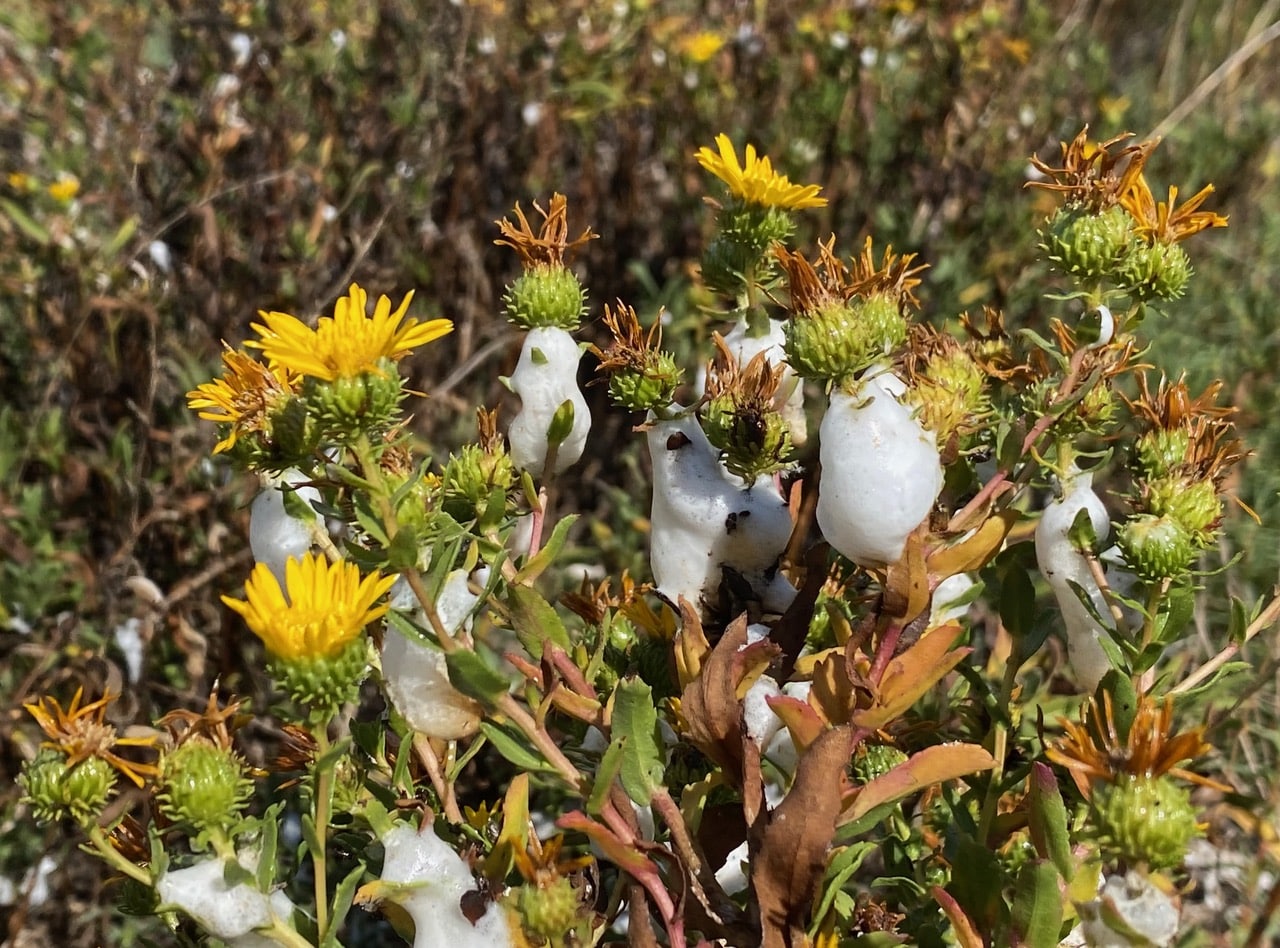
Arriving at the large patch of Oregon Gumweed, Grindelia stricta that is heavily infested by Spittlebugs, I make a bee line to the specific plant on which I have observed the emergence of adult Spittlebugs from their nymphs on 9/21/25. Surely I should be able to find some adults today?
The foam masses are made by the nymphs of a bug called the Spittlebug (superfamily Cercopoidea). Like the adults, the nymphs use their piercing, sucking mouthparts to feed on plant juices. The nymph produces a cover of foamed-up plant sap reminiscent of saliva, hence the common name of spittlebug. Whereas most insects that feed on sap feed on the nutrient-rich fluid from the phloem, Spittlebugs tap into the much more dilute sap flowing upward via the xylem. The large amount of excess water that must be excreted and the evolution of special breathing tubes allow the young spittlebug nymphs to grow in the relatively protective environment of the spittle. Symbiotic bacteria in the insects’ digestive system provides them with the essential amino acids that their diet lacks. The foam serves a number of purposes. It hides the nymph from the view of predators and parasites, and it insulates against heat and cold, and protects the delicate nymphs from desiccation. Moreover, the foam has an acrid taste that deters predators.
Many more adults have emerged since I was last here. Exuviae are everywhere, especially on the terminal leaves near the frothy masses. Exuviae are the cast-off outer skin or exoskeleton of an arthropod after a molt.
Ooh, this is a freshly molted adult, a teneral still holding on to its exuvia.
A teneral insect is a young insect that has just molted (emerged from its final nymphal skin) but has not yet hardened its exoskeleton or achieved its final coloration. Teneral insects typically have paler or different colors than their mature counterparts. Over a short period (often hours), the insect’s exoskeleton hardens and darkens, a process similar to the tanning of leather. This period allows the insect to expand its body and limbs. Being soft, and unable to move much, tenerals are more susceptible to injury and predation.
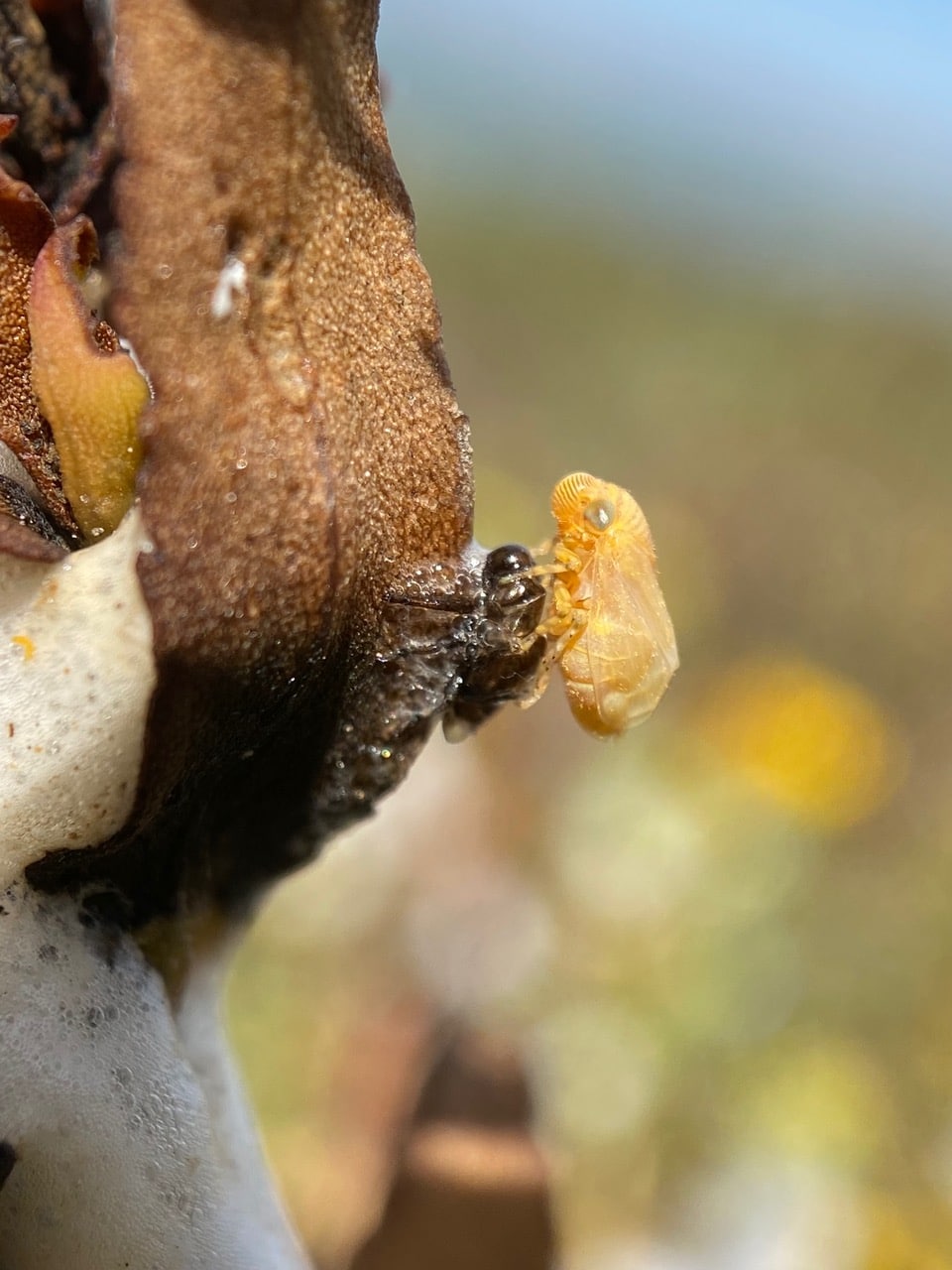
A adult male Spittlebug, Complex Clastoptera lineatocollis (family Clastopteridae) is perched on a Grindelia stem under a foam mass.
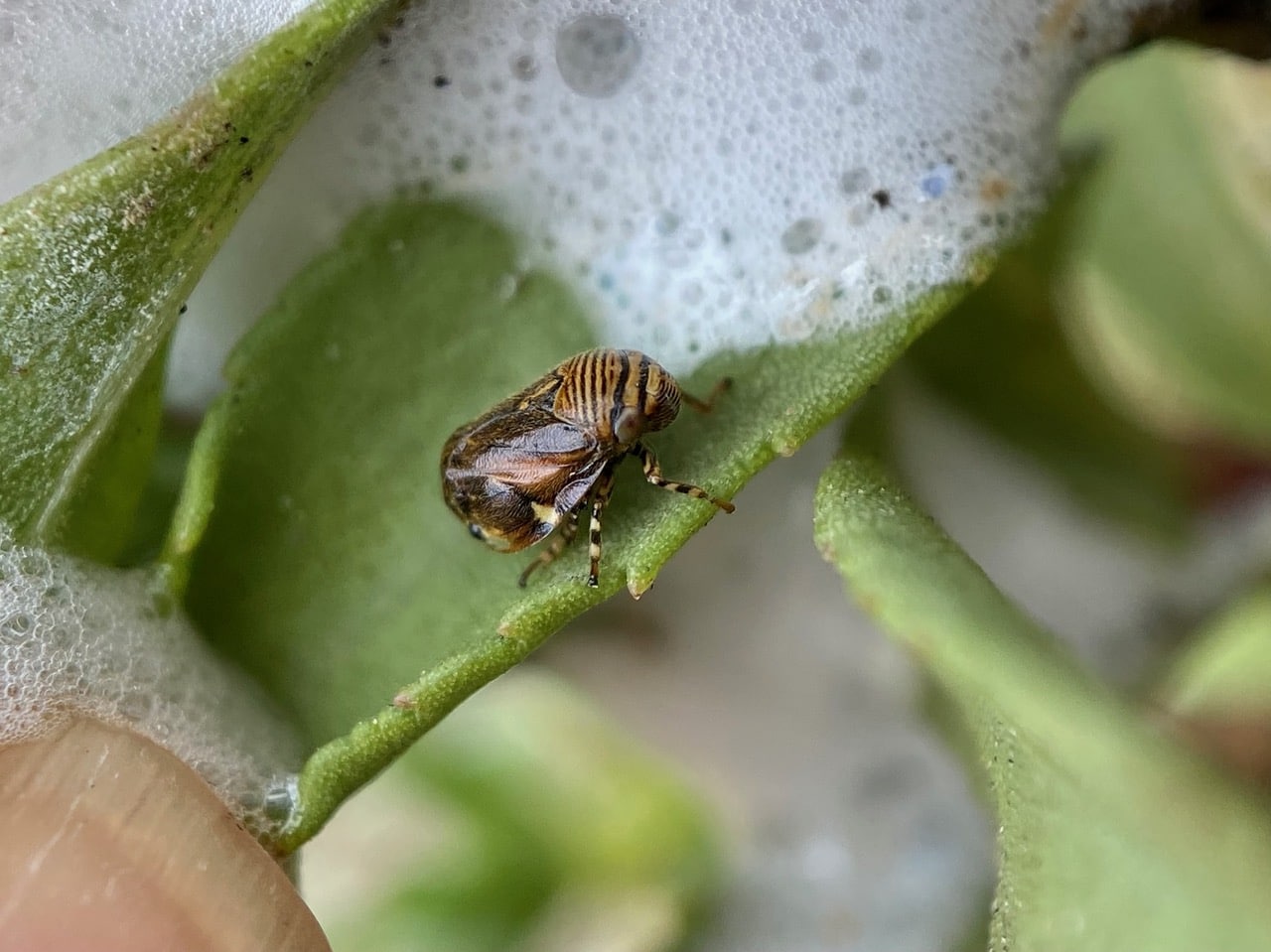
The Spittlebug, Complex Clastoptera lineatocollis (family Clastopteridae) is found in western United States. The bugs feed mostly on Asteraceae, although other hosts have been reported. Females are brownish (3.3-3.8 mm), while the smaller males (3.0-3.2 mm) are mostly black.
The adult Spittle Bug is sometimes called a Froghopper. The Froghopper is a “true bug” in the order Hemiptera. Froghoppers are champion jumpers among insects, out-performing even the fleas. The bug can leap the human equivalent of a skyscraper without a running start. It is the highest jumping insect proportional to body size. The muscles in its hind legs act like a “catapult” to release energy explosively.
Athletic prowess aside, the Froghopper is better known for its young, the “spittle bug”. The nymphs produce foamy white masses on plants within which they feed on plant sap. Froghoppers have piercing-sucking mouthparts, and feed on plant sap as both nymphs and adults. A recent report claims, “Froghoppers are the super-suckers of the animal world. The tiny insects produce negative pressures equivalent to people sucking a 100-meter-long straw.” The sucking power is strong enough to suck the water out of a cup at the base of the Statue of Liberty while perched on its crown. To complement that, the Froghopper is also exceptional at urination, excreting the human equivalent of 2,500 gallons of urine a day.
Here’s another male Spittlebug. It seems males far outnumber females in this population.
This one is still developing its final coloration; it is half-way between a brown female and a black male.
Still close to their exuvia, these two adults are large. I bet they will end up as brown females.
Finally, a mature female Spittlebug, Complex Clastoptera lineatocollis (family Clastopteridae)!
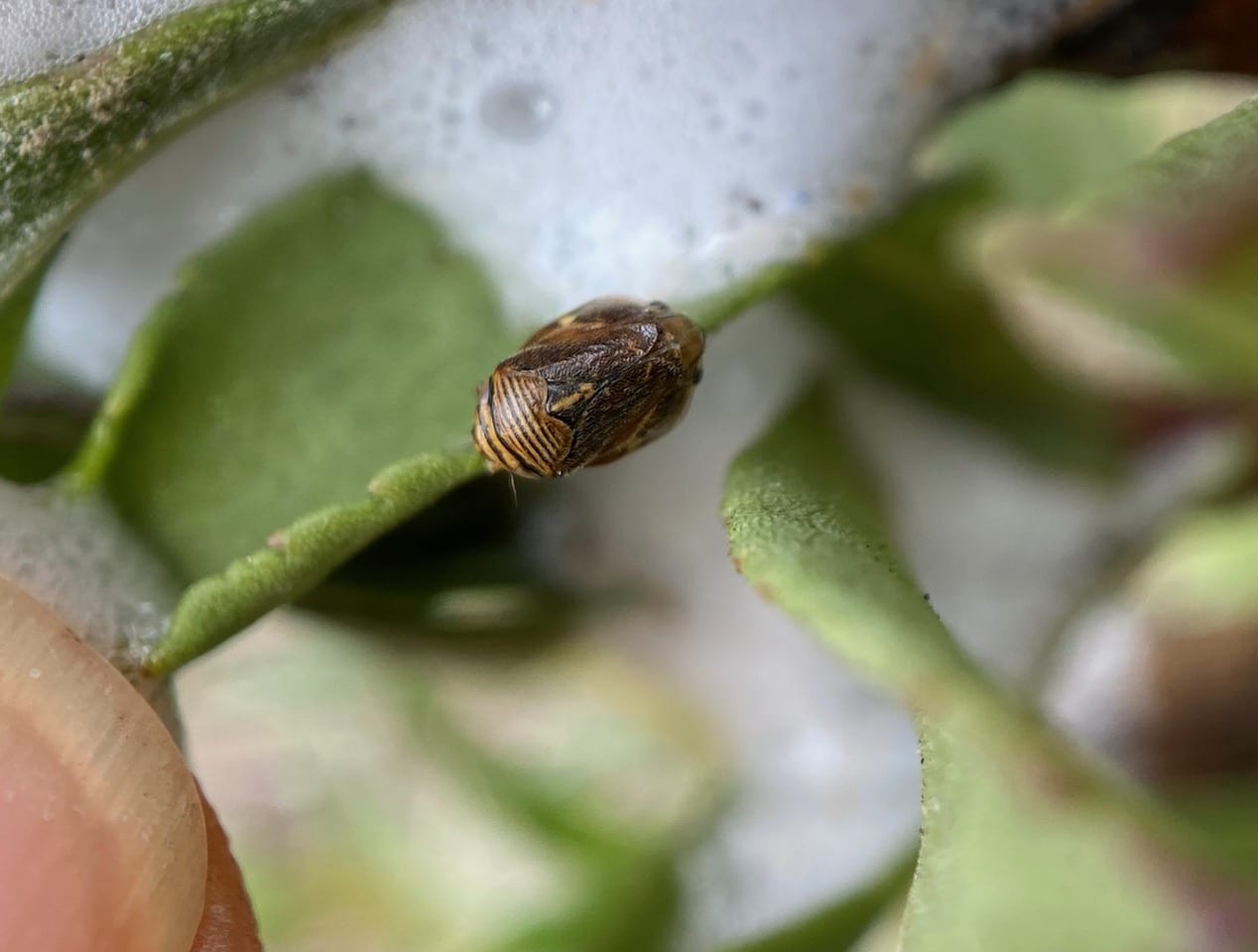
The female viewed straight down from the top.
The fine black and brown stripes are located right behind the female’s head. Note the fake eyespot at the rear of its wing.
The Spittelbug turns around to evade my camera, giving me a good look at the fake eyespot. In a split second, the bug jumps off the leaf with an audible snapping sound. I see the trajectory of the leap, but fail to see where exactly the bug lands. It is a surprisingly long jump for the little bug. Wow, this is the first time that I witness a jump by these bugs, although I have been photographing them all summer last year. They are extremely patient and long suffering, and do not spook easily.
Adult Spittlebugs, also known as Froghoppers, pierce plant surfaces with sharp, metal-reinforced spines on their hind legs to get the necessary traction for jumping. Spittlebugs are insect high-jump champions, and this mechanism is vital to their powerful leaps. Spittlebugs use a catapult-like system to jump. They slowly contract large internal muscles and store the energy by flexing a stiff, bow-shaped exoskeleton in a unique leg-locking mechanism. When the insect releases the “lock”, the stored energy is converted into an explosive extension of the hind legs, launching it into the air with an incredible acceleration of up to 400 times the force of gravity.
To top off today’s finds, I come across this mating pair of the Spittlebugs, Complex Clastoptera lineatocollis (family Clastopteridae) on a Grindelia leaf. I have longed for this shot all summer last year, hoping to prove to myself unequivocally that the species is sexually dimorphic. Here they are in plain sight today – the larger, brown female on the left, and her smaller, black mate on the right.