

Pollinator Post 9/25/24
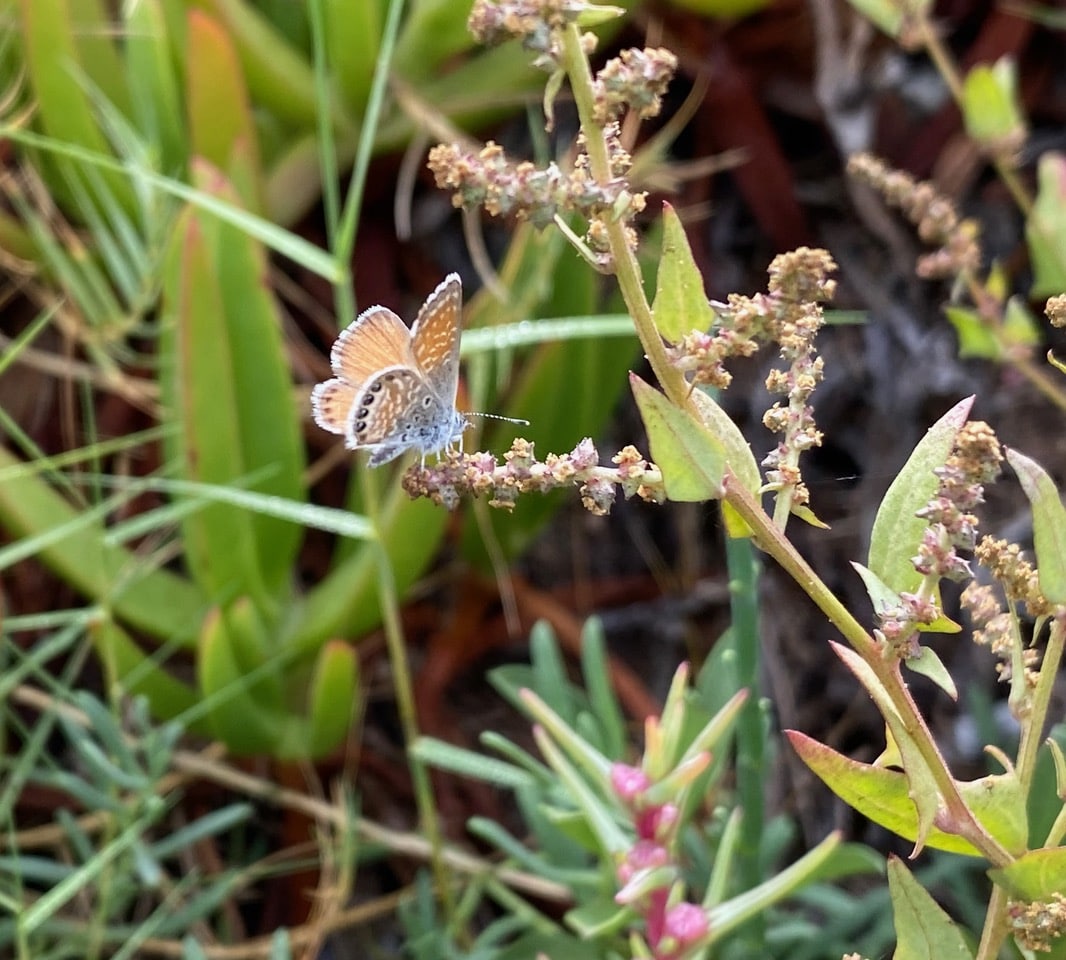
Sarab and I explore the north shore of Bay Farm Island this afternoon. A butterfly enthusiast, Sarab wishes to photograph the Western Pygmy Blue butterflies known to be abundant along this shoreline. We are happy that the sun, elusive in the morning has finally appeared. Butterflies are solar-powered!
Winding our way by the water among the pickleweeds and salt bushes, we come across a few Western Pygmy Blue butterflies. They are mostly interested in the Creeping Saltbush, Atriplex prostrata (family Chenopodiaceae). Sarab manages to get some pictures of a female laying eggs among the tiny flowers. As a bonus, he also gets some shots of the Tiger Beetles (family Cicindelidae) making their mad dashes on the sandy ground.
With a wingspan of 12-20 mm, about the size of a thumbnail, the Western Pygmy Blue, Brephidium exilis (family Lycaenidae) is one of the smallest butterflies in the world and the smallest in North America. The butterfly is found in alkaline areas such as deserts and salt marshes. The caterpillars feed on plants in the Goosefoot family Chenopodiaceae, commonly found in salty habitats. Although the species has no set breeding season, mating activity is at its peak during late summer and early fall.

In about an hour, gusty winds start to blow, making insect photography all but impossible. This Sandhill Skipper, Polites sabuleti (family Hesperiitdae) lands on the leaflitter on the ground, the only thing that is not waving wildly. Skippers have always looked similar to me, and I have never bothered to distinguish the various species. But I am in good hands with Sarab today!
Skippers are a family, the Hesperiidae, of the order Lepidoptera (butterflies and moths). They are named for their quick, darting flight habits. Most have the antenna clubs hooked backwards like a crochet hook. They also have generally stockier bodies and larger compound eyes than the other butterflies. Their wings are usually small in proportion to their bodies. When at rest, skippers keep their wings usually angled upwards or spread out, and only rarely fold them up completely. Californian species are mostly brown or tan, with black, orange, or yellow markings.
Skipper caterpillars are usually green or brown, sometimes yellowish, never brightly colored. They have a distinctive “collar”, a narrow ring around the body right behind the head. Caterpillars are camouflaged and often hide during the day. Many species make nests of leaves and silk for additional protection. Most North American species feed on grasses, but some common species eat shrubs and trees, especially in the bean family. Most species are limited to a single group of food plants. Adult skippers are only active during the day, but Skipper caterpillars feed mainly when it is dark or partly light.
The Sandhill Skipper, Polites sabuleti (family Hesperiidae) is found in western United States. Their habitats include alkali grasslands, moist meadows, lawns, salt marshes, sand dunes, sagebrush flats, and alpine fell-fields. Adults feed on flower nectar, while caterpillars feed on leaves and take shelter in nests of tied leaves. Larval host plants include various grasses, including the salt grasses. There are several flights from March-October in the southern range and low elevations.
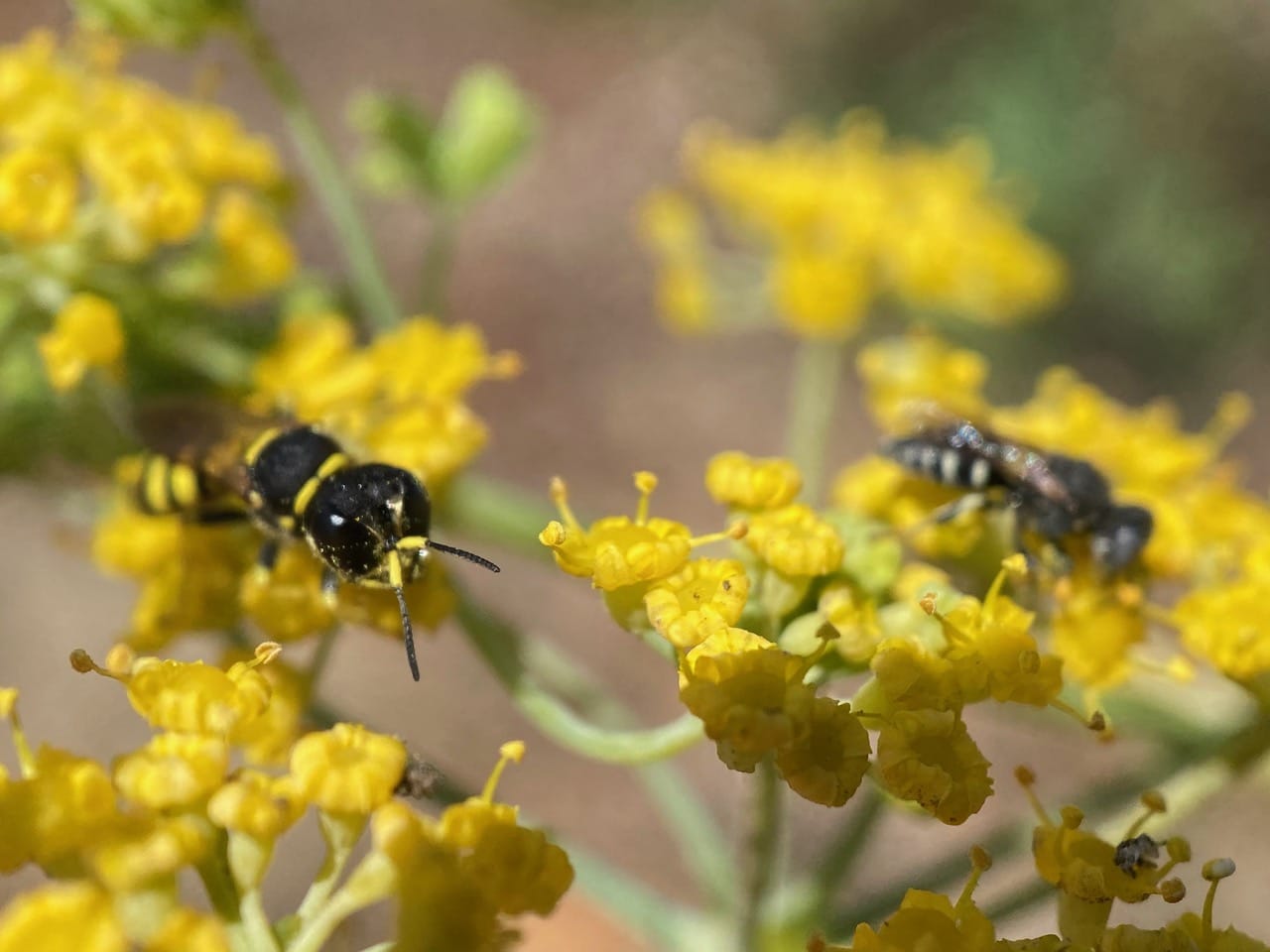
A tall Fennel is waving wildly in the wind, with two small insects desperately foraging on an umbel of fresh flowers. Grabbing the branch to steady it, I make out two wasp-like insects that I don’t recognize.
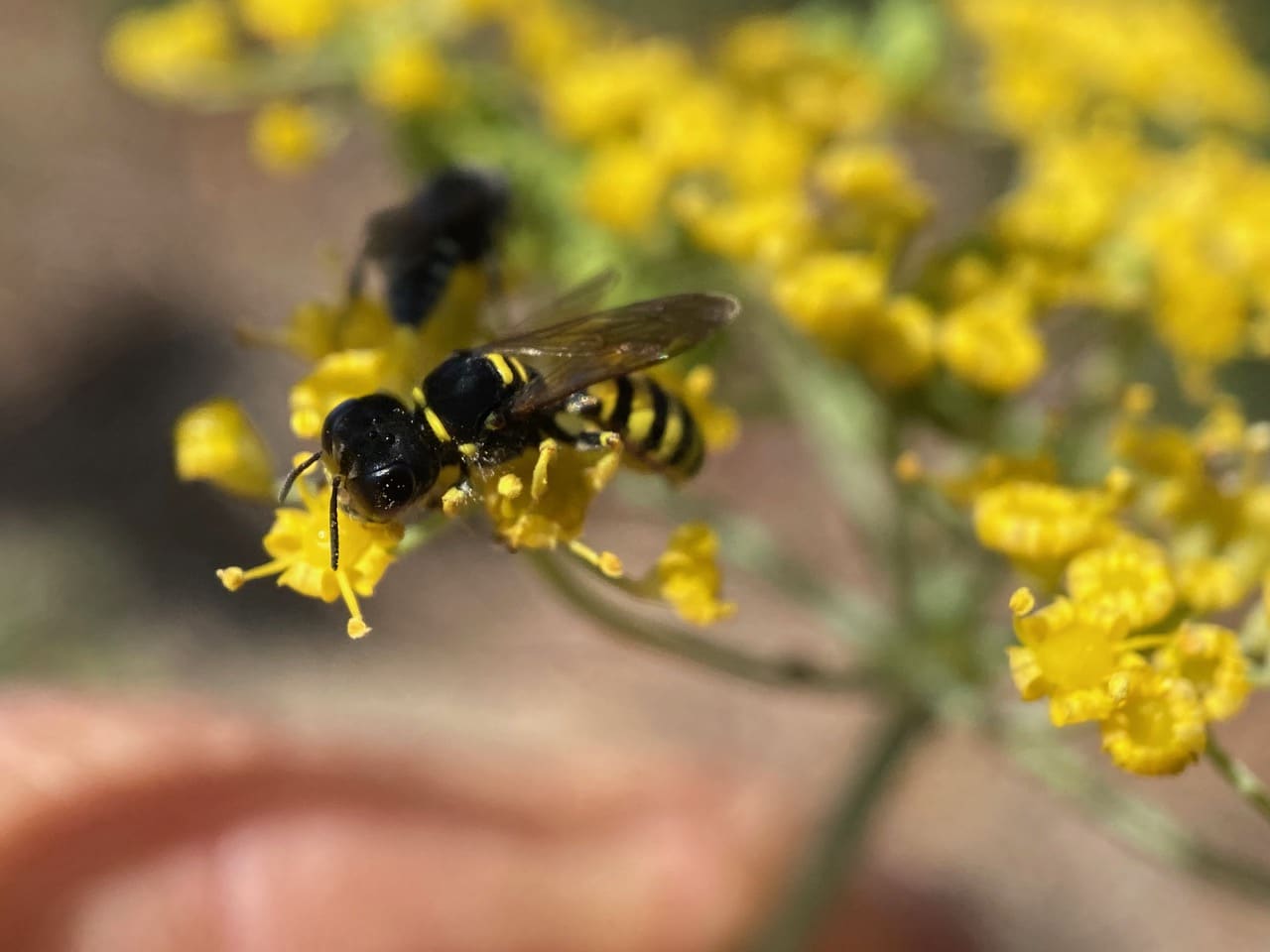
The larger insect with black-and-yellow abdomen has a huge, boxy head, with eyes set far apart. No doubt a Square-headed Wasp in the family Crabronidae, subfamily Crabroninae. iNaturalist has helped narrow the identify of the wasp to the genus Ectemnius (family Crabronidae).
The Crabronidae is one of our most diverse wasp families, with over 1,200 species in the U.S., and almost 9,000 species worldwide. The common name “square-headed wasps” only applies to species in the subfamily Crabroninae. Square-headed Wasps are solitary wasps that use their impressive jaws to make nests in the ground, in hollow stems, in the pith of broken stems, and in old galleries chewed in wood by beetle larvae. Adult Crabronid wasps derive all their nutrition from flower nectar, and they are often seen in late summer on flowers. With a few exceptions, most Crabronid wasps are predatory. They paralyze prey insects including aphids, leafhoppers, flies, beetles, crickets, cicadas, spiders and caterpillars and fly them back to the nest. Mom lays an egg on one of the insect prey, closes the chamber, and moves on. The carnivorous larva hatches out into its own personal pantry stocked with enough food to get it to the pupal stage. Many Square-headed Wasps are very specific about the kinds of insects they pursue.
Adult Ectemnius are striking, medium to large wasps with black and yellow markings on the abdomen, ranging from 6-17 mm depending on species. They have broad, highly modified mandibles ending with a series of ’teeth’ which they use to scrape out the tunnels and chambers in which they create they nests. Ectemnius wasps hunt various Diptera (flies) to stock their nests and feed their young. The wasp paralyzes its prey and carries it back to the nest by clutching it beneath their bodies with their legs. Prey can often be as large or even larger than the wasp itself.

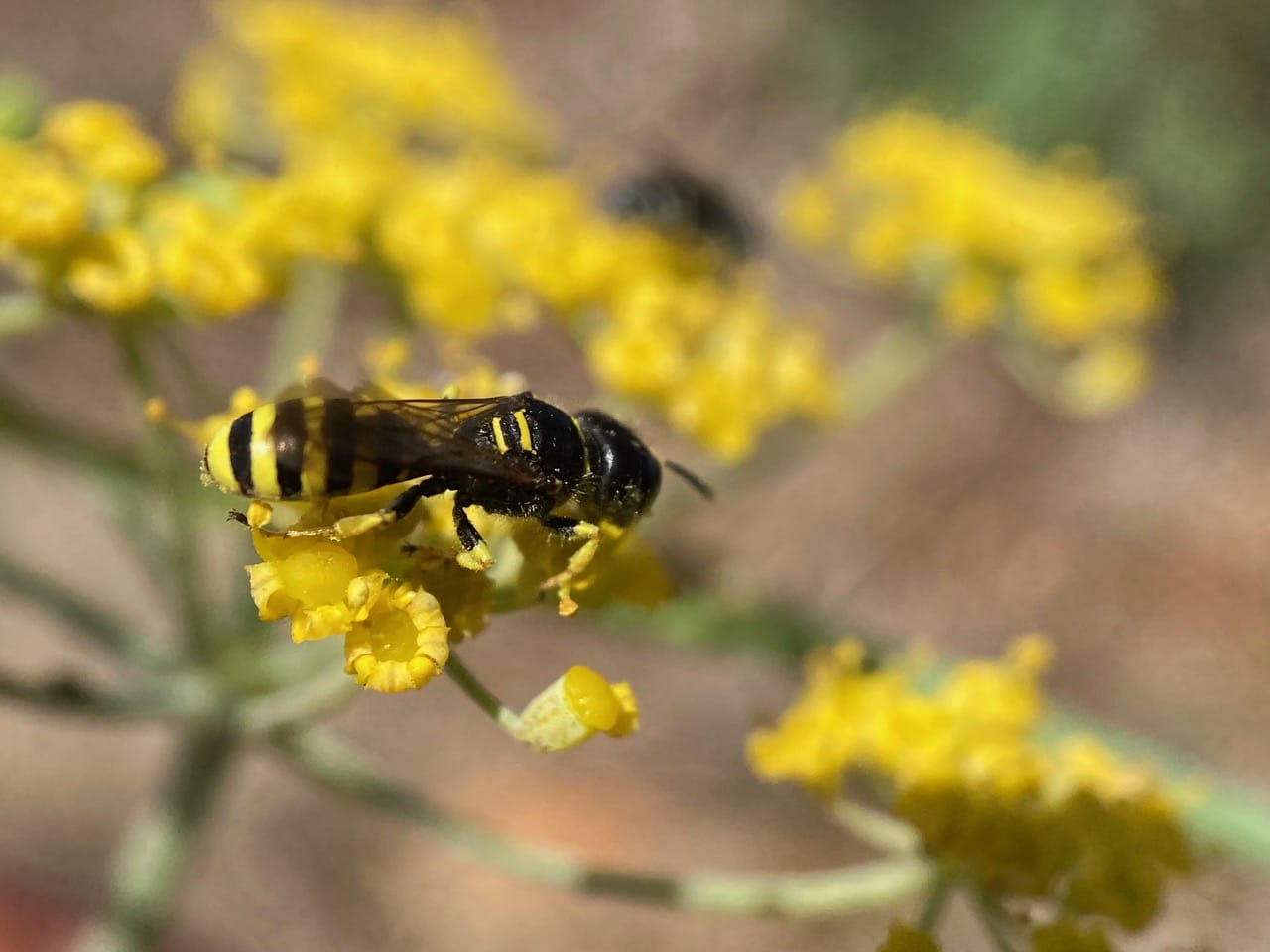
I next focus my attention on the smaller insect on the flower umbel. It turns out to be another Square-headed Wasp – the Prong-backed Fly Hunter Wasp, Oxybelus uniglumis (family Crabronidae, subfamily Crabroninae).

The Prong-backed Fly Hunter Wasp, Oxybelus uniglumis (family Crabronidae) occurs in northeastern North America. Its range also includes California and other western states. It is a small wasp, measuring 5-9 mm. The wasp nests in well-drained, sandy soil in a variety of habitats. A fully provisioned nest has one cell or at most a few cells. The female hunts various kinds of flies on the wing, captures one, then stings it, injecting venom to paralyze it. Rather than transporting the prey clutched beneath her like other small predatory wasps, she instead leaves her sting impaled in the fly while transporting it back to the nest. She lays a single egg on the first fly placed in a nest cell, then adds additional two to nine more flies before backfilling the nest. There is one generation per year, flying between May to early October.
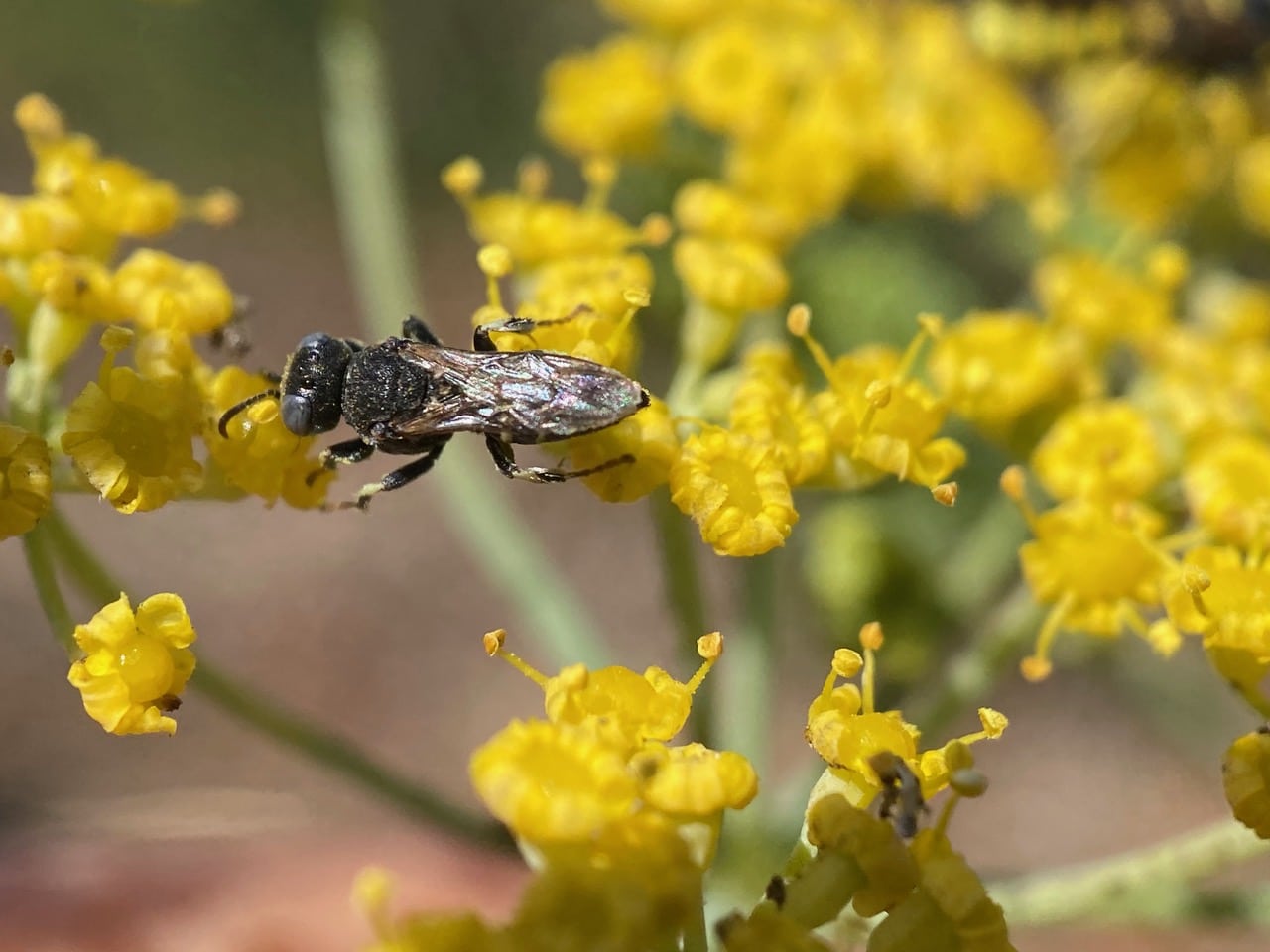
Oxybelus uniglumis is also known as the Common Spiny Digger Wasp. The propodeum (the back the pronotum next to the ‘waist’ or petiole of the abdomen) has a large spine with a rounded end, and the scutellum has two transparent flanges. These features are visible between the wings in this picture, though blurry.
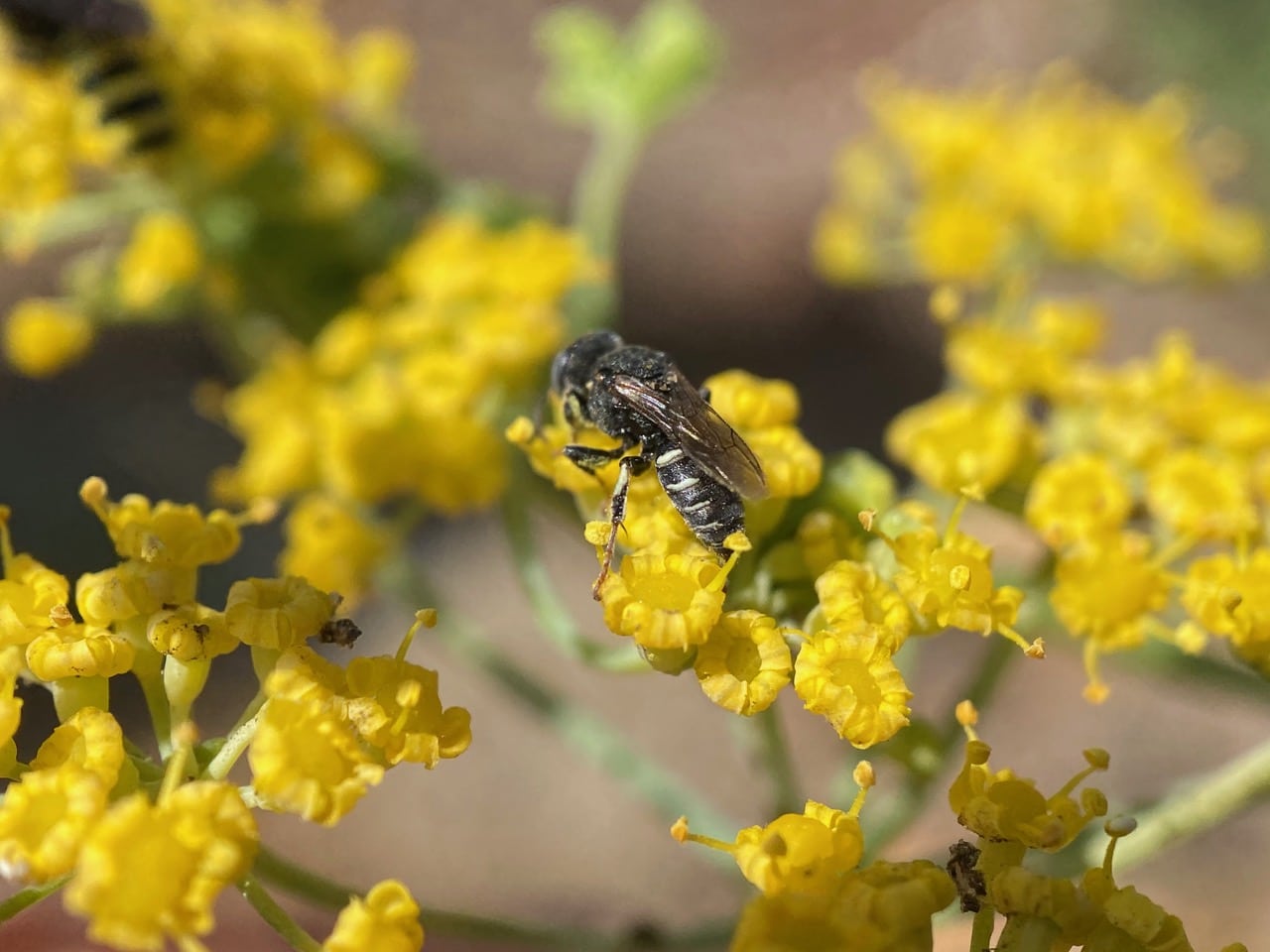
I think you would enjoy this charming video of Oxybelus as much as I do: