

Pollinator Post 9/25/23 (1)

It’s a clear, crisp fall morning. I decide to explore the northern section of Skyline Gardens from the Steam Train entrance.
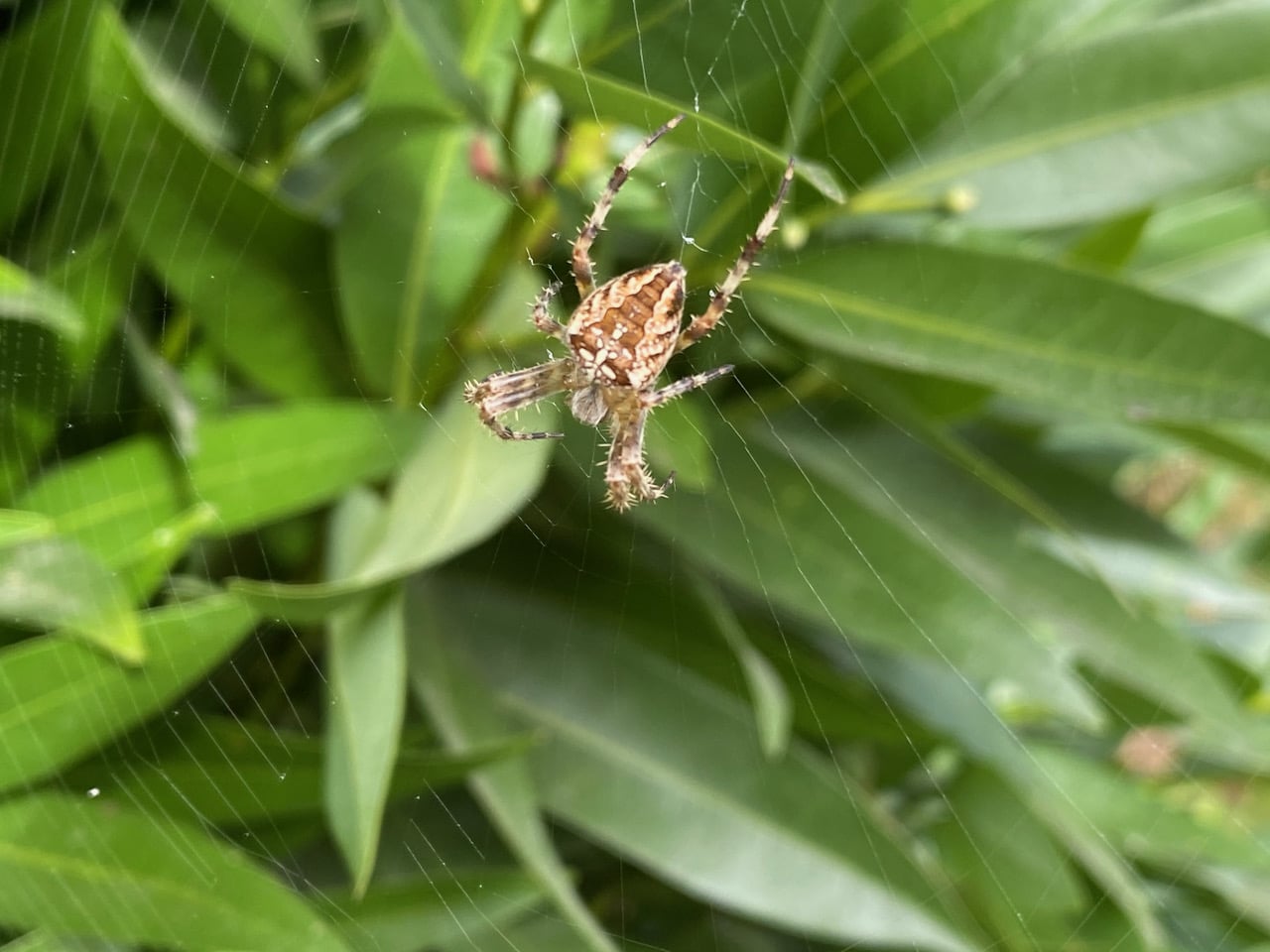 As I come down the steps from the entrance, I am greeted by a Cross Orbweaver, Araneus diadematus (family Araneidae) in its large orb web strung on a California Bay tree. Although not a large spider, it is the largest one I have found in the garden. Although Skyline hosts an impressive diversity of spiders, none of them is big. Why?
Araneus diadematus is commonly called the Cross Orbweaver or the European Garden Spider. It is found in Europe where it is native, and North America, where it was introduced. Individual spiders can vary markedly in coloration, from light yellow to dark grey, but all have mottled white markings across the dorsal abdomen, with four or more segments forming a cross. The markings are formed in cells filled with guanine, which is a byproduct of protein metabolism. Adult females range in length from 1/4 to 3/4 in, while the males range from 1/4 to 1/2 in.
The legs of orb-weaver spiders are specialized for spinning orb webs. The webs are built by larger females, which hang head down in the center of the web or remain hidden in nearby foliage, with one claw hooked to a signal line connected to the main orb, waiting for a disturbance to signal the arrival of prey. Prey is then quickly wrapped in silk and bitten, and the prey may hang on the web to be stored for later consumption. The initial bite serves to paralyzed the prey and to prevent injury to the spider from struggling prey. The injected enzymes serve to begin liquefaction of the prey’s internal structures.
Orbweaver spiders are well known for sexual cannibalism. Females often kill and consume the males just before, during, or just after mating.
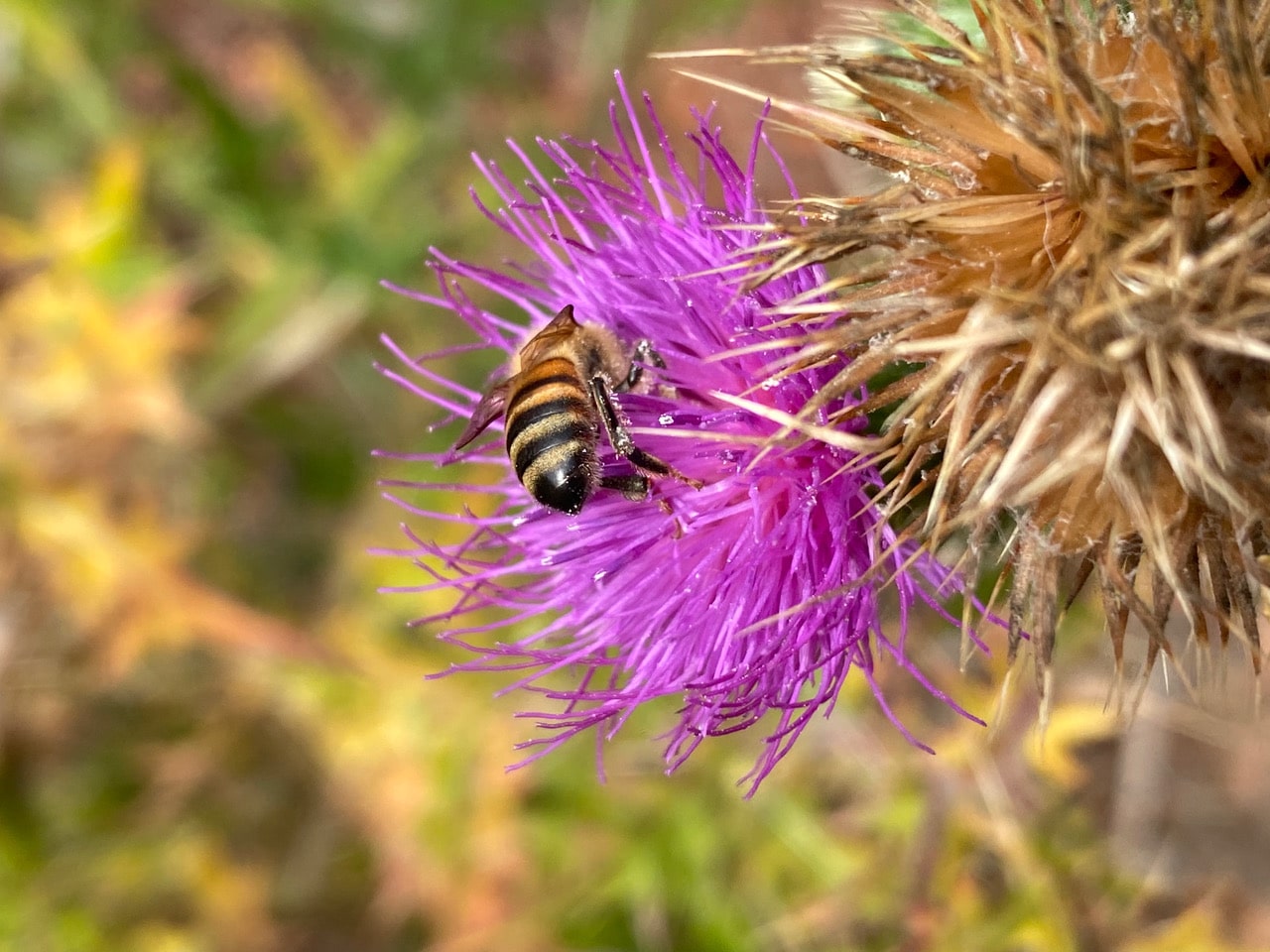
The Bull Thistles, Cirsium vulgare by the entrance are all fading. Several Honey Bees, Apis mellifera (family Apidae) are foraging on the last remaining flowerheads.
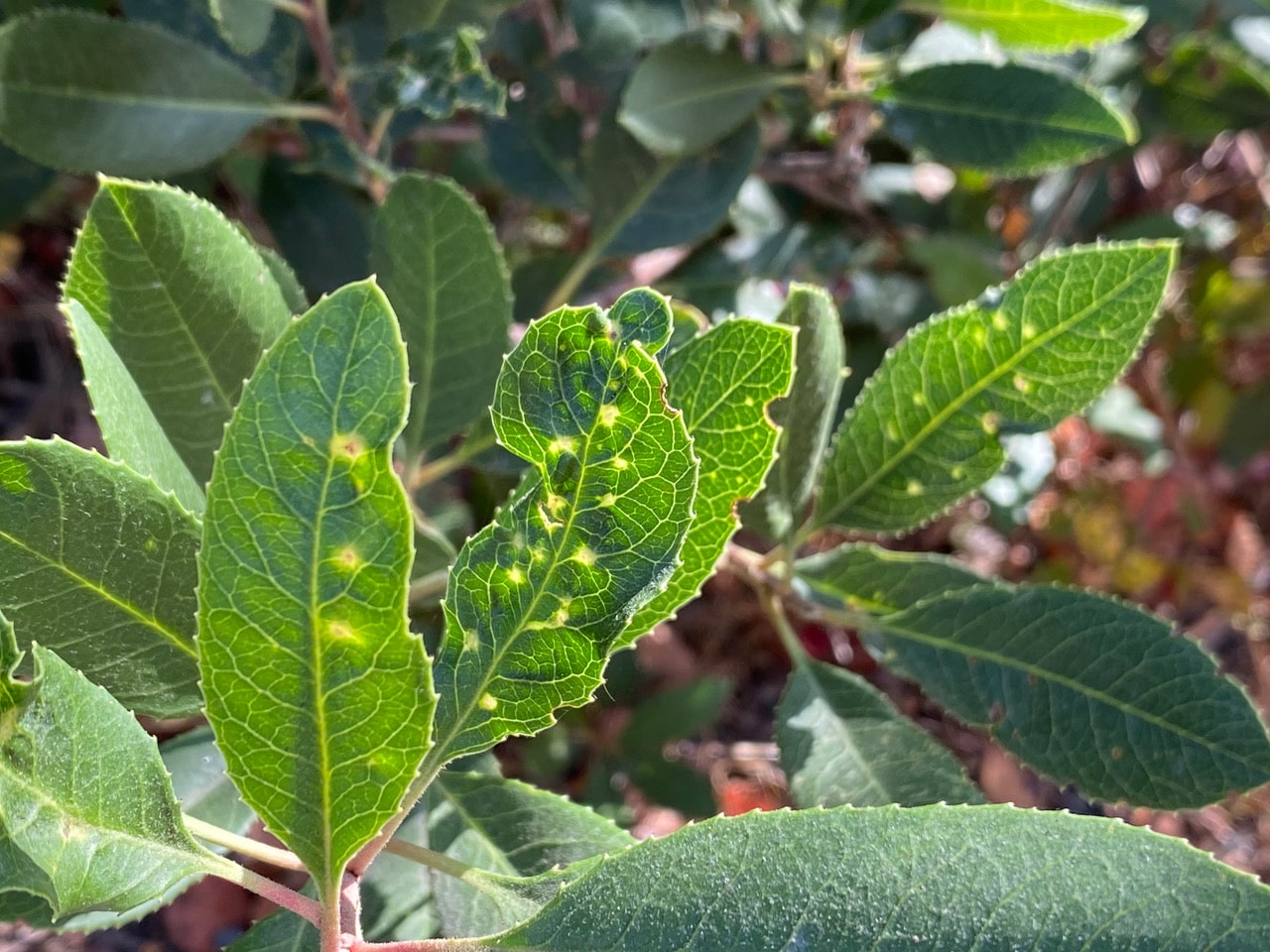
Many leaves on the Toyon, Heteromeles arbutifolia lining Skyline Trail are badly deformed and crimped. The crimping seems to originate from punctate wounds. Are these delivered by some bugs with piercing-sucking mouthparts? I examine the front and back of these leaves, but can’t find any insects.
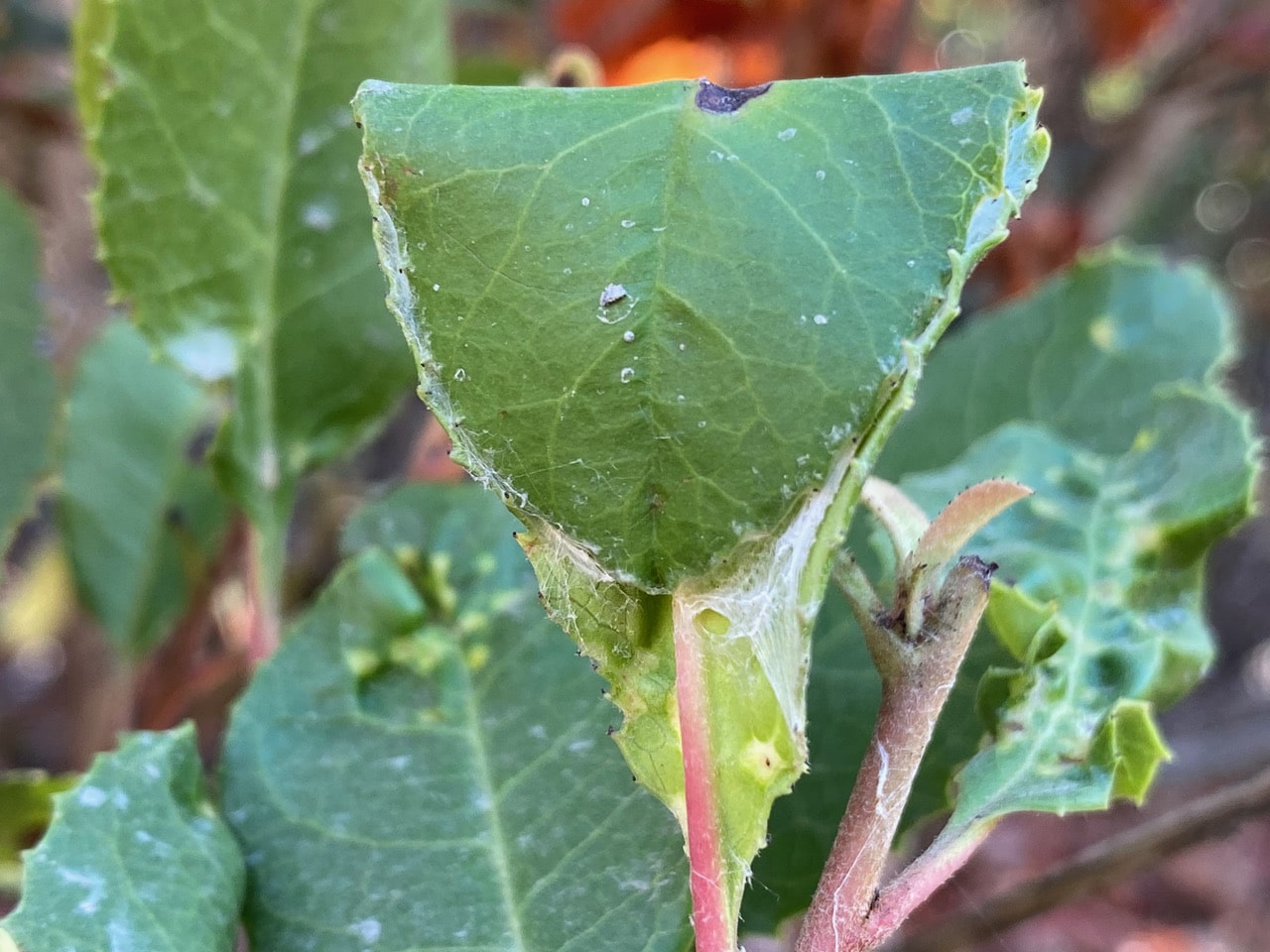
Then I notice a Toyon leaf that has been folded cross-wise almost in half, the edges sealed with silk. There is also a blackened wound along the fold near the mid rib. Was the wound intentionally made to make it possible to bend the leaf over?
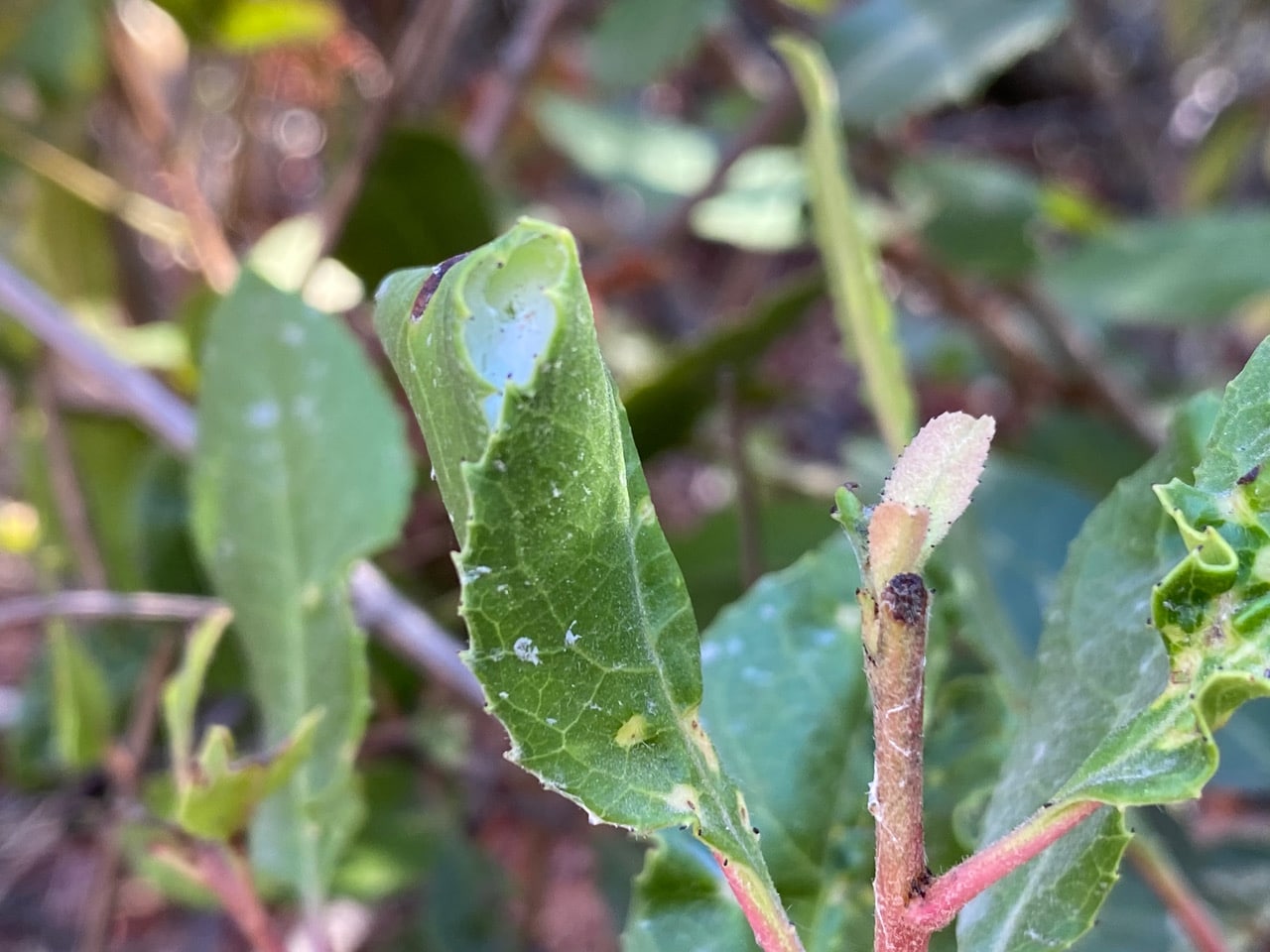
Side view of the folded leaf shows some fluffy silk in the hidden space. This is reminiscent of the folded Bay leaf I just saw yesterday – the same modus operandi. Can this also be a retreat of a Cobweb Spider? To avoid breaking into a viable egg case inside right now, I tag the plant to check back on it later.
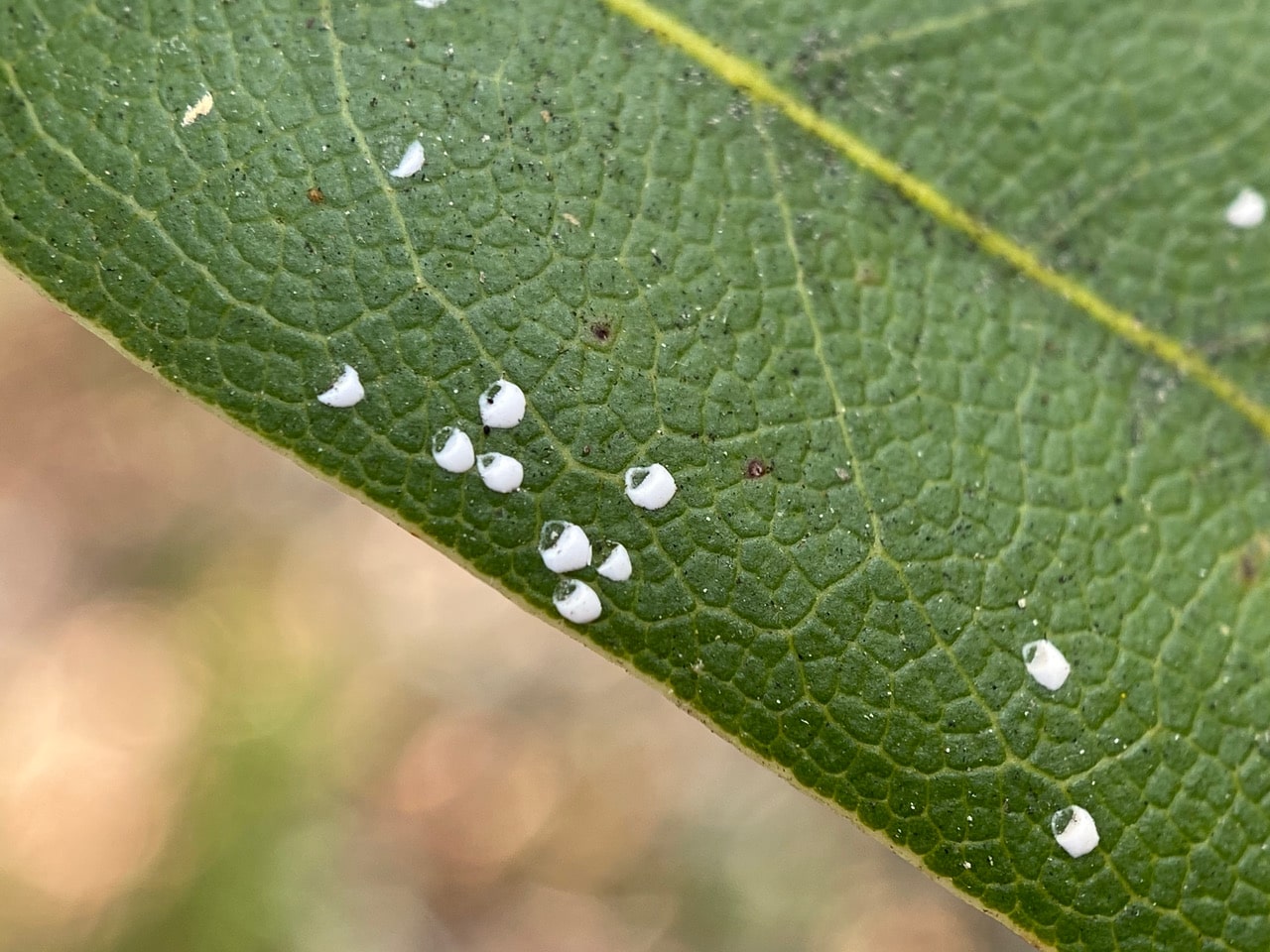
What are these tiny strange looking white objects on the California Bay leaf?
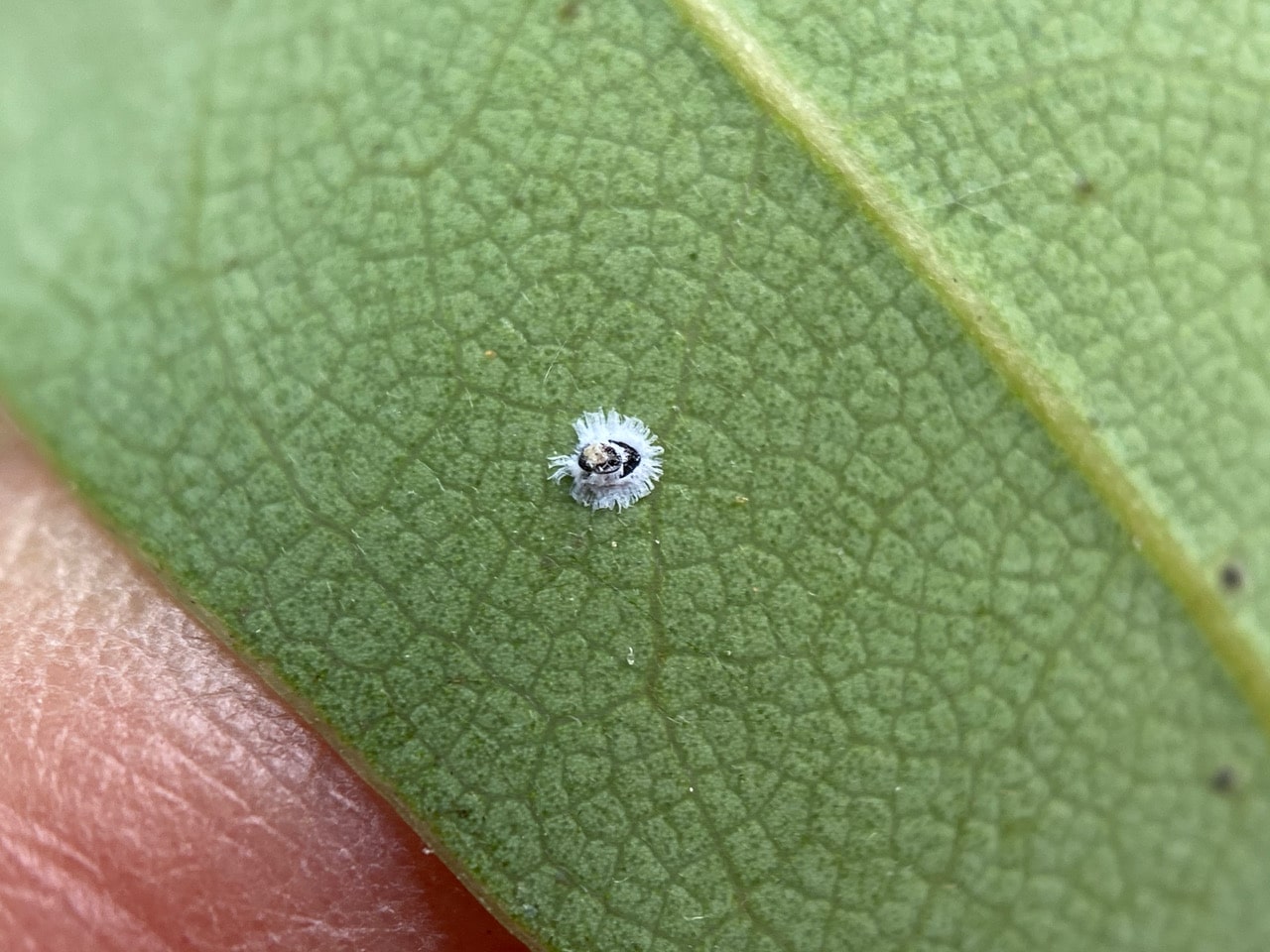
I turn over the leaf to find three of these even stranger looking things. Scale insects?
iNaturalist has helped to identify the insect as a Whitefly (family Aleyrodidae). It is a nymph with white waxy filaments.
Despite their name, whiteflies are not true flies, but are in the order Hemiptera, sap-sucking insects related to aphids, scales and mealybugs. They derive their name from the mealy white wax covering the adult’s wings and body. Adult whiteflies resemble tiny moths, most species with a wingspan of less than 3 mm and a body length of 1-2 mm.
Whiteflies use their piercing, needle-like mouthparts to suck sap from phloem, the food-conducting tissues in plant stems and leaves. Large colonies often develop on the underside of leaves. They can cause leaves to turn yellow, appear dry, or fall off plants. Like aphids, whiteflies excrete a sugary liquid called honeydew, so leaves may be sticky or covered with black sooty mold that grow on honeydew. The honeydew attracts ants, which interfere with the activities of natural enemies that may control the whiteflies. By far the whitefly’s major importance as crop pests is their transmission of virus to some host plants.
Female whiteflies lay eggs on the lower leaf surface of host plants. There generally are four larval instars. All the instars are more or less in the shape of a flattened ellipse fringed with bristles and waxy filaments. The first instar are mobile crawlers, but soon attach to host plants to feed. From then until it emerges as an adult, it remains attached to the plant by its mouthparts. The stage before the adult is called a “pupa”, though it shares little in common with the pupal stage of holometabolous insects.
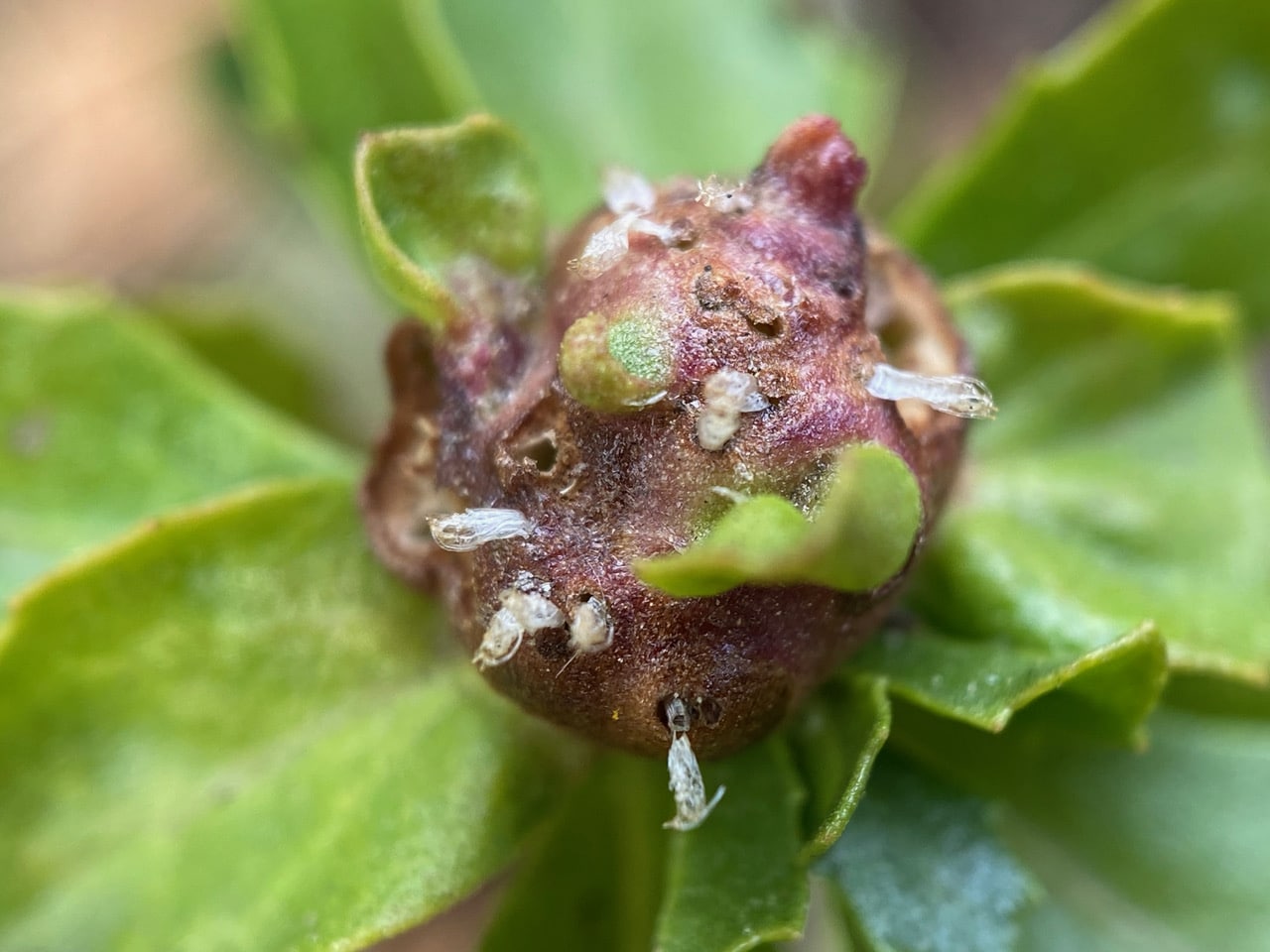
Some white diaphanous things are protruding from a bud gall of a young Coyote Brush, Baccharis pilularis. These are the empty pupa cases of the gall-maker, Rhopalomyia californica (family Cecidomyiidae).
The Coyote Brush Bud Gall Midge, Rhopalomyia californica lays eggs into the flowerbuds of Baccharis pilularis, inducing lumpy, fleshy galls. Female midges lay clusters of eggs on terminal buds. The larvae that hatch out burrow between bud scales and commence feeding. The gall tissue swells around each of the larvae. When fully grown, larvae burrow to the surface of the gall, where they develop their partially protruding white cocoons and pupate. Adults look like miniature mosquitoes. The species, Rhopalomyia californica (family Cecidomyiidae) represents one of the rare situations among all gall insects where fresh galls and emergence of adults occur throughout the year.
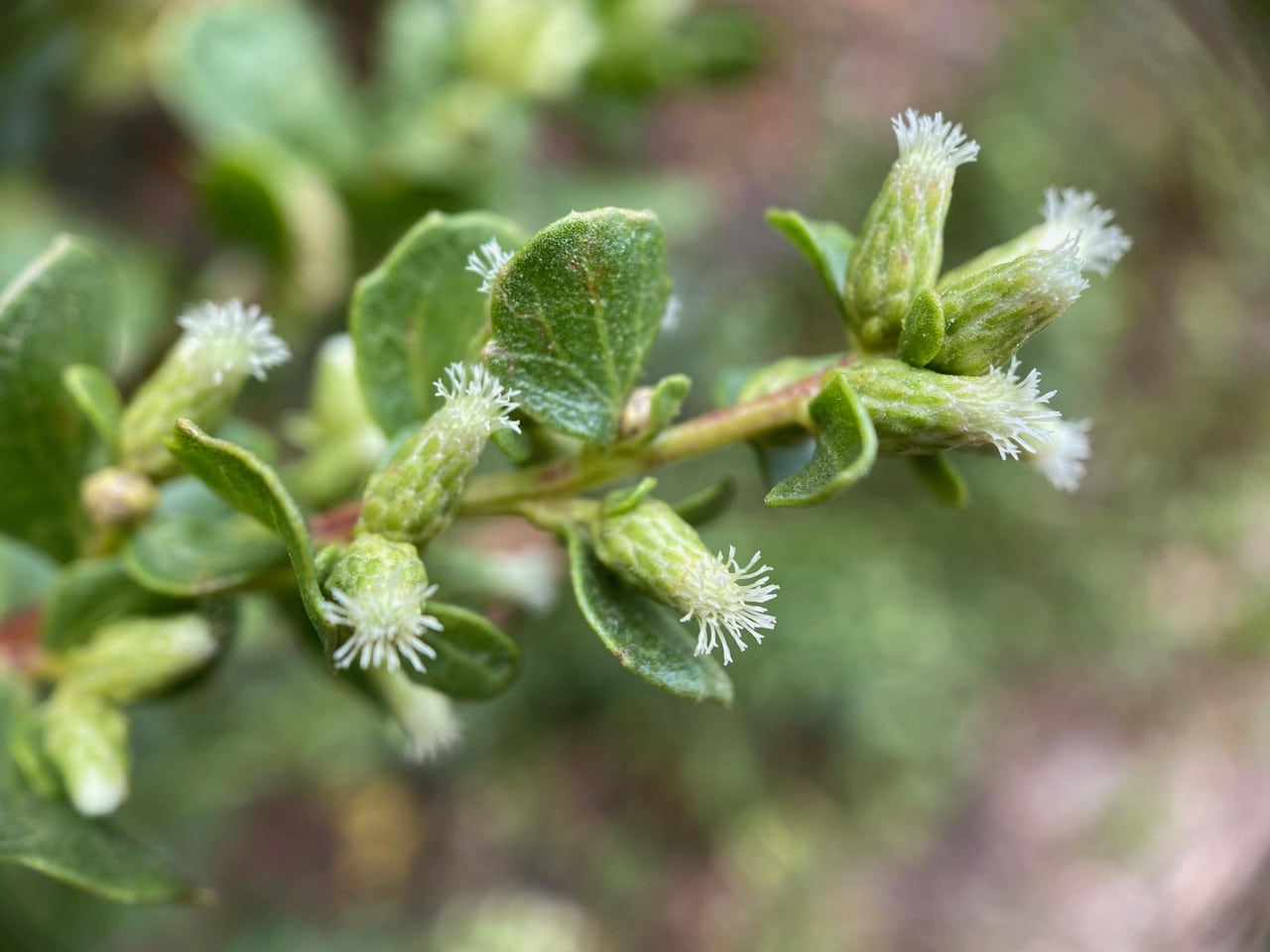
Coyote Brush, Baccharis pilularis along Skyline Trail is blooming nicely. Baccharis pilularis is dioecious, with male and female flowers borne on separate plants. Flowers of both sexes are tiny (called florets) with several crowded together into small flowerheads, which in turn are arranged into larger clusters toward the ends of branches. Female florets of Coyote Brush have a slender, pale, tubular corolla that is concealed within the pappus. There are no stamens and the single pistil has a slim, forked style. Although individual flowerheads of Baccharis pilularis are small, the large masses of them color the shrubs white (females) or creamy (males).

A Black-footed Drone Fly, Eristalis hirta (family Syrphidae) is foraging on the female flowers of Coyote Brush. Female flowers offer only nectar, and not pollen.
The Black-footed Drone Fly, Eristalis hirta (family Syrphidae) is a common Western North American species of hoverfly. The adults visit flowers for nectar and pollen. Larvae are aquatic filter-feeders of the rat-tailed type.
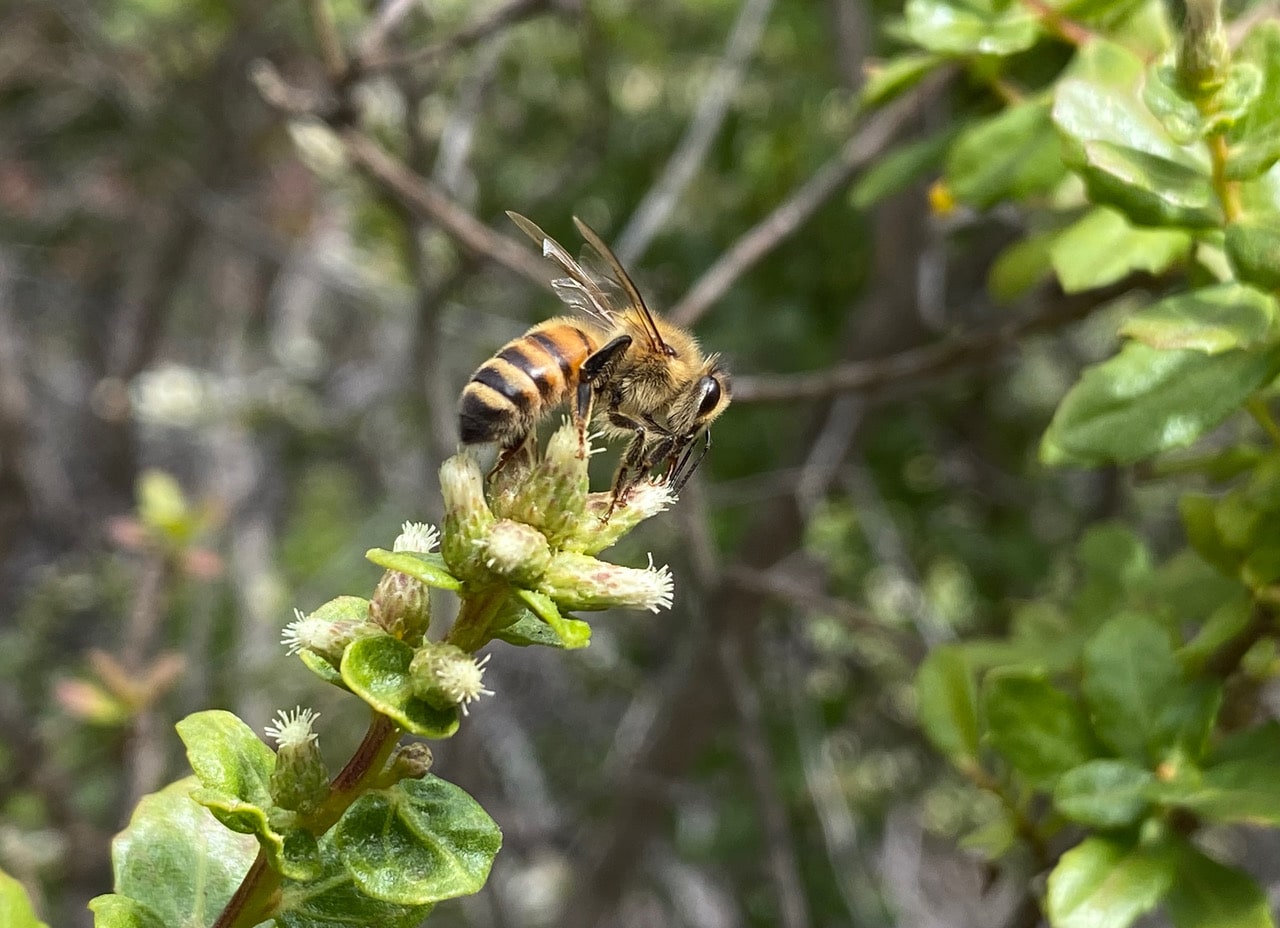
A Honey Bee, Apis mellifera (family Apidae) is taking nectar from the female flowers of Coyote Brush.
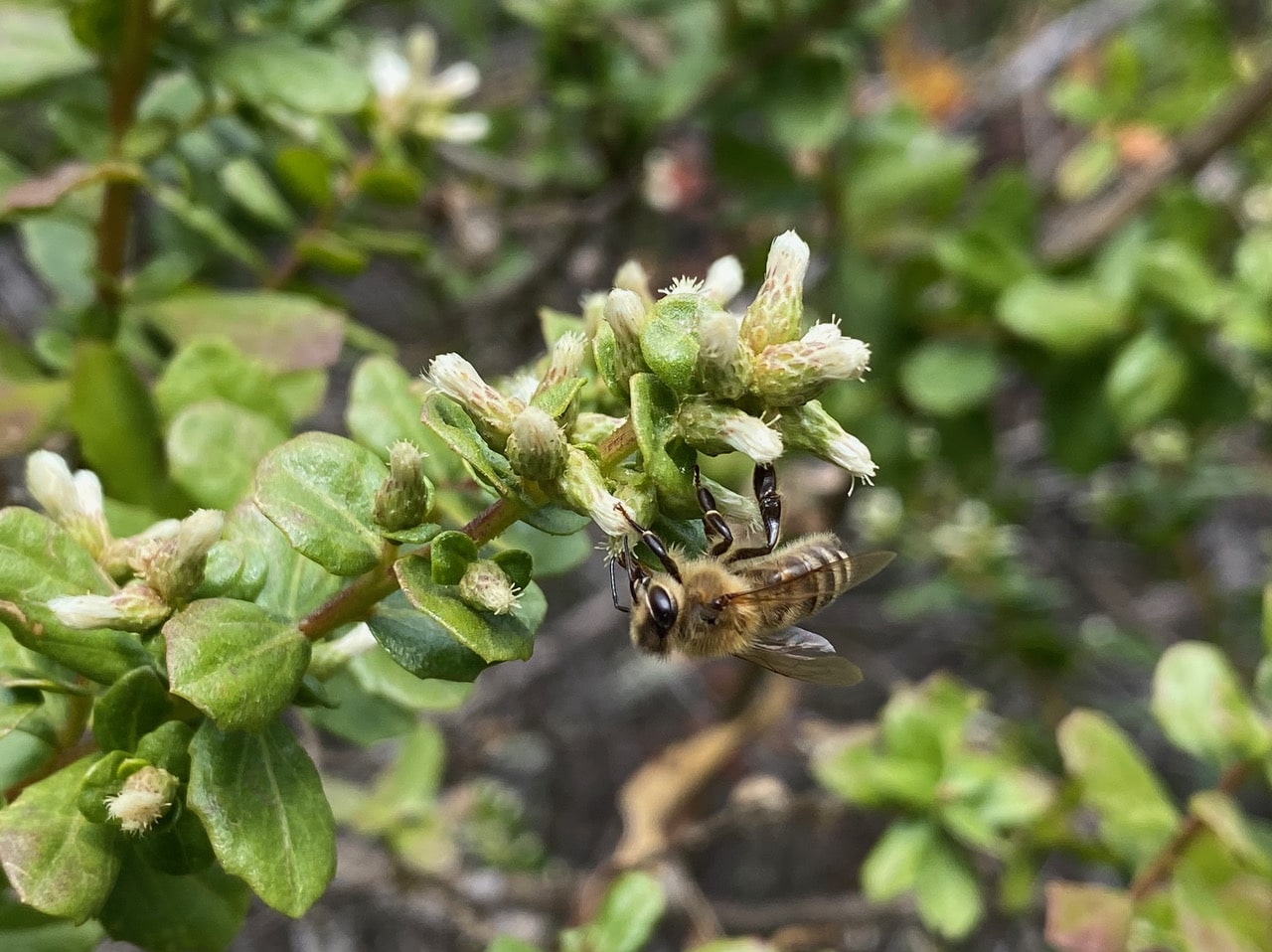
Here’s one of those darker Honey Bees that are often seen in late summer.
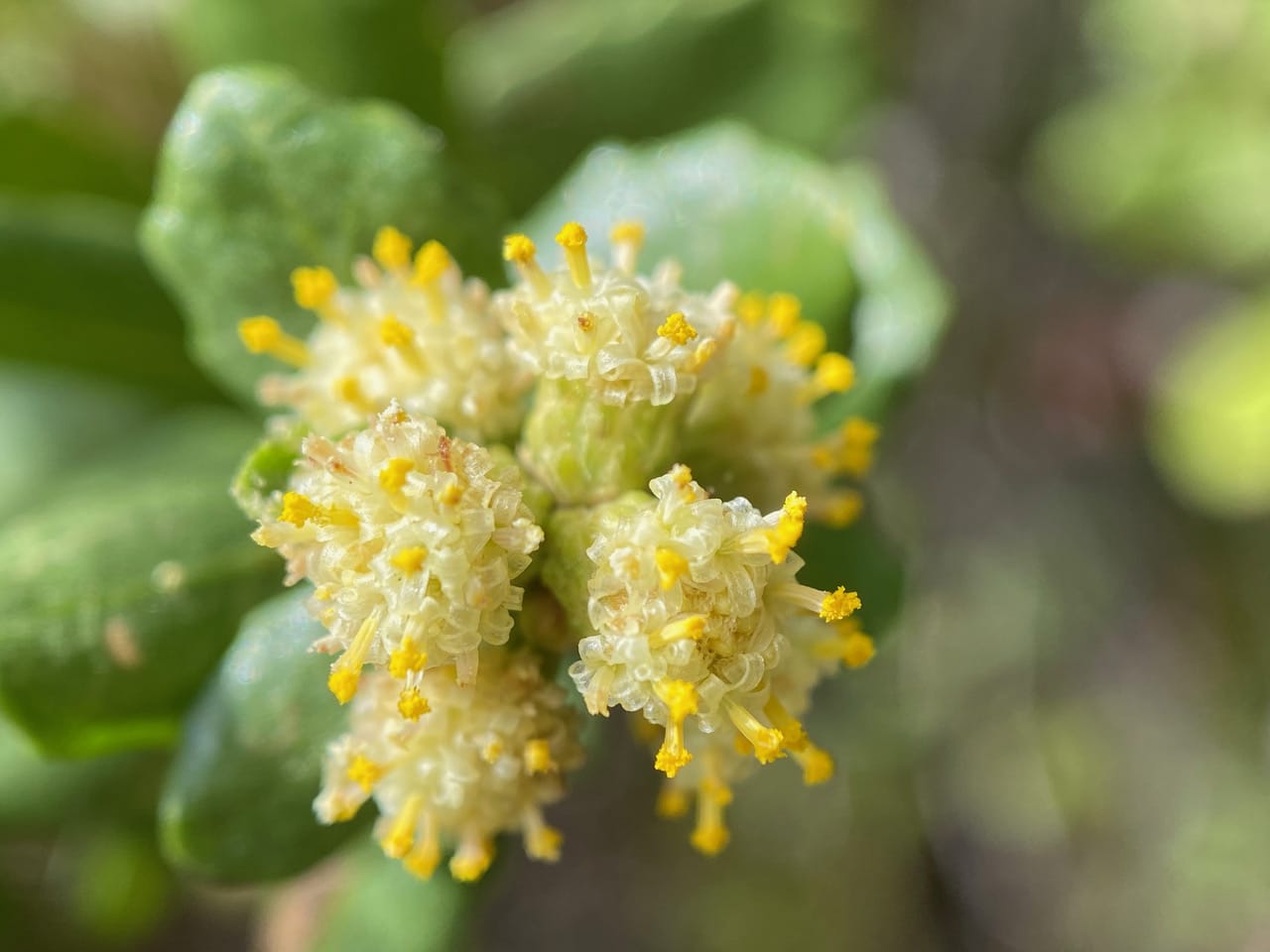
These are the flowerheads on a male Coyote Brush. Male florets consist of a tubular, cream-colored, five-lobed corolla, with five stamens forming a cylinder around the style of a sterile pistil. The calyx is reduced to a cluster of stiff hairs (the pappus) around the base of the corolla. Only male florets produce pollen. Insects visit the male flowers for both pollen and nectar.
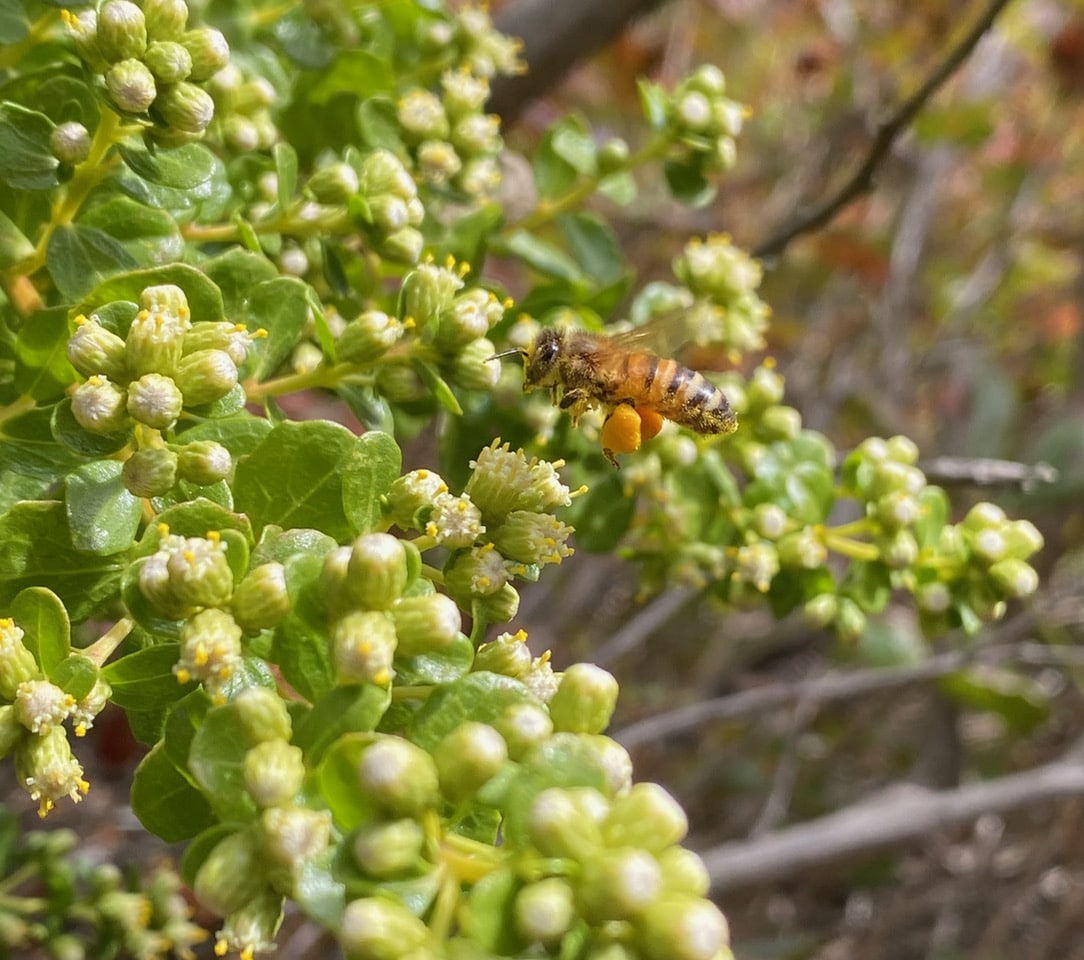
Smothered with sticky pollen, a Honey Bee is foraging on a male Coyote Brush. I watch her with awe while she tirelessly gathers pollen from a large shrub, the pollen loads on her hind legs growing larger and larger.
The pollen collecting apparatus in Apidae bees, which include honey bees and bumble bees, is commonly called a “pollen basket” or corbicula. This region is located on the tibia of the hind legs and consists of hairs surrounding a concave region. After the bee visits a flower, she begins to groom herself and brushes the pollen down toward her hind legs and packs the pollen into her pollen basket. A little nectar mixed with the pollen keeps it all together like putty, and the stiff hairs surrounding the pollen basket hold it in place. A honey bee can fly with a full pollen load that weighs as much as a third of her body weight.
.jpg)
Many years ago, a fellow docent at the Oakland Museum, a retired entomologist told me that every Honey Bee worker out foraging should be treated with respect – they are all little old ladies. Bud couldn’t have said it better. All Honey Bee foragers are female, and they are the oldest of their hive mates. How do honey bees get their job assignments within their social organization?
A bee’s job is, first of all, determined by its sex. Male bees, or drones, don’t do any work. Making up roughly 10% of the colony’s population, they spend their whole lives eating honey and waiting for the opportunity to mate with the queen. The queen mates with up to 20 drones and will store their sperm in her spermatheca for the rest of her life. That’s where male duties end. Female bees, known as worker bees, make up the vast majority of a hive’s population, and they do all the work to keep it functioning. Females are responsible for the construction, maintenance, and proliferation of the nest and the colony. When a worker bee emerges as an adult, she immediately starts cleaning the cell from which she hatched. Her first 3 days are spent cleaning cells to prepare them for the queen’s next round of eggs. Then her hormones kick in to initiate the next phase of work: nursing the young. The worker bee spends about a week nursing the brood, feeding larvae with royal jelly. Next, the worker bee enters the third phase, as a sort of utility worker, moving farther away from the nest’s center. Here she builds cells and stores food in the edge of the nest for about a week. A worker’s hormone shifts into the final phase of work at around 41st day: foraging. This work is the most dangerous and arguably the most important. It’s only done by older bees who are closer to death. As the worker bee approaches her fourth week of nonstop work, she senses her end of days, and removes herself from the hive, so as not the become a burden to the colony. If she dies in the hive, her hive mates would have to remove her corpse. Thus is the life of a female honey bee during the active seasons of spring and summer, compulsively working from the day she’s born until the day she expires.
So, don’t forget to tip your hat to the “little old ladies” you see in the garden!