

Pollinator Post 9/24/24 (1)

A calm, placid morning at Shoreline Park that is forecast to heat up soon.
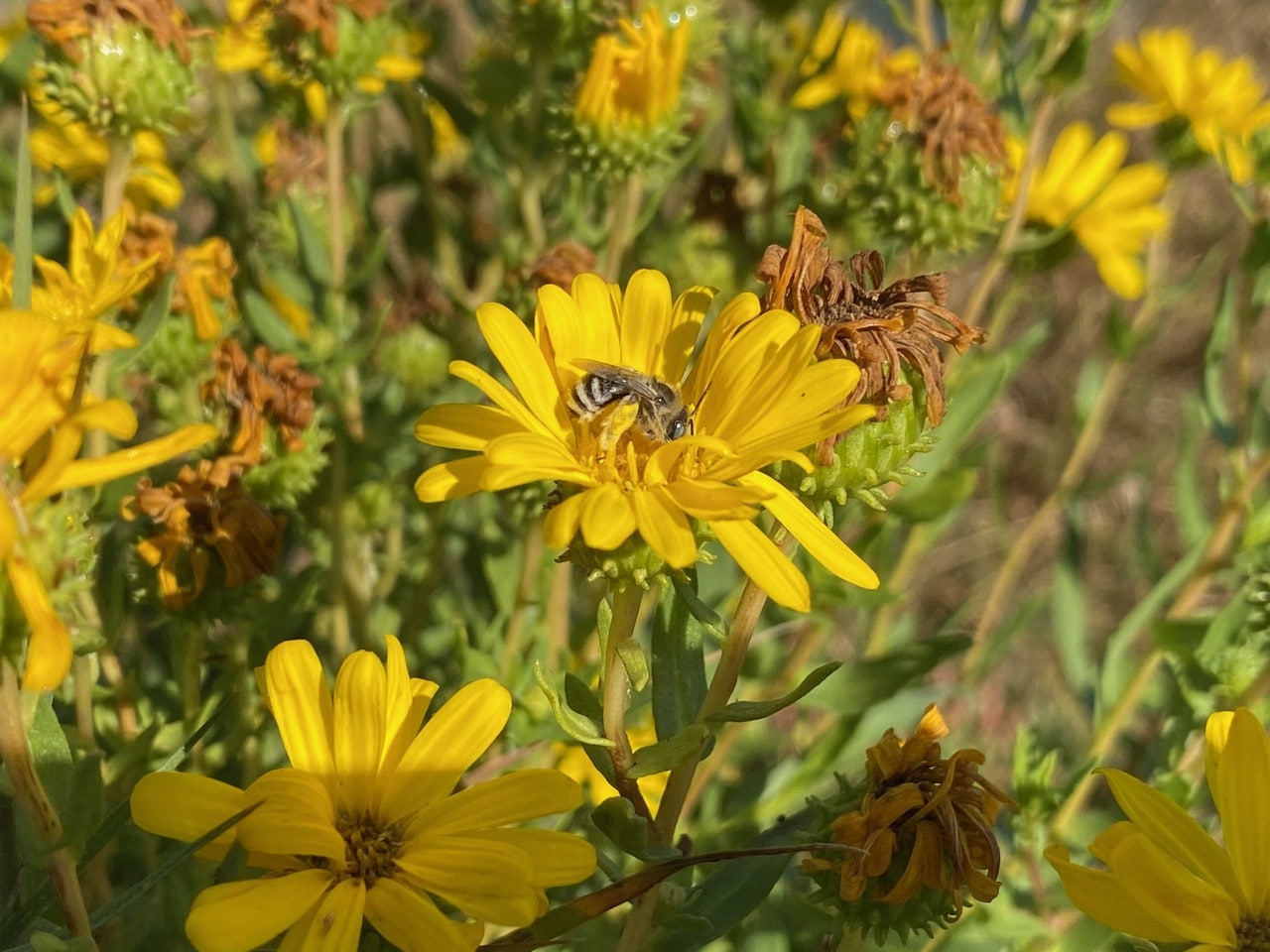
A female Summer Longhorn Bee, Melissodes sp. (family Apidae) is out foraging in a dense patch of Oregon Gumweed, Grindelia stricta by the water.
The Summer Longhorn Bees, Melissodes sp. (family Apidae) are medium to large bees, stout-bodied, usually with gray hair on the thorax and pale hair bands on the abdomen. Males usually have yellow markings on their faces and have very long antennae from which their common name is derived. They are active May to September, with peak flight in late June to early August. The females prefer flat, bare ground for digging their solitary nests, though they sometimes nest in aggregations. Pollen is transported in scopae on the hind legs. Pollen loads are often copious and brightly colored and thus very distinguishable. Melissodes are specialists on Asteraceae – females gather pollen from flowers of Aster, Bidens, Coreopsis, Cosmos, Encelia, Gaillardia, Helianthus, and Rudbeckia ssp.

A tiny wasp disappears behind an immature Grindelia flowerhead. From its minuscule size and the long ovipositor on the tip of its abdomen, I figure it must be a female parasitoid wasp in the superfamily Chalcidoidea (or simply Chalcid Wasp).


I find her in the shadows at the base of the flowerhead in an egg-laying position. The long “ovipositor” that we usually see at the tip of the abdomen of female parasitoid wasps are actually the sheath that protects the real ovipositor. During egg laying, the ovipositor is unsheathed and bent downward into the substrate into which the egg is injected.
After a while, the wasp reappears at the top of the flowerhead. iNaturalist has identified her as a member of the family Torymidae.
Torymidae is a family of wasps in the superfamily Chalcidoidea. Most species in this family are small with attractive metallic coloration, and females generally have long ovipositors. Many are parasitoids on gall-forming insects, and some are phytophagous (plant-eating) species, sometimes using the galls formed by other insects. Over 960 species in about 70 genera are found worldwide. They are best recognized in that they are one of the few groups of chalcidoidea in which the cerci are visible.
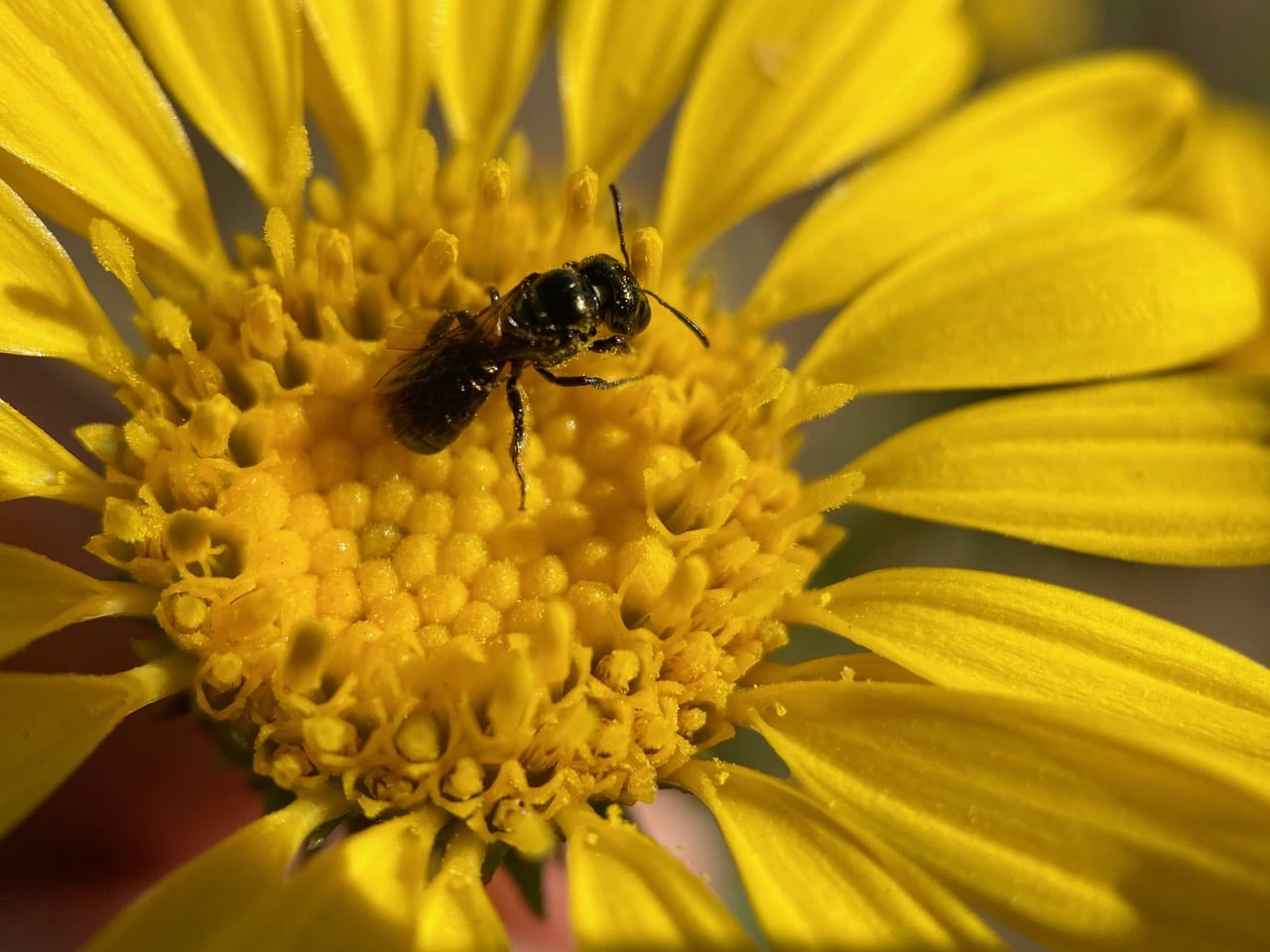
A Small Carpenter Bee, Ceratina sp. (family Apidae) is foraging on a Grindelia flowerhead.
The Small Carpenter Bee genus Ceratina is closely related to the more familiar, and much larger Carpenter Bees (genus Xylocopa). Ceratina are typically dark, shiny, even metallic bees, with fairly sparse body hairs and a weak scopa on the hind leg. The shield-shaped abdomen comes to a point at the tip. Some species have yellow markings, often on the face.
Females excavate nests with their mandibles in the pith of broken or burned plant twigs and stems. While many species are solitary, a number are subsocial. Both male and female carpenter bees overwinter as adults within their old nest tunnels, emerging in the spring to mate. In the spring, this resting place (hibernaculum) is modified into a brood nest by further excavation. The female collects pollen and nectar, places this mixture (called bee bread) inside the cavity, lays an egg on the provision, and then caps off the cell with chewed plant material. Several cells are constructed end to end in each plant stem.

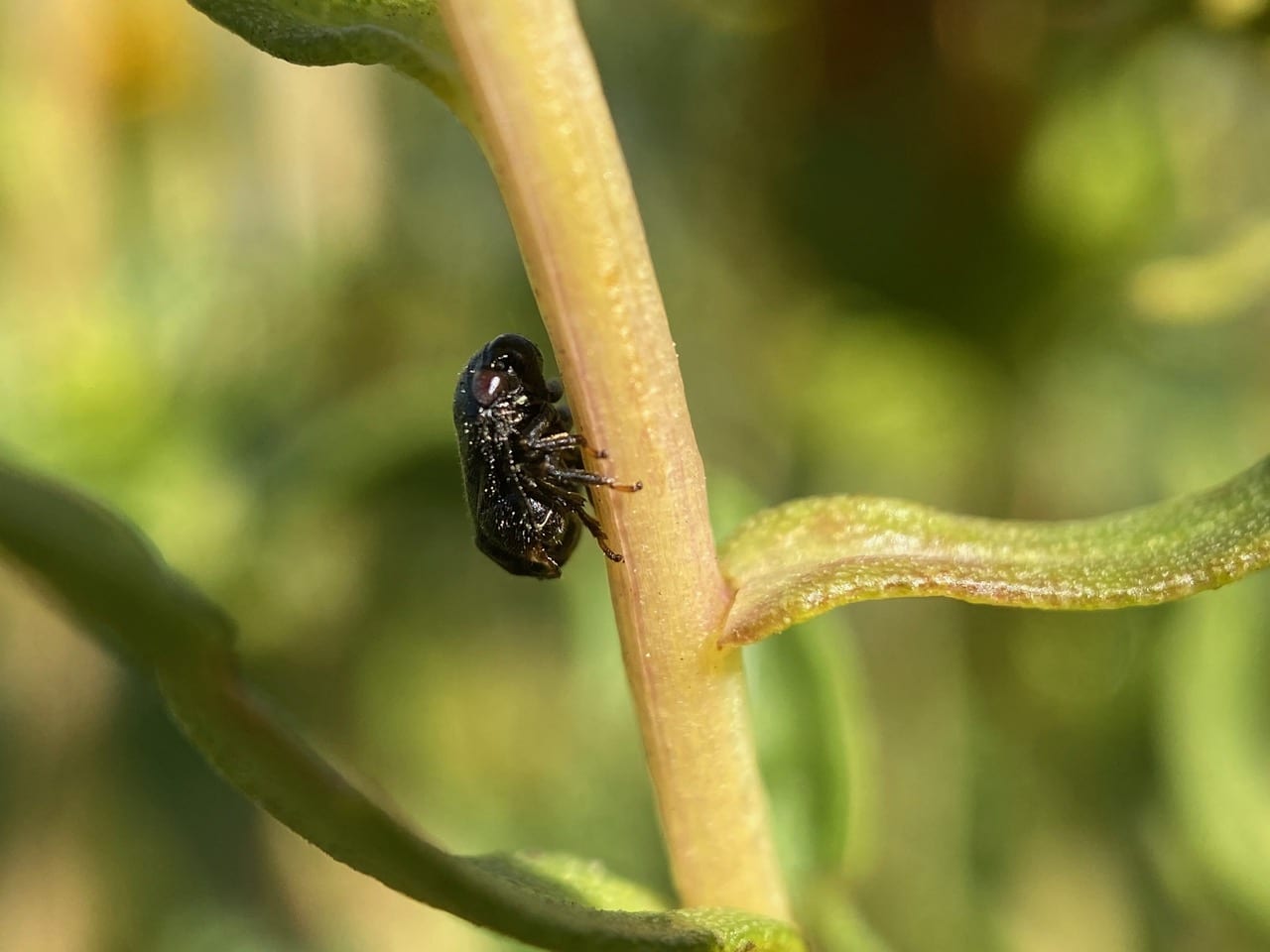
An adult Spittlebug (or Froghopper), Clastoptera lineatocollis (family Clastopteridae) is perched on the stem of Grindelia.
The Froghoppers (superfamily Cercopoidea) are a group of “true bugs” in the order Hemiptera. Adults are capable of jumping many times their height and length, giving them their common name, but many species are best known for their plant-sucking nymphs which produce foam shelters, and are referred to as “spittlebugs”. The superfamily currently consists of three families: the Aphrophoridae, Cercopidae, and Clastopteridae. The nymphs produce a cover of foamed-up plant sap visually resembling saliva, hence the common name. Whereas most insects that feed on plant sap tap into the nutrient-rich fluid from the phloem, the spittlebugs utilize the much more dilute sap flowing upward from the roots via the xylem. The insects’ digestive system contains symbiotic bacteria that provide them with the essential amino acids. The large amount of excess water that must be excreted and the evolution of special breathing tubes allow the young spittlebug nymphs to grow in the relatively protective environment of their foam shelters. The foam serves a number of purposes. It hides the nymph from the view of predators and parasites, and it insulates against heat and cold, providing thermal as well as moisture control. It also has an acrid taste that deters predators.
Froghoppers are champion jumpers among insects, out-performing even the fleas. The bug can leap the human equivalent of a skyscraper without a running start. It is the highest jumping insect proportional to body size. The muscles in its hind legs act like a “catapult” to release energy explosively.
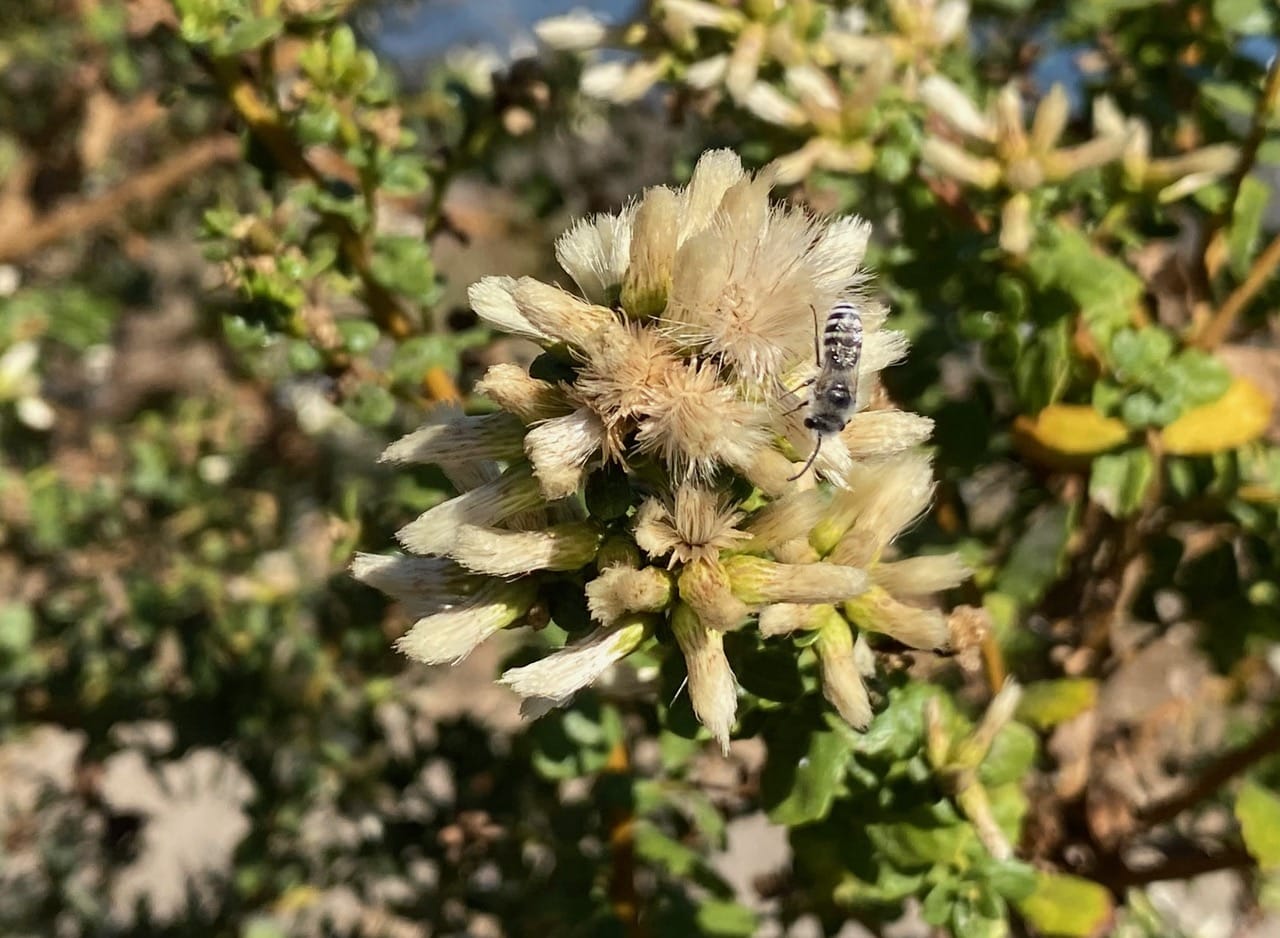
A small swarm of insects are dancing over the female Coyote Brush, Baccharis pilularis by the trail. In flight, they look almost bluish. But when one finally lands on an inflorescence, I recognize it as a male Cellophane Bee, Colletes sp. (family Colletidae) with black-and-white banded abdomen.
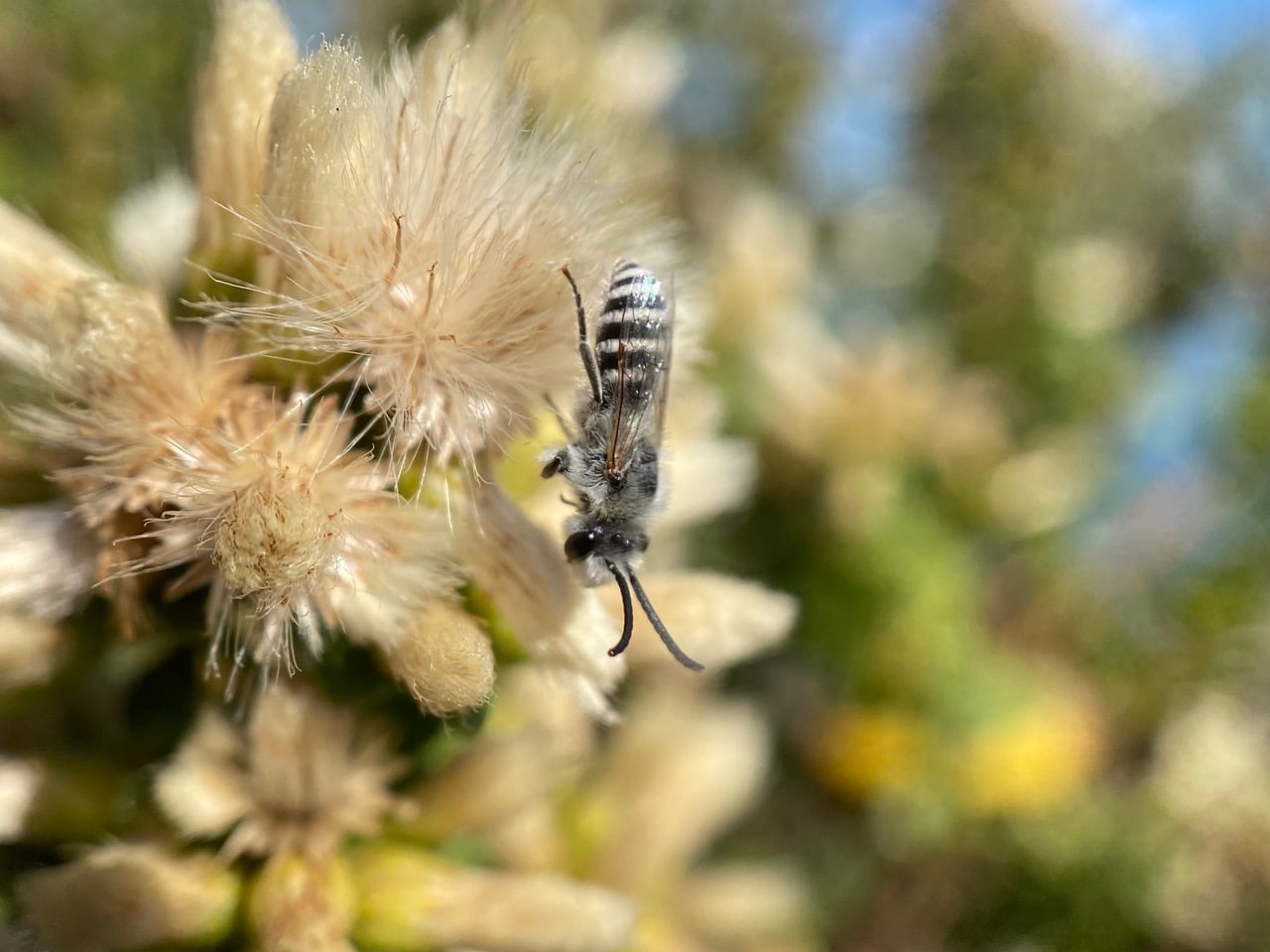
The male Colletes (family Colletidae) is hanging upside down grooming himself. It is a fuzzy bee with white hairs all over, especially on his face. As in most bees, males are identified by their longer antennae.
The bee family Colletidae includes generalists and specialists, and they are likely important pollinators of many wildflowers. All Colletidae in North America are solitary ground nesters, but some species nest in large aggregations. There are two major genera of Colletidae in North America: the Masked Bees (genus Hylaeus) and Cellophane Bees (genus Colletes). The most obvious shared characteristics of Colletidae is also the hardest to see: their short tongue. The eyes of Colletes are angled (rather than being parallel), making the face slightly heart-shaped.
The genus name Colletes means “one who glues”, referring to their habit of applying a glue- or cellophane-like lining to the walls of nest cells, using their specialized tongues. This lining gives rise to their common names: cellophane bees, polyester bees, and plasterer bees. Colletes tongue is unique: short, flat, and forked at the tip. Colletes line their nests with a distinctive cellophane-like substance made from saliva and secretions from the Dufour’s gland on the abdomen. Using their specialized tongue, they paint the walls with saliva, then with secretions from the Dufour’s gland, they add a coat of varnish. This creates a clear covering that is strong, durable, and resistant to mold and water.
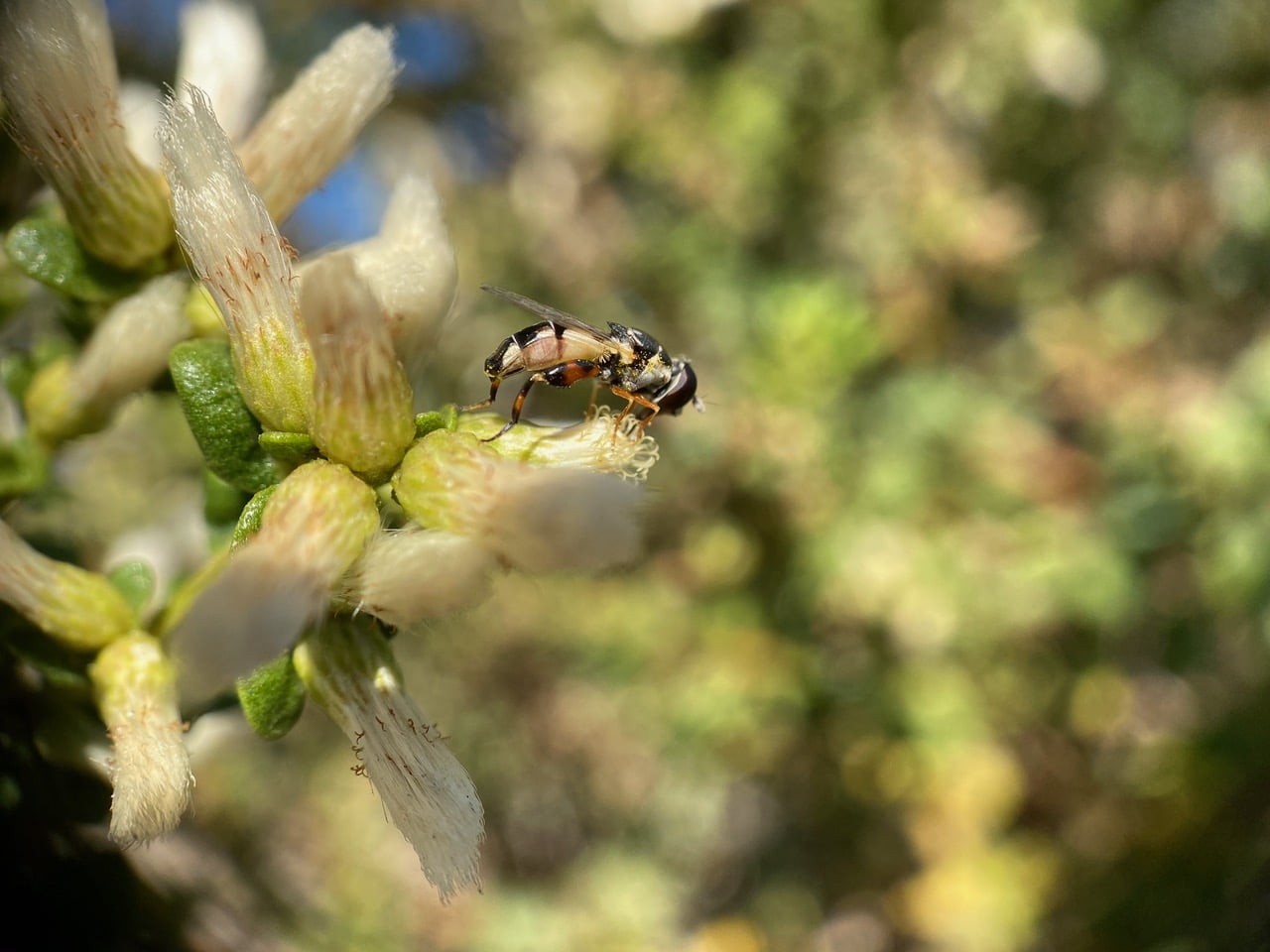
A hoverfly is perched on a flowerhead of female Coyote Brush, sipping nectar. It looks familiar – a Thick-legged Fly?
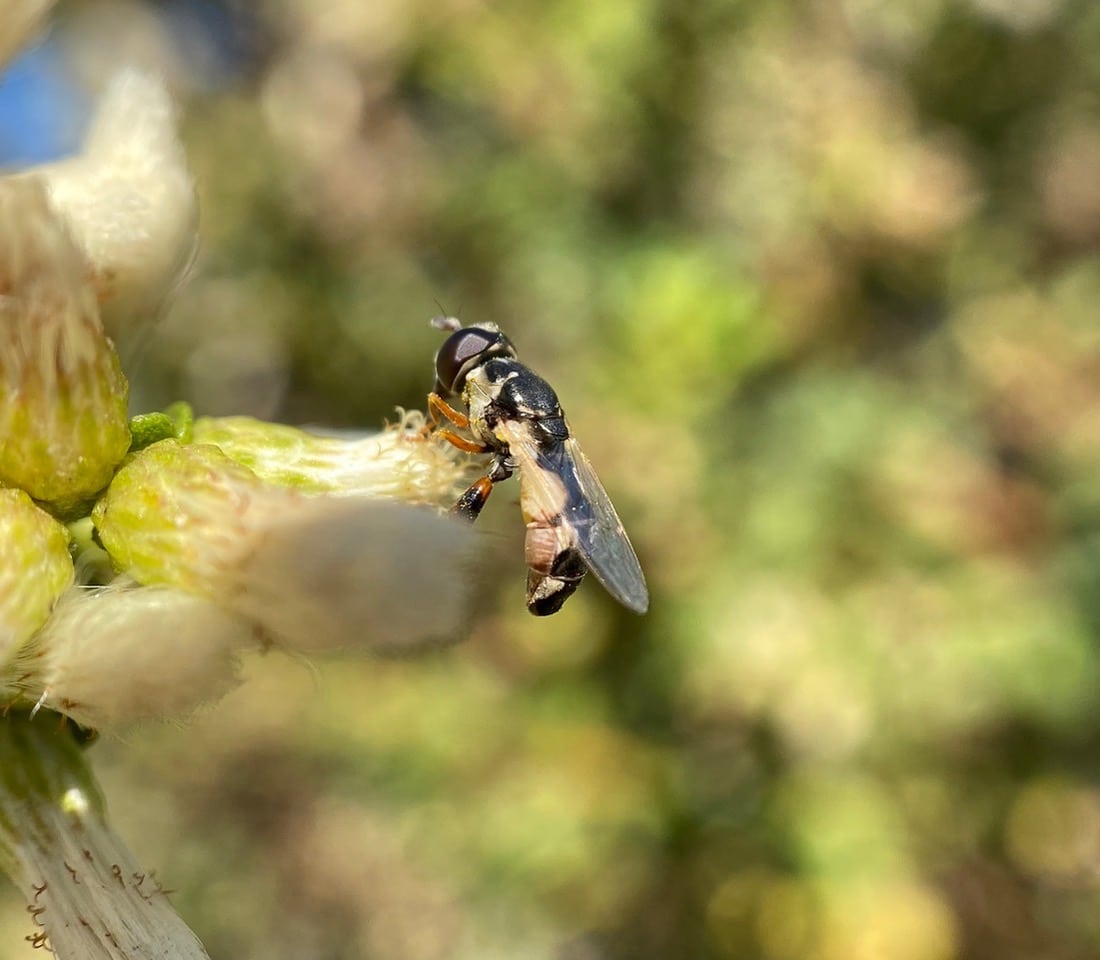
Its abdomen is rather distended. A gravid female? There seems to be more white markings on the back than the regular Thick-legged Hoverfly, Syritta pipiens.
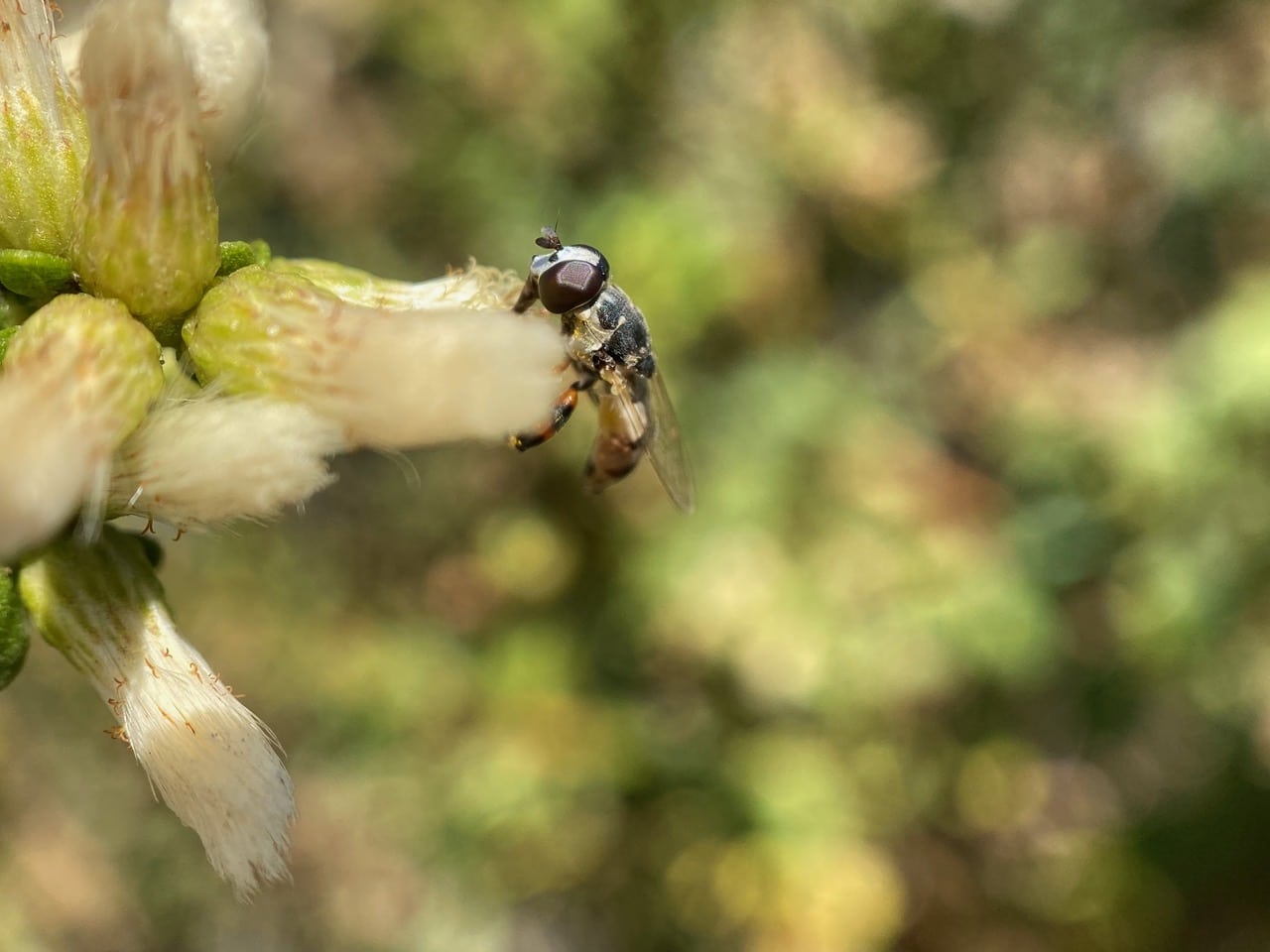
Yep, a female. It is easy to distinguish the genders of hoverflies in the field – by the placement of their eyes. Males have holoptic eyes that meet along a line on top of their head, whereas in the females there is a gap between the eyes.
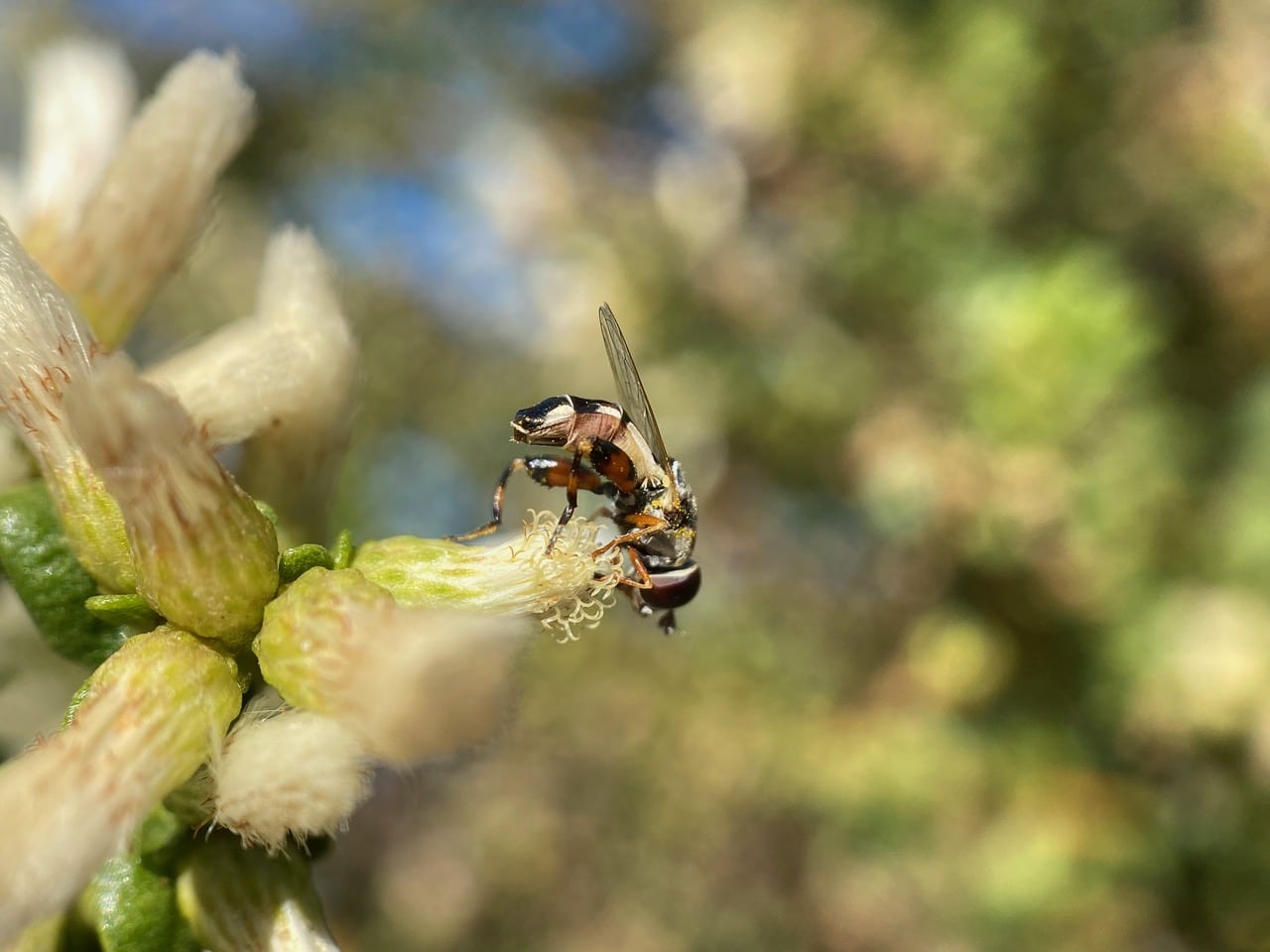
She has the enlarged femora of Syritta.
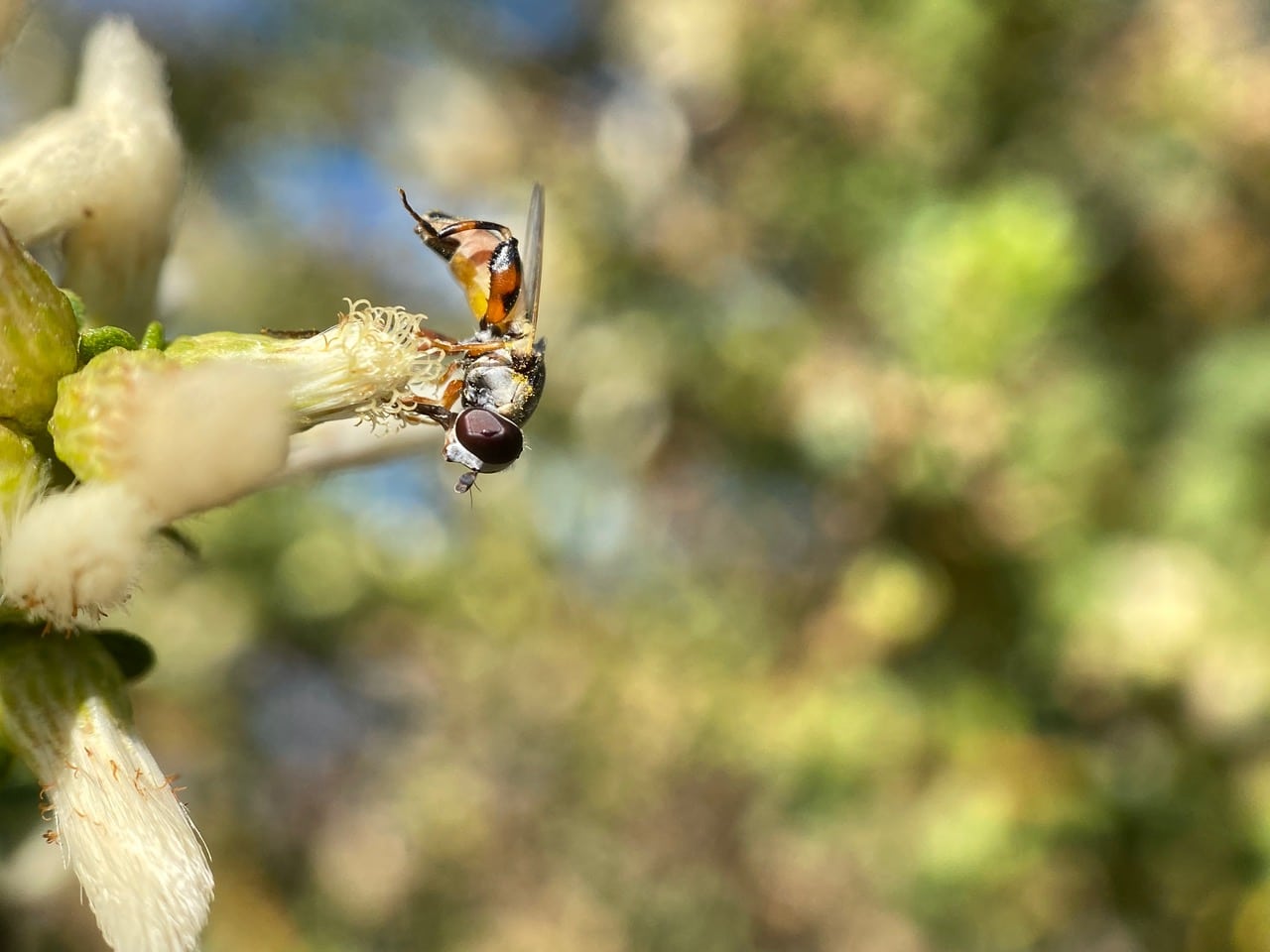
Here’s a clear view of the fly’s hind leg.
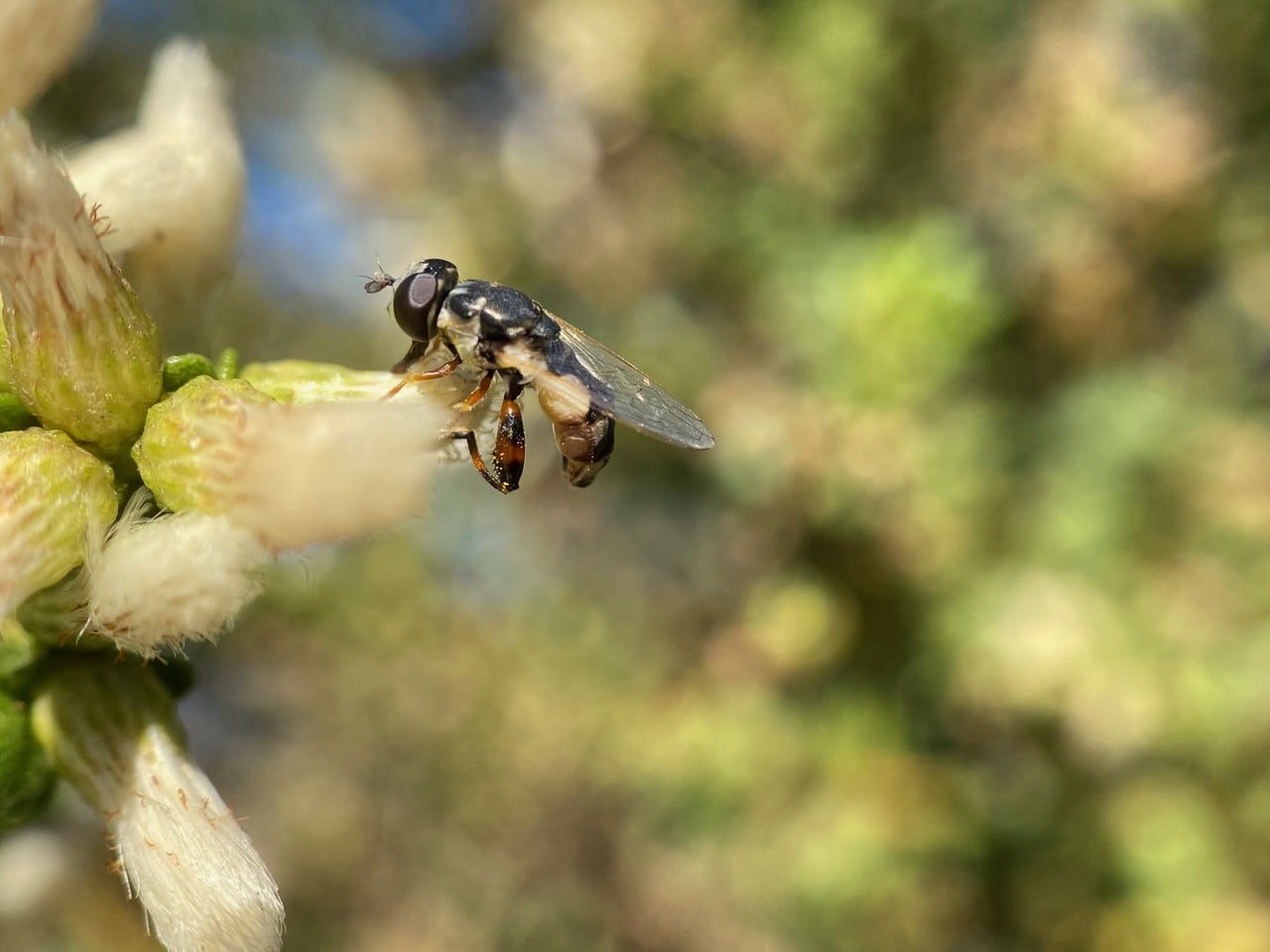
iNaturalist has helped identify the fly as the Peg-legged Compost fly, Syritta flaviventris (family Syrphidae).
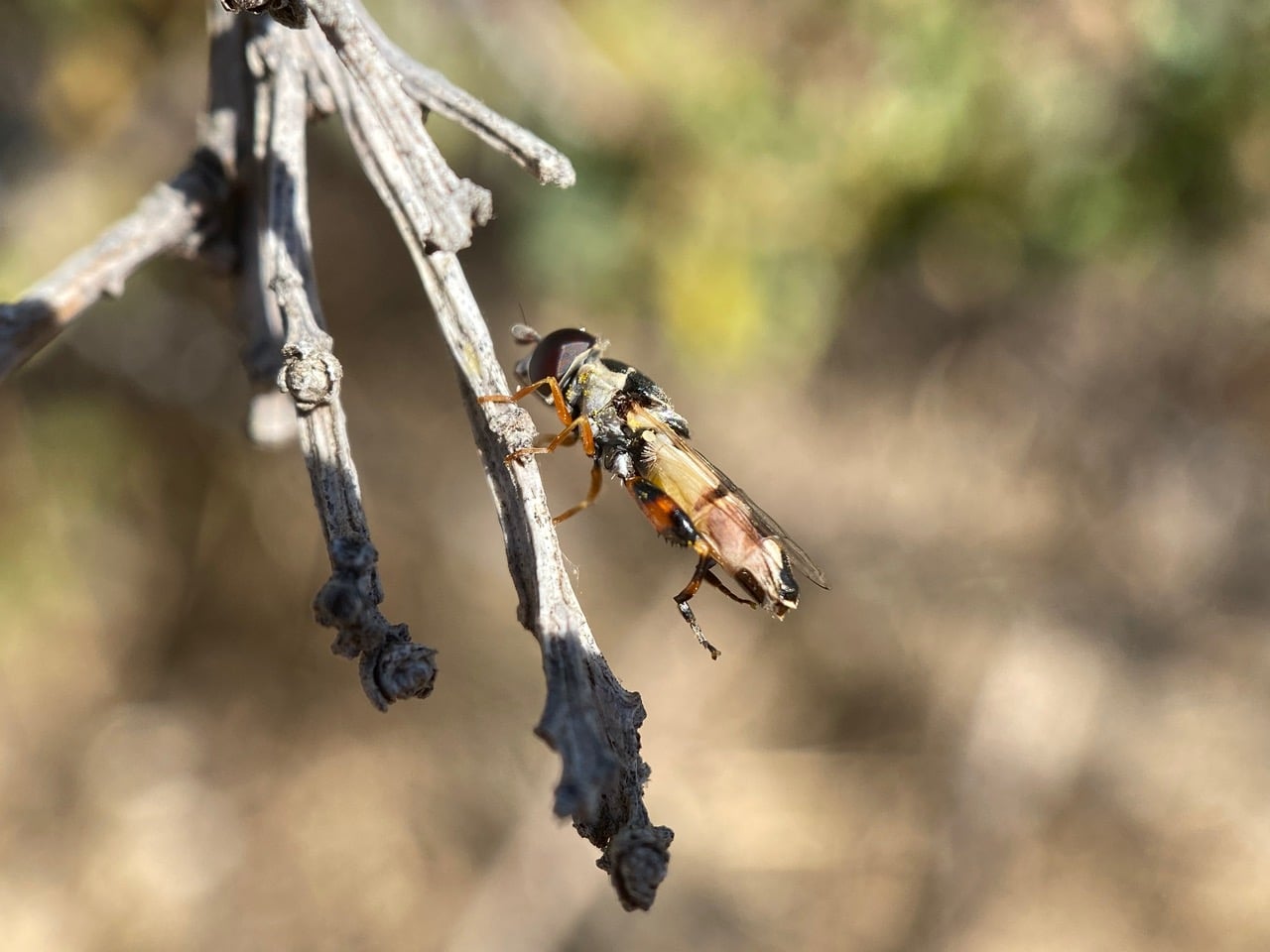
The fly lands on a twig and proceeds to groom herself, brushing her abdomen and wings with her hind legs. Why the name “peg-legged”? Since this is a female, it lacks the distinctive feature that gives rise to the species’ common name. Males have a large peg at base of the femur.
The Peg-legged Compost Fly, Syritta flaviventris (family Syrphidae) is a hover fly native to Europe and Africa. It was introduced to the United States in the 1990’s. The species is very similar to the Thick-legged Hover Fly, Syritta pipiens, also native to Europe. Both species have an enlarged hind femur, which distinguishes the genus Syritta. Adults are low-flying and are rarely seen flying higher than a meter from the ground. The larvae and puparia are found in damp decaying plant matter, also in animal and human manure. Their preferred habitat is a moist to damp environment, with good vegetation growth. Adults visit a wide variety of flowers for pollen and nectar.

I stop by a Bristly Oxtongue, Helminthotheca echioides (formerly genus Picris) that is heavily infested with dark aphids. There’s usually thriving insect life wherever there are aphids. I can already see a Convergent Lady Beetle, Hippodamia convergens (family Coccinellidae). Both adult and larvae of Lady beetles are voracious predators of aphids.
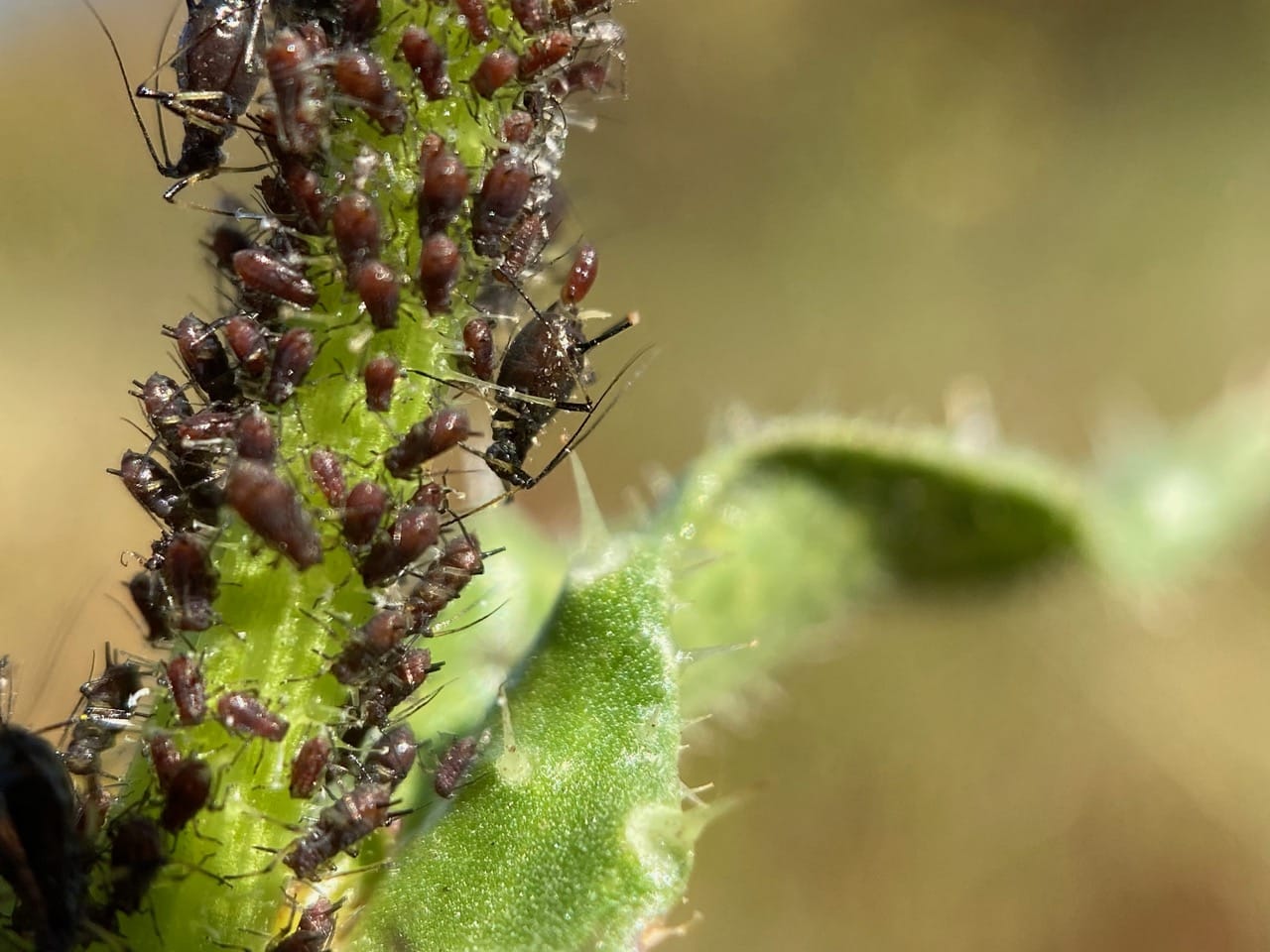
A big mama aphid is giving birth to a baby!
Aphids are small sap-sucking insects in the order Hemiptera. A typical life cycle involves flightless females giving live birth to female nymphs, – who may also be already pregnant, an adaptation called telescoping generations – without the involvement of males. Maturing rapidly, females breed profusely so that the population multiplies quickly. Winged females may develop later in the season, allowing the insects to colonize new plants. In temperate regions, a phase of sexual reproduction occurs in the autumn, with the insects often overwintering as eggs.
The life cycle of some species involves an alternation between two species of host plants. Some species feed on only one type of plant, while others are generalists, colonizing many plant groups. Some ants have a mutualistic relationship with aphids, tending them for their honeydew and protecting them from predators.
Aphids usually feed passively on phloem of plants. Once the phloem vessel is punctured, the sap, which is under pressure, is forced into the aphid’s food canal. Aphids produce large amounts of a sugary liquid waste called “honeydew”. A fungus called sooty mold can grow on honeydew deposits that accumulate on leaves and branches, turning them black.
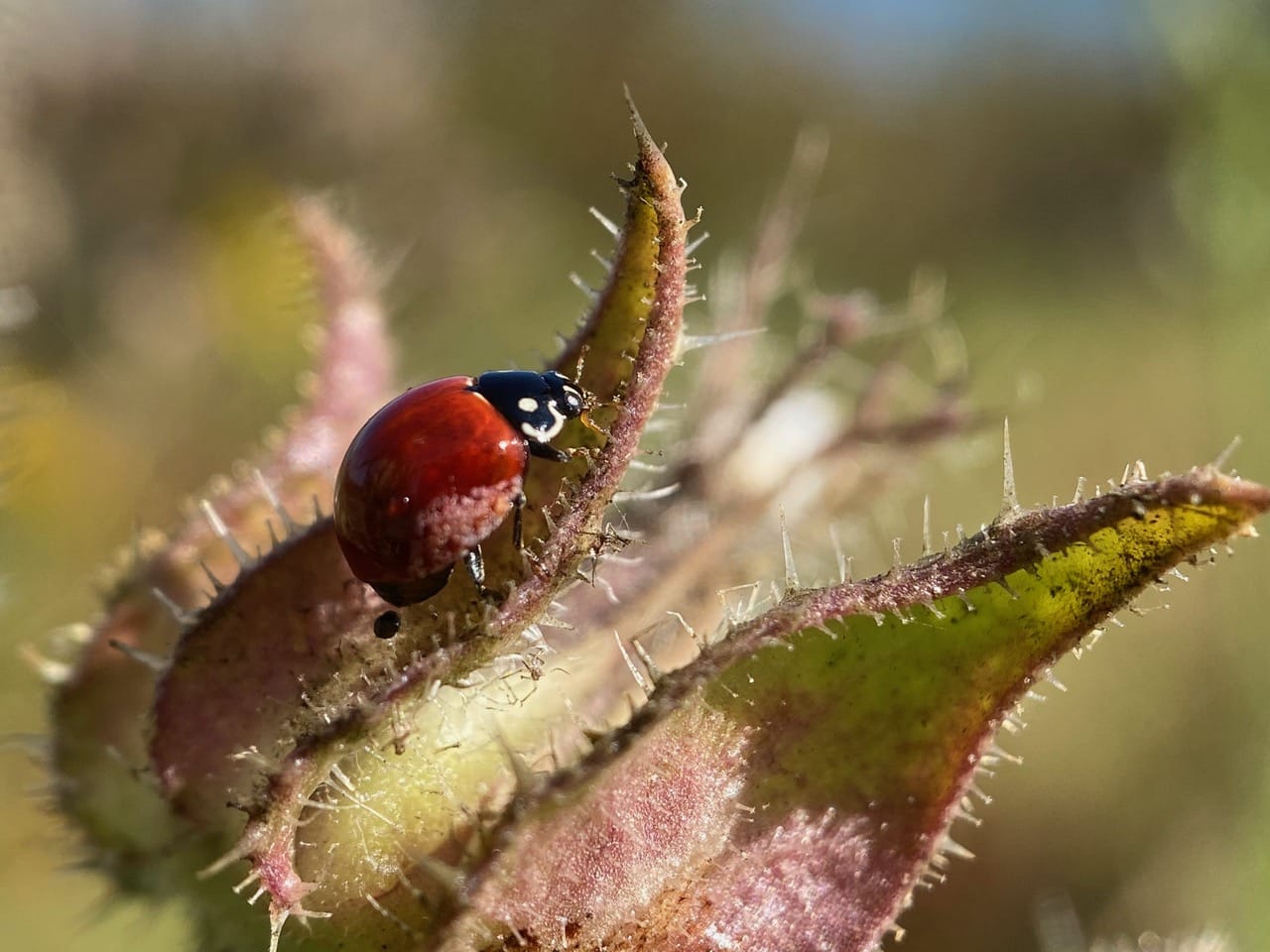
Here’s a different species of Lady Beetle on the spiny phyllary of a Bristly Oxtongue flowerhead. It is the Spotless Lady Beetle, Cycloneda sanguinea (family Coccinellidae).
The Spotless Lady Beetle, Cycloneda sanguinea is a widespread species of lady beetle in the Americas. It is is large lady beetle with red, unspotted elytra (wing covers) ranging from 4-6.5 mm long. The black and white marks on the head and pronoun are very distinctive, and they are also gender-specific. These lady beetles are very often found feeding on aphids on milkweeds, but also occur on a number of other plants.
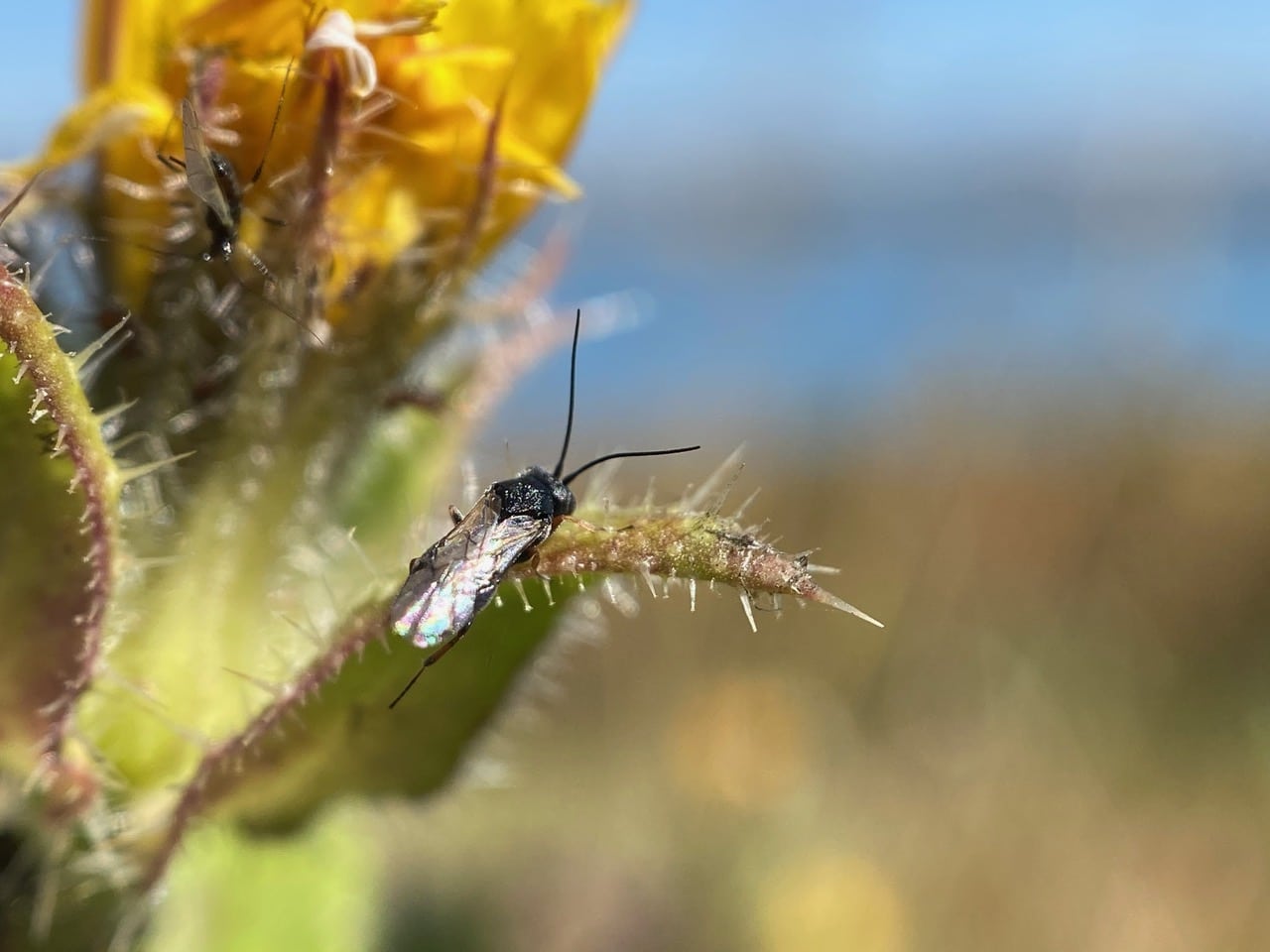
A small wasp with long antennae lands on a spiny phyllary of Bristly Oxtongue.
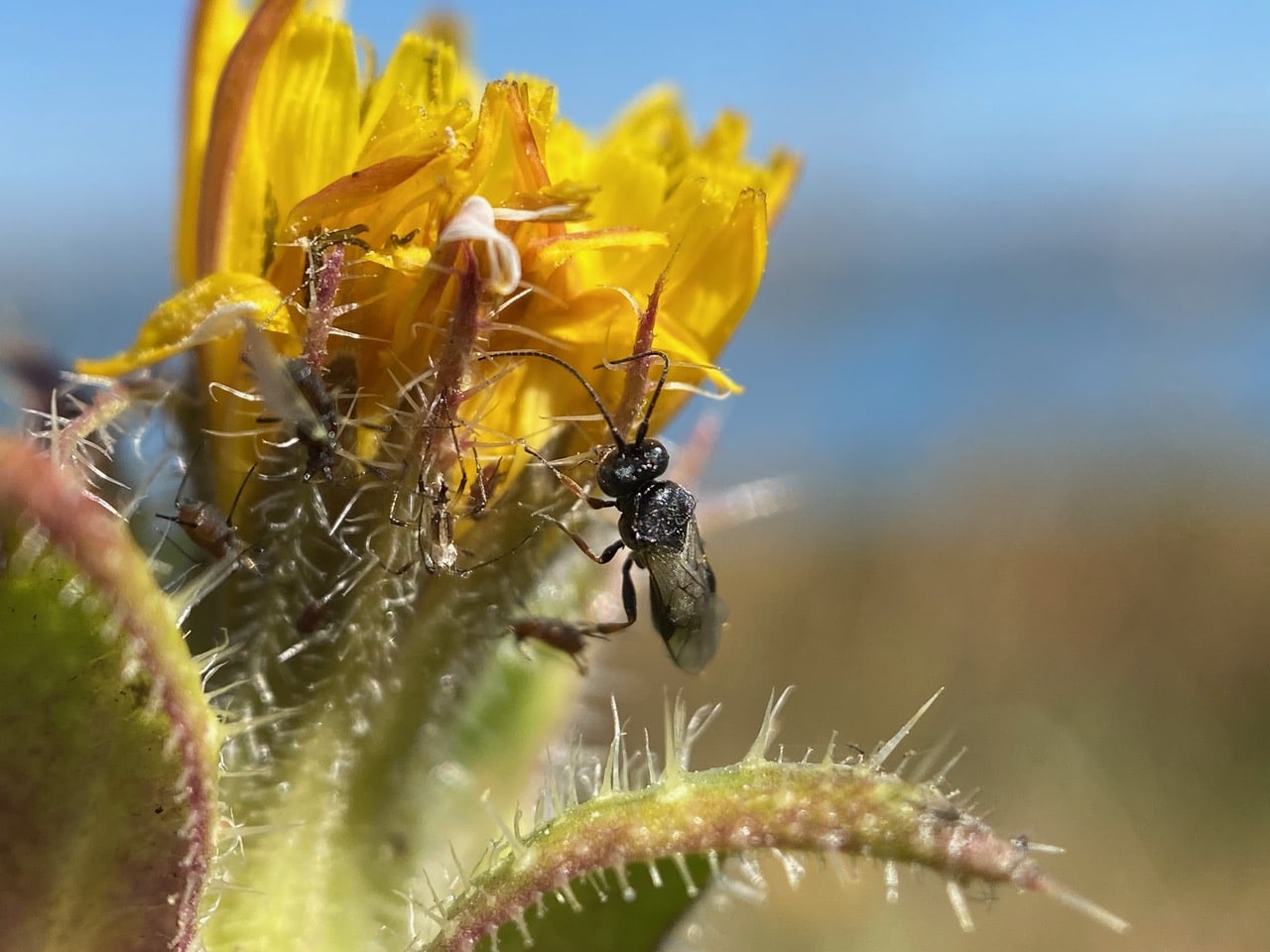
The wasp probes the base of the spent flowerhead with its long antennae, seeming to be searching for something. iNaturalist has suggested it is a Braconid Wasp, Chelonus sp. (family Braconidae)
The Braconidae are a family of parasitoid wasps. After the closely related Ichneumonidae, braconids make up the second-largest family in the order Hymenoptera, with about 17,000 recognized species. Females often have long ovipositors to lay eggs on or in their hosts. The larvae of most braconids are internal primary parasitoids of other insects, especially the larval stages of Coleoptera, Diptera, and Lepidoptera. Generally, the braconid life cycle begins when the female wasp deposits her eggs in the host insect, and the braconid larvae develop in the host body, eating it from the inside out. When the wasp larvae are ready to pupate, they may do so in or on the host insect. The new generation of adult braconid wasps emerges from their cocoons and begins the life cycle again.
Braconid wasps use a remarkable weapon to disable the defenses of their host insects – a virus. These parasitic wasps coevolved with polydnaviruses (read poly-DNA-virus), which they carry and inject into the host insects along with their eggs. The virus attacks the host’s immune system and renders it unable to encapsulate the wasp egg; it also halts the host’s development, so it can’t pupate and transform into an adult. Amazingly, the “bracovirus” also changes the host’s metabolism so that it can survive longer without food or water – thus ensuring a nurturing environment for all the young wasps to come.
Chelonus species tend to be heat and drought tolerant and are common in meadow, prairie, and grassland habitats, but may be found in any vegetated habitat where concealed-feeding lepidoptera are present. Chelonus larvae feed mainly on larvae of moths in the superfamilies Tortricoidea and Pyraloidea. The host larvae feed in concealment, such as in stems, buds, or fruit, or by constructing their own concealment, such as by rolling, folding, or tying leaves with silk.