

Pollinator Post 9/22/24 (2)
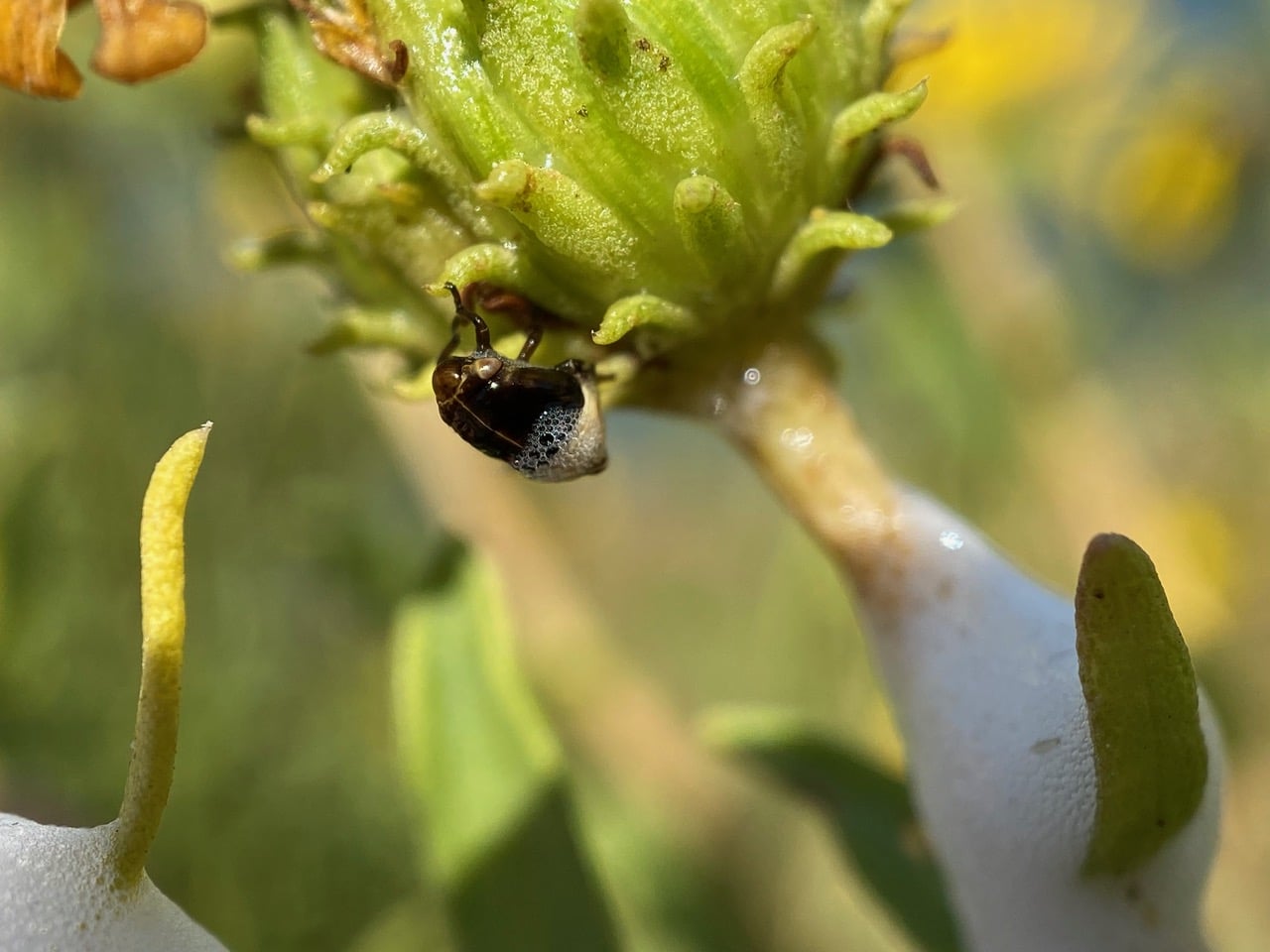
11:59:46 am
Still wet with frothy bubbles, a Spittlebug nymph, Clastoptera lineatocollis (family Clastopteridae) has crawled out of its foamy shelter on a Grindelia stem. It is heading up the involucre of the faded flowerhead above. Is it looking for a place to eclose? Eclosure is the emergence of an adult insect from a pupa or a nymph, or the hatching of a larva from the egg.
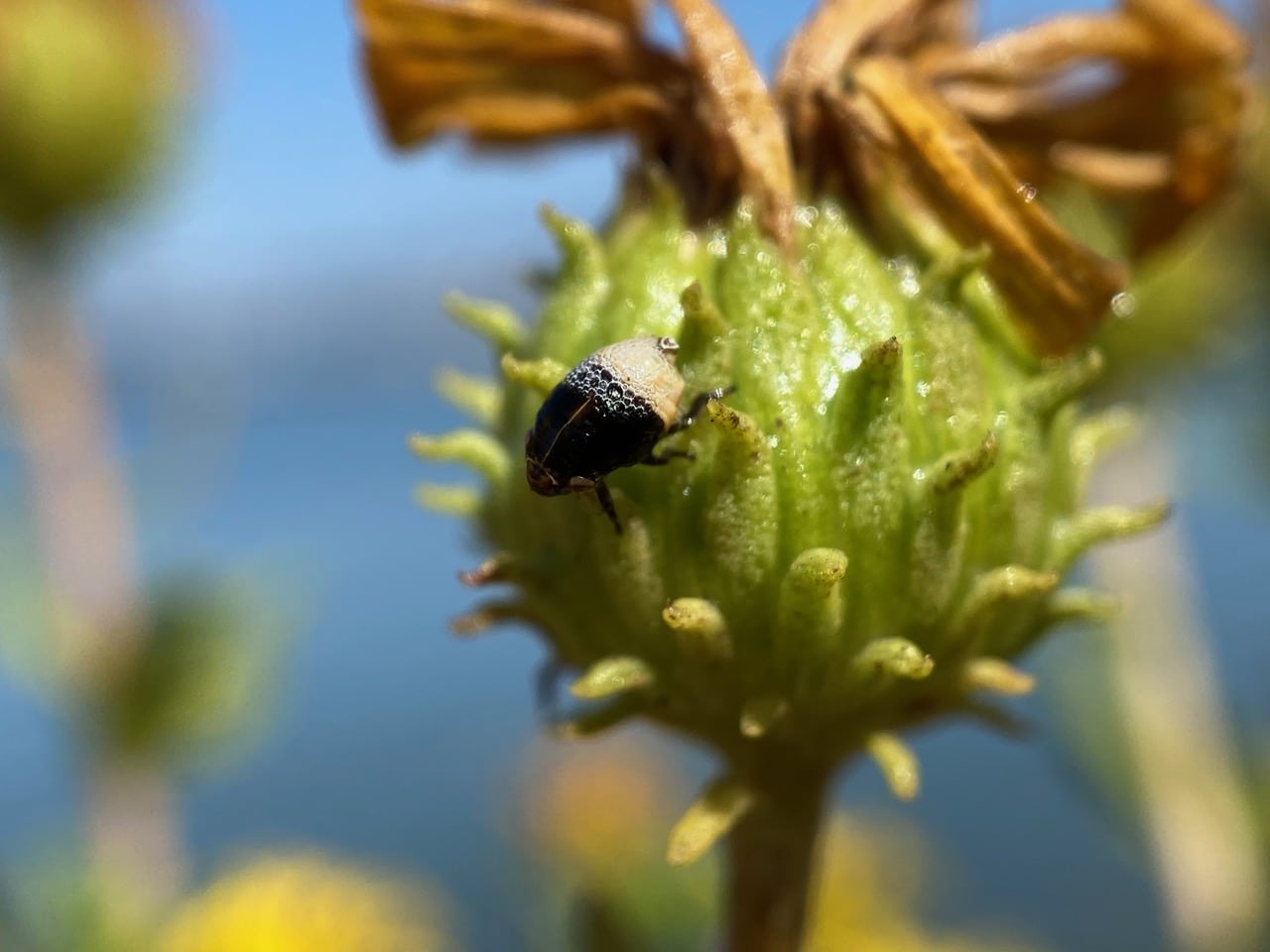
12:01:21 pm
The nymph has a pale rear end. Final ecdysis is already in progress. The pale butt belongs to the adult that has broken through the black exoskeleton of the nymph. I am rather surprised that the nymph is still active at this stage.

12:01:25 pm
You can see the structure at the tip of the abdomen that served as a snorkel when the nymph lived in its foam shelter.
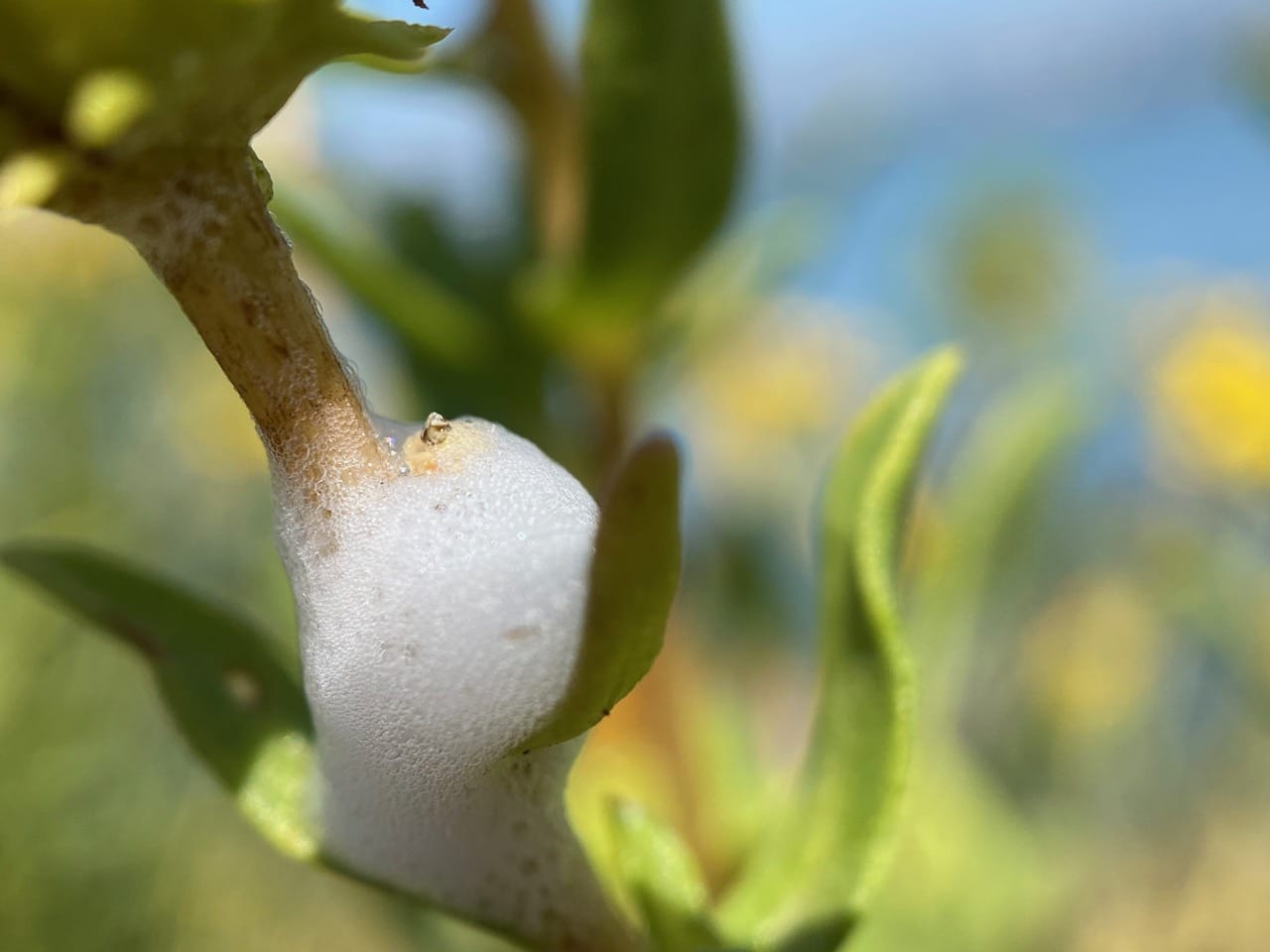
12:03:51 pm
When I look next, I am surprised to see the nymph entering its foamy home. I am not in time to capture the moment, but here you can see that the nymph has submerged itself, leaving only its “snorkel” exposed to air. What is going on? Why does a nymph ready to eclose wander around? And return to its foam shelter?
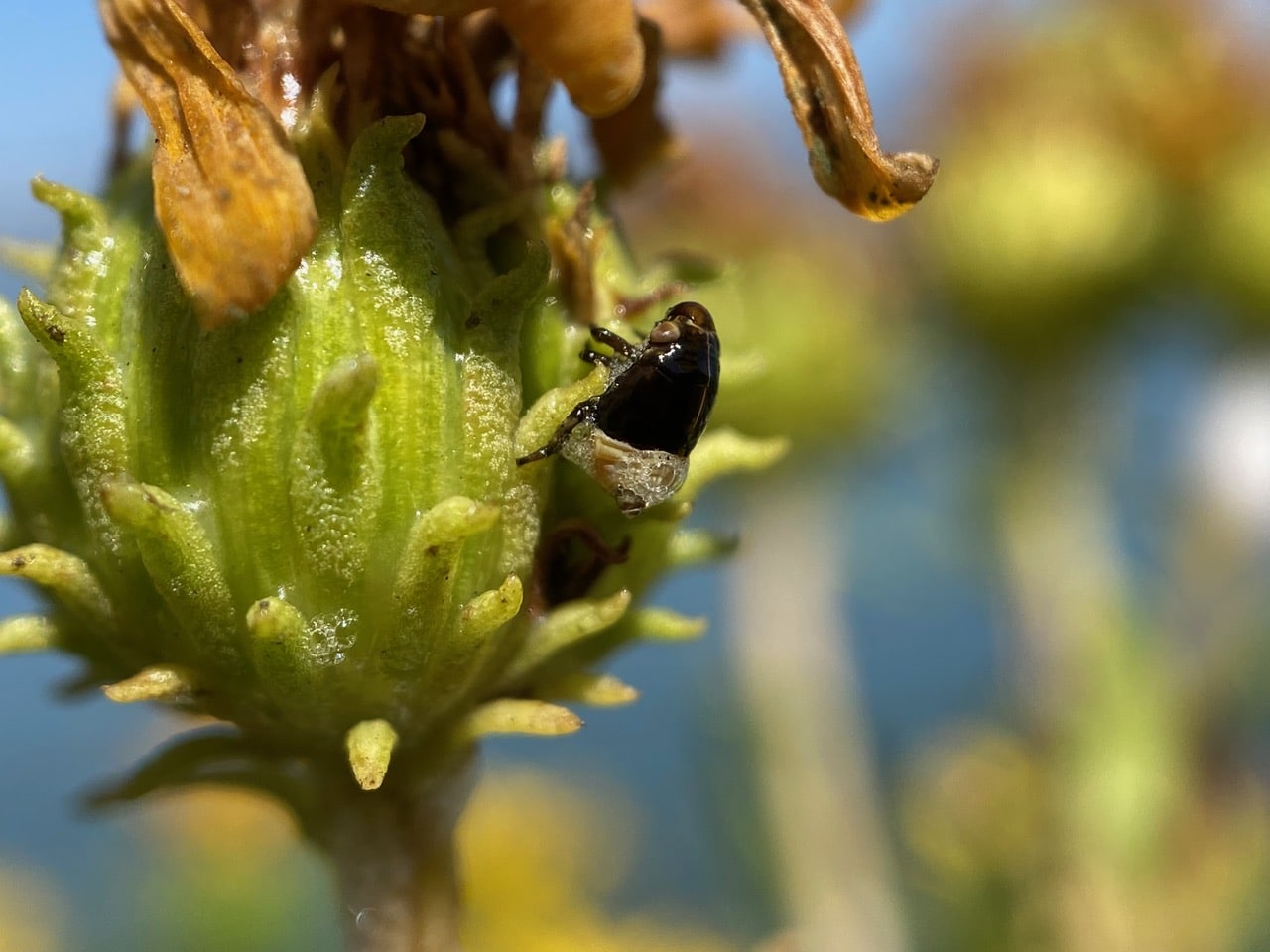
12:23:32 pm
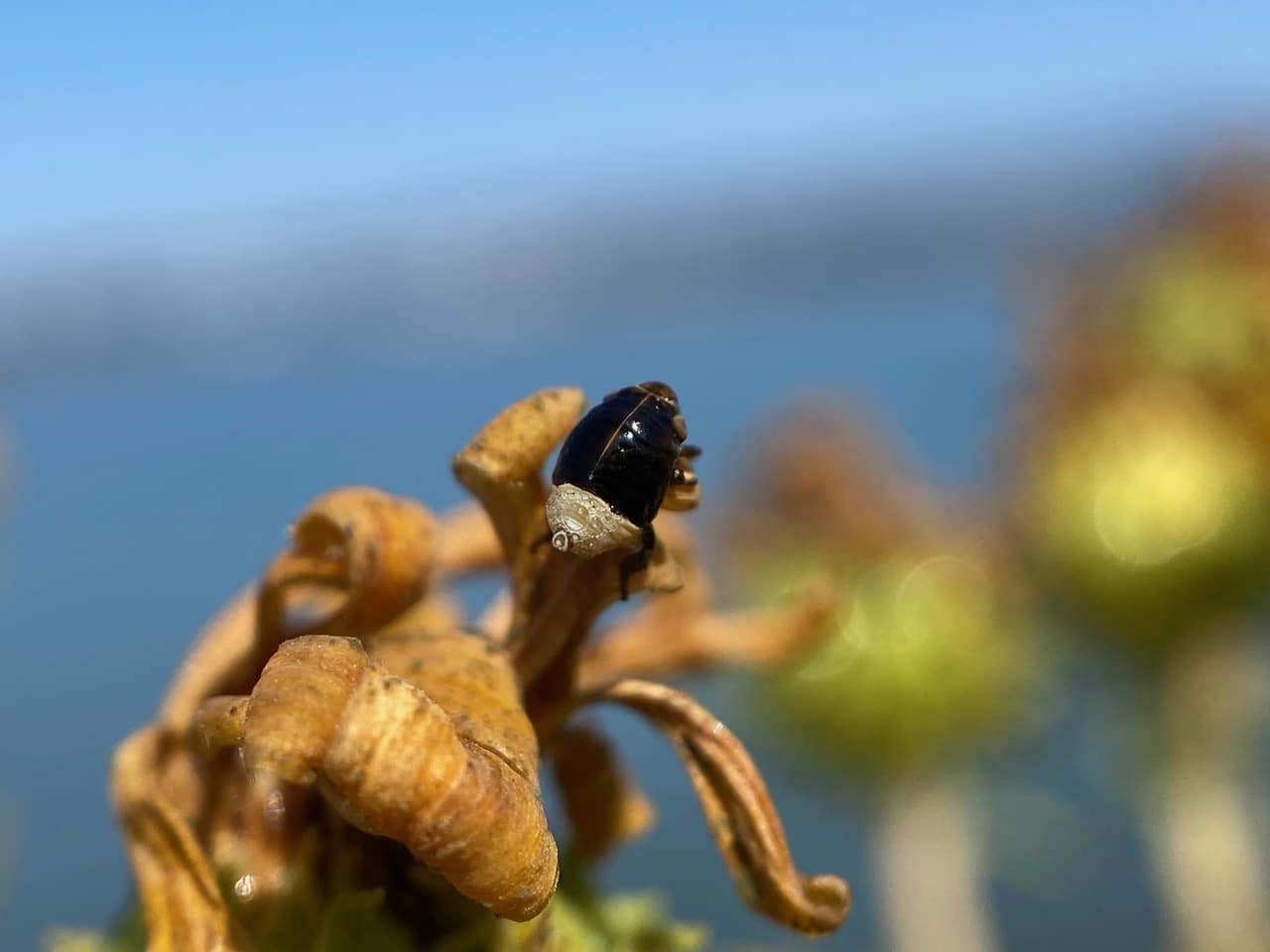
When I check back 20 minutes later, the nymph is up on the involucre again!
12:24:35 pm
The nymph climbs up to the very top of the faded flowerhead, onto the withered petals.

12:24:42 pm
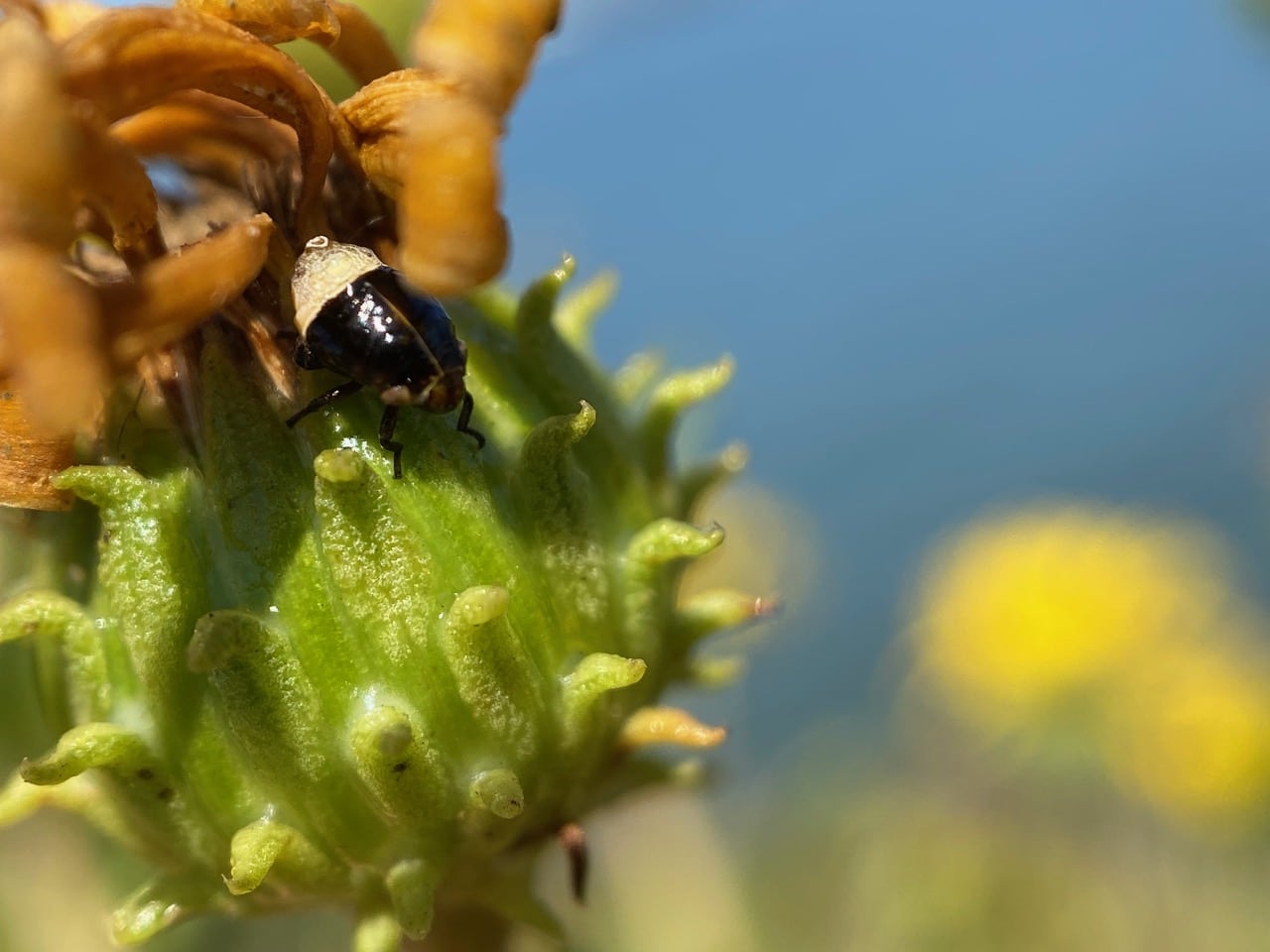
The spittlebug nymph heads down the flowerhead.
12:26:10 pm

12:30:53 pm
A few minutes later, the nymph is back on the stem, perched motionless above its foam shelter. I have a feeling that it is about to eclose. Unfortunately, I have to leave, and will miss the whole process. Maybe I’ll see it as an adult tomorrow?
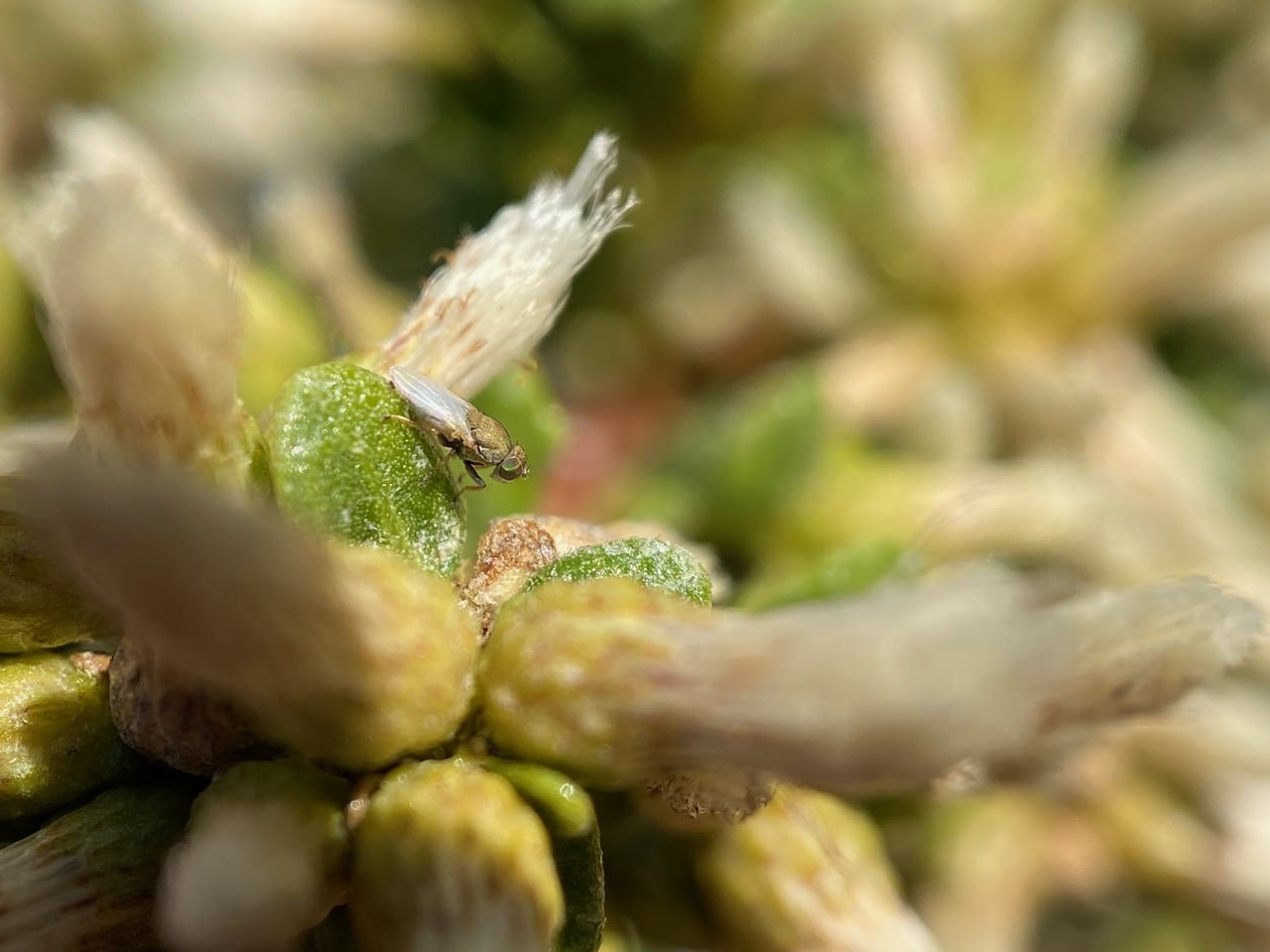
A Shore Fly, Hecamede sp. (family Ephydridae) is perched among a cluster of flowerheads of a female Coyote Brush, Baccharis pilularis.
The Shore Flies (family Ephydridae) are minute to small (2.5-9 mm), dark colored flies that are found in aquatic/semiaquatic habitats such as salt marshes, tidal salt pools, and alkaline lakes of arid regions. Along the shores of large lakes, they may rise in clouds from the ground. Larvae of most species filter microorganisms (bacteria, unicellular algae, yeasts) from the surrounding semiliquid medium, although some prefer dead and decaying animal tissue, or excrement.
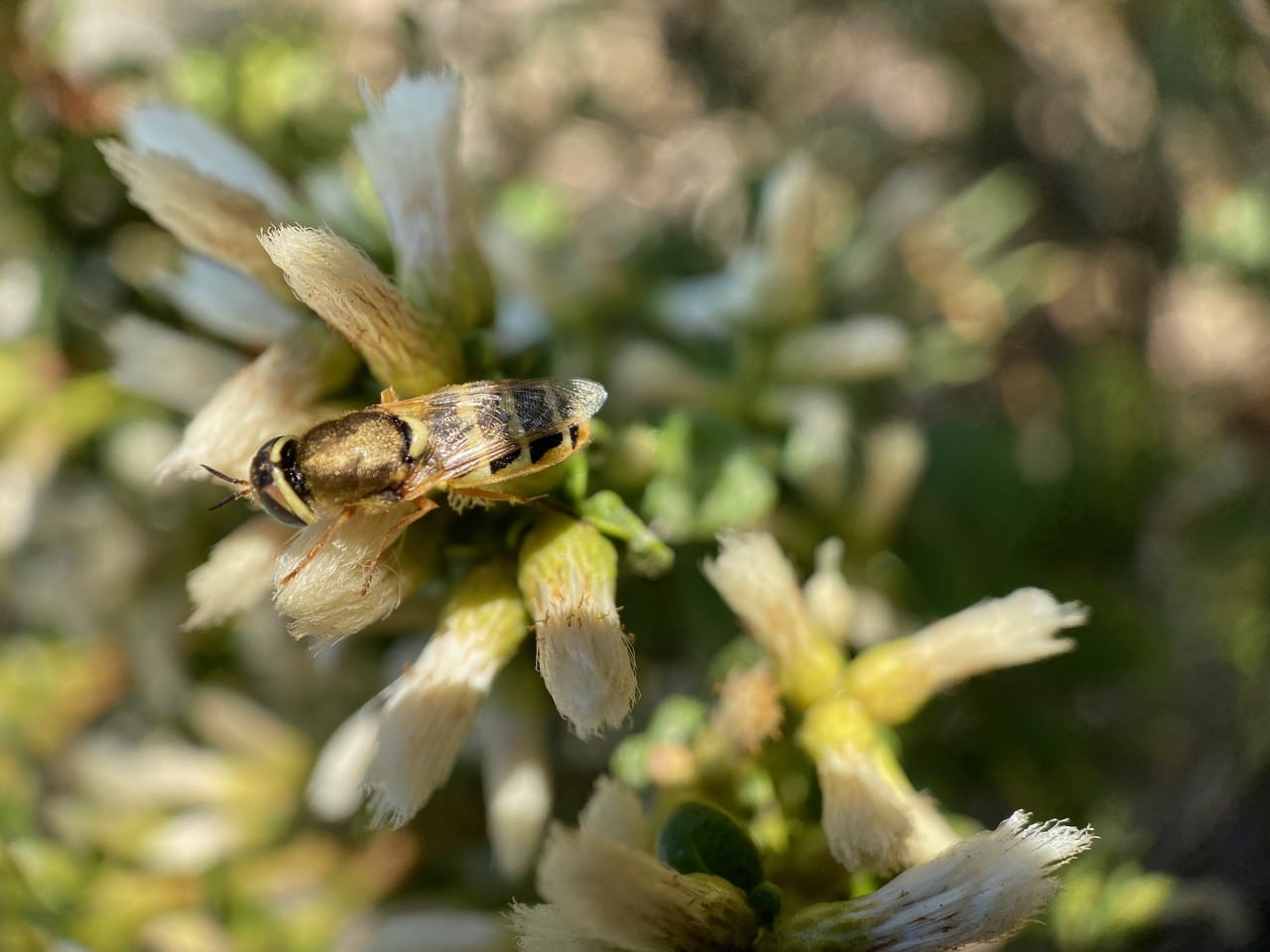
A Soldier Fly, Odontomyia sp. (family Stratiomyidae) is foraging on the Baccharis flowerheads.
Members of the genus Odontomyia occur throughout much of the world, found in woodlands, fields, usually near water. They are 9-12 mm in length. Adults take nectar, also sometimes found on dung. Larvae are aquatic and feed on algae. Eggs are laid on the edge of body of water. Larvae stick the tip of their abdomen through the water surface to obtain air.
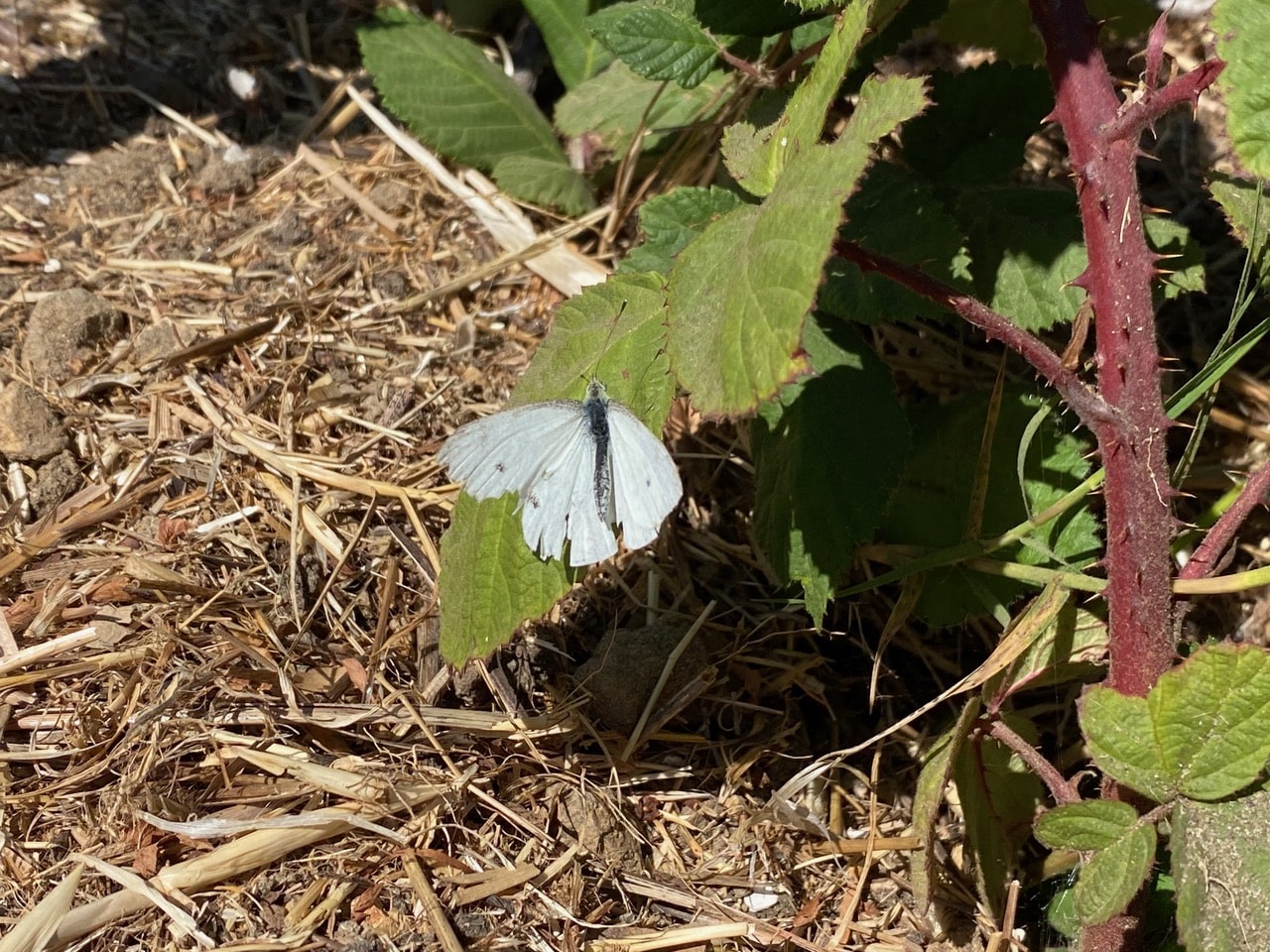
A male Small White or Cabbage White, Pieris rapae (family Pieridae) flutters around unsteadily, then lands on a Blackberry leaf. It has seen better days – its wings are faded and tattered at the edges.
The Small White or Cabbage White, Pieris rapae (family Pieridae) was introduced to the US along with European cabbage imports in the 1860’5. The caterpillars feed on plants in the mustard or Brassicaceae family, and occasionally some in the caper family. The butterflies have a darkened, yellowish underside of the hind wings, which enables them to heat up quickly in the sun. The butterfly’s white wings reflect ultraviolet light, which we can’t see but the butterflies can. To our eyes the butterflies seem plain and drab, but to each other, females are a gentle lavender and males shine with a deep royal purple. Brighter males are more attractive to females and the color’s strength reflects the amount of protein the males consumed as caterpillars. During mating, male butterflies transfer nutrients to the females in the form of infertile sperm, a nuptial gift which will enhance the female’s life expectancy and fertility. A male with a higher quality diet can afford to be brighter and to produce bigger and more nutritious nuptial gifts.

A Small Carpenter Bee, Ceratina sp. (family Apidae) leaves a Grindelia flowerhead after foraging on it.
The Small Carpenter Bee genus Ceratina is closely related to the more familiar, and much larger Carpenter Bees (genus Xylocopa). Ceratina are typically dark, shiny, even metallic bees, with fairly sparse body hairs and a weak scopa on the hind leg. The shield-shaped abdomen comes to a point at the tip. Some species have yellow markings, often on the face.
Females excavate nests with their mandibles in the pith of broken or burned plant twigs and stems. While many species are solitary, a number are subsocial. Both male and female carpenter bees overwinter as adults within their old nest tunnels, emerging in the spring to mate. In the spring, this resting place (hibernaculum) is modified into a brood nest by further excavation. The female collects pollen and nectar, places this mixture (called bee bread) inside the cavity, lays an egg on the provision, and then caps off the cell with chewed plant material. Several cells are constructed end to end in each plant stem.


A male Texas striped Sweat Bee, Agapostemon texanus (family Halictidae) lands on a Grindelia flowerhead.
The genus Agapostemon is widespread and abundant throughout North America. These ground nesters are most diverse and abundant in temperate regions and southwestern U.S. deserts. Agapostemon are commonly called “sweat bees” because they are closely related to, and resemble bees in the Halictus and Lasioglossum genera. Unlike those bees however, Agapostemon are not attracted to human sweat.
Agapostemon are brightly colored metallic green or blue bees measuring 7 to 14.5 mm long. Most species have a metallic green head and thorax, and black-and-yellow striped abdomen; some females are entirely bright green or blue. Females carry pollen on scopal hairs located on their hind legs. Agapostemon are generalists. Like other members of the family Halictidae, they are short-tongued and thus have difficulty extracting nectar from deep flowers. Males are often seen flying slowly around flowers looking for females. The bees favor flowers with high densities. They are active summer to fall.
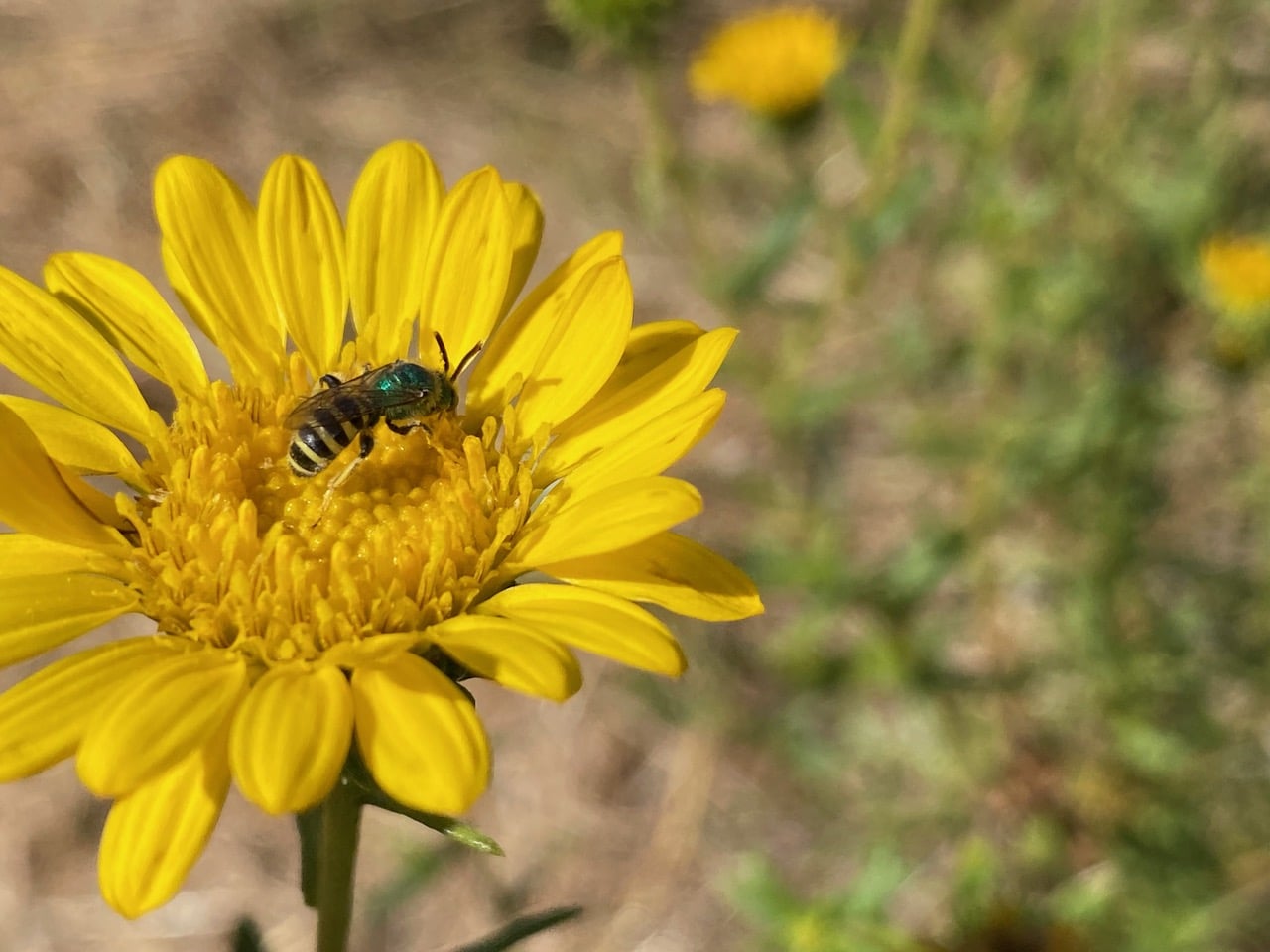
This view of the male Texas Striped Sweat Bee clearly shows the black-and-yellow bands on his abdomen. The females of the species are iridescent green all over.
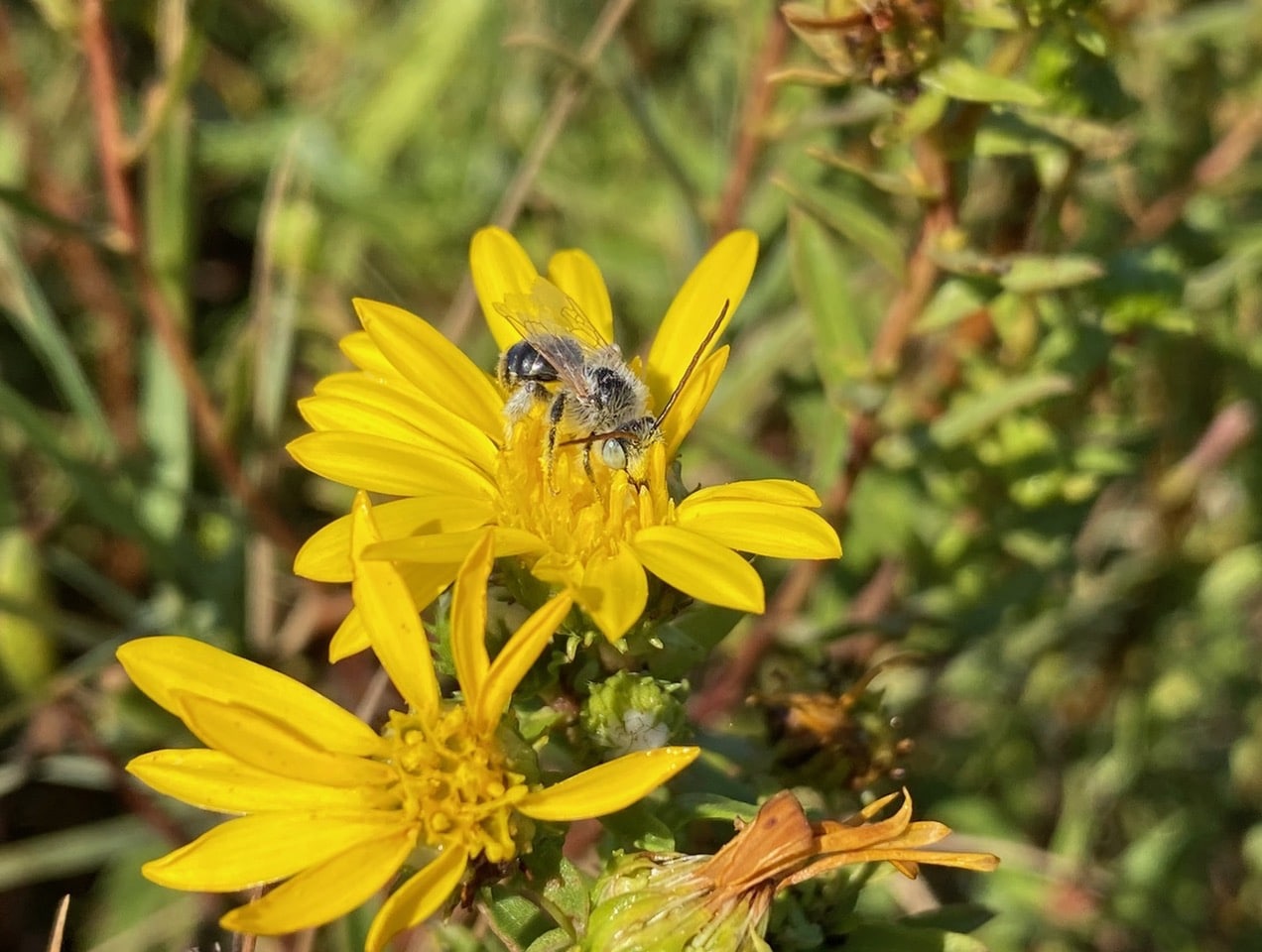
A male Summer Longhorn Bee, Melissodes sp. (family Apidae) is taking nectar from a Grindelia flowerhead.
The Summer Longhorn Bees, Melissodes sp. (family Apidae) are medium to large bees, stout-bodied, usually with gray hair on the thorax and pale hair bands on the abdomen. Males usually have yellow markings on their faces and have very long antennae from which their common name is derived. They are active May to September, with peak flight in late June to early August. The females prefer flat, bare ground for digging their solitary nests, though they sometimes nest in aggregations. Pollen is transported in scopae on the hind legs. Pollen loads are often copious and brightly colored and thus very distinguishable. Melissodes are specialists on Asteraceae – females gather pollen from flowers of Aster, Bidens, Coreopsis, Cosmos, Encelia, Gaillardia, Helianthus, and Rudbeckia ssp.

Note that his hind leg does not have the long scopal hairs that his female counterparts are well known for. Males do not have scopae and they do not collect pollen.
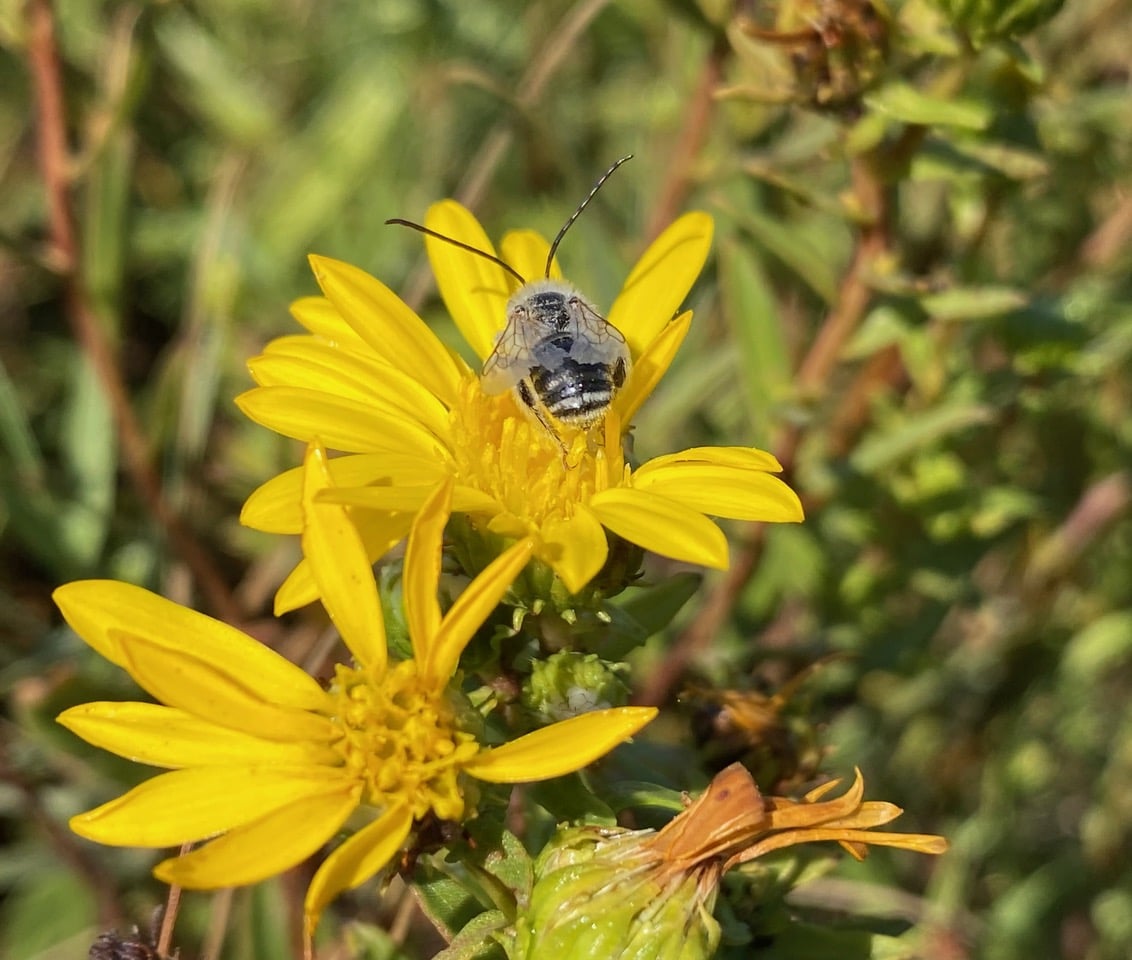
Tattered wings and balding abdomen are signs of aging on this male Melissodes.
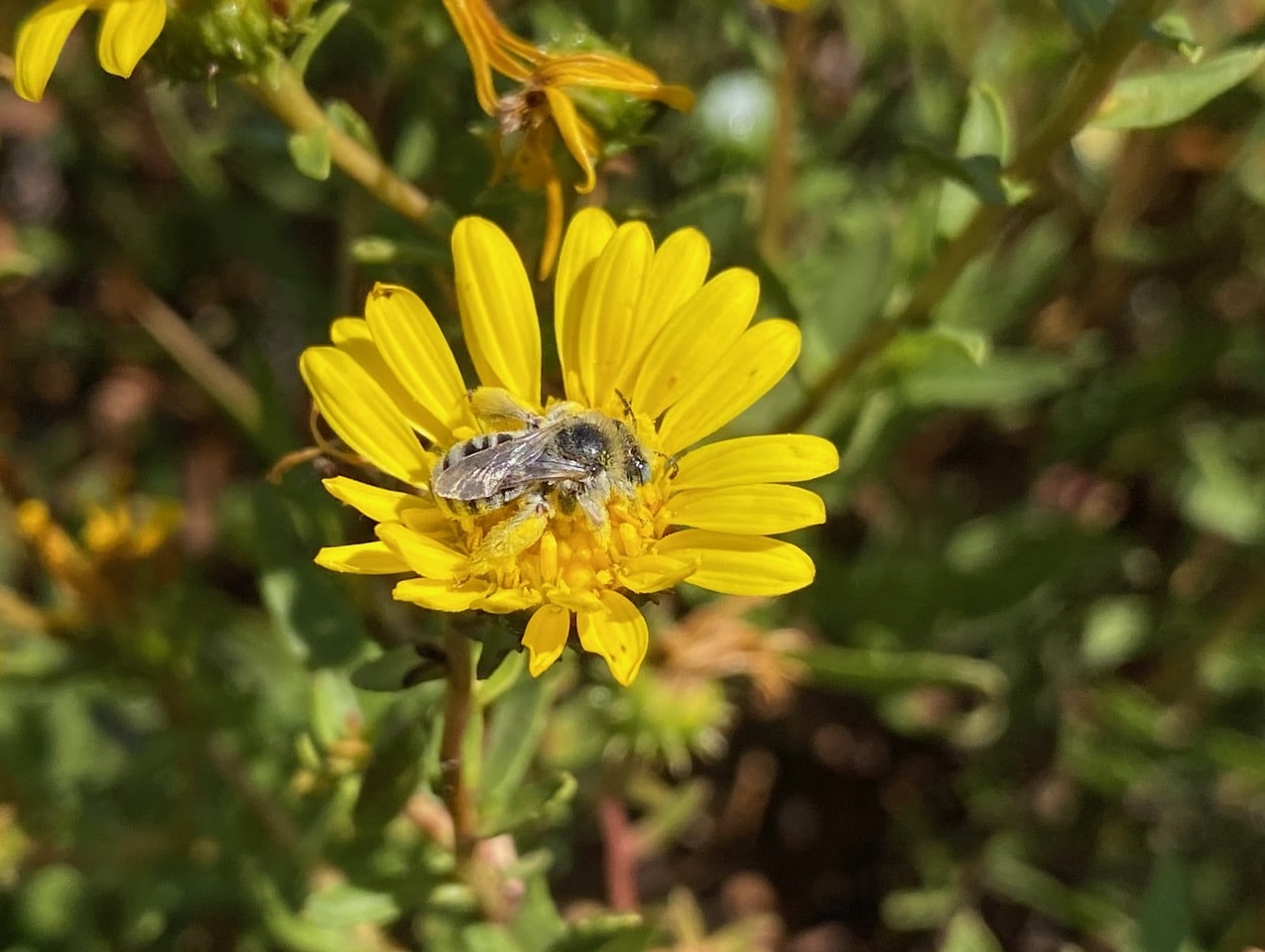
A female Summer Longhorn Bee, Melissodes sp. (family Apidae) is foraging on a Grindelia flowerhead. Unlike the male, she does not have the long antennae. Female Melissodes are notable for the prominent scopae on their hind legs for transporting pollen.
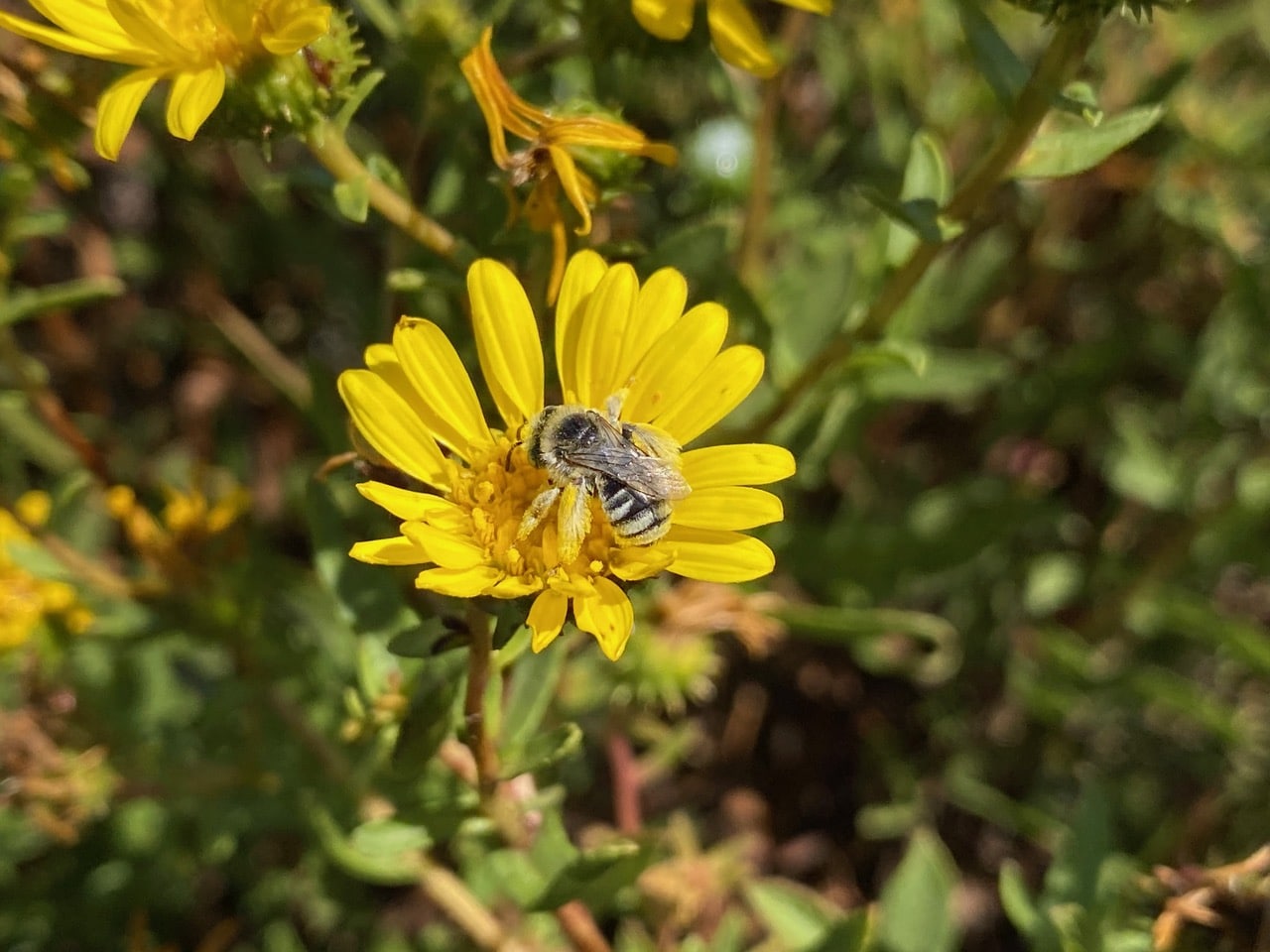
Her scopae are only partially filled. You can still see the hairs on her hind legs.

Her tongue extended, the female Melissodes is taking nectar from the Grindelia. Melissodes are specialists on flowers in the sunflower family Asteraceae. At Bay Farm the Melissodes use Grindelia flowers almost exclusively. Back at the nest, the female mixes the pollen and nectar she has collected into “bee bread” on which she will lay an egg. She repeats this process for every nest chamber she has prepared underground. The larvae will feed on the provisions until pupation.