

Pollinator Post 9/22/24 (1)

As I usually walk on the dirt path by the water where the Oregon Gumweed, Grindelia stricta grows, I have totally overlooked this patch of sparsely vegetated ground at Shoreline Park. The ground is sandy, having been continuously turned over by ground squirrels. There’s a lot of sand wasp action here this morning.
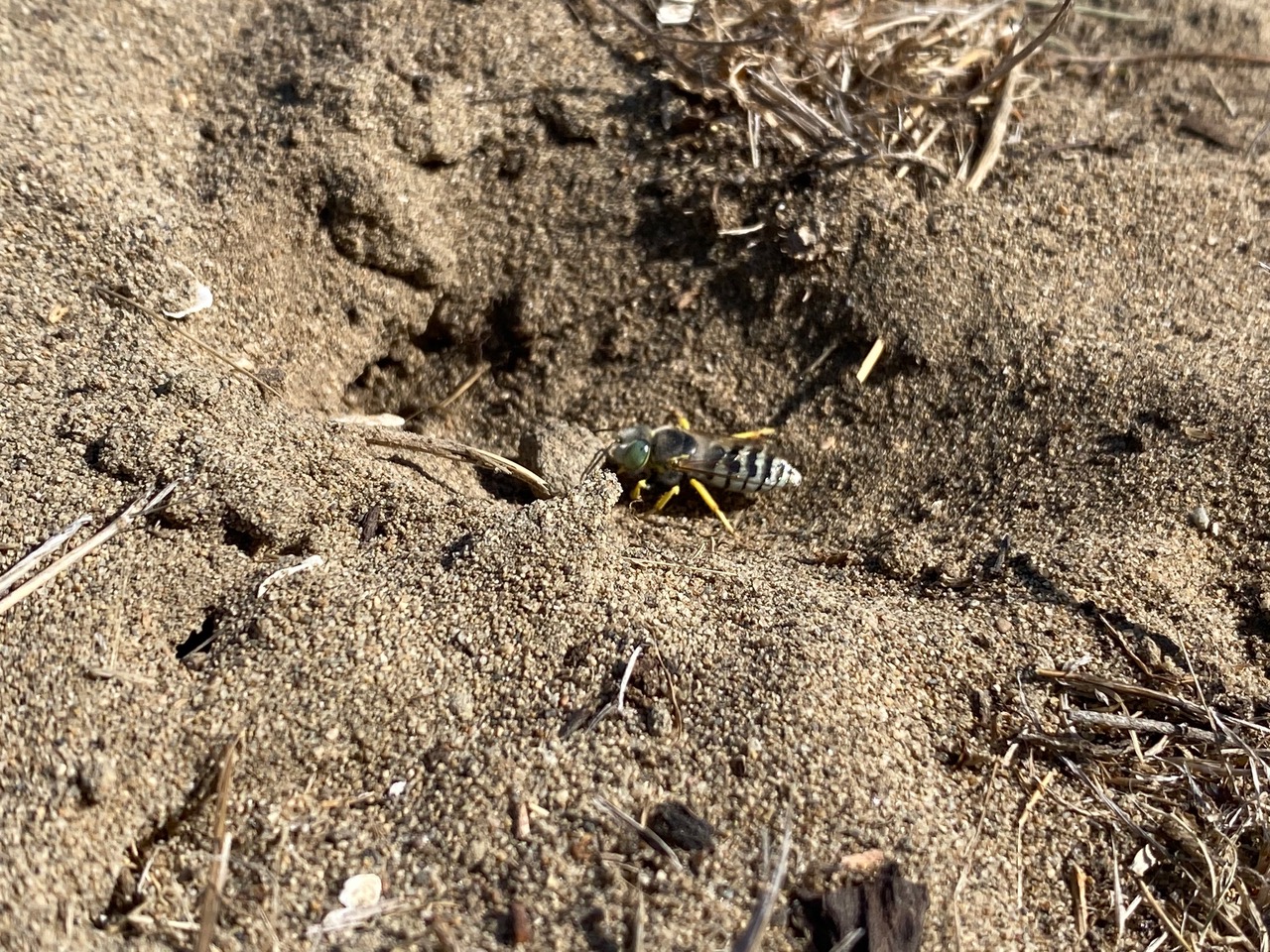
An American Sand Wasp, Bembix americana (family Crabronidae) is diligently excavating a nest, kicking sand behind her. Her activity is best seen in a video.
Sand wasps in the genus Bembix are familiar and common throughout North America, digging their burrows in dunes, on beaches, and other habitats with loose, deep sand. The female rapidly kicks out large quantities of sand using a “tarsal rake” of spines on each front leg. The burrow is excavated before the wasp goes hunting. Bembix are generalist, opportunistic hunters. True flies in the order Diptera are the usual prey. A victim is paralyzed or killed by the wasp’s sting, and is then flown back to the nest. Most species will lay an egg on the first victim, while some species lay an egg in the empty cell before starting to hunt. Once the egg hatches, mama wasp brings flies to her larva as needed. This “progressive provisioning” is rare in the insect world. When the larva reaches maturity, mama wasp closes the cell. Inside, the larva spins an oblong cocoon, weaving sand grains into the structure and resulting in a hardened capsule. Overwintering takes place as a prepupa inside this cocoon, but there are usually two generations a year.
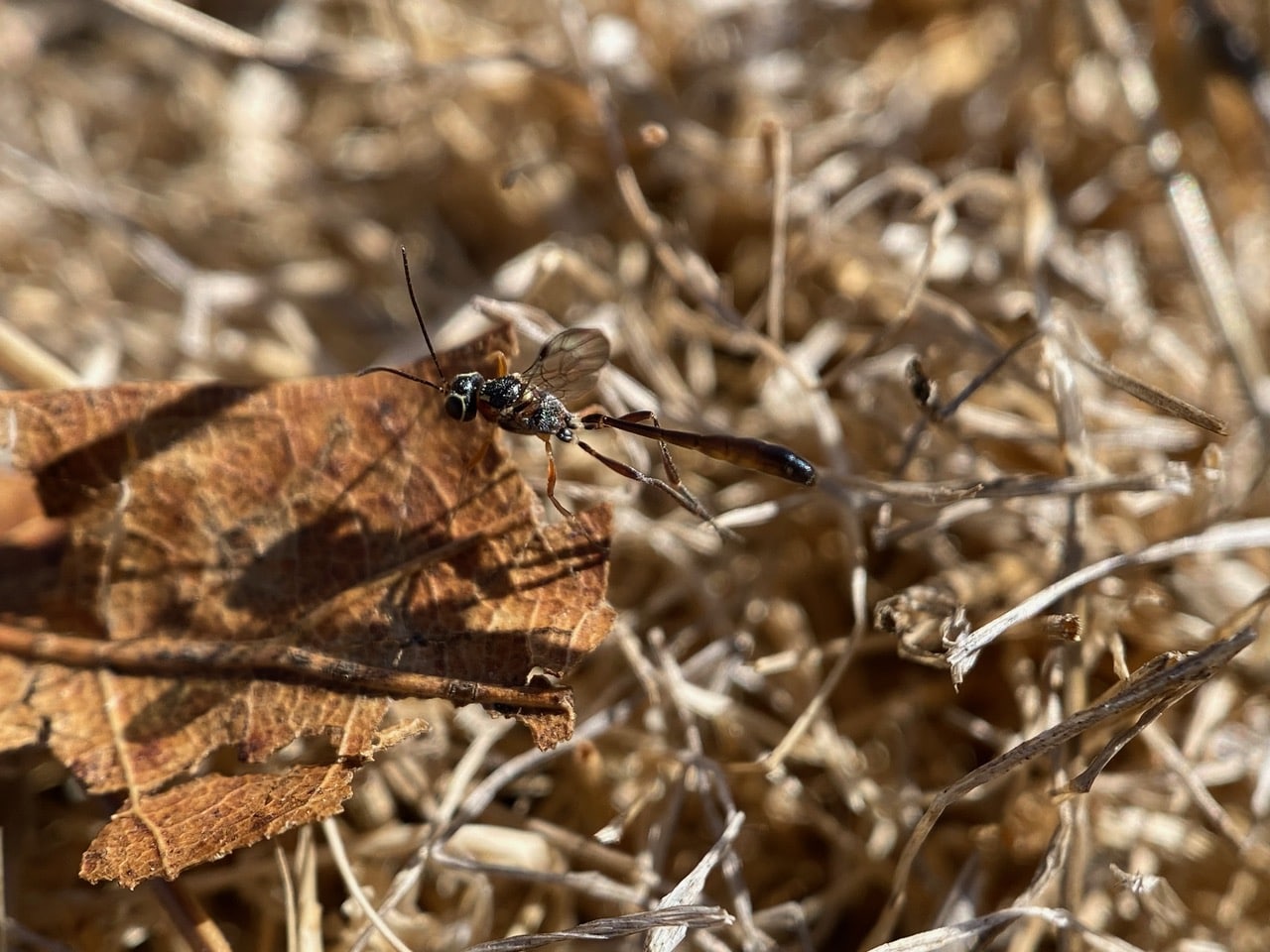
A skinny wasp barely 1/4 in long is flying low over the ground, occasionally landing on the sparse vegetation and leaf litter. It is almost impossible to photograph on this background. When I finally get a good look, I realize it is a parasitoid wasp, Anomalon sp. (family Ichneumonidae).
The Ichneumonidae, also known as the Ichneumon Wasps, or Ichneumonids, are a family of parasitoid wasps. They are one of the most diverse groups within the Hymenoptera (the order that includes the ants, wasps and bees) with about 25,000 species and counting. Ichneumon Wasps attack the immature stages of insects and spiders, eventually killing their hosts. They play an important role in the ecosystem as regulators of insect populations.
The Ichneumon Wasps have longer antennae than typical wasps, with 16 segments or more as opposed to 13 or fewer. Ichneumonid females have an unmodified ovipositor for laying eggs. They generally inject eggs either directly into their host’s body or onto its surface, and the process may require penetration of wood. After hatching, the Ichneumonid larva consumes its still living host. The most common hosts are larvae or pupae of Lepidoptera (butterflies and moths), Coleoptera (beetles) and Hymenoptera. Adult Ichneumonids feed on plant sap and nectar. Females spend much of their active time searching for hosts while the males are constantly on the look out for females. Many Ichneumonids are associated with specific prey, and Ichneumonids are considered effective biological controls of some pest species.
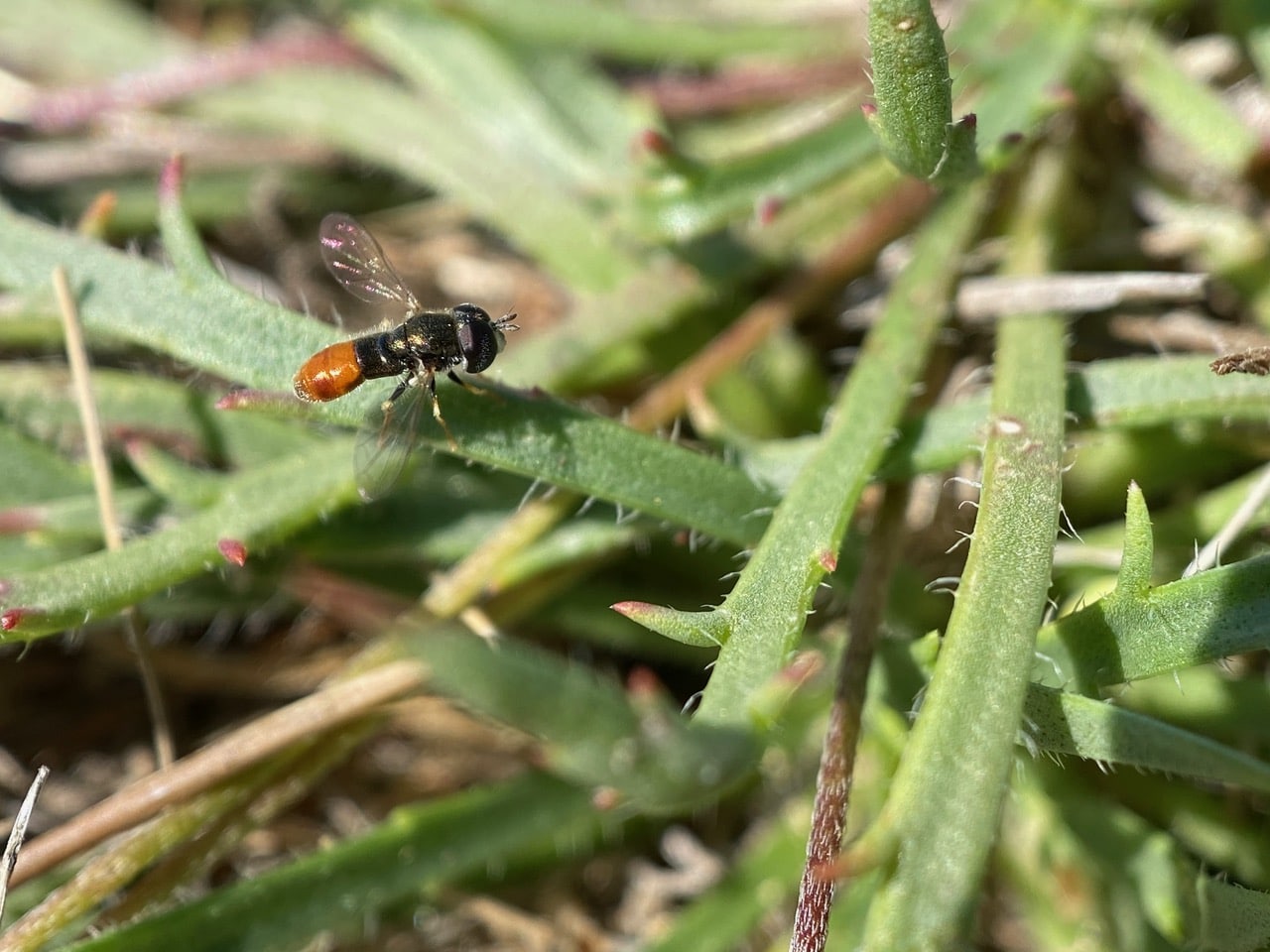
A Common Grass Skimmer, Paragus haemorrhous (family Syrphidae) lands on a small plantain in this sparsely vegetated patch.
The Common Grass Skimmer, Paragus haemorrhous (family Syrphidae) is easily the smallest hover fly I know, measuring only about 4 mm in length. The species has a world-wide distribution, found in unimproved grassland, dune grass, open areas and pathsides in forest, and meadows. Adults visit flowers for nectar and pollen. Larvae feed on aphids on low herbaceous plants.

A commotion breaks out on the sandy patch. A small dark insect is thrashing around on the ground, apparently trying to right itself. When it came to a momentary rest on its back, I see that it is a female Sugarcane Soldier Fly (family Stratiomyidae). She is missing her left hind leg, among other injuries. I am surprised that none of the sand wasps has come over to snatch her up for provisioning their nests.
The Sugarcane Soldier Fly, Inopus rubriceps (family Stratiomyidae) is native to eastern Australia where it infests such crops as corn, pastures, and sugarcane. The fly was accidentally introduced into California over 50 years ago. It is now infesting lawns in San Francisco and other Bay Area counties. Damage to turf and other members of the grass family results from withdrawal of sap from roots of host plants by the larvae and possibly, injection of a toxin into the plant.
In California adults occur in large numbers from late September to early November each year. Eggs are deposited in crevices in the soil. The adults are sexually dimorphic. Females have tiny red heads with eyes set far apart. The smaller males have large eyes that occupy the whole surface of the head.
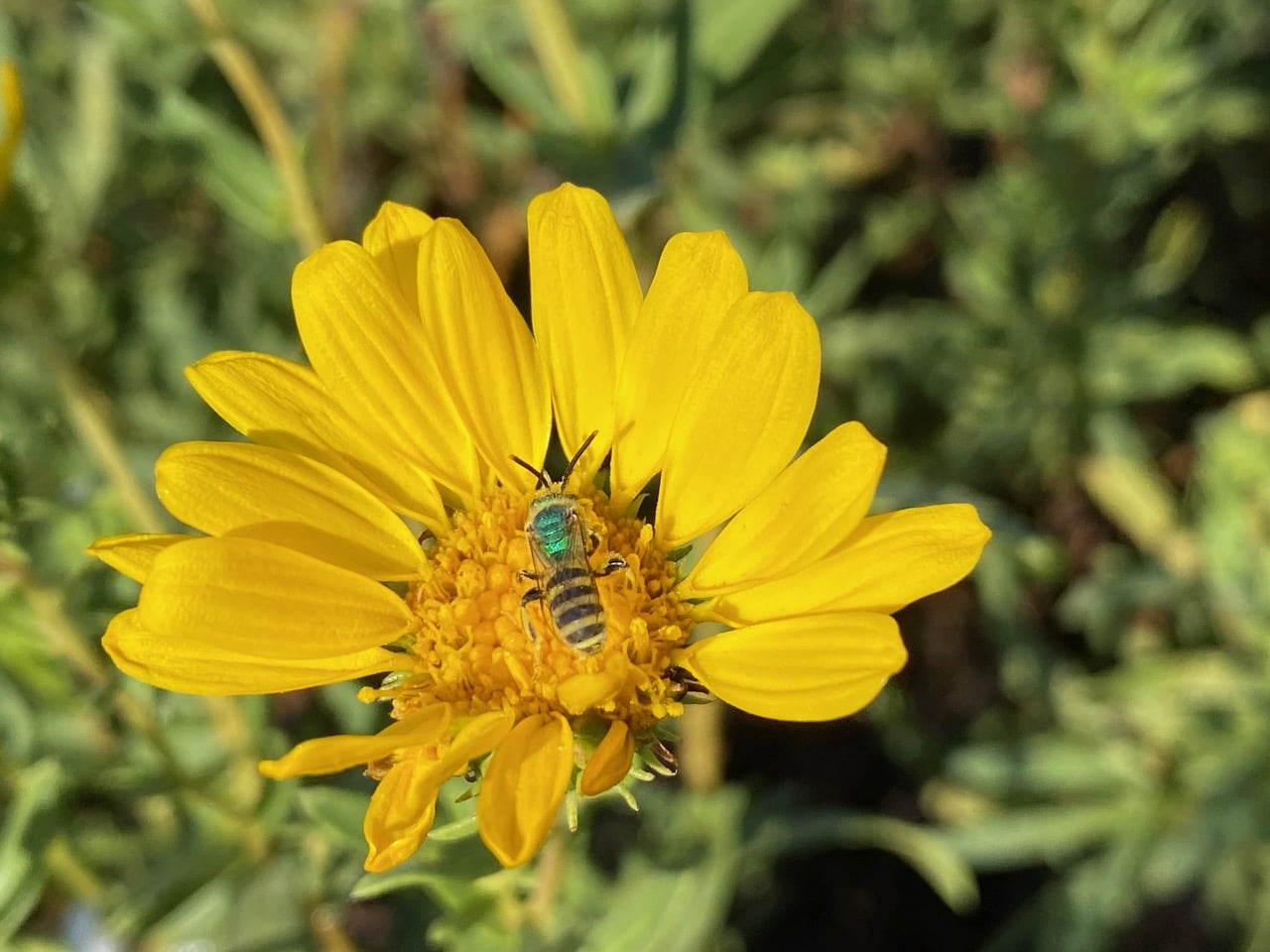
A male Texas Striped Sweat Bee, Agapostemon texanus (family Halictidae) is foraging on a Grindelia flowerhead.
The genus Agapostemon is widespread and abundant throughout North America. These ground nesters are most diverse and abundant in temperate regions and southwestern U.S. deserts. Agapostemon are commonly called “sweat bees” because they are closely related to, and resemble bees in the Halictus and Lasioglossum genera. Unlike those bees however, Agapostemon are not attracted to human sweat.
Agapostemon are brightly colored metallic green or blue bees measuring 7 to 14.5 mm long. Most species have a metallic green head and thorax, and black-and-yellow striped abdomen; some females are entirely bright green or blue. Females carry pollen on scopal hairs located on their hind legs. Agapostemon are generalists. Like other members of the family Halictidae, they are short-tongued and thus have difficulty extracting nectar from deep flowers. Males are often seen flying slowly around flowers looking for females. The bees favor flowers with high densities. They are active summer to fall.
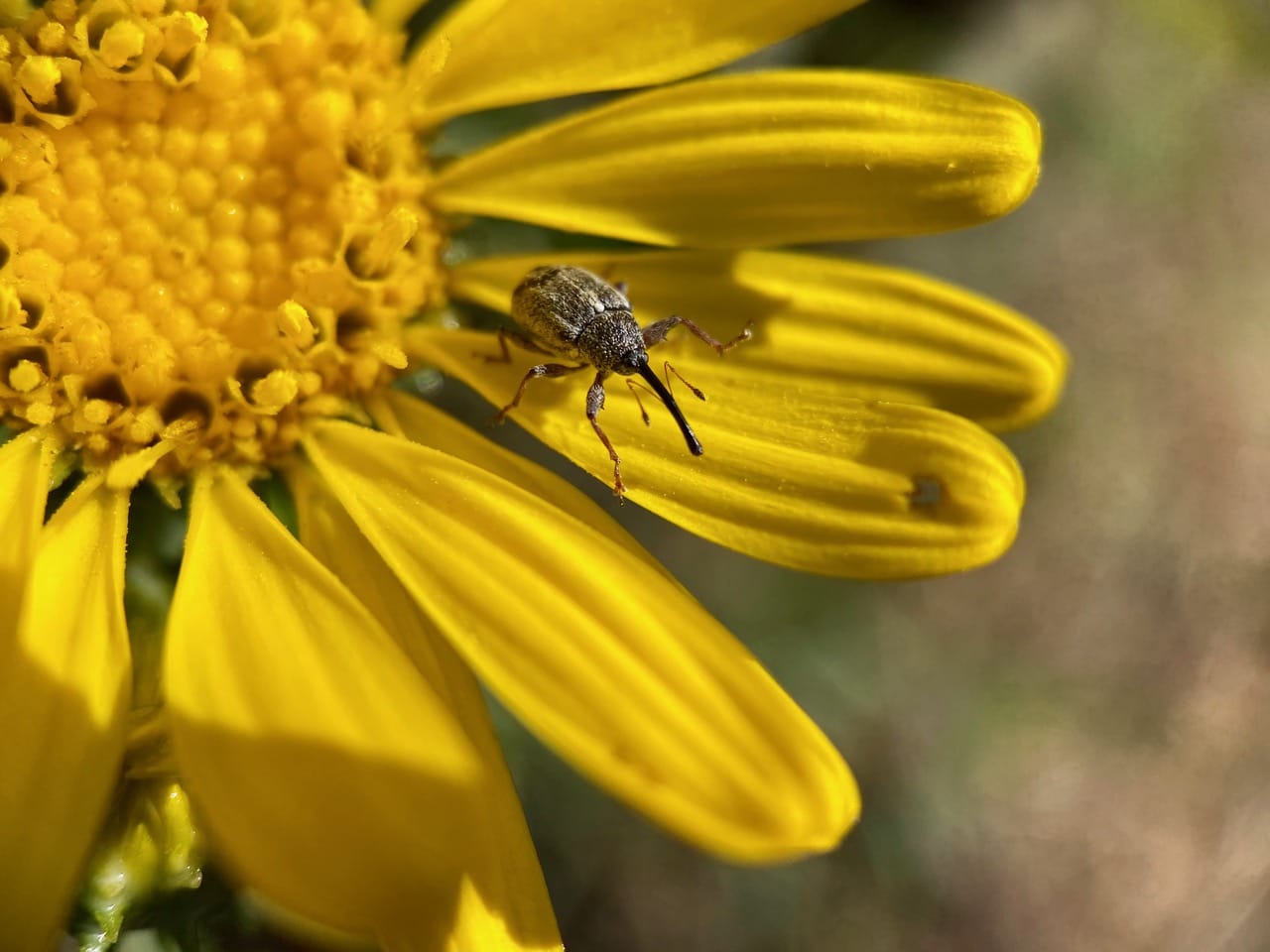
A Weevil (family Curculionidae) is perched on a ray petal of a Grindelia flowerhead. Note the elbowed antennae coming off its long snout.
Weevils, family Curculionidae, are also called snout beetles. Curculionidae is one of the largest beetle families (about 40,000 species). Most weevils have long, distinctly elbowed antennae that may fold into special grooves on the snout. The snout is used not only for penetration and feeding but also for boring holes in which to lay eggs. The mouthparts are quite small and located at the end of the rostrum (snout), designed for chewing. Many weevils have no wings, while others are excellent fliers. Most are less than 6 mm in length. The majority of weevils feed exclusively on plants. The fleshy, legless larvae of most species feed only on a certain part of a plant – i.e., the flower head, seeds, fleshy fruits, stems, or roots. Many larvae feed either on a single plant species or on closely related ones. Adult weevils tend to be less specialized in their feeding habits. The family includes some very destructive agricultural pests.
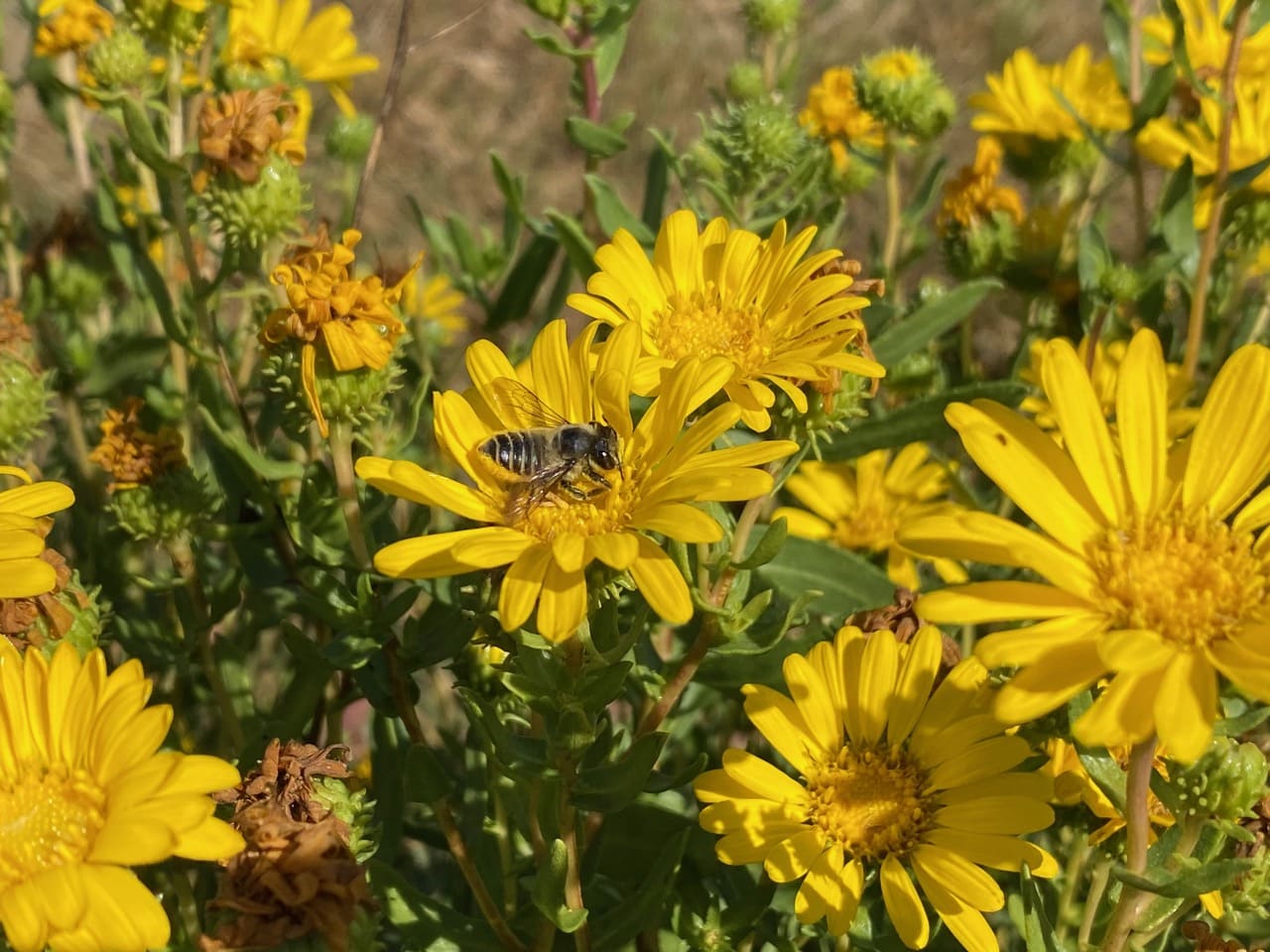
A female Western Leafcutter Bee, Megachile perihirta (family Megachilidae) is foraging in a dense stand of Oregon Gumweed, Grindelia stricta.

Leaf-cutter Bees, Megachile sp. (family Megachilidae) are stout-bodied, usually with pale hair on the thorax and stripes of white hairs on the abdomen. Females usually have a triangular abdomen with a pointed tip, and males’ faces are covered with dense, pale hair. Flight season is from May into September, with peak activity from June to August.
Solitary females construct nests in tubular cavities, including hollow stems, tree holes, and abandoned beetle burrows in wood. Many use holes drilled into wood, straws, or other manufactured tunnels. Females cut pieces from leaves or flower petals for use in the construction of brood cells. Most Megachile females are generalists when foraging for pollen. Pollen is transported in dense scopae on the underside of the abdomen.
Photos of Western Leafcutter Bee (Megachile perihirta) · iNaturalist
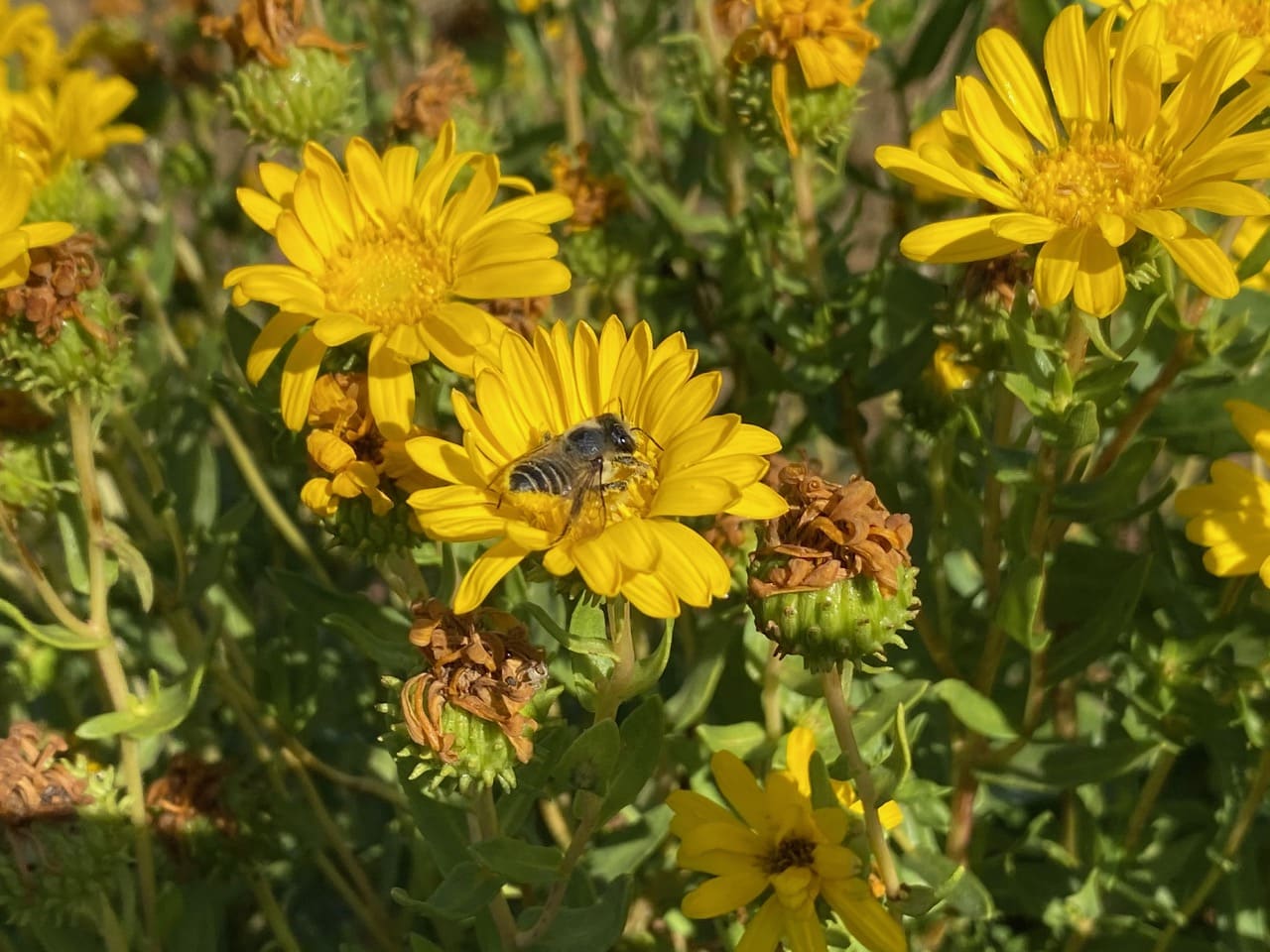
As the female Leafcutter turns around on the Grindelia flowerhead, we can see the yellow pollen that she is carrying in the scopa on the underside of her abdomen.
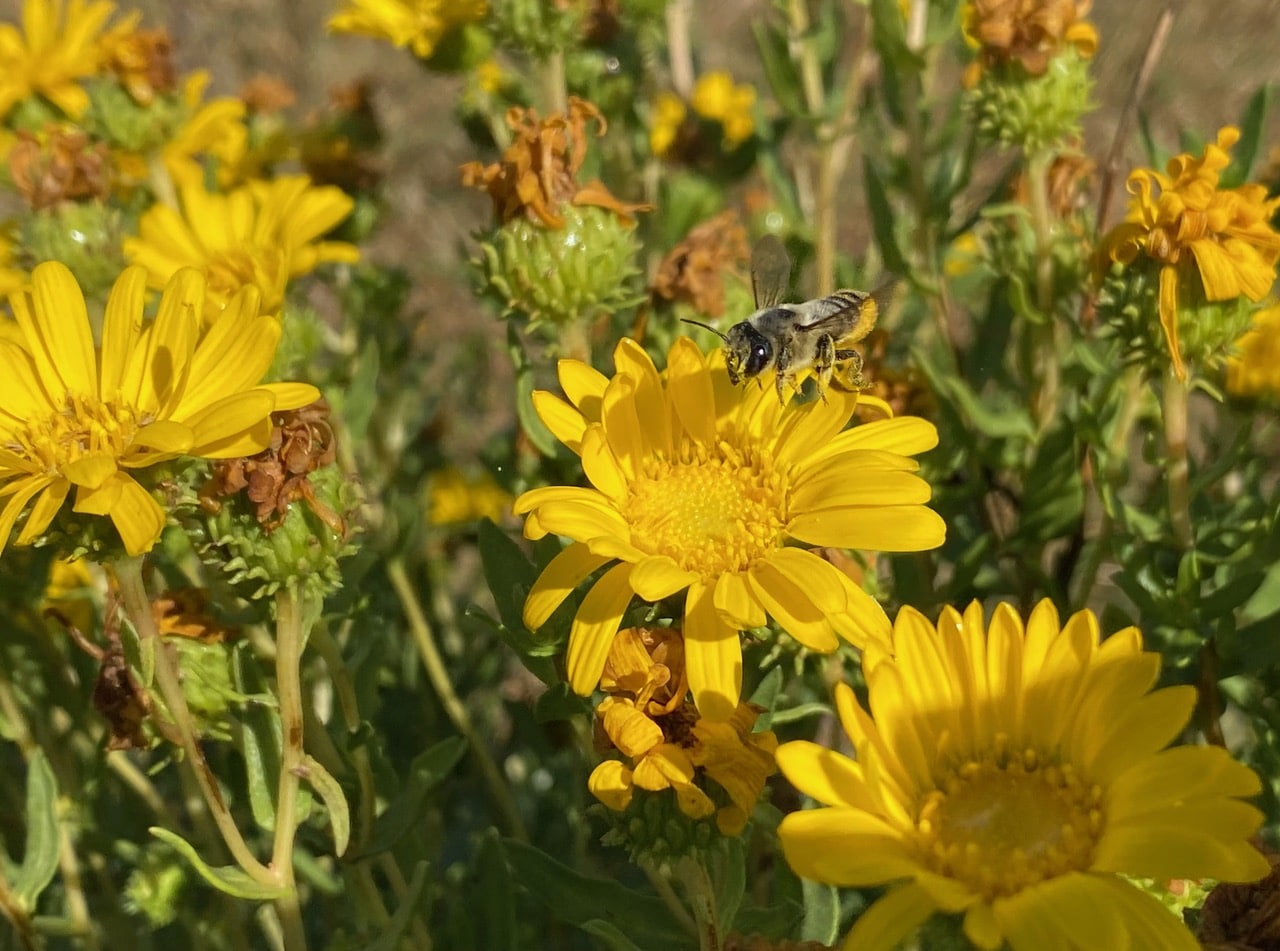
Off to the next flowerhead!
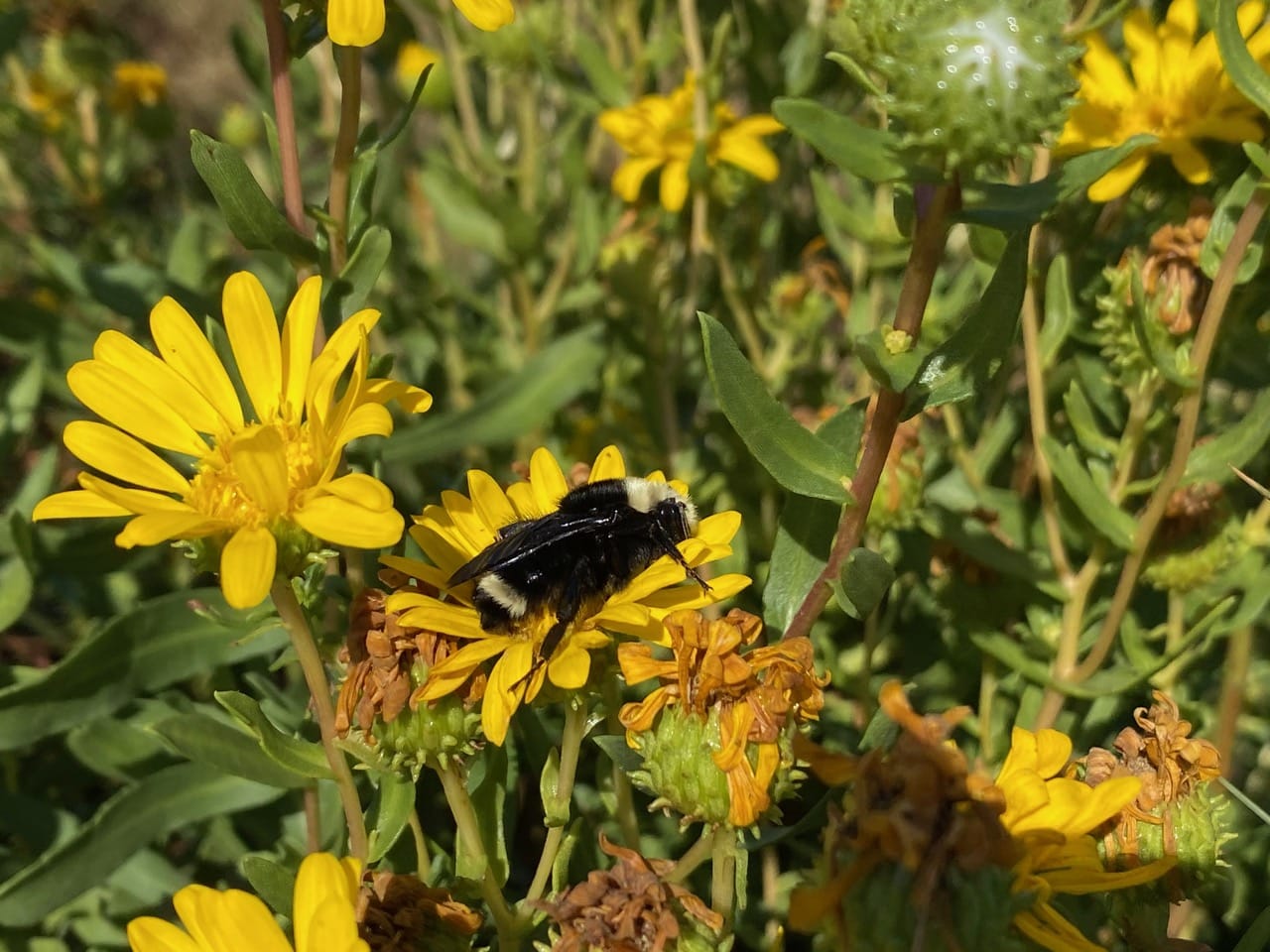
A large queen Yellow-faced Bumble Bee, Bombus vosnesenskii (family Apidae) is asleep on a Grindelia flowerhead. Her entire body, including her antennae, droops.

As I take her photos, the queen wakes up and clambers onto the next flowerhead to take a sip of nectar.
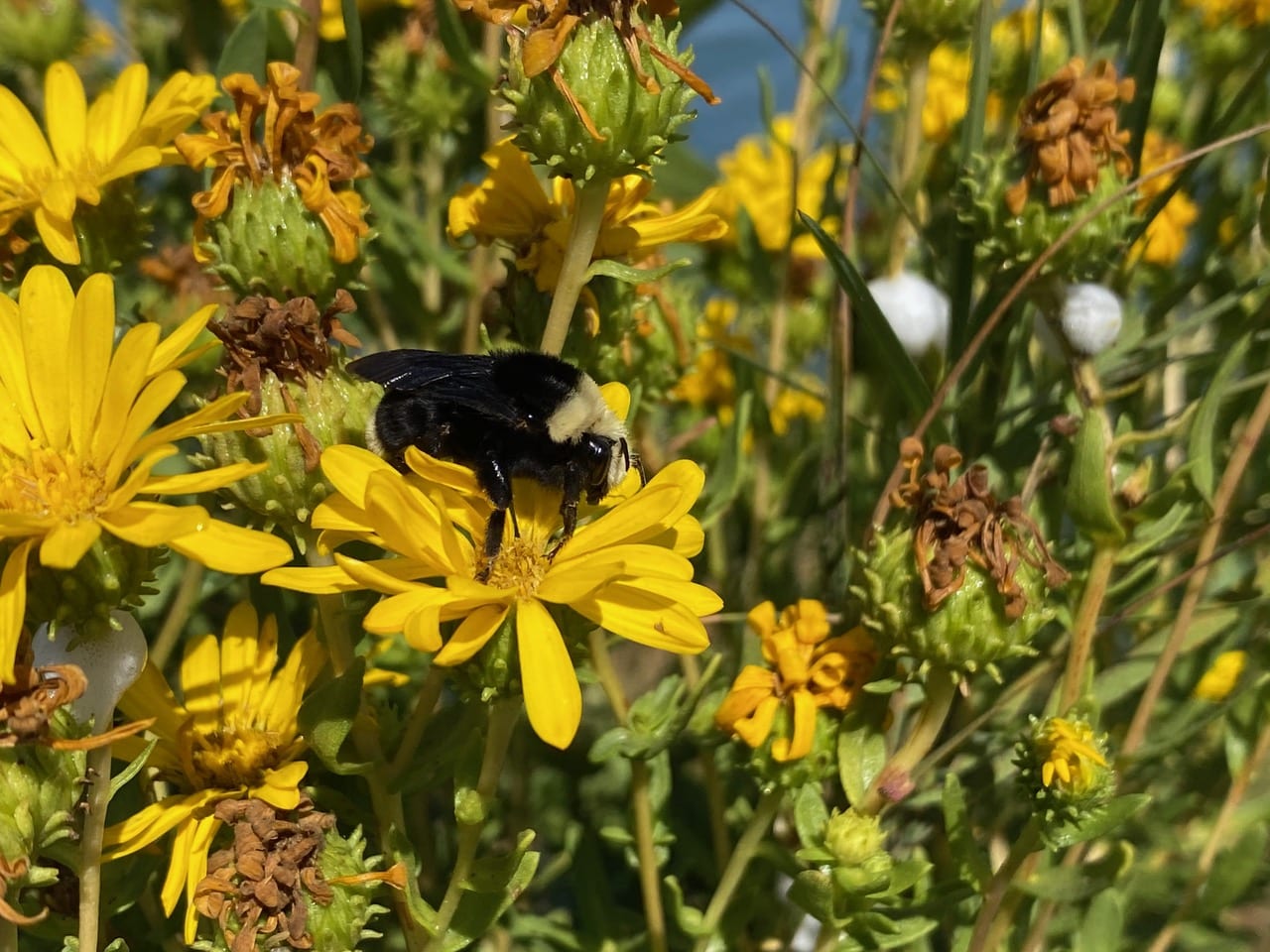
She then clambers over several flowerheads…

… and finally settles down on this flowerhead to continue her slumber. Is the queen getting enough nourishment until her winter hibernation? She appears to be in great shape. I wonder if she has found a good hibernation site? Lately I have been seeing many large queen Bumble Bees flying low over the ground searching for hibernation sites. After mating, the new queens produced this year are the only members of their colony that will overwinter. The rest of the colony, including the old queen dies. Emerging when the ground warms up next spring, each queen will establish her own colony.

A black adult Spittlebug, Complex Clastoptera lineatocollis (family Clastopteridae) is perched on a spent Grindelia flowerhead.
The Froghoppers (superfamily Cercopoidea) are a group of “true bugs” in the order Hemiptera. Adults are capable of jumping many times their height and length, giving them their common name, but many species are best known for their plant-sucking nymphs which produce foam shelters, and are referred to as “spittlebugs”. The superfamily currently consists of three families: the Aphrophoridae, Cercopidae, and Clastopteridae. The nymphs produce a cover of foamed-up plant sap visually resembling saliva, hence the common name. Whereas most insects that feed on plant sap tap into the nutrient-rich fluid from the phloem, the spittlebugs utilize the much more dilute sap flowing upward from the roots via the xylem. The insects’ digestive system contains symbiotic bacteria that provide them with the essential amino acids. The large amount of excess water that must be excreted and the evolution of special breathing tubes allow the young spittlebug nymphs to grow in the relatively protective environment of their foam shelters. The foam serves a number of purposes. It hides the nymph from the view of predators and parasites, and it insulates against heat and cold, providing thermal as well as moisture control. It also has an acrid taste that deters predators.
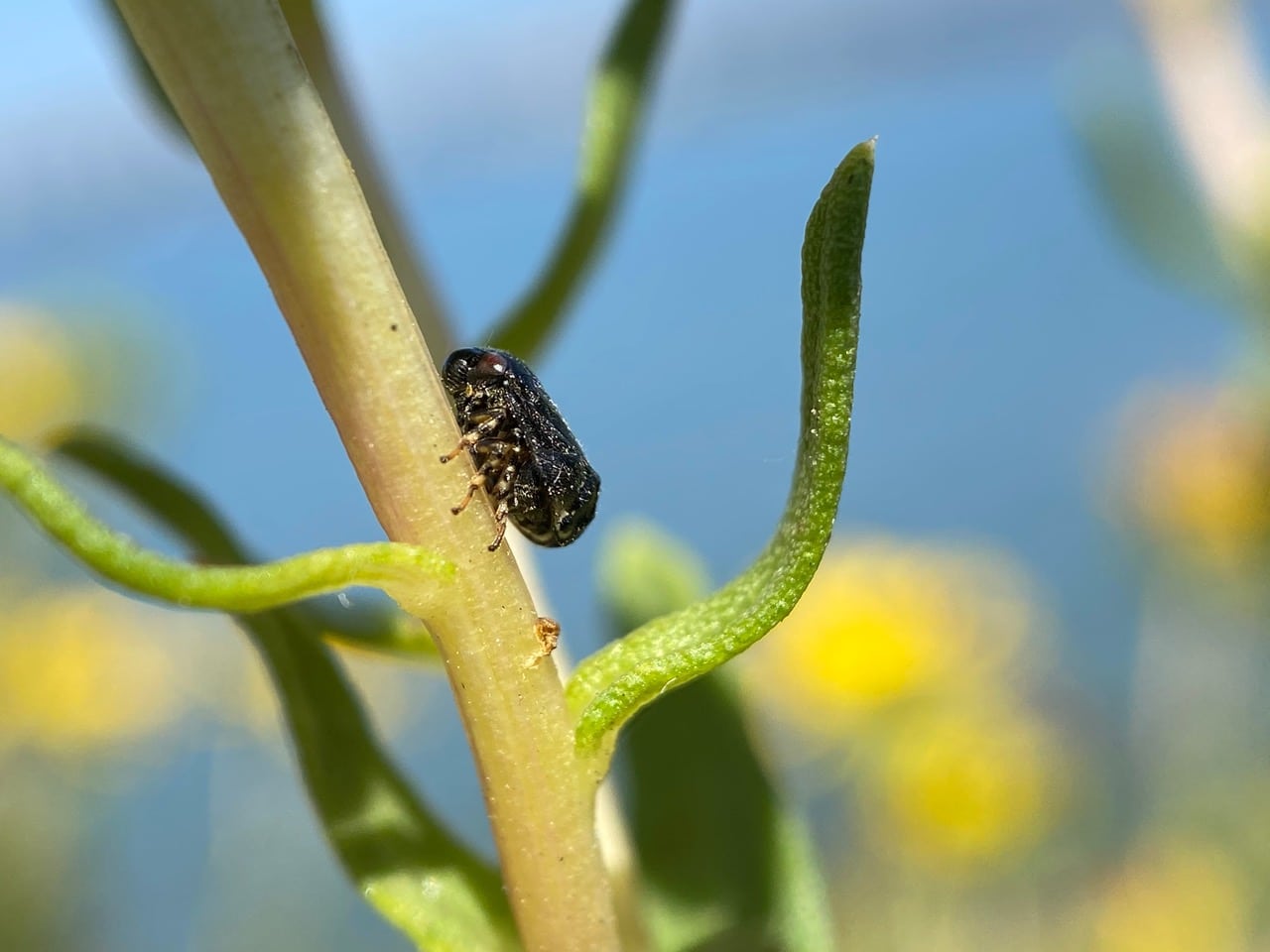
Here’s another one slowly walking up a Grindelia stem.
Froghoppers or adult Spittlebugs are champion jumpers among insects, out-performing even the fleas. The bug can leap the human equivalent of a skyscraper without a running start. It is the highest jumping insect proportional to body size. The muscles in its hind legs act like a “catapult” to release energy explosively.

11:59 am Right above a foam mass, a fresh adult Spittlebug has emerged and is still clinging to its old exoskeleton. The teneral bug is waiting for its new exoskeleton to dry and harden, and for its final coloration to come in.

12:02:05 pm The teneral Spittlebug’s genitalia is now visible.

12:25:25 pm The teneral Spittlebug’s body segments are all stretched out and the bug looks bigger. It is well on its way to becoming a full-fledged adult.