

Pollinator Post 9/21/25 (2)
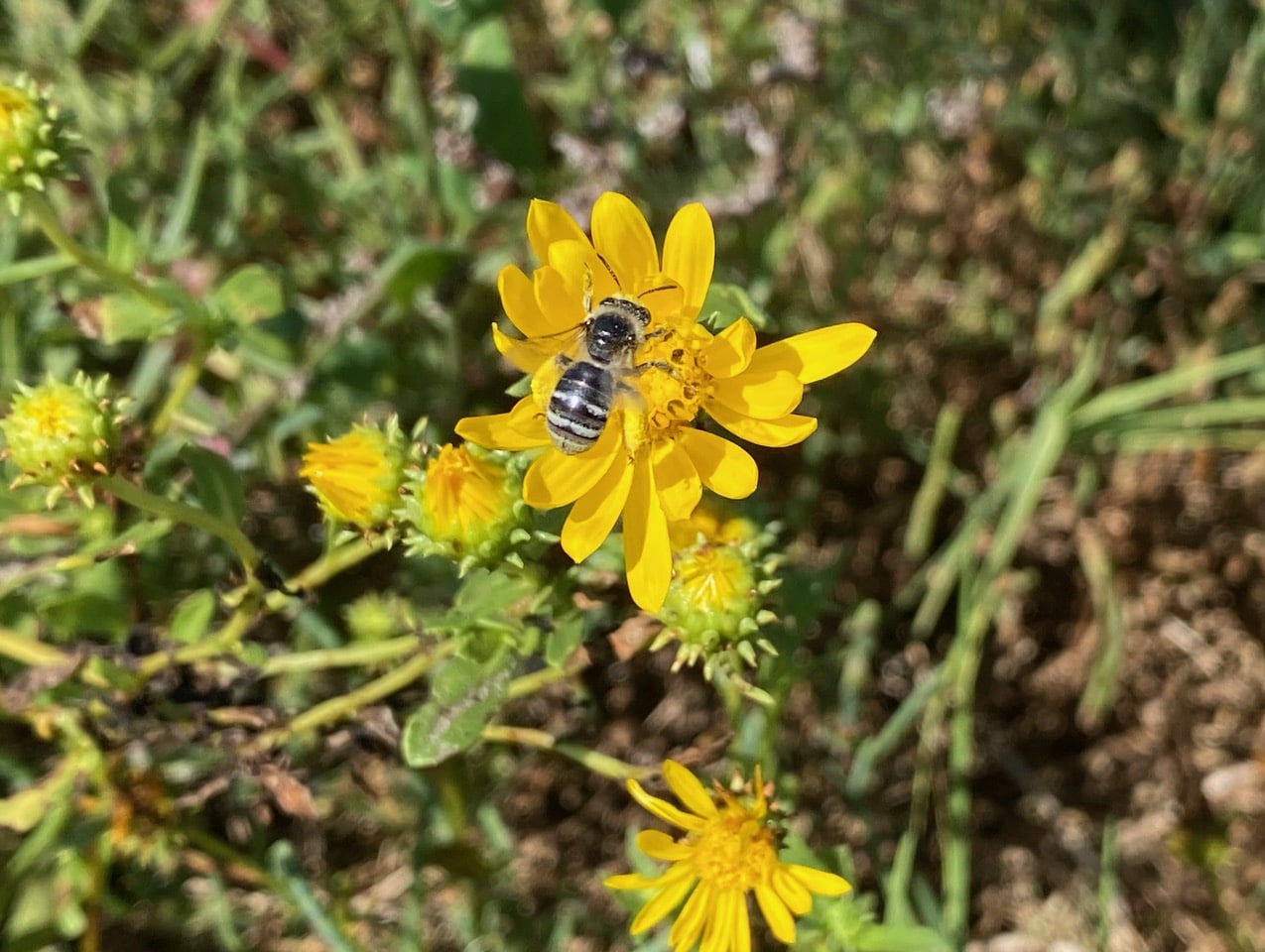
A female Summer Longhorn Bee, Melissodes sp. (family Apidae) is foraging on a Grindelia flowerhead. She is easily recognized in the field because of her prodigious pollen load.
The Summer Longhorn Bees, Melissodes sp. (family Apidae) are medium to large bees, stout-bodied, usually with gray hair on the thorax and pale hair bands on the abdomen. Males usually have yellow markings on their faces and have very long antennae from which their common name is derived. They are active May to September, with peak flight in late June to early August. The females prefer flat, bare ground for digging their solitary nests, though they sometimes nest in aggregations. Pollen is transported in scopae on the hind legs. Pollen loads are often copious and brightly colored and thus very distinguishable. Melissodes are specialists on Asteraceae – females gather pollen from flowers of Aster, Bidens, Coreopsis, Cosmos, Encelia, Gaillardia, Helianthus, and Rudbeckia ssp.
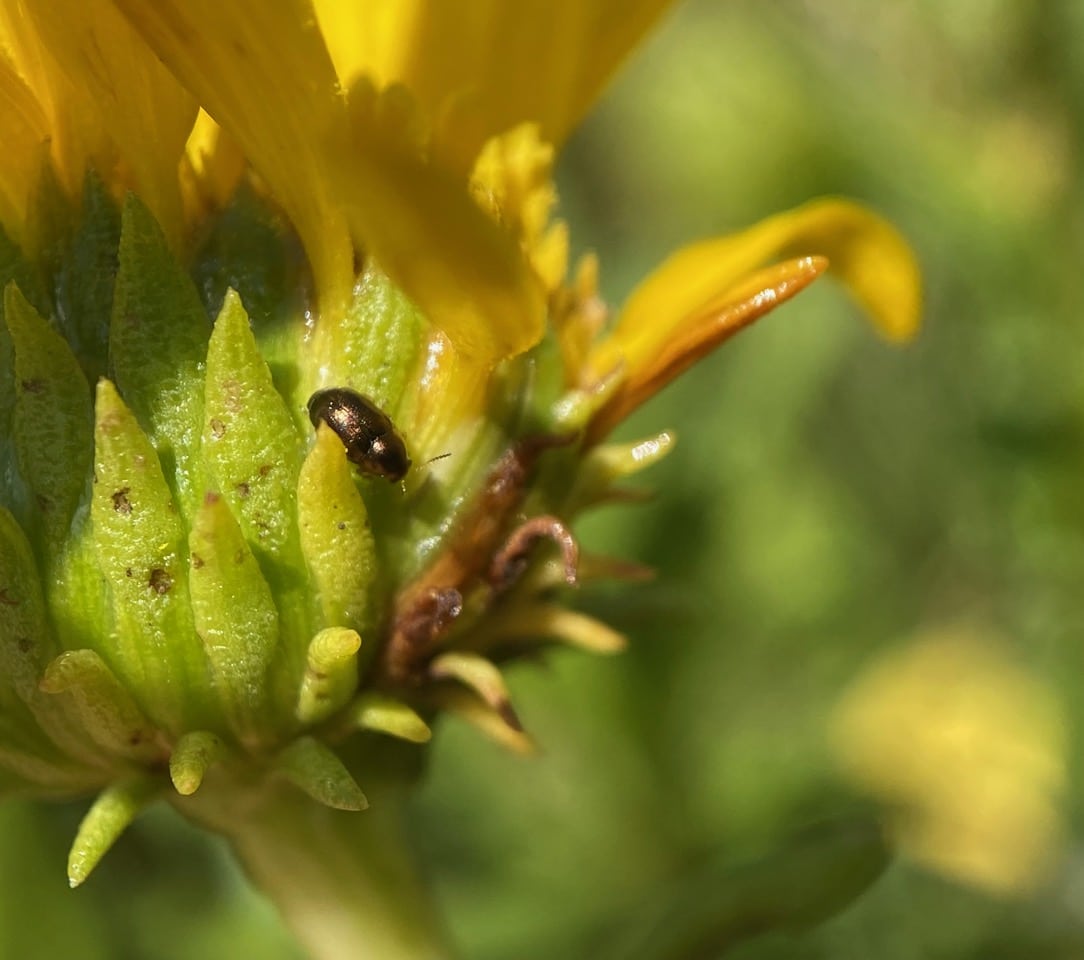
A tiny Bronze Leaf Beetle is reflecting sunlight brilliantly from the involucre of a Grindelia flowerhead.
The Bronze Leaf Beetle, Diachus auratus is a species of case-bearing leaf beetle in the family Chrysomelidae, subfamily Cryptocephalina. It is found in Australia, the Caribbean, the Americas, Oceania, and Southern Asia. Adults, 1-2 mm, are found on many unrelated plants, especially plants in bloom. Case-bearing leaf beetles are found in two subfamilies within Chrysomelidae. As she lays her eggs, the female case-bearing leaf beetle covers each one with a layer of excrement. After the larvae hatch, they retain this covering (case) as camouflage and add to it throughout their larval life. When disturbed, the larvae pull in their head and legs; because their color and shape resemble caterpillar droppings they are ignored by predators. Eventually the larva seals the case to pupate inside, before emerging as an adult. Some species are myrmecophiles, living near or even inside ant nests.

A pair of tiny black flies are mating on a leaf. iNaturalist has helped identify the insects as Freeloader Flies, Desmometopa sp. (family Milichiidae).
“Freeloader”? Milichiidae are a family of very small flies, usually 1-3 mm in length, typically black or at least dark. The adult flies exhibit kleptoparasitic behavior, meaning they steal food from other predators. They do this by waiting near predators like spiders or assassin bugs and then feeding on the fluids of the prey once it has been captured and injured by the larger predator. The flies use their long proboscis to feed on the liquefied tissues of the prey that have been broken down by the predator’s enzymes. This behavior provides protein for the female flies to produce eggs. The flies are attracted to the kill by chemical signals released from the injured prey. Larvae primarily feed on rotting plant materials or decaying wood, carrion, or feces, earning them another unflattering common name of “filth flies”.
.jpg)

A European Paper Wasp lands on the weedy vegetation in the undergrowth to groom itself.
Native to Europe, the European Paper Wasp, Polistes dominula (family Vespidae) is a social insect that produces an annual colony in a paper nest. Individual colonies are established anew each spring. The overwintering stage are mated females (queens). The overwintered queens emerge from sheltered spots in spring and search out sites to establish a new colony. Nests are constructed of paper, produced from chewed wood fibers of weathered fences, porch decks and other similar sources. Larvae are fed crushed insects, usually caterpillars. As the population increases, the original queen increasingly remains in the nest as new workers take over colony activities. A few of the wasps produced later in summer are males and increasing numbers of the females become sexually mature. Mating occurs and the mated females are the surviving overwintering stage. Males and non-reproductive females do not survive winter and the nest is abandoned by late fall. European Paper Wasps will sometimes feed on sweet materials, including honeydew produced by aphids. They may also feed on damaged ripe fruits. Because of their habit of hunting caterpillars, the wasps have become one of the most important natural controls of garden pests.
European Paper Wasp (Polistes dominula) · iNaturalist
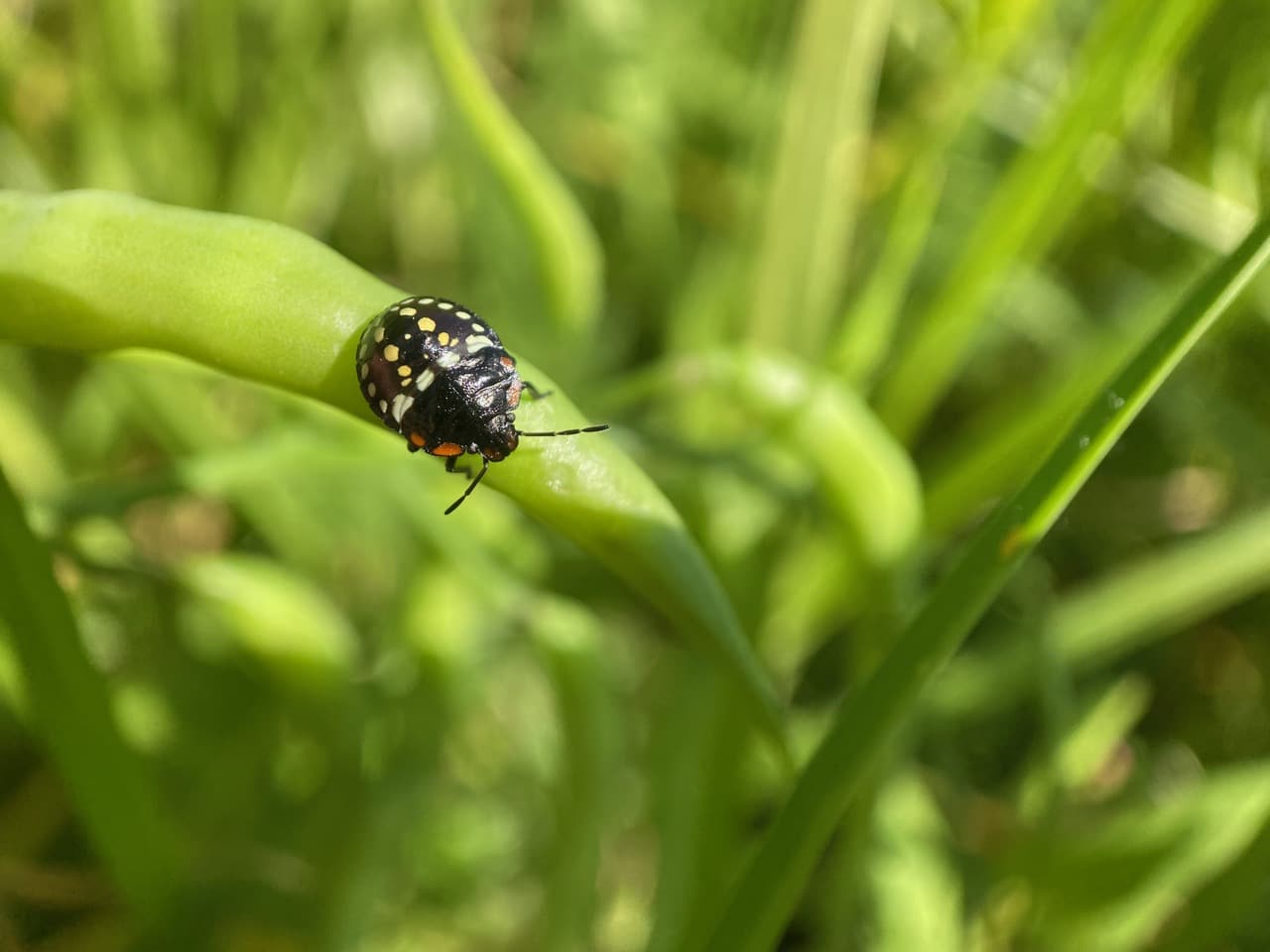
A colorful critter is walking on an immature Wild Radish seed pod. It is a juvenile (third instar) Southern Green Stink Bug, Nezara viridula (family Pentatomidae).
Pentatomidae is a family of insects belonging to the order Hemiptera or “true bugs”. As hemipterans, the pentatomids have piercing-sucking mouthparts, and most are phytophagous, including several species that are severe pests on agricultural crops. Stink Bugs feed on plant fluids by inserting their needlelike mouthparts into stems, leaves or seed pods. While feeding, they inject materials into the plant to aid in digestion and sap removal. Penetration by the mouthparts can cause physical damage, much like stabbing the plant with a fine needle.
All Pentatomids have 5-segmented antennae (hence their family name, Penta – five and tomos – section.) They generally have a large triangular scutellum in the center of the back. The adult is generally shield-shaped when viewed from above. The common name of Stink Bug refers to their ability to release a pungent defensive spray when threatened, disturbed, or crushed.
The Southern Green Stink Bug, Nezara viridula (family Pentatomidae) is a plant-feeding stink bug. Believed to have originated in Ethiopia, it can now be found across the world. Because of its preference for certain species of legumes, such as beans and soybeans, it is an economically important pest on such crops.
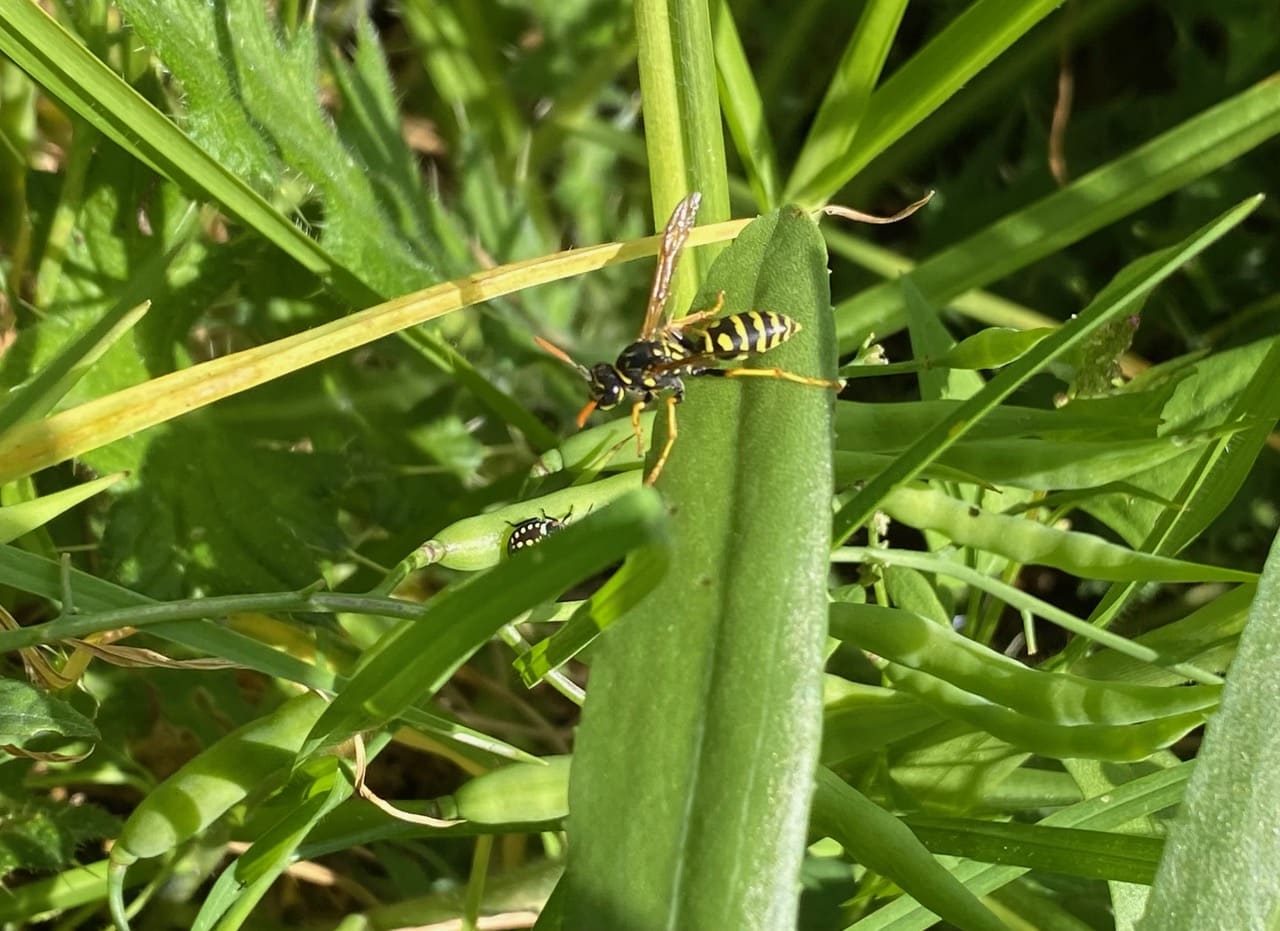
As I am photographing the stink bug, a European Paper Wasp lands on a leaf above to investigate the bug.
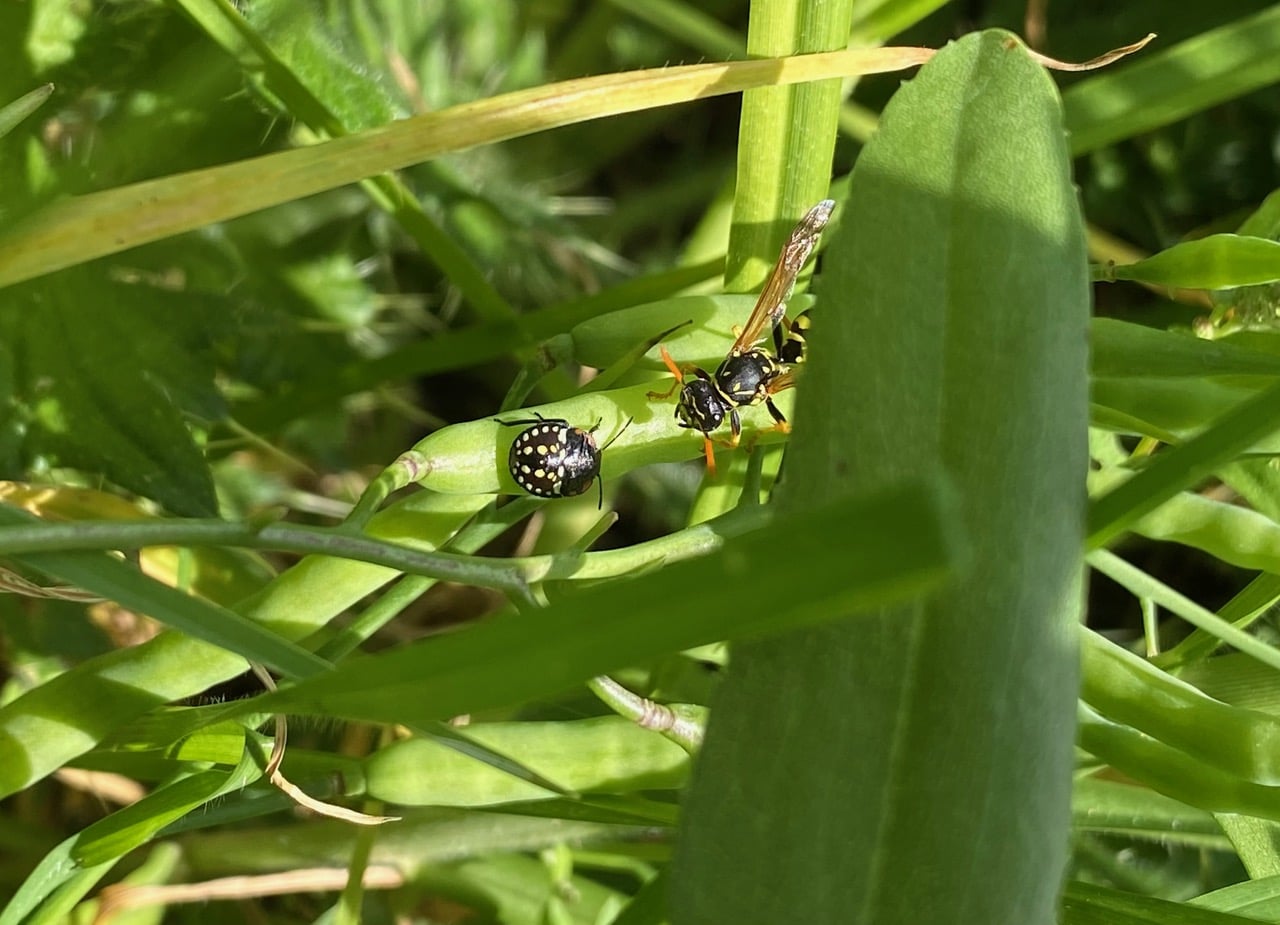
The wasp cautiously approaches the stink bug on foot, making hesitant jabbing motion towards it as if testing if the bug is a worthy prey. The stink bug stands its ground. The wasp finally gives up and flies away.

A dusky hover fly is foraging on a flower of Wild Radish, Raphanus sativus. It is a female Sedgesitter, Platycheirus sp. (family Syrphidae).
How can I tell it is female? The eyes of hoverflies are a convenient way to tell the sexes apart – the male’s eyes are holoptic, meeting along a central line on top of the head, while the female’s eyes are set apart.
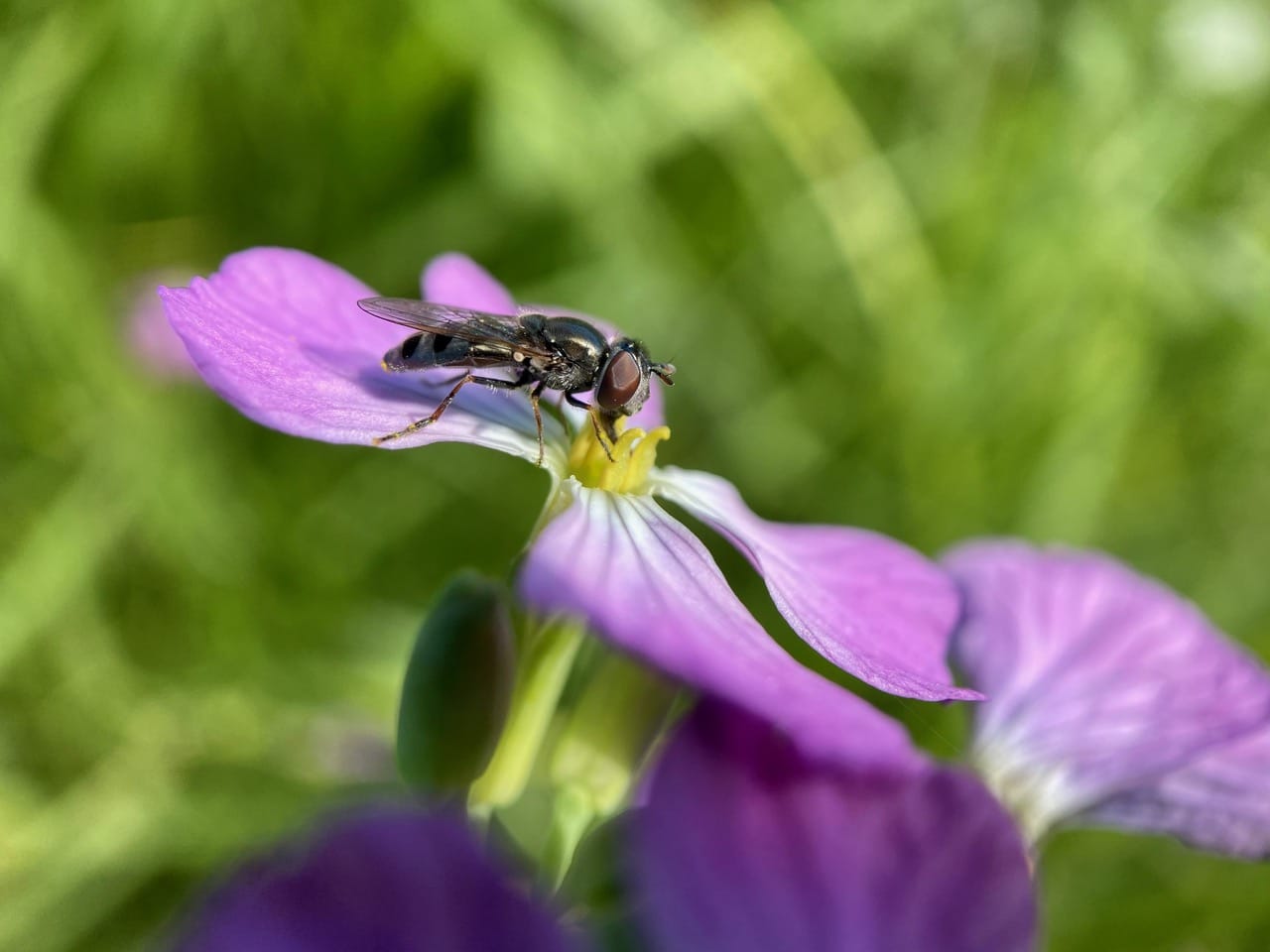
The Sedgesitter, Platycheirus sp. (family Syrphidae) is found in grass and herb vegetation. Adults of many species feed on pollen of wind-pollinated plants, such as Salix, Plantago, Poaceae, Cyperaceae, but they also visit other flowers. Many stay active during cold and rainy weather. Larvae feed on aphids.

While I am checking out the aphids on a Hooker’s Evening Primrose, Oenothera elata, a fly lands on a wilted flower, its body a resplendent gold.

A close-up of the fly reveals small, dark spots on its eyes. Ah, it is a Common Lagoon Fly, a rather unusual hover fly. I have never seen one this golden. The flies tend to look dark in less than optimal light.
The Common Lagoon Fly, Eristalinus aeneus (family Syrphidae) is a widespread species, native to Europe and found throughout the United States. Its common name derives from its habitat, which includes lagoons, ponds, and slow-moving streams. Key features are the small, dark spots on its eyes, which tend to merge at the top. The adult flies are pollinators, feeding on nectar and pollen from flowers. The larvae are found in damp environments, often with decaying seaweed. They are also known as “rat-tailed maggots”, for the long siphon on their rear end that acts like a snorkel, helping them breathe under water. The larvae are saprophagous, feeding on bacteria in water rich in decomposing organic matter.