

Pollinator Post 9/21/25 (1)

The clouds didn’t clear until 11 am today. Fred and I are happy to take a late morning walk at Shoreline Park on Bay Farm Island.
When I start on the trail at the end of Aughinbaugh Way, the first thing I notice are these white patches on the blooming Oregon Gumweed, Grindelia stricta. It appears as if snow has fallen on the plants. A serious case of Spittlebug infestation?
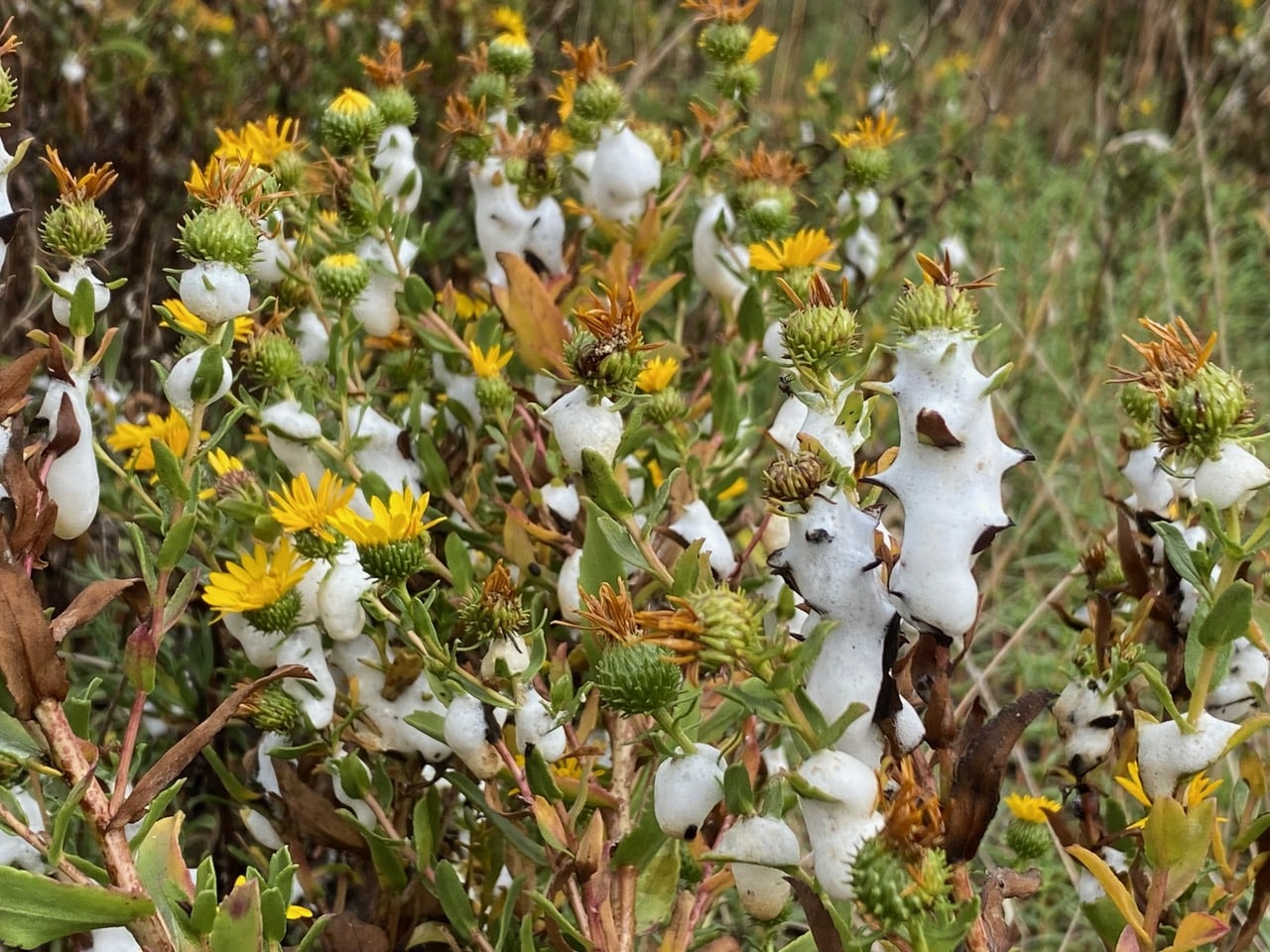
Some Grindelia are so loaded with the spittle that the foamy masses seem to melt into one another. Wow! This is the same spot where a similar infestation has occurred last year. The Spittle Bugs have returned in force! I wonder where the bugs have been spending the last few months out of sight. In the soil? As eggs? As adults?
The foam mass is made by a nymph of a bug called the Spittle Bug (superfamily Cercopoidea). Like the adults, the nymphs use their piercing, sucking mouthparts to feed on plant juices. The nymph produces a cover of foamed-up plant sap reminiscent of saliva, hence the common name of spittlebug. Whereas most insects that feed on sap feed on the nutrient-rich fluid from the phloem, Spittlebugs tap into the much more dilute sap flowing upward via the xylem. The large amount of excess water that must be excreted and the evolution of special breathing tubes allow the young spittlebug nymphs to grow in the relatively protective environment of the spittle. Symbiotic bacteria in the insects’ digestive system provides them with the essential amino acids that their diet lacks. The foam serves a number of purposes. It hides the nymph from the view of predators and parasites, and it insulates against heat and cold, and protects the delicate nymphs from desiccation. Moreover, the foam has an acrid taste that deters predators.

A couple of exuvia are clinging to the terminal leaves above a foam mass. One black adult is visible in the blurry foreground.
An exuvia is the discarded exoskeleton left behind after an insect (or other arthropod) sheds its skin during molting. This process, known as ecdysis, allows the organism to grow, as its rigid exoskeleton cannot expand.

A Spittlebug nymph is half submerged in a pool of foam on the Grindelia leaf axil. At this advanced instar, the nymph is black in the front half, and cream-colored in the rear half of the body. There is a dark spigot-like structure at the tip of its abdomen where gas exchange occurs.

An exuvia clings to a leaf above a foam mass where a mature nymph has emerged to molt for the last time into an adult.
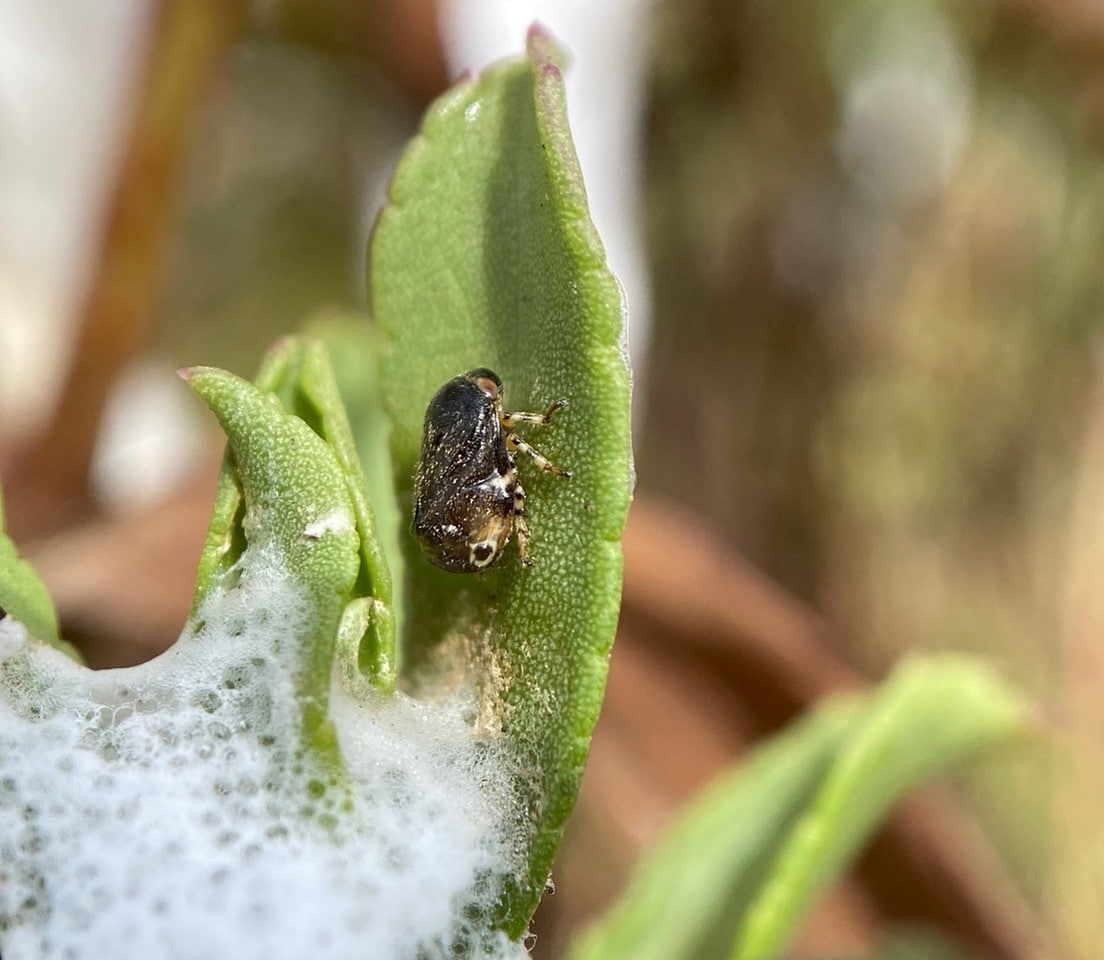
Ooh, here’s an adult Spittlebug, Complex Clastoptera lineatocollis (family Clastopteridae). The bug is facing up. Its eyes are a diffused maroon color. The white-rimmed black spot is actually a fake eyespot on the rear end of its fore wing.
The Spittlebug, Complex Clastoptera lineatocollis (family Clastopteridae) is found in western United States. The bugs feed mostly on Asteraceae, although other hosts have been reported. Females are brownish (3.3-3.8 mm), while the smaller males (3.0-3.2 mm) are mostly black.
The adult Spittle Bug is sometimes called a Froghopper. The Froghopper is a “true bug” in the order Hemiptera. Froghoppers are champion jumpers among insects, out-performing even the fleas. The bug can leap the human equivalent of a skyscraper without a running start. It is the highest jumping insect proportional to body size. The muscles in its hind legs act like a “catapult” to release energy explosively.
Athletic prowess aside, the Froghopper is better known for its young, the “spittle bug”. The nymphs produce foamy white masses on plants within which they feed on plant sap. Froghoppers have piercing-sucking mouthparts, and feed on plant sap as both nymphs and adults. A recent report claims, “Froghoppers are the super-suckers of the animal world. The tiny insects produce negative pressures equivalent to people sucking a 100-meter-long straw.” The sucking power is strong enough to suck the water out of a cup at the base of the Statue of Liberty while perched on its crown. To complement that, the Froghopper is also exceptional at urination, excreting the human equivalent of 2,500 gallons of urine a day.
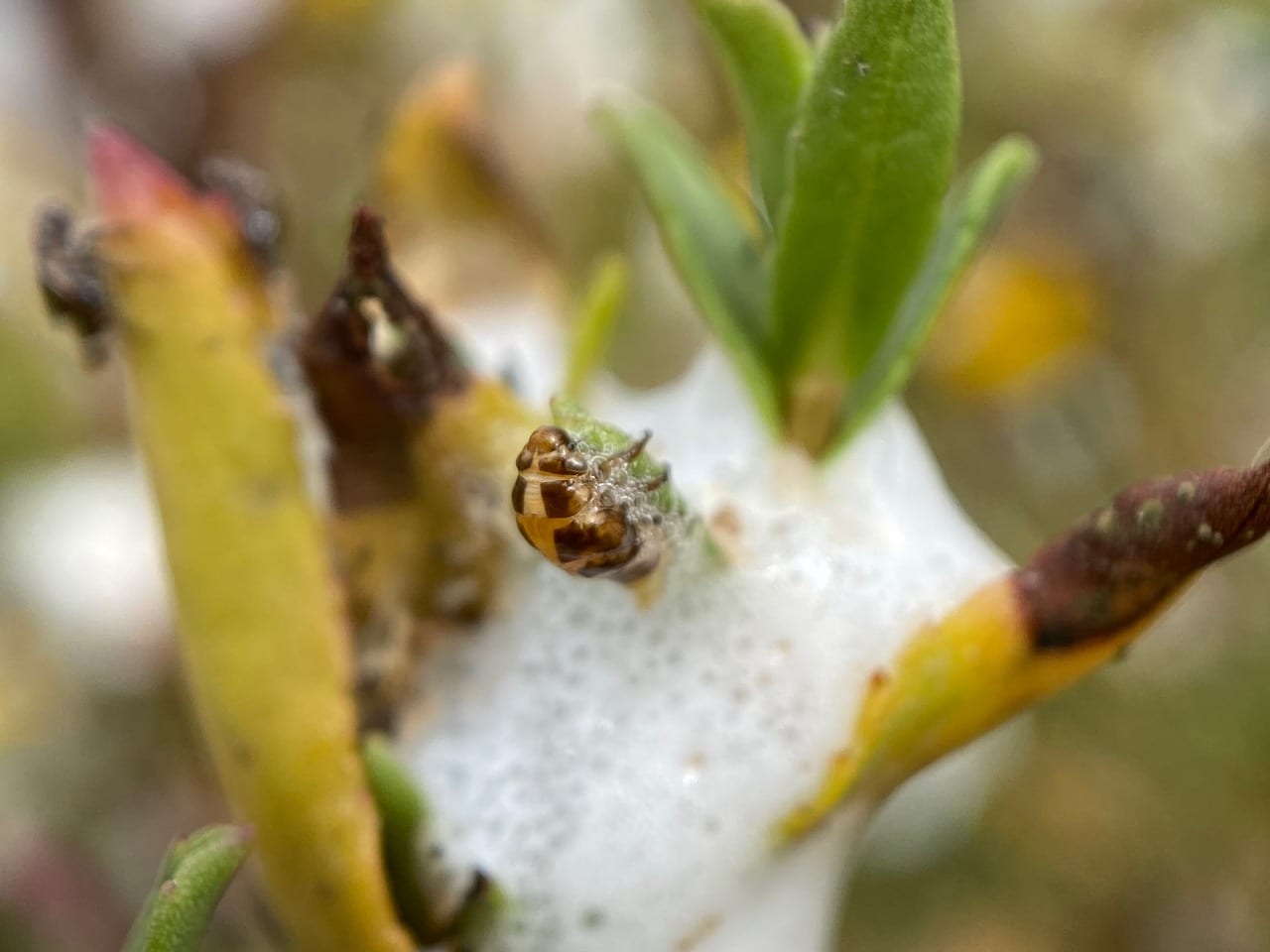
Something special is happening here – a Spittlebug nymph has crawled out of its foam mass to molt into an adult. Holding onto the tip of the Grindelia leaf, the nymph has split its skin on the thorax to start the process.

I settle down next to the plant to watch the spectacle unfold – it will take some time.
11:36:55 am. The pale orange adult Spittlebug is emerging from its old black exoskeleton pushing through the split in the thorax.
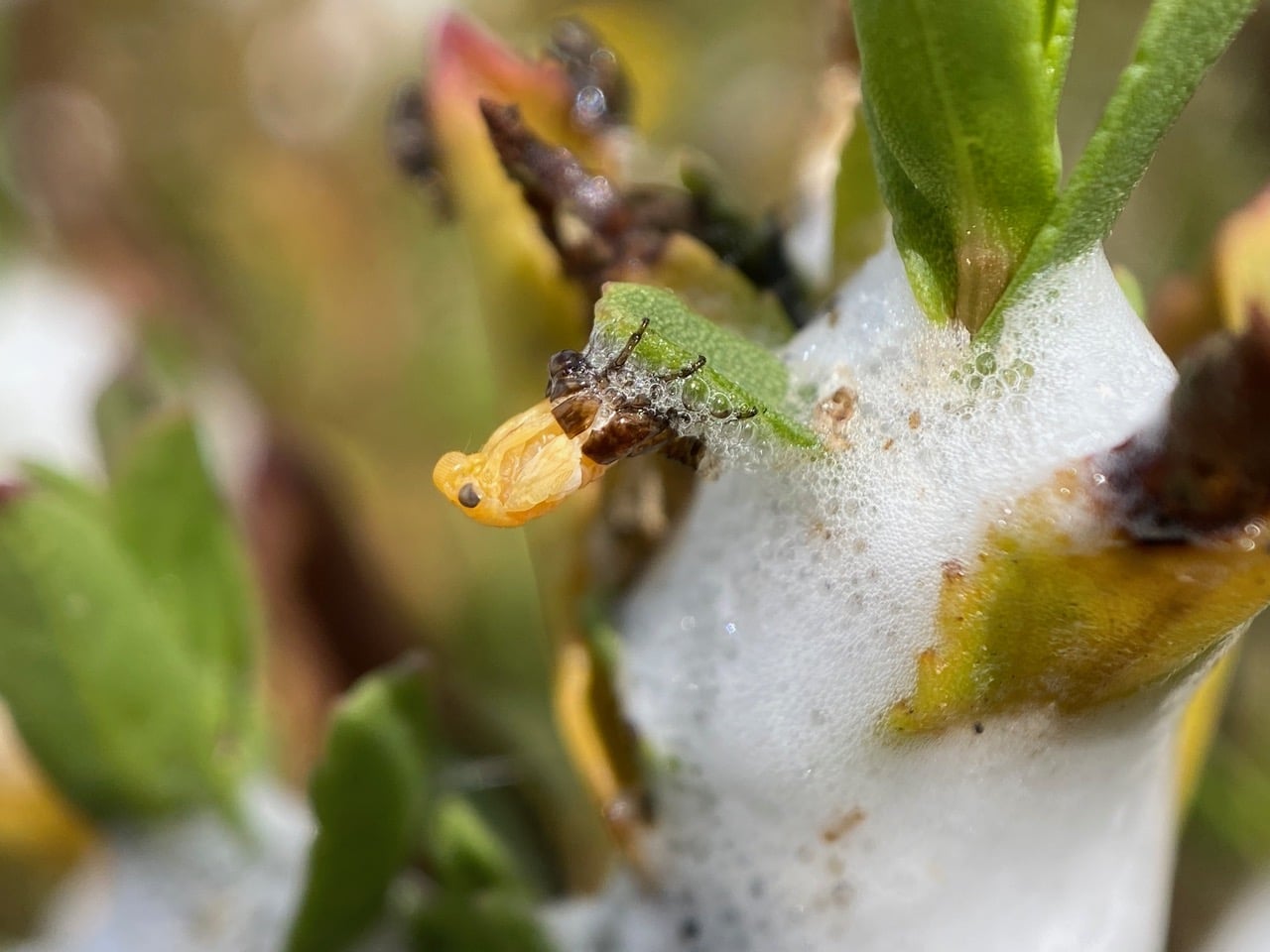
11:40:50 am. Half of the Spittlebug is already out of the old exoskeleton.

11:41:33 am. What cute angel wings!
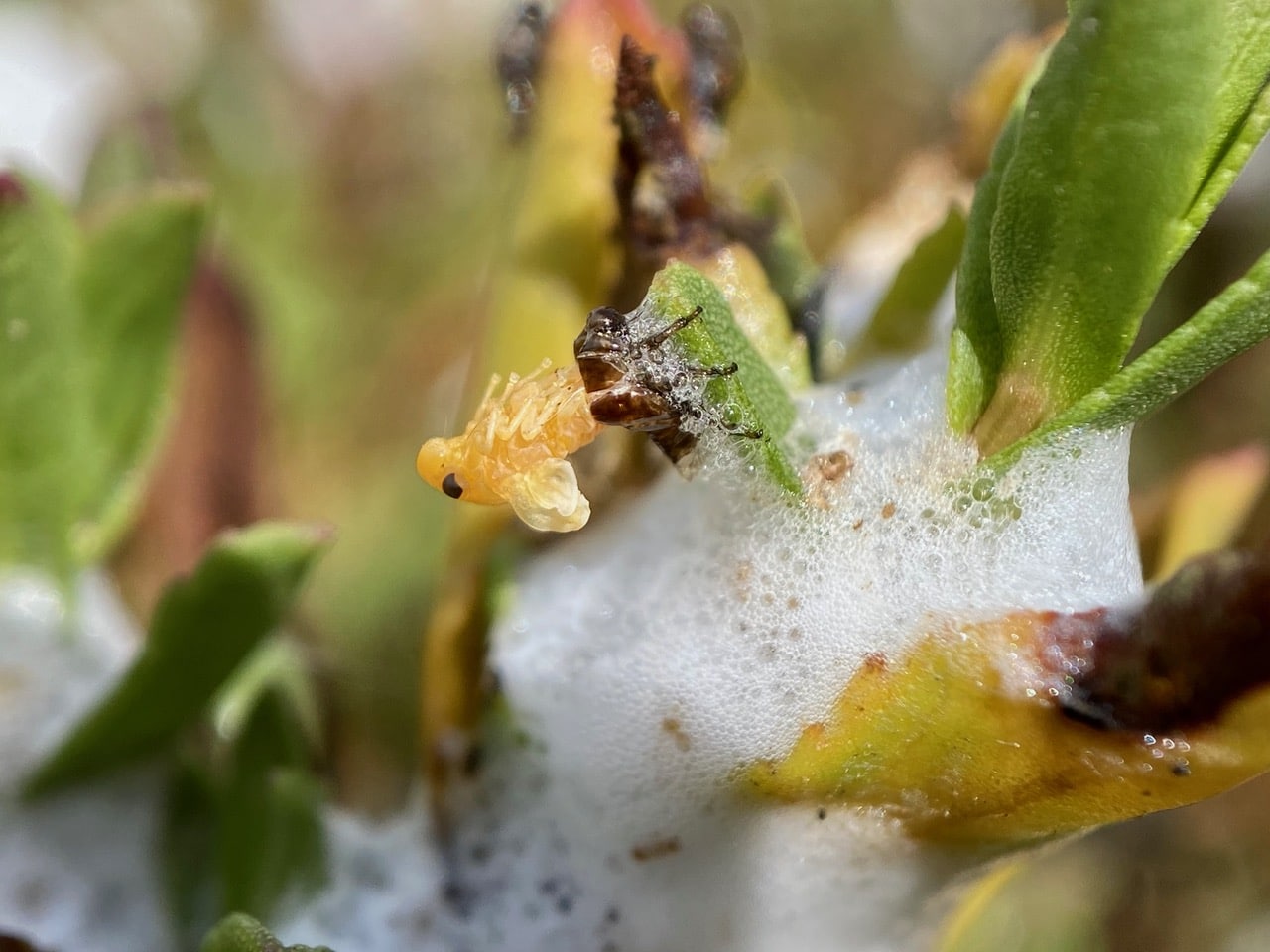
11:43:47 am. Ah, all six legs are now out of the exoskeleton.
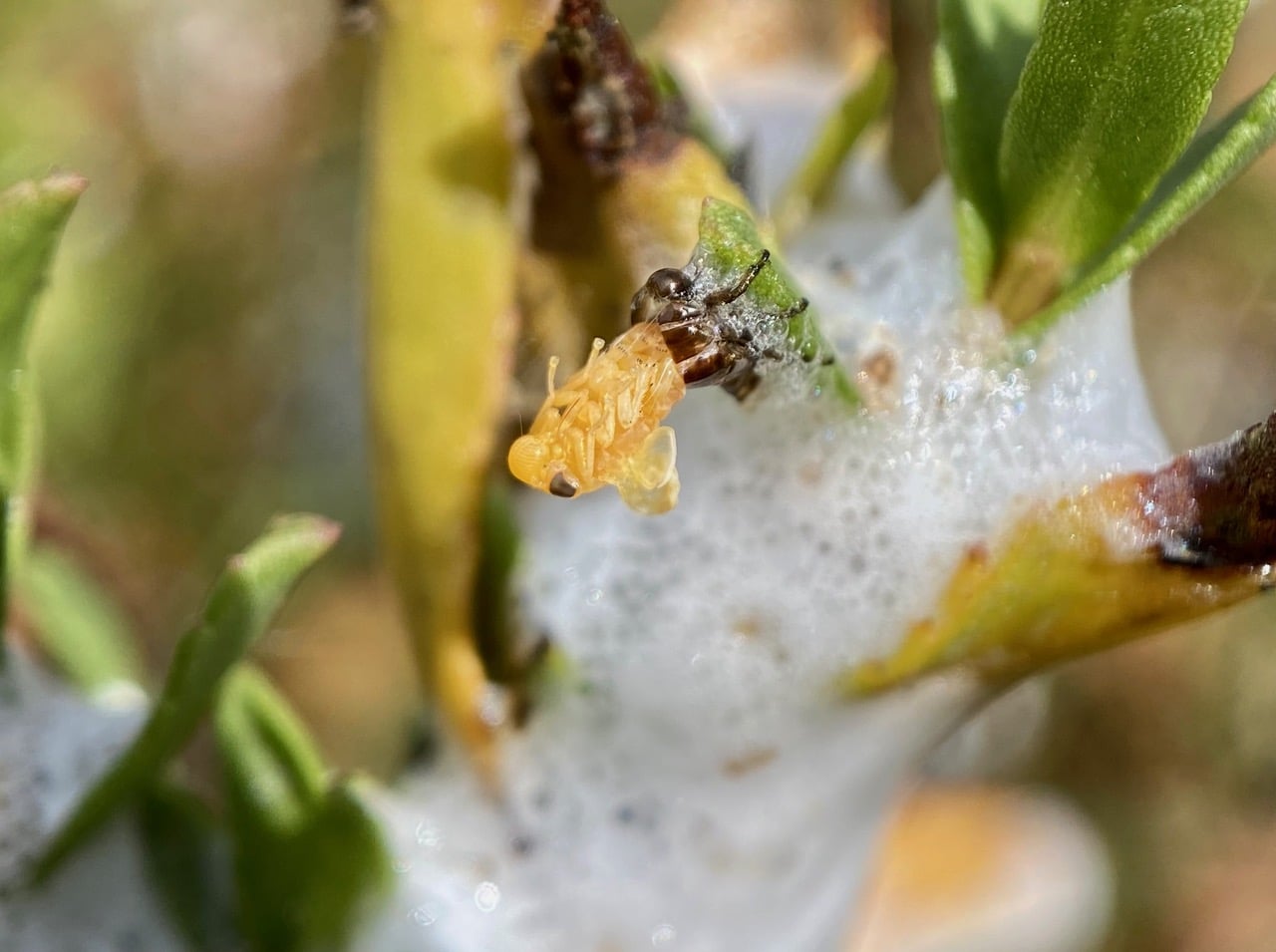
11:46:15 am From this angle, I can see the reddish hair-like stylet on the young Spittlebug’s rostrum (mouthparts).
The defining feature of Hemipterans or “true bugs” is their “beak” or rostrum, their piercing-sucking mouthparts. The modified mandibles and maxillae form a “stylet” which is sheathed within a modified labium. The stylet is capable of piercing tissues and sucking liquids, while the labium supports it. The stylet contains a channel for outward movement of saliva and digestive enzymes, and another channel for the inward movement of pre-digested liquid food. The rostrum is usually folded under the body when not in use.


11:51:05 am. The wings are expanding.

11:53:21 am. The bug’s entire body is out of the old exoskeleton. The Spittlebug now steadies itself by grasping the exuvia with its legs.

At this point, my attention is hijacked by a nearby Spittlebug nymph that is wandering in and out of its foam mass. Do the bugs come out of the foam to molt every time, or do they only come out for the last molt into the adult?
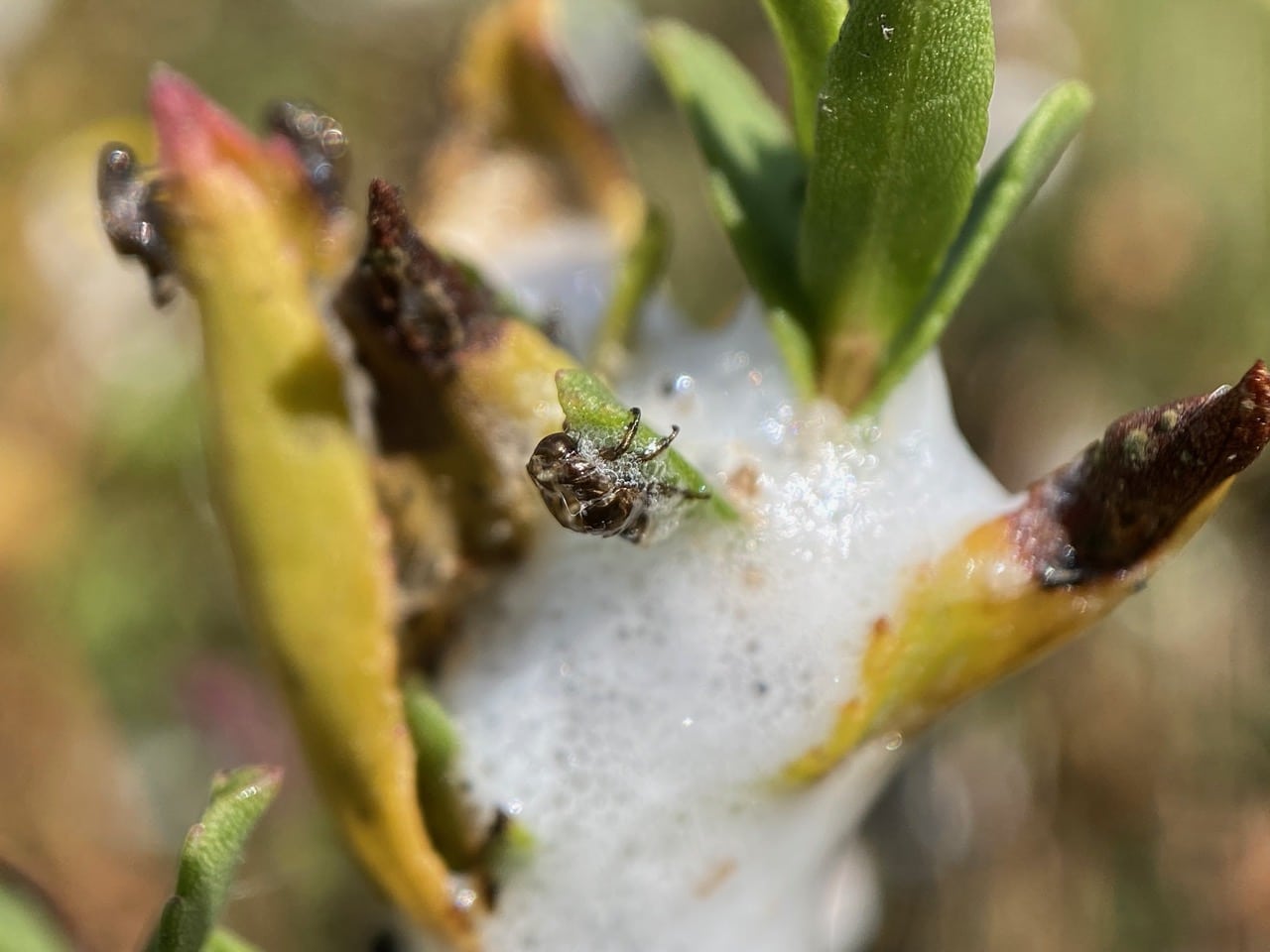
Hearing a loud buzzing sound, I look back at the newly emerged adult Spittlebug. It is gone! Alas, probably taken by a Yellowjacket or a European Paper Wasp! Numerous wasps are diligently patrolling the Grindelia for these tender morsels of protein. The newly emerged bugs are soft and helpless, and make easy prey.
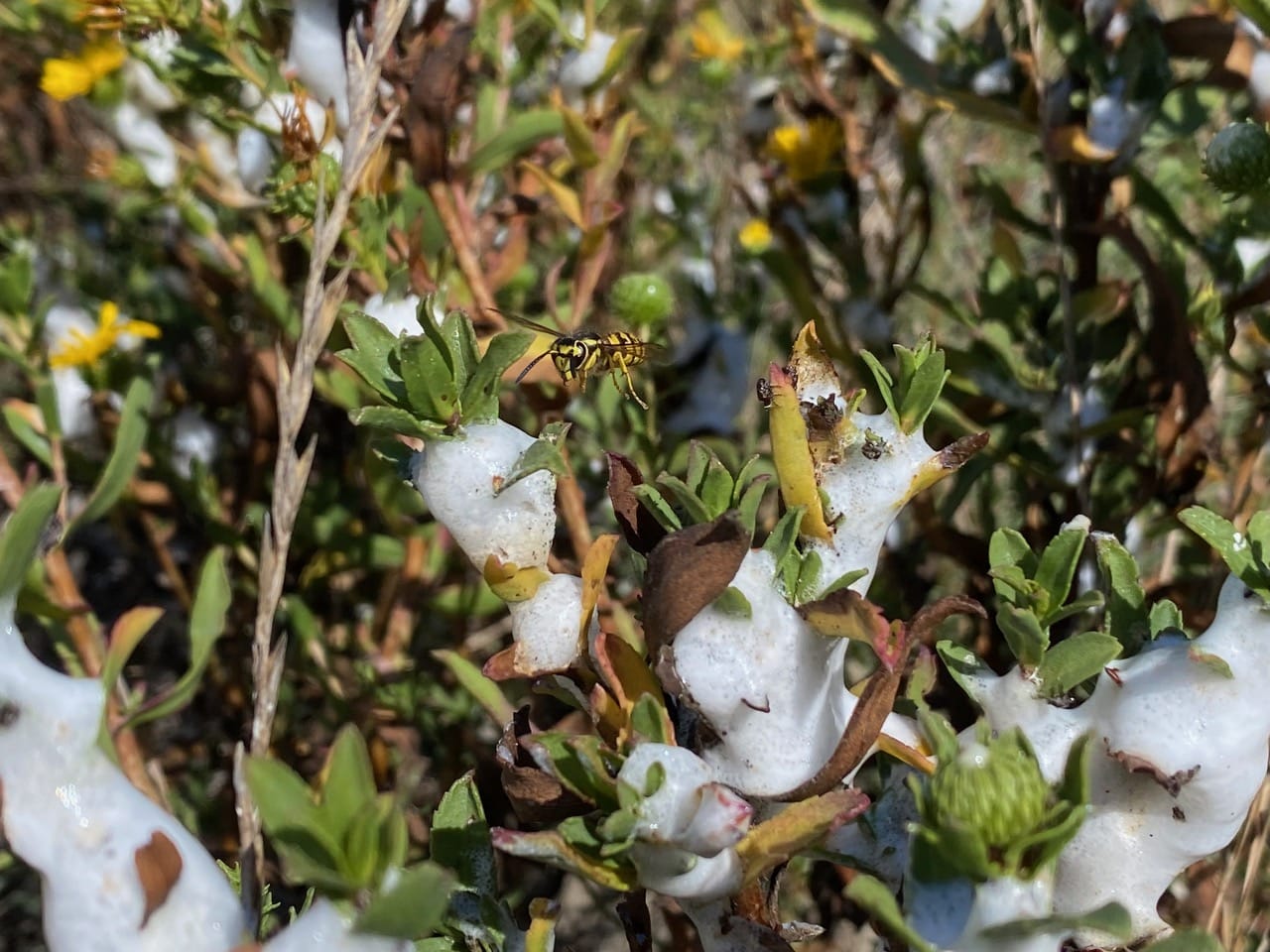
A Yellowjacket is flying around the Grindelia, checking the foamy masses with great interest.
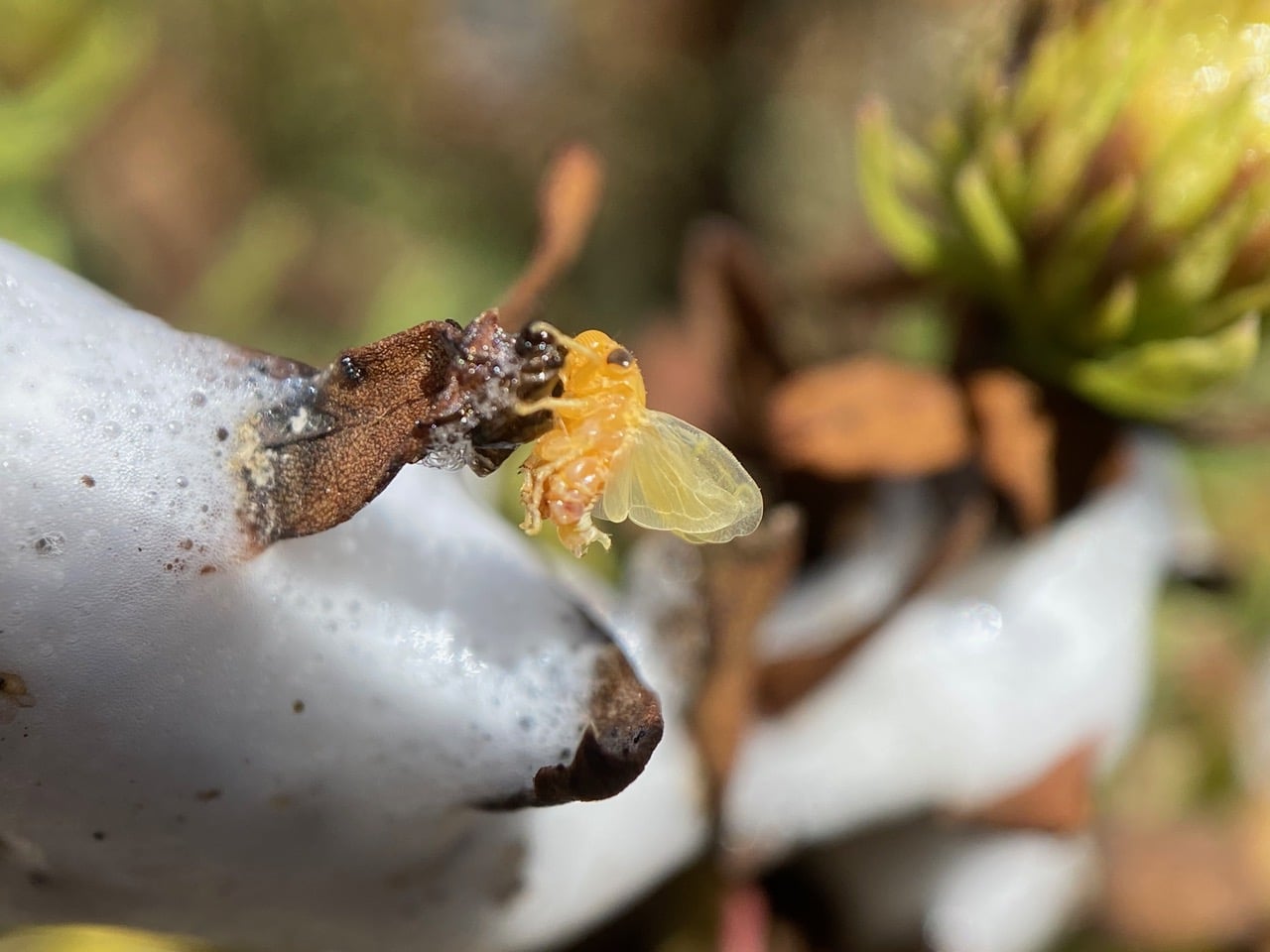
I have barely walked a few steps when I come upon a molting Spittlebug on another Grindelia plant. It is at about the same stage of development as the last bug I have been observing. The bug’s entire body is out of its exuvia, and it is inflating its wings.
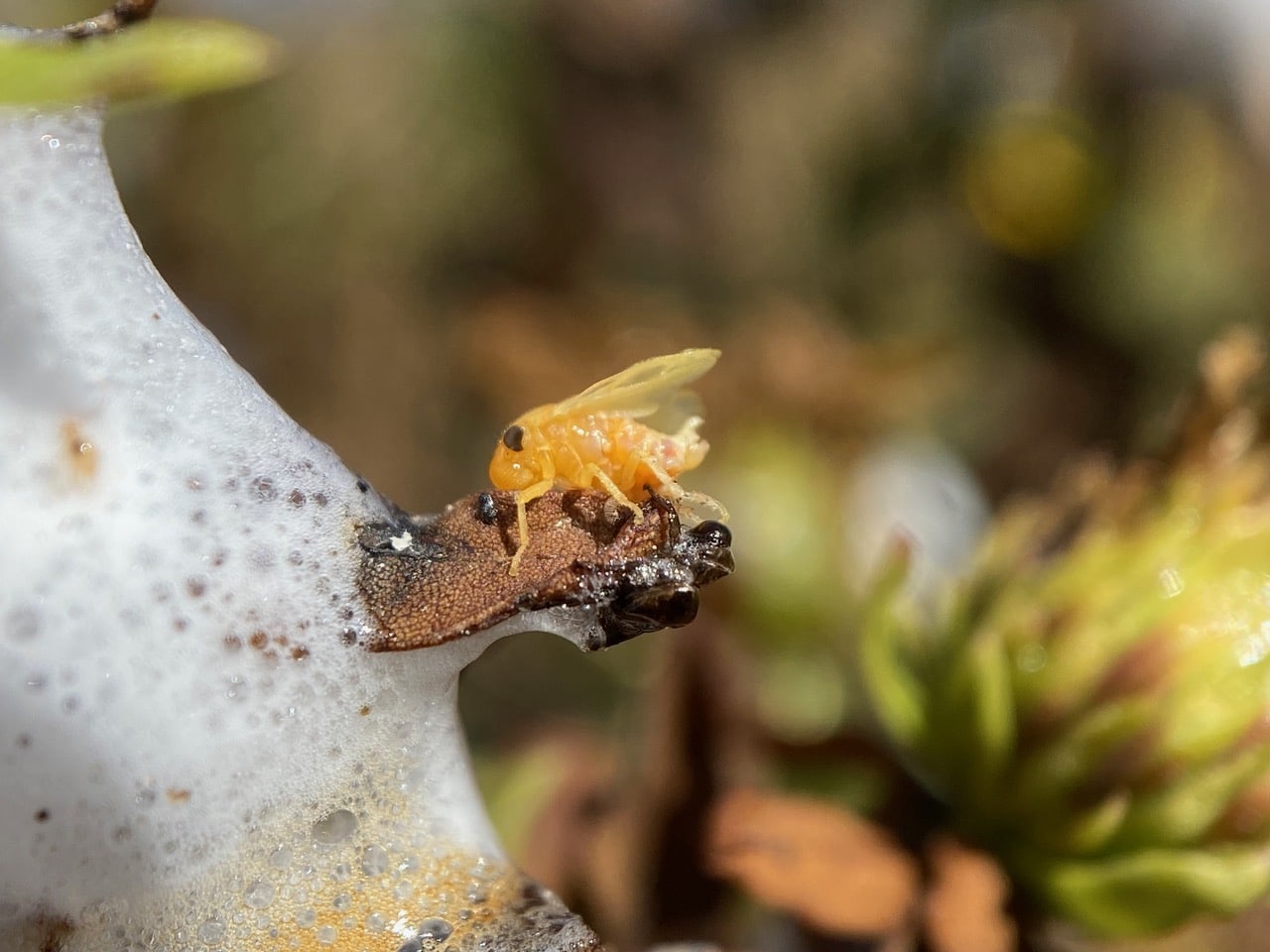
12:16:56 pm. This bug has left its exuvia and crawled onto the leaf.
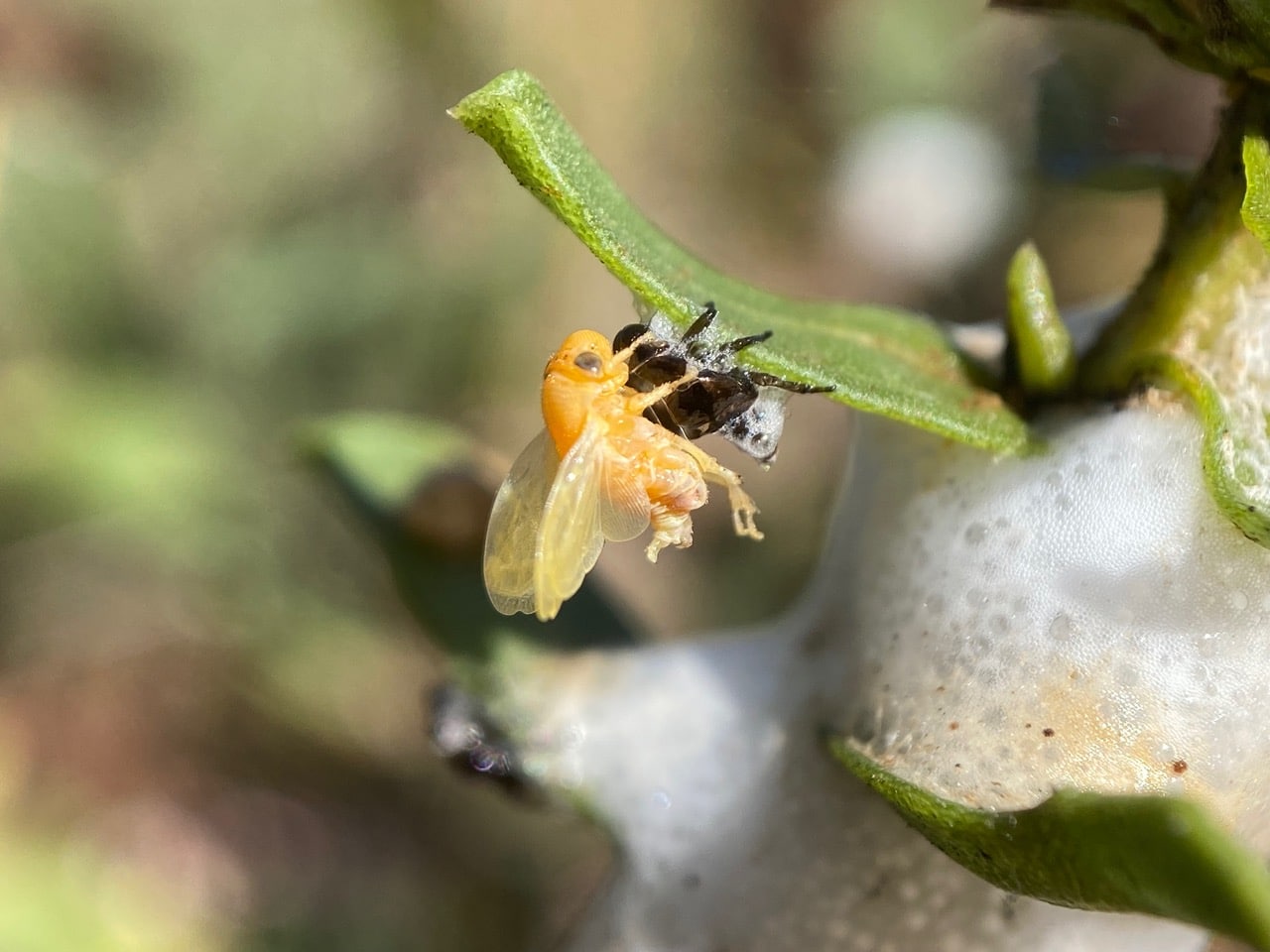
12:18:05 pm.. Hey, there’s another molting Spittlebug on this plant. It too is at the same stage of development. What synchronize the emergence of these bugs? Temperature? Light level? Time of day? I recall that the Spittlebug emergences I have observed here last year also occurred at mid day.

12:26:49 pm. The teneral Spittlebug has assumed an adult wing position – folded tent-like over the body.
A teneral insect is a young insect that has just molted (emerged from its final nymphal skin) but has not yet hardened its exoskeleton or achieved its final coloration. Teneral insects typically have paler or different colors than their mature counterparts. Over a short period (often hours), the insect’s exoskeleton hardens and darkens, a process similar to the tanning of leather. This period allows the insect to expand its body and limbs. Being soft, and unable to move much, tenerals are more susceptible to injury and predation.

On the leaf next to the newly emerged orange adult is a dull-colored teneral Spittlebug. It will probably take hours to acquire its full adult coloration.
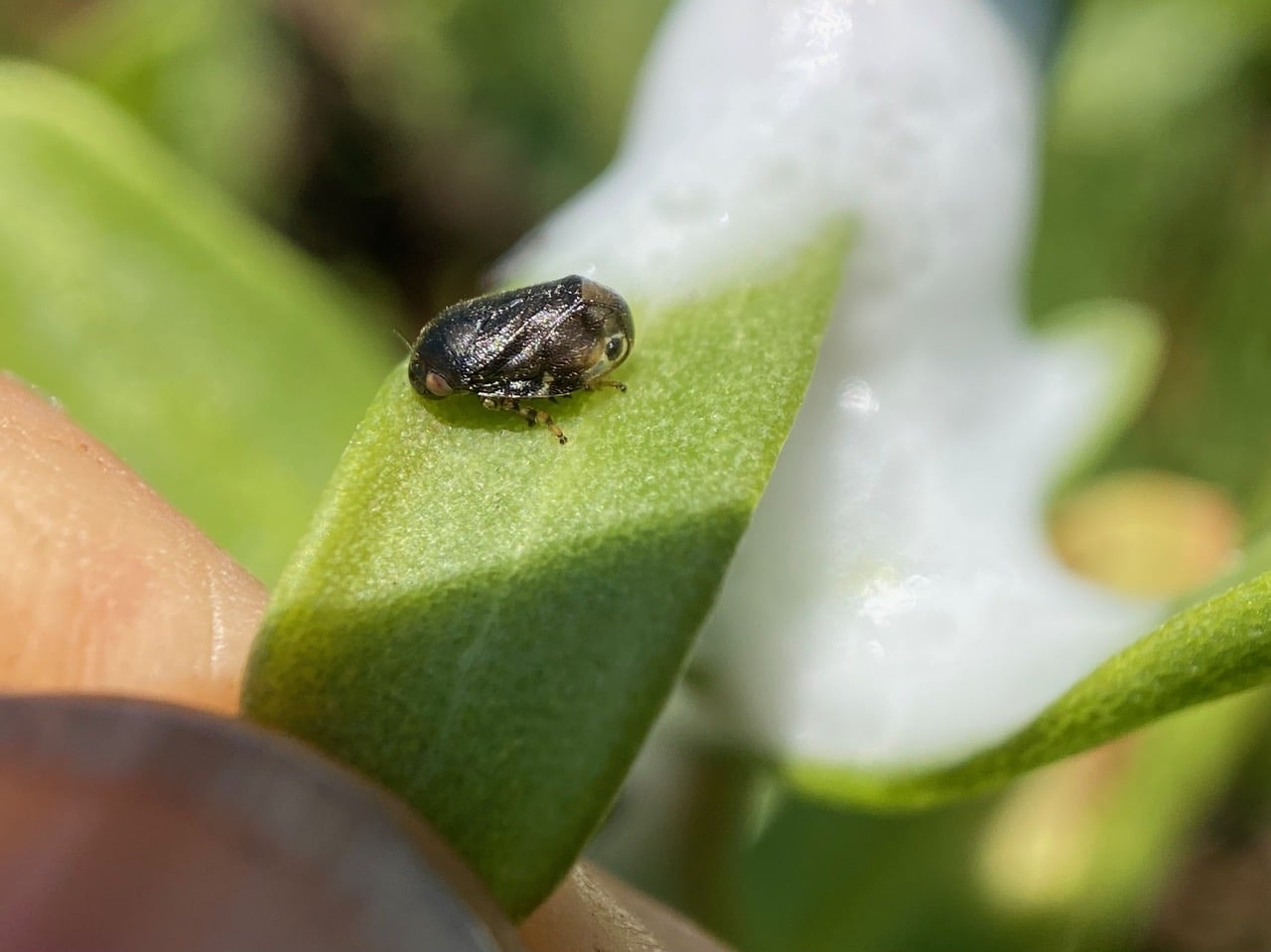
Hey, here’s a Spittlebug that has almost attained its final adult coloration – black. It is a male. Don’t be fooled by the fake eyespot on its wing. The insect is facing left.