

Pollinator Post 9/21/24 (2)
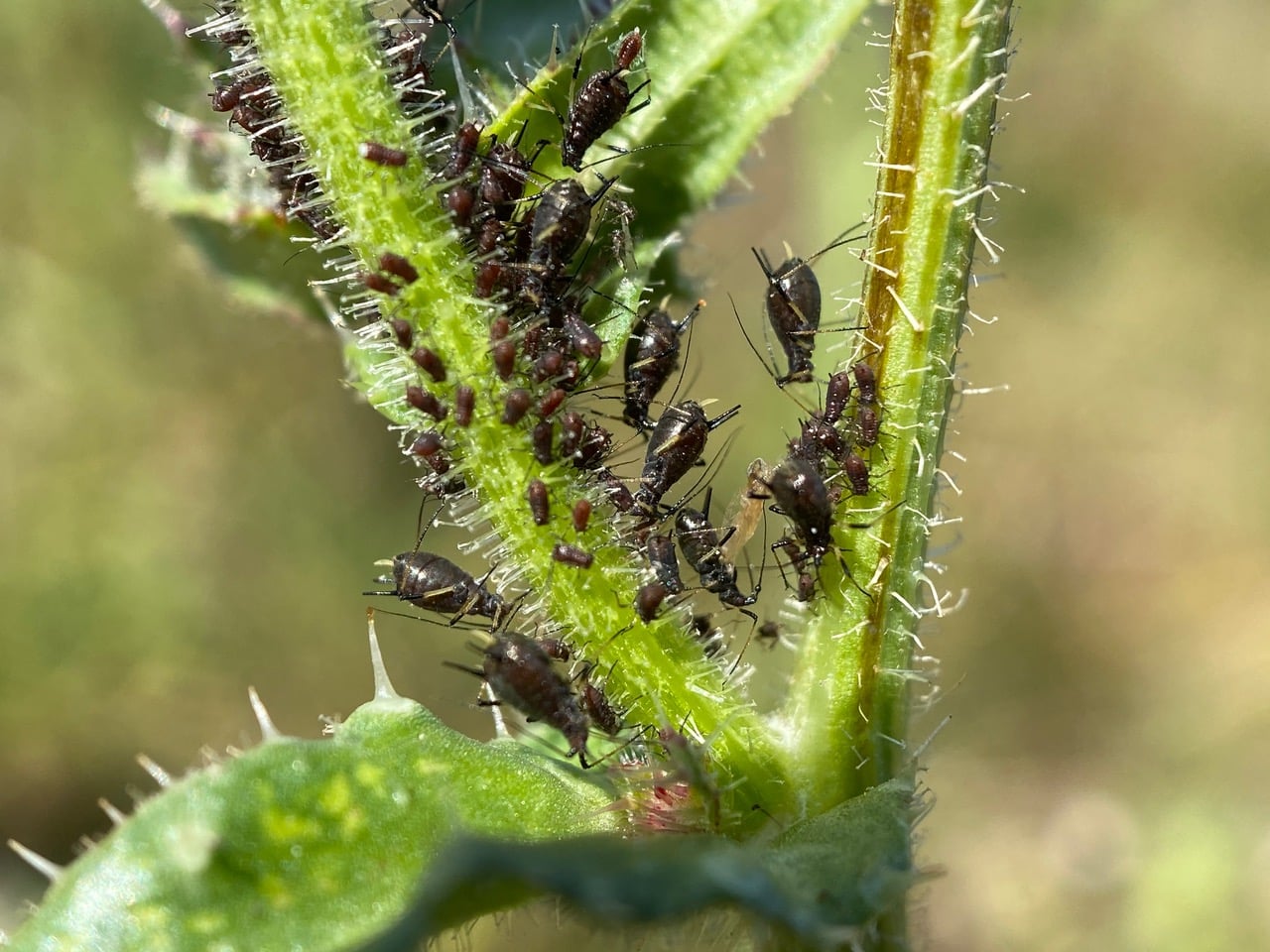
I pause by a Bristly Oxtongue, Picris echioides that is heavily infested with dark aphids. There are individuals of all ages and sizes on this branch. There’s even a mama giving birth to a baby (central, top most).
Aphids are small sap-sucking insects in the order Hemiptera. A typical life cycle involves flightless females giving live birth to female nymphs, – who may also be already pregnant, an adaptation called telescoping generations – without the involvement of males. Maturing rapidly, females breed profusely so that the population multiplies quickly. Winged females may develop later in the season, allowing the insects to colonize new plants. In temperate regions, a phase of sexual reproduction occurs in the autumn, with the insects often overwintering as eggs.
The life cycle of some species involves an alternation between two species of host plants. Some species feed on only one type of plant, while others are generalists, colonizing many plant groups. Some ants have a mutualistic relationship with aphids, tending them for their honeydew and protecting them from predators.
Aphids usually feed passively on phloem of plants. Once the phloem vessel is punctured, the sap, which is under pressure, is forced into the aphid’s food canal. Aphids produce large amounts of a sugary liquid waste called “honeydew”. A fungus called sooty mold can grow on honeydew deposits that accumulate on leaves and branches, turning them black.

It is not a surprise to find a Lady Beetle on the plant – both adults and larvae of these beetles are voracious aphid predators. The beetle is resting on a spent seed head. There are many kinds of spotless lady beetles, but most can be identified by their pronotum.
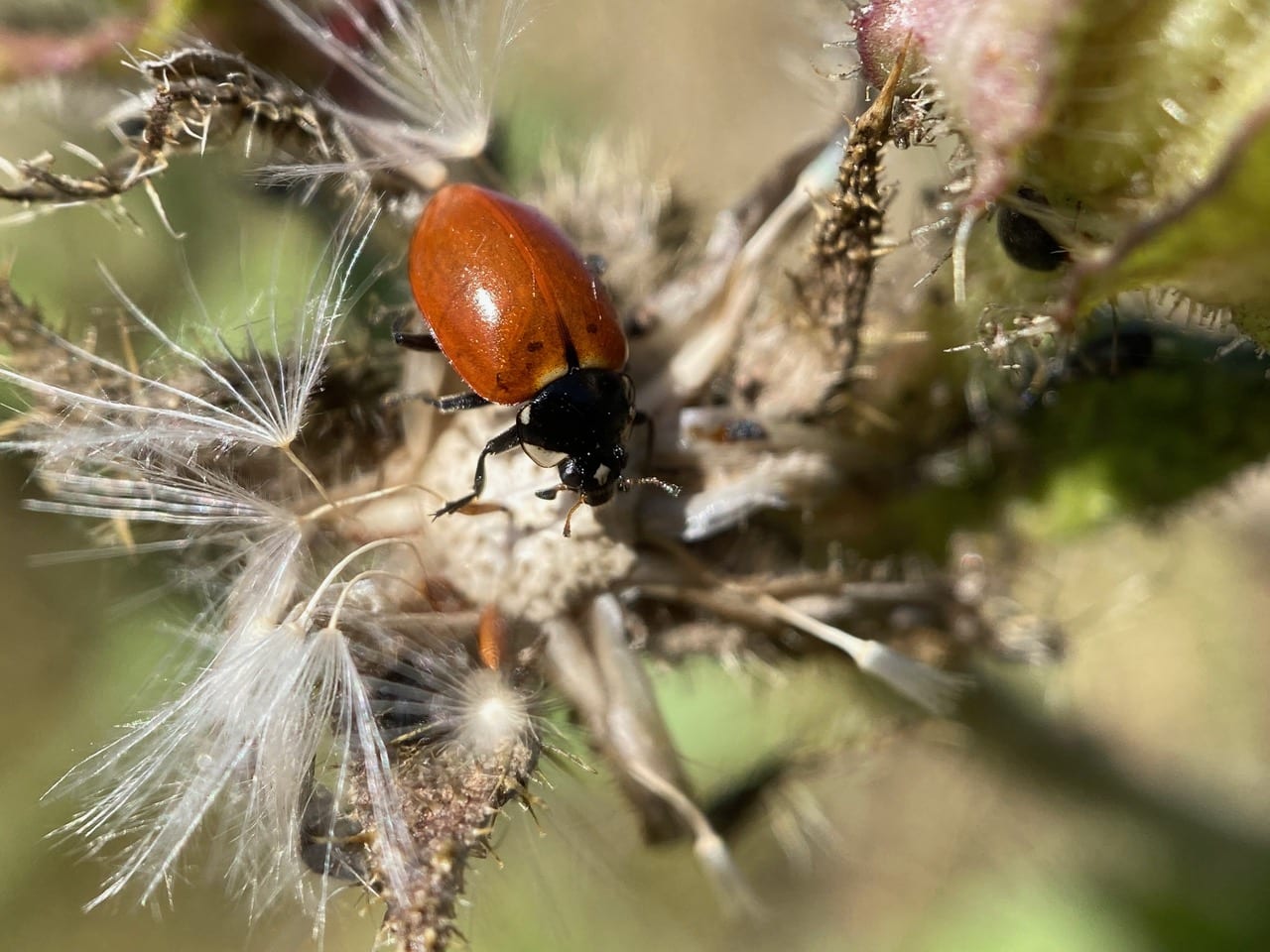
I finally get a good look at the beetle’s pronotum – the white pattern on its black pronotum is not familiar to me.
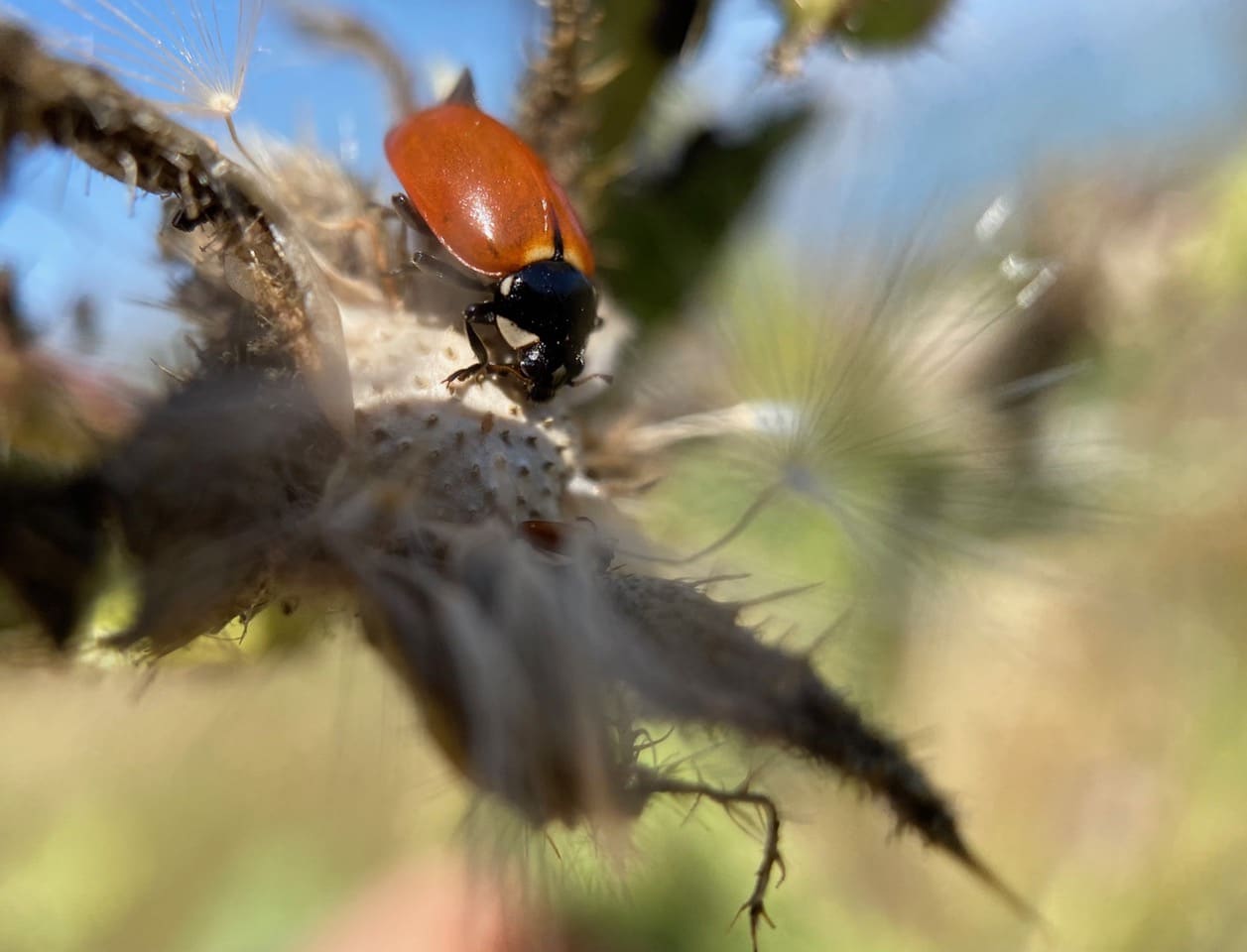
An expert on iNaturalist has helped identify the beetle as the Pacific Five-spotted Lady Beetle, Hippodomia quinquesignata ssp. ambigua (family Coccinellidae). The species is found in western North America. Elytral color pattern is extremely variable, with some being completely spotless. Pronotum with or without convergent pale spots. Yay, a new species for me!
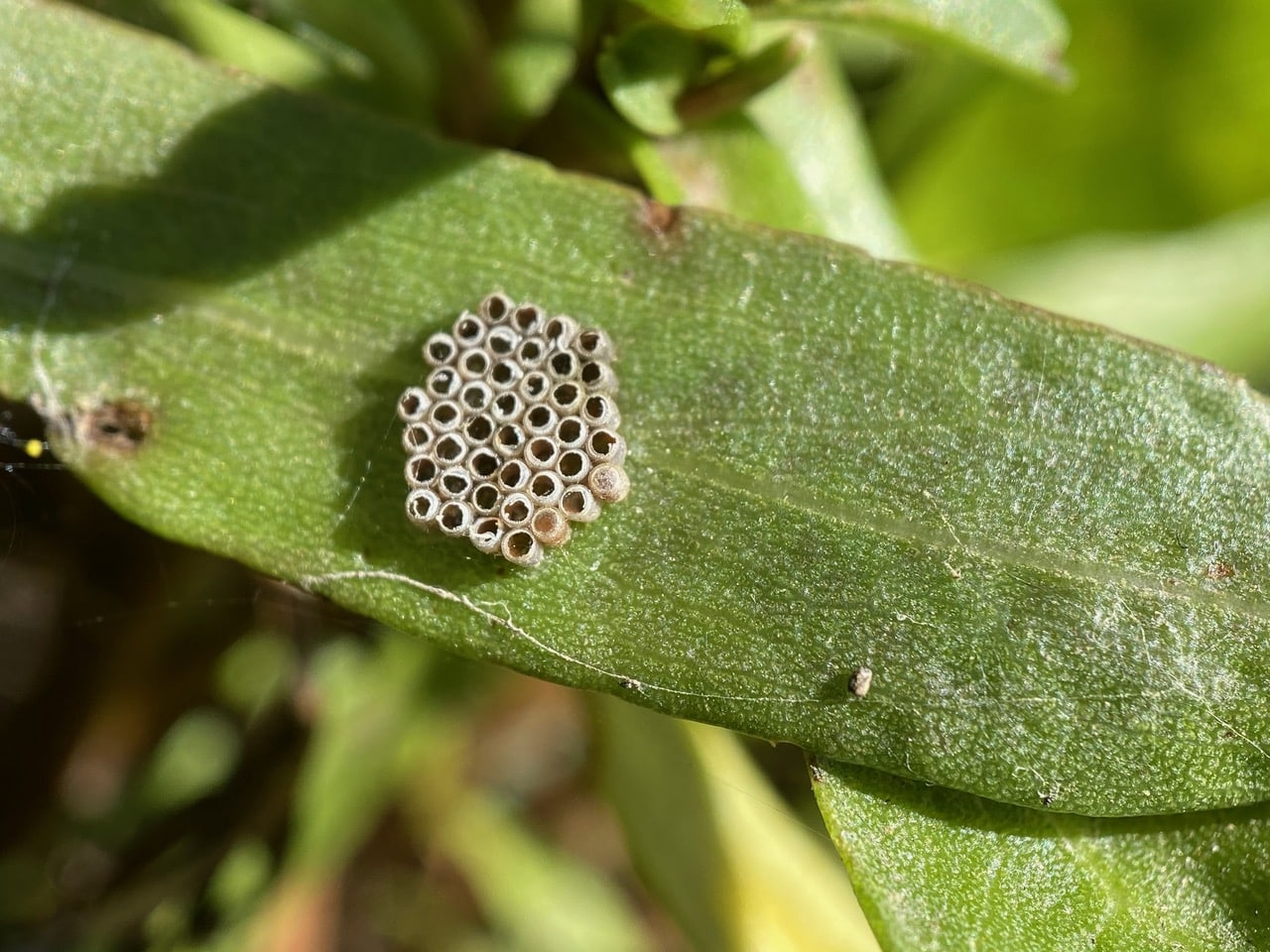
I find a cluster of Stink Bug eggs on a Grindelia leaf and a black/red insect lurking around them. The insect scampers away before I can take a good look. I am impressed by the way mama Stink Bug has arranged the eggs – in a neat hexagon. The only Stink Bugs I have seen here at Shoreline Park are the nymphs of the Southern Green Stink Bug, Nezara viridula (family Pentatomidae). In fact, we just saw one earlier today.
Stink Bug eggs are barrel-shaped with a pop-top from which the nymph eventually emerges. Most of the eggs in this cluster are empty except for two on the right edge.
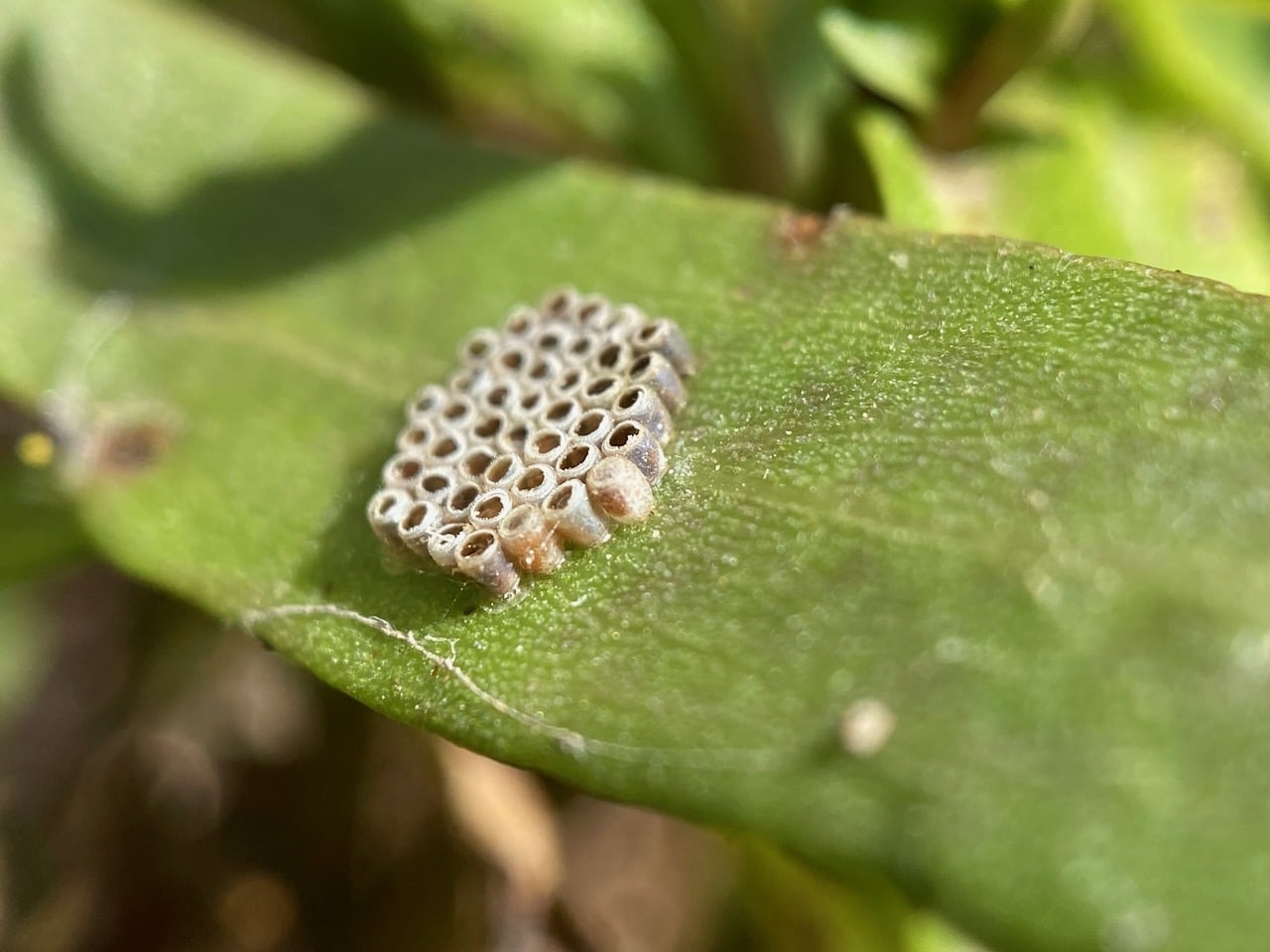
Another view of the Stink Bug eggs.

I am happy to locate the black-and-red insect again. It is a Four-spotted Collops, Collops quadrimaculatus, a species of the Soft-winged Flower Beetle in the family Melyridae. They are found in Central and North America.
Members of the family Melyridae differ from most other beetles in that their bodies are not hard and shell-like. Collops are small beetles, 4-7 mm. They are important predators with a penchant for soft-bodied insects like whiteflies, small Lygus nymphs, aphids, mites, and lepidopteran eggs and caterpillars. Occasionally they graze on pollen and nectar resources too. Larvae are predaceous in the soil litter, but are rarely seen.
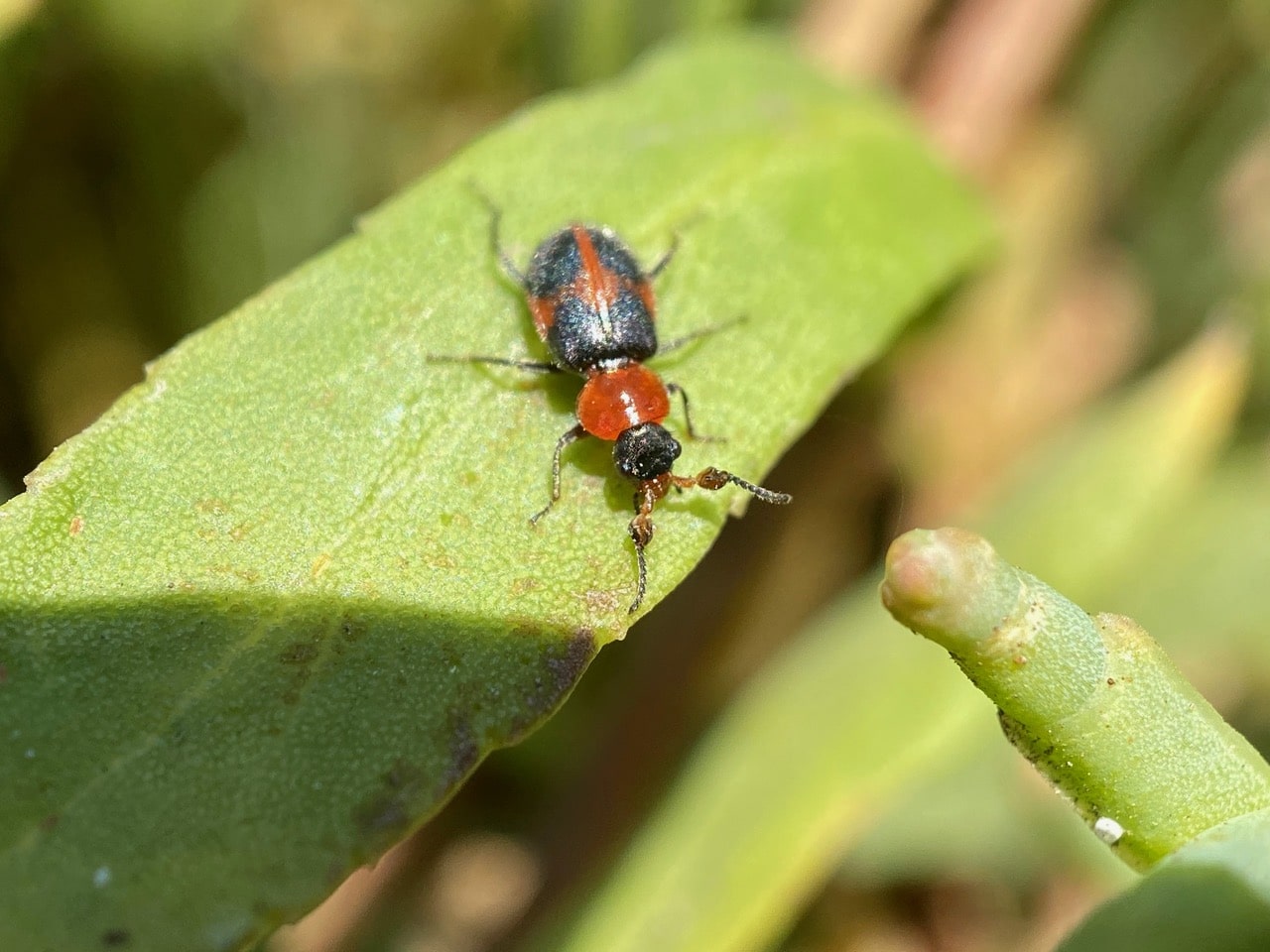
Male and female Collops can be distinguished by clearly visible knobby structures present on the base of the male’s antennae. We obviously have a male here. The function of the enlarged basal antenomeres are not clearly understood. But here’s a description by an observer:
“I have watched a male approach a female and present his vibrating antennae for her inspection, touching them to her antennae and sweeping the knobs across her head and pronotum. It looked as if he was maybe releasing pheromones towards the chemoreceptors on her antennae…. which would make her receptive to his advances.”

A Spittlebug, Clastoptera lineatocollis (family Clastopteridae) runs up a Grindelia stem to avoid my camera. I wonder why it doesn’t jump instead.
The Froghoppers (superfamily Cercopoidea) are a group of “true bugs” in the order Hemiptera. Adults are capable of jumping many times their height and length, giving them their common name, but many species are best known for their plant-sucking nymphs which produce foam shelters, and are referred to as “spittlebugs”. The superfamily currently consists of three families: the Aphrophoridae, Cercopidae, and Clastopteridae. The nymphs produce a cover of foamed-up plant sap visually resembling saliva, hence the common name. Whereas most insects that feed on plant sap tap into the nutrient-rich fluid from the phloem, the spittlebugs utilize the much more dilute sap flowing upward from the roots via the xylem. The insects’ digestive system contains symbiotic bacteria that provide them with the essential amino acids. The large amount of excess water that must be excreted and the evolution of special breathing tubes allow the young spittlebug nymphs to grow in the relatively protective environment of their foam shelters. The foam serves a number of purposes. It hides the nymph from the view of predators and parasites, and it insulates against heat and cold, providing thermal as well as moisture control. It also has an acrid taste that deters predators.
Froghoppers are champion jumpers among insects, out-performing even the fleas. The bug can leap the human equivalent of a skyscraper without a running start. It is the highest jumping insect proportional to body size. The muscles in its hind legs act like a “catapult” to release energy explosively.
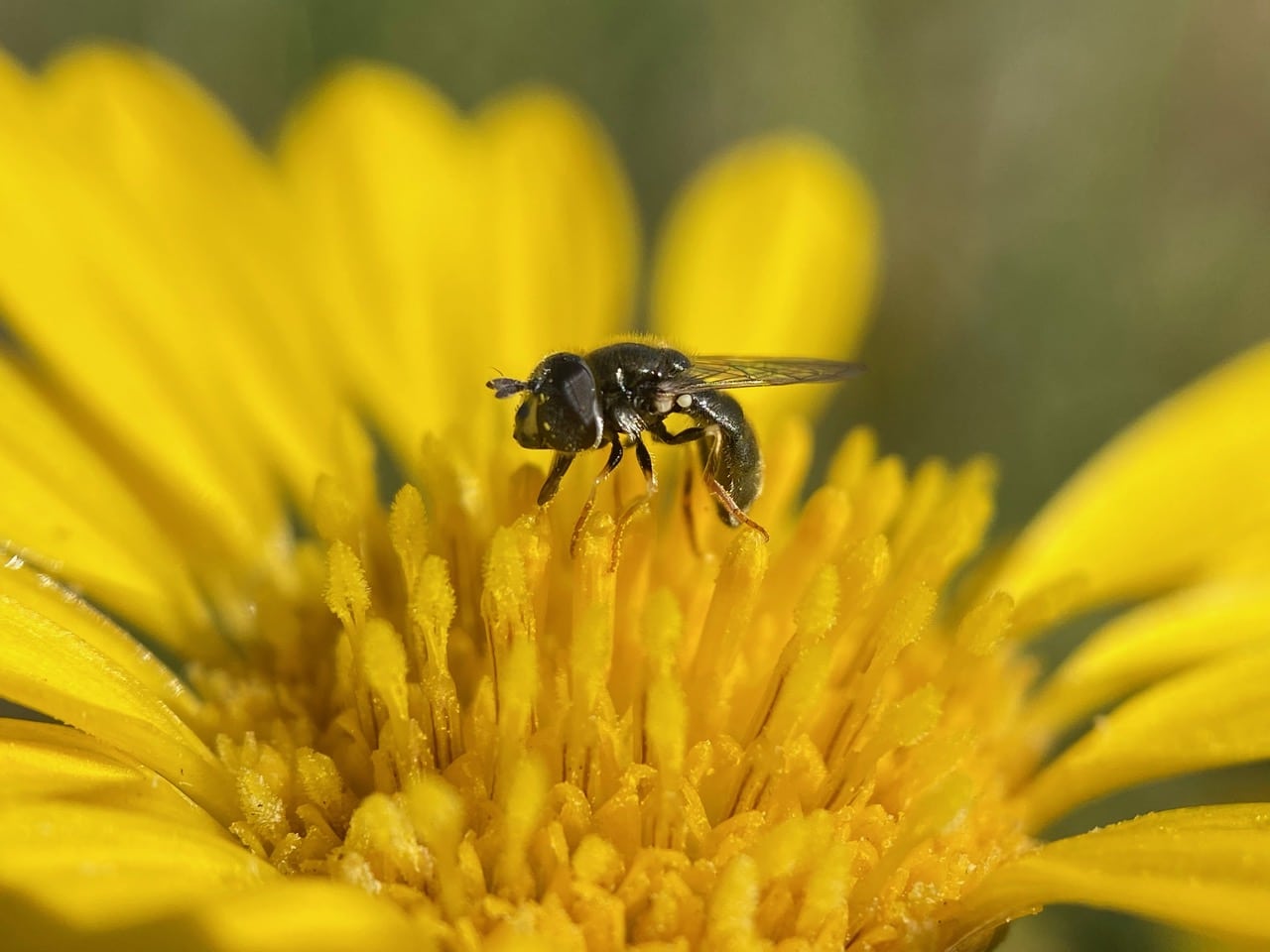
Perched in its typical droopy posture, a Common Grass Skimmer, Paragus haemorrhous (family Syrphidae) is foraging for nectar and pollen from the Grindelia florets.
The Common Grass Skimmer, Paragus haemorrhous (family Syrphidae) is easily the smallest hover fly I know, measuring only about 4 mm in length. The species has a world-wide distribution, found in unimproved grassland, dune grass, open areas and pathsides in forest, and meadows. Adults visit flowers for nectar and pollen. Larvae feed on aphids on low herbaceous plants.
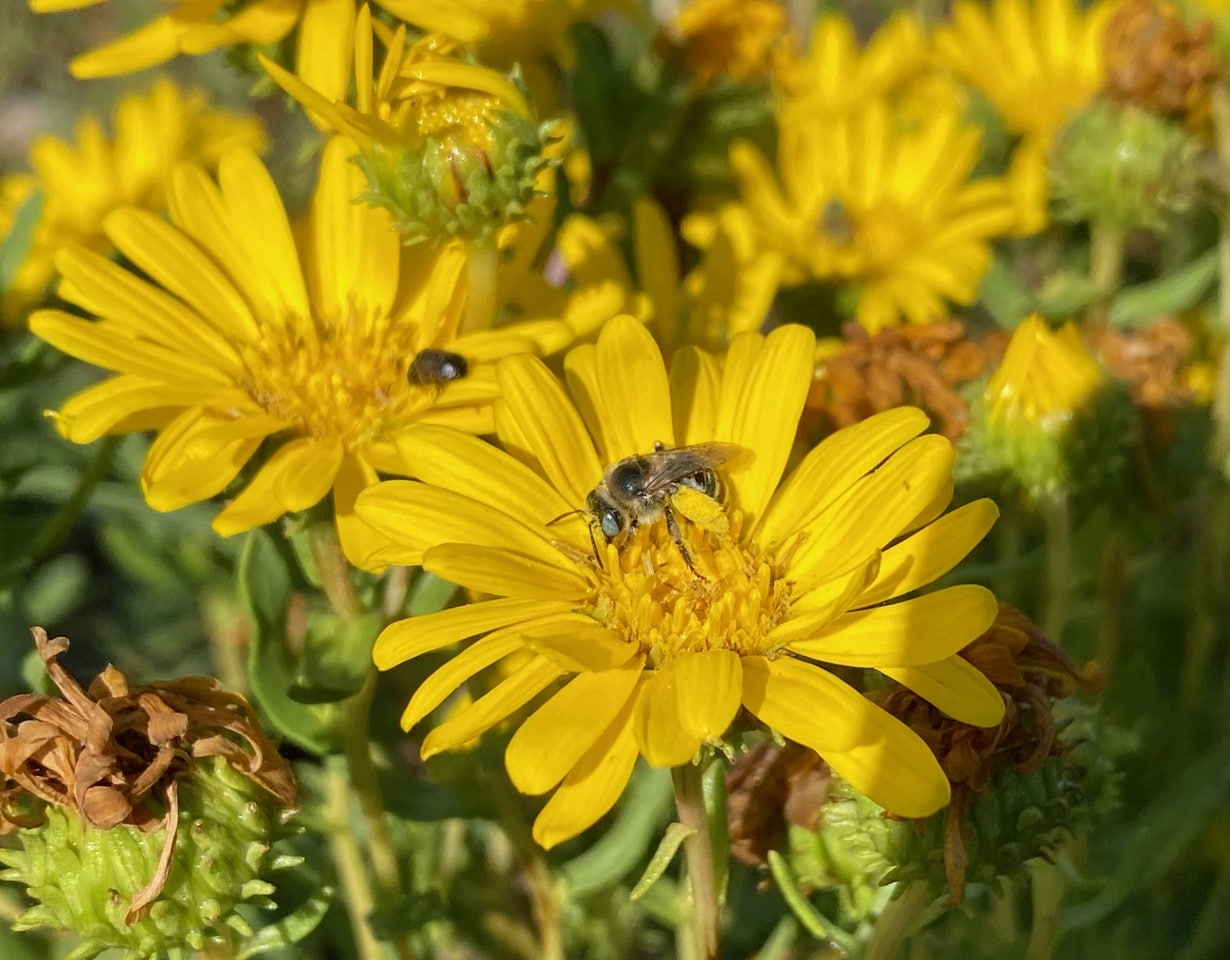
A female Summer Longhorn Bee, Melissodes sp. (family Apidae) is foraging on a Grindelia flowerhead. Even from a distance, she can be identified by the huge load of pollen in her scopae.

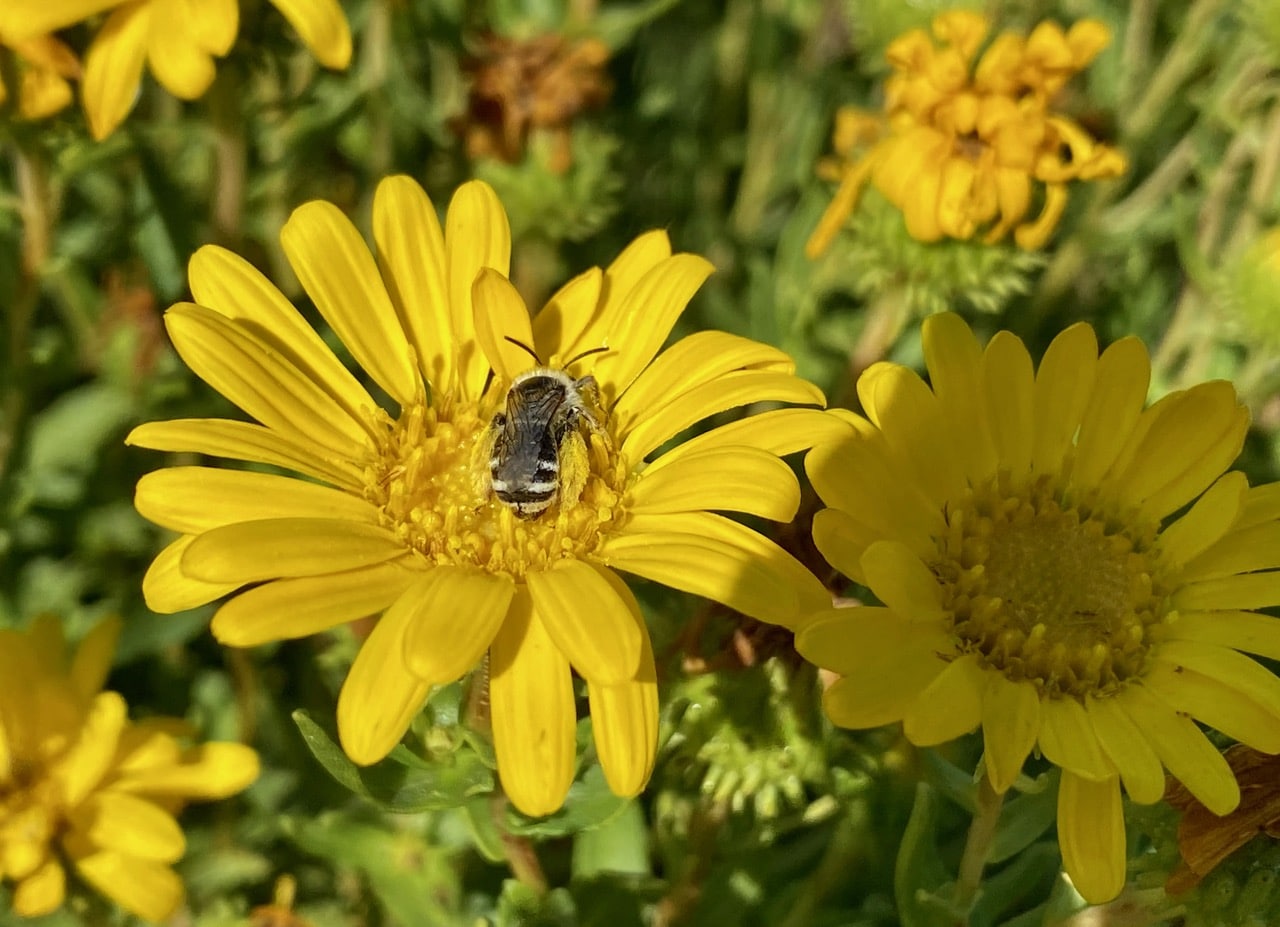
The long shaggy hairs on her scopae enable the female Melissodes to transport huge loads of pollen. The pollen grains are loosely attached by electro-static attraction, and comes off easily as the bee goes from one flower to the next. Scientists believe that bees with scopae that pack loose pollen grains are more effective pollinators than those such as the bumble bees and honey bees that pack pollen moistened with nectar and saliva in their corbiculae (“pollen baskets”).

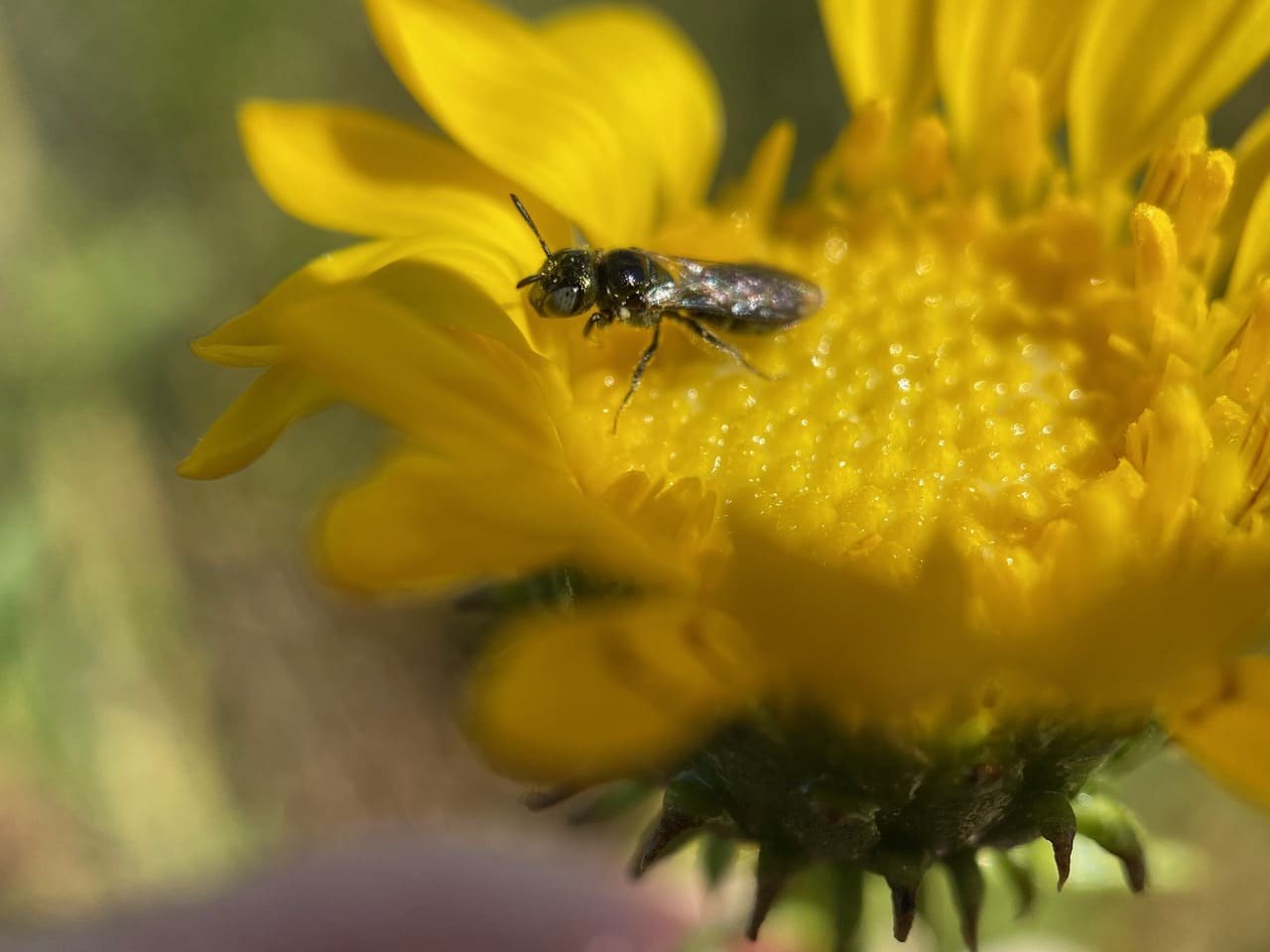
A Small Carpenter Bee, Ceratina sp. (family Apidae) checks out a Grindelia flowerhead.

The Small Carpenter Bee genus Ceratina is closely related to the more familiar, and much larger Carpenter Bees (genus Xylocopa). Ceratina are typically dark, shiny, even metallic bees, with fairly sparse body hairs and a weak scopa on the hind leg. The shield-shaped abdomen comes to a point at the tip. Some species have yellow markings, often on the face.
Females excavate nests with their mandibles in the pith of broken or burned plant twigs and stems. While many species are solitary, a number are subsocial. Both male and female carpenter bees overwinter as adults within their old nest tunnels, emerging in the spring to mate. In the spring, this resting place (hibernaculum) is modified into a brood nest by further excavation. The female collects pollen and nectar, places this mixture (called bee bread) inside the cavity, lays an egg on the provision, and then caps off the cell with chewed plant material. Several cells are constructed end to end in each plant stem.


Note the abdomen that comes to a point at the tip, and the modest scopa on her hind leg.
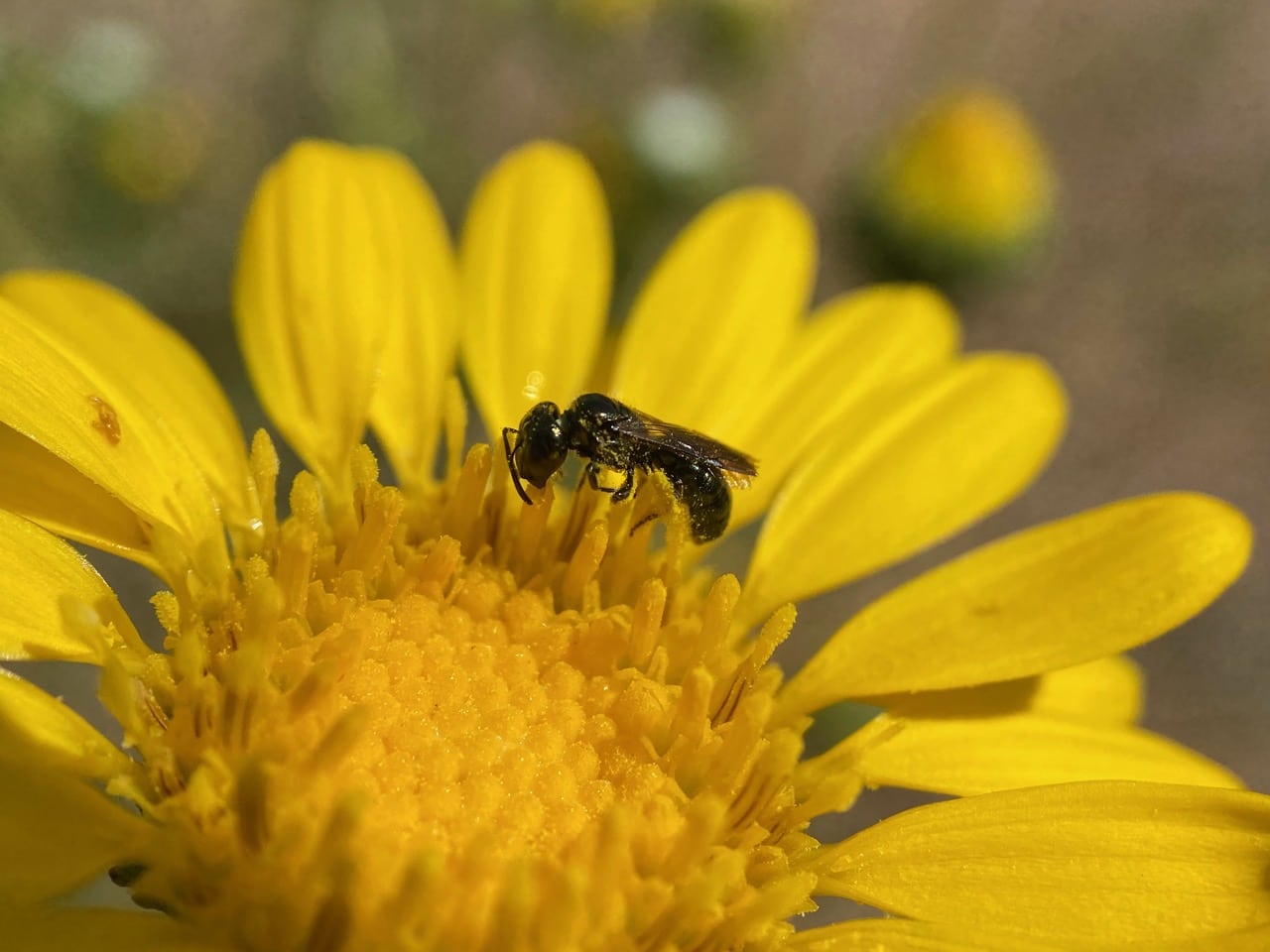
Hunched over a floret, Ceratina is collecting pollen from the top of an anther tube.

A dead male Summer Longhorn Bee, Melissodes sp. (family Apidae) is still attached to the top of a faded Grindelia flowerhead – a frozen record of his last moments.
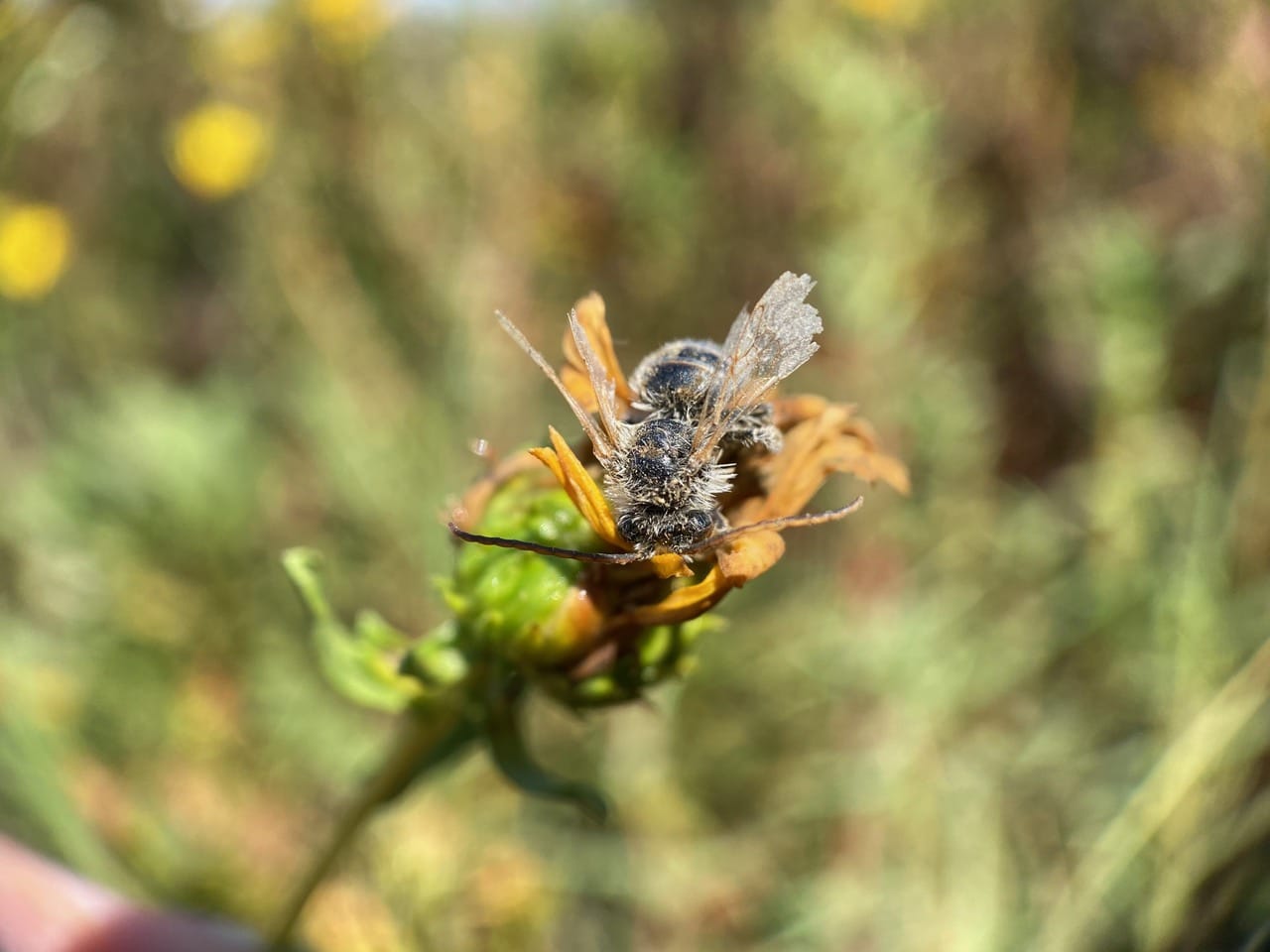
I wonder how long the bee has been dead. His body appears desiccated, his wings tattered and his hairs matted. He was apparently taking his last sip of nectar from his beloved flower, the Grindelia when he expired. Melissodes are specialists on flowers in the sunflower family Asteraceae. Here at Bay Farm, I have not seen them visit any flowers other than Grindelia.
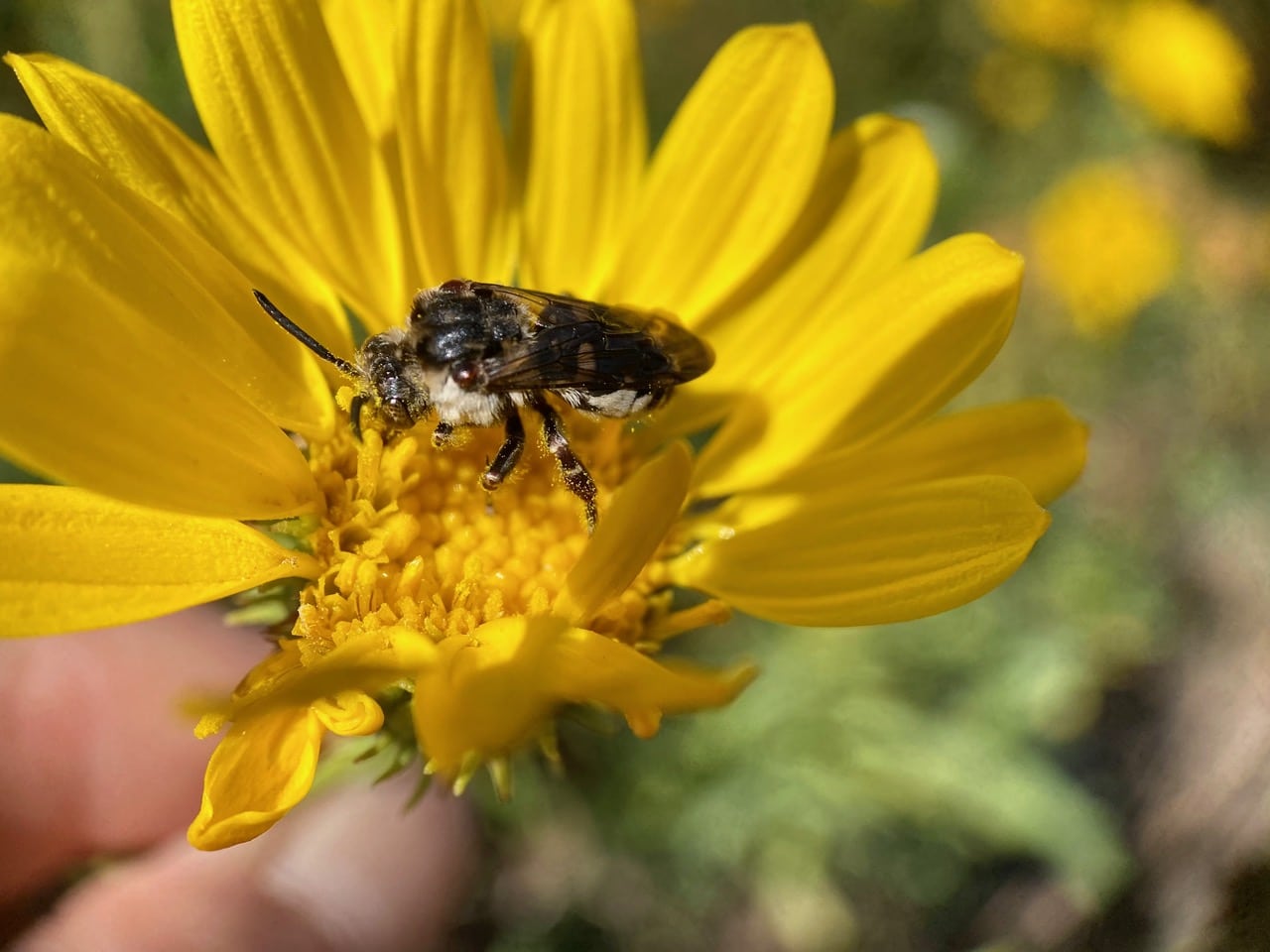
A rather strange looking bee is taking nectar from a Grindelia flowerhead. I think it might be a California Digger-cuckoo Bee, Brachymelecta californica (family Apidae), but I need to see its abdomen under those dark wings.
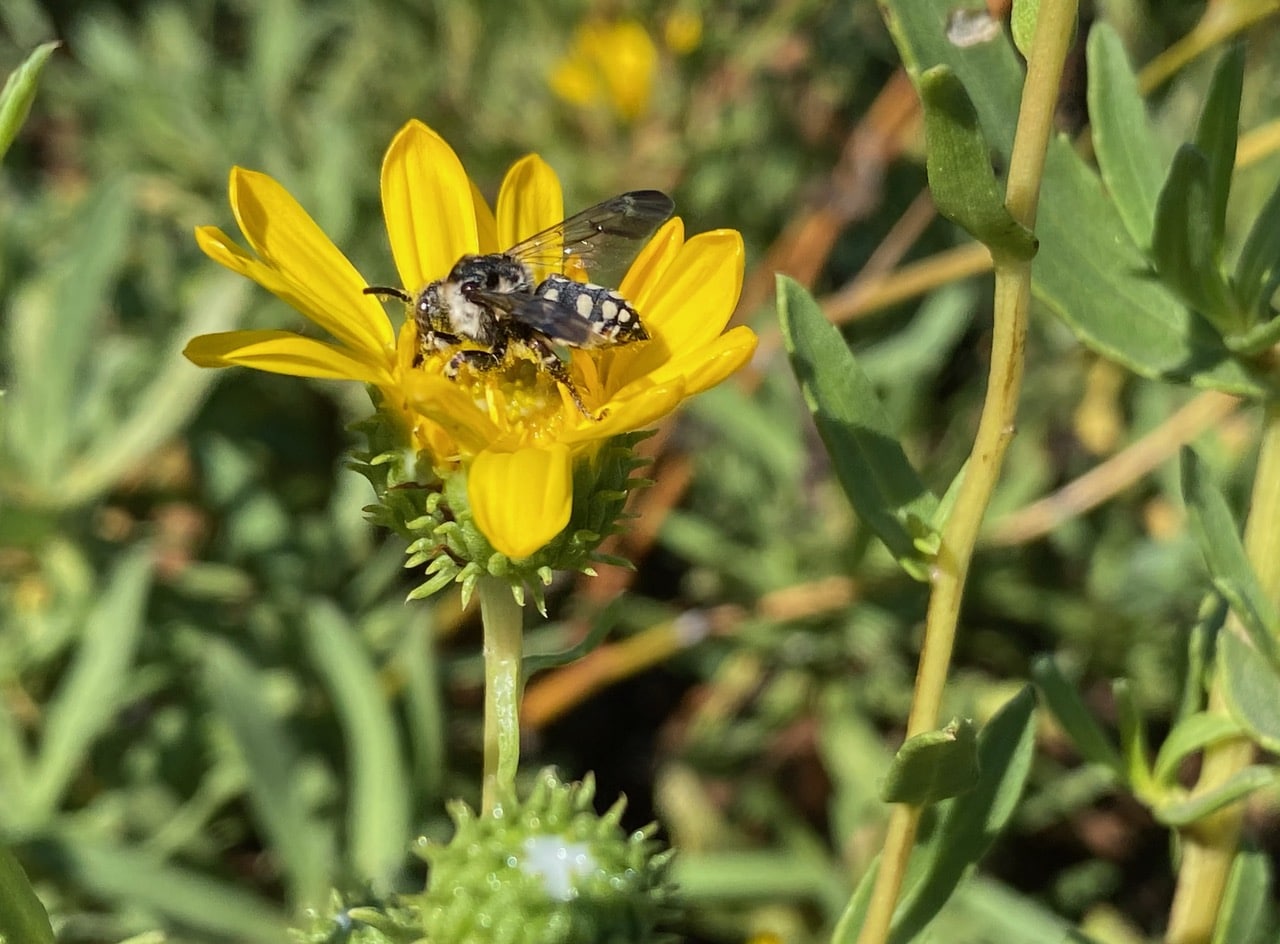
The term cuckoo bee refers to a variety of different bee lineages which have evolved the kleptoparasitic behavior of laying their eggs in the nests of other bees, similar to the behavior of cuckoo birds. Female cuckoo bees lack pollen-collecting structures and do not construct their own nests. Cuckoo bees typically enter the nests of pollen-collecting species, and lay their eggs in cells provisioned by the host bee. When the cuckoo bee larva hatches, it consumes the provision in the nest, and kills the host larva. Many cuckoo bees are closely related to their hosts, and may bear similarities in appearance reflecting this relationship. Others parasitize bees in families different from their own.

The California Digger-cuckoo Bee, Brachymelecta californica (family Apidae) is an odd-looking creature. The terga (upper body segments) have medially broken bands of appressed white (rarely pale brown) pubescence. They are parasites of the Digger Bees, Anthophora sp. (family Apidae).