

Pollinator Post 9/21/24 (1)
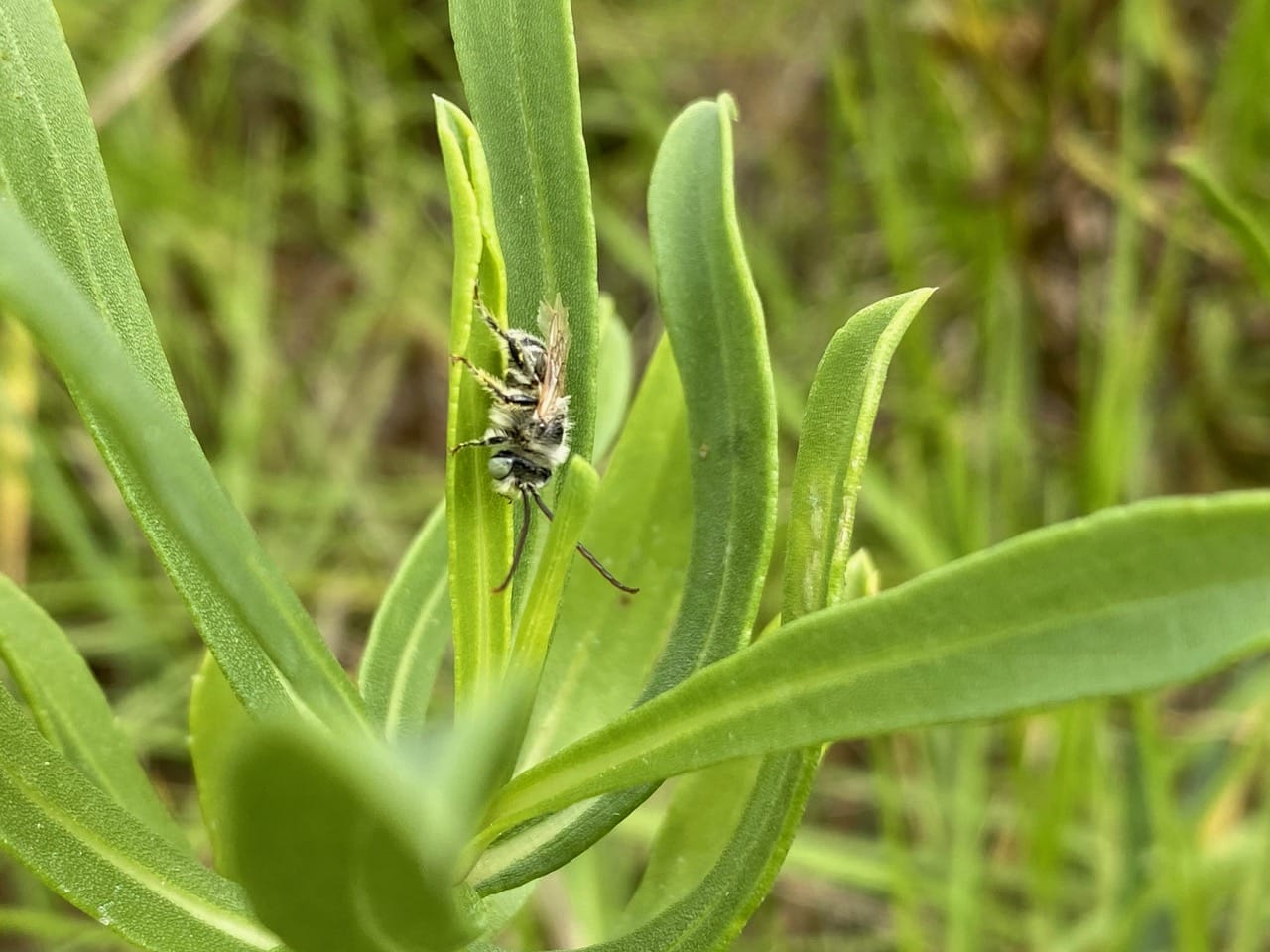
10:53 am A scruffy old male Summer Longhorn Bee, Melissodes sp. (family Apidae) is still asleep, clinging upside down to a terminal leaf of Oregon Gumweed, Grindelia stricta. Unlike the females, the males do not build nests and collect pollen for the young. While the females sleep in their nests at night, the males sleep out in the open, mostly on vegetation, often in aggregations.

A large queen Yellow-faced Bumble Bee, Bombus vosnesenskii (family Apidae) is asleep on a Grindelia flowerhead.
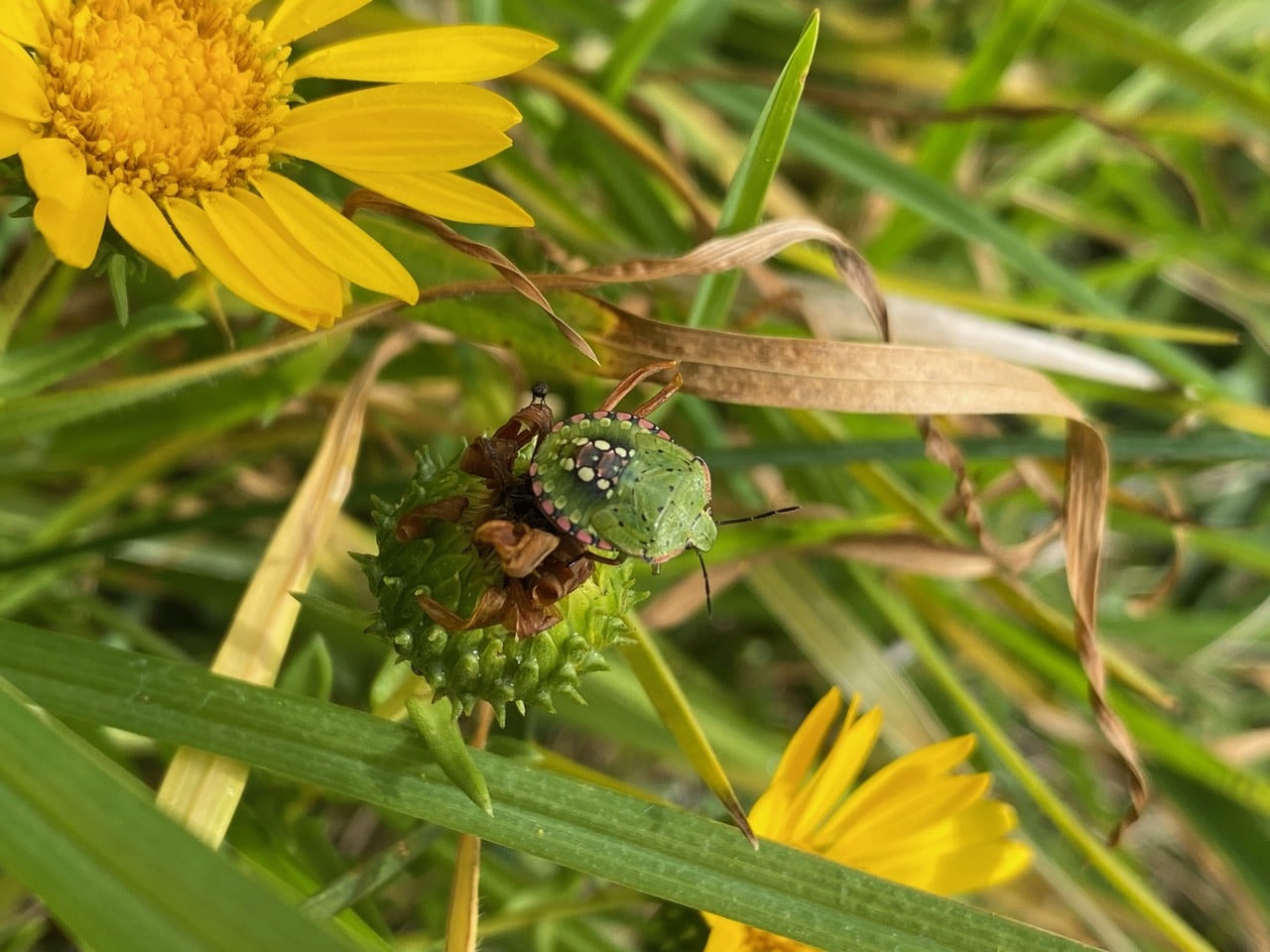
A fifth instar of the Southern Green Stink Bug, Nezara viridula (family Pentatomindae) is perched on a spent Grindelia flowerhead. The bug usually spends eight days as a fifth instar before the final molt to an adult.
The Southern Green Stink Bug, Nezara viridula (family Pentatomidae) is a plant-feeding stink bug. Believed to have originated in Ethiopia, it can now be found across the world. Because of its preference for certain species of legumes, such as beans and soybeans, it is an economically important pest on such crops.
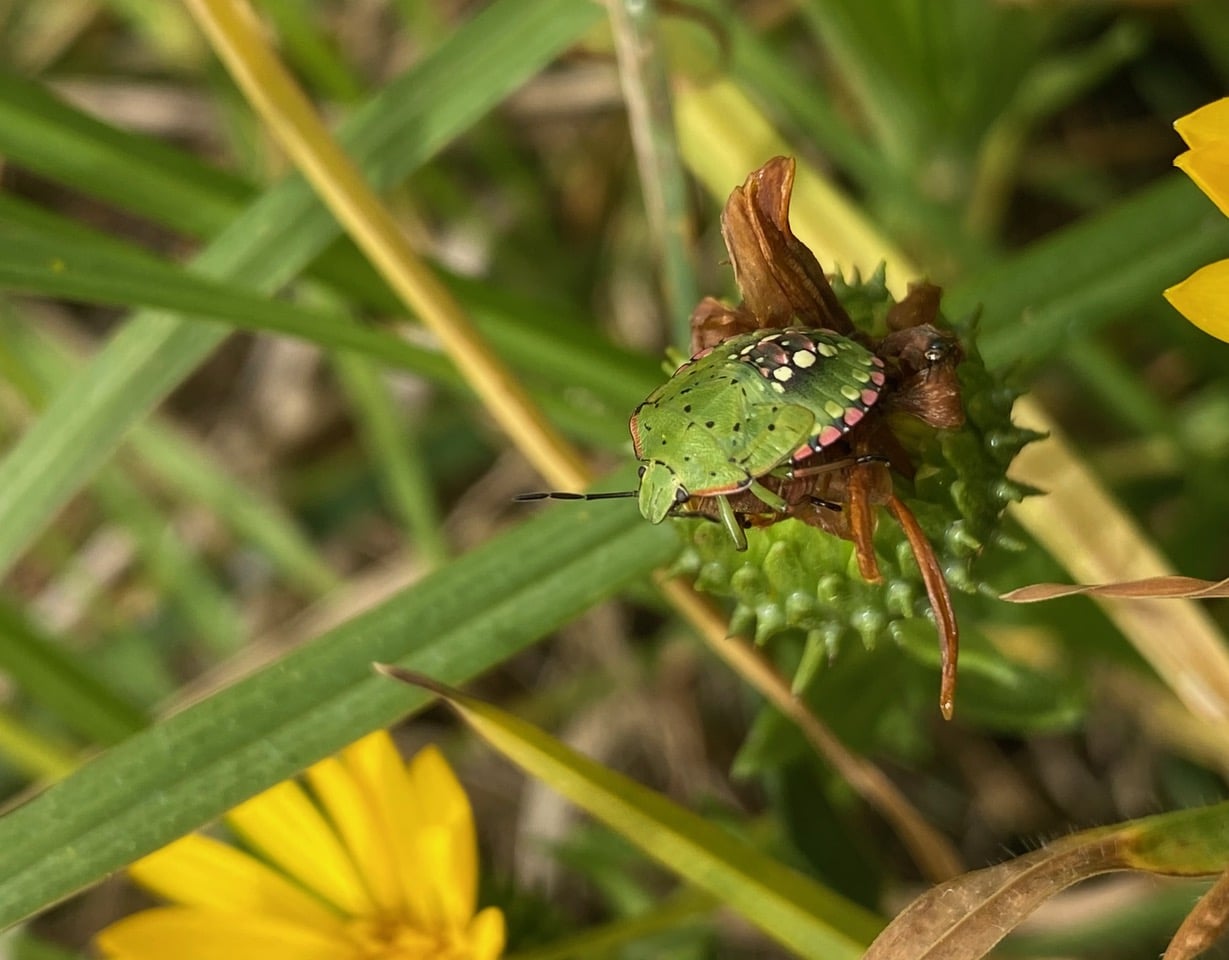
The same Stink Bug nymph from a different angle. Note how flat the bug is.
Stink Bugs or Pentatomidae is a family of insects belonging to the order Hemiptera or “true bugs”. As hemipterans, the pentatomids have piercing-sucking mouthparts, and most are phytophagous, including several species that are severe pests on agricultural crops. Stink Bugs feed on plant fluids by inserting their needlelike mouthparts into stems, leaves or seed pods. While feeding, they inject materials into the plant to aid in digestion and sap removal. Penetration by the mouthparts can cause physical damage, much like stabbing the plant with a fine needle.
All Pentatomids have 5-segmented antennae (hence their family name, Penta – five and tomos – section.) They generally have a large triangular scutellum in the center of the back. The adult is generally shield-shaped when viewed from above. The common name of Stink Bug refers to their ability to release a pungent defensive spray when threatened, disturbed, or crushed.
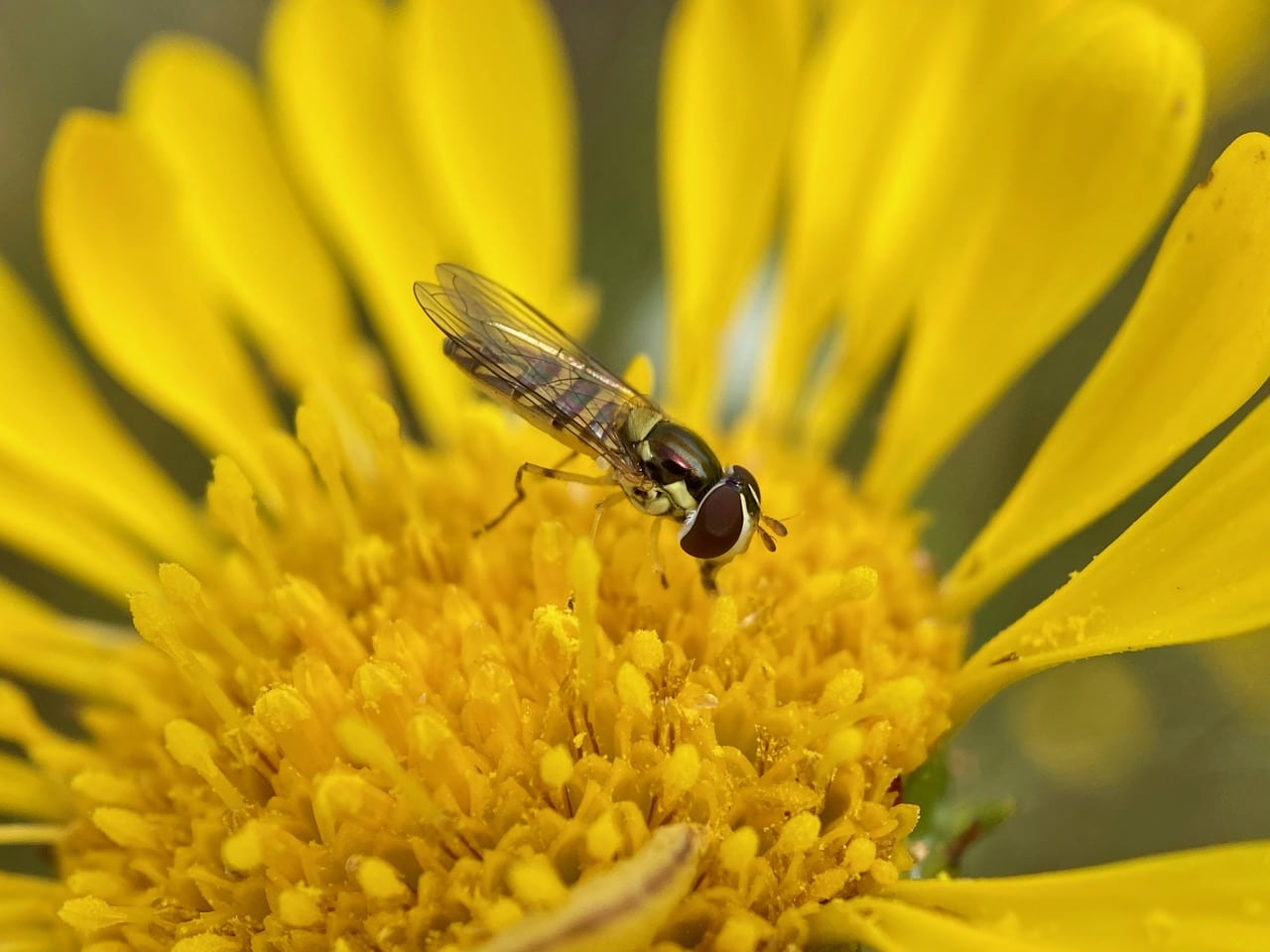
An Oblique Streaktail, Allograpta obliqua (family Syrphidae) is taking nectar on a Grindelia flowerhead.
The Oblique Streaktail is a common North American species of hoverfly. Adults are 6-7 mm long. Males have holoptic eyes (that meet on top of the head), while females have dichoptic eyes. Eggs are laid on surfaces of leaves or stems near aphids. The larvae are important predators of aphids. Adults visit flowers for nectar and pollen, and are pollinators.
Photos of Oblique Streaktail (Allograpta obliqua) · iNaturalist
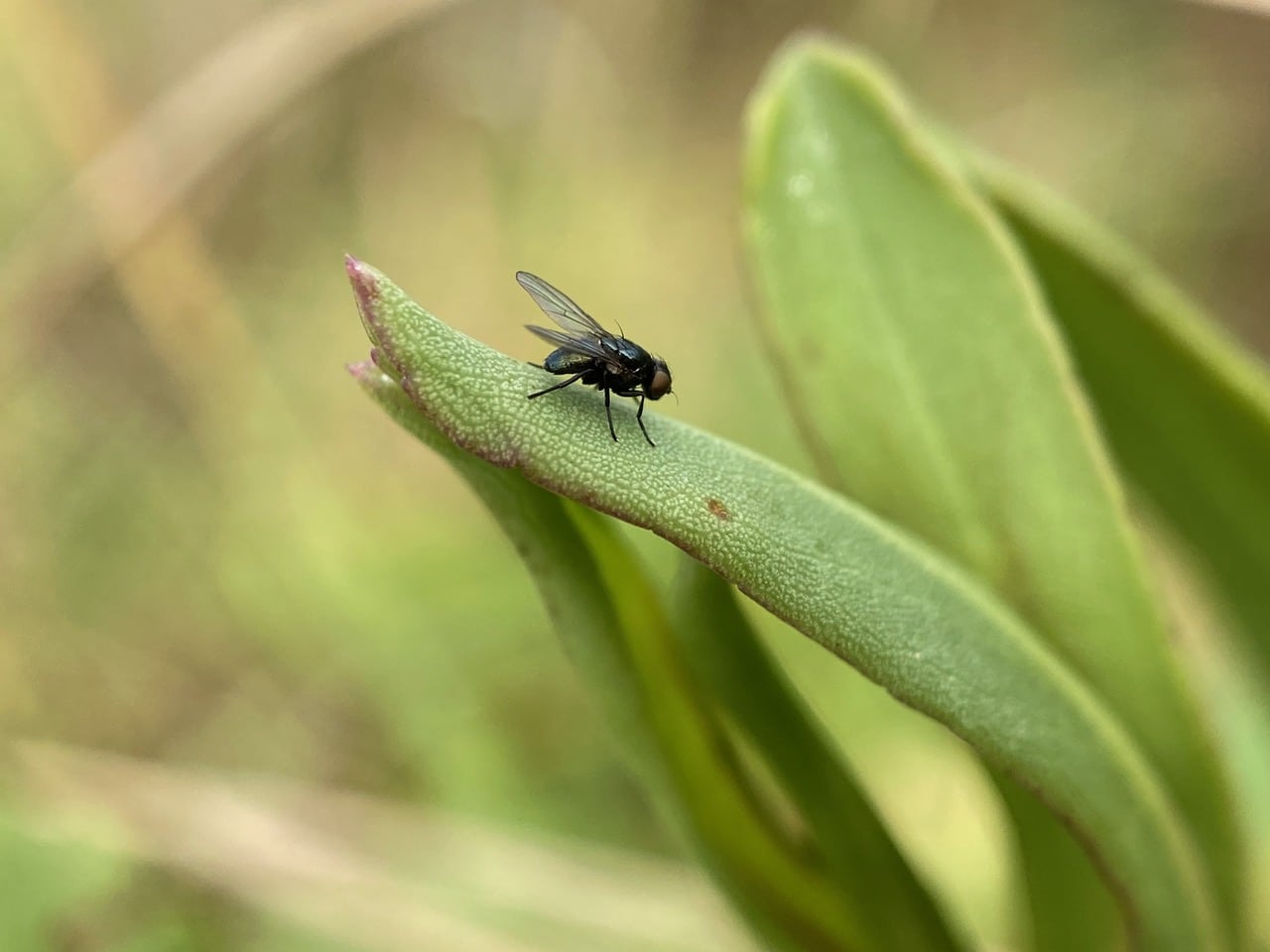
A tiny fly is perched on a Grindelia leaf. It is probably a Lear-miner Fly (family Agromyzidae).
The Agromyzidae are a family commonly referred to as the Leaf-miner Flies, for the feeding habits of their larvae, most of which are leaf miners on various plants. They are small flies, most species in the range of 2-3 mm. Agromyzidae larvae are phytophagous, feeding as leaf miners, less frequently as stem miners or stem borers. A few live on developing seeds, or produce galls. There is a high degree of host specificity. A number of species attack plants of agricultural or ornamental value, so are considered pests. The shape of the mine is often characteristic of the species and therefore useful for identification. Adults occur in a variety of habitats, depending on the larval host plants.
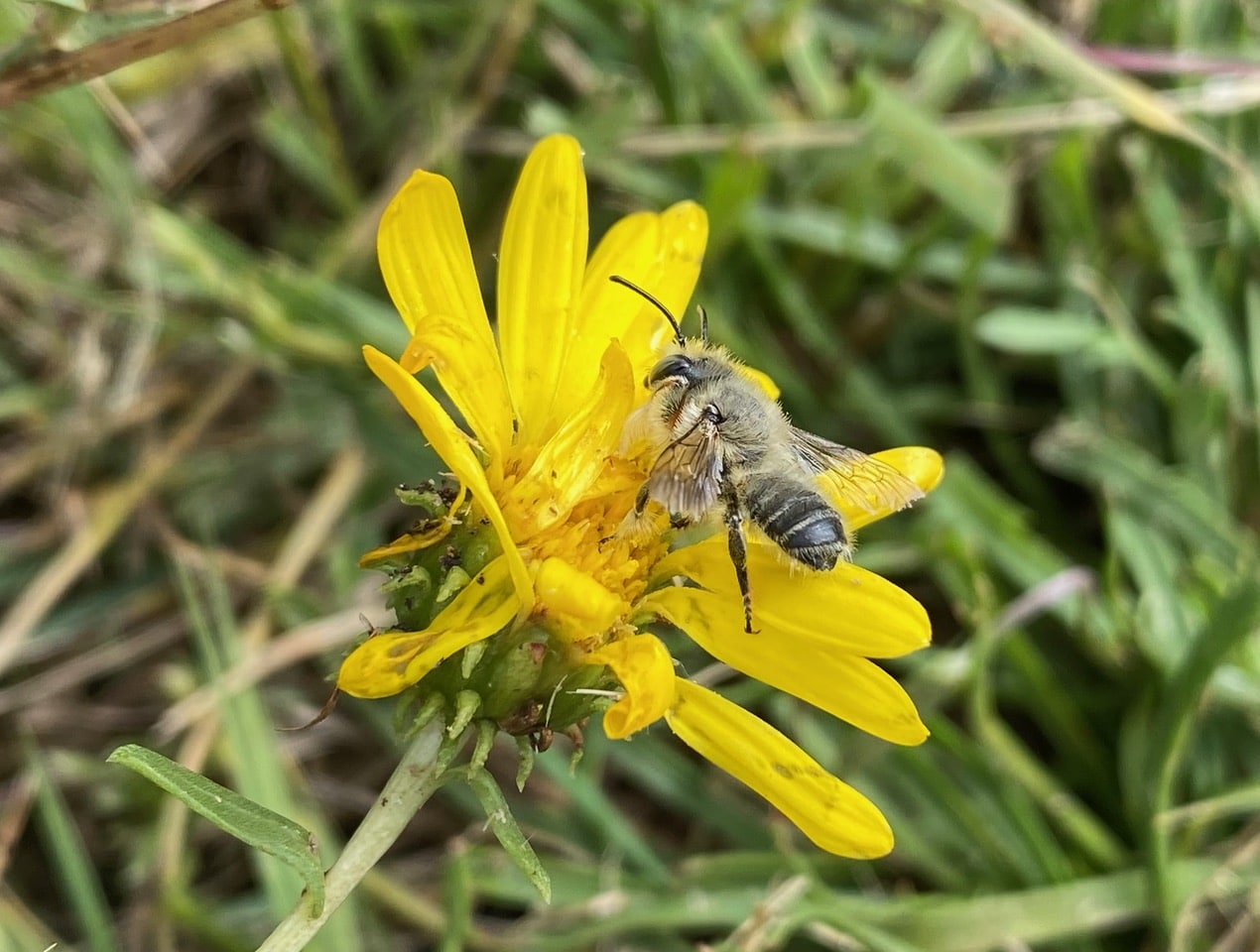
A scruffy male Western Leafcutter Bee, Megachile perihirta (family Megachilidae) lands on a Grindelia flowerhead. He has seen better days – his wings are tattered, and his abdomen is missing a lot of hair.
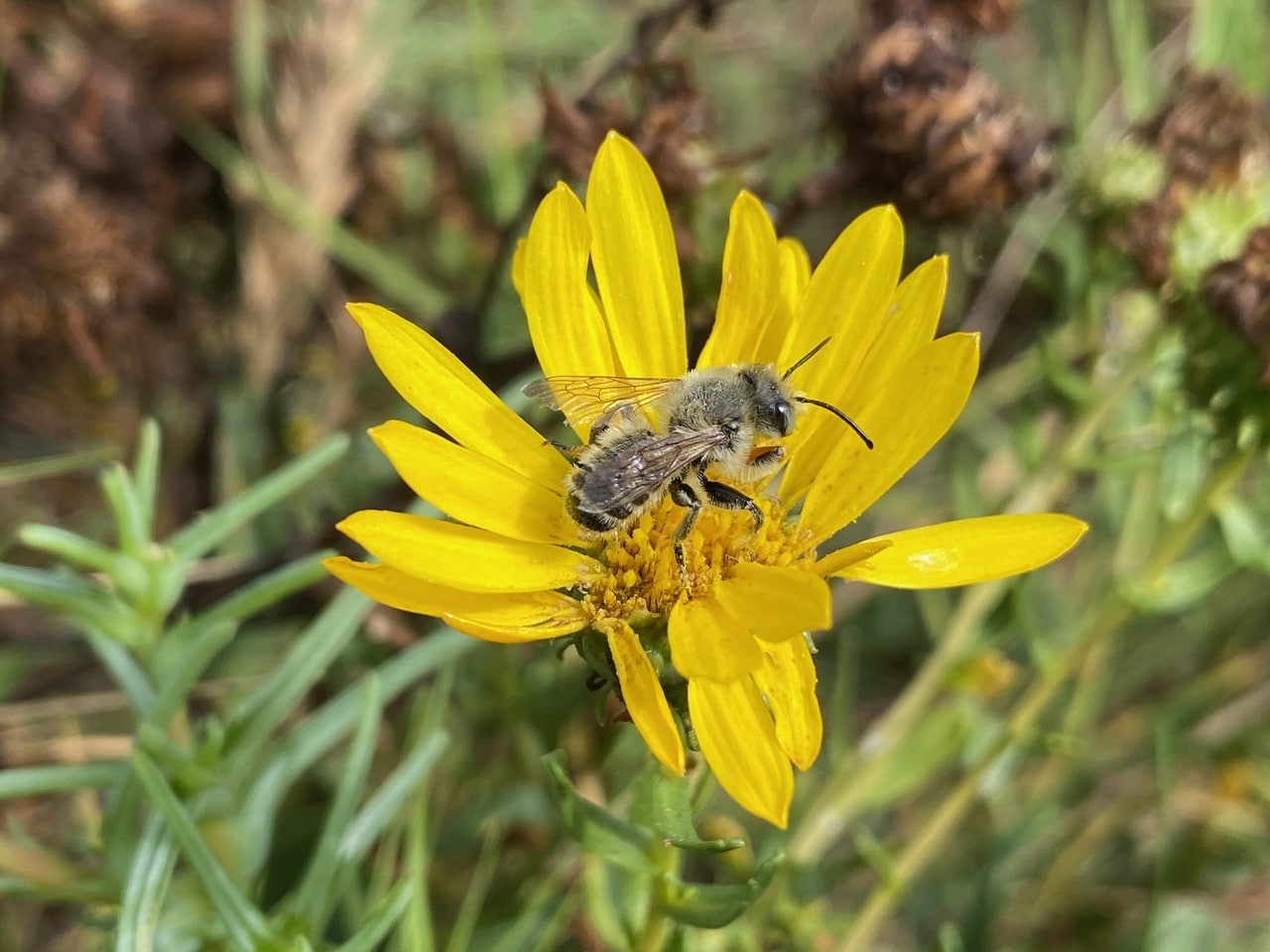
Note the male’s reddish front leg.
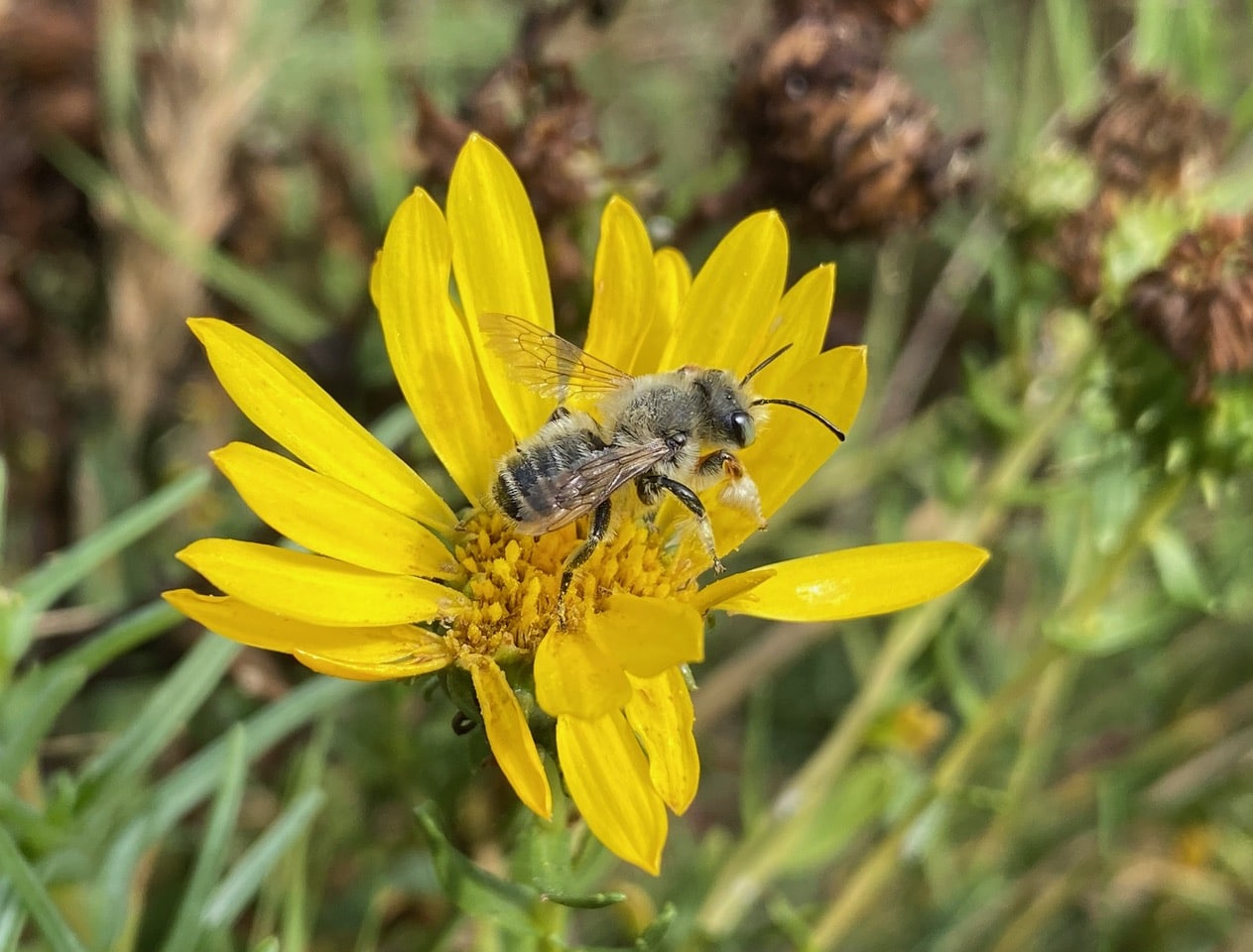
The bee’s front leg has a different color than the other legs, and it has tufts of white hairs, appearing as though he is wearing white mittens.
Males of some species of Megachile (including M. perihirta) have enlarged forelegs with long border hairs. They use these to cover the eyes of females while mating, presumably as blinders to calm them and increase receptivity.


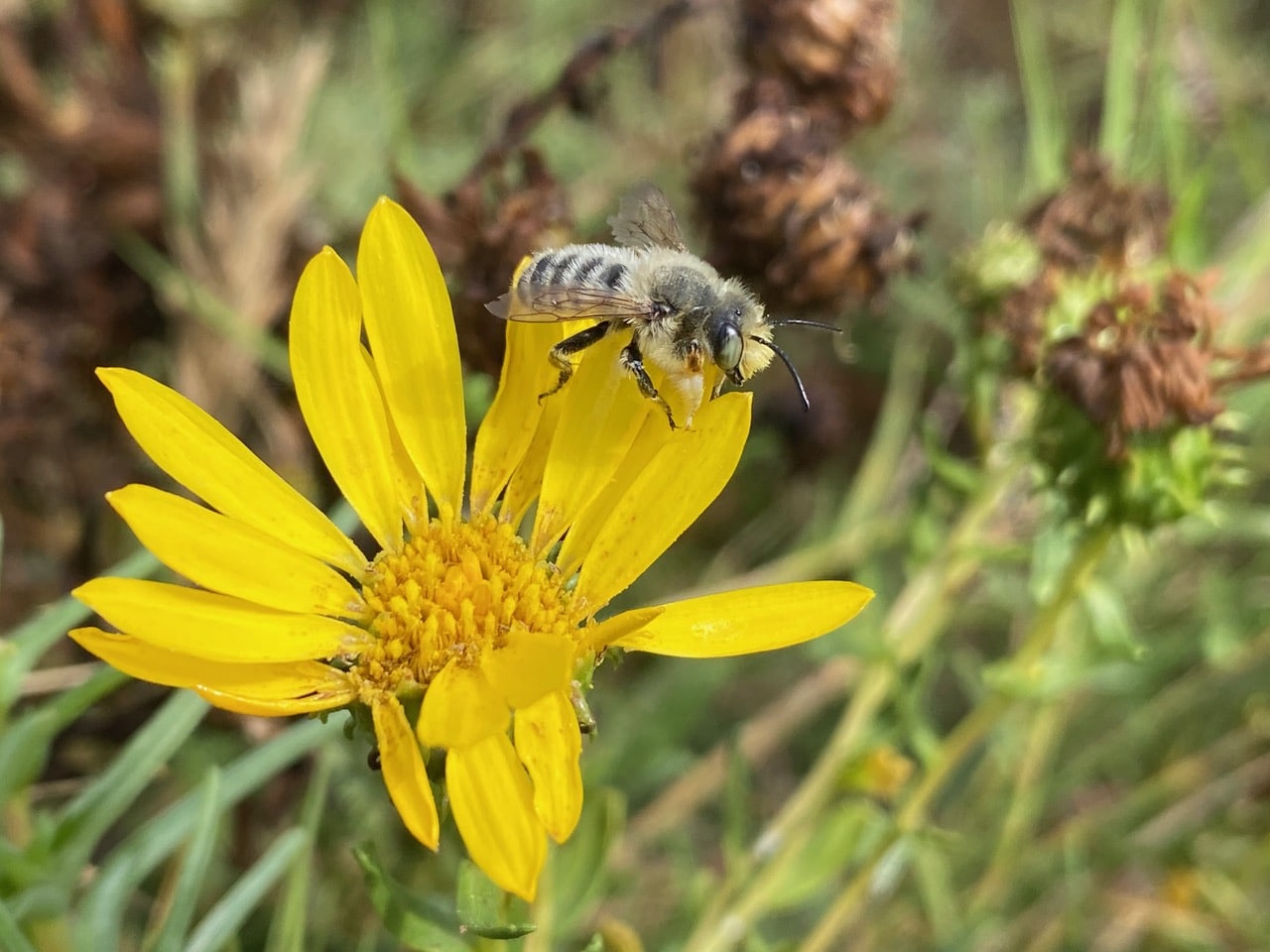
Another look at the male’s white mitten as well as the tuft of pale hairs on his face.
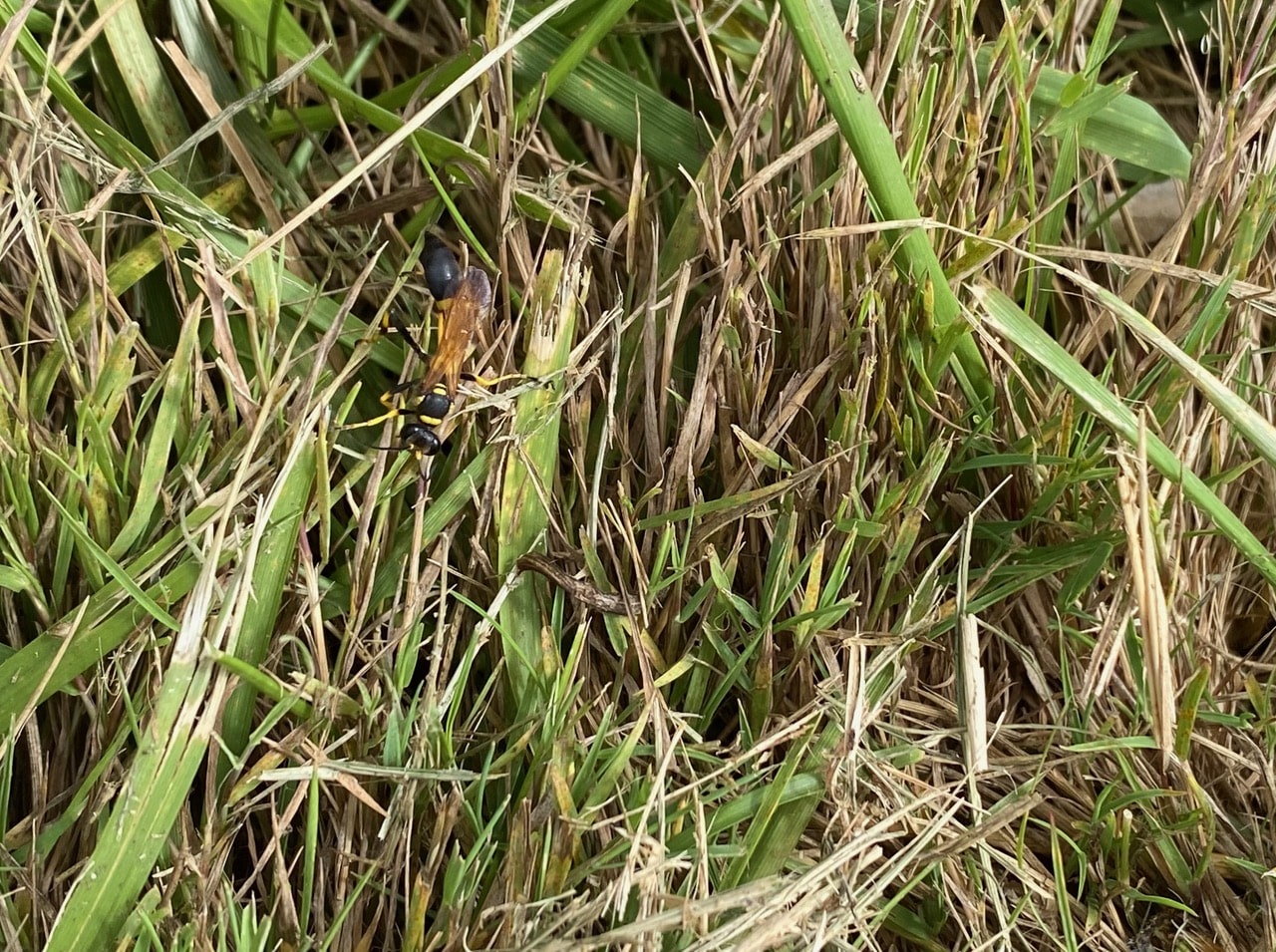
Do you see the black-and-yellow wasp among the cut grass? This is how I usually find the Yellow-legged Mud-daubers here. The females come to this soggy stretch of the trail to gather mud for constructing their nests.
The Yellow-legged Mud-dauber, Sceliphron caementarium (family Sphecidae) is widespread in the Americas. The species is found in a wide variety of habitats, such as rock ledges, man-made structures, puddles and other water edges. The wasp can reach a length of 24-28 mm. They are generally black with yellow markings, with impossibly long and skinny “waist”. They are solitary parasitoid wasps that build nests out of mud. Females collect mud balls at puddles and pool edges for constructing nests. The nests comprise up to 25 vertically arranged, individual cylindrical cells. Eventually the cells are covered over as a cluster by more mud, forming a smooth structure the size of a human fist. Nest constructed, the female wasp goes hunting for spiders. The prey are stung and paralyzed and placed in the cell, usually 6-15 per cell. A single egg is laid on the prey within each cell. The wasp then seals the cell with a thick mud plug. The larva that hatches out feeds on the spiders, pupates in the cell and emerges as an adult, breaking out of its mud nursery. Adult wasps can be seen in mid-summer feeding on nectar at flowers.
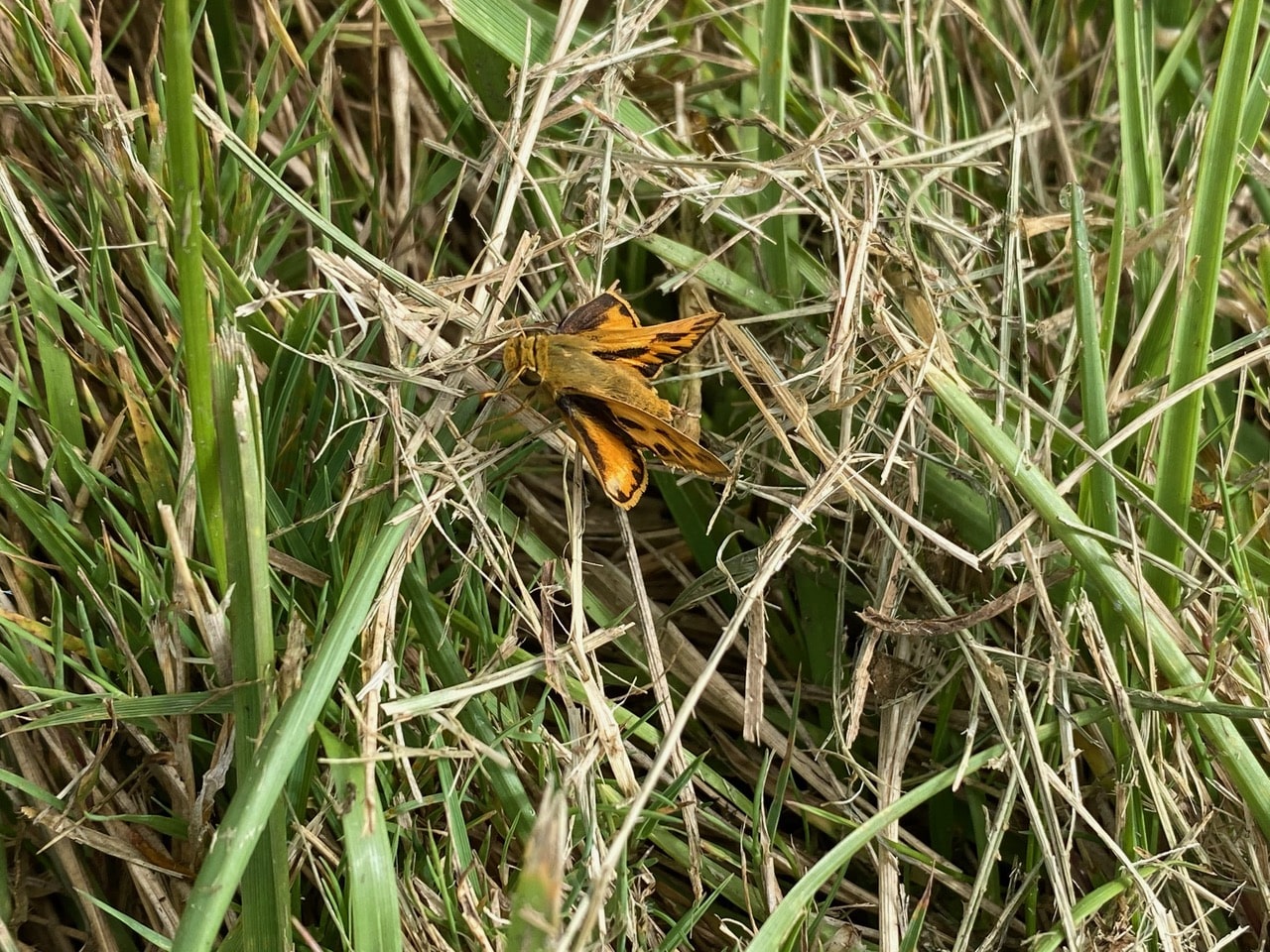
A male Fiery Skipper, Hylephila phyleus (family Hesperiidae) lands on mowed grass by the side of the trail.
The Fiery Skipper, Hylephila phyleus is a species of butterfly in the family Hesperiidae. The species has a wide range in North and South America. At about 1 inch in length, males are orange or yellow while the females are dark brown. In both sexes, small brown spots are seen on both the hindwings and forewings. Like other skippers, the Fiery Skippers often hold their wings in a “triangle” shape – the forewings held upright, and the hindwing folded flat. This position is thought to better absorb the sun’s rays. The butterfly’s flight is described as rapid and darting. Fiery Skipper larvae are greenish pink-grey with a black head and constricted neck. These caterpillars are often considered pests as they feed on many species of turfgrass.

A small Weevil (family Curculionidae) is resting on an immature Grindelia flowerhead.
Weevils, family Curculionidae, are also called snout beetles. Curculionidae is one of the largest beetle families (about 40,000 species). Most weevils have long, distinctly elbowed antennae that may fold into special grooves on the snout. The snout is used not only for penetration and feeding but also for boring holes in which to lay eggs. The mouthparts are quite small and located at the end of the rostrum (snout), designed for chewing. Many weevils have no wings, while others are excellent fliers. Most are less than 6 mm in length. The majority of weevils feed exclusively on plants. The fleshy, legless larvae of most species feed only on a certain part of a plant – i.e., the flower head, seeds, fleshy fruits, stems, or roots. Many larvae feed either on a single plant species or on closely related ones. Adult weevils tend to be less specialized in their feeding habits. The family includes some very destructive agricultural pests.
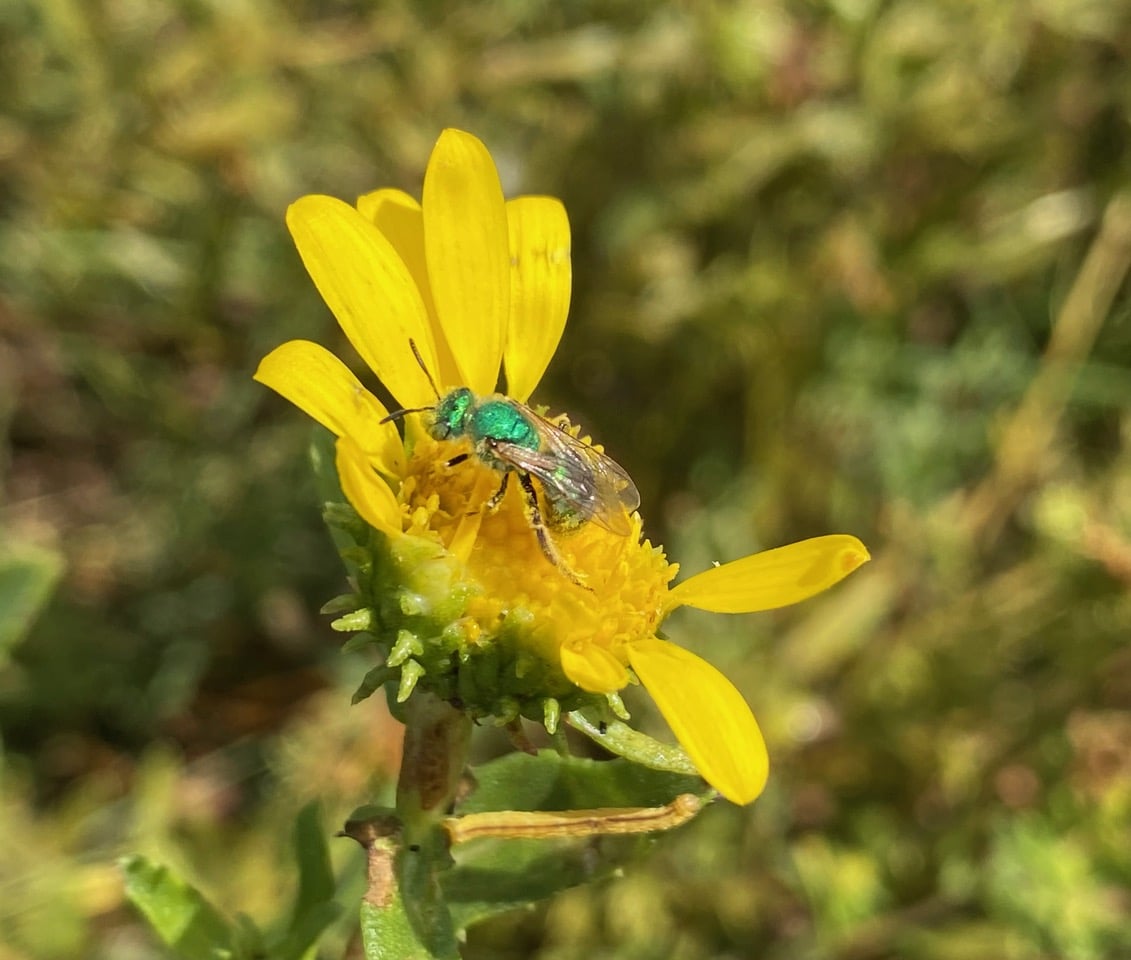
Hey, that’s the first female Texas Striped Sweat Bee, Agapostemon texanus (family Halictidae) I have seen in a while. I have mostly been seeing males lately.
The genus Agapostemon is widespread and abundant throughout North America. They are most diverse and abundant in temperate regions and southwestern U.S. deserts. Agapostemon are commonly called “sweat bees” because they are closely related to, and resemble bees in the Halictus and Lasioglossum genera. Unlike those bees however, Agapostemon are not attracted to human sweat.
Agapostemon are brightly colored metallic green or blue bees measuring 7 to 14.5 mm long. Most species have a metallic green head and thorax, and black-and-yellow striped abdomen; some females are entirely bright green or blue. Females carry pollen on scopal hairs located on their hind legs. Agapostemon are generalists. Like other members of the family Halictidae, they are short-tongued and thus have difficulty extracting nectar from deep flowers. Males are often seen flying slowly around flowers looking for females. The bees favor flowers with high densities. The species is active summer to fall.
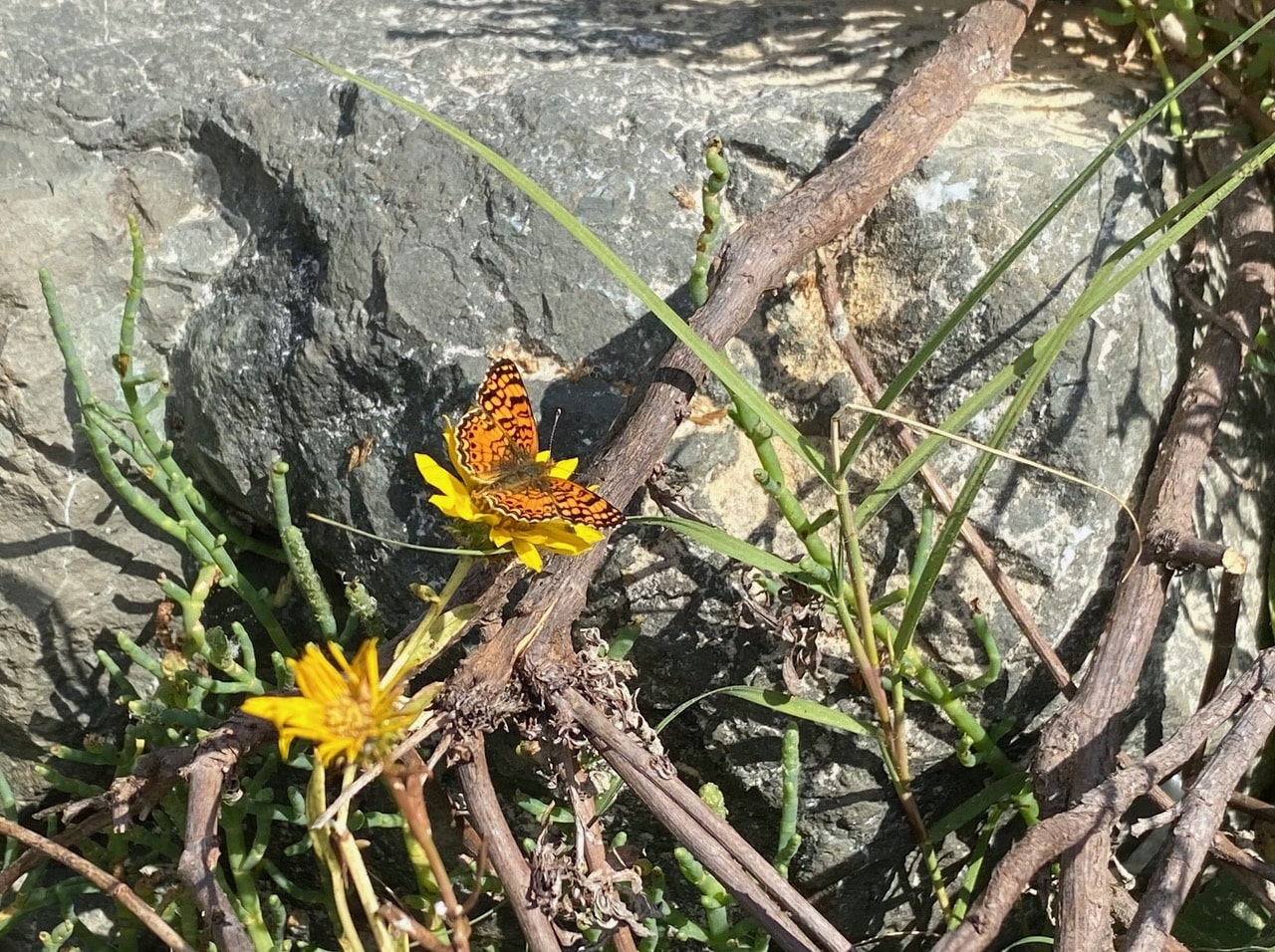
Ooh, a little butterfly Mylitta Crescent, Phyciodes mylitta (family Nymphalidae) has landed on a Grindelia flowerhead!
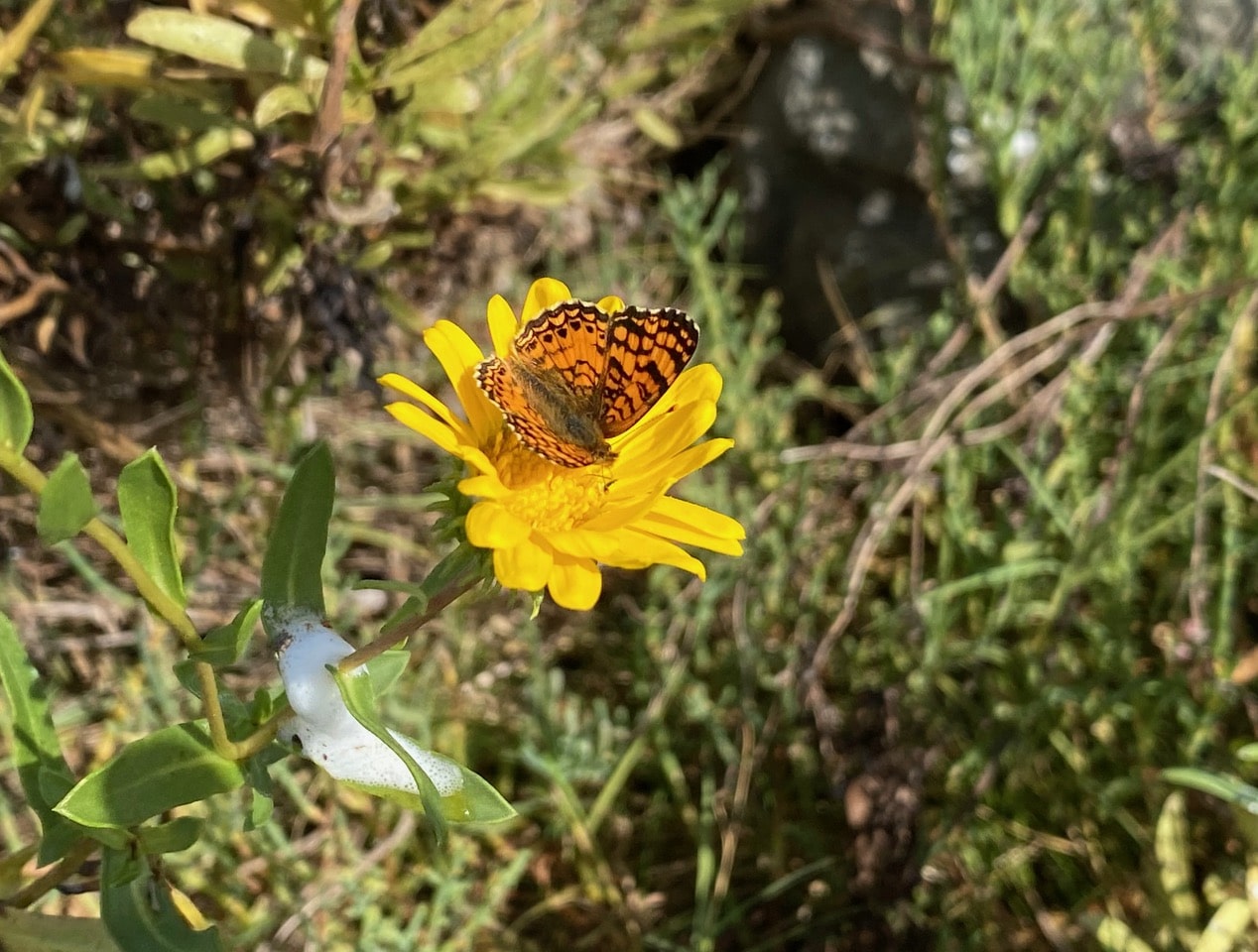
Crescent butterflies (genus Phyciodes) are so-called for their crescent-shaped spots on the underside of their hindwing, but their intricate orange-and-black patterns on the upper side are more likely to catch your eye. Mylitta Crescent, Phyciodes mylitta (family Nmyphalidae) is found in western North America. Wingspan is 26-37 mm. Wings are orange with black markings and white fringe on the edges. The females are darker than the males. The butterfly flies from June until fall in California. They grace a wide variety of habitats, including urban areas, dry fields and wet meadows, woodland openings and mountain canyons, from sea level to treelike. Caterpillars are black with spines and white markings. They primarily feed on thistles. Adults feed on flower nectar.
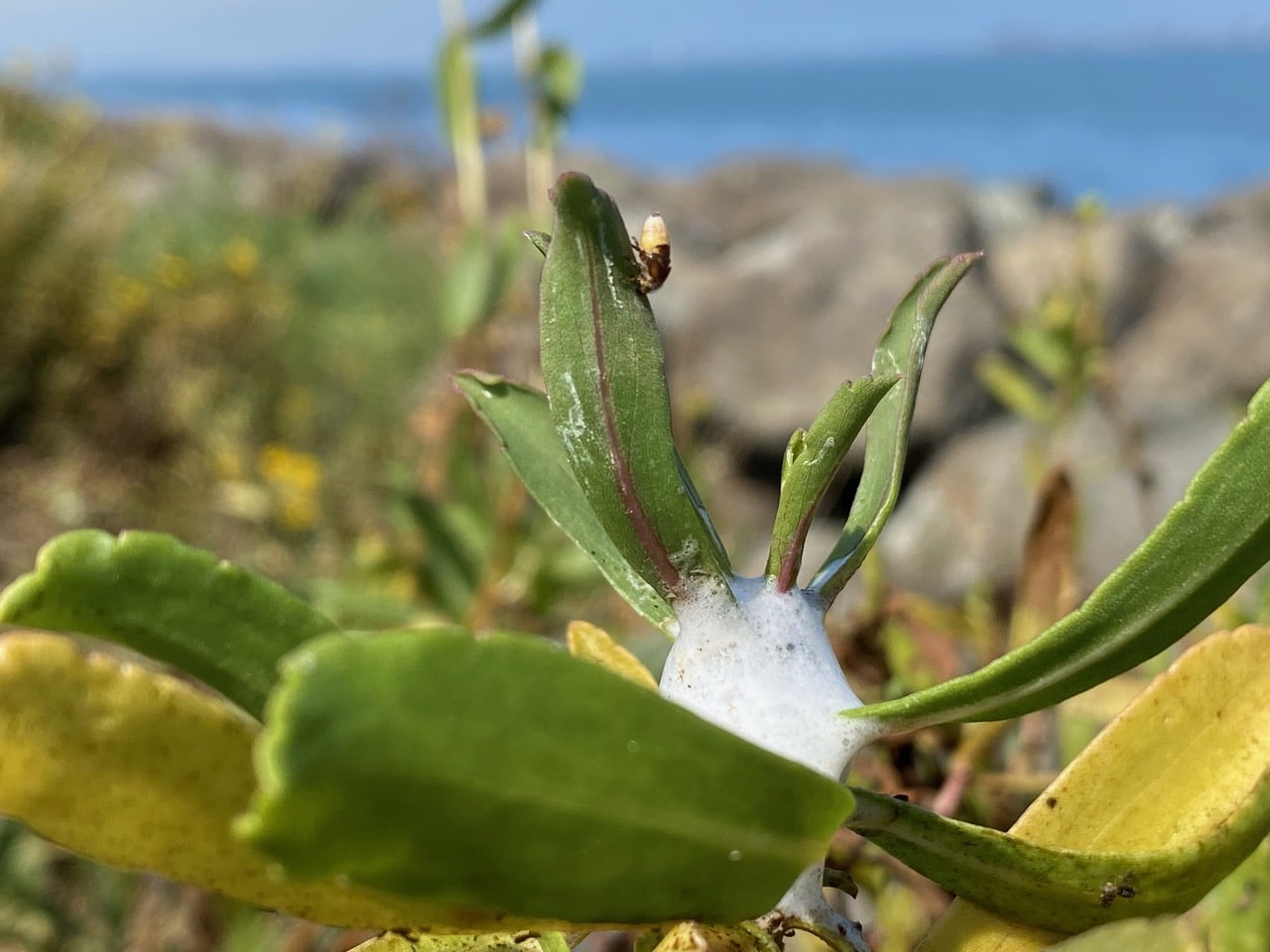
Ooh, something is happening on that terminal leaf of Grindelia above a Spittlebug foam mass.

Close-up, I find a Spittlebug nymph in an upside-down position that is undergoing ecdysis. The new adult has broken through the rear end of the nymph exoskeleton.

On the same plant, I find another nymph in the same condition, resting in a bit of froth at a leaf axil. The nymph has recently crawled out from its foamy shelter to eclose. I think this is the beginning of the emergence of the adult Spittlebug. Eventually the head of the new adult will break through the thorax of the nymph. You can already see the pale seam on the thorax that will split open.
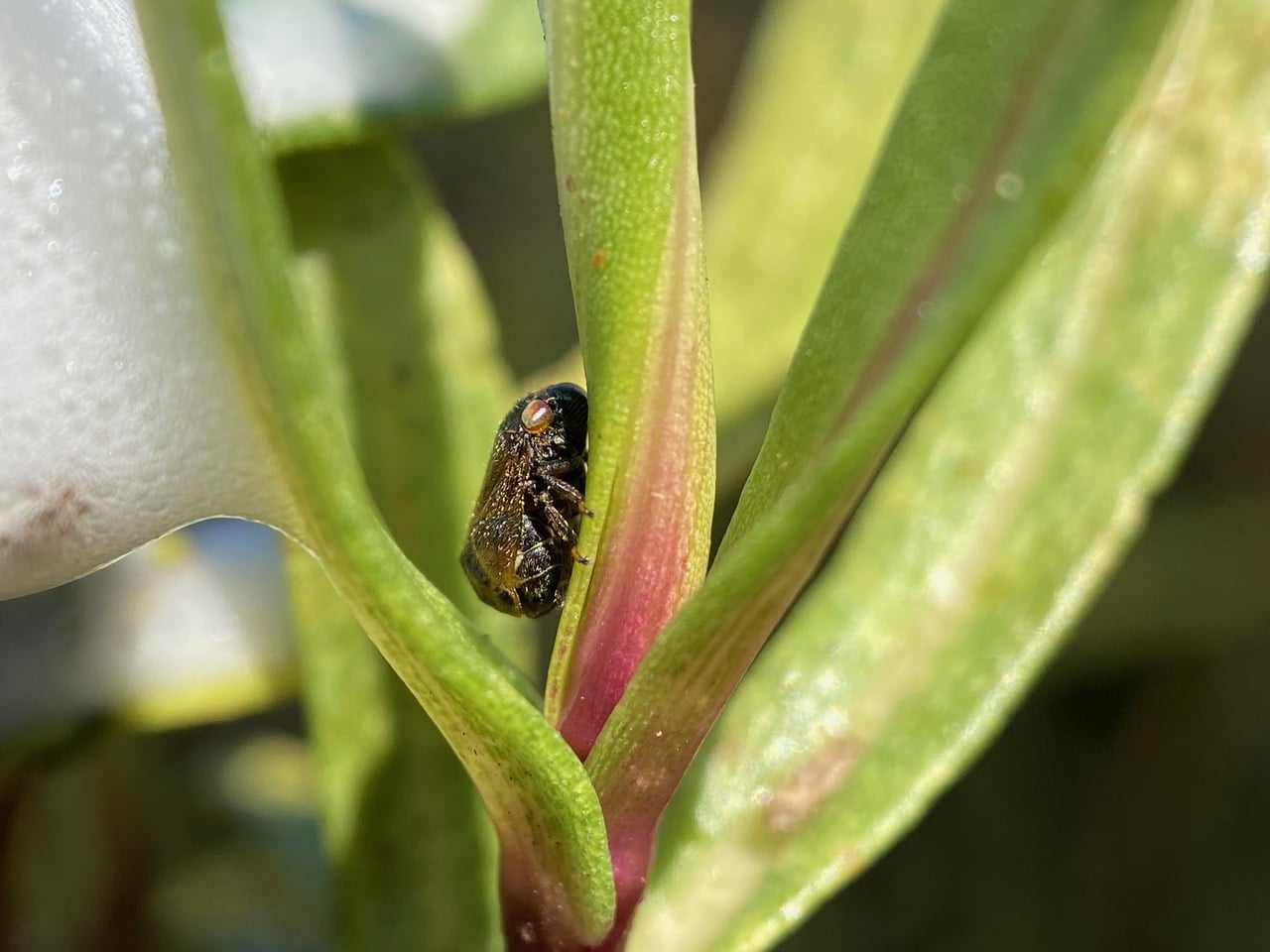
On another branch, a black adult Spittlebug, or Froghopper is resting on a leaf. It is Clastoptera lineatocollis (family Clastopteridae).
The Froghoppers (superfamily Cercopoidea) are a group of “true bugs” in the order Hemiptera. Adults are capable of jumping many times their height and length, giving them their common name, but many species are best known for their plant-sucking nymphs which produce foam shelters, and are referred to as “spittlebugs”. The superfamily currently consists of three families: the Aphrophoridae, Cercopidae, and Clastopteridae. The nymphs produce a cover of foamed-up plant sap visually resembling saliva, hence the common name. Whereas most insects that feed on plant sap tap into the nutrient-rich fluid from the phloem, the spittlebugs utilize the much more dilute sap flowing upward from the roots via the xylem. The insects’ digestive system contains symbiotic bacteria that provide them with the essential amino acids. The large amount of excess water that must be excreted and the evolution of special breathing tubes allow the young spittlebug nymphs to grow in the relatively protective environment of their foam shelters. The foam serves a number of purposes. It hides the nymph from the view of predators and parasites, and it insulates against heat and cold, providing thermal as well as moisture control. It also has an acrid taste that deters predators.
Froghoppers are champion jumpers among insects, out-performing even the fleas. The bug can leap the human equivalent of a skyscraper without a running start. It is the highest jumping insect proportional to body size. The muscles in its hind legs act like a “catapult” to release energy explosively.
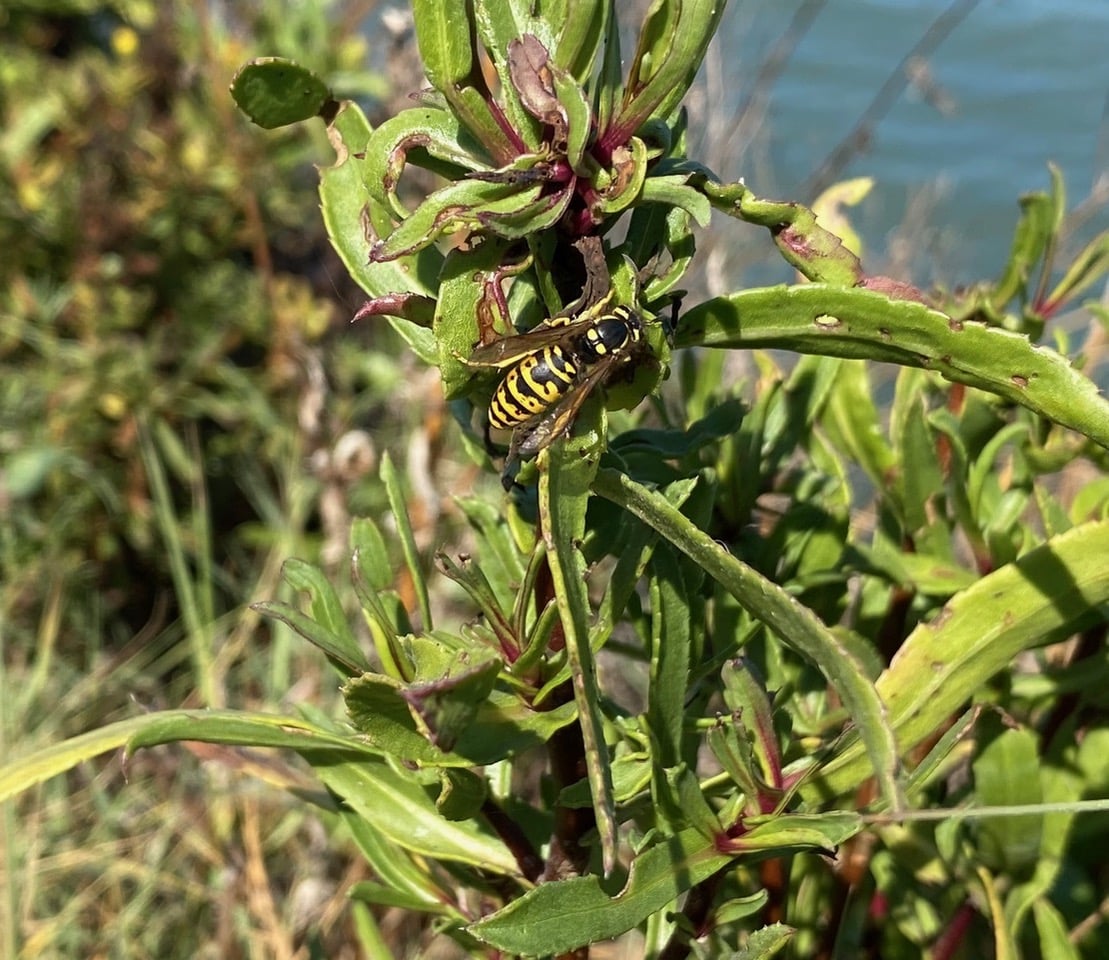
A Yellowjacket wasp is hunting on the foliage of an Oregon Gumweed, Grindelia stricta, carefully looking into every nook and cranny.
Yellowjacket is the common name for predatory social wasps of the genera Vespula and Dolicovespula (family Vespidae). Yellowjackets are social hunters living in colonies containing workers, queens, and males (drones). Colonies are annual with only inseminated queens overwintering. Queens emerge during the warm days of late spring or early summer, select a nest site, and build a small paper nest in which they lay eggs. They raise the first brood of workers single-handedly. Henceforth the workers take over caring for the larvae and queen, nest expansion, foraging for food, and colony defense. The queen remains in the nest, laying eggs. Later in the summer, males and queens are produced. They leave the parent colony to mate, after which the males quickly die, while fertilized queens seek protected places to overwinter. Parent colony workers dwindle, usually leaving the nest to die, as does the founding queen. In the spring, the cycle is repeated.
Yellowjackets have lance-like stingers with small barbs, and typically sting repeatedly. Their mouthparts are well-developed with strong mandibles for capturing and chewing insects, with probosces for sucking nectar, fruit, and other juices. Yellowjacket adults feed on foods rich in sugars and carbohydrates such as plant nectar and fruit. They also search for foods high in protein such as insects and fish. These are chewed and conditioned in preparation for larval consumption. The larvae secrete a sugary substance that is eaten by the adults.
The Western Yellowjackets typically build nests underground, often using abandoned rodent burrows. The nests are made from wood fiber that the wasps chew into a paper-like pulp. The nests are completely enclosed except for a small entrance at the bottom. The nests contain multiple, horizontal tiers of combs within. Larvae hang within the combs.
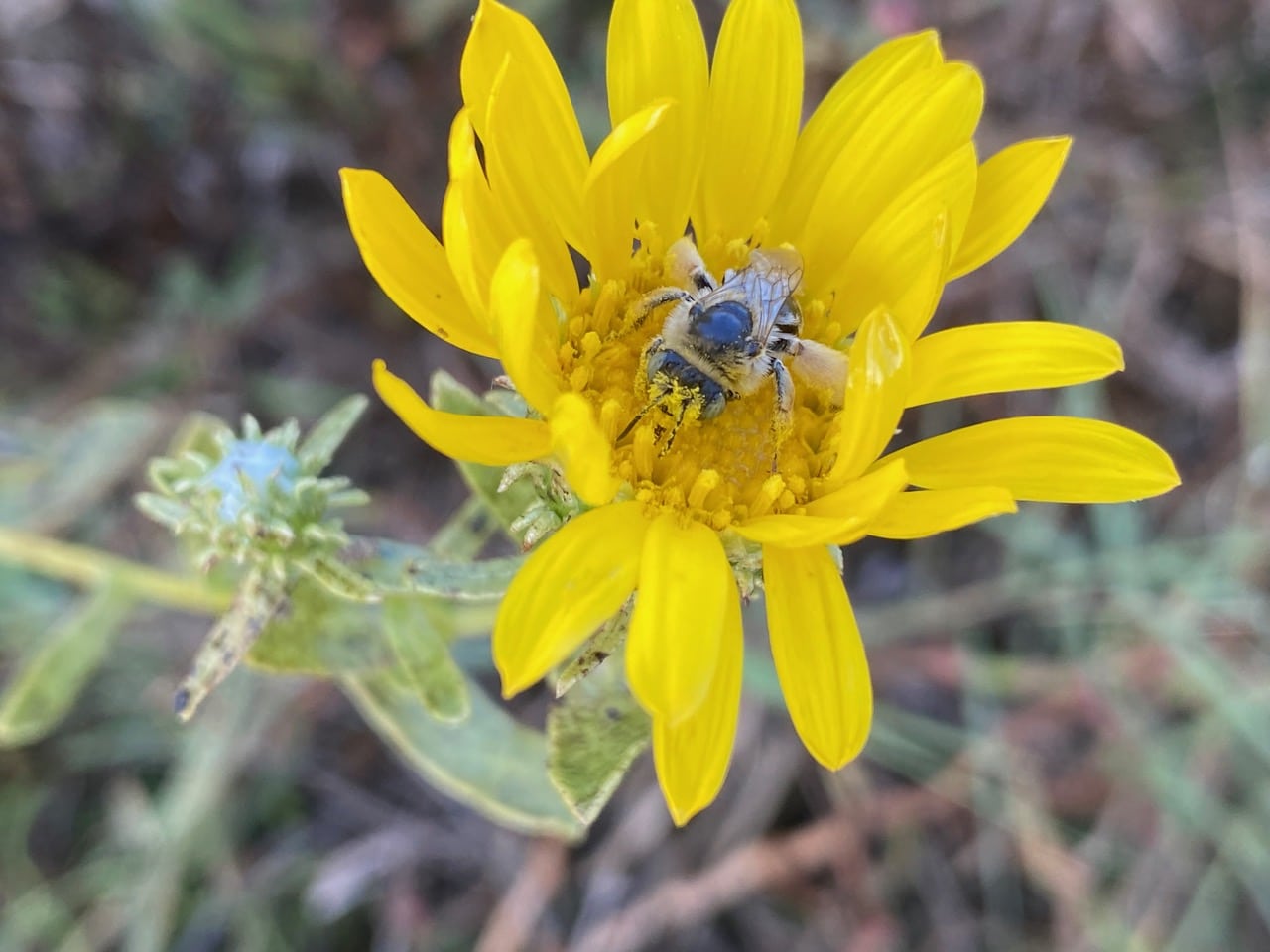
Yellow pollen stuck to her face, a female Summer Longhorn Bee, Melissodes sp. (family Apidae) is taking nectar from a Grindelia flowerhead. She has yet to fill her empty scopae.
The Summer Longhorn Bees, Melissodes sp. (family Apidae) are medium to large bees, stout-bodied, usually with gray hair on the thorax and pale hair bands on the abdomen. Males usually have yellow markings on their faces and have very long antennae from which their common name is derived. They are active May to September, with peak flight in late June to early August. The females prefer flat, bare ground for digging their solitary nests, though they sometimes nest in aggregations. Pollen is transported in scopae on the hind legs. Pollen loads are often copious and brightly colored and thus very distinguishable. Melissodes are specialists on Asteraceae – females gather pollen from flowers of Aster, Bidens, Coreopsis, Cosmos, Encelia, Gaillardia, Helianthus, and Rudbeckia ssp.
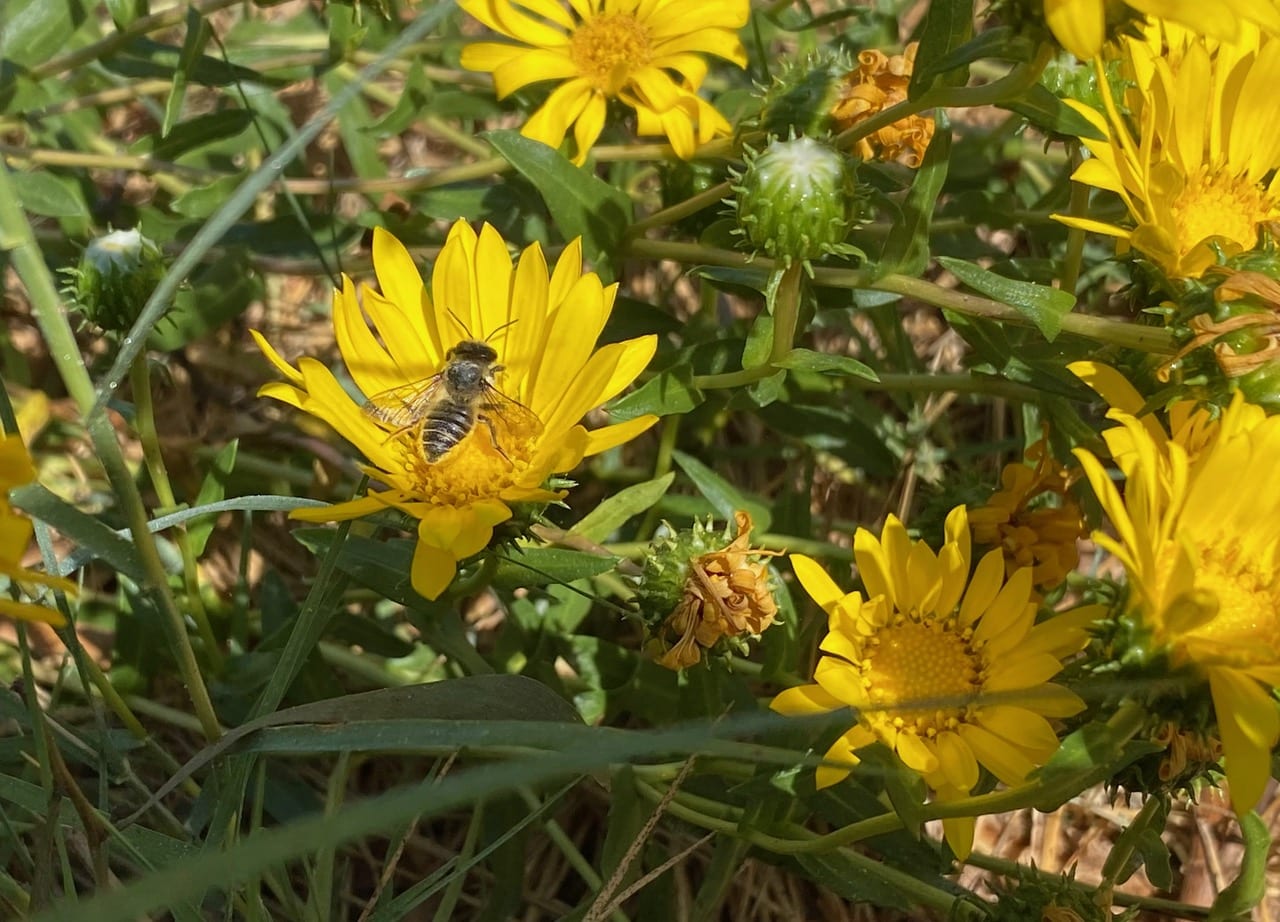
The underside of her abdomen yellow with pollen, a female Western Leafcutter Bee, Megachile perihirta (family Megachilidae) is foraging on a Grindelia flowerhead.
Leaf-cutter Bees, Megachile sp. (family Megachilidae) are stout-bodied, usually with pale hair on the thorax and stripes of white hairs on the abdomen. Females usually have a triangular abdomen with a pointed tip, and males’ faces are covered with dense, pale hair. Flight season is from May into September, with peak activity from June to August.
Solitary females construct nests in tubular cavities, including hollow stems, tree holes, and abandoned beetle burrows in wood. Many use holes drilled into wood, straws, or other manufactured tunnels. Females cut pieces from leaves or flower petals for use in the construction of brood cells. Most Megachile females are generalists when foraging for pollen. Pollen is transported in dense scopae on the underside of the abdomen.
Photos of Western Leafcutter Bee (Megachile perihirta) · iNaturalist