

Pollinator Post 9/2/24

A California Ground Squirrel, Otospermophilus beecheyi peeks from the boulders of Shoreline Park at Bay Farm Island. I toss it a few pieces of shelled walnuts from my pocket. The squirrel immediately scurries over to pick them up, stuffing its cheek pouches. I know I am not supposed to feed wildlife, but who could resist interacting with such adorable creatures?
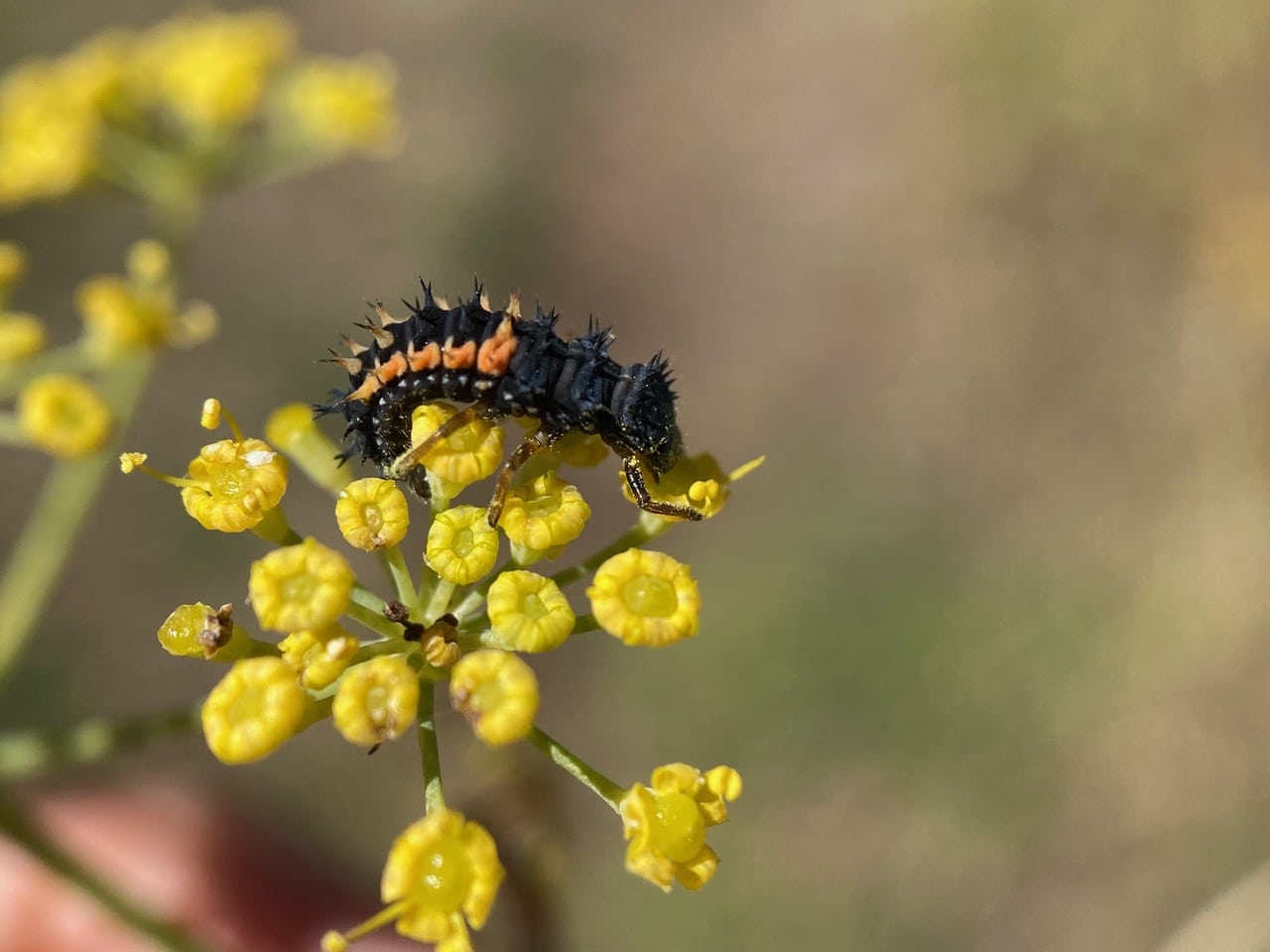
Passing a Fennel along the dirt path, I spot a Lady Beetle larva (family Coccinellidae) on the flowers. Is it hunting aphids? The plant does not seem to be infested with aphids.

This is the first time I see a Lady Beetle larva feed on pollen. Although it is known that the predatory beetles sometimes feed on pollen when prey is scarce, I didn’t know that the behavior includes their larvae.
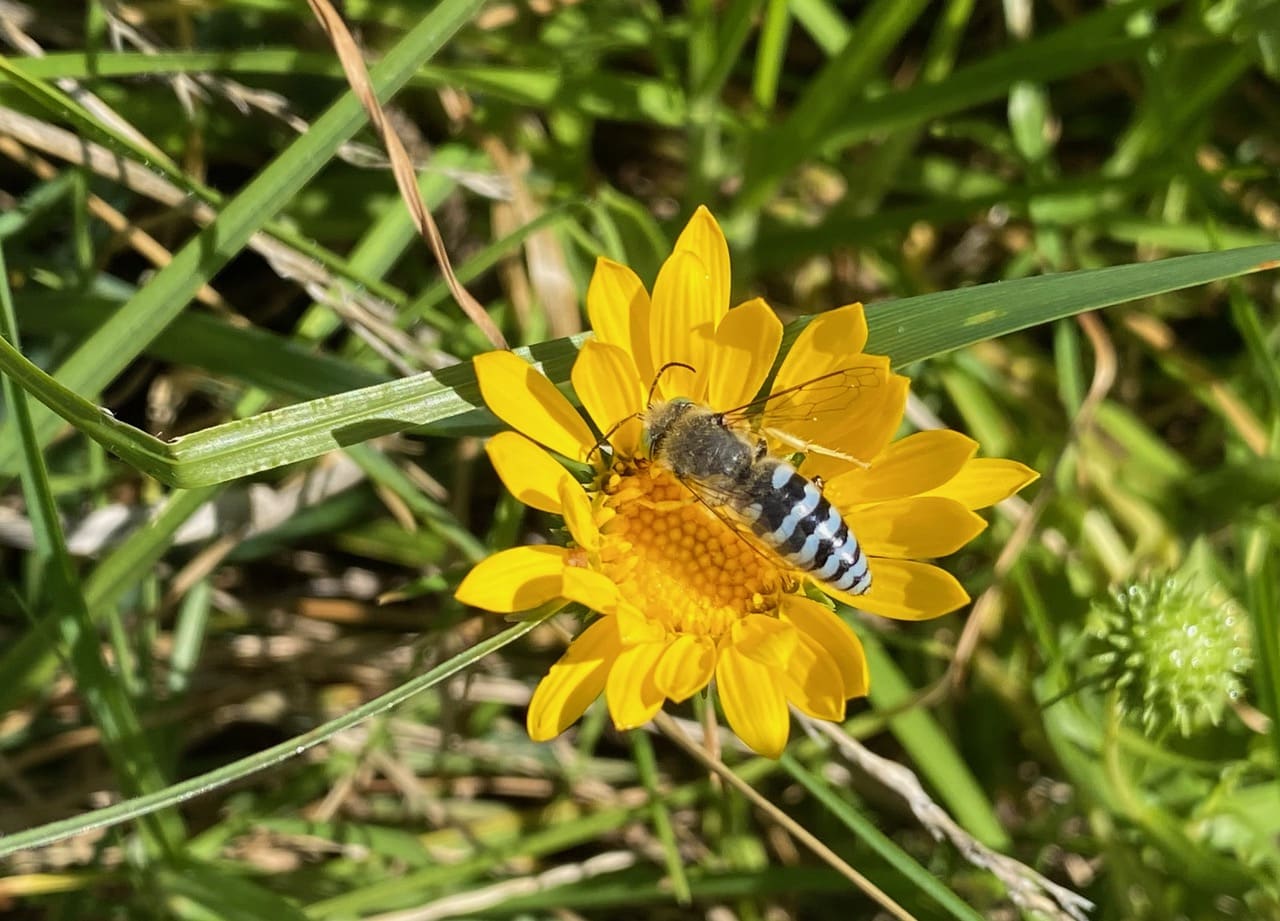
An American Sand Wasp, Bembix americana (family Crabronidae) is taking nectar from a flowerhead of Grindelia stricta.
Sand wasps in the genus Bembix are familiar and common throughout North America, digging their burrows in dunes, on beaches, and other habitats with loose, deep sand. The female rapidly kicks out large quantities of sand using a “tarsal rake” of spines on each front leg. The burrow is excavated before the wasp goes hunting. Bembix are generalist, opportunistic hunters. True flies in the order Diptera are the usual prey. A victim is paralyzed or killed by the wasp’s sting, and is then flown back to the nest. Most species will lay an egg on the first victim, while some species lay an egg in the empty cell before starting to hunt. Once the egg hatches, mama wasp brings flies to her larva as needed. This “progressive provisioning” is rare in the insect world. When the larva reaches maturity, mama wasp closes the cell. Inside, the larva spins an oblong cocoon, weaving sand grains into the structure and resulting in a hardened capsule. Overwintering takes place as a prepupa inside this cocoon, but there are usually two generations a year.

A male Western Leafcutter Bee, Megachile perihirta (family Megachilidae) lands on a Grindelia flowerhead.
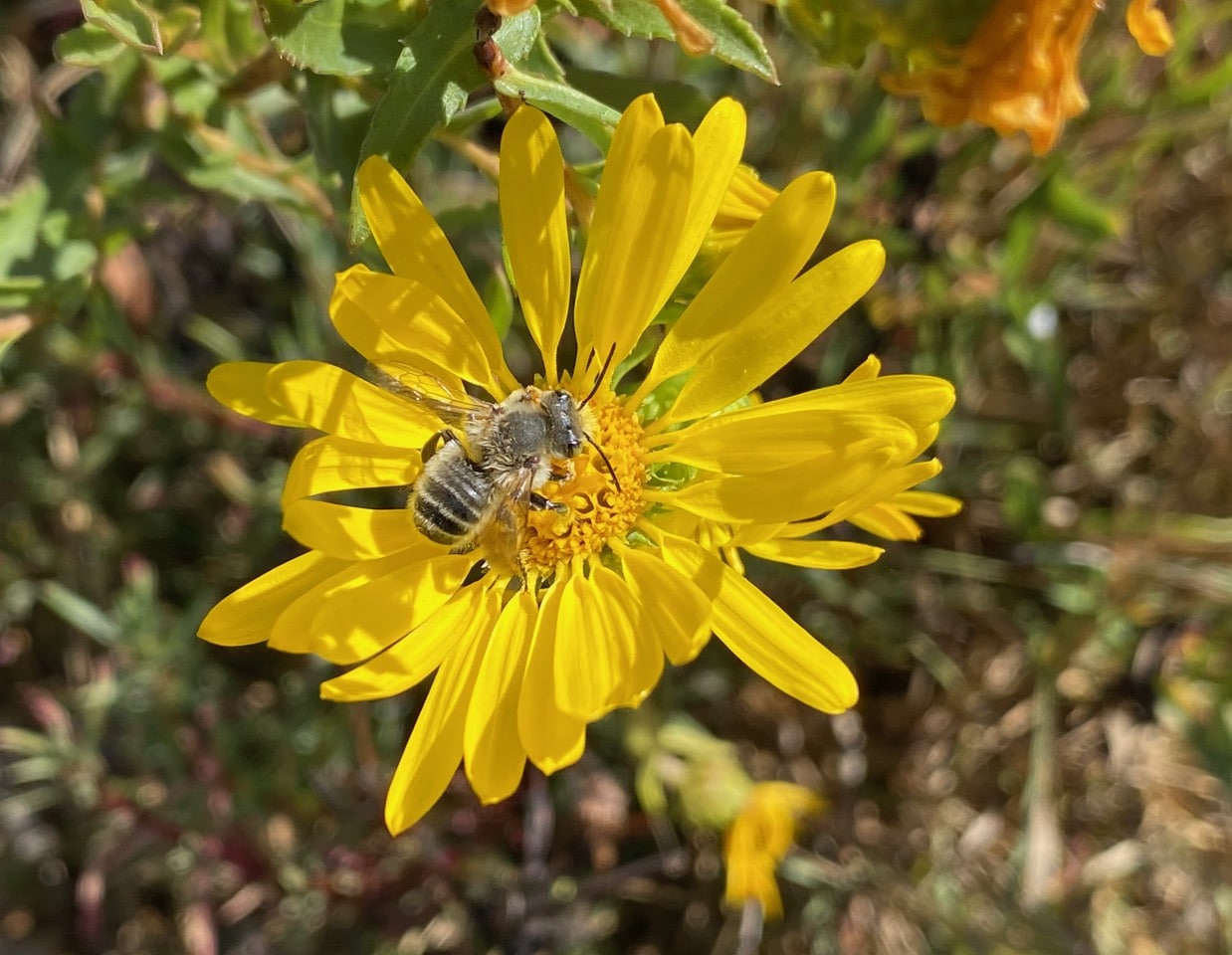
Leaf-cutter Bees, Megachile sp. (family Megachilidae) are stout-bodied, usually with pale hair on the thorax and stripes of white hairs on the abdomen. Females usually have a triangular abdomen with a pointed tip, and males’ faces are covered with dense, pale hair. Flight season is from May into September, with peak activity from June to August.
Solitary females construct nests in tubular cavities, including hollow stems, tree holes, and abandoned beetle burrows in wood. Many use holes drilled into wood, straws, or other manufactured tunnels. Females cut pieces from leaves or flower petals for use in the construction of brood cells. Most Megachile females are generalists when foraging for pollen. Pollen is transported in dense scopae on the underside of the abdomen.
Photos of Western Leafcutter Bee (Megachile perihirta) · iNaturalist
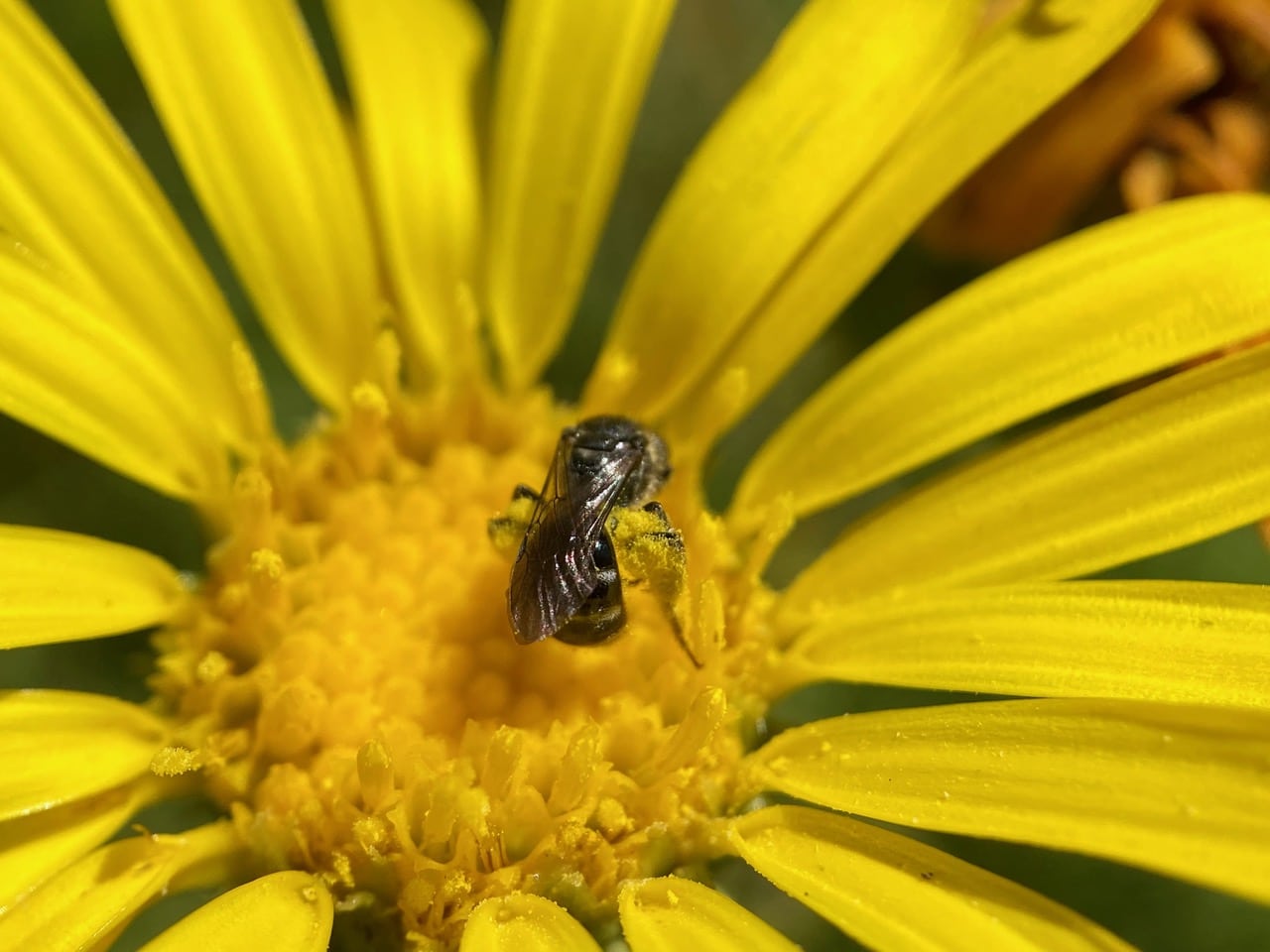
A small black bee with faint white bands across its abdomen is gathering pollen from the Grindelia flowers.
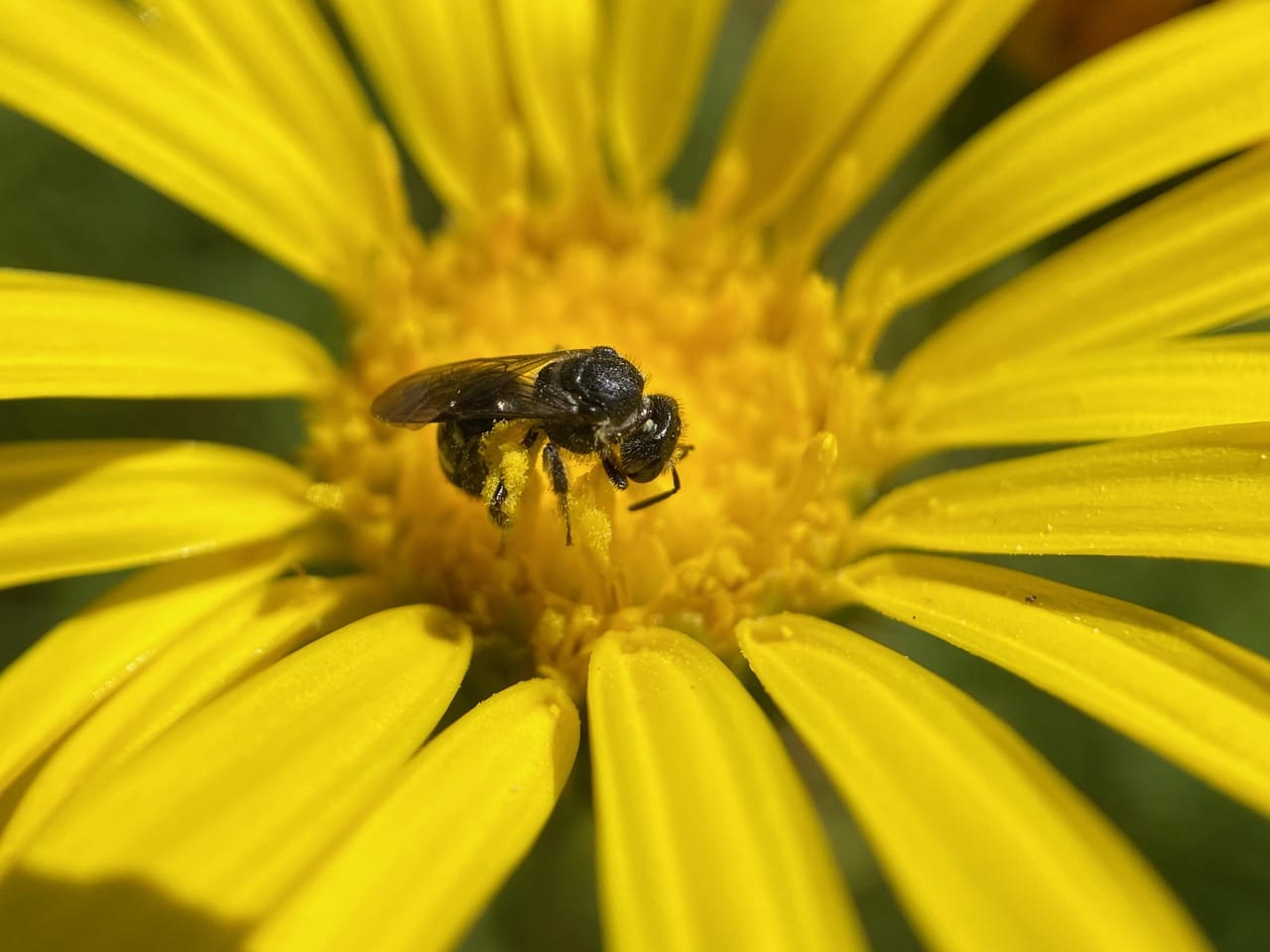
It is a Sweat Bee, Lasioglossum (Evylaeus) sp. (family Halictidae).
Lasioglossum species are found worldwide, and they constitute the largest bee genus. The subgenus Dialictus are the most likely to be seen in the U.S., with over 300 species of these tiny metallic bees. The majority of Lasioglossum are generalists. Because they are so abundant throughout the flowering season, the bees are often important pollinators. Their sheer numbers are enough to achieve excellent pollination of many wild flowers, especially of plants in the Asteraceae, which have shallow floral tubes that are easily accessed by these minute bees.
Lasioglossum exhibit a range of social behaviors; the genus includes solitary, communal, semi social, primitively eusocial, and even parasitic species. Almost all Lasioglossum in the U.S. nest in the ground. Generally these nests are built in the spring by fertilized females (called foundresses) that spent the winter in hibernation. In social species, the foundresses behave much like the queen Bumble Bees – they lay the first batch of eggs that develop into the first generation of female workers. The nest grows with each additional generation of bees. Later broods may consist of both males and females. They mate, and at the end of the season the fertilized females hibernate til the following spring, repeating the life cycle of the colony.
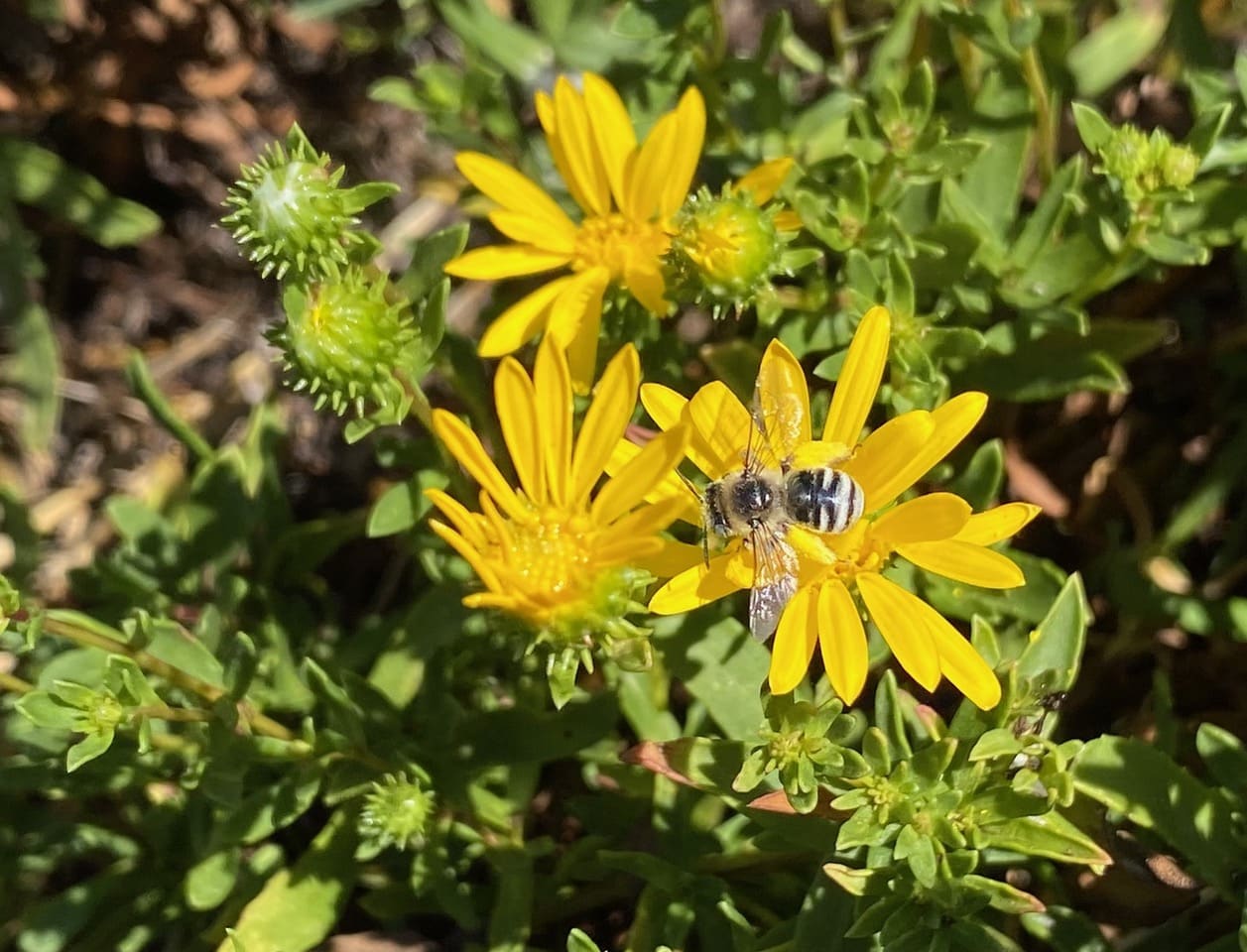
A female Summer Longhorn Bee, Melissodes sp. (family Apidae) is foraging on a Grindelia flowerhead. Note the huge load of pollen in her scopae.
The Summer Longhorn Bees, Melissodes sp. (family Apidae) are medium to large bees, stout-bodied, usually with gray hair on the thorax and pale hair bands on the abdomen. Males usually have yellow markings on their faces and have very long antennae from which their common name is derived. They are active May to September, with peak flight in late June to early August. The females prefer flat, bare ground for digging their solitary nests, though they sometimes nest in aggregations. Pollen is transported in scopae on the hind legs. Pollen loads are often copious and brightly colored and thus very distinguishable. Melissodes are specialists on Asteraceae – females gather pollen from flowers of Aster, Bidens, Coreopsis, Cosmos, Encelia, Gaillardia, Helianthus, and Rudbeckia ssp.
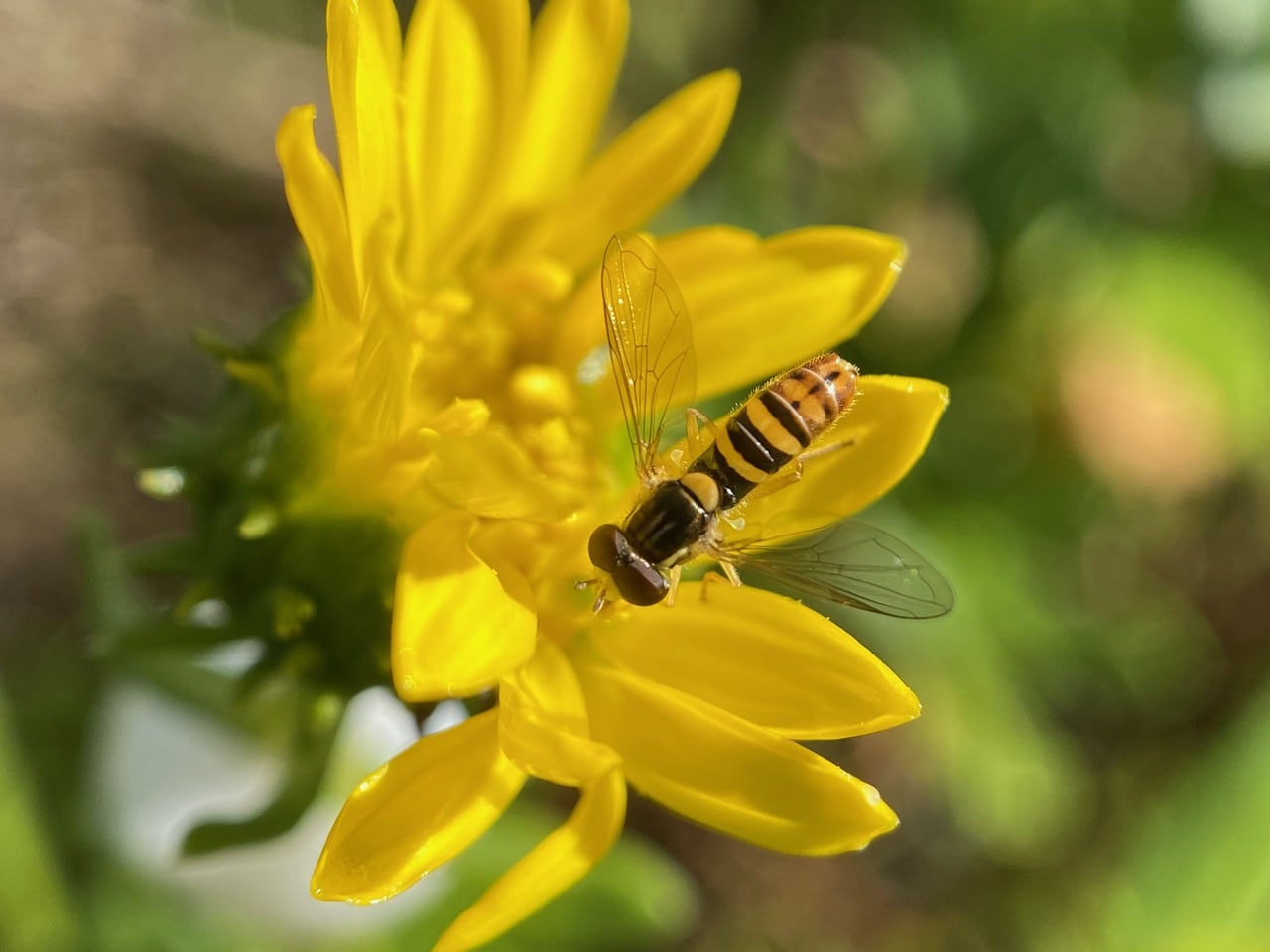
A male Forked Globetail, Sphaerophoria sulphuripes (family Syrphidae) lands to forage on a Grindelia flowerhead.
The hover fly is native to western North America. There is marked sexual dimorphism in the Forked Globetail – the males have a narrow abdomen with a reddish, swollen tip. Adults visit flowers for nectar and pollen. The larvae of Sphaerophoria feed on aphids and other soft-bodied insects.
Forked Globetail (Sphaerophoria sulphuripes) · iNaturalist

Today I am paying special attention to the Grindelia along this stretch of the shoreline that is heavily infested with Spittle Bugs (superfamily Cercopoidea). Thousands of the larvae have left masses of white foam on the stems of the plants. I have yet to see an adult Spittle Bug.
The foam mass is made by a nymph of a bug called the Spittle Bug (superfamily Cercopoidea). Like the adults, the nymphs use their piercing, sucking mouthparts to feed on plant juices. The nymph produces a cover of foamed-up plant sap reminiscent of saliva, hence the common name of spittlebug. Whereas most insects that feed on sap feed on the nutrient-rich fluid from the phloem, Cercopidae tap into the much more dilute sap flowing upward via the xylem. The large amount of excess water that must be excreted and the evolution of special breathing tubes allow the young spittlebug nymphs to grow in the relatively protective environment of the spittle. Symbiotic bacteria in the insects’ digestive system provides them with the essential amino acids that their diet lacks. The foam serves a number of purposes. It hides the nymph from the view of predators and parasites, and it insulates against heat and cold, and protects the delicate nymphs from desiccation. Moreover, the foam has an acrid taste that deters predators.
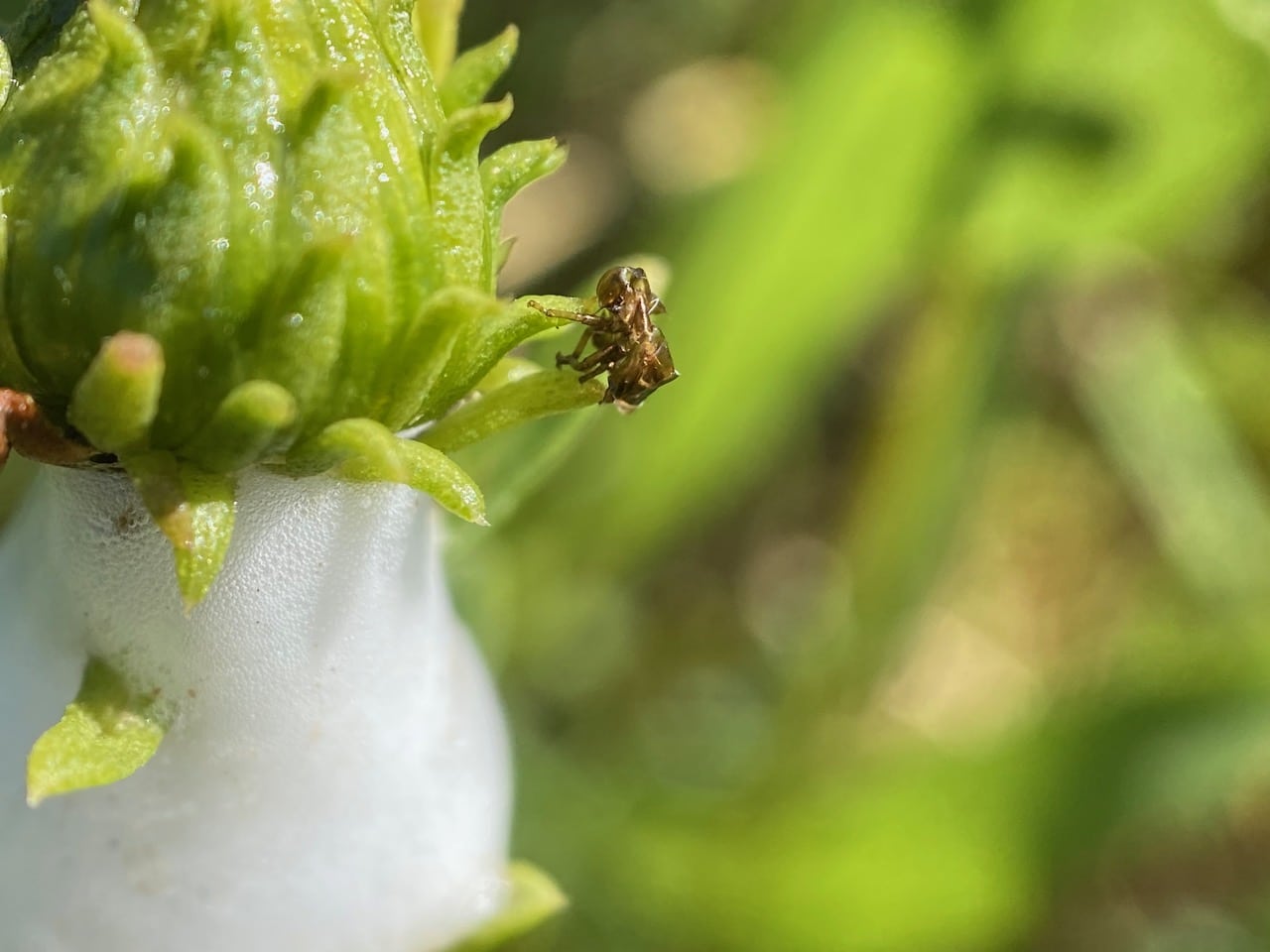
Checking out a Spittlebug foam mass at the base of an immature Grindelia flowerhead, I find a brown exuvia (exoskeleton shed during molting) clinging to the phyllaries above the foam. The mature nymphs apparently leave the foam mass for their final molt into an adult.
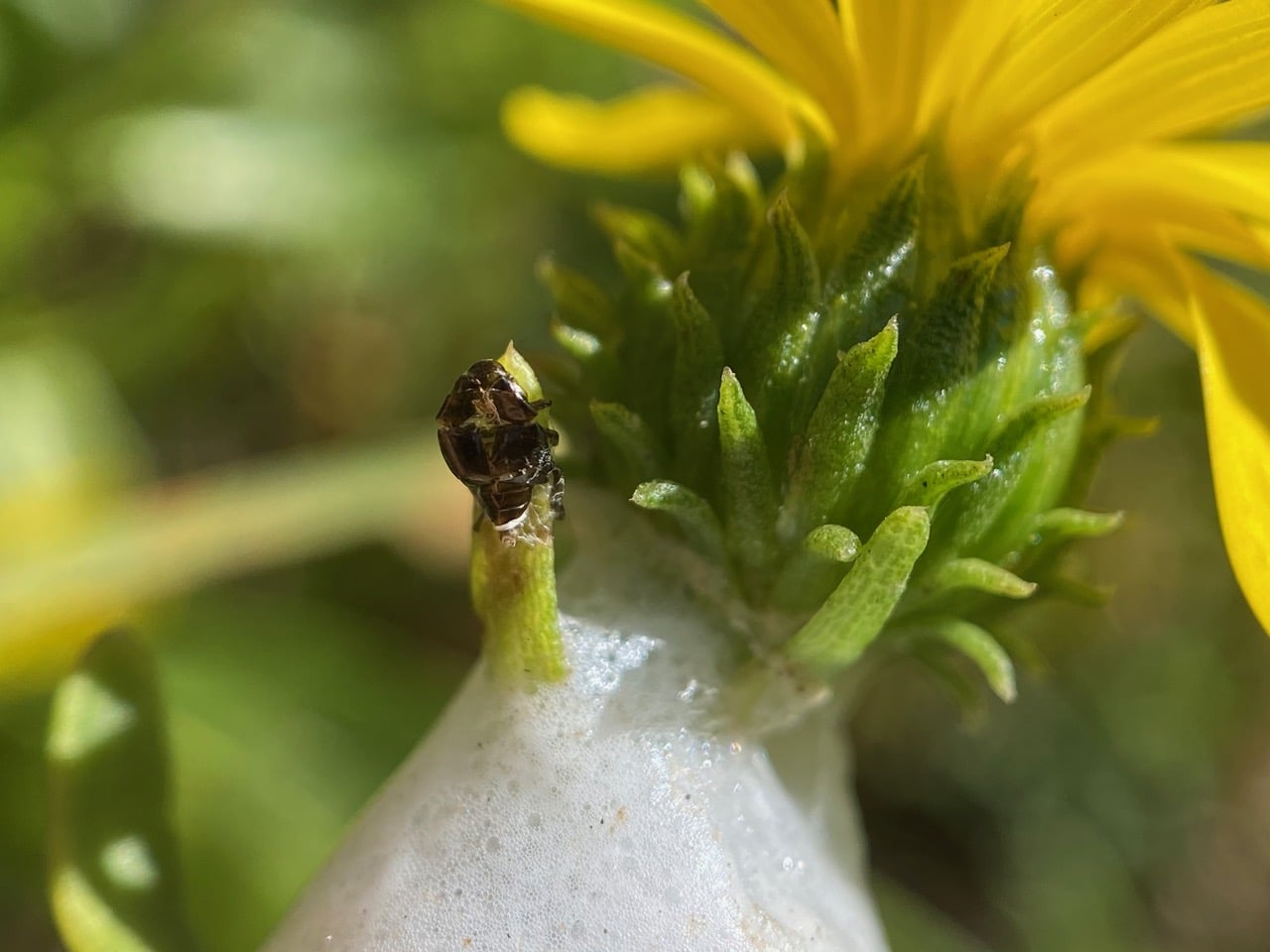
Here’s another Spittlebug exuvia.
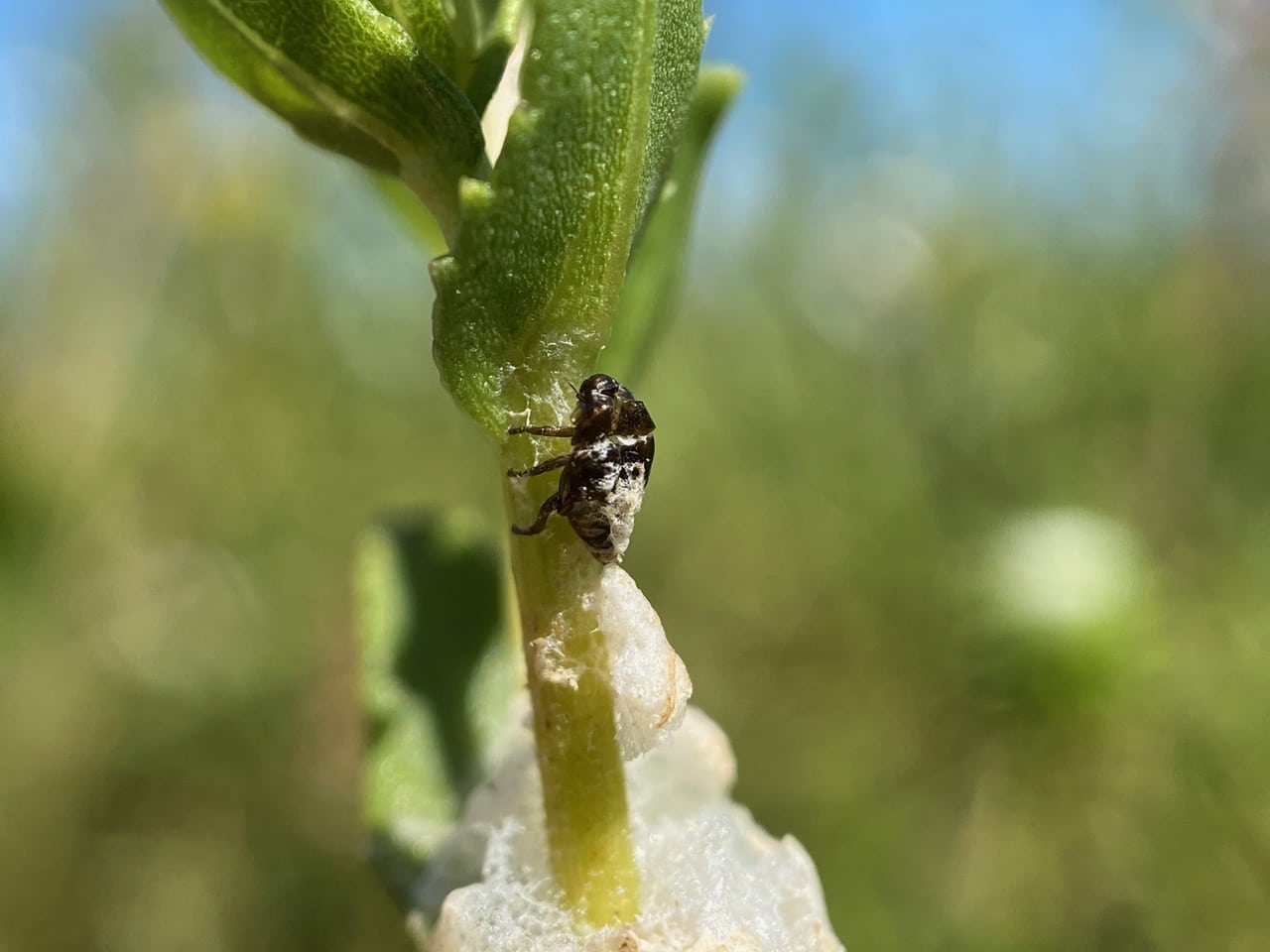
And another……

Do the Spittlebug nymphs leave their foamy shelter for every molt , or do they do this only on their last molt into adulthood?

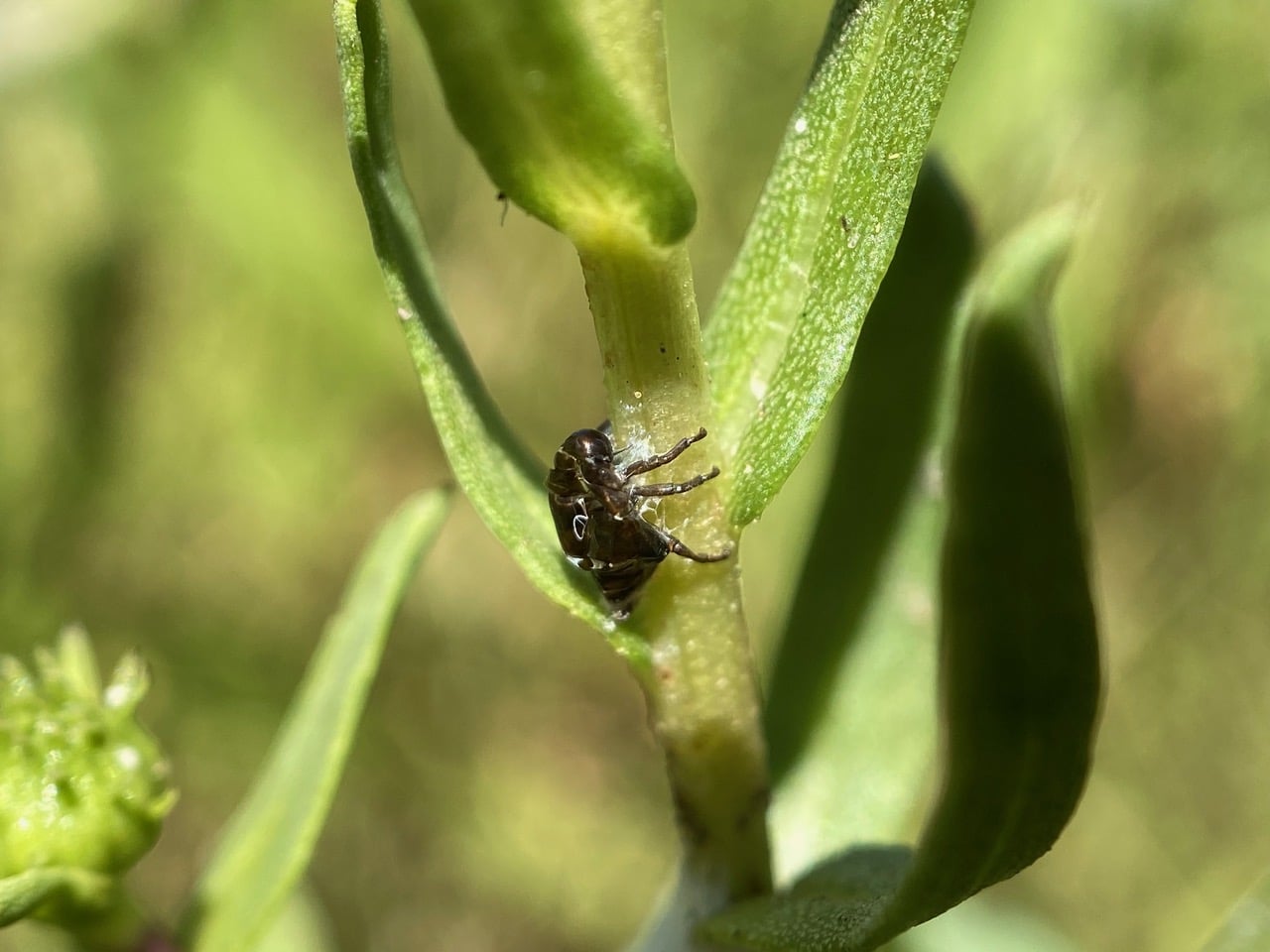
It is apparent that many of the nymphs have crawled out of their foamy homes to molt into adults. Surely I should be able to find an adult?
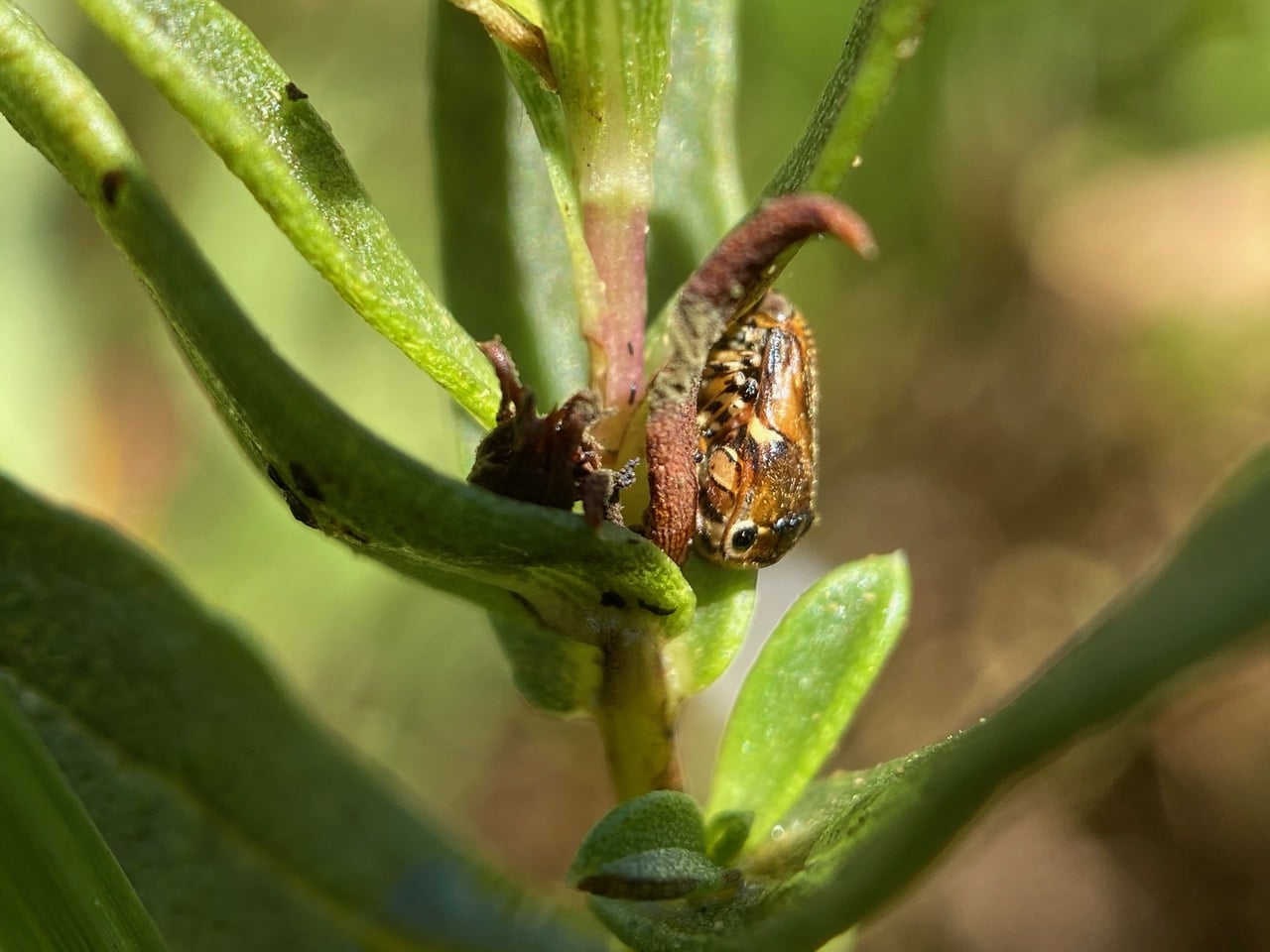
What on earth is that brown thing at the leaf axil. Is that an adult Spittlebug? Which side is up and which side is down?

From a better angle, it becomes apparent that the bug is facing up. Its eyes are a diffused olive-brown color. The white-rimmed black spot is actually a fake eyespot on the rear end of its wing. Like most adult Spittlebugs, the insect has a prominent corrugated ’snout’ that supports the rostrum (a true bug’s piercing-sucking mouthparts). Unfortunately I can’t get a dorsal view of the bug. For an insect that is known for its jumping prowess, it sure is cooperative in sitting still for this picture.
iNaturalist has helped identify the Spittle Bug as a member of the Complex Clastoptera lineatocollis (family Clastopteridae). Photos of Complex Clastoptera lineatocollis · iNaturalist The species is found in western United States. The bugs feed mostly on Asteraceae, although other hosts have been reported. Females are brownish (3.3-3.8 mm), while the smaller males (3.0-3.2 mm) are mostly black.
The adult Spittle Bug is sometimes called a Froghopper. The Froghopper is a “true bug” in the order Hemiptera. Froghoppers are champion jumpers among insects, out-performing even the fleas. The bug can leap the human equivalent of a skyscraper without a running start. It is the highest jumping insect proportional to body size. The muscles in its hind legs act like a “catapult” to release energy explosively.
Athletic prowess aside, the Froghopper is better known for its young, the “spittle bug”. The nymphs produce foamy white masses on plants within which they feed on plant sap. Froghoppers have piercing-sucking mouthparts, and feed on plant sap as both nymphs and adults. A recent report claims, “Froghoppers are the super-suckers of the animal world. The tiny insects produce negative pressures equivalent to people sucking a 100-meter-long straw.” The sucking power is strong enough to suck the water out of a cup at the base of the Statue of Liberty while perched on its crown. To complement that, the Froghopper is also exceptional at urination, excreting the human equivalent of 2,500 gallons of urine a day.
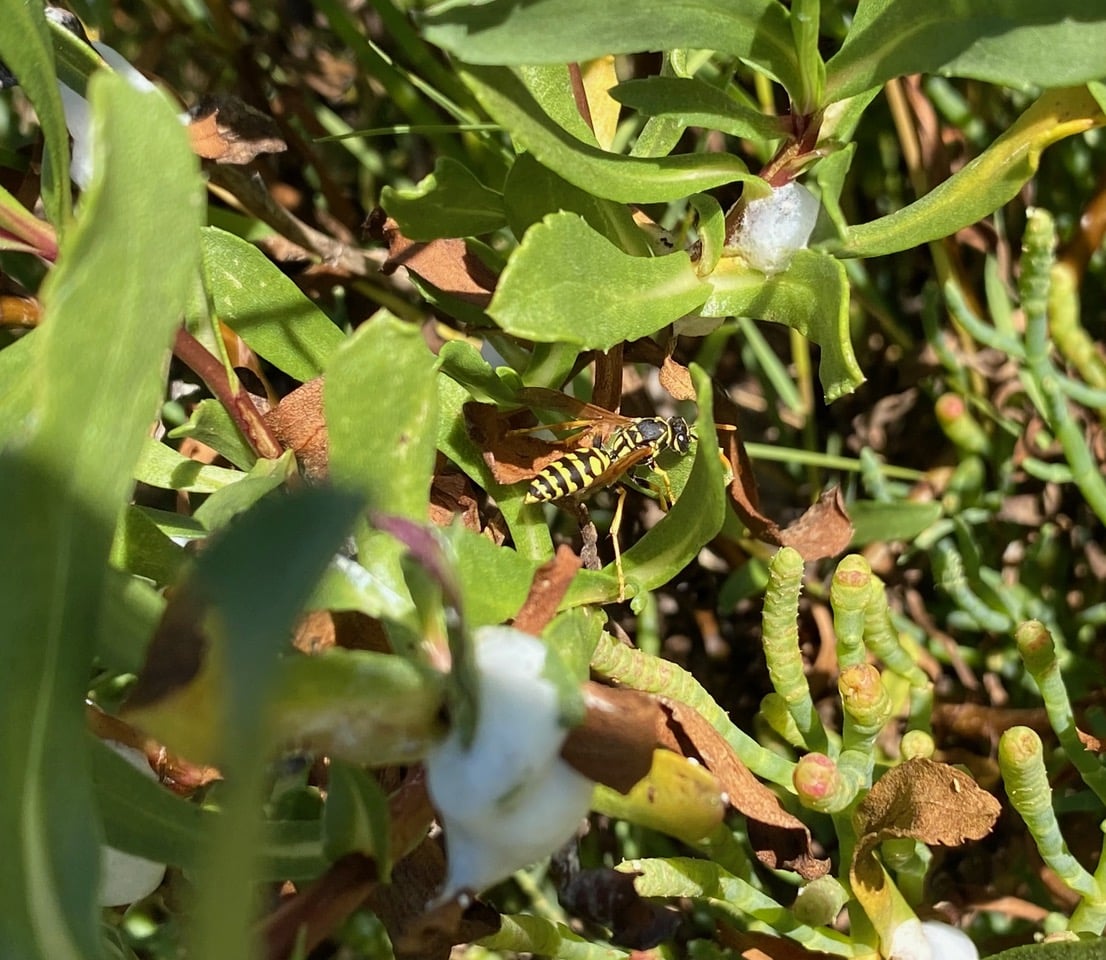
Numerous European Paper Wasps, Polistes dominula (family Vespidae) can be seen flying around the infested Grindelia, sometimes landing to investigate the foamy masses made by the Spittlebugs. Are the wasp hunting Spittlebugs or are they attracted by the honeydew produced by the sap-sucking bugs?
Native to Europe, the European Paper Wasp, Polistes dominula, is a social insect that produces an annual colony in a paper nest. Individual colonies are established anew each spring. The overwintering stage are mated females (queens). The overwintered queens emerge from sheltered spots in spring and search out sites to establish a new colony. Nests are constructed of paper, produced from chewed wood fibers of weathered fences, porch decks and other similar sources. Larvae are fed crushed insects, usually caterpillars. As the population increases, the original queen increasingly remains in the nest as new workers take over colony activities. A few of the wasps produced later in summer are males and increasing numbers of the females become sexually mature. Mating occurs and the mated females are the surviving overwintering stage. Males and non-reproductive females do not survive winter and the nest is abandoned by late fall. European Paper Wasps will sometimes feed on sweet materials, including honeydew produced by aphids. They may also feed on damaged ripe fruits. Because of their habit of hunting caterpillars, the wasps have become one of the most important natural controls of garden pests.

Hey, isn’t that a male Sharptail Bee on the Grindelia flowerhead? iNaturalist has identified the bee as the Red-footed Cuckoo Leafcutter, Coelioxys rufitarsis (family Megachilidae).
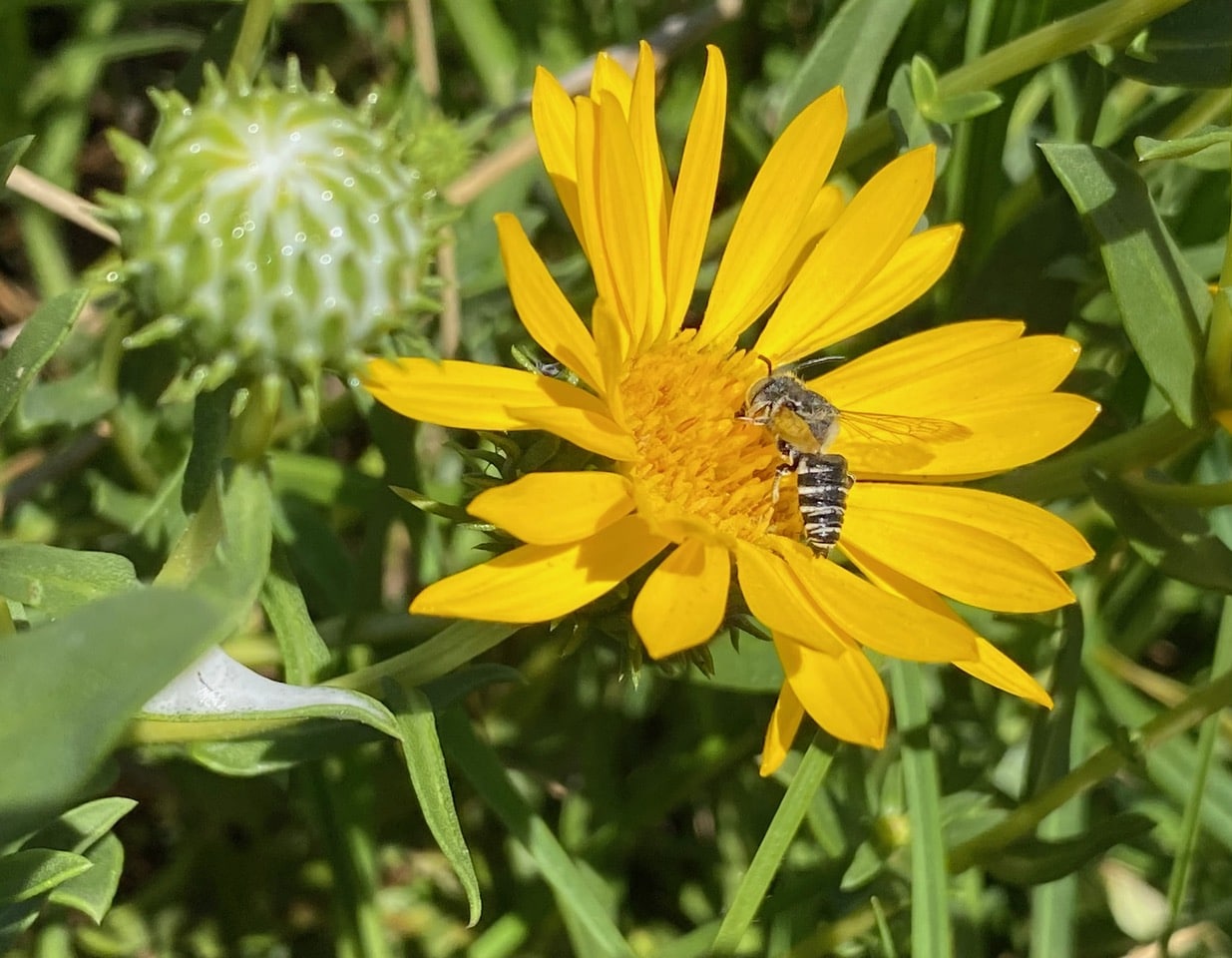
Coelioxys, commonly known as the Sharptail Bee or the Cuckoo Leafcutter Bee, is a genus of solitary kleptoparasitic cuckoo bee belonging to the family Megachilidae. It is native to North America.
The term cuckoo bee refers to a variety of different bee lineages which have evolved the kleptoparasitic behavior of laying their eggs in the nests of other bees, similar to the behavior of cuckoo birds. Female cuckoo bees lack pollen-collecting structures and do not construct their own nests. Cuckoo bees typically enter the nests of pollen-collecting species, and lay their eggs in cells provisioned by the host bee. When the cuckoo bee larva hatches, it consumes the provision in the nest, and kills the host larva. Many cuckoo bees are closely related to their hosts, and may bear similarities in appearance reflecting this relationship. Others parasitize bees in families different from their own.
The Cuckoo Leafcutter Bees belong to the genus Coelioxys, in the same family as their hosts, Megachilidae. Members of the genus Coelioxys share the distinctive trait of having hairs on their eyes. In addition, the back rim of the bee’s scutellum (the second segment of the thorax) has prominent toothlike protrusions called axillae. In Greek, Coelioxys means “sharp belly”, referring to the tapered, pointed abdomens of cuckoo leaf cutters. The bees have dark abdomens banded by short pale hairs; thorax with prominent axillae; red, black or red-and-black legs; and green eyes. Female Coelioxys have pointed, conical abdomens with spearlike tips. The spade-shaped abdominal tips allow the female cuckoos to break through the brood-cell walls that leafcullters construct with leaves, petals and other materials. Males have abdomens armed with multiple pronged tips.
The Red-legged Cuckoo Leafcutter Bee, Coelioxys rufitarsis parasitizes the nests of several other Leafcutter Bees, including Megachile perihirta.