

Pollinator Post 9/2/23 (1)
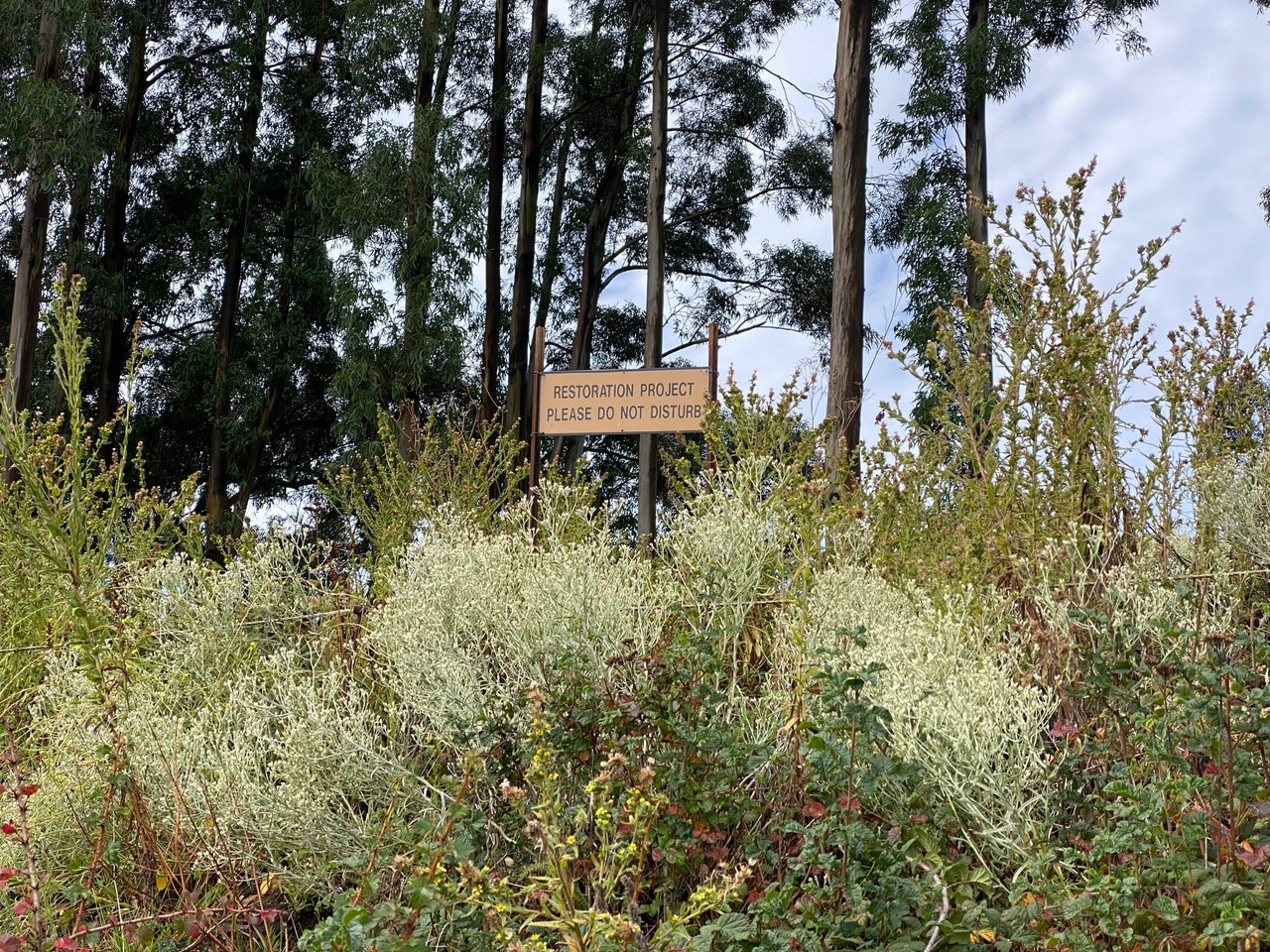
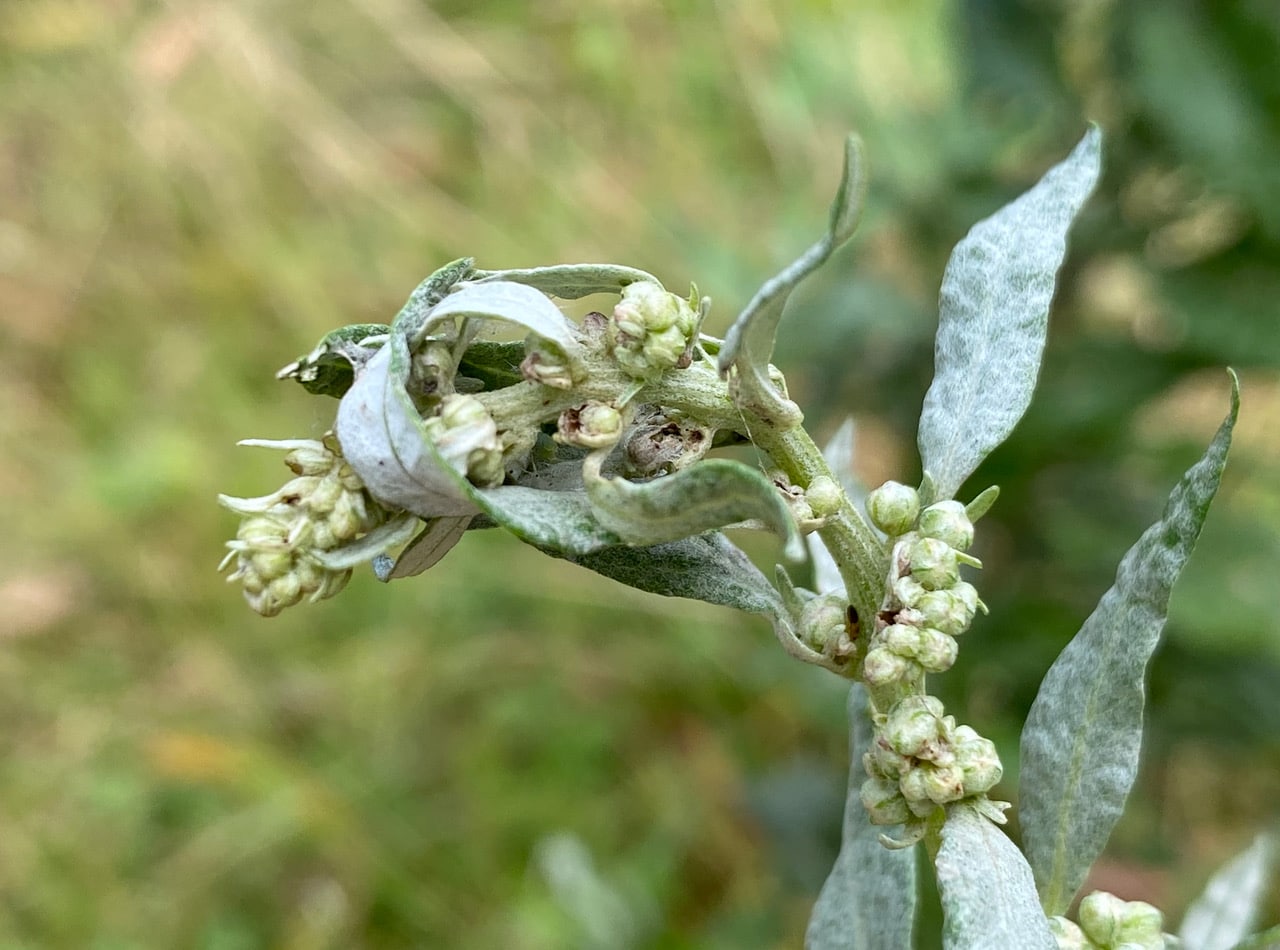
Is that a new signage on the hill west of the paved road to the Radio Tower? The place beckons to me with budding Fragrant Everlasting, Pseudognaphalium beneolens, and who knows what else in this relatively wild spot.
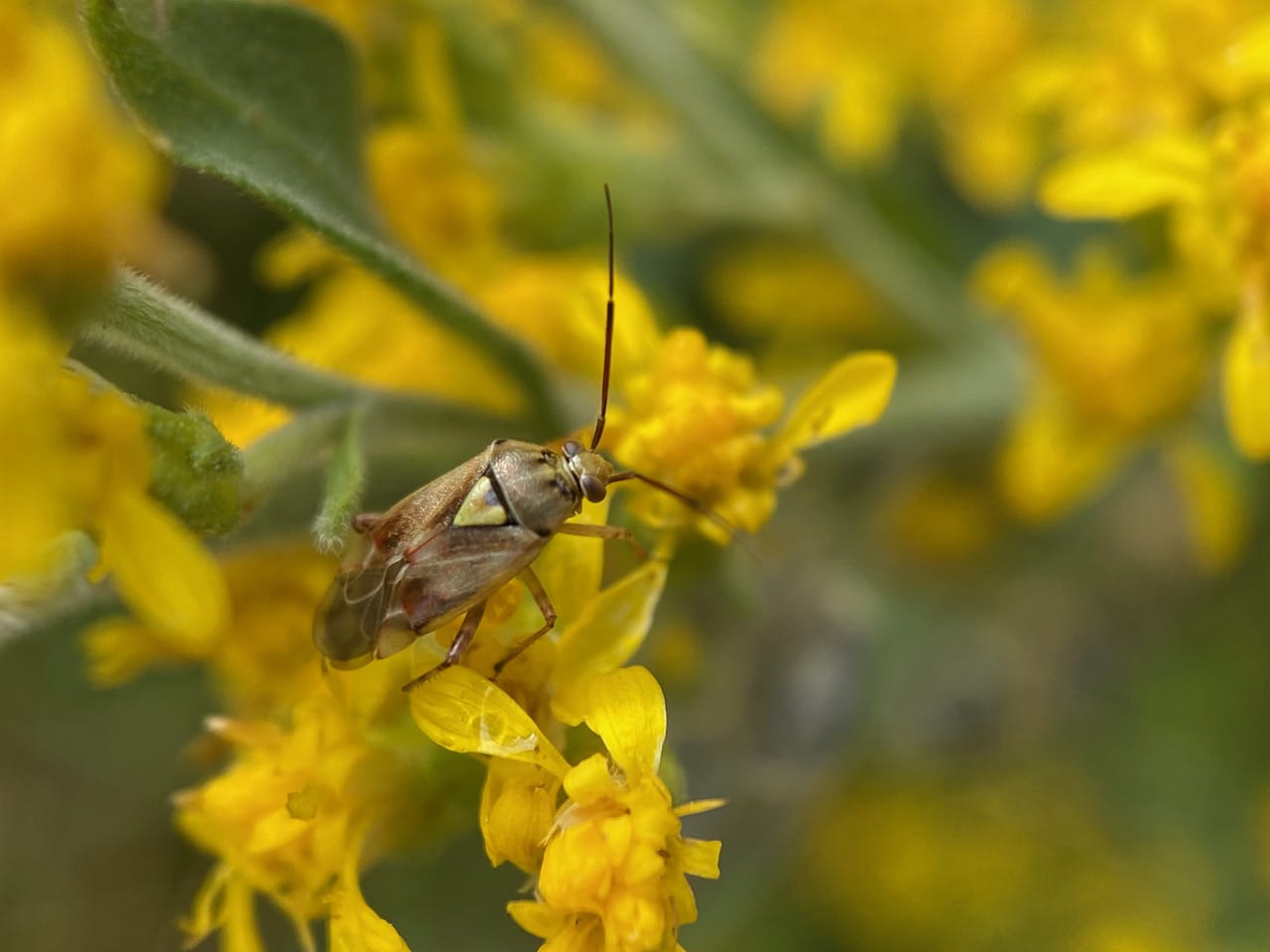








I discover a nice little patch of blooming California Goldenrod, Solidago velutina ssp. californica. A Lygus Bug (family Miridae) is exploring an inflorescence.
The term lygus bug is used for any member of the genus Lygus, in the family of plant bugs, Miridae. Adult lygus are approximately 3 mm wide and 6 mm long, colored from pale green to reddish brown or black. They have a distinctive triangle or V-shape on their backs. Lygus bugs are known for their destructive feeding habits – they puncture plant tissues with their piercing mouthparts, and feed by sucking sap. Both the physical injury and the plant’s own reaction to the bug’s saliva cause damage to the plant. Many lygus bugs are well-known agricultural pests.
Something lands in the underbrush next to the goldenrods. It is a nymph of the North American Spur-throated Grasshopper, Melanoplus sp. (family Acrididae).
Melanoplus is a large genus of grasshoppers. They are the typical large grasshoppers (and in some cases migratory “locusts”) in North America. These grasshoppers eat grasses of all kinds, as well as leafy and grassy agricultural crops and garden plants. They feed on the leaves, and sometimes fruit, flowers, and buds, as well as tree bark. Many of the more notable agricultural pest grasshoppers belong here, including the Rocky Mountain locust, the most significant insect pest of the 19th century Great Plains, but now extinct.
The leaves of this young California Goldenrod are already riddled with Blister Galls. The infestation is especially intense this year.
The blisters are actually a well-known goldenrod gall, induced by the gall midge Asteromyia carbonifera (family Cecidomyiidae). The midge induces flat, circular galls in the leaves of various goldenrods (Solidago). One to ten or more larvae develop in each gall. Color and size of the gall vary by host species and number of larvae. The galls contain a symbiotic fungus, Botryosphaeria dothidea, which the larva apparently does not eat. The fungus seems to confer some protection against parasitoid wasps. Females carry spores of the fungus.
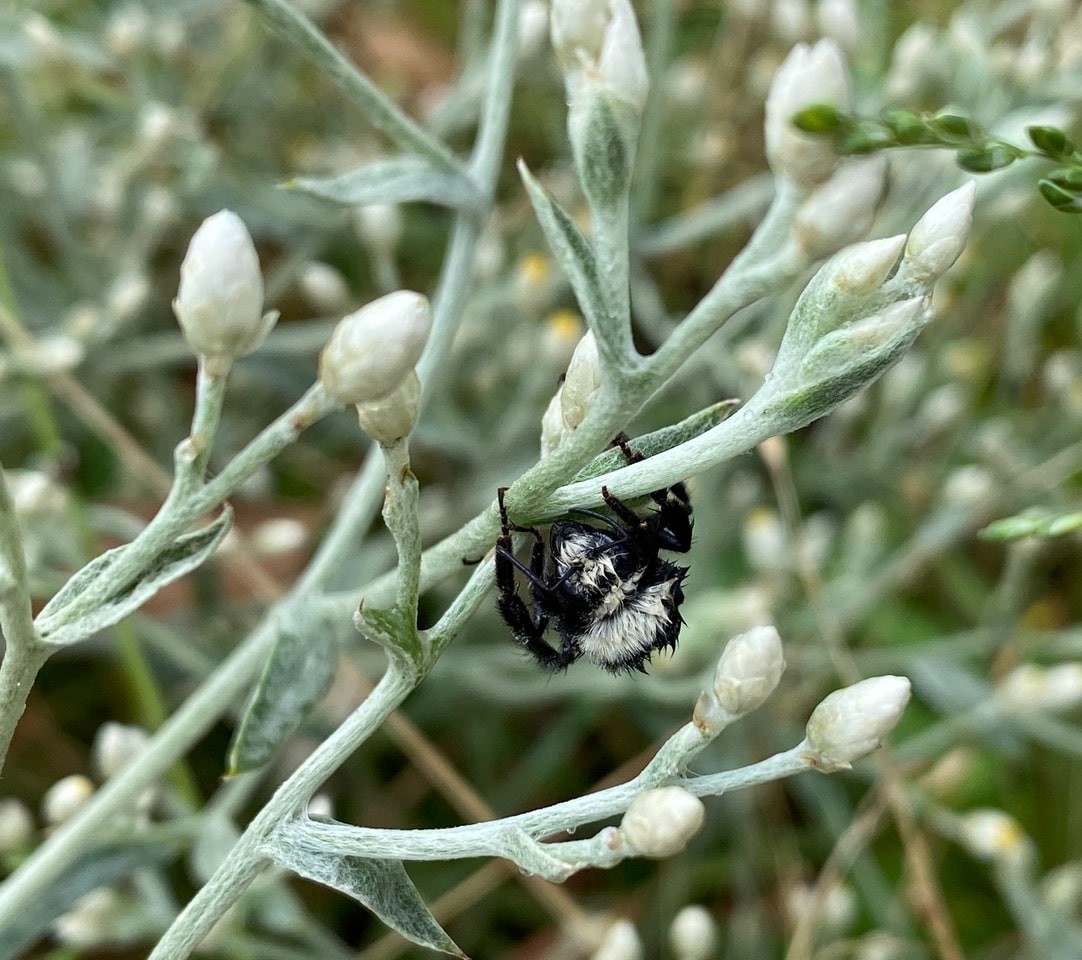
A wet and disheveled Yellow-faced Bumble Bee, Bombus vosnesenskii is perched motionless on a branch of the Fragrant Everlasting. It must have been caught unprepared in the heavy fog and never made it home last night. I wonder if it is still alive, but don’t have the heart to prod it to find out.
Hey, look who’s here on a cluster of immature everlasting flowerheads! That’s the familiar rear view of a Two-tubercled Orbweaver Spider.
The Two-tubercled Orbweaver, Gibbaranea bituberculata is a species of ‘orbweavers’ belonging to the family Araneidae. They are found in sunny habitats on shrubs, edges and low plants, where they can make their webs near the ground. Their basic color is very variable, but usually it is brownish, with whitish shades. The cephalothorax is covered with lying down hairs.
Orb-weaver spiders are members of the spider family Araneidae. They are the most common group of builders of spiral wheel-shaped webs often found in gardens, fields, and forests. Generally, orb-weavers are three-clawed builders of flat webs with sticky spiral capture silk. The third claw is used to walk on the non-sticky part of the web. Typically, the prey insect that blunders into the sticky lines is stunned by a quick bite, and then wrapped in silk.
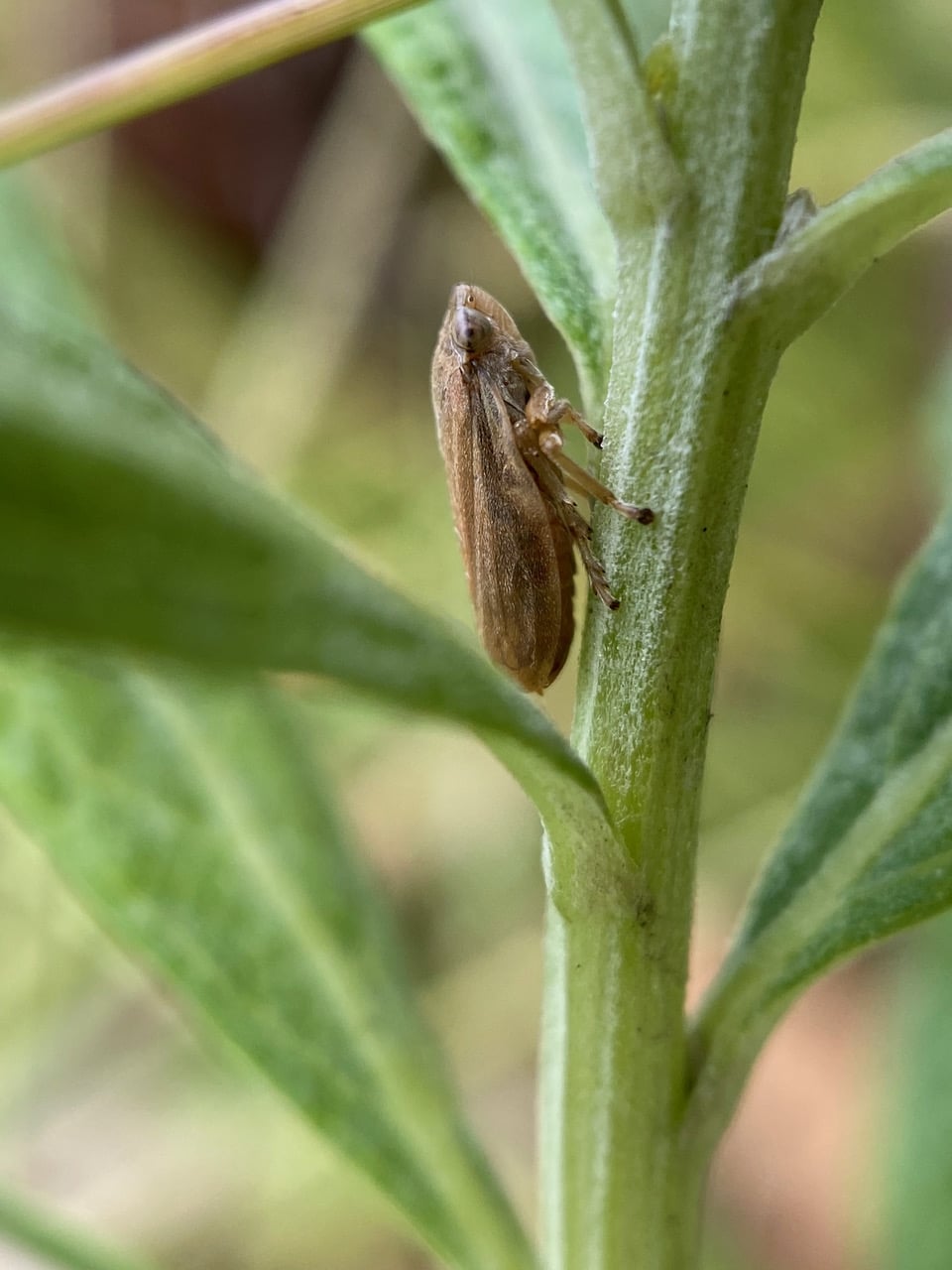
A Froghopper Philaenus sp.(family Aphrophoridae) is resting on the stem of a California Mugwort, Artemisia douglasiana. Most of the Froghoppers I have seen this year have been on Mugwort. I wonder if the plant is especially attractive to the bugs, or whether it is easier for me to spot them on the pale colored foliage?
The Froghopper is a “true bug” in the order Hemiptera, family Aphrophoridae. Froghoppers are champion jumpers among insects, out-performing even the fleas. The bug can leap the human equivalent of a skyscraper without a running start! The muscles in its hind legs act like a “catapult” to release energy explosively. Its athletic prowess not withstanding, the Froghopper is better known for its young, the “spittle bugs”. The nymphs produce foamy white masses on plants within which they feed on plant sap. Froghoppers have piercing-sucking mouthparts, and feed on plant sap as both nymphs and adults. A recent report claims, “Froghoppers are the super-suckers of the animal world. The tiny insects produce negative pressures equivalent to people sucking a 100-meter-long straw.” So the little bug has two titles under its belt – champion jumper, and super-sucker!
The terminal leaves of this California Mugwort have been webbed together. Is this the work of a spider or a caterpillar?
This is what the retreat looks like on the other side. It appears that some of the formerly enclosed flower buds have been eaten. Most likely by a caterpillar.
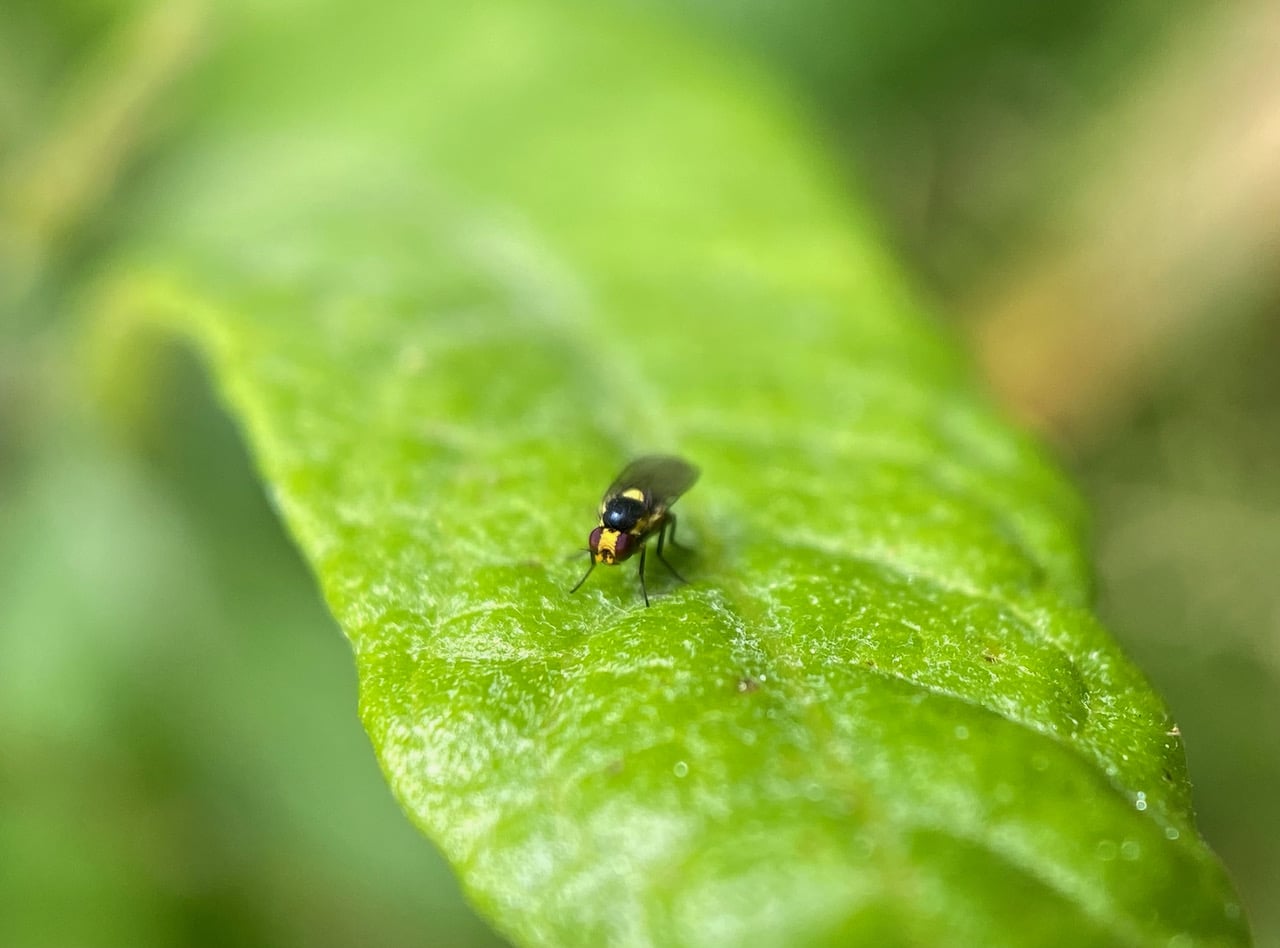
A tiny fly, barely 2 mm, is resting on a mugwort leaf. For a fly this size, I immediately think of a Leaf-miner Fly (family Agromyzidae).
The Agromyzidae are a family commonly referred to as the Leaf-miner Flies, for the feeding habits of their larvae, most of which are leaf miners on various plants. They are small flies, most species in the range of 2-3 mm. Agromyzidae larvae are phytophagous, feeding as leaf miners, less frequently as stem miners or stem borers. A few live on developing seeds, or produce galls. There is a high degree of host specificity. A number of species attack plants of agricultural or ornamental value, so are considered pests. The shape of the mine is often characteristic of the species and therefore useful for identification. Adults occur in a variety of habitats, depending on the larval host plants.
Some leaf mines on a Mugwort leaf.
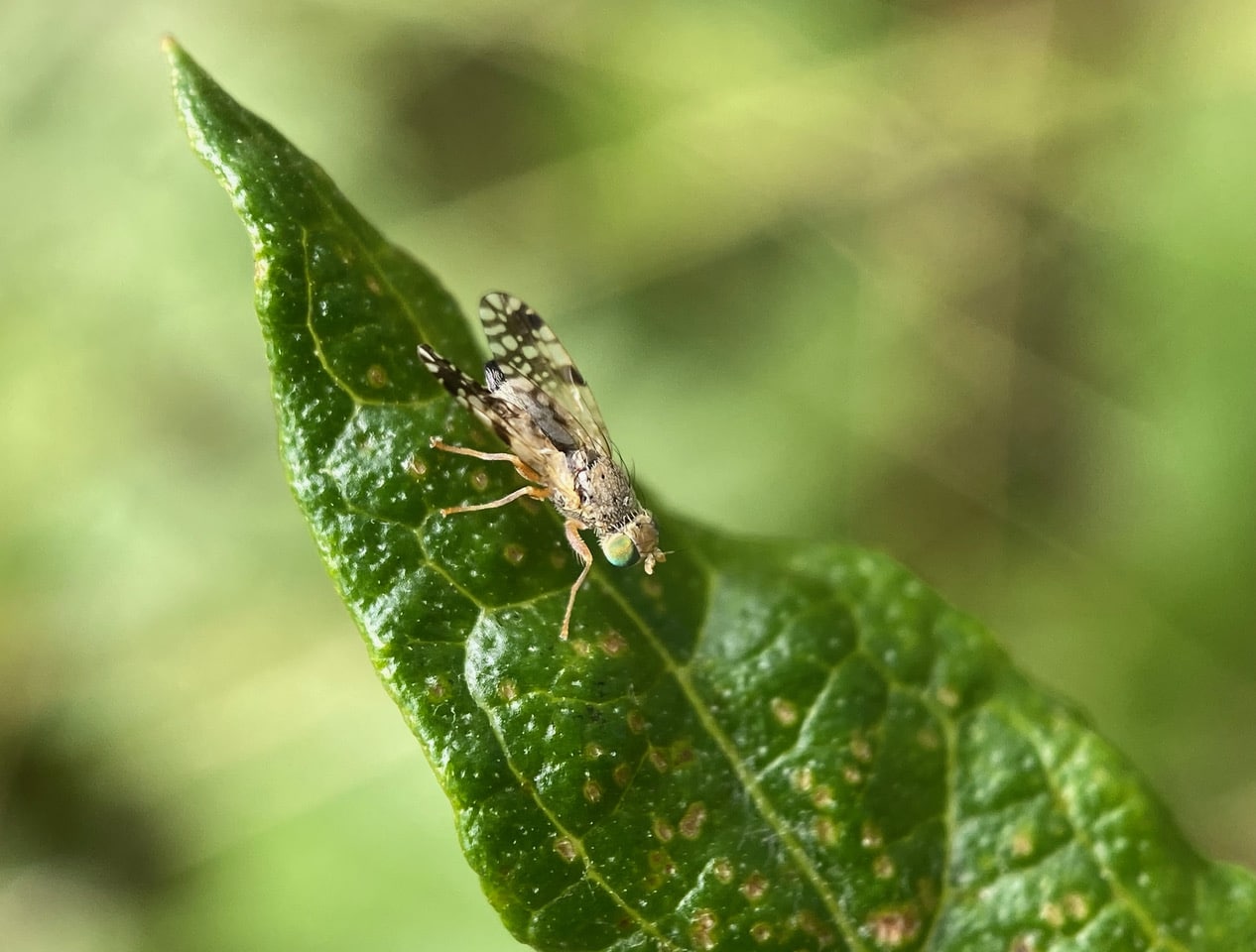
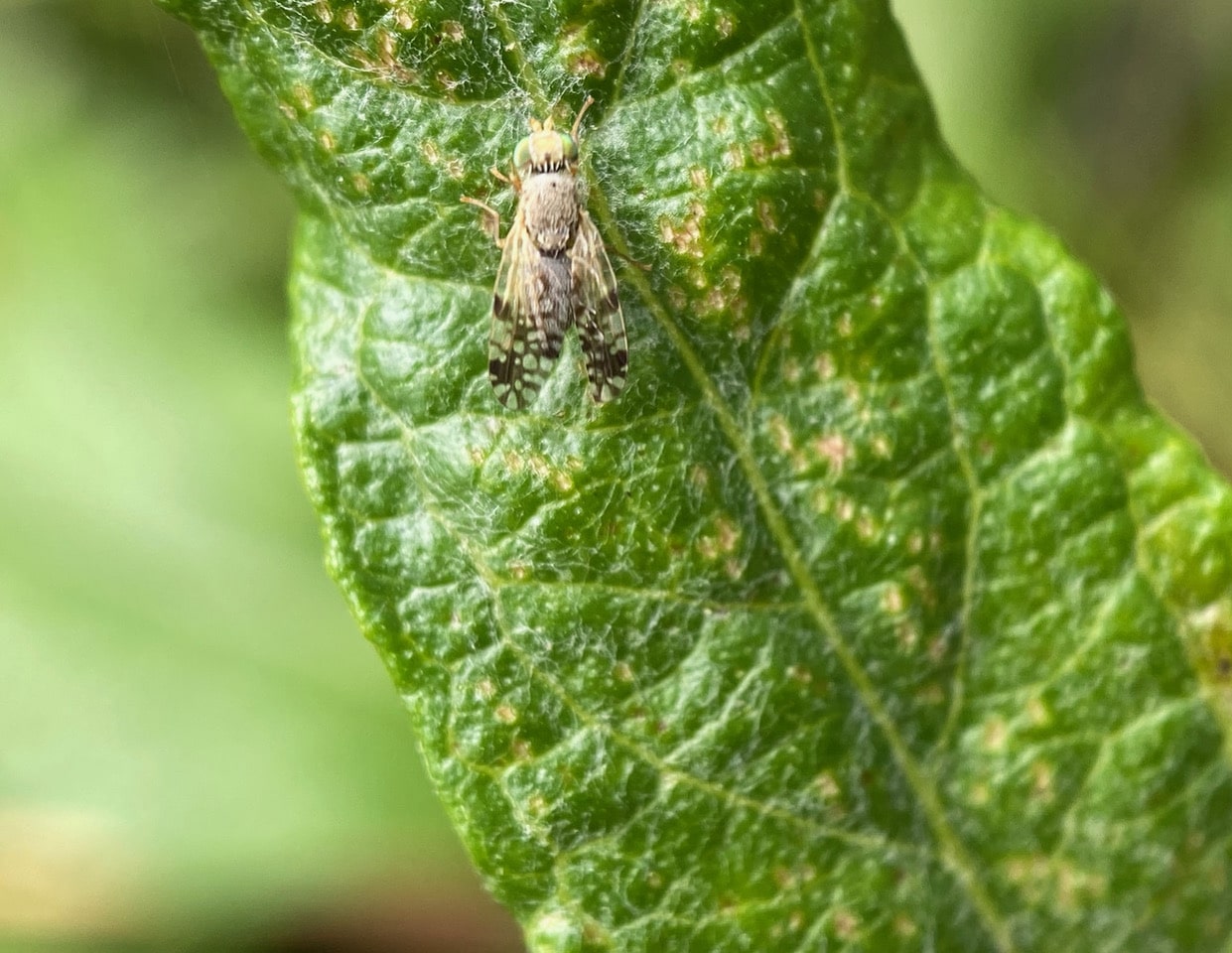
A green-eyed Fruit Fly (family Tephritidae) is roaming the foliage of a California Mugwort. It is a female as evidenced by the pointed tipped structure, the oviscape at the end of her abdomen. The oviscape is the non-retractile sclerotized sheath that remains exposed when the telescopic ovipositor is withdrawn and not in action.
Tephritids are small to medium-sized flies that are often colorful, and usually with picture wings. The larvae of almost all Tephritidae are phytophagous. Females deposit eggs in living, healthy plant tissues using their telescopic ovipositors. Here the larvae find their food upon emerging. The larvae develop in leaves, stems, flowers, seeds, fruits, and roots of the host plant, depending on the species. Adults are often found on the host plant and feeding on pollen, nectar, rotting plant debris, or honeydew. Tephritid flies are of major economic importance as they can cause damage to fruit and other plant crops. On the other hand, some Tephritids are used as agents of biological control of noxious weeds.
A Tephritidae expert on iNaturalist has helped identify our fruit fly as a member of the genus Tephritis.
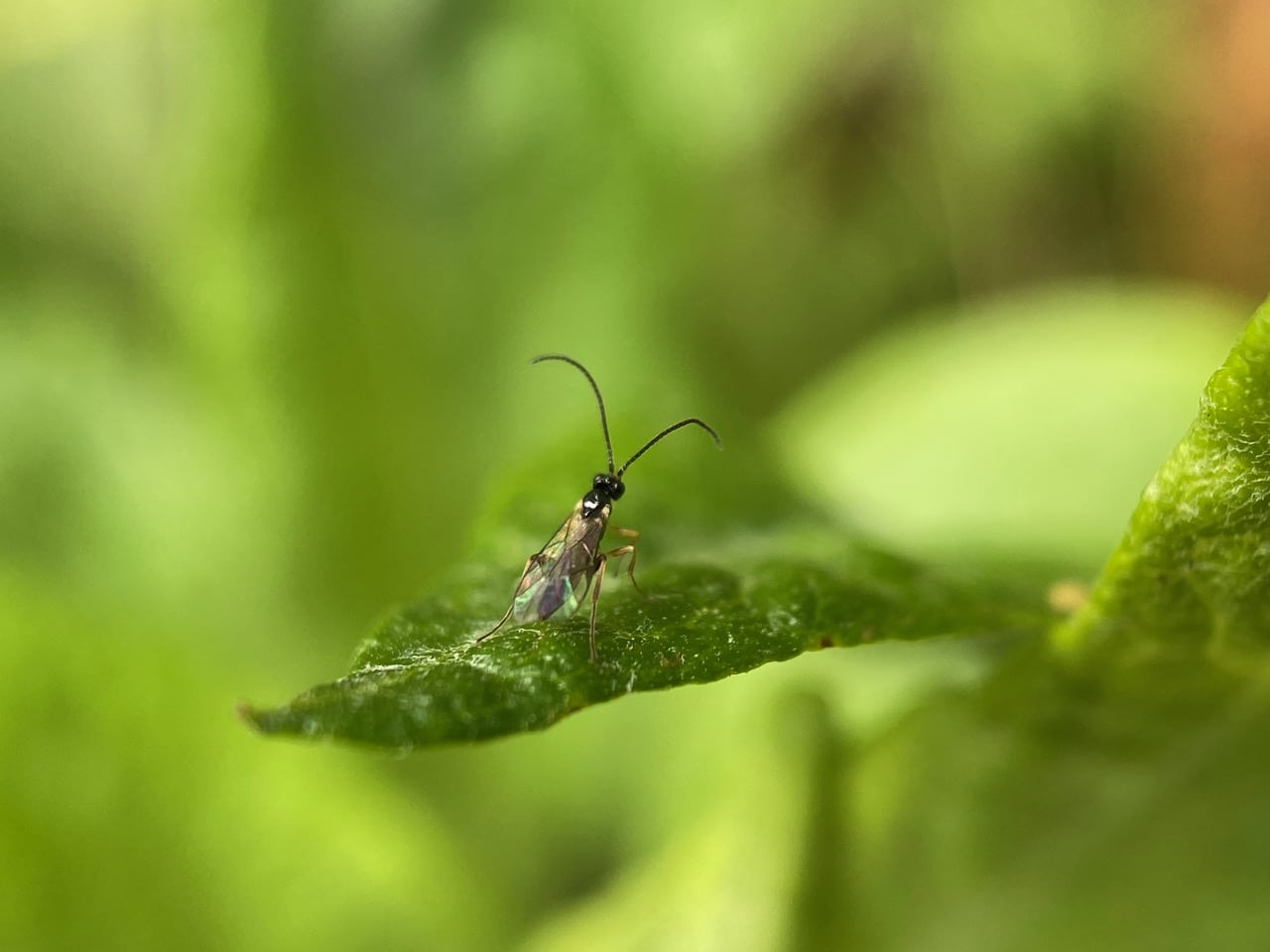
A tiny wasp lands on a Mugwort leaf, long antennae a-waving. For a wasp this size, I immediately suspect a parasitoid wasp, most likely in the superfamily Ichneumonoidea.
The superfamily Ichneumonoidea comprises the two largest families within Hymenoptera: Ichneumonidae and Braconidae, both with a cosmopolitan distribution. Members of the two families are distinguished by wing venation. Ichneumonoids are solitary wasps, and the vast majority are parasitoids; the larvae feed on or in another insect, eventually killing it. In general, ichneumonoids are host specific, and only attack one or few closely related host species. Many species use polydnaviruses to suppress the immune systems of their host insects.
Whoa, that’s the biggest Lauxaniid fly I have ever seen! It’s probably a female ready to lay her eggs. These are some of the most numerous and widespread flies in the garden, but nobody ever talks about them; the fly does not even have a common name. Another one of those decomposers/recyclers, unsung heroes of the ecosystem.
Lauxaniidae are small flies (2-7 mm in length). They are often rather plump and dull, the body color varying from yellow-brown to black, or with a combination of these colors. They are characterized by strong, backward pointing bristles on the front (top of the head right above the eyes). The larvae are mostly saprophages, feeding in leaf litter, soil, bird nests, etc. Larvae of some mine fallen leaves, others live in rotten wood.
Will the sun ever make an appearance today?