

Pollinator Post 9/19/25 (1)
Craig and Jenny’s garden in Alameda is only a year old, but the well-irrigated garden was abuzz with insects when I visited a few days ago. I decide to pay a repeat visit this clear, cool morning.
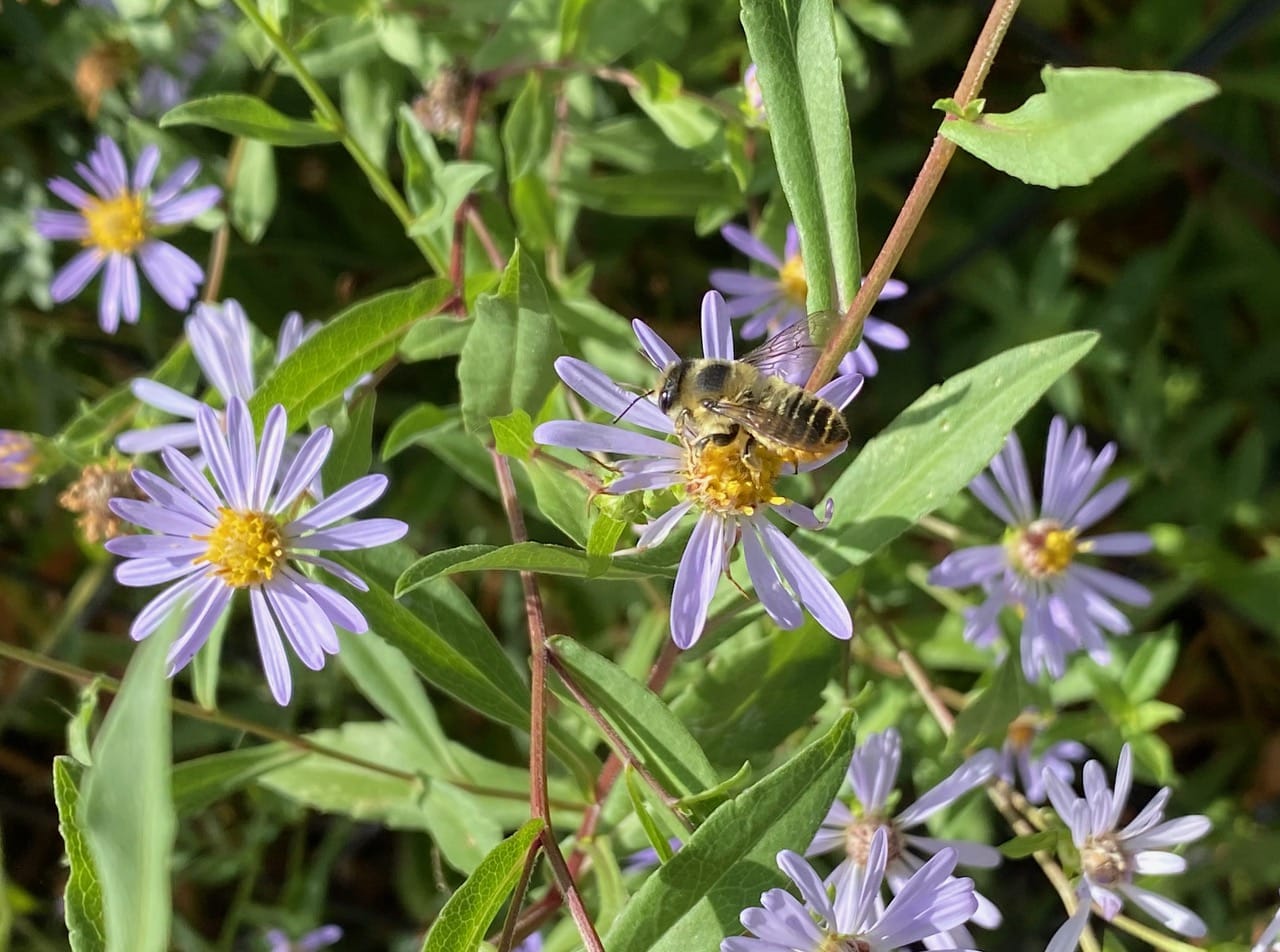
The first insect to grab my attention is a female Western Leafcutter Bee, Megachile perihirta (family Megachilidae) foraging on the flowers of Pacific Aster, Symphyotrichum chilense on the sidewalk strip. Note the yellow pollen on the scopae on the underside of her abdomen.
The scientific name Megachilidae translates as “large lipped” in Greek, referring to their large lips and strong jaws that are well-suited for collecting of nest-building materials. The family represents 15-20% of named species of bees. Characteristic traits of this family are their enlarged jaws and the way the females carry pollen – in a scopa (special pollen-collecting hairs) on the underside of the abdomen.
Leaf-cutter Bees, Megachile sp. (family Megachilidae) are stout-bodied, usually with pale hair on the thorax and stripes of white hairs on the abdomen. Females usually have a triangular abdomen with a pointed tip, and males’ faces are covered with dense, pale hair. Flight season is from May into September, with peak activity from June to August. Solitary females construct nests in tubular cavities, including hollow stems, tree holes, and abandoned beetle burrows in wood. Many use holes drilled into wood, straws, or other manufactured tunnels. Females cut pieces from leaves or flower petals for use in the construction of brood cells. Most Megachile females are generalists when foraging for pollen. Pollen is transported in dense scopae on the underside of the abdomen.
North America is home to many leafcutter bees, but the Western Leafcutter, Megachile perihirta is one of the largest. The species ranges on the west coast from British Columbia south to northern Mexico. From a distance, the female can be mistaken for a honey bee. She is about the same size as a worker honey bee and enjoys many of the same flowers, but her head is disproportionately large because it houses the bulky muscles that operate her large mandibles. While most leafcutter bees nest above ground in tubes and tunnels, the Western Leafcutter nests underground. Often a small group of females live in a community and burrow into soil, gravel, or sand. Although they are generalist foragers, the Western Leafcutters, Megachile perihirta prefer flowers in the Asteracea family for nectar and pollen; the composite flowerheads offer a flat surface on which numerous florets are clustered. The bees are frequently seen foraging on Seaside Daisy, Grindelia, Asters, Sunflowers, Cosmos, and Dahlia.
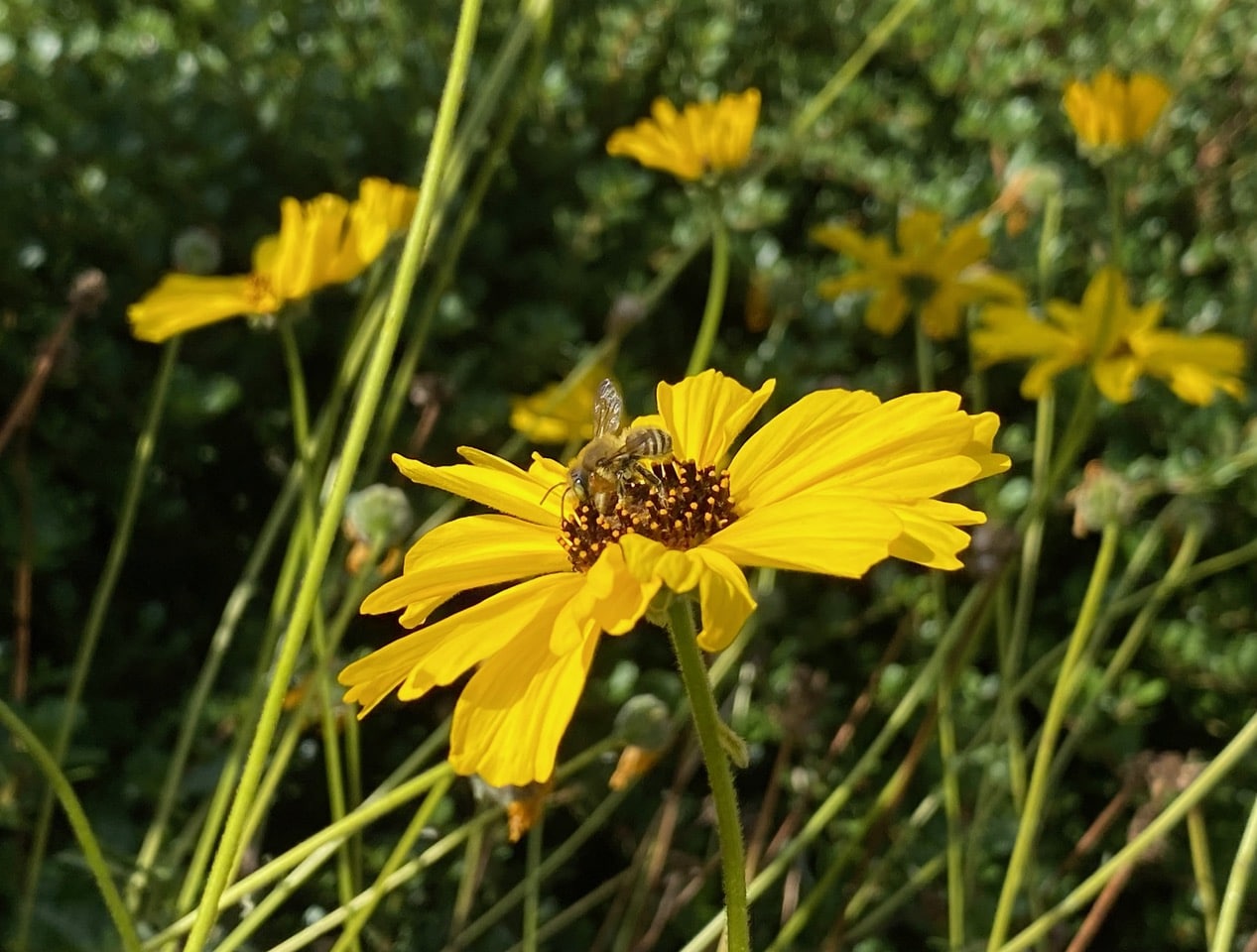
Ooh, that’s a male Western Leafcutter Bee, Megachile perihirta (family Megachilidae) on that flowerhead of Bush Sunflower, Encelia californica. Even from this distance we can see that it has bluish eyes and a rounded abdomen. (Females have black eyes and a pointed abdomen.) Although the males do not collect pollen intentionally to provision the nest, their fuzzy bodies often attract pollen that stick to their hairs and get transferred from flower to flower as the bee seeks nectar, effectively helping with pollination.
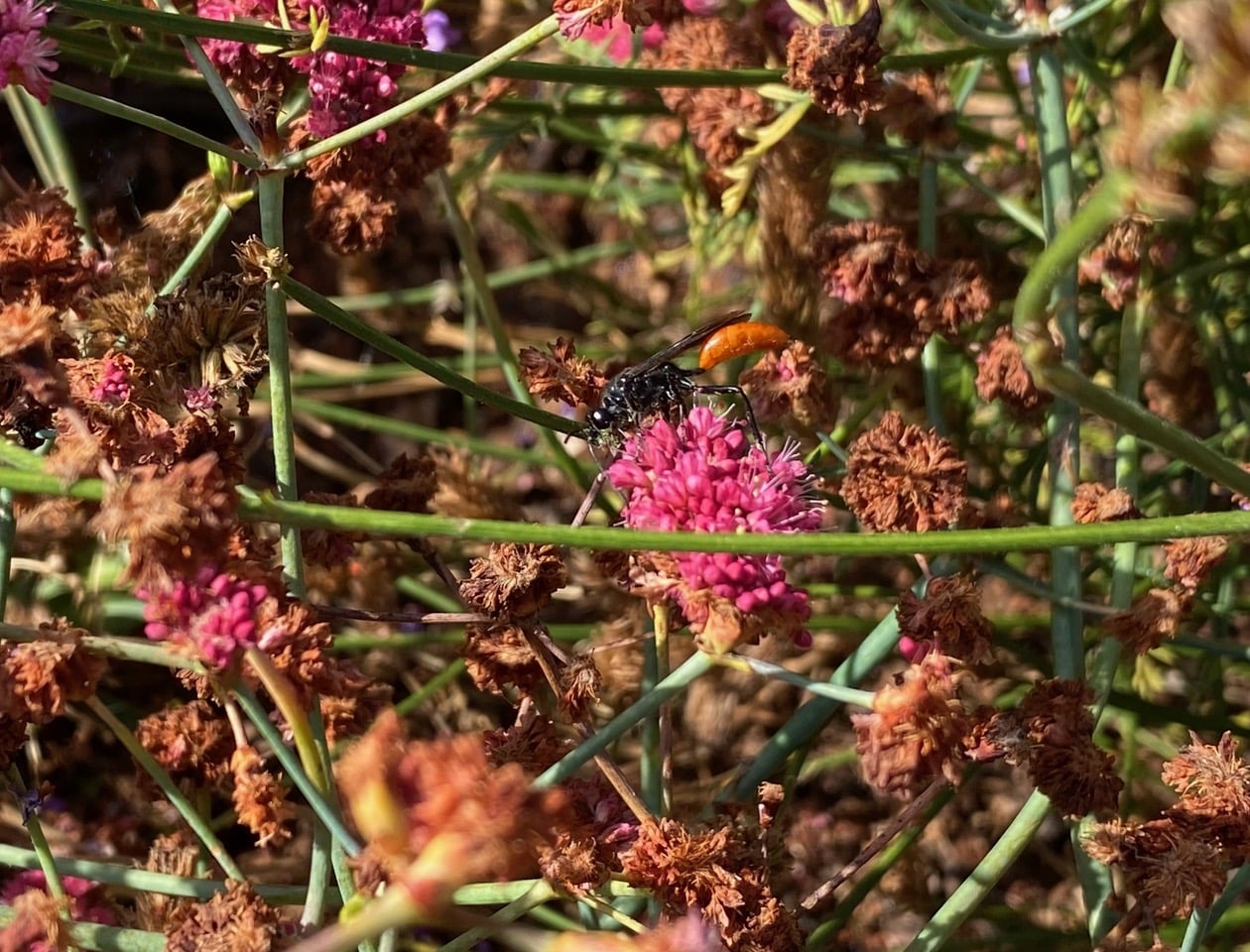
It is hard to see anything among this tangle of branches and flowers of the fading Red-flowered Buckwheat, Eriogonum grande ssp. rubescens. A female Thread-waisted Burrowing Wasp, Sphex lucae (family Sphecidae) with an eye-catching orange-red abdomen is foraging on a cluster of fresh flowers.
The Sphecidae are solitary wasps with elongated and narrow first abdominal segment, giving rise to the common name Thread-waisted Wasps. Sphex lucae is a widespread western species, ranging from WA in the north, south to CA, and east to TX. The species exhibits sexual dimorphism – females are black with a red abdomen, while the males are all black. Adults visit many types of flowers for nectar. Females hunt katydids and grasshoppers as food for their young. The wasp excavates a single-celled burrow in the soil in advance of hunting activities. She drags her paralyzed prey back to the burrow, laying a single egg on the victim. The nest entrance is then sealed and the process is repeated. Males of this species spend nights in sleeping aggregations in sheltered places such as beneath a rock overhang.
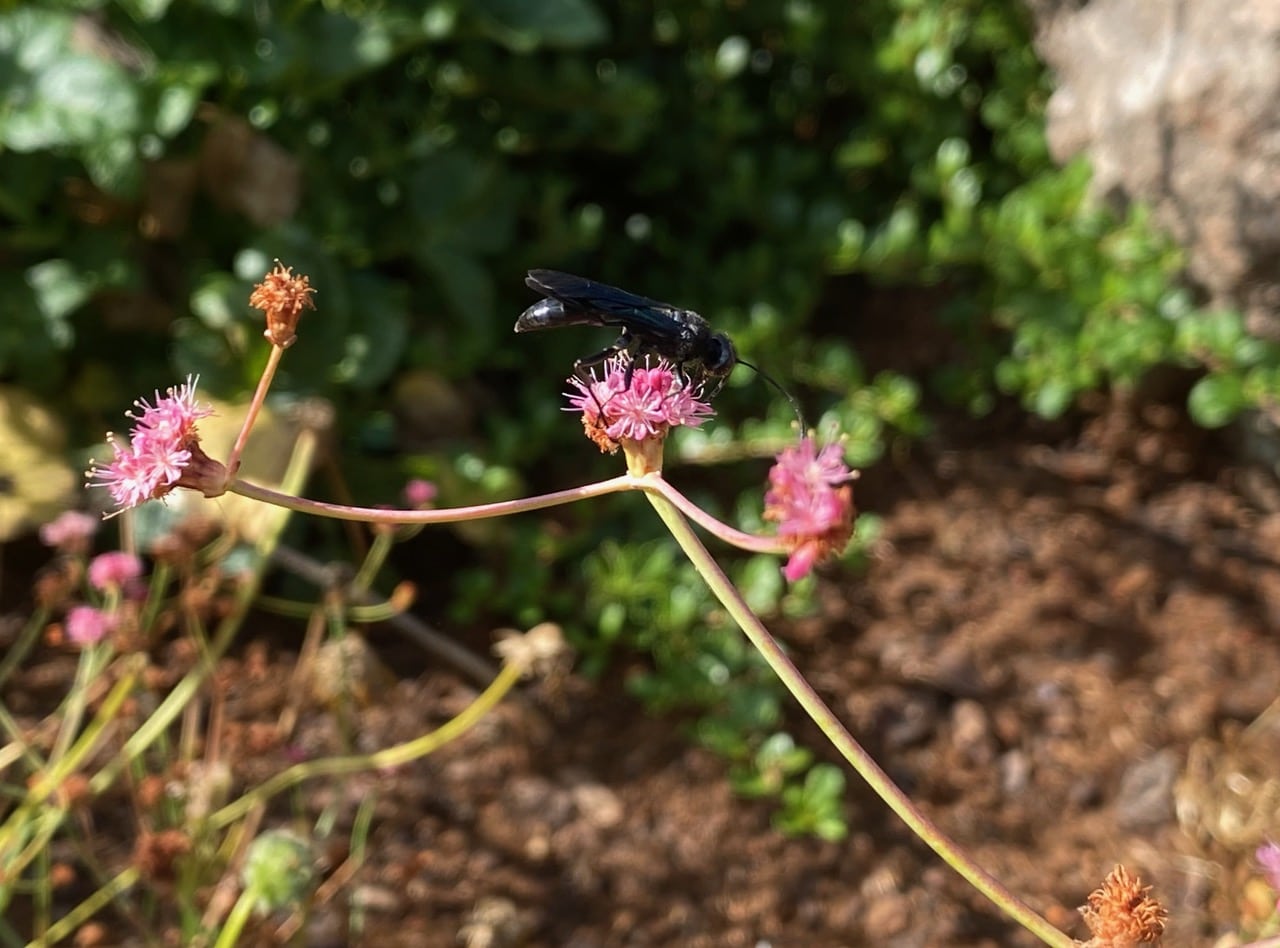
A male Sphex lucae is seeking nectar from another cluster of buckwheat flowers. In contrast to the females, he is all black and a little smaller.
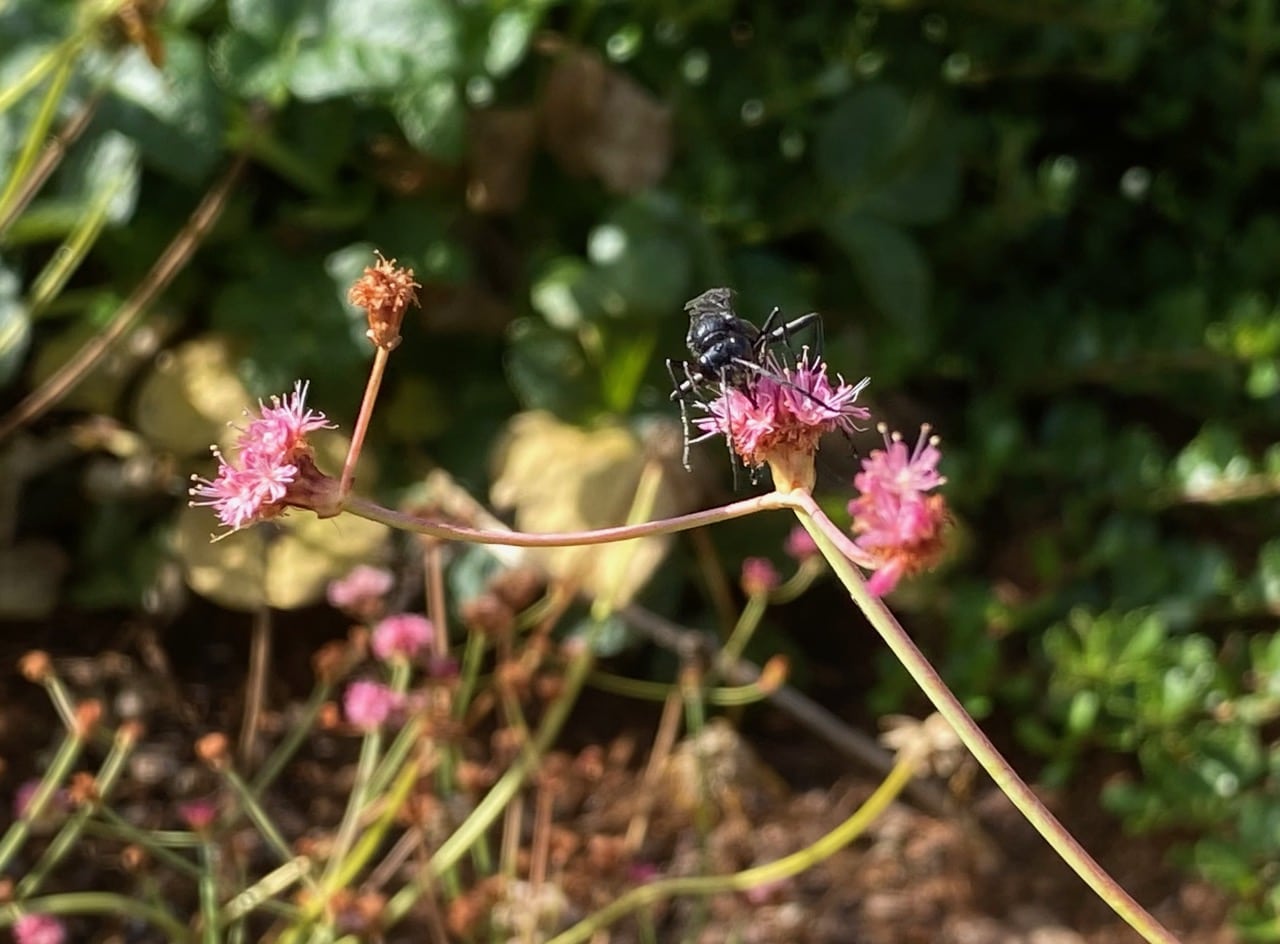
The male wasp also appears to have longer antennae than their female counterparts.
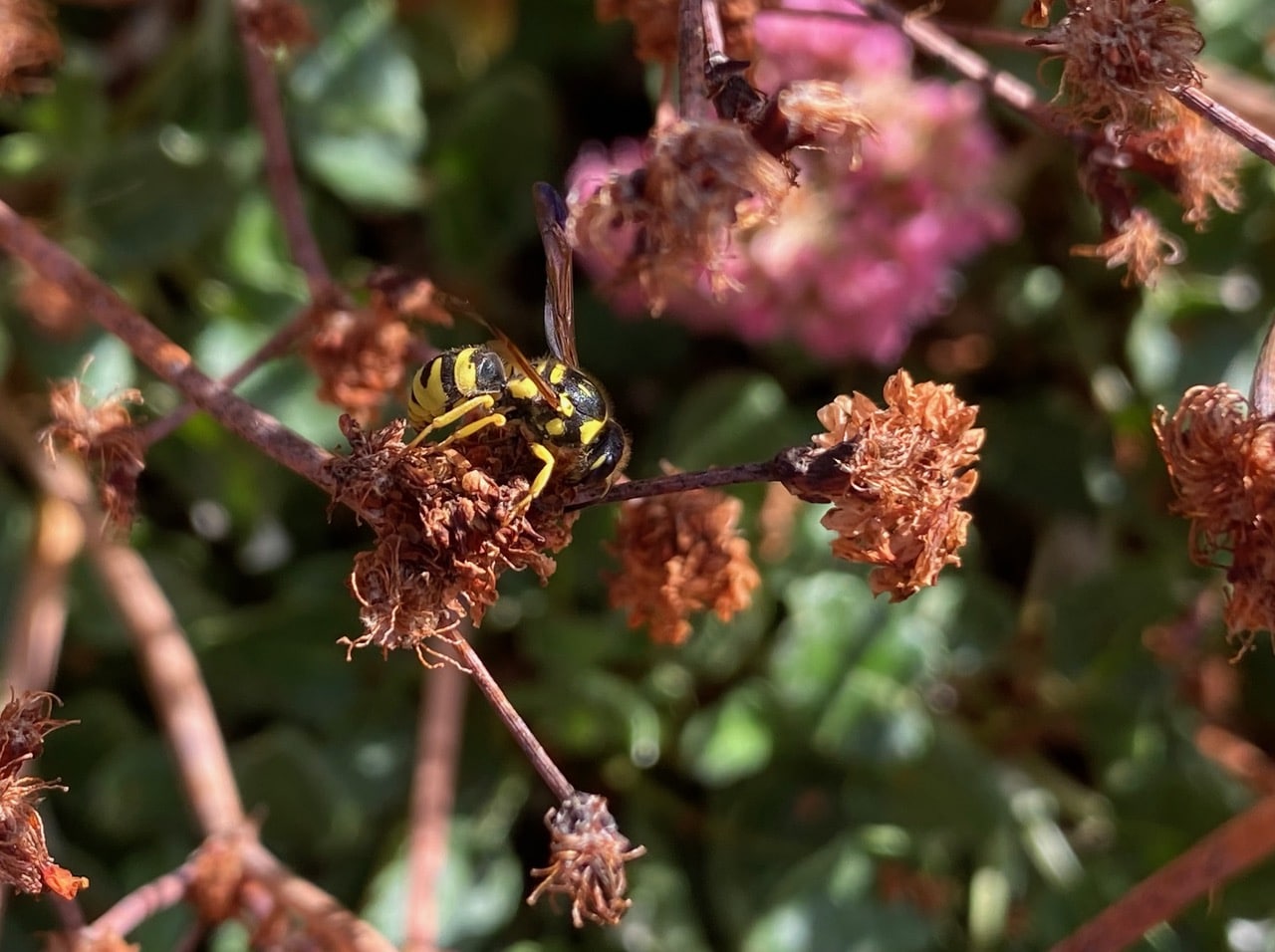
A Mason Wasp, Ancistrocerus bustamente (family Vespidae, subfamily Eumeninae) is hunting on a cluster of spent buckwheat flowers.

Front view of the wasp.
Potter wasps (or mason wasps), the Eumeninae, are a cosmopolitan wasp group presently treated as a subfamily of Vespidae. Most eumenine species are black or brown, and commonly marked with strikingly contrasting patterns of yellow, white, orange, or red. Their wings are folded longitudinally at rest. Eumenine wasps are diverse in nest building. The Mason Wasps are species that generally nest in pre-existing cavities in wood, rock, or other substrate. Potter Wasps are the species that build free-standing nests out of mud, often with a spherical mud envelope. The most widely used building material is mud made of a mixture of soil and regurgitated water.
All known Eumenine species are predators, most of them solitary mass provisioners. When a cell is completed, the adult wasp typically collects beetle larvae, spiders, or caterpillars and, paralyzing them, places them in the cell to serve as food for a single wasp larva. As a normal rule, the adult wasp lays a single egg in the empty cell before provisioning it. The complete life cycle may last from a few weeks to more than a year from the egg until the adult emerges. Adult mason wasps feed on floral nectar.
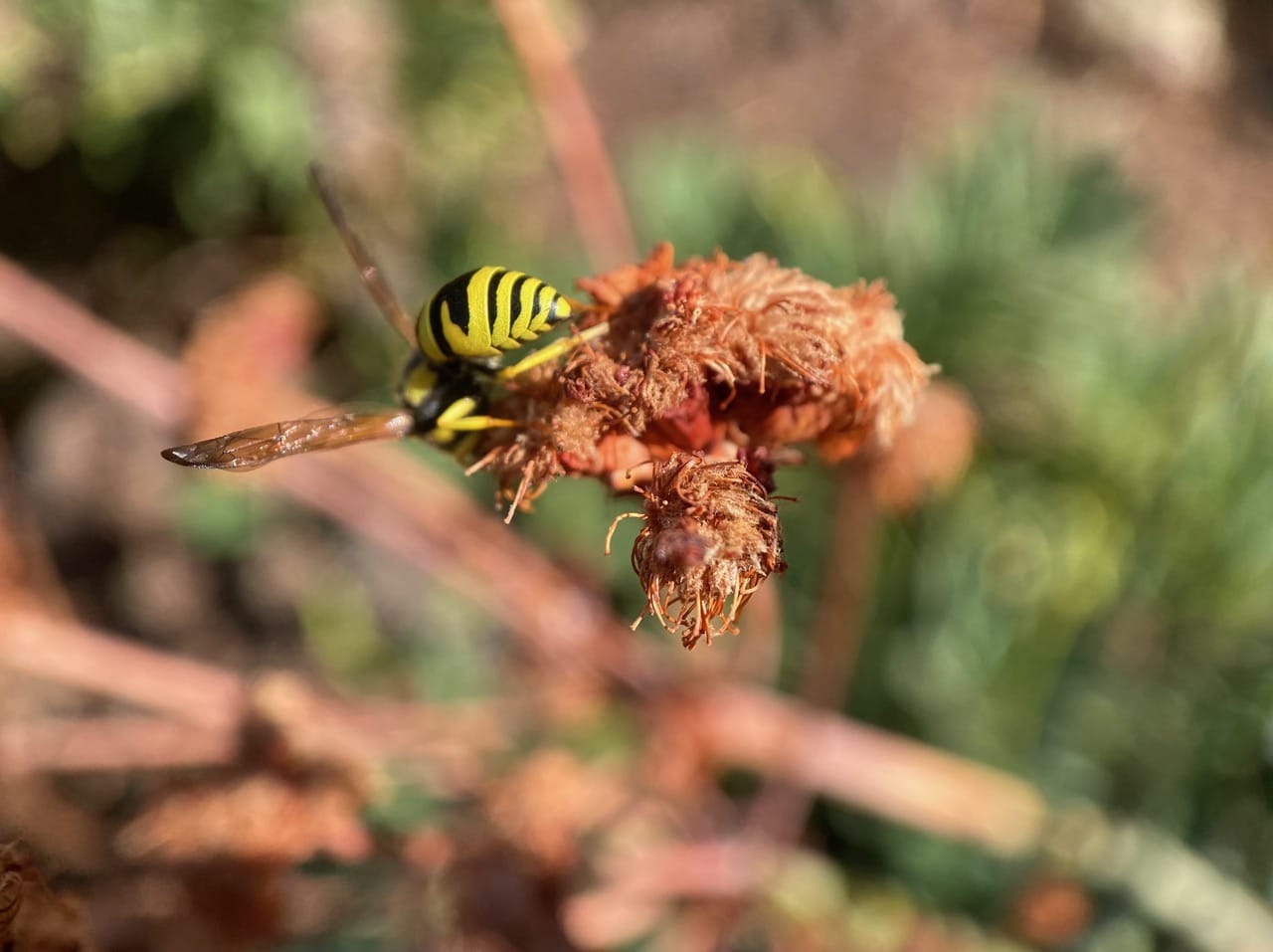
The Mason Wasp, Ancistrocerus bustamente (family Vespidae, subfamily Eumeninae) is found in western North America and Mexico. The species frequents arid areas, and nests in pre-existing cavities (e.g. old borings in wood, hollow stems, rock crevices) and use mud for partitions between brood cells. The wasps have been known to nest in Sambucus (Elderberry) stems. The name of the genus means “hooked horn” for the back-curved last segments of the antennae characteristic of the males.
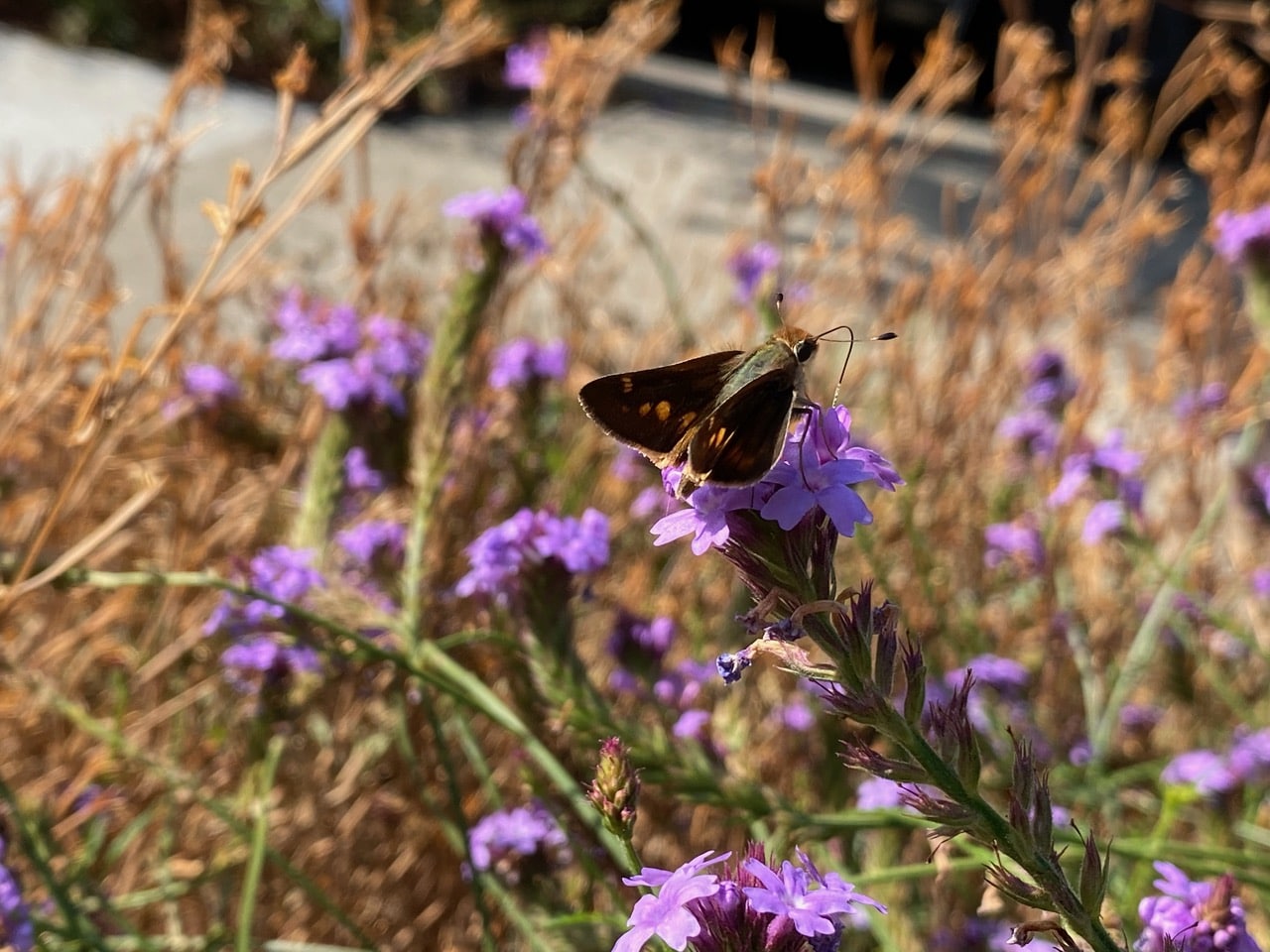
An Umber Skipper, Lon melane (family Hesperiidae) is taking nectar from an inflorescence of the De La Mina Verbena, Verbena lilacina.
Skippers are a family, the Hesperiidae, of the order Lepidoptera (butterflies and moths). They are named for their quick, darting flight habits. Most have the antenna clubs hooked backwards like a crochet hook. They also have generally stockier bodies and larger compound eyes than the other butterflies. Their wings are usually small in proportion to their bodies. When at rest, skippers keep their wings usually angled upwards or spread out, and only rarely fold them up completely. Californian species are mostly brown or tan, with black, orange, or yellow markings.
Skipper caterpillars are usually green or brown, sometimes yellowish, never brightly colored. They have a distinctive “collar”, a narrow ring around the body right behind the head. Caterpillars are camouflaged and often hide during the day. Many species make nests of leaves and silk for additional protection. Most North American species feed on grasses, but some common species eat shrubs and trees, especially in the bean family. Most species are limited to a single group of food plants. Adult skippers are only active during the day, but Skipper caterpillars feed mainly when it is dark or partly light.
The Umber Skipper is found in the western United States, the highlands of Mexico and Central America. Umber refers to the red-brown color of the upper sides of the wings. Habitat consists of desert foothills, grassy areas, streamsides, roadsides, yards, parks and open oak woodland. There are two generations per year. Adults feed on flower nectar. Larvae feed on various grasses, and live in shelters made of rolled or tied leaves.
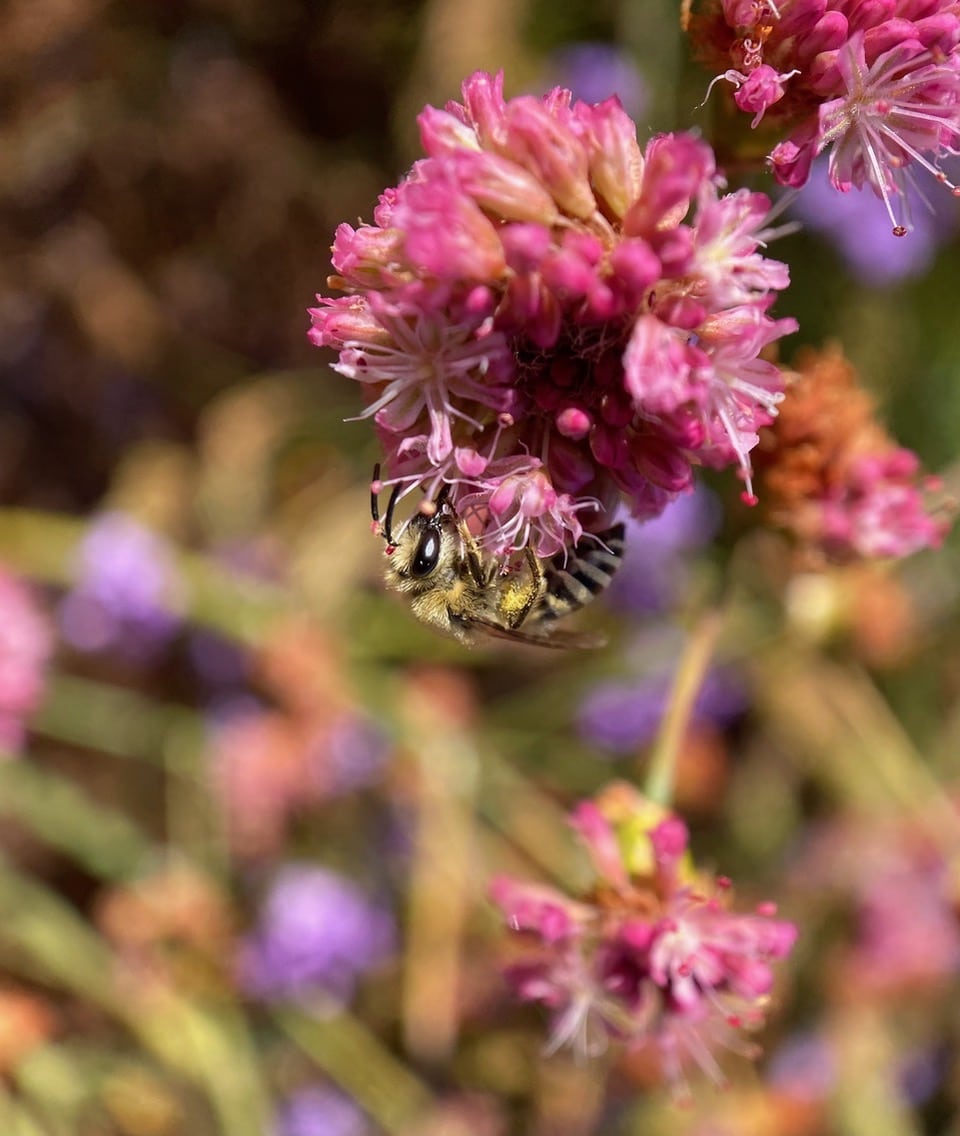
A female Cellophane Bee, Colletes sp. (family Colletidae) is foraging on an inflorescence of Red-flowered Buckwheat.
The bee family Colletidae includes generalists and specialists, and they are likely important pollinators of many wildflowers. All Colletidae in North America are solitary ground nesters, but some species nest in large aggregations. There are two major genera of Colletidae in North America: the Masked Bees (genus Hylaeus) and Cellophane Bees (genus Colletes). The most obvious shared characteristics of Colletidae is also the hardest to see: their short tongue. Colletes are moderately hairy, slender bees, ranging in size from 7 to 16 mm. Distinct features include a hairy head and thorax, pale bands of hair on the abdomen, and a heart-shaped head. The eyes of Colletes are angled (rather than being parallel), making the face slightly heart-shaped.
The genus name Colletes means “one who glues”, referring to their habit of applying a glue- or cellophane-like lining to the walls of nest cells, using their specialized tongues. This lining gives rise to their common names: cellophane bees, polyester bees, and plasterer bees. Colletes tongue is unique: short, flat, and forked at the tip. Colletes line their nests with a distinctive cellophane-like substance made from saliva and secretions from the Dufour’s gland on the abdomen. Using their specialized tongue, they paint the walls with saliva, then with secretions from the Dufour’s gland, they add a coat of varnish. This creates a clear covering that is strong, durable, and resistant to mold and water.
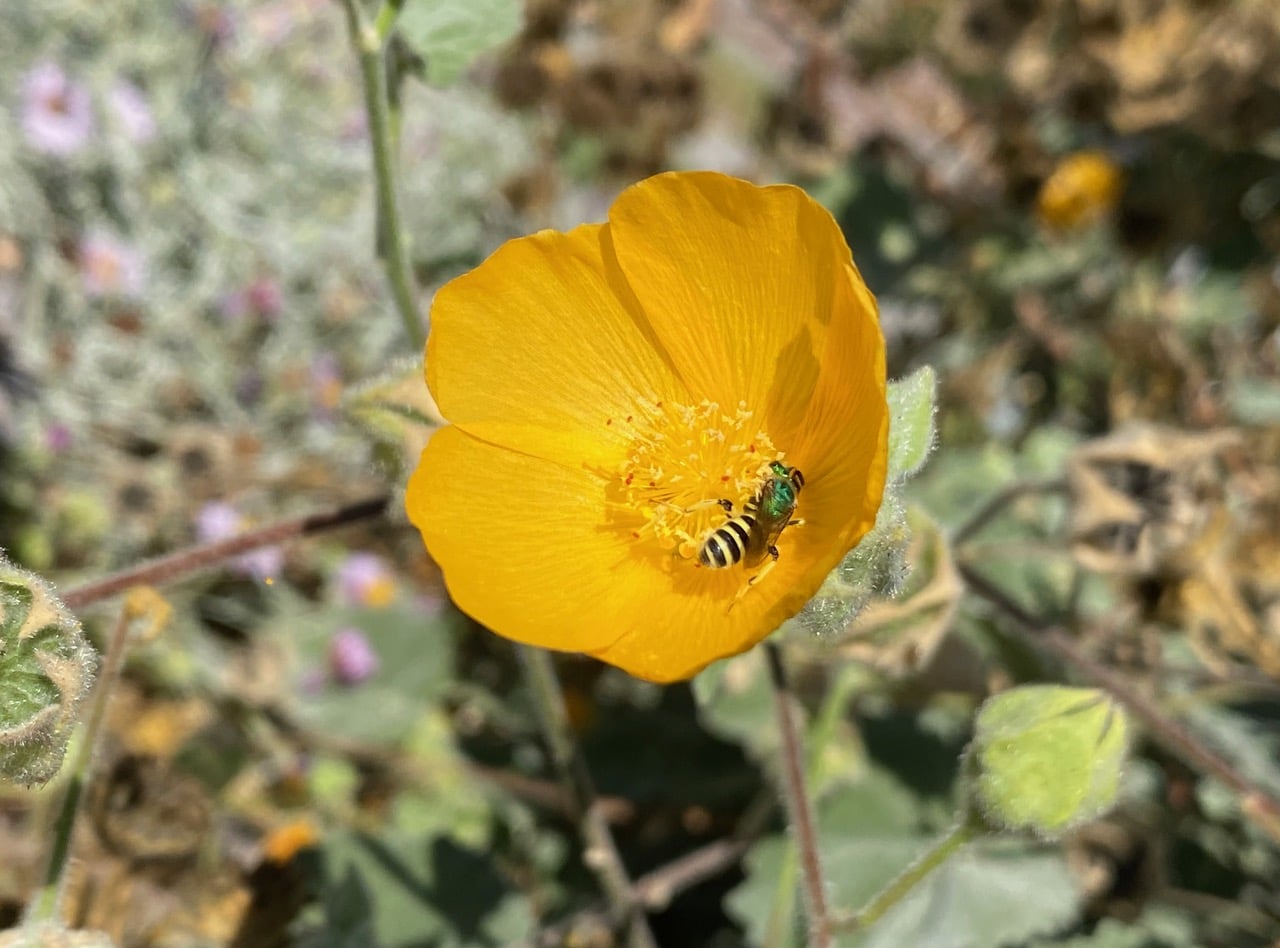
A male Fine Striped Sweat Bee, Agapostemon subtilior (family Halictidae) is reaching for nectar at the base of a flower of the Palmer’s Indian Mallow, Abutilon palmeri .
The genus Agapostemon is widespread and abundant throughout North America. They are most diverse and abundant in temperate regions and southwestern U.S. deserts. Agapostemon are commonly called “sweat bees” because they are closely related to, and resemble bees in the Halictus and Lasioglossum genera. Unlike those bees however, Agapostemon are not attracted to human sweat.
Agapostemon are brightly colored metallic green or blue bees measuring 7 to 14.5 mm long. Most species have a metallic green head and thorax, and black-and-yellow striped abdomen; some females are entirely bright green or blue. Females carry pollen on scopal hairs located on their hind legs. Agapostemon are generalists. Like other members of the family Halictidae, they are short-tongued and thus have difficulty extracting nectar from deep flowers. Males are often seen flying slowly around flowers looking for females. The bees favor flowers with high densities. These bees are active summer through fall.
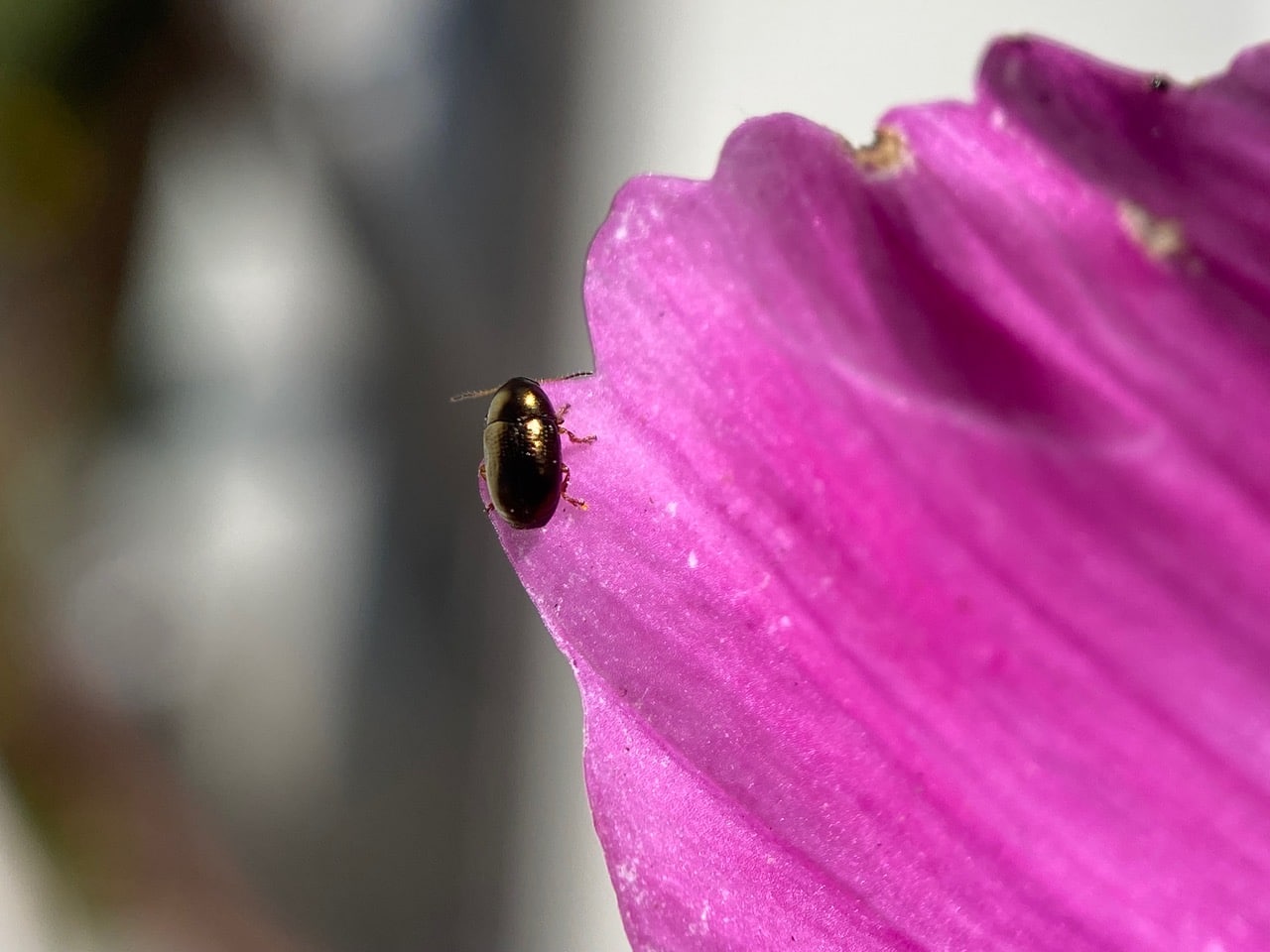
Reflecting brightly in the sunlight, a tiny beetle is perched on the edge of a Cosmos ray petal. A close inspection reveals that it is a Bronze Leaf Beetle, Diachus auratus (family Chrysomelidae).
The Bronze Leaf Beetle, Diachus auratus is a species of case-bearing leaf beetle in the family Chrysomelidae, subfamily Cryptocephalina. It is found in Australia, the Caribbean, the Americas, Oceania, and Southern Asia. Adults, 1-2 mm, are found on many unrelated plants, especially plants in bloom. Case-bearing leaf beetles are found in two subfamilies within Chrysomelidae. As she lays her eggs, the female case-bearing leaf beetle covers each one with a layer of excrement. After the larvae hatch, they retain this covering (case) as camouflage and add to it throughout their larval life. When disturbed, the larvae pull in their head and legs; because their color and shape resemble caterpillar droppings they are ignored by predators. Eventually the larva seals the case to pupate inside, before emerging as an adult. Some species are myrmecophiles, living near or even inside ant nests.
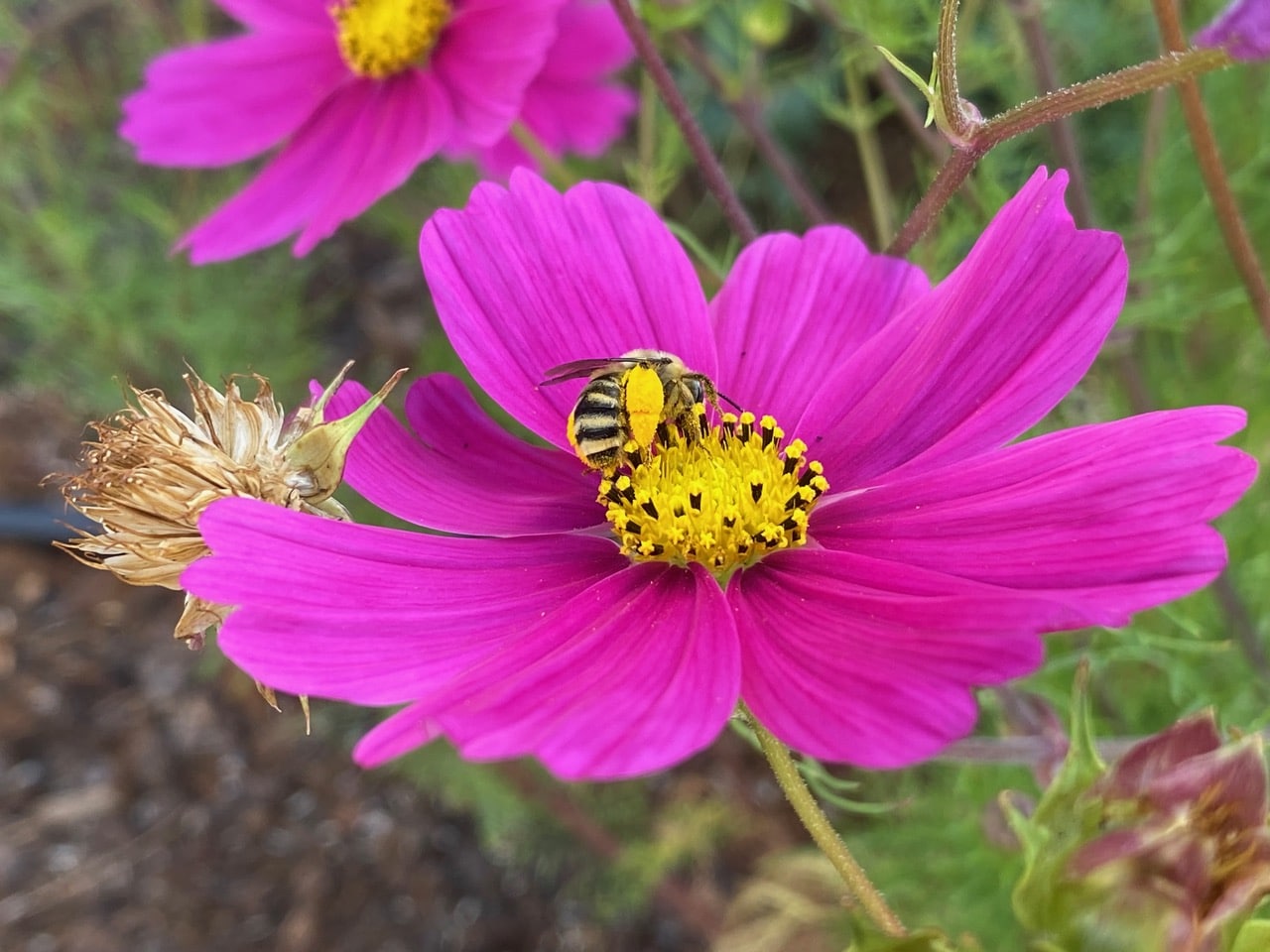
A female Summer Longhorn Bee, Melissodes sp. (family Apidae) is foraging on a flowerhead of Cosmos. The bee is so loaded with pollen on her hind legs that she appears to be wearing yellow pantaloons.
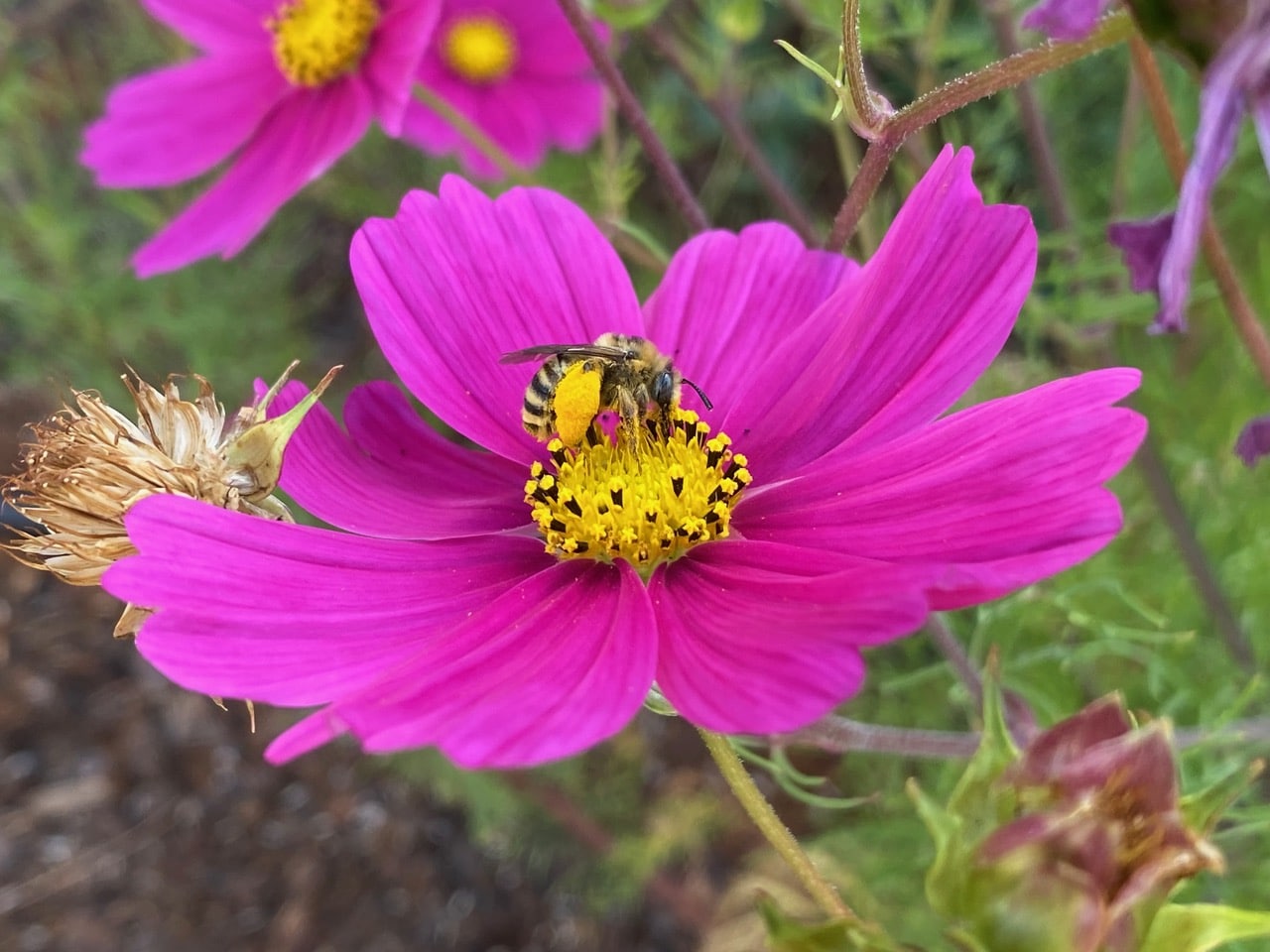
The Summer Longhorn Bees, Melissodes sp. (family Apidae) are medium to large bees, stout-bodied, usually with gray hair on the thorax and pale hair bands on the abdomen. Males usually have yellow markings on their faces and have very long antennae from which their common name is derived. They are active May to September, with peak flight in late June to early August. The females prefer flat, bare ground for digging their solitary nests, though they sometimes nest in aggregations. Pollen is transported in scopae on the hind legs. Pollen loads are often copious and brightly colored and thus very distinguishable. Melissodes are specialists on Asteraceae – females gather pollen from flowers of Aster, Bidens, Coreopsis, Cosmos, Encelia, Gaillardia, Helianthus, and Rudbeckia ssp.

Now and then, the bee brushes the pollen load on her hind legs with her middle legs, as if to pat down the loose grains.
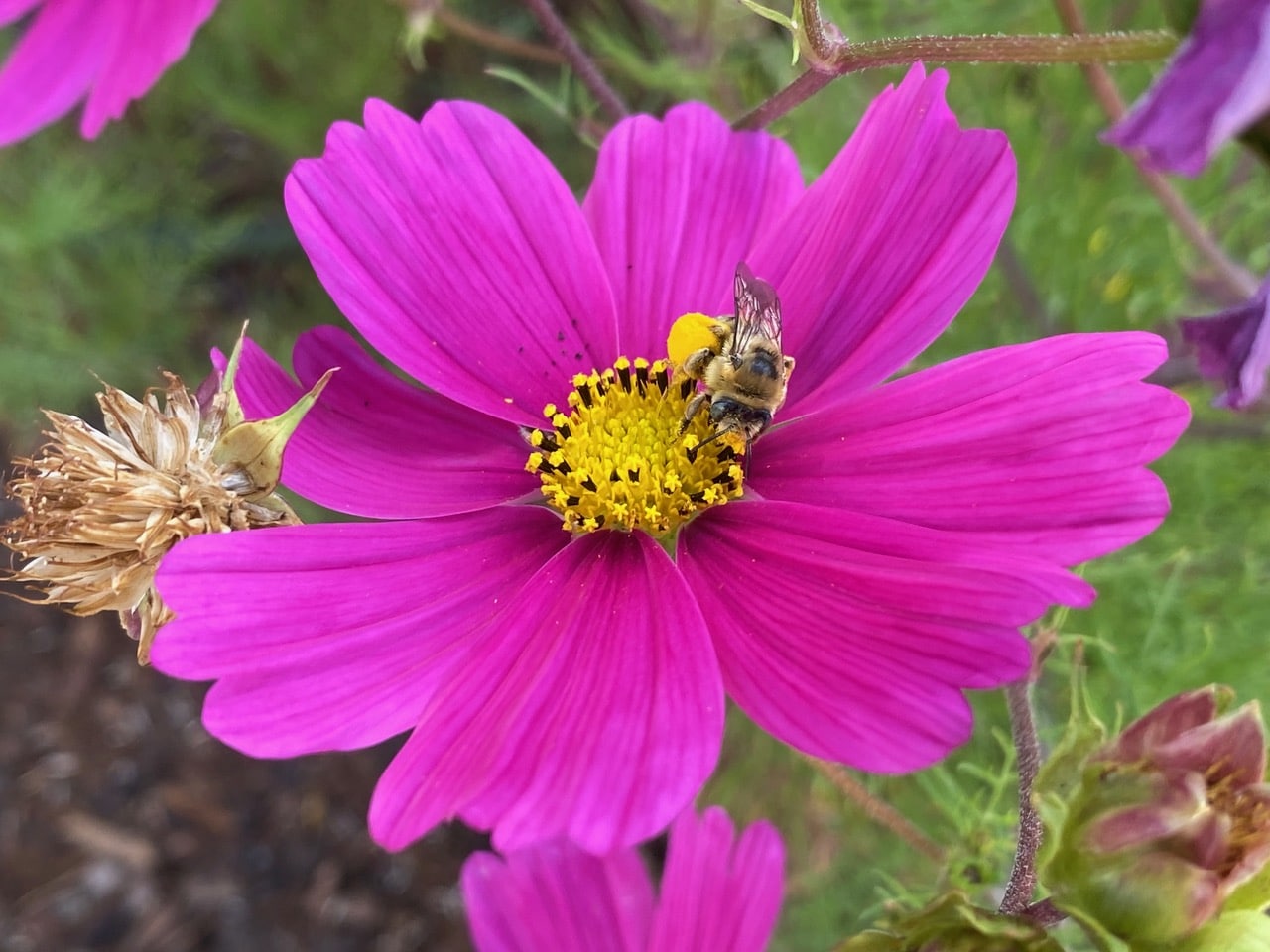
The bee is making a full circle around the rim of the flowerhead where the florets are releasing pollen from their anther tubes.
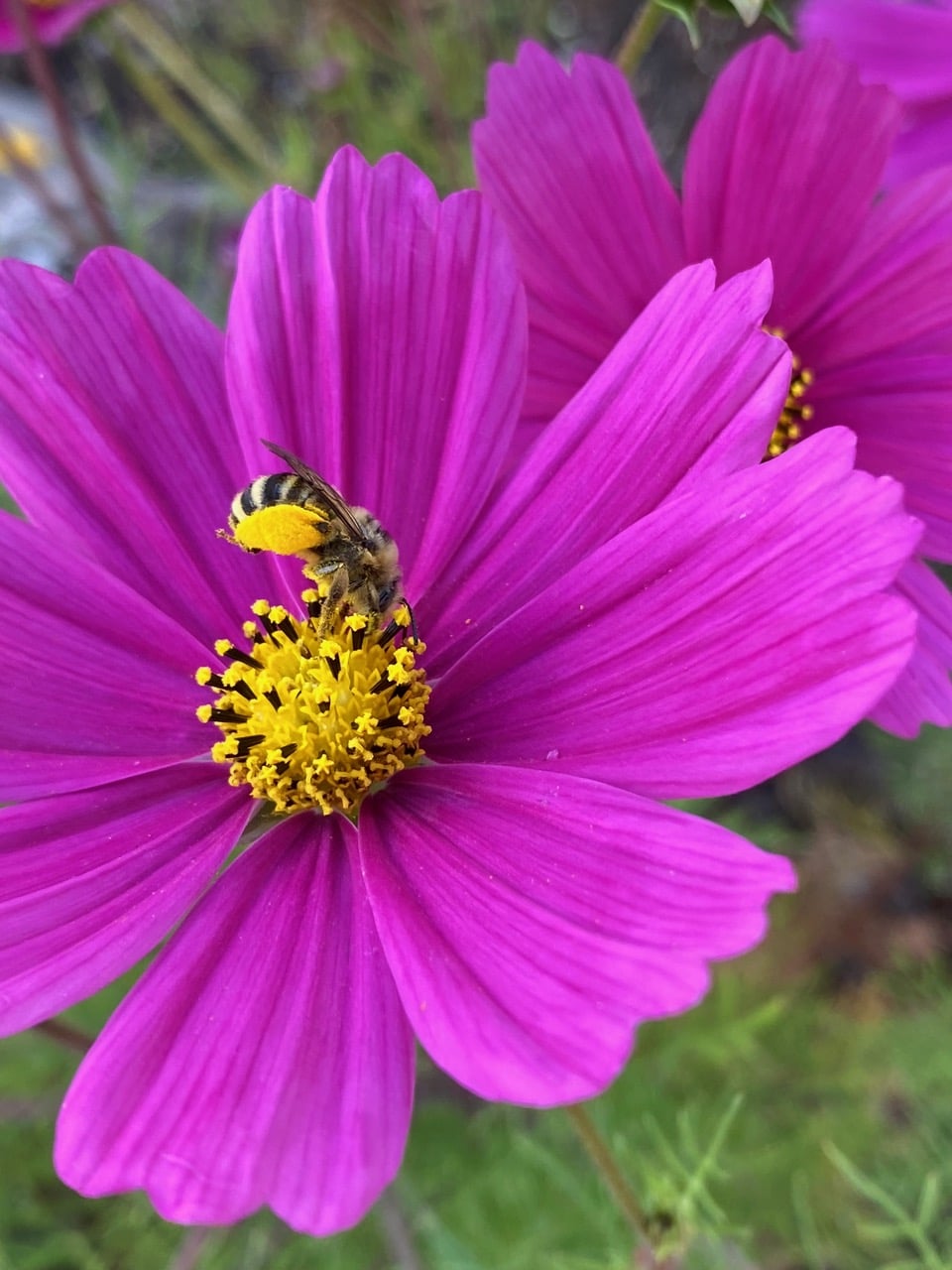
The bee lifts up her rear to groom and shape her pollen load. Totally focused on her task and oblivious to my presence, she allows me to video record her behavior at close range.

An Inchworm caterpillar of the Common Eupithecia Moth, Eupithecia miserulata (family Geometridae), is standing upright on its anal prolegs on a flowerhead of Bush Sunflower, Encelia californica. You can see the three pairs of true legs right behind its head.
Inchworms are also called loopers and measuring worms. They majority of the inchworms are the larvae of moths in the family Geometridae. The name comes from the Greek “geo” for earth and “metro” from measure, because the caterpillars seem to be measuring the surface on which they are walking. Most caterpillars have five sets of prolegs, four in the middle of the body and one pair at the hind end. Inchworms have the normal six true legs but only two or three pairs of prolegs, all located at the tail end of the body, with none in the middle. When an inchworm walks, it moves its tail-end prolegs up behind its true legs, causing the center of its body to loop upward. Then it stretches its front end forward to take another step.
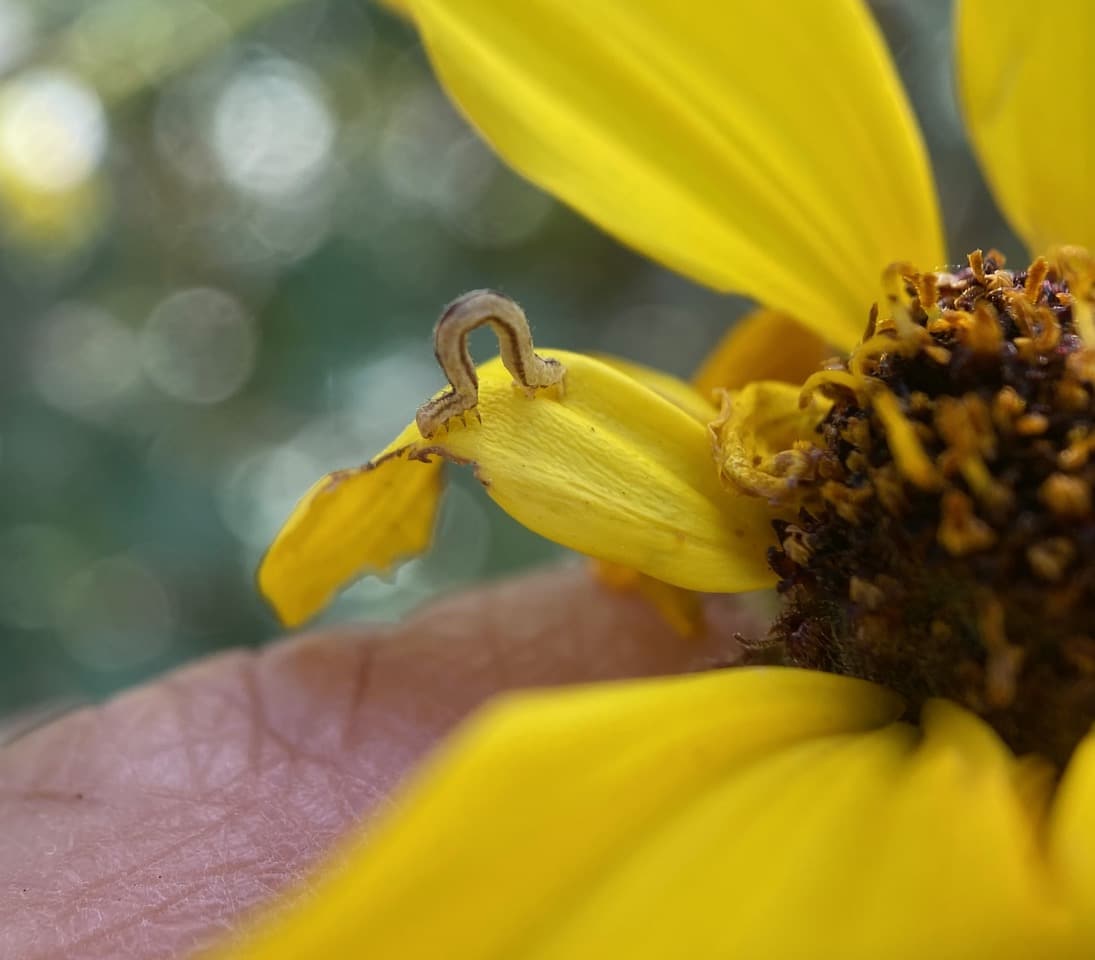
This Inchworm is displaying the classic inverted U-shape stance on an Encelia ray petal. Its three pairs of true legs are visible right behind the head.

A larger Eupithecia caterpillar has its head buried in the flowerhead, feeding on the florets.
Eupithelia is the largest genus of moths of the family Geometridae. Occurring worldwide except for Australasia, species in the genus are commonly known as pugs. Adults are typically small, 12 – 35 mm, with muted colors. Most species rest with forewings held flat at right angles to the body, while the hindwing are largely covered by the forewings. They are generally nocturnal. Larvae mostly feed from the flowers and seeds of their food plants rather than the foliage. Many species have a very specific food plant.
Eupithecia miserulata, the Common Eupithecia Moth is found in North America. The adult wingspan is 12-20 mm. The larvae feed on a wide range of plants, including coneflower, asters, willow, cherry, juniper and clover.
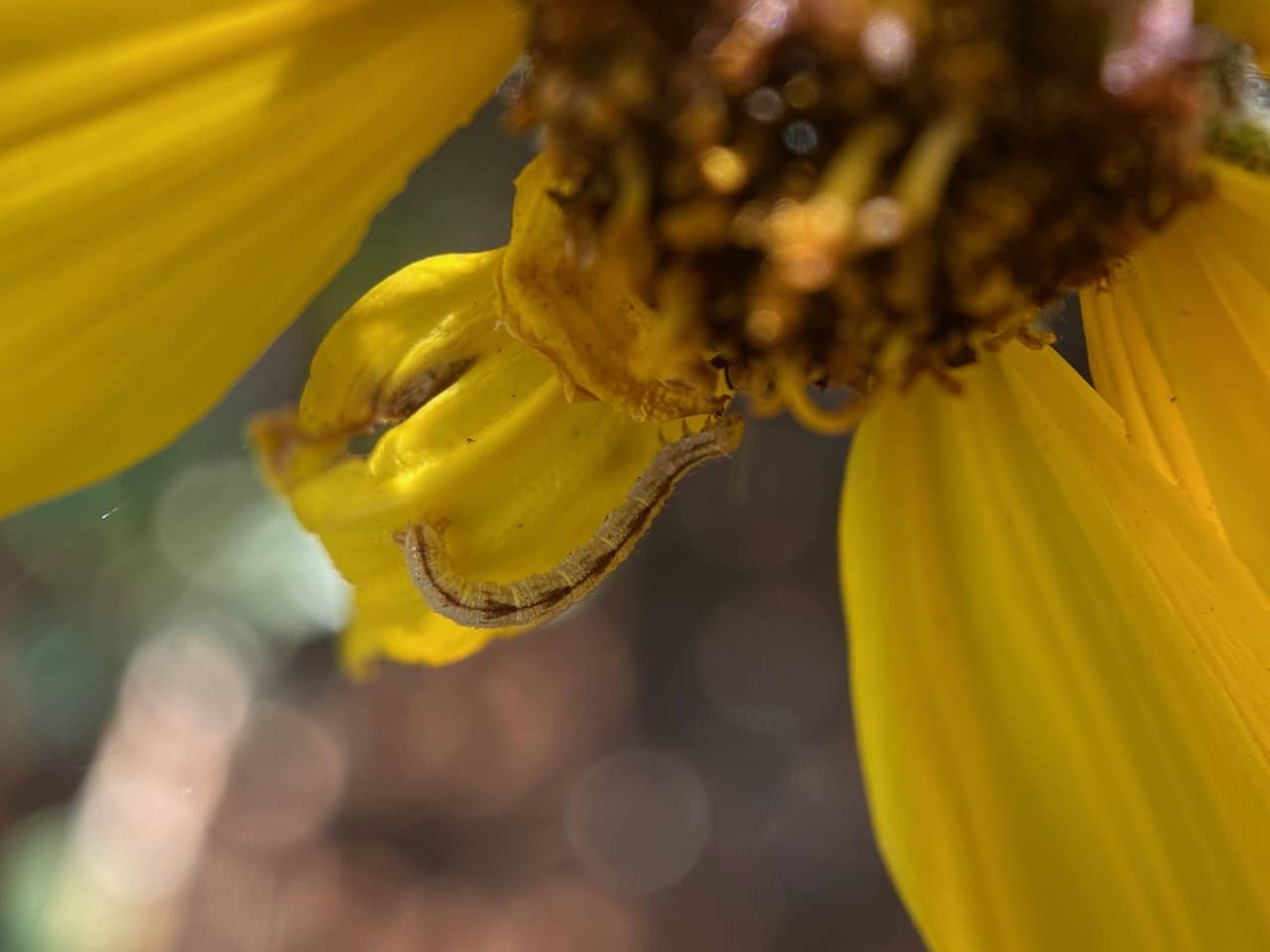
Within minutes, I find several Eupithecia caterpillars on the Encelia flowerheads in the front yard.
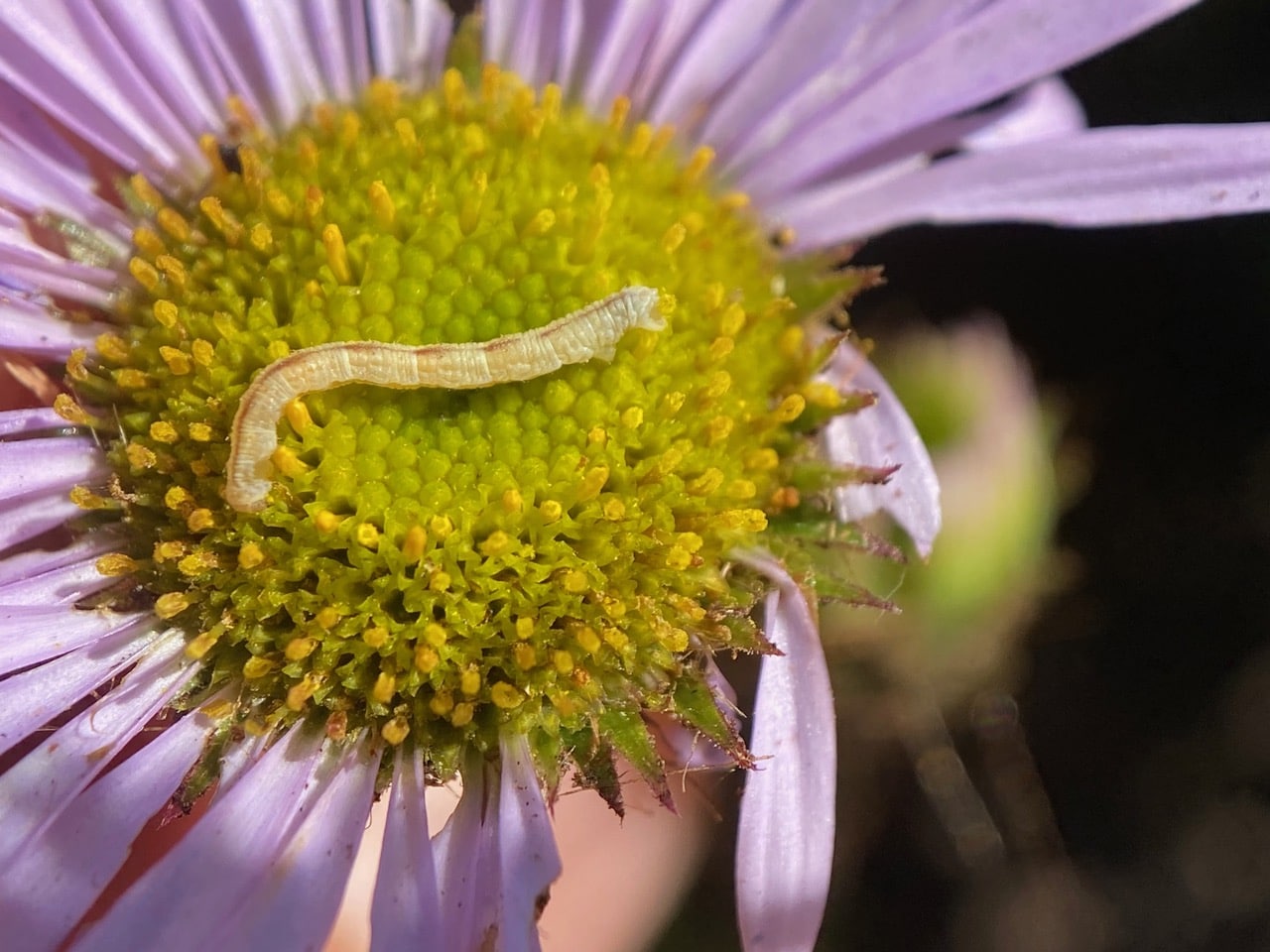
An Inchworm caterpillar of the Common Eupithecia Moth, Eupithecia miserulata (family Geometridae) is feeding on a flowerhead of Seaside Daisy, Erigeron glaucus. Note that some of the peripheral disc florets have been emptied of their reproductive parts. Is the caterpillar also responsible for the missing ray petals?
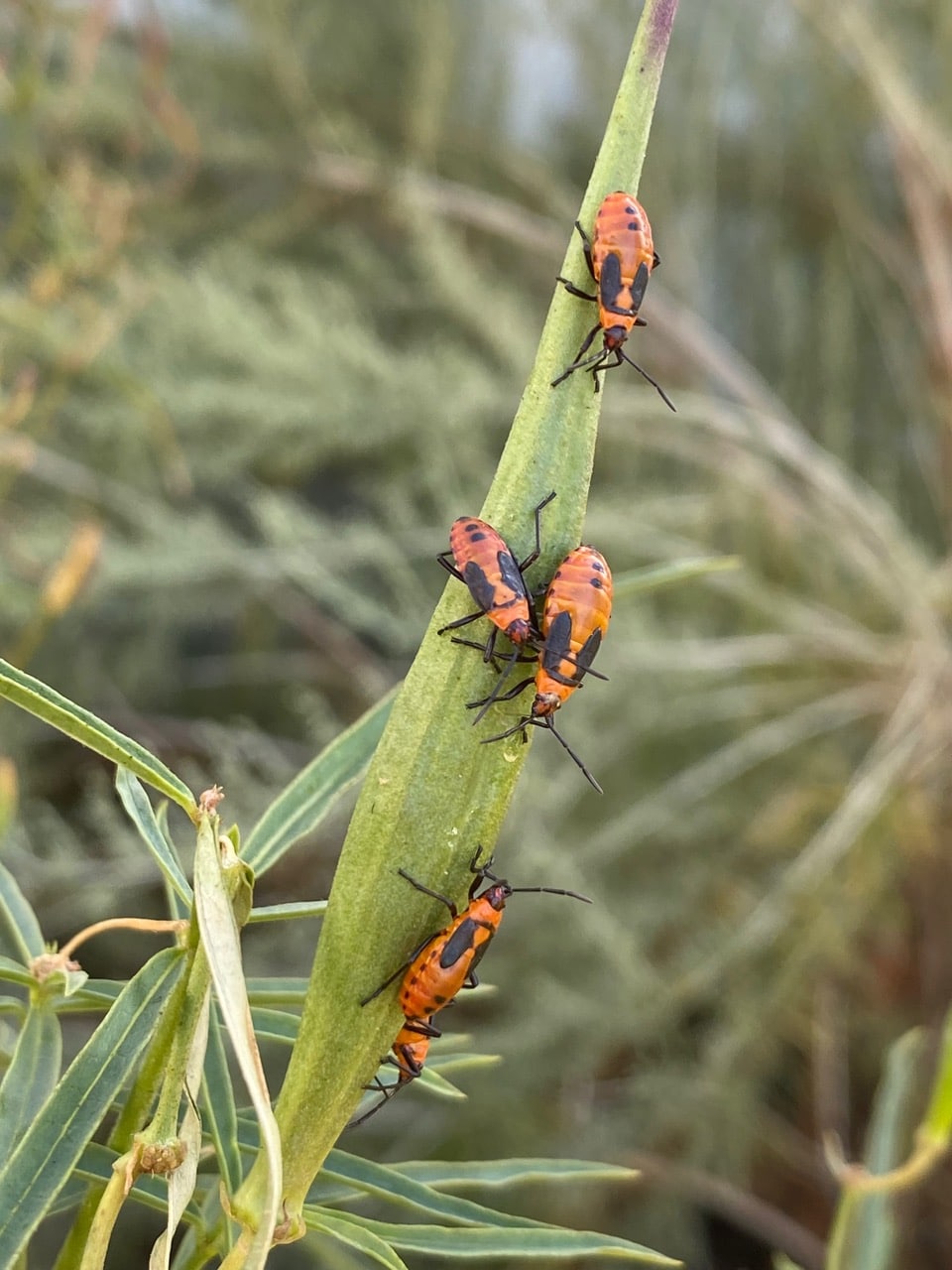
In the front yard, several large, conspicuous nymphs of the Large Milkweed Bug, Oncopeltus fasciatus (family Lygaeidae) can be seen on an immature seed pod of the Narrowleaf Milkweed, Asclepias fascicularis. Note their black wing pads. These will transform into functional wings upon the nymph’s final molt into an adult.
Milkweed Bugs are Seed Bugs (family Lygaeidae) in the insect order of “true bugs”, Hemiptera. The bold red-and-black coloration of the bug serves as aposematic warning to potential predators of its distastefulness and toxicity. Like the Monarch butterflies, Oncopeltus sequesters the toxic compounds of milkweeds, giving the insect its toxicity. The bugs undergo incomplete metamorphosis, with five instars before reaching adulthood. The nymphs and adults all feed on milkweed using their piercing-sucking mouthparts. Adults are capable of penetrating the seed pod with their proboscis and injecting digestive juices. All stages of development can be found on the plants in mid to late summer. Adults live for about one month. The insect overwinters as an adult.
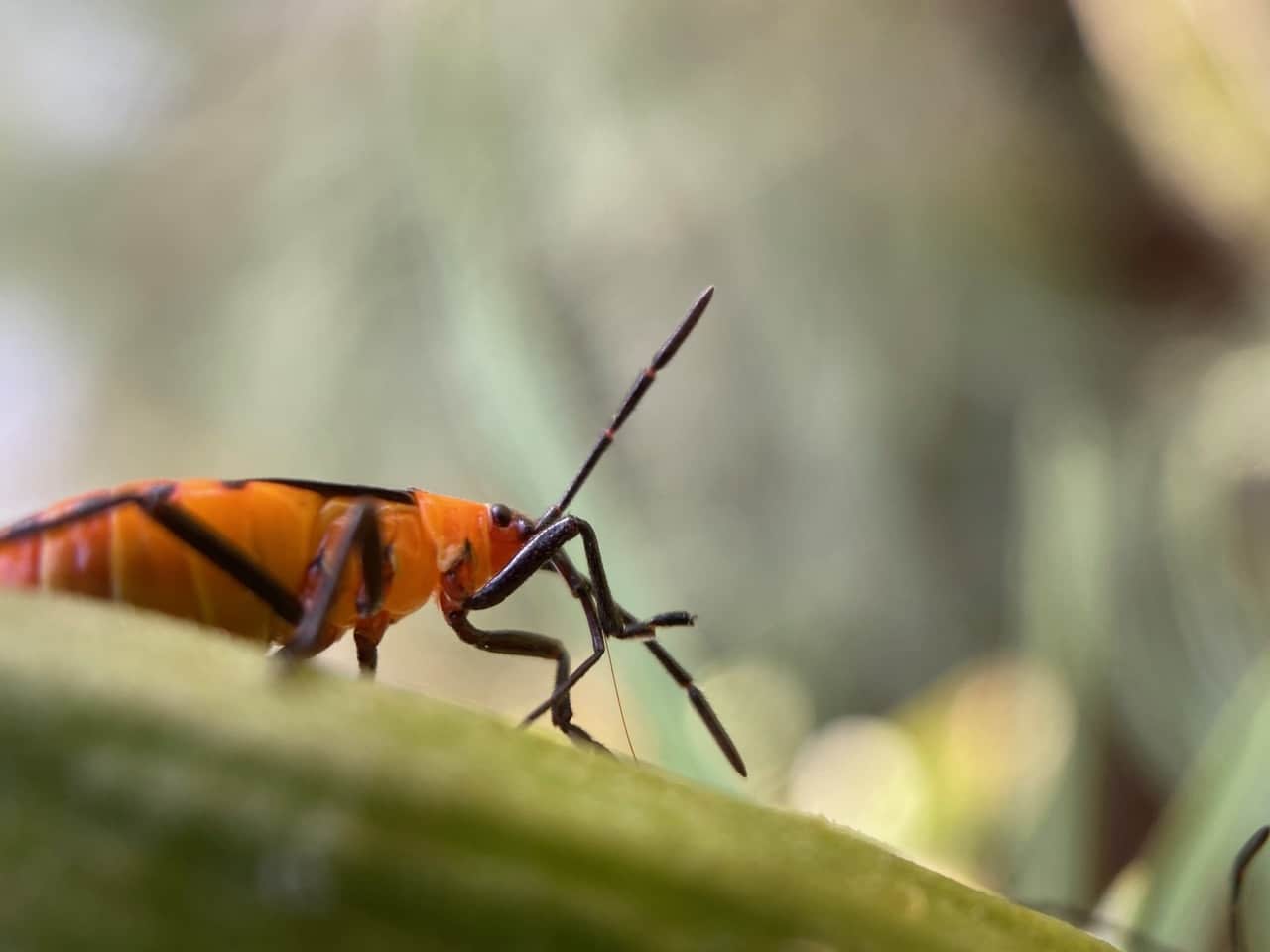
Close-up view of a Large Milkweed Bug feeding on a milkweed seed pod. See the fine, hair-like structure that extends from the jointed, curved rostrum (mouthparts)? It is the stylet that penetrates the plant tissues that the bug feeds on.
The defining feature of Hemipterans or “true bugs” is their “beak” or rostrum in which the modified mandibles and maxillae form a “stylet” which is sheathed within a modified labium. The stylet is capable of piercing tissues and sucking liquids, while the labium supports it. The stylet contains a channel for outward movement of saliva and digestive enzymes, and another channel for the inward movement of pre-digested liquid food. The rostrum is usually folded under the body when not in use. Seed bugs are able to feed on seeds by injecting digestive juices into the seeds and sucking up the digested contents as a liquid.

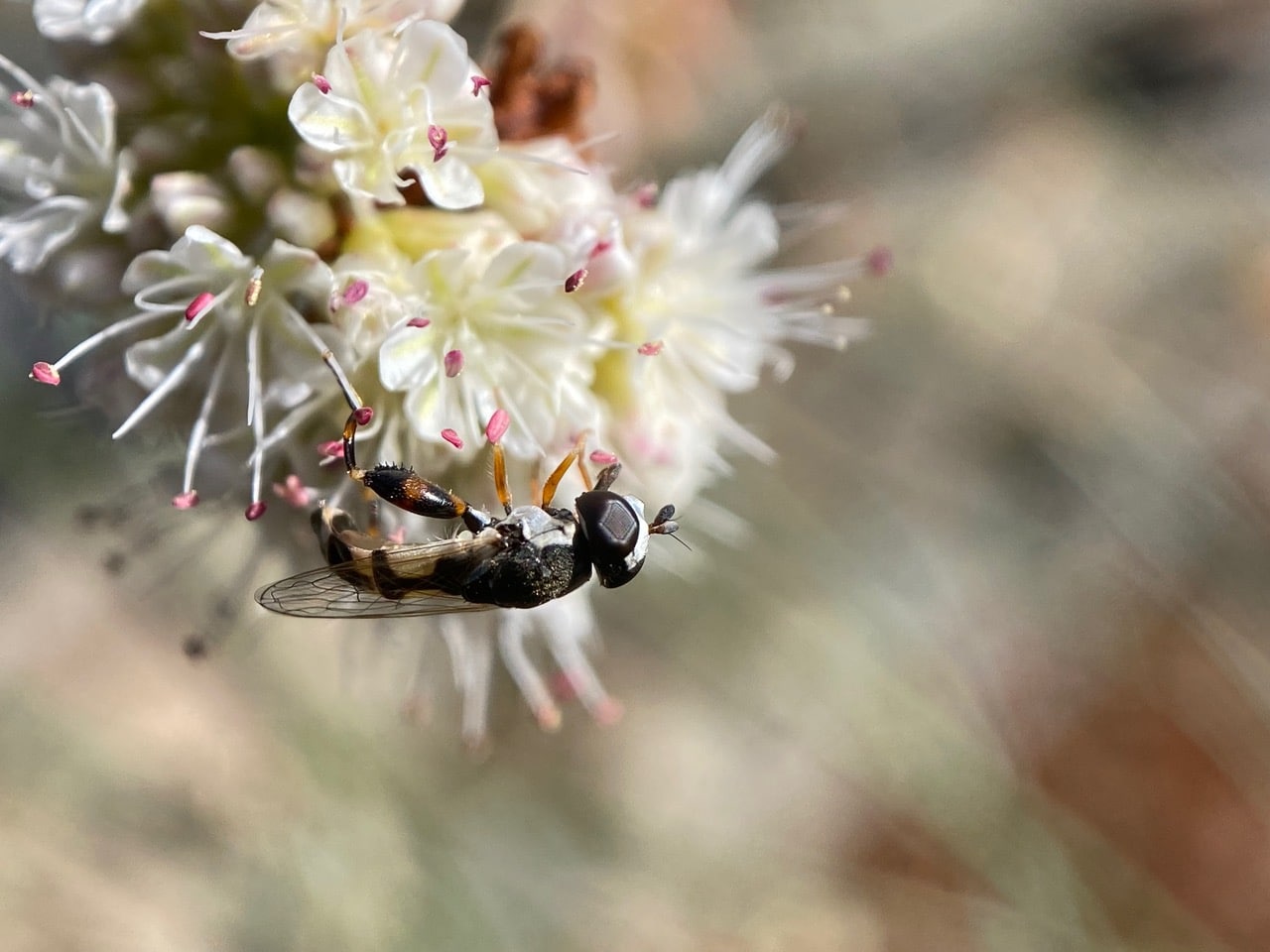
A Thick-legged Hover Fly, Syritta Pipiens (family Syrphidae) is foraging on a cluster of Buckwheat flowers in the backyard.
The Thick-legged Hover Fly, Syritta pipiens (family Syrphidae) originates from Europe and is currently distributed across Eurasia and North America. The species is distinguished by its enlarged hind femora (thighs). They are fast and nimble fliers. The fly is about 6.5 – 9 mm long. The species flies at a very low height, rarely more than 1 m above the ground. Adults visit flowers – males primarily to feed on nectar, and females to feed on protein-rich pollen to produce eggs. The species is found wherever there are flowers. It is also anthropophilic, occurring in farmland, suburban gardens, and urban parks. Larvae are found in wetlands that are close to bodies of freshwater such as lakes, ponds, rivers, ditches. Larvae feed on decaying organic matter such as garden compost and manure. Males often track females in flight, ending with a sharp dart towards them after they have settled, aiming to attempt forced copulation.
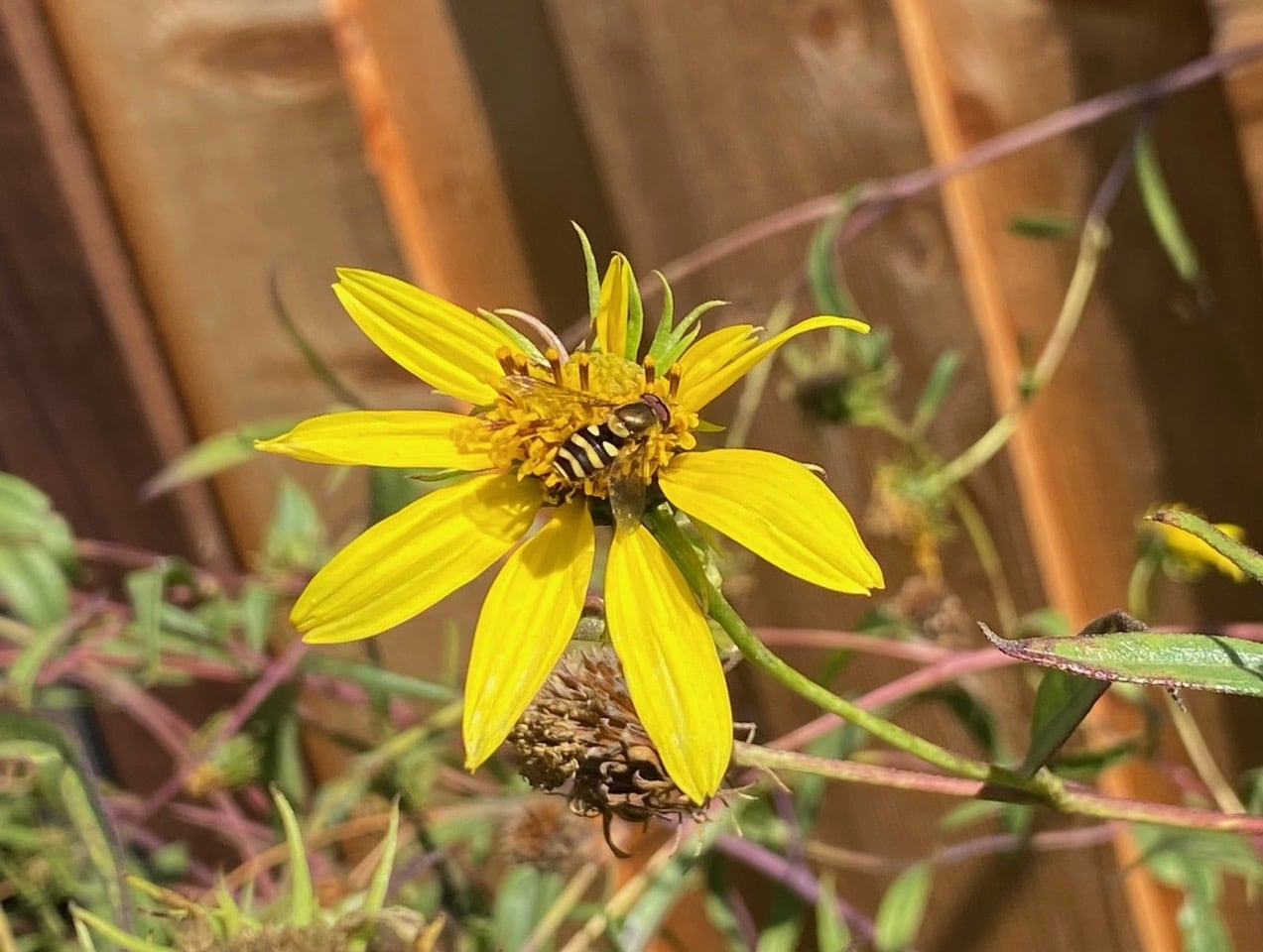
A Black-margined Flower Fly, Syrphus opinator (family Syrphidae) is foraging on a flowerhead of California Sunflower, Helianthus californicus.
The Black-margined Flower Fly, Syrphus opinator (family Syrphidae) has black-and-yellow patterns on its abdomen that mimic those of wasps and bees, a kind of Bayesian mimicry commonly seen in hover flies that helps deter potential predators. The species is common in central California during winter months. It can be distinguished from similar species by the abdominal fascia restricted to the sides and isolated from the margins. Adults visit flowers for nectar and pollen. Larvae feed on aphids and other soft-bodied insects.

Barely the size of the stigmas protruding from the florets, a tiny fly with picture wings is lurking on a fresh flowerhead of a Bush Sunflower, Encelia californica. It is a Fruit Fly, Campiglossa sp. (family Tephritidae).
Tephritids are small to medium-sized flies that are often colorful, and usually with picture wings. The larvae of almost all Tephritidae are phytophagous. Females deposit eggs in living, healthy plant tissues using their telescopic ovipositors. Here the larvae find their food upon emerging. The larvae develop in leaves, stems, flowers, seeds, fruits, and roots of the host plant, depending on the species. Adults are often found on the host plant and feeding on pollen, nectar, rotting plant debris, or honeydew. Tephritid flies are of major economic importance as they can cause damage to fruit and other plant crops. On the other hand, some Tephritids are used as agents of biological control of noxious weeds.
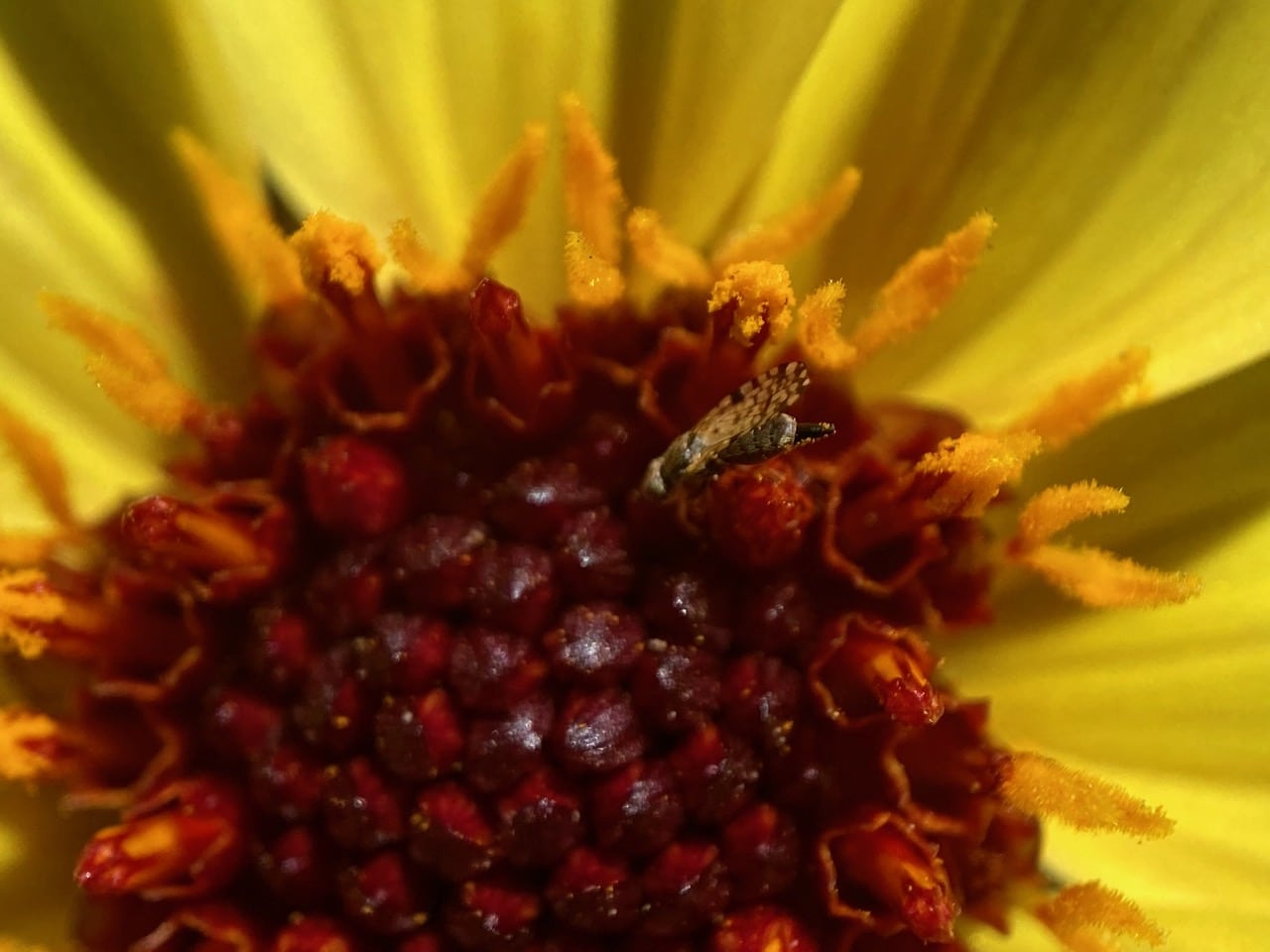
As the Fruit Fly reaches into the flower buds in the middle of the flowerhead, I get a glimpse of its oviscape on its rear. It is a female. She is probably seeking to lay her eggs.
Female Fruit Flies are easily distinguished by the presence of an oviscape – the pointy structure at the tip of their abdomen. The oviscape is the basal part of the ovipositor, the non-retractile sheath that protects the ovipositor. It remains exposed when the ovipositor is withdrawn and not in action.