

Pollinator Post 9/19/24 (1)
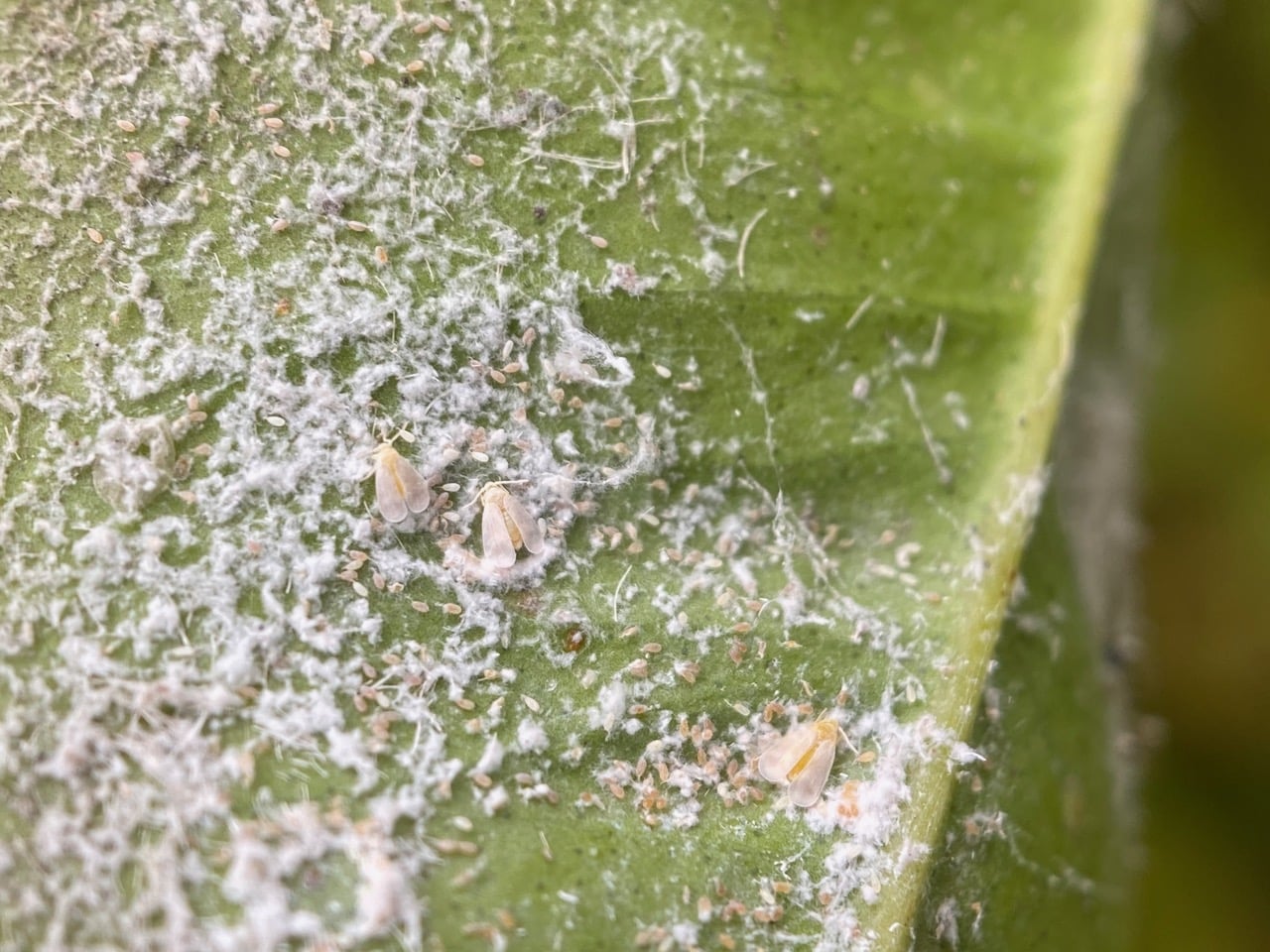
Naomi has kindly arranged for me to visit a home garden in Oakland that she tends. As the morning is forecast to be cloudy, I don’t expect to see much insect activity. While waiting for Naomi to arrive, Silvia and Kathleen show me the large lemon tree in their backyard that seems to be in trouble. Some leaves are covered with black sooty mold, while others are deformed and curled.
I turn over a deformed leaf, and find that the underside is covered with a layer of white fluff. Looking through the macro lens, I can make out some Whiteflies (family Aleyrodidae) and what look like eggs and crawlers (young nymphs) among the white fluff.
Despite their name, Whiteflies are not true flies. Rather, they are in the order Hemiptera along with aphids, mealybugs, and scales. They comprise the family Aleyrodidae. These are small insects, most with wingspan of less than 3 mm and a body length of 1-2 mm. Like all members of Hemiptera, Whiteflies have piercing-sucking mouthparts that they use to extract sap from plants. Whiteflies typically feed on the underside of plant leaves, tapping into the phloem of plants, introducing toxic saliva, and excreting copious quantities of honeydew. Since the whiteflies congregate in large numbers, infested plants can be quickly overwhelmed. Damage consists of yellowing and wilting of the foliage, reduction in crop yield. Honeydew and the resulting sooty mold may interfere with photosynthesis in the affected plant. Whiteflies are capable of transmitting viral pathogens to host plants.
The greenhouse whitefly produces nymphs with very long filaments of wax and adults that have white wings and a yellow body. Females usually lay 200-400 eggs. The eggs hatch into flattened nymphs, called crawlers that wander about the plant. Soon, they insert their mouthpart and begin to feed. The first stage has legs and antennae, but these are lost after the first molt, and the flattened, oval-shaped larvae stay fixed at one feeding site. The last part of the fourth instar is the pupa. Adults emerge from the pupa through a T-shaped slit and soon mate and reproduce. They have four wings and are covered with a white, powdery, waxy substance. The adults live for about one month. Within a population, all life stages are present and generations often overlap. The life cycle takes only 18 days.
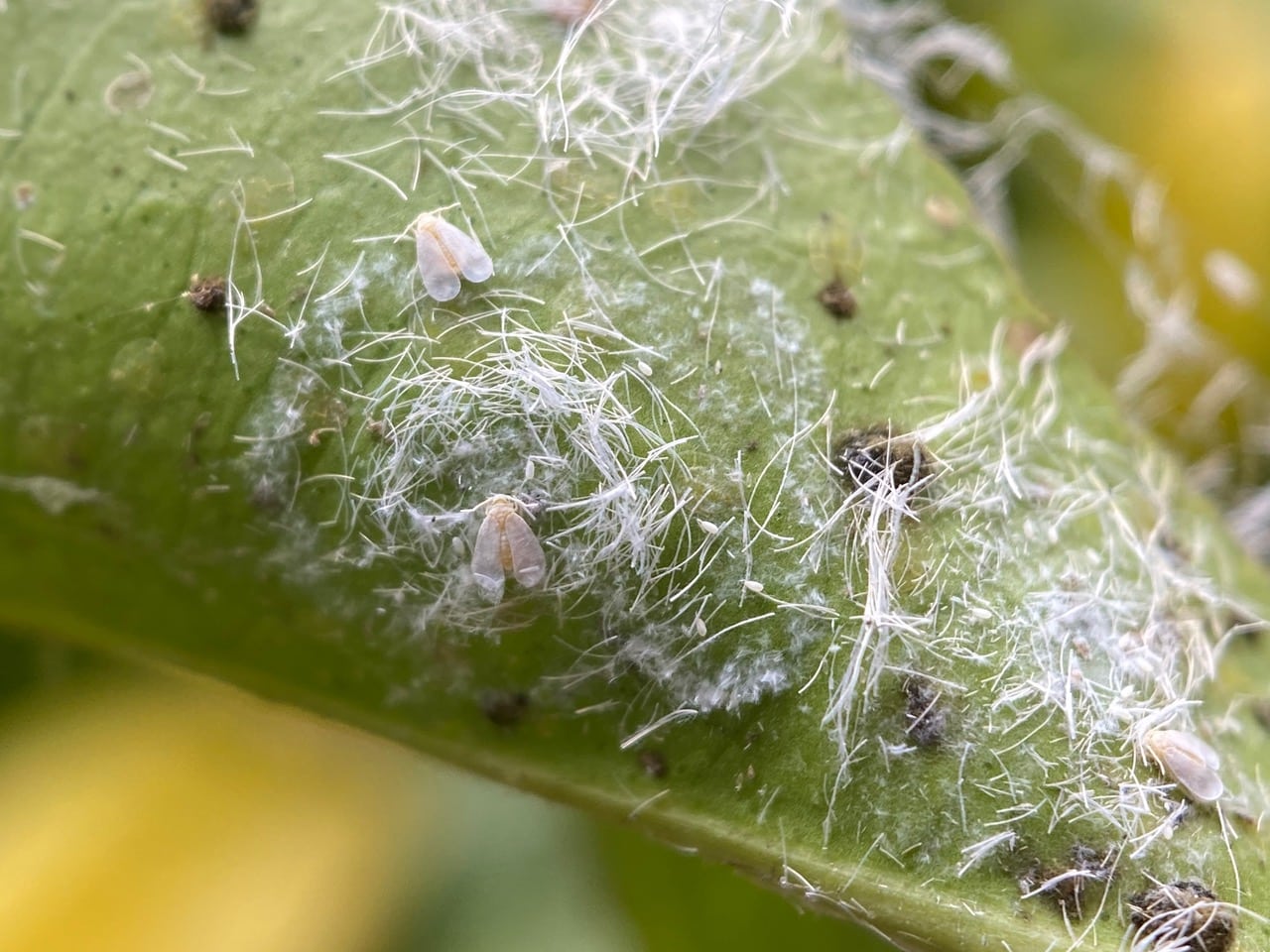
Certain areas of the leaf is covered with tiny waxy filaments, often curiously arranged in circles.
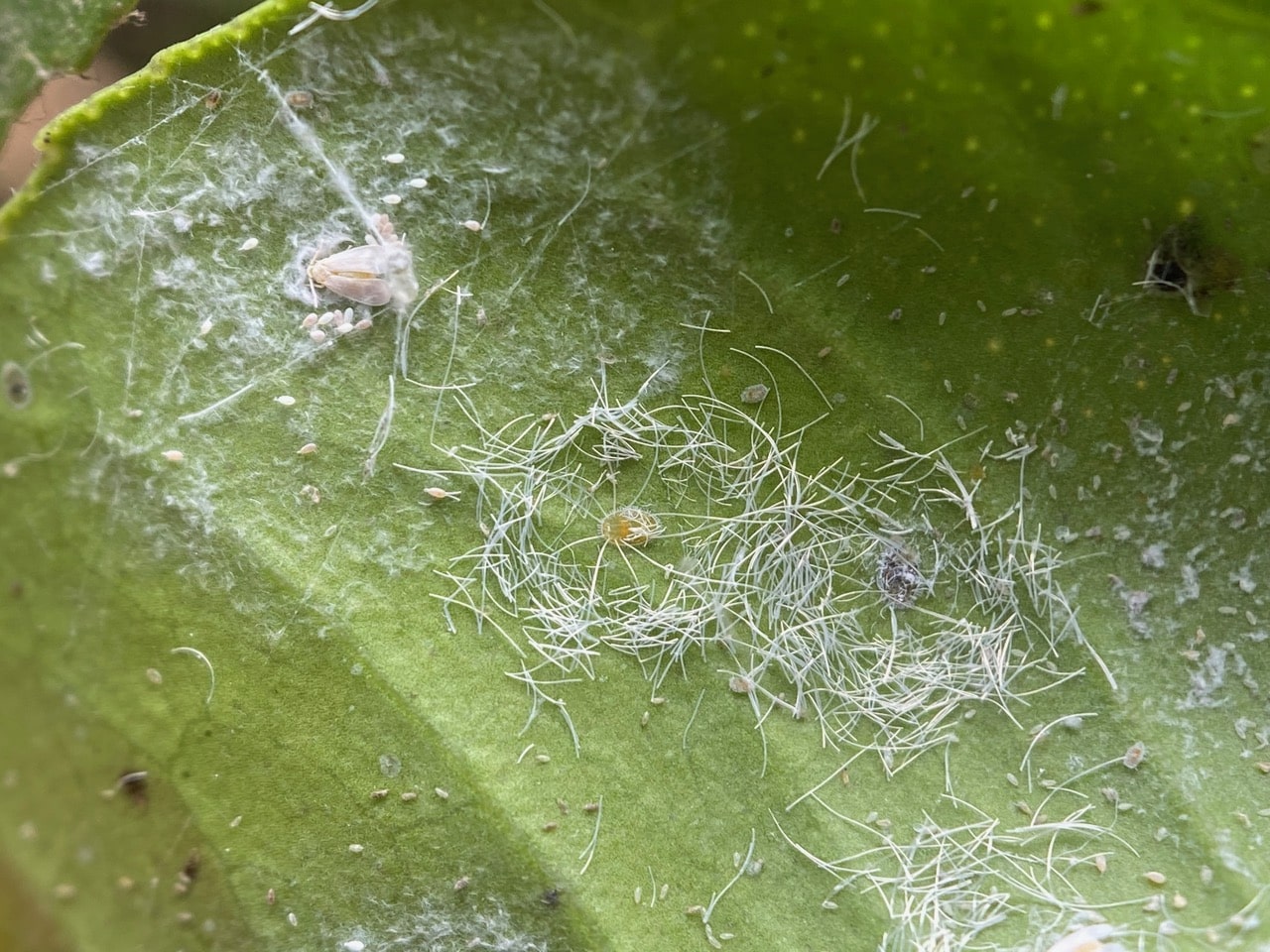
Whoa, here’s a Whitefly nymph that is secreting the white waxy filaments. This is how those circles are formed! I think the darker nymph on the right is probably a later instar.
Adult whiteflies cover all parts of the body except the eyes with waxy particles. They produce filaments of a waxy material from abdomenal wax plates, composed of many pores and use their tibia to periodically break off the extruding filaments to form waxy particles. The purpose of the waxy coating is not known. It has been suggested that it may 1) prevent water loss, 2) waterproof against water droplets, 3) protect from sticking to honeydew, and 4) deter predators.
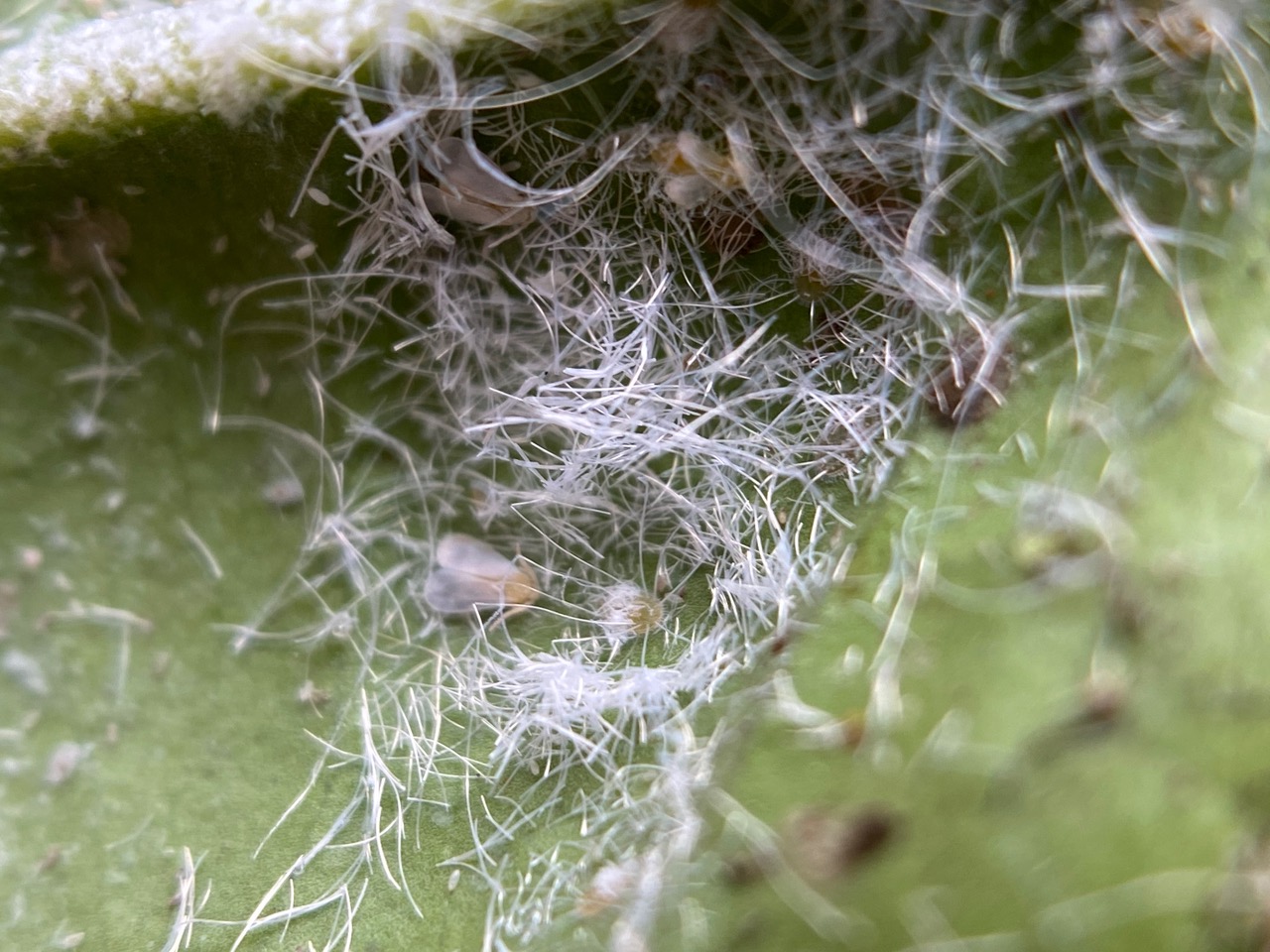
Next to an adult Whitefly, a nymph is secreting long filaments of wax from its body. Bizarre!
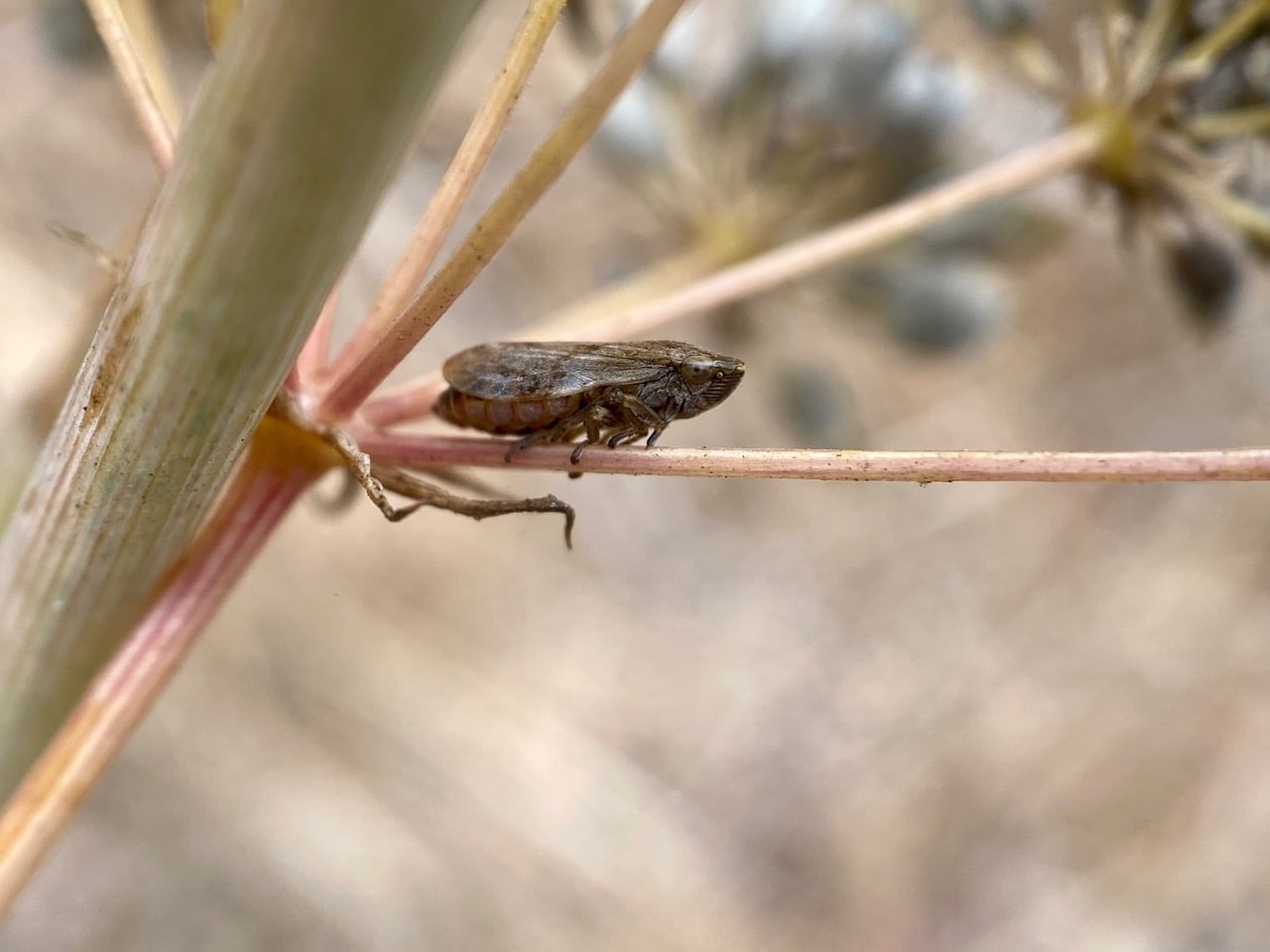
Naomi is eager to try out her new macro lens on her camera. She is the first to spot this tiny Meadow Froghopper, Philaenus sp. (family Aphrophoridae) perched on the base of a fading umbel of California Yampah, Perideridia californica.
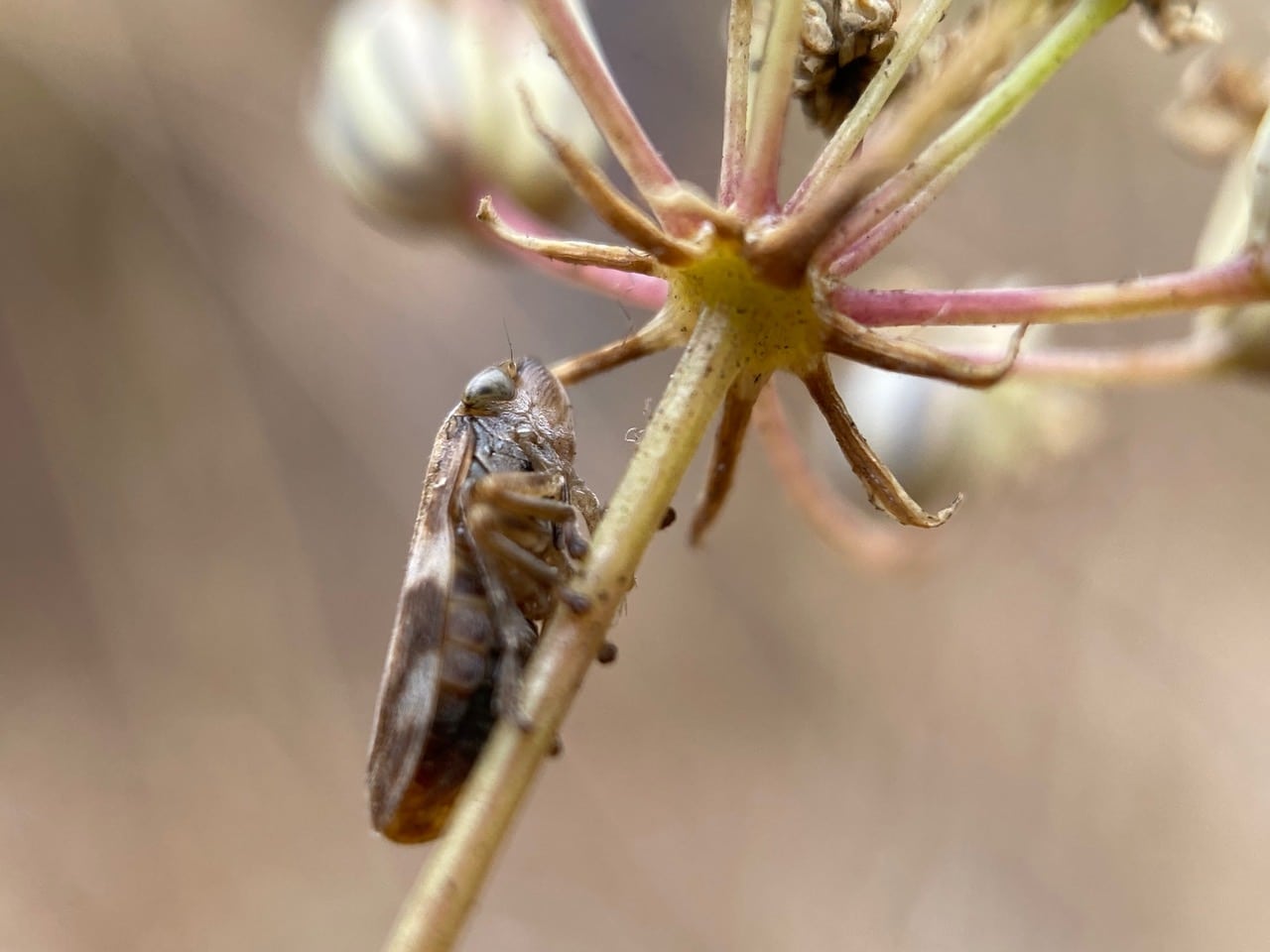
The Froghoppers (superfamily Cercopoidea) are a group of “true bugs” in the order Hemiptera. Adults are capable of jumping many times their height and length, giving them their common name, but many species are best known for their plant-sucking nymphs which produce foam shelters, and are referred to as “spittlebugs”. The superfamily currently consists of three families: the Aphrophoridae, Cercopidae, and Clastopteridae. The nymphs produce a cover of foamed-up plant sap visually resembling saliva, hence the common name. Whereas most insects that feed on plant sap tap into the nutrient-rich fluid from the phloem, the spittlebugs utilize the much more dilute sap flowing upward from the roots via the xylem. The insects’ digestive system contains symbiotic bacteria that provide them with the essential amino acids. The large amount of excess water that must be excreted and the evolution of special breathing tubes allow the young spittlebug nymphs to grow in the relatively protective environment of their foam shelters. The foam serves a number of purposes. It hides the nymph from the view of predators and parasites, and it insulates against heat and cold, providing thermal as well as moisture control. It also has an acrid taste that deters predators.
Froghoppers are champion jumpers among insects, out-performing even the fleas. The bug can leap the human equivalent of a skyscraper without a running start. It is the highest jumping insect proportional to body size. The muscles in its hind legs act like a “catapult” to release energy explosively.
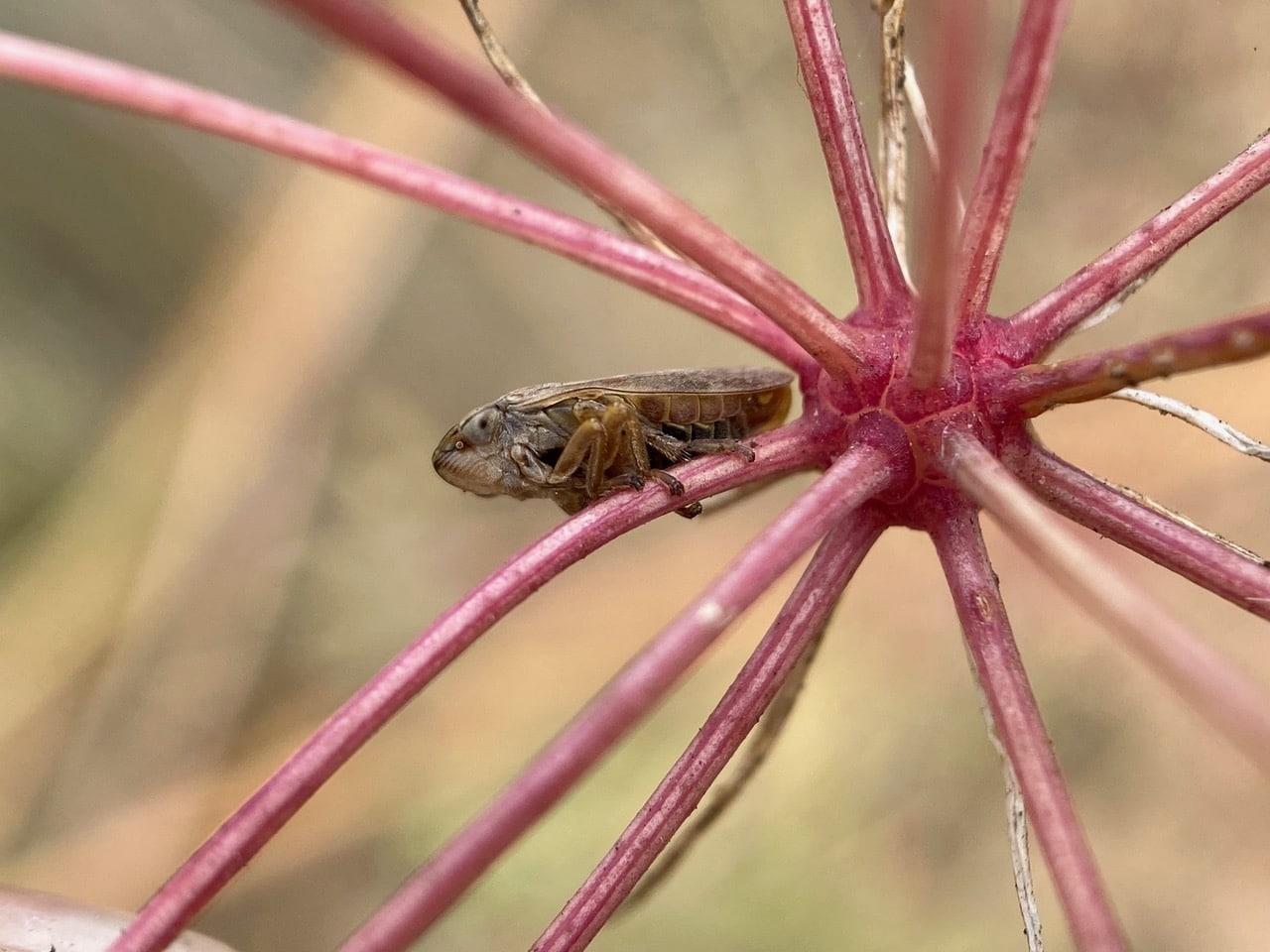
For all its jumping prowess, this Froghopper is sure cooperative. It does not budge as I approach for this close-up,
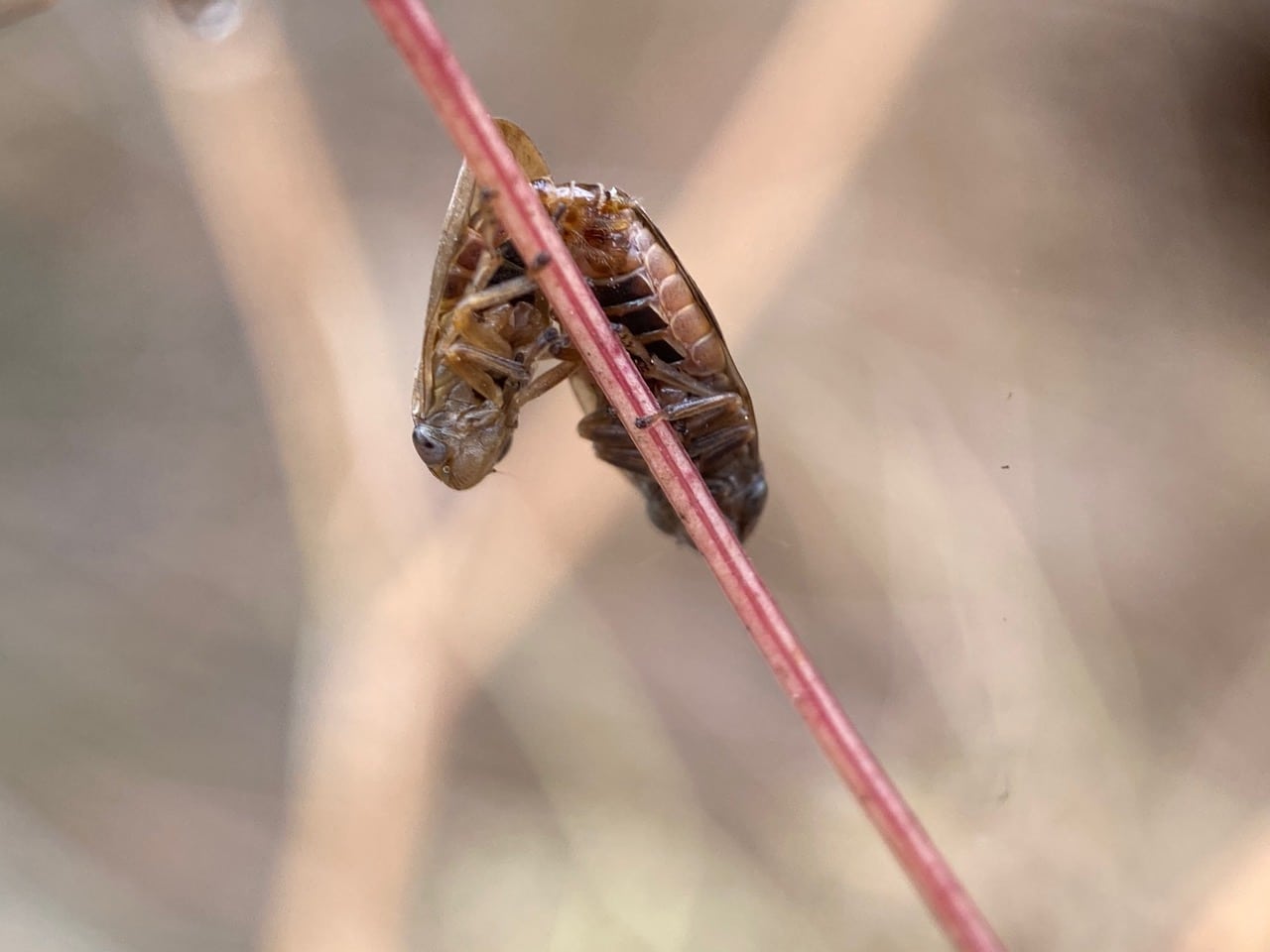
A pair of Meadow Froghoppers, Philaenus sp. (family Aphrophoridae) is mating on a flower stalk of a fading California Yampah. The larger one on the right is probably the female.
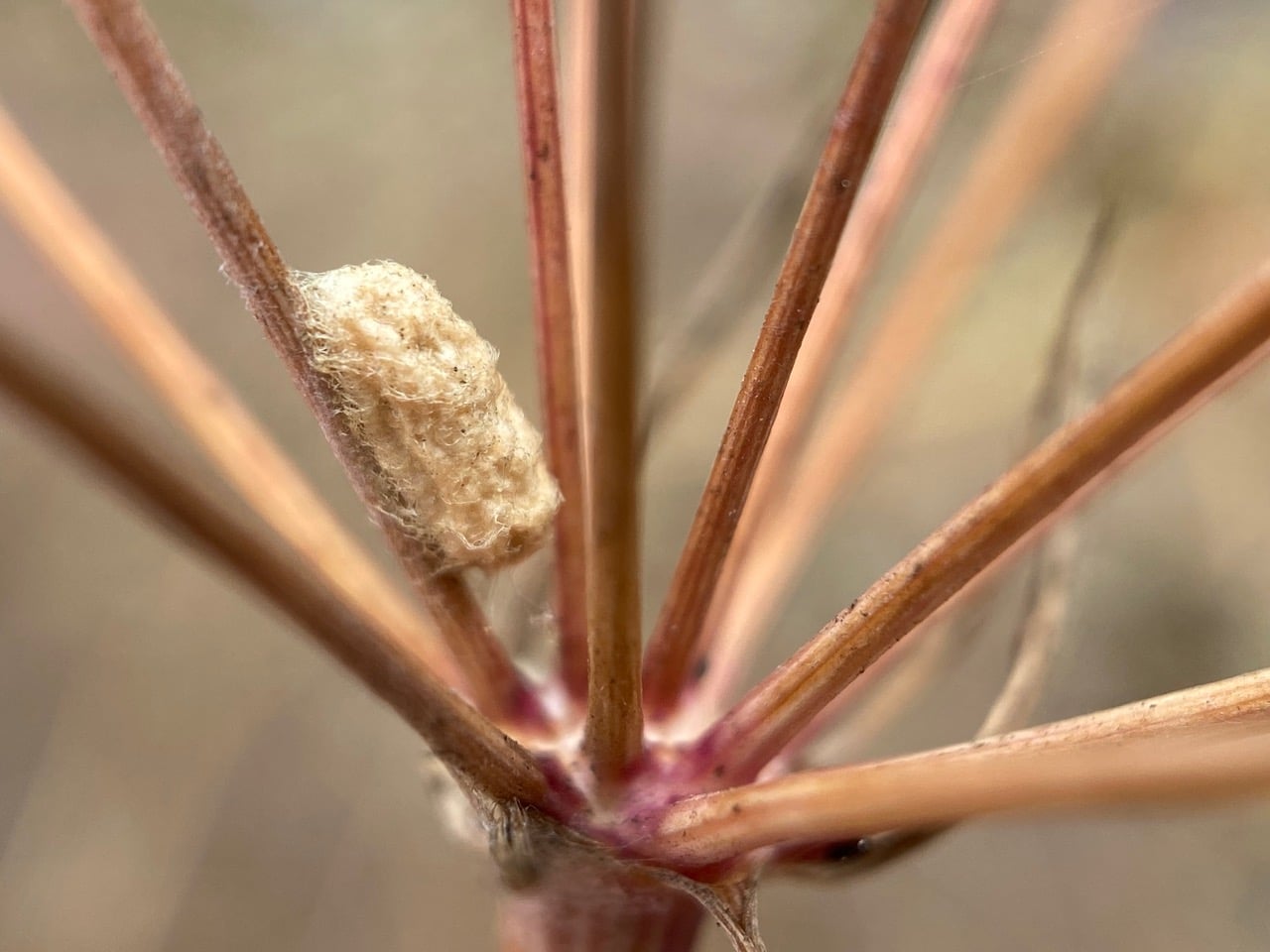
Looking like a miniature tufa sponge, a cocoon is attached to the base of a flower stalk in an umbel of California Yampah, Perideridia Californica. I recognize it right away, having seen many a dead Anise Swallowtail caterpillar next to these cocoons in the past. This is a rather gruesome story.
One of the greatest parasitoids, responsible for many moth and butterfly deaths, is the Braconid wasp (family Braconidae). Female Braconids lay an egg in or on the young caterpillar of the Anise Swallowtail butterfly. The egg hatches and the wasp larva feeds on the caterpillar from the inside out while the host is still alive, eating and growing. Before the caterpillar is ready to pupate, the wasp larva exits the caterpillar through its skin/cuticle, and immediately spins its own cocoon next to the caterpillar. The caterpillar may live a day or two before dying. Eventually the adult wasp emerges from the cocoon by cutting a round hatch-like opening at one end of the cocoon.
There are many variations to this scenario. Many Braconids lay multiple eggs in the caterpillar host, resulting in multiple cocoons attached to the dead caterpillar eventually. Other Braconids “zombify” their host caterpillar, keeping it alive as a bodyguard to protect the wasp cocoon from predators.
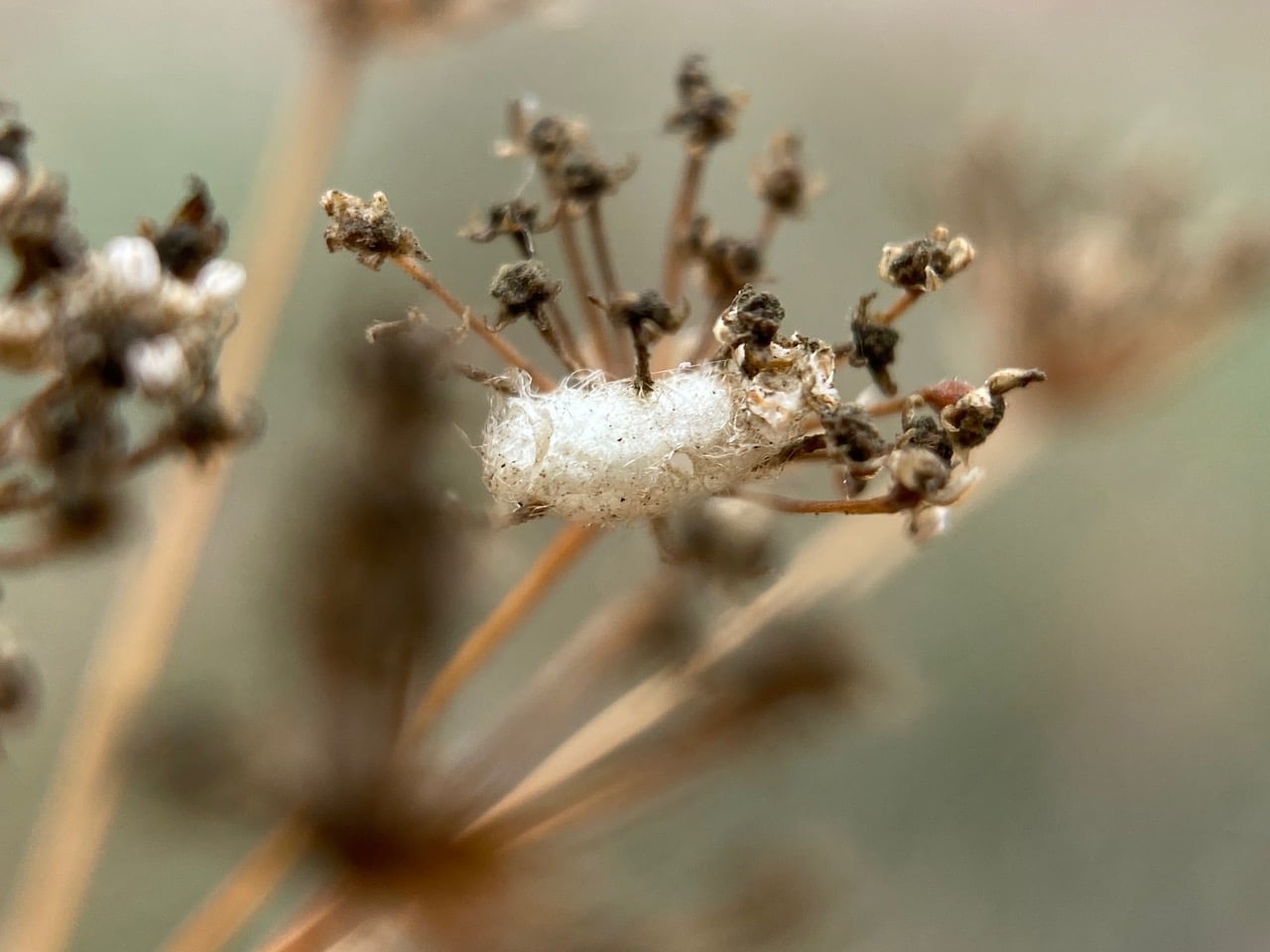
Here’s a similar cocoon attached to another dried Yampah flower umbel. The parasitoid wasp has already emerged from this cocoon, as evident from the hatch-like round opening at one end of the cylindrical cocoon.
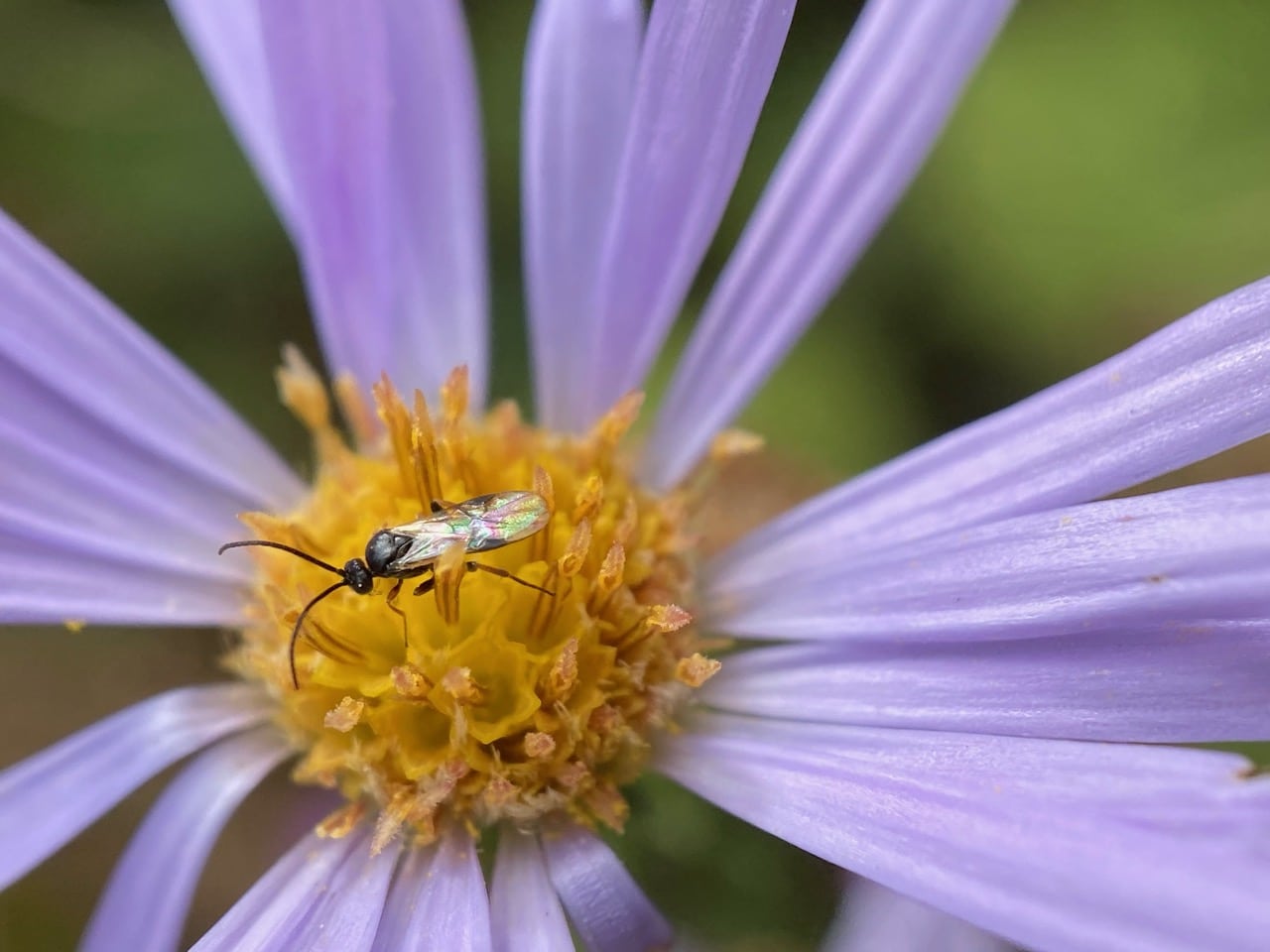
A tiny wasp is taking nectar a flowerhead of Pacific Aster, Symphyotrichum chilense. It appears to belong to the superfamily Ichneumonoidea.
The superfamily Ichneumonoidea comprises the two largest families within Hymenoptera: Ichneumonidae and Braconidae, both with a cosmopolitan distribution. Members of the two families are distinguished by wing venation. Ichneumonoids are solitary wasps, and the vast majority are parasitoids; the larvae feed on or in another insect, eventually killing it. In general, ichneumonoids are host specific, and only attack one or few closely related host species. Many species use polydnaviruses to suppress the immune systems of their host insects.
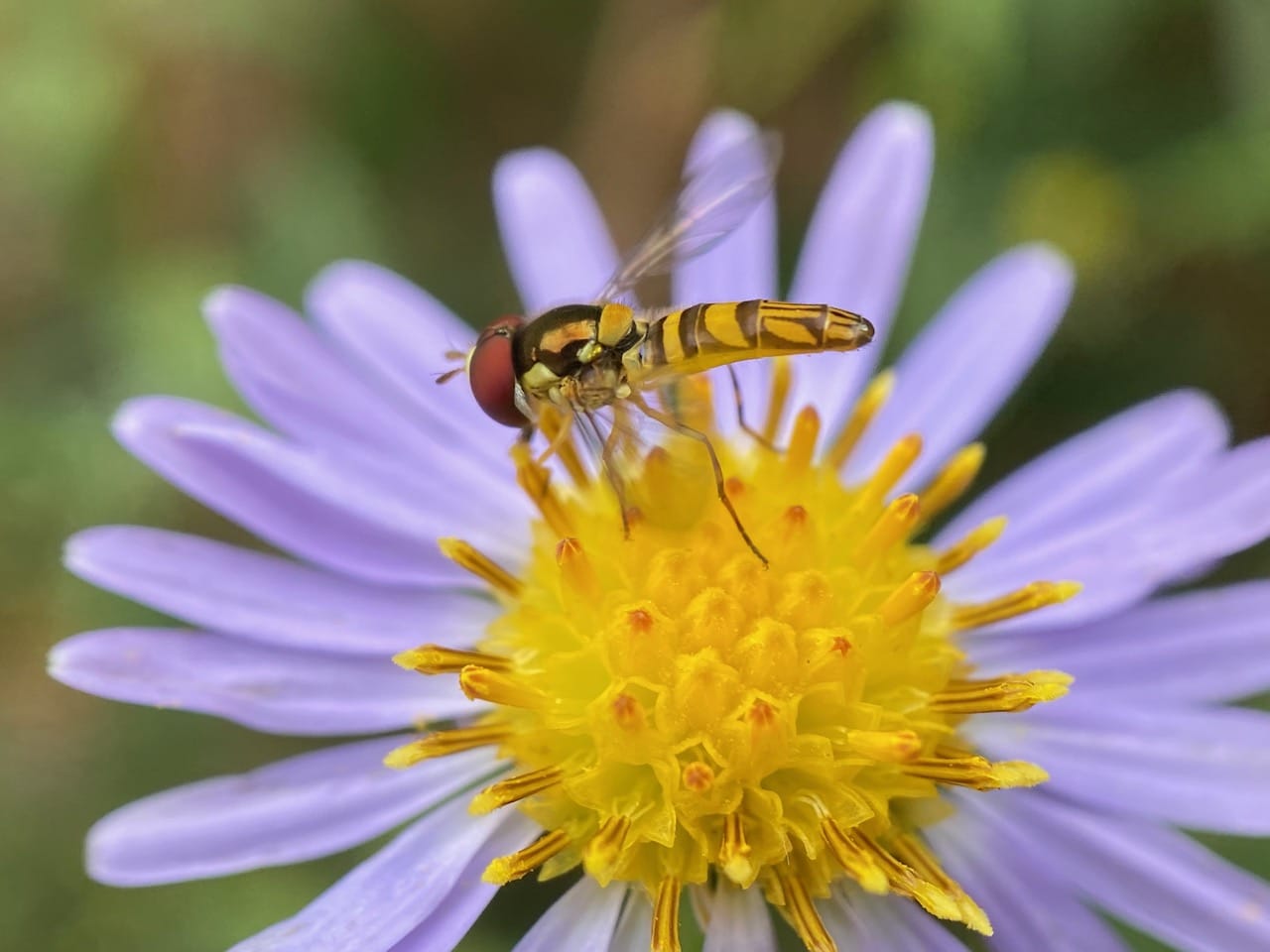
A male Oblique Streaktail, Allograpta obliqua (family Syrphidae) forages on a flowerhead of Pacific Aster.
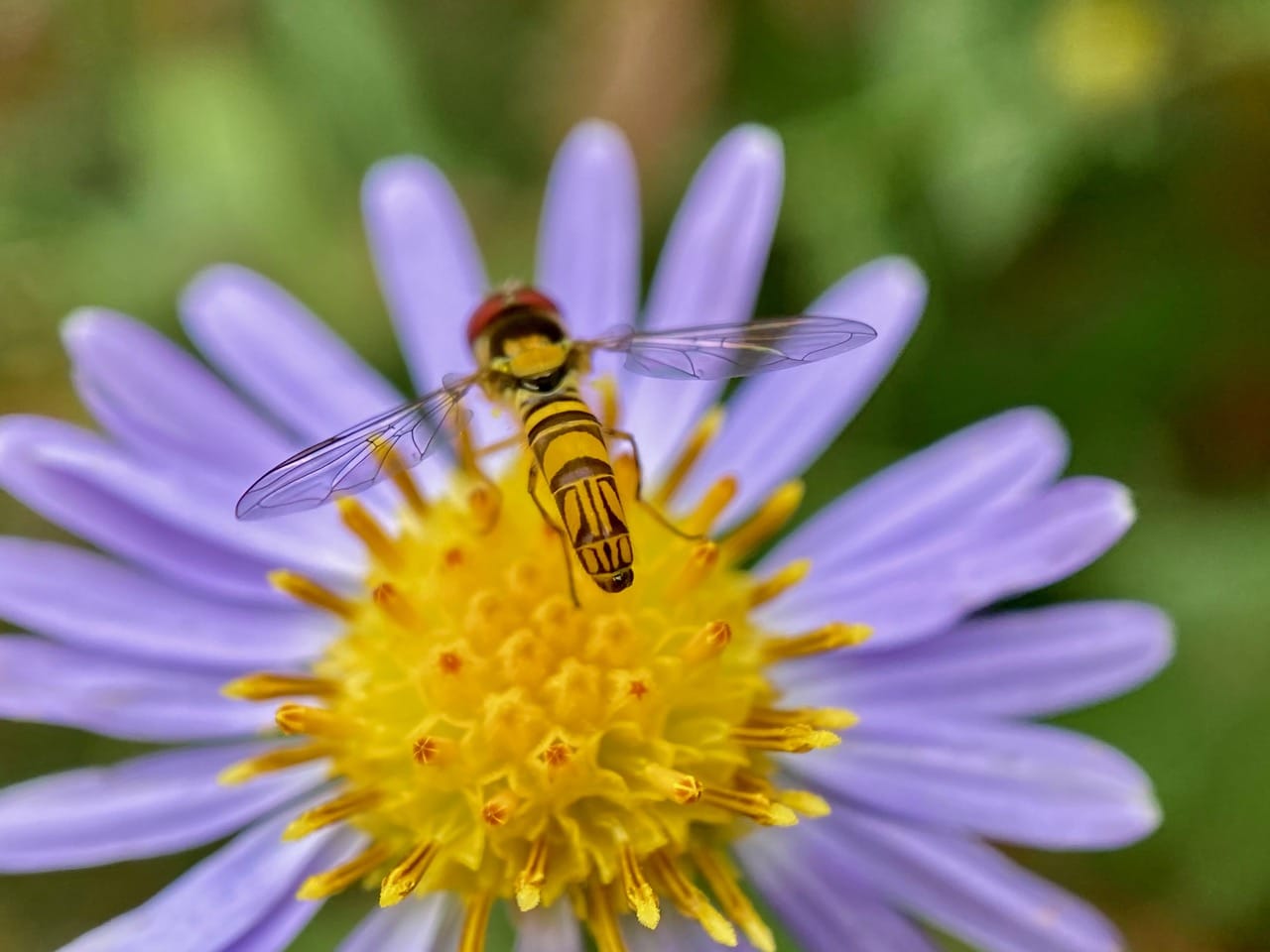
The Oblique Streaktail is a common North American species of hoverfly. Adults are 6-7 mm long. Males have holoptic eyes (that meet on top of the head), while females have dichoptic eyes. Eggs are laid on surfaces of leaves or stems near aphids. The larvae are important predators of aphids. Adults visit flowers for nectar and pollen, and are pollinators.
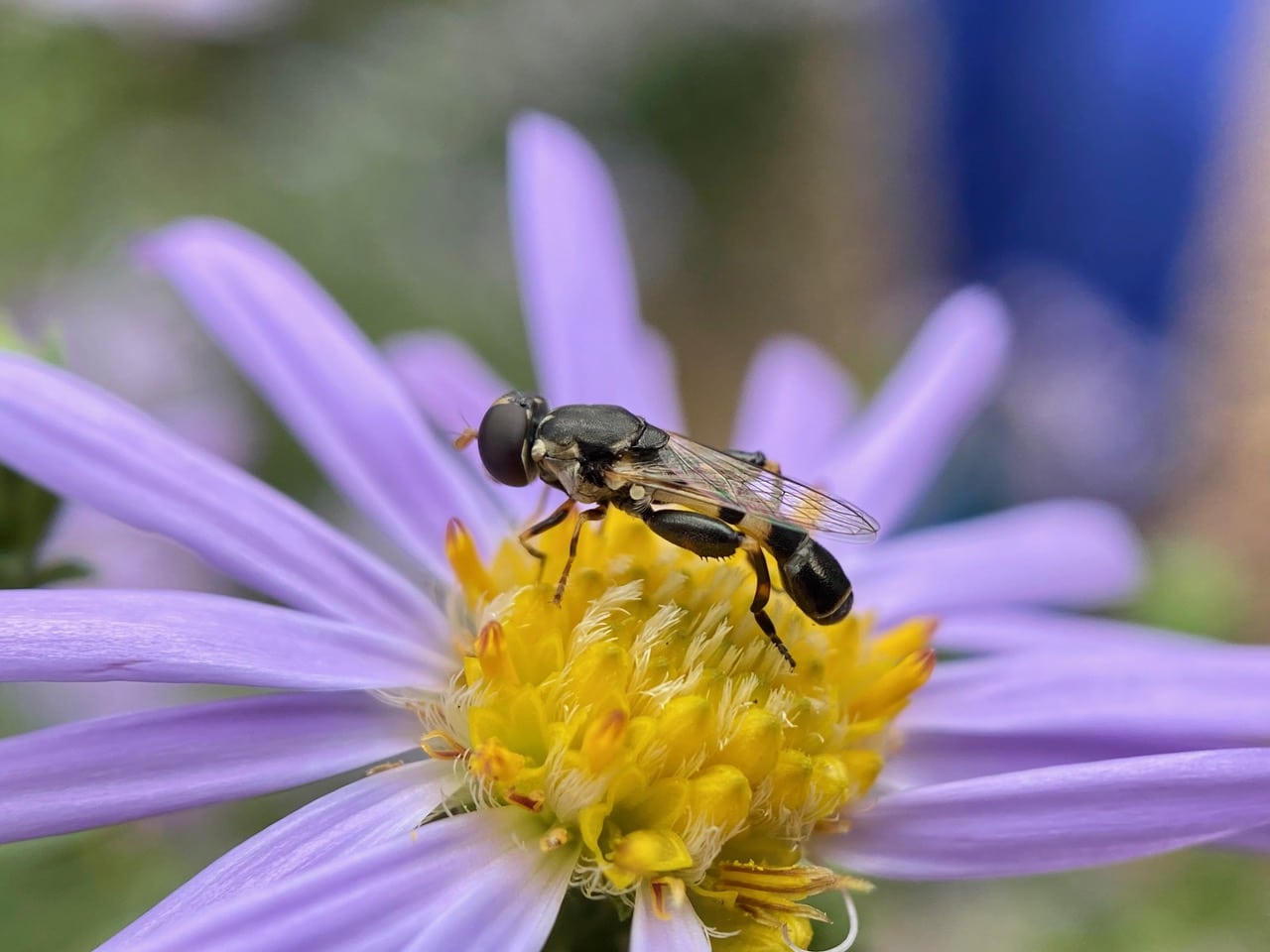
A Thick-legged Hover Fly, Syritta pipiens (family Syrphidae) is foraging on a Pacific Aster flowerhead.
Syritta pipiens originates from Europe and is currently distributed across Eurasia and North America. They are fast and nimble flyers, and their larvae are found in wet, rotting organic matter such as garden compost, manure, and silage. The flies are important pollinators for a variety of flowering plants.
The Thick-legged Hover Flies are often found on flowers, where the adult males primarily feed on nectar and adult females eat protein-rich pollen to produce eggs. The common name comes from the fly’s distinctively broad femora. The fly is about 6.5 -9 mm long. The species flies at a very low height, rarely more than 1 m above the ground. Males accurately track females, aiming to attempt forced copulation.
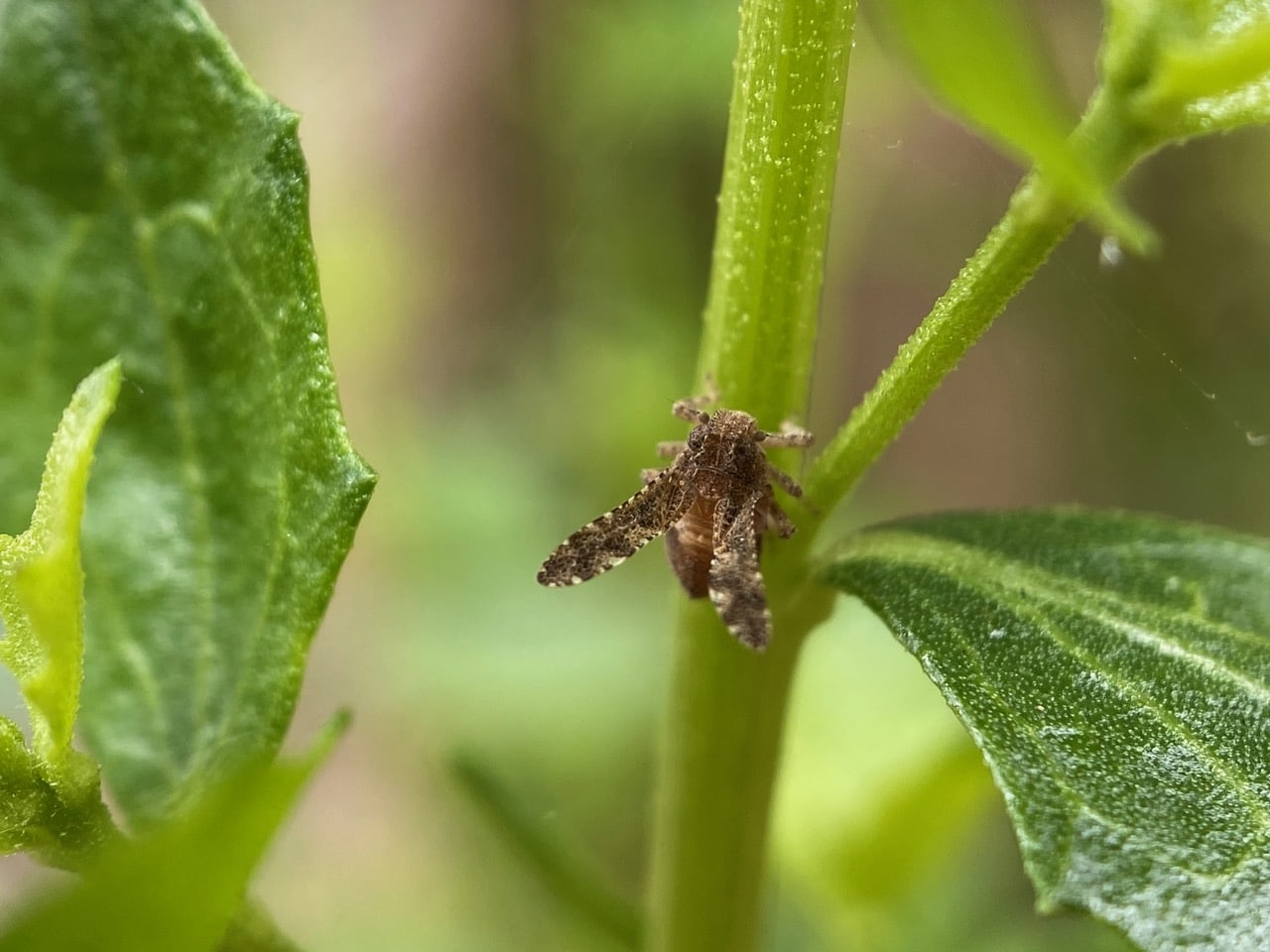
A Planthopper, Danepteryx sp. (family Tropiduchidae) perched on a stem at the base of a Coyote Brush, Baccharis pilularis. The oddly shaped insect can easily be mistaken for a bit of plant debris.
Tropiduchidae is a relatively small, advanced planthopper family. Members of the genus Danepteryx are sometimes called Upright-winged Hoppers. Most of the genus is endemic to California, but members of the family are more broadly found in southwestern US and extreme northern Mexico. Planthoppers may be small, but they attract mates from afar by sending vibrational calls along plant stems and leaves using fast, rhythmic motions of their abdomen.
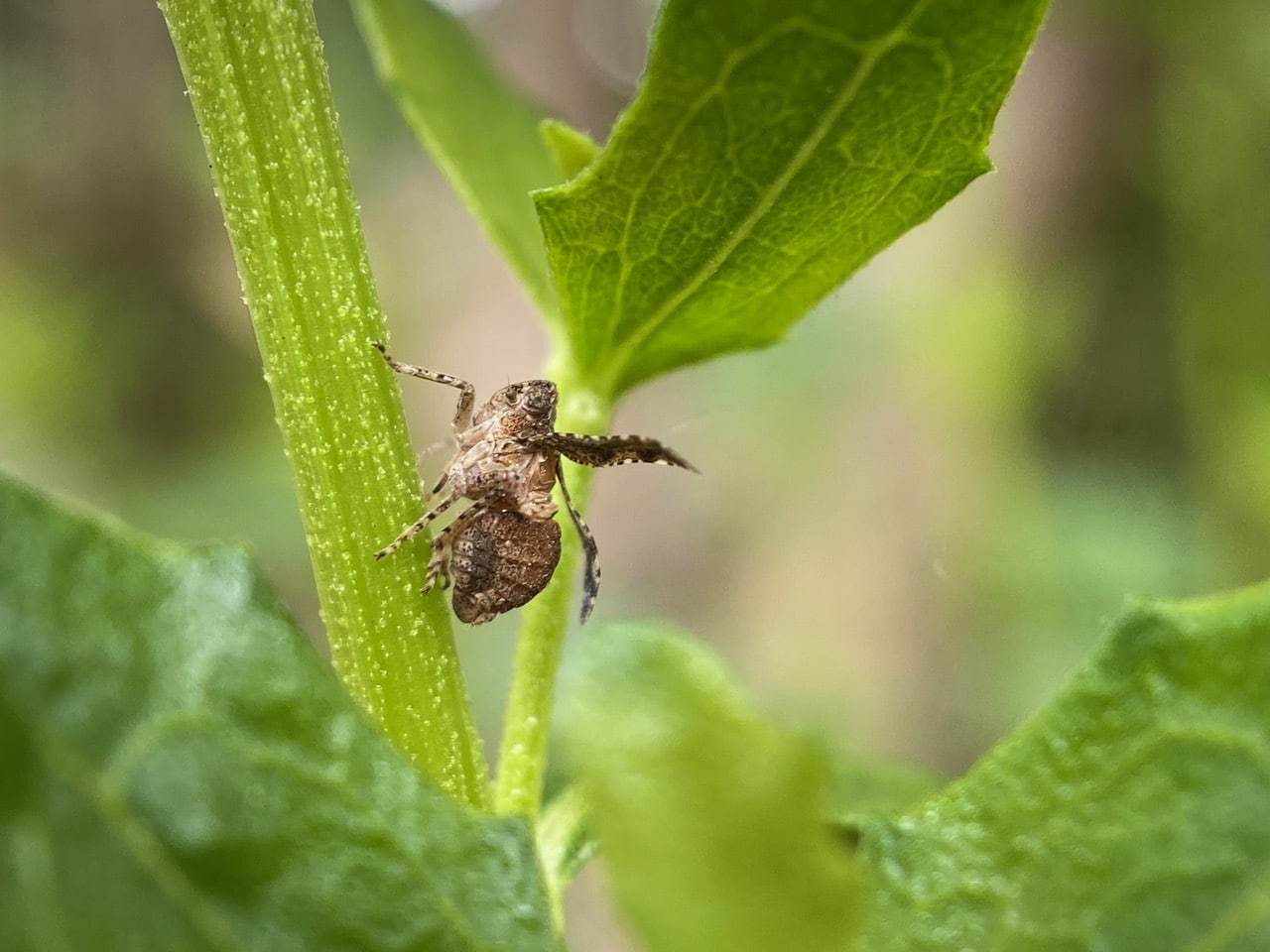
Instead of jumping or flying, the Planthopper is running away from my camera. Note the needle-like black-tipped proboscis that is folded under its body. This is the characteristic piercing-sucking mouthpart of the members of the order Hemiptera.
The Planthoppers have the first mechanical gear system ever observed in nature. The tiny bug uses mechanical gears on its joints to precisely synchronize the kicks of its hind legs as it jumps forward.
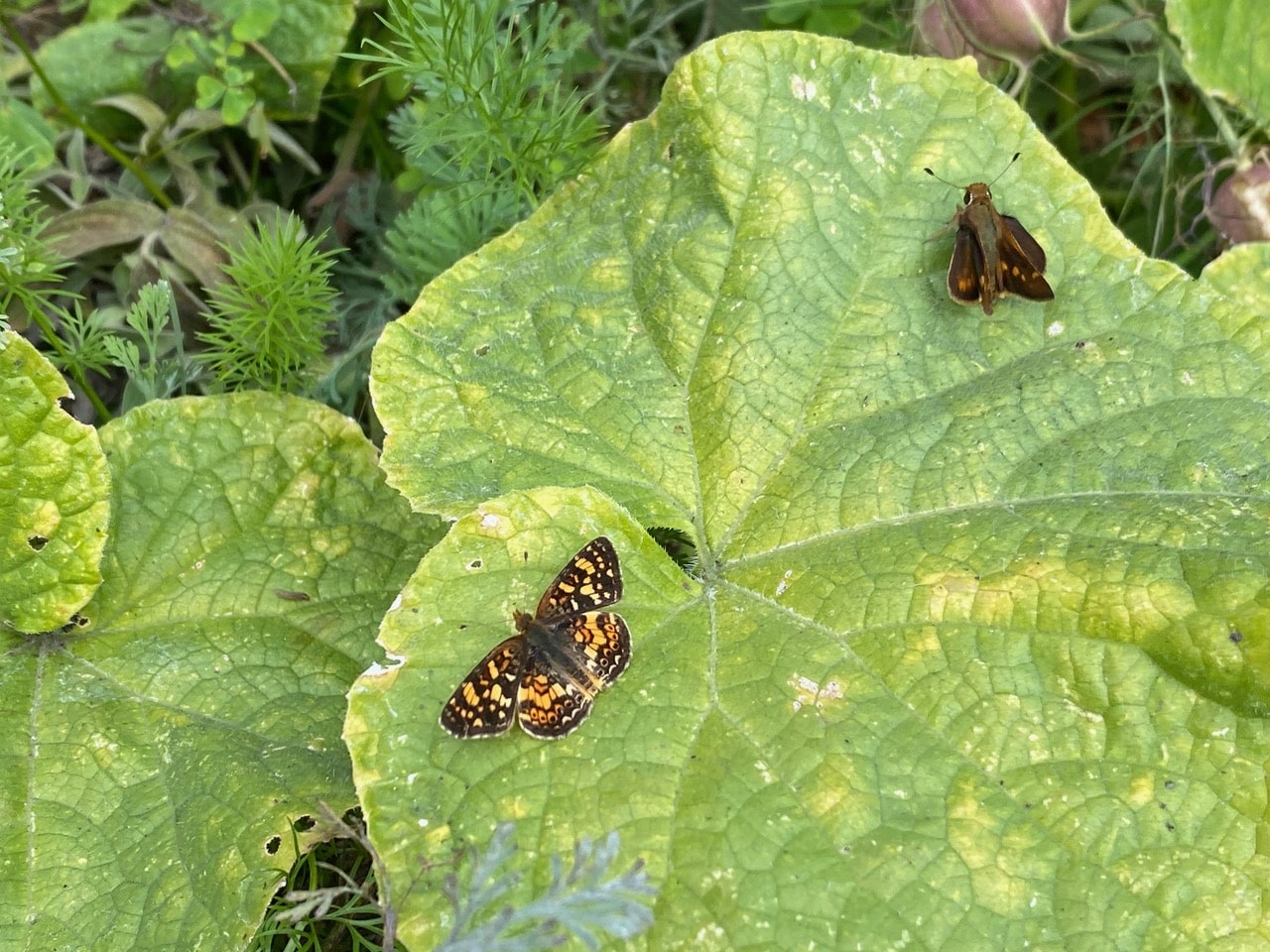
A Field Crescent, Phyciodes pulchella (family Nymphalidae) has landed on the same Cucumber leaf as a Umber Skipper, Poanes melane (family Hesperiidae).
It is not surprising to encounter the Field Crescent as this garden abounds in Pacific Aster. The butterfly’s larval food plants are various kinds of Asters. Females lay eggs in large batches on underside of host plant leaves. Young caterpillars sometimes live in a loose web. There can be three or four flights from April to October in lowland California. The species is mostly found in the western United States.
Skippers are a family, the Hesperiidae, of the order Lepidoptera (butterflies and moths). They are named for their quick, darting flight habits. Most have the antenna clubs hooked backwards like a crochet hook. They also have generally stockier bodies and larger compound eyes than the other butterflies. Their wings are usually small in proportion to their bodies. When at rest, skippers keep their wings usually angled upwards or spread out, and only rarely fold them up completely. Californian species are mostly brown or tan, with black, orange, or yellow markings. The larvae of most North American species feed on grasses. Adult skippers are only active during the day, but Skipper caterpillars feed mainly when it is dark or partly light.
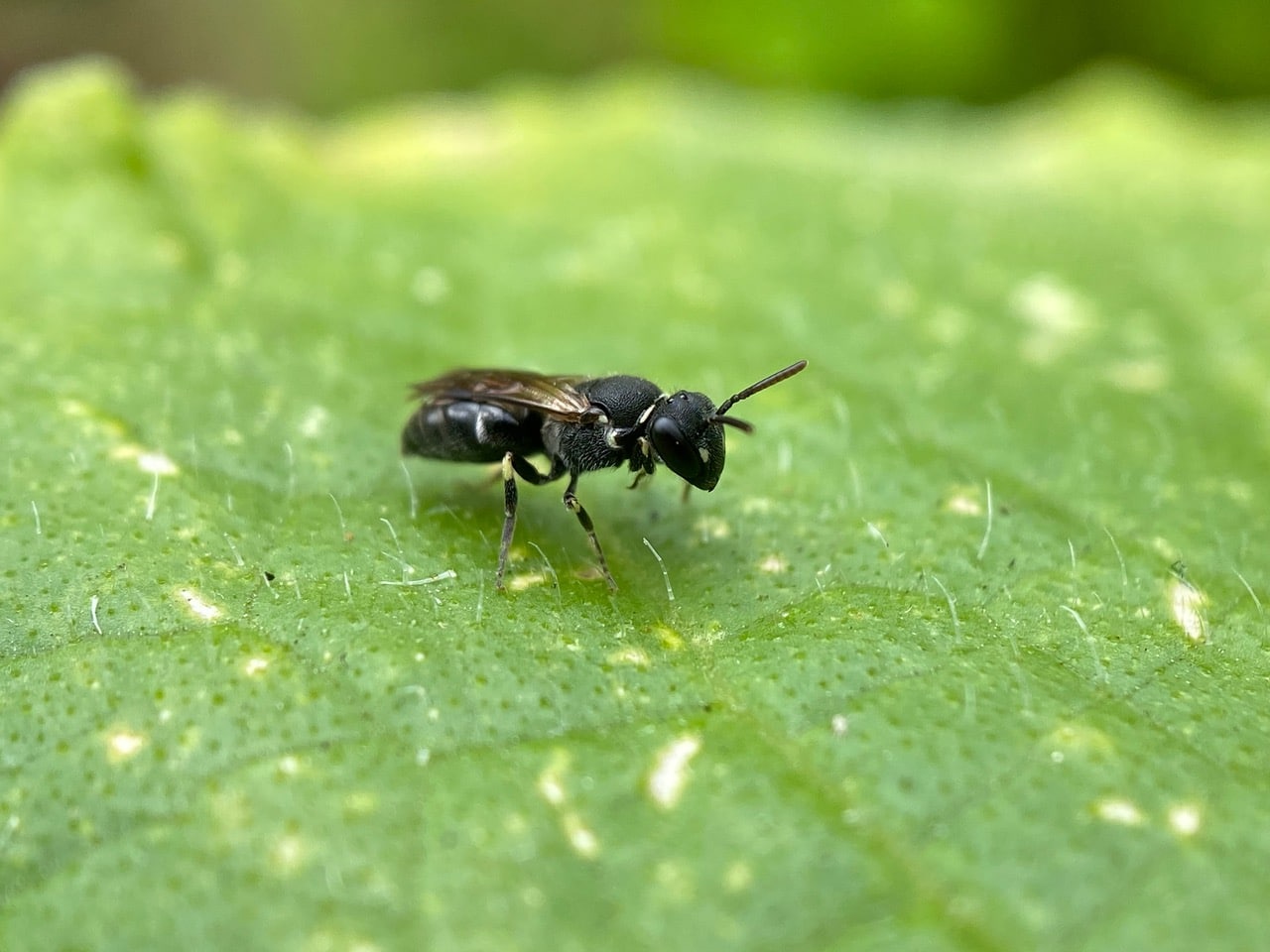
Close-up of a female Masked Bee, Hylaeus sp. (family Colletidae) stopping on a leaf of Cucumber.
Hylaeus (family Colletidae) are shiny, slender, hairless, and superficially wasp-like bees. They are small, 5 to 7 mm long, usually black with bright yellow or white markings on their face and legs. These markings are more pronounced on the males. Hylaeus do not carry pollen and nectar externally, they instead store their food in the crop and regurgitate it upon returning to their nests. They are primarily generalist foragers. Hylaeus are short-tongued, but their small body size enables them to access deep flowers. Hylaeus nest in stems and twigs, lining their brood cells with self-secreted cellophane-like material. They lack strong mandibles and other adaptations for digging, using instead pre-existing cavities made by other insects.