

Pollinator Post 9/18/26 (2)

A plump inchworm caterpillar of the Pug Moth, Eupithecia sp. (family Geometridae) is stretched out across a Grindelia flowerhead.
Inchworms are also called loopers and measuring worms. The majority of the inchworms are the larvae of moths in the family Geometridae. The name comes from the Greek “geo” for earth and “metro” from measure, because the caterpillars seem to be measuring the surface on which they are walking. The “looping” locomotion is mandated by the absence of prolegs in the middle section of the caterpillar’s body.
Eupithecia is the largest genus of moths of the family Geometridae. Occurring worldwide except for Australasia, species in the genus are commonly known as pugs. The caterpillars move in a looping manner and are commonly called inchworms. Adults are typically small, 12 – 35 mm, with muted colors. Most species rest with forewings held flat at right angles to the body, while the hindwing are largely covered by the forewings. They are generally nocturnal. Larvae mostly feed from the flowers and seeds of their food plants rather than the foliage. Many species have a very specific food plant. Many are commonly found on Asteraceae flowers.
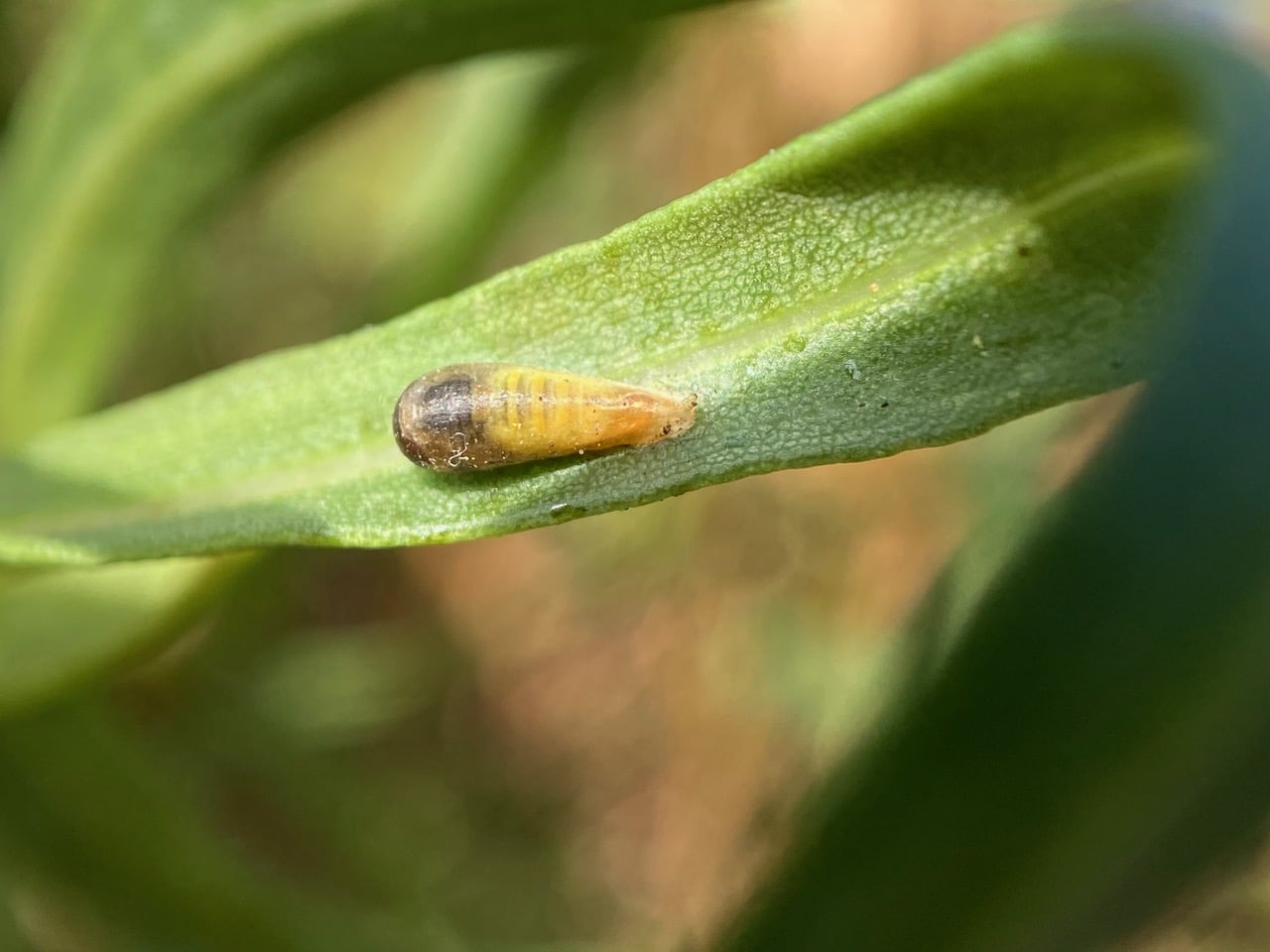
Ooh, that’s a hover fly pupa attached to a Grindelia leaf. Note the pair of tiny, short, snorkel-like appendages at the tapered rear end of the pupa. These are called posterior spiracles (or caudal spiracles), allowing the insect to take in oxygen. Because the hover fly pupates inside its final larval skin (forming a teardrop-shaped shell called a puparium), this prominent breathing structure remains visible at the tail end of the pupa.
Hover fly pupae (family Syrphidae) are the teardrop-shaped, transitional life stage where mature larvae metamorphose into adults. They often start out greenish and translucent before shifting to tan-brown or taking on the colors of the developing adult inside. Depending on the species, pupation happens directly on the host plant’s foliage near where the larvae fed on aphids, or down below in the loose soil, mulch, and leaf litter. Pupae need damp conditions or high humidity to successfully mature. If it is too dry, mature larvae crawl down into the soil to find moisture. The pupal stage typically lasts about one to two weeks before the adult hover fly emerges. Many species survive the cold winter months by remaining as pupae hidden in protected leaf litter or topsoil.
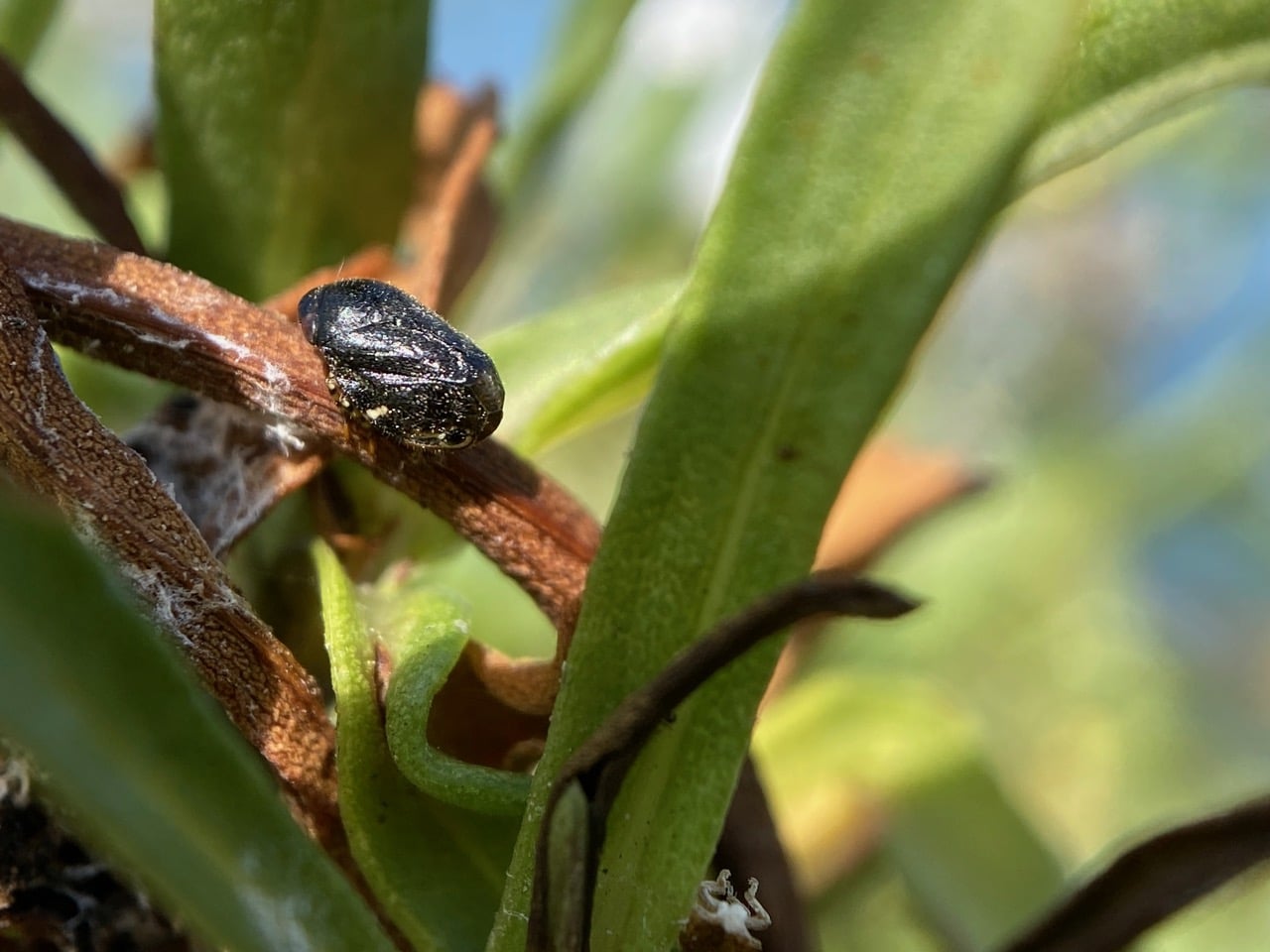
An adult male Spittlebug, Clastoptera lineatocollis (family Clastopteridae) is resting on a dried Grindelia leaf .
The Spittlebug, Complex Clastoptera lineatocollis (family Clastopteridae) is found in western United States. The bugs feed mostly on Asteraceae, although other hosts have been reported. Females are brownish (3.3-3.8 mm), while the smaller males (3.0-3.2 mm) are mostly black.
Unlike their young, adult spittlebugs (also known as Froghoppers) are efficient flyers and hoppers, feeding on diverse plant species. Using their piercing-sucking mouthparts, they pierce plant stems to feed on xylem. To get enough nutrients, they consume massive quantities of sap, drinking up to 280 times their body weight daily, resulting in high waste excretion. Froghoppers can cause damage by distorting plant leaves and causing shoot tips to die back. Froghoppers are champion jumpers among insects, out-performing even the fleas. The bug can leap the human equivalent of a skyscraper without a running start. It is the highest jumping insect proportional to body size. The muscles in its hind legs act like a “catapult” to release energy explosively.

When mature, the Spittlebug nymph crawls out of its frothy home to molt for the last time into an adult. Still clinging to its exuvia, this new adult Spittlebug is in the process of expanding and hardening its wings and new exoskeleton.
Why the common name of “spittlebug”? The nymphs (immatures) of these bugs create foam masses on plants in which they live and feed. Like the adults, the nymphs use their piercing, sucking mouthparts to feed on plant juices. The nymph produces a cover of foamed-up plant sap reminiscent of saliva, hence the common name of spittlebug. Whereas most insects that feed on sap feed on the nutrient-rich fluid from the phloem, Spittlebugs tap into the much more dilute sap flowing upward via the xylem. The large amount of excess water that must be excreted and the evolution of special breathing tubes allow the young spittlebug nymphs to grow in the relatively protective environment of the spittle. Symbiotic bacteria in the insects’ digestive system provides them with the essential amino acids that their diet lacks. The foam serves a number of purposes. It hides the nymph from the view of predators and parasites, and it insulates against heat and cold, and protects the delicate nymphs from desiccation. Moreover, the foam has an acrid taste that deters predators.

Here’s yet another teneral Spittlebug in a slightly more advanced stage of development. It has lowered its wings over its body. It still has a long wait for full coloration to set in.
A teneral insect is a young insect that has just molted (emerged from its final nymphal skin) but has not yet hardened its exoskeleton or achieved its final coloration. Teneral insects typically have paler or different colors than their mature counterparts. Over a short period (often hours), the insect’s exoskeleton hardens and darkens, a process similar to the tanning of leather. This period allows the insect to expand its body and limbs. Being soft, and unable to move much, tenerals are more susceptible to injury and predation.
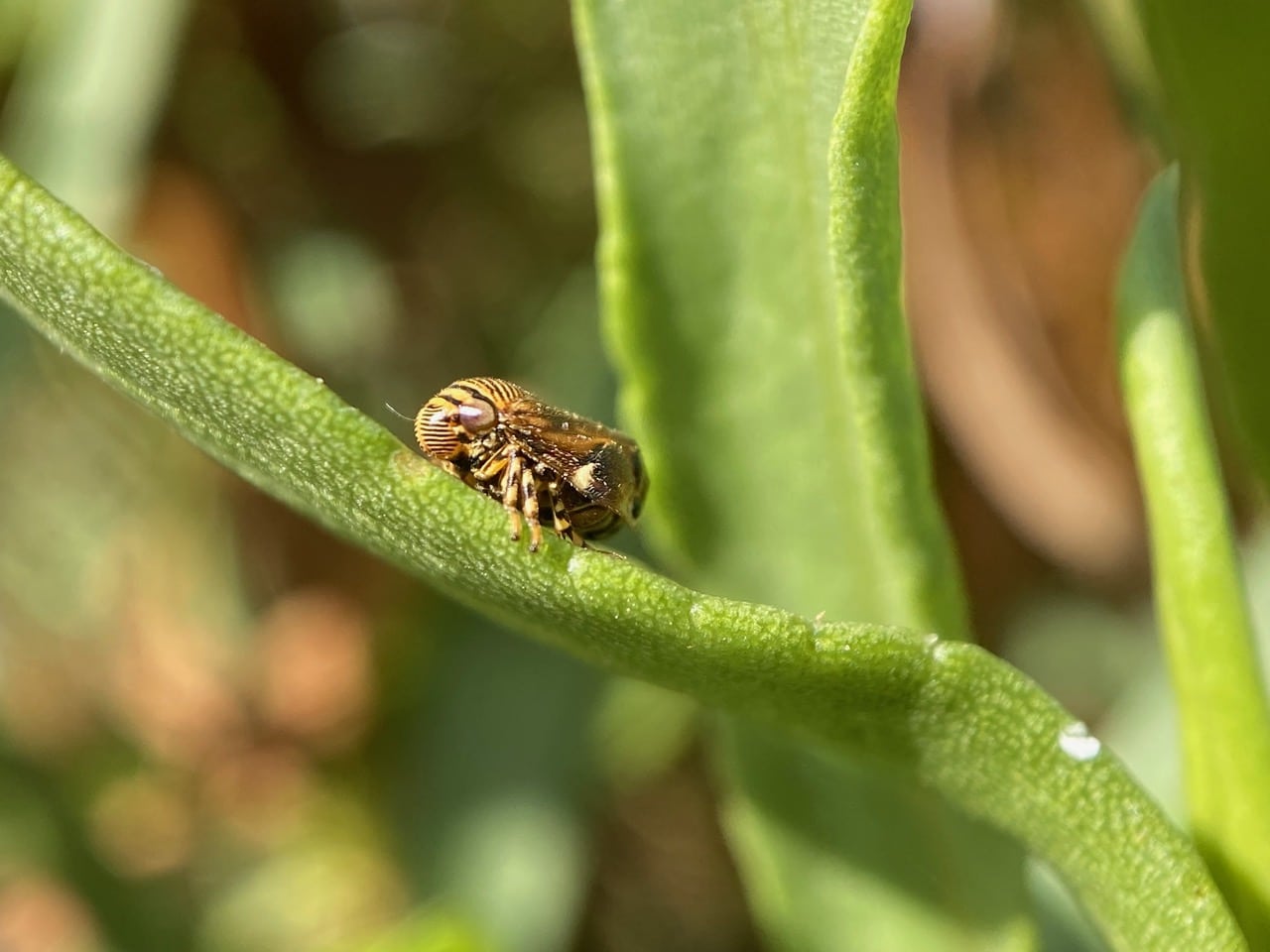
An adult female Spittlebug, Clastoptera lineatocollis (family Clastopteridae) is perched on the leaf of a Grindelia leaf. Note its bulbous snout.
Adult spittlebugs, also known as froghoppers, have a prominent, bulbous snout that houses a highly powerful, internal muscular pump used to suck plant sap. Because xylem sap is mostly water and contains very few nutrients, spittlebugs must drink vast quantities of it just to survive. Pulling xylem sap out of a plant requires immense negative pressure. The bulbous snout provides the physical space needed to pack in massive dilator muscles that serve as a high-speed hydraulic pump, allowing the insect to constantly pull in fluid.
Both the adult froghoppers and their juvenile nymphs share this facial structure, though the nymphs put the massive volume of processed fluid to a unique use – whipping the excess fluid out of their rear ends to build their famous, protective “spittle” bubble nests.
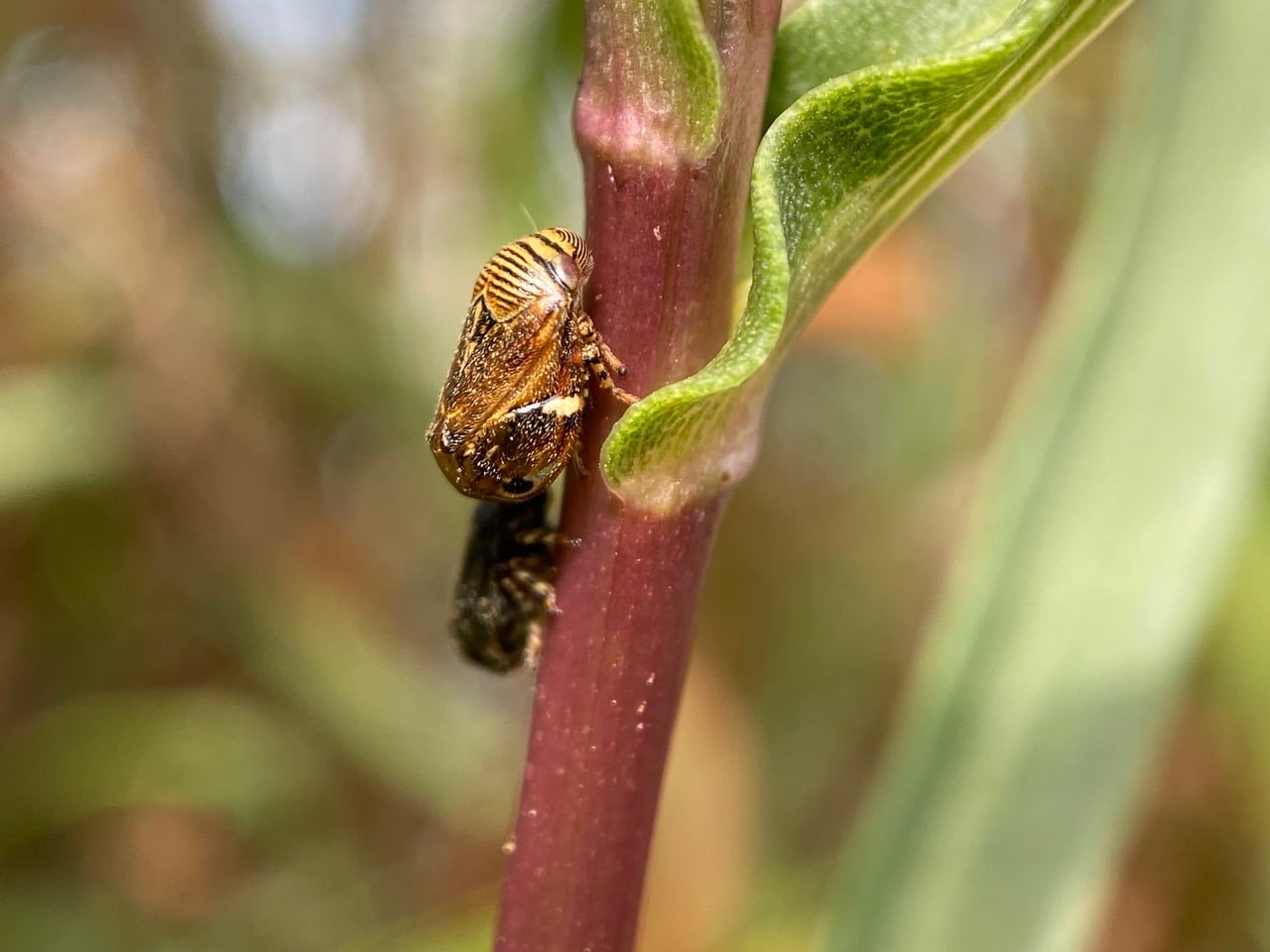
A male Spittlebug appears to be nuzzling the rear side of a female. Is this prelude to mating? The black male is only about half the size of the brown female.

The female lifts her abdomen and walks away up the stem.
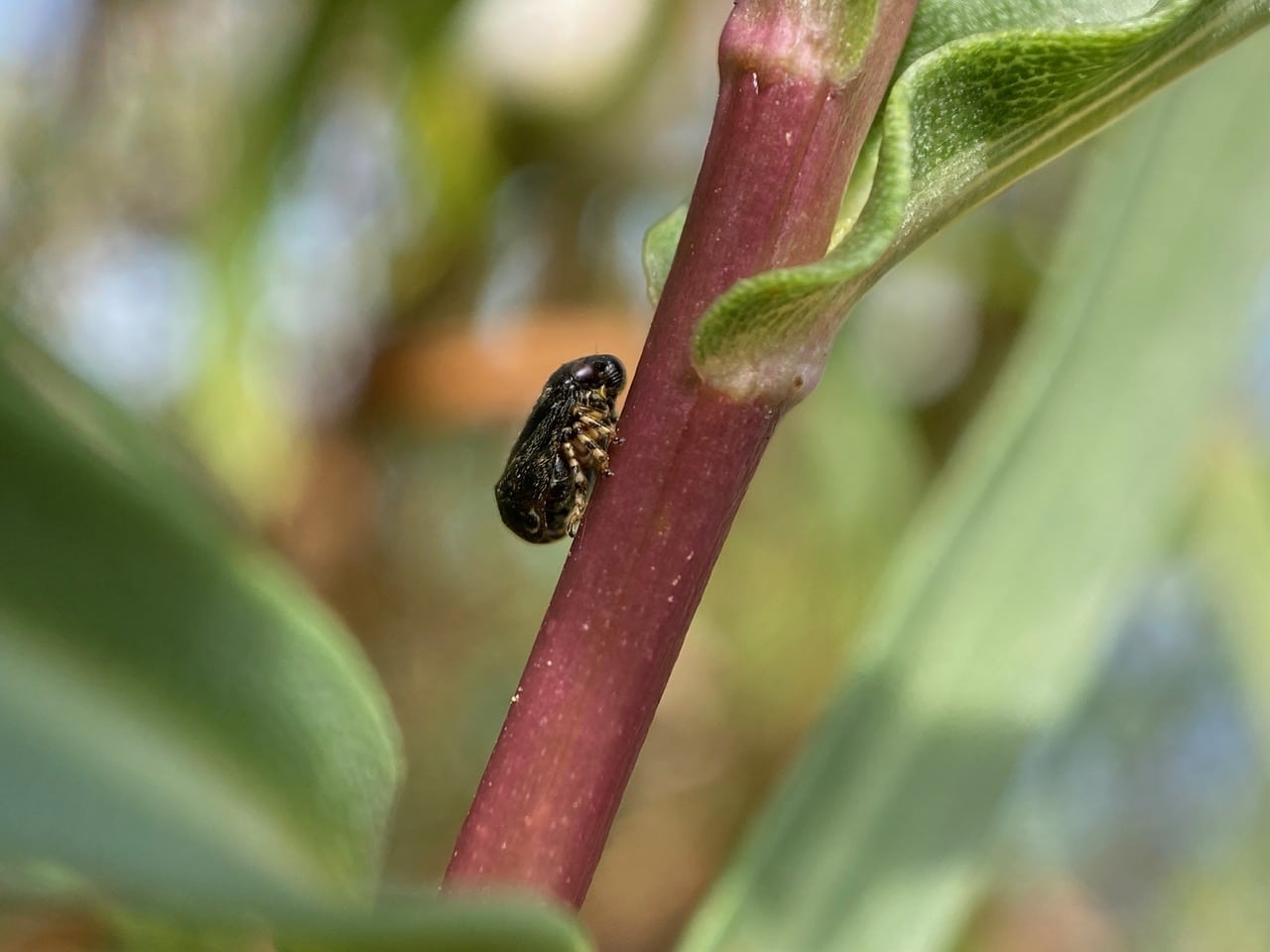
Sorry, little fella. Better luck next time!
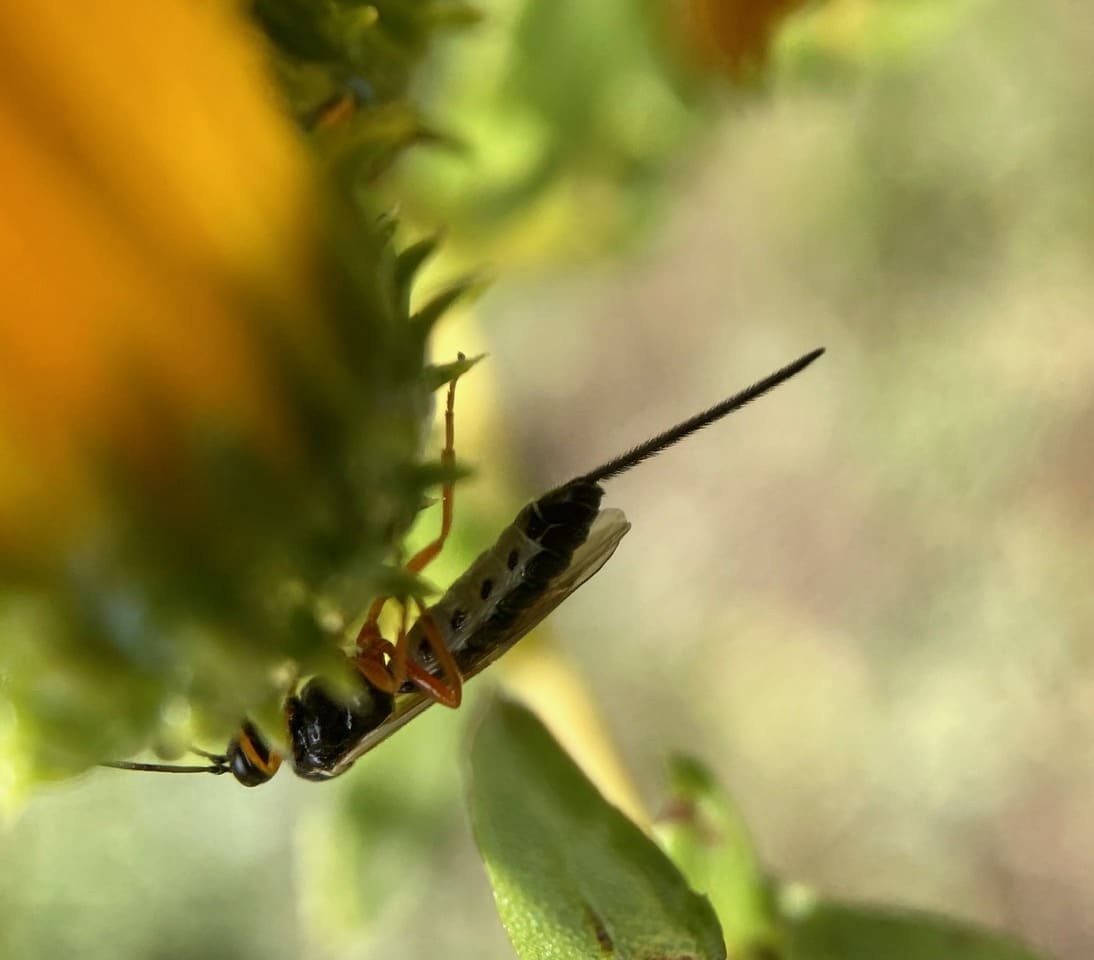
Before I have a chance to dial down the magnification on my camera, a small wasp lands to investigate an immature Grindelia flowerhead. The wasp is long and slender, with very long antennae and a long and sturdy ovipositor. A female parasitoid wasp in the family Ichneumonidae searching for a host? Getting the detailed view of the ovipositor is pure luck – I couldn’t have done it even if I tried. I had no idea that the outer protective sheath of the ovipositor is densely covered in short spines!
An outer pair of sheaths covers and supports the delicate ovipositor when it is not in use. The unsheathing of the ovipositor in a parasitic wasp involves the separation of the flexible protective external sheaths from the needle-like egg-laying organ (terebra) so the wasp can maneuver and insert it into a substrate. To unsheath the ovipositor, the wasp bends or flexes its abdomen and swings the protective sheaths away or loops them backward, exposing the bare needle-like stylet to touch and penetrate the host’s habitat. The actual drilling organ consists of three interconnected, sliding parts called valvulae. Once unsheathed, the individual valves slide back and forth against each other in an alternating push-pull pattern, which lets the wasp drill deep into wood or plant tissue without bending the slender organ.
The Ichneumonidae, also known as the Ichneumon Wasps, or Ichneumonids, are a family of parasitoid wasps. They are one of the most diverse groups within the Hymenoptera (the order that includes the ants, wasps and bees) with about 25,000 species and counting. Ichneumon Wasps attack the immature stages of insects and spiders, eventually killing their hosts. They play an important role in the ecosystem as regulators of insect populations.
The Ichneumon Wasps have longer antennae than typical wasps, with 16 segments or more as opposed to 13 or fewer. Ichneumonid females have an unmodified ovipositor for laying eggs. They generally inject eggs either directly into their host’s body or onto its surface, and the process may require penetration of wood. After hatching, the Ichneumonid larva consumes its still living host. The most common hosts are larvae or pupae of Lepidoptera (butterflies and moths), Coleoptera (beetles) and Hymenoptera. Adult Ichneumonids feed on plant sap and nectar. Females spend much of their active time searching for hosts while the males are constantly on the look out for females. Many Ichneumonids are associated with specific prey, and Ichneumonids are considered effective biological controls of some pest species.
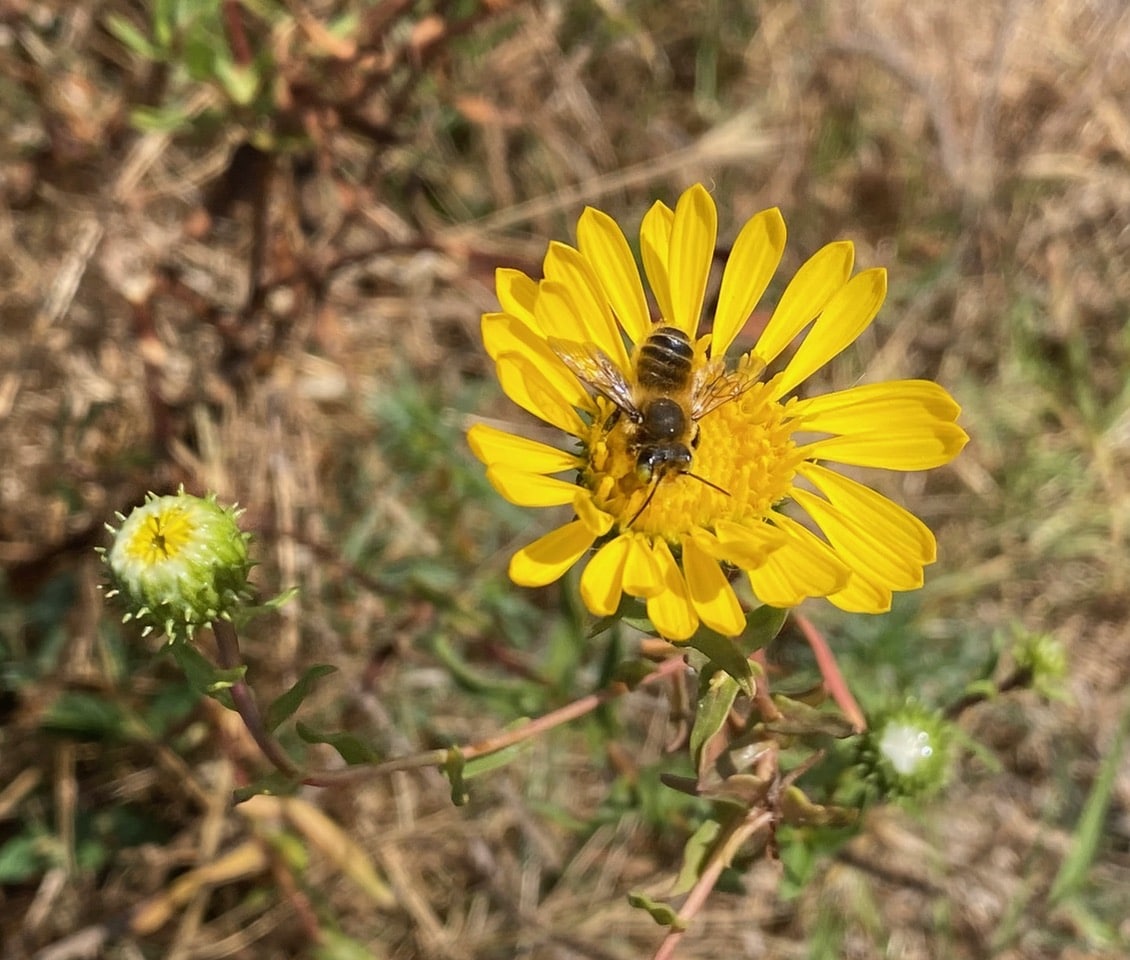
A male Western Leafcutter Bee, Megachile perihirta (family Megachilidae) has landed on a Grindelia flowerhead.
Leafcutter Bees, Megachile sp. (family Megachilidae) are stout-bodied, usually with pale hair on the thorax and stripes of white hairs on the abdomen. Females usually have a triangular abdomen with a pointed tip, and males’ faces are covered with dense, pale hair. Flight season is from May into September, with peak activity from June to August. Solitary females construct nests in tubular cavities, including hollow stems, tree holes, and abandoned beetle burrows in wood. Many use holes drilled into wood, straws, or other manufactured tunnels. Females cut pieces from leaves or flower petals for use in the construction of brood cells. Most Megachile females are generalist foragers, but prefer flowers in the family Asteraceae.
North America is home to many leafcutter bees, but the Western Leafcutter, Megachile perihirta is one of the largest. The species ranges on the west coast from British Columbia south to northern Mexico. From a distance, the female can be mistaken for a honey bee. She is about the same size as a worker honey bee and enjoys many of the same flowers, but her head is disproportionately large because it houses the bulky muscles that operate her large mandibles. While most leafcutter bees nest above ground in tubes and tunnels, the Western Leafcutter nests underground. Often a small group of females live in a community and burrow into soil, gravel, or sand.

Luscious berries are ripening on the vines of Armenian Blackberry, Rubus armeniacus.
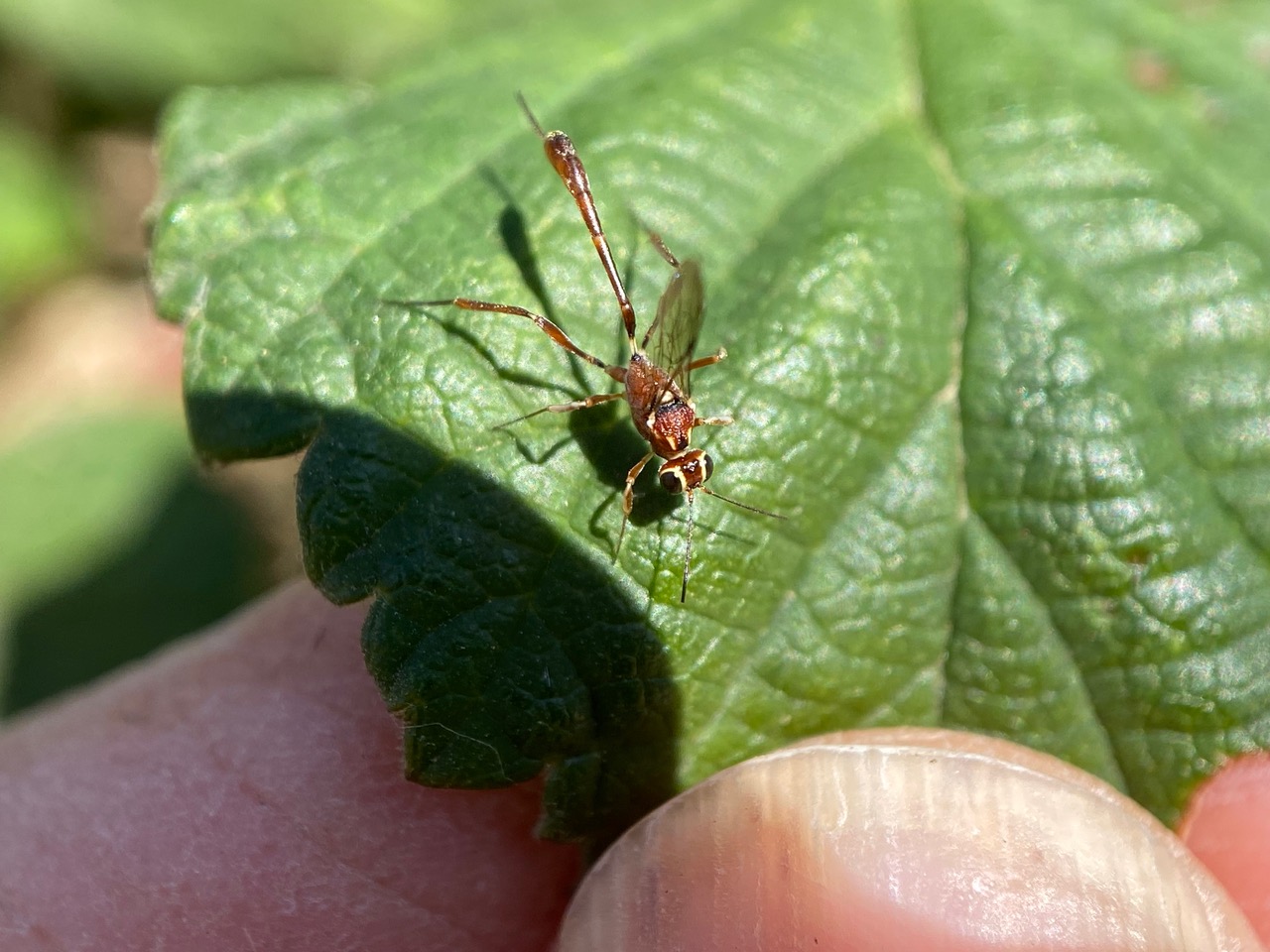
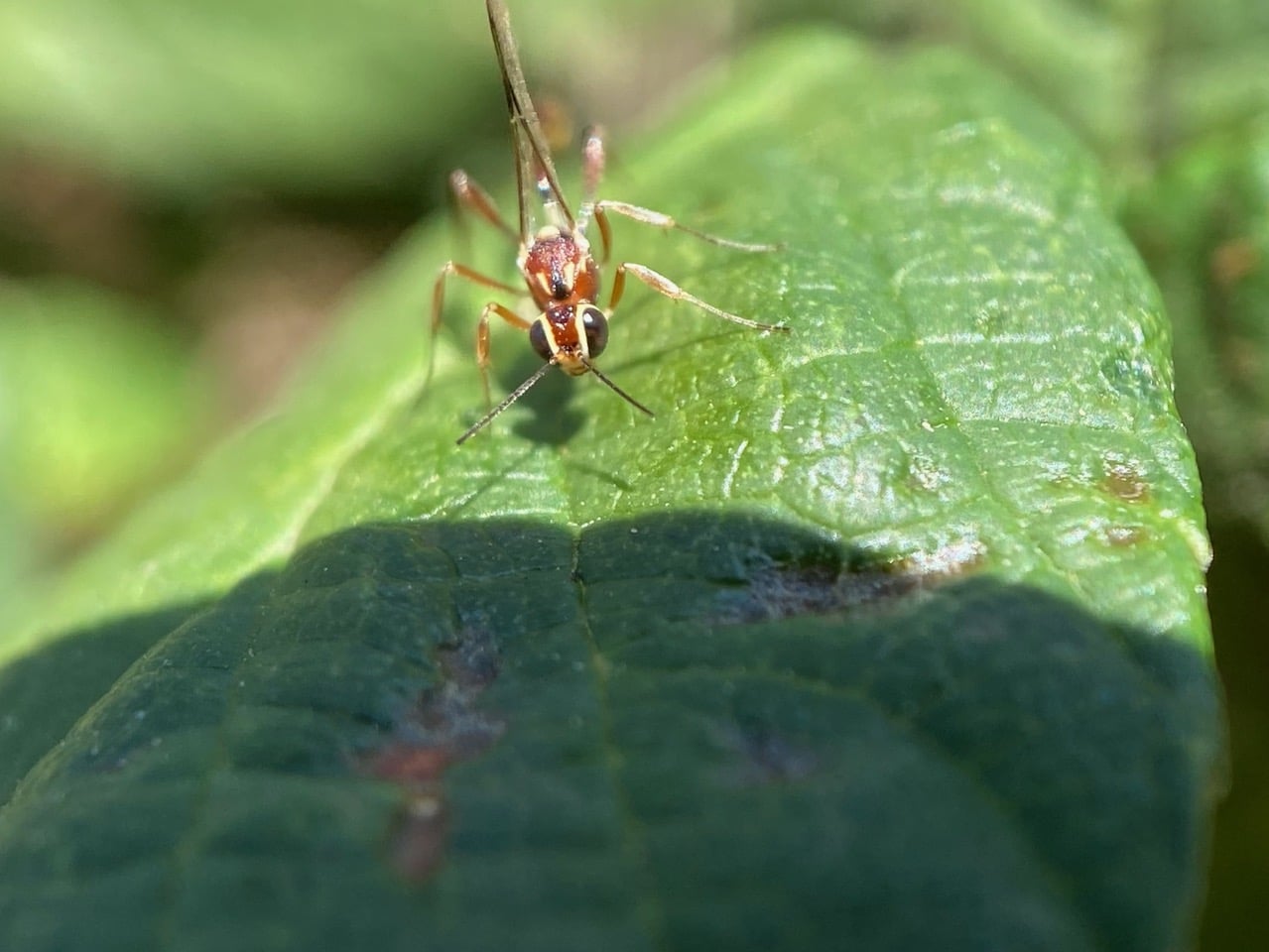
As I am photographing the blackberries, I notice 4 or 5 small and seriously slender wasps moving around on the leaves of the plant, their heads lowered as if feeding on something on the leaf surface. The yellow rings around their eyes tell me that these are parasitoid wasps in the genus Anomalon (family Ichneumonidae).

Anomalon is a large genus of parasitoid wasps in the family Ichneumonidae. The wasps are present worldwide, but most diverse in tropical regions. In the Americas they are mostly found in very wet rain forests. Recorded hosts include tenebrionid (darkling beetle) or elaterid (click beetle) larvae, and noctuid and tortricid moth larvae. Adult Anomalon wasps feed primarily on flower nectar, pollen, and plant sap.
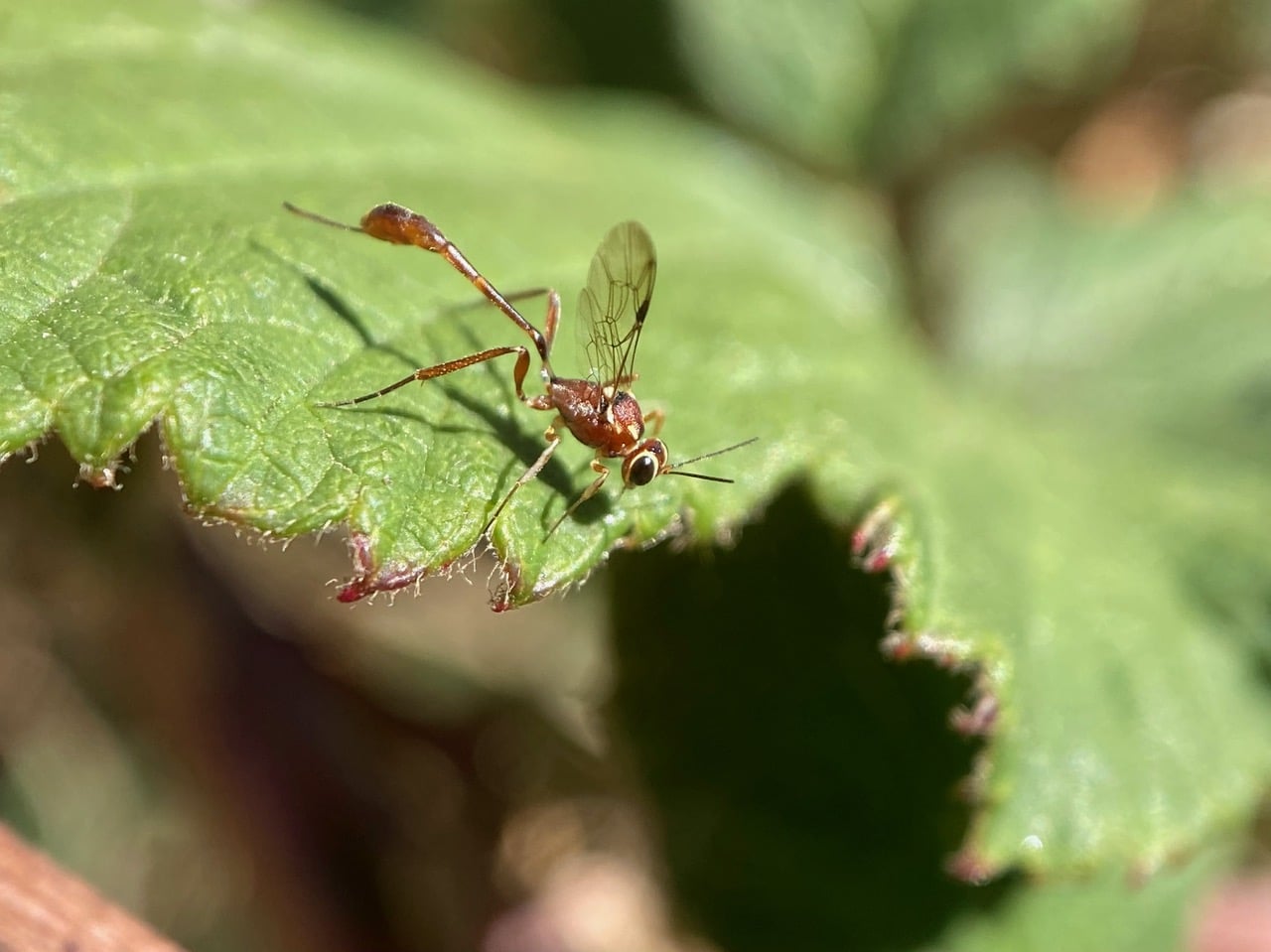
It’s not often that I get such clear views of Anomalon, a mere wisp of a wasp.

There’s another kind of wasp running around on a leaf of the same Blackberry plant. It is small, all black, and has a squarish, boxy head. iNaturalist has helped identify it as a Typical Aphid Wasp in the genus Pemphredon (family Pemphredonidae).
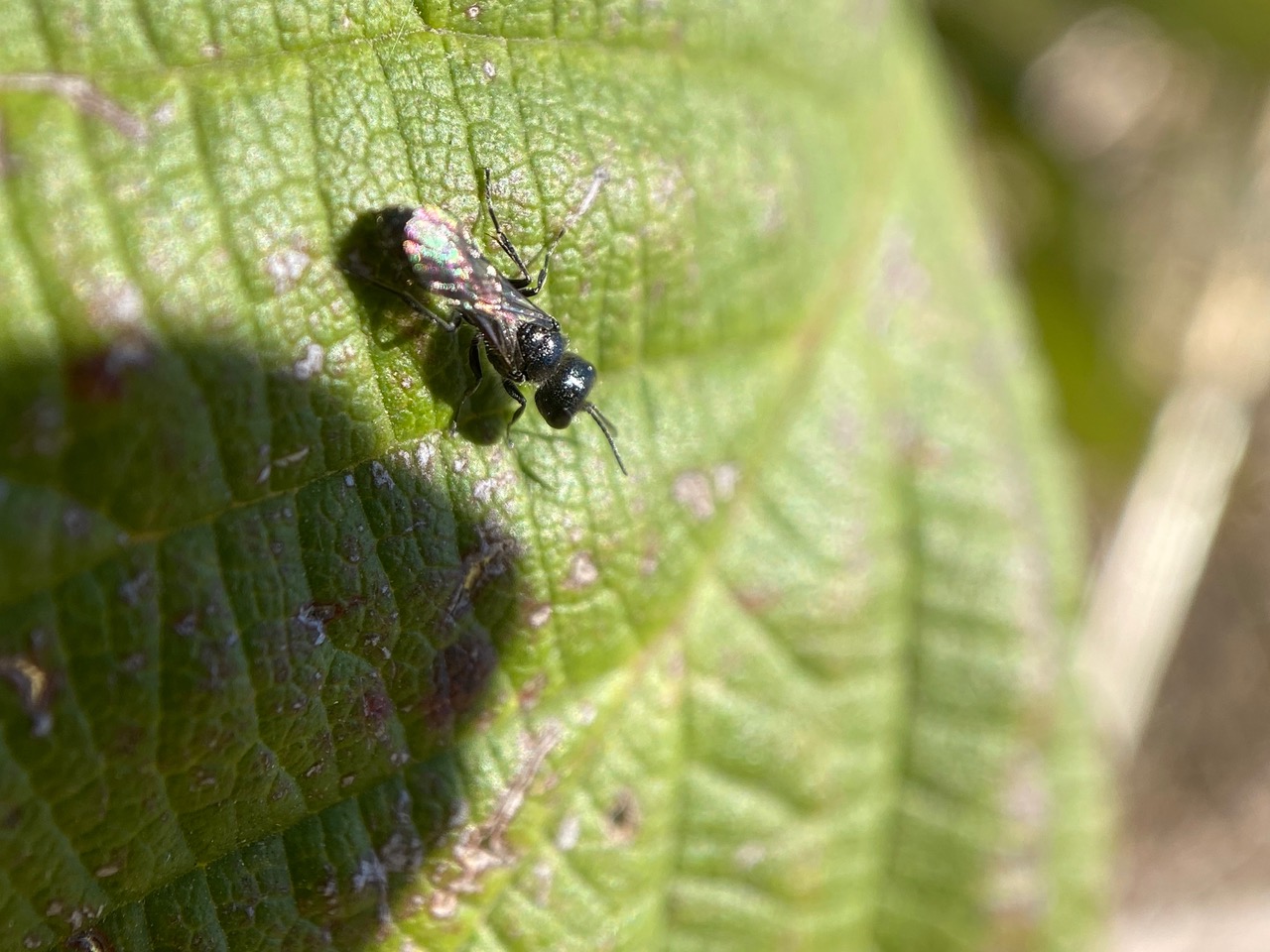
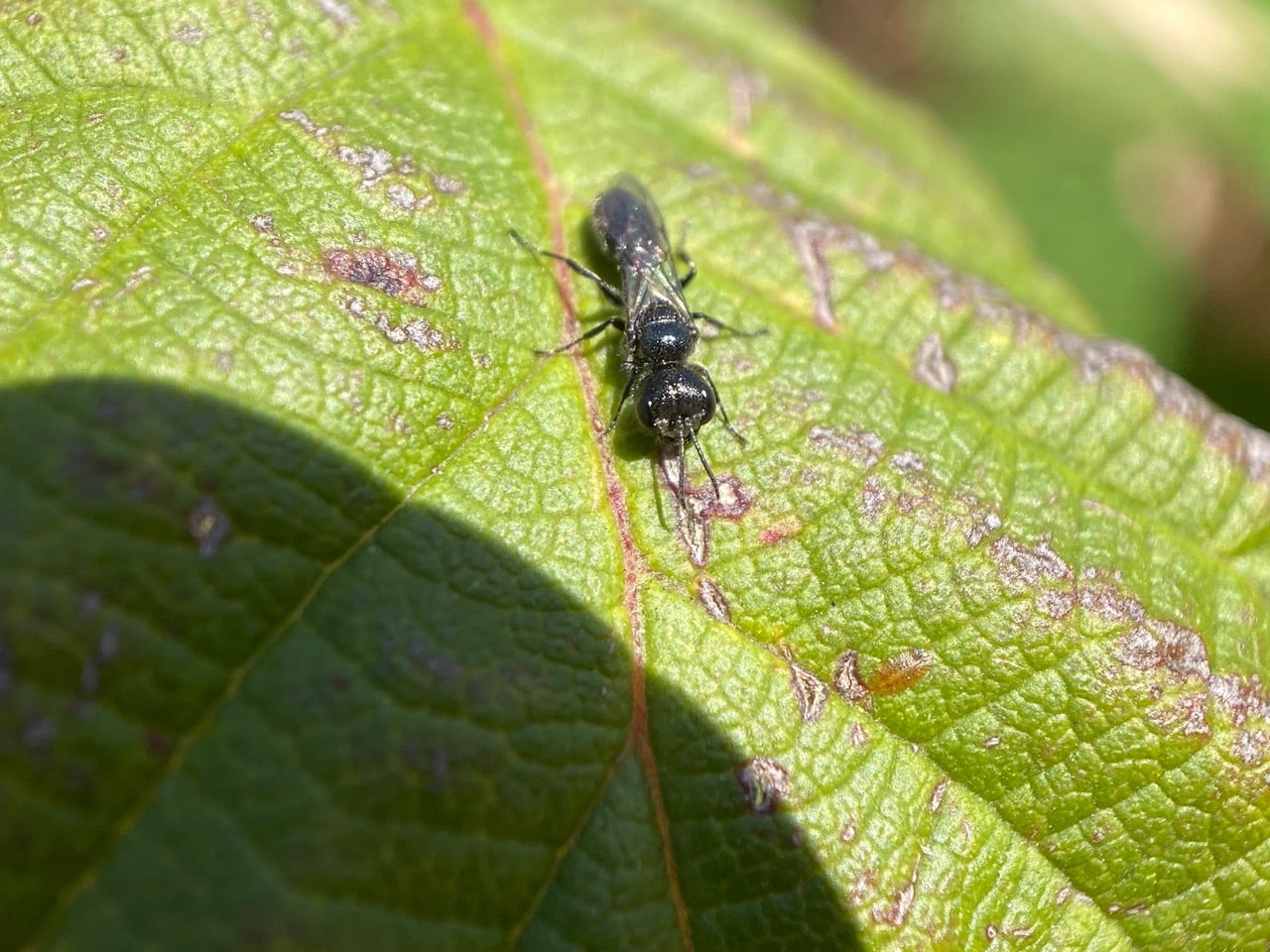
The Pemphredon species are often small and black. They are hunting wasps that use aphids for prey. The females usually build their nests in hollow or pithy stems. Partitions between nest cells are made of chewed pith material. Prey are located by the female wasp who grasps a single aphid, paralyzes it by stinging, and returns to the nest. Each cell is provisioned with about two dozen aphids. She then lays an egg on the aphids and seals the cell with a plug of chewed pith. Larvae that hatch out feed on the aphids, and emerge as adults after pupation in the nest. Adults emerge in reverse order of when eggs were laid. Female eggs are laid first, toward the back of the nest. Pemphredon develops proterandric, which means that the males hatch a few days before the females. The adults feed on honeydew, but sometimes also on the aphids themselves.
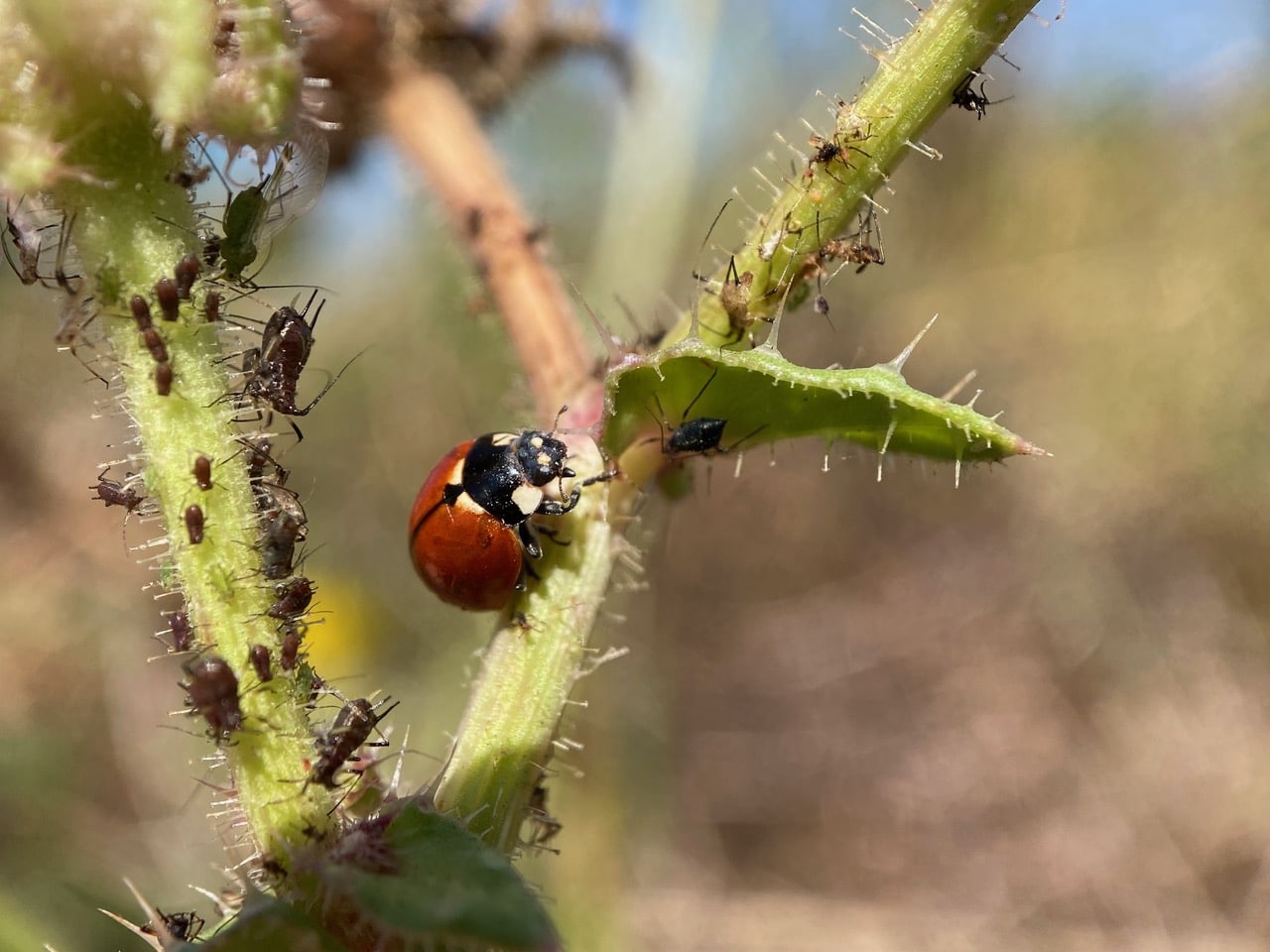
Here’s another aphid hunter, a California Lady Beetle, Coccinella californica (family Coccinellidae) on a Bristly Oxtongue infested with a robust colony of Sow-thistle Aphids, Uroleucon sonchi (family Aphididae) .
The California Lady Beetle, Coccinella californica has a red elytra that is usually spotless. Pronotum is black with a white patch on each side. Head is black with two small white spots between the eyes. There is a black suture (where the wings meet, down the middle of the back). The species’ range is the coastal counties north of the Transverse Ranges. Both adults and larvae are voracious predators of aphids and other soft-bodied insects.

The lone female Coyote Brush is already releasing its plumed seeds. Since there are few fresh flowers left, the insect activity on the plant has diminished considerably since my last visit.
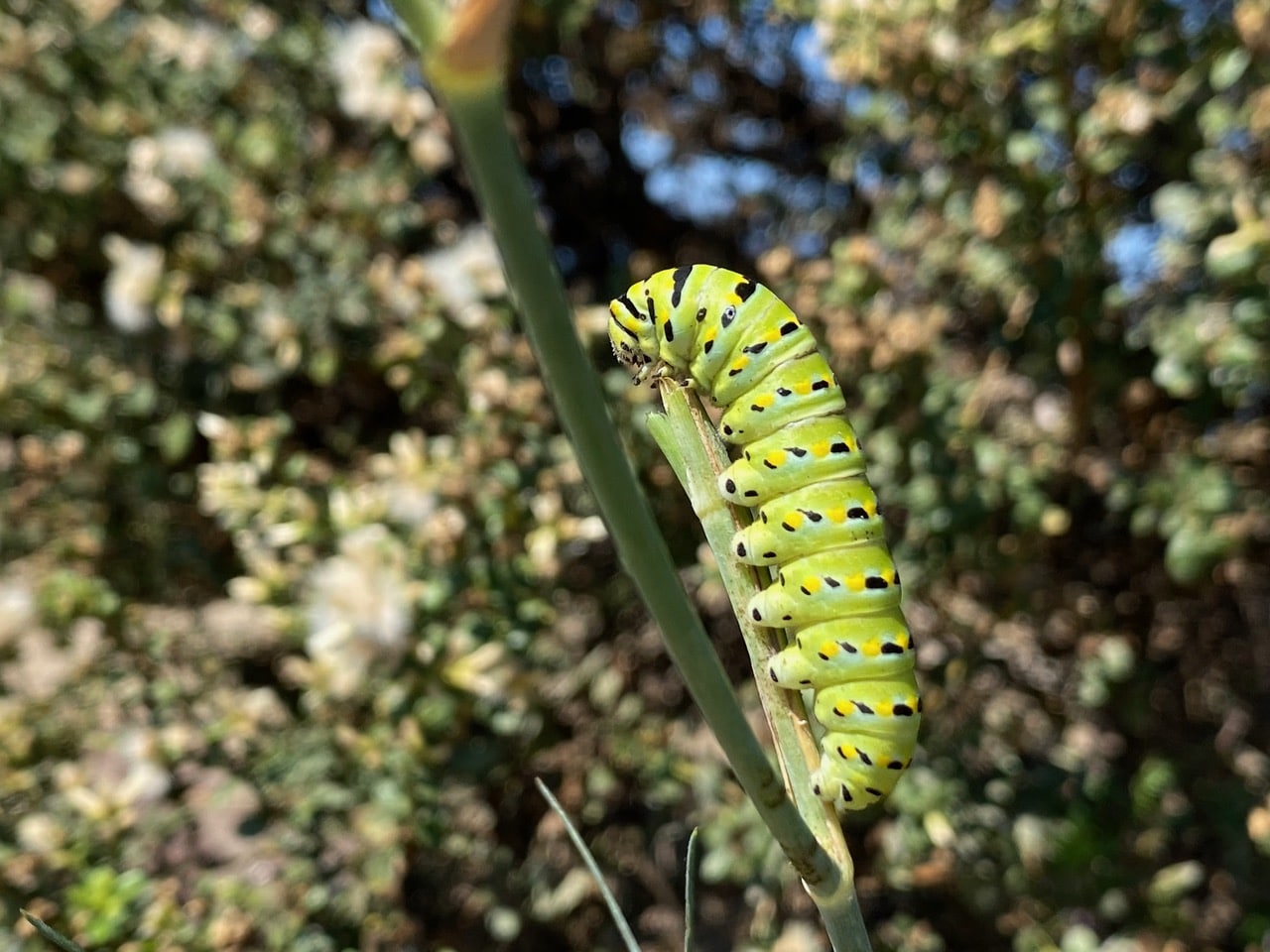
I look down at the small Fennel plant next to the Coyote Brush, and am thrilled to be greeted by this sight. A plump, fifth-instar caterpillar of Anise Swallowtail about 2 inches long is perched on a broken vertical stem. It appears to be close to pupation!
The Anise Swallowtail, Papilio zelicaon (family Papilionidae), is a common swallowtail butterfly of western North America. It is found in fairly open country, most likely seen on bare hills or mountains, in fields or at the roadside. Adult females lay eggs singly on the underside of host plant leaves. In the first two instars, the caterpillar is a bird poop mimic – dark brown, almost black, with an irregular white band at its middle. After that it becomes more green at each successive molt until, in the fifth (last) instar, it is predominantly green, with markings in black, orange, and light blue. Its major food plants are members of the carrot family, Apiaceae (including Fennel), and also some members of the citrus family, Rutaceae.
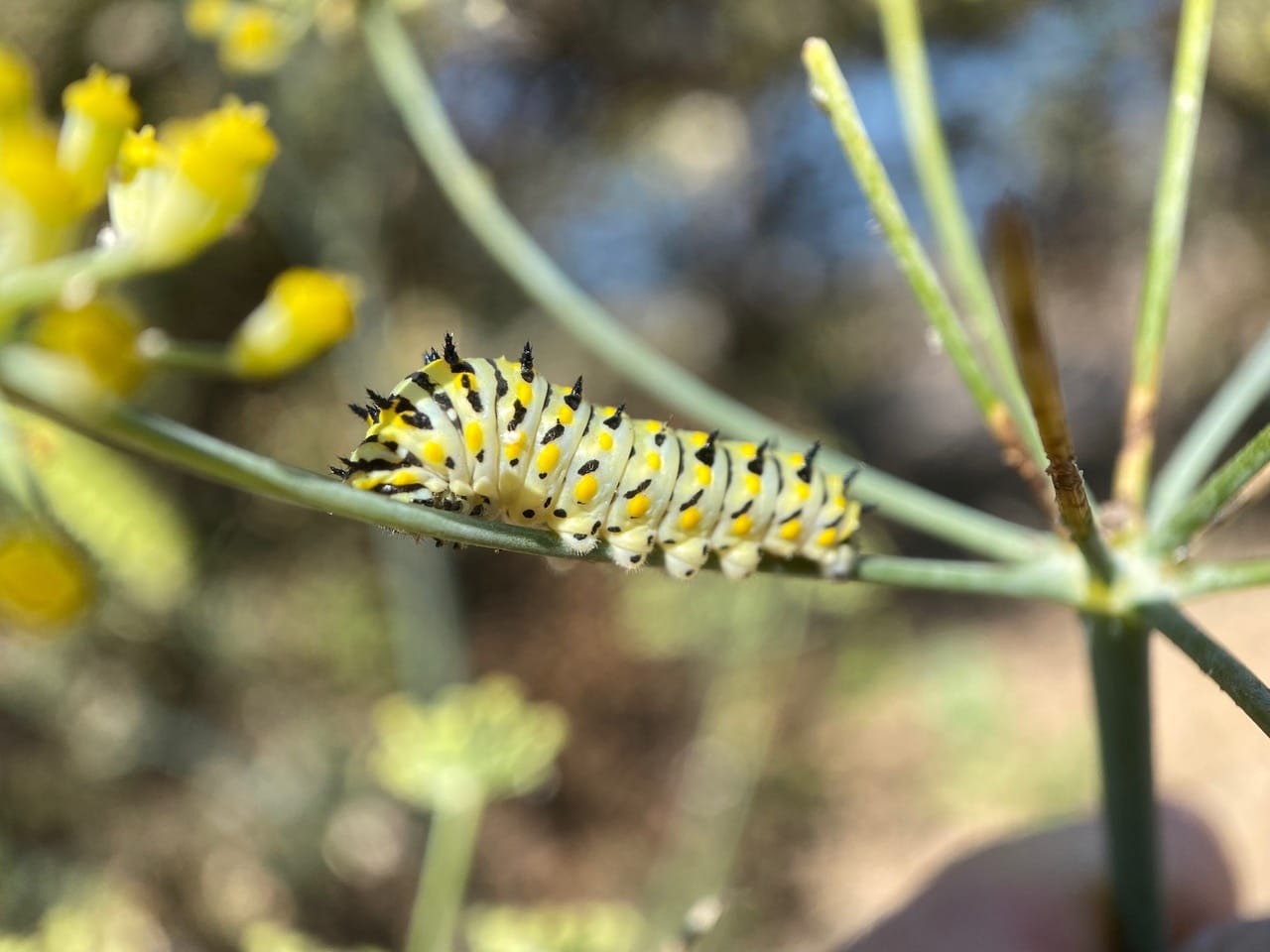
As I carefully check the rest of the plant, I am delighted to find three more Anise Swallowtail caterpillars, all in their fourth instar, more yellow than green. They are about 3/4 in. long.
Instar is the term given to the developmental stage of an insect between molts. For example, after hatching from the egg an insect is said to be in its first instar. When the insect molts it is then a second instar and so on.
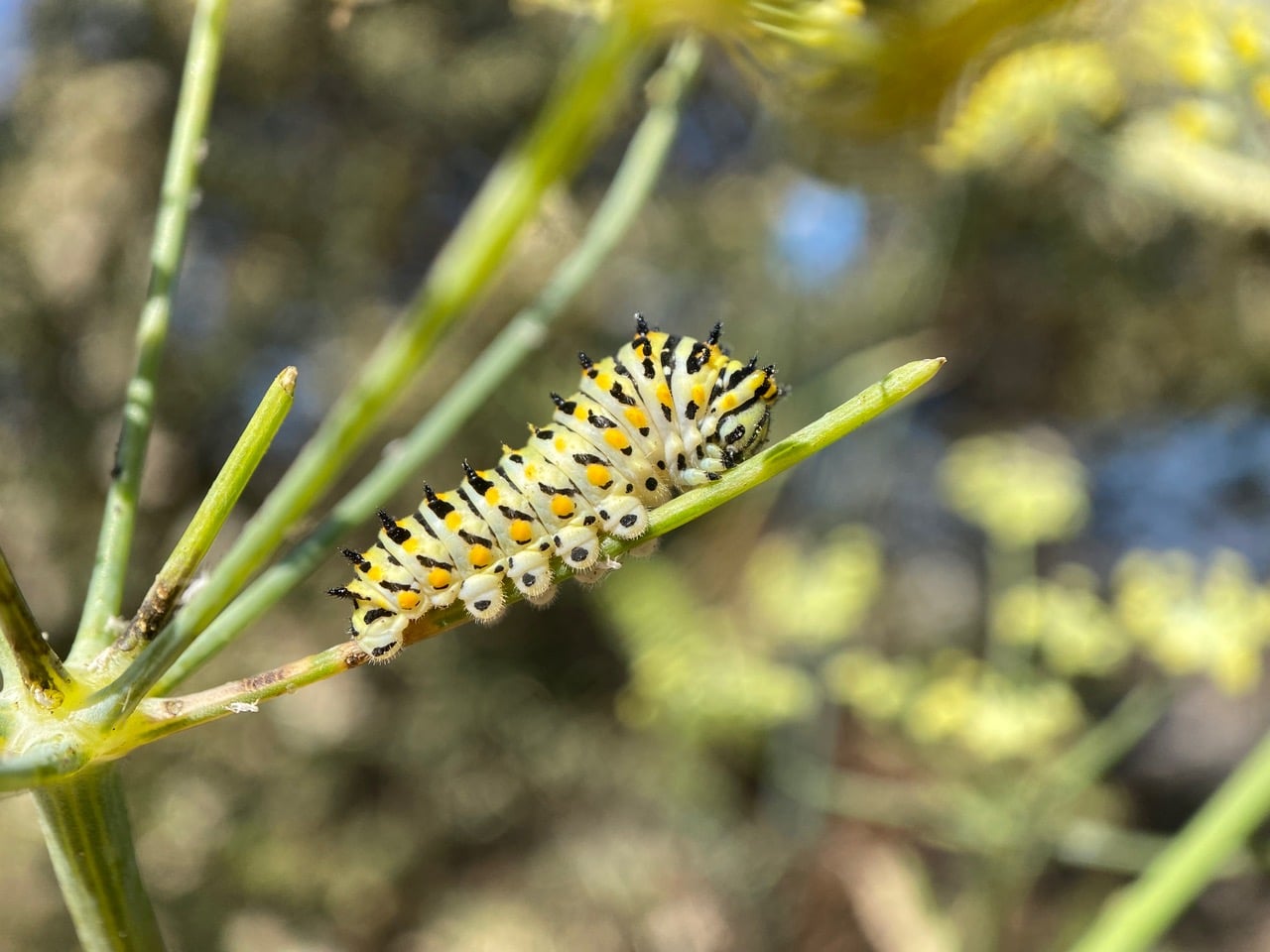
Note the feeding scars left by the hungry caterpillar, and the missing umbels of flowers.
Clustered close to the caterpillar’s head, under the thoracic segments are three pairs of jointed thoracic legs with claws. Behind them under the abdominal segments are several fleshy nubbins, the prolegs. The thoracic legs will be retained in the adult butterfly after metamorphosis, while the prolegs will disappear. Unlike true legs, prolegs are soft extensions of the body wall and lack the rigid segments and joints. The bottom of each proleg features tiny hooks called crochets. These work like microscopic Velcro or grappling hooks to hold tightly onto leaves and stems. Most common caterpillars have up to five pairs of prolegs on their abdomen. These anchor the back and middle parts of the body securely, allowing caterpillars to hang upside down or climb smooth surfaces.
