

Pollinator Post 9/18/26 (1)

The bay is calm when I arrive in late morning at Bay Farm. I have walked this stretch of the shoreline hundreds of times and am by now quite familiar with the vegetation and the insects on them. But I always keep an open mind and heart for new discoveries.
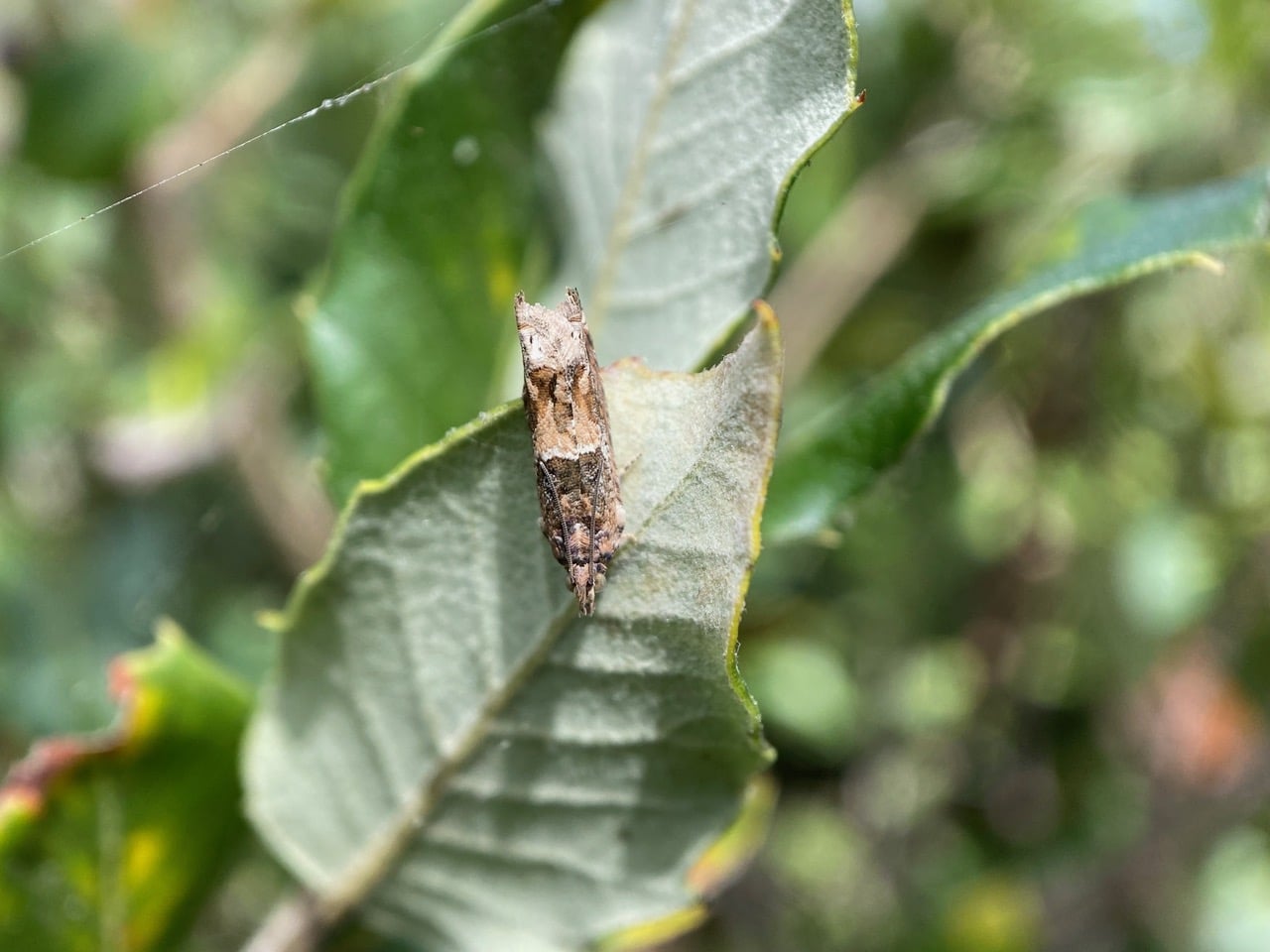
As I stand in front of a big bushy Holm Oak, a small moth flies erratically by and lands on the back of a leaf. iNaturalist has helped identify it as a Leafroller moth in the genus Crocidosema (family Tortricidae).
The Tortricidae are a family of moths, commonly known as tortrix moths or leafroller moths. Tortrix Moths are generally small, with a wingspan of 3 cm or less. Many species are drab and have mottled and marbled brown colors. The typical resting posture is with the wings folded back, producing a rather rounded profile. Tortrix moths hold their wings over their abdomens in a bell shape when at rest and have protruding mouthparts that resemble a snout. Tortricid eggs are often flattened and scale-like.
Crocidosema is a genus of small tortrix moths. They are mostly small, inconspicuous moths with brown or gray forewings, distinct wing vein traits. They are primarily found in the Southern Hemisphere and the Neotropics, though certain species have spread globally. One species is a major agricultural pest in Central and South America targeting soybeans and cultivated larvae tunnel into stems and feed on terminal buds. Another widely distributed species has larvae that feed on plants in the Malvaceae family like cotton and mallow. Crocidosema lantana is utilized internationally as a biological control agent for invasive Lantana plants. I have to laugh as Alameda is probably the Lantana capital of the world, with the ornamental blooming year round on every street corner!

Hooker’s Evening Primrose, Oenothera elata continues to bloom along the shoreline. Amazingly this hardy native is able to hold its own among the invasive plants that dominate this altered habitat.
Hooker’s Evening Primrose, Oenothera elata (family Onagraceae) is usually biennial, completing its life cycle in two growing seasons. It can reach 6 feet in height. Native to California, it is found along roadsides, in moist meadows, or in woodland. At the top of reddish stems are open clusters of 2-4 inch wide yellow flowers with 4 large petals and protruding yellow stamens and 4-branched pistil. The fragrant flowers open at dusk and close up during mid-morning the next day, turning orange with age.
The flowers of Evening Primrose open at night and have most of the characteristics associated with night-pollination by moths: they are large with nectar glands at the bottom of a deep flower cup, and their reproductive parts extend beyond the petals. The pale flowers are visible to night-pollinators; they are also sweetly scented as an additional guide at night. Pollinators brush against the reproductive structures when they go into the base of the flower after nectar. Sphinx moths are the most significant pollinators for the evening primrose that bloom at night. Their long tongues enable them to reach the nectar deep within the flower. As they feed, pollen is transferred from one flower to another. Oenothera elata is also pollinated by specialist bees active at dawn and dusk such as the twilight-foraging Evening Primrose Sweat Bees. These bees have evolved specialized hairs on their legs to collect the distinctive stringy pollen.
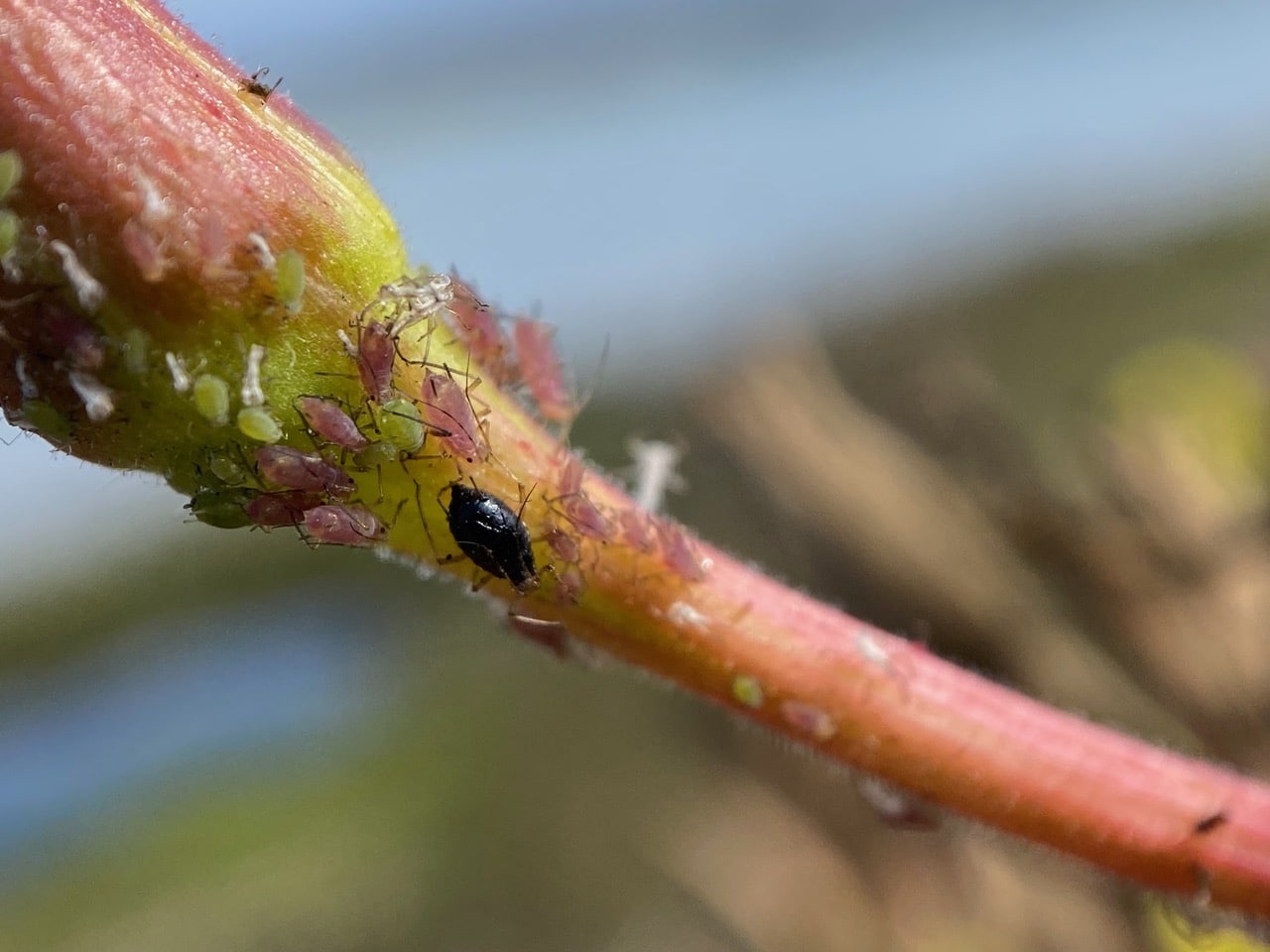
Tiny green and pink aphids cover the base of a flower bud of Hooker’s Evening Primrose. iNaturalist has helped identify these as the Beeblossom Aphid, Macrosiphum gaurae (family Aphididae). Scattered among the colony are occasional bloated black aphids. These are aphid “mummies” – aphids that have been parasitized by a parasitoid wasp in the family Aphelinidae.
The Beeblossom Aphid, Macrosiphum gaurae is an aphid endemic to the North American continent, ranging from the east coast to the west coast of North America. There are two forms: a pink form and a green form. They both have the same features, with black siphunculi (“tailpipes”). The species uses evening primrose and beeblossom as its main host plants.
The bloated, black aphid has been parasitized by a wasp in the family Aphelinidae. The mother wasp uses her ovipositor to inject a single egg and symbiotic polydnaviruses into an aphid. The wasp larva hatches and slowly consumes the aphid’s non-vital organs while it is still alive. Right before the larva pupates, it kills the host aphid. The chemical interaction between the wasp and the aphid’s cuticle causes the aphid to swell into a balloon-like, shiny black “mummy”. The wasp pupates safely inside the black shell. Once mature, it chews a perfectly round exit hole in the rear of the mummy to escape and hunt for new aphids.
Not all aphid wasps turn their hosts black – wasps from the subfamily Aphidiinae (family Braconidae) tend to leave behind tan, gold, or brown mummies. Together, these two families of parasitoid wasps are highly effective natural pest control agents for gardens and agriculture.
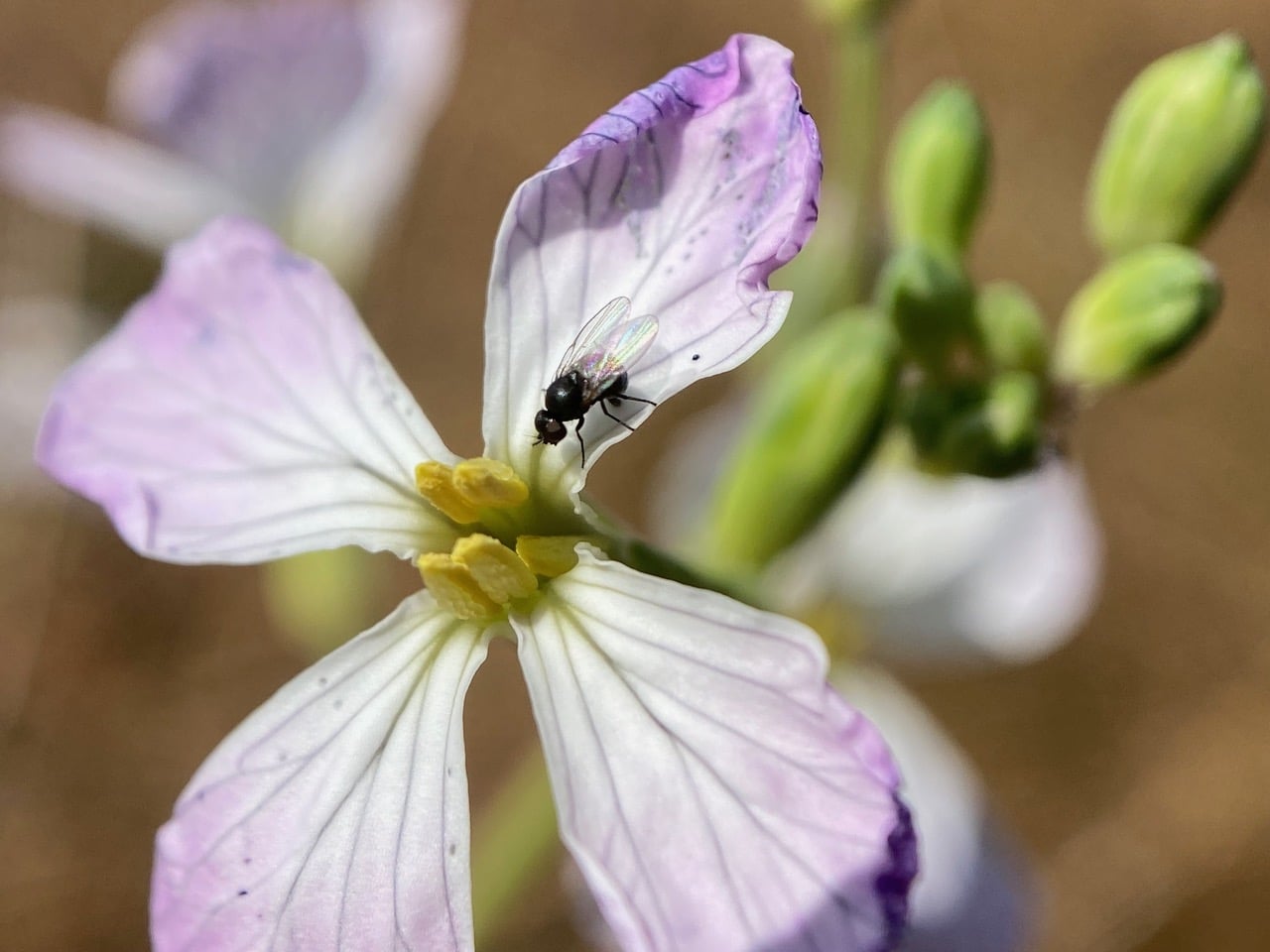
A tiny dark fly is resting on a flower petal of Wild Radish. It is a Leaf-miner Fly, Melanagromyza sp. (family Agromyzidae).
The Agromyzidae are a family commonly referred to as the Leaf-miner Flies, for the feeding habits of their larvae, most of which are leaf miners on various plants. They are small flies, most species in the range of 2-3 mm. Agromyzidae larvae are phytophagous, feeding as leaf miners, less frequently as stem miners or stem borers. A few live on developing seeds, or produce galls. There is a high degree of host specificity. A number of species attack plants of agricultural or ornamental value, so are considered pests. The shape of the mine is often characteristic of the species and therefore useful for identification. Adults occur in a variety of habitats, depending on the larval host plants.

Many of the Bristly Oxtongue, Helminthotheca echioides growing along the shoreline are host to thriving colonies of Sow-thistle Aphids, Uroleucon sonchi (family Aphididae).
The Sow-thistle Aphid, Uroleucon sonchi (family Aphididae) is native to Europe, and has been introduced to several other countries. It primarily feeds on the sow thistle (genus Sonchus), but also on many plants in the Asteraceae family, including cultivated lettuce.
Aphids (family Aphididae) are small sap-sucking insects in the order Hemiptera (true bugs). A typical life cycle involves flightless females giving live birth to female nymphs, – who may also be already pregnant, an adaptation called telescoping generations – without the involvement of males. Maturing rapidly, females breed profusely so that the population multiplies quickly. Winged (alate) females may develop later in the season, allowing the insects to colonize new plants. In temperate regions, a phase of sexual reproduction occurs in the autumn, with the insects often overwintering as eggs.
Aphids usually feed passively on phloem of plants. Once the phloem vessel is punctured, the sap, which is under pressure, is forced into the aphid’s food canal. Aphids produce large amounts of a sugary liquid waste called “honeydew”. A fungus called sooty mold can grow on honeydew deposits that accumulate on leaves and branches, turning them black.
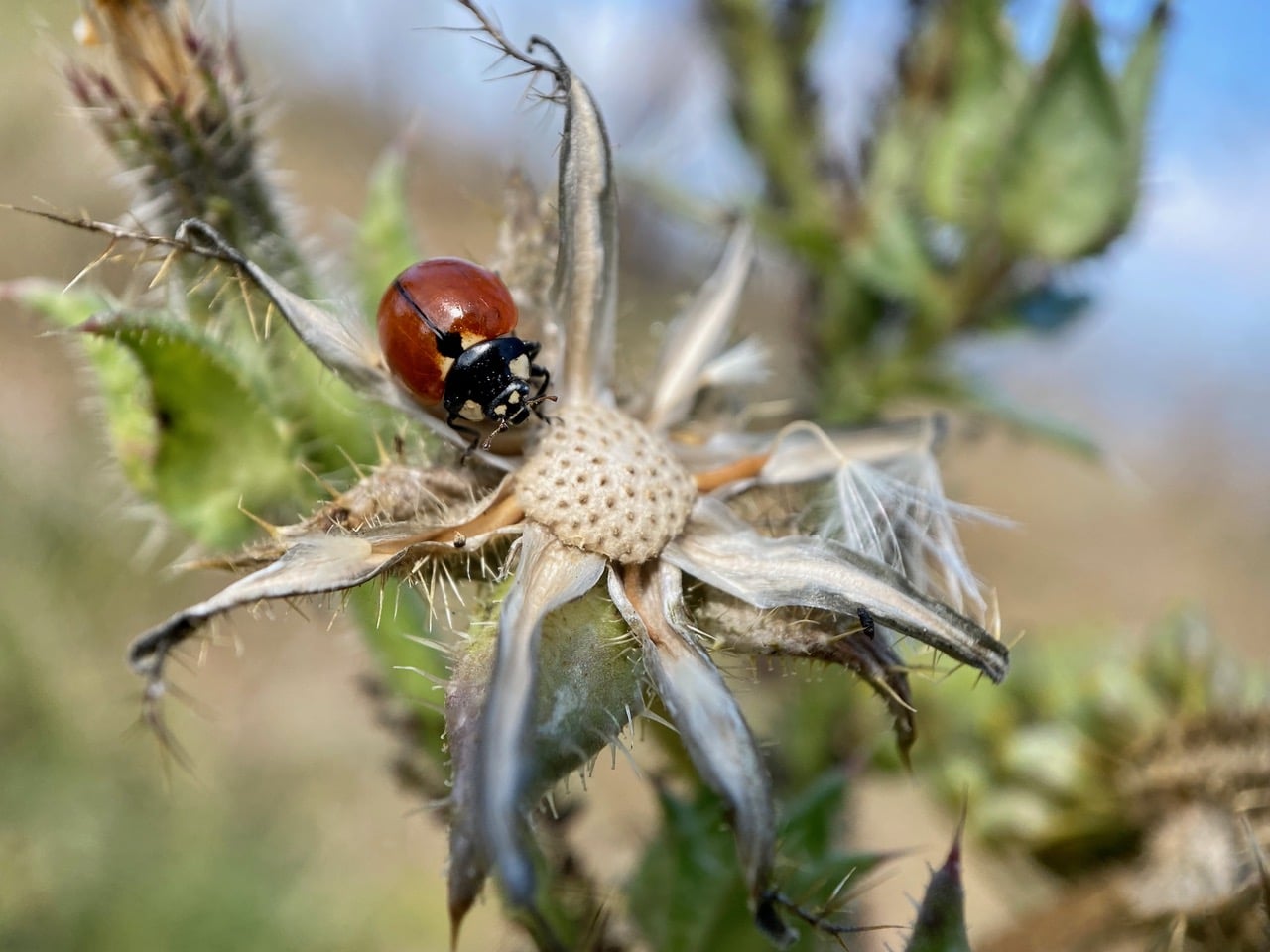
A California Lady Beetle, Coccinella californica (family Coccinellidae) is resting on a spent seed head of Bristly Oxtongue.
The California Lady Beetle, Coccinella californica has a red elytra that is usually spotless. Pronotum is black with a white patch on each side. Head is black with two small white spots between the eyes. There is a black suture (where the wings meet, down the middle of the back). The species’ range is the coastal counties north of the Transverse Ranges. Both adults and larvae are voracious predators of aphids and other soft-bodied insects.
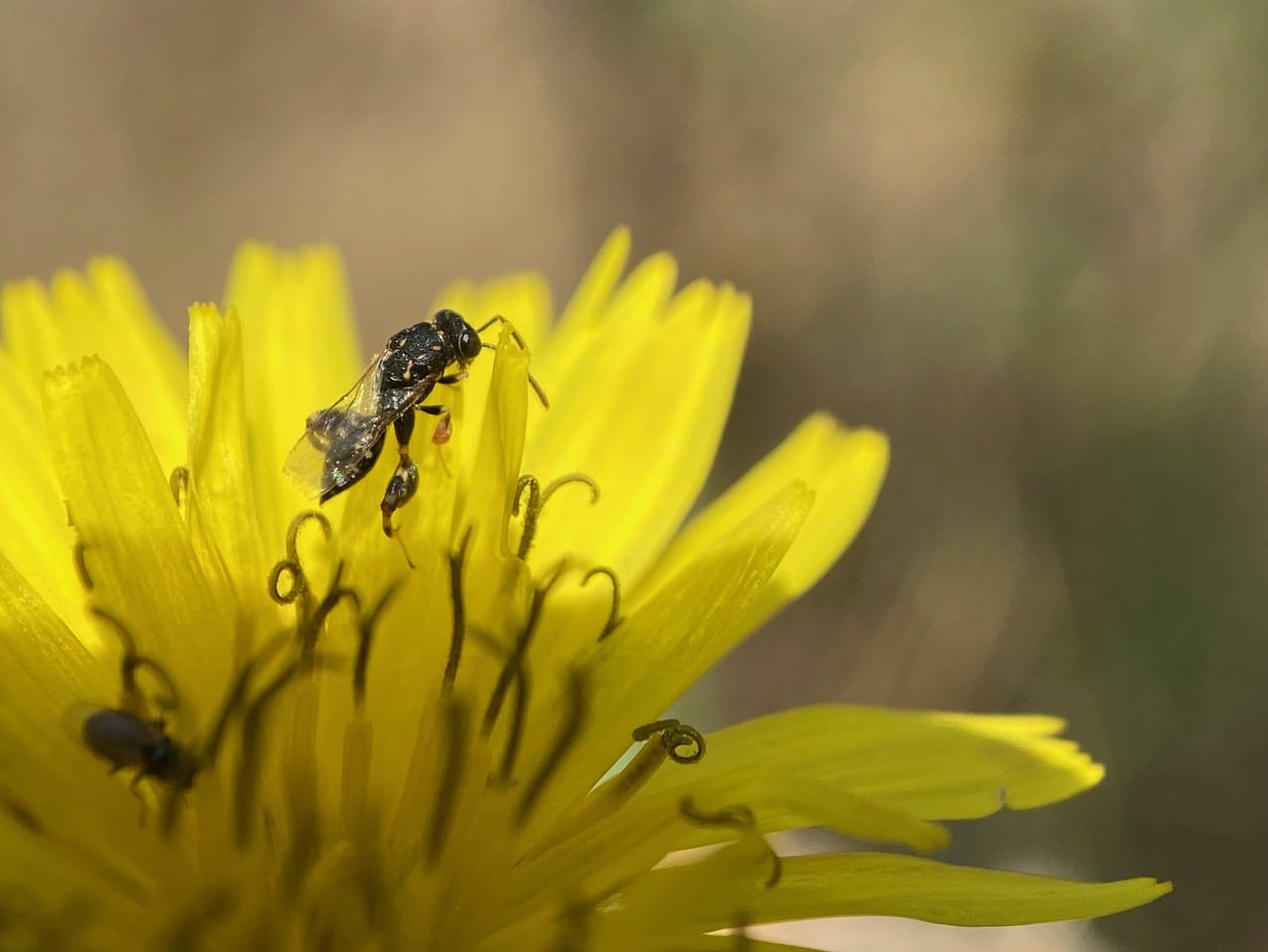
My heart misses a beat when I spot this tiny wasp in a Bristly Oxtongue flowerhead. I have first seen this strange looking creature three years ago at Skyline Gardens, but have not come across another one since.

Note the wasp’s “thunder thighs” – the greatly enlarged femur and the bow-shaped tibia under it. These features help to place it in the genus Conura (family Chalcididae).
Conura wasps are a large genus of tiny, colorful parasitoid wasps in the family Chalcididae, known for their greatly swollen hind legs. They are generally very small, usually about 4-7 mm in length. The hind femurs are massively swollen and often feature small teeth or spikes along the underside, used to hold onto hosts. The hind tibia is characteristically curved or arched so it can fit snugly against the swollen femur when the leg is folded. This specialized leg structure contains a huge flexor muscle that allows the wasp to launch into a powerful jump to escape danger before taking flight.
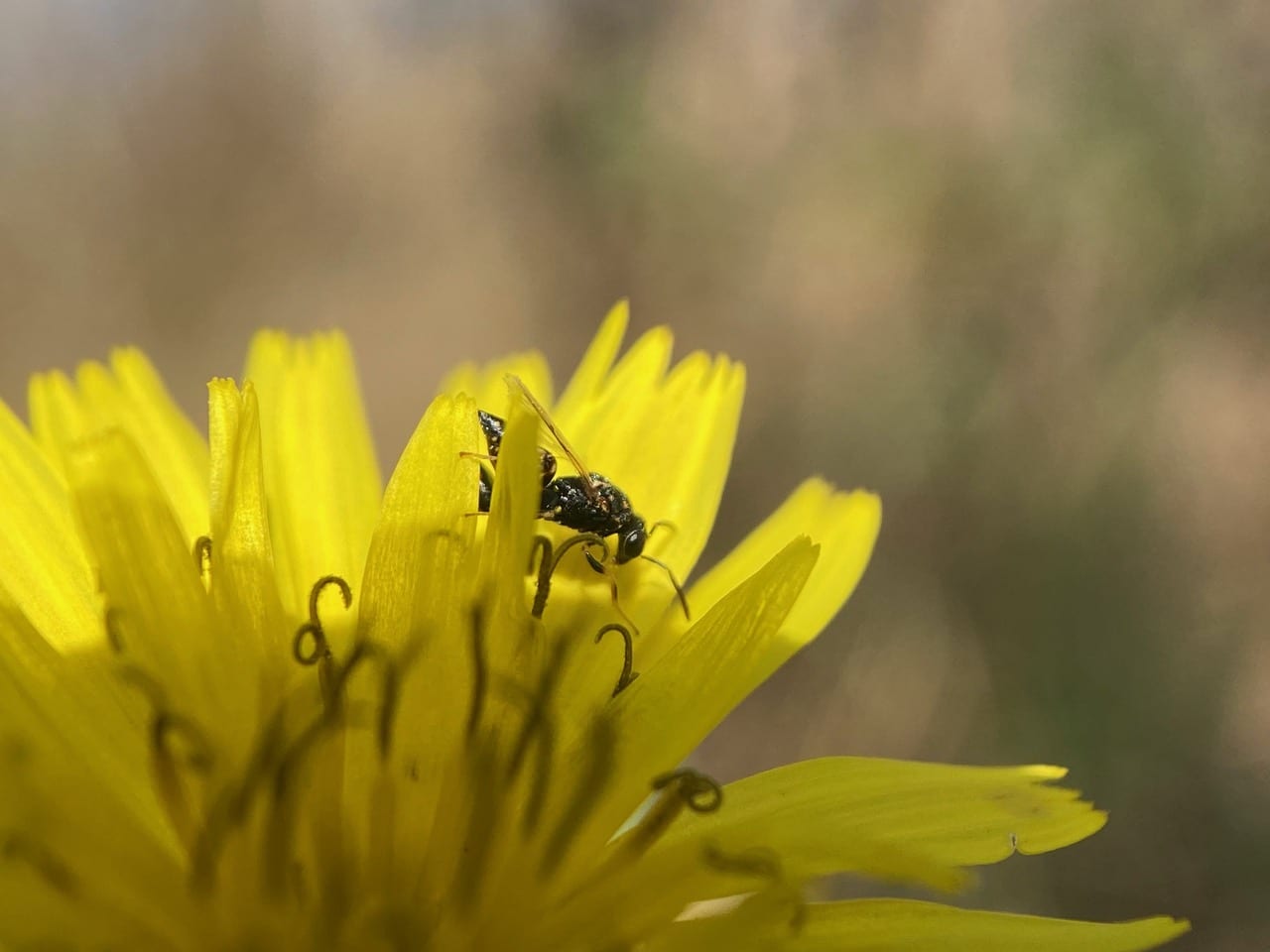
These compact, heavily armored wasps are parasitoids. Females lay their eggs directly inside the pupae of other insects, notably butterflies and moths while others target certain beetles or flies. Some act as hyperparasitoids (parasitizing other parasitic wasps). The wasp larva hatches, consumes the host pupa from the inside, and eventually pupates inside the dead host’s shell before emerging as an adult.
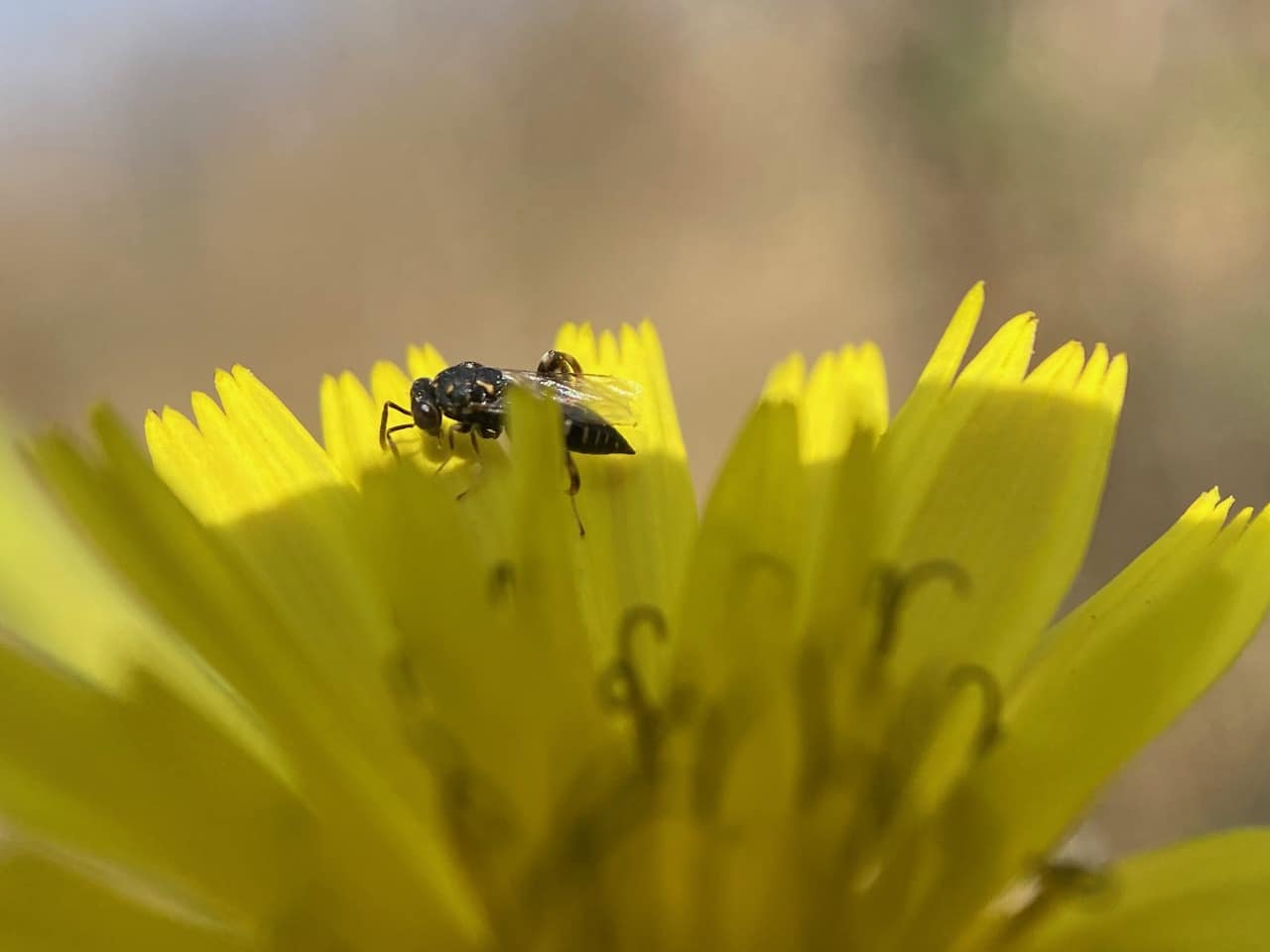
A remarkable little wasp!
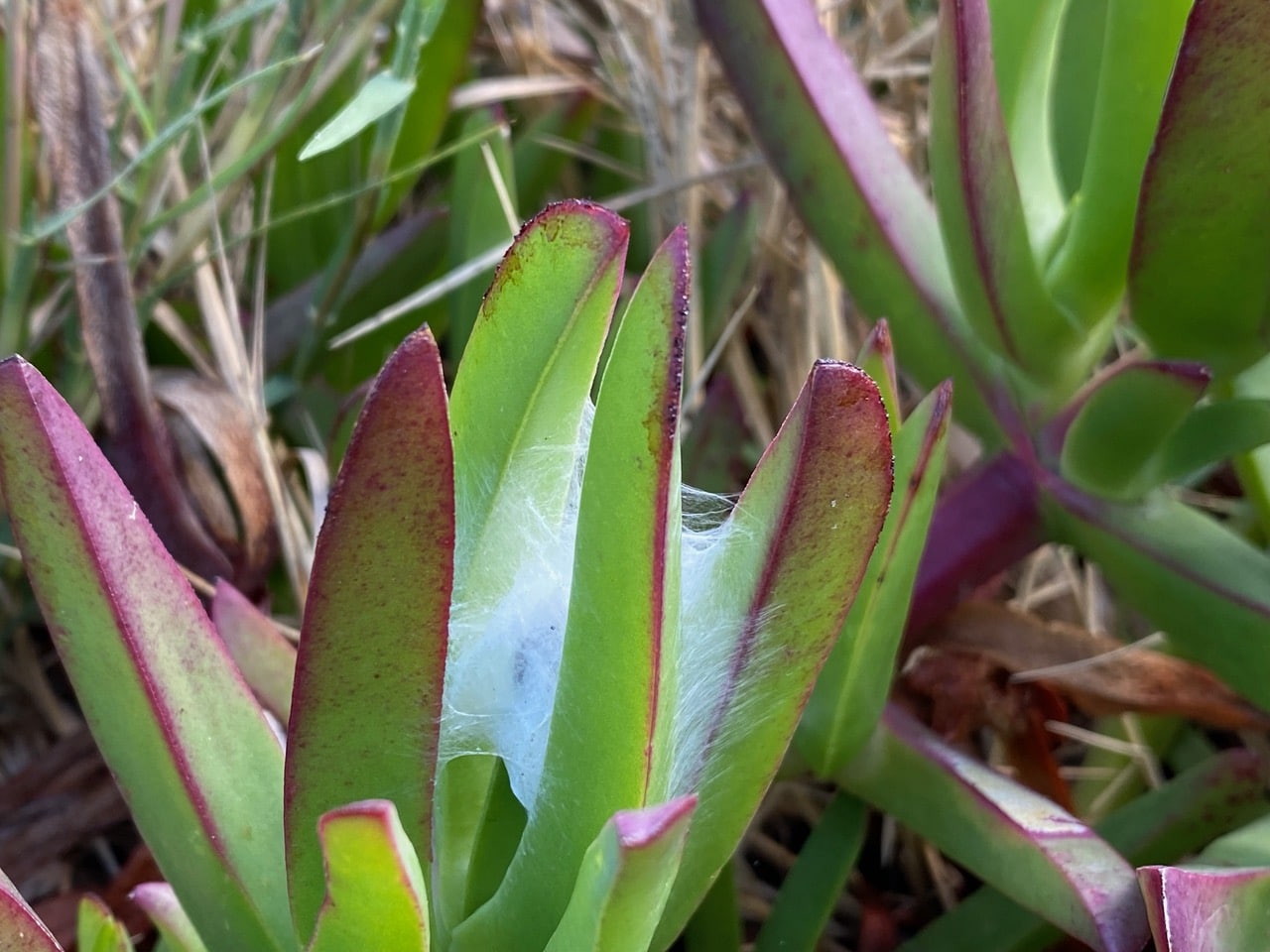
A spider has woven an elaborate retreat between the young leaves of Ice Plant, Carpbrotus edulis. It is likely a well-fortified shelter for the spider’s egg case.
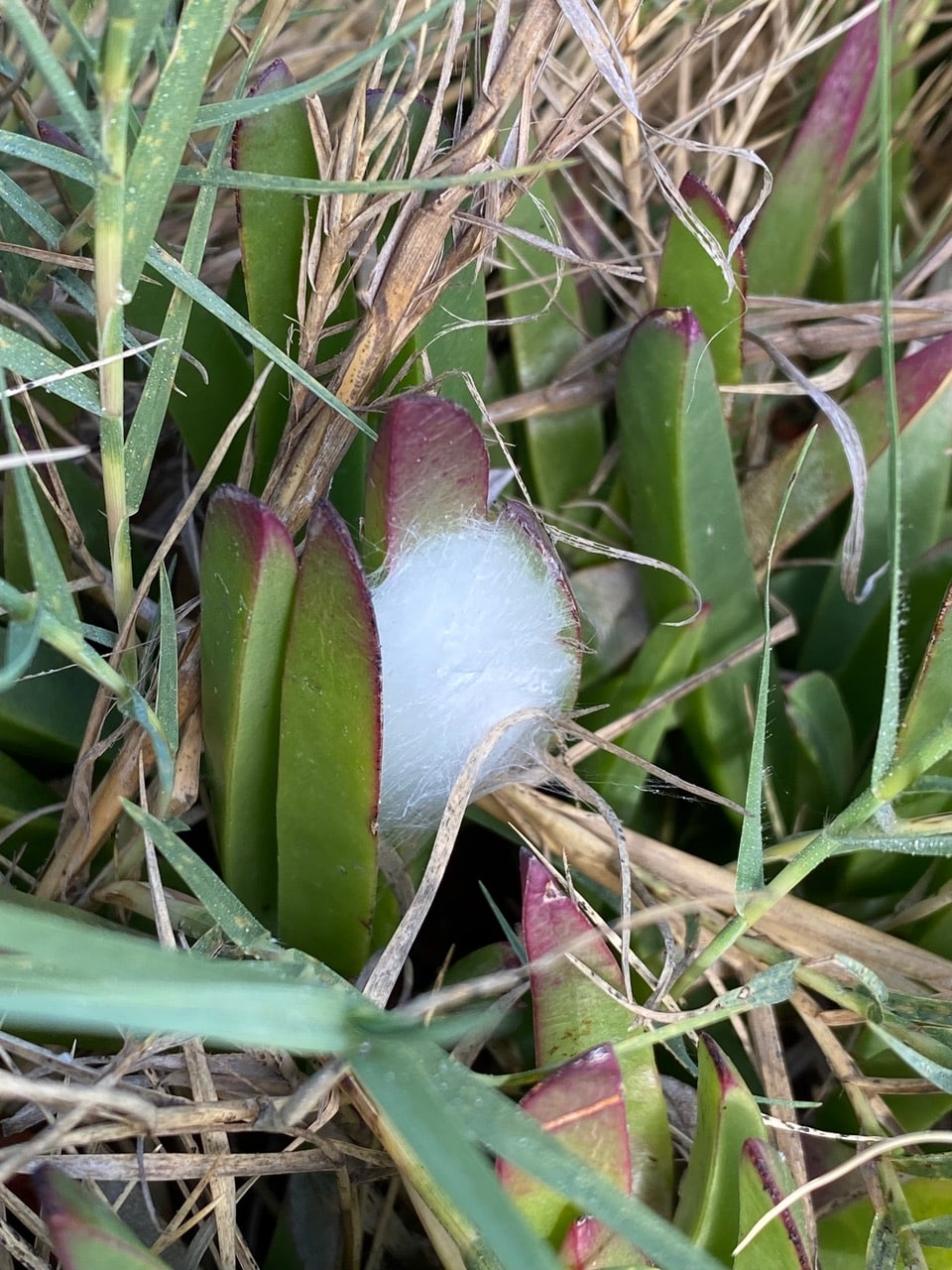
Here’s another one of those spider egg cases on Ice Plant. I don’t have the heart to tear it open to find out what’s inside.

A scruffy male Summer Longhorn Bee, Melissodes sp. (family Apidae) is taking nectar on a flowerhead of Oregon Gumweed, Grindelia stricta. Although male bees do not collect pollen to provision the nest, pollen often adheres to their hairy body, making them good incidental pollinators.
The Summer Longhorn Bees, Melissodes sp. (family Apidae) are medium to large bees, stout-bodied, usually with gray hair on the thorax and pale hair bands on the abdomen. Males usually have yellow markings on their faces and have very long antennae from which their common name is derived. They are active May to September, with peak flight in late June to early August. The females prefer flat, bare ground for digging their solitary nests, though they sometimes nest in aggregations. Pollen is transported in scopae on the hind legs. Pollen loads are often copious and brightly colored and thus very distinguishable. Melissodes are specialists on Asteraceae – females gather pollen from flowers of Aster, Bidens, Coreopsis, Cosmos, Encelia, Gaillardia, Helianthus, and Rudbeckia ssp.

A female Summer Longhorn Bee, Melissodes sp. (family Apidae) is foraging on another Grindelia flowerhead close by. The females are easily recognizable in the field because of the prolific scopae on their hind legs, especially when these are filled with pollen.

Unlike the males, the antennae on the female Melissodes are not particularly long. The females are a little easier to photograph as they take time to collect pollen.
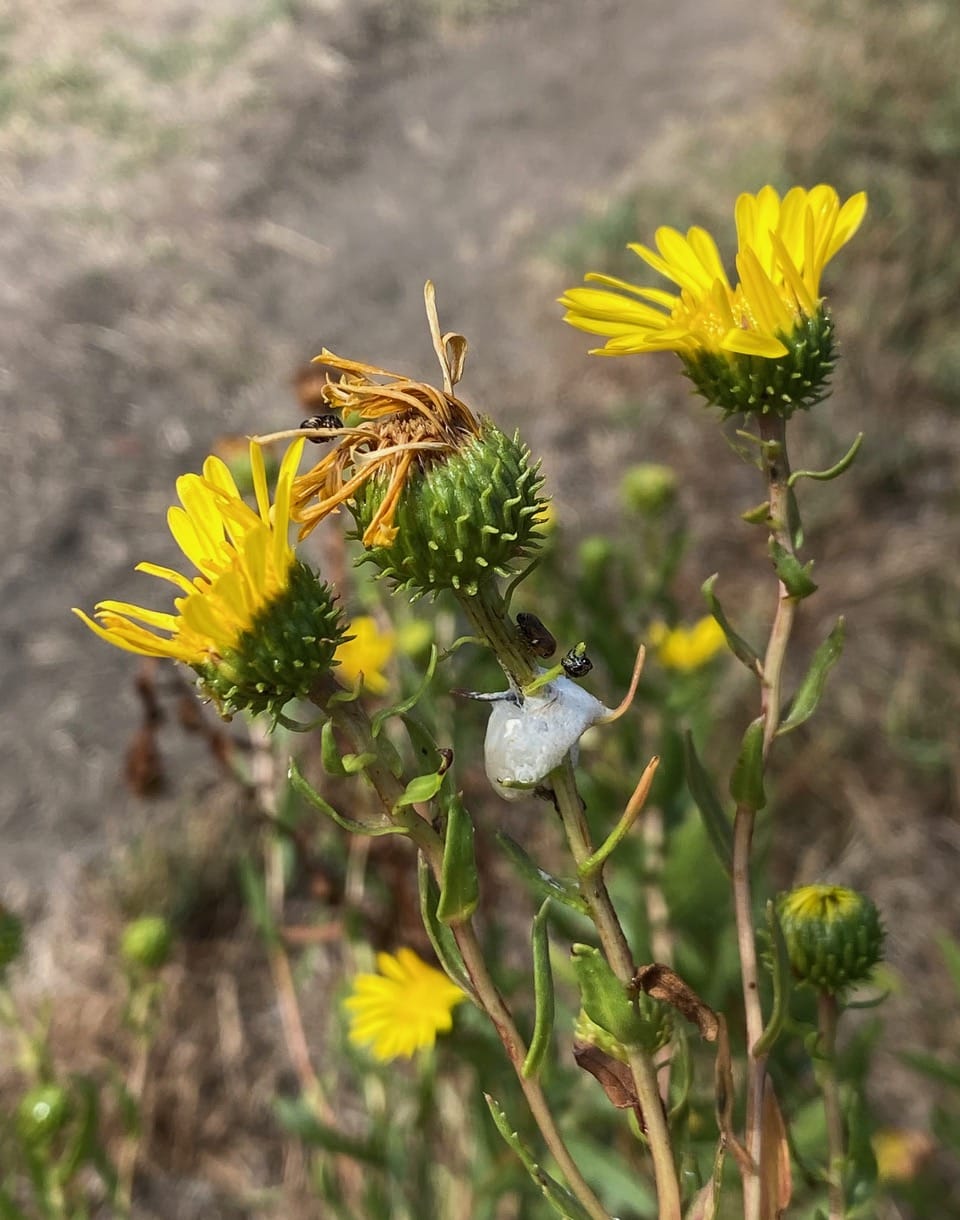
I stop often to examine the Grindelia for adult Spittlebugs that have emerged from their foam masses. Some of the frothy masses are already drying up, and the damaging effects of the sucking insects are already evident in the flowerheads that are aborted or wilt prematurely.
Spittlebugs, also known as Froghoppers belong to the superfamily Cercopoidea within the order Hemiptera (true bugs). While sometimes generally referred to as the family Cercopidae, they are scientifically divided into several families, primarily Aphrophoridae (common spittlebugs), Cercopidae (froghopper), and Clastopteridae.
Why the common name of “spittlebug”? The nymphs (immatures) of these bugs create foam masses on plants in which they live and feed. Like the adults, the nymphs use their piercing, sucking mouthparts to feed on plant juices. The nymph produces a cover of foamed-up plant sap reminiscent of saliva, hence the common name of spittlebug. Whereas most insects that feed on sap feed on the nutrient-rich fluid from the phloem, Spittlebugs tap into the much more dilute sap flowing upward via the xylem. The large amount of excess water that must be excreted and the evolution of special breathing tubes allow the young spittlebug nymphs to grow in the relatively protective environment of the spittle. Symbiotic bacteria in the insects’ digestive system provides them with the essential amino acids that their diet lacks. The foam serves a number of purposes. It hides the nymph from the view of predators and parasites, and it insulates against heat and cold, and protects the delicate nymphs from desiccation. Moreover, the foam has an acrid taste that deters predators.
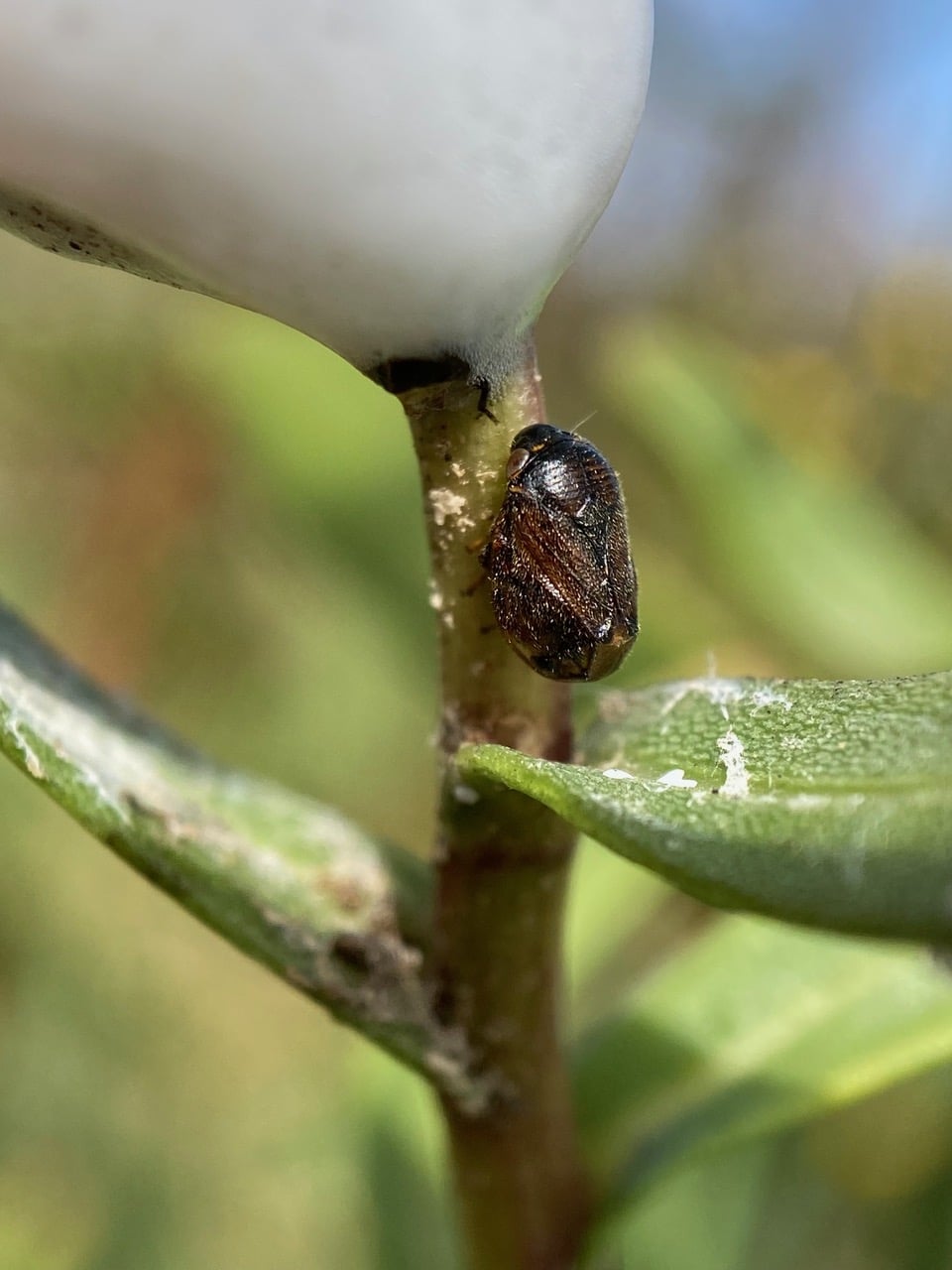
Here’s an adult that has yet to acquire its full coloration. Because of its larger size, I think it is a female (The species exhibits sexual dimorphism.).
The Spittlebug, Complex Clastoptera lineatocollis (family Clastopteridae) is found in western United States. The bugs feed mostly on Asteraceae, although other hosts have been reported. Females are brownish (3.3-3.8 mm), while the smaller males (3.0-3.2 mm) are mostly black.
Unlike their young, adult spittlebugs (also known as Froghoppers) are efficient flyers and hoppers, feeding on diverse plant species. Using their piercing-sucking mouthparts, they pierce plant stems to feed on xylem. To get enough nutrients, they consume massive quantities of sap, drinking up to 280 times their body weight daily, resulting in high waste excretion. Froghoppers can cause damage by distorting plant leaves and causing shoot tips to die back. Froghoppers are champion jumpers among insects, out-performing even the fleas. The bug can leap the human equivalent of a skyscraper without a running start. It is the highest jumping insect proportional to body size. The muscles in its hind legs act like a “catapult” to release energy explosively.

A black adult male Spittlebug is crawling away to avoid my prying camera. Note its banded legs and the false eye-spot on the edge of its wing. Despite their well-known prowess at jumping, these bugs are relatively sedentary, usually preferring to flee on foot when threatened.
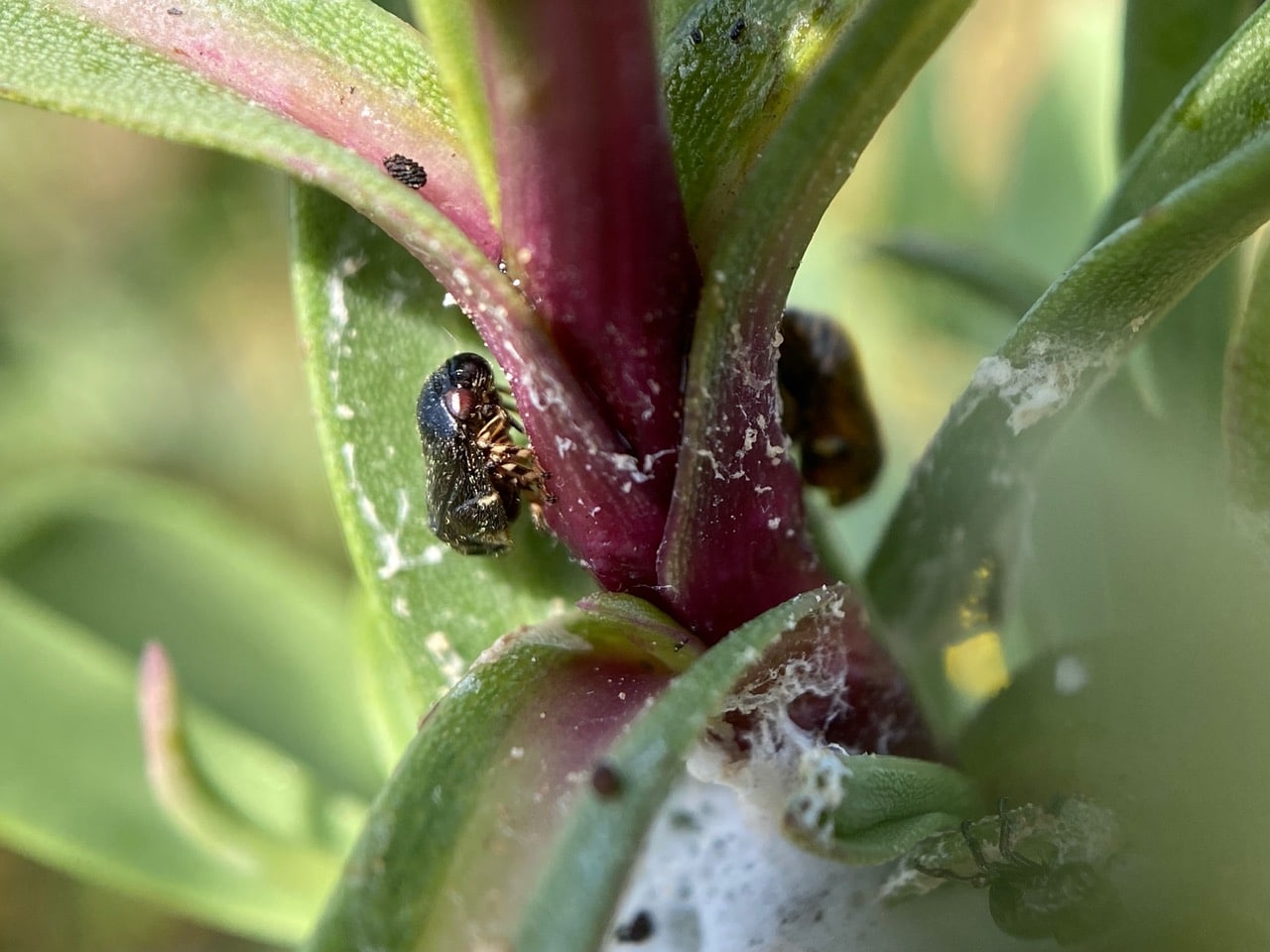
The little male has settled down at the base of a leaf. Note its bulbous snout. The drying foam masses have left white debris all over the plant.
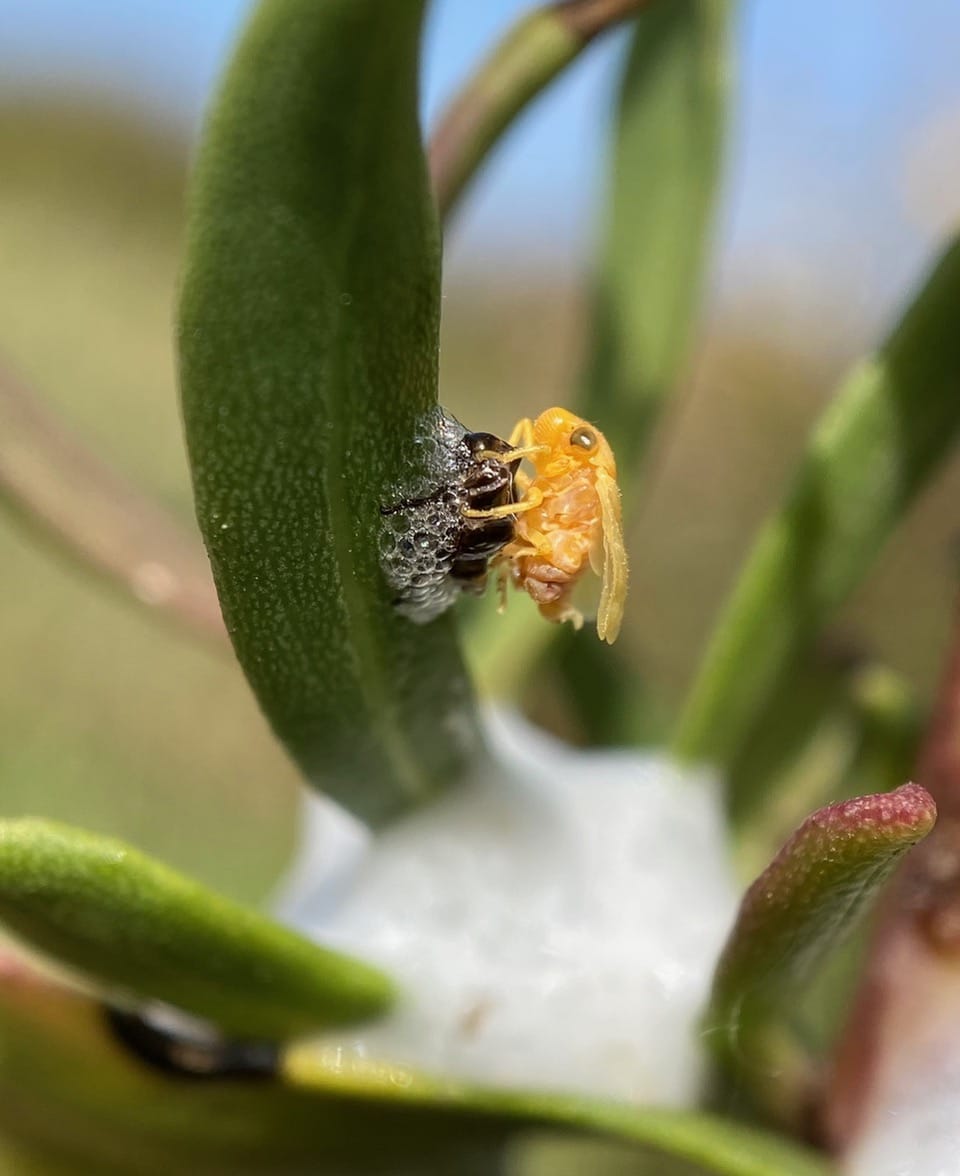
A Spittlebug nymph has crawled out of a foam mass to molt for the last time into an adult. The newly emerged teneral is still clinging to its exuvia while waiting for its wings and new exoskeleton to dry and harden.
A teneral insect is a young insect that has just molted (emerged from its final nymphal skin) but has not yet hardened its exoskeleton or achieved its final coloration. Teneral insects typically have paler or different colors than their mature counterparts. Over a short period (often hours), the insect’s exoskeleton hardens and darkens, a process similar to the tanning of leather. This period allows the insect to expand its body and limbs. Being soft, and unable to move much, tenerals are more susceptible to injury and predation.

This other teneral Spittlebug has left its exuvia to wait out the process.

There are fewer visible white foam masses on the Grindelia now. In their place are brown foliage and aborted flowerheads.

The Spittlebugs have taken a heavy toll on this patch of Grindelia. Traces of the dried foam are still evident on the foliage.

Some spider has woven a tangled network of silk to cover this Grindelia branch tip. I can even see a Spittlebug caught on the messy web.
.
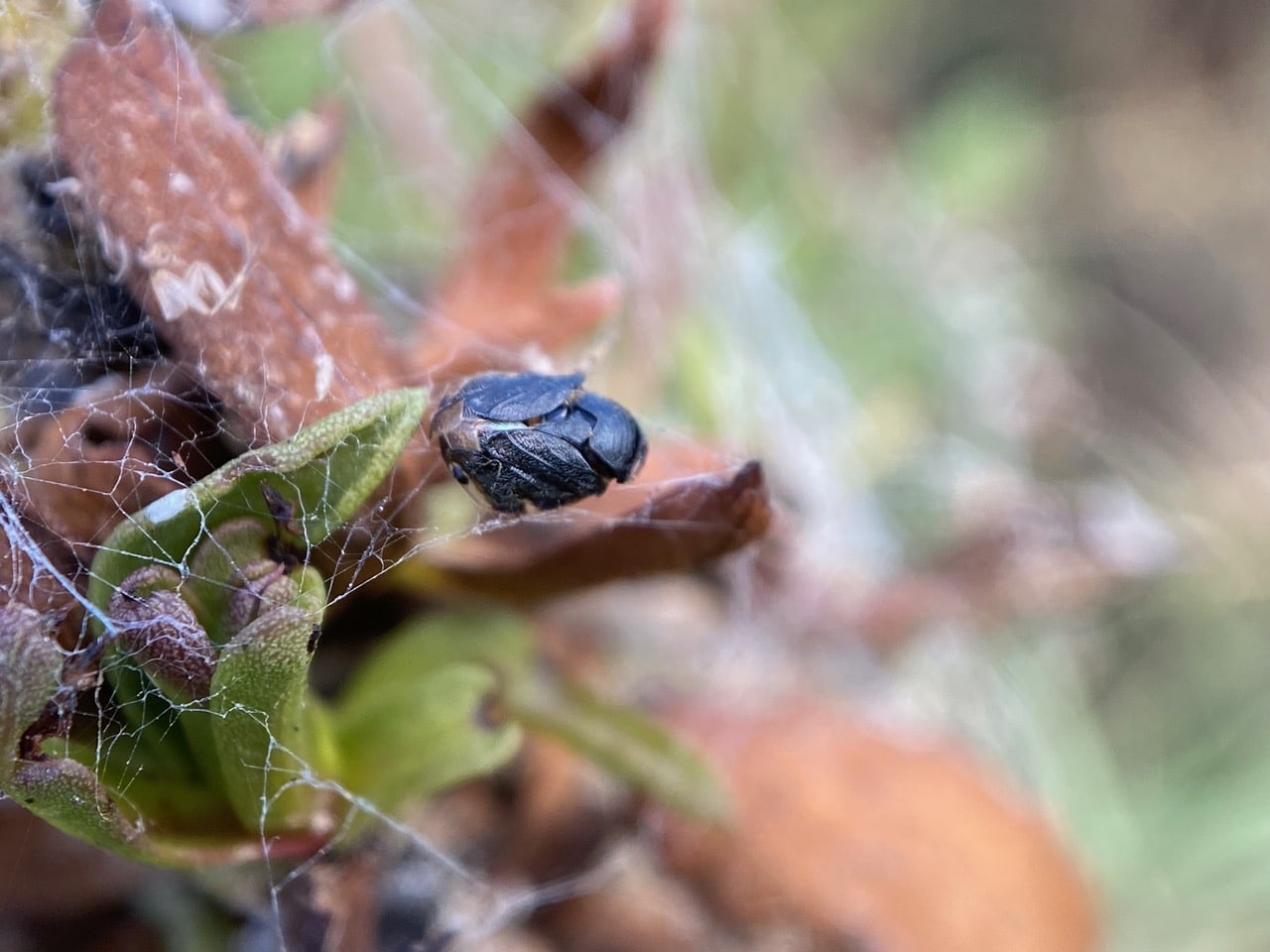
Here’s the dead Spittlebug on the spider web, its exoskeleton breaking apart into brittle pieces. I wonder if the spider has fed on its body contents?