

Pollinator Post 9/18/24
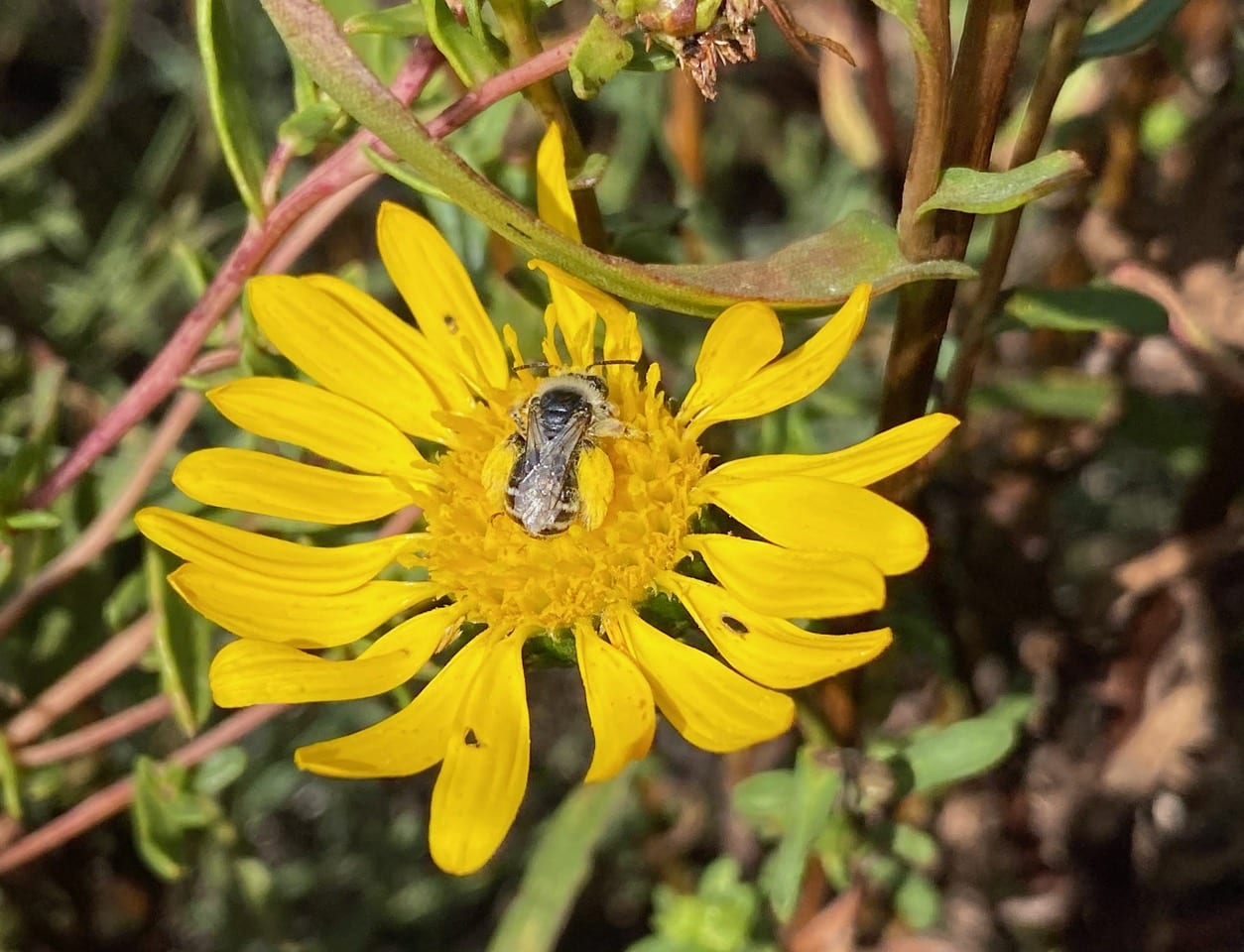
The sun has finally come out in the early afternoon. To get some sunshine, Fred and I have been taking our walk at Bay Farm in the afternoon the past few days.
A female Summer Longhorn Bee, Melissodes sp. (family Apidae) with her prolific scopa full of pollen never fails to put a smile on my face.
The Summer Longhorn Bees, Melissodes sp. (family Apidae) are medium to large bees, stout-bodied, usually with gray hair on the thorax and pale hair bands on the abdomen. Males usually have yellow markings on their faces and have very long antennae from which their common name is derived. They are active May to September, with peak flight in late June to early August. The females prefer flat, bare ground for digging their solitary nests, though they sometimes nest in aggregations. Pollen is transported in scopae on the hind legs. Pollen loads are often copious and brightly colored and thus very distinguishable. Melissodes are specialists on Asteraceae – females gather pollen from flowers of Aster, Bidens, Coreopsis, Cosmos, Encelia, Gaillardia, Helianthus, and Rudbeckia ssp.

Here’s a male Summer Longhorn Bee, Melissodes sp. (family Apidae) on a flowerhead of Oregon Gumweed, Grindelia stricta. The bees are getting old and scruffy as their season wears on. But as long as the Grindelia are still in bloom, the Melissodes population hangs on. Melissodes are specialists on plants in the sunflower family, Asteraceae. Here at Bay Farm, I have only seen them visit Grindelia.
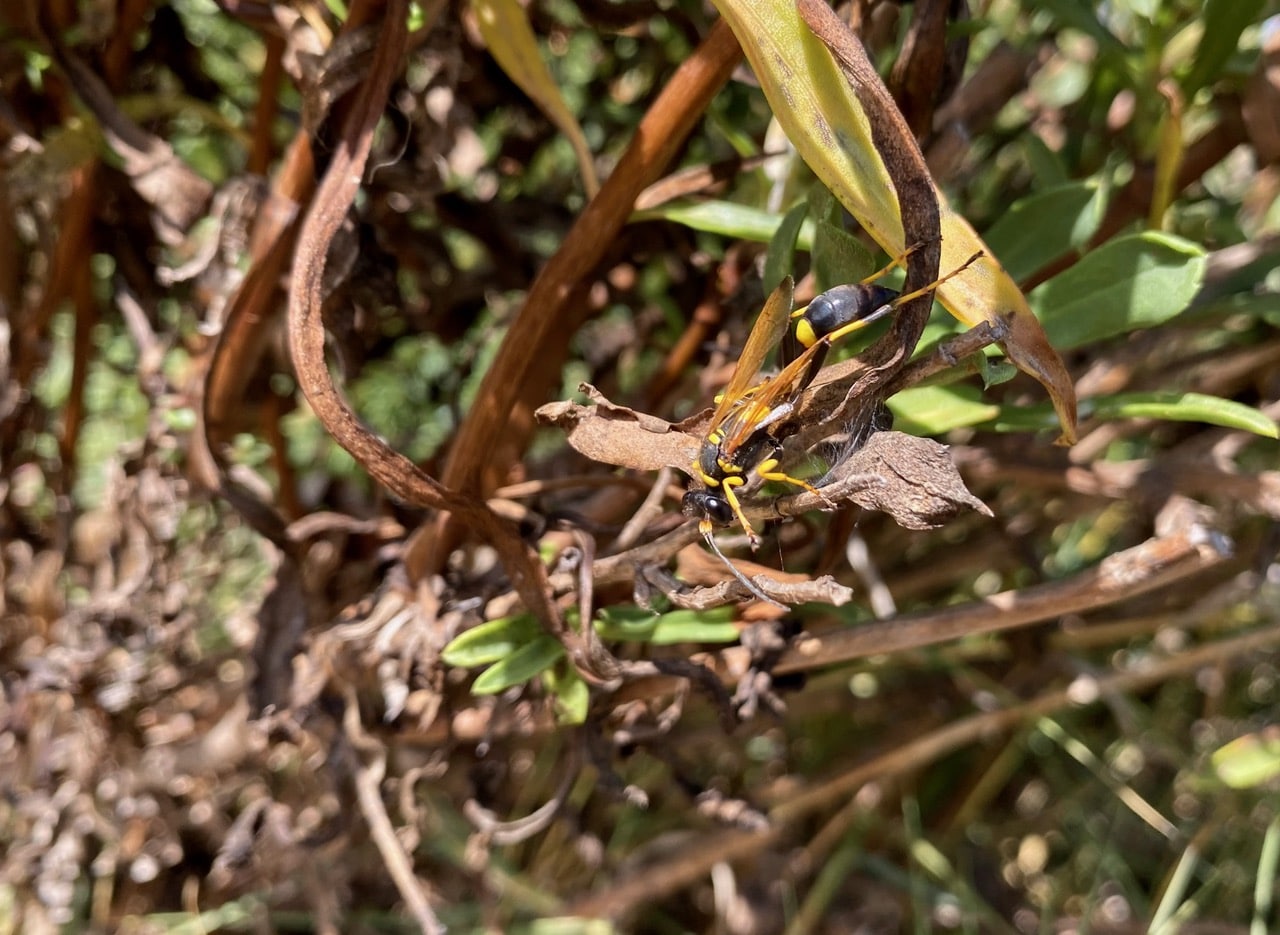
Along the wet section of the dirt path, I often see female Mud Daubers scouting for mud for nest construction. Here’s one! She has landed on the foliage at the base of a Grindelia, rendering her almost invisible. Look for her black and yellow body.
The Yellow-legged Mud-dauber, Sceliphron caementarium (family Sphecidae) is widespread in the Americas. The species is found in a wide variety of habitats, such as rock ledges, man-made structures, puddles and other water edges. The wasp can reach a length of 24-28 mm. They are generally black with yellow markings, with impossibly long and skinny “waist”. They are solitary parasitoid wasps that build nests out of mud. Females collect mud balls at puddles and pool edges for constructing nests. The nests comprise up to 25 vertically arranged, individual cylindrical cells. Eventually the cells are covered over as a cluster by more mud, forming a smooth structure the size of a human fist. Nest constructed, the female wasp goes hunting for spiders. The prey are stung and paralyzed and placed in the cell, usually 6-15 per cell. A single egg is laid on the prey within each cell. The wasp then seals the cell with a thick mud plug. The larva that hatches out feeds on the spiders, pupates in the cell and emerges as an adult, breaking out of its mud nursery. Adult wasps can be seen in mid-summer feeding on nectar at flowers.
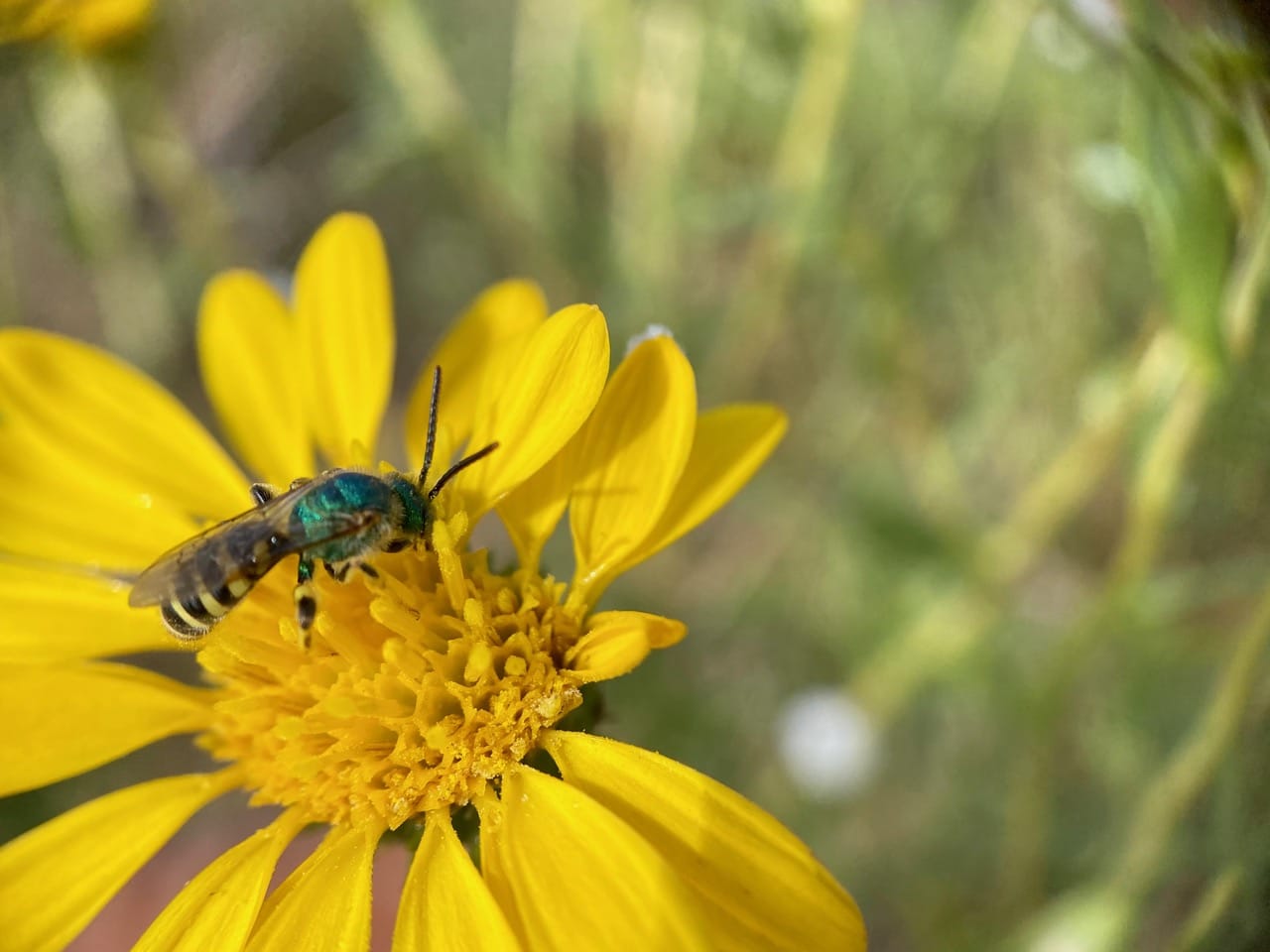
A male Texas Striped Sweat Bee, Agapostemon texanus (family Halictidae) is foraging on a Grindelia flowerhead. I haven’t seen a female for a week now.
The genus Agapostemon is widespread and abundant throughout North America. These ground nesting bees are most diverse and abundant in temperate regions and southwestern U.S. deserts. Agapostemon are commonly called “sweat bees” because they are closely related to, and resemble bees in the Halictus and Lasioglossum genera. Unlike those bees however, Agapostemon are not attracted to human sweat.
Agapostemon are brightly colored metallic green or blue bees measuring 7 to 14.5 mm long. Most species have a metallic green head and thorax, and black-and-yellow striped abdomen; some females are entirely bright green or blue. Females carry pollen on scopal hairs located on their hind legs. Agapostemon are generalists. Like other members of the family Halictidae, they are short-tongued and thus have difficulty extracting nectar from deep flowers. Males are often seen flying slowly around flowers looking for females. The bees favor flowers with high densities. The species is active summer to fall.
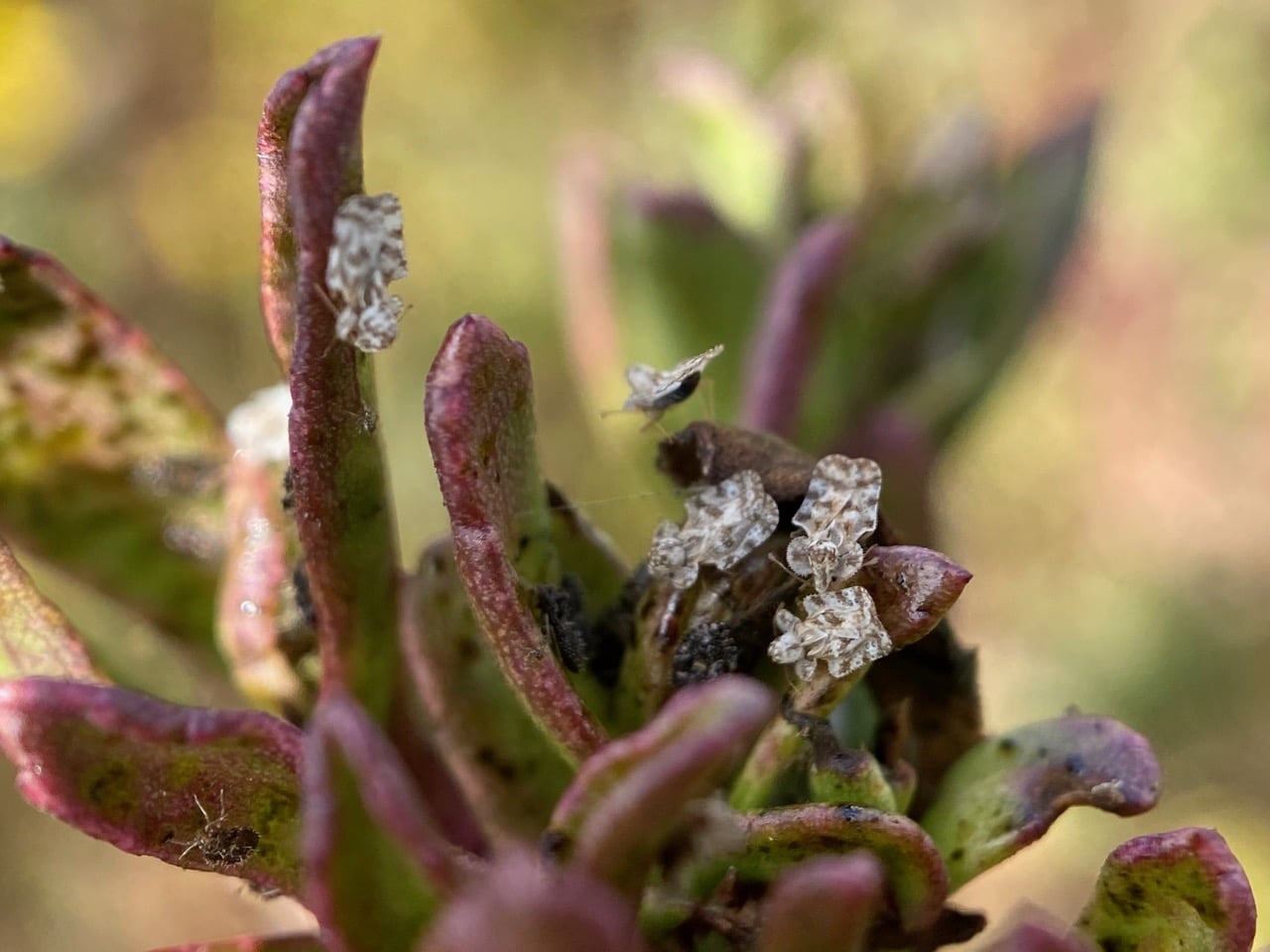
The Lace Bugs, Corythucha sp. (family Tingidae) have converged on the last remaining healthy foliage on the tip of this Grindelia branch. Who would’ve thought that these tiny, delicate-looking bugs could cause so much damage?
The Tingidae are a family of very small (2-10 mm) insects in the order Hemiptera that are commonly referred to as lace bugs. They are called lace bugs because the pronotum and fore wings of the adult have a delicate and intricate network of divided areas that resemble lace. Their body is flattened dorsoventrally, and the head is often concealed under the hood-like pronotum. Lace Bugs feed by sucking sap from plants, extracting the protein they need and excreting liquid waste as honeydew. The most common symptom of feeding is the stippled and mottled yellowish foliage. In heavy infestations, black sooty mold may develop on the honeydew, impairing photosynthesis by the plant. This may result in some dieback of twigs and branches and a reduction in flowering the following year. Tingids are usually host-specific and can be very destructive to plants. Each individual usually completes its entire lifecycle on the same plant, if not the same part of the plant.
The genus Corythucha is primarily distributed in the northern hemisphere, including Europe, North America and eastern Asia.

A female Grapevine Jumping Spider, Sassacus vitis (family Salticidae) is hunting on a cluster of flowerheads of a female Coyote Brush, Baccharis pilularis.
The spider is native to North America, with a range spanning from Canada to Panama. It is a small jumping spider with iridescent gold abdomen and white ring around the anterior surface of abdomen. Body is covered with golden scales. Males are 3.5 mm long, females 4.5 mm. The name vitis is Latin for “grapevine”. The spider is commonly found on shrubs and vines and in fields. Best known as a common resident of vineyards.
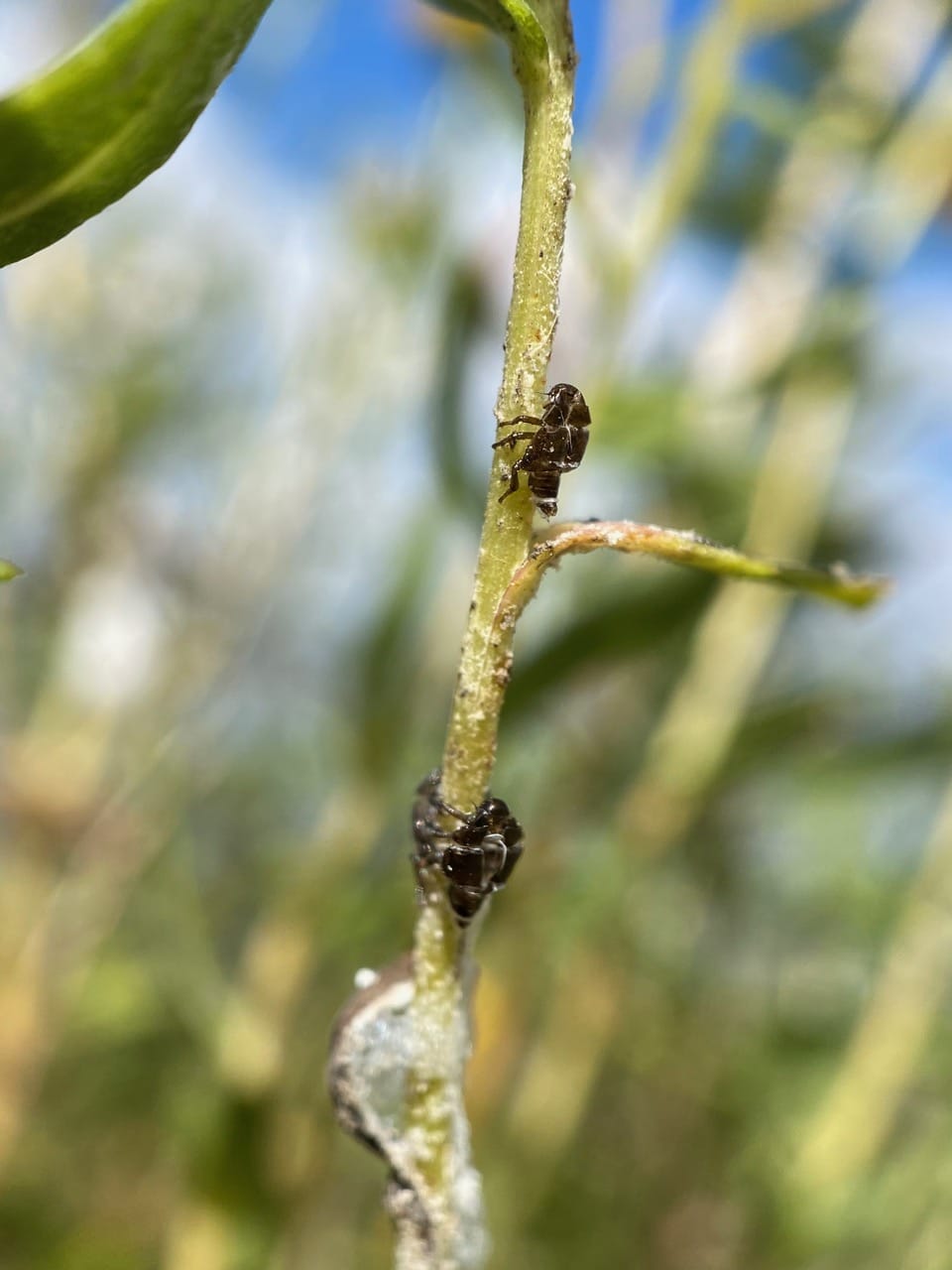
Three Spittlebug exuvia still cling to a Grindelia stem above the nymphs’ former foamy shelter that has by now dried up and crumbled. Things seem quiet after the flurry of adult emergence a few days ago. Where are the adults?
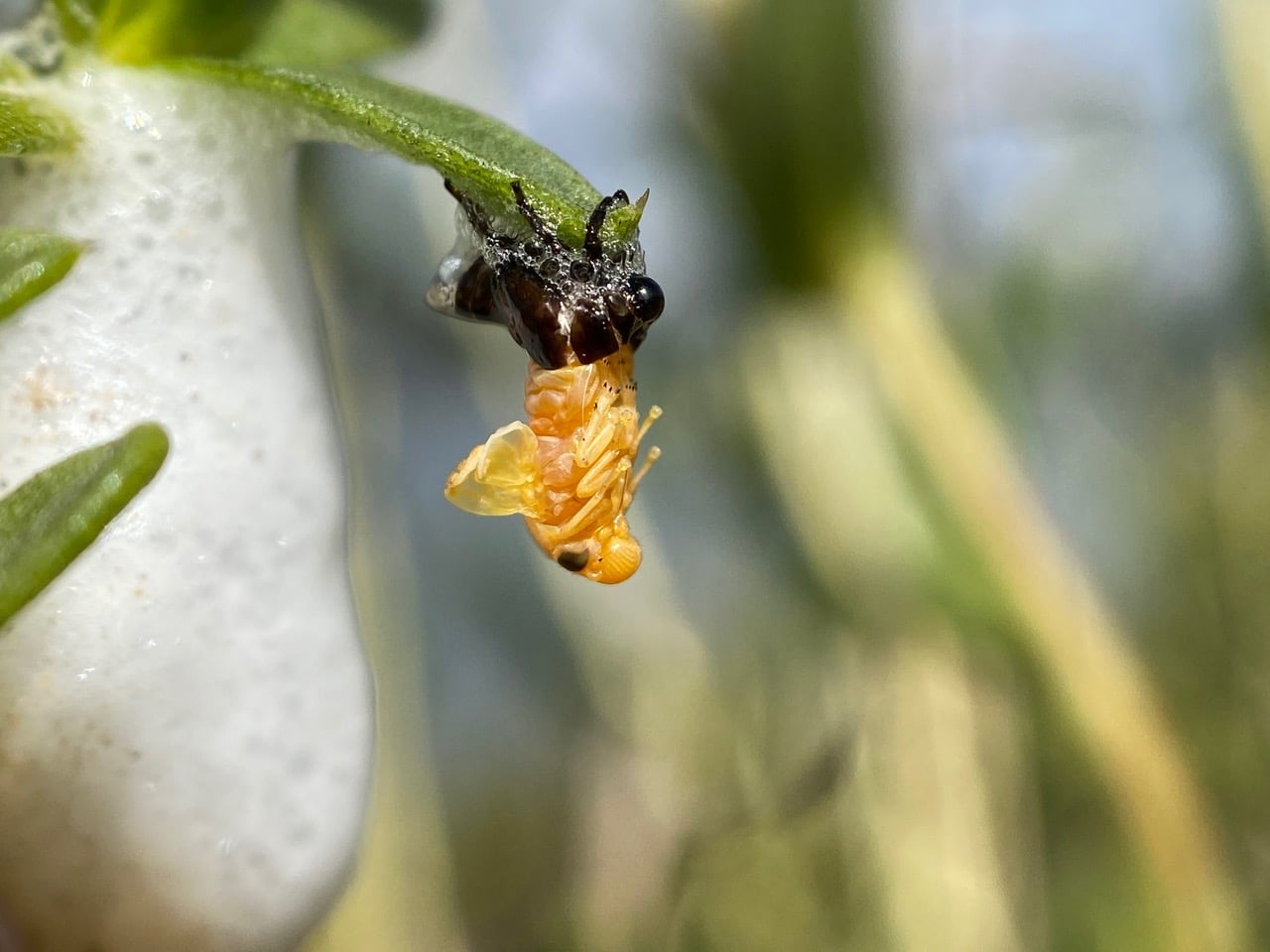
Hey, emergence is still happening! A few branches away, a fresh, pale adult Spittlebug is emerging from its old exoskeleton. The nymph has held on upside down to the tip of a leaf, next to the foam mass from with it has crawled out for its final molt into an adult. The wings are unfurling. The hind legs are yet to be freed, but the ring of dark spines on the tibia are already visible.
Froghoppers gain traction that lets them leap from smooth leaves thanks to spines on their legs. A study using high-speed videography showed that the froghoppers’ hind legs gripped the surfaces when the insects took off, allowing them to soar through the air. When jumping from leaves, the froghoppers’ spines left behind microscopic holes. But on hard glass, the insects could not gain traction and slipped when they jumped.

This is the only adult Spittlebug or Froghopper, Clastoptera lineatocollis (family Clastopteridae) I find today. It is a small, black individual. Note the false eyespot on its rear end. Members of the family Clastopteridae have their wings modified to form false heads at the tail end, an anti-predator adaptation.
The Froghoppers (superfamily Cercopoidea) are a group of “true bugs” in the order Hemiptera. Adults are capable of jumping many times their height and length, giving them their common name, but many species are best known for their plant-sucking nymphs which produce foam shelters, and are referred to as “spittlebugs”. The superfamily currently consists of three families: the Aphrophoridae, Cercopidae, and Clastopteridae. The nymphs produce a cover of foamed-up plant sap visually resembling saliva, hence the common name. Whereas most insects that feed on plant sap tap into the nutrient-rich fluid from the phloem, the spittlebugs utilize the much more dilute sap flowing upward from the roots via the xylem. The insects’ digestive system contains symbiotic bacteria that provide them with the essential amino acids. The large amount of excess water that must be excreted and the evolution of special breathing tubes allow the young spittlebug nymphs to grow in the relatively protective environment of their foam shelters. The foam serves a number of purposes. It hides the nymph from the view of predators and parasites, and it insulates against heat and cold, providing thermal as well as moisture control. It also has an acrid taste that deters predators.
Froghoppers are champion jumpers among insects, out-performing even the fleas. The bug can leap the human equivalent of a skyscraper without a running start. It is the highest jumping insect proportional to body size. The muscles in its hind legs act like a “catapult” to release energy explosively.

My eyes are drawn to something black on an immature flowerhead of Grindelia. It is a female Fruit Fly (family Tephritidae) laying eggs right into the gummy sap atop the flowerhead. I just saw this three days ago here! It seems the females select the youngest Grindelia flowerheads for ovipositing. How can their eggs and larvae survive in the sticky exudate? Surely the Fruit Fly must be a specialist on Grindelia, with special adaptations?
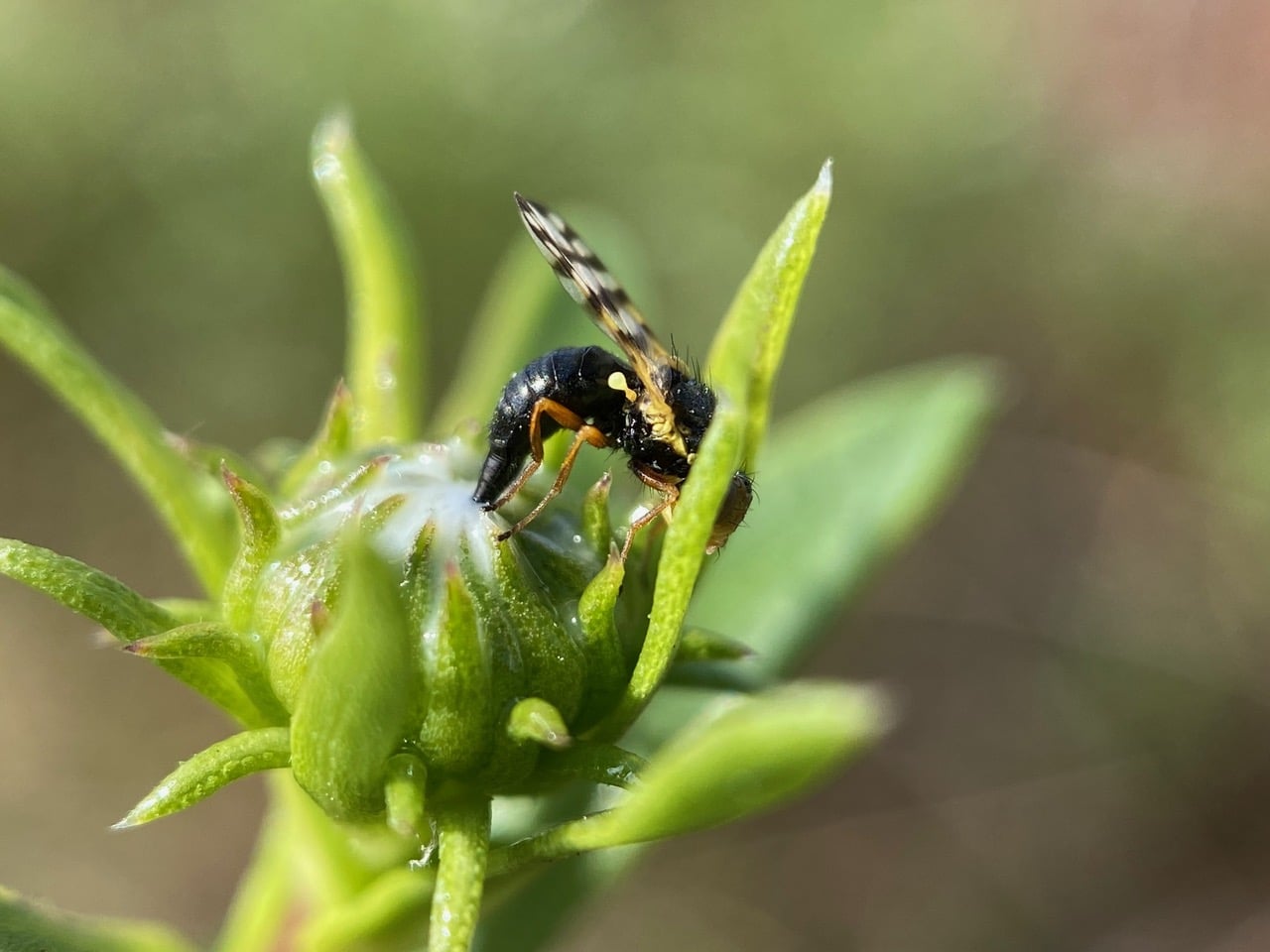
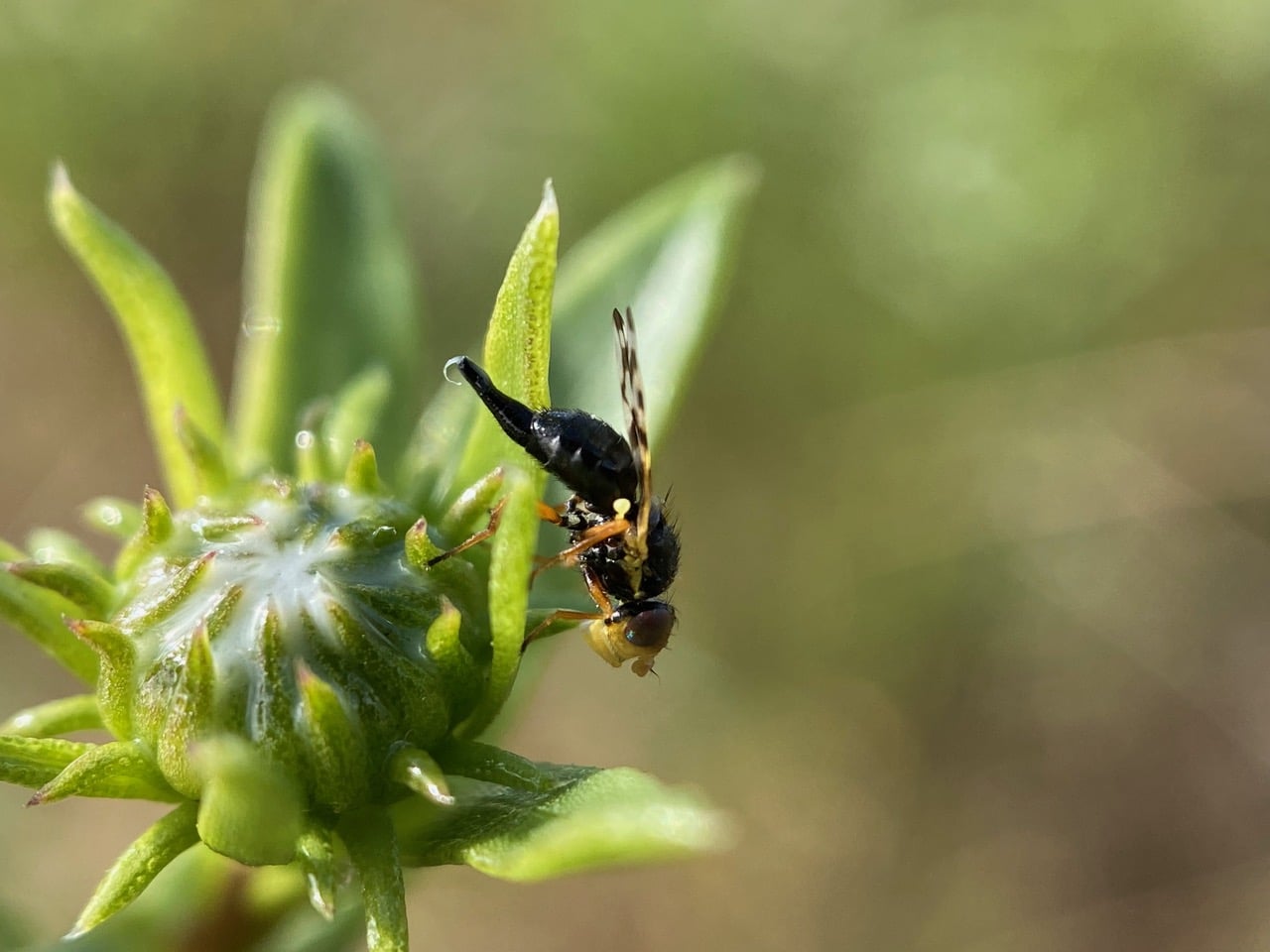
Close-up of the action. The female has inserted her oviscape at the tip of her abdomen into the gooey exudate. The oviscape is the protective structure through which the female’s telescopic ovipositor is extended when laying eggs.

Front view of the Fruit Fly.
Commonly called Fruit Flies, Tephritids are small to medium-sized flies that are often colorful, and usually with picture wings. The larvae of almost all Tephritidae are phytophagous. Females deposit eggs in living, healthy plant tissues using their telescopic ovipositors. Here the larvae find their food upon emerging. The larvae develop in leaves, stems, flowers, seeds, fruits, and roots of the host plant, depending on the species. Adults are often found on the host plant and feeding on pollen, nectar, rotting plant debris, or honeydew. Tephritid flies are of major economic importance as they can cause damage to fruit and other plant crops. On the other hand, some Tephritids are used as agents of biological control of noxious weeds.

The Fruit Fly has pulled her oviscape out of the flowerhead.
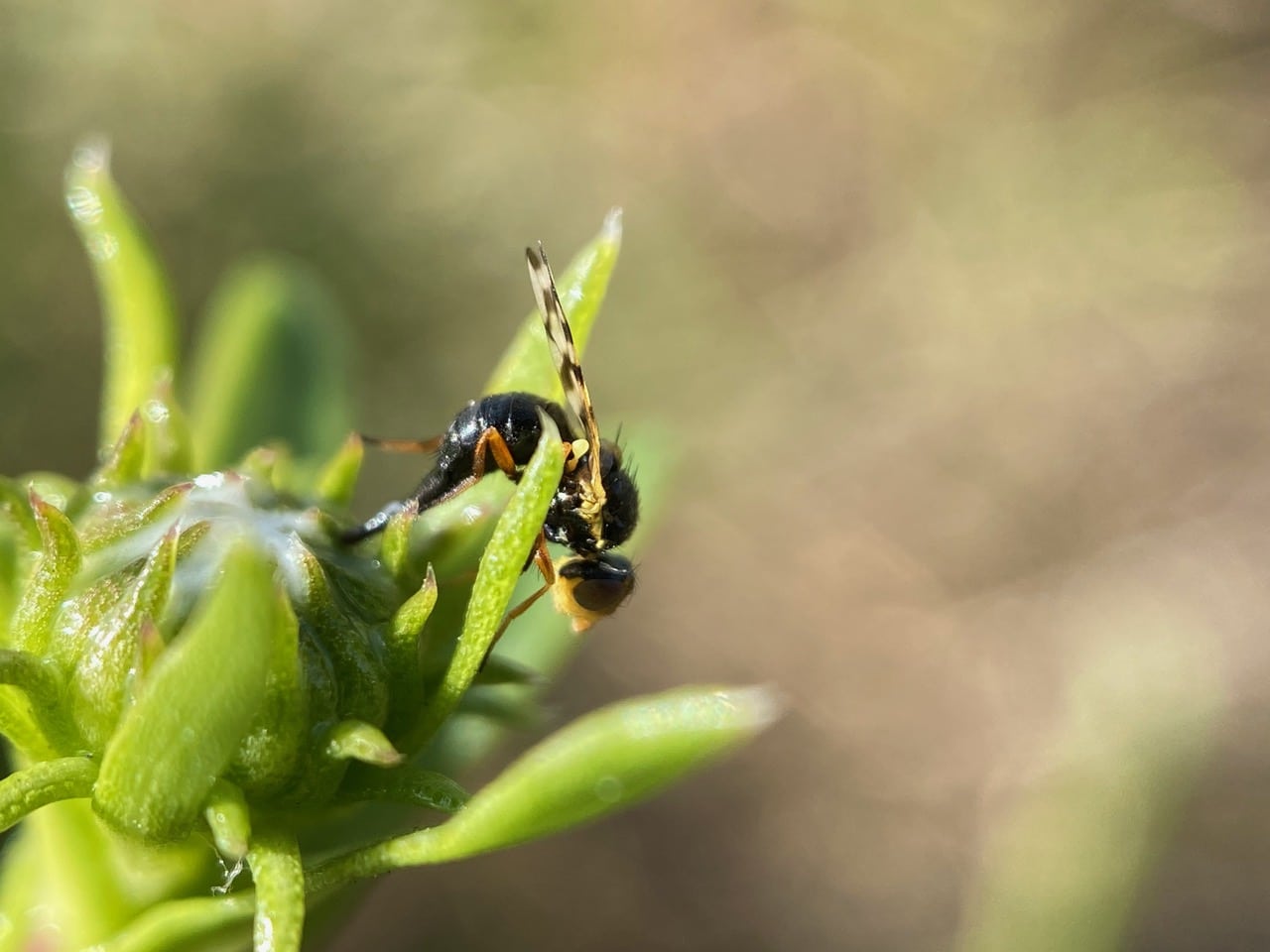
She spends some time cleaning her oviscape with her hind legs.

Hey, she’s not done! She’s reinserting her oviscape into the flowerhead.
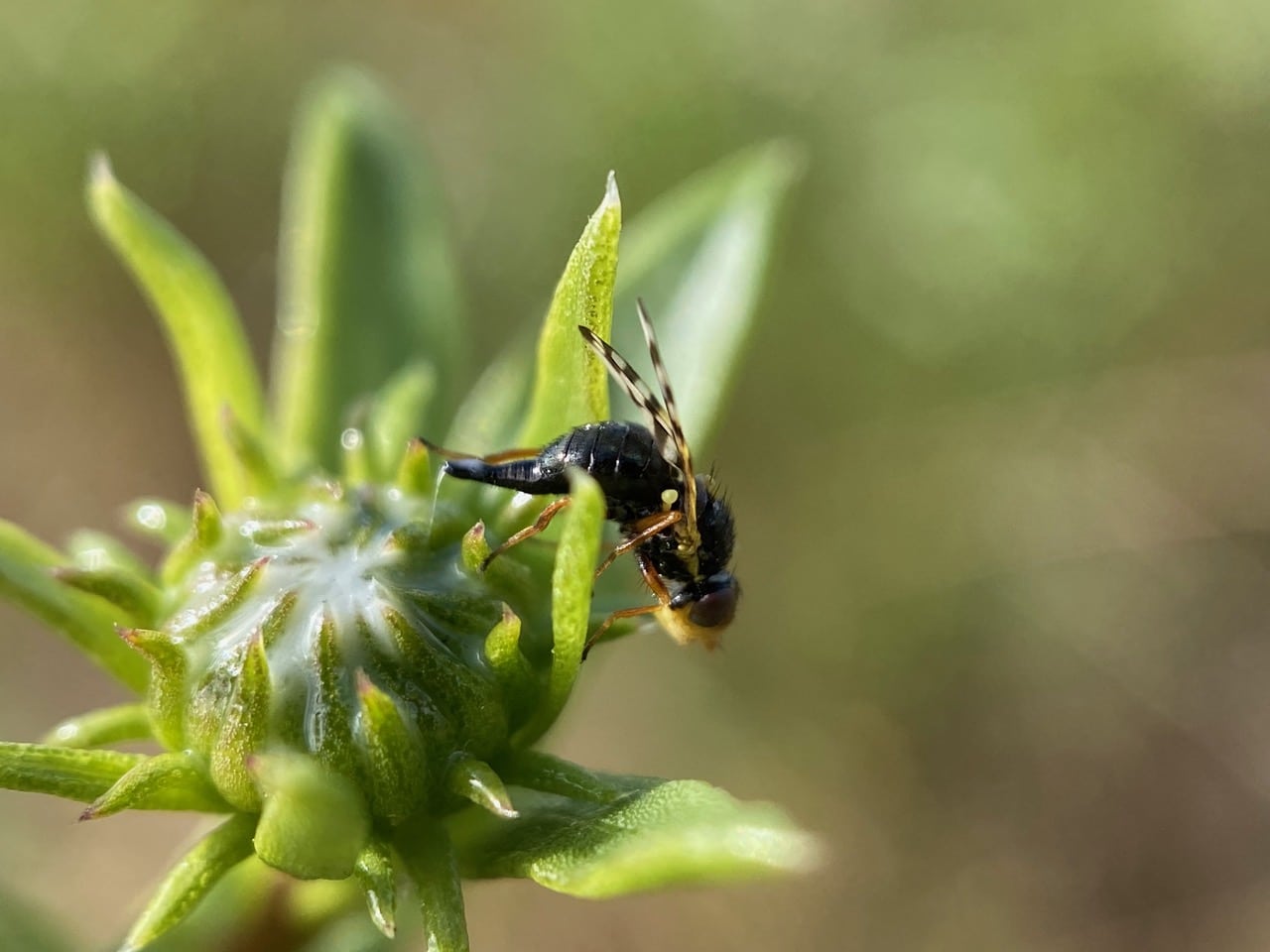
The Fruit Fly lifts her oviscape from the gummy material, the white liquid still trailing. We don’t see her ovipositor as it is telescopic and has been retracted into the oviscape.

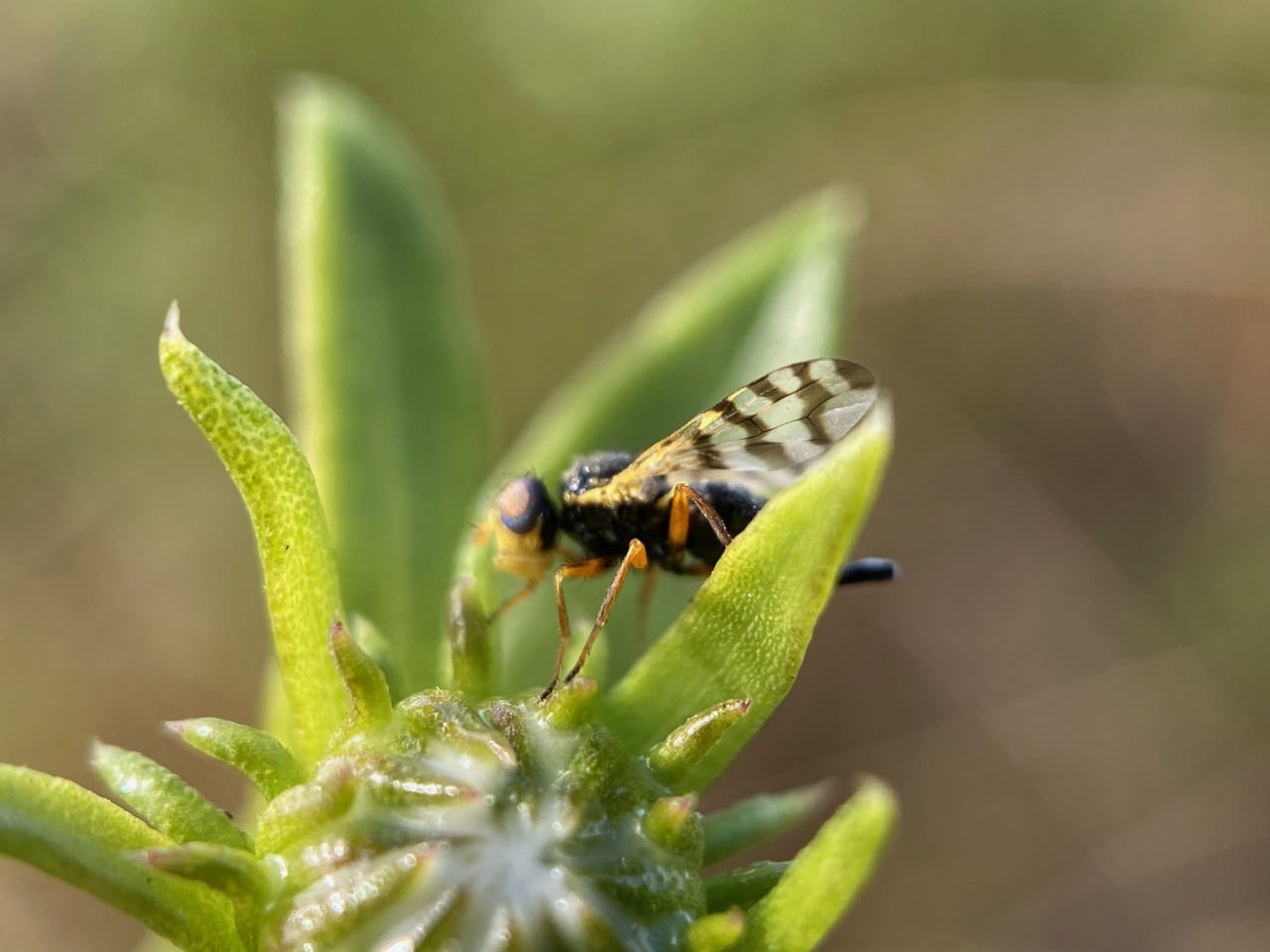
A glimpse of her picture wing.
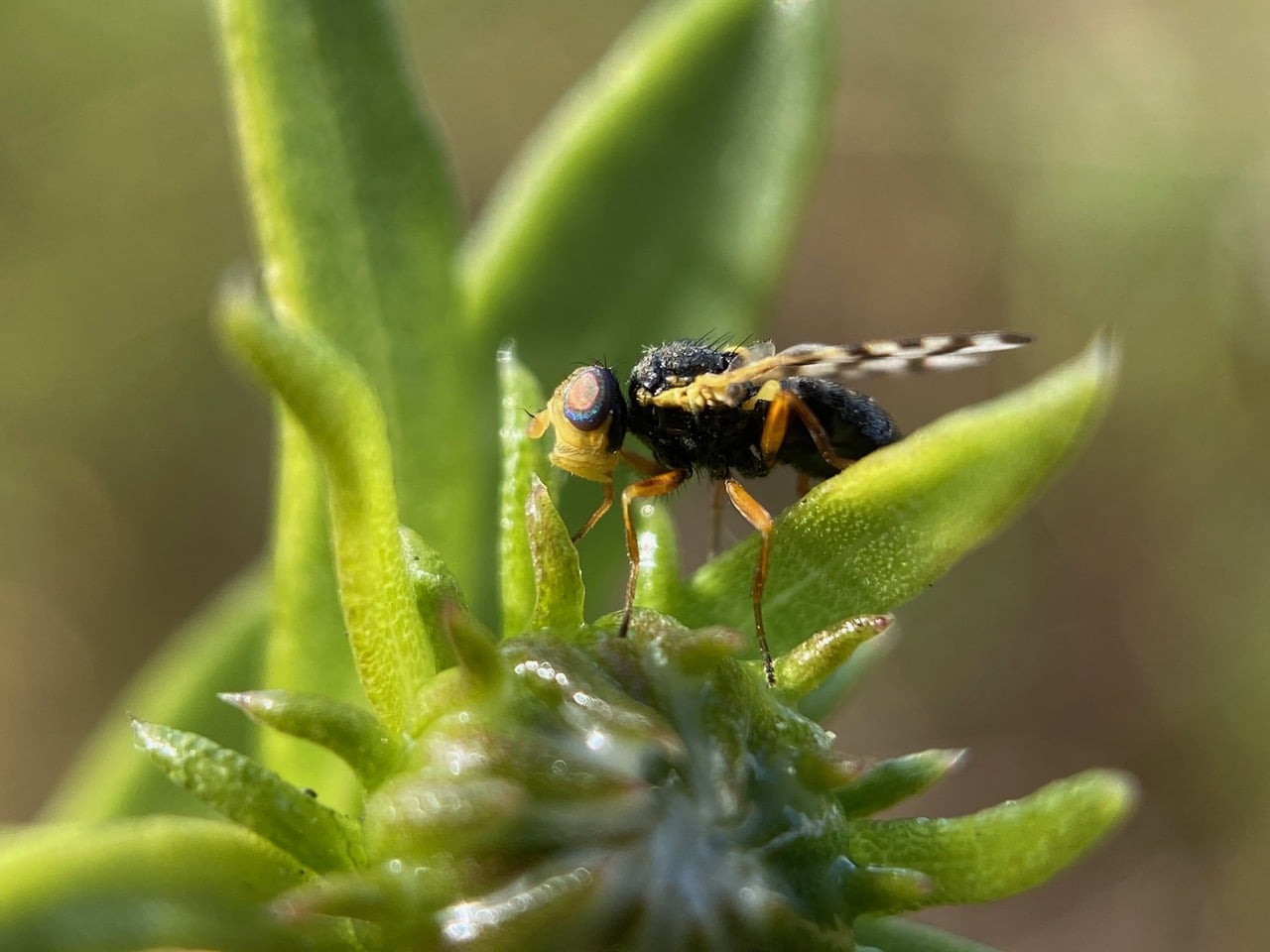
A quick look at her opal-hued eyes before she flies off.
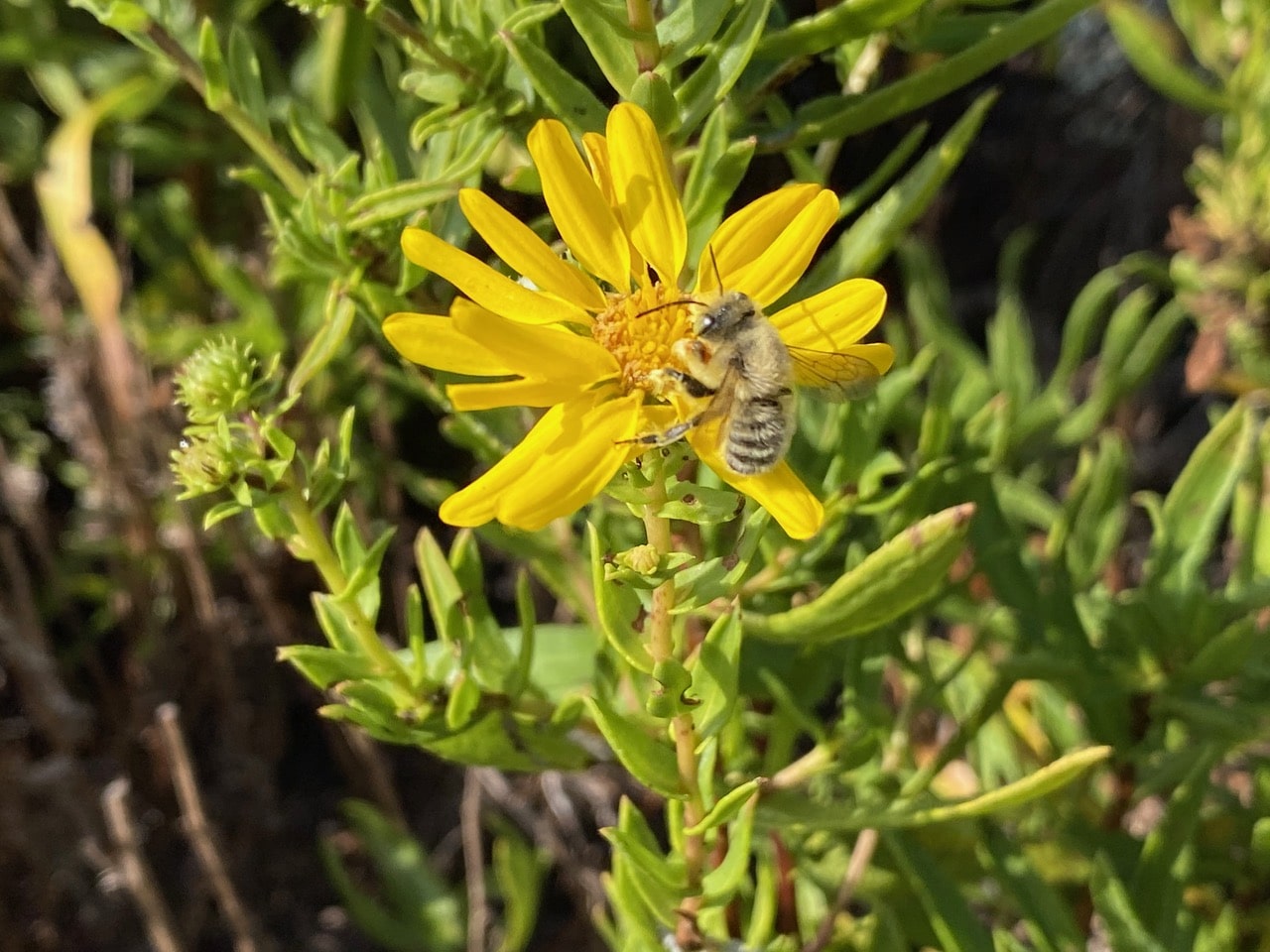
A pale, fuzzy male Western Leafcutter Bee, Megachile perihirta (family Megachilidae) has landed on a Grindelia flowerhead.

Note that his front legs are pale and fuzzy, unlike the other legs, as if he is wearing white mittens. Males of some species of Megachile have enlarged forelegs with long border hairs. They use these to cover the eyes of females while mating, presumably as blinders to calm them and increase receptivity.


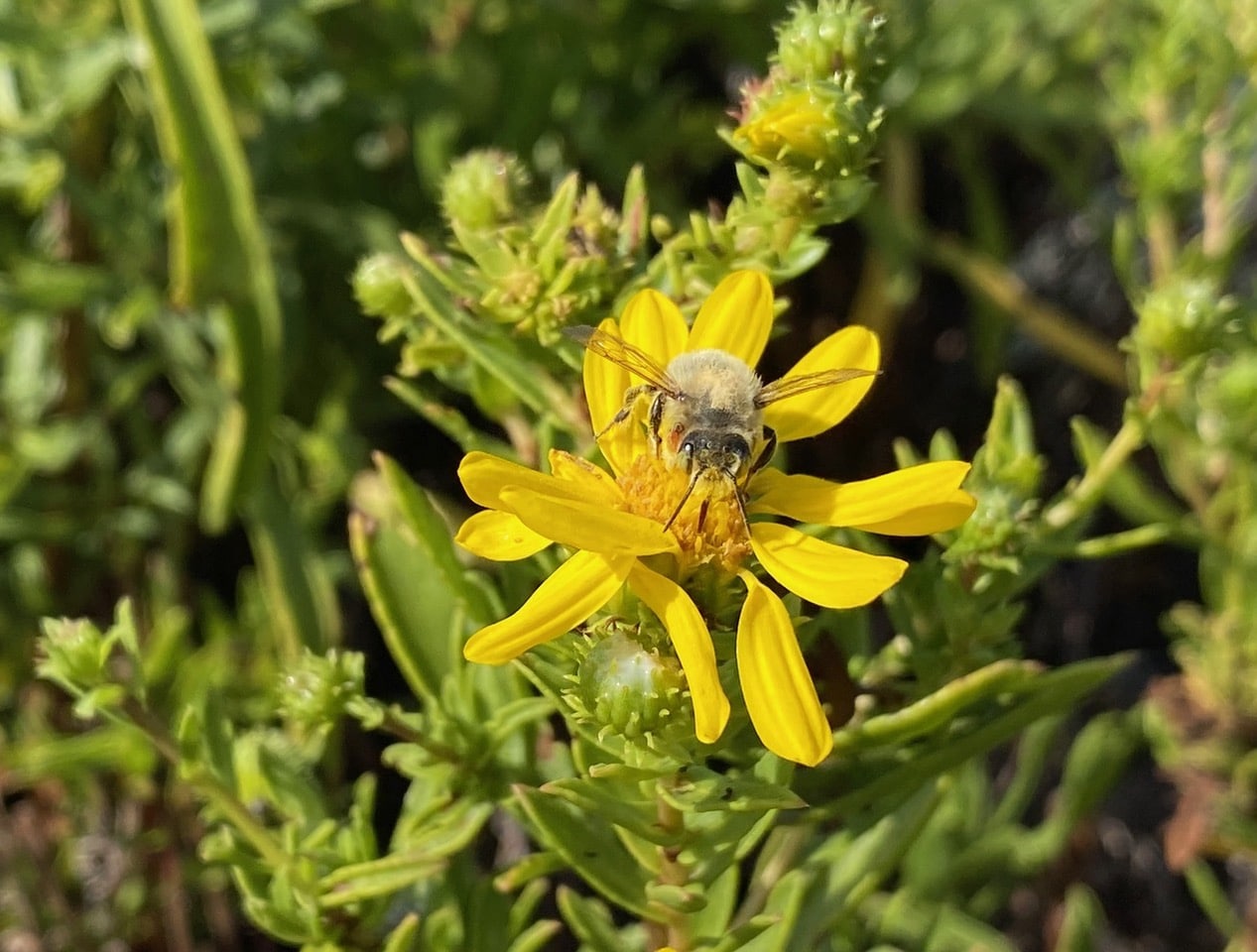
Front view of the male Western Leafcutter Bee, Megachile perihirta (family Megachilidae).
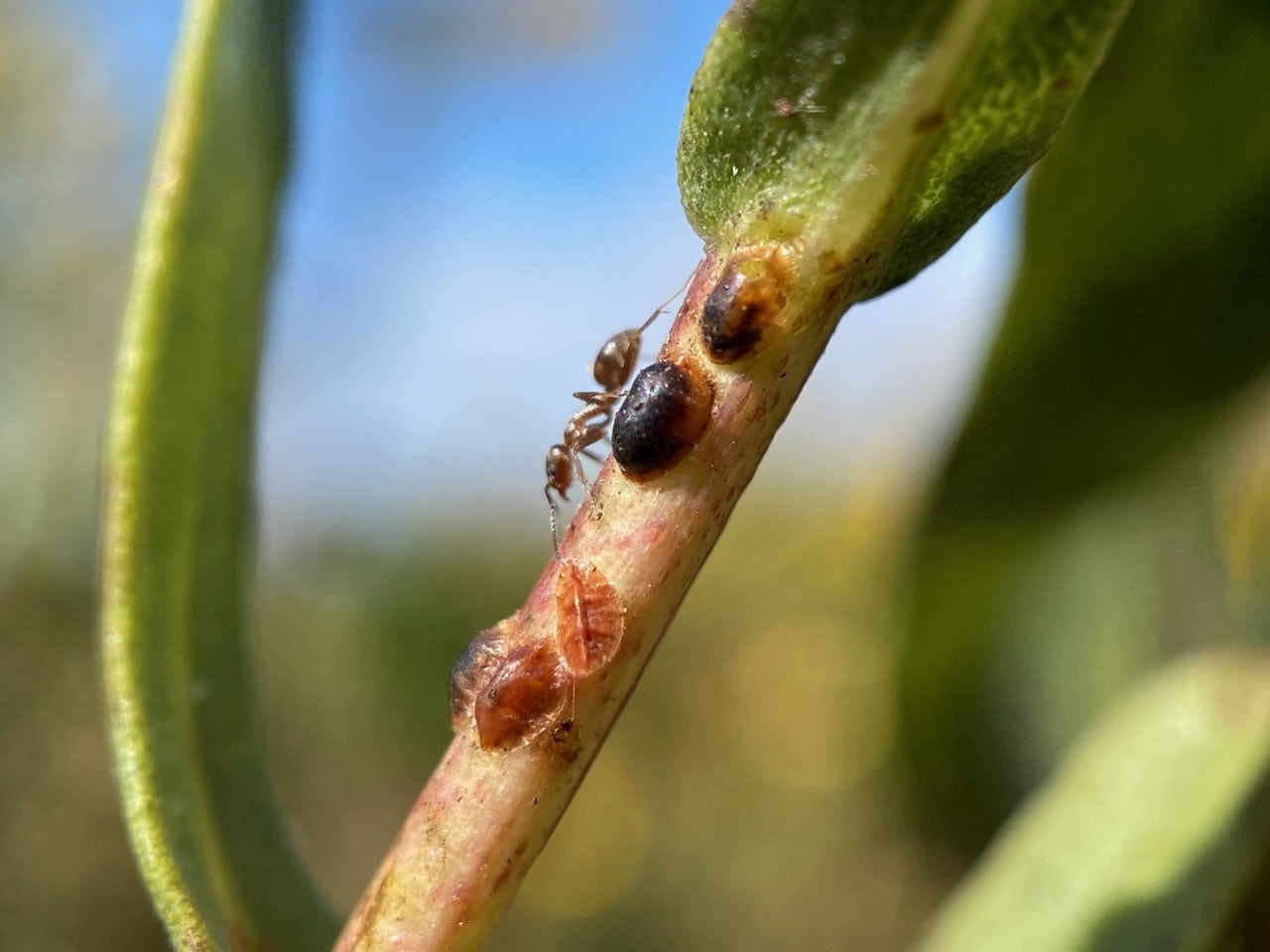
Argentine Ants, Linepithema humile (family Formicidae) are patrolling up and down the stem of this Grindelia, occasionally stopping at these odd looking bumps. The bumps are actually Brown Soft Scales, Coccus hesperidum (family Coccidae). The flatter, reddish ones with ridges are the nymphs. As they get older, they become rounder and darker.
The species has a cosmopolitan distribution and feeds on many different host plants – crops, ornamental and greenhouse plants. The adult female scale insect is oval and dome-shaped, about 3-5 mm long. It retains its legs and antennae throughout its life. Males of the species are rarely found. The Brown Soft Scale is ovoviviparous and produces young mostly by parthenogenesis. Over the course of her life, the female may produce up to 250 eggs, a few being laid each day. The eggs are retained inside the insect until they hatch, at which time small nymphs emerge and are brooded for a few hours before dispersing. These first-stage nymphs are known as crawlers and move a short distance from the mother before settling and starting to feed. They have piercing-sucking mouthparts and feed on the host plant’s sap. They are largely sedentary for the rest of their lives and pass through two more nymphal stages before becoming adults. There may be 3-7 generations in a year. Males are occasionally produced and these pass through four nymphal stages before becoming winged adults.
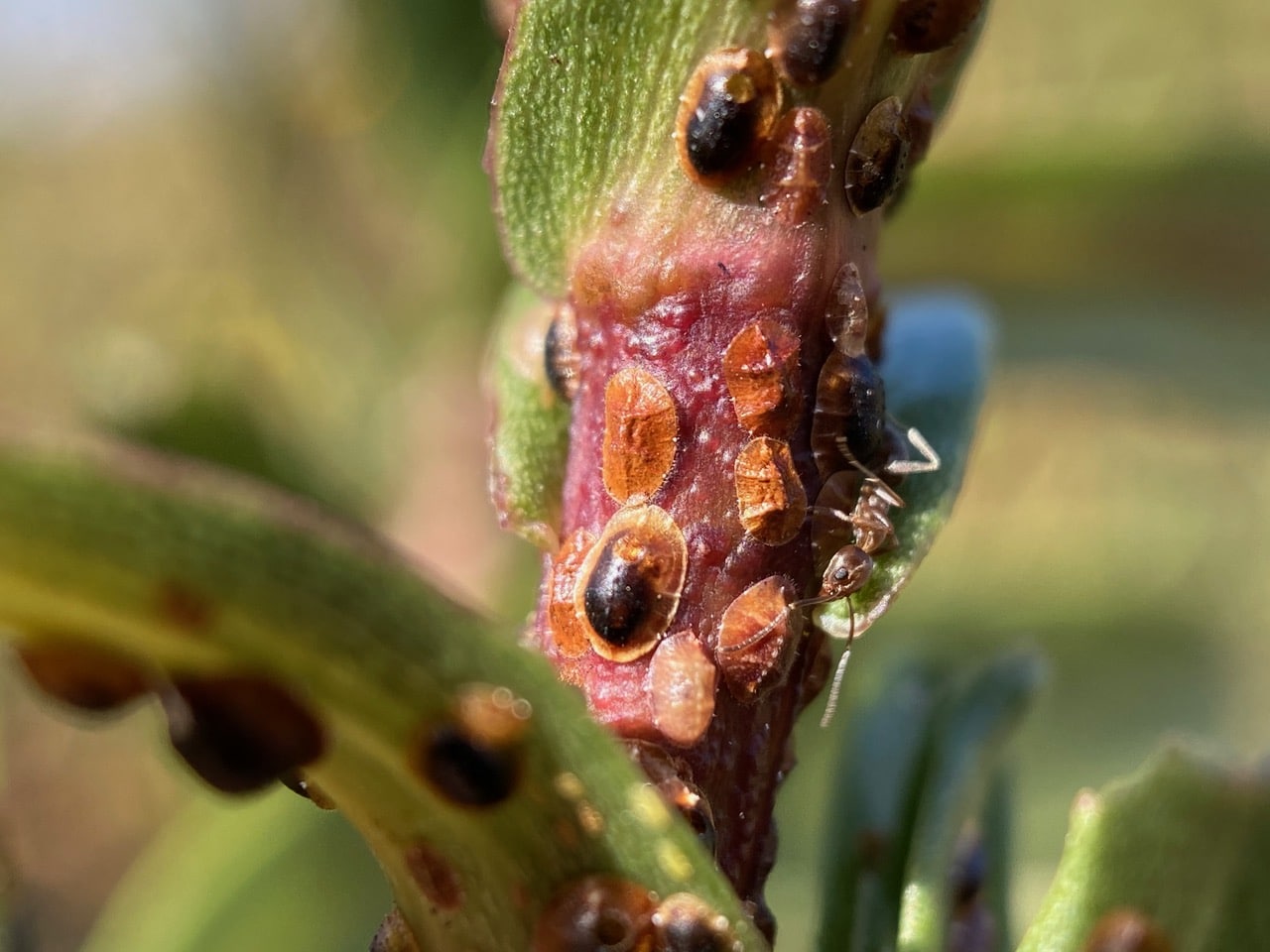
An Argentine Ant is tending the Brown Soft Scales of various ages at a leaf axil of Grindelia. The ants are here to feed on the sweet honeydew excreted by the scale insects.
In order to obtain all the nutrients they need, the scale insects ingest large quantities of sap. They then excrete the excess sugary fluid as honeydew. This is attractive to ants which often tend the scale insects, driving away predators. The Brown Soft Scale does not normally kill the host plant, but heavy feeding by the scale insects reduces plant vigor, and kills twigs. Sooty mold that grows on the excreted honeydew on the plant surfaces may interfere with photosynthesis and render the plants unsightly.
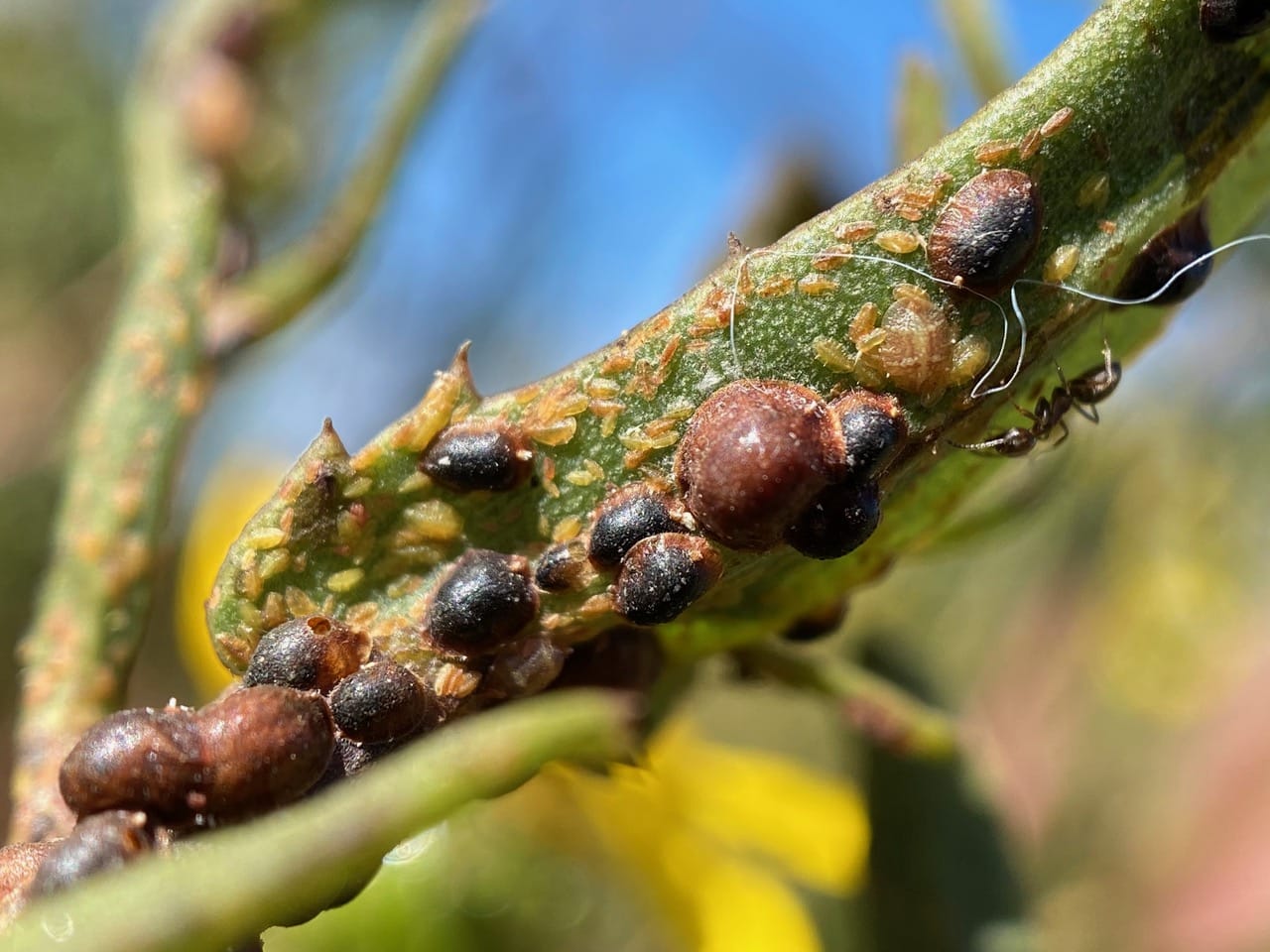
I look on the underside of a leaf and discover that it is studded with numerous large adult scales and tiny nymphs. These must be the “crawlers” that disperse from the mothers. Note the scale on the left with a hole on its back. That is probably the exit hole made by a parasitoid wasp. Many species of wasps are parasitoids of scale insects, and some are commercially available for biological pest control.