

Pollinator Post 9/18/23 (1)

Bumps, our Pale Swallowtail caterpillar is growing nicely on its Coffeeberry shrub. It has not molted and still looks like bird poop, but Bump has plumped up considerably since I found it.
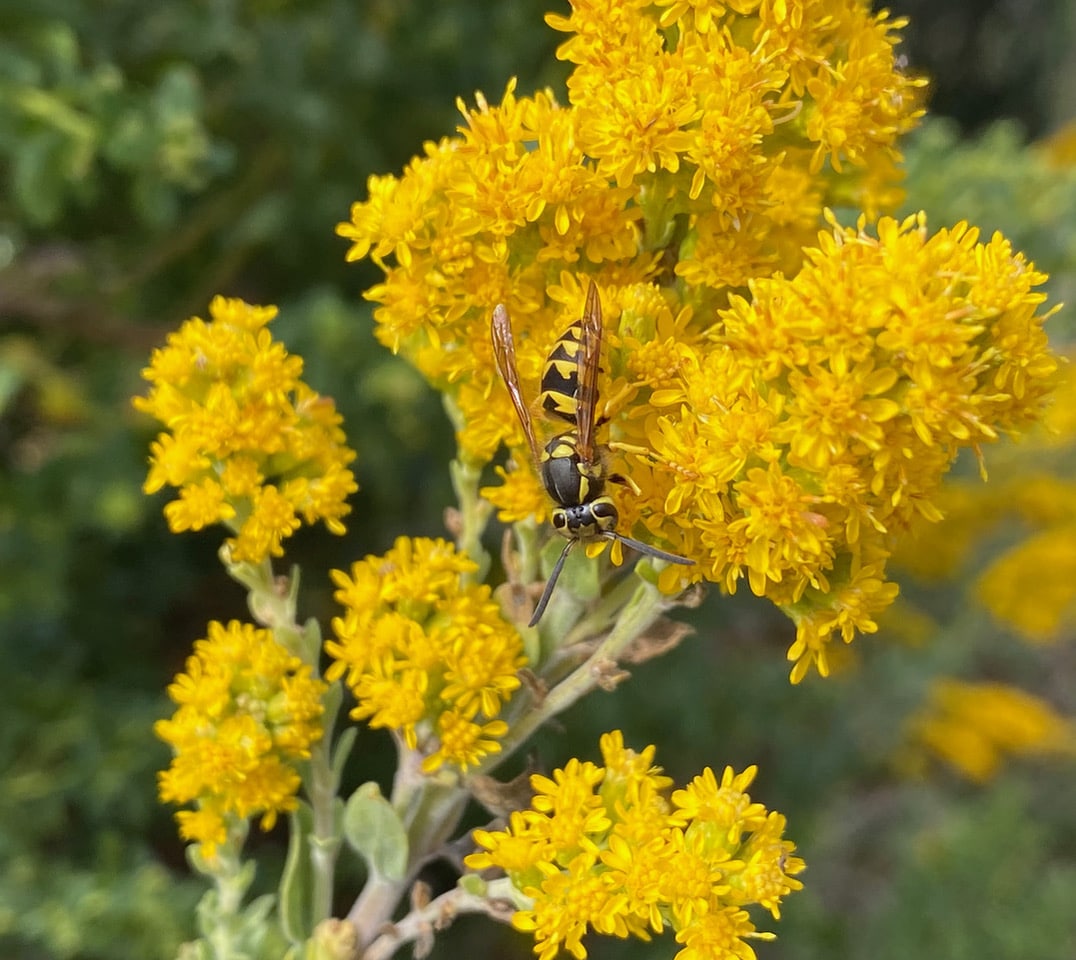
Several Yellowjacket wasps are incessantly patrolling the blooming California Goldenrod, Solidago velutina ssp. californica. The wasp would occasionally land on the flower spikes, checking for prey. Surely there must be something small hidden among the flowers?
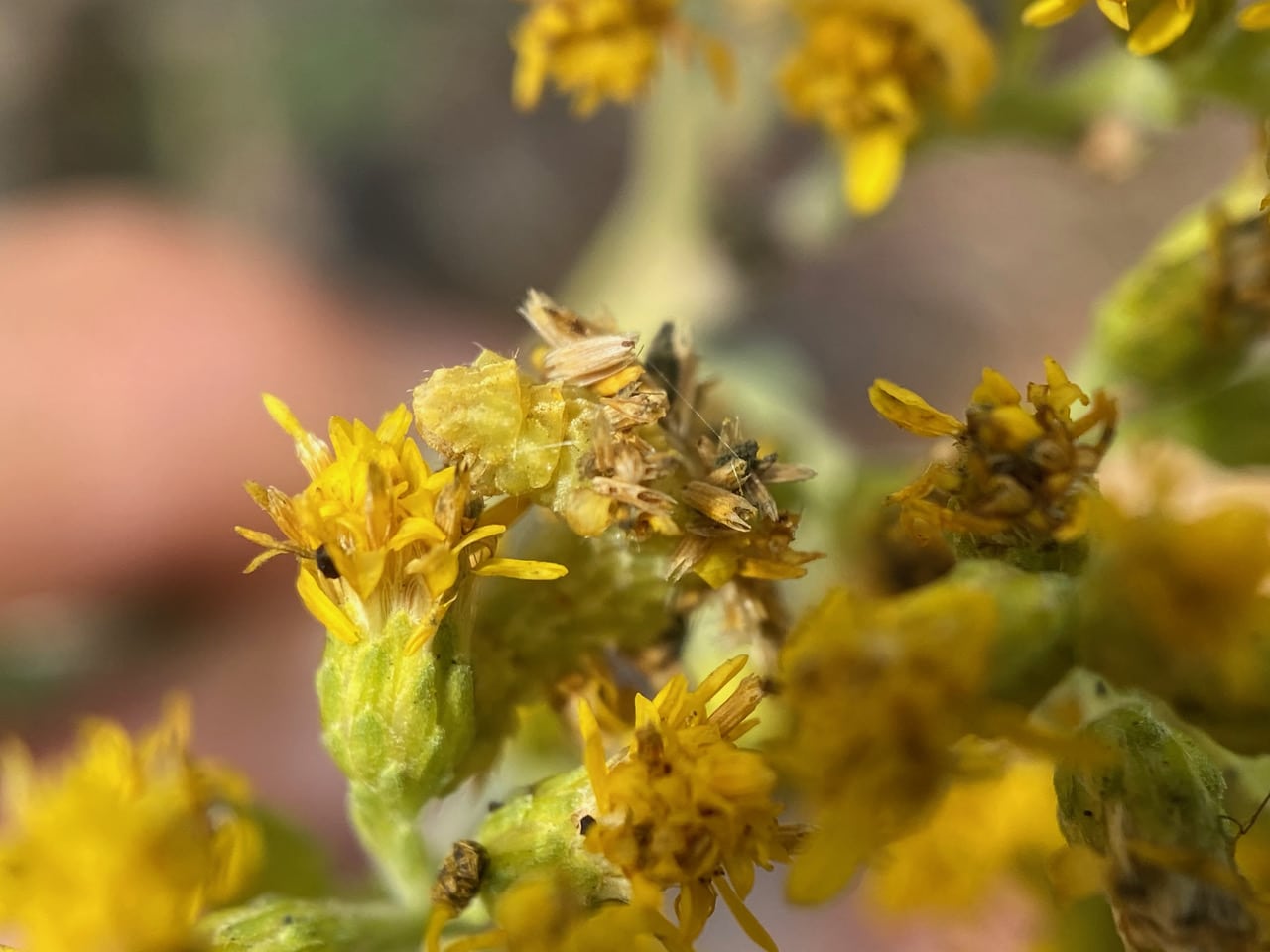
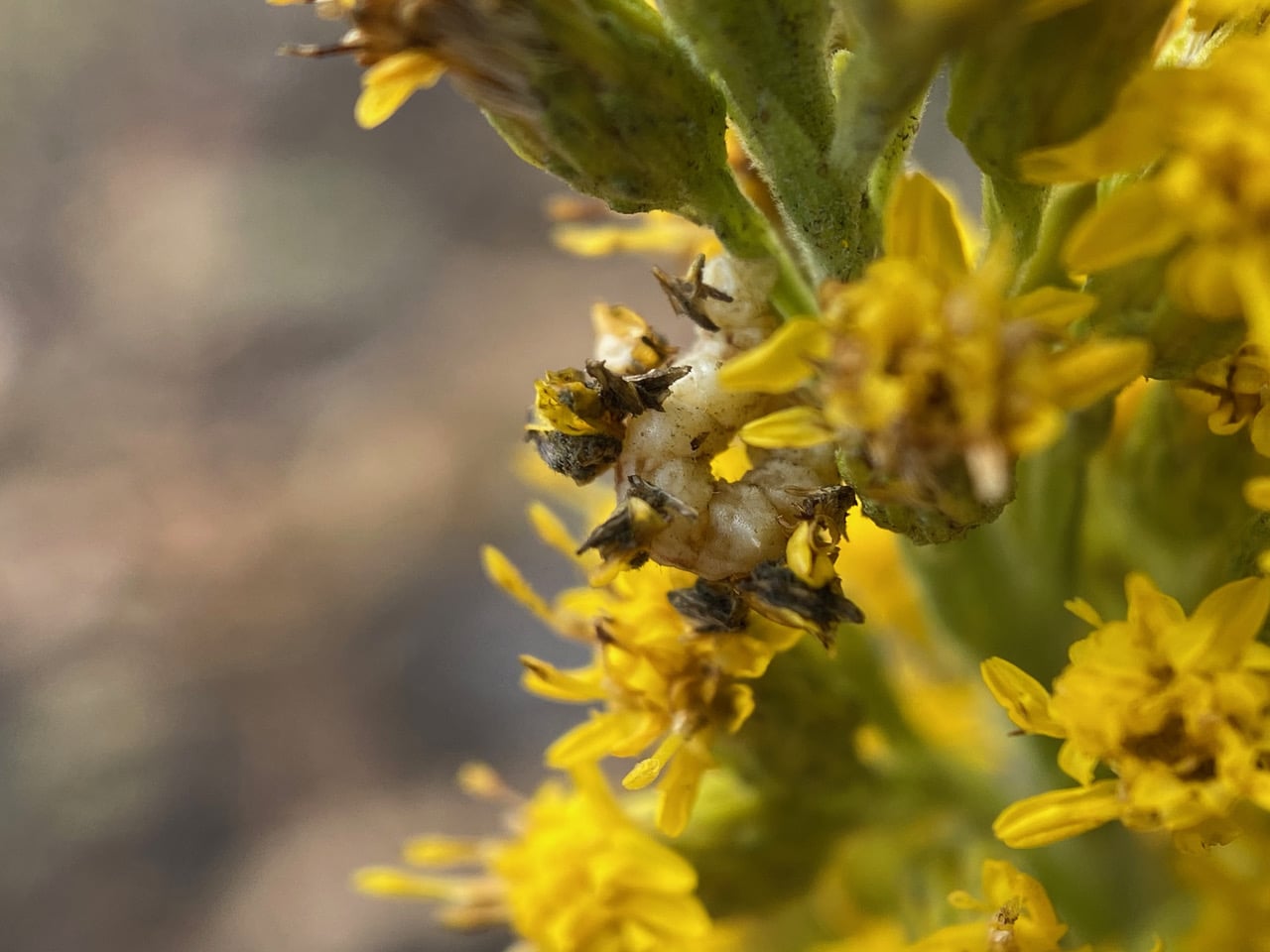
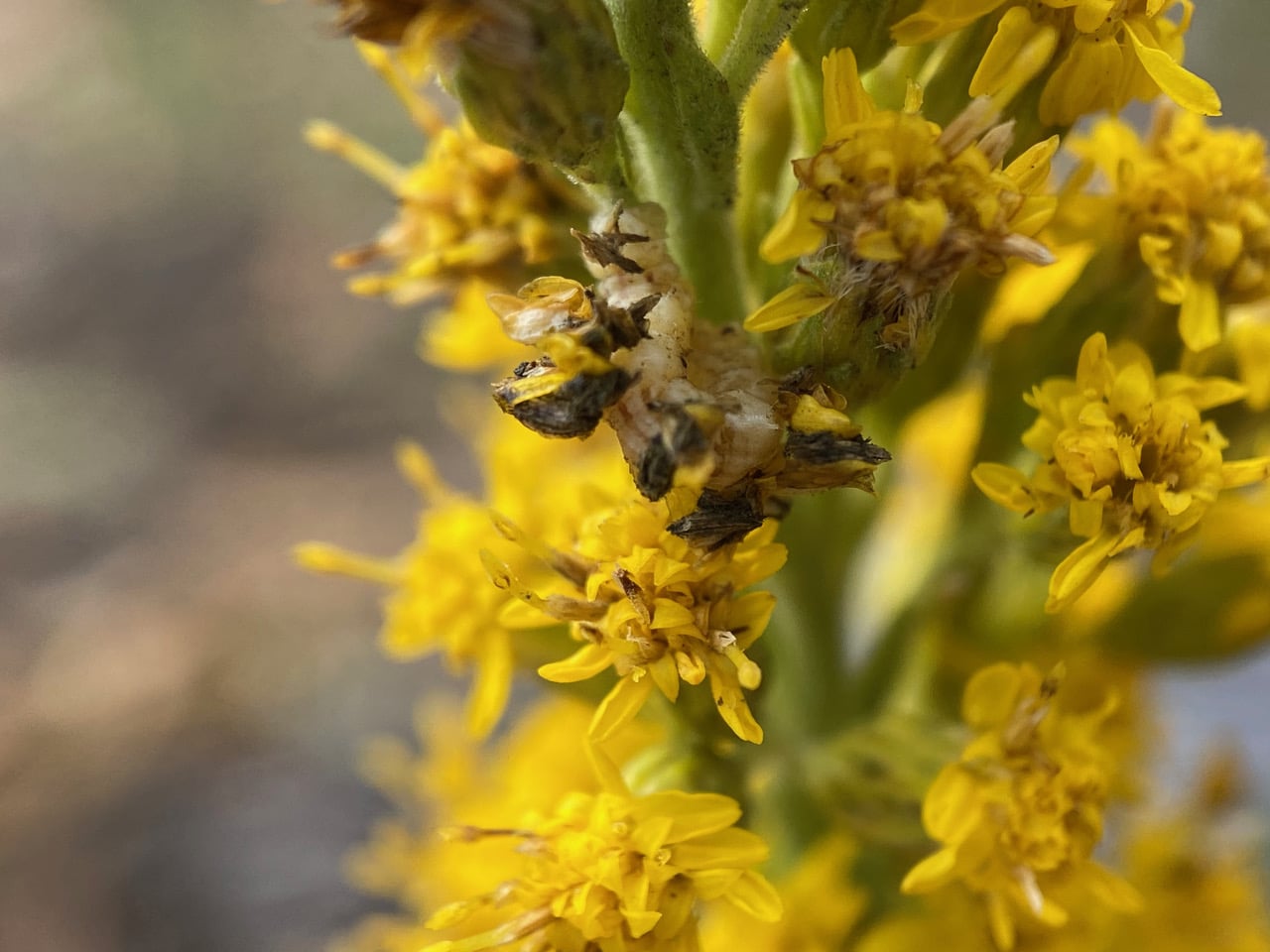


Just as the thought occurs to me, I detect a small movement from the corner of my eye. Closing in with my macro lens, I find a tiny Camouflaged Looper reaching up a flowerhead. Can you see it? Its thoracic segments are exposed; Its back is covered with flower debris that now appears more faded and brown than the surrounding flowers. You can even see some silk threads that it has used to bind its costume together.
Camouflaged Loopers belong to a group of moth species commonly referred to as inch worms because of the way they move, inching along, front legs reaching out, body stretched to its limit, grabbing ahead, pulling and looping the rest of the body forward. The caterpillar appears to be measuring the earth as it moves along, hence the name Geometridae for the family (Geo = earth, metron = measure).
The Camouflaged Looper is the larva of the Wavy-lined Emerald Moth, Synchlora aerata (family Geometridae), a species found throughout much of North America. The larvae feed on many plants in the family Asteraceae, as well as a variety of other flowering plants.
The Camouflaged Loopers are well known for covering themselves with the plant they feed on. The caterpillar chews off small pieces of flower petals, seed heads, leaves, whatever plant material is available, and attaches the pieces to its back with a little silk from the spinnerets beneath the caterpillar’s mouth. The caterpillar must do this several times during its life as a larva. Each time it molts the camo falls off with the old skin.
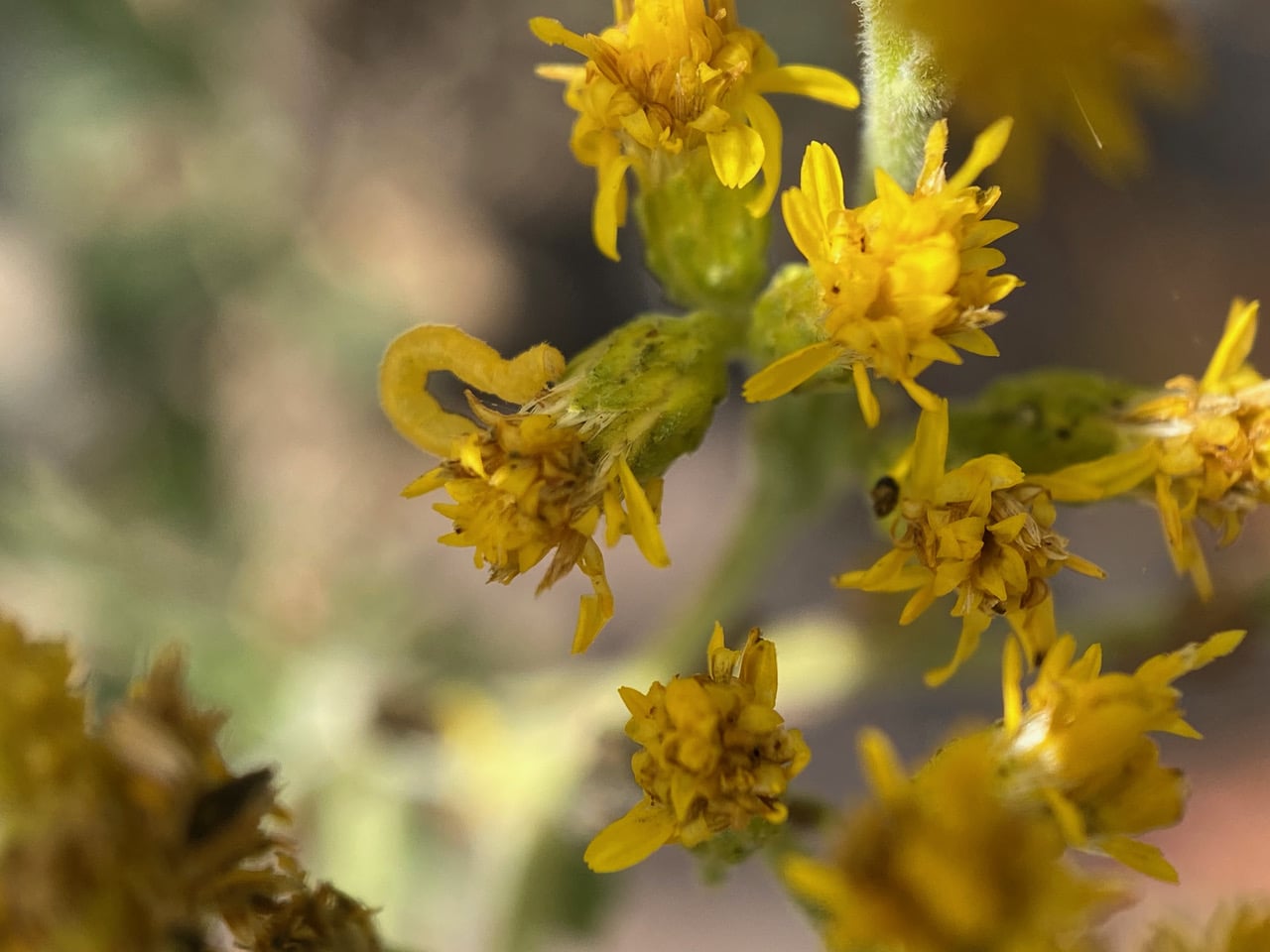
Close by, another, much smaller and unadorned inchworm is looping its way on a flowerhead. These tiny yellow inchworms are very commonly found among the goldenrod flowers. Are they the younger instars of the Camouflaged Looper?
The yellow inchworm is reaching into a goldenrod flowerhead, probably feeding on the flower parts.
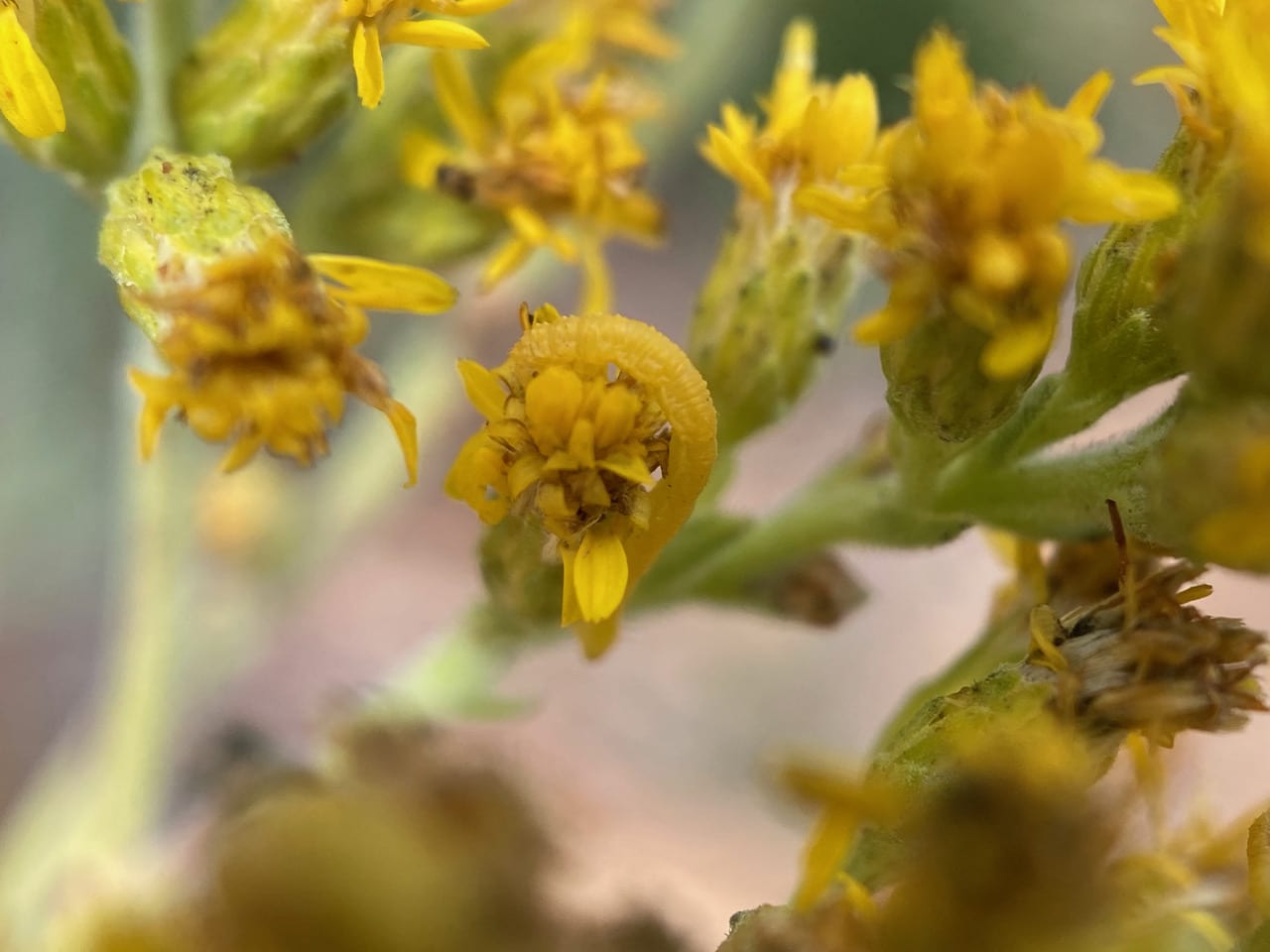
On a separate goldenrod flower spike, I notice some dark plant debris. On close examination, it turns out to be another Camouflaged Looper in an inverted U position. On its back are bits of plant debris that are dried and brown.
Yep, it’s a caterpillar with a camo costume! It needs to change the costume soon, as it doesn’t serve it well anymore. With the Yellowjackets constantly on the hunt, it is easy to understand why the caterpillars go to such extreme efforts to conceal themselves.
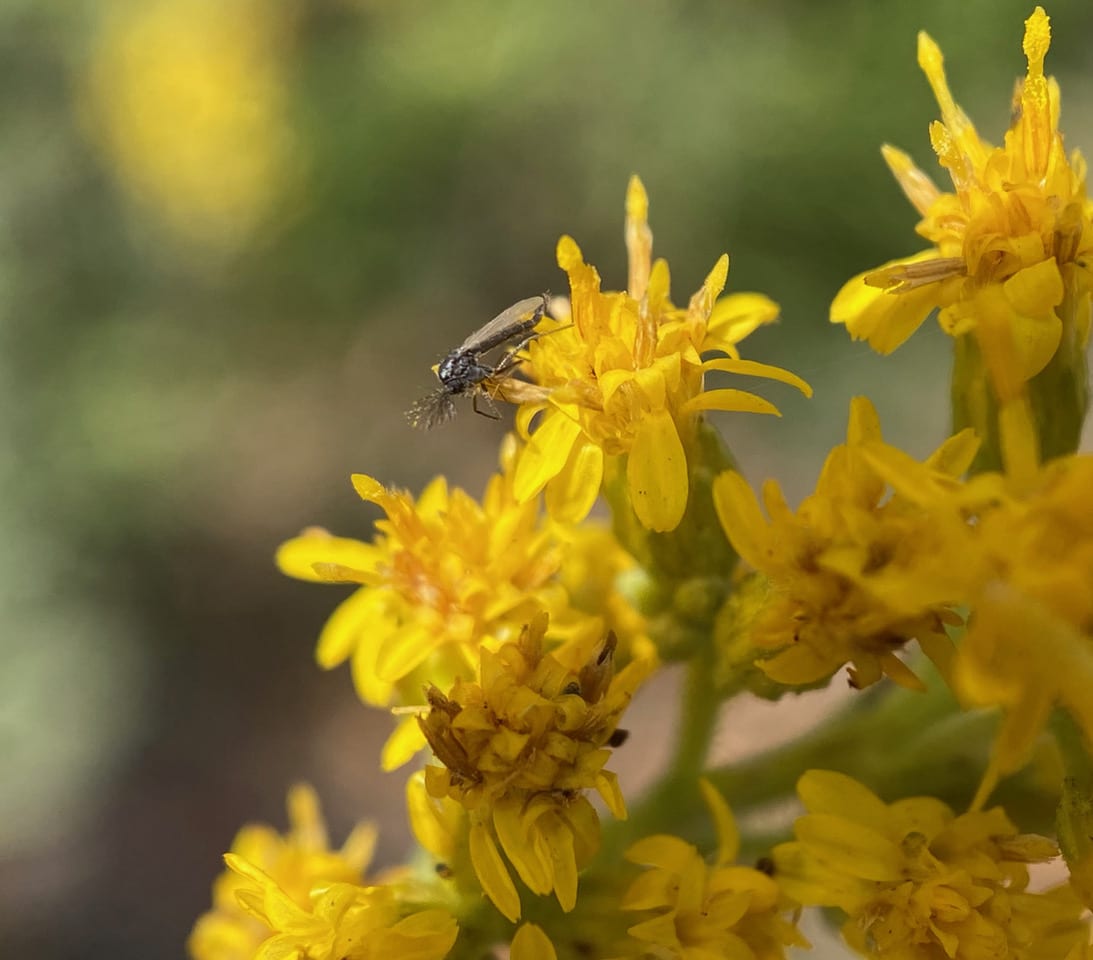
A tiny midge has landed on a goldenrod flowerhead. Its plumose antennae dusted with yellow pollen gives it away as a male Non-biting Midge (family Chironomidae).
The Chironomidae is a large and diverse family of flies, with over 20,000 species known world-wide. Adult midges are small, most measuring 1-10 mm long, with narrow bodies and long legs. They resemble mosquitos, but do not bite. Males have long, feathery (plumose) antennae. Adults are short-lived. They feed on fly droppings, nectar, pollen, honeydew, and various sugar-rich materials. Larvae are mostly aquatic or semi-aquatic; most occur in freshwater habitats, a few occur in decaying matter, under bark, in moist ground, or tree holes. Larvae are mostly scavengers/detritivores. Collectively, they play a vital role in freshwater ecosystems as primary consumers. They harvest an enormous amount of energy from detritus and are important food items for fish, amphibians, birds, and predatory insects such as dragonflies and dance flies. Adult Chironomids can be pests when they emerge in large numbers, forming mating swarms over water or road surfaces.
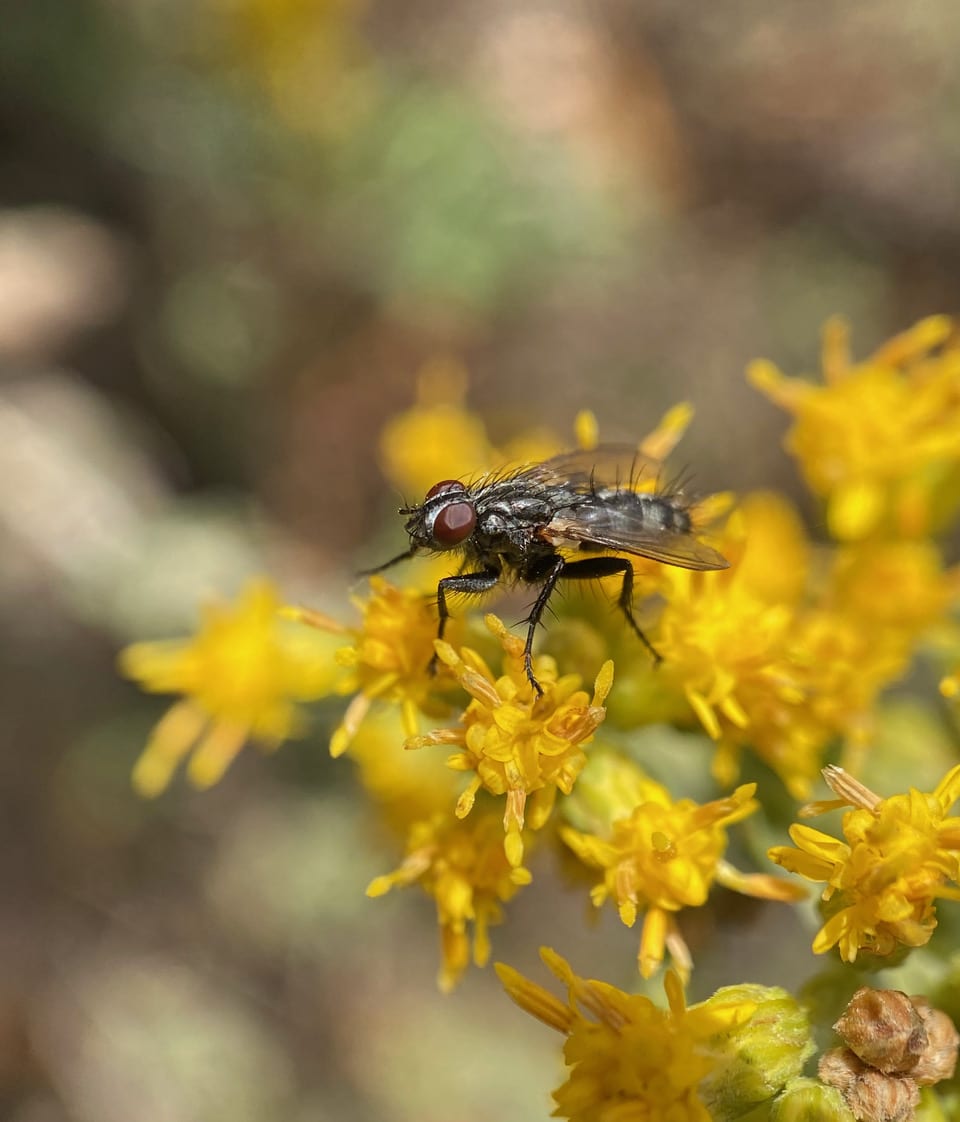
Here’s one of the most common flies in the garden, the Woodlouse Fly, Stevenia deceptoria (family Rhinophoridae). It is hard to imagine that we could have enough woodlice to support this large a population of the fly.
These small, slender, black, bristly flies are somewhat related to the Tachinidae. The larvae are mostly parasitoids of woodlice (pill bugs), beetles, spiders and other arthropods, and occasionally snails.
Native to Europe, Stevenia deceptoria is now widespread in the US. The flies are parasitoids of terrestrial woodlice (roly polies) of the order Isopoda (Oniscoidea).

Ooh, a Crab Spider (family Thomisidae) is waiting in ambush among a cluster of goldenrod flowerheads! It does not look like a typical Goldenrod Crab Spider, Misumena vatia. It is a Mecaphesa sp. that has turned yellow! Wow, I have been wondering if Mecaphesa could change color.
Members of the family Thomisidae do not spin webs, and are ambush predators. The two front legs are usually long and more robust than the rest of the legs. Their common name derives from their ability to move sideways or backwards like crabs. Most Crab Spiders sit on or beside flowers, where they grab visiting insects. Some species are able to change color over a period of some days, to match the flower on which they are sitting.
Most Crab Spiders are usually yellow or white. This ultimately depends on the flower on which they are hunting (active camouflage). They have the ability to change between these colors based on their surroundings, using visual cues. The color-changing process is not instant and can take up to 25 days to complete. Depending on the color of flower they see around them, the spiders can secrete a liquid yellow pigment into the body’s outer cell layer. The baseline color of the spider is white. In its white state, the yellow pigment is sequestered beneath the outer cell layer so that the inner glands which are filled with white guanine are visible. While the spider is residing on a white flower, it tends to excrete the yellow pigment instead of storing it in its glands. In order to change back to yellow, the spider must first produce enough of the yellow pigment. For this reason it takes these spiders much longer to turn from white to yellow than it does the reverse. The color change from white to yellow can take between 10-25 days while the opposite color change takes only about 6 days.
Mecaphesa is distinguished from the other genera of Crab Spider by the size and arrangement of the eight eyes (in two curved rows of four). Mecaphesa is also often hairy, with tiny hairs protruding from the head, legs, and body.
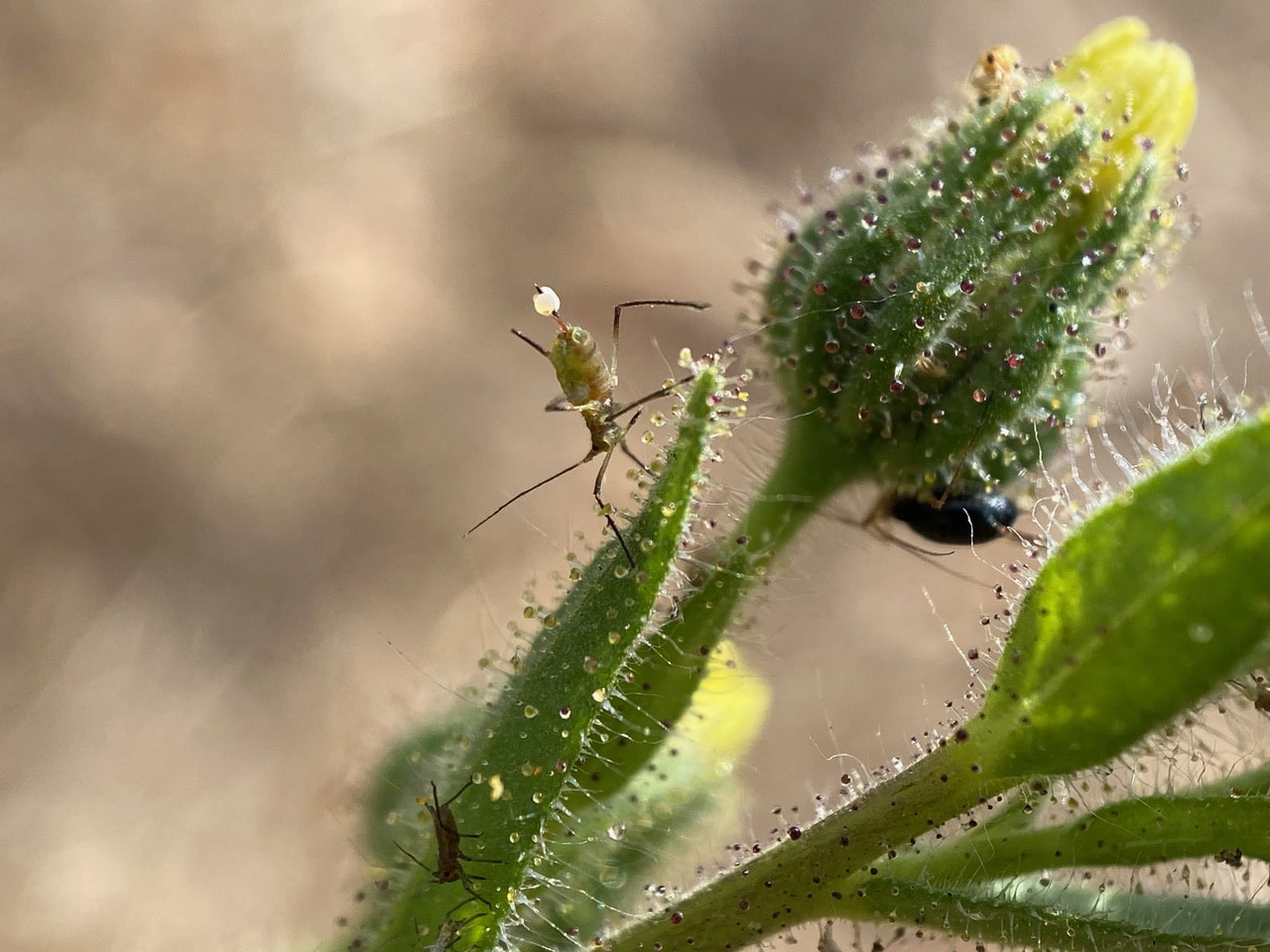
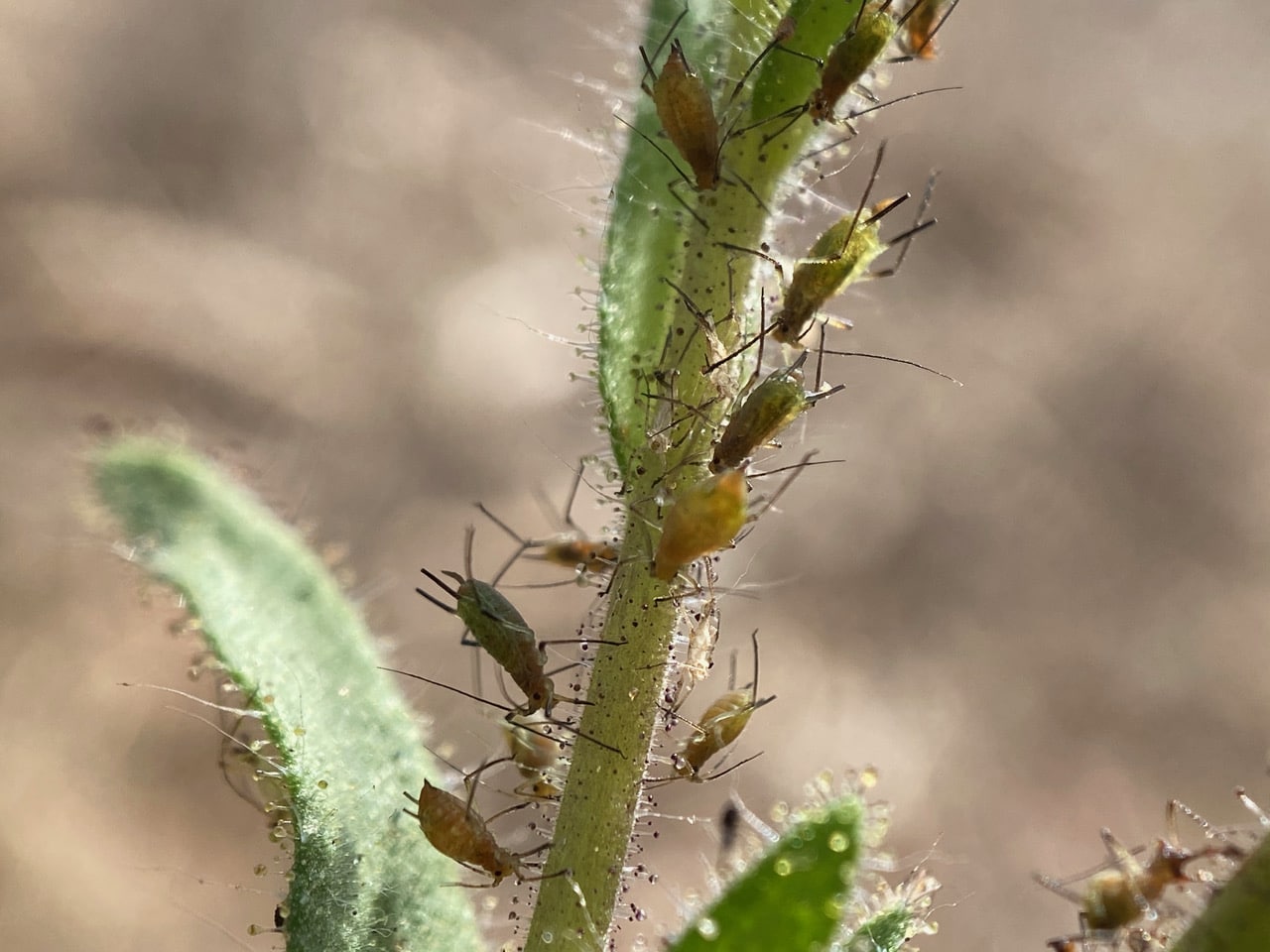
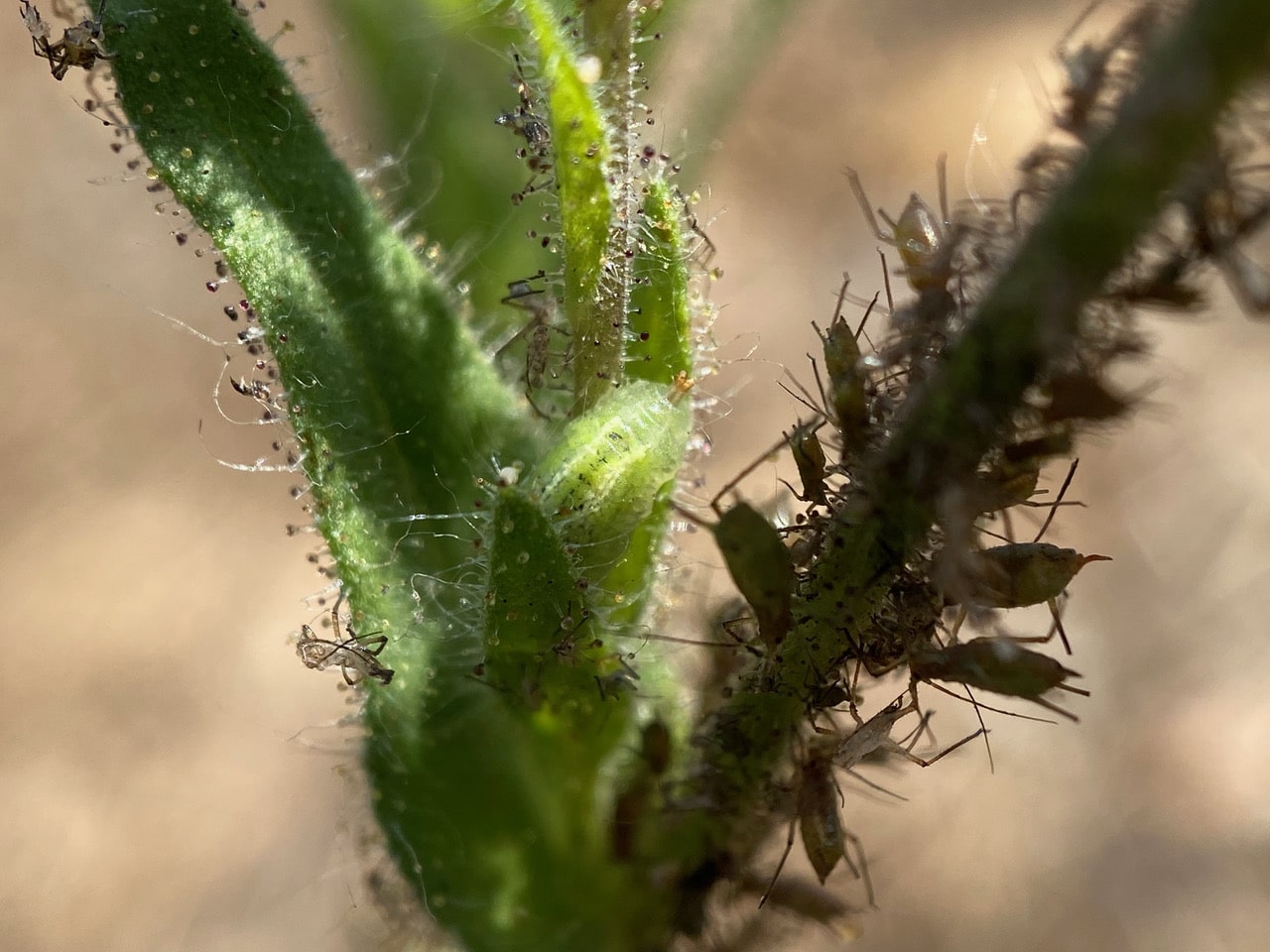
A colony of aphids, Uroleucon sp. (family Aphididae) on a young Coast Tarweed, Madia sativa is on high alert. A large adult on a top leaf is waving its butt and extruding a substance from its cornicles. The substance is an alarm pheromone that alerts colony mates of impending threats. Aphids would sometimes take evasive action by dropping from the plant.
The aphids below also seem agitated, occasionally wagging their rears in unison. What could be alarming them so? Synchronous butt wagging is another way that aphids warn each other of danger. Amazingly, the aphids can continue to feed while doing the butt wave.
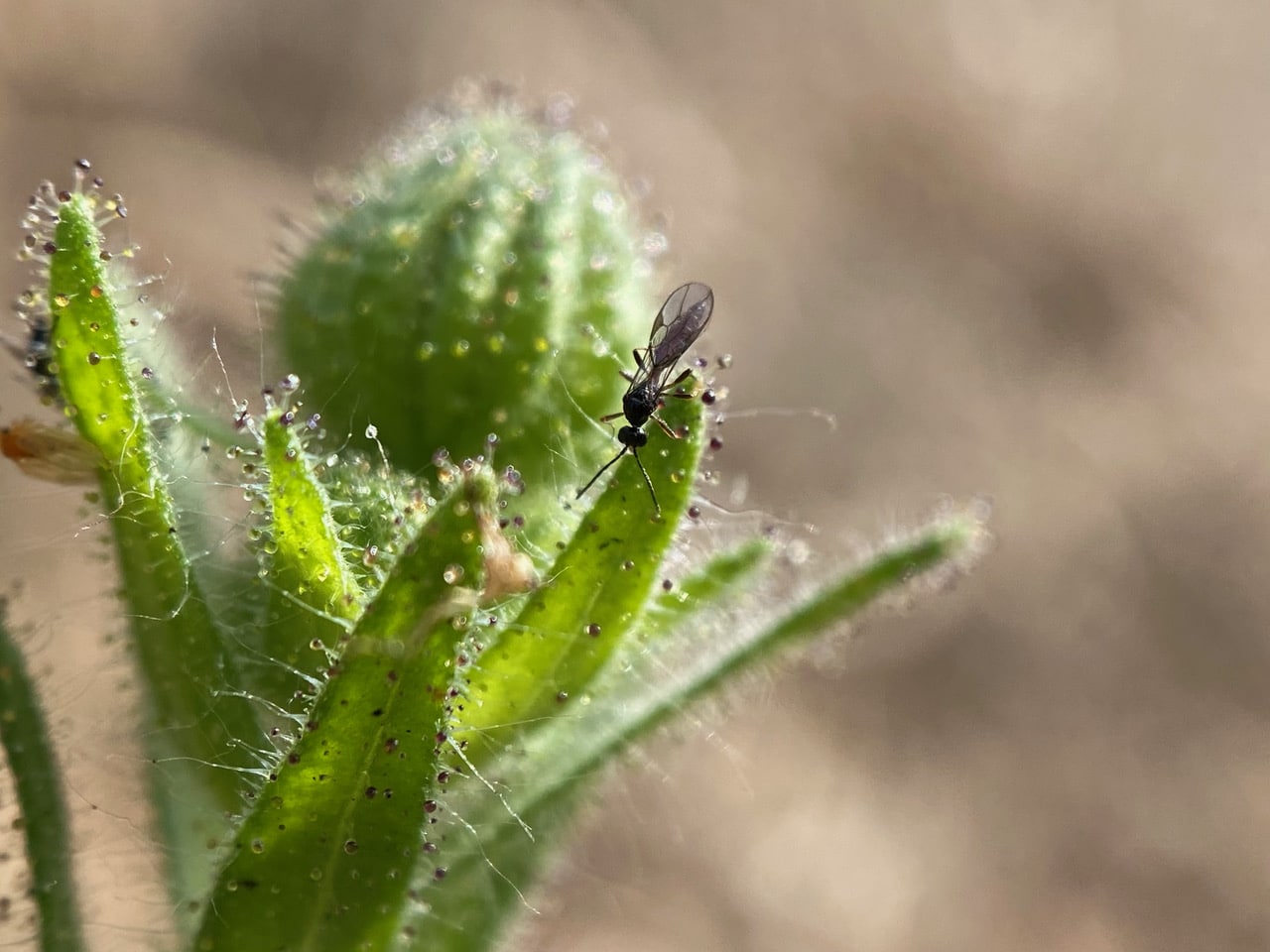
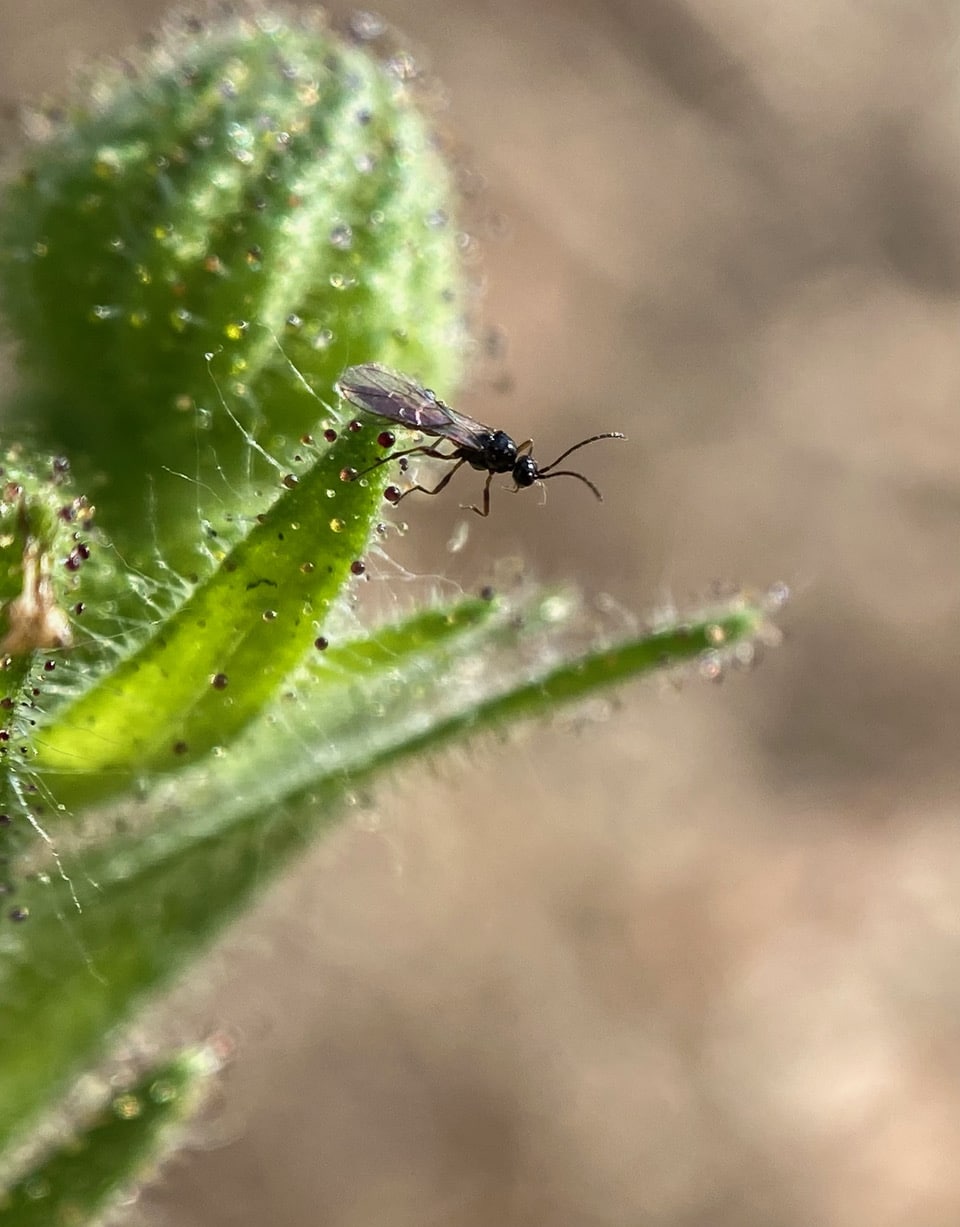
Ah, this may be the cause for alarm! A tiny wasp has landed on a top leaf. It appears to be a parasitoid wasp in the family Braconidae. Members of the subfamily Aphidiinae use aphids as their hosts.
The wasp looks around warily, its long antennae waving.
Aphidius is a genus of parasitoid wasps in the family Broconidae. Aphidius is a small wasp, usually less then 3 mm long. They are endoparasitoids of aphids. The female wasp lays single eggs in aphids. When the egg hatches, the wasp larva feed on the inside of the aphid. As the larva matures, the host dies and becomes discolored, bloated, or mummified. Complete metamorphosis of the wasp occurs within the host. When the adult is ready to emerge, it cuts an escape hole in the back of the “aphid mummy” and immediately go in search of food (nectar and pollen) as well as a mate. Once mated, the females search for aphids in which to lay their eggs, using the scent of the aphids as a guide.
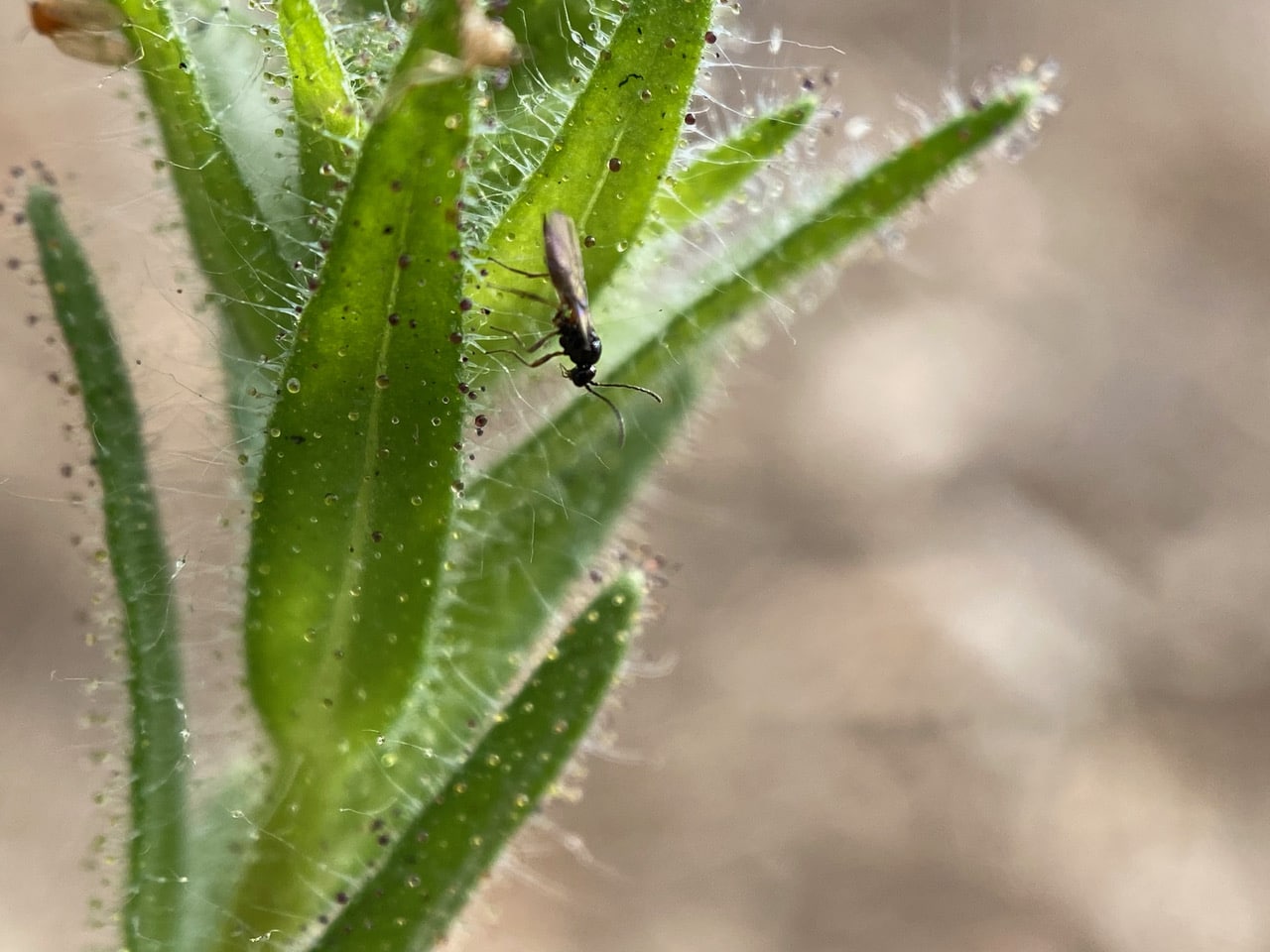
Gingerly the wasp makes it way down among the sticky hairs of the plant.
Before the wasp reaches the aphids, it pauses for a while to grooming itself. Then, much to my disappointment, flies away. Perhaps the sticky exudate is more than it can handle.
After the wasp left, the aphids still behave nervous and agitated. I begin to suspect other threats to the aphids. Sure enough, there’s this tiny green Syrphid larva hidden in a leaf axil. We are looking at its rear end with a pair of yellowish snorkel-like tubes protruding.
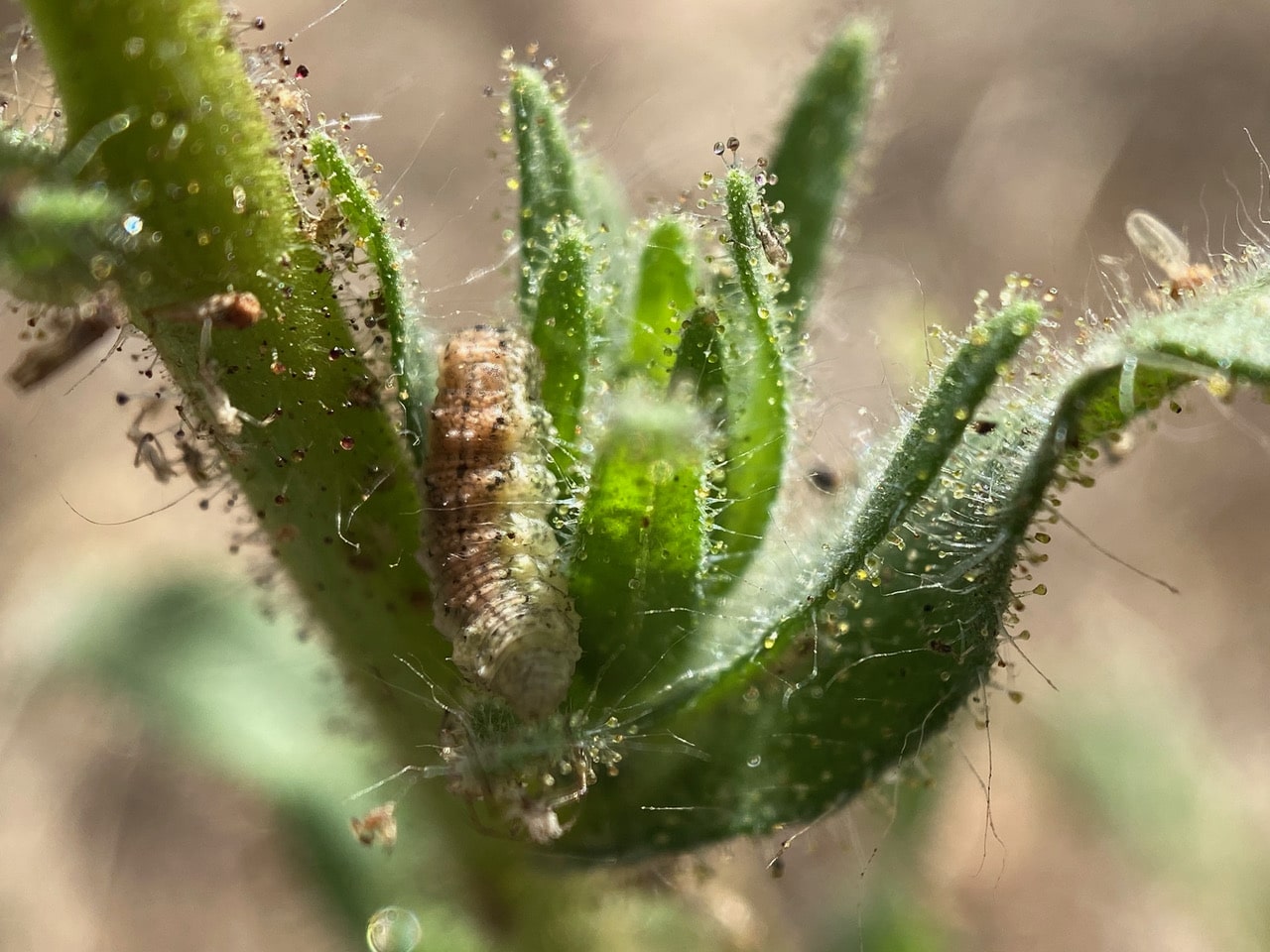
The larvae of many species of hover flies (family Syrphidae) are voracious predators of aphids. Syrphids have four life stages: eggs, larva, pupa, and adult. After hatching, larvae develop through three, increasingly larger instars before pupation. For Syrphids that prey on aphids, egg to adult development time during the growing season is commonly 2 to 4 weeks. These species can have 5-7 generations per year. Each Syrphid larva may feed on 100 to 400 aphids before it pupates, but this varies by the mature size of the Syrphid relative to the aphid size.
Ooh, here’s another Syrphid larva! It has a brown tinge on its back, maybe ready to pupate? Or maybe a different species? The aphids have legitimate reason to be nervous.
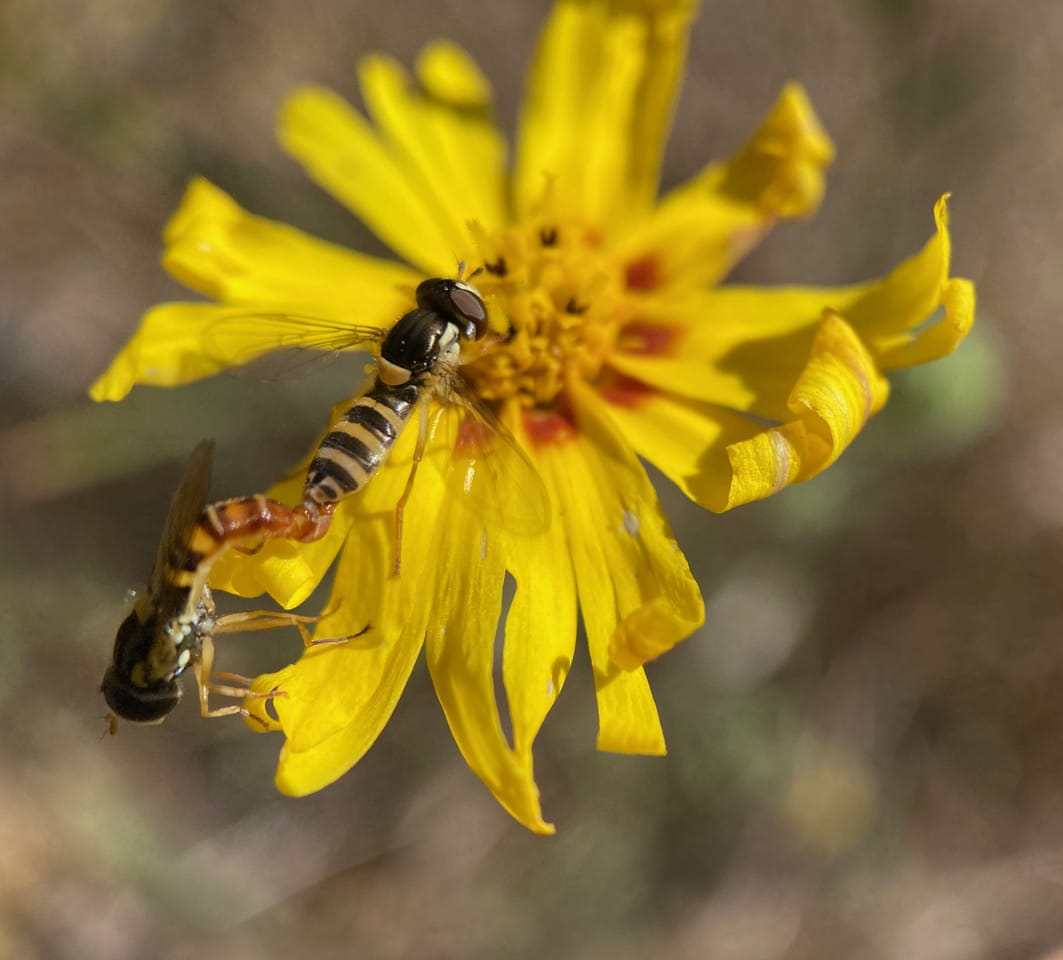
Movements on a flowerhead of Elegant Tarweed, Madia elegans alert me to a mating pair of Forked Globetail, Sphaerophoria sulphuripes (family Syrphidae). The male is the one on the lower left, with a reddish abdomen. He has uncurled his genitals from under the tip of his abdomen and inserted it into the female. This species of hover fly is the most commonly seen at the tarweed patch. The small Syrphid larvae on the plants are probably its young.
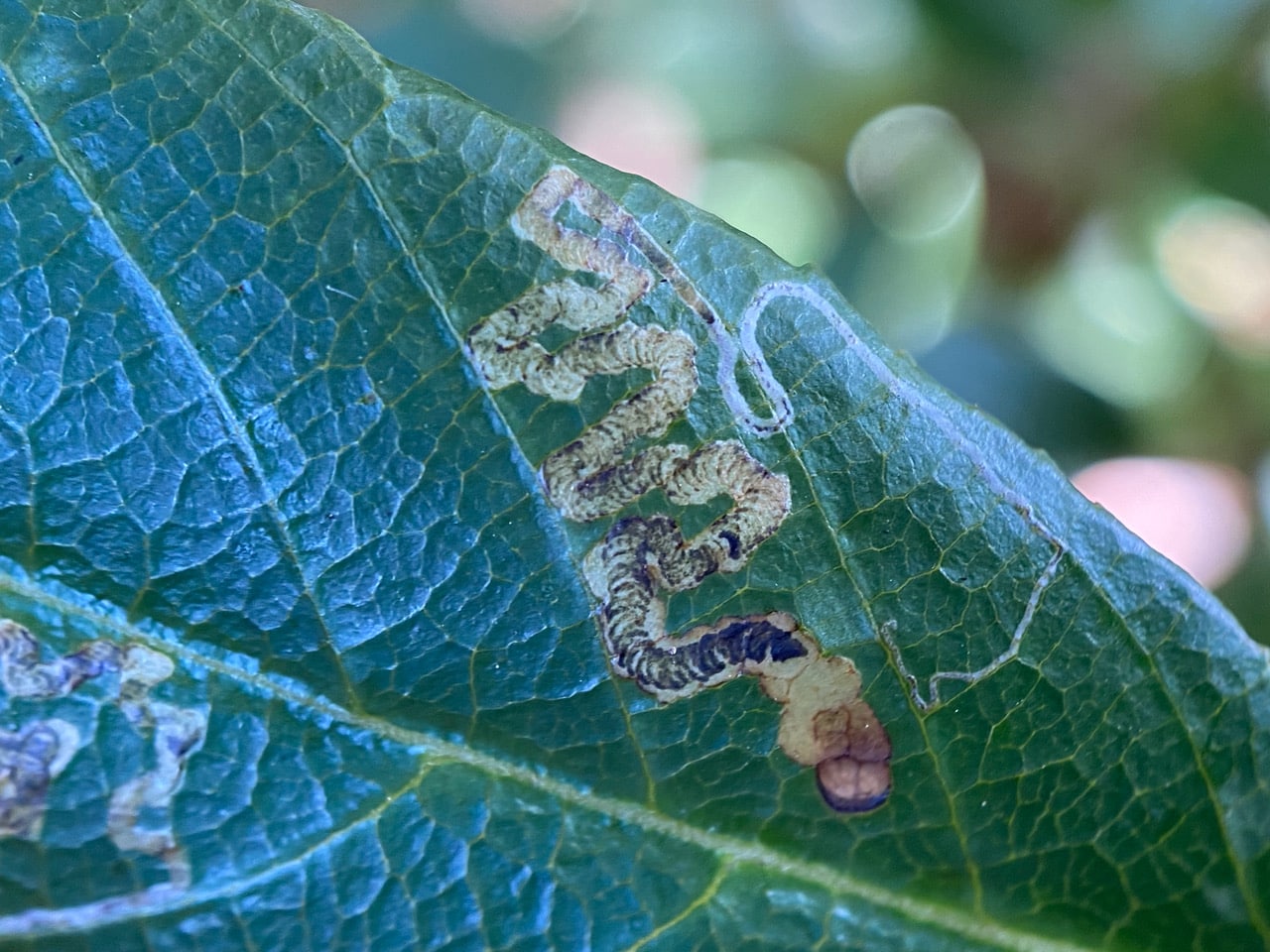
I pause in the shade of the grove of Eucalyptus/ Bay trees to look for insects on the California Coffeeberry, Frangula californica (family Rhamnaceae). Wow, that’s an interesting leaf mine on a Coffeeberry leaf – almost snake-like in its sinuous path!
A leaf miner is any one of numerous species of insects in which the larval stage lives in, and eats, the leaf tissue of plants. The vast majority of leaf-mining insects are moths (Lepidoptera), sawflies (Symphyta), and flies (Diptera). Some beetles also exhibit this behavior. Leaf miners are protected from many predators and plant defenses by feeding within the tissues of the leaves, selectively eating only the layers that have the least amount of cellulose, and lowest levels of defensive chemicals.
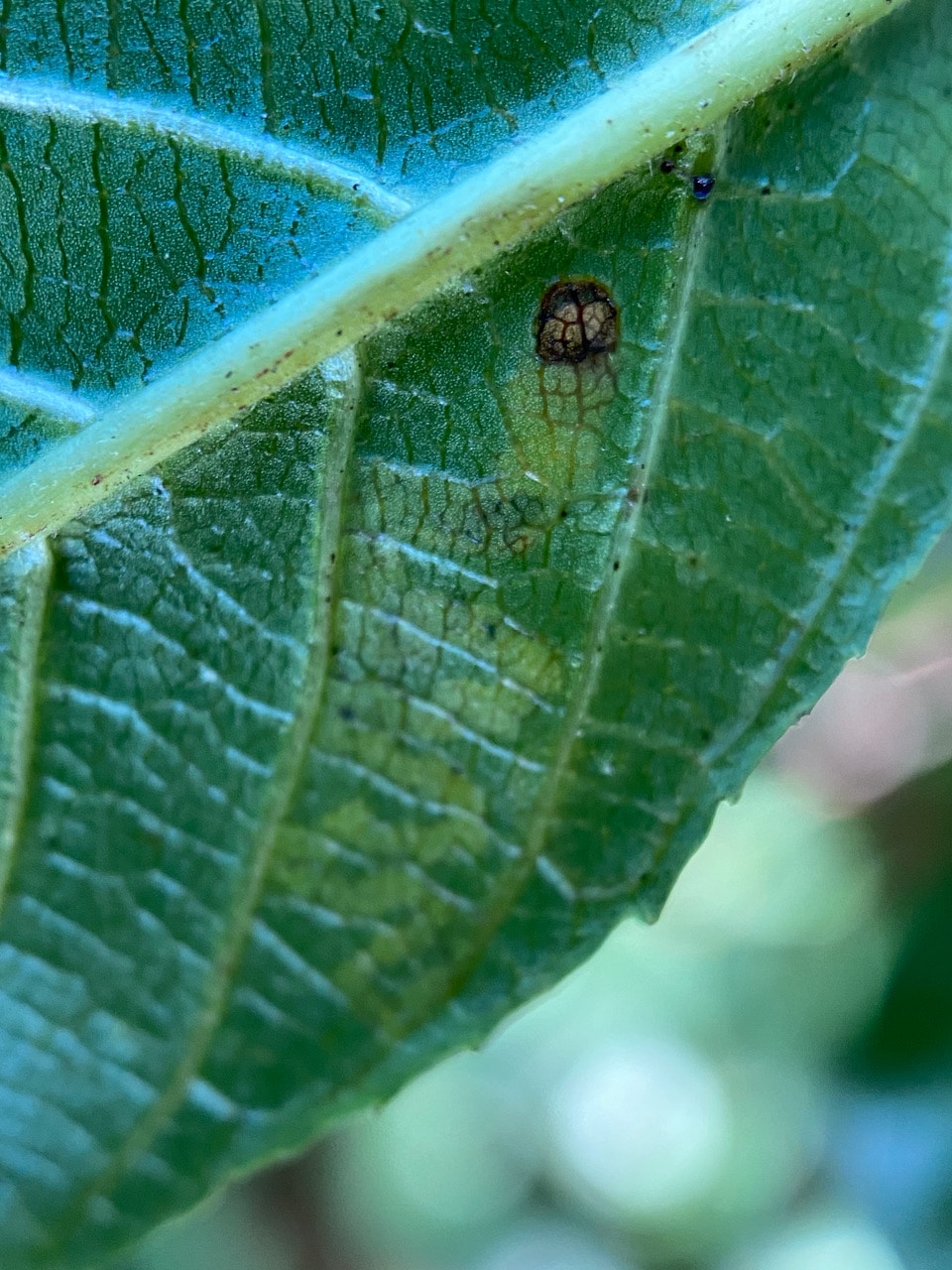
Underside of the same Coffeeberry leaf, showing very faint traces of the mine. The larva apparently feeds more closely to the upper surface of the leaf.
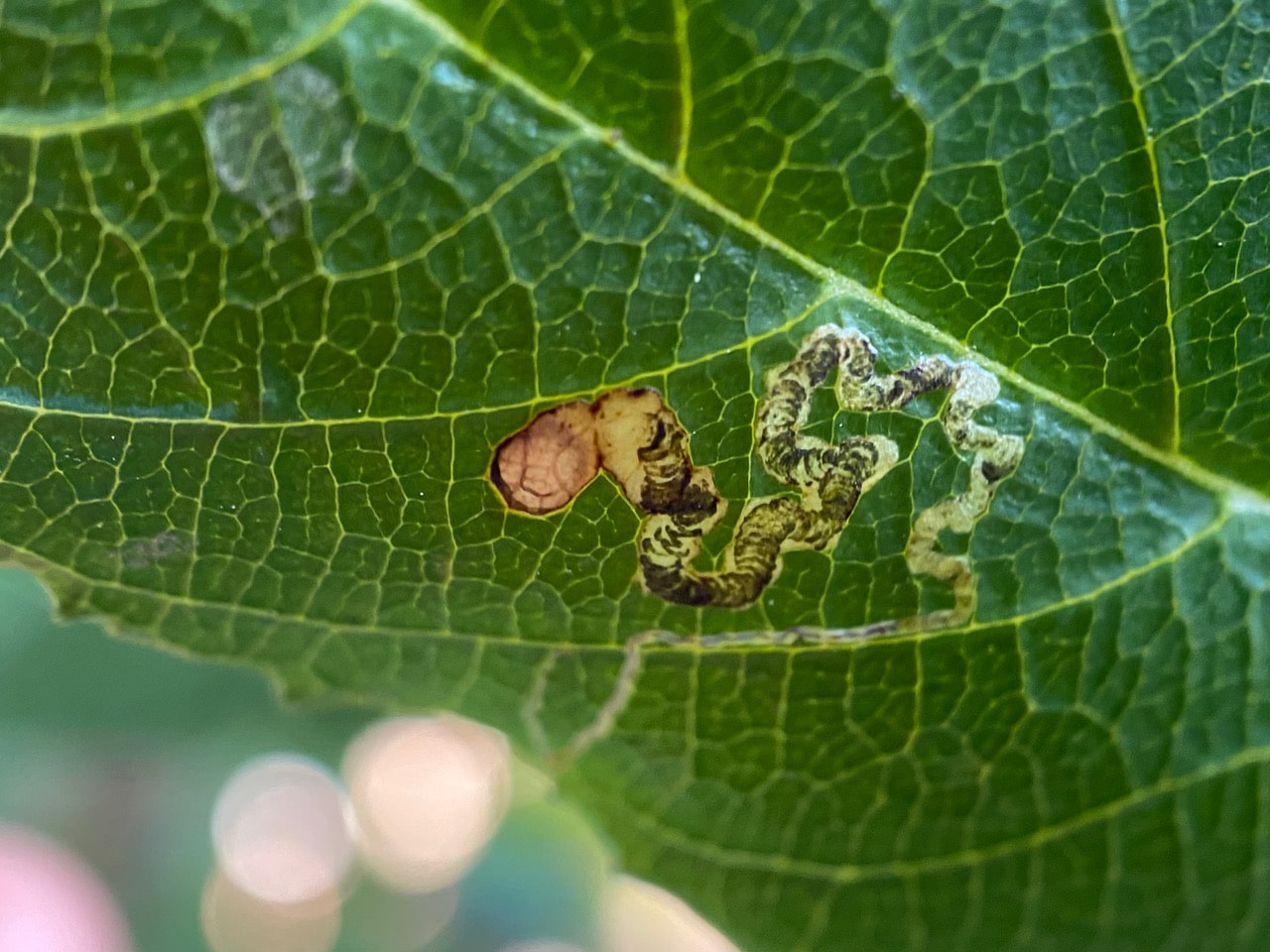
Here’s another of the Coffeeberry leaf mine in better light. The larva is no longer in the mine. Does it exit to pupate elsewhere?
When I submitted the picture to iNaturalist, I was delighted that their Computer Vision (AI) was able to immediately identify the leaf miner as most likely the moth, Stigmella rhamnicola (family Nepticulidae). The specific epithet of the moth is reassuring – rhamnicola means “residing in Rhamnus”. I recall that California Coffeeberry was formerly classified as Rhamnus californicus.
Stigmella rhamnicola is a small moth of the family Nepticulidae, named for the host plant genus Rhamnus. It is found in Ohio, United States where the larvae feed on Buckthorn, including Rhamnus lanceolata and R. cathartica. They mine the leaves of their host plant. The mine is much contorted and linear at first. Later, the mine lengthens and straightens, crossing to the upper surface and broadening markedly. The frass (insect poop) is deposited as a continuous black line initially, but becomes a granular arcuate (curved) line in later stages. Little is known about the adult moths.