

Pollinator Post 9/17/24 (2)
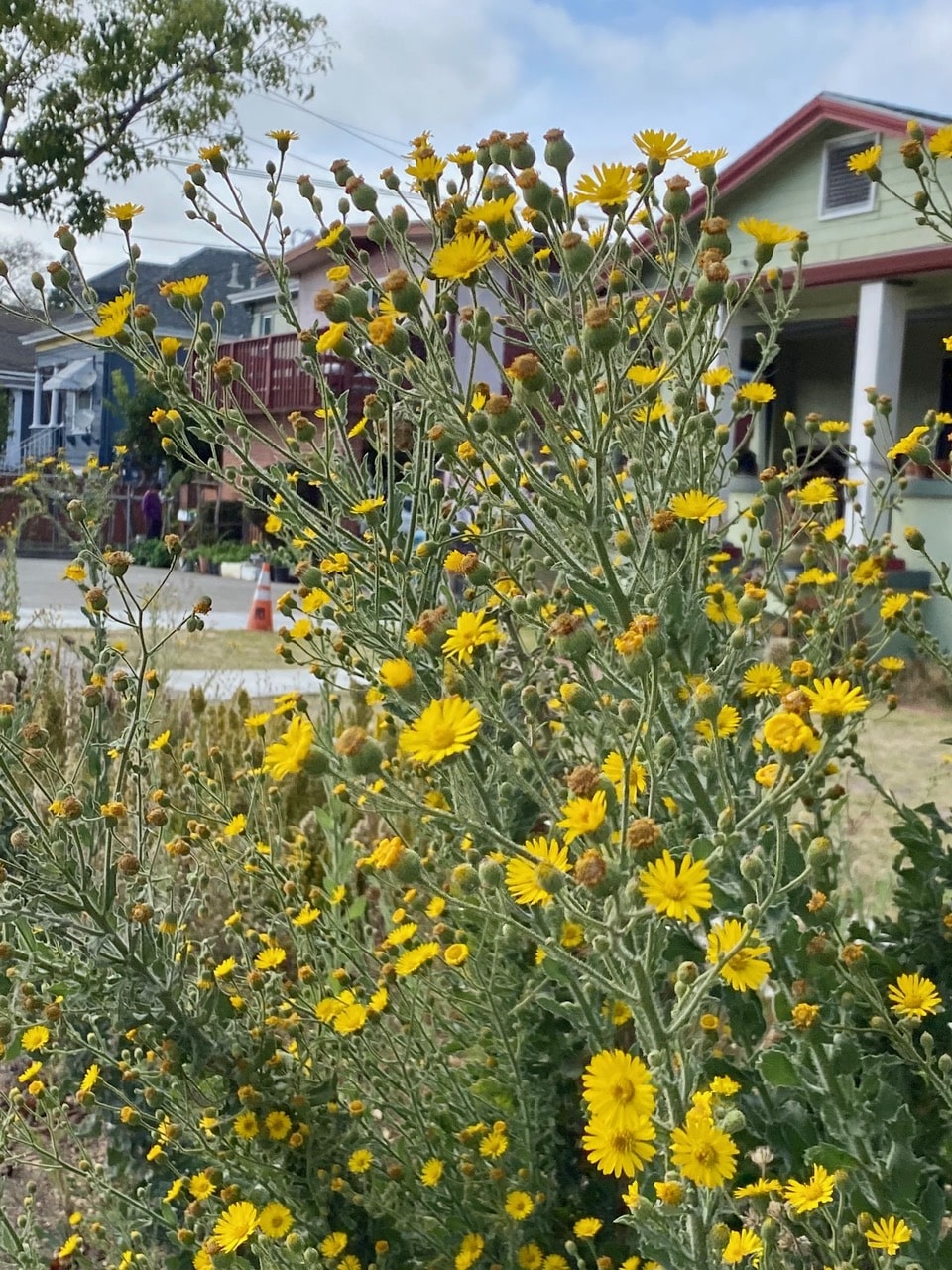
On the way home from Bay Farm, I decide to stop by the sidewalk strip in Alameda planted by Naomi. Maybe the male Longhorn Bees are ready to settle down for the evening?







The little sidewalk garden is still ablaze with cheery yellow blooms. But these are no longer those of the Elegant Tarweed, Madia elegans. They have been replaced by another composite the Telegraphweed, Heterotheca grandiflora. Just like the Elegant Tarweed, the flowerheads of Telegraphweed appear on short branches on top of a tall stem. Despite similar appearances, the flowers of Telegraphweed do not seem to have the same appeal for the insects. For the hour that I spend at the garden I do not see a single insect land on these flowerheads.
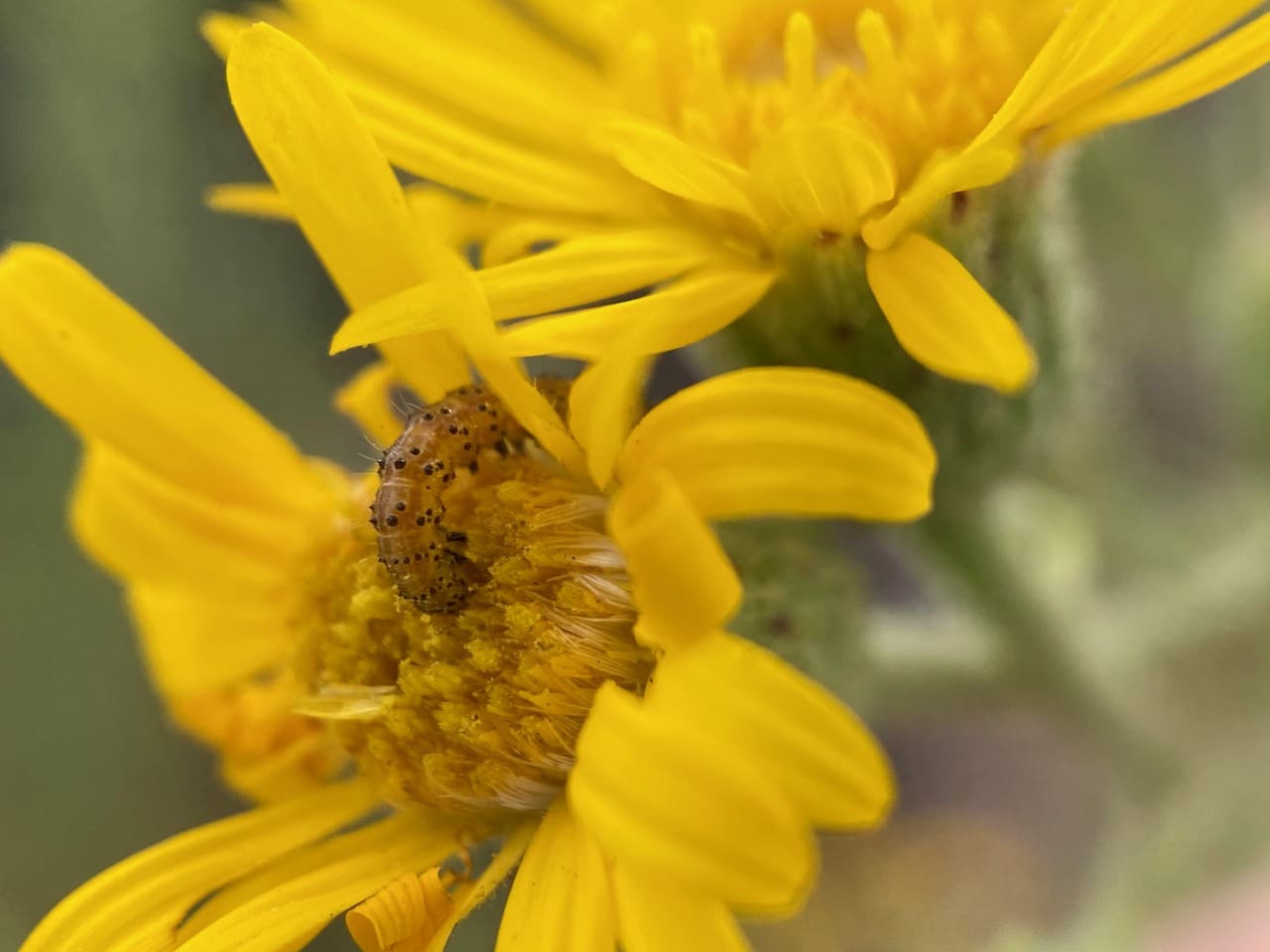
This brown caterpillar is the only insect I can find on the flowers of Telegraphweed. It is the larva of the Darker-spotted Straw Moth, Heliothis phloxiphaga (family Noctuidae).
Found across the US and S. Canada, Heliothis phloxiphaga is a medium-sized (wing span 3.3-3.7cm) light yellow-brown or tan moth with darker markings. Adults are both nocturnal and diurnal in activity, and may be found feeding and ovipositing during the day. Like other species of the genus, the larvae feed on the flowering parts and seeds of the host plants. Some Heliothis species are agricultural pests on crop species such as tobacco, cotton, soybean and pigeon pea. H. phloxiphaga seems to be fond of members of the sunflower family Asteraceae.
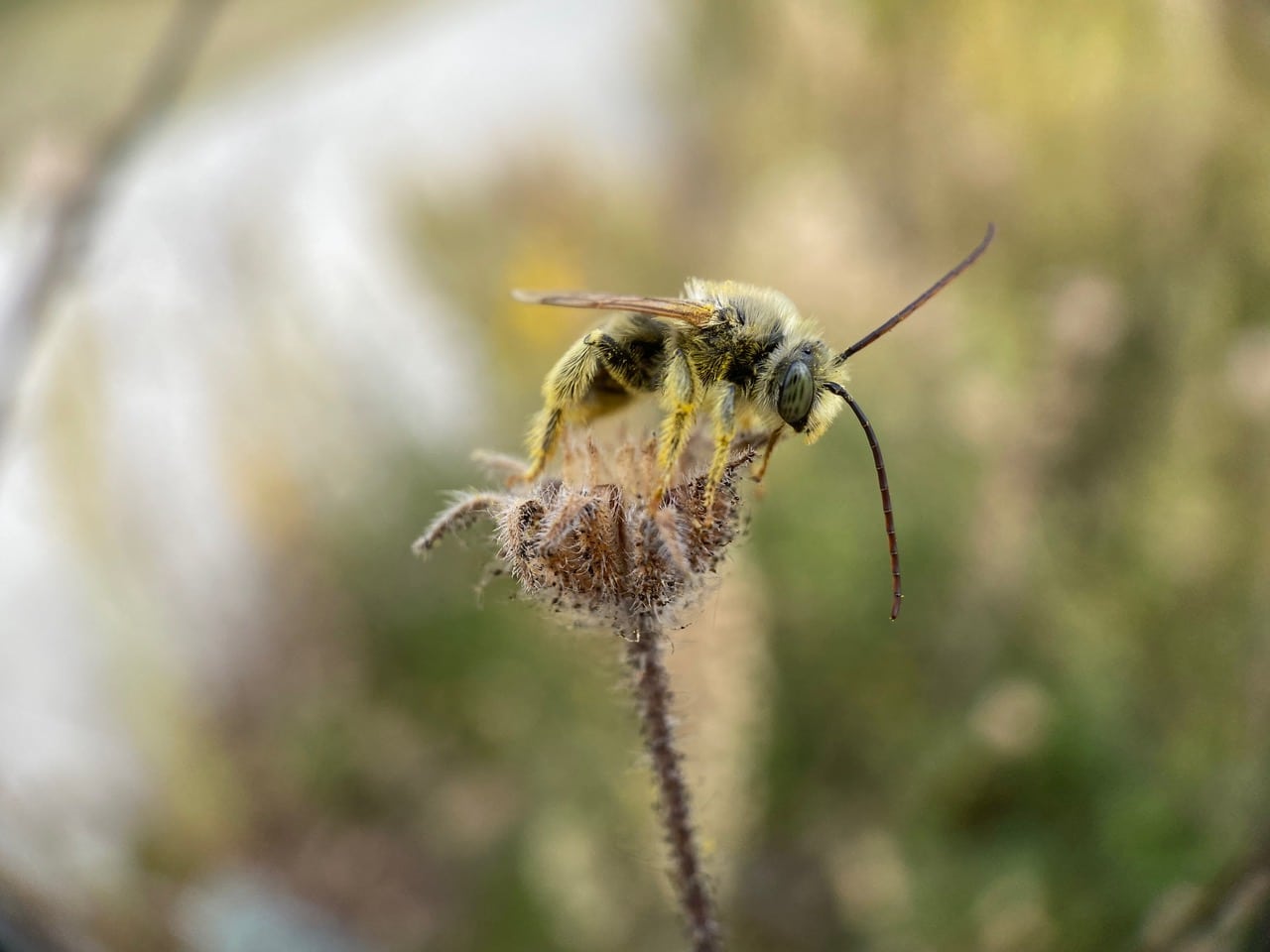
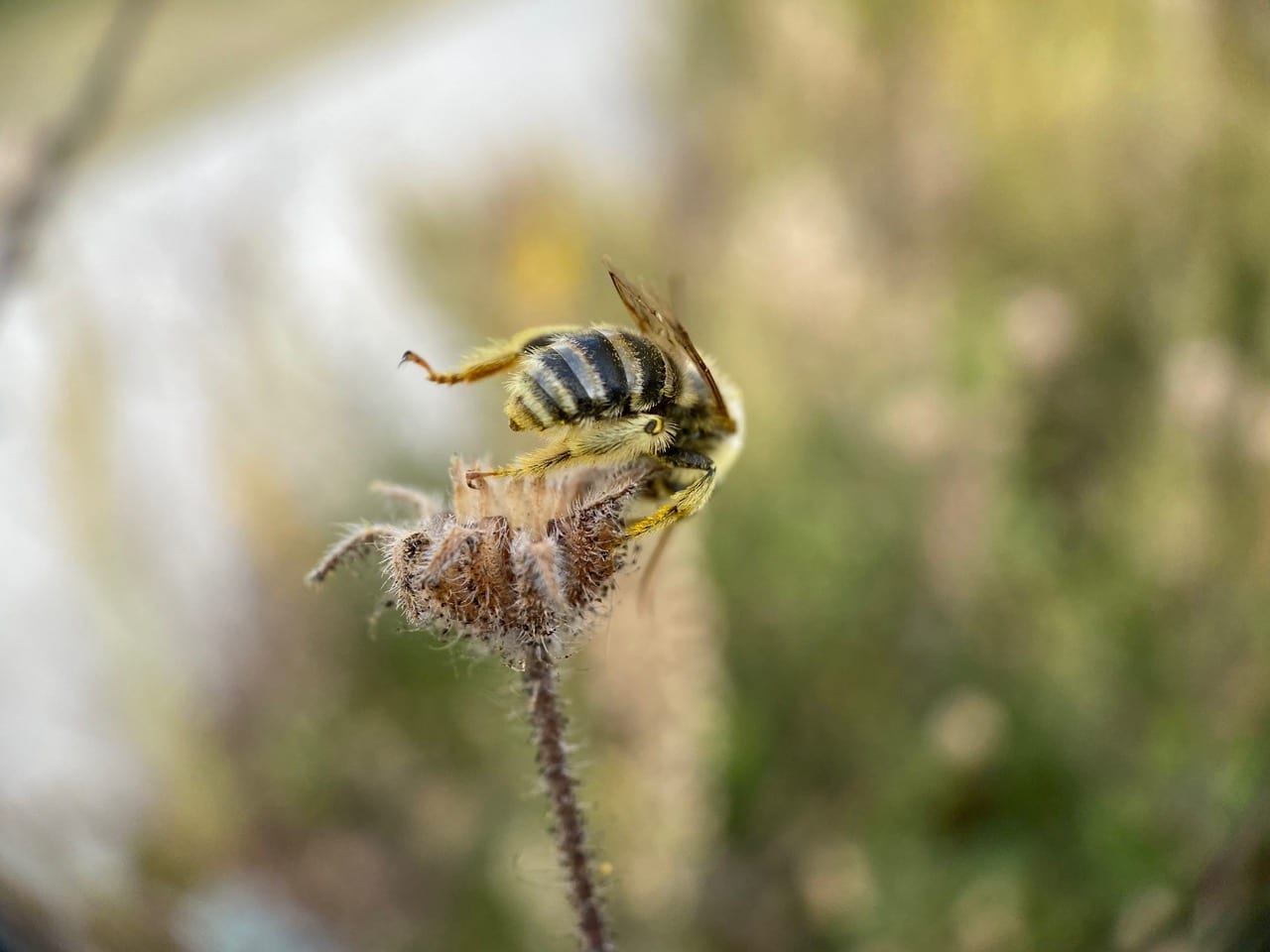
4:09 pm. A Summer Longhorn Bee, Melissodes sp. (family Apidae) flies past me and lands on a dried seed head of Elegant Tarweed. The bee is joining another male that has settled on top of the seed head. The new comer holds on to the side and grooms himself thoroughly – a bed time ritual.
Another longhorn male lands on an empty Madia seed head close by. He does a quick check of the seed head…
… but decides it’s not good enough and leaves. The bee is missing a lot of hair on his abdomen. Most of the Summer Longhorn Bees are old by now.
Most of the California Goldenrod, Solidago velutina ssp. californica have faded and gone to seed. The yellow flowers have been replaced by billowy clumps of fluffy seed heads.
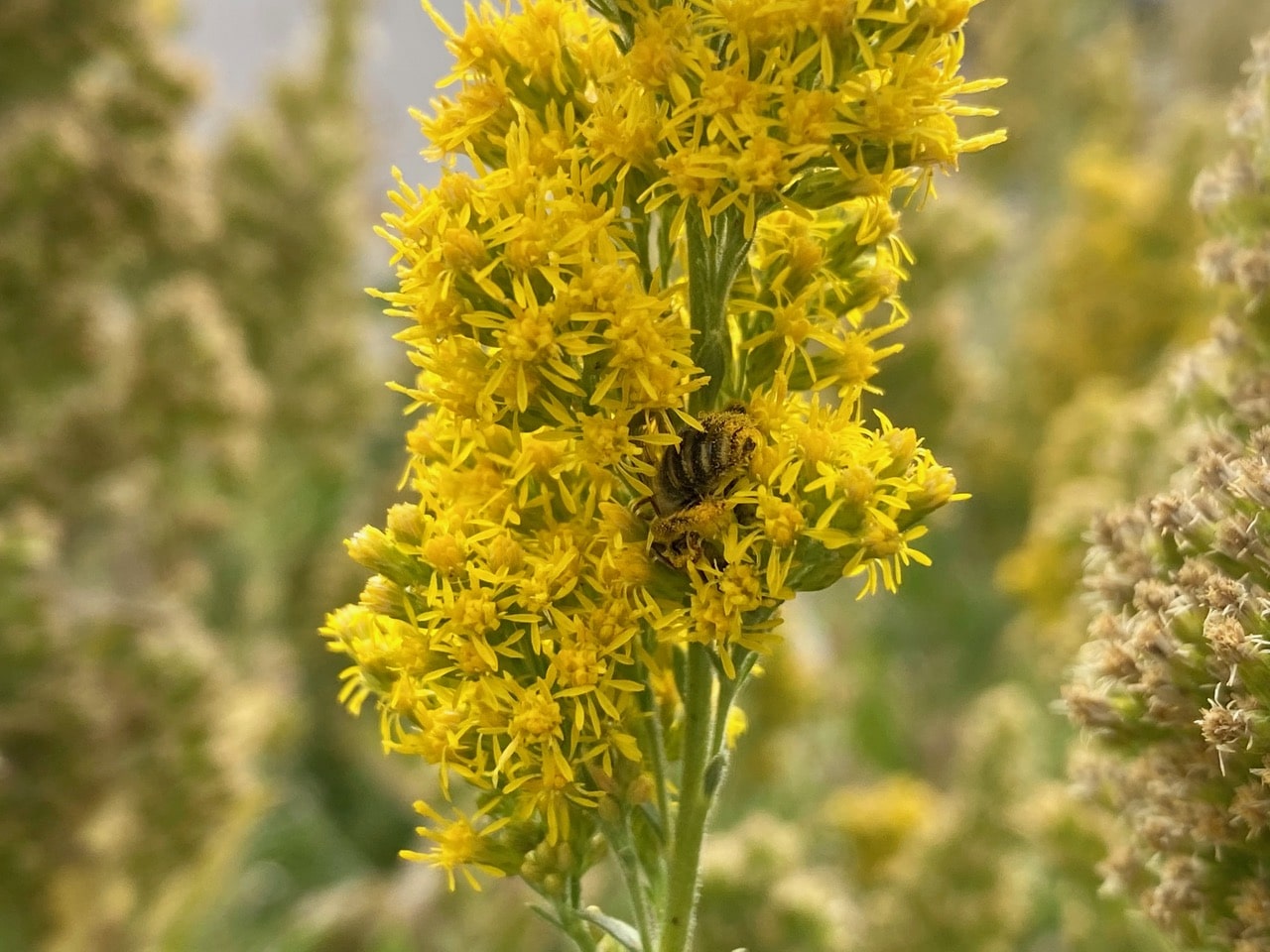
Only a few spikes of the California Goldenrod still bear fresh flowers. A tiny Metallic Sweat Bee, Lasioglossum (Dialictus) sp. (family Halictidae) is foraging on the crowded flowerheads.
Lasioglossum species are found worldwide, and they constitute the largest bee genus. The subgenus Dialictus are the most likely to be seen in the U.S., with over 300 species of these tiny metallic bees. The majority of Lasioglossum are generalists. Because they are so abundant throughout the flowering season, the bees are often important pollinators. Their sheer numbers are enough to achieve excellent pollination of many wild flowers, especially of plants in the Asteraceae, which have shallow floral tubes that are easily accessed by these minute bees.
Lasioglossum are closely related to the genera Halictus and Agapostemon. These genera are commonly called “sweat bees” because of their attraction to human sweat, which they drink for its salt content. Lasioglossum are dusky black to brown slender bees with bands of hair on their abdomen. Female Sweat Bees (family Halictidae) carry pollen in the scopae on their entire hind legs and underside of their abdomen.
Dialictus is a subgenus of Sweat Bees belonging to the genus Lasioglossum. Most of the members of this subgenus have a subtly metallic appearance, and are small, about 3.4-8.1 mm in size. They are commonly found in Northern Hemisphere and are found in abundance in North America. As in the other members of the family Halictidae, the bees have very diverse forms of social structure, making them model organisms for studying the social behavior of bees.
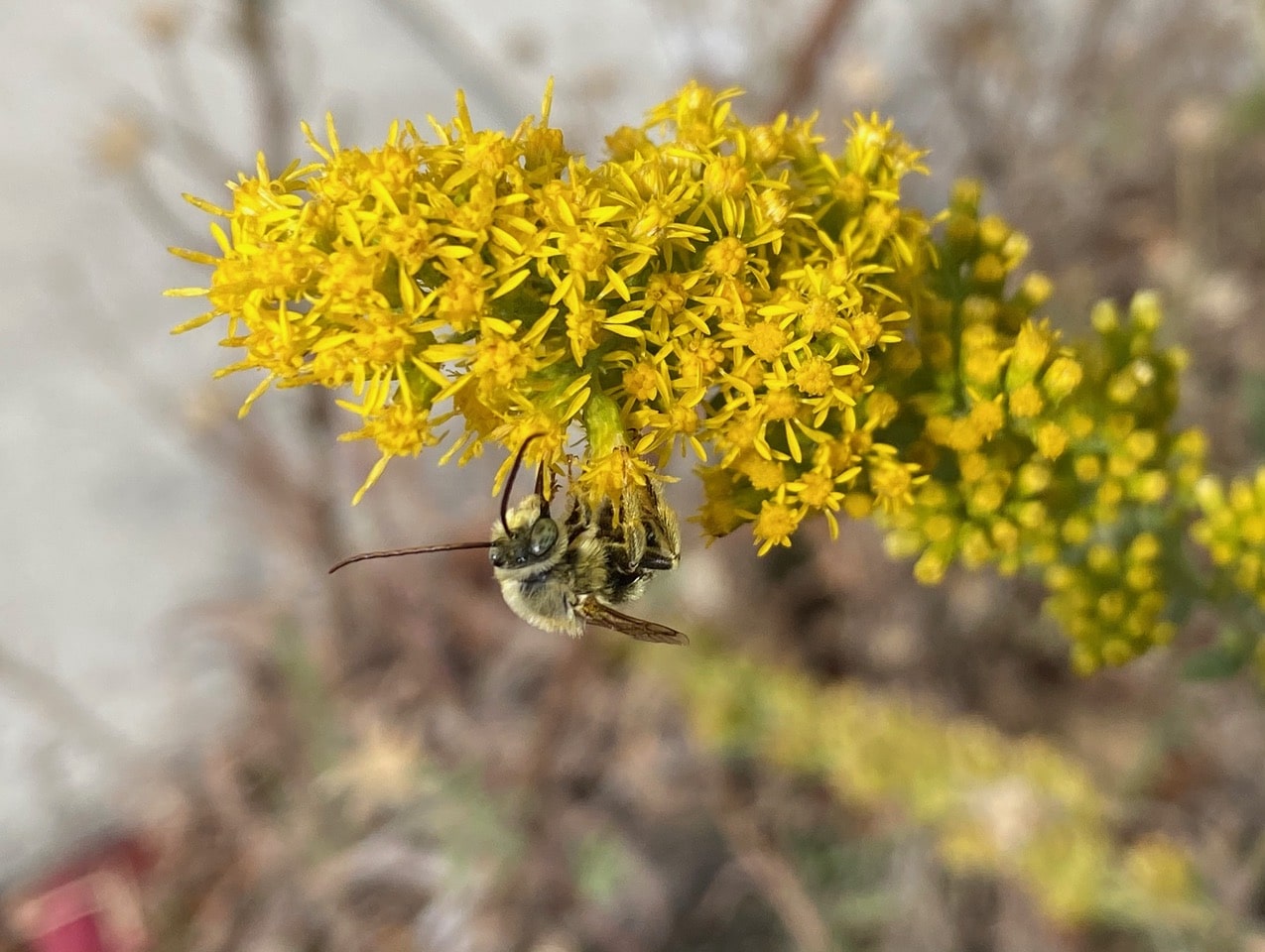
A male Summer Longhorn Bee is taking nectar from an inflorescence of California Goldenrod.
It is amazing that out of the masses of the faded Goldenrod flowers, the bee manages to find the last few fresh ones.
I spot some movements on a goldenrod inflorescence. Tucked securely among the crowded flowerheads, a male Longhorn Bee is grooming the pollen off his body with his hind legs. Probably getting ready for bed? Is he going to settle down here tonight, in a more sheltered place, instead of on a Madia seed head waving in the chilly wind?
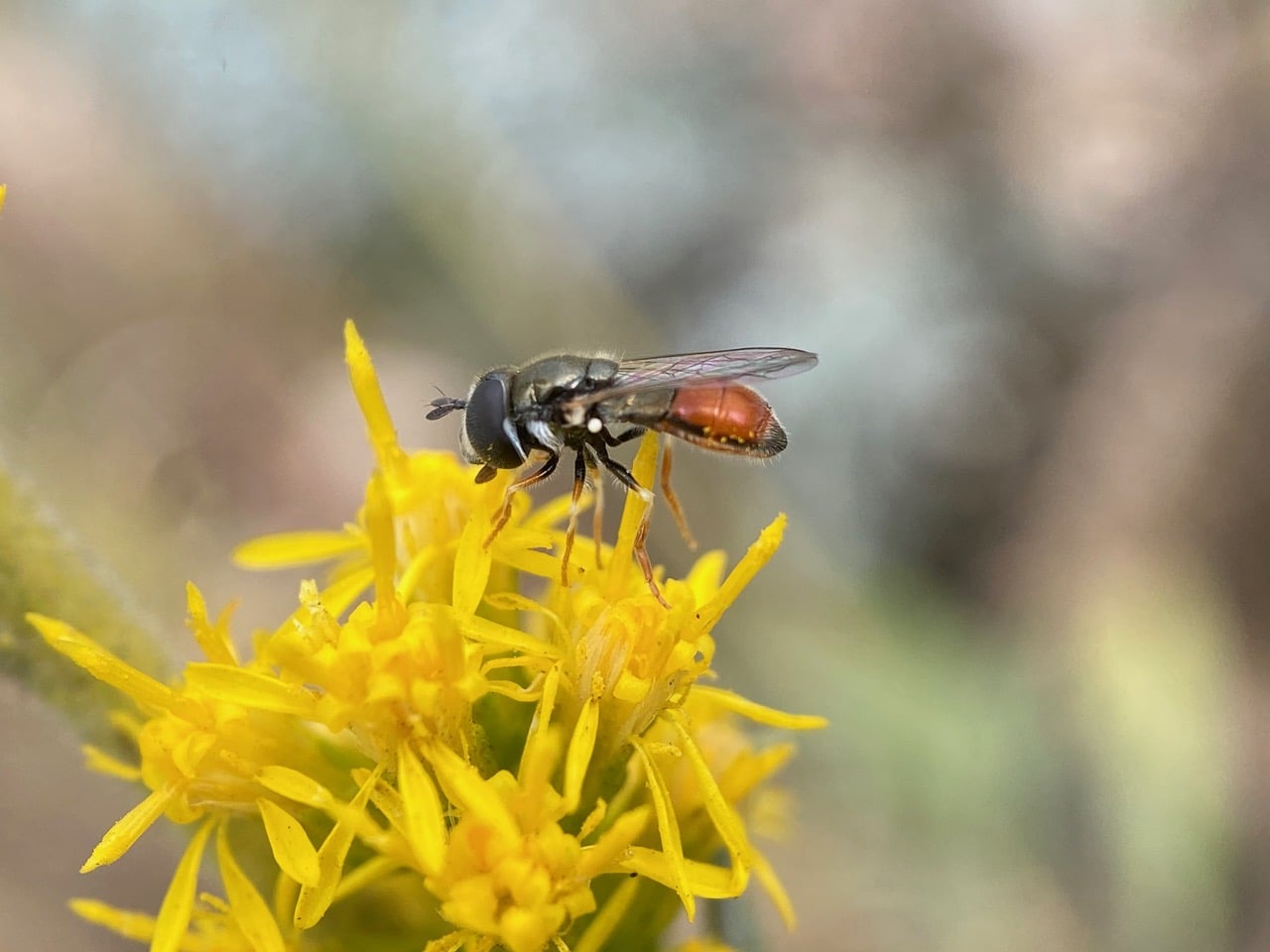
A Common Grass Skimmer, Paragus haemorrhous (family Syrphidae) is foraging on a cluster of goldenrod flowerheads.
The Common Grass Skimmer, Paragus haemorrhous (family Syrphidae) is easily the smallest hover fly I know, measuring only about 4 mm in length. The species has a world-wide distribution, found in unimproved grassland, dune grass, open areas and pathsides in forest, and meadows. Adults visit flowers for nectar and pollen. Larvae feed on aphids on low herbaceous plants.
This droopy posture is characteristic of the Common Grass Skimmer.
The light is fading and I need to get home. Quickly I run to the back of Naomi’s house to check on the tall Fennel on which I have found a few Anise Swallowtail caterpillars and a chrysalis on 8/31. High above my head, I spy a new chrysalis hanging on a green stem – a green one! The last chrysalis I found here was a brown one low on the plant, among dried, brown foliage. What determines the color of the chrysalids?
Whether a chrysalis turns out green or brown depends on several interacting factors. The color of the surface they are pupating on comes into play. In addition, for some reason, it also matters whether the pupation surface is smooth or rough. Smooth surfaces favor a green chrysalis, rough surfaces favor a brown one. However, when the days get short, that overrides color and texture, and gives rise to a brown chrysalis regardless (since the chrysalis is likely to overwinter, and brown offers the best camouflage over the winter).
It was formerly thought that pupation is a quiescent resting period in a butterfly’s life cycle. Nothing can be further from the truth. The chrysalis is a hotbed of demolition and reconstruction.