

Pollinator Post 9/16/24
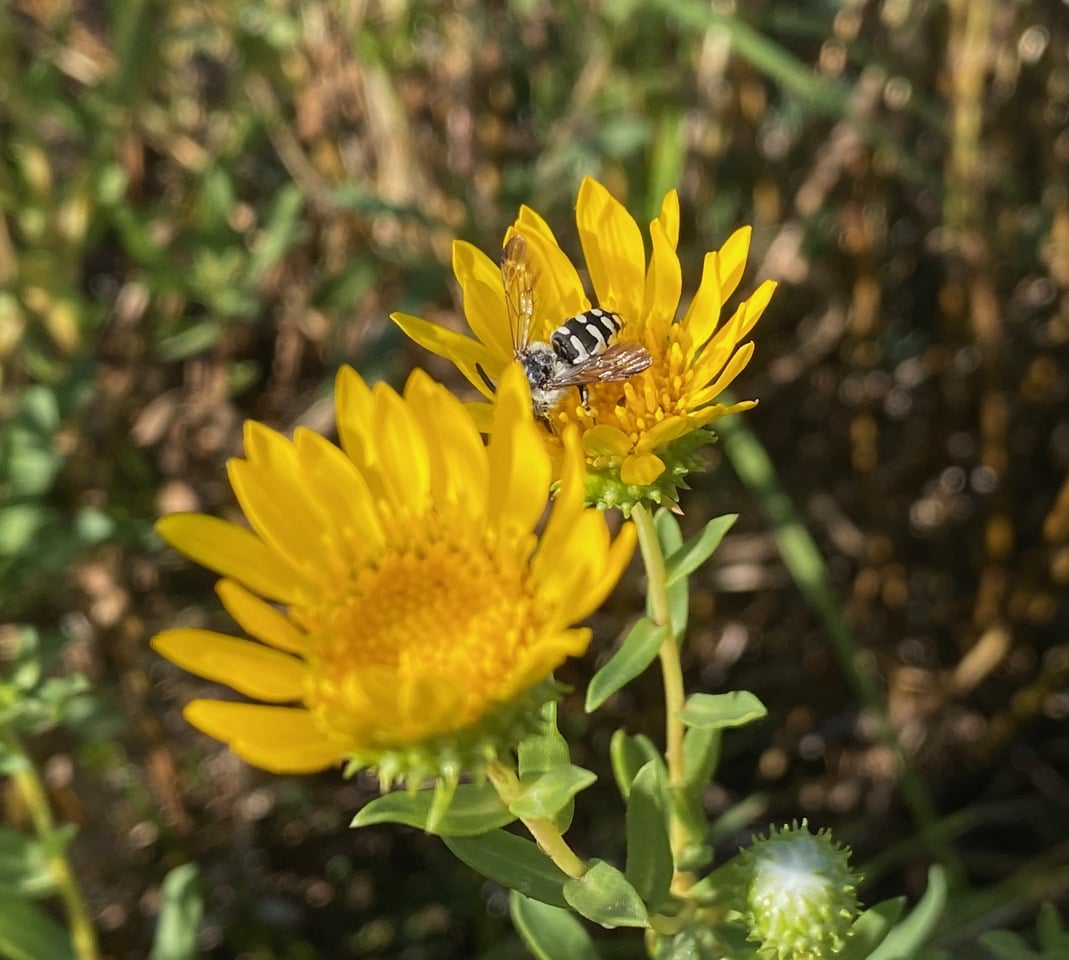
Hey, I recognize that abdomen with the thick broken white bands! It belongs to the California Digger-cuckoo Bee, Brachymelecta californica (family Apidae). The bee is taking nectar from a flowerhead of Oregon Gumweed, Grindelia stricta at Shoreline Park, Bay Farm Island.
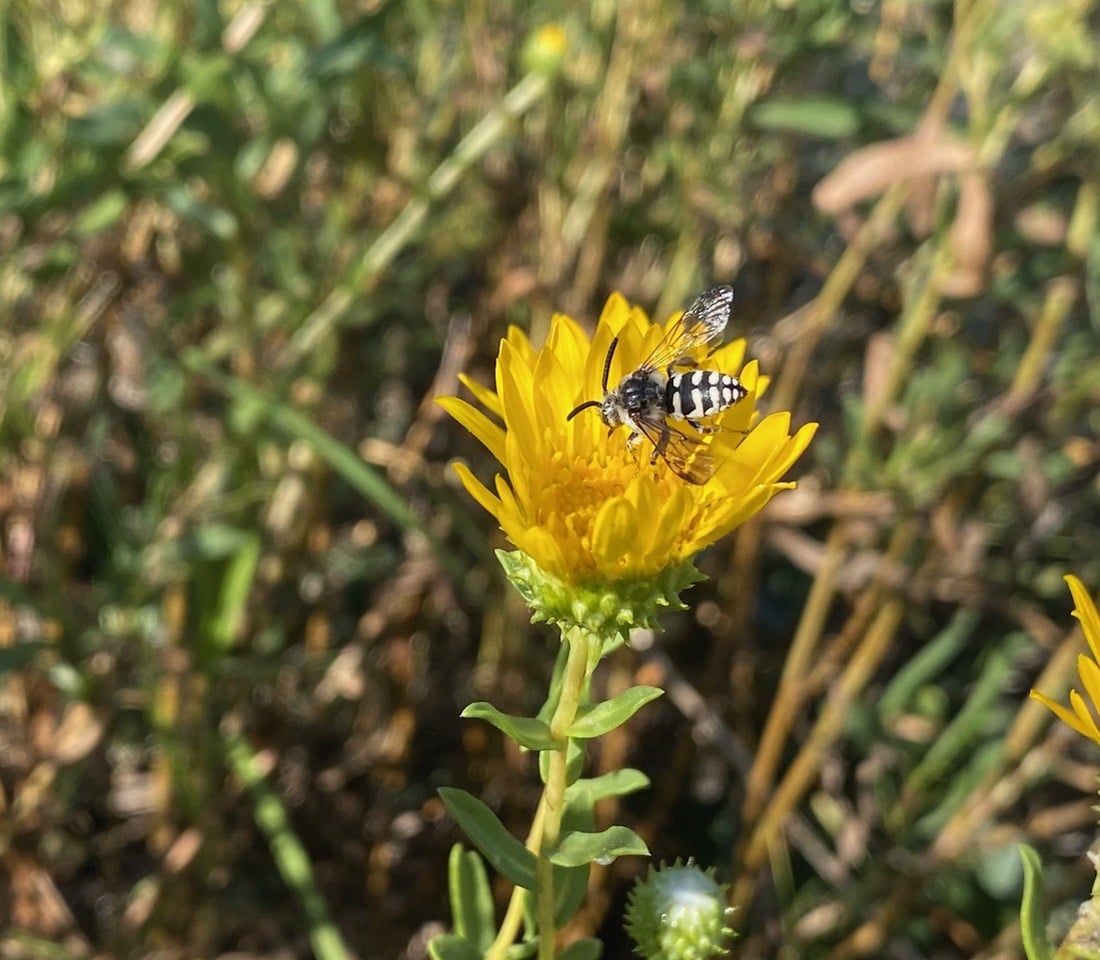
The California Digger-cuckoo Bee, Brachymelecta californica (family Apidae) is an odd-looking creature. The terga (upper body segments) have medially broken bands of appressed white (rarely pale brown) pubescence. They are parasites of the Digger Bees, Anthophora sp. (family Apidae).
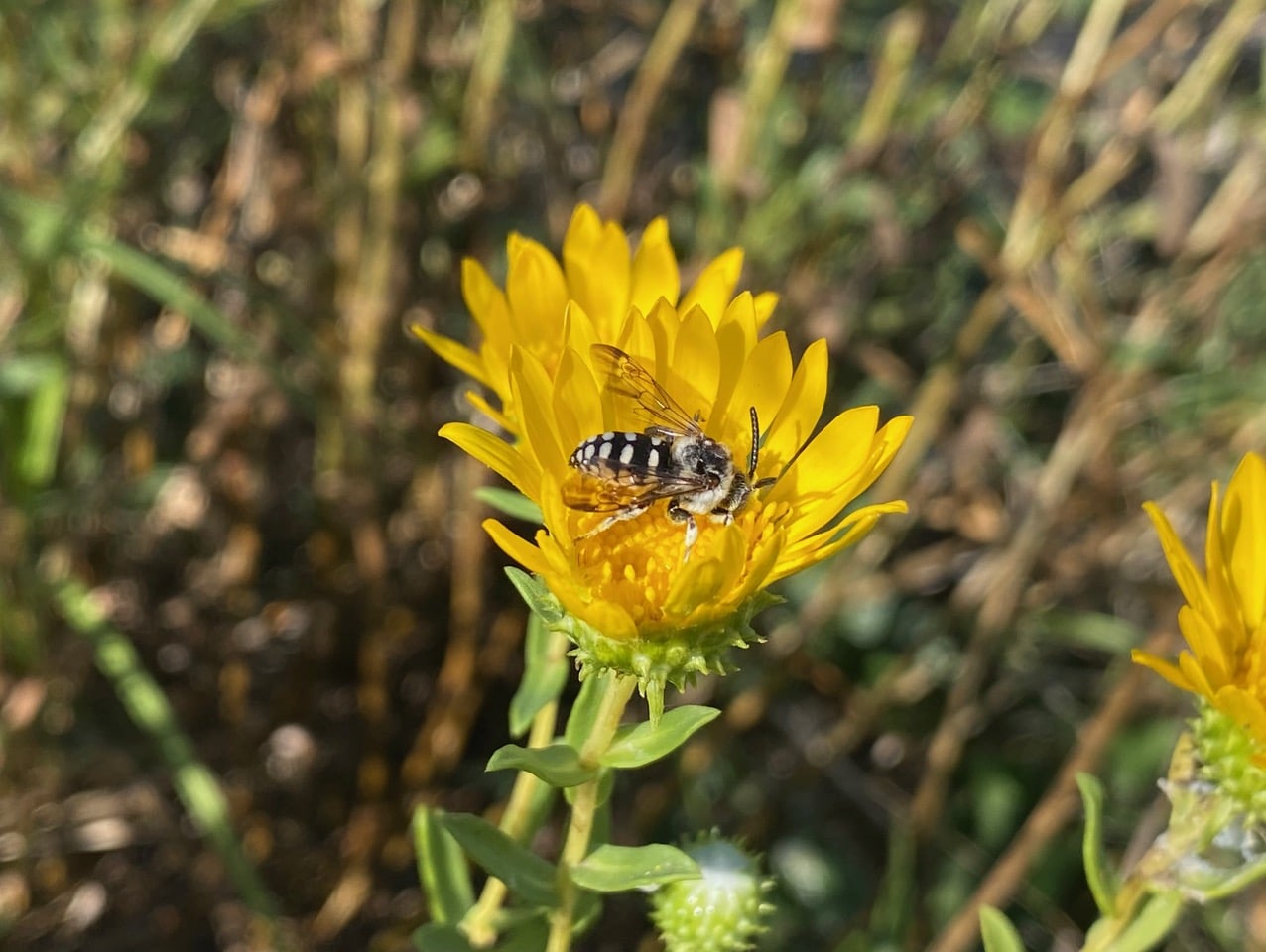
The term cuckoo bee refers to a variety of different bee lineages which have evolved the kleptoparasitic behavior of laying their eggs in the nests of other bees, similar to the behavior of cuckoo birds. Female cuckoo bees lack pollen-collecting structures and do not construct their own nests. Cuckoo bees typically enter the nests of pollen-collecting species, and lay their eggs in cells provisioned by the host bee. When the cuckoo bee larva hatches, it consumes the provision in the nest, and kills the host larva. Many cuckoo bees are closely related to their hosts, and may bear similarities in appearance reflecting this relationship. Others parasitize bees in families different from their own.
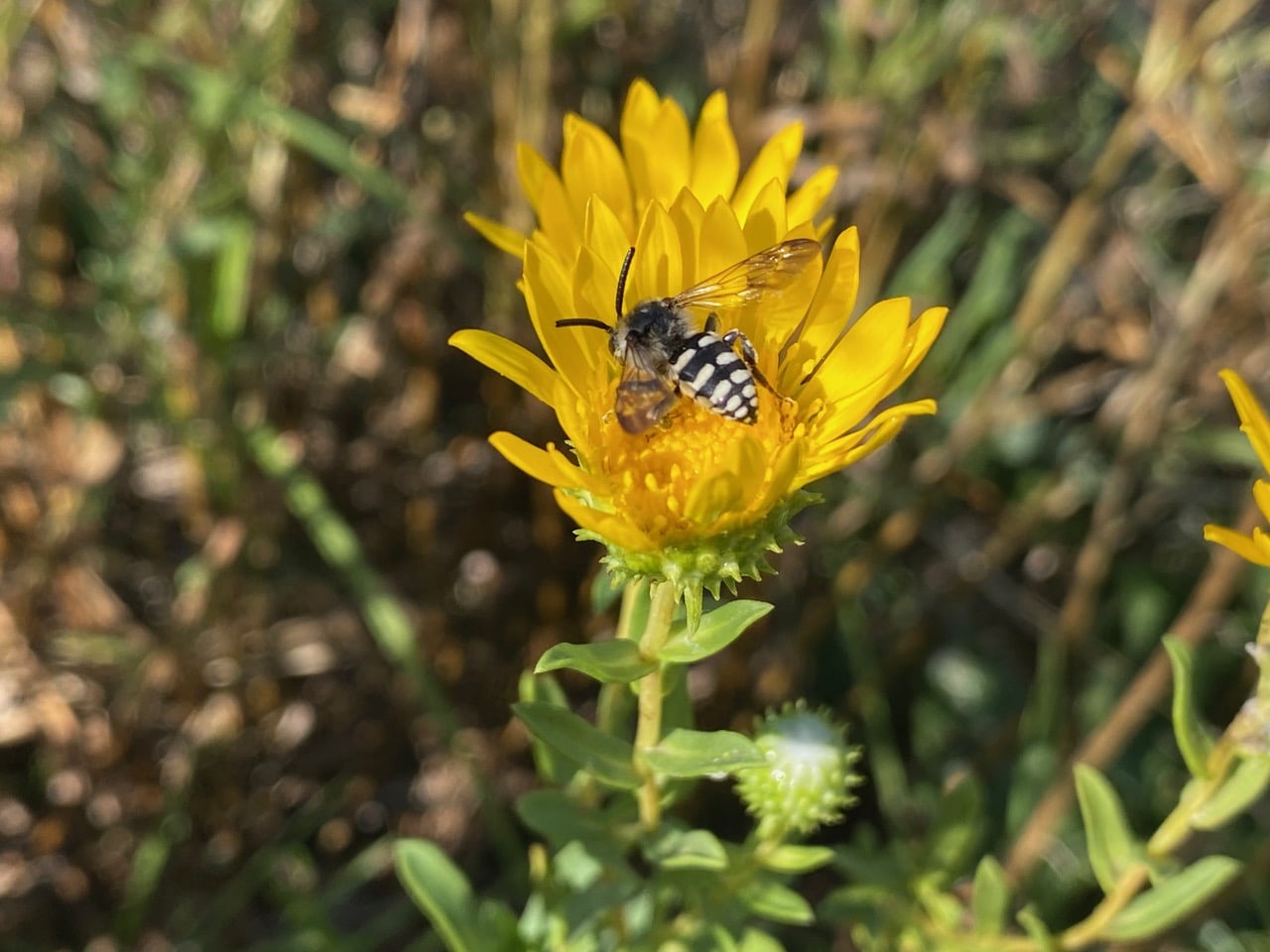

A male Western Leafcutter Bee, Megachile perihirta (family Megachilidae) visits a Grindelia flowerhead.
Leaf-cutter Bees, Megachile sp. (family Megachilidae) are stout-bodied, usually with pale hair on the thorax and stripes of white hairs on the abdomen. Females usually have a triangular abdomen with a pointed tip, and males’ faces are covered with dense, pale hair. Flight season is from May into September, with peak activity from June to August.
Solitary females construct nests in tubular cavities, including hollow stems, tree holes, and abandoned beetle burrows in wood. Many use holes drilled into wood, straws, or other manufactured tunnels. Females cut pieces from leaves or flower petals for use in the construction of brood cells. Most Megachile females are generalists when foraging for pollen. Pollen is transported in dense scopae on the underside of the abdomen.
Photos of Western Leafcutter Bee (Megachile perihirta) · iNaturalist

Wow, that Grindelia is in trouble! Its leaves are speckled with Sooty Mold and turning yellow. You can actually see the culprits – the tiny Lace Bugs (family Tingidae) and their black nymphs on the leaves.
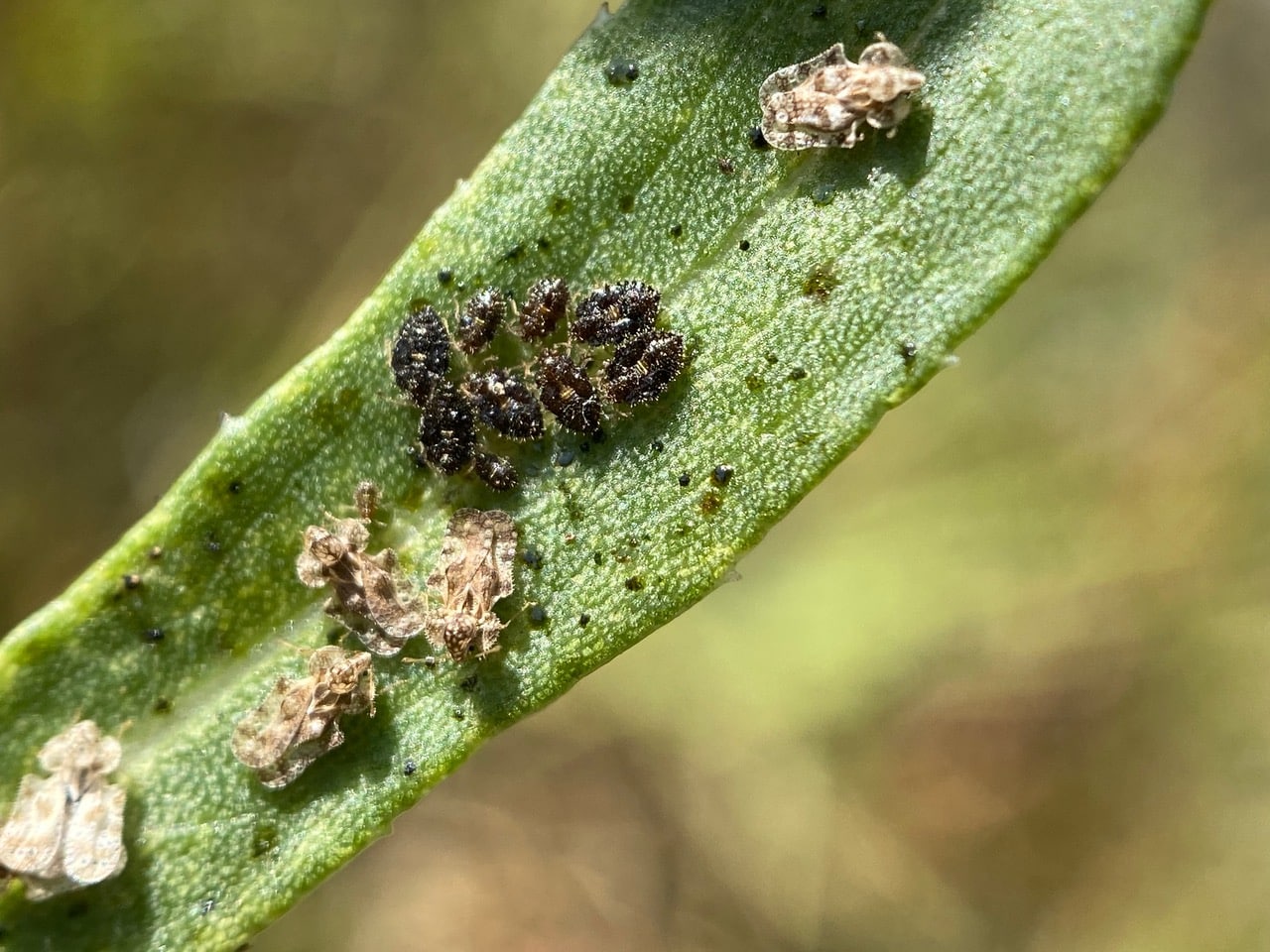
A few adult Lace Bugs, Corythucha sp. (family Tingidae) next to a cluster of shiny black nymphs. Note that the leaf is speckled with black Sooty Mold that grows on the sugary honeydew excreted by the bugs.
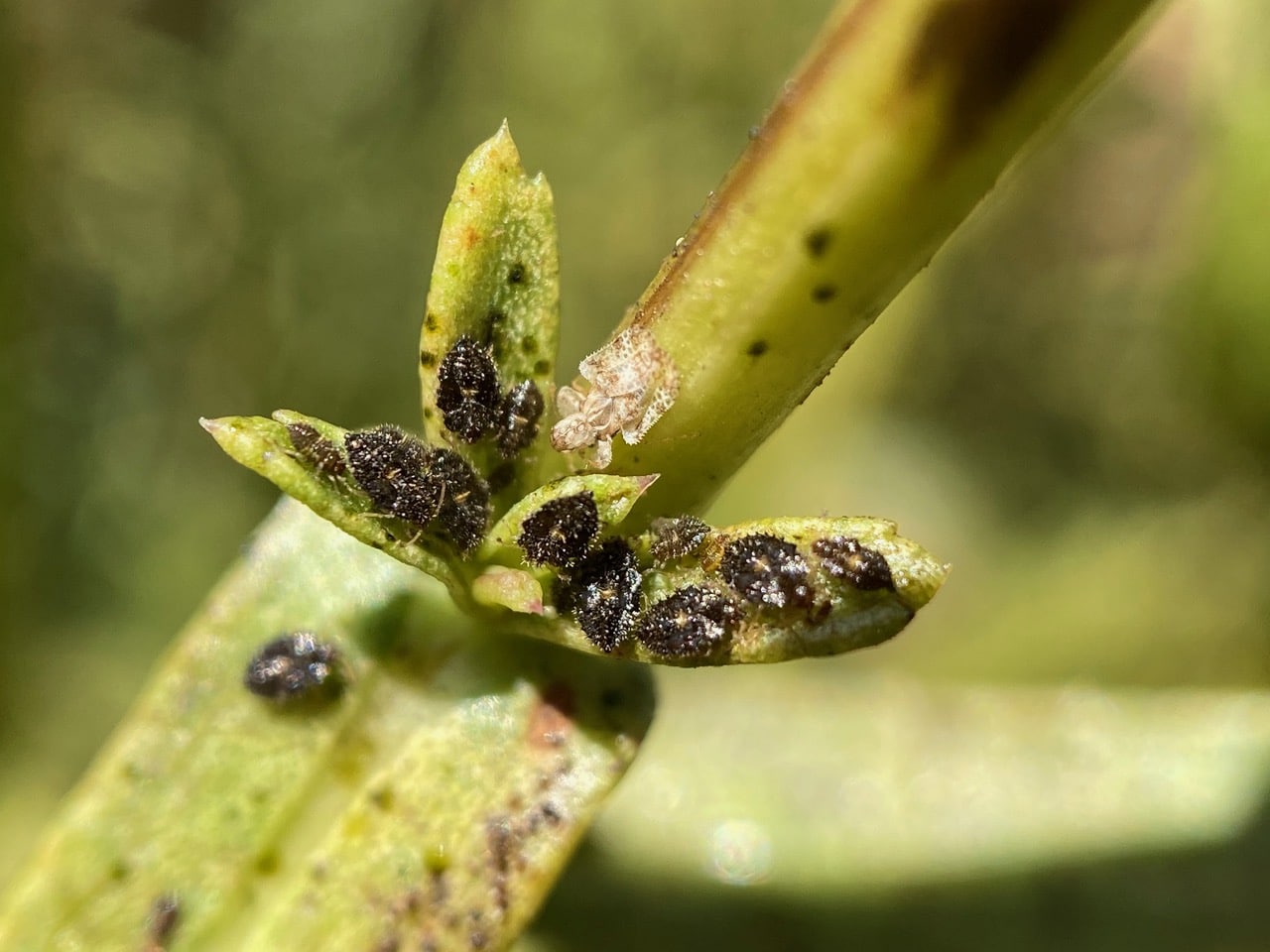
The Tingidae are a family of very small (2-10 mm) insects in the order Hemiptera that are commonly referred to as lace bugs. They are called lace bugs because the pronotum and fore wings of the adult have a delicate and intricate network of divided areas that resemble lace. Their body is flattened dorsoventrally, and the head is often concealed under the hood-like pronotum. Lace Bugs feed by sucking sap from plants, extracting the protein they need and excreting liquid waste as honeydew. The most common symptom of feeding is the stippled and mottled yellowish foliage. In heavy infestations, black sooty mold may develop on the honeydew, impairing photosynthesis by the plant. This may result in some dieback of twigs and branches and a reduction in flowering the following year. Tingids are usually host-specific and can be very destructive to plants. Each individual usually completes its entire lifecycle on the same plant, if not the same part of the plant.
The genus Corythucha is primarily distributed in the northern hemisphere, including Europe, North America and eastern Asia.
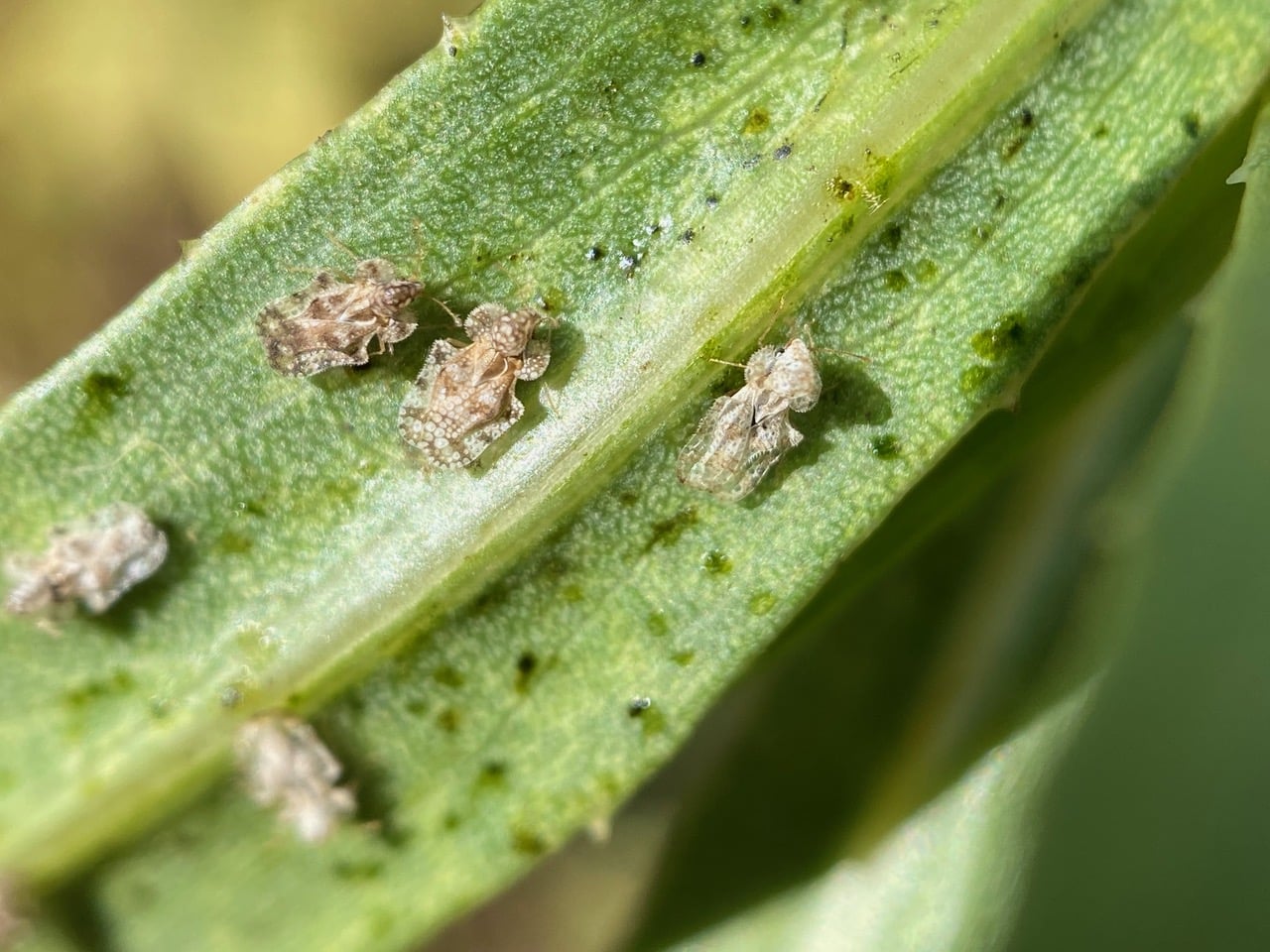
The bugs look like they are dressed to the nines ready to attend a fancy ball.

It is interesting to get a side view of the Lace Bug. Note the hood over the head of the bug in profile.
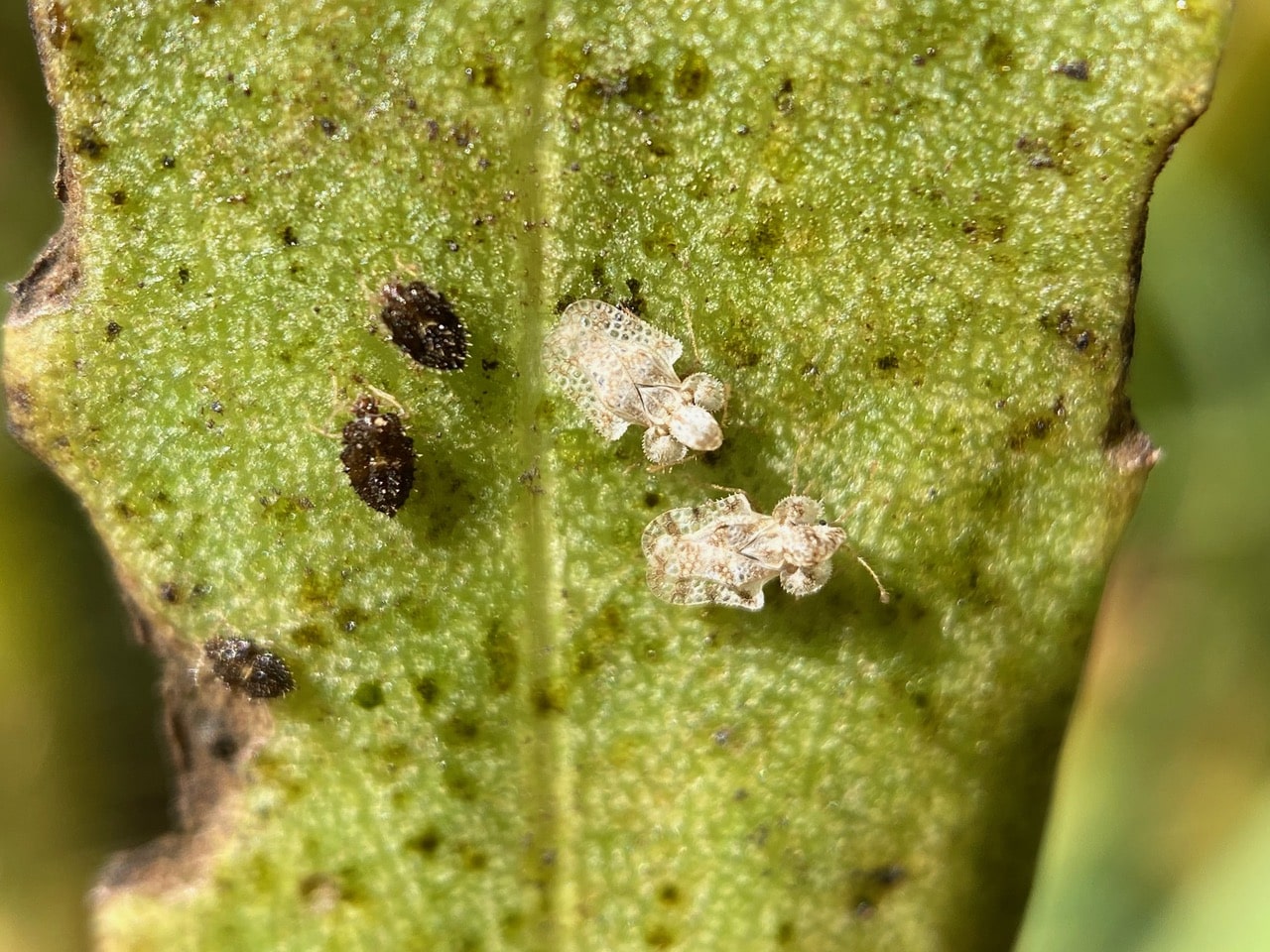
Why do the Lace Bugs have such elaborate wings? I have not seen them fly even when I disturb the leaves they are on. Maybe the wings serve more of a protective function, shielding the body? Perhaps the wings make them unpalatable to predators, too much of a mouthful? One can’t help speculating on those unusual wings.
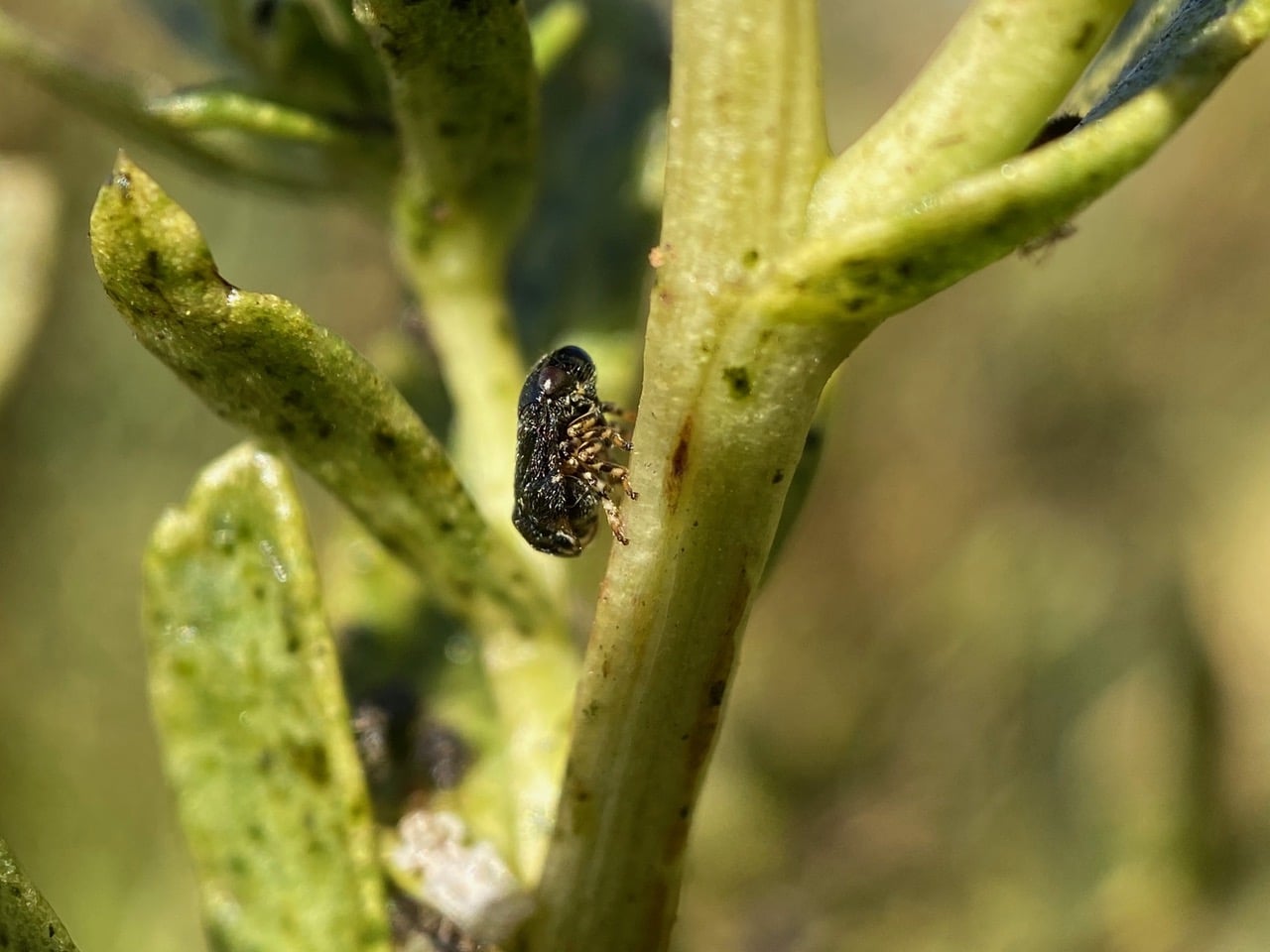
A Spittlebug, Complex Clastoptera lineatocollis (family Clastopteridae) is walking as if on tip-toe on a Grindelia heavily infested by the Lace Bugs. Is it trying to avoid the sticky, honeydew-covered surface? Unlike the Lace Bugs and most other sucking insects, Spittlebugs feed on sap from the xylem instead of the phloem of plants. Their diet is very dilute, and the waste they excrete, while copious is not likely to cause the growth of sooty mold. In fact, the foamy shelters of the Spittlebug nymphs are made of the expelled fluids.
The Froghoppers (superfamily Cercopoidea) are a group of “true bugs” in the order Hemiptera. Adults are capable of jumping many times their height and length, giving them their common name, but many species are best known for their plant-sucking nymphs which produce foam shelters, and are referred to as “spittlebugs”. The superfamily currently consists of three families: the Aphrophoridae, Cercopidae, and Clastopteridae. The nymphs produce a cover of foamed-up plant sap visually resembling saliva, hence the common name. Whereas most insects that feed on plant sap tap into the nutrient-rich fluid from the phloem, the spittlebugs utilize the much more dilute sap flowing upward from the roots via the xylem. The insects’ digestive system contains symbiotic bacteria that provide them with the essential amino acids. The large amount of excess water that must be excreted and the evolution of special breathing tubes allow the young spittlebug nymphs to grow in the relatively protective environment of their foam shelters. The foam serves a number of purposes. It hides the nymph from the view of predators and parasites, and it insulates against heat and cold, providing thermal as well as moisture control. It also has an acrid taste that deters predators.
Froghoppers are champion jumpers among insects, out-performing even the fleas. The bug can leap the human equivalent of a skyscraper without a running start. It is the highest jumping insect proportional to body size. The muscles in its hind legs act like a “catapult” to release energy explosively.
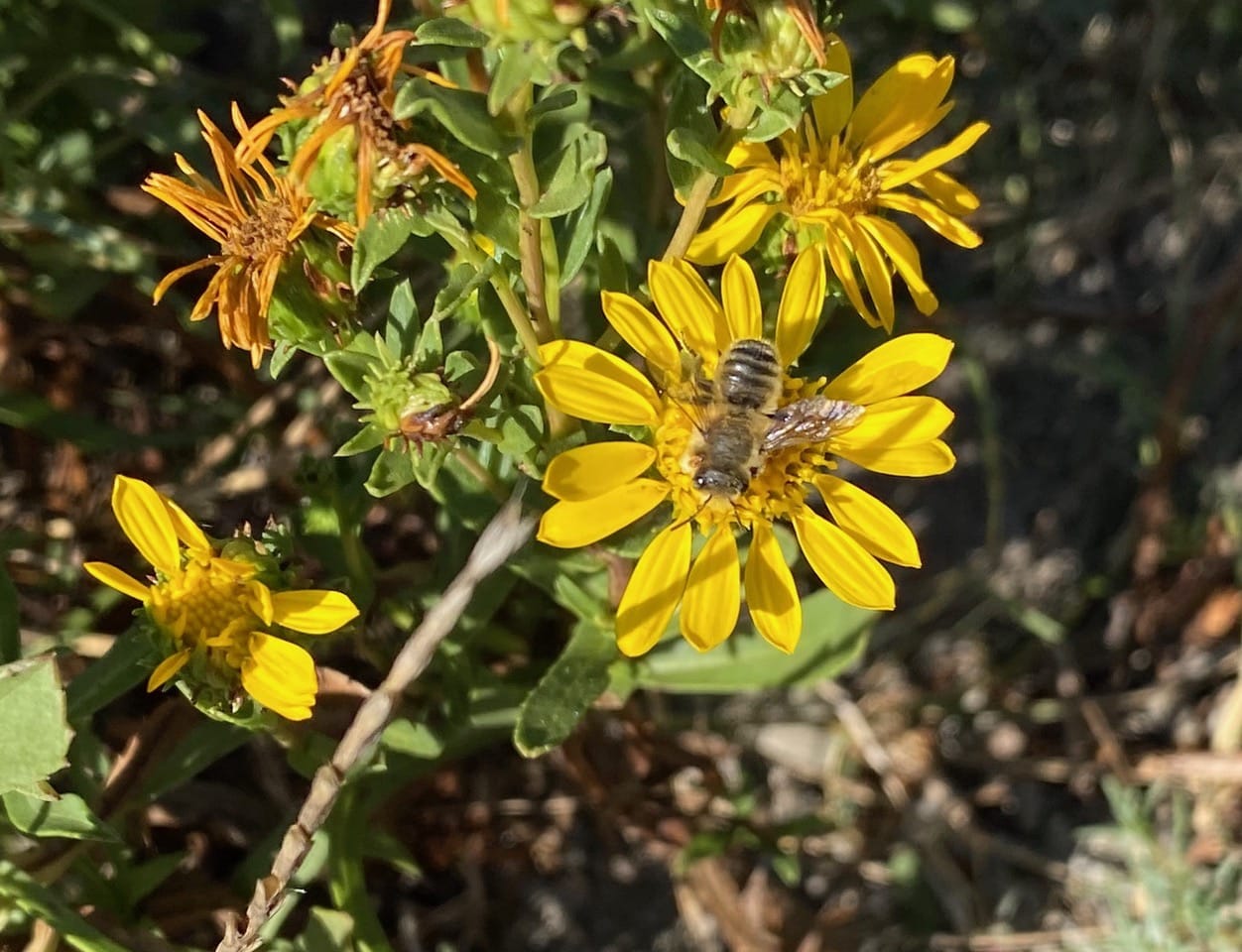
A male Western Leafcutter Bee, Megachile perihirta (family Megachilidae) is taking nectar on a Grindelia flowerhead.
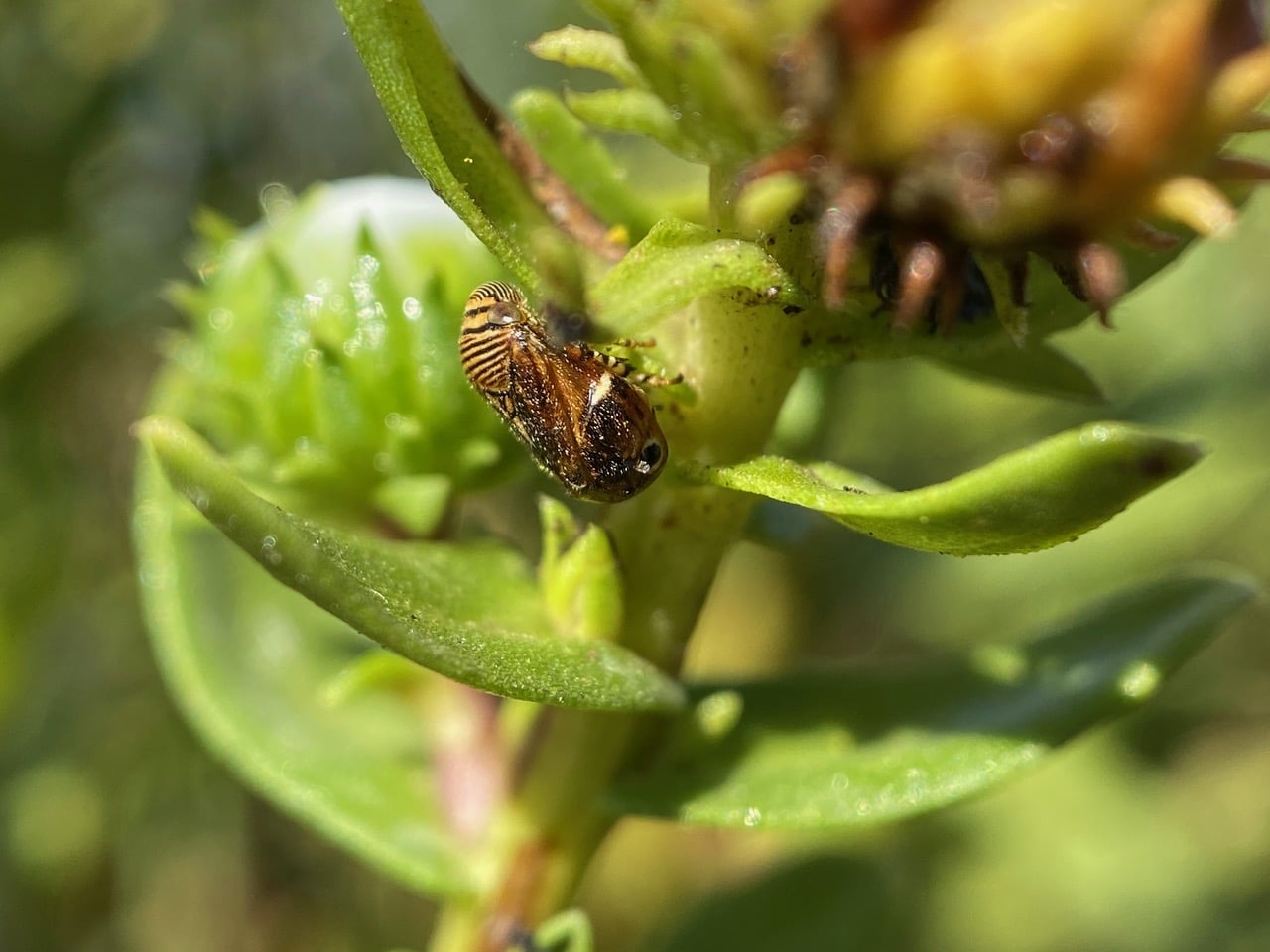
I am glad that I have marked the Grindelia plant on which I have observed a Spittlebug undergo its last molt into an adult two days ago. I have no difficulty finding that individual today – it is on the exact same stem, not far from where it was yesterday. These bugs are remarkably sedentary and easy to track!
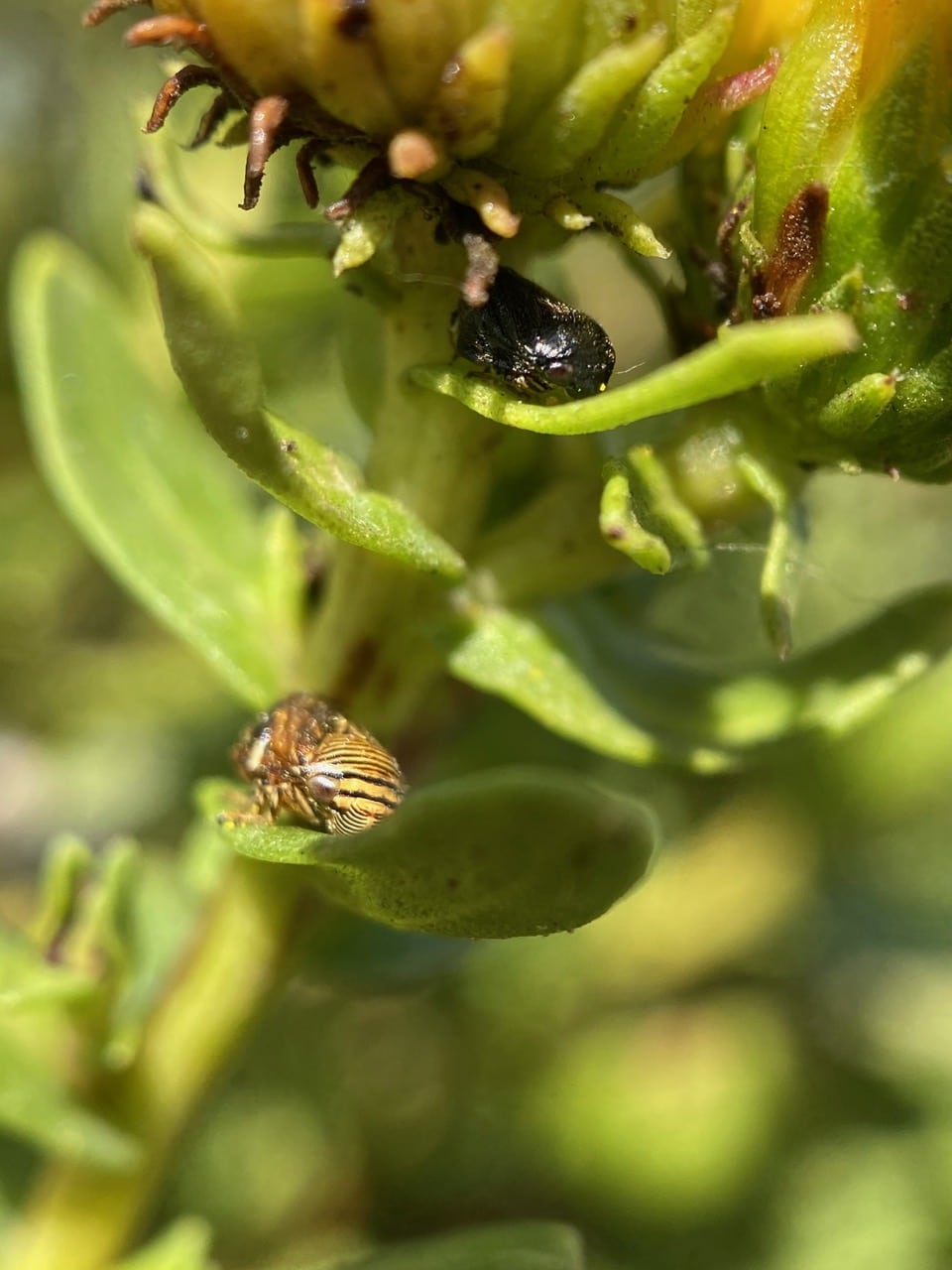
After crawling a bit, the Spittlebug settles down on a leaf. In trying to photograph it, I spot a black individual on another leaf above it. The black one is quite a bit smaller. I wonder if the two will interact?
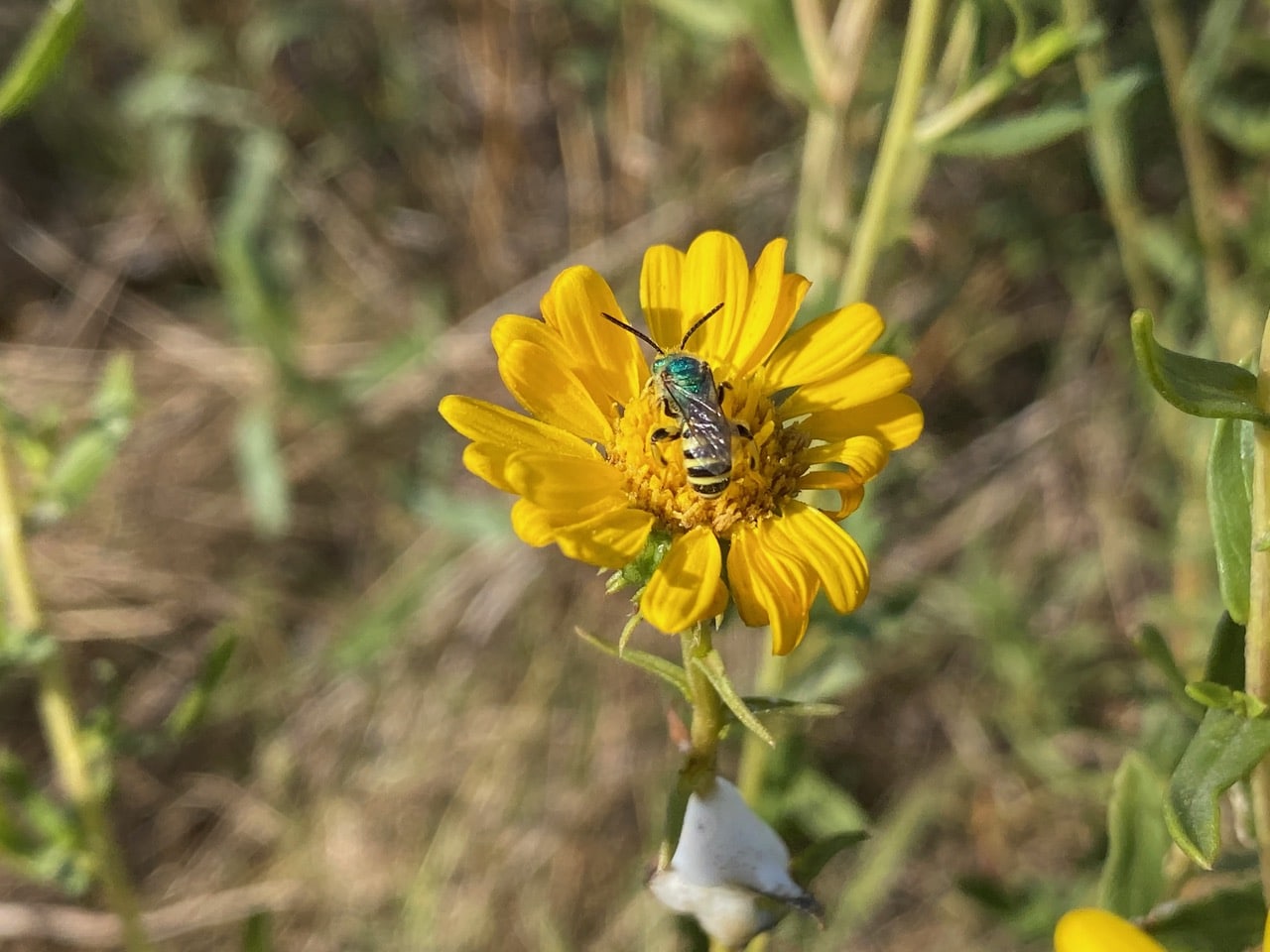
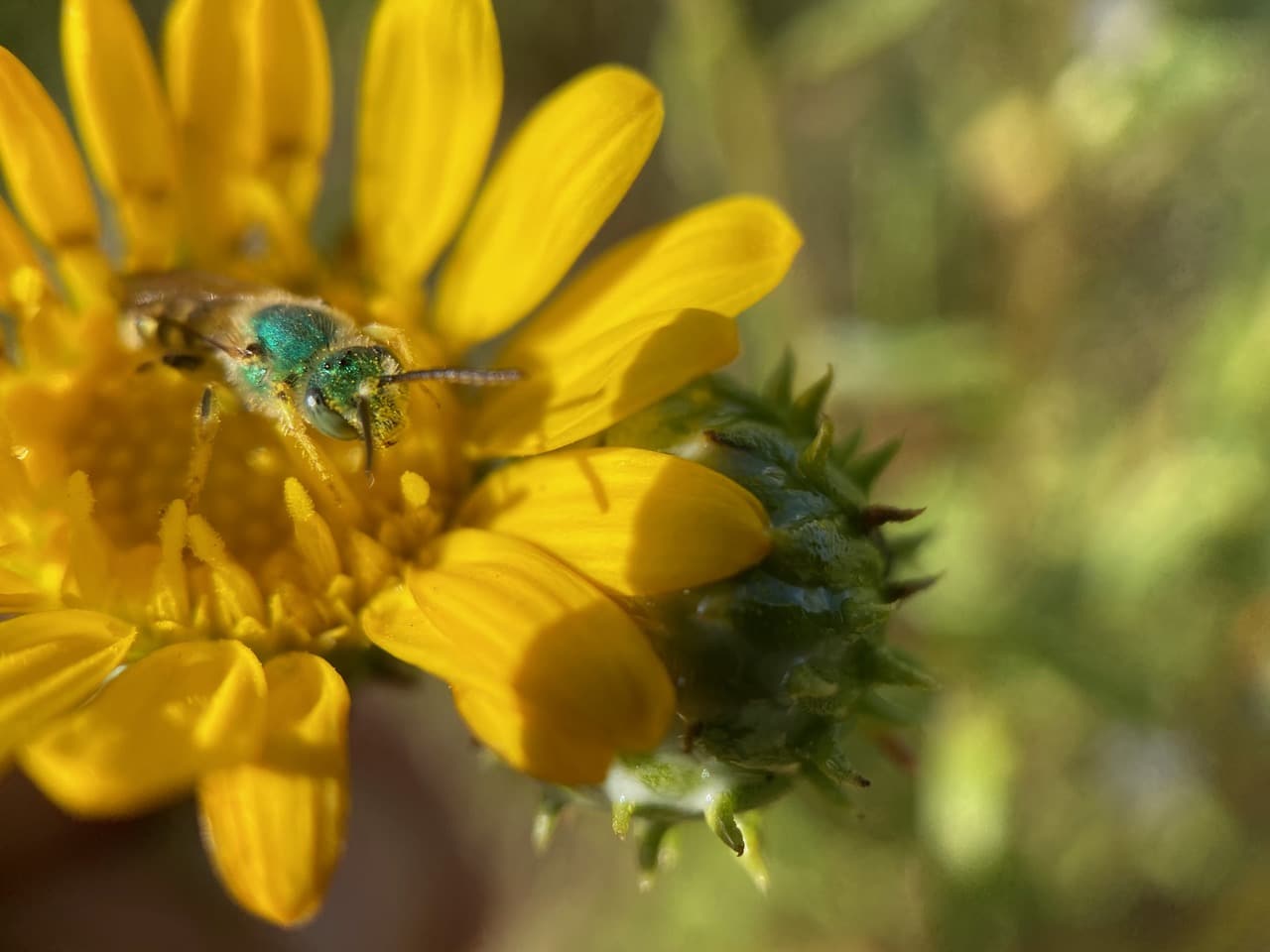
A male Texas Striped Sweat Bee, Agapostemon texanus (family Halictidae) is easily recognizable from his iridescent green head and thorax, and a black-and-yellow banded abdomen.
The genus Agapostemon is widespread and abundant throughout North America. These ground nesters are most diverse and abundant in temperate regions and southwestern U.S. deserts. Agapostemon are commonly called “sweat bees” because they are closely related to, and resemble bees in the Halictus and Lasioglossum genera. Unlike those bees however, Agapostemon are not attracted to human sweat.
Agapostemon are brightly colored metallic green or blue bees measuring 7 to 14.5 mm long. Most species have a metallic green head and thorax, and black-and-yellow striped abdomen; some females are entirely bright green or blue. Females carry pollen on scopal hairs located on their hind legs. Agapostemon are generalists. Like other members of the family Halictidae, they are short-tongued and thus have difficulty extracting nectar from deep flowers. Males are often seen flying slowly around flowers looking for females. The bees favor flowers with high densities. They are active summer to fall.
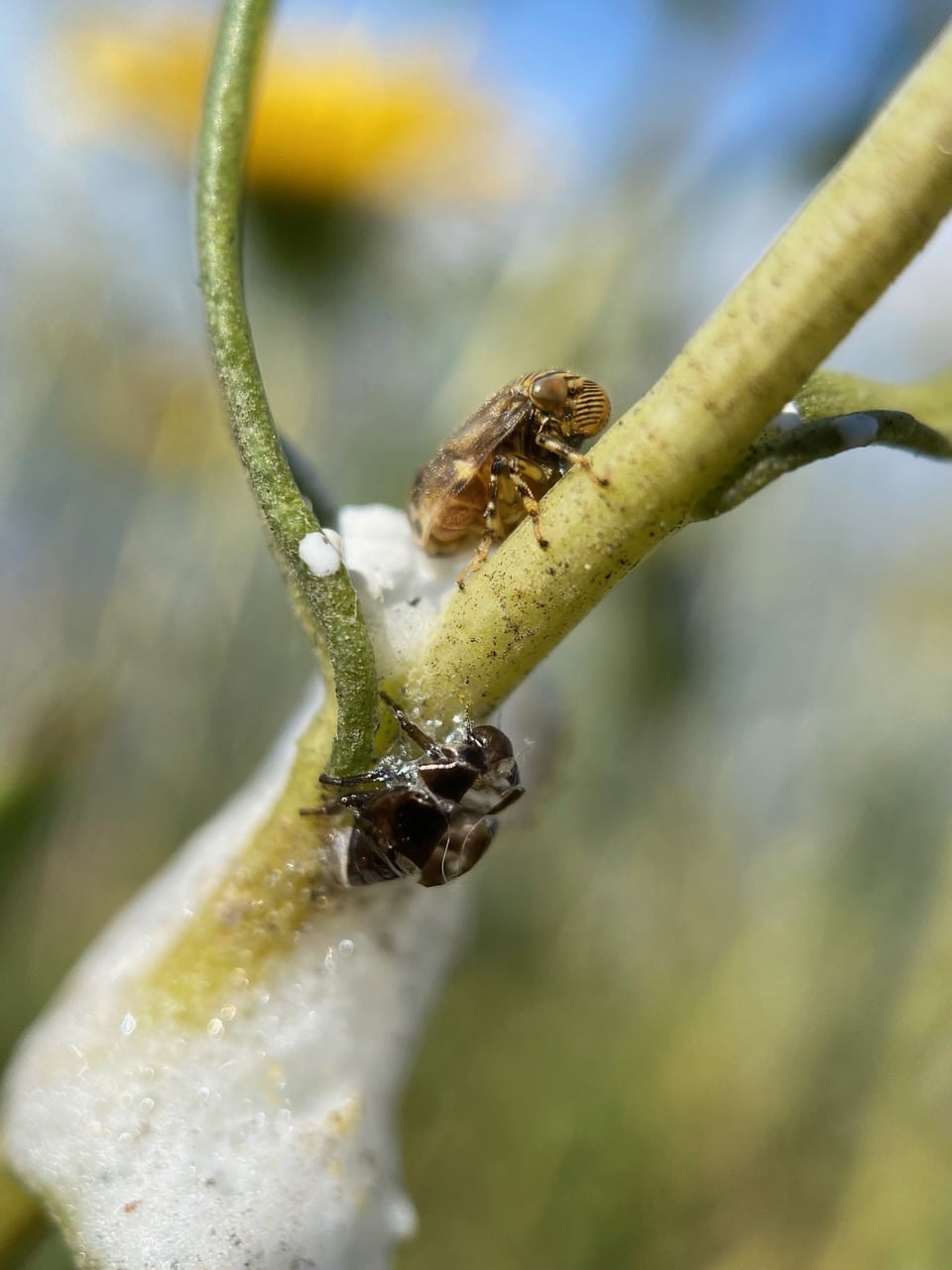
I hurry to the Grindelia plant on which I have found six emerging adult Spittlebugs yesterday. When I left them at around 2:30 pm yesterday they were still pale tenerals. I expect them to be full-fledged adults with their final coloration by now. Sure enough I don’t see any tenerals on the plant today. I find only two adults – this brown one above its foam shelter and exuvia….
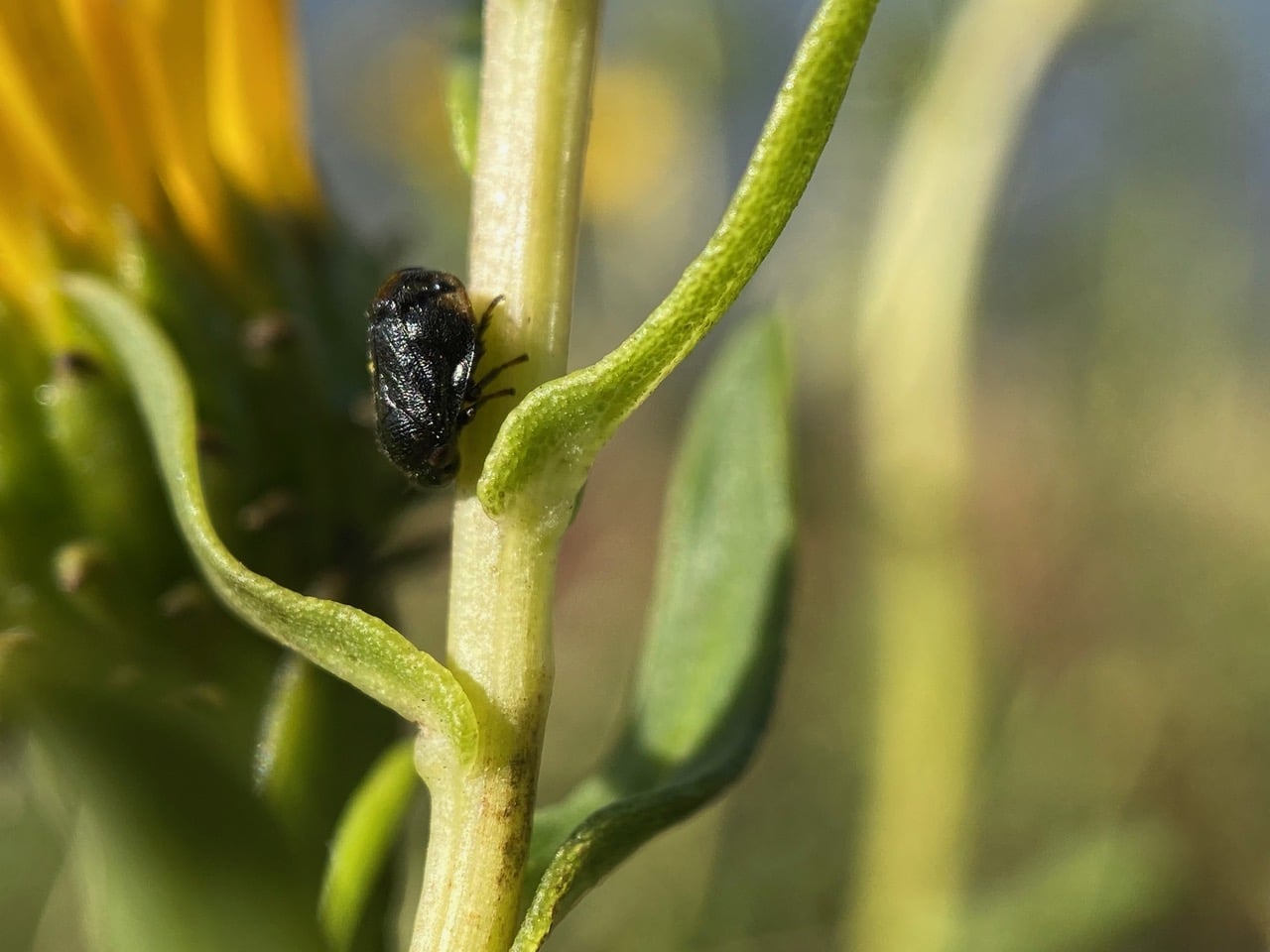
… and this black one. The other adults must have dispersed, are taken by wasps, or hiding out of sight.
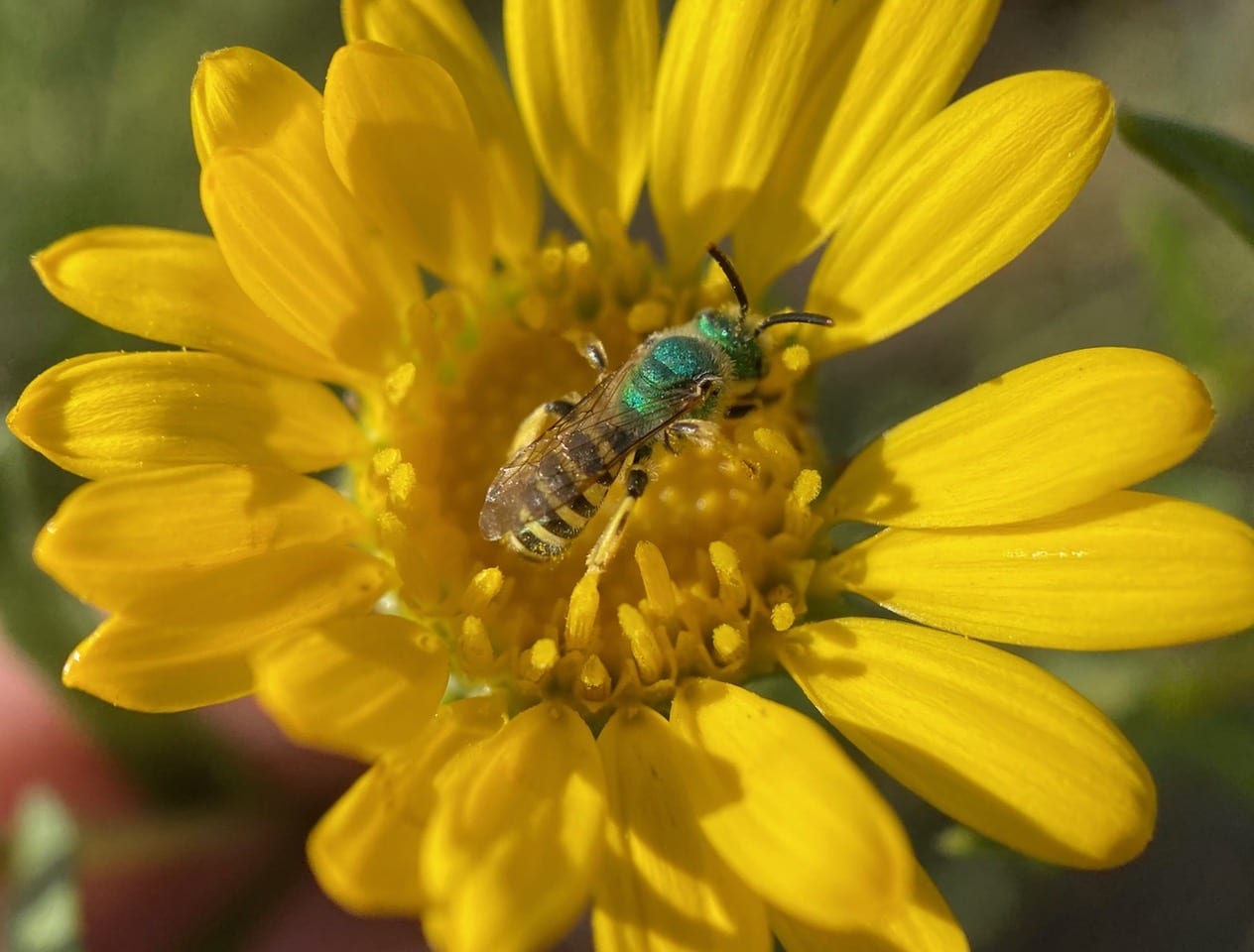
A male Texas Striped Sweat Bee, Agapostemon texanus (family Halictidae) is foraging on a Grindelia flowerhead.
I have been seeing mostly males lately. What happened to the females?

A scruffy male Summer Longhorn Bee, Melissodes sp. (family Apidae) hurries off after taking nectar from the Grindelia flowerhead. It is past 4 pm. The bee will be settling down to sleep soon. On cool mornings, I often find the Melissodes males fast asleep on their favorite plants, sometimes in aggregations.
The Summer Longhorn Bees, Melissodes sp. (family Apidae) are medium to large bees, stout-bodied, usually with gray hair on the thorax and pale hair bands on the abdomen. Males usually have yellow markings on their faces and have very long antennae from which their common name is derived. They are active May to September, with peak flight in late June to early August. The females prefer flat, bare ground for digging their solitary nests, though they sometimes nest in aggregations. Pollen is transported in scopae on the hind legs. Pollen loads are often copious and brightly colored and thus very distinguishable. Melissodes are specialists on Asteraceae – females gather pollen from flowers of Aster, Bidens, Coreopsis, Cosmos, Encelia, Gaillardia, Helianthus, and Rudbeckia ssp.