

Pollinator Post 9/15/24 (1)
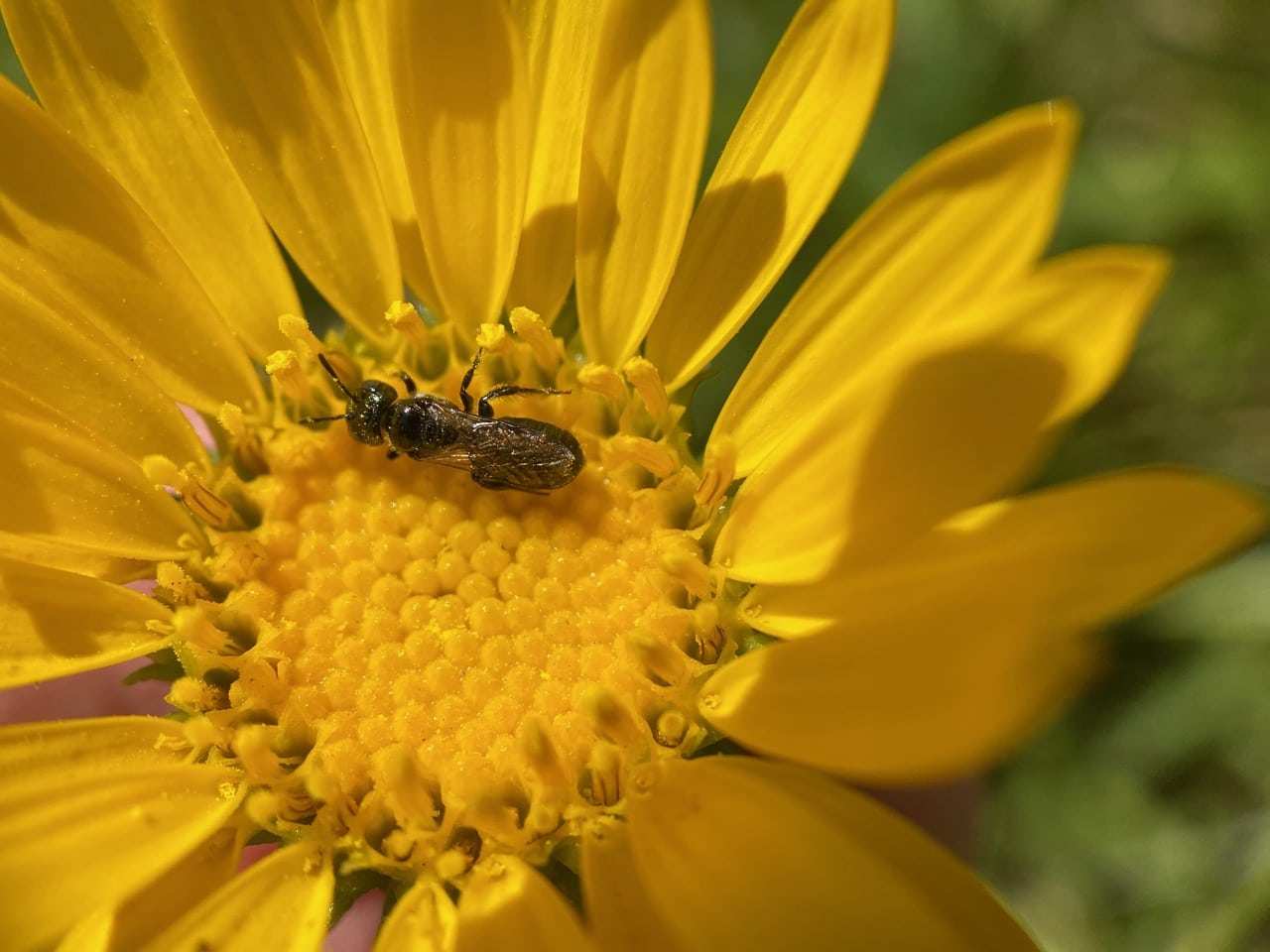
Since it was cool and cloudy all morning, Fred and I didn’t make it to Shoreline Park until afternoon to enjoy a couple hours of sunshine.
A Small Carpenter Bee, Ceratina sp. (family Apidae) is foraging on a flowerhead of Oregon Gumweed, Grindelia stricta.

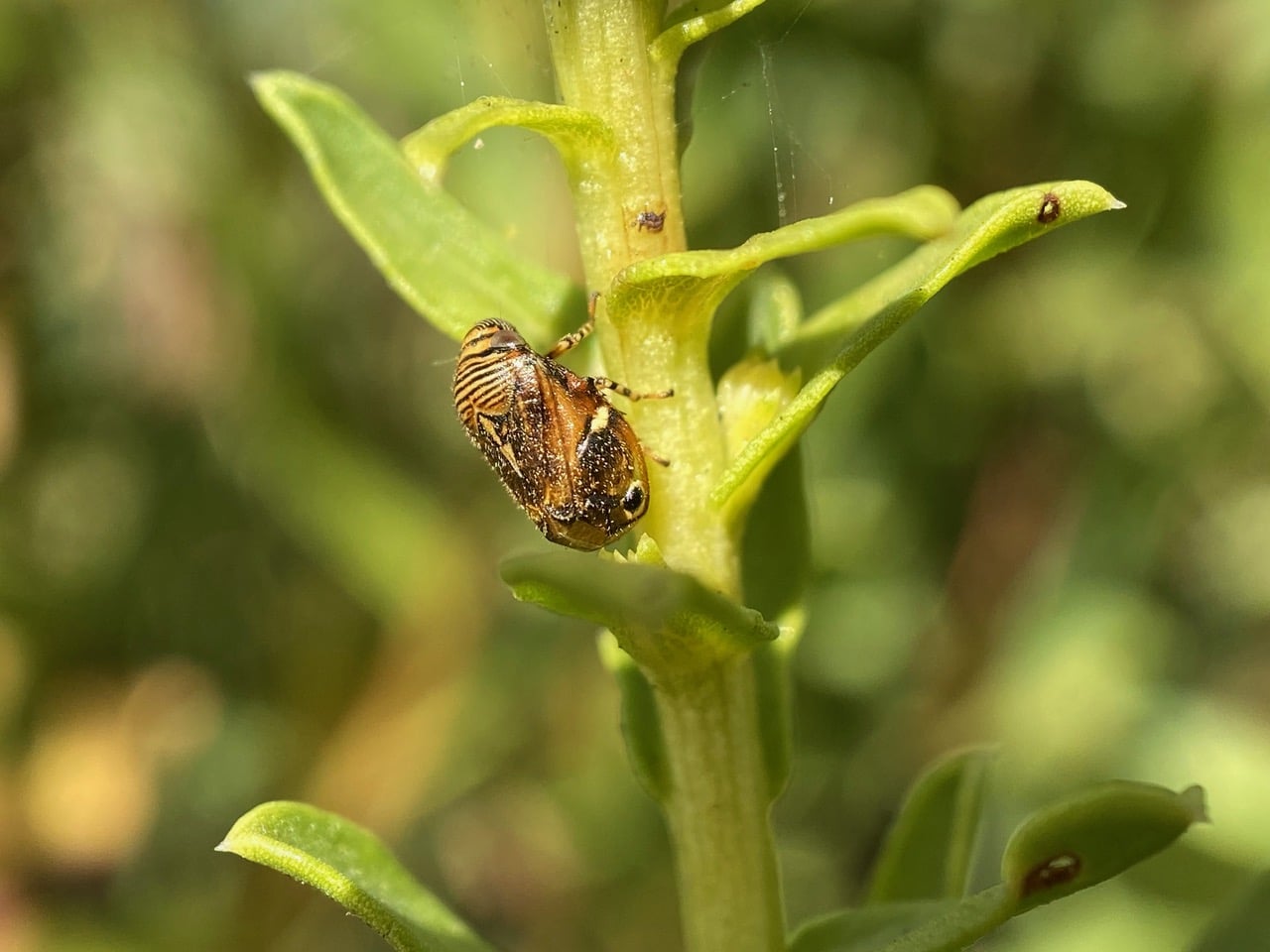
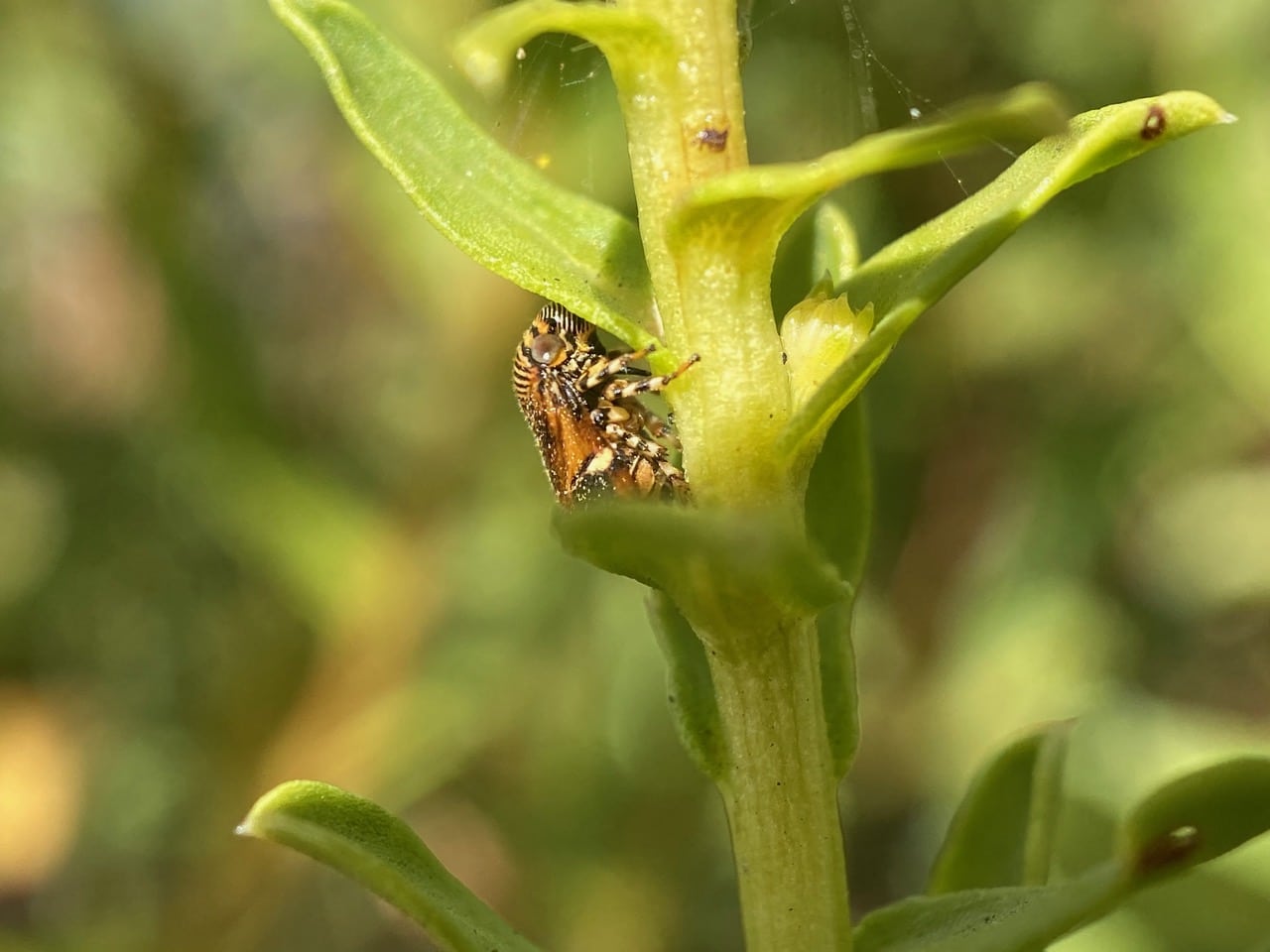
 Froghoppers are the most polite insects I know. Despite their jumping prowess, they are the perfect photographic subject as they don’t usually flee. When feeling threatened, they simply sidle to the other side of the stem or leaf to be out of sight.









The Small Carpenter Bee genus Ceratina is closely related to the more familiar, and much larger Carpenter Bees (genus Xylocopa). Ceratina are typically dark, shiny, even metallic bees, with fairly sparse body hairs and a weak scopa on the hind leg. The shield-shaped abdomen comes to a point at the tip. Some species have yellow markings, often on the face.
Females excavate nests with their mandibles in the pith of broken or burned plant twigs and stems. While many species are solitary, a number are subsocial. Both male and female carpenter bees overwinter as adults within their old nest tunnels, emerging in the spring to mate. In the spring, this resting place (hibernaculum) is modified into a brood nest by further excavation. The female collects pollen and nectar, places this mixture (called bee bread) inside the cavity, lays an egg on the provision, and then caps off the cell with chewed plant material. Several cells are constructed end to end in each plant stem.

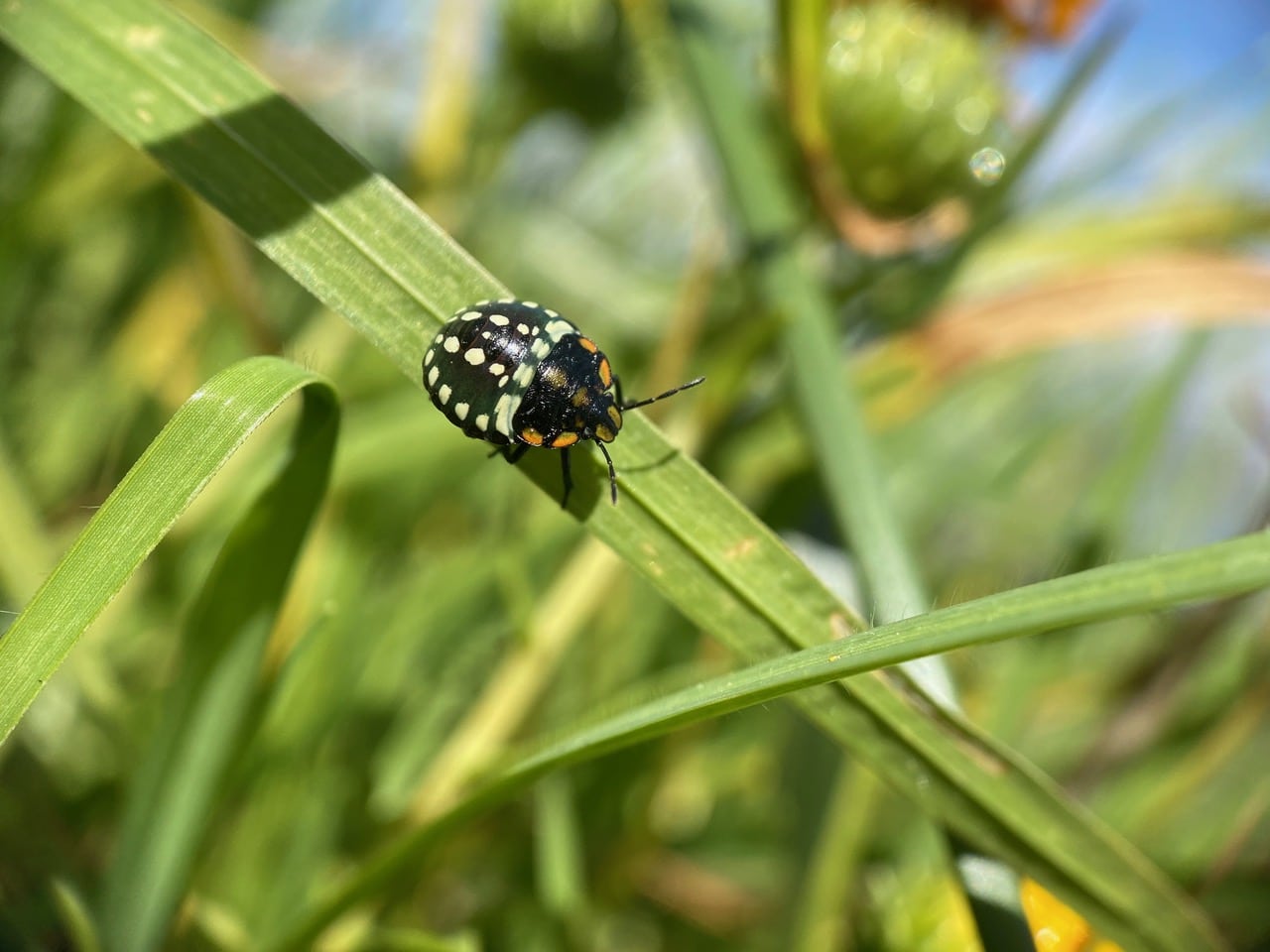
A colorful third instar nymph of the Southern Green Stinkbug, Nezara viridula (family Pentatomidae) is resting on a blade of grass. Why does an insect that is all green as an adult have nymphal stages that are whimsically patterned and colored? Mother Nature certainly has a sense of humor! So far I have seen quite a few of the nymphs, but none of the adults. The latter, being green, must be much harder to spot.
Pentatomidae is a family of insects belonging to the order Hemiptera or “true bugs”. As hemipterans, the pentatomids have piercing-sucking mouthparts, and most are phytophagous, including several species that are severe pests on agricultural crops. Stink Bugs feed on plant fluids by inserting their needlelike mouthparts into stems, leaves or seed pods. While feeding, they inject materials into the plant to aid in digestion and sap removal. Penetration by the mouthparts can cause physical damage, much like stabbing the plant with a fine needle.
All Pentatomids have 5-segmented antennae (hence their family name, Penta – five and tomos – section.) They generally have a large triangular scutellum in the center of the back. The adult is generally shield-shaped when viewed from above. The common name of Stink Bug refers to their ability to release a pungent defensive spray when threatened, disturbed, or crushed.
The Southern Green Stink Bug, Nezara viridula (family Pentatomidae) is a plant-feeding stink bug. Believed to have originated in Ethiopia, it can now be found across the world. Because of its preference for certain species of legumes, such as beans and soybeans, it is an economically important pest on such crops.
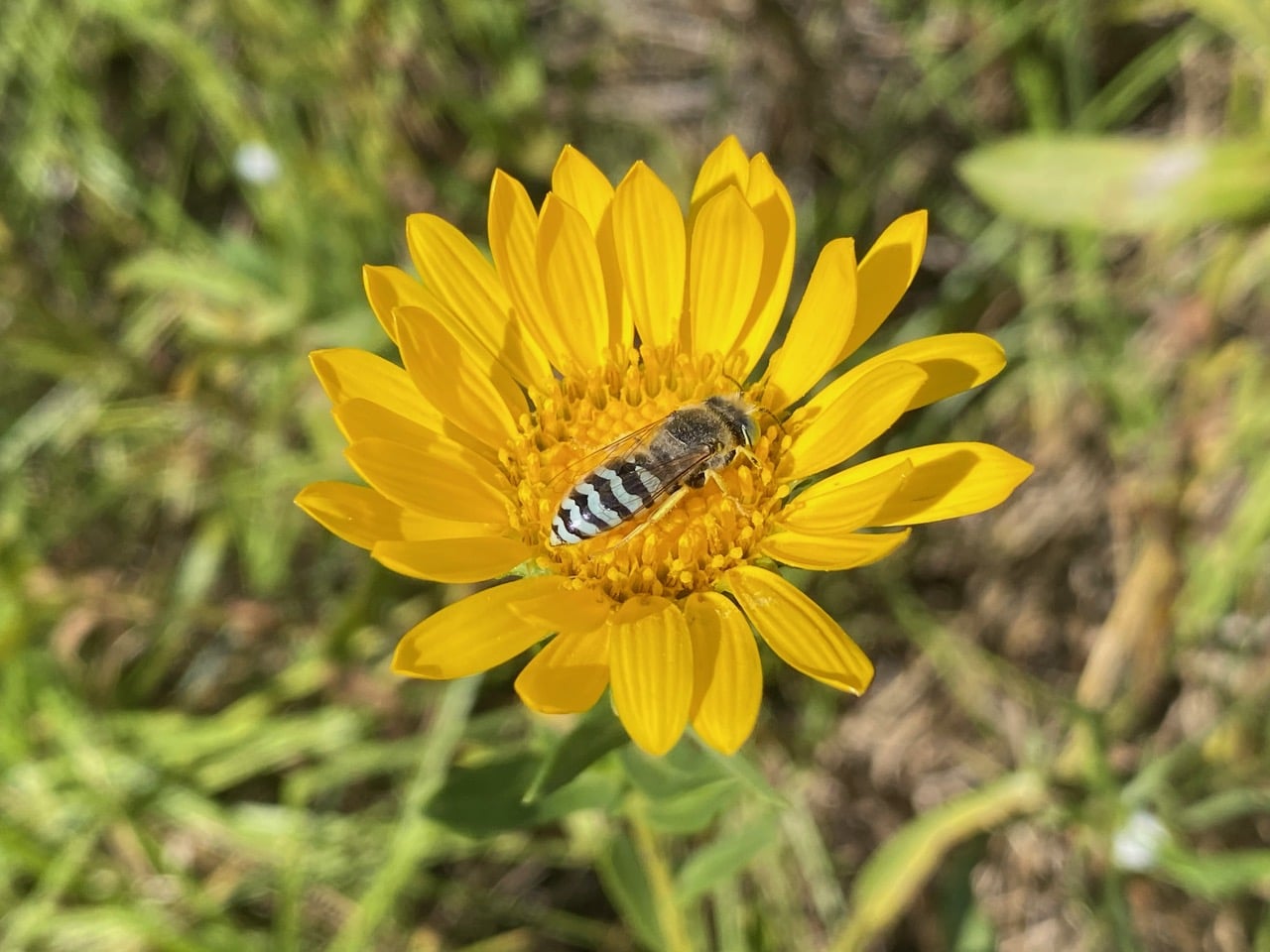
A California Digger-cuckoo Bee, Brachymelecta californica (family Apidae) makes a quick nectar stop on a Grindelia flowerhead.
The California Digger-cuckoo Bee, Brachymelecta californica (family Apidae) is an odd-looking creature. The terga (upper body segments) have medially broken bands of appressed white (rarely pale brown) pubescence. They are parasites of the Digger Bees, Anthophora sp. (family Apidae).
The term cuckoo bee refers to a variety of different bee lineages which have evolved the kleptoparasitic behavior of laying their eggs in the nests of other bees, similar to the behavior of cuckoo birds. Female cuckoo bees lack pollen-collecting structures and do not construct their own nests. Cuckoo bees typically enter the nests of pollen-collecting species, and lay their eggs in cells provisioned by the host bee. When the cuckoo bee larva hatches, it consumes the provision in the nest, and kills the host larva. Many cuckoo bees are closely related to their hosts, and may bear similarities in appearance reflecting this relationship. Others parasitize bees in families different from their own.
An American Sand Wasp, Bembix americana (family Crabronidae) is taking nectar from a Grindelia flowerhead.
Sand wasps in the genus Bembix are familiar and common throughout North America, digging their burrows in dunes, on beaches, and other habitats with loose, deep sand. The female rapidly kicks out large quantities of sand using a “tarsal rake” of spines on each front leg. The burrow is excavated before the wasp goes hunting. Bembix are generalist, opportunistic hunters. True flies in the order Diptera are the usual prey. A victim is paralyzed or killed by the wasp’s sting, and is then flown back to the nest. Most species will lay an egg on the first victim, while some species lay an egg in the empty cell before starting to hunt. Once the egg hatches, mama wasp brings flies to her larva as needed. This “progressive provisioning” is rare in the insect world. When the larva reaches maturity, mama wasp closes the cell. Inside, the larva spins an oblong cocoon, weaving sand grains into the structure and resulting in a hardened capsule. Overwintering takes place as a prepupa inside this cocoon, but there are usually two generations a year.
Male sand wasps often engage in an elaborate flight ritual called “sun dances”. Males emerge before females, and fly erratically at dizzying speed one or two inches above the ground attempting to detect virgin females about to emerge from their underground nests. Both sexes are often seen taking nectar at flowers, especially from Asteraceae family. Bembix wasps are often victims of other insects such as cuckoo wasps (Chrysididae), velvet ants (Mutillidae), satellite flies (Sarcophagidae), bee flies (Bombyliidae), and thick-headed flies (Conopidae).
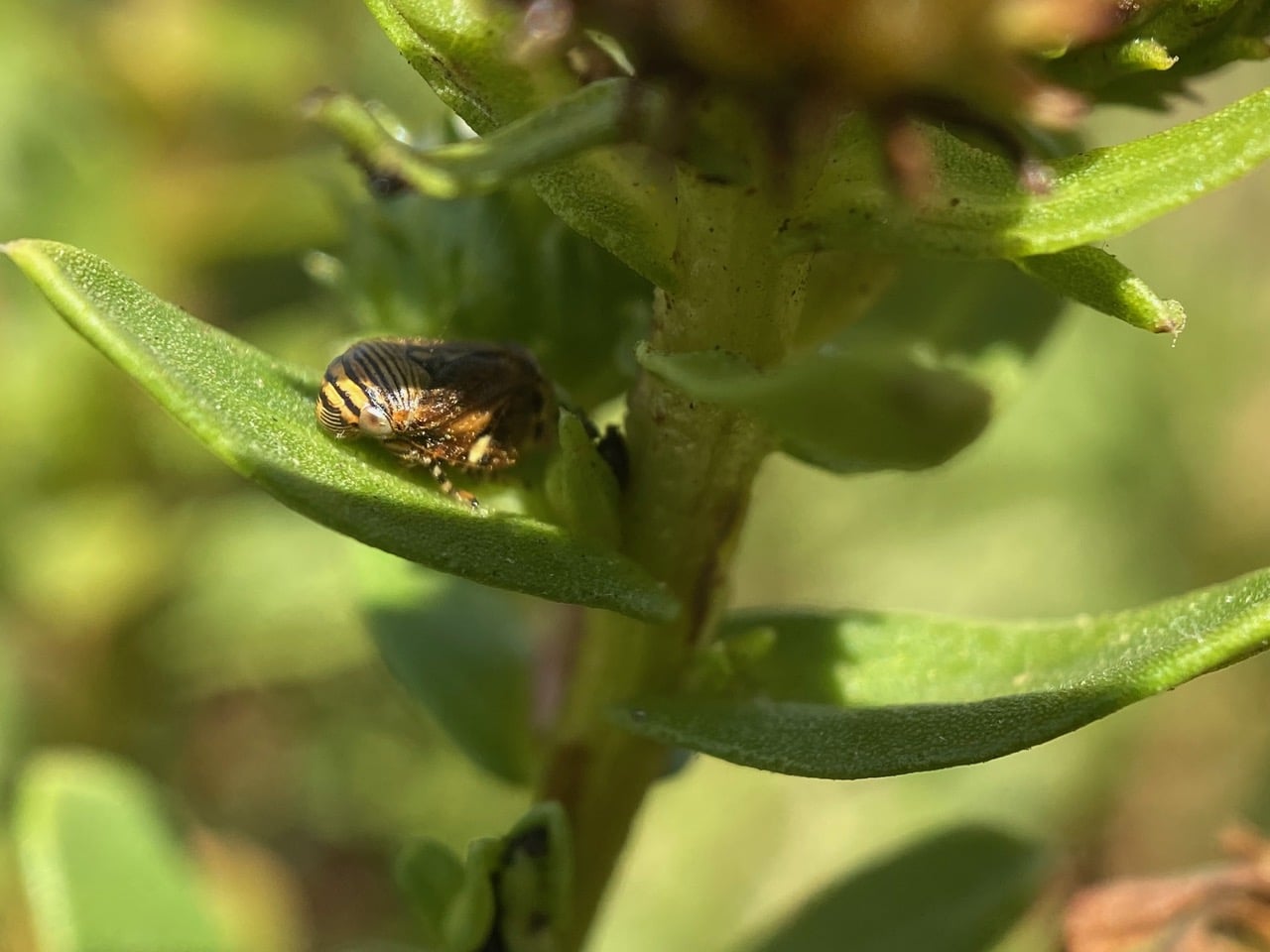
I check the Grindelia plant on which I have observed a Spittlebug, Complex Clastoptera lineatocollis (family Clastopteridae) make its debut as an adult yesterday. This is the first adult I found on the plant, just like yesterday – it seems these bugs are very sedentary. This bug has only moved a couple of inches down from its position yesterday.
The Froghoppers (superfamily Cercopoidea) are a group of “true bugs” in the order Hemiptera. Adults are capable of jumping many times their height and length, giving them their common name, but many species are best known for their plant-sucking nymphs which produce foam shelters, and are referred to as “spittlebugs”. The superfamily currently consists of three families: the Aphrophoridae, Cercopidae, and Clastopteridae. The nymphs produce a cover of foamed-up plant sap visually resembling saliva, hence the common name. Whereas most insects that feed on plant sap tap into the nutrient-rich fluid from the phloem, the spittlebugs utilize the much more dilute sap flowing upward from the roots via the xylem. The insects’ digestive system contains symbiotic bacteria that provide them with the essential amino acids. The large amount of excess water that must be excreted and the evolution of special breathing tubes allow the young spittlebug nymphs to grow in the relatively protective environment of their foam shelters. The foam serves a number of purposes. It hides the nymph from the view of predators and parasites, and it insulates against heat and cold, providing thermal as well as moisture control. It also has an acrid taste that deters predators.
Froghoppers are champion jumpers among insects, out-performing even the fleas. The bug can leap the human equivalent of a skyscraper without a running start. It is the highest jumping insect proportional to body size. The muscles in its hind legs act like a “catapult” to release energy explosively.
Ah, I think I see its black rostrum (piercing-sucking mouthparts) under its body, between its legs.
Froghoppers are the most polite insects I know. Despite their jumping prowess, they are the perfect photographic subject as they don’t usually flee. When feeling threatened, they simply sidle to the other side of the stem or leaf to be out of sight. Hey, that must be our Birthday Bug from yesterday, already a full-fledged adult! It is hunkered on a leaf about 3 in. above the leaf on which it eclosed yesterday. When I left it at noon yesterday, it was still a pale teneral. What difference a day makes! Strangely, I feel like a proud midwife, having witnessed its “birth”.
This is what it looks like on the other side, complete with false eyespot on its hind wing.
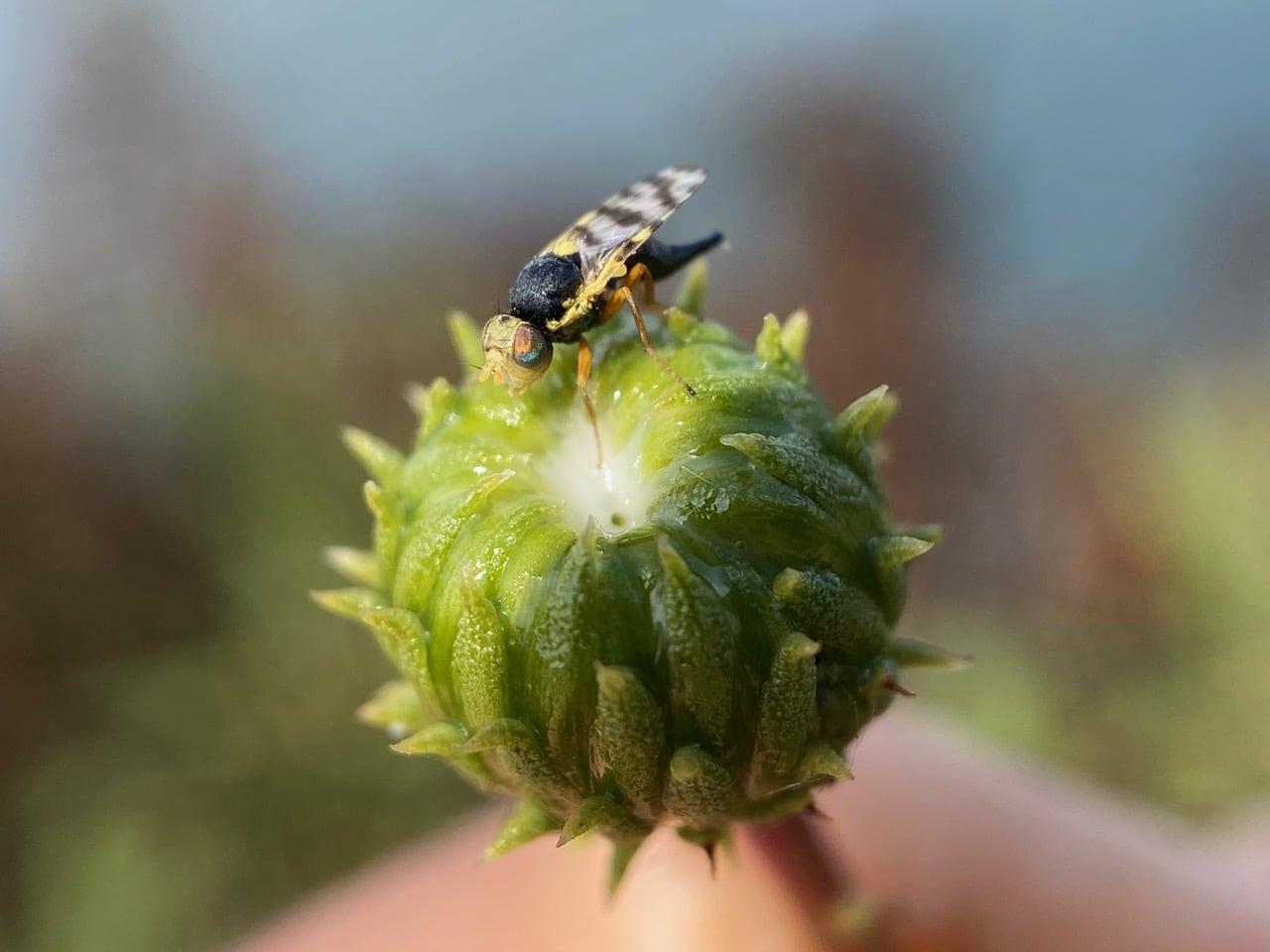
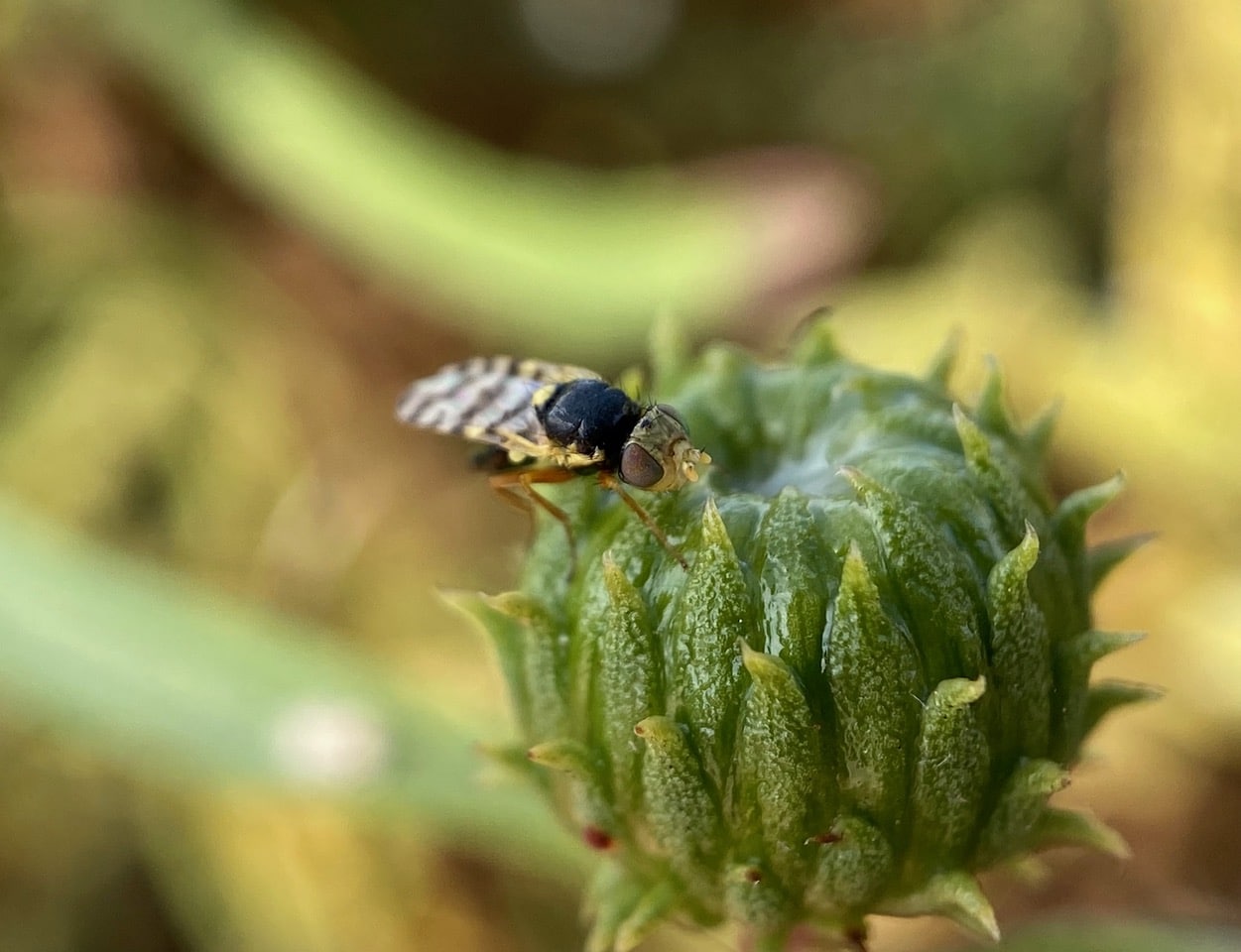
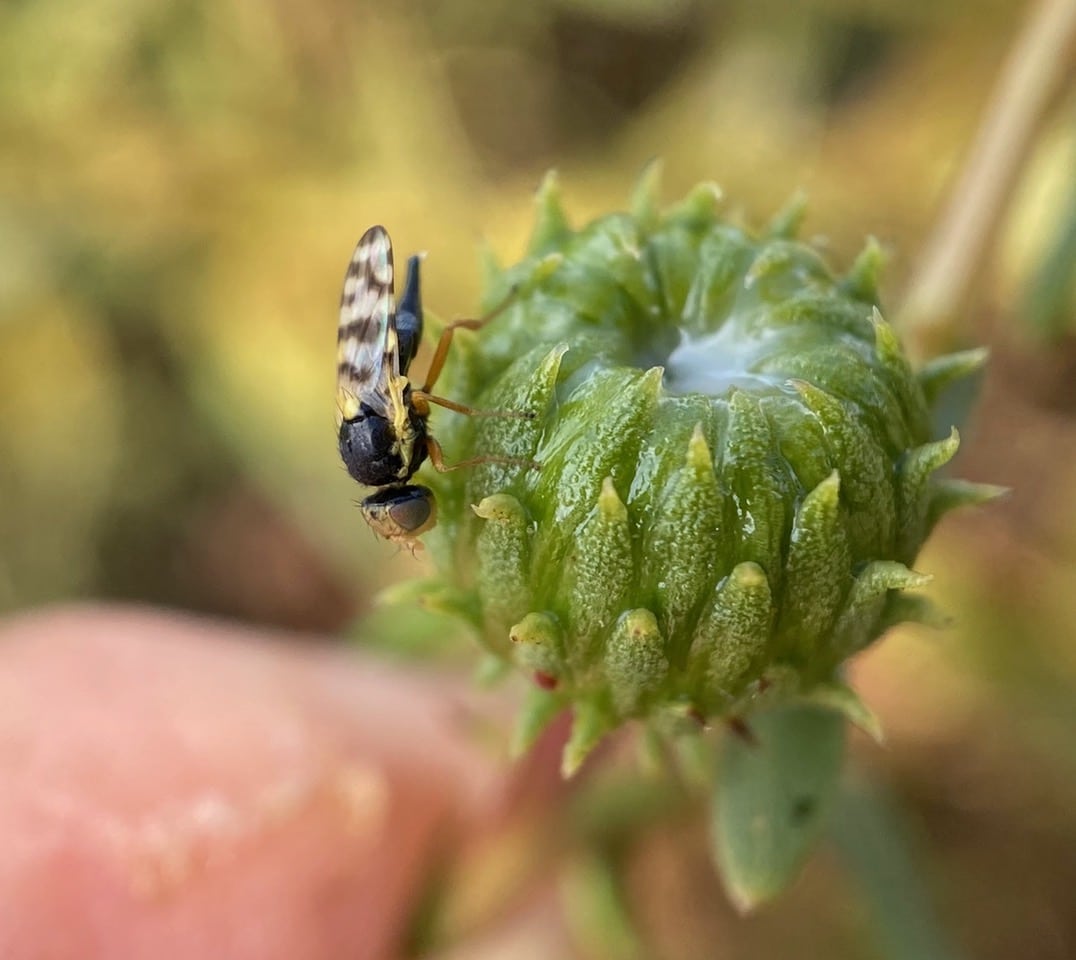
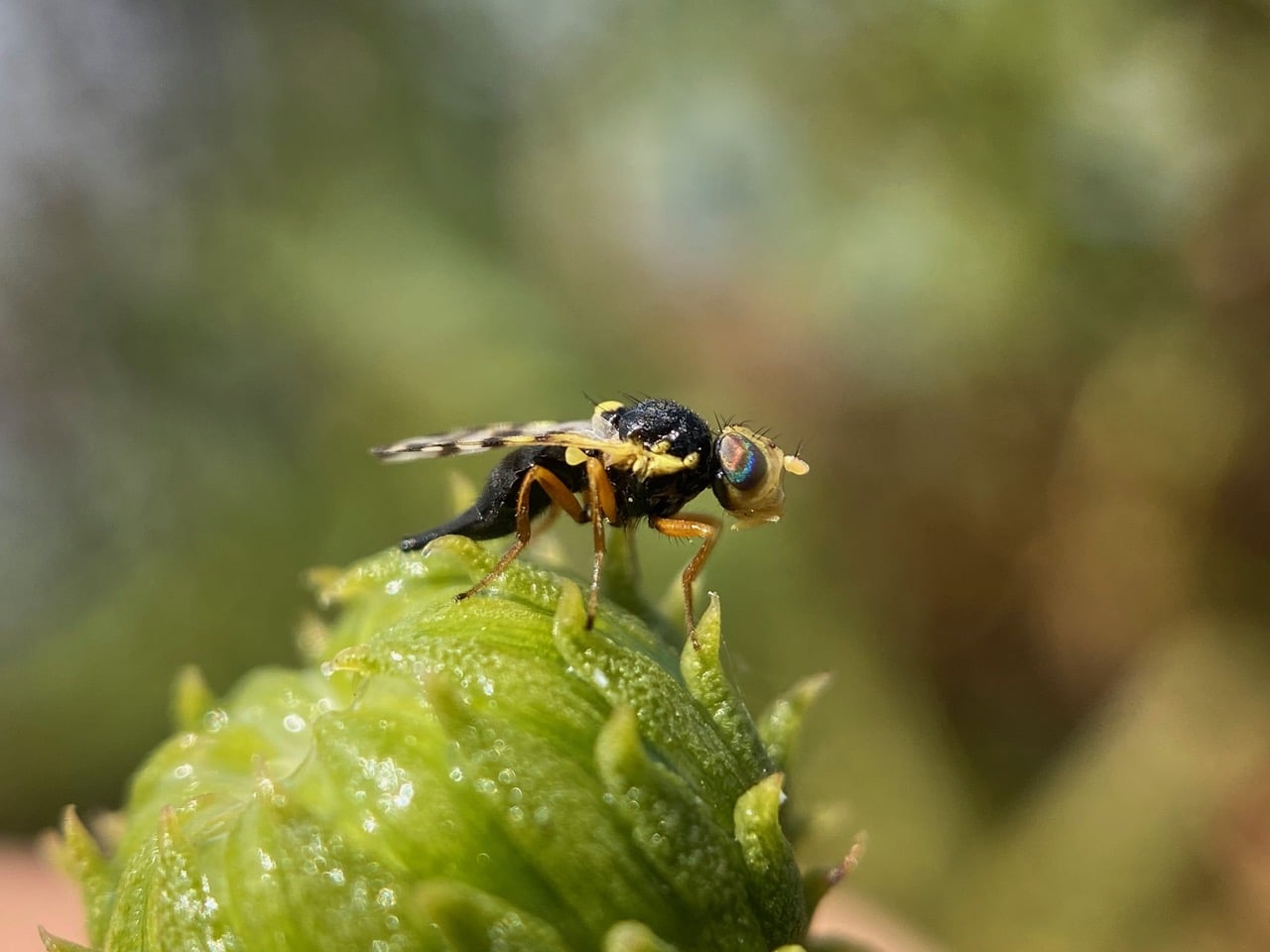
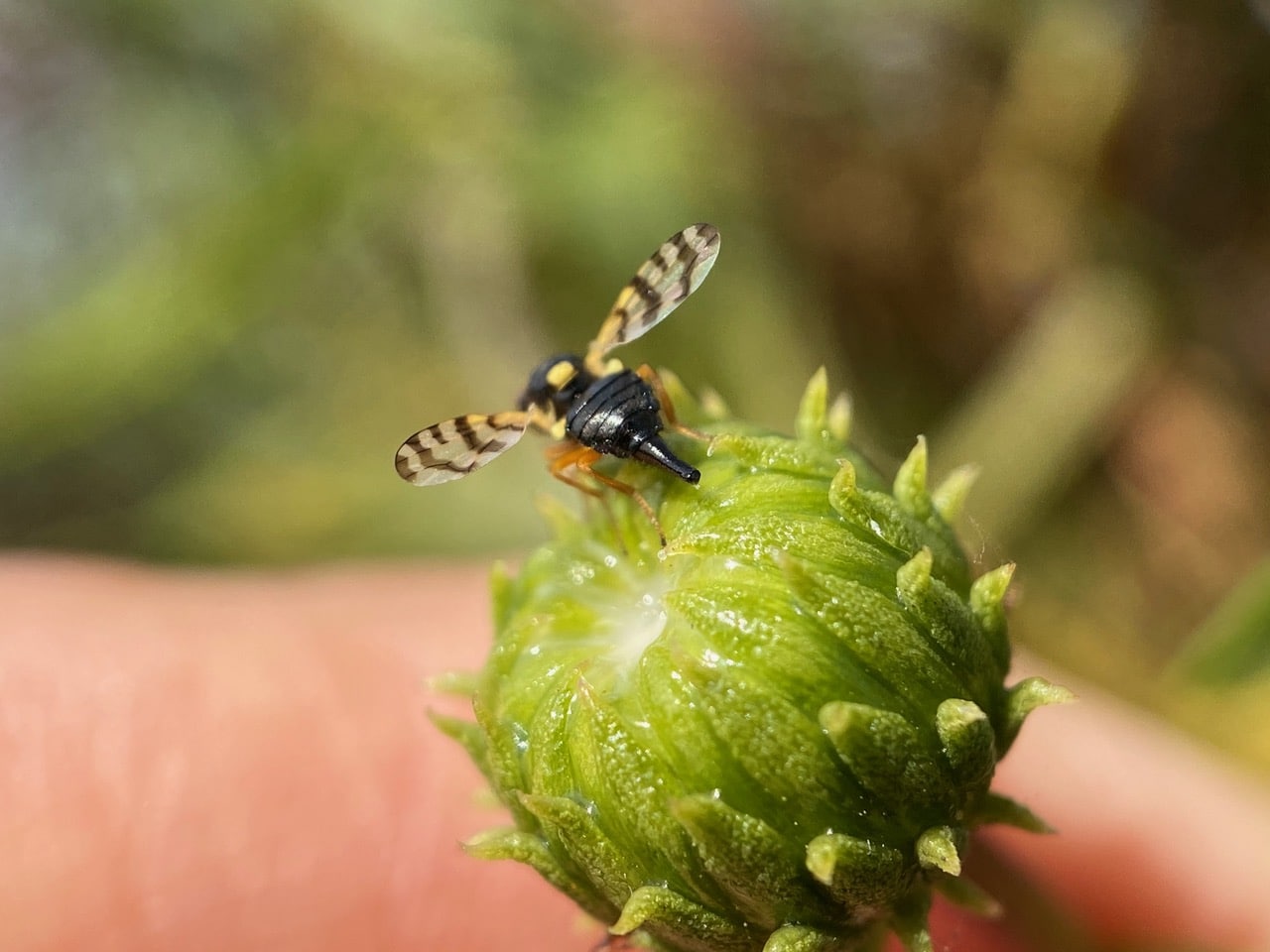
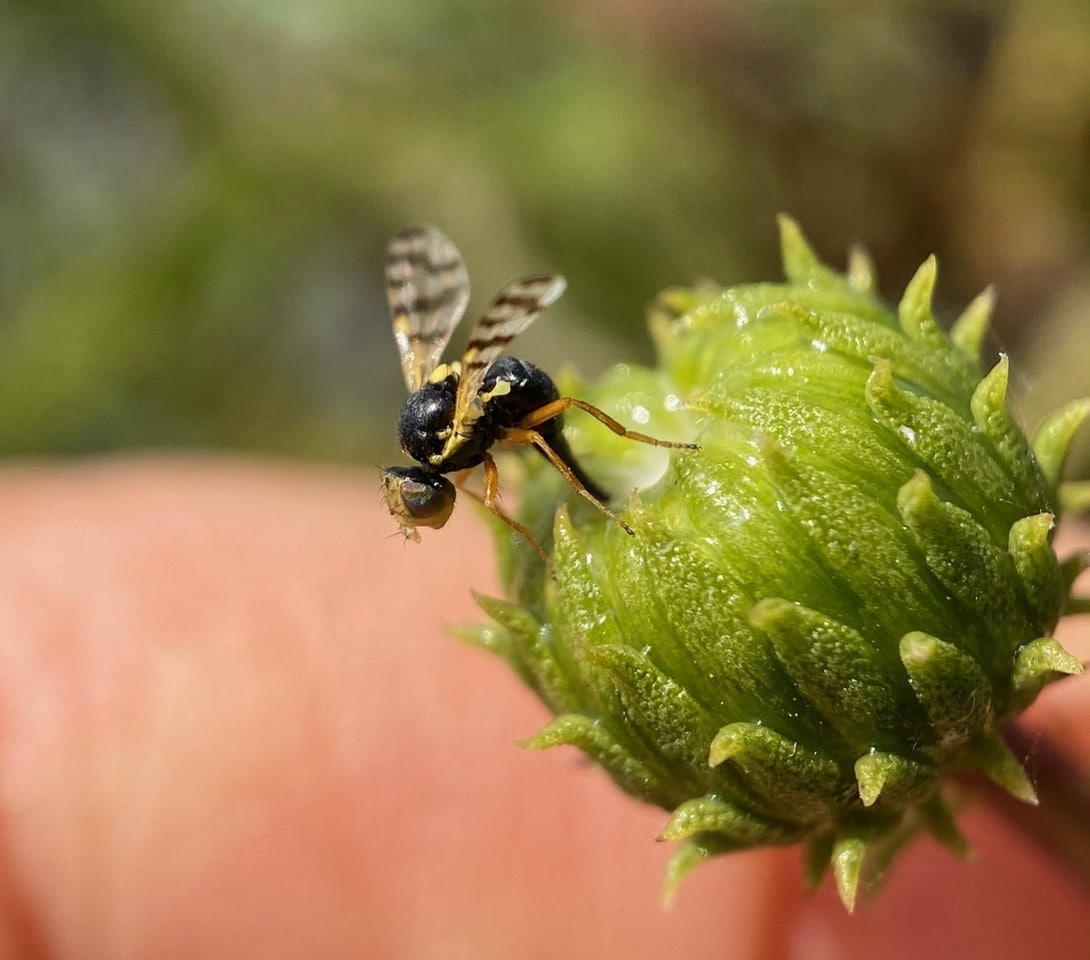
Stopping to take a look at a small insect on an immature Grindelia flowerhead through the macro lens, I recognize it as a Fruit Fly (family Tephritidae), although not a familiar species. It is a female with a pointed oviscape on the tip of her abdomen. The oviscape is the protective structure through which the female’s telescopic ovipositor is extended when laying eggs.
Commonly called Fruit Flies, Tephritids are small to medium-sized flies that are often colorful, and usually with picture wings. The larvae of almost all Tephritidae are phytophagous. Females deposit eggs in living, healthy plant tissues using their telescopic ovipositors. Here the larvae find their food upon emerging. The larvae develop in leaves, stems, flowers, seeds, fruits, and roots of the host plant, depending on the species. Adults are often found on the host plant and feeding on pollen, nectar, rotting plant debris, or honeydew. Tephritid flies are of major economic importance as they can cause damage to fruit and other plant crops. On the other hand, some Tephritids are used as agents of biological control of noxious weeds.
I am pleasantly surprised that the fly doesn’t spook when I have to steady the flowerhead against the winds with my fingers.
The fly continues to investigate the flowerhead.
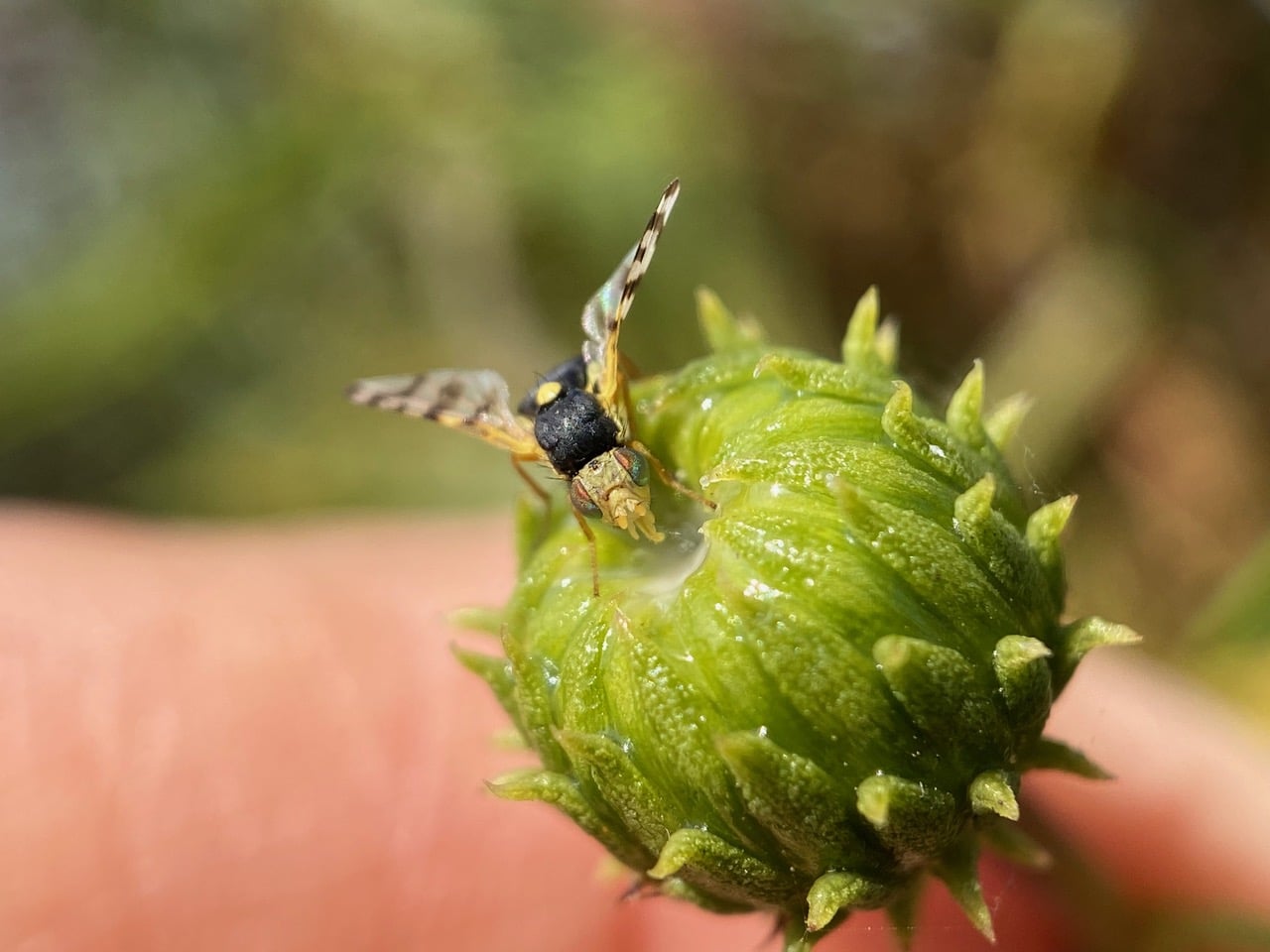
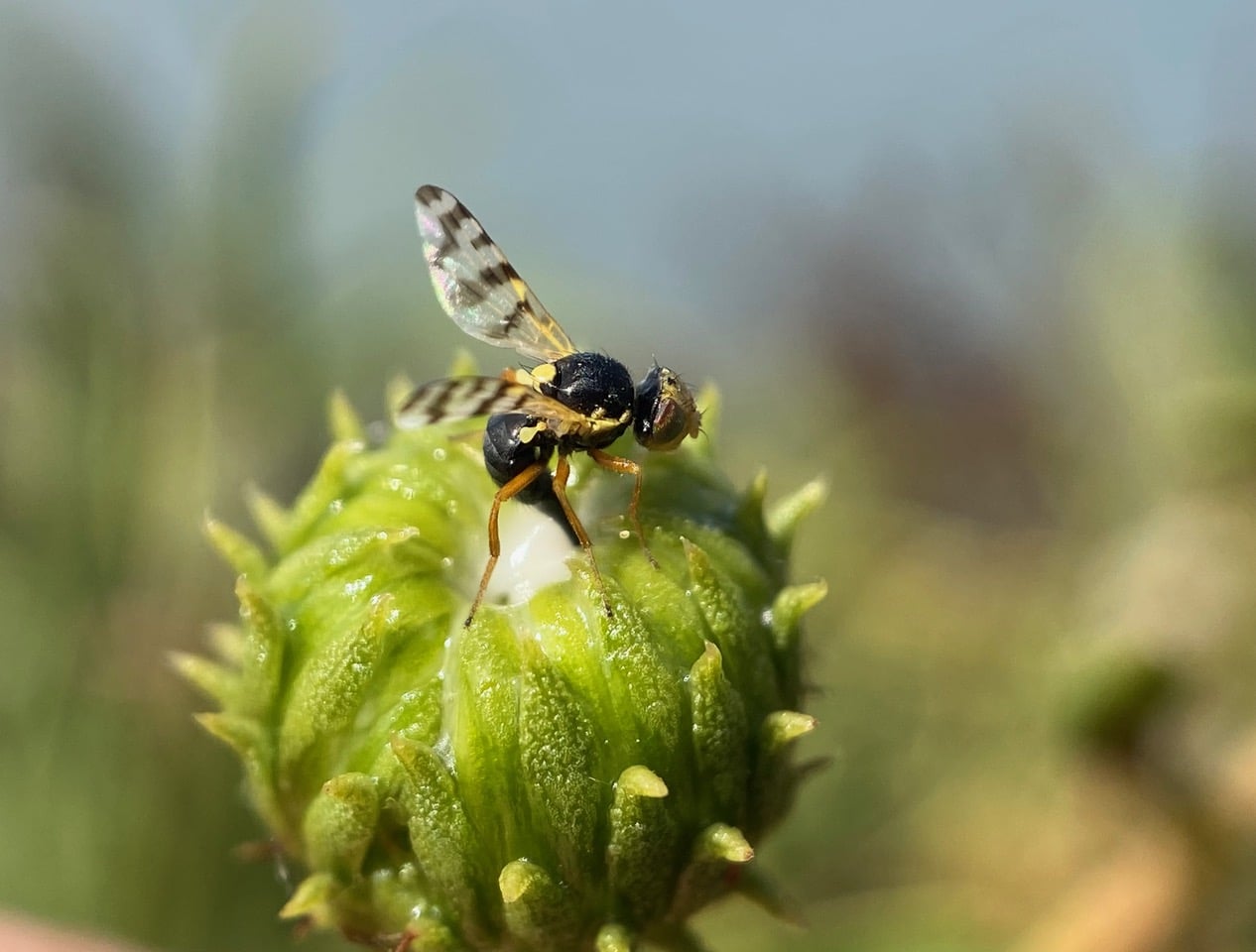
The fly lowers her mouthparts as if testing the gooey white sap at the center of the immature flowerhead.
The fly begins to wave her wings in wide arcs several times.
She turns around and lowers her oviscape into the gooey center of the immature flowerhead.
I twist the stem to get better light on the fly. She isn’t spooked, totally focused on her task at hand – laying eggs. I am surprised that any insect would oviposit in the sticky white sap of Grindelia.
She stays in this position for a while.
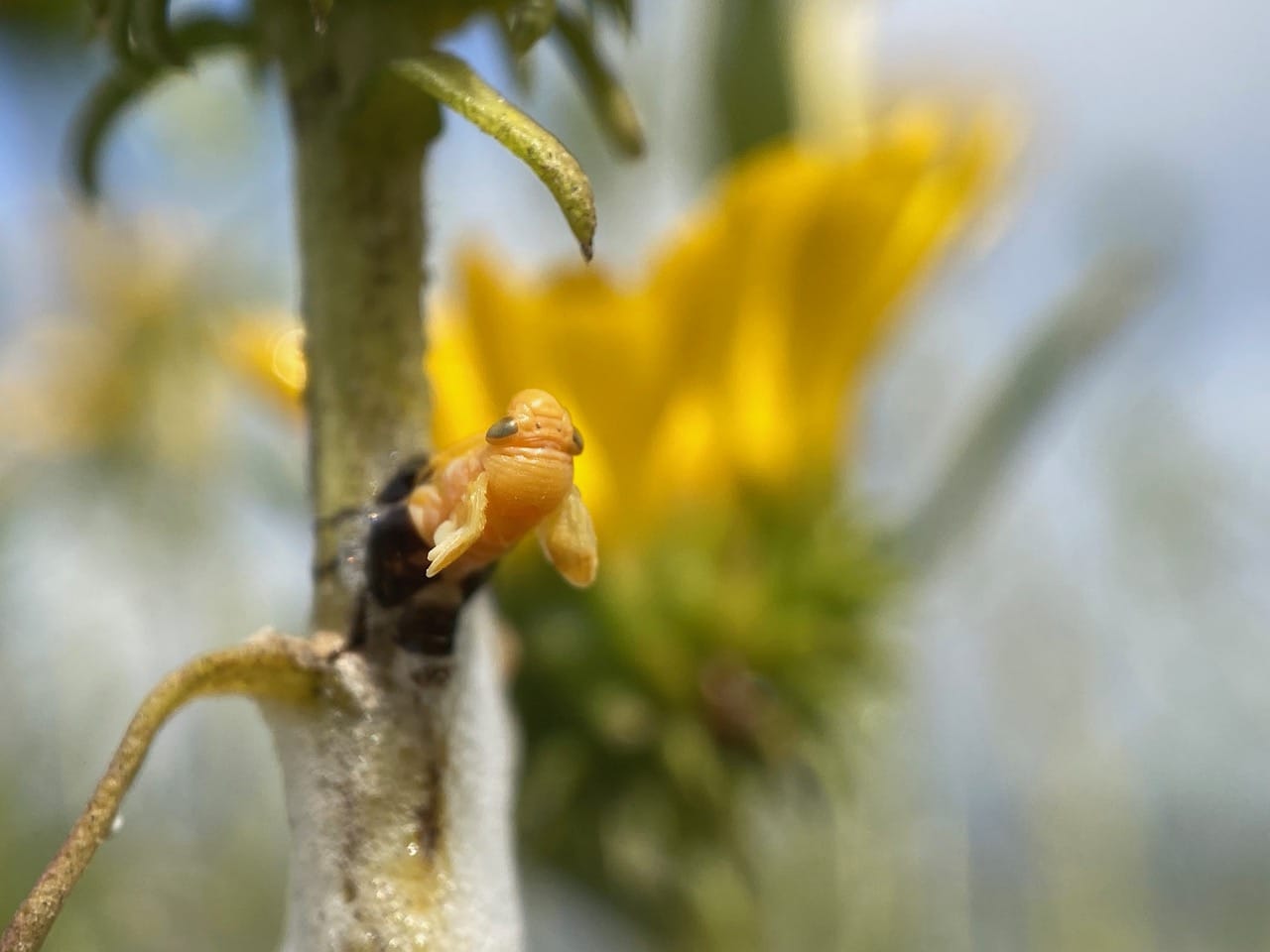
I pause by a robust, solitary Gridelia that grows by the path, quickly scanning the stems above the spittlebug foam masses. Much to my delight, I count 6 adults in the process of ecdysis (molting)! This one looks the most dramatic with wings unfurling.
This teneral is already completely out of its old exoskeleton, its wings in position. A teneral insect is one that has recently molted and its exoskeleton is yet to harden and get its final coloration. In this state, the insect is very vulnerable. The teneral state can last for some time.
This teneral under the leaf is in the same stage of development, waiting for its new exoskeleton to dry and harden, and for the final coloration to come in.
Tiny wings are just starting to unfurl on this young adult, still emerging from its exoskeleton.
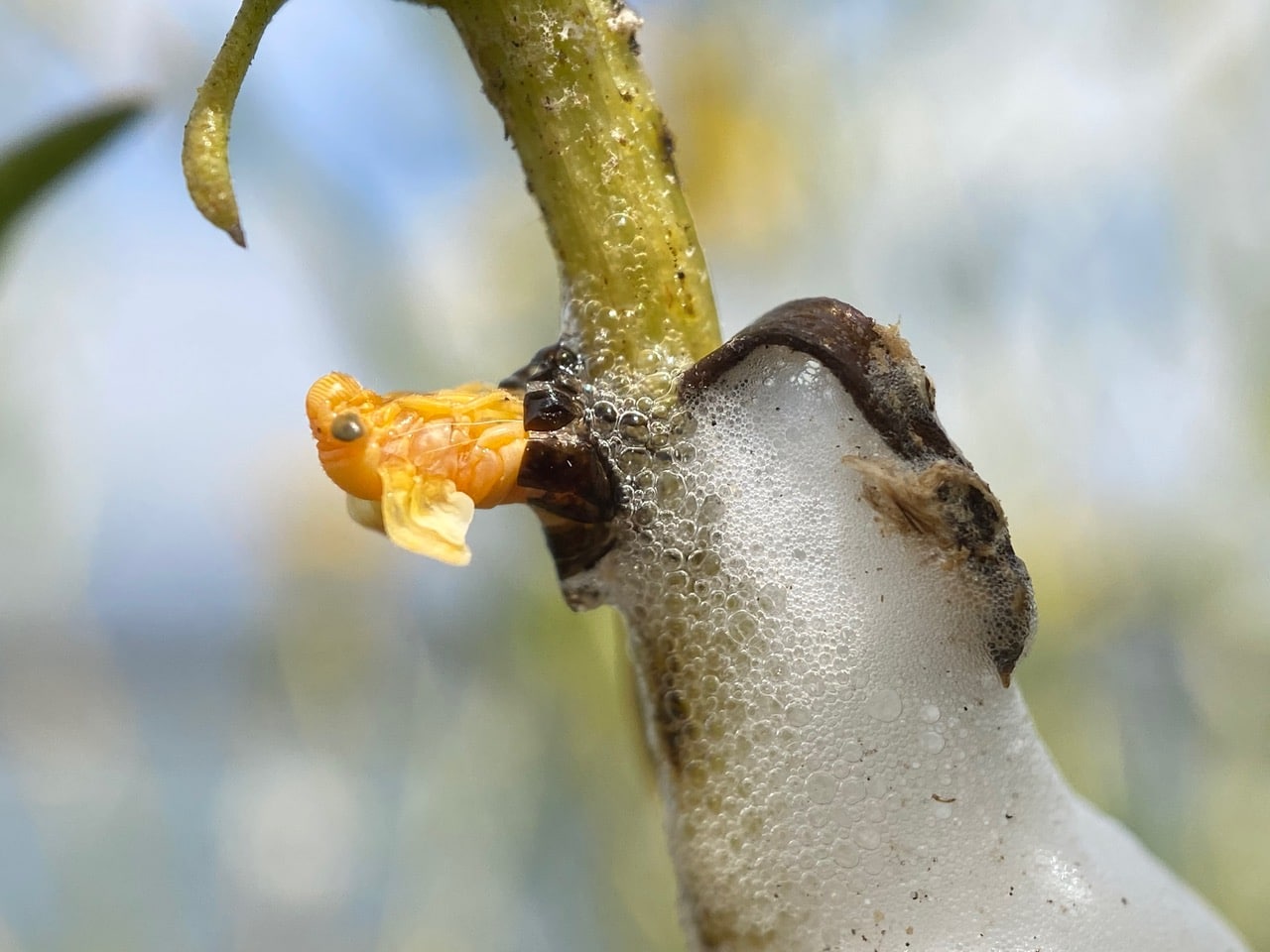
Side view of the same emerging adult. It looks like Dumbo here.
This fresh adult is still unfurling and expanding its wings.
This teneral is probably the most “mature” of the lot. Note that the false eyespot is already visible near the tip of its wing.
Wow, six adult spittlebugs emerging on the same Grindelia plant on the same day. Never thought I would have so much fun with these bugs!
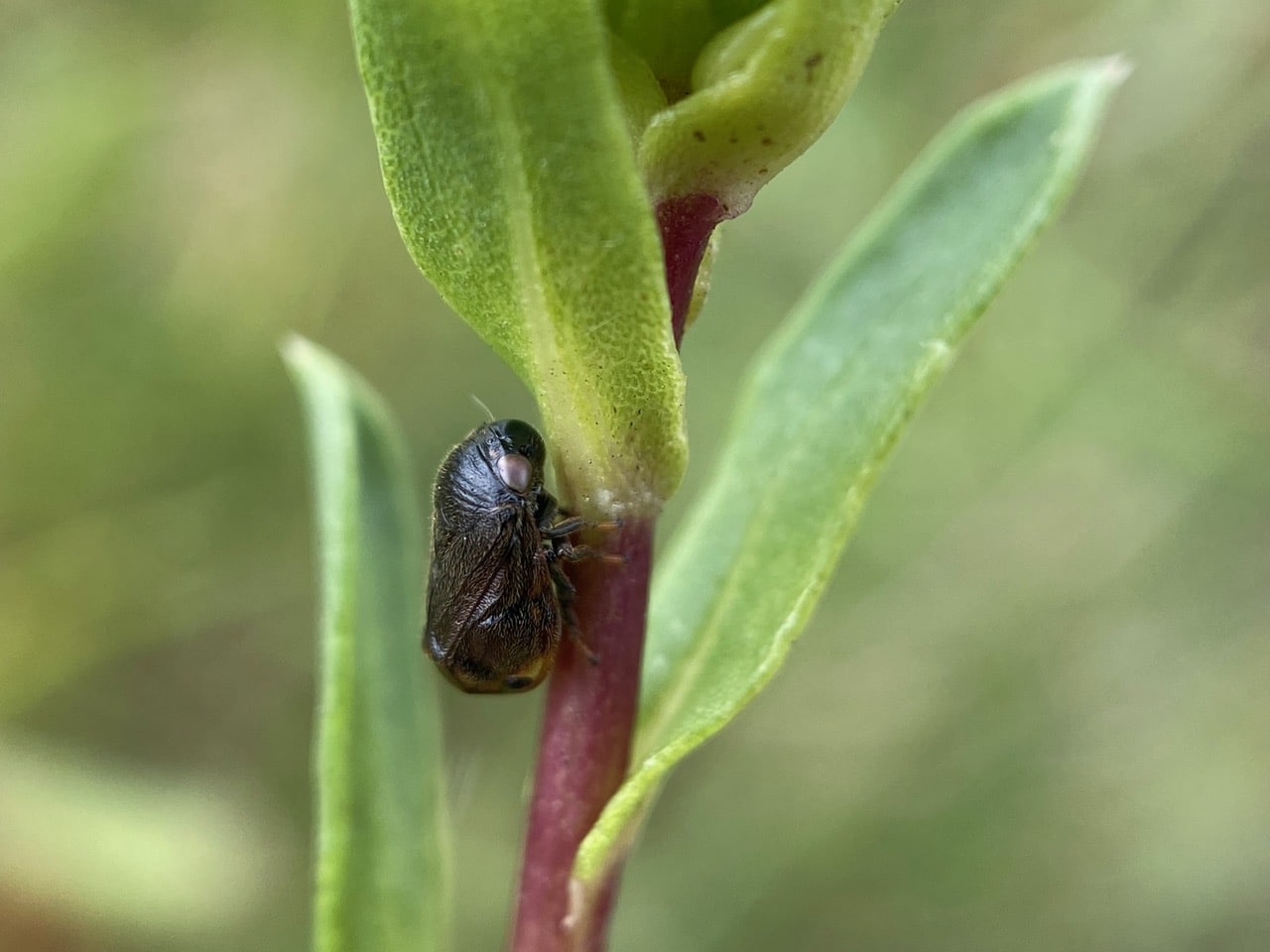
A black adult Spittlebug, Complex Clastoptera lineatocollis (family Clastopteridae) is resting on the stem of a Grindelia. I am puzzled by the color variations I have been seeing. iNaturalist has identified both the brown and the black individuals as the same species. Are the colors of the adults age-related? Is the species sexually dimorphic? The best way to find out is to find a mating pair.