

Pollinator Post 9/15/23 (2)

I can predictably find the Blue-green Sharpshooters now on the Coffeeberry shrubs under the Eucalyptus and Bay trees. The bugs are mostly found on the tender leaves at the branch tips.
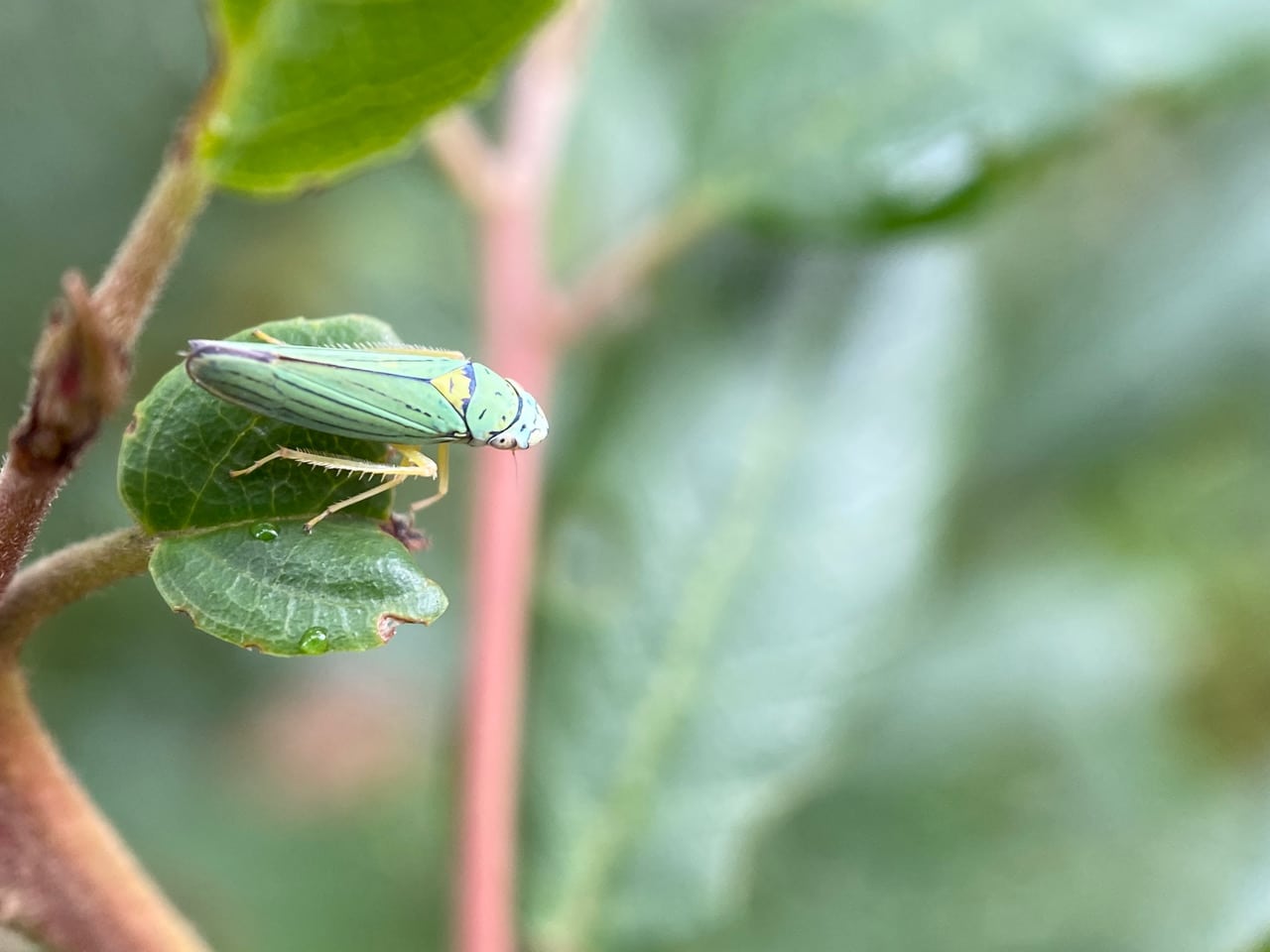
The Blue-green Sharpshooter, Graphocephalus atropunctata (family Cicadellidae) is a hemipteran bug endemic to California. It is about 0.4 in long with blue or bluish-green color on the upper surface while the head, prothorax, legs and underside are lighter and yellow-green. Adult blue-green sharpshooters are long-lived. Both nymphs and adults share the peculiar habit of running sideways. There is usually only a single generation per year. The females mature during their first winter and lay eggs the following spring. The bugs can be found in the vegetation alongside streams and rivers, in locations with abundant soil moisture and some shade. They can be found on the leaves of native as well as cultivated ornamental plants and crops. More than 150 plants have been recorded as hosts.
The Blue-green Sharpshooter is known to be a carrier of Pierce’s Disease, a disease infecting grape vine, among other crops of economic importance. As the bugs feed, they inject plants with a bacteria that causes the disease, blocking the flow of water and nutrients through the xylem.
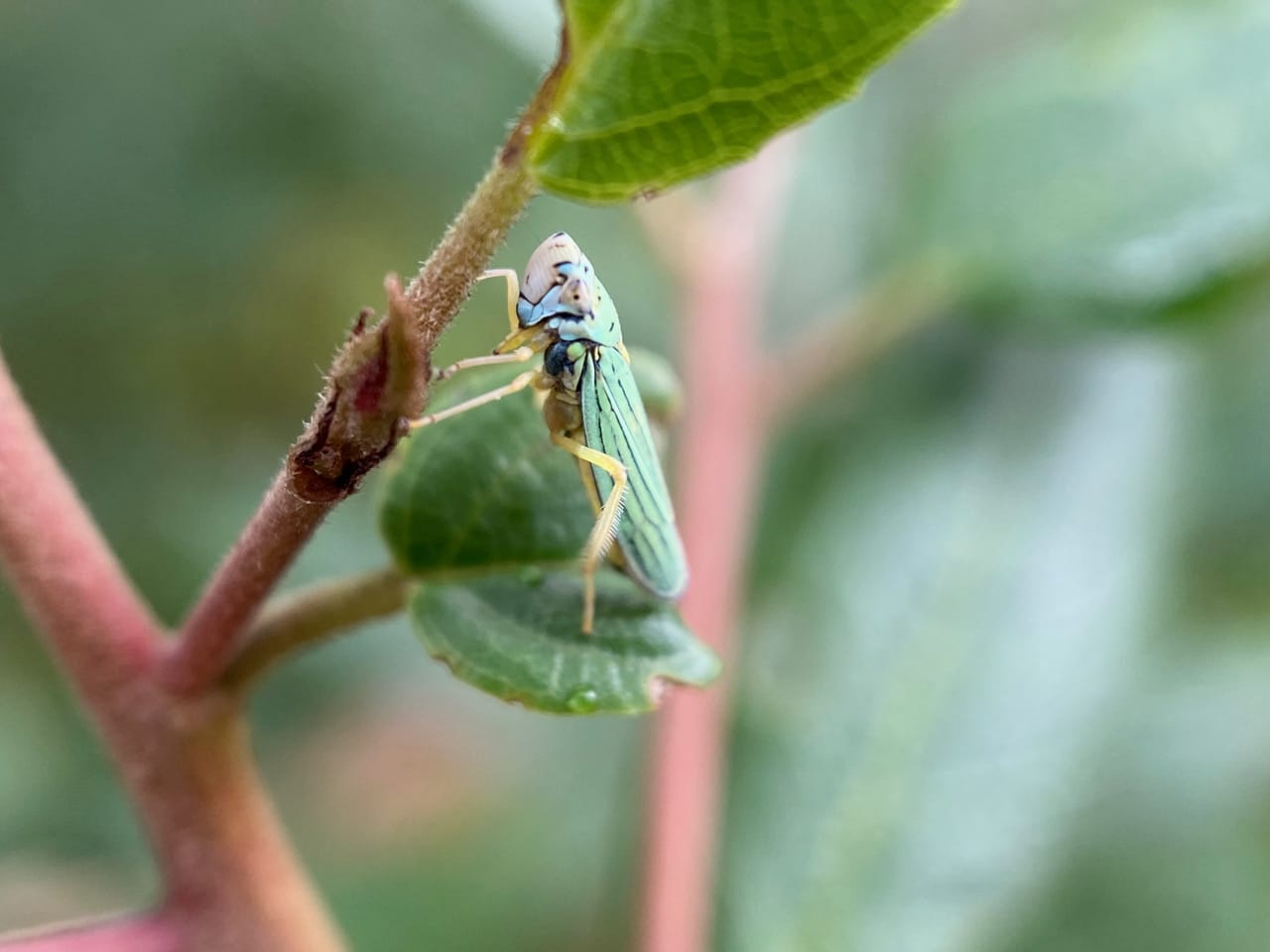
Sharpshooters feed on the plant’s xylem, extracting small amounts of nutrients in large volumes of water, forcing them to eliminate up to 300 times their body weight in liquid waste each day. To accomplish this, the sharpshooters employ an energy-efficient mechanism called super propulsion to expel their urine using an anal catapult.

I love weevils. They have the look of a puppy that has been caught messing up the couch. This Eucalyptus Snout Beetle, Gonipterus platensis (family Curculionidae) is clinging to the edge of a Poison Oak leaf. Its presence on the plant is most likely incidental. It probably fell from the Eucalyptus tree above.
The beetle is endemic to Australia where Eucalyptus trees are native, but it has spread around the world where Eucalyptus is found. Adult female Eucalyptus Snout Beetles lay about two hundred eggs in batches of about ten in grey colored capsules, attached to the leaves. Upon hatching, the larvae feed on leaves and young shoots. After three molts, the larvae drop to the ground to pupate in the soil. The weevil is of little economic significance in Australia where it has natural enemies. This is not the case where the trees have been introduced. Adult weevils feed mostly on leaves and the soft bark of twigs while the larvae feed mostly on leaves. Repeated defoliation may cause the splitting and death of branches or even whole trees. The weevil is able to disperse by flight.

It’s noon at Diablo Bend. The view of Mt. Diablo is still obliterated by the persistent fog.

The Lauxaniid Fly (family Lauxaniidae) is one of the most common flies in the garden, yet they haven’t even been given a common name.

I am paying them more attention now that there are so few other insects around to observe. Very often, the Lauxaniid fly has its head lowered, and its sponging mouthpart extended to feed on something on the leaf surface. It is most likely a scavenger, even though nothing in the scientific literature says so.
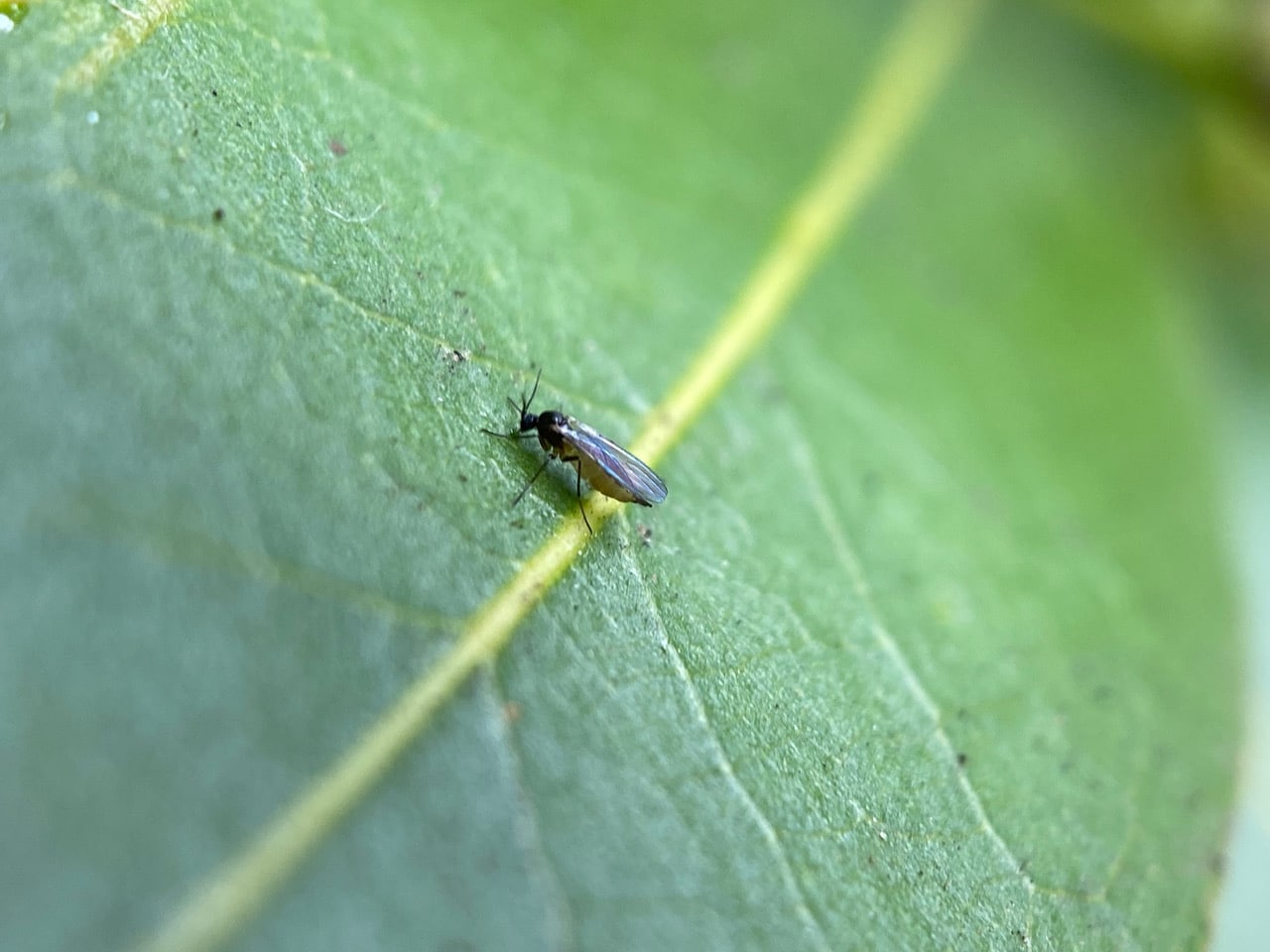
A tiny midge has landed on a California Bay leaf. It too seems to be feeding on something invisible on the leaf. I think the midge is a Dark-winged Fungus Gnat (family Sciaridae).
Occurring worldwide, the Sciaridae are a family of flies, commonly known as Dark-winged Fungus Gnats. Commonly found in moist environments, they are known to be a pest of mushroom farms and are commonly found in household plant pots. In moist, shadowy areas, up to 70% of all dipteran species can be Sciaridae. Adults are small, dark flies, usually less than 5 mm long. They are distributed through wind and drifting, or by humans through transported soil. Sciarid larvae often occur in decaying plant matter such as rotten wood or under the bark of fallen trees. They play an important role in turning forest leaf litter into soil. The adults with their characteristic dancing flight do not bite. They only ingest liquids and only live long enough to mate and produce eggs. They die after about five days.
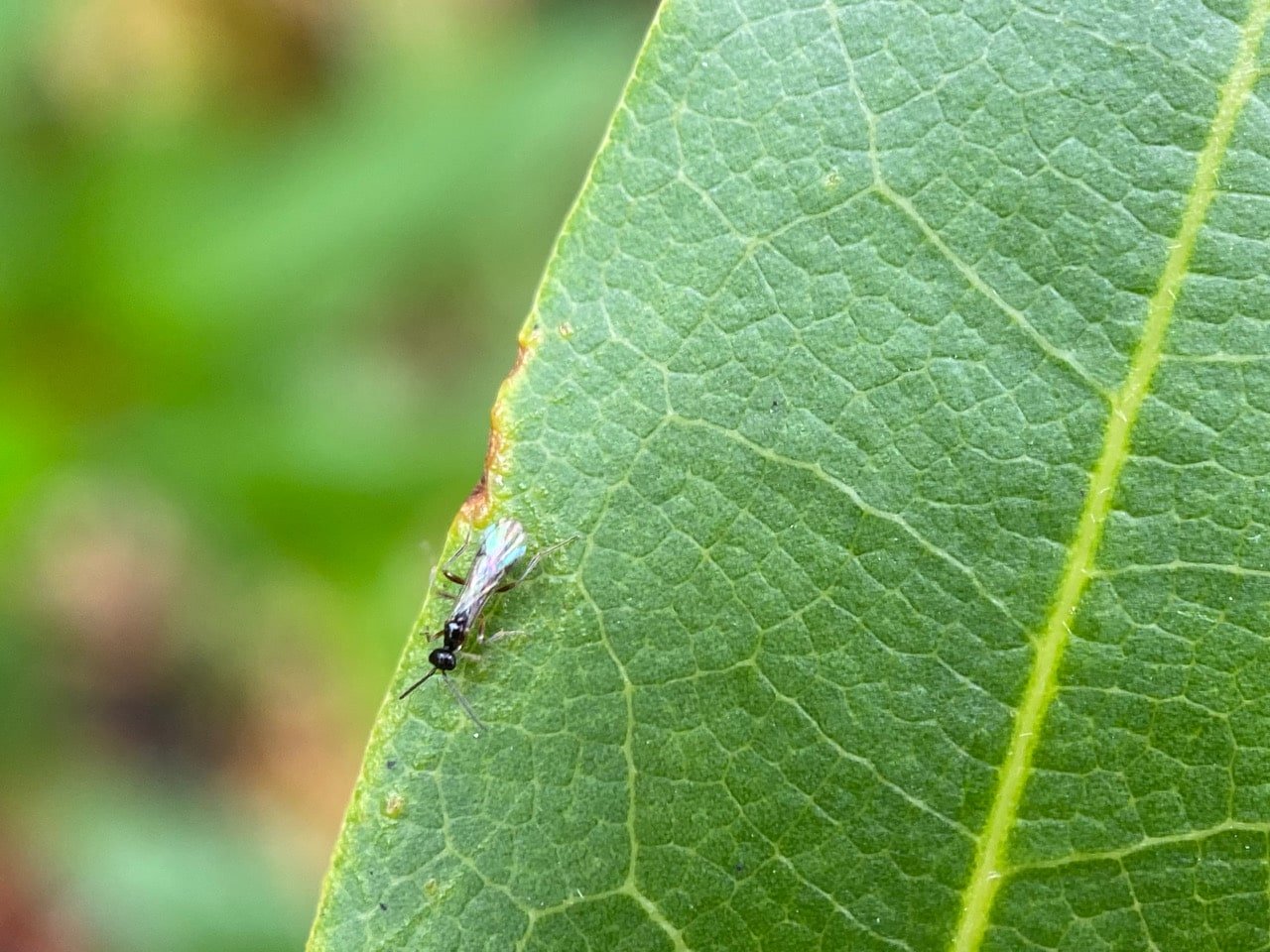
A tiny parasitoid wasp is roaming the leaf of a California Bay.

A female Coyote Brush, Baccharis pilularis has started to bloom. Perched on a flowerhead, an Odorous House Ant is reaching into the flowers for nectar.
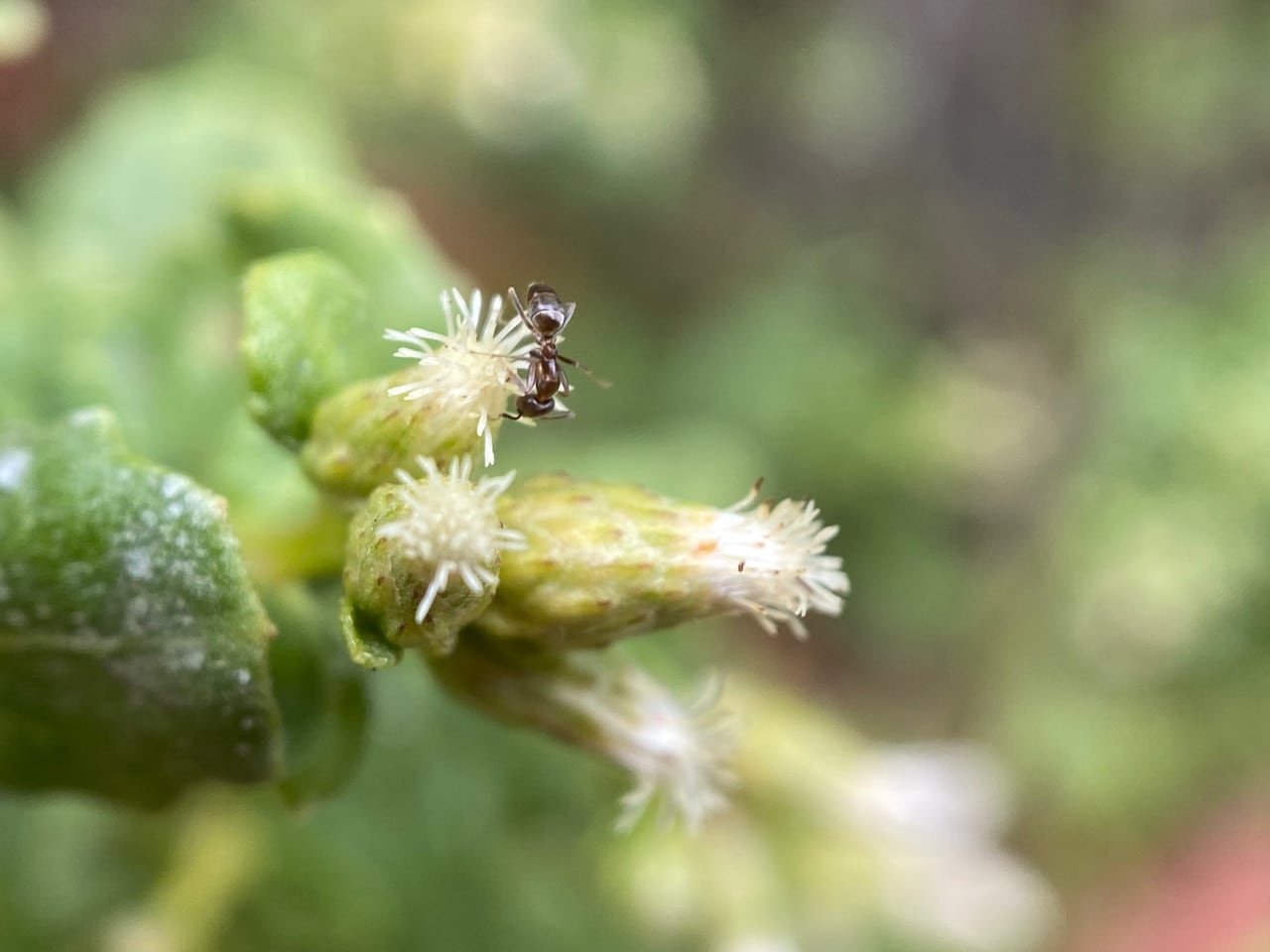
The Odorous House Ant, Tapinoma sessile (subfamily Dolichoderinae) is native to North America, ranging from southern Canada to northern Mexico. The species is found in a vast diversity of habitats, including within houses. The ants mainly feed on floral nectar and other sugary food. They also forage for honeydew produced by aphids and scale insects that they guard and tend.
Odorous House Ants are small ants, the workers measuring 2-3 mm. As in all members of the subfamily Dolichoderinae (odorous ants), this species does not possess a sting, instead relying on the chemical defense compounds produced from the anal gland. Such compounds are responsible for the smell given off by the ants when crushed or disturbed.
T. sessile colonies are polydomous (consist of multiple nests) and polygynous (contain multiple reproductive queens). The species practices seasonal polydomy – the colony overwinters in a single nest, and forms multiple nests during spring and summer when resources are more abundant and spread out.
The Odorous House Ants are rather docile, with little propensity for attack, preferring to use chemical secretions instead of biting. For this reason they are vulnerable to the invasion of the aggressive Argentine Ants, Linepithema humile.

Of the dozen pictures I took of this red mite racing around on the California Bay, this is the only one in reasonable focus, Alas!
It is a Whirligig Mite, Anystis sp. (family Anystidae). Anystis are predatory mites that prey on spider mites, aphids, leafhoppers, psyllid, thrips, and other small arthropods. They occur in trees, shrubs, and woody vines. Anystis are 1-1.5mm long, larger than most mite species. Adults are orange or red. The legs are covered with numerous, fine, short hairs. The distinct mouthparts project forward from the head. Adults’ overall shape is broadly rounded at the rear and more narrow in front. Nymphs and adults have 4 pairs of legs. The long legs appear to arise from a single point. This close spacing of the basal segments allows the mite’s common behavior of twirling around, which is the source of the name whirligig mites. The mites are highly mobile and move rapidly over plant surfaces. Adults live about 2-3 weeks. During this time, they consume about 40 spider mites or 6 leafhopper nymphs per day or their equivalent. Not a “chewer”, a mite punctures its prey and sucks out the juices. The Whirligig Mites are used as biological pest control agents in orchards. Only females are known in some populations and they reproduce parthenogenetically (without mating).
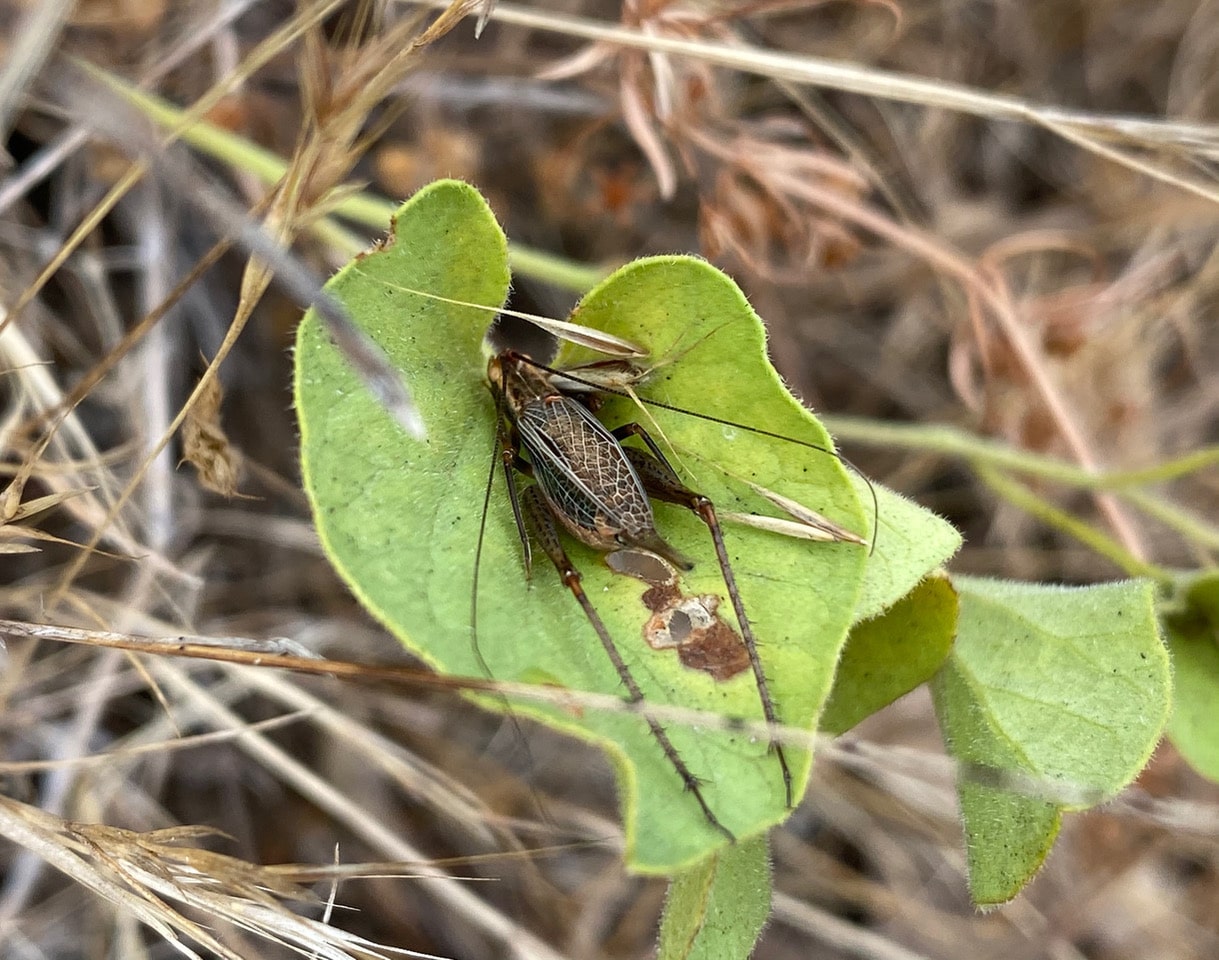
I part the dried grasses around this morning glory vine to have a better look at the dark insect. The cricket seems to be fast asleep!
From the photo iNaturalist could only identify the insect to the superfamily of Grylloidea, generally known as crickets. The features that distinguish crickets in Grylloidea from others are long, thread-like antennae, three tarsal segments, slender tactile cerci at the tip of the abdomen and bulbous sensory bristles on the cerci.
Crickets are mainly nocturnal, and are best known for the loud, persistent, chirping song of males trying to attract females, although some species are mute. The tibia of the front legs bears the sound-detecting tympana organs. The forewing of males bears the stridulatory organ, with a sound being created when a file on one wing is rubbed by a scraper on the other.
Some species are completely herbivorous, feeding on flowers, fruits, and leaves, with ground-based species consuming seedling grasses, pieces of leaf, and the shoots of young plants. Others are more predatory and include in their diet invertebrate eggs, larvae, pupae, aphids, and scale insects. Many are scavengers and consume various organic remains, decaying plants, seedlings, and fungi.

With quick action of its proboscis, a Margined Calligrapher is feeding on pollen from the tips of the stamens of a weedy Bristly Oxtongue flowerhead, Picris echioides.
Toxomerus marginatus, also known as the Margined Calligrapher, is a common species of hoverfly. It is found in many parts of North America, in diverse habitats. Highly adaptable, the species can occur in very disturbed habitats. Adults, only 5-6 mm long, have a shiny abdomen narrowly margined with yellow. Adults feed on a wide range of flowers. The larvae are predators of thrips, aphids, and small caterpillars.