

Pollinator Post 9/14/25 (2)

There is another small patch of Narrowleaf Milkweed, Asclepias fascicularis in the very back of Jenny and Craig’s garden. It is heavily infested with the yellow Oleander Aphids, Aphis nerii (family Aphididae).
Aphis nerii is also known as Milkweed Aphid. The species is widespread in regions with tropical and Mediterranean climates. The species probably originated in the Mediterranean region, the origin of its principal host plant, oleander. This bright yellow aphid, measuring 1.5-2.6 mm, has black legs, antennae and cornicles (“tail pipes”). The aphids feed primarily on the sap of plants in the dogbane family, Apocynaceae, including Milkweeds, Oleander and Vinca.
Females are viviparous and parthenogenetic, meaning that they give birth to live young instead of laying eggs, and that the progeny are produced by the adult female without mating. The nymphs feed gregariously on the plant terminal in a colony that can become quite large. Nymphs progress through five nymphal instars without a pupal stage. Normally wingless adults are produced but alate adults occur under conditions of overcrowding and when plants are senescing, allowing the aphids to migrate to new host plants. The parthenogenetic mode of reproduction, high fecundity, and short generation time allow large colonies of Oleander Aphids to build quickly on infested plants.
The Oleander Aphid ingests sap from the phloem of its host plant. The damage caused by aphid colonies is mainly aesthetic due to the large amounts of sticky honeydew produced by the aphids and the resulting black sooty mold that grows on the honeydew. The terminal growths of host plants may be deformed, resulting in stunted growth in heavy infestation.
Oleander Aphids sequester cardiac glycosides, a toxin from their host plants. They also fortify their cornicle secretions with these bitter, poisonous chemicals. Their bright aposematic (warning) coloration and possession of toxins protect them from predation by certain species of birds and spiders. Aphid populations are usually kept under control by natural biological agents such as parasitoid wasps, and predators such as Syrphid larvae, Lacewing larvae, and Lady Beetles.

The aphid colony has produced some alates (winged reproductives).
Aphids have many generations a year. Most aphids in California’s mild climate reproduce asexually throughout most or all of the year with adult females giving birth to live offspring – often as many as 12 per day – all clones of the mother. The young aphids or nymphs molt, shedding their skin about four times before becoming adults. When the weather is warm, many species can develop from newborn to reproductive adult in 7-8 days. Because each adult aphid can produce up to 80 offspring in a matter of a week, aphid populations can increase in staggering speed.
Generally adult aphids are wingless, but most species also occur in winged forms, especially when populations are high or during spring and fall. The ability to produce winged individuals provides the aphids with a way to disperse to other plants when the quality of the food source deteriorates, or when predation pressure is high.
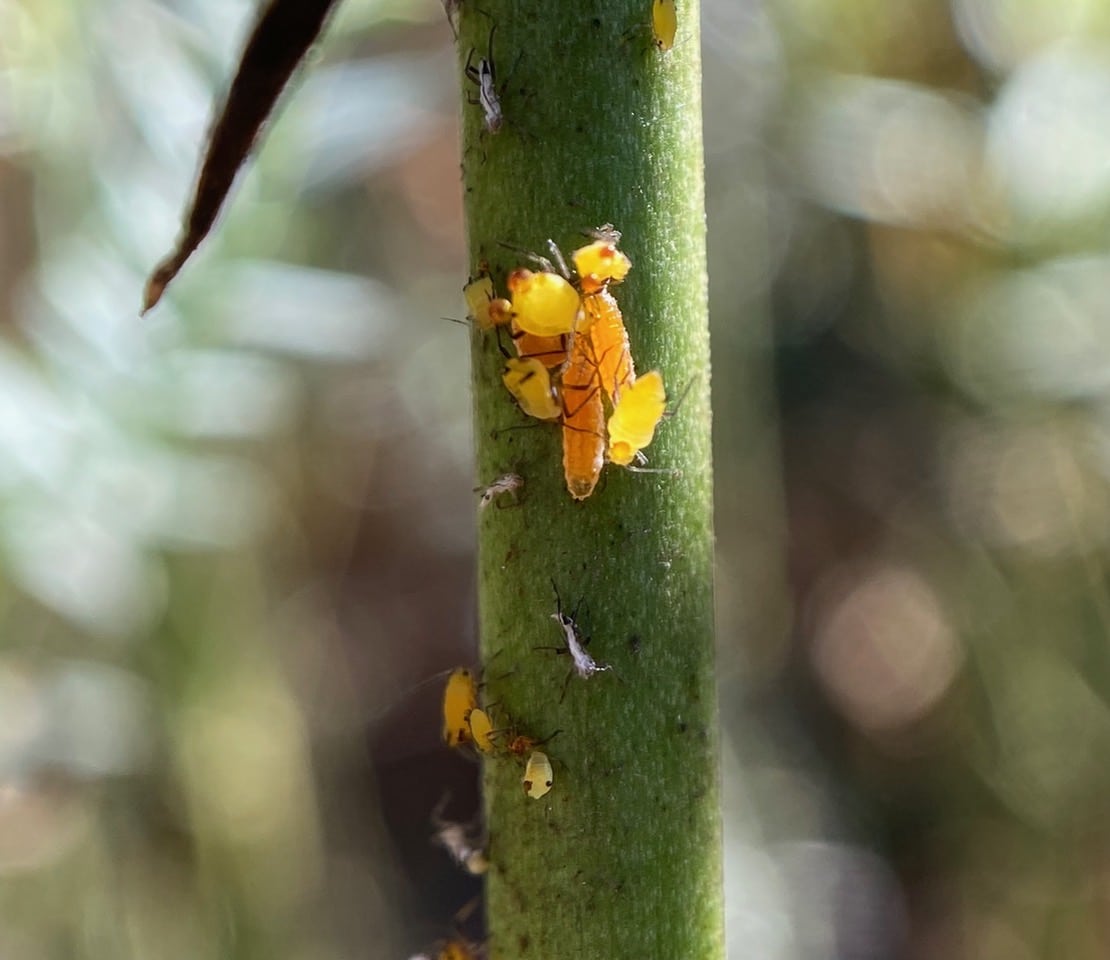
No bigger than their prey, three orange slug-like creatures are attacking the Oleander Aphids. In response, the aphids have secreted droplets of fluid from their cornicles.
The liquid secreted from an aphid’s cornicles, or siphunculi (I simply call them “tail pipes”), is a waxy defensive fluid that rapidly hardens upon exposure to air. This sticky substance serves as a defense mechanism against predators and contains alarm pheromones to warn other aphids of danger. This is different from honeydew, which is a sugary waste excreted from the anus.
The orange creatures are the larvae of the Aphid Midge, Aphidoletes aphidimyza (family Cecidomyiidae). Cecidomyiidae are usually known as gall midges, with larvae that live and feed within plant galls. The Aphid Midge is sort of an oddball within the family. Instead of growing up in a gall, it is a free-roaming aphid hunter.
The Aphid Midge, Aphidoletes aphidimyza is a midge whose larvae feed on over 80 aphid species. The adults are small, less than 3.2 mm long, black, delicate, short-lived flies that feed on aphid honeydew. They hide beneath the leaves during the day, and are active at night. Females deposit 100-250 tiny shiny orange eggs among aphid colonies that hatch in 2-3 days. After 3-7 days the larvae drop to the ground to pupate in the soil. The small, bright orange, slug-like larvae inject a toxin into aphids’ leg joints to paralyze them and then suck out the aphid body contents through a hole bitten in the thorax. Larvae can consume aphids much larger than themselves and may kill more aphids than they eat when aphid populations are high. A single larva grows up to 3.2 mm long and kills 4-65 aphids a day. The life cycle from egg to adult can be completed in about 3 weeks, with multiple generations per year. The Aphid Midge is commercially available, widely used in biological control programs for greenhouse crops and orchards.

A Spotless Lady Beetle, Cycloneda sanguinea (family Coccinellidae) is hunting along a milkweed stem. Both the adults and larvae of lady beetles are voracious predators of aphids and other soft-bodied insects. I wonder why there are so few lady beetles on the aphid-infested milkweeds in this garden. Perhaps it takes time for the predators’ population to build up? This garden is only a year old.
The Spotless Lady Beetle, Cycloneda sanguinea (family Coccinellidae) is a widespread species of lady beetle in the Americas. It is is a large lady beetle with red, unspotted elytra (wing covers) ranging from 4-6.5 mm long. The black and white marks on the head and pronotum are very distinctive, and they are also gender-specific. Both adult and larvae of Spotless Lady Beetles are voracious predators of aphids. They are very often found feeding on aphids on milkweeds, but also occur on a number of other plants.
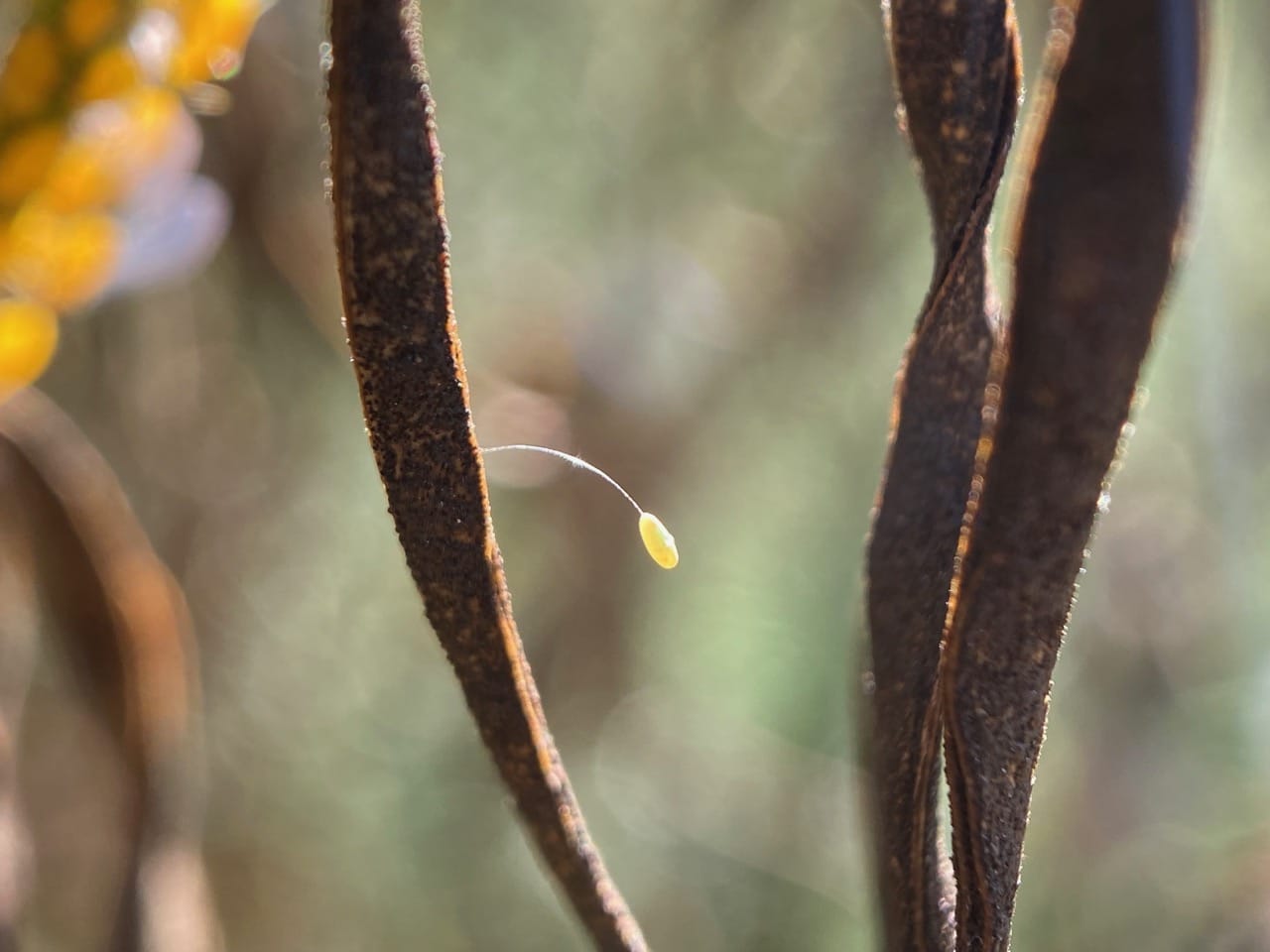
Hey, the milkweed has another defender! A stalked egg of a Lacewing (family Chrysopidae) hangs from a dried milkweed leaf.
Lacewings are insects in the large family Chrysopidae of the order Neuroptera. Adults are crepuscular or nocturnal. They feed on pollen, nectar and honeydew supplemented with mites, aphids and other small arthropods. Eggs are deposited at night, hung on a slender stalk of silk usually on the underside of a leaf. Immediately after hatching, the larvae molt, then descend the egg stalk to feed. They are voracious predators, attacking most insects of suitable size, especially soft-bodied ones (aphids, caterpillars and other insect larvae, insect eggs). Their maxillae are hollow, allowing a digestive secretion to be injected in the prey. Lacewing larvae are commonly known as “aphid lions” or “aphid wolves”. In some countries, Lacewings are reared for sale as biological control agents of insect and mite pests in agriculture and gardens.
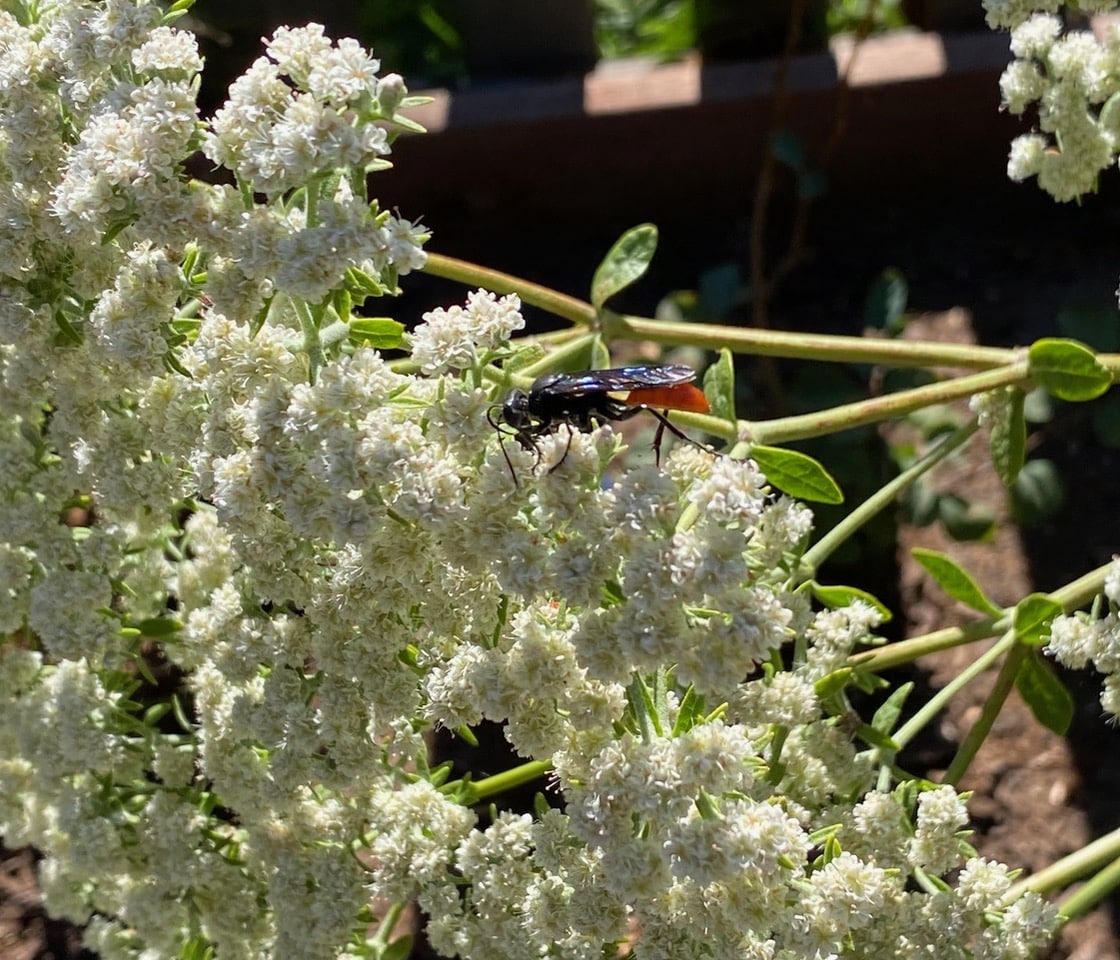
A large black wasp with orange-red abdomen keeps coming back to forage on the dense flowers of St. Catherine’s Lace, Eriogonum giganteum. It is easily recognizable as a female Thread-waisted Burrowing Wasp, Sphex lucae (family Sphecidae).

The Sphecidae are solitary wasps with elongated and narrow first abdominal segment, giving rise to the common name Thread-waisted Wasps. Sphex lucae is a widespread western species, ranging from WA in the north, south to CA, and east to TX. The species exhibits sexual dimorphism – females are black with a red abdomen, while the males are all black. Adults visit many types of flowers for nectar. Females hunt katydids and grasshoppers as food for their young. The wasp excavates a single-celled burrow in the soil in advance of hunting activities. She drags her paralyzed prey back to the burrow, laying a single egg on the victim. The nest entrance is then sealed and the process is repeated. Males of this species spend nights in sleeping aggregations in sheltered places such as beneath a rock overhang.

Over by the back fence, a Bush Sunflower, Encelia californica has attracted quite a few bees. A female Summer Longhorn Bee, Melissodes sp. (family Apidae) is so loaded with pollen on her hind legs that she appears to be wearing yellow pantaloons.
The Summer Longhorn Bees, Melissodes sp. (family Apidae) are medium to large bees, stout-bodied, usually with gray hair on the thorax and pale hair bands on the abdomen. Males usually have yellow markings on their faces and have very long antennae from which their common name is derived. They are active May to September, with peak flight in late June to early August. The females prefer flat, bare ground for digging their solitary nests, though they sometimes nest in aggregations. Pollen is transported in scopae on the hind legs. Pollen loads are often copious and brightly colored and thus very distinguishable. Melissodes are specialists on Asteraceae – females gather pollen from flowers of Aster, Bidens, Coreopsis, Cosmos, Encelia, Gaillardia, Helianthus, and Rudbeckia ssp.

Before I have a good look, a black-and-yellow wasp disappears down the throat of a Scarlet Monkeyflower, Erythranthe cardinalis
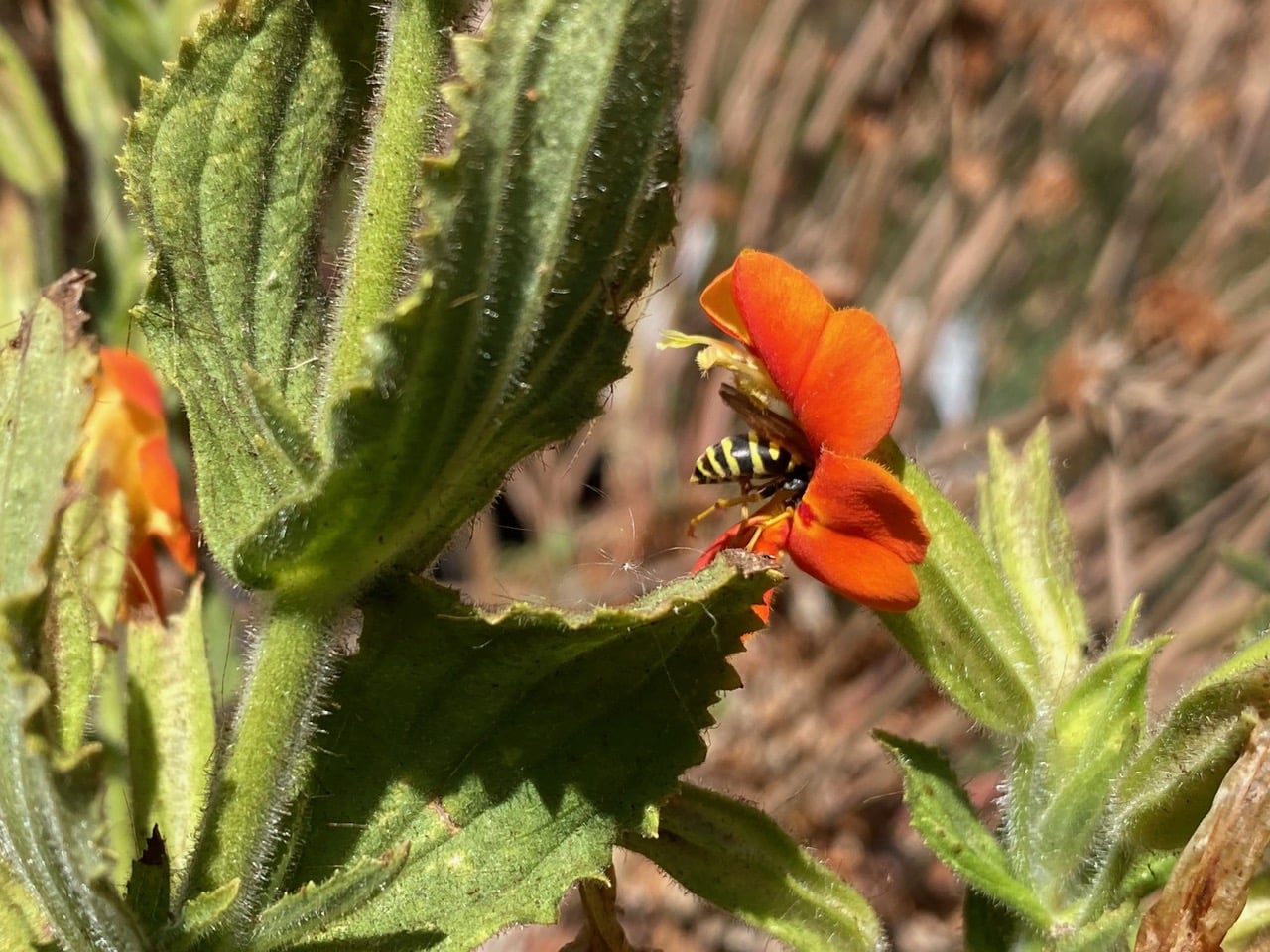
I wait patiently until the wasp backs out of the monkey flower.

Ah, it’s a European Paper Wasp, Polistes dominula (family Vespidae).
Native to Europe, the European Paper Wasp, Polistes dominula, is a social insect that produces an annual colony in a paper nest. Individual colonies are established anew each spring. The overwintering stage are mated females (queens). The overwintered queens emerge from sheltered spots in spring and search out sites to establish a new colony. Nests are constructed of paper, produced from chewed wood fibers of weathered fences, porch decks and other similar sources. Larvae are fed crushed insects, usually caterpillars. As the population increases, the original queen increasingly remains in the nest as new workers take over colony activities. A few of the wasps produced later in summer are males and increasing numbers of the females become sexually mature. Mating occurs and the mated females are the surviving overwintering stage. Males and non-reproductive females do not survive winter and the nest is abandoned by late fall. European Paper Wasps will sometimes feed on sweet materials, including honeydew produced by aphids. They may also feed on damaged ripe fruits. Because of their habit of hunting caterpillars, the wasps have become one of the most important natural controls of garden pests.
European Paper Wasp (Polistes dominula) · iNaturalist
Often mistaken for Yellowjacket Wasps, the European Paper Wasps can be distinguished by their slender body, and their orange-tipped antennae. Yellowjackets have shorter, thicker bodies, and they have black antennae. Paper wasps dangle their long legs when they fly, while the yellowjackets tuck their legs under their bodies when they fly. Paper wasp nests resemble an open honeycomb or upside-down umbrella. They often build their nests on man-made structures such as eaves or lawn furniture. Yellowjacket nests are covered with a surrounding envelope of paper; the nests have a single opening that is often hard to see because the nest is underground.
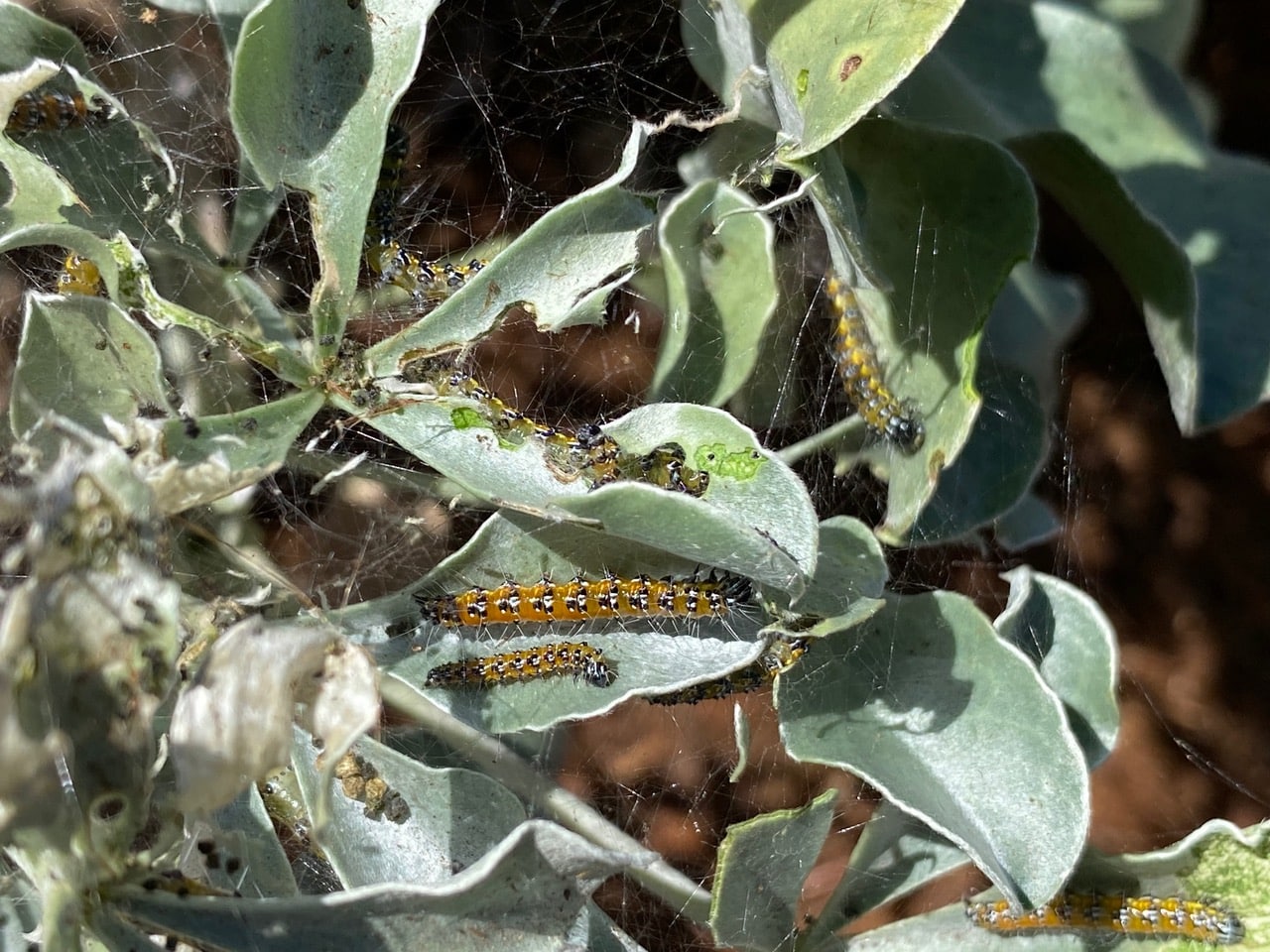
The unfamiliar plant has been labeled Cobb Mountain Lupine, Lupinus sericatus ‘Cobb Mountain’. All its large, silvery, palmate leaves have been severely damaged by countless caterpillars of the Genista Broom Moth, Uresiphita reversalis (family Crambidae). The caterpillars have constructed a loose silken webbing over the foliage

The Genista Broom Moth, Uresiphita reversals is a moth in the family Crambidae. The species is probably native to Mexico before spreading north into the U.S. and the Caribbean, establishing in the San Francisco Bay Area by 1980. The adult moths have a wingspan of 27-34 mm. They are on wing year round in multiple generations per year. The larvae feed on Acacia, Lonicera, Baptisia, Genista, Lupinus species, as well as “other pea family shrubs”. Genista is an Old World genus for “broom” in the pea family Fabaceae.

Genista Broom Moth females lay eggs in batches of up to about 70. The tiny, newly hatched caterpillars are green and blend in with the foliage. Larger caterpillars are brownish-green with raised black spots and bright yellow patches on each segment. Each black spot has a white dot at the tip that sports sparse, long hairs. The head is black with white dots as well. Genista caterpillars ingest and store alkaloids from their host plants, which make the larvae bitter and even toxic to mammals and birds, and some insect predators. The species overwinters in cocoons on or near the base of their host plants and the adults emerge the following year. There can be 4-5 generations per year in their southern range. They can become abundant enough to cause extensive defoliation.

The bright colors of older Genista Broom Moth caterpillars are aposematic, or warning, coloration that signals to predators that they are toxic and unpalatable. These caterpillars accumulate toxic alkaloids from their host plants, such as lupines and brooms, and their vibrant yellow and black markings serve as a clear warning to deter birds, lizards, and other potential predators from attacking them.
While these caterpillars might be considered pests in gardens, they are useful biological pest control for a number of invasive plants in the wild that belong to the pea family, notably the brooms. They are helping to check the invasion of French and Scotch brooms that cover extensive hillsides and displace the native chaparral vegetation of California.
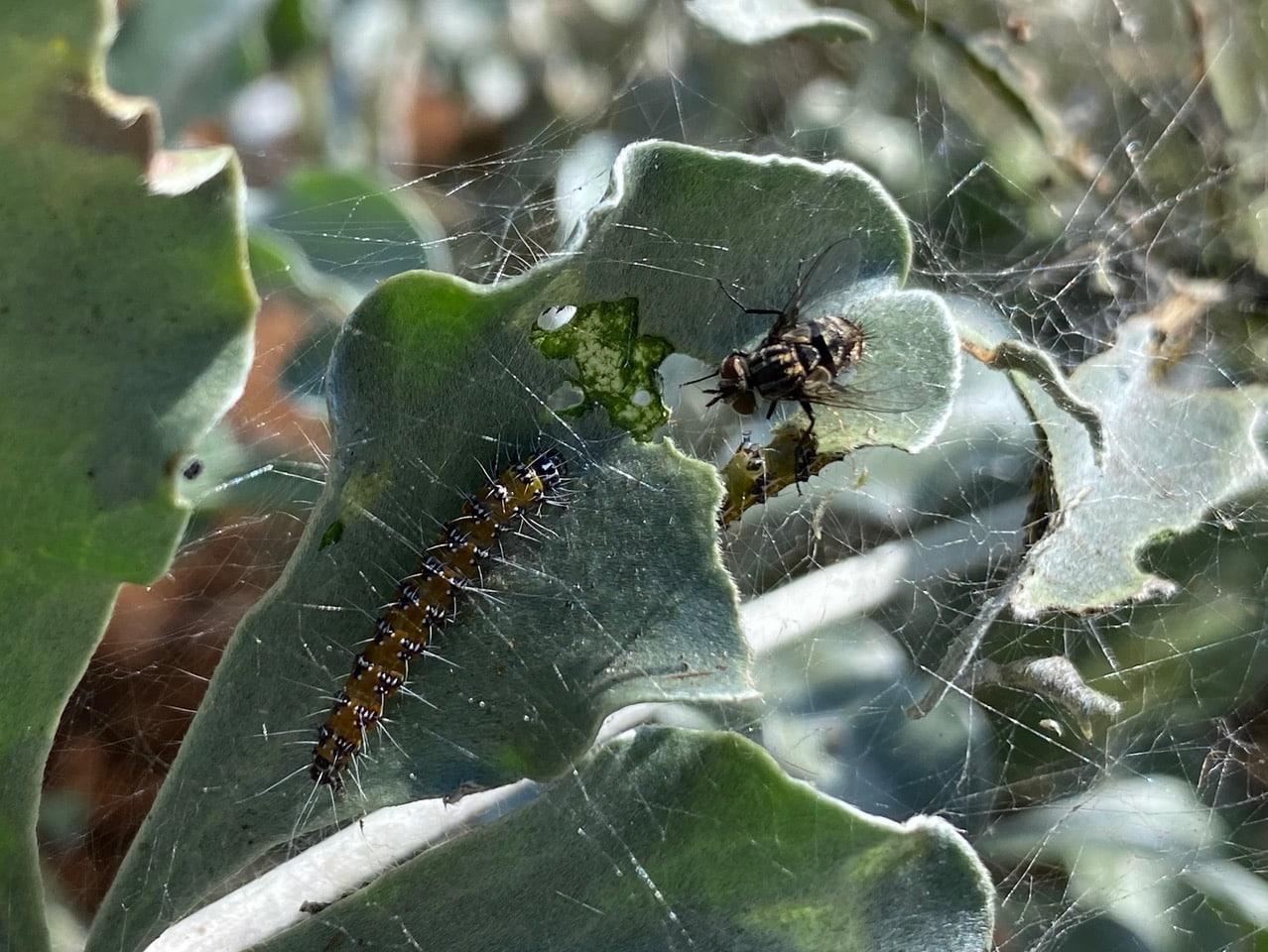
A small dark bristly fly has landed on the silk webbing, and is watching a Genista Broom Moth caterpillar feeding below with unwavering attention.
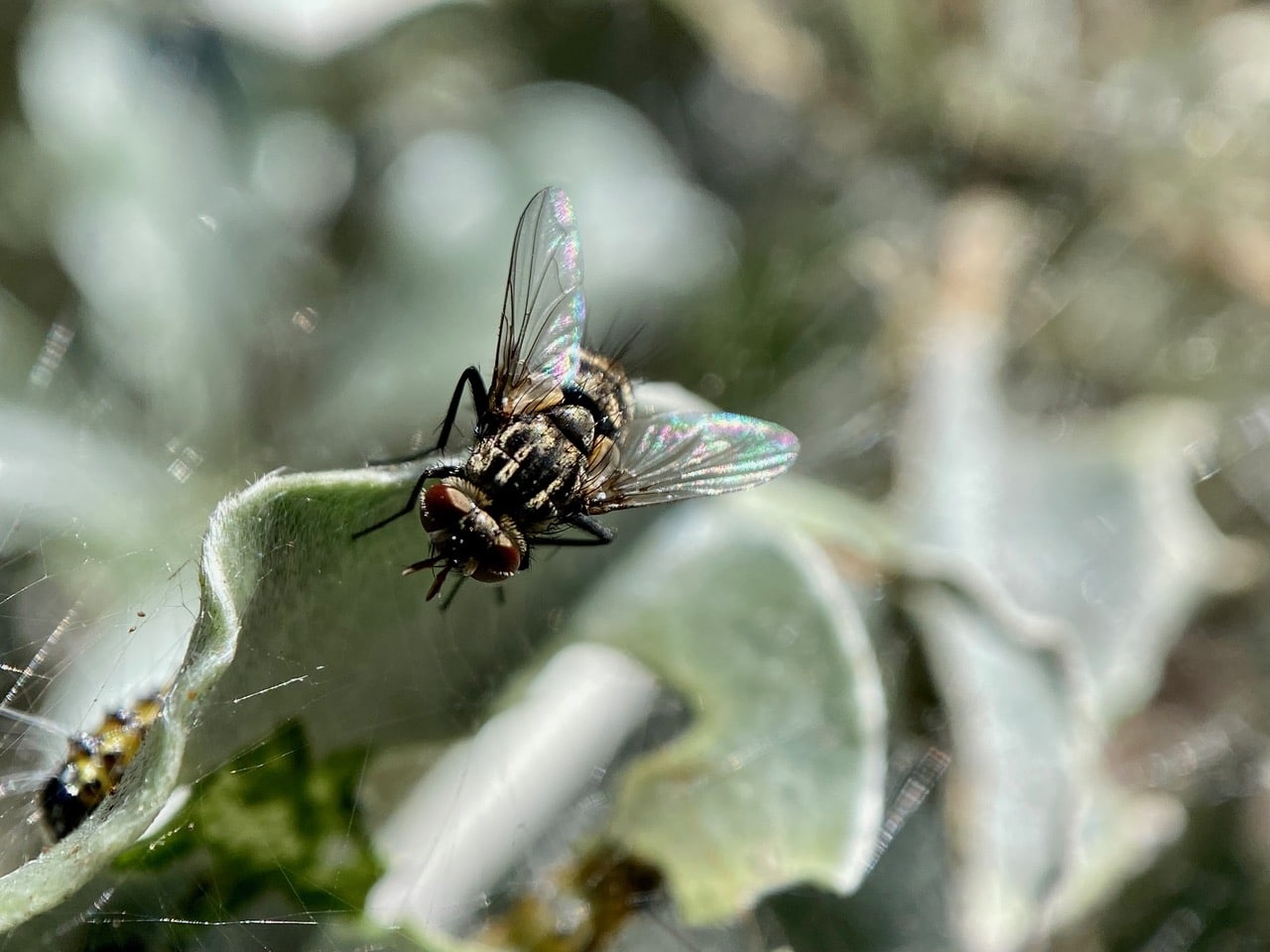
The fly maneuvers to the edge of the leaf, craning to observe the caterpillar from this vantage point.

At times, the fly is so close to the caterpillar, with only the silken web separating the two. Is it a Tachinid Fly looking to lay an egg on or near the caterpillar?
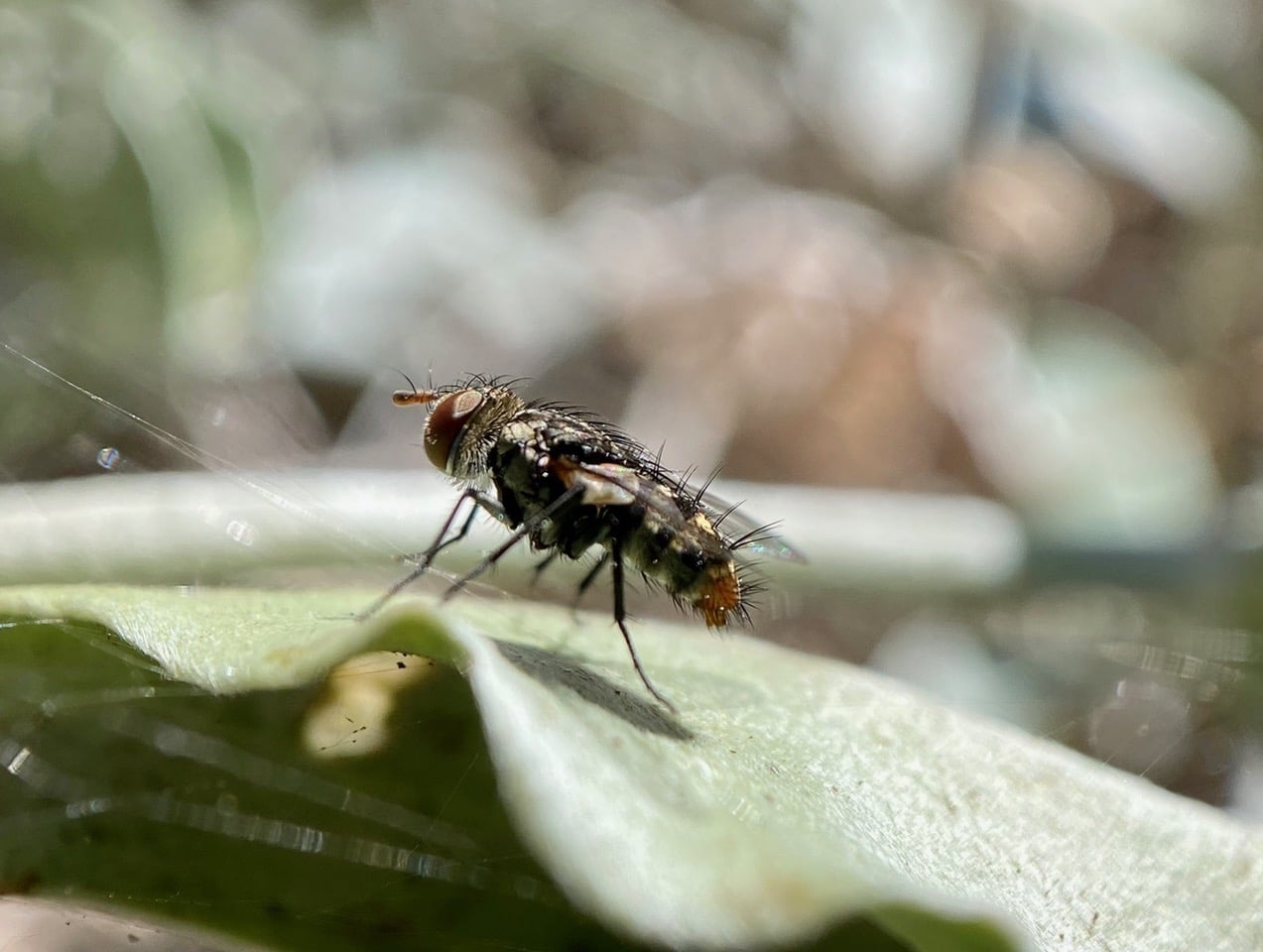
iNaturalist has since confirmed my suspicion, identifying the fly as a Tachinid Fly in the genus Winthemia (family Tachinidae).

The family Tachinidae is by far the largest and most important group of parasitoid flies. All species are parasitic in the larval stage. Most adults have distinct abdominal bristles, hence the common name of Bristle Flies. Adults feed on liquids such as nectar and honeydew. They can be found resting on foliage, feeding at flowers or searching for hosts. Most tachinids attack caterpillars, adult and larval beetles, true bugs, grasshoppers, and other insects. Females lay eggs in or on the host. Tachinid larvae live as internal parasites, consuming their hosts’ less essential tissues first and not finishing off the vital organs until they are ready to pupate. The larvae leave the host and pupate on the ground. Tachinids are very important in natural control of many pests, and many have been used in biological control programs.
The genus Winthemia occurs worldwide, including most of North America. They mainly parasitize various Lepidoptera (moths and butterflies). Winthemia quadripustulata sometimes destroys between 50% and nearly 100% of the army worm populations.

I watch as a dozen of these Tachinid Flies lurk on the plant or silk webbing, tracking the Genista Broom Moth caterpillars with great interest. Will these natural pest control agents be able to rid the lupine of its tormentors? How did these parasitoid flies find the caterpillars? Where did they come from? This garden is after all, only a year old!

A Thick-legged Hover Fly, Syritta pipiens (family Syrphidae) is perched on a leaf of Golden Currant, Ribes aureum.
The Thick-legged Hover Fly, Syritta pipiens (family Syrphidae) originates from Europe and is currently distributed across Eurasia and North America. The species is distinguished by its enlarged hind femora (thighs). They are fast and nimble fliers. The fly is about 6.5 – 9 mm long. The species flies at a very low height, rarely more than 1 m above the ground. Adults visit flowers – males primarily to feed on nectar, and females to feed on protein-rich pollen to produce eggs. The species is found wherever there are flowers. It is also anthropophilic, occurring in farmland, suburban gardens, and urban parks. Larvae are found in wetlands that are close to bodies of freshwater such as lakes, ponds, rivers, ditches. Larvae feed on decaying organic matter such as garden compost and manure. Males often track females in flight, ending with a sharp dart towards them after they have settled, aiming to attempt forced copulation.

A male Summer Longhorn Bee, Melissodes sp. (family Aphidae) is foraging on a Cosmos flowerhead. Although these males do not collect pollen to provision the nest, and can take nectar from any blooming plant, they most often visit the flowers in the sunflower family (Asteraceae). This is where they are most likely to find the females who forage for pollen exclusively from Asteraceae.

A male Western Leafcutter Bee, Megachile perihirta (family Megachilidae) has landed on a flowerhead of Pacific Aster. Note his rounded abdomen, in contrast to the female’s pointed abdomen.

Leaf-cutter Bees, Megachile sp. (family Megachilidae) are stout-bodied, usually with pale hair on the thorax and stripes of white hairs on the abdomen. Females usually have a triangular abdomen with a pointed tip, and males are covered with a dense fur coat. The males often sport a bushy mustache of pale hair.

Male leafcutter bees do not construct nests; they do not cut leaves or petals. In their search for nectar, their hairy body often picks up pollen unintentionally, making them effective pollinators.

A Thick-legged Hover Fly, Syritta pipiens (family Syrphidae) is feeding on pollen from an anther tube of a Pacific Aster floret.