

Pollinator Post 9/14/24 (1)

Fred and I don’t get to Shoreline Park for our walk until late morning. As usual he walks the paved path, and I veer off on the dirt path along the water where the Grindelia grows.
Scanning the Grindelia with foamy masses for adult Spittlebugs (also known as Froghoppers), I find a brown one under the involucre of aflowerhead (seen here in the middle).
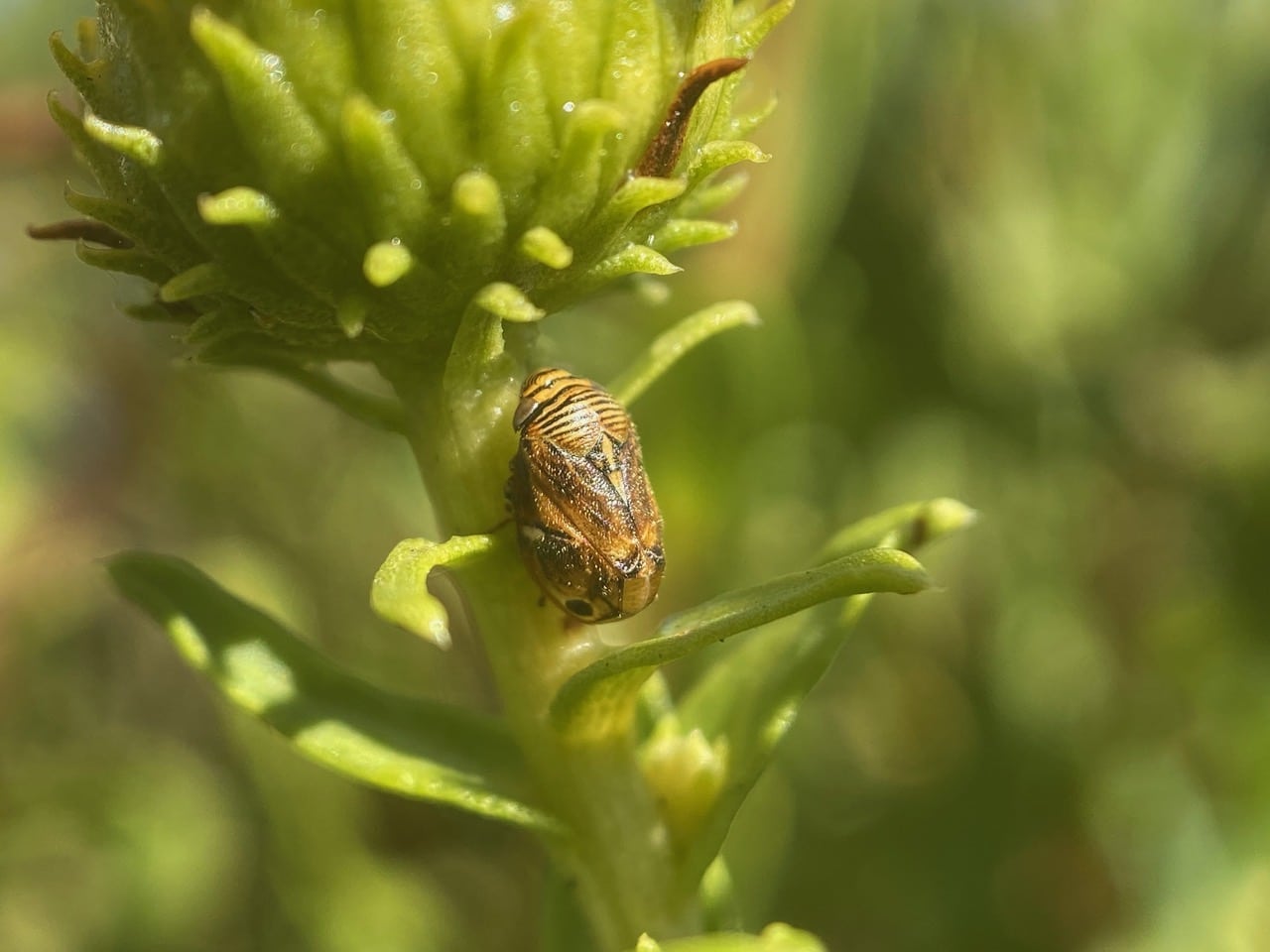
Close-up of Spittlebug, Complex Clastoptera lineatocollis (family Clastopteridae).
The Froghoppers (superfamily Cercopoidea) are a group of “true bugs” in the order Hemiptera. Adults are capable of jumping many times their height and length, giving them their common name, but many species are best known for their plant-sucking nymphs which produce foam shelters, and are referred to as “spittlebugs”. The superfamily currently consists of three families: the Aphrophoridae, Cercopidae, and Clastopteridae. The nymphs produce a cover of foamed-up plant sap visually resembling saliva, hence the common name. Whereas most insects that feed on plant sap tap into the nutrient-rich fluid from the phloem, the spittlebugs utilize the much more dilute sap flowing upward from the roots via the xylem. The insects’ digestive system contains symbiotic bacteria that provide them with the essential amino acids. The large amount of excess water that must be excreted and the evolution of special breathing tubes allow the young spittlebug nymphs to grow in the relatively protective environment of their foam shelters. The foam serves a number of purposes. It hides the nymph from the view of predators and parasites, and it insulates against heat and cold, providing thermal as well as moisture control. It also has an acrid taste that deters predators.
Froghoppers are champion jumpers among insects, out-performing even the fleas. The bug can leap the human equivalent of a skyscraper without a running start. It is the highest jumping insect proportional to body size. The muscles in its hind legs act like a “catapult” to release energy explosively.
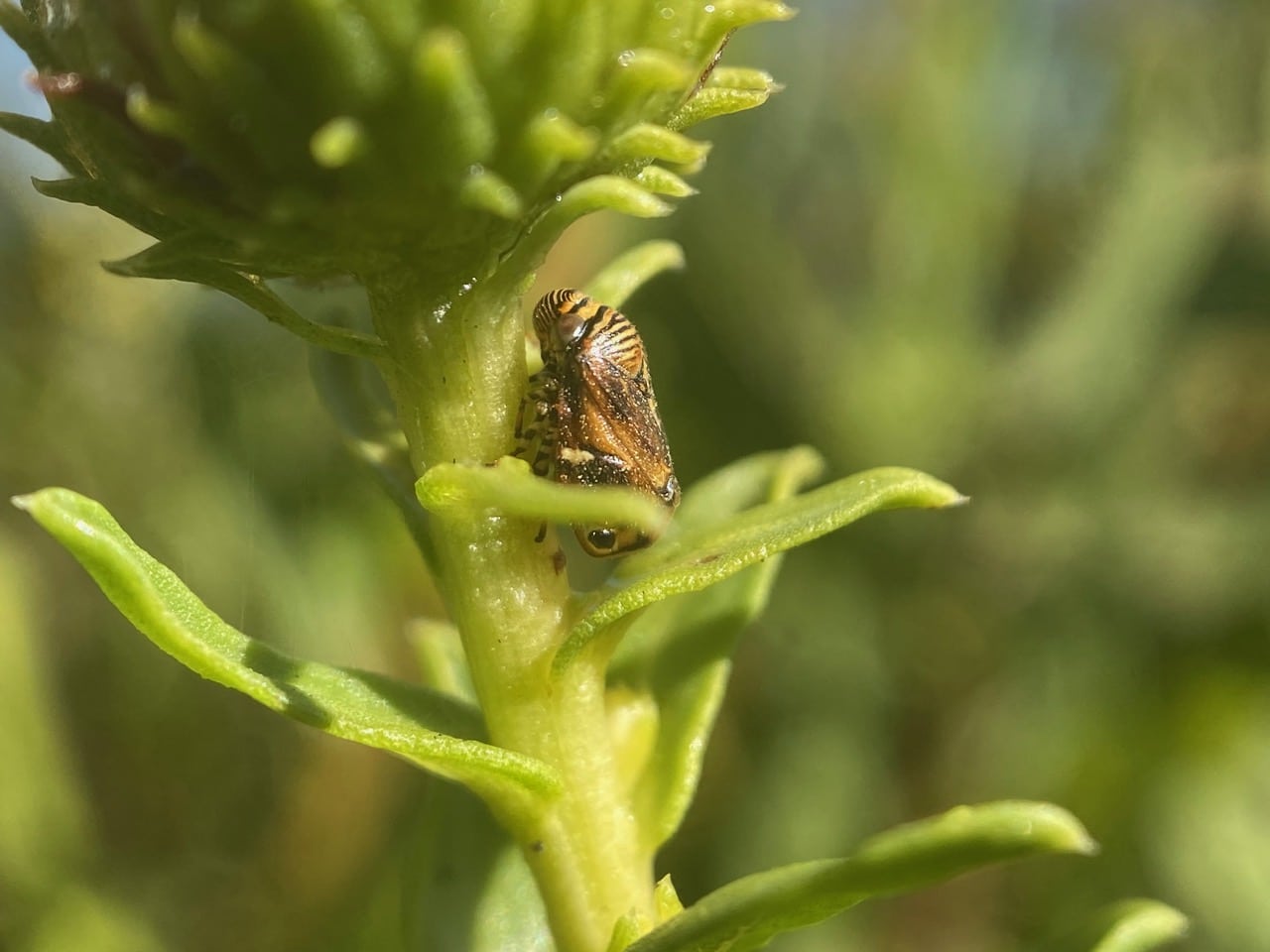
Side view of the Spittlebug. It is about 4 mm long.

10:59:05 am
Hello, who is this on the same plant?

I tilt the branch for a side view of the insect. It has a yellowish abdomen. It is a Spittlebug nymph undergoing its final molt into an adult! The abdomen of the adult has broken through the rear end of the old exoskeleton. This is rather unexpected, as I thought most insects emerge thorax-first. Immediately abandoning my walk, I settle down in front of the Grindelia. An amazing event is unfolding right in front of my eyes!
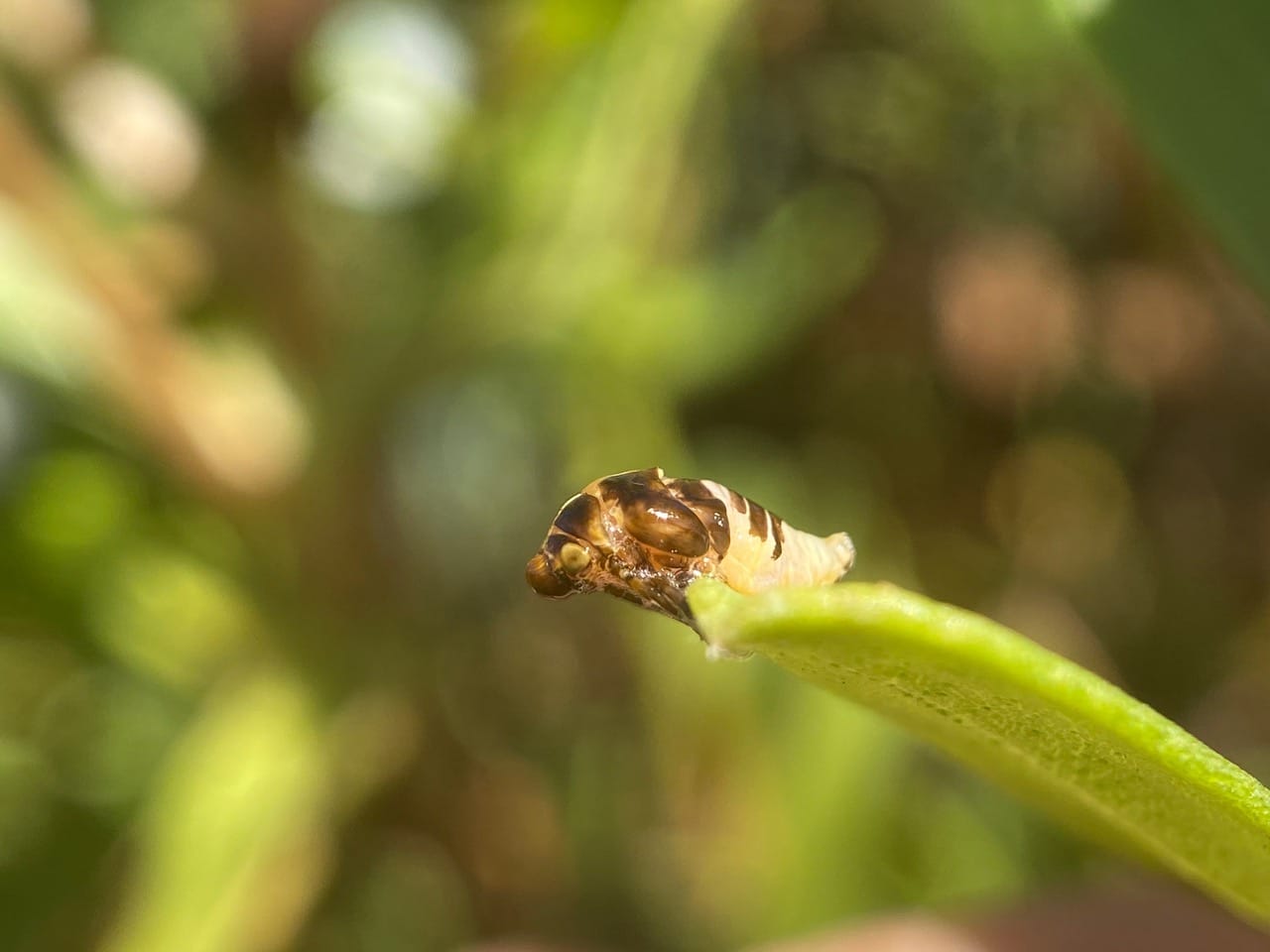
11:01:48 am
Another view of the eclosing Spittlebug. The emergence of an adult insect from a pupa or a larva (or nymph) is called eclosion.
Ecdysis is the process of an arthropod molting its exoskeleton. Molting is necessary as the exoskeleton is inflexible and doesn’t allow for growth. Molting is a critical but vulnerable time for the animal. Their existing cuticle weakens at specific points and by taking in water or air, the animal splits its old exoskeleton. The animal then extracts itself from the old skin and inflates its new skin. The new exoskeleton is soft and the arthropod cannot move as its musculature is attached to this exoskeleton. Once the new exoskeleton has dried and hardened the animal is able to move again.

11:02:19 am
The exoskeleton is splitting open at well-defined seams on the last instar nymph.

11:04:17 am
View from the top – the adult Spittlebug is emerging thorax-first from the split exoskeleton.
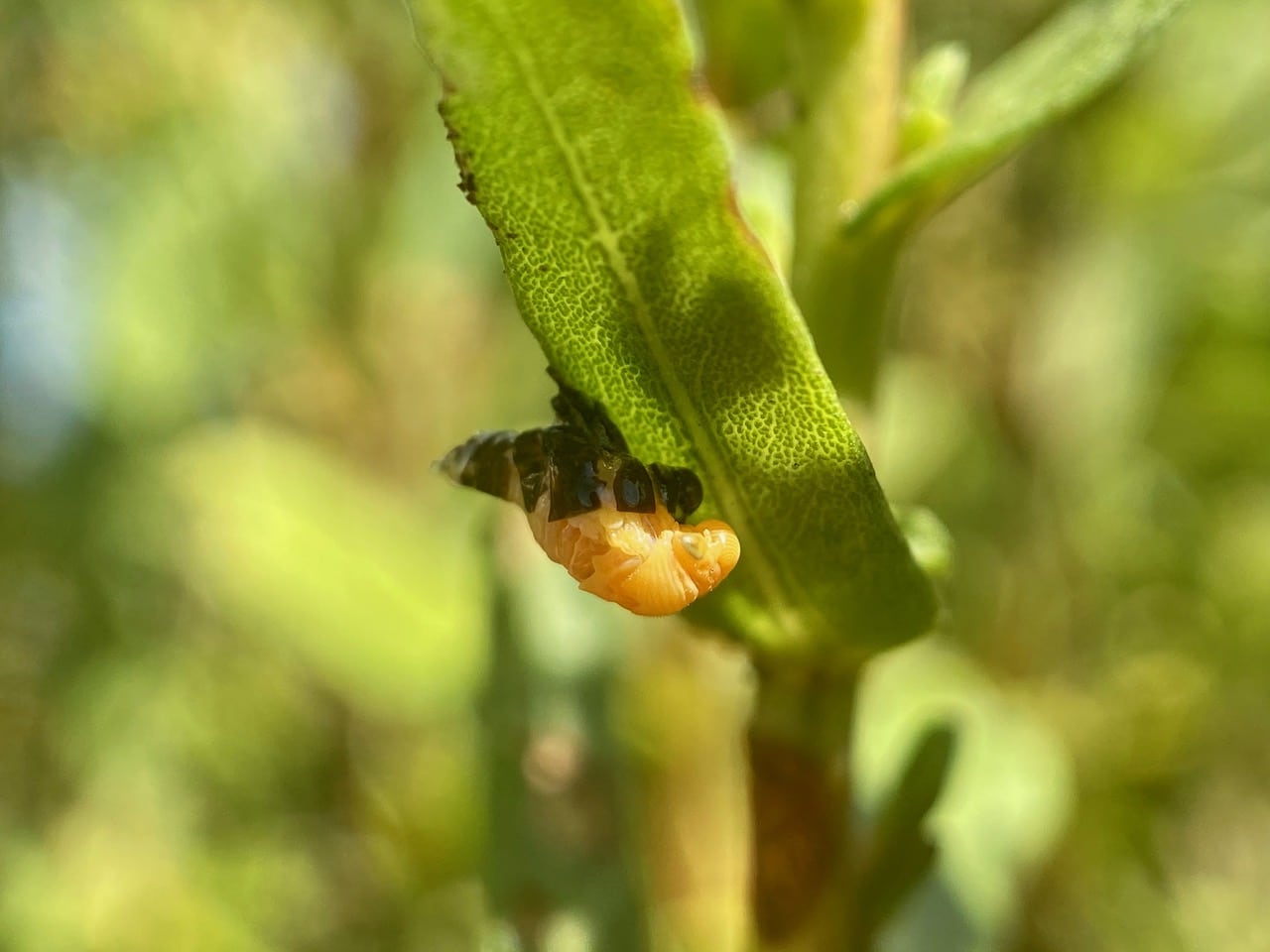
11:07:08 am
Wow, while it is very pale, the emerging creature is recognizable as an adult spittlebug.

11:08:53 am
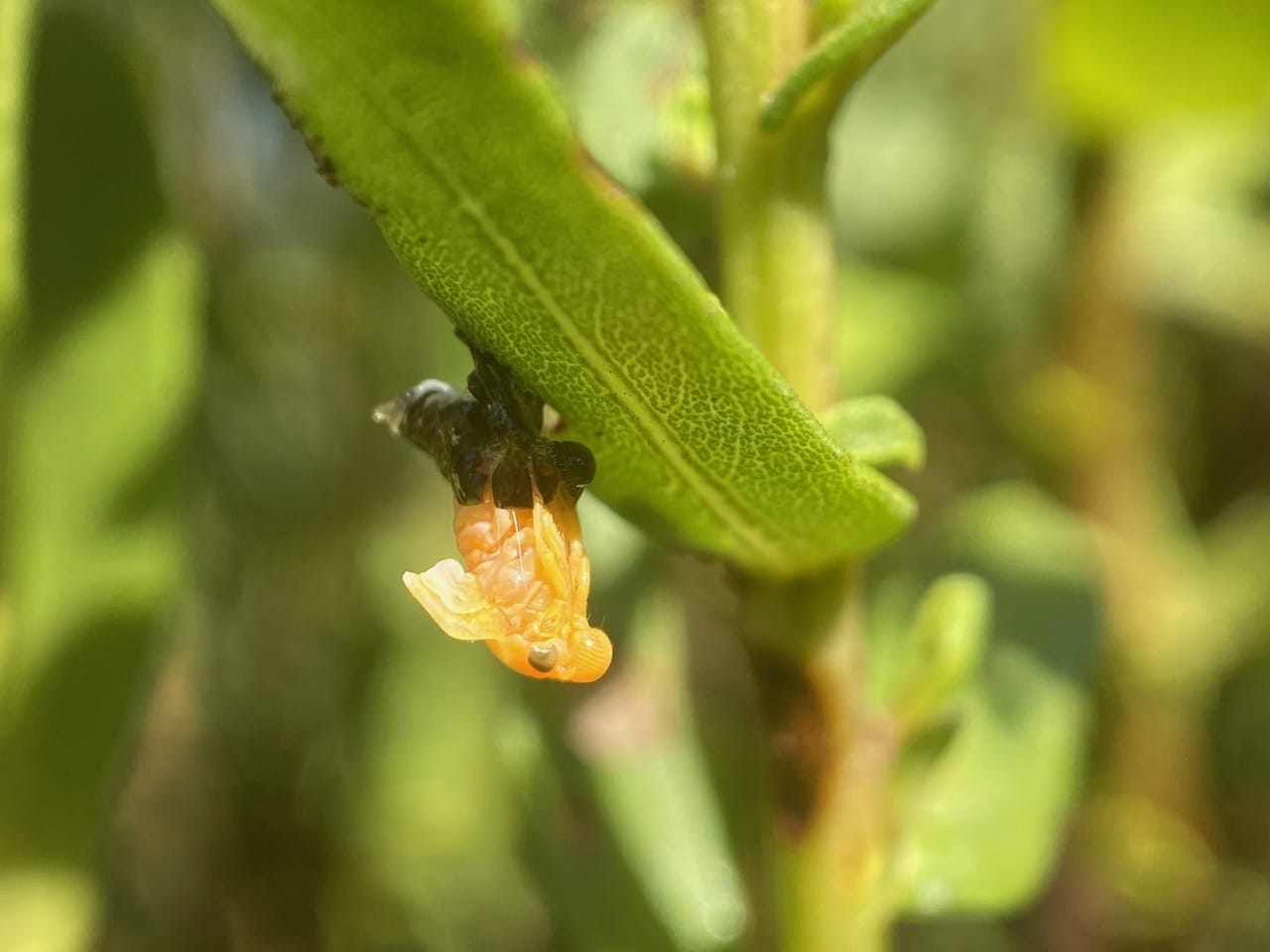
11:10:33 am
Wings start to unfurl.
 11:12:19 am
Front legs break free.

11:17:01 am
All legs are out. Note the rostrum (piercing-sucking mouthparts) with the dark line down the middle.

11:19:22 am
Rings of dark spines are visible on the tibia of hindlegs.
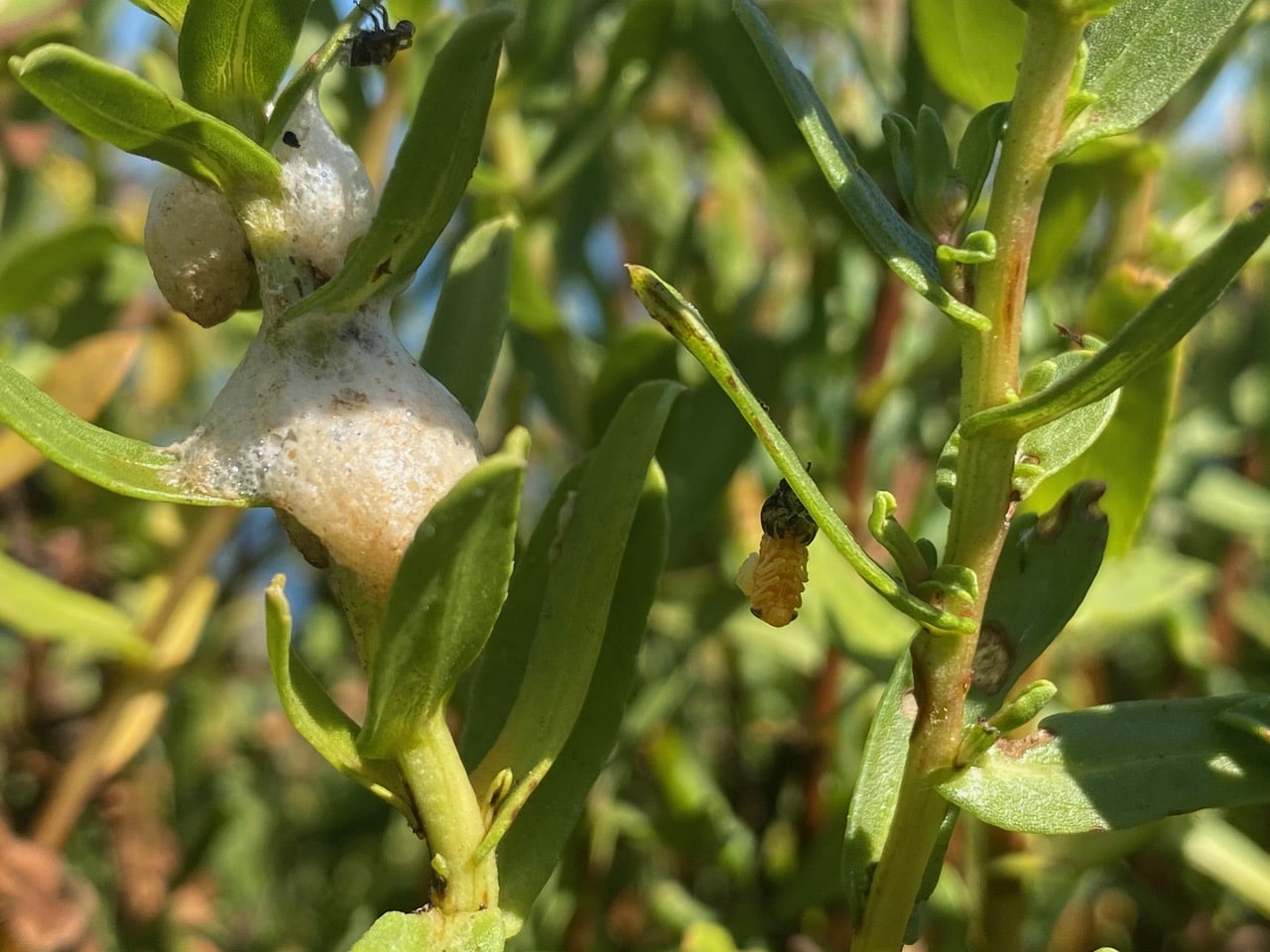
Time to get a perspective on what we are looking at. See the emerging Spittlebug under the leaf on the right stem? When I first spotted the bug, it was on a leaf tip next to the dirty foam mass on the left branch. In getting the branch into the light, I have accidentally brushed it against the right branch. For a heart-stopping moment, I thought I have lost the nymph. Amazingly, by virtue of its sticky foam, the eclosing nymph managed to attach itself to the leaf on the right branch to continue its epic transformation without losing a beat.
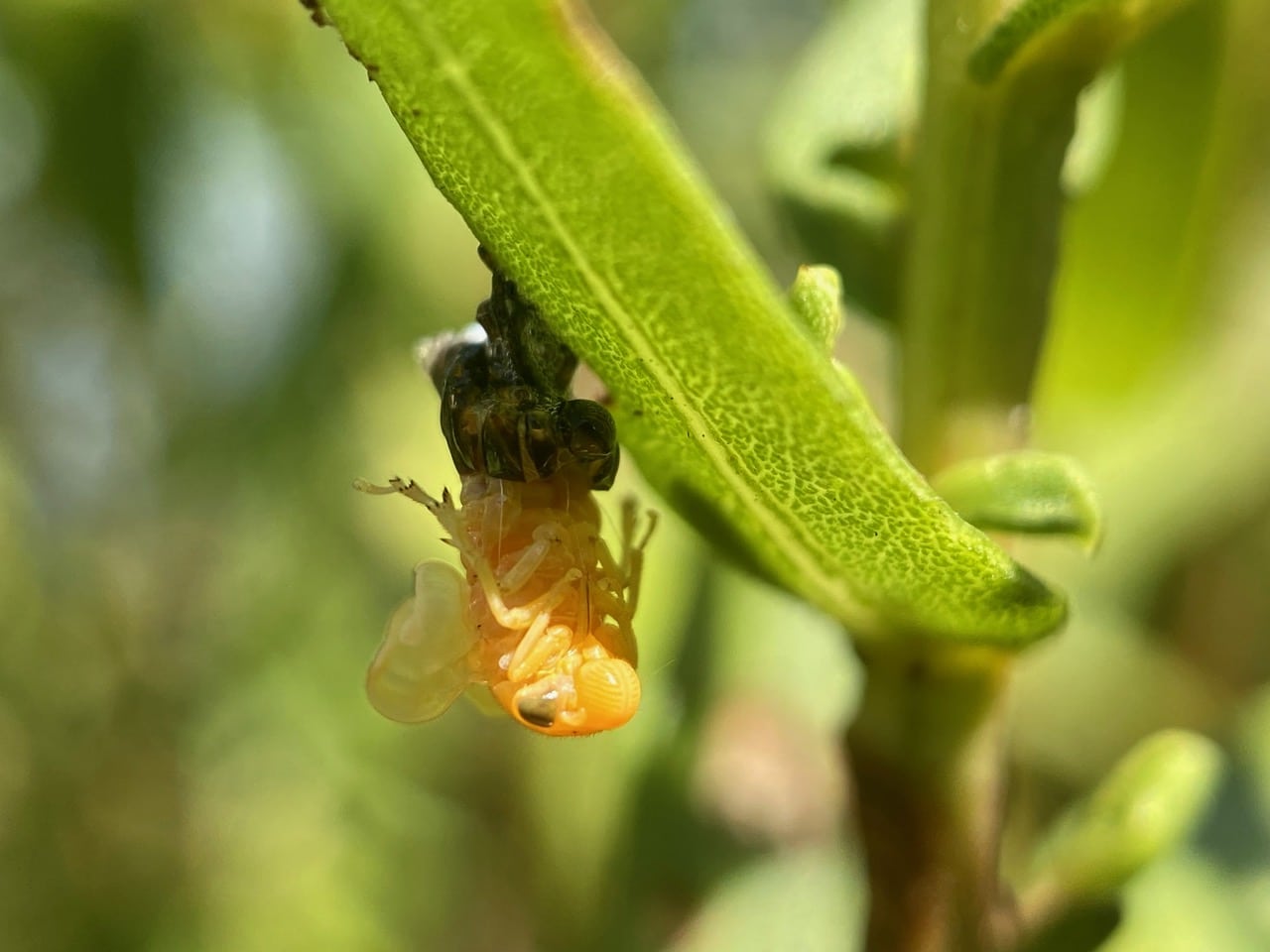
11:21:38 am
Flexing those awesome hindlegs. Note the spines.
Froghoppers gain traction that lets them leap from smooth leaves thanks to spines on their legs. A study using high-speed videography showed that the froghoppers’ hind legs gripped the surfaces when the insects took off, allowing them to soar through the air. When jumping from leaves, the froghoppers’ spines left behind microscopic holes. But on hard glass, the insects could not gain traction and slipped when they jumped.

11:26:19 am
The whole body of the bug is out of the old exoskeleton. Perched in a horizontal, upside-down position the bug is allowing its wings to hang free and inflate. See that fine white thread stretched between the bug and its exuvia (shed skin)? That’s the lining of one of the last tracheal tubes that is being turned inside-out and shed. The new adult now has a new set of trachea for breathing.

11:37:28 am
The fully expanded wings are now closed. It is time for me to move on, not knowing how long this teneral state will last. It may take hours.
A teneral insect is one that has recently molted and its exoskeleton is yet to harden and get its final coloration. In this state, the insect is very vulnerable. The teneral state can last for some time.

While watching the eclosure of the Spittlebug, I am treated to a simultaneous side show of a tiny Jumping Spider on an adjacent branch of the same plant. It is a female Sun Jumping Spider, Heliophanus apiatus (family Salticidae) showing off her bright yellow pedipalps.
The pedipalps are jointed appendages, much like small legs. They are used by the spider to sense objects, shape their webs, and to aid in prey capture and feeding. In male spiders, the pedipalps are also used to deliver sperm during mating.
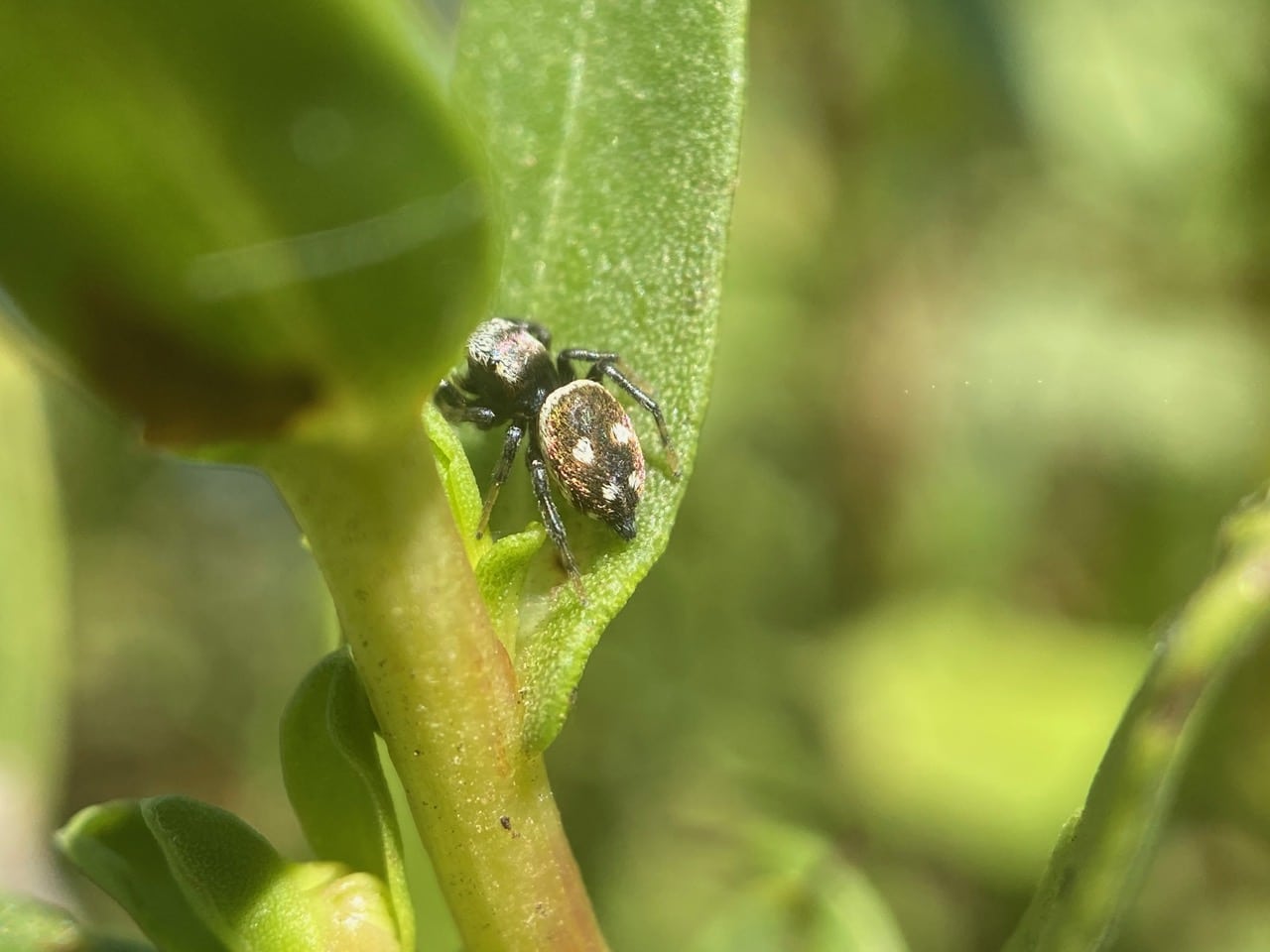
The genus Heliophanus is one of the largest genera of jumping spiders with over 150 species, widespread in the Palearctic and Africa, with one center of diversity in the Mediterranean region. Heliophanus apiatus was first reported in the San Francisco Bay Area in 2015. Since then the species has established in three counties – Alameda, Santa Clara and San Mateo – surrounding the southern arm of San Francisco Bay. H. apiatus is a small salticid, male measuring 3.5-4.0 mm, and females 4.0-4.5 mm in body length. Mature males and females are similar in appearance, but only the females have yellow pedipalps. These spiders are found on low vegetation and on hard structures on or near the ground. They are capable of taking prey their own size.
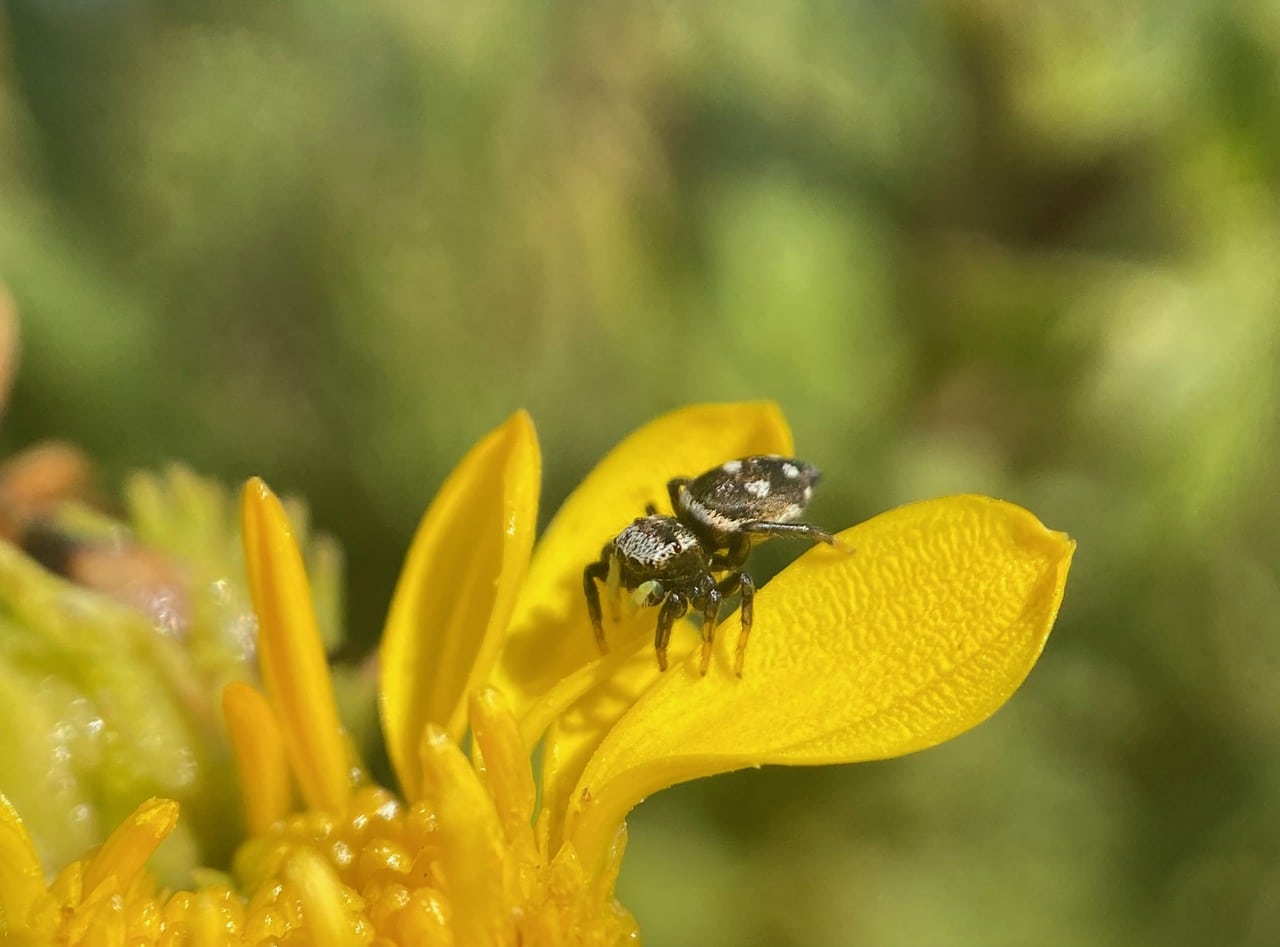
When I next see the spider, she is on the ray petals of a flowerhead.
Salticids or Jumping Spiders are free-roaming hunters. They do not weave a web to catch prey. They stalk, then pounce on their prey. Just before jumping, the spider fastens a safety line to the substrate. It can leap 10-20 times their body length to capture prey. Their movement is achieved by rapid changes in hydraulic pressure of the blood. Muscular contractions force fluids into the hind legs, which cause them to extend extremely quickly.
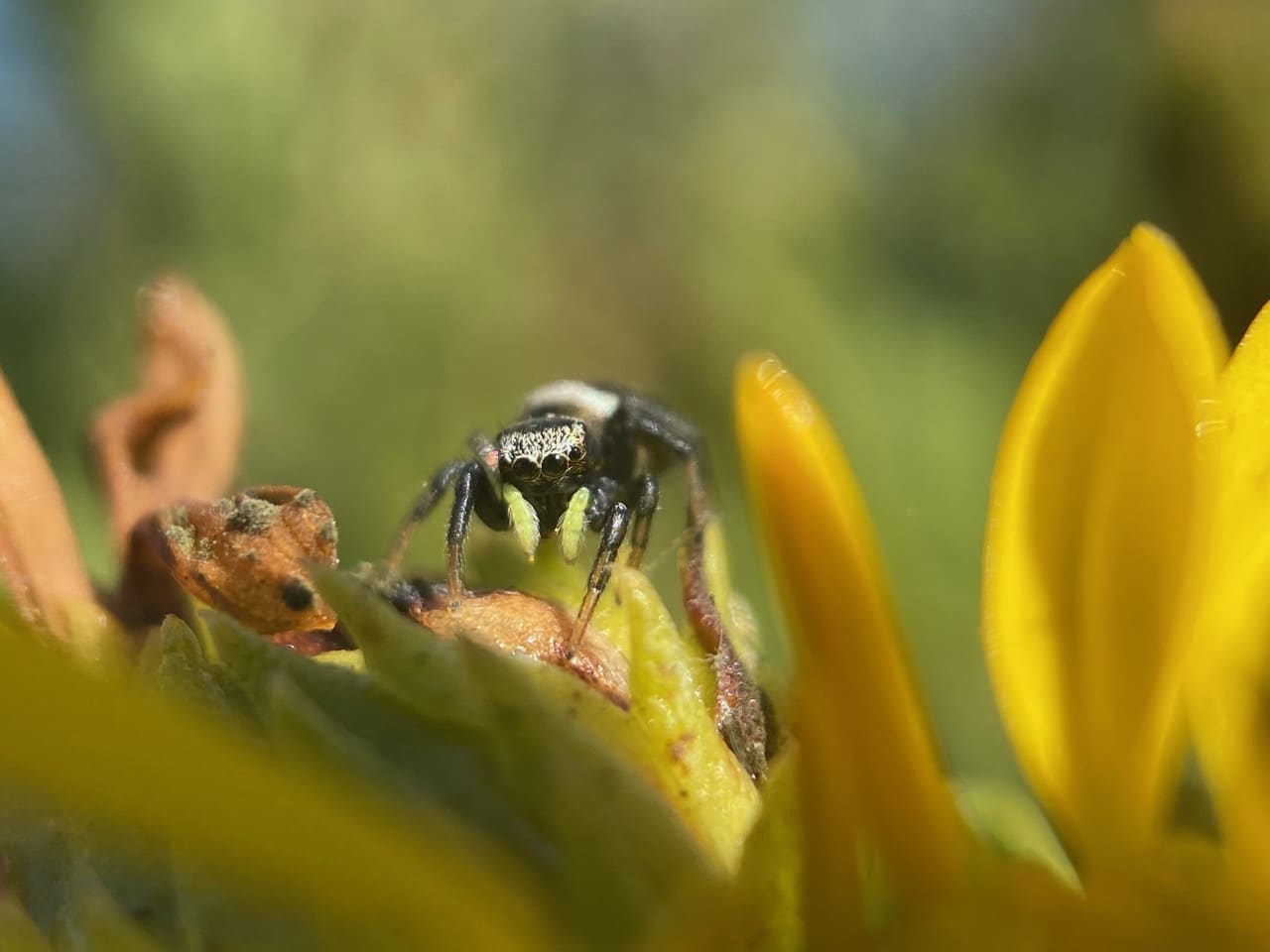
Her large anterior median eyes are locked on something in front of her.
Jumping spiders have excellent vision, with among the highest acuities in invertebrates. The 8 eyes are grouped four on the face (the two big Anterior Median Eyes in the middle, and two smaller Anterior Lateral eyes to the side), and four on top of the carapace. The anterior median eyes provide high acuity but small field of view, while the other six eyes act like our peripheral vision, with lower resolution but broad field of view. Since all eight eyes are fixed in place and can’t pivot independently from the body like human eyes can, jumping spiders must turn to face whatever they want to see well. This includes moving their cephalothorax up and down, an endearing behavior.

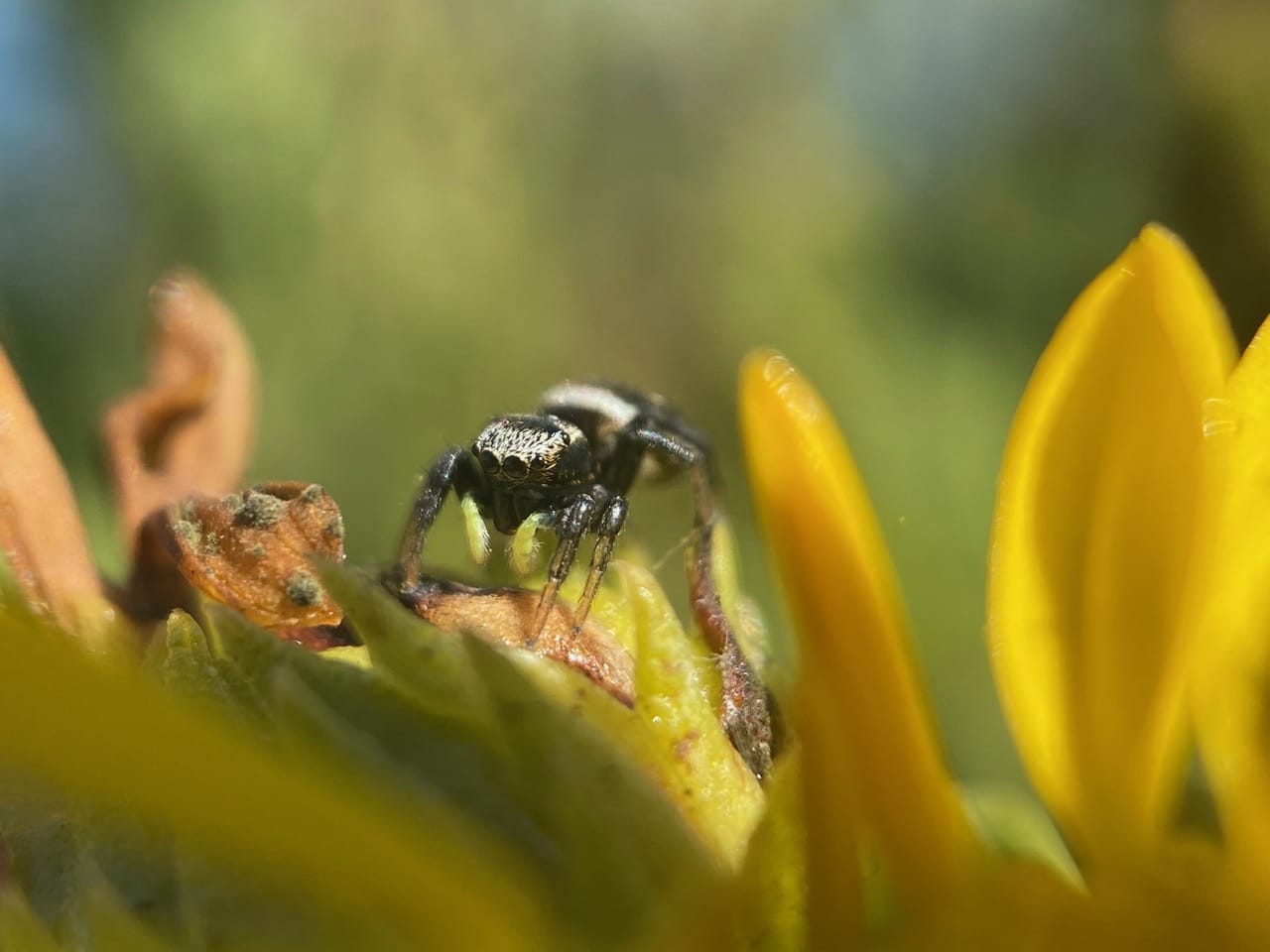
Do you see the smaller eyes on the side and top of her head?
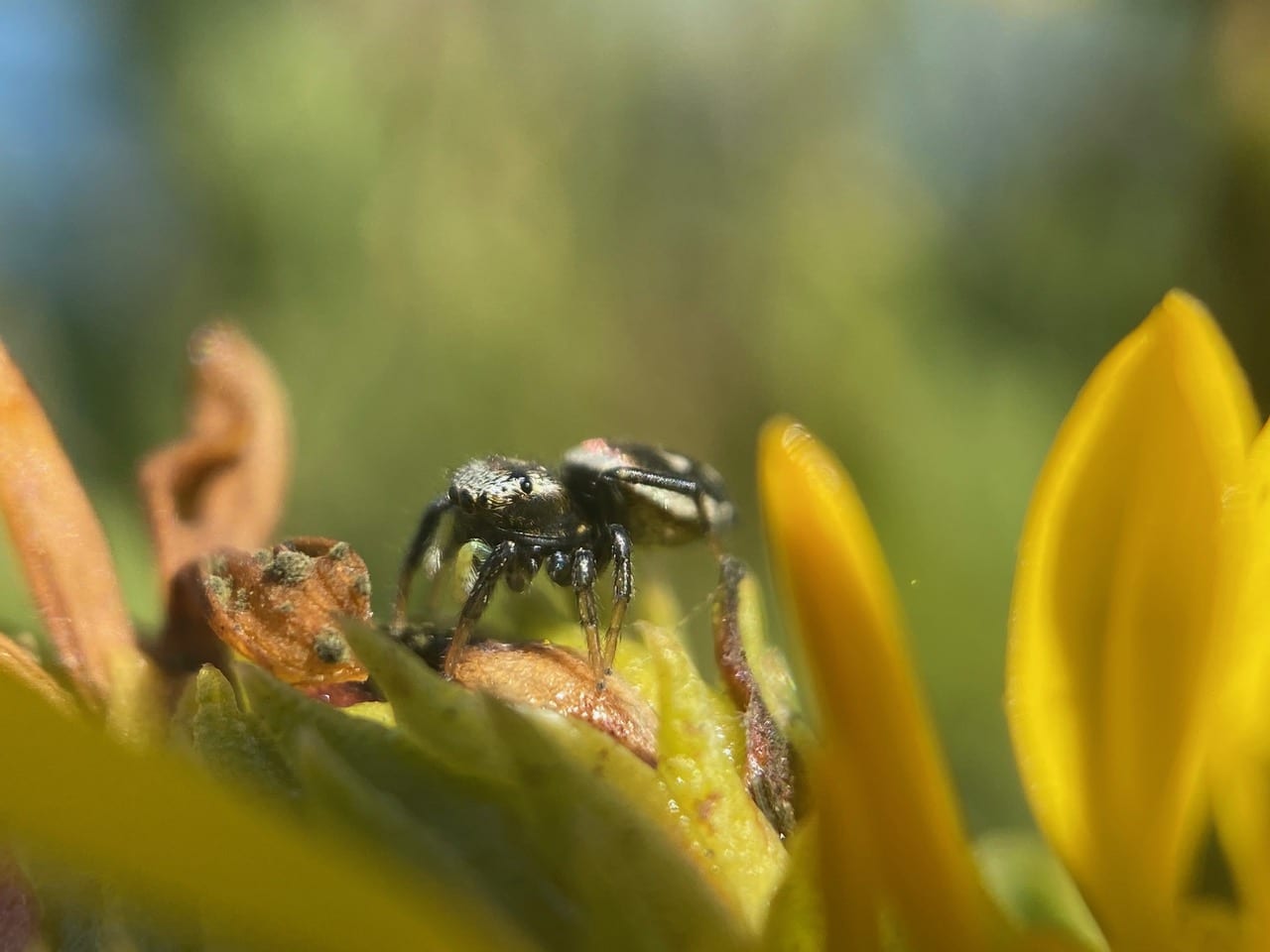
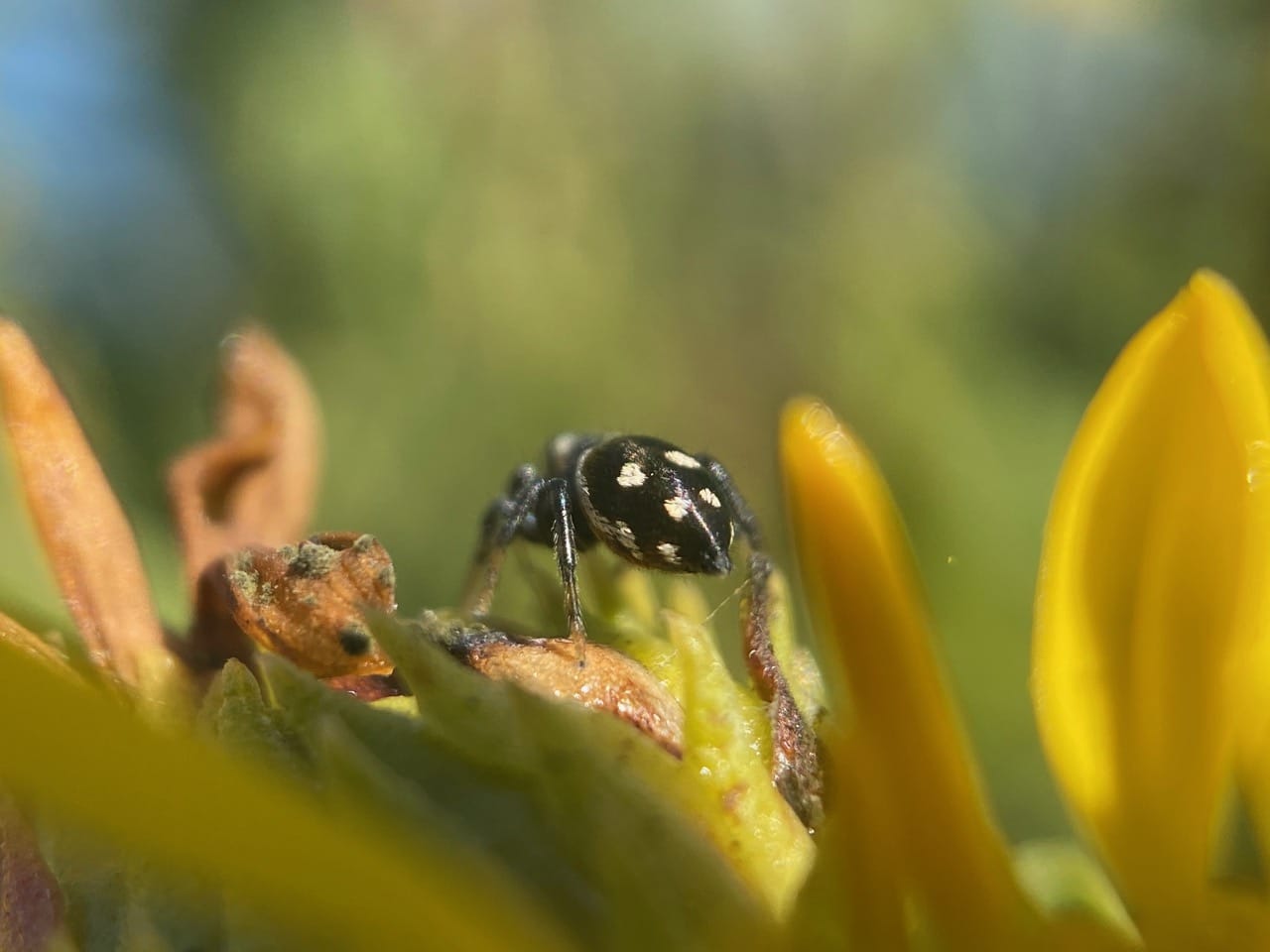
Bye-bye, Sun Spider! Will our Spittlebug become spider chow? The tender tenerals are easy targets for these roaming hunters.
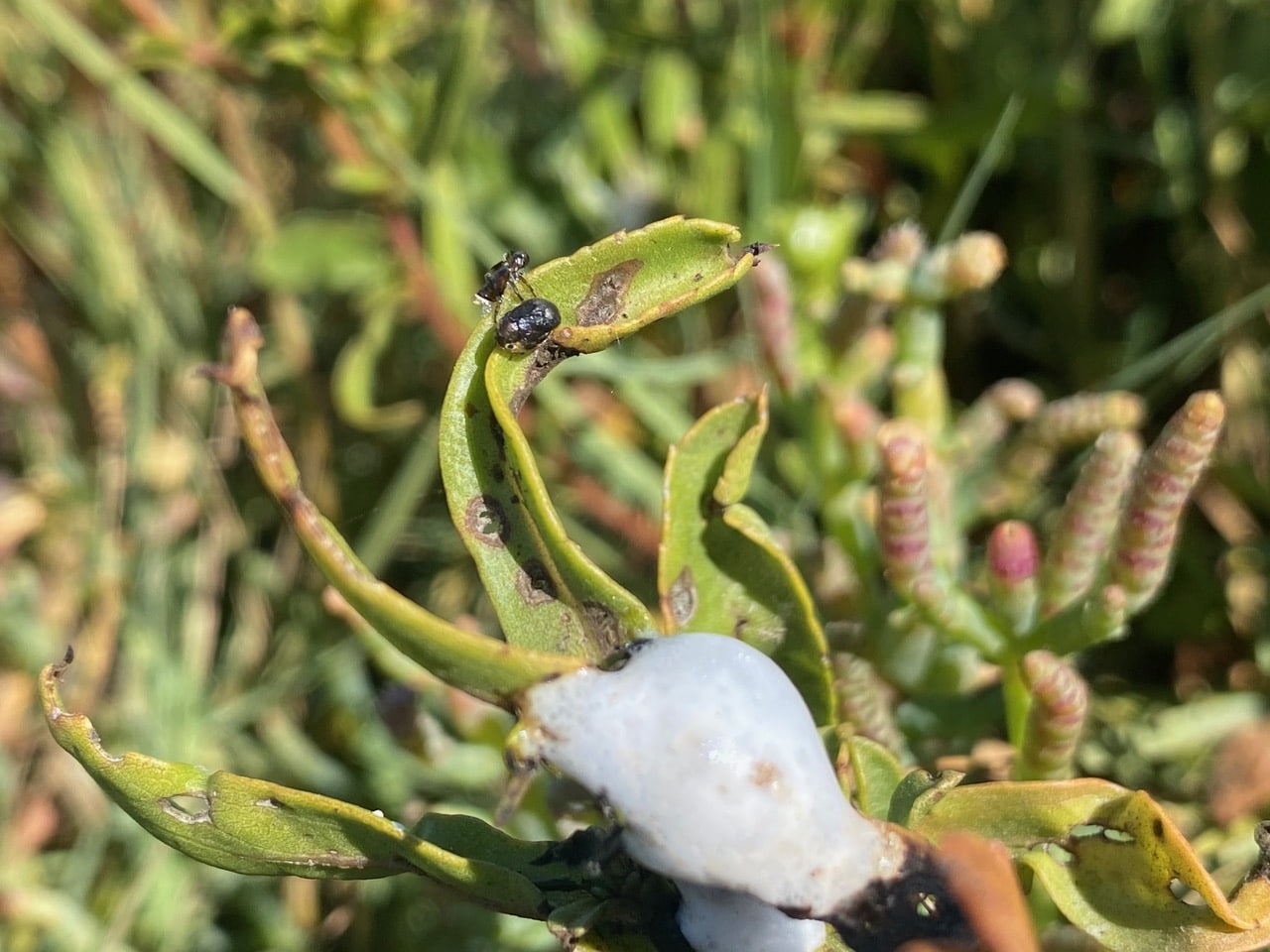 A short distance from a foam mass on a Grindelia, an adult Spittlebug is lying on a leaf next to its exuvia. Exuvia is the old exoskeleton of insects and other arthropods that is shed after a molt.
Close-up of the Spittlebug, Complex Clastoptera lineatocollis (family Clastopteridae). If you think the shiny black spot with a white rim is the insect’s eye, you have been roundly duped! That’s a false eyespot on its rear end. Members of the family Clastopteridae have their wings modified to form false heads at the tail end, an anti-predator adaptation. I have observed that these bugs are able to walk backwards just as easily as they walk forward, completing the illusion. While a predator attacks the rear, the bug can escape by leaping away.
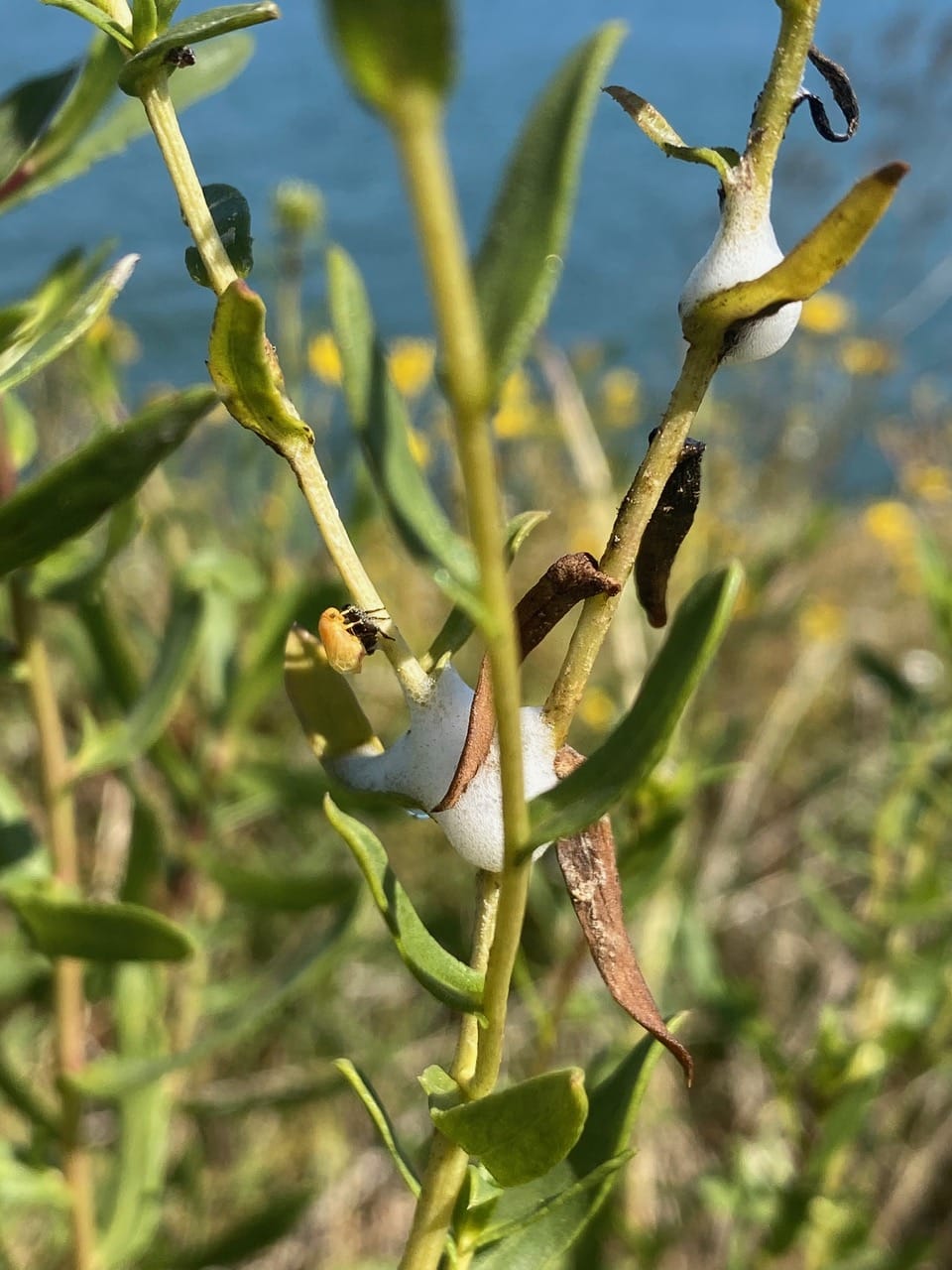
Ooh, here’s another teneral Froghopper still clinging to its exuvia right above its former foamy shelter.

Close-up of the teneral Froghopper. It is at the same stage of development as the last one I just observed. They have emerged at around the same time. Why the synchrony? Is the eclosure triggered by some environmental factor such as time of day, temperature, or something else?