

Pollinator Post 9/12/24
 Passing the fading Fennel at Shoreline Park on Bay Farm Island, I check for the Lady Beetle pupa I found a couple of days ago. Yes it is still there, and it hasn’t eclosed yet.
 Watch Ladybugs Go From Goth to Glam | Deep Look – YouTube
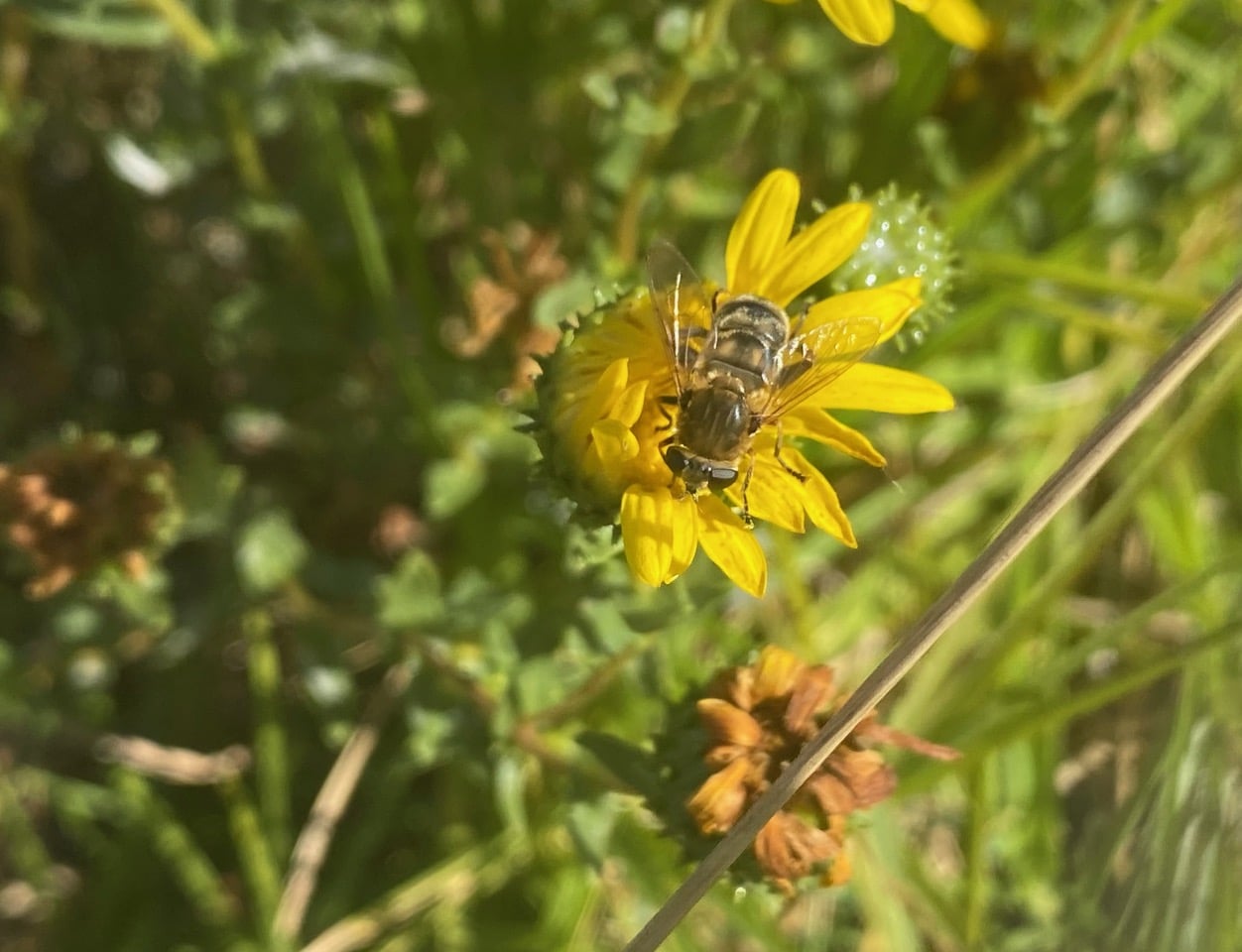
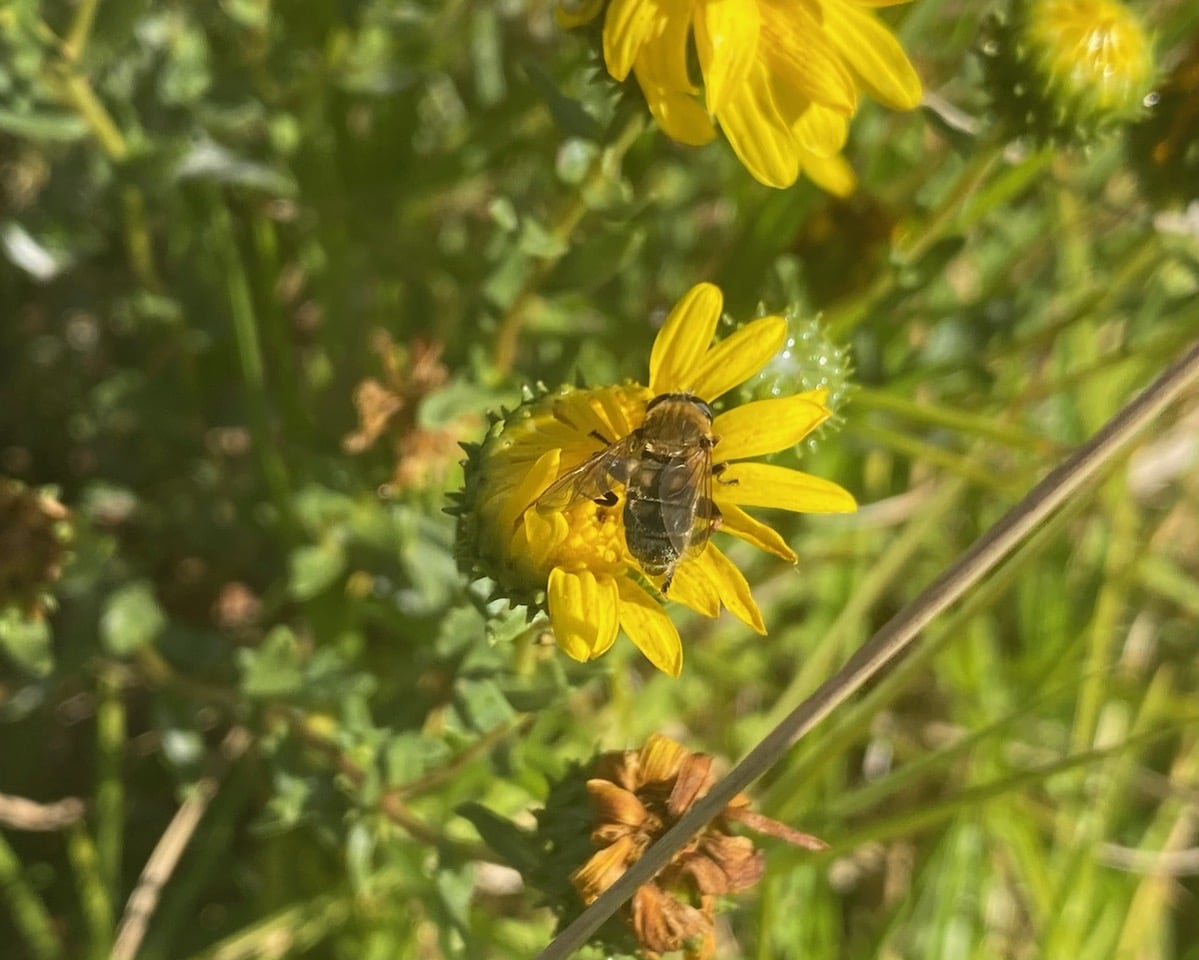
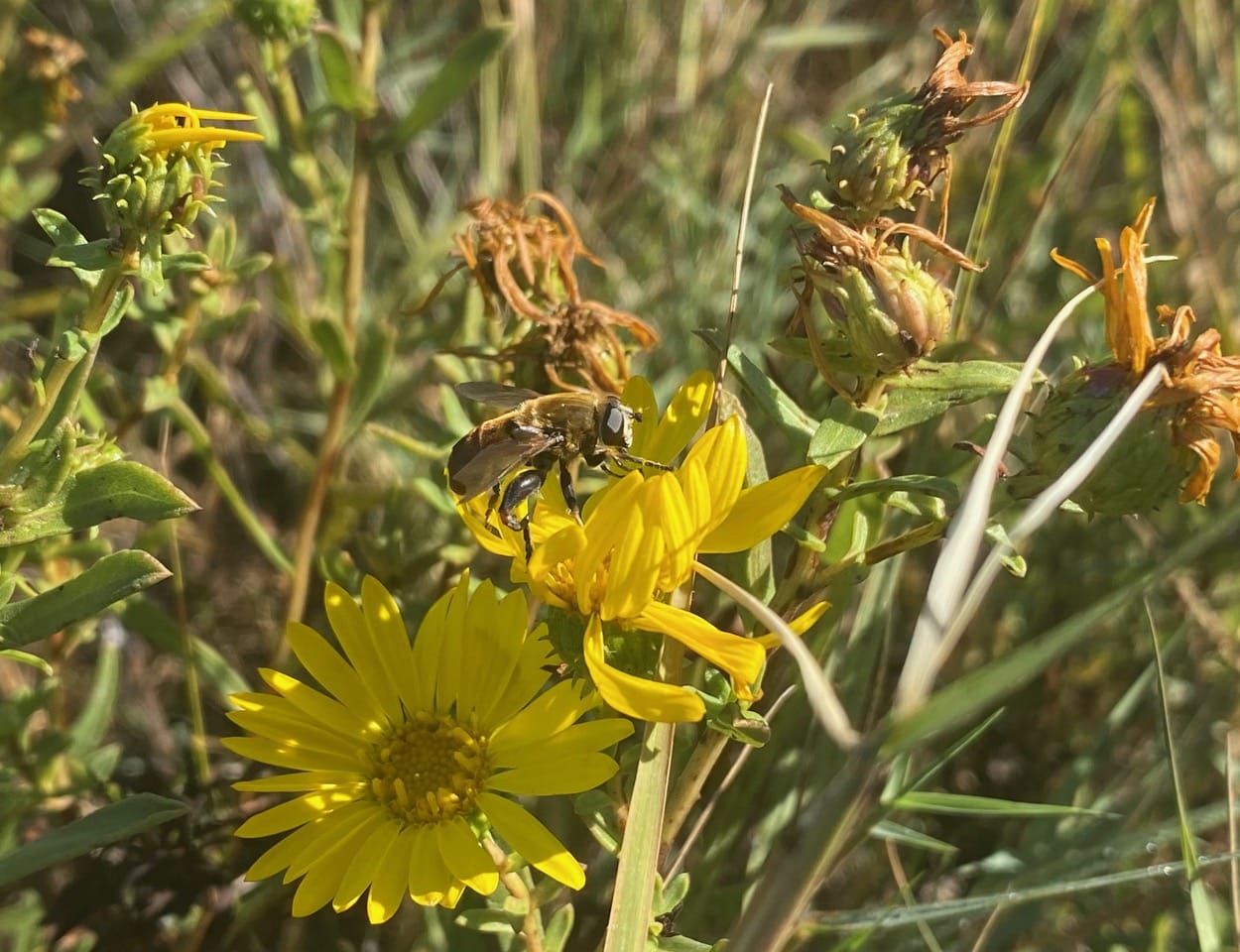
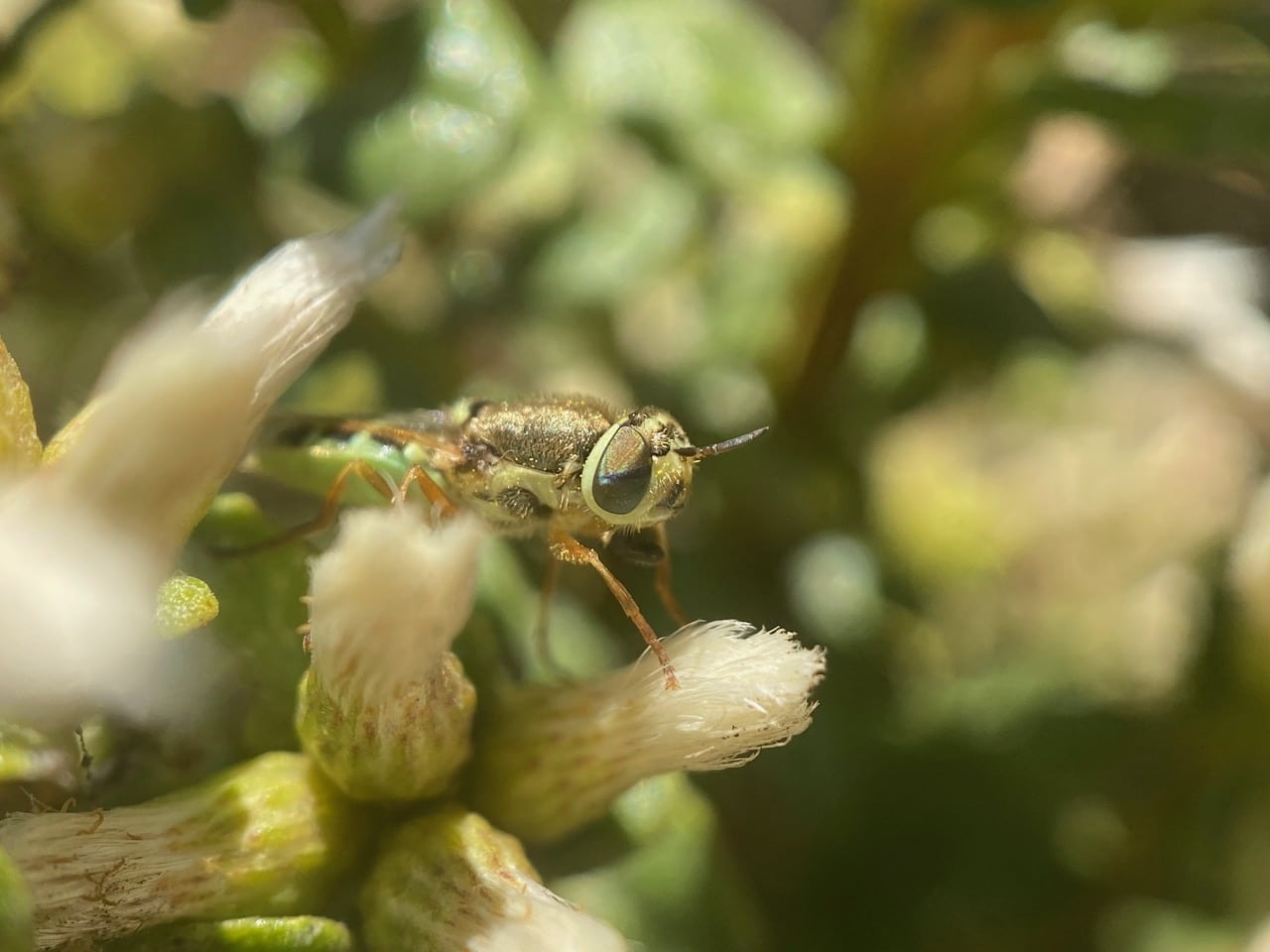
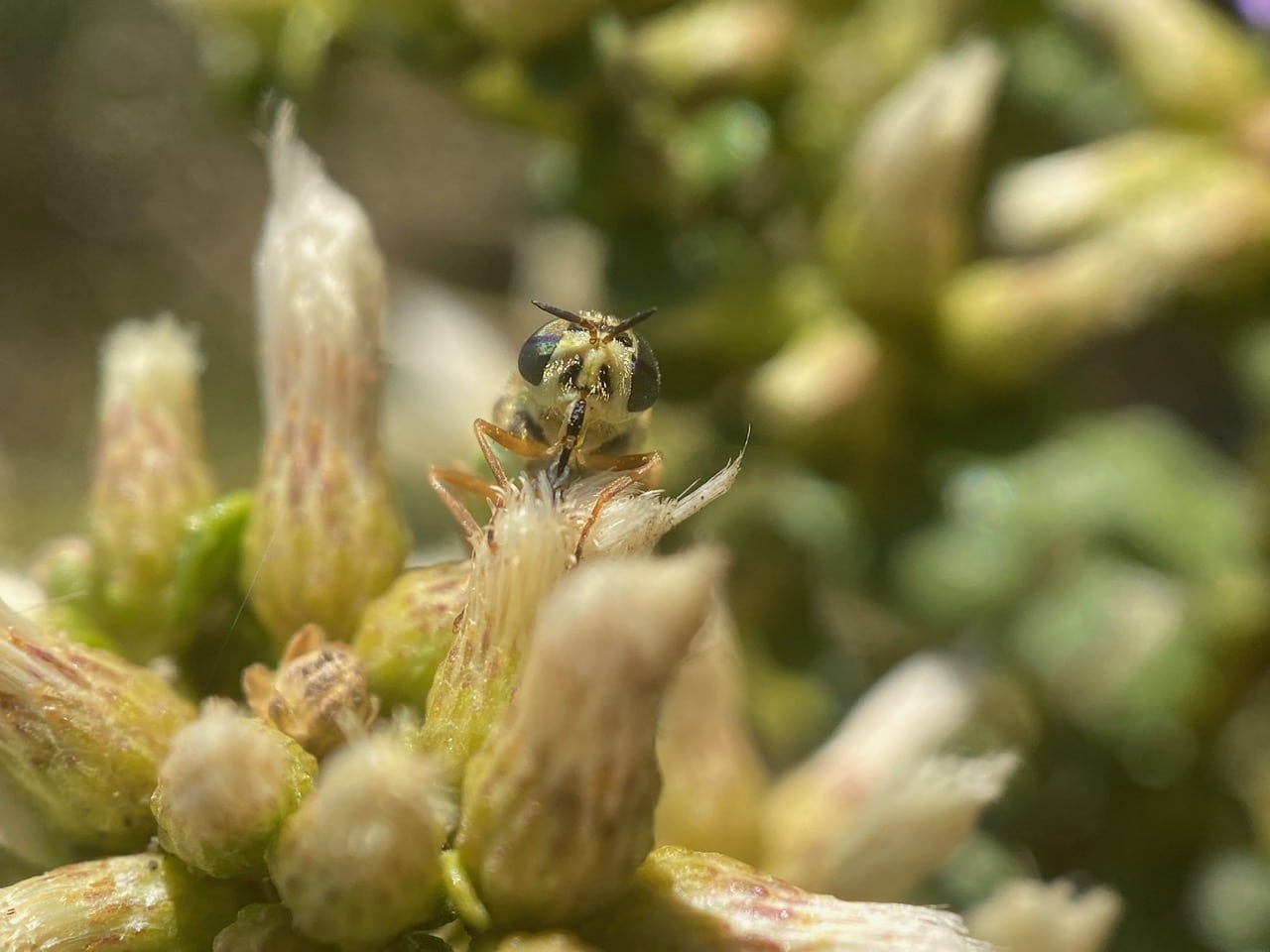

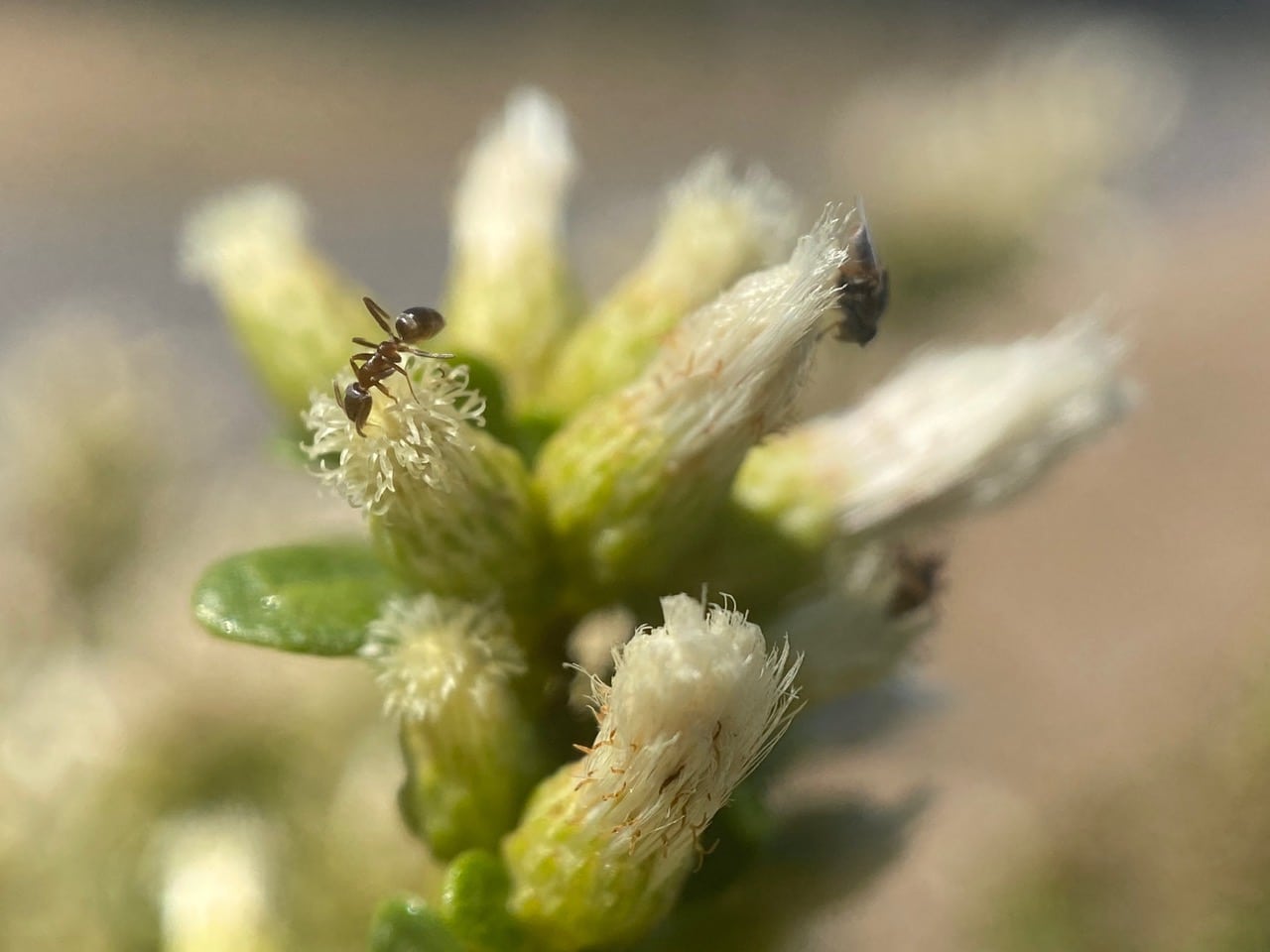
Everyday when I walk this short stretch of Shoreline Park, I often see this large brown hoverfly foraging on the Grindelia flowers. I am lucky to get some pictures of the elusive creature this morning.
Hoverflies or syrphids, make up the insect family Syrphidae. As their common name suggests, they are often seen hovering or nectaring at flowers. The adults of many species feed mainly on nectar and pollen, while the larvae eat a wide range of foods. In some species, the larvae are saprotrophs, eating decaying plant and animal matter in the soil or in ponds and streams. In other species, the larvae are insectivores, preying on aphids, thrips, and other plant-sucking insects. Many species of hoverflies are mimics of stinging wasps and bees, a mimicry which may serve to ward off predators.
Hoverflies are important pollinators of flowering plants in many ecosystems worldwide, and are often considered second-most important group of pollinators after wild bees. Although hoverflies are often considered generalist pollinators visiting a wide range of flowers, some species are highly selective. In general, hoverflies have been shown to prefer white and yellow flowers. Many hoverflies have short, unspecialized mouthparts and tend to feed on flowers that are more open as the nectar and pollen can be easily accessed.
Among other insects, iNaturalist has suggested a Dimorphic Sickleleg, Polydontomyia curvipes (family Syrpidae). The males of the species have a red abdomen, so our friend here is probably a female. Many hoverflies are Batesian mimics of bee/wasp, but the Sickleleg seems to have done away with that convention, preferring a drab appearance, at least for the females.
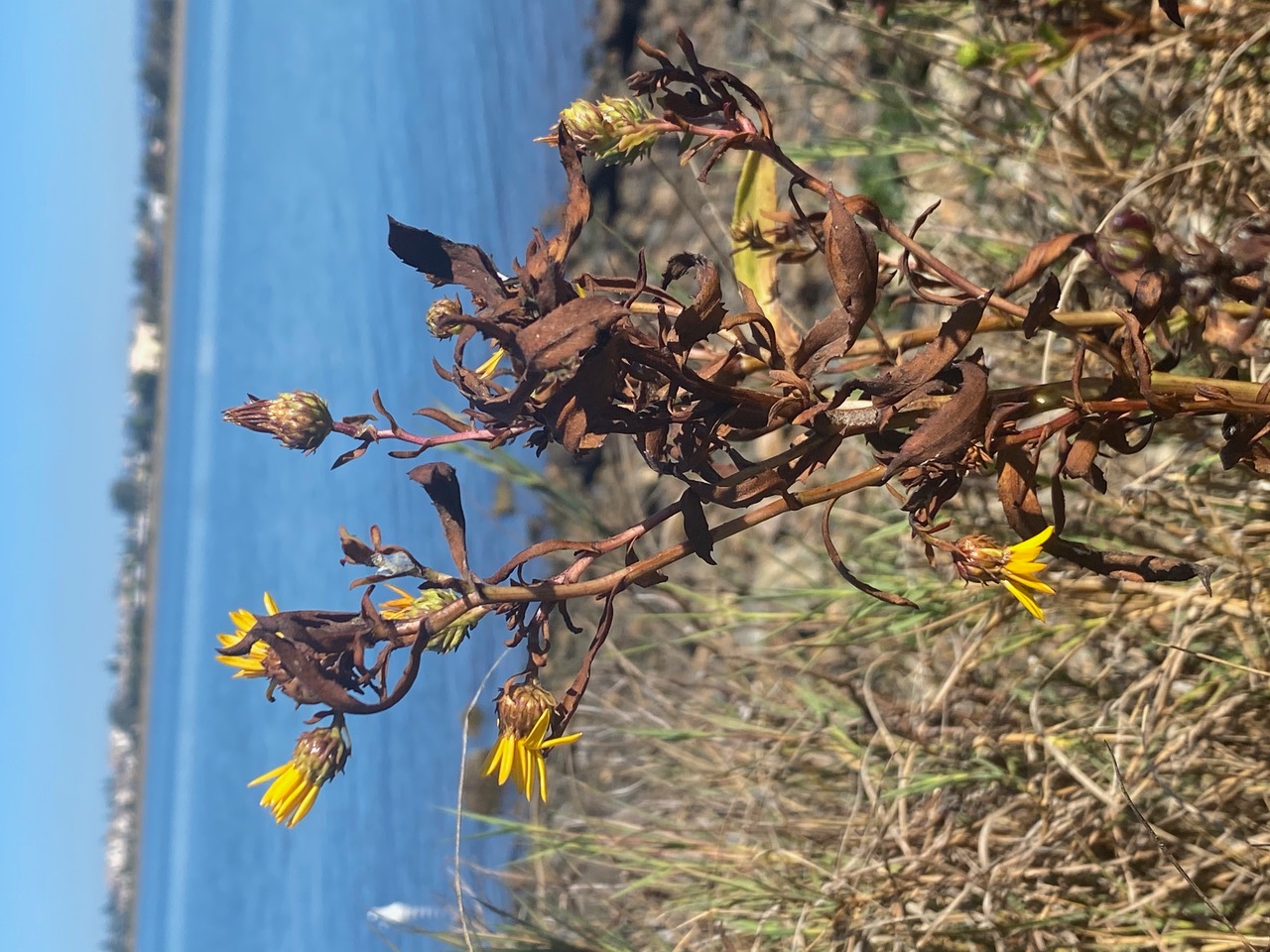
Some of the Oregon Gumweed, Grindelia stricta along the shore are turning brown and dying back. These plants are heavily infested with Lace Bugs (family Tingidae) and Spittlebugs (family Clastopteridae)
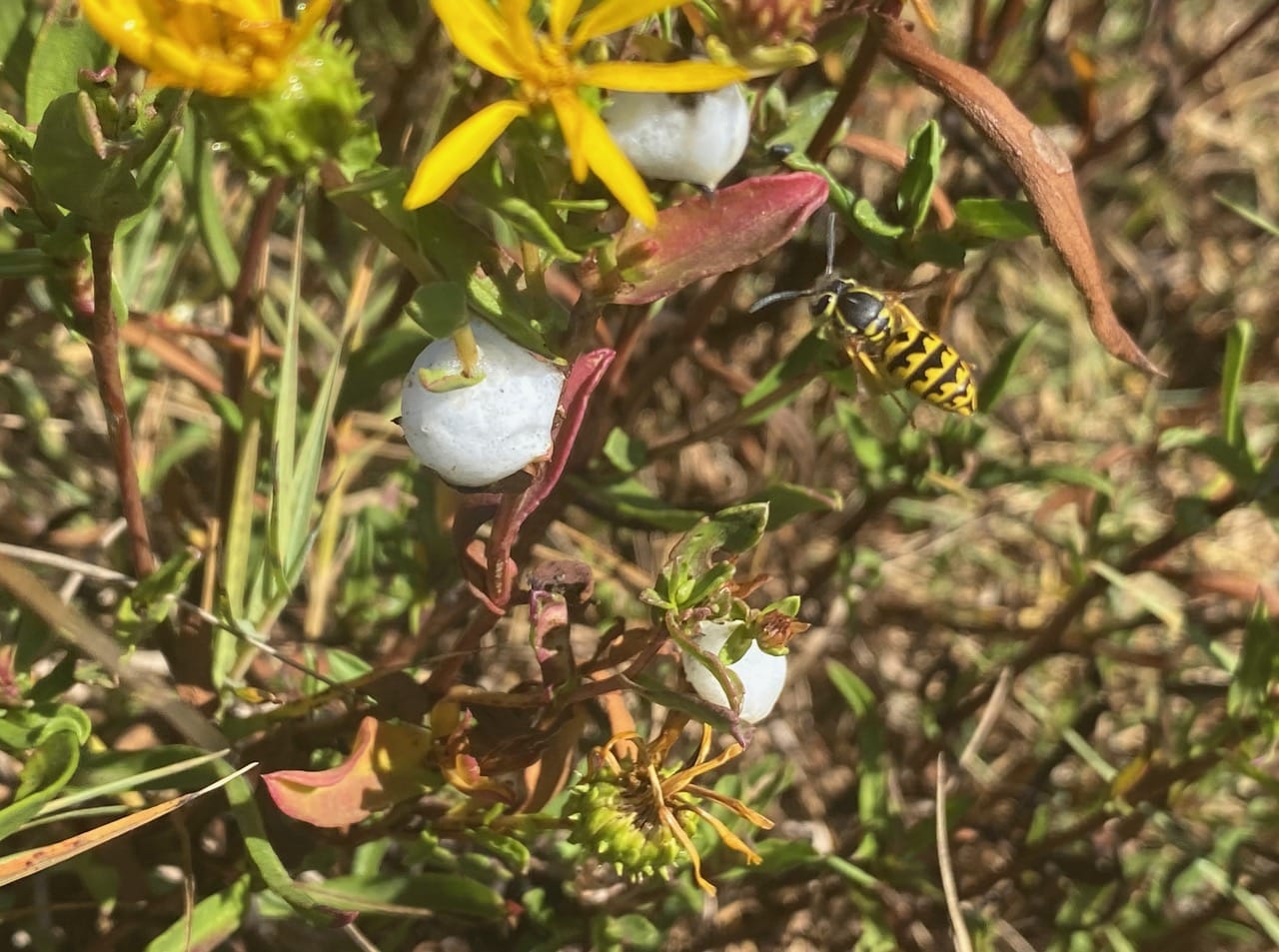
The infested plants are regularly patrolled by wasps – the Yellowjackets and European Paper Wasps (family Vespidae).
Yellowjacket is the common name for predatory social wasps of the genera Vespula and Dolicovespula (family Vespidae). Yellowjackets are social hunters living in colonies containing workers, queens, and males (drones). Colonies are annual with only inseminated queens overwintering. Queens emerge during the warm days of late spring or early summer, select a nest site, and build a small paper nest in which they lay eggs. They raise the first brood of workers single-handedly. Henceforth the workers take over caring for the larvae and queen, nest expansion, foraging for food, and colony defense. The queen remains in the nest, laying eggs. Later in the summer, males and queens are produced. They leave the parent colony to mate, after which the males quickly die, while fertilized queens seek protected places to overwinter. Parent colony workers dwindle, usually leaving the nest to die, as does the founding queen. In the spring, the cycle is repeated.
Yellowjackets have lance-like stingers with small barbs, and typically sting repeatedly. Their mouthparts are well-developed with strong mandibles for capturing and chewing insects, with probosces for sucking nectar, fruit, and other juices. Yellowjacket adults feed on foods rich in sugars and carbohydrates such as plant nectar and fruit. They also search for foods high in protein such as insects and fish. These are chewed and conditioned in preparation for larval consumption. The larvae secrete a sugary substance that is eaten by the adults.
The Western Yellowjackets typically build nests underground, often using abandoned rodent burrows. The nests are made from wood fiber that the wasps chew into a paper-like pulp. The nests are completely enclosed except for a small entrance at the bottom. The nests contain multiple, horizontal tiers of combs within. Larvae hang within the combs.
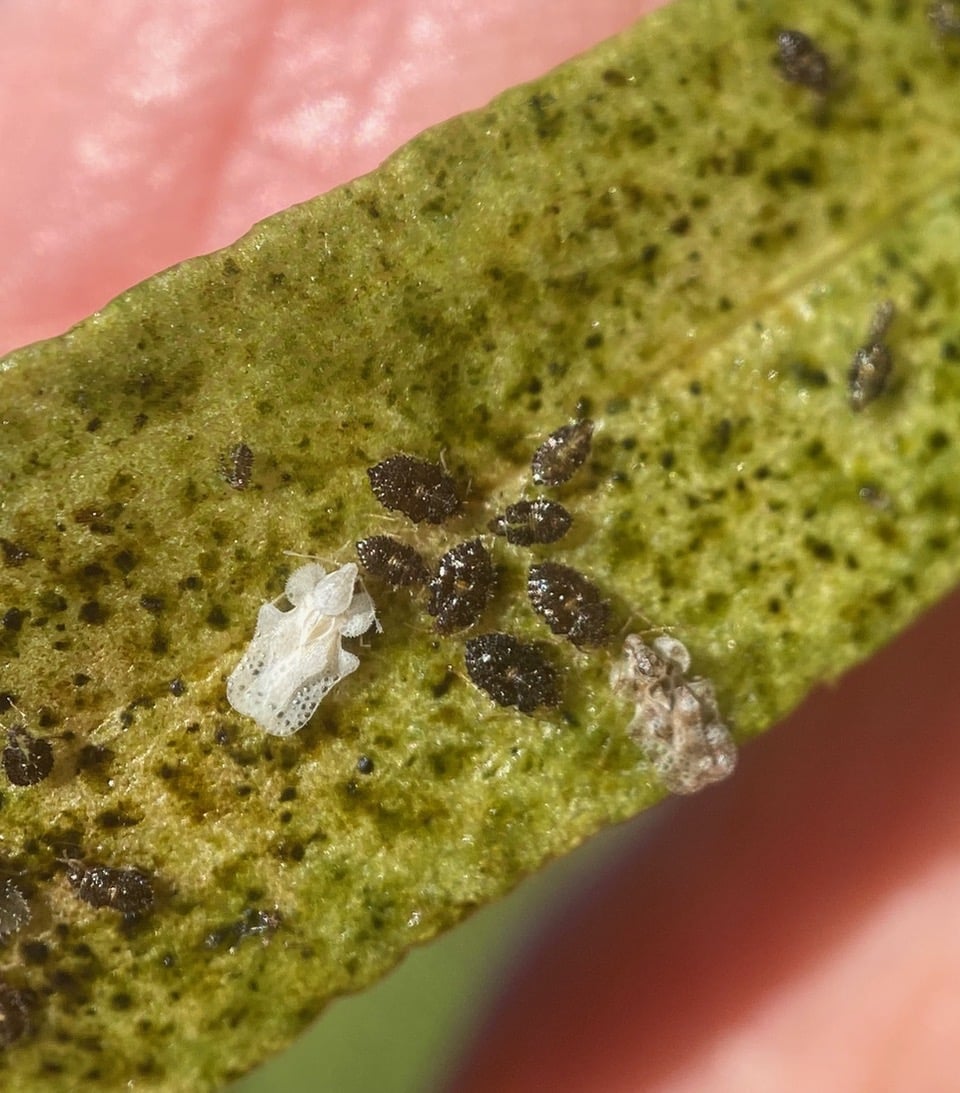
I examine the Grindelia leaves that are infested with Lace Bugs, Corythucha sp. (family Tingidae). There are mottled brown adults as well as shiny black nymphs. Occasionally a white adult can be seen – I wonder if these were freshly molted tenerals? The infested leaf is covered with black sooty mold that grows on honeydew, the sugary excretions of the sucking insects. These tiny bugs can make quite a mess!
The Tingidae are a family of very small (2-10 mm) insects in the order Hemiptera that are commonly referred to as lace bugs. They are called lace bugs because the pronotum and fore wings of the adult have a delicate and intricate network of divided areas that resemble lace. Their body is flattened dorsoventrally, and the head is often concealed under the hood-like pronotum. Lace Bugs feed by sucking sap from plants, extracting the protein they need and excreting liquid waste as honeydew. The most common symptom of feeding is the stippled and mottled yellowish foliage. In heavy infestations, black sooty mold may develop on the honeydew, impairing photosynthesis by the plant. This may result in some dieback of twigs and branches and a reduction in flowering the following year. Tingids are usually host-specific and can be very destructive to plants. Each individual usually completes its entire lifecycle on the same plant, if not the same part of the plant.
The genus Corythucha is primarily distributed in the northern hemisphere, including Europe, North America and eastern Asia.
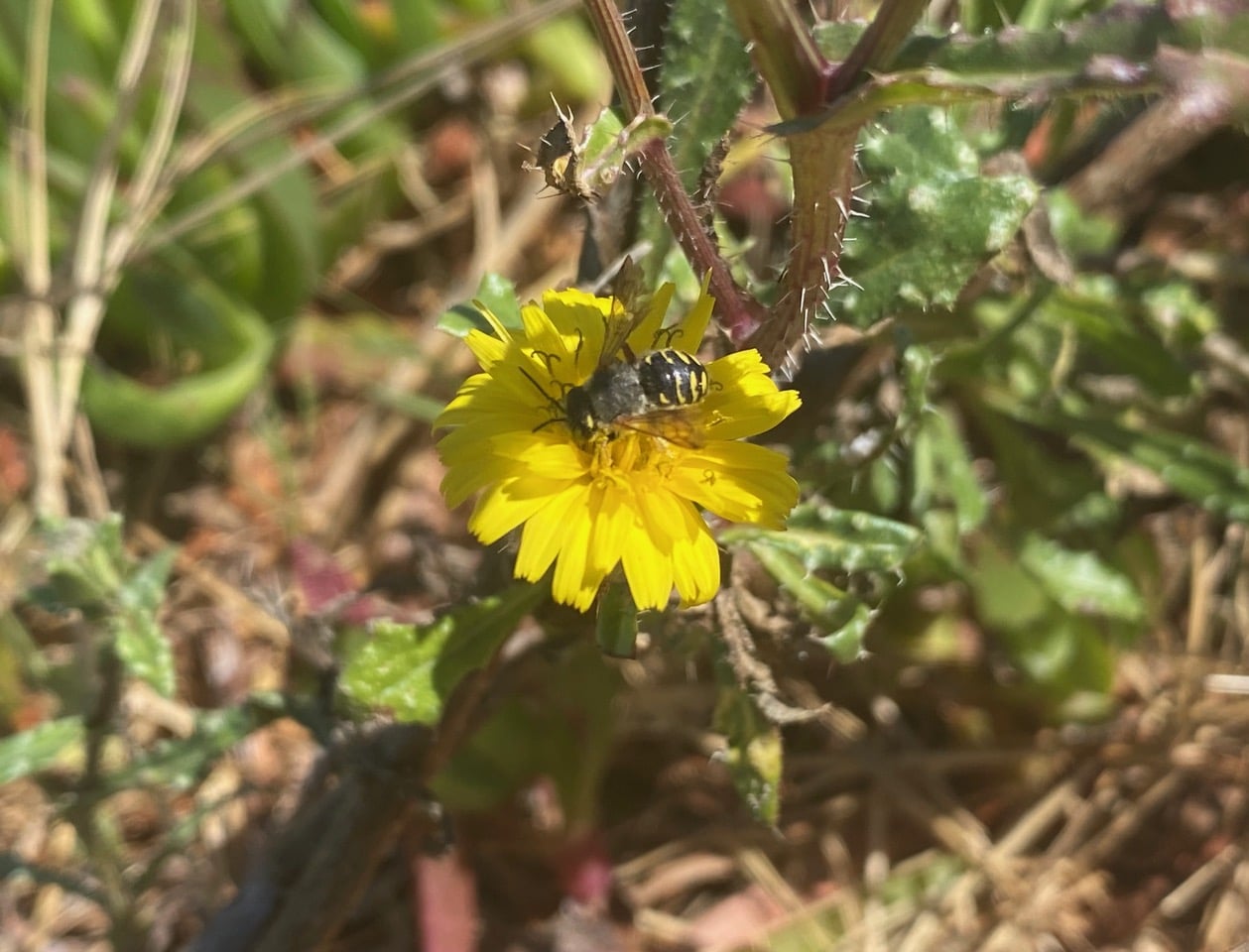
A European Woolcarder Bee, Anthidium manicatum (family Megachilidae) is foraging on a flowerhead of the Bristly Oxtongue, Picris echioides.
Anthidium manicatum, commonly called the European Woolcarder Bee, is a species in the family Megachilidae, which includes the leaf-cutter bees and mason bees. They get the name “carder” from the behavior of the females scraping hair from leaves and stems of wooly plants. The substantially larger males engage in territorial behavior, aggressively chasing other males and pollinators from their territory. They mate with the females that forage in their territory. The females construct their nests in pre-existing cavities, using the hairs of wooly plants that they collect with their sharply toothed mandibles. They then roll up the fibers into a ball and transport them to the nest to line the nest cell, where they lay an egg and a provisioning mass consisting of nectar and pollen. Females largely use the hairs of plants in the mint family, Lamiaceae, especially those of genus Stachys and Betonica. The European Woolcarder Bees visit a wide range of flowers, with a preference for blue flowers that have long throats. They are considered generalists. Females carry pollen in the scopa on the underside of their abdomen. Both males and females can hover in midair near flowers similar to the hover flies (family Syrphidae).
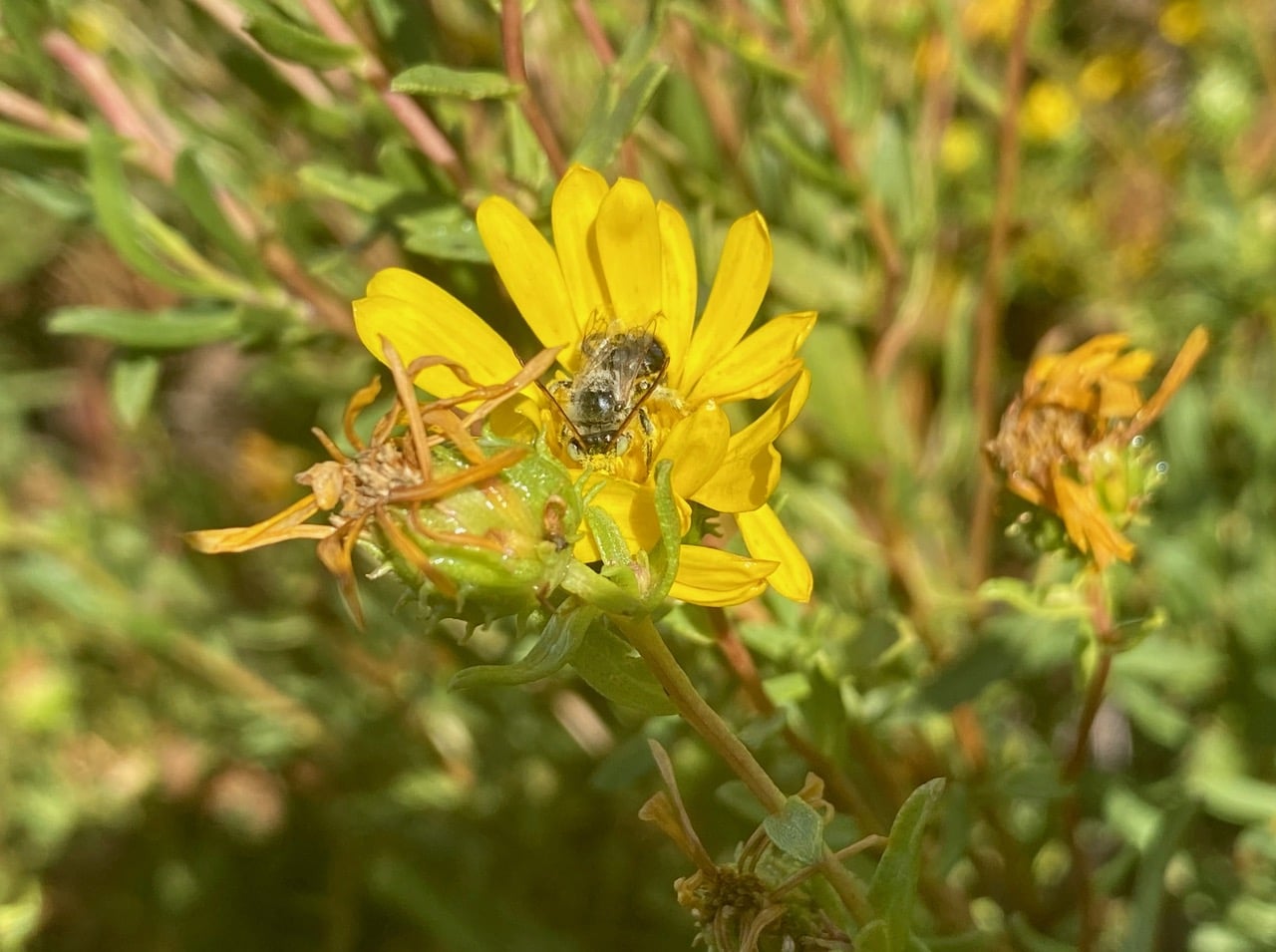
There are a few Summer Longhorn Bees, Melissodes sp. (family Apidae), both males and females out foraging on the Grindelia, but their numbers have dwindled markedly. Their season is inevitably coming to an end.
Hey, I think it’s that hoverfly again! What we have here is another female Dimorphic Sickleleg, Polydontomyia curvipes (family Syrphidae). This time I have a reasonably good look at the fly’s strongly bowed hindleg that gives the species its common name. The species is found throughout North America.
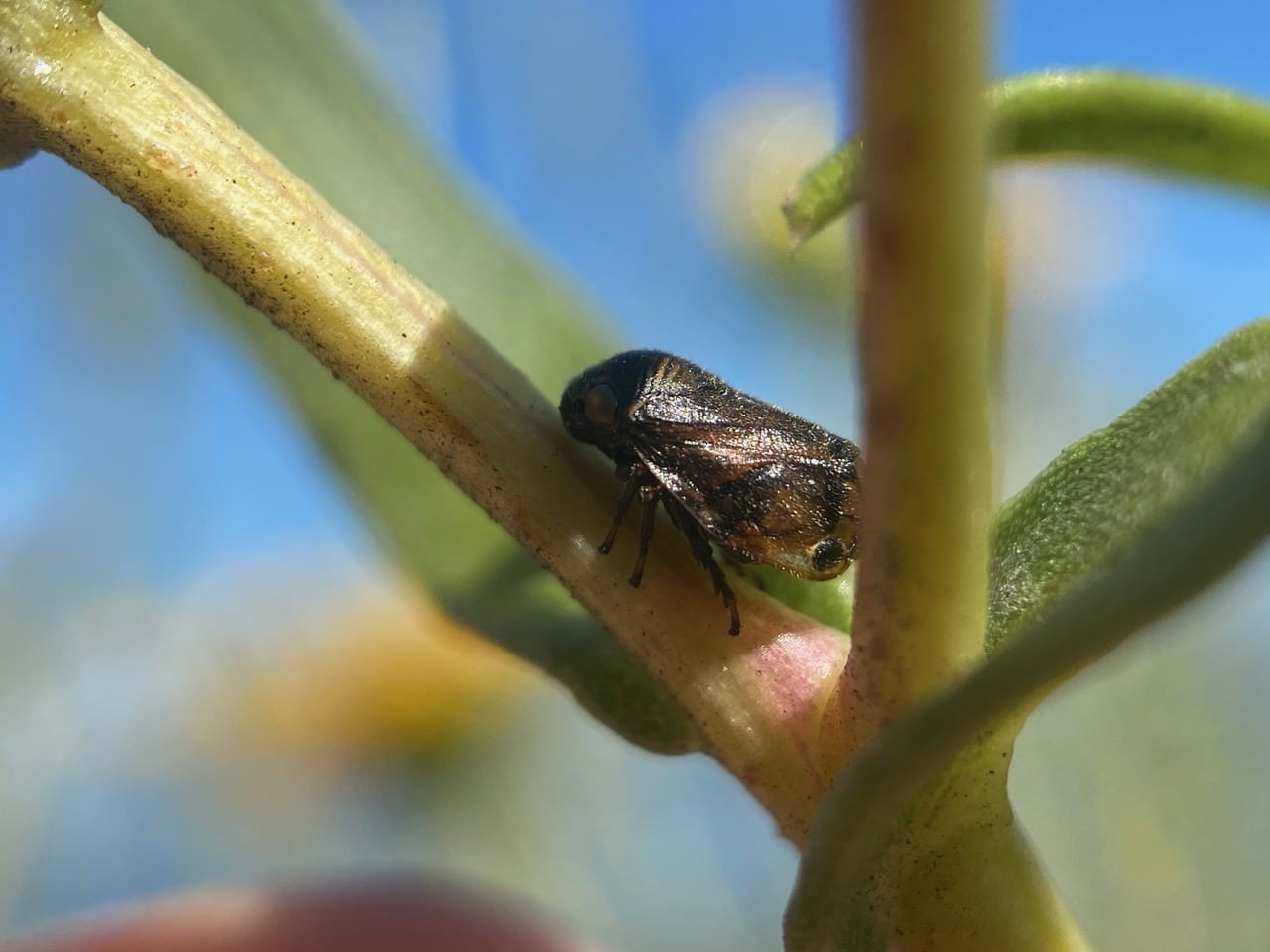
A dark brown Spittlebug, Complex Clastoptera lineatocollis (family Clastopteridae) is resting at a Grindelia leaf axil.
The Froghoppers (superfamily Cercopoidea) are a group of “true bugs” in the order Hemiptera. Adults are capable of jumping many times their height and length, giving them their common name, but many species are best known for their plant-sucking nymphs which produce foam shelters, and are referred to as “spittlebugs”. The superfamily currently consists of three families: the Aphrophoridae, Cercopidae, and Clastopteridae. The nymphs produce a cover of foamed-up plant sap visually resembling saliva, hence the common name. Whereas most insects that feed on plant sap tap into the nutrient-rich fluid from the phloem, the spittlebugs utilize the much more dilute sap flowing upward from the roots via the xylem. The insects’ digestive system contains symbiotic bacteria that provide them with the essential amino acids. The large amount of excess water that must be excreted and the evolution of special breathing tubes allow the young spittlebug nymphs to grow in the relatively protective environment of their foam shelters. The foam serves a number of purposes. It hides the nymph from the view of predators and parasites, and it insulates against heat and cold, providing thermal as well as moisture control. It also has an acrid taste that deters predators.
Froghoppers are champion jumpers among insects, out-performing even the fleas. The bug can leap the human equivalent of a skyscraper without a running start. It is the highest jumping insect proportional to body size. The muscles in its hind legs act like a “catapult” to release energy explosively.
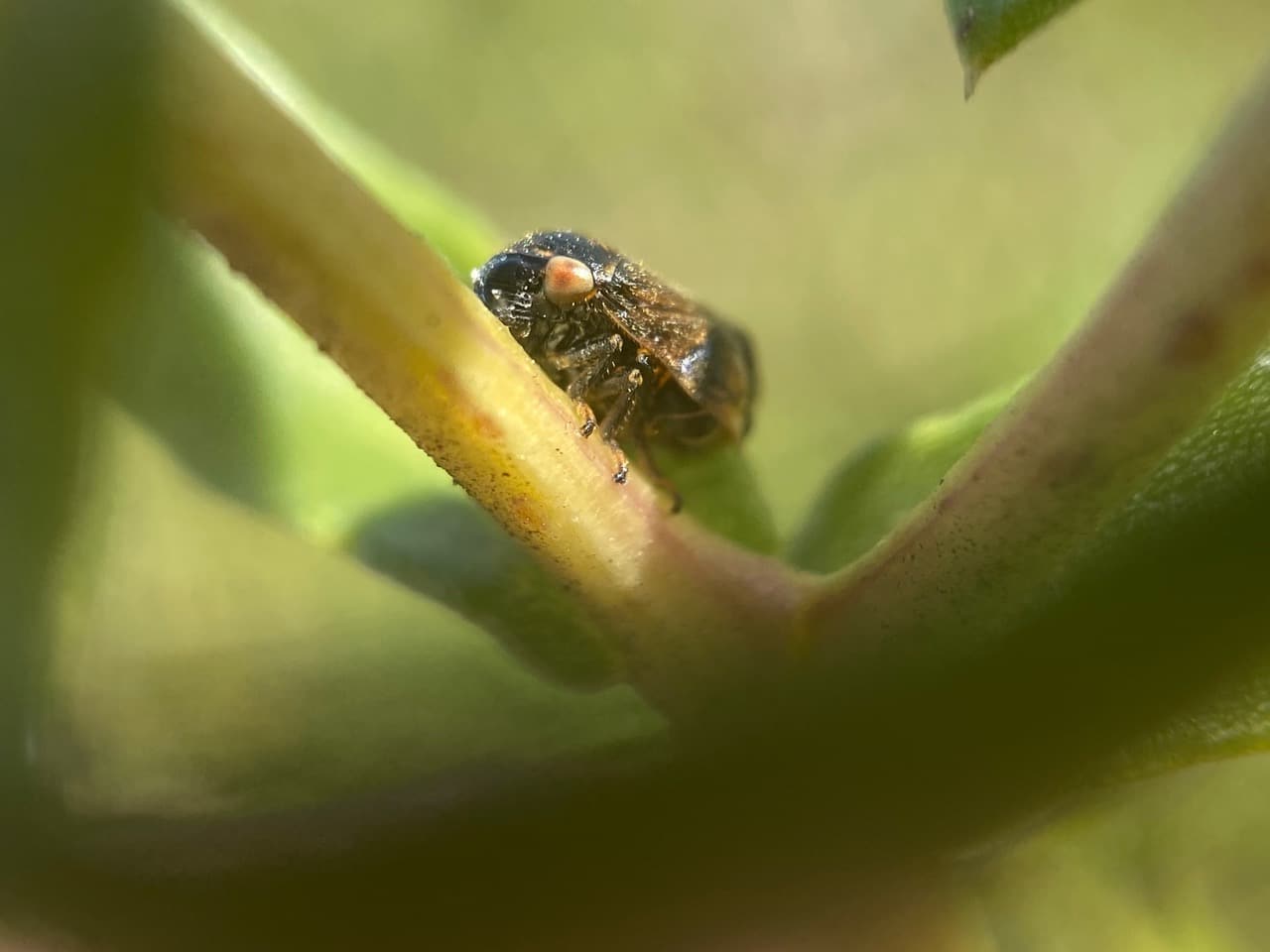
This is as close as I can get to a Spittlebug, and still I can’t see its rostrum (piercing-sucking mouthparts of a Hemipteran or “true bug” that is folded under the body when not in use). Sigh!
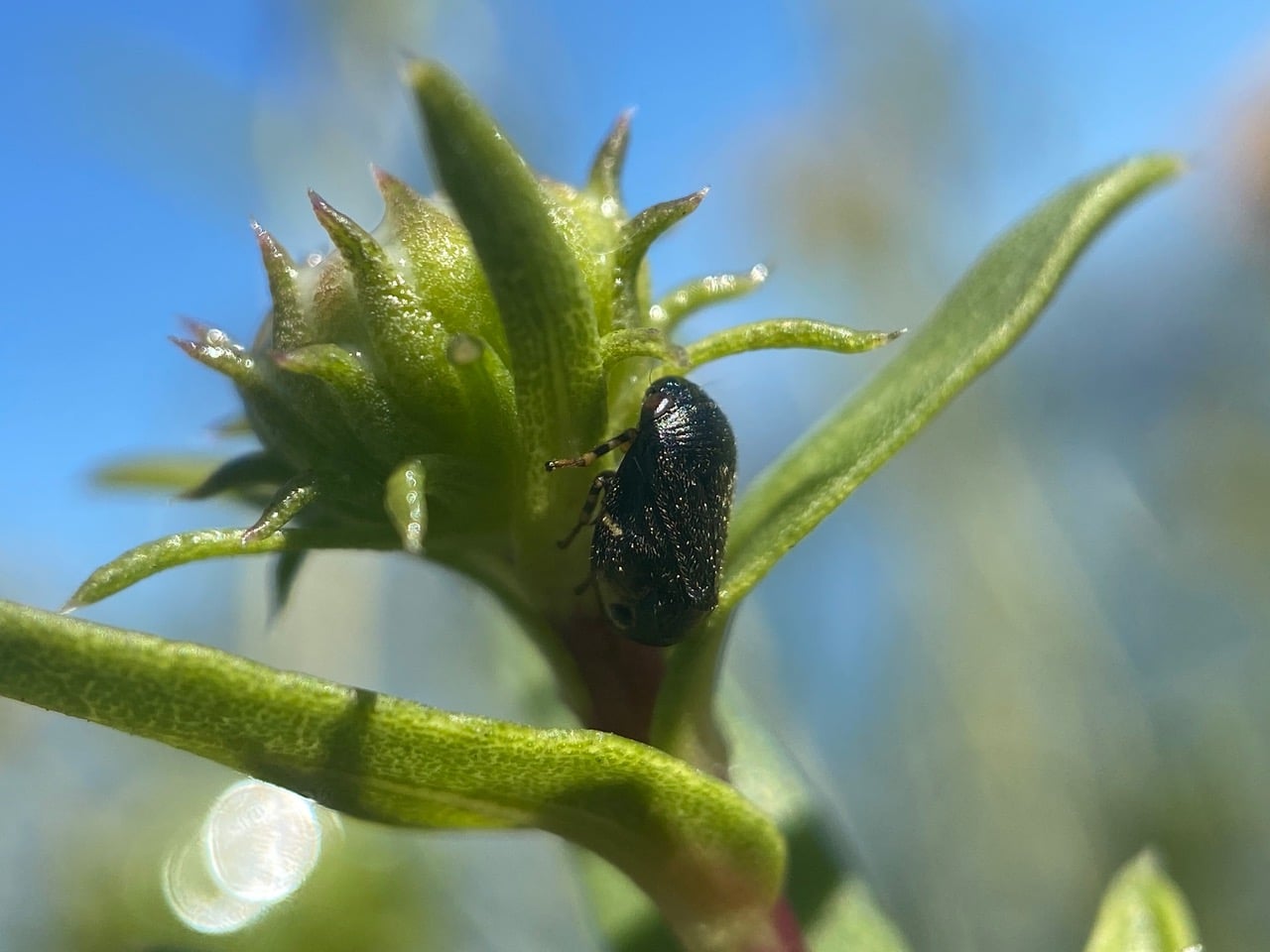
Here’s a black Spittlebug, Complex Clastoptera lineatocollis (family Clastopteridae) clinging to the involucre of an immature Grindelia flowerhead. There appears to be quite a wide variation in color within the species.
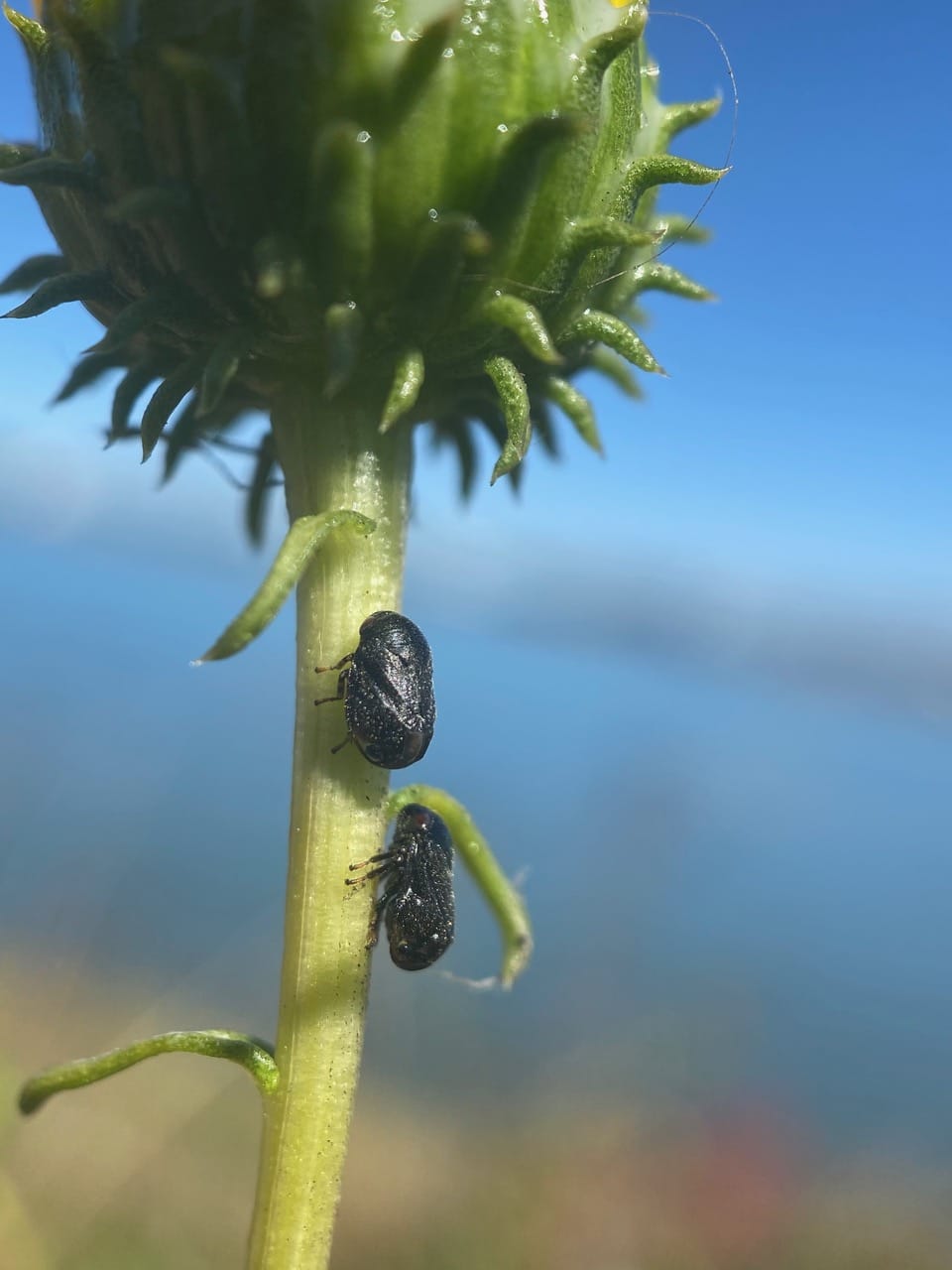
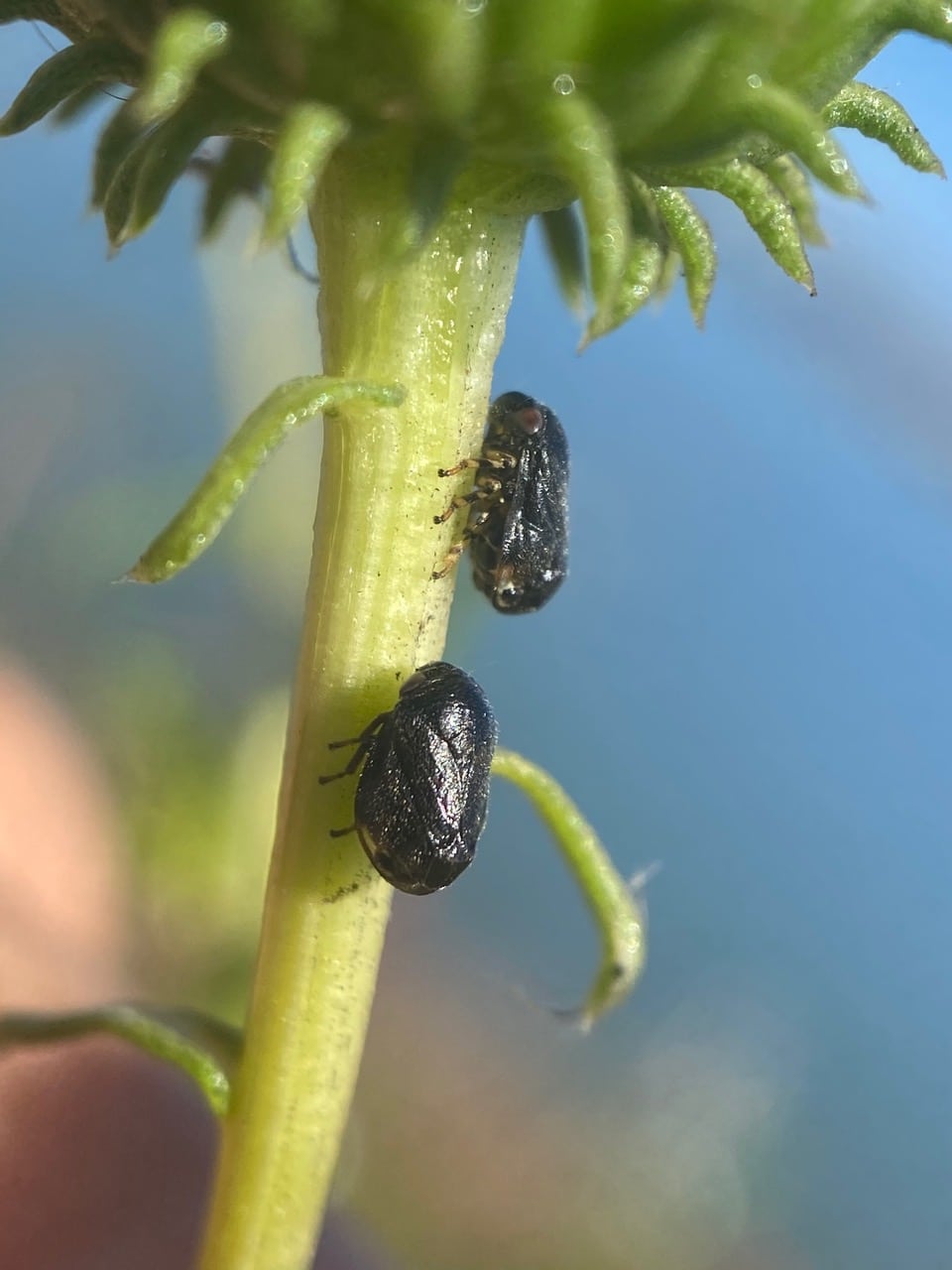
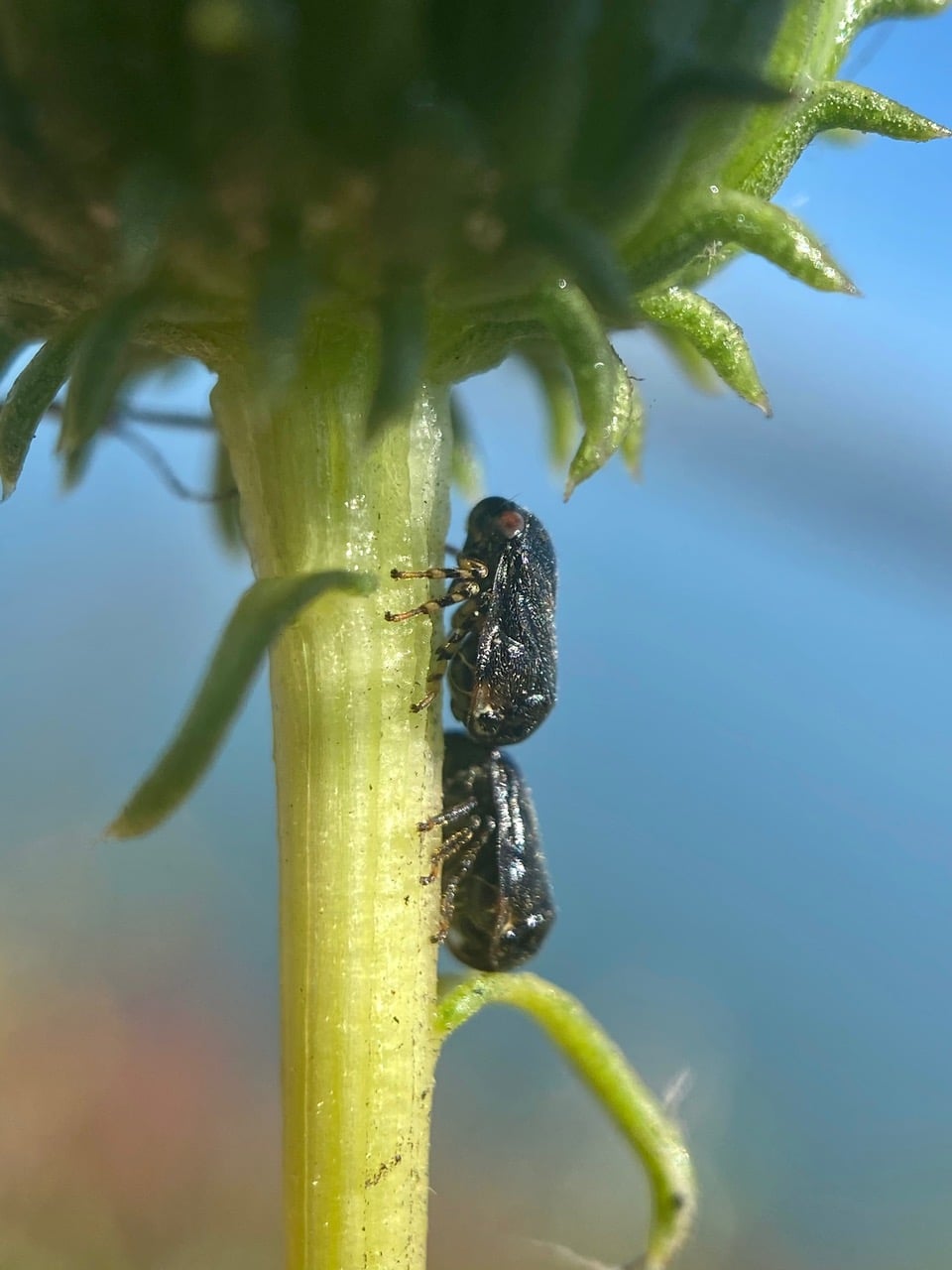
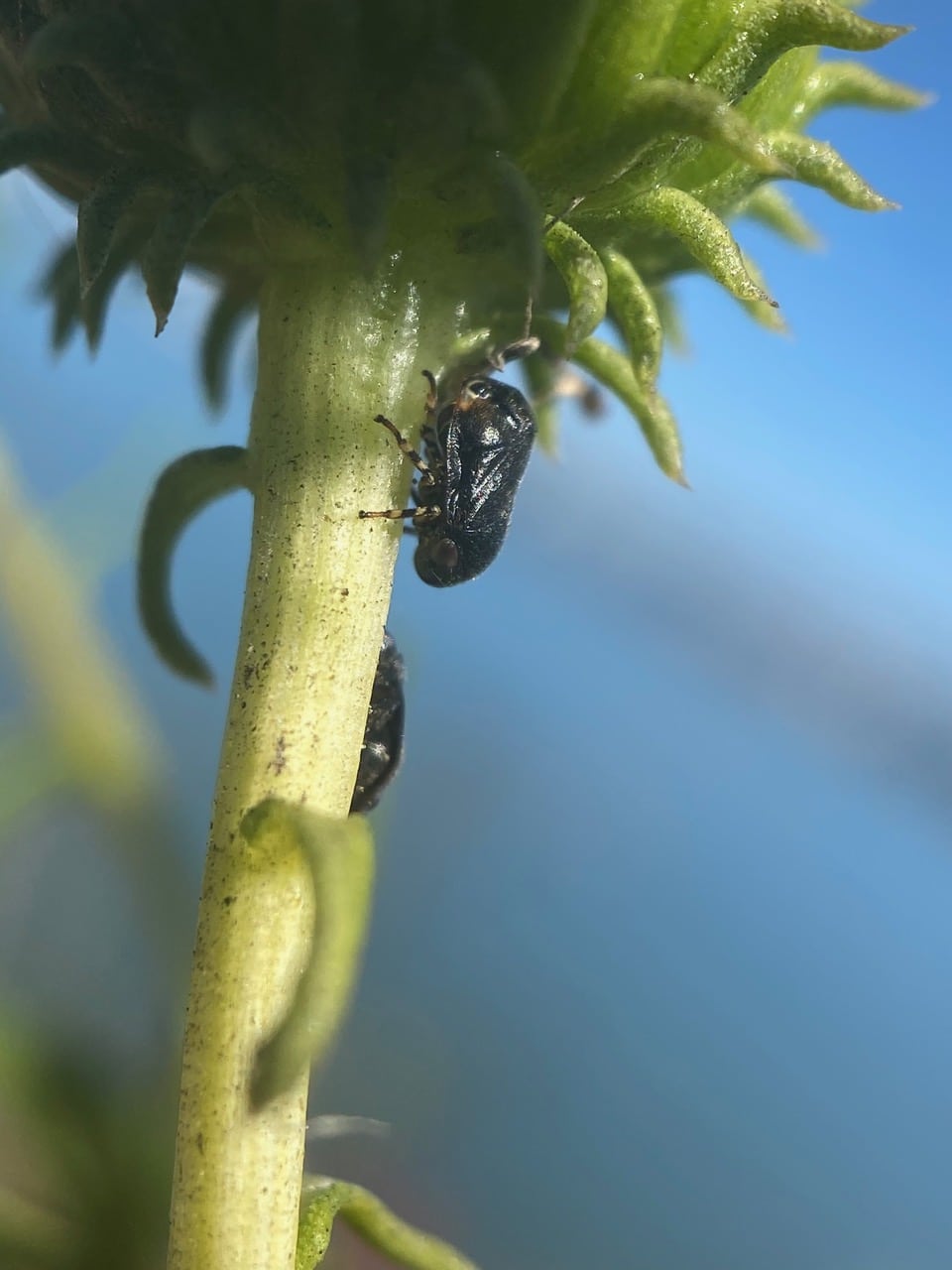
Wait, there are two black Spittlebugs close to each other under a Grindelia flowerhead. I stop to watch if they were interacting.
For a few minutes, the bugs were moving closer to each other, and then they move apart…
One of the bugs turns around and the two are face to face with each other for a while before separating again. One interesting and comical behavior I notice is that the bugs are capable of walking backwards with ease. This is how the false eyespots maybe useful for fooling potential predators. Is this a courting pair? The fact that I have to twist the stem around to get the bugs into light probably does not allow for normal behavior. This do-si-do dance may go on for hours! I mark the plant with a piece of red yarn, and continue on my walk.
When I return about 20 minutes later, I spot a Yellowjacket perched lower down the stem, busy chewing on something. It flies away before I can get a photo. I immediately look for the two Spittlebugs – they are nowhere to be found! The scenario that comes to mind is that the Yellowjacket has nabbed the mating pair. Alternatively, maybe the Yellowjacket got one of them, and the other jumped off. If the spittlebug is considered a pest harming the Grindelia, then the Yellowjacket is certainly providing a service as a natural pest control agent. It takes me a while to come to terms with that thought as I walk away, shaken. Real or imagined, predation is not pretty.
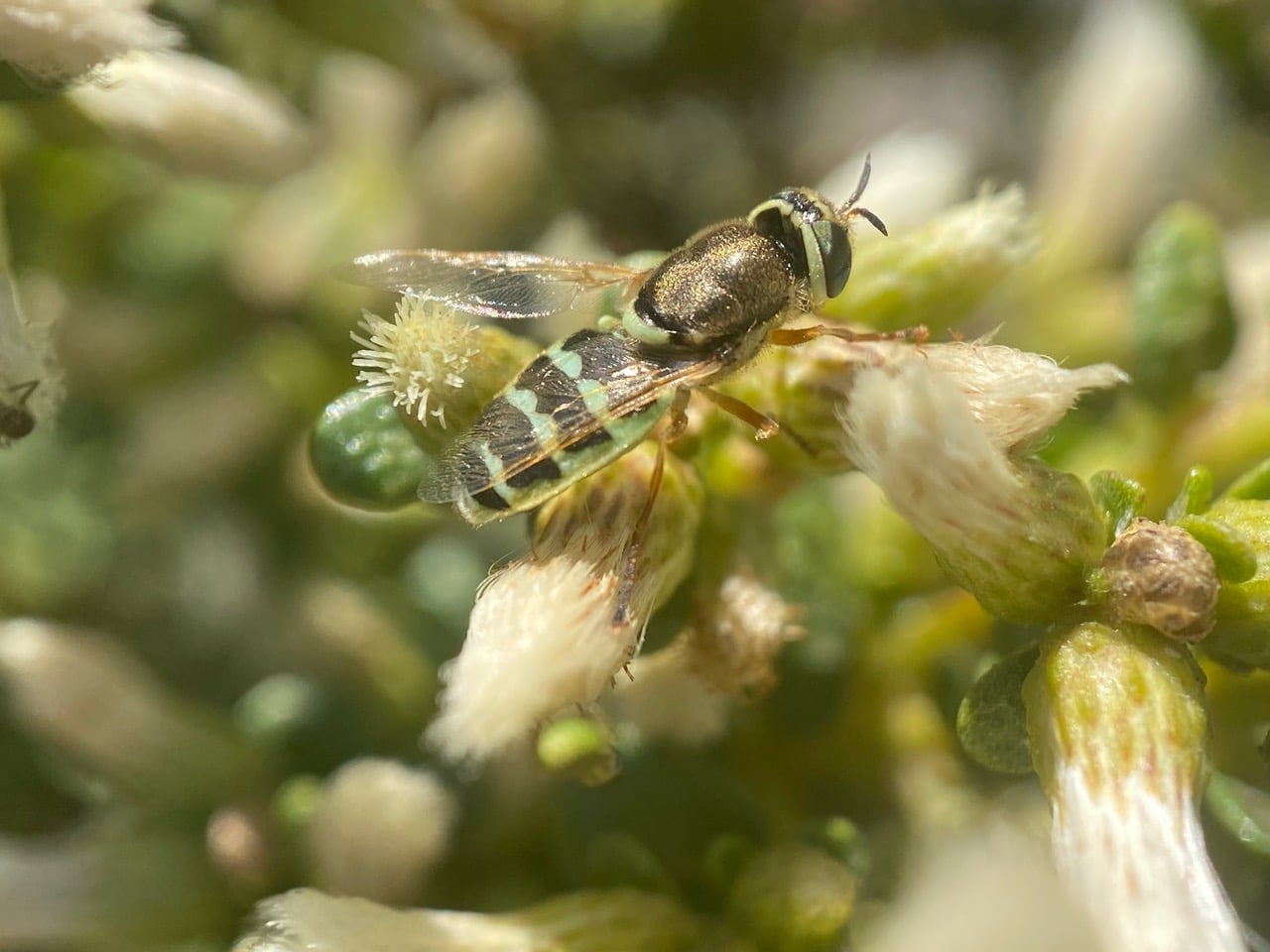
I never fail to find a Soldier Fly, Odontomyia sp. (family Stratiomyidae) on this female Coyote Brush, Baccharis pilularis. This individual is different from the others I have seen – it has a green striped abdomen!
Members of the genus Odontomyia occur throughout much of the world, found in woodlands, fields, usually near water. They are 9-12 mm in length. Adults take nectar, also sometimes found on dung. Larvae are aquatic and feed on algae. Eggs are laid on the edge of body of water. Larvae stick the tip of their abdomen through the water surface to obtain air.
Its proboscis extended, the Soldier Fly is taking nectar from a flowerhead of the female Coyote Brush.
When not in flight, Soldier Flies (family Stratiomyidae) tend to hold their wings neatly folded, one above the other over the abdomen, not quite covering the width of their abdomen.
Perched atop a freshly blooming flowerhead of the Coyote Brush, an Argentine Ant, among other small creatures, is taking nectar.
The Argentine Ant, Linepithema humile (family Formicidae) is native to Northern Argentina, but it has been inadvertently introduced by humans to many countries, and is now an established invasive species in many Mediterranean climate areas worldwide. The success of the species can be attributed to their lack of aggression between the colonies. There is no apparent antagonism between separate colonies of its own kind, resulting in “super-colonies” that extend across hundreds or thousands of kilometers in different parts of the their range. Genetic, behavioral, and chemical analyses show that introduced Argentine Ants on separate continents actually represent a single global supercolony.
The Argentine Ants are ranked among the world’s worst invasive animal species. In its introduced range, the Argentine ant often displaces most or all native ants and can threaten native invertebrates and even small vertebrates that are not accustomed to defending against the aggressive ants. This can, in turn, imperil other species in the ecosystem, such as native plants that depend on native ants for seed dispersal, or lizards that depend on native ants for food.