

Pollinator Post 9/12/23 (2)
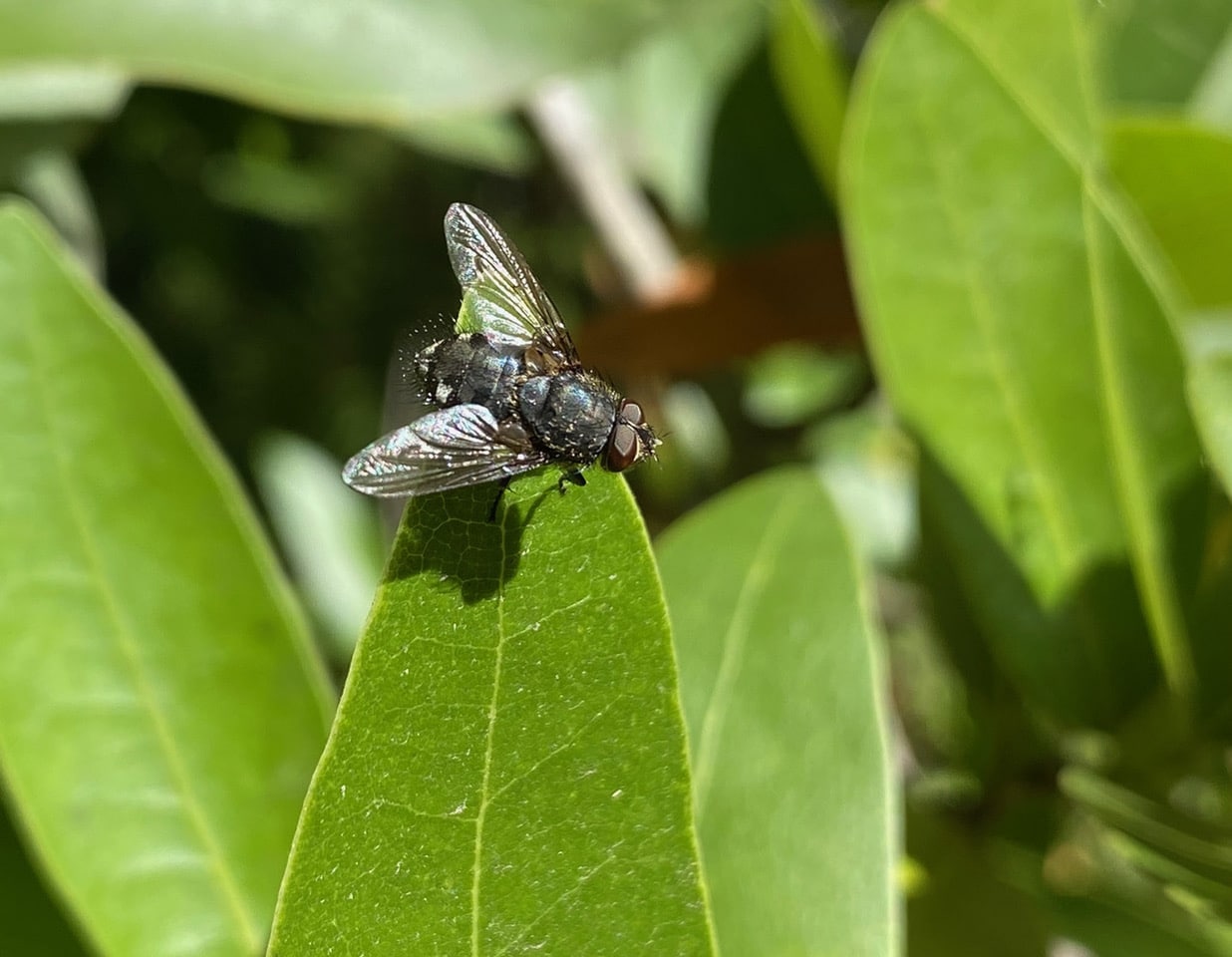
A good sized fly lands momentarily on the tip of a leaf of California Bay. It is a Cluster Fly (family Polleniidae), an earthworm specialist.
Called the Common Cluster Fly, Pollenia rudis (family Polleniidae) is slightly larger than house flies. It is dull gray with checkered black and silvery-black abdomens. A newly emerged fly has many golden hairs on its thorax which may be lost throughout the life of the fly. The common name comes from the tendency of the flies to aggregate near windows when they are trapped in human dwellings. The immature stages – eggs and larvae – are seldom seen because they are deposited on the soil where they burrow into earthworms which they parasitize. The Cluster Fly is a European species. They may have found their way to America in the ballast of ships containing soil, probably along with introduced earthworms.
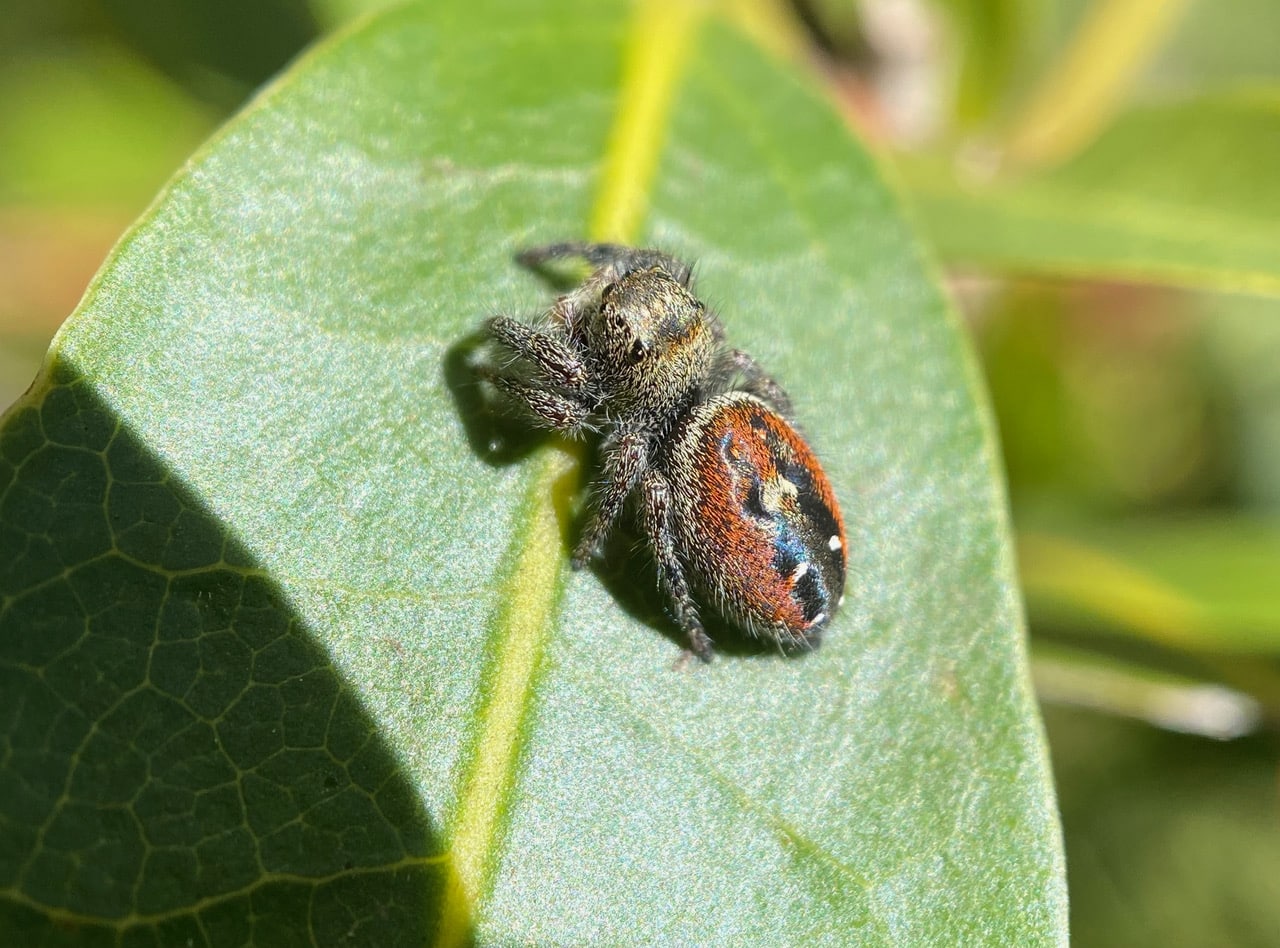 Look who else is on the bay tree – a female Red-backed Jumping Spider! Phidippus johnsoni (family Salticidae) is one of the largest and most commonly encountered jumping spiders in western North America. The sexes are easy to tell apart – males have an all-red abdomen. I am particularly fond of this species as I have kept a female as a pet. They are curious, bold and intelligent creatures, and formidable hunters.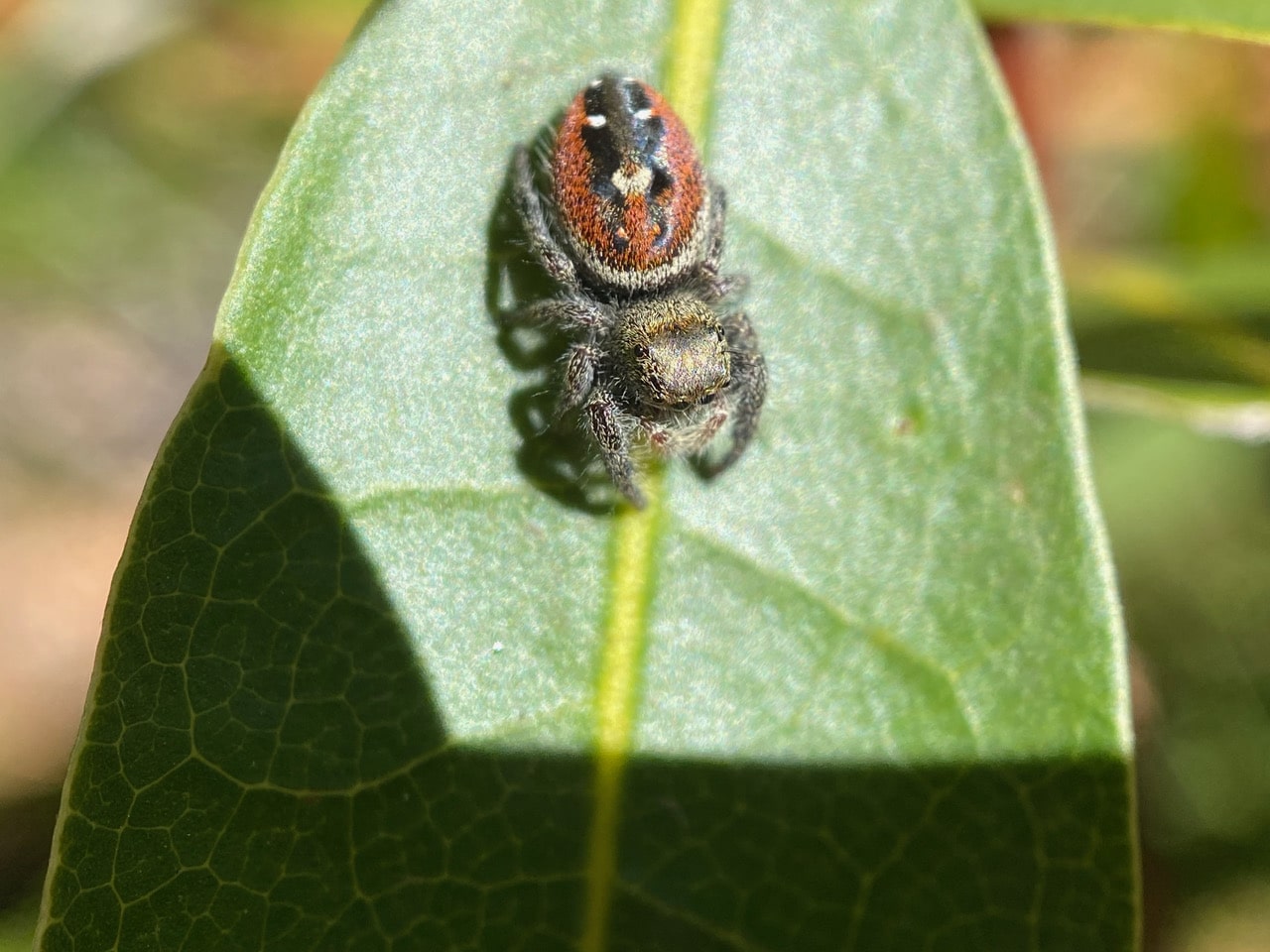
Salticids are free-roaming hunting spiders. They do not weave a web to catch prey. They stalk, then pounce on their prey. Just before jumping, the spider fastens a safety line to the substrate. It can leap 10-20 times their body length to capture prey. Their movement is achieved by rapid changes in hydraulic pressure of the blood. Muscular contractions force fluids into the hind legs, which cause them to extend extremely quickly.
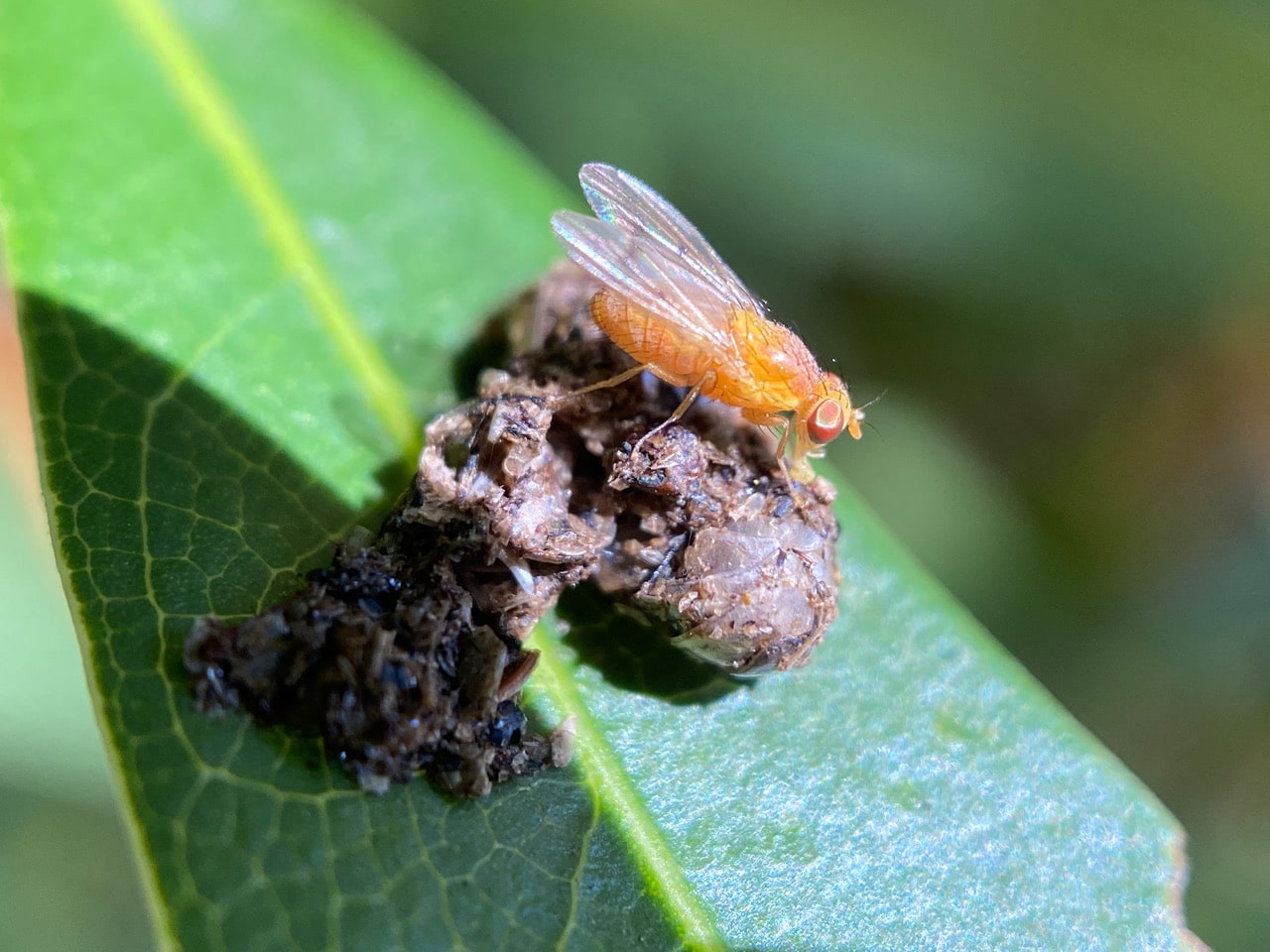
One man’s trash is another man’s treasure. Its proboscis extended, a Lauxaniid Fly, Neogriphoneura sordida (family Lauxaniidae) is eagerly feeding on the pile of fecal material on a leaf of California Bay. Apparently the adult flies are scavengers on foliage.
Lauxaniidae are small flies (2-7 mm in length). They are often rather plump and dull, the body color varying from yellow-brown to black, or with a combination of these colors. They are characterized by strong, backward pointing bristles on the front (top of the head right above the eyes). The larvae are mostly saprophages, feeding in leaf litter, soil, bird nests, etc. Larvae of some mine fallen leaves, others live in rotten wood.

Hey, our Two-tubercled Orb Weaver has moved – it is clinging upside-down to an opened seed capsule on the Soap Plant, Chlorogalum pomeridianum. So obviously it wasn’t dead when I photographed her yesterday. We are now looking at the rear end of the spider.
The Two-tubercled Orb Weaver, Gibbaranea bituberculata is a species of ‘orbweavers’ belonging to the family Araneidae. They are found in sunny habitats on shrubs, edges and low plants, where they can make their webs near the ground. Their basic color is very variable, but usually it is brownish, with whitish shades. The cephalothorax is covered with lying down hairs.
Orb-weaver spiders are members of the spider family Araneidae. They are the most common group of builders of spiral wheel-shaped webs often found in gardens, fields, and forests. Generally, orb-weavers are three-clawed builders of flat webs with sticky spiral capture silk. The third claw is used to walk on the non-sticky part of the web. Typically, the prey insect that blunders into the sticky lines is stunned by a quick bite, and then wrapped in silk.

Side view of the spider, showing her deflated abdomen. As with most females who have laid their eggs, she will probably not feed again, and will slowly fade away.
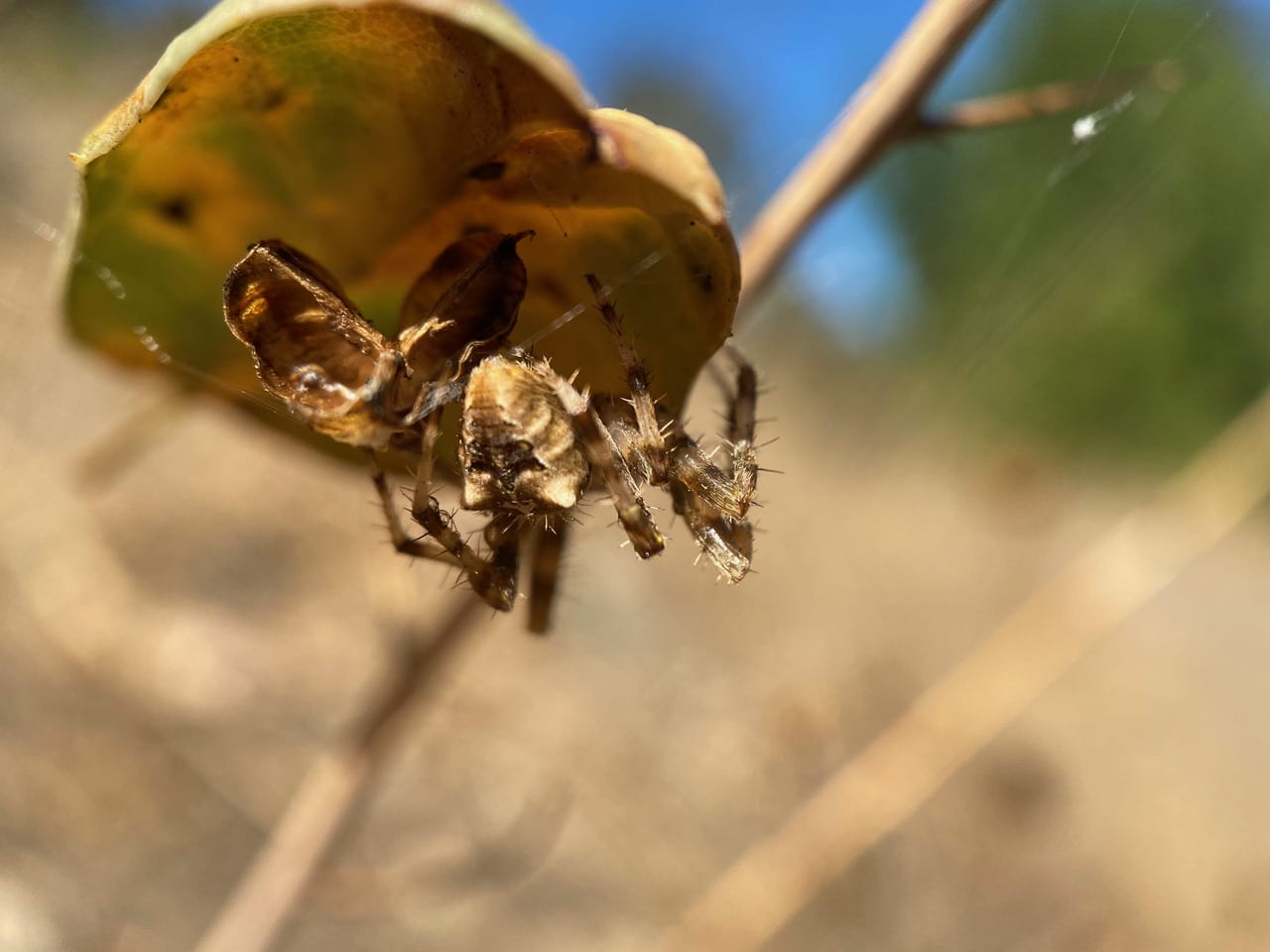
I look for the smaller Two-tubercled Orb Weaver on the adjacent Soap Plant, but can’t find it. Surprisingly, it’s now on the larger plant that belongs to our large Two-tubercled Orb Weaver. The little one (let’s call it Leggy) is hanging under a dried oak leaf that has been incorporated into a web around a seed capsule. Leggy probably senses that the owner of the territory is dying, and has moved over to take over the superior real estate. It would be fun to observe Leggy from now on, and to determine whether it is male or female.
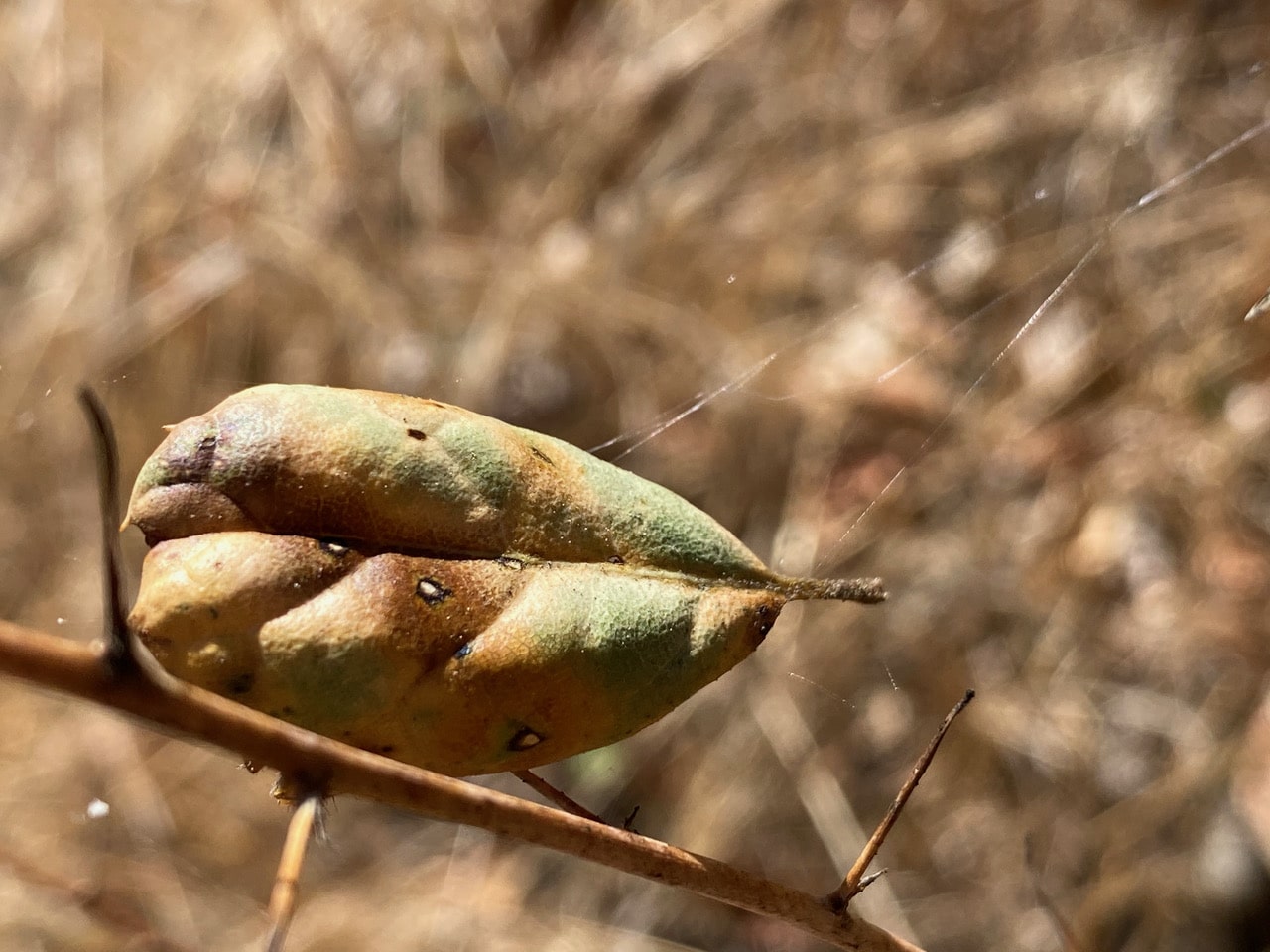
This is the oak leaf that Leggie is sheltering under. Note that it has been securely attached to the plant with several strong silk threads.

Further along Skyline Trail towards Siesta Gate, I notice numerous Coast Live Oak leaves strewn about on the ground that are still greenish. Most have these beautiful yellow and brown blemishes. I wonder what causes the blemishes and the leaf fall. Fungal infection?
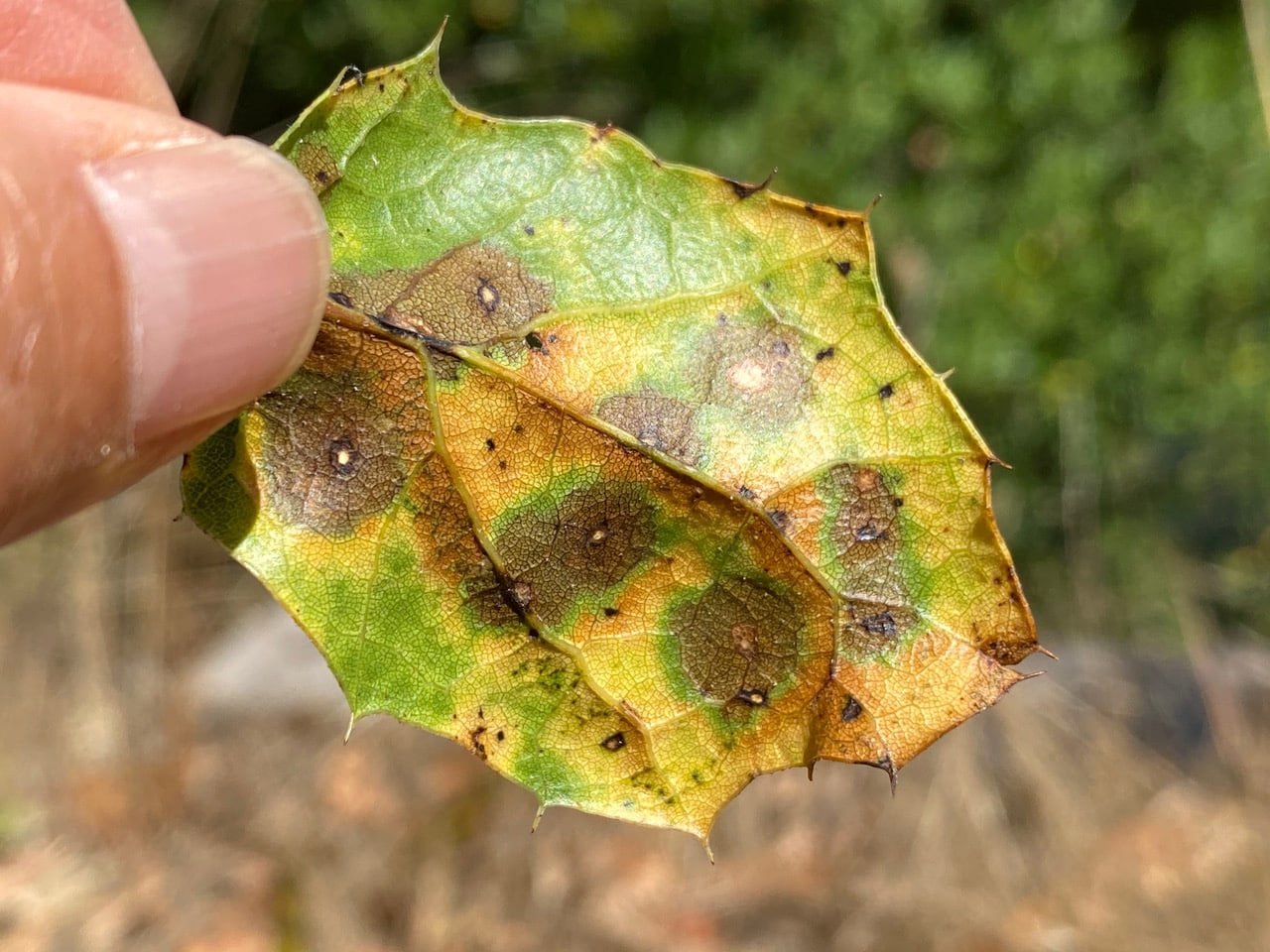
Underside of one of the fallen leaves. There seems to be a white puncture wound in the center of each of the brown spots. Can these be caused by a bug with piercing-sucking mouthparts?

The leaves do not appear to be galled or mined. I don’t know the answer to the mystery, but do enjoy looking at the beautiful patterns on the leaves.