

Pollinator Post 9/12/23 (1)
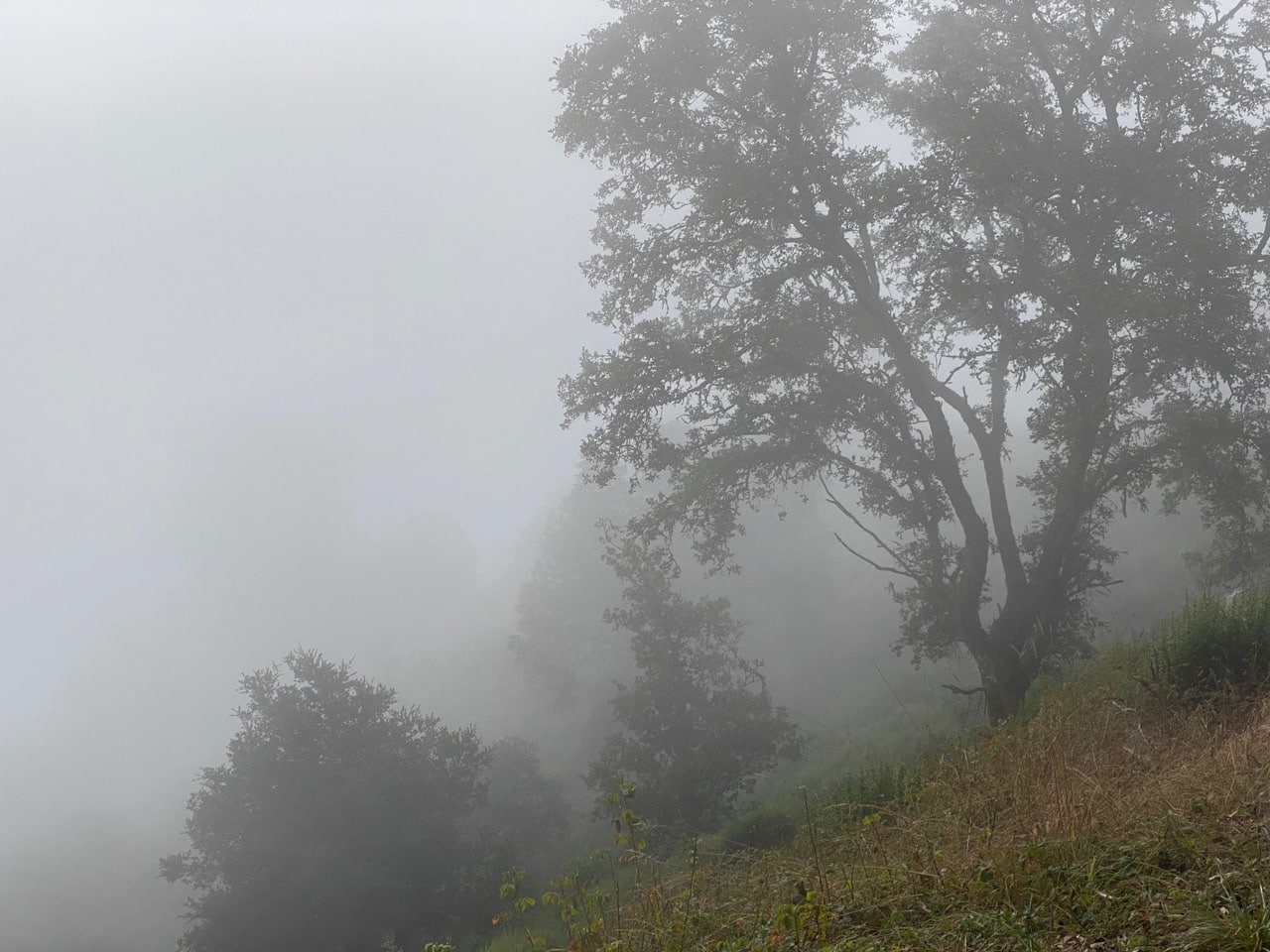
Excited by the prospect of seeing Blue, our Pale Swallowtail caterpillar for the last time before it wanders off to pupate, I arrive early at the garden while it is still shrouded in fog. I feel silly, as it would be impossible to see, let alone photograph the caterpillar in such low light.




 Even smaller than the Sharpshooter is this tiny insect on a Coffeeberry leaf. I recognize it as a Barklouse (order Psocodea, formerly Psocoptera). A Psocodea expert on iNaturalist has identified it as a Lizard Barklouse, Valenzuela sp.(family Caeciliusidae). This is yet another new family of Psocids for Skyline Gardens!
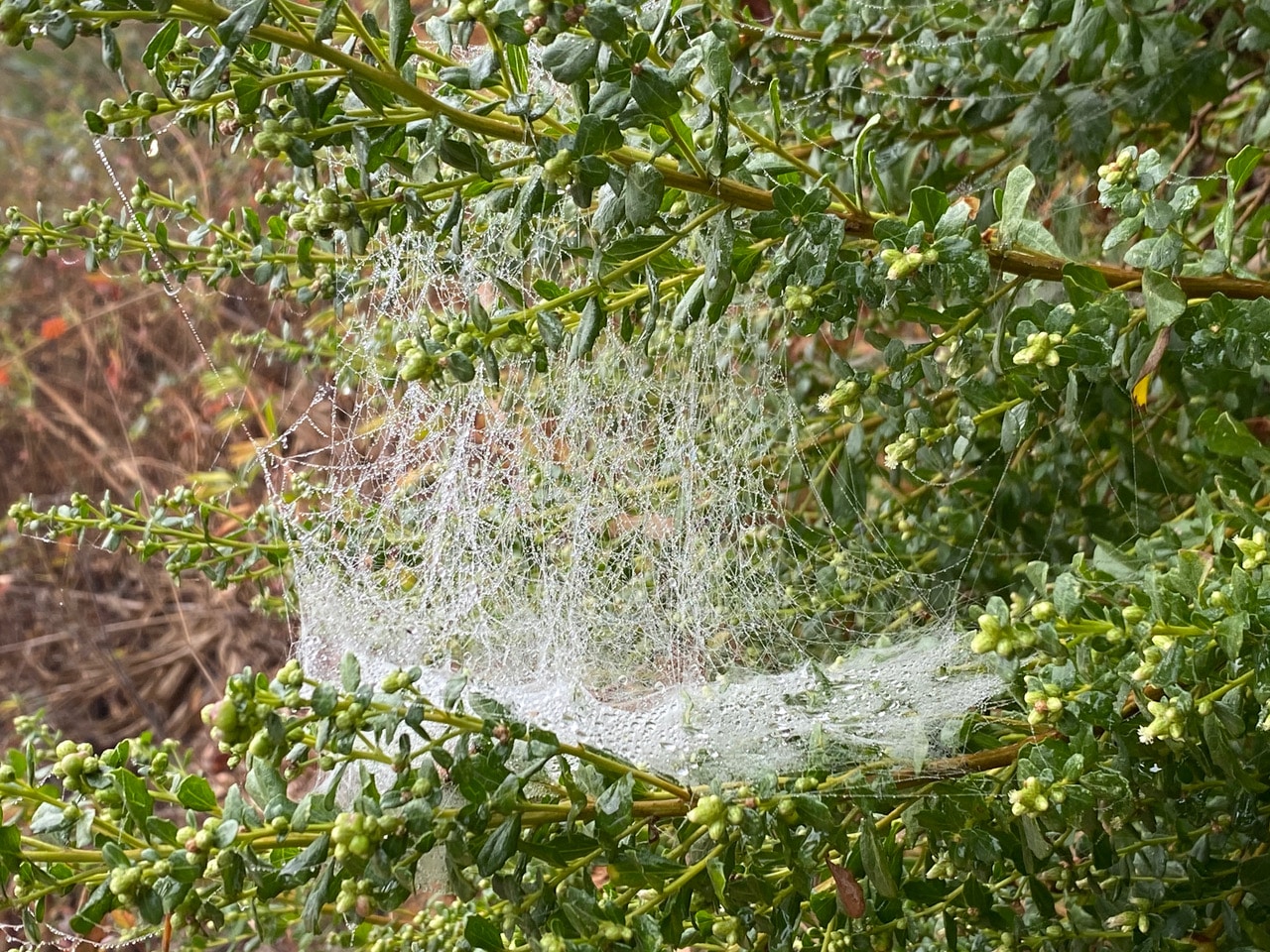
The fog begins to clear as I make my way up the paved road. Every spider web on the vegetation is visible, festooned with condensed fog. I stop to admire this elaborate sheet web on a Coyote Brush.
The webs of Sheetweb Weavers (family Linyphiidae) form a flat or curved surface suspended from vegetation or over an opening on the ground. Above the actual “sheet” is an elaborate matrix of silk threads to confuse and disorient prey insects as they fly through. The spiders hang beneath the web and attack prey that wander or fall onto the web surface by biting directly through the silk webbing. Most species are tiny; some are among the smallest of spiders. A few of the common and larger species build distinctive webs for which they are named, such as the “bowl-and-doily” spider, the “filmy-dome” spider, and the “hammock” spider. Linyphiids are famous for dispersing by ballooning (flying by means of silk strands carried in a breeze), and these spiders are often responsible for the sheets of gossamer which sometimes coat fields and fences.
Close-up of water droplets on the tangled silk strands above the horizontal sheet web.
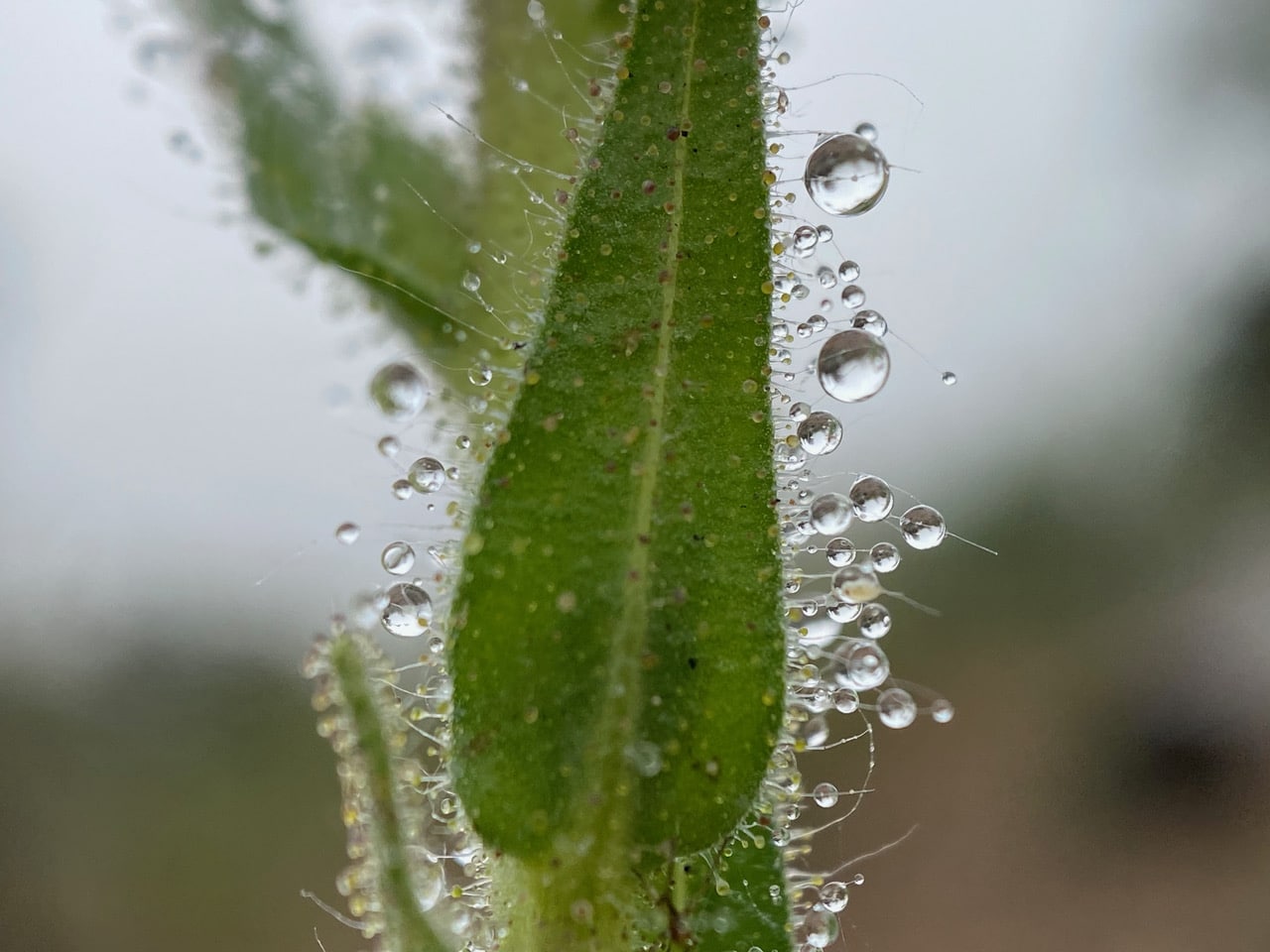
There’s something about fine fibers that attract water in the air. The longer, fine hairs on the leaf of this Coast Tarweed, Madia sativa have also gathered a fair share of the atmospheric moisture. These hairs are distinct from the shorter glandular hairs that secrete the sticky exudates of tarweeds.
Water droplets not withstanding, these aphids, Uroleucon sp. (family Aphididae) are holding on with their mouthparts securely affixed to the stem of a Coast Tarweed.
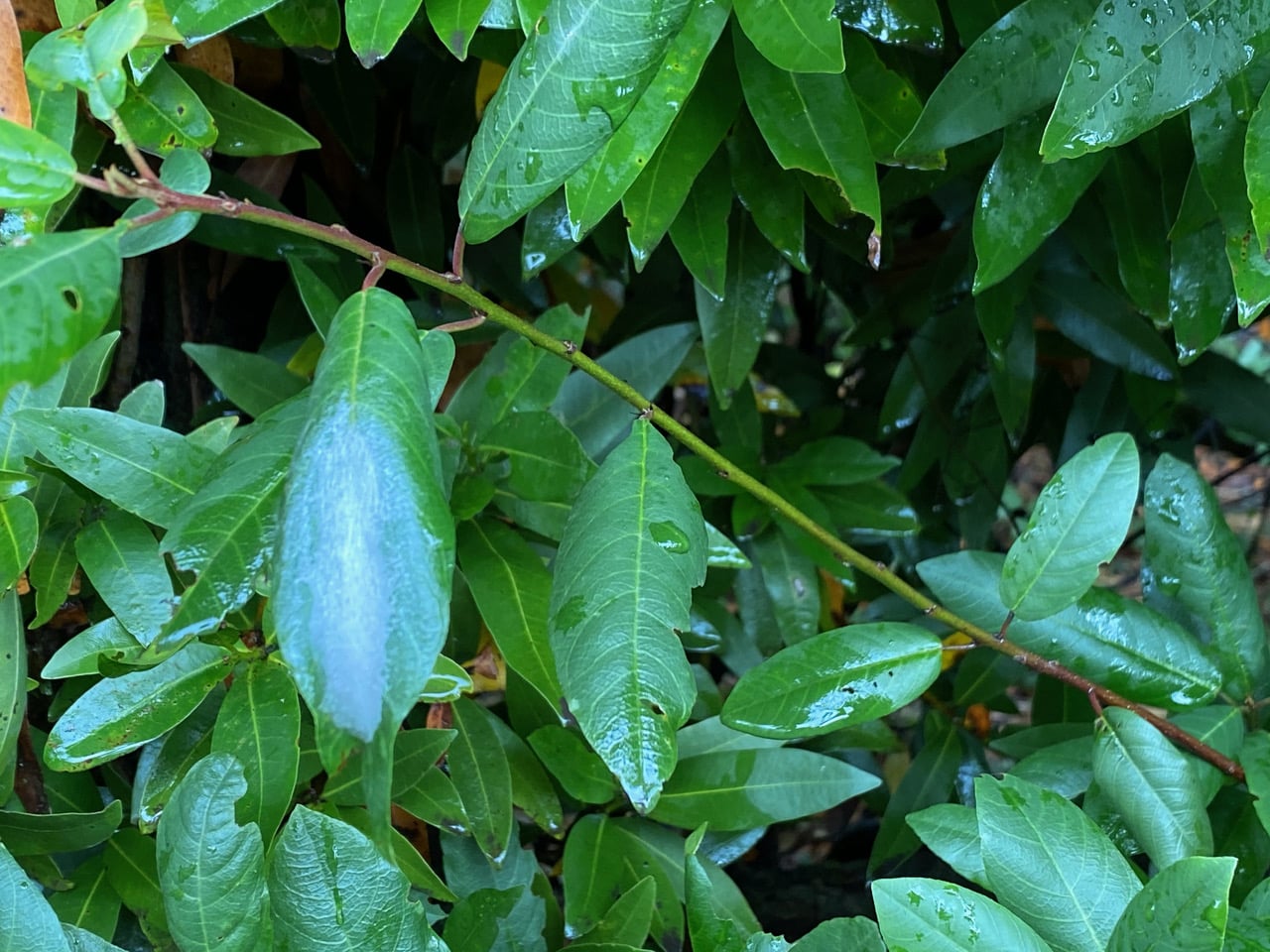
Aww, I am too late for Blue! It is no longer on its home leaf on the Coffeeberry bush. Its silk pad is soaked with fog drip. I suspect Blue must have started its walk-about in the dark of night. I think Blue has been feeding at night too, as I have hardly seen it move from its silk pad during the day.
I notice for the first time that Blue might have removed the lower leaves that it has been feeding on. Or maybe the damaged leaves have withered and fallen off on their own? Either way, this provides a clear passage for Blue’s exit from the plant.
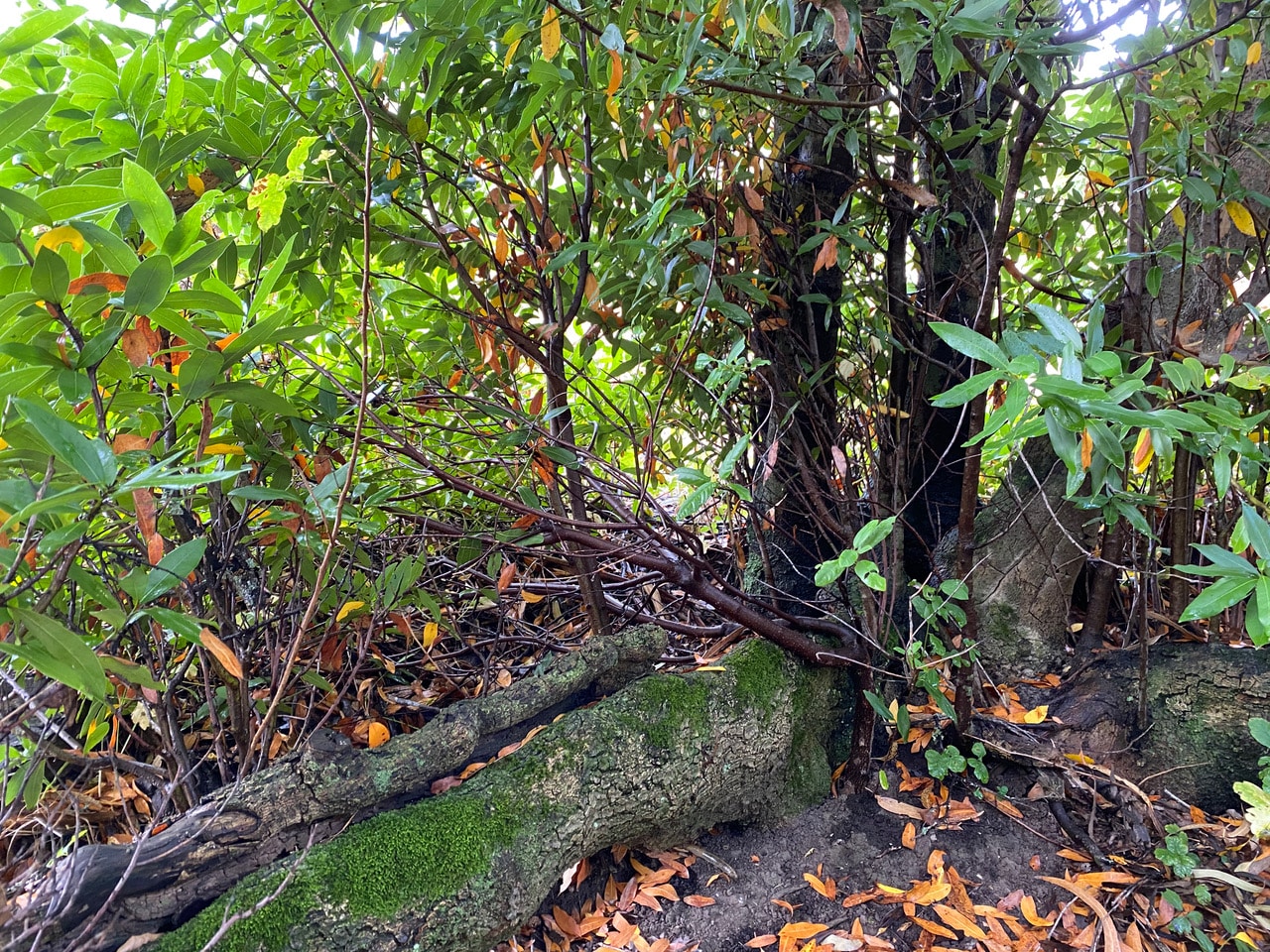
Carefully avoiding poison oak, I step off the trail to investigate the backside of Blue’s Coffeeberry to figure out where the caterpillar might have gone. The spindly shrub, leaning obliquely for the sun, is entangled with the multi-trunked California Bay tree under which it grows. According to Alan, Pale Swallowtail caterpillars almost never pupate on their host plant. So Blue would most likely have crawled down the Coffeeberry and onto the bay tree. There are a million nooks and crannies on the bark to which Blue could attach its chrysalis. Given the amazing camouflage of the Pale Swallowtail chrysalis, there’s no way that I can find Blue in such a complex environment. I am comforted to know that Blue can pupate safely here, sheltered from heavy rains and winds through the winter.
Sweet slumber, Blue. I look forward to seeing you in the spring, a full-fledged butterfly!
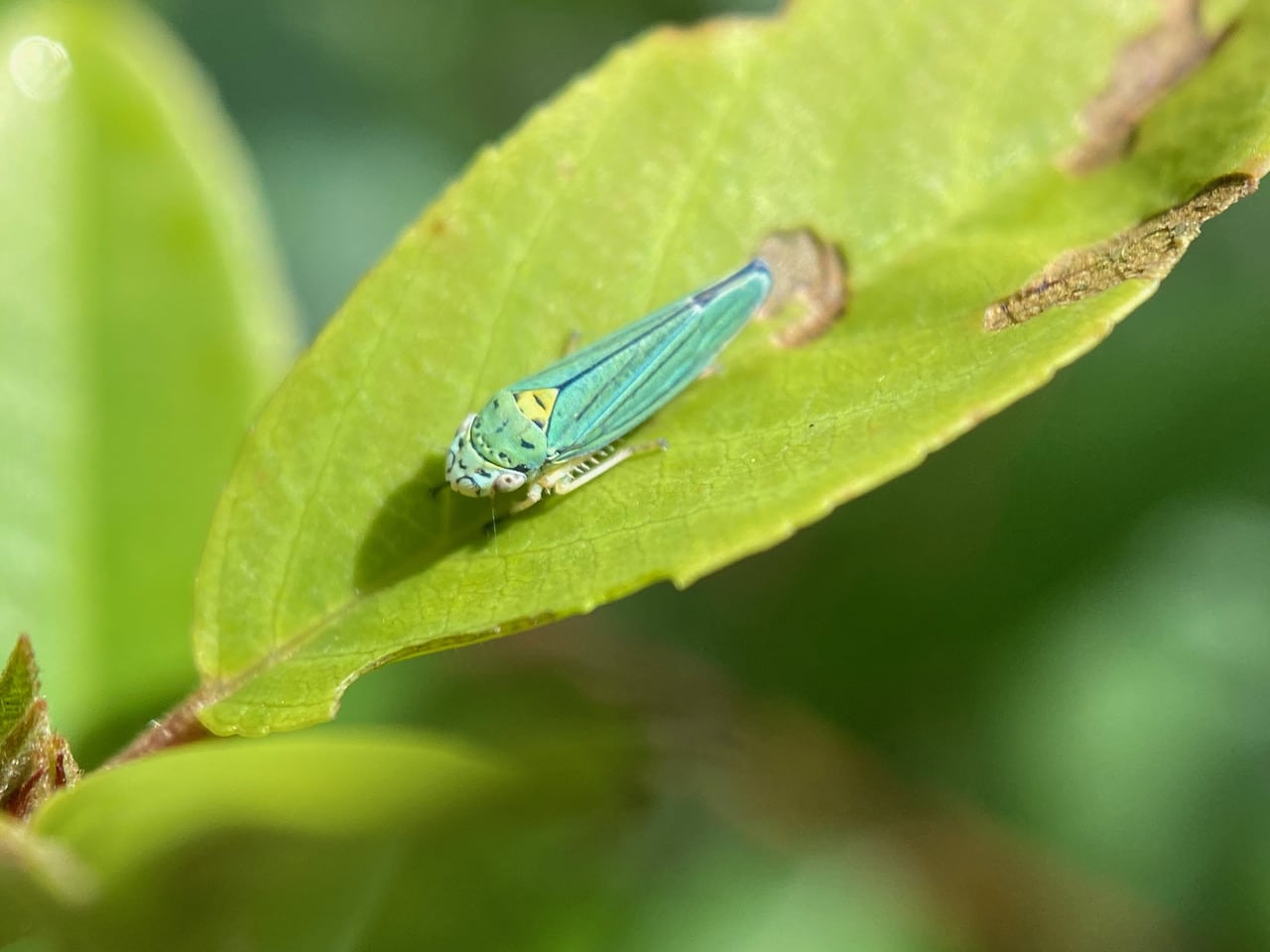
I pause at the next Coffeeberry bush along the trail, hoping to find the Bush Katydid nymph I encountered last time. It’s not here today, but look at this small insect with the striking turquoise color! The neat rows of comb-like spines along its hind legs quickly identify it as a Leafhopper (family Cicadellidae).
iNaturalist identifies the leafhopper to the species – the Blue-green Sharpshooter, Graphocephalus atropunctata (family Cicadellidae). The small insect is a hemipteran bug endemic to California. It is about 0.4 in long with blue or bluish-green color on the upper surface while the head, prothorax, legs and underside are lighter and yellow-green. Adult blue-green sharpshooters are long-lived. Both nymphs and adults share the peculiar habit of running sideways. There is usually only a single generation per year. The females mature during their first winter and lay eggs the following spring. The bugs can be found in the vegetation alongside streams and rivers, in locations with abundant soil moisture and some shade. They can be found on the leaves of native as well as cultivated ornamental plants and crops. More than 150 plants have been recorded as hosts.
The Blue-green Sharpshooter is known to be a carrier of Pierce’s Disease, a disease infecting grape vine, among other crops of economic importance. As the bugs feed, they inject plants with a bacteria that causes the disease, blocking the flow of water and nutrients through the xylem.
Leafhopper is the common name given to true bugs in the family Cicadellidae. The bugs are plant feeders that suck plant sap from grass, shrubs, or trees. Their hind legs are modified for jumping, and are covered with hairs that facilitate the spreading of a secretion over their bodies that act as a water repellent and carrier of pheromones. They undergo partial metamorphosis, and have various host associations, varying from very generalized to very specific.
While sucking the sap of plants, these insects excrete any extra sugar as a sticky liquid commonly called honeydew. This is a serious hazard for small insects, possibly sticking the insect to a leaf, or gluing its body parts together. Some bugs deal with this problem by shooting the waste away from their bodies at high speed. Leafhoppers have a unique solution – they make brochosomes, a proteinaceous material within a special gland in their guts, and secrete them by the billions in a milky anal fluid, and spread them over their bodies using their legs. When the fluid dries, the brochosomes form a powdery coating, and the leafhoppers spread them even further using comb-like hairs on their legs. The brochosomal coat is superhydrophobic, and acts as a water-repellent, non-stick coating protecting the leafhoppers from their own sticky exudates.
Sharpshooters feed on the plant’s xylem, extracting small amounts of nutrients in large volumes of water, forcing them to eliminate up to 300 times their body weight in liquid waste each day. To accomplish this, the sharpshooters employ an energy-efficient mechanism called super propulsion to expel their urine using an anal catapult.
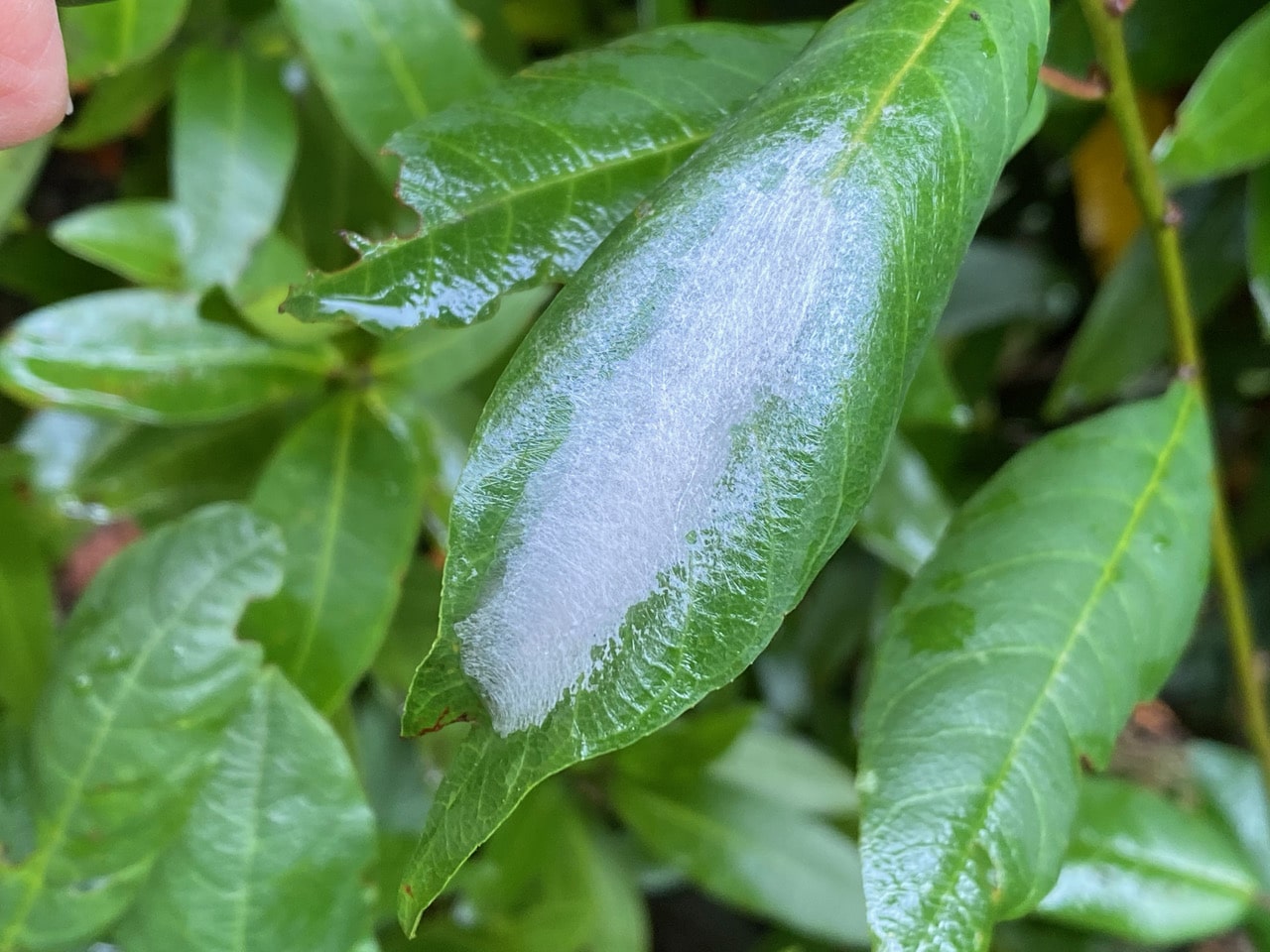
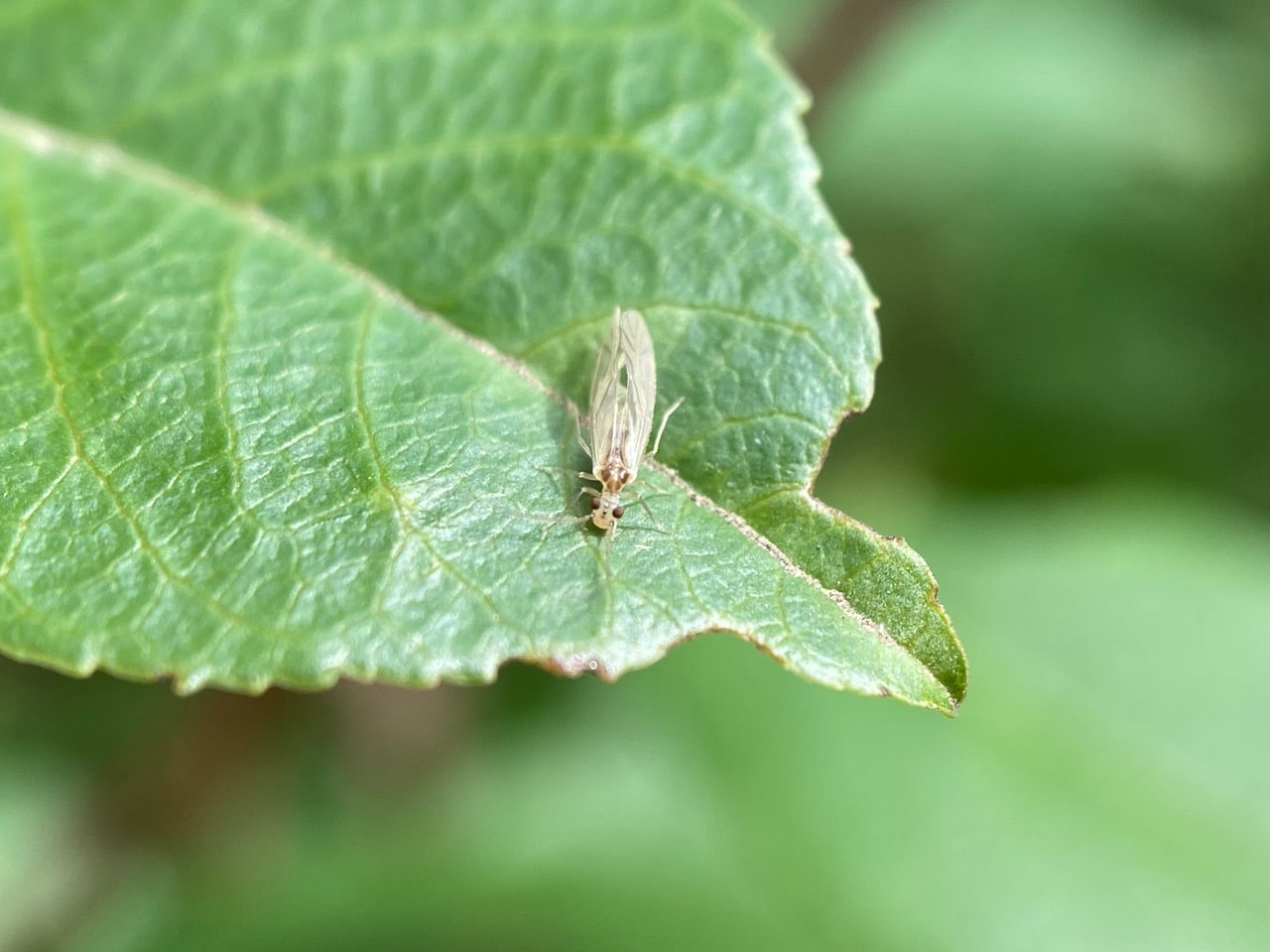
Even smaller than the Sharpshooter is this tiny insect on a Coffeeberry leaf. I recognize it as a Barklouse (order Psocodea, formerly Psocoptera). A Psocodea expert on iNaturalist has identified it as a Lizard Barklouse, Valenzuela sp.(family Caeciliusidae). This is yet another new family of Psocids for Skyline Gardens!The scientific name Psocodea comes from the Greek psocus (to grind) referring to the psocodean jaws, which are shaped to grind food, rather like a pestle and mortar. These insects are conveniently discussed in two groups – barklice that live outdoors, and booklice that are found in human habitations.
Barklice are usually found in moist places, such as leaf litter, under stones, on vegetation or under tree bark. They have long antennae, broad heads and bulging eyes. They feed on algae, lichens, fungi and various plant matter, such as pollen. Barklice are usually less than 6 mm, and the adults are often winged. The wings are held roof-like over their bodies. Some species are gregarious, living in small colonies beneath a gossamer blanket spun with silk from labial glands in their mouth. Sometimes the colonies seem to move in coordinated fashion, rather like sheep.
Booklice are wingless and are much smaller (less than 2 mm). They are commonly found in human dwellings, feeding on stored grain, book bindings, wallpaper paste and other starchy products, and on the minute traces of mold found in old books.
Psocodea undergo incomplete metamorphosis. They are regarded as the most primitive amongst the hemipteroids (true bugs, the thrips and lice) because their mouthpart show the least modification from those of the earliest known fossils.
Members of the genus Valenzuela are leaf-inhabiting species. Eggs are laid bare and webbed.