

Pollinator Post 9/11/24
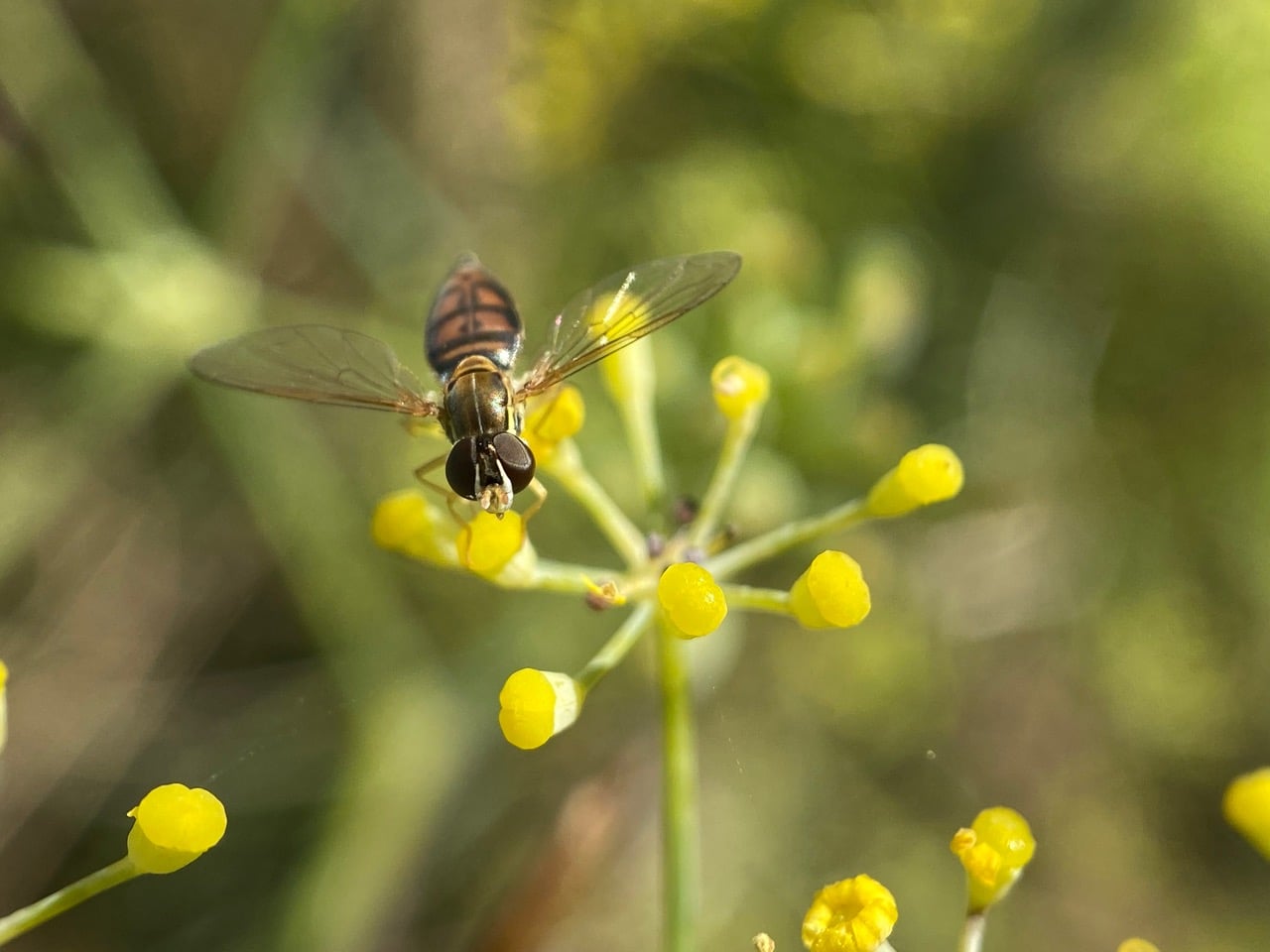
A Margined Calligrapher, Toxomerus marginatus (family Syrphidae) is foraging on the succulent style base of a Fennel flower. Do these flowers still produce nectar after they have shed their petals?
Toxomerus marginatus, also known as the Margined Calligrapher is a common species of hoverfly found in North America. These are small hoverflies, measuring 5-6 mm in length. The abdomen is black and yellow, and is narrowly margined with yellow. Adults are found in diverse habitats such as forests, fields, meadows, marshes, deserts, and alpine areas. They are highly adaptable and can occur is very disturbed habitats. Larvae prey on aphids, thrips, mites, and small caterpillars. Adults visit flowers for nectar and pollen.
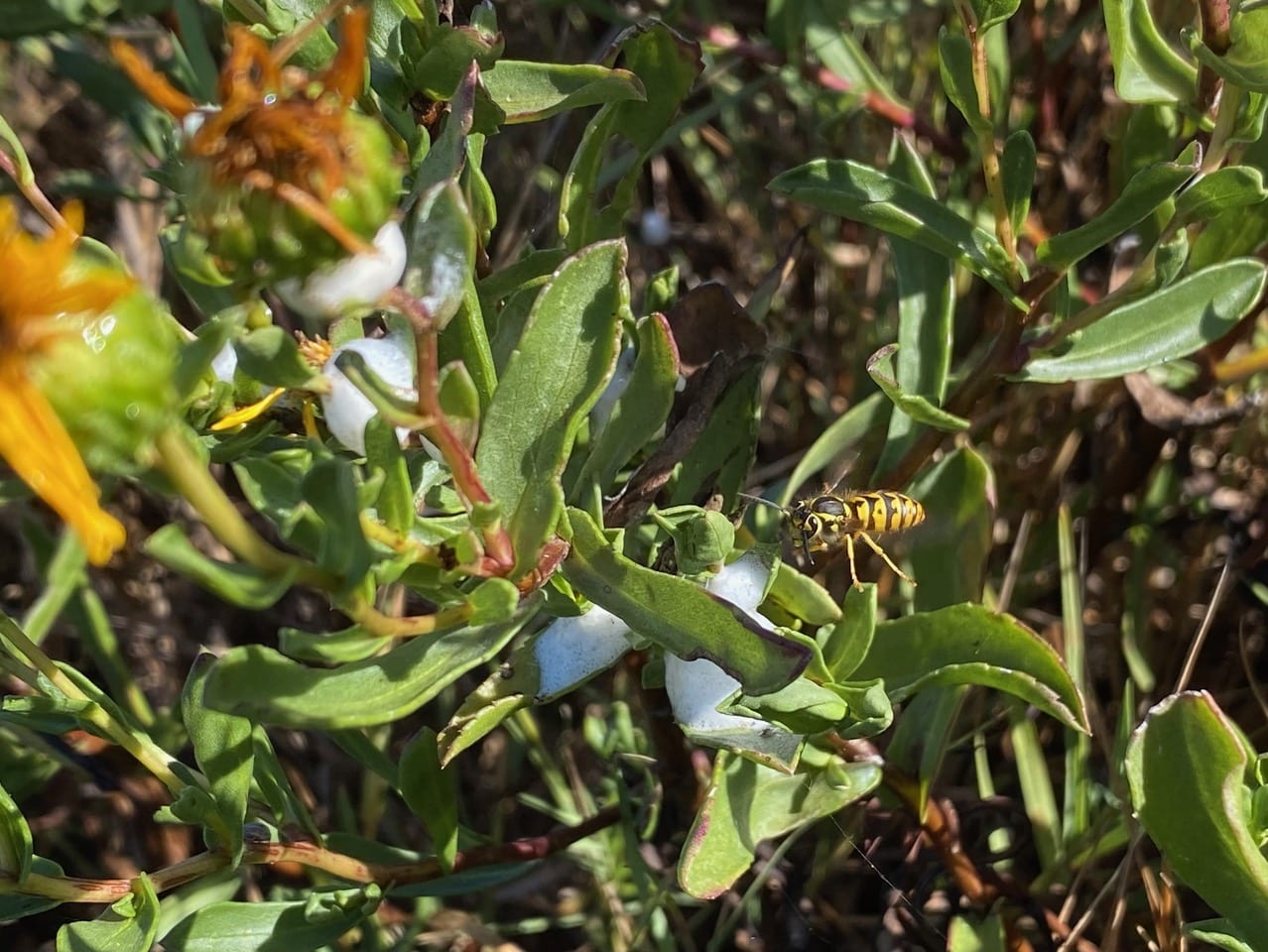
A Yellowjacket is patrolling the foamy masses on the Oregon Gumweed, Grindelia stricta. Is it hunting for Spittlebugs?
Yellowjacket is the common name for predatory social wasps of the genera Vespula and Dolicovespula (family Vespidae). Yellowjackets are social hunters living in colonies containing workers, queens, and males (drones). Colonies are annual with only inseminated queens overwintering. Queens emerge during the warm days of late spring or early summer, select a nest site, and build a small paper nest in which they lay eggs. They raise the first brood of workers single-handedly. Henceforth the workers take over caring for the larvae and queen, nest expansion, foraging for food, and colony defense. The queen remains in the nest, laying eggs. Later in the summer, males and queens are produced. They leave the parent colony to mate, after which the males quickly die, while fertilized queens seek protected places to overwinter. Parent colony workers dwindle, usually leaving the nest to die, as does the founding queen. In the spring, the cycle is repeated.
Yellowjackets have lance-like stingers with small barbs, and typically sting repeatedly. Their mouthparts are well-developed with strong mandibles for capturing and chewing insects, with probosces for sucking nectar, fruit, and other juices. Yellowjacket adults feed on foods rich in sugars and carbohydrates such as plant nectar and fruit. They also search for foods high in protein such as insects and fish. These are chewed and conditioned in preparation for larval consumption. The larvae secrete a sugary substance that is eaten by the adults.
The Western Yellowjackets typically build nests underground, often using abandoned rodent burrows. The nests are made from wood fiber that the wasps chew into a paper-like pulp. The nests are completely enclosed except for a small entrance at the bottom. The nests contain multiple, horizontal tiers of combs within. Larvae hang within the combs.
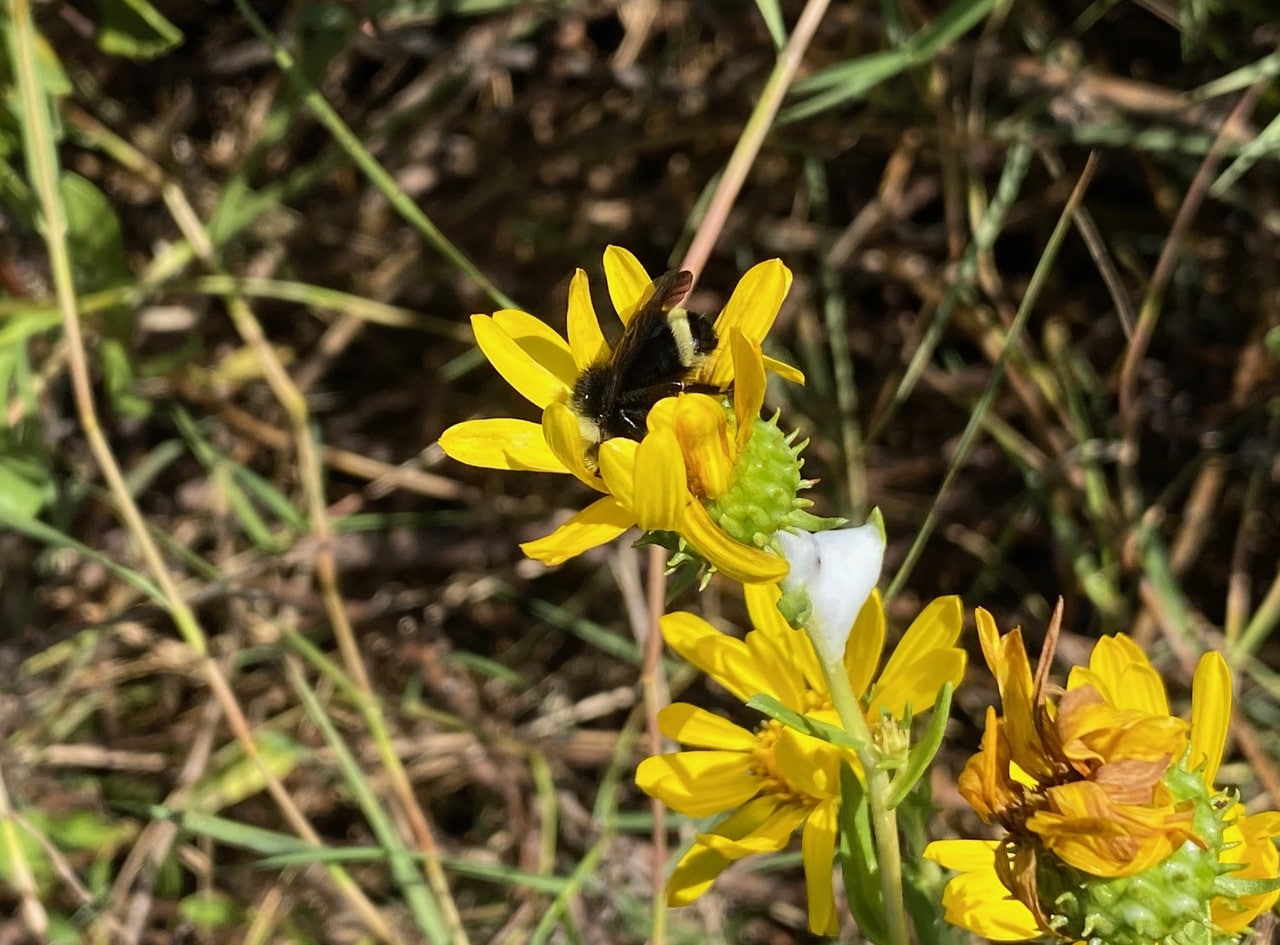
A Yellow-faced Bumble Bee, Bombus vosnesenskii (family Apidae) is asleep on a Grindelia flowerhead.
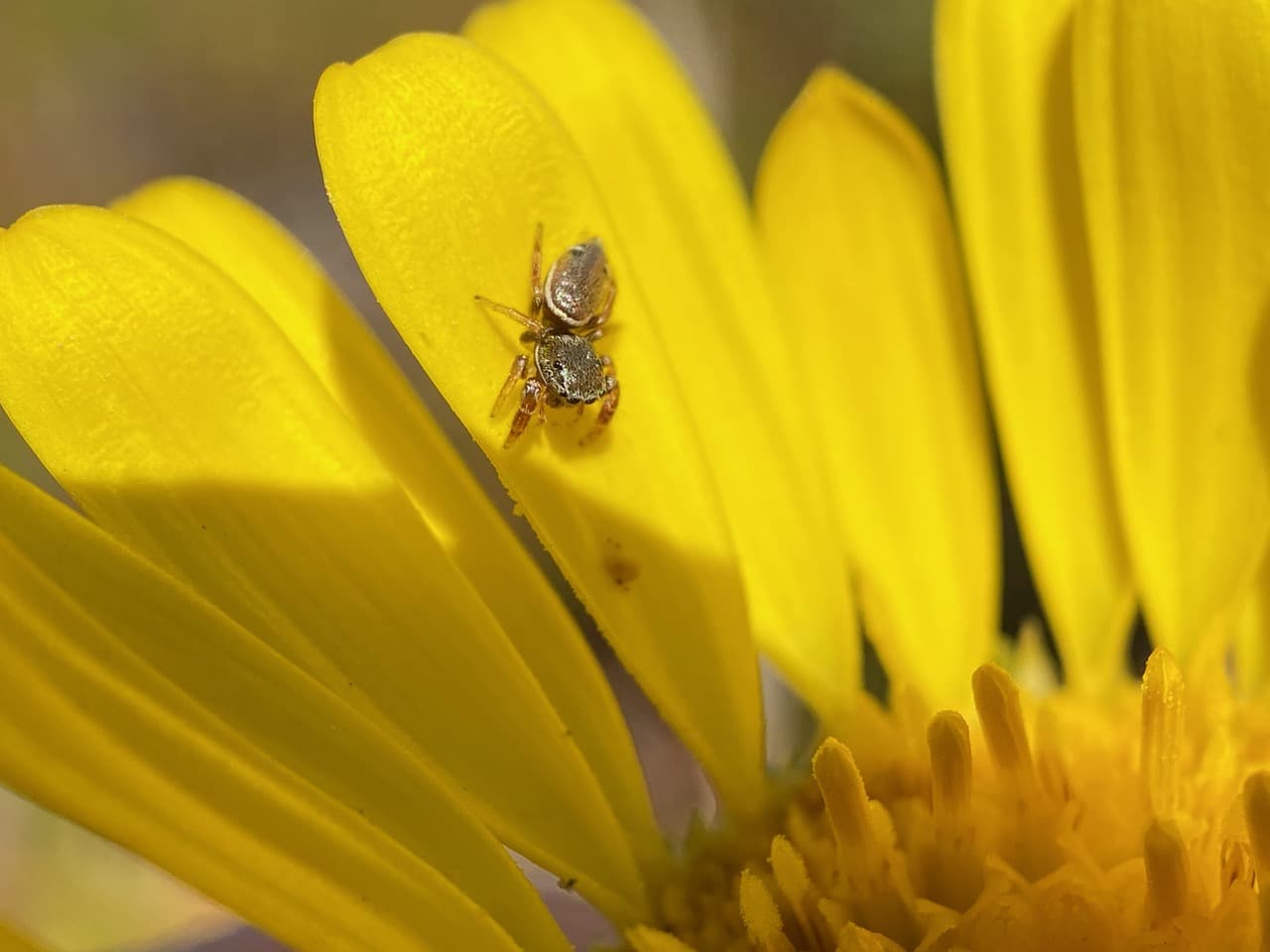
A tiny spider is moving around on the ray petals of a Grindelia flowerhead. It is a beautiful female Grapevine Jumping Spider, Sassacus vitis (family Salticidae).
Salticids are free-roaming hunting spiders. They do not weave a web to catch prey. They stalk, then pounce on their prey. Just before jumping, the spider fastens a safety line to the substrate. It can leap 10-20 times their body length to capture prey. Their movement is achieved by rapid changes in hydraulic pressure of the blood. Muscular contractions force fluids into the hind legs, which cause them to extend extremely quickly. Jumping spiders are visual hunters. Their excellent vision has among the highest acuities in invertebrates. Since all their 8 eyes are fixed in place and cannot pivot independently from the body like human eyes can, jumping spiders must turn to face whatever they want to see well. This includes moving their cephalothorax up and down, an endearing behavior.
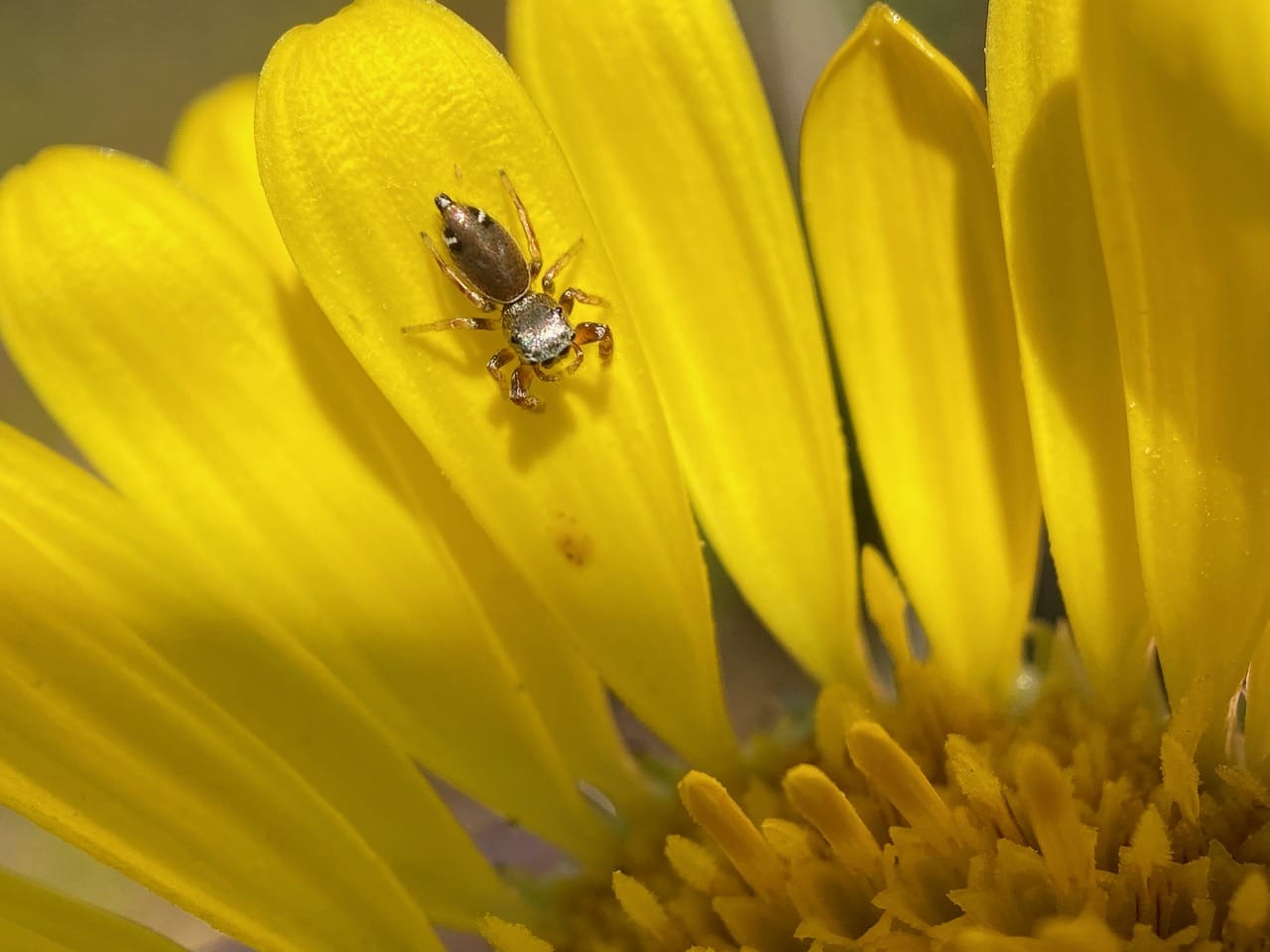
Sassacus vitis is native to North America, with a range spanning from Canada to Panama. It is a small jumping spider with iridescent gold abdomen and white ring around the anterior surface of abdomen. Body is covered with golden scales. Males are 3.5 mm long, females 4.5 mm. The name vitis is Latin for “grapevine”. The spider is commonly found on shrubs and vines and in fields. Best known as a common resident of vineyards.
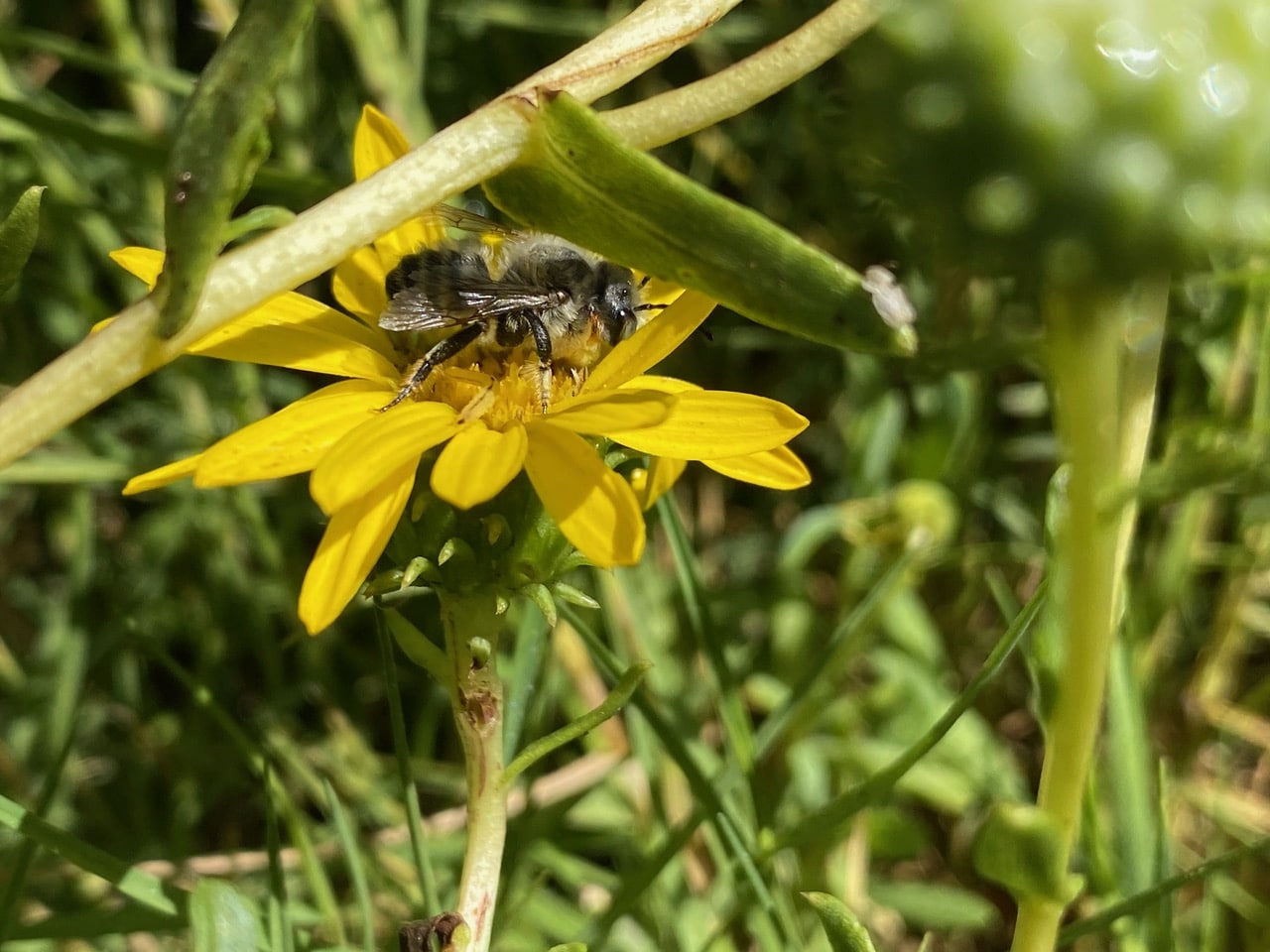
A male Western Leafcutter Bee, Megachile perihirta (family Megachilidae) checks on many Grindelia flowerheads before settling down on this one among the tangles of vegetation. He seems to be getting ready for a nap.
Leaf-cutter Bees (family Megachilidae) are stout-bodied, usually with pale hair on the thorax and stripes of white hairs on the abdomen. Females usually have a triangular abdomen with a pointed tip, and males’ faces are covered with dense, pale hair. Flight season is from May into September, with peak activity from June to August.
Solitary females construct nests in tubular cavities, including hollow stems, tree holes, and abandoned beetle burrows in wood. Many use holes drilled into wood, straws, or other manufactured tunnels. Females cut pieces from leaves or flower petals for use in the construction of brood cells. Most Megachile females are generalists when foraging for pollen. Pollen is transported in dense scopae on the underside of the abdomen.
Photos of Western Leafcutter Bee (Megachile perihirta) · iNaturalist
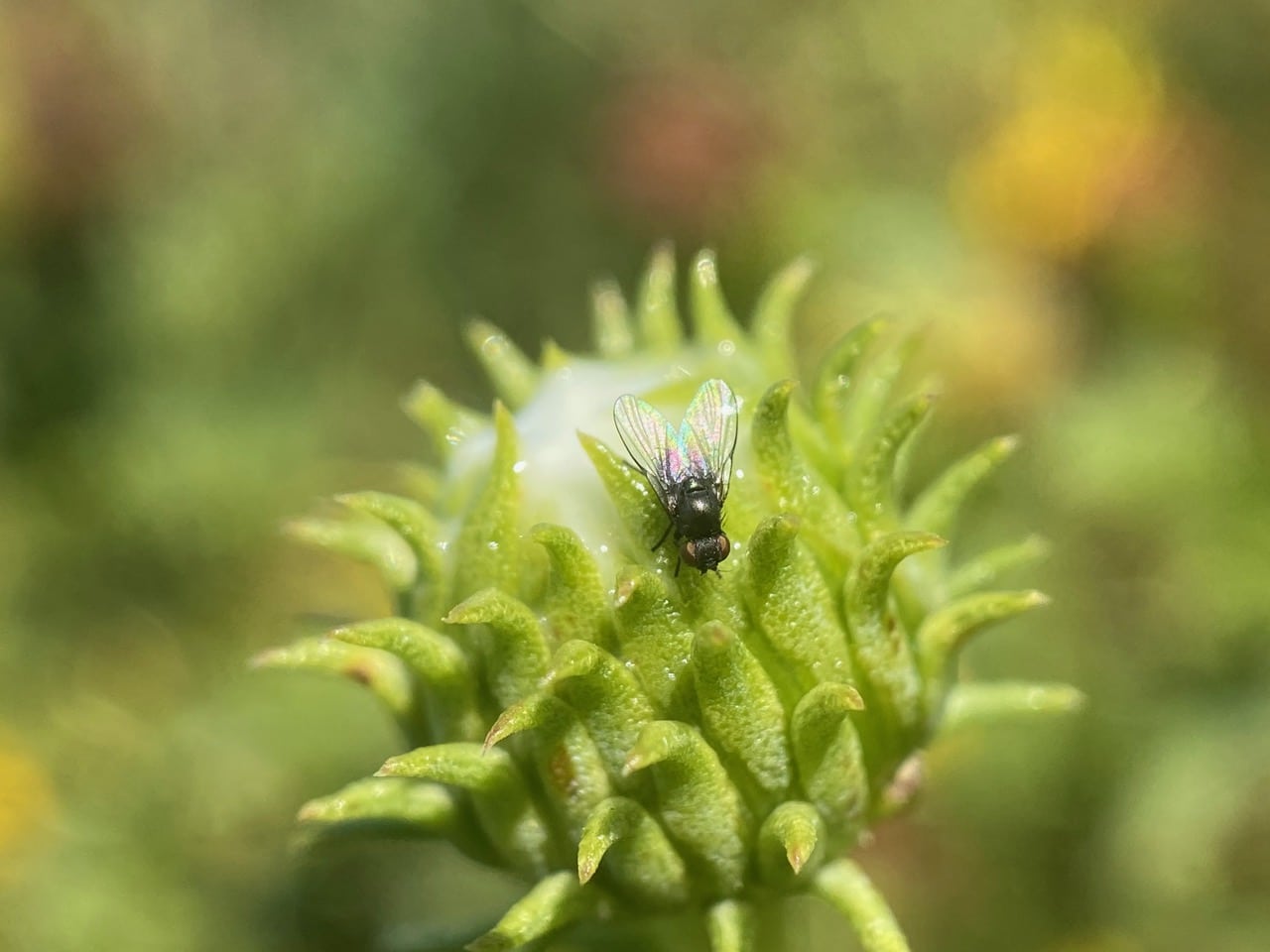
Barely a speck to the naked eye, a tiny fly is perched on an immature Grindelia flowerhead. Is it a Leaf-miner Fly in the genus Ophiomyia (family Agromyzidae)?
The Agromyzidae are a family commonly referred to as the Leaf-miner Flies, for the feeding habits of their larvae, most of which are leaf miners on various plants. They are small flies, most species in the range of 2-3 mm. Agromyzidae larvae are phytophagous, feeding as leaf miners, less frequently as stem miners or stem borers. A few live on developing seeds, or produce galls. There is a high degree of host specificity. A number of species attack plants of agricultural or ornamental value, so are considered pests. The shape of the mine is often characteristic of the species and therefore useful for identification. Adults occur in a variety of habitats, depending on the larval host plants.

A Small Carpenter Bee, Ceratina sp. (family Apidae) is foraging on a Grindelia flowerhead.
The Small Carpenter Bee genus Ceratina is closely related to the more familiar, and much larger Carpenter Bees (genus Xylocopa). Ceratina are typically dark, shiny, even metallic bees, with fairly sparse body hairs and a weak scopa on the hind leg. The shield-shaped abdomen comes to a point at the tip. Some species have yellow markings, often on the face.
Females excavate nests with their mandibles in the pith of broken or burned plant twigs and stems. While many species are solitary, a number are subsocial. Both male and female carpenter bees overwinter as adults within their old nest tunnels, emerging in the spring to mate. In the spring, this resting place (hibernaculum) is modified into a brood nest by further excavation. The female collects pollen and nectar, places this mixture (called bee bread) inside the cavity, lays an egg on the provision, and then caps off the cell with chewed plant material. Several cells are constructed end to end in each plant stem.

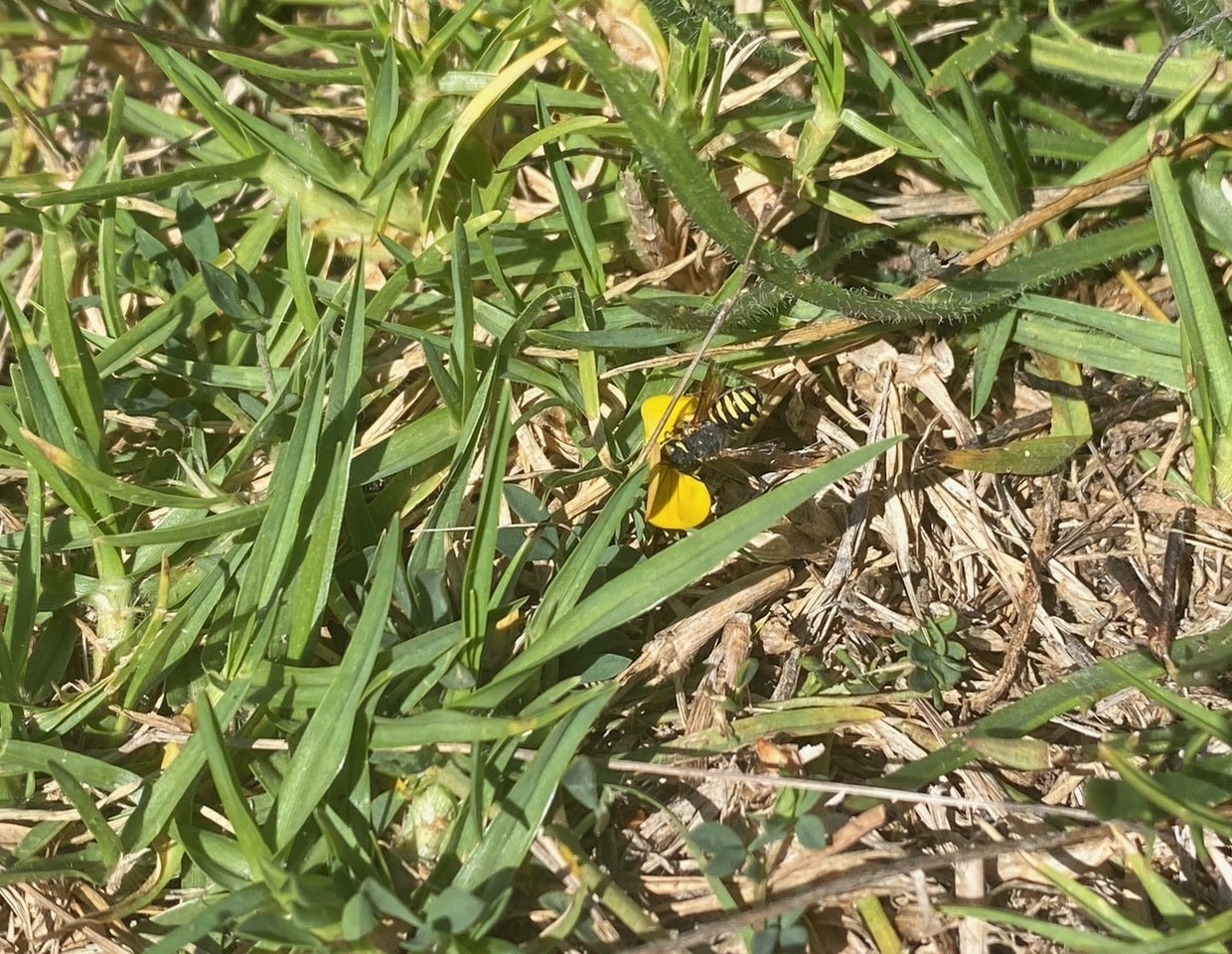
Most of extensive ground-cover of the Bird’s-foot Trefoil, Lotus tenuis have naturally died back. The flowers are much loved by the European Woolcarder Bees, Anthidium manicatum (family Megachilidae). I sadly watch as an individual keeps coming back to sip nectar from a single available flower. There is another flower species these bees resort to at this dire time of the year – the Bristly Oxtongue. I never see these small bees visit the Grindelia that is still abundant and in bloom here.
Anthidium manicatum, commonly called the European Woolcarder Bee, is a species in the family Megachilidae, which includes the leaf-cutter bees and mason bees. They get the name “carder” from the behavior of the females scraping hair from leaves and stems of wooly plants. The substantially larger males engage in territorial behavior, aggressively chasing other males and pollinators from their territory. They mate with the females that forage in their territory. The females construct their nests in pre-existing cavities, using the hairs of wooly plants that they collect with their sharply toothed mandibles. They then roll up the fibers into a ball and transport them to the nest to line the nest cell, where they lay an egg and a provisioning mass consisting of nectar and pollen. Females largely use the hairs of plants in the mint family, Lamiaceae, especially those of genus Stachys and Betonica. The European Woolcarder Bees visit a wide range of flowers, with a preference for blue flowers that have long throats. They are considered generalists. Females carry pollen in the scopa on the underside of their abdomen. Both males and females can hover in midair near flowers similar to the hover flies (family Syrphidae).
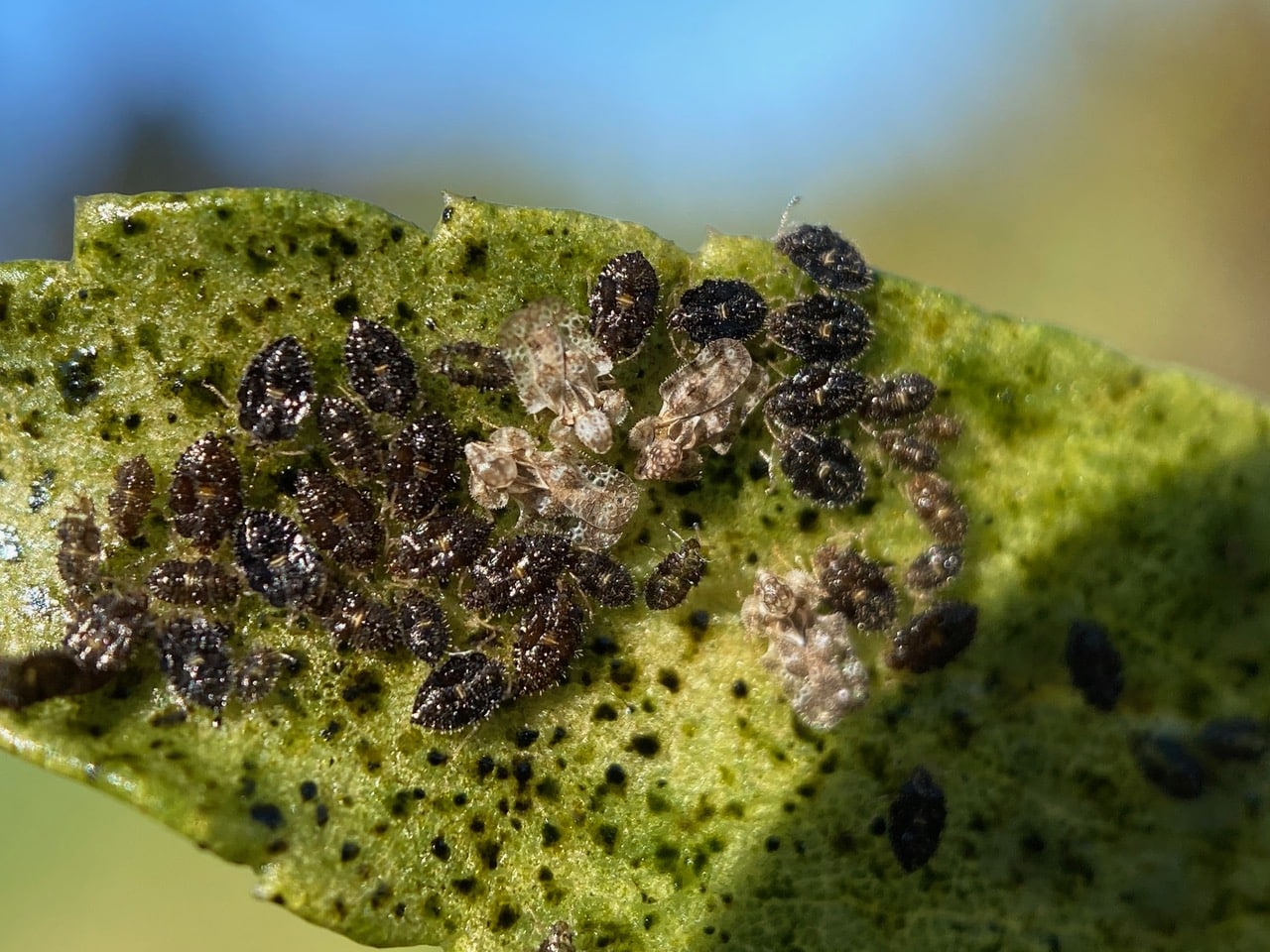
I found huge numbers of Lace Bugs, Corythucha sp.(family Tingidae), both adults and nymphs, on some sad looking Grindelia. The infected plants look sick, turn brown, and are covered with tiny spots of sooty mold growing on the puncture wounds inflicted by the sucking insects.
The Tingidae are a family of very small (2-10 mm) insects in the order Hemiptera that are commonly referred to as lace bugs. They are called lace bugs because the pronotum and fore wings of the adult have a delicate and intricate network of divided areas that resemble lace. Their body is flattened dorsoventrally, and the head is often concealed under the hood-like pronotum. Tingids are usually host-specific and can be very destructive to plants. Most feed on the underside of leaves by piercing the epidermis and sucking the sap. The resulting empty cells give the leaves a bronzed or silvery appearance. Each individual usually completes its entire lifecycle on the same plant, if not the same part of the plant.
The genus Corythucha is primarily distributed in the northern hemisphere, including Europe, North America and eastern Asia.

Is the white individual a teneral? Most of the black “nymphs” are actually exuviae that have been shed during molting as the nymphs go through their growth and development.

Side view of the bizarrely beautiful insects. The tiny bugs have a large “hood” over their head.
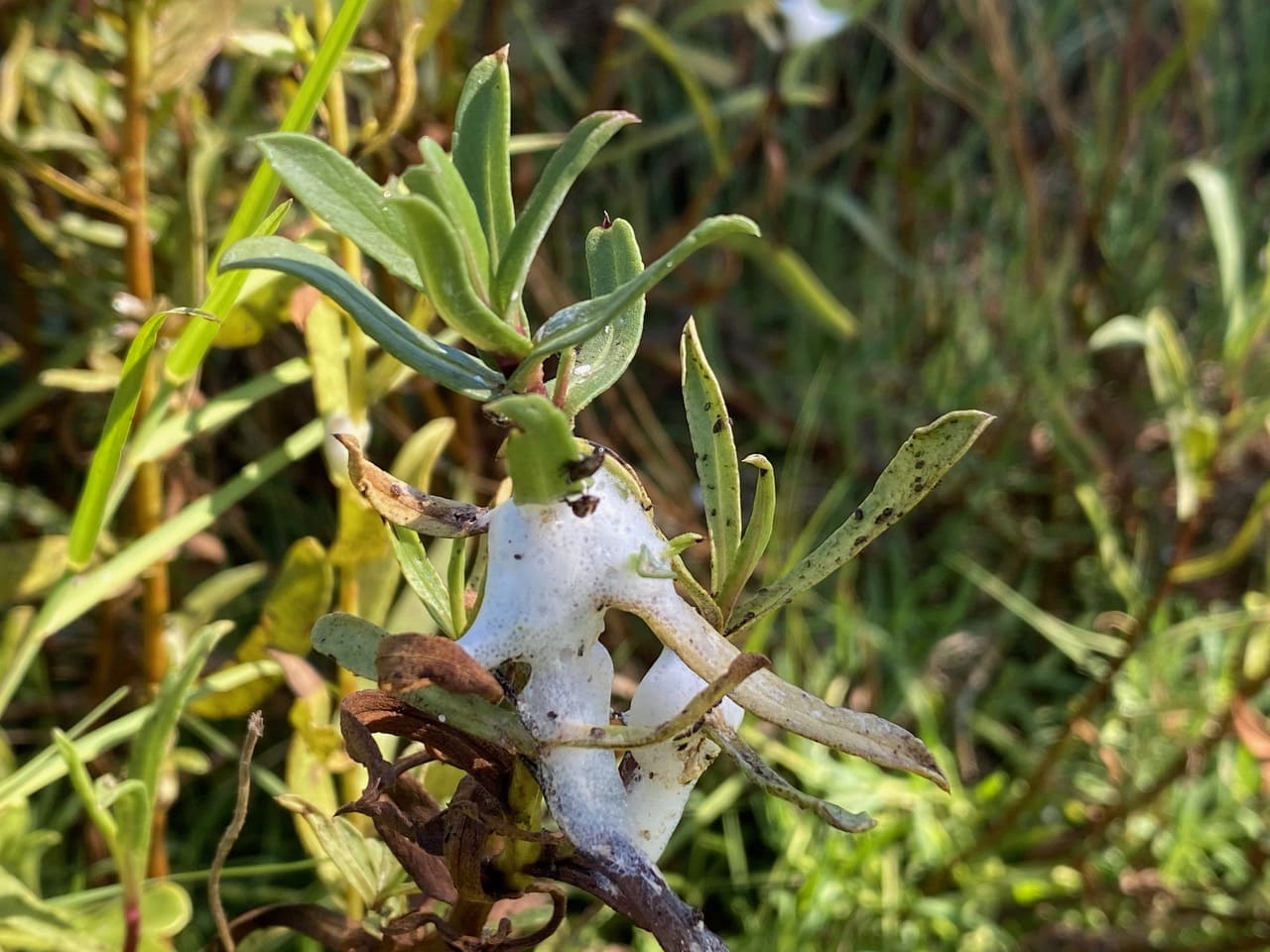
This poor Grindelia is infested with both Spittlebugs and Lace Bugs.

A dark brown adult Spittlebug or Froghopper, Complex Clastoptera lineatocollis (family Clastopteridae) is hiding in a leaf axil under a foam mass.
The Froghoppers (superfamily Cercopoidea) are a group of “true bugs” in the order Hemiptera. Adults are capable of jumping many times their height and length, giving them their common name, but many species are best known for their plant-sucking nymphs which produce foam shelters, and are referred to as “spittlebugs”. The superfamily currently consists of three families: the Aphrophoridae, Cercopidae, and Clastopteridae. The nymphs produce a cover of foamed-up plant sap visually resembling saliva, hence the common name. Whereas most insects that feed on plant sap tap into the nutrient-rich fluid from the phloem, the spittlebugs utilize the much more dilute sap flowing upward from the roots via the xylem. The insects’ digestive system contains symbiotic bacteria that provide them with the essential amino acids. The large amount of excess water that must be excreted and the evolution of special breathing tubes allow the young spittlebug nymphs to grow in the relatively protective environment of their foam shelters. The foam serves a number of purposes. It hides the nymph from the view of predators and parasites, and it insulates against heat and cold, providing thermal as well as moisture control. It also has an acrid taste that deters predators.
Froghoppers are champion jumpers among insects, out-performing even the fleas. The bug can leap the human equivalent of a skyscraper without a running start. It is the highest jumping insect proportional to body size. The muscles in its hind legs act like a “catapult” to release energy explosively.
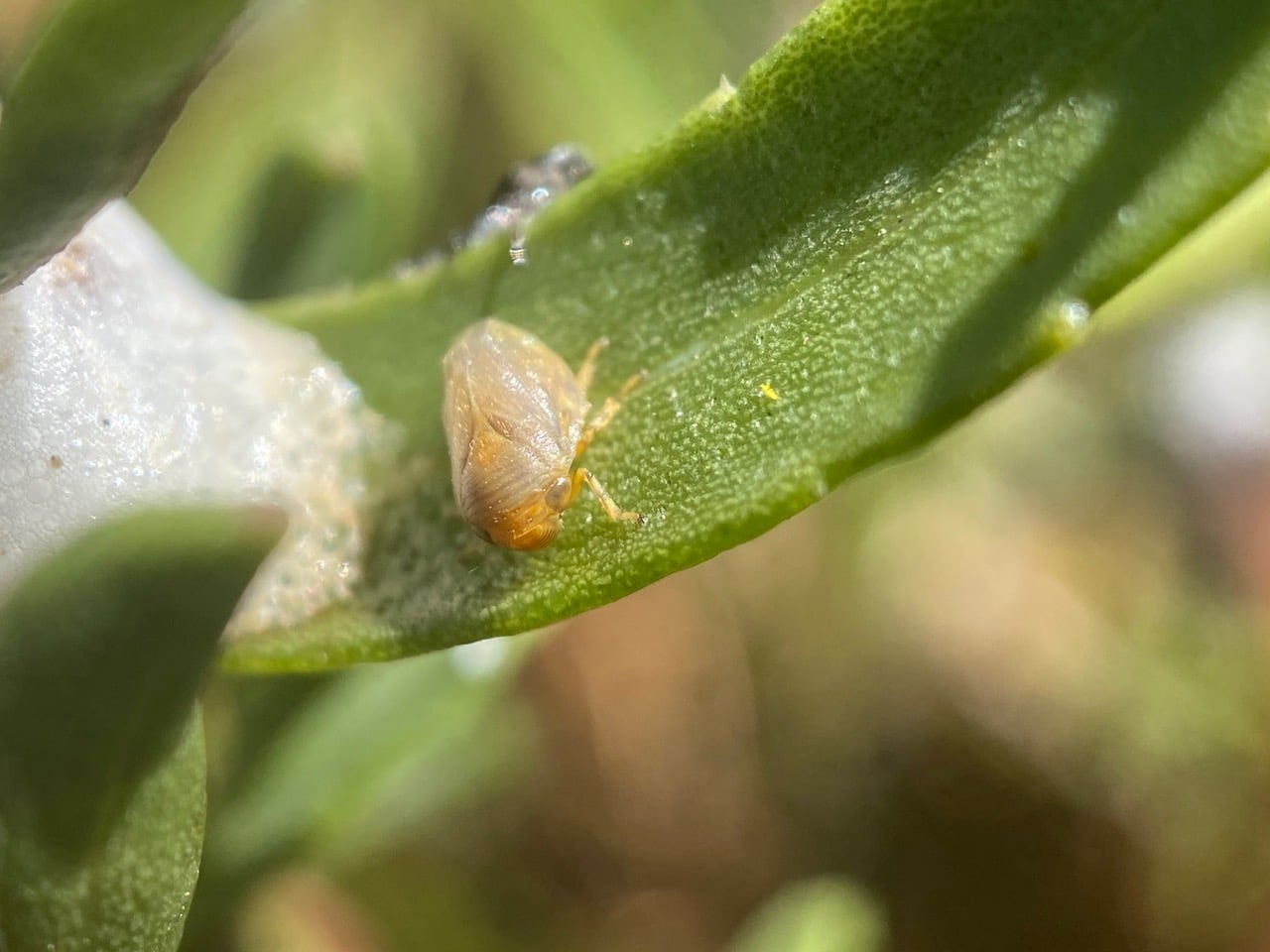
A teneral Spittlebug is resting next to its foam shelter. A teneral insect is one that has recently molted and its exoskeleton is yet to harden and get its final coloration. In this state the insect is very vulnerable. The teneral state can last for some time.
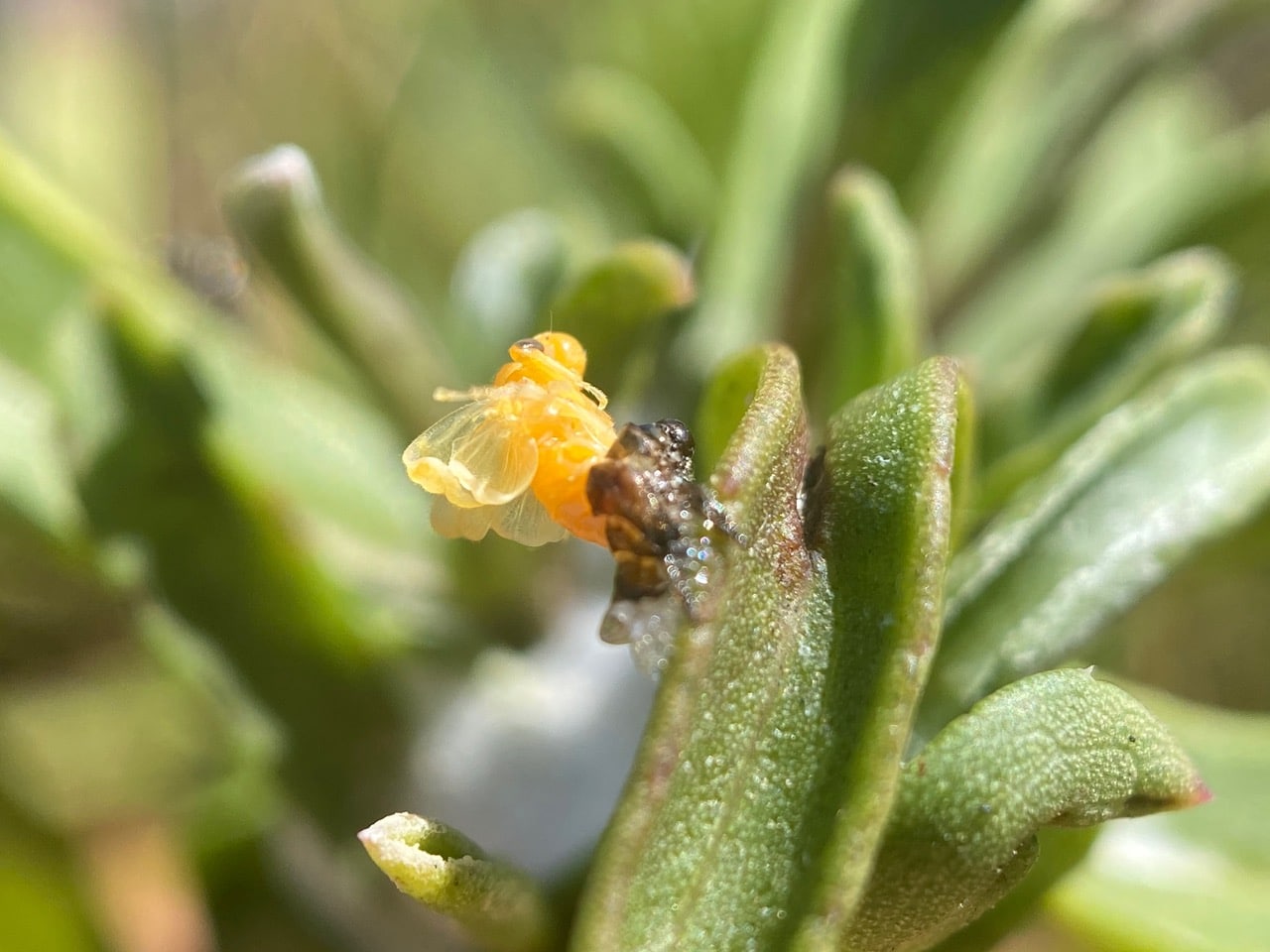
Whoa, eclosure in progress! A Spittlebug is emerging from its exuvia – it is undergoing its final molt into an adult.

Wings unfurling.
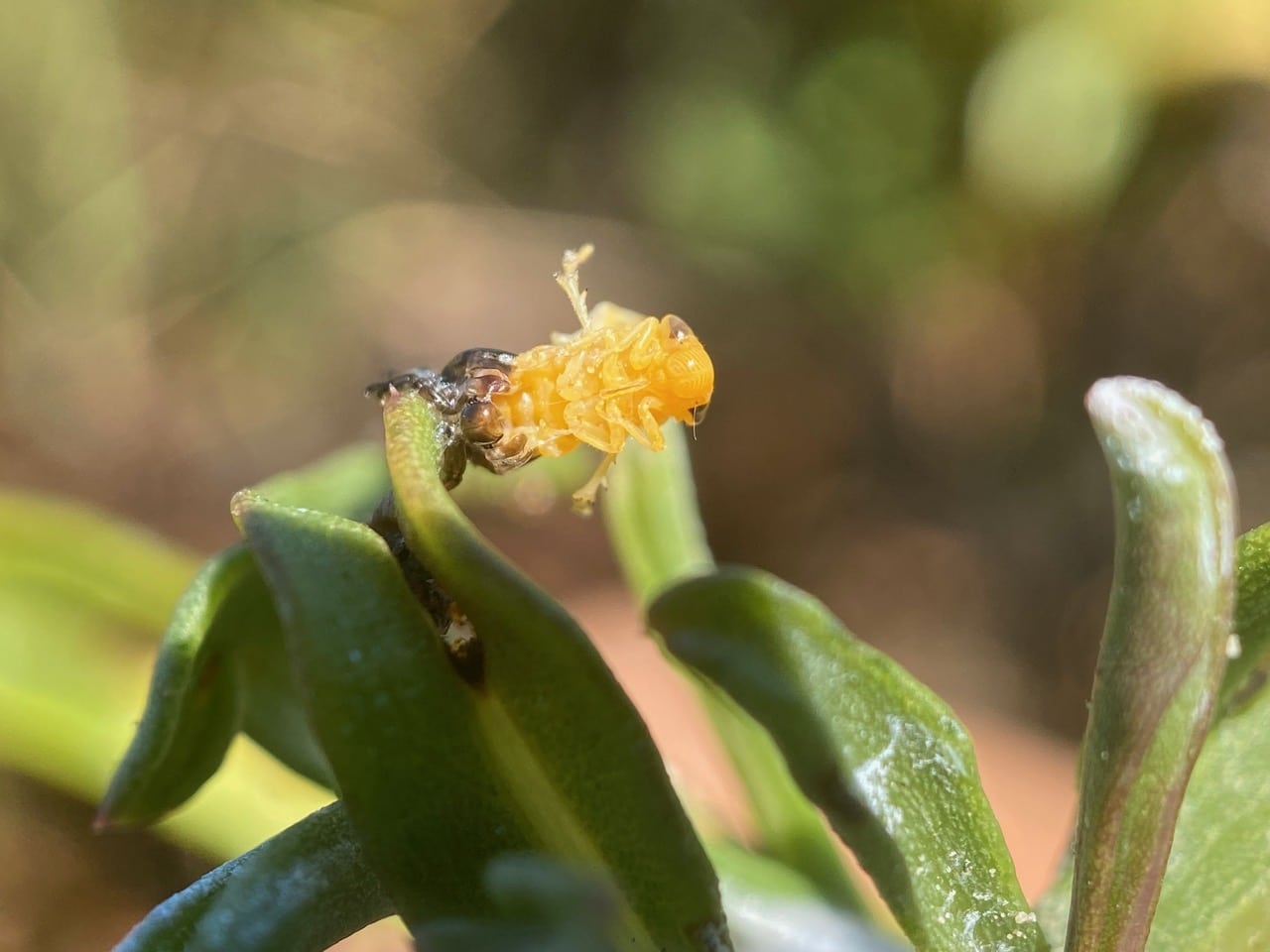
Front view of emerging adult Spittlebug. It has just pulled its hind legs out of the old exoskeleton – Yay! The fresh adult is so pale it is hard to see any details. If you squint hard enough you might see the short rostrum (needle-like mouthparts) folded under the body between its legs.
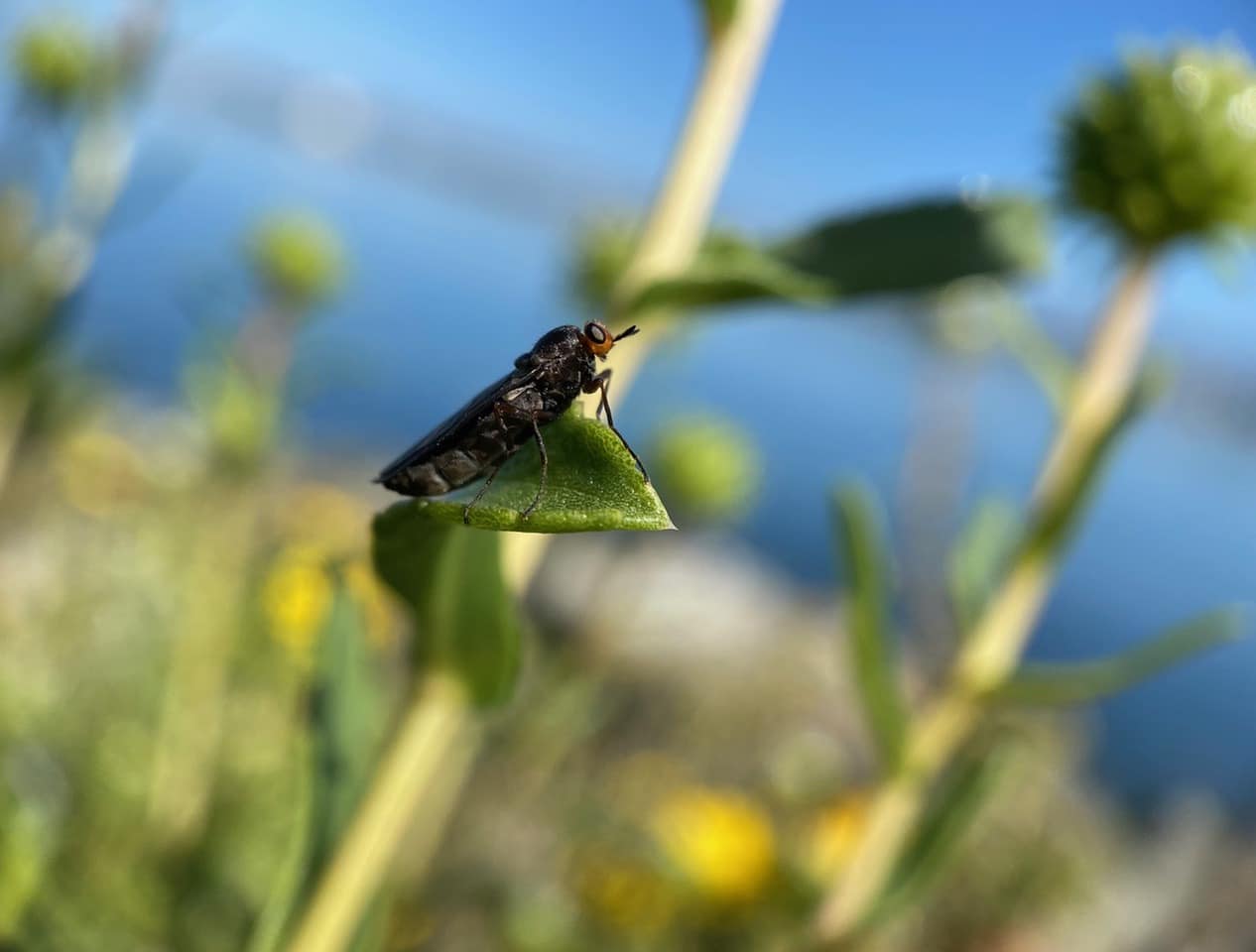
A black fly with tiny red head and black eyes is perched on a Grindelia leaf. iNaturalist has identified it as Sugarcane Soldier Fly (family Stratiomyidae).
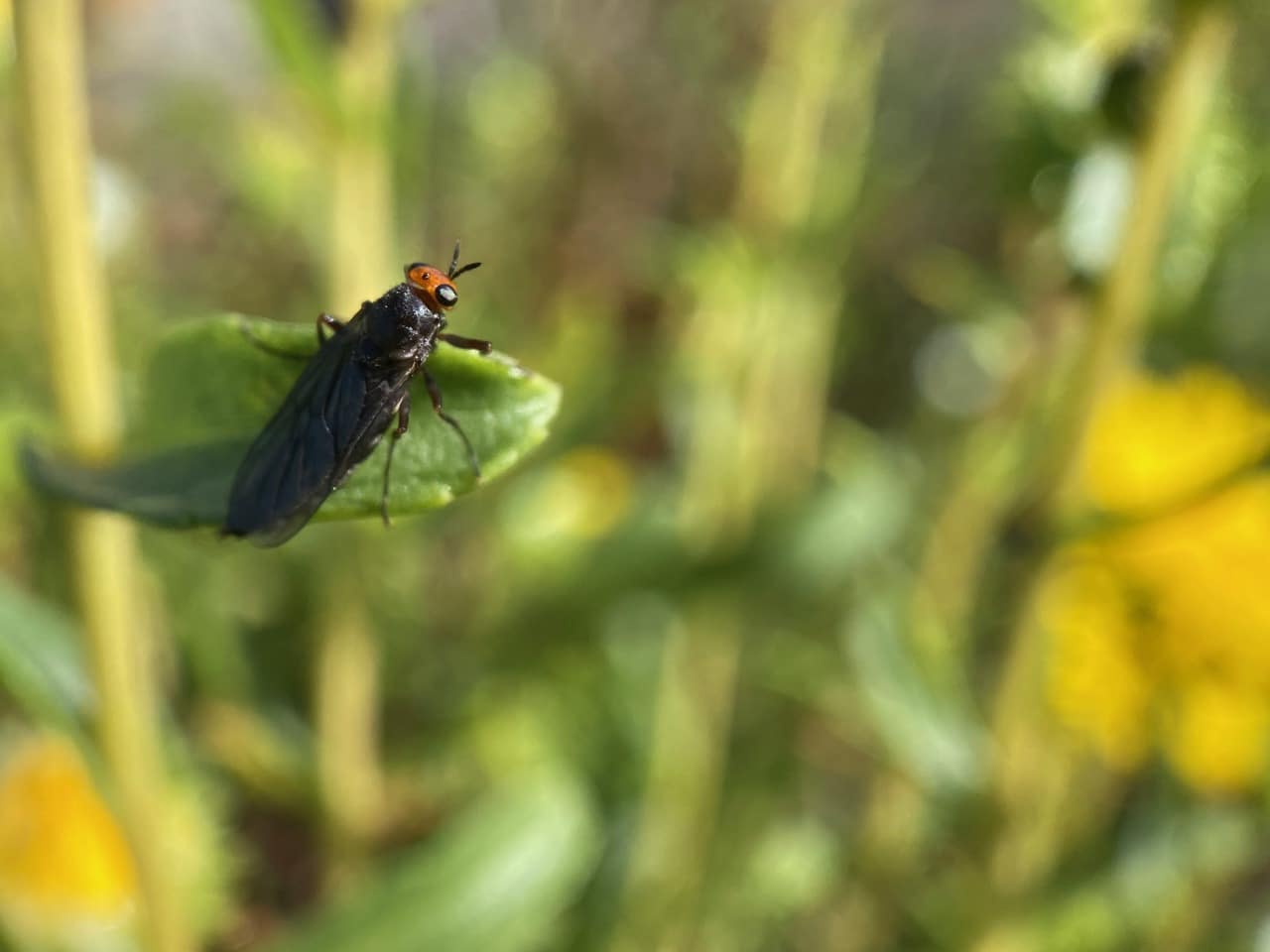
The eyes of the fly are set far apart on the red head. Wow, it doesn’t look remotely like any Soldier Fly I have ever seen!
The Sugarcane Soldier Fly, Inopus rubriceps (family Stratiomyidae) is native to eastern Australia where it infests such crops as corn, pastures, and sugarcane. The fly was accidentally introduced into California over 50 years ago. It is now infesting lawns in San Francisco and other Bay Area counties. Damage to turf and other members of the grass family results from withdrawal of sap from roots of host plants by the larvae and possibly, injection of a toxin into the plant.
In California adults occur in large numbers from late September to early November each year. Eggs are deposited in crevices in the soil. The adults are sexually dimorphic. Females have tiny red heads with eyes set far apart. The smaller males have large eyes that occupy the whole surface of the head.
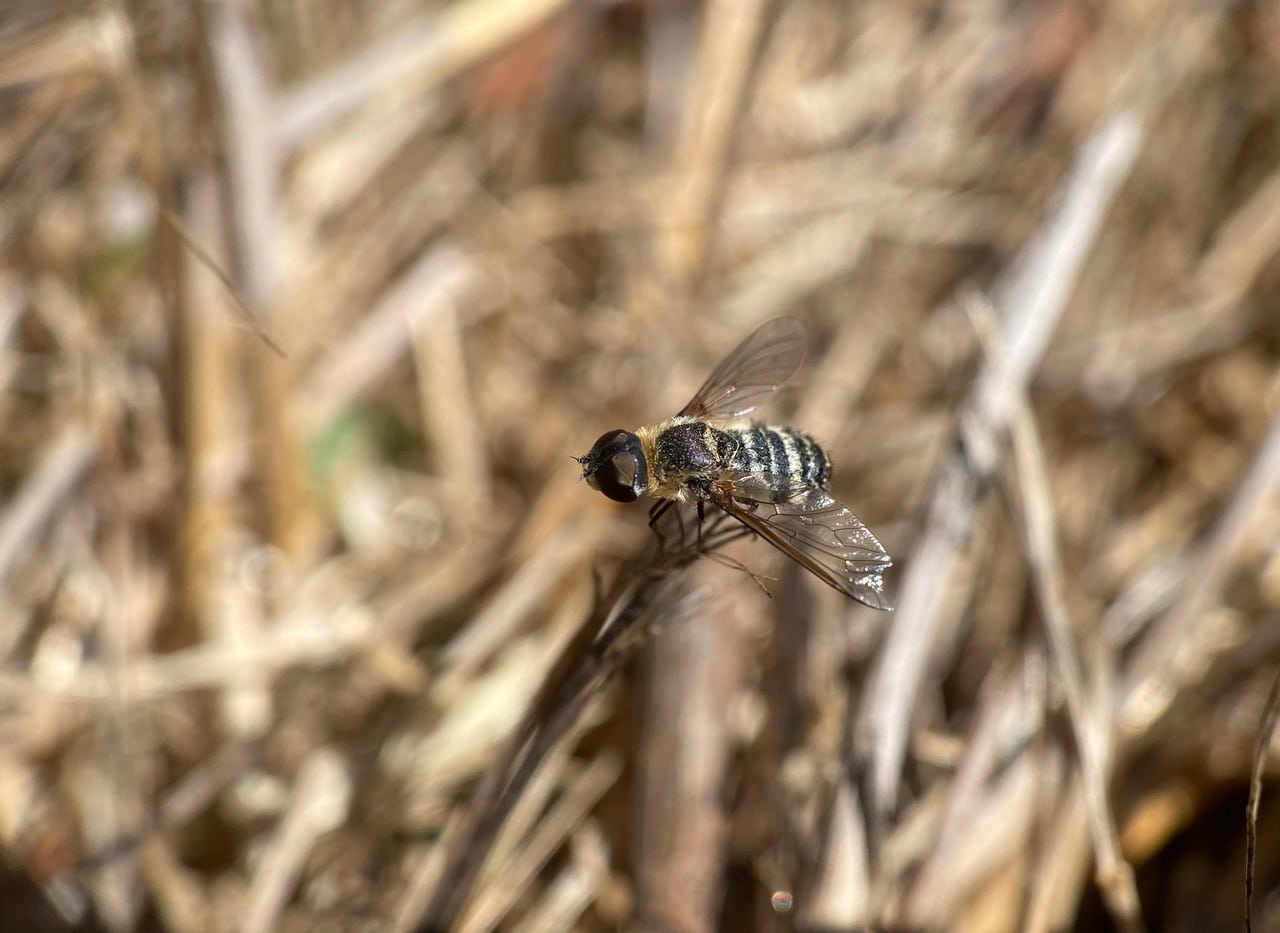 A Bee Fly, Villa sp. (family Bombyliidae) has landed on a twig among the dried grass on the ground.
The Bee Flies belong to the family Bombyliidae. Adults generally visit flowers for nectar and pollen, some being important pollinators. Larvae generally are parasitoids of other insects. When at rest, many species of bee flies hold their wings at a characteristic “swept back” angle. The adult females usually deposit eggs in the vicinity of possible hosts, quite often in the burrows of beetles or ground-nesting bees/wasps. Bombyliidae parasitism is not host-specific, but rather opportunistic, using a variety of hosts. Adult females of the genus Villa lay eggs in mid-air and flick them towards the nest entrances of their hosts. They typically have an eversible pouch near the tip of their abdomen known as a sand chamber, which is filled with sand grains gathered before egg laying. These sand grains are used to coat each egg just before their aerial release, presumably to improve the female’s aim by adding weight.
This Fly Torpedoes a Bindweed Bee’s Nest | Deep Look – YouTube
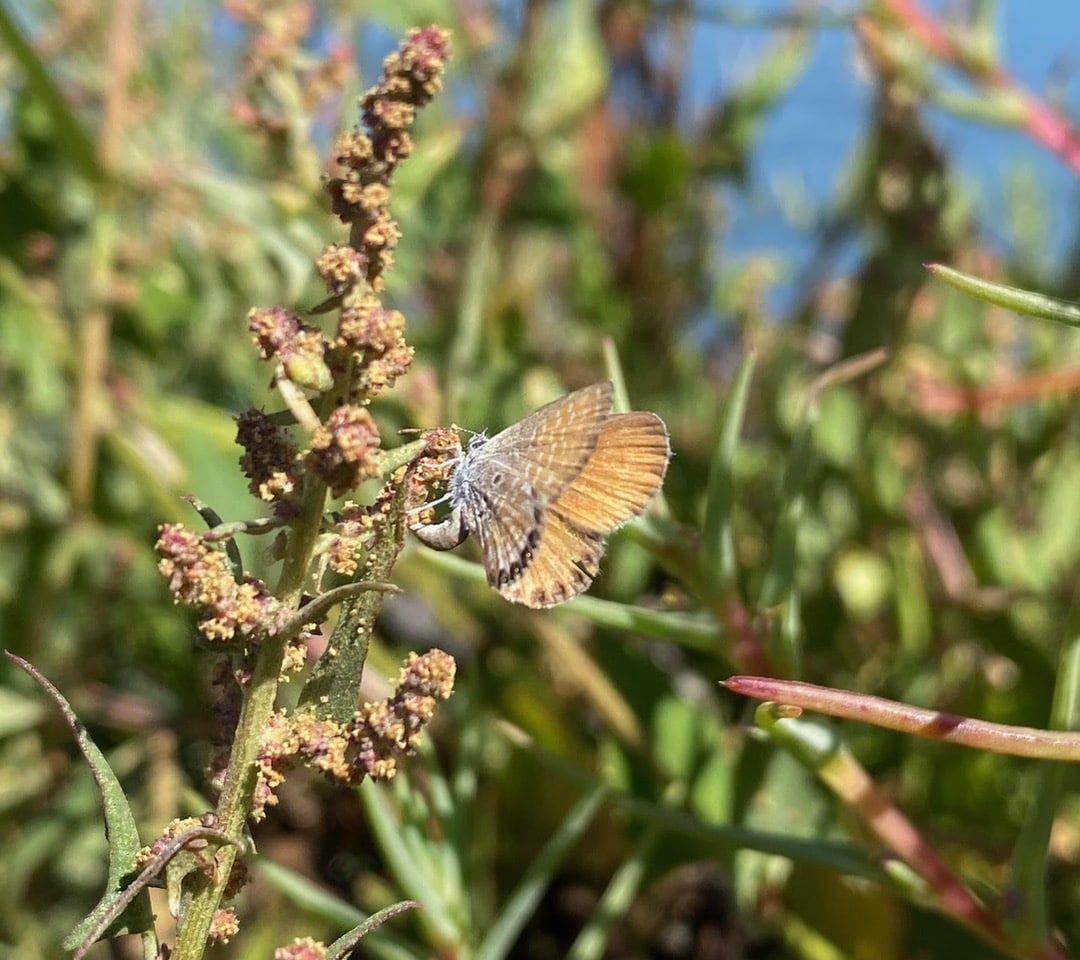
A Western Pygmy Blue, Brephidium exilis (family Lycaenidae) is laying eggs on Creeping Saltbush, Atriplex prostrata (family Chenopodiaceae).
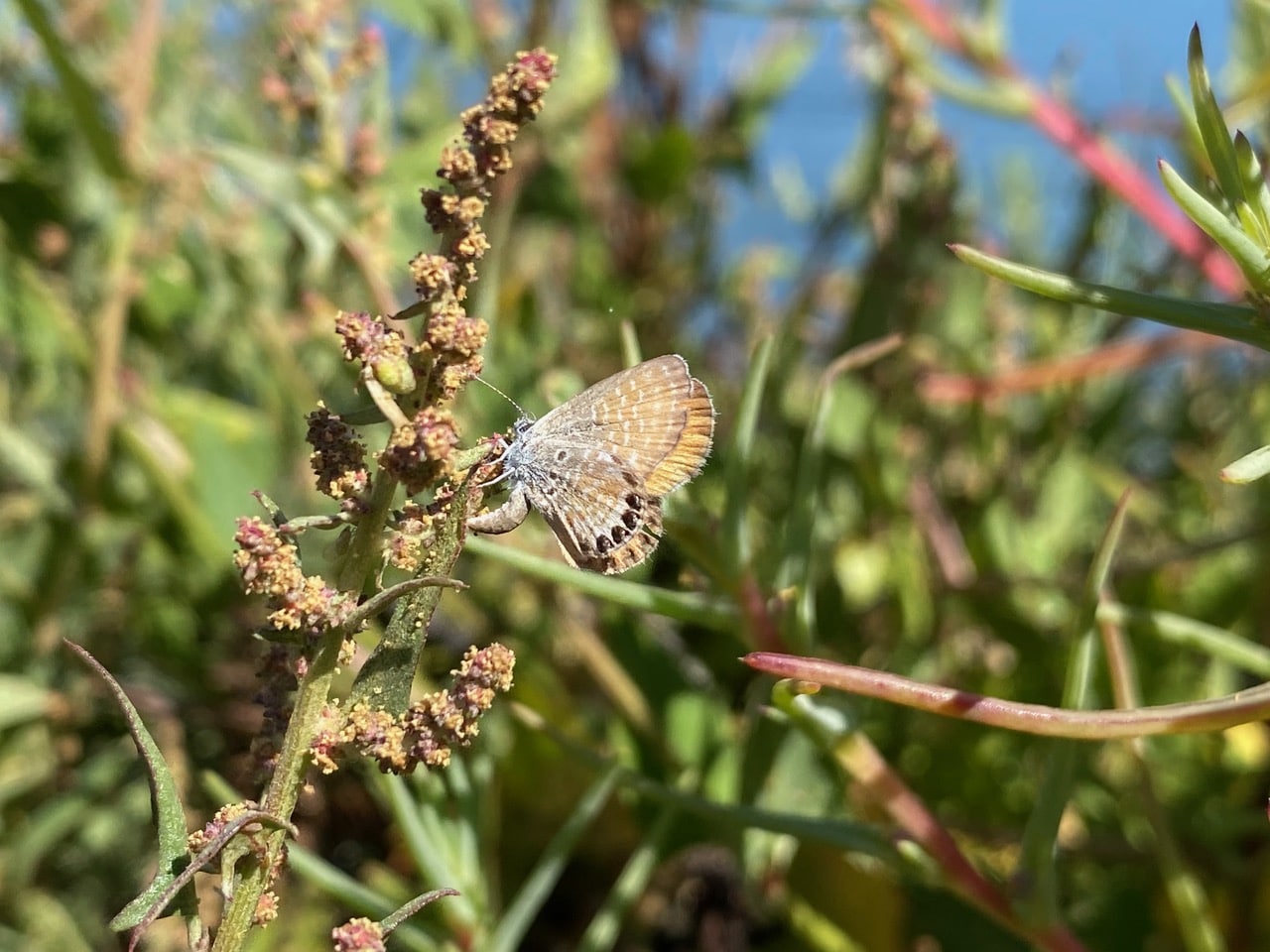
With a wingspan of 12-20 mm, about the size of a thumbnail, the Western Pygmy Blue, Brephidium exilis (family Lycaenidae) is one of the smallest butterflies in the world and the smallest in North America. The butterfly is found in alkaline areas such as deserts and salt marshes. The caterpillars feed on plants in the Goosefoot family Chenopodiaceae, commonly found in salty habitats. Although the species has no set breeding season, mating activity is at its peak during late summer and early fall.
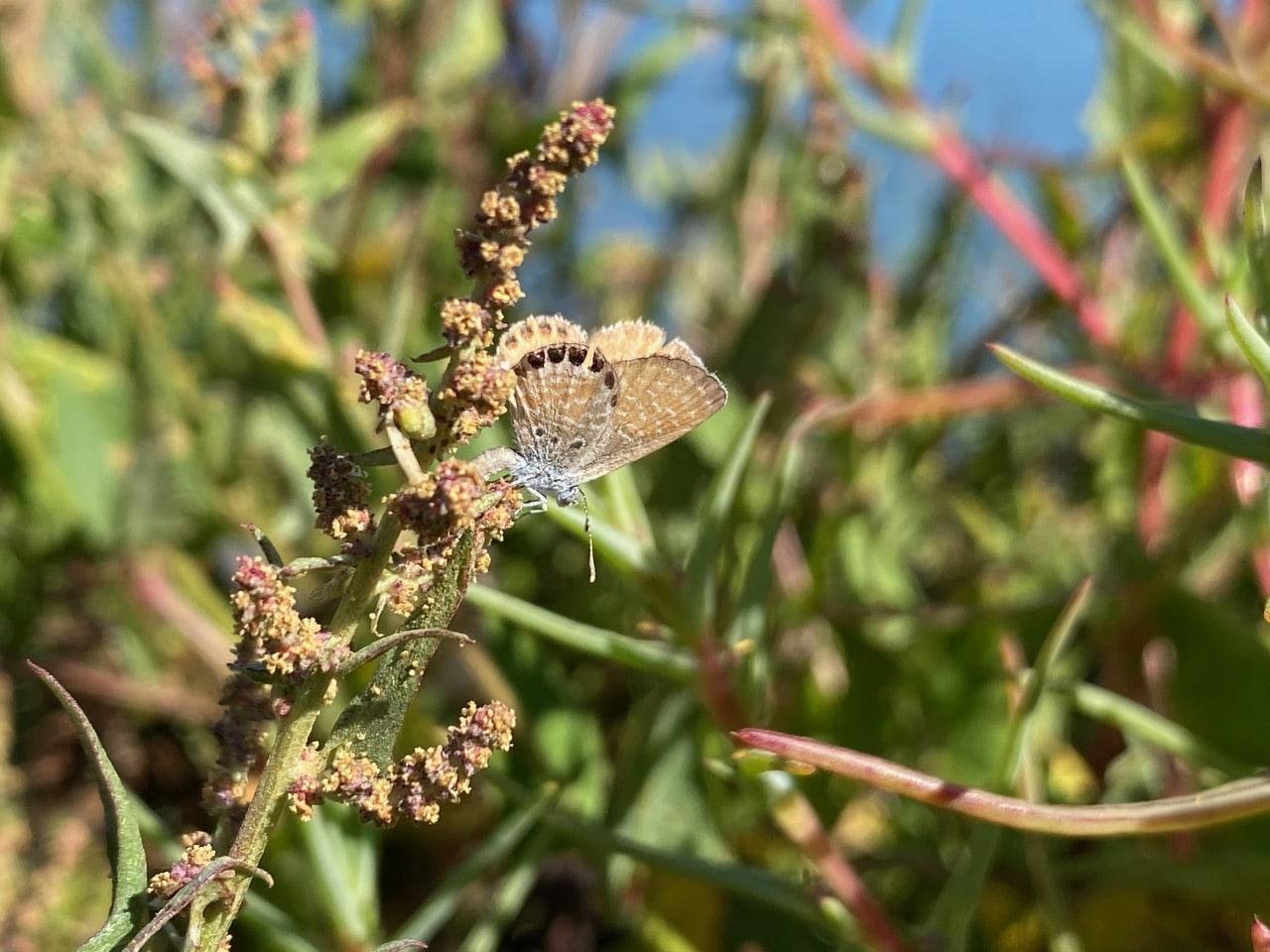

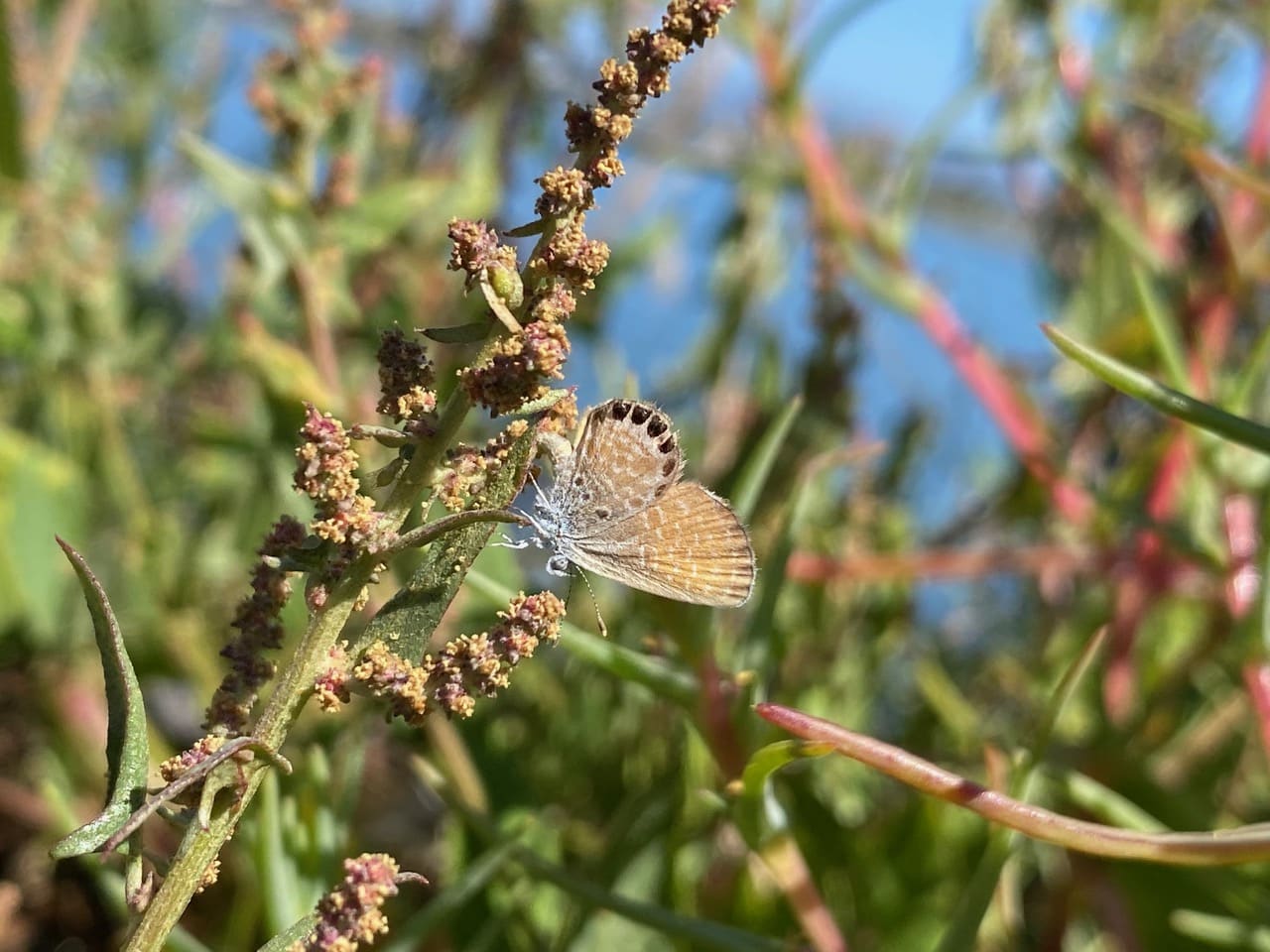

The little butterfly lays her eggs among the clusters of tiny flowers from the top of the spike to the bottom. I am glad to be able to see the underside of her wings.

Bravo, mama butterfly! That performance made my day!